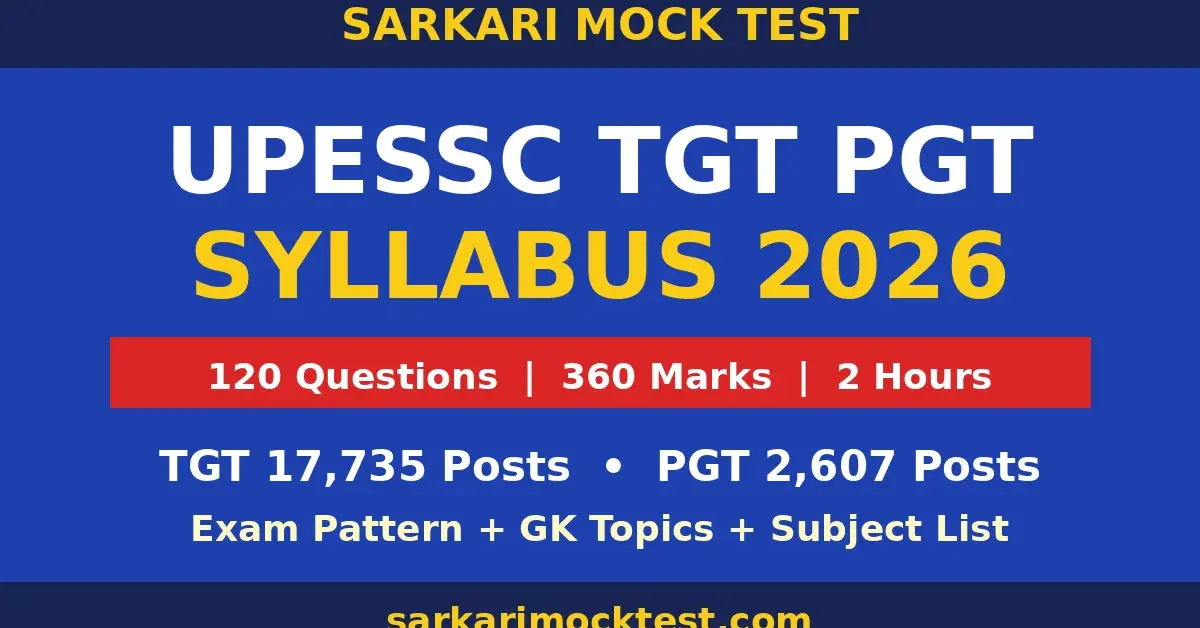
The UPESSC TGT PGT Syllabus 2026 is the revised syllabus for two teacher exams of the Uttar Pradesh Education Service Selection Commission. The TGT exam is for 17,735 Assistant Teacher posts under advertisement number 07/2026. The PGT exam is for 2,607 Lecturer posts under advertisement number 06/2026. Both written exams have 120 objective questions for 360 marks in 2 hours. Part 1 has 30 General Knowledge questions. Part 2 has 90 questions from your subject. Each correct answer gives 3 marks. A wrong answer or more than one answer cuts 1 mark. The PGT exam dates are 15 and 16 December 2026. The TGT exam dates are 23 and 24 December 2026.
This page gives the full syllabus in one place. It gives the exam pattern, the General Knowledge topics, the subject list, the dates, the fee, the age rule, the qualification rule and the merit rule. Read the tables first. Then open the official syllabus PDF for your subject and start your study plan from that PDF.
Two exams are covered here. TGT means Trained Graduate Teacher. In this advertisement the post name is Assistant Teacher with graduate pay scale. PGT means Post Graduate Teacher. In this advertisement the post name is Lecturer. Both exams fill teacher posts in non government aided secondary schools of Uttar Pradesh. The schools include boys schools and girls schools.
What is the UPESSC TGT PGT Syllabus 2026 in short?
The short answer is simple. There is one common General Knowledge part for both exams. There is one subject part for your own subject. The subject part carries more marks, so your subject study matters most. Still, the General Knowledge part has 90 marks. Those 90 marks can change your rank. Give time to both parts every day.
| Point | TGT 2026 | PGT 2026 |
|---|---|---|
| Conducting body | Uttar Pradesh Education Service Selection Commission | Uttar Pradesh Education Service Selection Commission |
| Advertisement number | 07/2026 | 06/2026 |
| Advertisement date | 23 October 2026 | 15 September 2026 |
| Post name | Assistant Teacher, graduate pay scale | Lecturer |
| Total posts | 17,735 | 2,607 |
| Posts in boys schools | 16,193 | 2,329 |
| Posts in girls schools | 1,542 | 278 |
| Written exam questions | 120 | 120 |
| Written exam marks | 360 | 360 |
| Written exam time | 2 hours | 2 hours |
| Exam dates | 23 and 24 December 2026 | 15 and 16 December 2026 |
| Interview | No interview | Interview of 40 marks |
| Final merit base | Written exam marks out of 360 | Written 360 marks plus interview 40 marks |
The syllabus is marked as effective for upcoming examinations from 2026. That means old notes from past cycles may not match the new paper. Use the revised subject PDF. Use the common General Knowledge PDF. Keep both PDFs saved on your phone and on your computer.
What are the important dates for UP TGT PGT 2026?
The PGT form dates are over. The TGT form dates were revised by an official notice dated 21 November 2026. The revised TGT last date is 28 November 2026. The revised TGT correction last date is 30 November 2026. If you are a TGT candidate and your form is still not complete, finish it before the last date. Do not wait for the last day.
| Event | TGT 2026 | PGT 2026 |
|---|---|---|
| Advertisement published | 23 October 2026 | 15 September 2026 |
| Online application start | 24 October 2026 | 18 September 2026 |
| Fee deposit last date | 28 November 2026 | 17 October 2026 |
| Correction last date | 30 November 2026 | 21 October 2026 |
| Written exam dates | 23 and 24 December 2026 | 15 and 16 December 2026 |
| Admit card | Not announced as of 25 November 2026 | Not announced as of 25 November 2026 |
| Result | Not announced as of 25 November 2026 | Not announced as of 25 November 2026 |
The exam dates are already given in the advertisements. PGT candidates get less time now. TGT candidates get a few more days. Make your plan from today. Count the days left. Divide your subject topics by those days. Keep the last three days only for revision and mock tests.
How many posts are there in UP TGT PGT 2026?
TGT has 17,735 posts. PGT has 2,607 posts. The total of both exams is 20,342 posts. TGT has many more posts. PGT has fewer posts but it also has an interview stage. Your subject decides your real competition. A subject with fewer posts can still be tough. Do not judge the exam only by the total posts.
| Exam | Boys schools | Girls schools | Total posts |
|---|---|---|---|
| TGT Assistant Teacher | 16,193 | 1,542 | 17,735 |
| PGT Lecturer | 2,329 | 278 | 2,607 |
| Both exams together | 18,522 | 1,820 | 20,342 |
The vacancy tables list 17 TGT subjects and 26 PGT subjects. The syllabus lists have a few more entries. The TGT syllabus list also has Bangla and Persian. The PGT syllabus list also has Animal Husbandry and Dairy Science. Always check your subject in the advertisement vacancy table first. Then check the same subject in the syllabus list.
What is the application fee for UP TGT PGT 2026?
The fee is different for TGT and PGT. The fee is also different by category. The table below gives the fee values from the official fee tables. Keep your fee receipt safe. Keep a print of your form safe. You may need both at later stages.
| Category | TGT fee | PGT fee |
|---|---|---|
| General, Unreserved, OBC, EWS and others | Rs 1,000 | Rs 1,500 |
| SC and ST | Rs 500 | Rs 750 |
| Divyangjan | Rs 300 | Rs 500 |
Pay the fee only through the official application process. Do not pay money to any person who promises a form, a seat or a result. The Commission does not sell seats. Your marks decide your place in the merit list.
What is the age limit and pay for UP TGT PGT 2026?
The minimum age is 21 years on 1 July 2026 for both exams. The advertisements also mention the superannuation age of 62 years. Superannuation means the age of retirement from service. Read the age rule in your advertisement with care. Age rules can differ by category in government service. The advertisement is the final word for your case.
| Point | TGT 2026 | PGT 2026 |
|---|---|---|
| Minimum age | 21 years on 1 July 2026 | 21 years on 1 July 2026 |
| Superannuation age mentioned | 62 years | 62 years |
| Pay level | Level 7 | Level 8 |
| Pay range | Rs 44,900 to Rs 1,42,400 | Rs 47,600 to Rs 1,51,100 |
Pay is good for both posts. PGT pay is higher because the post needs a postgraduate degree. Pay alone should not decide your preparation. Your subject strength should decide your effort. A strong subject base gives you marks in the biggest part of the paper.
What qualification do you need for UP TGT 2026?
For TGT, you need a bachelor degree from a recognised university in India with the concerned subject. You need at least 50 percent marks at graduation or at least 45 percent marks at postgraduation. You need B.Ed from an NCTE recognised course in India. You also need the TET of the Uttar Pradesh Government or the Government of India for upper primary classes 6 to 8.
| TGT requirement | Rule |
|---|---|
| Degree | Bachelor degree with the concerned subject from a recognised university in India |
| Marks in degree | At least 50 percent at graduation or at least 45 percent at postgraduation |
| Training | B.Ed from an NCTE recognised course in India |
| TET | UP Government or Government of India TET for classes 6 to 8 |
| Hindi subject extra rule | Sanskrit at Intermediate level or Uttar Madhyama level |
| Special subjects | Subject specific degree, diploma or training entries are given in the advertisement table |
An official update dated 4 November 2026 gives one relief. The minimum graduation percentage condition does not apply to candidates who had taken admission in B.Ed, B.El.Ed or an equivalent course before 29 July 2011. If this point covers your case, keep your admission proof ready. Your documents must support your claim at verification time.
What qualification do you need for UP PGT 2026?
For PGT, you need a postgraduate degree in the concerned subject from a recognised university in India. You need B.Ed from an NCTE recognised course. For Hindi, you also need BA with Sanskrit. Some subjects have subject specific equivalents in the advertisement. Read your subject row with full care.
| PGT requirement | Rule |
|---|---|
| Degree | Postgraduate degree in the concerned subject from a recognised university in India |
| Training | B.Ed from an NCTE recognised course |
| Hindi subject extra rule | BA with Sanskrit |
| Sanskrit subject update | Acharya in Sanskrit from Sampurnanand Sanskrit University, Varanasi is recognised as a postgraduate degree for Lecturer Sanskrit |
| Special subjects | Subject specific equivalents are listed in the advertisement |
The Sanskrit update came through an official notice dated 8 October 2026. It covers Lecturer Sanskrit under advertisement number 06/2026. If you hold this degree, keep the degree and mark sheets ready. Keep the university name clear in your documents.
What is the UP TGT PGT exam pattern 2026?
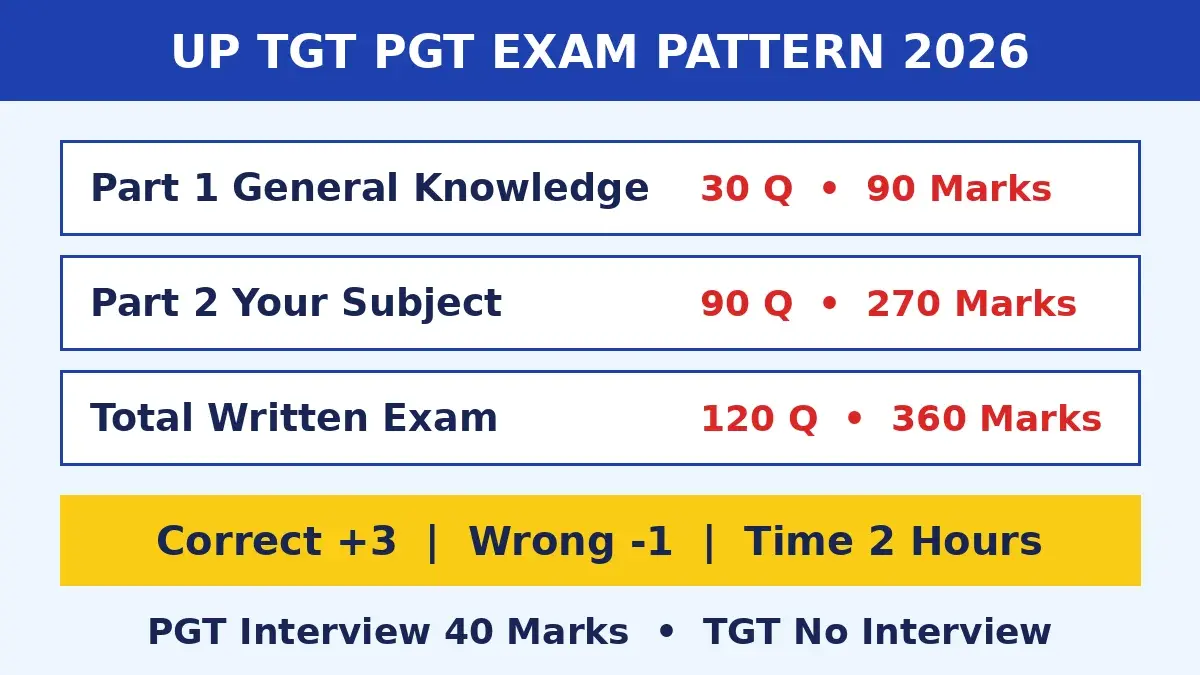
Both written exams follow the same pattern. The paper has 120 objective questions. The total is 360 marks. The time is 2 hours. Each question has four options. You darken the correct circle on the answer sheet with a black ballpoint pen. The question paper is in Hindi and English, except for language subjects.
| Part | Questions | Marks | Time |
|---|---|---|---|
| Part 1 General Knowledge | 30 | 90 | Common time of 2 hours |
| Part 2 Concerned subject | 90 | 270 | Common time of 2 hours |
| Total written exam | 120 | 360 | 2 hours |
| Marking point | Rule |
|---|---|
| Correct answer | Plus 3 marks |
| Wrong answer | Minus 1 mark |
| More than one answer marked | Minus 1 mark |
| Question type | Objective multiple choice with four options |
| Answer method | Darken the circle on the answer sheet with a black ballpoint pen |
| Paper language | Hindi and English, except language subjects |
Negative marking is now a part of the game. A blind guess can cut your marks. Guess only when you can remove at least two options with logic. Leave a question blank when you have no idea. One wrong answer cuts 1 mark. Three wrong answers cancel one correct answer. Protect your correct answers first.
Time is also tight. You get 120 minutes for 120 questions. That is one minute for one question on average. Some questions will take less time. Some subject questions will take more time. Practice with a timer. Learn to leave a hard question and come back later.
How is the final merit made in UP TGT PGT 2026?
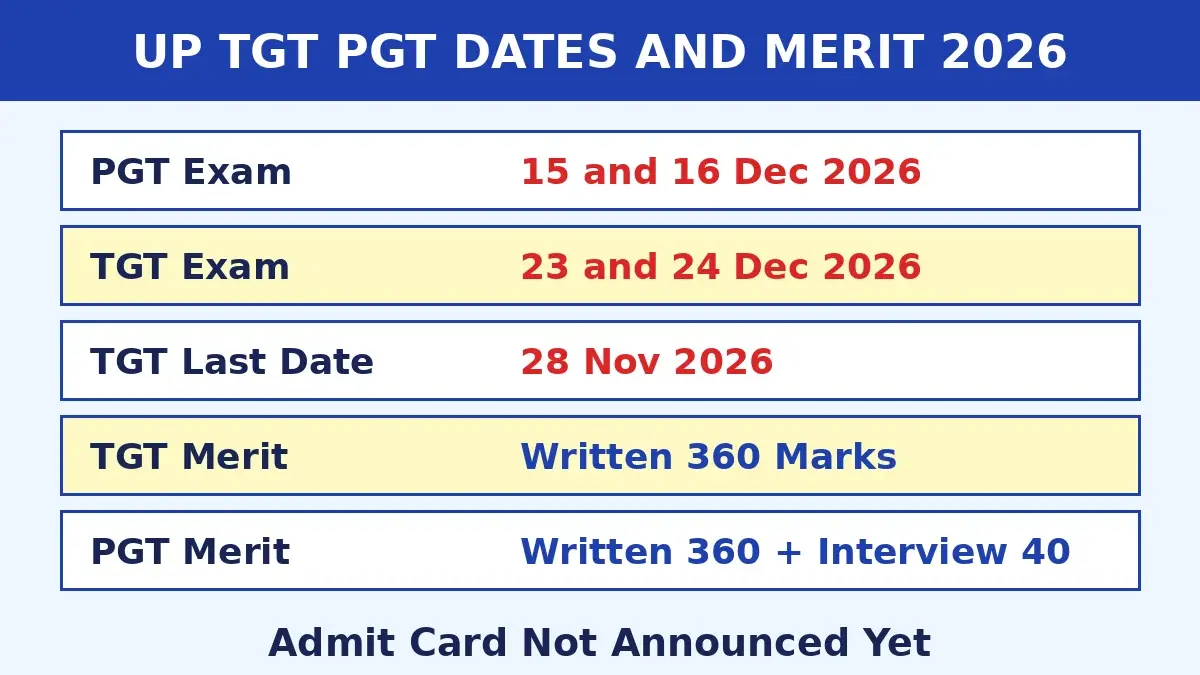
TGT merit is made from the written exam only. The merit list is based on 360 marks. PGT merit is made from two stages. The written exam gives 360 marks. The interview gives 40 marks. The PGT final merit is out of 400 marks.
| Exam | Merit base | Total |
|---|---|---|
| TGT | Written exam marks | 360 marks |
| PGT | Written exam marks plus interview marks | 400 marks |
| Tie situation | TGT rule | PGT rule |
|---|---|---|
| First tie breaker | Higher graduation percentage | Higher written exam marks |
| Second tie breaker | Higher training qualification percentage | Higher interview marks |
| Third tie breaker | Older age | Higher postgraduate percentage |
| Fourth tie breaker | Not needed after age rule | Higher training qualification percentage |
| Last tie breaker | Older age decides | Older age decides |
Tie rules matter when many candidates score the same marks. You cannot control your age. You can control your marks. Aim for a safe score, not a border score. Every extra correct answer gives you safety. Every wrong answer takes safety away.
What is the General Knowledge syllabus for UP TGT PGT 2026?
The General Knowledge part is common for TGT and PGT. It has 30 questions. The official PDF title is General Knowledge TGT and PGT. The PDF states the number of questions as 30. The syllabus has three units. Study all three units. Do not leave any unit for the last day.
| Unit | Main areas | What to study |
|---|---|---|
| Unit 1 Current Affairs | Current events, personalities in news, sports | State, national and international current events. Persons in news. Sports events and winners. |
| Unit 2 India studies | Indian History, Indian Polity, Indian Economy, Indian Geography | Indian history and the national movement. Constitution and polity. Legal and constitutional development linked with the education system. Indian economy. Basic geography and population of India. |
| Unit 3 General Science and ICT | General Science, technology, environment, health, ICT | General science and technology. Environment and current issues. Human health and hygiene. Vitamins, minerals, deficiency diseases, hormones and enzymes. Computer and internet terms. Uses of ICT. Development of educational technology. |
How should you study Unit 1 Current Affairs?
Read current events of the state, the nation and the world. Note persons in news with their field and achievement. Note sports winners, records and host places. Make short notes in your own words. Revise those notes every week. Current affairs facts fade fast. Weekly revision keeps them fresh.
How should you study Unit 2 India studies?
Indian History needs a clear time line. Learn the national movement in order. Indian Polity needs the Constitution basics. Learn fundamental rights, directive principles and the structure of government. The unit also covers legal and constitutional development linked with the education system. As a teacher candidate, give this part extra care. Indian Economy needs basic terms and current data sense. Indian Geography needs maps, rivers, climate, soil and population basics.
How should you study Unit 3 General Science and ICT?
General Science questions are usually direct. Learn daily life science, health and hygiene. Learn vitamins, minerals and deficiency diseases in a table. Learn hormones and enzymes with their functions. ICT questions test computer and internet terms. Learn uses of ICT in teaching. Learn how educational technology has developed. A teacher should know these points well.
| GK area | Easy study method | Revision method |
|---|---|---|
| Current Affairs | Daily short notes with date and fact | Weekly reading of notes |
| Indian History | Time line chart from ancient to modern India | Map and date revision |
| Indian Polity | Constitution articles in simple words | One page chart revision |
| Indian Economy | Basic terms with examples | Terms list revision |
| Indian Geography | Map practice with rivers and states | Blank map practice |
| General Science | Tables for vitamins, diseases, hormones | Table reading before mock tests |
| ICT | Computer terms list with full forms | Terms quiz with a friend |
Which subjects are in the UP TGT syllabus 2026?
The official syllabus list has 20 revised TGT entries including General Knowledge. Your subject PDF depends on the subject you chose in the form. Download only your subject PDF and the General Knowledge PDF. Keep the file names clear. Do not mix PDFs of many subjects in one folder.
| TGT syllabus entries | Count |
|---|---|
| Painting, Sewing, Biology, Persian, Bangla | 5 |
| General Knowledge, Music Instrumental, Music Vocal, Physical Education, Home Science | 5 |
| Maths, Social Science, Science, Agriculture, Commerce | 5 |
| Art, English, Urdu, Sanskrit, Hindi | 5 |
| Total TGT syllabus entries with General Knowledge | 20 |
The vacancy table lists 17 TGT subjects. The syllabus list has Bangla and Persian as extra entries. Your form subject must match the vacancy table. If your subject is in the syllabus list, download that PDF. If you face any doubt, trust the advertisement vacancy table for posts and the syllabus PDF for topics.
Which subjects are in the UP PGT syllabus 2026?
The official syllabus list has 28 revised PGT entries including General Knowledge. PGT subjects go deeper than TGT subjects. Your postgraduate study is your base. The syllabus PDF tells you the exact areas. Build your notes from the PDF units. Do not study random topics outside the PDF in the last days.
| PGT syllabus entries | Count |
|---|---|
| Animal Husbandry and Dairy Science, Agronomy, Agriculture, Painting, History | 5 |
| General Knowledge, Physical Education, Urdu, Art, Sociology | 5 |
| Education, Civics, Commerce, Biology, Sanskrit | 5 |
| English, Chemistry, Physics, Mathematics, Hindi | 5 |
| Psychology, Logic, Geography, Economics, Military Science | 5 |
| Music Instrumental, Music Vocal, Home Science | 3 |
| Total PGT syllabus entries with General Knowledge | 28 |
The vacancy table lists 26 PGT subjects. The syllabus list also has Animal Husbandry and Dairy Science. PDF links are shown in English or Hindi and the choice varies by subject. Open your subject link and save the PDF. Read the first page of the PDF to confirm the subject name and the exam level.
How do you download the UP TGT PGT syllabus PDF?
Download the PDF only from the official UPESSC website. The official syllabus page lists the revised entries for examinations from 2026. Follow the steps in the table. Save the PDF. Print the unit list if you can. Tick each unit as you finish it.
| Step | Action |
|---|---|
| Step 1 | Open the official UPESSC website |
| Step 2 | Open the syllabus listing page |
| Step 3 | Find the Secondary Education section |
| Step 4 | Find your TGT or PGT subject in the revised list |
| Step 5 | Open the English or Hindi view link for your subject |
| Step 6 | Save the PDF and check the subject name on the first page |
| Step 7 | Also save the common General Knowledge PDF |
| Step 8 | Make a unit wise tick list from both PDFs |
Keep a backup copy of both PDFs. Phone storage can fail. A backup on mail or on a second device saves your time. Name the files with your subject and exam name. Clear names help you open the right file fast during revision.
How should you prepare for UP TGT PGT 2026?
Your subject gives 270 marks. General Knowledge gives 90 marks. Give more time to your subject. Still, give daily time to General Knowledge. A simple ratio works well. Give about three parts of time to the subject. Give about one part of time to General Knowledge. Change the ratio if your General Knowledge base is weak.
| Study block | Time share | Work to do |
|---|---|---|
| Subject study | About 3 parts | Read one unit. Make short notes. Solve questions from that unit. |
| General Knowledge study | About 1 part | Read one small topic. Add facts to your notes. Revise old notes. |
| Mock test | Fixed slots each week | Give a full test with a timer. Check every wrong answer. |
| Revision | Daily short slot | Read notes of the last three days. Mark weak points. |
What is a good subject study method?
Read the unit list of your subject PDF. Pick one unit. Read the topic from your main book. Write short notes in simple words. Solve objective questions from the same topic. Note the questions you got wrong. Write the correct fact next to the wrong question. Revise that fact after two days. This method builds strong recall.
What is a good General Knowledge study method?
Divide General Knowledge into small daily topics. One day for current affairs. One day for history. One day for polity. One day for geography. One day for science. One day for ICT. Keep Sunday for revision and a mock test. Small daily steps beat one long sitting once a week.
How many mock tests should you give?
Give at least one full mock test every week. In the last two weeks, give two or three full tests every week. Always use the real pattern. Use 120 questions, 360 marks and 2 hours. Use minus 1 for a wrong answer. Check your score after each test. Note your weak units. Study those units before the next test.
| Week plan | Subject work | GK work | Test work |
|---|---|---|---|
| Early weeks | Finish all subject units once | Finish all three GK units once | One full test each week |
| Middle weeks | Second reading of weak units | Notes revision and current affairs update | Two full tests each week |
| Last two weeks | Only notes and wrong questions | Only notes and fact tables | Two or three full tests each week |
| Last three days | Light revision only | Light revision only | One calm test and full rest |
What mistakes should you avoid in UP TGT PGT 2026?
The first mistake is the use of an old syllabus. The revised syllabus applies from 2026. Old notes can miss new areas. The second mistake is blind guessing. Minus 1 punishes blind guesses. The third mistake is poor time use. One hard question should not eat five minutes. Leave it and move ahead.
| Mistake | Loss | Safe habit |
|---|---|---|
| Old syllabus notes | You study wrong areas | Use the revised PDF only |
| Blind guessing | Minus 1 for each wrong answer | Guess only after removing two options |
| Spending too long on one question | Easy questions remain unseen | Leave and return later |
| No mock tests | Poor speed on exam day | Weekly timed tests |
| No revision of wrong answers | Same errors repeat | Wrong question notebook |
| Ignoring General Knowledge | Loss of up to 90 marks | Daily GK slot |
| Ignoring documents | Trouble at verification | Keep degree, B.Ed and TET papers ready |
Keep your documents ready from now. TGT candidates need degree papers, B.Ed papers and TET papers. PGT candidates need postgraduate papers and B.Ed papers. Keep category papers ready if they apply to you. Document stress in the last days hurts your study. Finish document work early.
What should PGT candidates do for the interview?
PGT has an interview of 40 marks. The written exam comes first. Only candidates who qualify in the written stage move ahead. Still, start light interview preparation early. Know your subject basics well. Know why you want to teach. Know current issues in education. Speak in clear and simple words.
| Interview area | Preparation |
|---|---|
| Subject depth | Revise core concepts of your postgraduate subject |
| Teaching sense | Practice how you will explain a tough topic to a class |
| Education issues | Read current education topics and school level changes |
| Personal clarity | Prepare short answers about your study and your goal |
| Document clarity | Know every paper in your file and its purpose |
Do not fear the interview now. Your first target is the written exam. A strong written score gives you a strong base. The interview can add up to 40 marks. Treat the interview as a later stage. Give full focus to the written paper in these days.
Where can you practise mock tests for UP TGT PGT 2026?
Practice with the real pattern. Use 120 questions. Use 360 marks. Use 2 hours. Use minus 1 for a wrong answer. Take the UP TGT PGT mock test on sarkarimocktest.com and mocktestcenter.com. A mock test shows your speed. It also shows your weak units. Study the weak units after every test.
You can also read related teacher exam pages on this site. The UP Super TET syllabus page helps primary teacher candidates. The UPTET result page helps candidates who check eligibility test updates. The UPSSSC Inter Level syllabus page helps candidates who also prepare for other Uttar Pradesh exams. Read only the pages that match your goal.
What is the final advice for UP TGT PGT 2026?
Trust the official PDF. Study your subject with full care. Study General Knowledge daily. Respect negative marking. Practice with a timer. Revise your wrong answers. Keep your documents ready. The exam dates are near. Calm and steady study beats panic. One unit at a time. One test at a time. One revision at a time.
| Final check | Status to confirm |
|---|---|
| Subject PDF saved | Yes, with correct subject name |
| General Knowledge PDF saved | Yes, common PDF for TGT and PGT |
| Unit tick list ready | Yes, for subject and GK |
| Mock test pattern set | 120 questions, 360 marks, 2 hours, minus 1 |
| Documents ready | Degree, B.Ed, TET or postgraduate papers as needed |
| Exam date noted | PGT 15 and 16 December 2026, TGT 23 and 24 December 2026 |
| Admit card watch | Check the official website for the admit card notice |
How should you use the last days before the exam?
The last days need calm work, not new load. Do not start a fresh book now. Do not chase a new topic from a random video. Your notes, your wrong question notebook and your subject PDF are enough for these days, because they hold the exact areas you have already studied and the exact points where you still lose marks.
Keep one simple order. Morning for subject notes. Noon for General Knowledge facts. Evening for a timed test or for wrong questions. Night for light reading only. Sleep well. A tired mind reads a question wrong and marks a wrong circle, and that one mistake costs you the mark you worked so hard to earn.
PGT candidates have the exam on 15 and 16 December 2026, so their last week should stay very light, with short revision, early sleep and one calm mock test that keeps speed warm without adding stress. TGT candidates have the exam on 23 and 24 December 2026. They get a little more time. They can use that time for one more round of weak units, but they should still stop new topics three days before the exam.
| Last days work | Do this | Avoid this |
|---|---|---|
| Subject revision | Read unit notes and wrong questions | Start a new book |
| GK revision | Read fact tables and current affairs notes | Collect new facts from many places |
| Mock test | One calm timed test with full checking | Many tests without checking |
| Rest | Sleep early and keep the mind fresh | Late night heavy study |
| Exam kit | Keep admit card and identity proof ready when issued | Search for papers on exam morning |
Which subject groups need what kind of care?
Language subjects need grammar, vocabulary and passage practice. Hindi candidates should revise grammar rules, literature basics and Sanskrit linked points with care, because the Hindi paper can test language depth in many small ways that reward steady reading. English candidates should practise grammar, vocabulary, unseen passages and literature terms. Urdu and Sanskrit candidates should revise their core texts and grammar points from the official PDF units.
Science subjects need concept clarity. Physics, Chemistry, Biology, Mathematics and Science candidates should solve questions daily, because formula recall alone does not give speed, and speed comes only from repeated practice under time. Write formulas on one page. Revise that page before every mock test. Mark the questions where calculation took too long.
Social science subjects need maps, dates and clear concepts. History, Geography, Civics, Economics, Sociology, Psychology, Logic, Education and Social Science candidates should link facts with reasons, because objective questions often test the link between an event, its cause and its result. Make small charts. Revise charts often.
Commerce, Agriculture, Home Science, Physical Education, Art, Music, Sewing and Painting candidates should respect the practical side of their subjects. Read the official units with care. Note terms, tools, methods and safety points where they apply. Objective questions from practical areas are often direct, and direct questions give sure marks when your basics are clear.
| Subject group | Main care | Daily habit |
|---|---|---|
| Languages | Grammar, vocabulary, passages, literature basics | One passage and twenty grammar questions |
| Science and Maths | Concepts, formulas, fast calculation | Timed question practice |
| Social Science | Maps, dates, concepts, cause and result | Chart and map revision |
| Commerce and Agriculture | Terms, methods, current basics | Terms list revision |
| Arts and practical subjects | Tools, methods, theory basics | Unit wise short notes |
Every subject group shares one truth. The official PDF is your map. Your notes are your road. Mock tests are your speed check. If you follow the map, walk the road daily and check your speed each week, your preparation will stay on track even when the exam date feels near.
What is a simple daily revision routine?
Read. Revise. Test. Repeat. This short routine works because it turns passive reading into active recall, and active recall is the skill that helps you remember a fact when the question paper is in front of you and the clock is moving fast.
Start small. Pick one unit. Read it once with full focus, then close the book and write the main points from memory on a blank page, because the points you cannot write are the points you have not learned yet. Check the page. Mark the gaps. Read only the gaps again.
Questions matter. Solve twenty questions from the same unit, check every answer with care, and write the correct fact beside each wrong answer so that your notebook becomes a personal list of the exact traps that cost you marks in practice. Revise that list after two days. Then revise it again after one week.
Speed matters. Use a timer for every practice set, leave a hard question when it eats too much time, and return to it only after you finish the easy questions that give sure marks with far less risk. Calm speed wins. Panic loses marks.
Notes matter. Keep notes short, keep them in your own words, and keep them in one notebook that you can revise in thirty minutes, because a short notebook that you revise often is worth more than a thick file that you never open again. Read the notebook before sleep. Read it before mock tests.
Rest matters. Sleep well. Eat well. Walk a little every day, because a fresh mind reads questions with care, marks circles with care, and avoids the silly mistakes that come from tired eyes and a rushed hand. Health is part of preparation.
| Routine step | Time | Goal |
|---|---|---|
| Read one unit | 30 minutes | Understand the topic |
| Write from memory | 10 minutes | Find the gaps |
| Solve questions | 30 minutes | Build speed and accuracy |
| Check wrong answers | 15 minutes | Fix the traps |
| Revise notes | 15 minutes | Lock the facts |
Follow this routine daily and your syllabus will shrink step by step, unit by unit, until the full paper feels familiar and your mock test scores start to rise in a steady and honest way. Small steps. Daily steps. Sure steps.
Sources
Official sources only. UPESSC homepage: upessc.up.gov.in. UPESSC syllabus listing: Syllabus page. PGT advertisement 06/2026 PDF and TGT advertisement 07/2026 PDF are published on the official UPESSC website. The common General Knowledge PDF is published on the official UPESSC website.