MP High Court Assistant Grade 3 Answer Key 2026 Out for 1,174 Posts
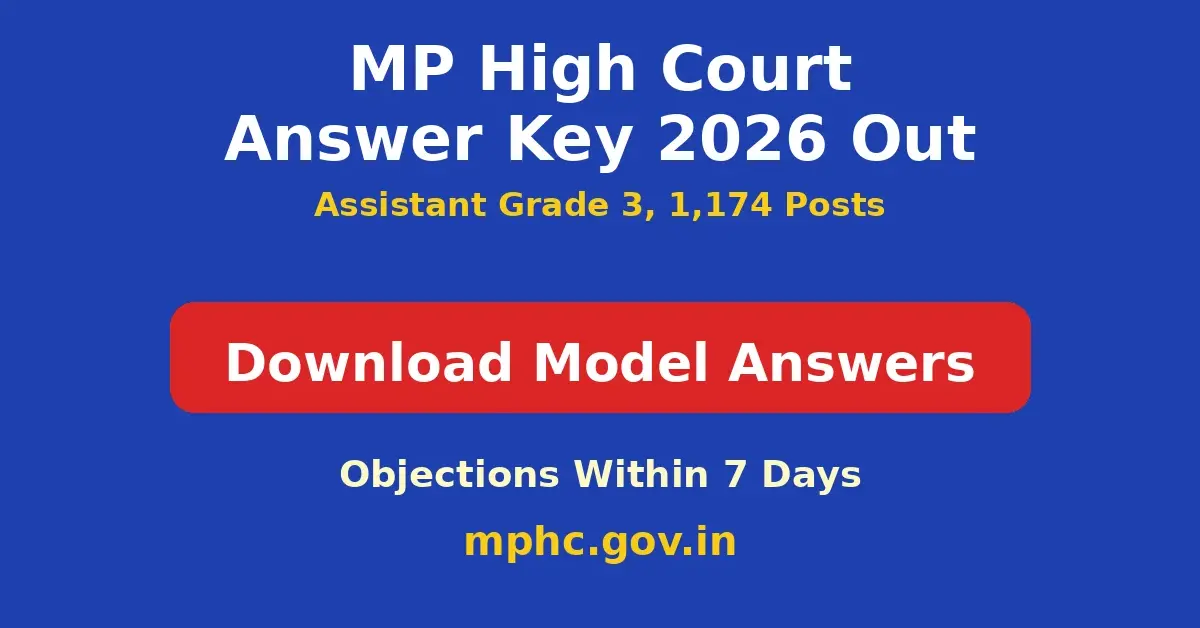
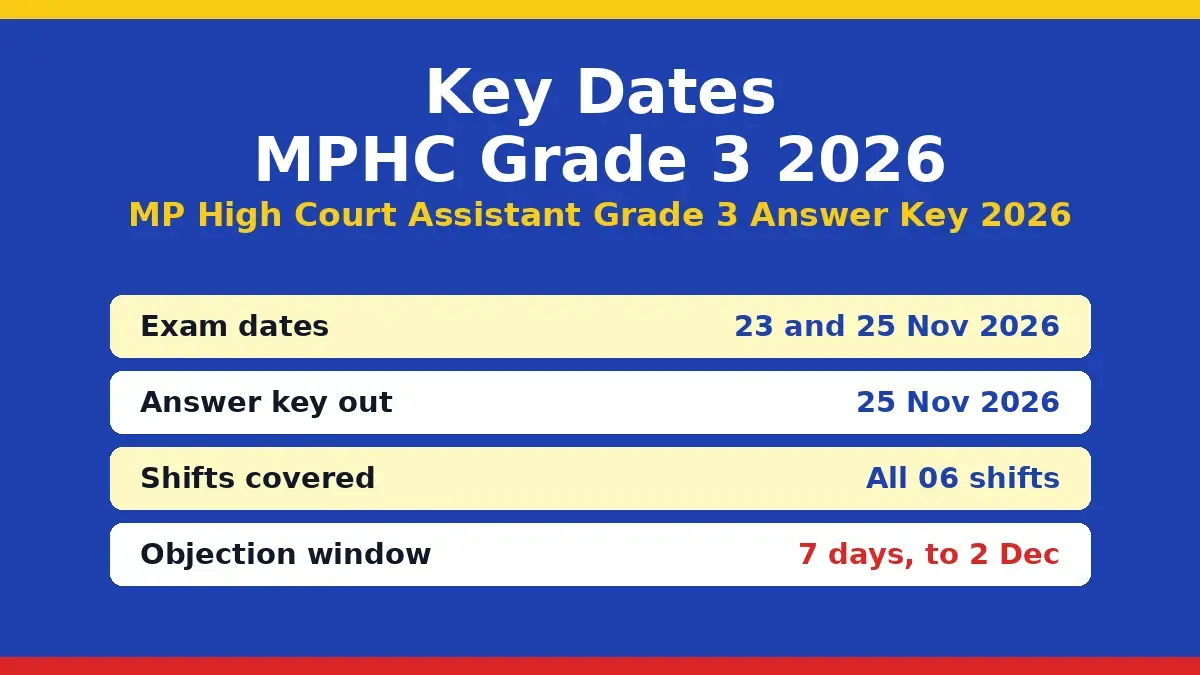
The MP High Court Assistant Grade 3 Answer Key 2026 is out. The High Court of Madhya Pradesh put the proposed model answers on mphc.gov.in on 25 November 2026, with the question papers of all 6 shifts. The online preliminary exam was held on 23 and 25 November 2026 for 1,174 Assistant Grade-III posts in the district courts of Madhya Pradesh.
You can download the full PDF from mphc.gov.in right now. The file has 58 pages, and the last pages carry the objection format. If you think an answer in the key is wrong, you get 7 days from the date of uploading to send an objection. The objection goes offline, on paper, and an email objection will not be read at all.
Listen to this article in 1 minute:
This page gives you the download steps, the objection rules in plain words, the paper pattern, the post table, and the next stage of the selection. Every date and number here comes from the High Court notice and the advertisement named in the Sources part.
What has the High Court released?
The release is a single PDF, and it carries two things together. The first part is the question papers with the proposed model answers for all 6 shifts. The second part is the format you must use if you want to object to an answer.
The notice number is 748/Exam/2026, and it is dated 25 November 2026 from Jabalpur. The Registrar (Exam) signed it. The notice says the High Court is publishing the proposed model answers of the question papers of all 6 shifts of the online preliminary examination for Assistant Grade-III, held on 23 and 25 November 2026.
| Detail | MP High Court Assistant Grade-III 2026 |
|---|---|
| Conducting body | High Court of Madhya Pradesh, Jabalpur |
| Post | Assistant Grade-III, district court establishments |
| Total posts | 1,174 |
| Advertisement number | 614/Exam/2026, dated 14 August 2026 |
| Answer key notice | Number 748/Exam/2026, dated 25 November 2026 |
| Exam dates | 23 and 25 November 2026 |
| Shifts | 6 shifts in all |
| PDF size | 58 pages |
| Official website | mphc.gov.in |
The word "proposed" in the notice matters. These answers are not final yet. The High Court gives candidates a short window to point out mistakes, and the answers can change after that window. If no objection reaches in time, the notice says the proposed model answers will be treated as final.
How do you download the answer key?
The download is free, and you need no login for the PDF. The High Court has put the file in the Exam Updates part of mphc.gov.in, with the 25 November 2026 date on the listing.
Follow these steps in order. First, open mphc.gov.in on your phone or computer. Second, look for the Exam Updates part on the homepage. Third, find the 25 November 2026 listing for the Assistant Grade-III model answers. Fourth, open the PDF and save it on your device. Fifth, find your shift inside the PDF and read your paper first.
The direct PDF link is given in the Sources part of this page, and it opens the same 58 page file. Download the file once and keep two copies, one on your phone and one on a computer or a pen drive. The portal link can move later, and your saved copy stays with you.
Check your shift with care before you count anything. The PDF holds 6 shifts, and each shift has its own question paper and its own answers. A candidate from Shift 1 who reads the Shift 4 answers will count a wrong score and may object to a question that was never in the paper. The shift header sits at the top of each paper, and one sample header in the PDF reads Exam Date 23 November 2026, Shift 01, 9:00 AM to 11:00 AM.
Match your admit card date and shift with the header in the PDF. Then start counting. Print your shift paper if you can, because marking on paper is faster than scrolling on a small screen.
What is inside the 58 page PDF?
The file opens with the one page notice. The notice gives the objection rules, the address, and the 7 day window. Read that page first, because it decides whether your objection counts at all.
After the notice come the question papers with the proposed model answers, shift by shift. The model answer sits with each question, so you can match your response against the key line by line. The last part of the file is the objection format, and the High Court expects objections in that format.
| Part of the PDF | What it holds |
|---|---|
| Page 1 | Notice number 748/Exam/2026 with the objection rules |
| Main body | Question papers with proposed model answers, all 6 shifts |
| Last part | Format for submitting objections |
One habit will save you time here. Note the question number, your marked option, and the model answer in a small notebook as you go. When you finish, you will have your score and a short list of doubtful questions in one place. That list is the raw material for an objection.
Your score from this count is a guide, and the preliminary exam is a screening stage. The advertisement says the preliminary marks do not count in the final result. The count still matters, because the shortlist for the next stage comes from these marks.
How do you raise an objection?
The High Court takes objections offline only. You write the objection on paper, sign it, and send it to the Principal Registrar (Exam), High Court of Madhya Pradesh, Jabalpur. You can send it by post, or you can hand it in at the Receipt Section of the High Court. No other route counts.
The notice says it in plain words: only offline objections will be entertained, and objections received through email or any other mode shall not be entertained. An email objection carries no weight in this process, however strong the proof inside it may be.
| Objection point | What the notice says |
|---|---|
| Mode | Offline only, in writing, signed |
| Send to | Principal Registrar (Exam), High Court of Madhya Pradesh, Jabalpur |
| How to send | By post, or by hand in the Receipt Section only |
| Format | The format given in the PDF |
| Must mention | Your name and application number |
| Proof | Self attested photocopies of source documents or proof |
| Fee | No fee is stated in the notice |
| Email objection | Not entertained |
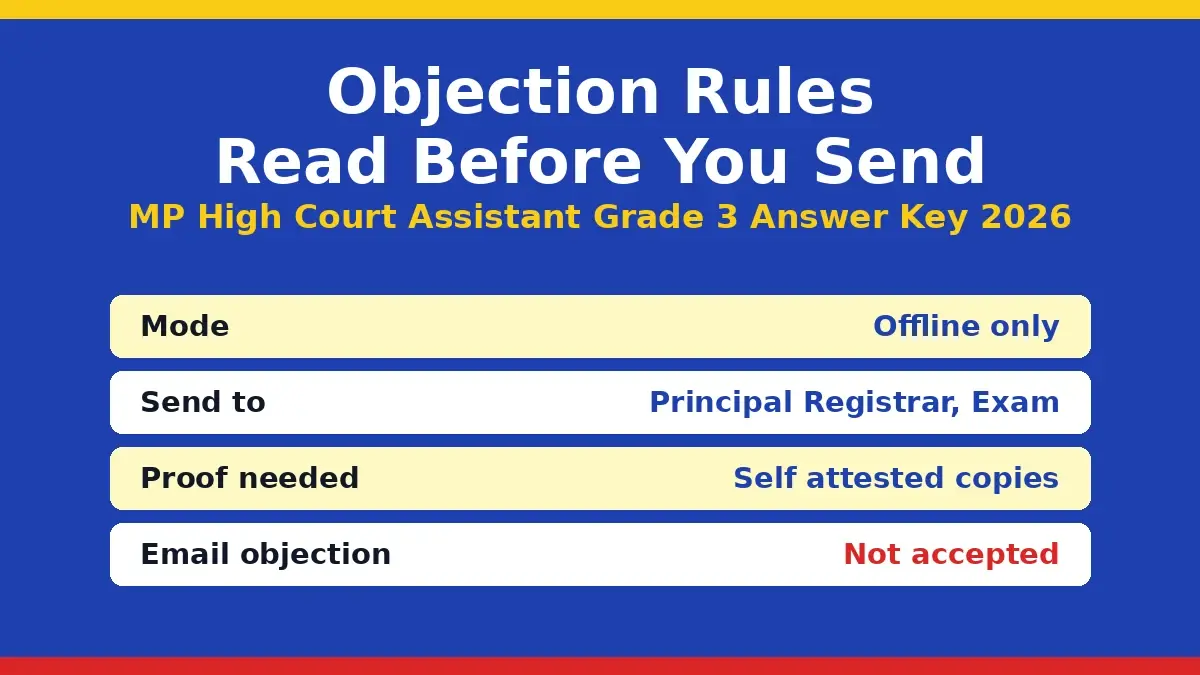
Write your name and application number on the objection. The notice asks for both, and an objection without the application number cannot be matched to your paper. Attach self attested photocopies of the source pages that support your answer. A standard book page or an official publication page carries weight, and a bare claim carries none.
Use the format from the PDF. The notice says late objections, objections in the wrong format, and objections without proof will not be considered. Postal delay is no excuse either, and the notice says so. Post your objection early, or hand it in at the Receipt Section if you can reach Jabalpur.
Keep a photocopy of your full objection set before you send it. Keep the postal receipt with it. If a question comes up later, your copy and the receipt are your proof of what you sent and when you sent it.
What is the last date for objections?
The notice does not print a calendar last date. It gives a rule instead: objections may be submitted within 7 days from the date of uploading of the proposed model answers.
The answers were uploaded with the 25 November 2026 notice. Seven days from 25 November ends on Wednesday, 2 December 2026. Count your days from 25 November, and make sure your objection reaches the High Court inside that window.
The word "reaches" is the hard part of this rule. A letter posted on the last day can arrive late, and the notice refuses postal delay as a reason. A candidate in a far district should post the objection in the first two or three days, or use a fast postal service with tracking. A candidate near Jabalpur can hand the objection in at the Receipt Section and remove the postal risk in full.
Do not wait for the last day to start writing. You need time to find proof pages, fill the format, sign the papers, and make photocopies. That work takes an evening at least, and the 7 day window includes the time your letter spends on the road.
What happens after the objection window closes?
The High Court reads the objections that reach in time and in the right format. Answers can change where a candidate proves an error with source pages. Where no objection reaches in time, the proposed model answers stand as final.
After the answers settle, the High Court prepares the preliminary result from the final answers. The preliminary exam is a screening test. Its marks do not add to your final merit, and the advertisement states this clearly. The marks still decide who moves ahead, because the shortlist comes from this stage.
The advertisement shortlists candidates at about 1:5 in each category for the next stage. That means about five candidates move ahead for every one post in the category. Before the skill test, the High Court checks documents and applications of the shortlisted candidates.
The next stage is the Hindi Typing Skill Test. It carries 50 marks, and your final merit comes from this test. The test gives you about 350 words to type in 10 minutes, in Remington Gail layout, in unrestricted mode. The checking follows CPCT standards, with net words per minute and accuracy, and it cuts 0.50 marks for a missed word or error and 0.10 marks for a backspace.
| Stage | What happens |
|---|---|
| Stage 1 | Online preliminary exam, 100 marks, screening only |
| Shortlist | About 1:5 per category from prelims marks |
| Scrutiny | Document and application check of shortlisted candidates |
| Stage 2 | Hindi Typing Skill Test, 50 marks |
| Final merit | Skill test marks, category wise |
The minimum marks in the skill test differ by category. The advertisement sets 55 percent for UR and OBC, 45 percent for SC, 40 percent for ST and PwD, and 49.5 percent for EWS. If two candidates tie, the older candidate gets preference. The final select list and the waiting list will come on the High Court website.
No result date is announced yet. Any page that prints a result date today is guessing. Wait for the High Court notice, and use the waiting days for typing practice, because the skill test decides the final rank.
What was the prelims paper pattern?
The preliminary paper had 100 objective questions for 100 marks, with 1 mark for each question. You got 120 minutes for the paper. Five subjects carried 20 marks each, and the split helps you read your score section by section.
| Subject | Questions | Marks |
|---|---|---|
| General Knowledge and General Studies, with MP GK | 20 | 20 |
| Mathematics and Logical Reasoning | 20 | 20 |
| General Hindi | 20 | 20 |
| English Knowledge | 20 | 20 |
| Computer Knowledge | 20 | 20 |
| Total | 100 | 100 |
The exam scheme in the advertisement does not state negative marking. Read that line with care. This page does not claim a negative marking rule, because the scheme read for this page does not print one. Your rough score is the count of right answers, and the final answers after objections will settle the count.
Split your score by subject when you count. A candidate with 16 in General Knowledge, 12 in Mathematics, 15 in Hindi, 13 in English, and 17 in Computer Knowledge has 73 marks. The weak subject in that split is Mathematics, and that split tells the candidate where the marks went.
The split also tells you which answers to recheck first. Most doubtful questions sit in the subject where you guessed under time pressure. Read those questions in the PDF with a cool head, and check the model answer against a standard book before you decide to object.
How many posts are there?
The recruitment covers 1,174 Assistant Grade-III posts in the district court establishments of Madhya Pradesh. The advertisement gives the category split in one table, and the numbers add to 1,174.
| Category | Posts |
|---|---|
| UR | 314 |
| OBC | 325 |
| EWS | 118 |
| SC | 181 |
| ST | 236 |
| Total | 1,174 |
Inside these posts, the advertisement also carries horizontal reservation. Women get 35 percent across categories, ex servicemen get 10 percent, and PwD candidates get 6 percent. The PwD split in the table is VH 18, HH 18, LD 17, and MD 17.
Your category decides your shortlist pool. The 1:5 shortlist runs category wise, so a UR candidate competes inside the UR pool and an SC candidate competes inside the SC pool. The same score can clear the line in one pool and miss it in another, and that is why a single all India cut off guess helps nobody here.
The full recruitment details, with the CPCT and diploma rules in simple words, sit on the MP High Court Assistant Grade 3 recruitment page on this site. Read that page if you want the form rules and the document list in one place.
Who could apply for these posts?
The advertisement asks for a graduation degree in any discipline from a recognized university. It asks for a CPCT score card from MAP-IT or an agency recognized by the Madhya Pradesh Government. It also lists a one year diploma course in computer application from an institution recognized by the Madhya Pradesh Government.
Read the exact clauses in the advertisement PDF before you judge your own case. Computer qualification clauses get read strictly at document checking time, and the advertisement wording is the final word. The recruitment page on this site explains the CPCT and diploma point in plain words.
| Condition | What the advertisement asks |
|---|---|
| Education | Graduation in any discipline from a recognized university |
| Computer test | CPCT score card from MAP-IT or a recognized agency |
| Computer diploma | One year diploma in computer application, recognized institution |
| Minimum age | 18 years completed on 1 January 2026 |
| Maximum age, UR male | 40 years |
| Maximum age, MP OBC, SC, ST | 45 years, male and female |
| Maximum age, women and PwD | 45 years |
The age table in the advertisement sets the maximum at 40 years for UR male candidates from Madhya Pradesh and other states. Madhya Pradesh OBC, SC, and ST candidates get 45 years.
All women and all PwD candidates get 45 years, and Madhya Pradesh Government employees and Nagar Sainik also get 45 years. The full age table sits in the advertisement, and your category row in that table is the only row that counts for you.
A corrigendum dated 18 September 2026 also sits on the High Court website. Its title speaks of 5 years age relaxation, up to 45 years, for male aspirants of the EWS category in this recruitment. Candidates who applied under that relaxation should keep the corrigendum copy with their papers for the scrutiny stage.
Age counts on 1 January 2026, and that date is fixed in the advertisement. A candidate who turned 18 after that date did not meet the minimum age rule for this cycle, whatever the exam date was.
What is the pay for Assistant Grade-III?
The advertisement gives the pay as 5200 to 20200 with grade pay 1900. It also notes that the 7th pay matrix range of Rs 19,500 to Rs 62,000 applies. Allowances follow the rules that apply at joining time.
| Pay point | Detail |
|---|---|
| Pay band in advertisement | Rs 5,200 to Rs 20,200 plus grade pay Rs 1,900 |
| 7th pay matrix range | Rs 19,500 to Rs 62,000 |
| Post level | Assistant Grade-III, district courts |
Pay alone should not drive your next week of work. The skill test decides the final merit, and typing speed with accuracy is a trainable skill. Ten minutes of clean typing is the test, and daily practice in Remington Gail layout builds exactly that.
How do you count your score from the key?
Counting takes ten quiet minutes if you do it in order, and it takes an hour of confusion if you jump around the PDF. Open your shift paper first. Keep a pen in hand. Mark each question right or wrong against the model answer, and write the subject totals at the end of each block of 20 questions.
Take a candidate who got 15 right in General Knowledge, 11 in Mathematics and Logical Reasoning, 17 in General Hindi, 12 in English Knowledge, and 16 in Computer Knowledge. The total is 71 out of 100. The same candidate can see in one look that Mathematics cost the most marks, and that Hindi carried the score.
Take another candidate with 18, 17, 14, 15, and 13 across the same five subjects. The total is 77. Six marks separate the two candidates, and the gap sits mostly in Mathematics and Logical Reasoning, where the second candidate scored 17 against 11.
Those two counts show why the subject split matters more than the total in this week. The total tells you where you stand. The split tells you which questions to recheck for objections, because a wrong model answer usually hides in the subject where you marked fast and guessed twice.
Count twice. The first count gives your score, and the second count catches the marking slips that creep in when you count 100 questions in one sitting. If the two counts differ, count a third time and trust the count that repeats.
Write the final count on the first page of your printout, with the date. When the final answers come, you will count again against the settled key, and the old count will show you exactly which questions changed.
What does the skill test check, mark by mark?
The Hindi Typing Skill Test carries 50 marks, and the advertisement ties the checking to CPCT standards. Two numbers decide your result in that test: net words per minute and accuracy. Speed without accuracy loses marks, and accuracy without speed loses marks in a different way.
The test gives about 350 words in 10 minutes. A candidate who types the full passage cleanly inside the time stands in a strong place. A candidate who types half the passage with perfect accuracy has left half the test unattempted, and the marks follow the work done.
The deductions are printed in the advertisement. A missed word or an error costs 0.50 marks. A backspace costs 0.10 marks. Ten errors cost 5 marks out of 50, and that is a tenth of the whole test gone on mistakes a slower hand would have avoided.
Work the numbers once and the lesson sticks. A candidate who types 300 words with 20 errors and 30 backspaces loses 10 marks for errors and 3 marks for backspaces, a total loss of 13 marks before accuracy and speed even enter the count. A candidate who types 280 words with 4 errors and 5 backspaces loses 2.5 marks. The second candidate typed less and kept more.
That is why daily practice beats one long practice day. Sit for 10 minutes a day with a Hindi passage in Remington Gail layout, type at a steady pace, and count your errors at the end. Speed grows on its own when accuracy stops leaking marks.
The minimum marks rule then sets the floor for each category. UR and OBC candidates need 55 percent in the skill test, which is 27.5 marks out of 50. SC candidates need 45 percent, ST and PwD candidates need 40 percent, and EWS candidates need 49.5 percent. A candidate below the floor for the category does not enter the final merit, whatever the prelims score was.
Which papers should you keep ready for scrutiny?
Shortlisted candidates face a document and application scrutiny before the skill test. The advertisement eligibility rests on a small set of papers, and the scrutiny will test exactly those papers. Keep them in one file from today.
Keep your graduation degree or mark sheet ready. Keep your CPCT score card ready. Keep your one year computer diploma certificate ready if your eligibility rests on it. Keep your category certificate ready if you claimed a category benefit, and keep a photo identity proof with the file.
Check the spelling of your name across the papers. A name that reads one way on the degree and another way on the application invites questions at scrutiny time, and those questions cost days you may not have. Note any mismatch now, while you still have time to collect a supporting paper.
Keep your application print and your admit card in the same file. The application number on those papers is the number you write on an objection today and the number the scrutiny will match later. One file, kept in order, removes most of the last minute running around.
Common mistakes that waste an objection
The first mistake is the email objection. Candidates send a long email with proof attached and feel the work is done. The notice refuses email objections in full, and the High Court will not read that mail as an objection.
The second mistake is the missing proof. An objection that says only "this answer is wrong" gives the reader nothing to check. Attach self attested photocopies of the source pages, and mark the line that supports your answer.
The third mistake is the wrong format. The PDF carries a format, and the notice refuses objections outside it. Fill the format, sign the objection, and write your name and application number on it.
The fourth mistake is late posting. The window is 7 days from uploading, and postal delay is no excuse. A letter posted on 2 December from a far district will reach late, and a late objection will not be considered.
The fifth mistake is the wrong shift. A candidate objects to a question from another shift paper, and the objection fails on that ground alone. Match your shift header with your admit card before you write a single line.
One more MP answer key is open this week, and the rules there run the other way. The MP Police ASI and Subedar answer key page covers an online objection window that closes on 26 November 2026. Keep the two systems apart in your head, because a paper objection sent to the police board and a portal objection expected by the High Court both fail in the same silent way.
What should you do today?
Download the PDF from mphc.gov.in and open your shift paper. Count your right answers subject by subject, and write the five subject scores in a notebook. That count takes twenty minutes, and it tells you where you stand.
Mark every question where your answer and the model answer differ. Read each marked question again, and check it against a standard book or an official publication. Keep only the questions where a source page supports your answer.
For each kept question, fill the objection format from the PDF. Write your name and application number, state your answer in one line, and attach self attested photocopies of the proof pages. Sign the objection.
Post the set early, or hand it in at the Receipt Section of the High Court in Jabalpur. Keep your photocopy set and the postal receipt together. Then start typing practice, because the skill test carries your final merit.
Candidates waiting for the next MP exam can also read the MP Police Constable exam date page on this site. That exam now starts from 9 December 2026, and the admit card will come soon as per the board notice.
One last habit for this week: check mphc.gov.in once a day in the evening. Notices in this recruitment have come without long warning, and the skill test notice will follow the same pattern. A daily two minute check costs nothing, and it keeps you ahead of every date that matters.