UPSC CISF AC LDCE 2027 Notification Out, Apply Online
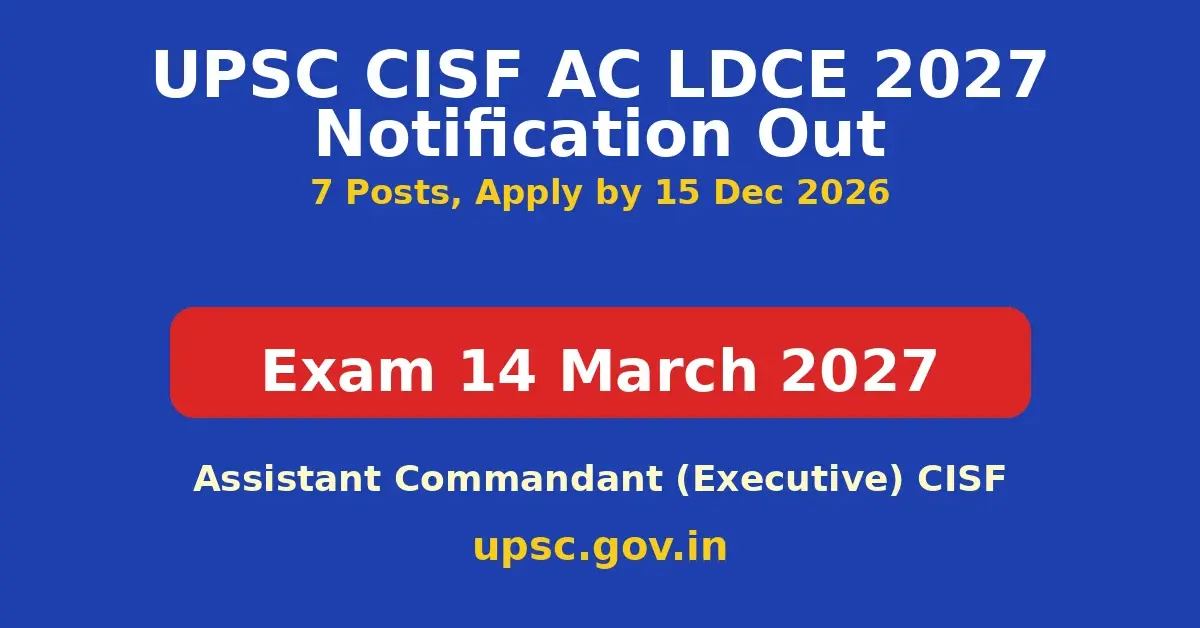
The UPSC CISF AC LDCE 2027 notification is out now. The Union Public Service Commission put the notification on its official website on 25 November 2026, and online applications are open from 25 November 2026.
This exam fills the post of Assistant Commandant (Executive) in the Central Industrial Security Force through a Limited Departmental Competitive Examination. The notification gives 7 vacancies in total, and the last date to apply online is 15 December 2026 till 6 PM.
Only serving CISF personnel in the named ranks can apply for this exam. A civilian candidate cannot apply, because the notification restricts this exam to certain categories of departmental candidates of CISF.
This page gives the full notification update in simple words. You will find the key dates, the vacancy break up, the eligibility rules, the age limit, the application steps, the exam pattern, the syllabus parts and the selection stages. Every date, every number and every rule on this page comes from the official UPSC notification named in the Sources part at the end.
Listen to this article in 1 minute:
Is the UPSC CISF AC LDCE 2027 notification out now?
Yes, the notification is out now. The Commission uploaded the notification on 25 November 2026, and the official detail page on upsc.gov.in shows the upload date as 25 November 2026 with an Apply Online link for this exam.
The exam name in the notification reads CISF AC (Exe) LDCE 2027. The full form of LDCE is Limited Departmental Competitive Examination, and the word limited carries the main point of this exam. Only departmental candidates of CISF in the ranks named in the rules can sit in this exam.
The rules for this exam come from a Gazette Notification of the Ministry of Home Affairs dated 25 November 2026. The notification tells candidates that these rules can be downloaded from the CISF website and are also available on the UPSC website.
| Point | Detail |
|---|---|
| Conducting body | Union Public Service Commission (UPSC) |
| Exam name | CISF Assistant Commandant (Executive) Limited Departmental Competitive Examination 2027 |
| Post | Assistant Commandant (Executive) in CISF |
| Total vacancies | 7 vacancies |
| Notification date | 25 November 2026 |
| Last date to apply online | 15 December 2026 till 6 PM |
| Exam date | 14 March 2027 |
| Exam centre | New Delhi |
| Apply website | upsconline.nic.in |
Read the overview table once and keep three dates in your diary. The notification date is 25 November 2026. The last date to apply online is 15 December 2026. The exam date is 14 March 2027 at New Delhi.
The application window is short. Candidates get about three weeks from the notification date to the last date, and the hard copy through proper channel needs more time after the online form. Start the form in the first week itself and keep the proper channel step in your plan from day one.
What are the key dates for this exam?
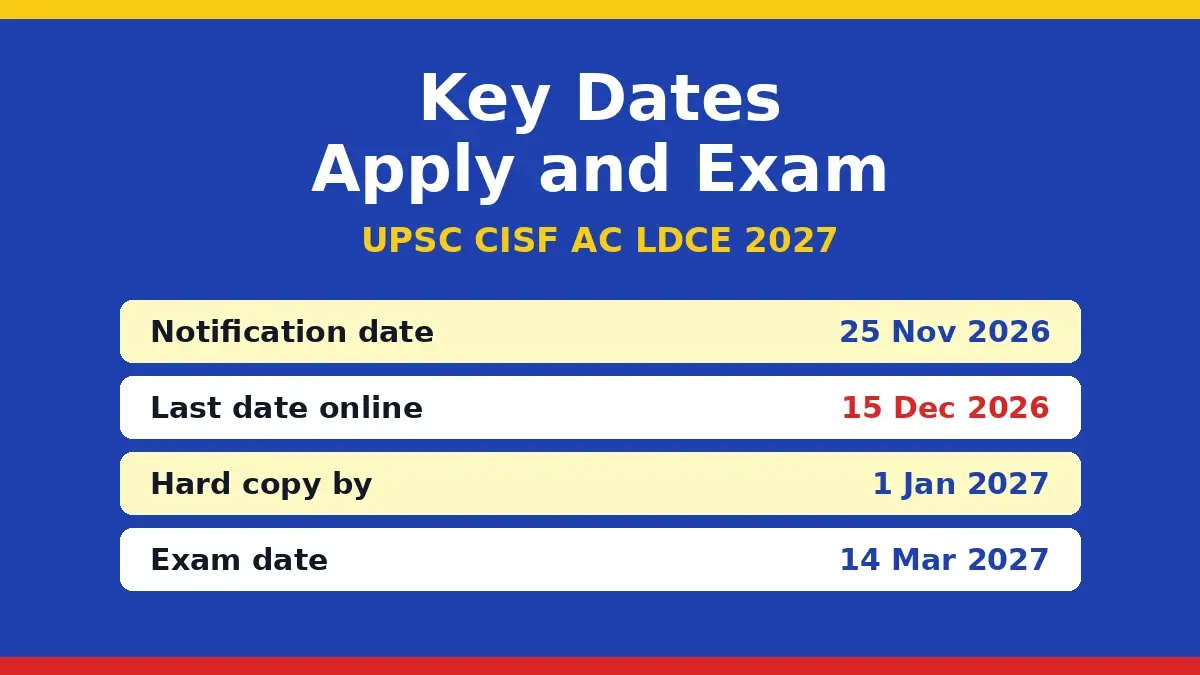
The notification fixes the application window and the exam date. Online applications run from 25 November 2026 to 15 December 2026 till 6 PM. The written examination will take place on 14 March 2027 at New Delhi.
One more date matters for every applicant. A hard copy of the application through proper channel must reach the Director General, CISF at New Delhi on or before 1 January 2027. The online form alone does not finish your application for this departmental exam.
| Event | Date |
|---|---|
| Notification date | 25 November 2026 |
| Online application starts | 25 November 2026 |
| Last date to apply online | 15 December 2026 till 6 PM |
| Hard copy through proper channel must reach DG CISF by | 1 January 2027 |
| Written examination | 14 March 2027 |
| e-Admit Card | Last working day of the week before the exam date, on upsconline.nic.in |
The notification gives no clock time for the exam day. It gives the paper durations only. Your e-Admit Card will carry your reporting details, so read the card with full care when it comes in the week before the exam.
The notification also gives no result date. It gives no date for the physical test, the medical test or the interview. Candidates should watch the UPSC website and the CISF website for those dates after the written exam.
Count your preparation time from today. From 25 November 2026 to 14 March 2027 you get close to sixteen weeks. That time covers Paper I practice, Paper II writing practice and physical preparation if you plan the weeks well from the start.
How many vacancies are there in this exam?
The notification gives 7 vacancies in total. The category break up in the notification reads General 6, Scheduled Caste 1 and Scheduled Tribe 0. The notification also states that the vacancies are tentative and subject to change.
Seven posts make this a small and sharp competition. The candidate pool stays small because only eligible CISF personnel can apply, and every mark in the written papers and the interview will matter in the final merit list.
| Category | Vacancies |
|---|---|
| General | 6 |
| Scheduled Caste | 1 |
| Scheduled Tribe | 0 |
| Total | 7 |
Read the tentative line with care. The Commission can change the vacancy number before the final result, and candidates should treat 7 as the notified number on the notification date. Any change will come through an official notice on the UPSC website.
A small vacancy count also raises the value of the interview. The written papers carry 400 marks and the interview carries 200 marks, so a strong interview can move a candidate up the merit list in a close contest for 7 posts.
Who can apply for the UPSC CISF AC LDCE 2027?
Only certain categories of departmental candidates of CISF can apply. The rules name Sub Inspector (GD) and Inspector (GD) candidates of CISF for this examination. A candidate from outside CISF cannot apply for this exam.
This point needs full clarity on day one. Many readers will see the words UPSC and Assistant Commandant and will read this exam as an open recruitment. The open Assistant Commandant route runs through the CAPF Assistant Commandants Examination, and this LDCE is a separate departmental route for serving CISF personnel.
Candidates who want the open route can read our page on the UPSC CAPF AC result and selection stages to understand how the open examination works. The LDCE on this page stays open only to the departmental candidates named in the rules.
| Point | Rule in the notification |
|---|---|
| Eligible ranks | Sub Inspector (GD) and Inspector (GD) of CISF |
| Civilian candidates | Cannot apply for this departmental exam |
| Service needed | 4 years of regular service in the named ranks, including basic training |
| Service counted as on | 1 January of the year of the examination |
| Attempts allowed | 3 attempts |
Check your rank and your service record before you open the application form. The proper channel verification will check your service details, and a wrong claim at the form stage can end your candidature at a later stage.
What service condition must a candidate meet?
A candidate should have completed 4 years of regular service as on 1 January of the year of the examination in the rank of Sub Inspector (GD) or Inspector (GD). The service count includes the basic training period.
The year of the examination is 2027, so the service count date for this cycle falls on 1 January 2027. Count your regular service in the named ranks up to that date and check the full 4 years with care before you apply.
The rules also ask for a clean record. A candidate should have no minor punishment under the named clauses of Rule 34 of the CISF Rules 2001 in the last 4 years till the offer of appointment. A candidate should also have no major punishment under the named clauses of the same rule during the entire service.
| Service point | What the rules state |
|---|---|
| Regular service needed | 4 years in Sub Inspector (GD) or Inspector (GD) rank |
| Basic training | Counted in the 4 years of service |
| Service count date | 1 January 2027 for this cycle |
| Minor punishment condition | No minor punishment under the named Rule 34 clauses in the last 4 years till offer of appointment |
| Major punishment condition | No major punishment under the named Rule 34 clauses during entire service |
The proper channel step gives these conditions real weight. Your hard copy application moves through your unit and the CISF headquarters, and the service record check will run on official records. Read your service book entries once before you submit the form.
What is the age limit for this exam?
A candidate must not have attained the age of 35 years on 1 August 2027. In simple words, a candidate born earlier than 2 August 1992 cannot apply for this exam under the general age rule.
The upper age limit can relax up to a maximum of 5 years for Scheduled Caste and Scheduled Tribe candidates. The notification states that the age limits can in no case be relaxed beyond this rule.
| Age point | Rule |
|---|---|
| Maximum age | Must not have attained 35 years on 1 August 2027 |
| Birth date limit | Born not earlier than 2 August 1992 |
| SC and ST relaxation | Up to a maximum of 5 years in the upper age limit |
| Other relaxation | Age limits can in no case be relaxed beyond the stated rule |
Check your date of birth from your service record and your Class 10 certificate before you apply. The two records should match, and the age count runs from the date of birth in your official records.
What qualification does a candidate need?
A candidate needs graduation from a recognized university. The notification asks for a degree from a recognized university, and the degree should stand in your name on the date the rules require.
An NCC B or C certificate carries desirable status in the rules. The certificate gets consideration at the Interview and Personality Test stage only. The certificate does not replace the graduation rule and it does not add marks in the written papers.
The notification permits 3 attempts for this examination. Count your past attempts in this LDCE with care, because a fourth attempt will cross the rule and the Commission can cancel such a candidature.
| Point | Rule |
|---|---|
| Educational qualification | Graduation from a recognized university |
| NCC certificate | NCC B or C certificate desirable, considered at interview stage only |
| Attempts | 3 attempts permitted |
Keep your degree certificate and your service documents ready in one file. The verification through proper channel and the document checks at later stages will ask for originals, and a ready file saves time at every stage.
How can you apply for this exam step by step?
Open the UPSC online application website first. Go to upsconline.nic.in in your browser and look for the CISF AC (Exe) LDCE 2027 application link on the website.
Fill the online application form with care. Enter your name, your date of birth, your rank details and your service details exactly as they stand in your official records. Read every field once before you move to the next part of the form.
Submit the online form before 15 December 2026 till 6 PM. Save the submitted form copy and your registration details in a safe place. Take a print of the submitted form for the proper channel step.
Send the hard copy through proper channel after the online form. The hard copy must reach the Director General, CISF, 13 CGO Complex, Lodi Road, New Delhi 110003 on or before 1 January 2027. The headquarters will verify the application and send it onward to the Commission.
| Step | What to do |
|---|---|
| Step 1 | Open upsconline.nic.in and find the CISF AC (Exe) LDCE 2027 link |
| Step 2 | Fill the online form with details from your official records |
| Step 3 | Submit the form by 15 December 2026 till 6 PM and save the copy |
| Step 4 | Send the hard copy through proper channel to DG CISF, New Delhi by 1 January 2027 |
| Step 5 | Keep your registration details safe for the e-Admit Card download |
Treat the hard copy step as a full part of the application. A candidate who submits the online form and skips the proper channel copy leaves the application incomplete for this departmental exam.
Start the proper channel movement in your unit right after the online submission. Unit offices and headquarters need time for verification, and the 1 January 2027 date counts the arrival at the headquarters, so an early dispatch protects your application.
What is the application fee for this exam?
The notification gives no application fee amount. The full notification text states no fee figure and no fee exemption category for this examination.
Candidates should read the application portal screens with care at the time of the form. If the portal shows any fee step, follow the portal instruction and keep the payment proof with your form copy. This page states no fee number because the official notification states none.
Do not pay any person or any outside website for this application. The application route runs through the official UPSC online portal and your own proper channel. No agent can complete the proper channel verification for you.
What is the exam pattern for Paper I and Paper II?
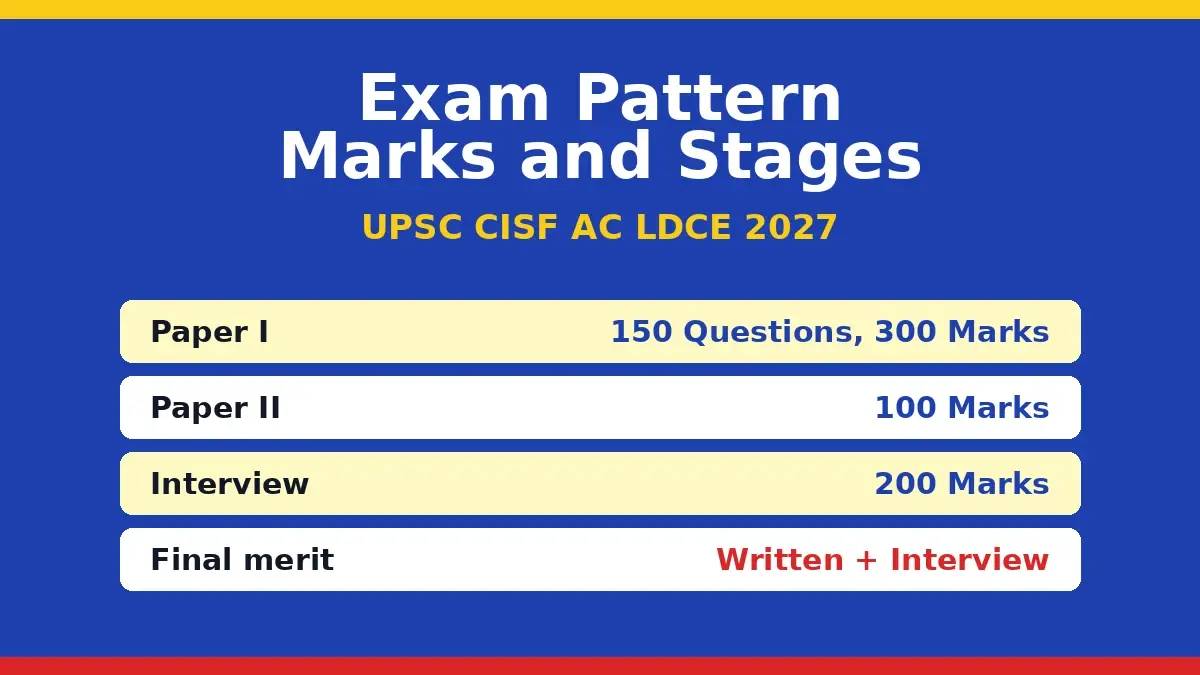
The written examination has two papers. Paper I carries 300 marks with 150 objective questions. Paper II carries 100 marks and tests essay writing, precis writing and comprehension.
Paper I runs for 2 hours and 30 minutes. The questions come in English and Hindi. Paper II runs for 2 hours. The essay can come in English or Hindi, and the precis and comprehension parts come in English only.
| Paper | Questions and marks | Time |
|---|---|---|
| Paper I: General Ability and Intelligence and Professional Skill | 150 objective questions, 300 marks | 2 hours 30 minutes |
| Paper II: Essay, Precis Writing and Comprehension | 100 marks | 2 hours |
| Written examination total | 400 marks | Two papers on 14 March 2027 |
The notification states no negative marking rule for Paper I. Candidates should still mark answers with care, because the Commission fixes minimum qualifying marks separately in each paper. The notification gives no numeric qualifying mark, so a balanced score in both papers matters more than a high score in one paper alone.
Paper I gives 2 marks for every question on an average count of 300 marks for 150 questions. Time runs at one minute for every question across the full paper. Practice with a timer will build the speed this paper demands.
What does Paper I Part A cover?
Paper I Part A carries 75 questions for 150 marks. This part tests General Mental Ability, General Science, Current Events of National and International Importance and General Awareness.
The General Awareness part covers the history of India, Indian and World Geography and Indian Polity and Economy. These areas match the general study base of most UPSC pattern examinations, and steady daily reading will cover the current events part well.
| Part A area | What to study |
|---|---|
| General Mental Ability | Reasoning and mental ability questions |
| General Science | Basic science concepts and daily science awareness |
| Current Events | National and international events of importance |
| General Awareness | History of India, Indian and World Geography, Indian Polity and Economy |
Part A rewards a wide and steady study base. Read a good newspaper daily for current events, revise basic science from school level books and practice mental ability questions in short daily sets. Small daily work beats one heavy study day in a week for this part.
What does Paper I Part B cover?
Paper I Part B carries 75 questions for 150 marks. This part tests professional skill for CISF work. The notification names CISF related professional skills, Law, Computer and Service Rules in this part.
Part B gives serving personnel a fair ground to use their duty knowledge. A candidate with strong ground duty experience and clear service rule knowledge can score well here with planned revision.
| Part B area | Focus for preparation |
|---|---|
| CISF professional skills | Duties, security work and professional knowledge of CISF |
| Law | Legal provisions linked with CISF duties |
| Computer | Basic computer knowledge and use |
| Service Rules | CISF service rules and departmental provisions |
Revise service rules from official rule books and unit instructions. Read the CISF Act provisions linked with your duties and revise basic computer terms from a standard book. Duty experience helps here, and rule book revision turns that experience into marks.
How does Paper II work?
Paper II carries 100 marks in 2 hours. The paper has three parts. The parts are Essay, Precis Writing and Comprehension.
A candidate can write the essay in English or Hindi. The precis and the comprehension parts come in English only. Candidates who write well in Hindi should still practice English precis and comprehension with full focus, because those parts carry marks in English only.
| Paper II part | Language rule |
|---|---|
| Essay | English or Hindi |
| Precis Writing | English only |
| Comprehension | English only |
Write one essay and one precis every week from now. Read your writing after one day and cut extra words with a firm hand. Clear and short writing scores well in precis work, and regular writing builds that skill faster than reading alone.
What happens after the written examination?
The selection process runs in clear stages. Candidates first sit in the written examination. Candidates who clear the written stage then face the Physical Standard Test and the Physical Efficiency Test. A medical examination follows, and the Interview and Personality Test forms the last scored stage.
The physical and medical stages carry qualifying status only. These stages give no marks, and a candidate must clear each stage to stay in the process. The final merit rests on the written examination marks and the interview marks together.
| Stage | Marks and nature |
|---|---|
| Written examination | 400 marks, scored stage |
| Physical Standard Test and Physical Efficiency Test | Qualifying only, no marks |
| Medical examination | Qualifying only, no marks |
| Interview and Personality Test | 200 marks, scored stage |
| Final merit | Written marks plus interview marks |
Eligibility and document verification run through the process. The proper channel verification and the original document checks at later stages confirm your service, your age and your qualification claims. Keep originals ready at every stage.
What are the physical efficiency test standards?
The Physical Efficiency Test checks running, jumping and shot put ability. Male candidates must run 100 metres in 16 seconds and 800 metres in 3 minutes 45 seconds. Male candidates must also clear a long jump of 3.5 metres and a shot put of 4.5 metres with a 7.26 kg shot.
Female candidates must run 100 metres in 18 seconds and 800 metres in 4 minutes 45 seconds. Female candidates must clear a long jump of 3.0 metres. The shot put column for female candidates carries no standard in the notification table.
| Event | Male standard | Female standard |
|---|---|---|
| 100 metre race | 16 seconds | 18 seconds |
| 800 metre race | 3 minutes 45 seconds | 4 minutes 45 seconds |
| Long jump | 3.5 metres | 3.0 metres |
| Shot put 7.26 kg | 4.5 metres | No standard shown |
Candidates get three chances for the long jump and the shot put events. Train for these events with steady weekly practice from now, because the physical stage comes after the written result and leaves little time for fresh fitness work.
What are the physical standards for height, chest and eyesight?
Male candidates need a height of 165 cms. Female candidates need a height of 157 cms. A height relaxation of 5 cms applies for the categories and regions named in the notification, and the list covers Scheduled Tribe candidates and candidates from the Garhwali, Kumaoni, Dogra, Maratha and North Eastern region groups among the named groups.
Male candidates need a chest measure of 81 to 86 cms with a minimum expansion of 5 cms. Weight should stay in proportion to height and age. The eyesight standard asks for distant vision of 6/6 and 6/9 without correction and near vision of N6 and N9 without correction, with high grade colour vision.
| Standard | Male | Female |
|---|---|---|
| Height | 165 cms | 157 cms |
| Chest | 81 to 86 cms, minimum 5 cms expansion | No chest standard shown |
| Weight | In proportion to height and age | In proportion to height and age |
| Eyesight | Distant 6/6 and 6/9, near N6 and N9, without correction | Distant 6/6 and 6/9, near N6 and N9, without correction |
The notification also states conditions for candidates with LASIK eye surgery. The conditions cover a minimum period after surgery and a corneal thickness standard. Candidates with eye surgery should read the medical appendix in the notification with full care before the medical stage.
What medical standards will the board check?
Candidates must stay medically fit under the medical standards in the notification. The medical board checks the body systems and the fitness points named in the medical appendix.
The notification names knock knee, flat foot, varicose veins and squint as rejection grounds. Tattoo rules and pregnancy test provisions also find a place in the medical standards. A Detailed Medical Examination and a Review Medical Examination form this stage, and the review step runs within 24 hours where the rules allow it.
Get a basic health check done in your unit medical room well before the stage. A known health point found early gives you time to understand your position, while a surprise finding at the board leaves no time for any step.
How much weight does the interview carry?
The Interview and Personality Test carries 200 marks. The written examination carries 400 marks. The final merit adds the written marks and the interview marks for candidates who clear every qualifying stage.
The interview share stands at one third of the total merit marks. A candidate with a mid level written score can still reach the merit list with a strong interview, and a candidate with a high written score can lose ground with a weak interview. Prepare for the interview from the start of your study plan.
Interview preparation for a departmental candidate rests on service knowledge and clear thinking. Read your force history, your current duty area and national current events with care. Practice short and clear answers on your service record and your reasons for seeking the Assistant Commandant rank.
Where is the exam centre and how will the admit card come?
The written examination will take place at New Delhi on 14 March 2027. The notification names New Delhi as the exam centre for this examination. Candidates posted outside Delhi should plan travel and leave well in advance.
The e-Admit Card will come on the UPSC online application website. The notification states that the e-Admit Card issues on the last working day of the week before the examination date. No admit card will come by post.
| Point | Detail |
|---|---|
| Exam date | 14 March 2027 |
| Exam centre | New Delhi |
| e-Admit Card website | upsconline.nic.in |
| e-Admit Card timing | Last working day of the week before the exam date |
| Admit card by post | No admit card by post |
Download the e-Admit Card on the day it comes and read every line on it. Check your name, your roll number, the centre address and the reporting instructions. Keep two print copies and one copy on your phone.
Which mistakes should candidates avoid?
The first mistake is a late start on the proper channel copy. The online form closes on 15 December 2026 and the hard copy must reach the headquarters by 1 January 2027. A form submitted on the last online day leaves thin time for unit movement and headquarters verification.
The second mistake is a loose service count. Count 4 years of regular service in the named ranks as on 1 January 2027 and include the basic training period in the count. Read the punishment conditions in the rules once and match them with your service record.
The third mistake is single paper focus. The Commission fixes minimum qualifying marks separately in each paper. A candidate who prepares only Paper I and leaves Paper II writing for the last month risks a qualifying failure in Paper II.
The fourth mistake is fitness delay. The physical stage follows the written result, and running fitness takes weeks to build. Keep a light fitness routine through the study months and raise the load after the written exam.
| Mistake | Safe step |
|---|---|
| Online form on the last day | Apply in the first week and move the hard copy at once |
| Wrong service count | Count service as on 1 January 2027 from official records |
| Paper II left for the end | Write one essay and one precis every week |
| Fitness started late | Keep weekly running and jump practice through the study months |
| Admit card wait by post | Download the e-Admit Card from upsconline.nic.in in exam week |
How should a candidate prepare in the coming weeks?
Divide your week across the three scored areas. Give Paper I Part A a daily slot for mental ability, science, current events and general awareness. Give Paper I Part B a fixed slot for CISF professional skills, law, computer basics and service rules. Give Paper II two writing slots in every week.
Practice Paper I with a timer. The paper gives 150 questions in 2 hours and 30 minutes, so timed sets of 50 questions in 50 minutes will build the right speed. Review every wrong answer on the same day and note the topic for revision.
Use mock test practice for the objective parts. Our mock test categories page lists UPSC and defence practice sets for general ability and awareness topics. Regular mock test practice shows your weak topics early and gives your revision a clear order.
Serving personnel who came through the Sub Inspector route can also read our SSC CPO examination update for the wider CAPF Sub Inspector picture. The LDCE preparation on this page still rests on the UPSC notification pattern given above.
| Week part | Work to finish |
|---|---|
| Daily study | Current events reading and mental ability practice |
| Paper I Part B | Service rules revision and professional skill topics |
| Paper II writing | One essay and one precis with self review |
| Timed practice | One timed objective set with same day review |
| Fitness | Running practice and long jump practice |
Keep the plan light enough for duty days. A plan that fits duty hours will run for sixteen weeks, and a heavy plan that breaks in the second week gives no benefit. Short daily work with weekly review wins this preparation race.
What should a candidate do this week?
Read the notification once from the official UPSC page. Check your rank, your service count, your age and your graduation record against the rules. Fill the online form this week itself and start the proper channel copy movement in your unit.
Set your study table after the form work. Fix daily slots for Part A, Part B and writing practice. Start fitness practice at a light level and keep it steady through the study months.
The UPSC CISF AC LDCE 2027 gives serving CISF personnel a direct route to the Assistant Commandant rank. Seven vacancies make the contest tight, and early application work with steady preparation gives a candidate the best chance in this examination.
Sources
All facts on this page come from the official UPSC notification for CISF AC (Exe) LDCE 2027 dated 25 November 2026 and the official pages named below. Candidates should read the notification and the rules on the official websites before they apply.
Union Public Service Commission notification page: upsc.gov.in notification page for CISF AC (Exe) LDCE 2027. UPSC online application website: upsconline.nic.in. Central Industrial Security Force website for the rules: cisf.gov.in. Union Public Service Commission home page: upsc.gov.in.