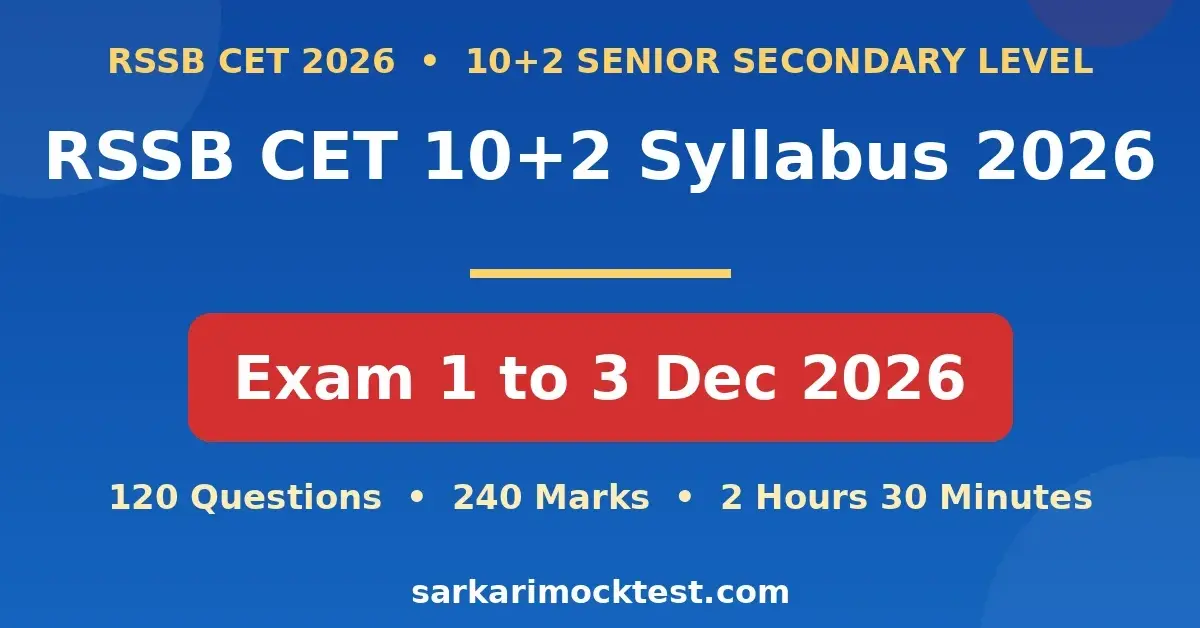
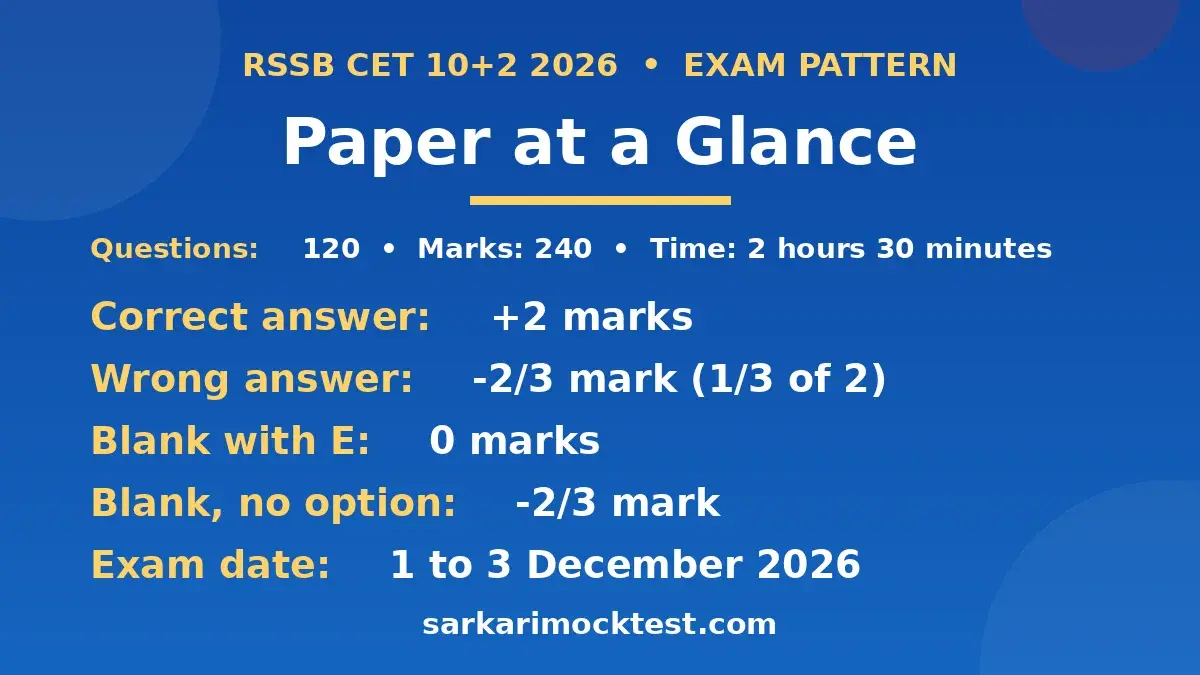
The RSSB CET 10+2 Senior Secondary Level 2026 paper has 120 multiple choice questions for 240 marks, to be answered in 2 hours 30 minutes on an OMR sheet. The exam runs from 1 to 3 December 2026, in two shifts each day. A candidate needs 40 percent to qualify, 35 percent for SC and ST candidates, and the score stays valid for three years. The admit card comes out on 26 November 2026.
Listen to this article in 1 minute:
The Rajasthan Staff Selection Board, known as RSSB, runs this test for candidates who have passed Class 12 and want a state government post in Rajasthan. The notification is Advertisement Number 08/2026, dated 23 June 2026. This page gives the full RSSB CET 10+2 Syllabus 2026, all 13 areas, the revised exam pattern, the qualifying marks, and the 14 services this one test opens. Every fact here comes from the board's own advertisement, its exam schedule notice of 16 November 2026, and its admit card notice of 19 November 2026.
What is the RSSB CET 10+2 Senior Secondary Level 2026?
The Common Eligibility Test, or CET, is a qualifying test. A qualifying score lets a candidate sit the main exam for a post, when the board or the department advertises that post. The Senior Secondary CET is for posts that need a Class 12 pass.
The Graduate Level CET is a separate test for posts that need a degree. The board holds CET under the Rajasthan Subordinate and Ministerial Service (Common Eligibility Test) Rules, 2022.
The table below gives the whole test at a glance.
| Detail | RSSB CET 10+2 Senior Secondary Level 2026 |
|---|---|
| Exam | Common Eligibility Test (CET), Senior Secondary Level 2026 |
| Board | Rajasthan Staff Selection Board (RSSB), Jaipur |
| Advertisement | Number 08/2026, dated 23 June 2026 |
| Exam date | 1 to 3 December 2026 (revised, two shifts a day) |
| Mode | Offline, pen and paper, OMR answer sheet |
| Questions | 120 multiple choice questions |
| Marks | 240 marks, 2 marks for each question |
| Time | 2 hours 30 minutes |
| Negative marking | One third of the question's marks for each wrong answer |
| Qualifying marks | 40 percent (35 percent for SC and ST) |
| Score validity | 3 years from the date of the result |
| Applications | Closed on 23 July 2026 |
| Admit card | Comes out on 26 November 2026 |
| Official website | rssb.rajasthan.gov.in |
When is the exam, and why did the date change?
The exam runs from 1 to 3 December 2026. That is the revised date. The first date in the advertisement was 23 to 25 October 2026.
The board changed the date in its revised exam calendar of 28 September 2026, because the local body and Panchayati Raj elections clashed with the exam calendar. The board then issued a detailed exam schedule notice on 16 November 2026, which fixed the six shifts, and an admit card notice on 19 November 2026.
The board allots each candidate one day and one shift across the three days and six shifts. The admit card will carry the exact day, shift, centre name and address. No candidate can choose a day or a shift.
| Day | Date | Shifts |
|---|---|---|
| Day 1 | Tuesday 1 December 2026 | Two shifts (Shift 1 and Shift 2) |
| Day 2 | Wednesday 2 December 2026 | Two shifts (Shift 3 and Shift 4) |
| Day 3 | Thursday 3 December 2026 | Two shifts (Shift 5 and Shift 6) |
| Shift | Timing |
|---|---|
| Morning shift | 10:00 AM to 12:30 PM |
| Evening shift | 3:00 PM to 5:30 PM |
| Event | Date |
|---|---|
| Notification | 23 June 2026 (Advertisement 08/2026) |
| Online application starts | 24 June 2026 |
| Online application closes | 23 July 2026, 11:59 PM |
| First exam date announced | 23 to 25 October 2026 |
| Revised exam date (revised calendar) | 1 to 3 December 2026 |
| Exam schedule notice | 16 November 2026 |
| Exam city slip | 21 November 2026 |
| Admit card notice | 19 November 2026 |
| Admit card | 26 November 2026 |
| Answer key | To come after the exam |
| Result | To come after the exam |
What is the exam pattern?
One paper, one sitting, 120 questions. Every question carries the same marks. The advertisement publishes no section wise question split, so no subject has a fixed number of questions.
The paper mixes all 13 areas in one paper. A candidate cannot skip an area and still score well, because the questions can come from any part of the list.
| Part | Detail |
|---|---|
| Questions | 120 multiple choice questions |
| Marks | 240 marks, 2 marks for each question |
| Time | 2 hours 30 minutes |
| Mode | Offline, OMR answer sheet, pen and paper |
| Options | 5 options for each question, A, B, C, D and E |
| Section wise split | None published by the board |
| Normalisation | Yes, when the exam runs in more than one shift |
| Medium | Hindi and English |
The clock gives 150 minutes for 120 questions, which works out to 75 seconds per question. That is the whole budget. A candidate who spends three minutes on one hard question has already spent the time of two easy ones. The plan in the last section of this page uses that number.
How does negative marking work?
The negative marking is easy to get wrong. Each question is worth 2 marks, and the board deducts one third of the question's marks for a wrong answer. One third of 2 is 2 by 3, so a wrong answer costs 2 by 3 of a mark. Some pages on the internet say a wrong answer costs 1 by 3 of a mark.
That is wrong. It costs 2 by 3. The advertisement states the rule in plain words, and the numbers below follow the advertisement.
The table below shows what five different attempts score. The last column is the percent out of 240. Only the first four attempts cross the 40 percent line.
| Right | Wrong | E marked | Score | Percent |
|---|---|---|---|---|
| 110 | 5 | 5 | 216.67 | 90.3 percent |
| 100 | 15 | 5 | 190 | 79.2 percent |
| 85 | 25 | 10 | 153.33 | 63.9 percent |
| 70 | 40 | 10 | 113.33 | 47.2 percent |
| 60 | 50 | 10 | 86.67 | 36.1 percent |
Read the fourth row twice. A candidate who gets 70 right and 40 wrong still qualifies, because the 40 wrong answers cost only 26.67 marks in total. A candidate who guesses on every doubtful question loses marks slowly, but a candidate who leaves questions blank without marking E loses the same 2 by 3 of a mark and risks disqualification as well. The next section explains the rule that decides this.
What is Option E, and why does it matter?
Every question has five options. A, B, C and D are answers. E means not attempted.
If a candidate wants to skip a question, the candidate must darken the E circle with a blue ballpoint pen. That is the whole rule, and it decides marks in two ways.
| Rule | What happens |
|---|---|
| E darkened for a question | 0 marks lost, the question is counted as not attempted |
| No option darkened at all | Minus 2 by 3 mark, the same as a wrong answer |
| More than 12 questions left blank without E | Disqualification from the exam |
| Pen to use | Blue ballpoint pen for the OMR sheet |
| How many E marks are allowed | No limit, as long as E is darkened for each skipped question |
The number 12 comes from the advertisement. Ten percent of 120 questions is 12 questions. A candidate who leaves 13 questions blank without darkening any option is disqualified, even if the other 107 answers are all right. A candidate who darkens E for those same 13 questions loses nothing for them.
The habit to build in mock tests is simple. Never leave a circle empty. If the answer is not known, darken E and move on.
Work the numbers once and the rule sticks. Take 20 questions you do not know. If you guess all 20 and get 5 right and 15 wrong, you score 10 marks and lose 10.05 marks, a net of almost zero from 20 attempts. If you darken E on all 20, you score zero and lose zero.
If you leave all 20 blank, you lose 13.4 marks without answering a single one. The lesson is plain: never leave a question with no circle. If you do not know the answer, darken E. Then move on.
A guess is worth it only when you can rule out at least two of the four answers. With two options left, the odds turn in your favour even after the 2 by 3 penalty. With all four options open, the guess breaks even at best, so darken E.
The board gives 10 extra minutes after the exam time so candidates can check that every question has a circle darkened. Use those minutes for the circles, not for solving new questions.
What are the 13 syllabus areas?
The RSSB CET 10+2 Syllabus 2026 lists 13 areas in one combined syllabus. The board publishes no section wise question split, so the areas below carry no official weight. Some websites print weightages, such as 9 percent for history or 13 percent for reasoning.
Those numbers are estimates counted from old papers, not the board's figures. Treat them as a rough guide at best, and prepare every area.
| Number | Area | What it covers in one line |
|---|---|---|
| 1 | History of Rajasthan | Ancient sites, rulers, 1857, movements, integration of Rajasthan |
| 2 | Art and Culture of Rajasthan | Architecture, painting, folk music, saints and folk deities |
| 3 | Geography of India | Physical features, rivers, wildlife, disaster management, climate |
| 4 | Geography of Rajasthan | Land, climate, water, soils, tribes, minerals, tourism |
| 5 | Indian Political System, with special reference to Rajasthan | Constitution, rights, Parliament, courts, Rajasthan state bodies |
| 6 | Economy of Rajasthan | Crops, industry, poverty, schemes, MGNREGA, VB-G RAM G |
| 7 | Everyday Science | Physics, chemistry, biology, space, environment, health |
| 8 | Logical Reasoning and Mathematics | Reasoning, series, clock, algebra, geometry, data and graphs |
| 9 | Current Affairs | State and national events, famous people, duties, the 2022 Act |
| 10 | Public Health | First aid, CPR, drug abuse, youth fitness, social media risks |
| 11 | Computer Knowledge | Computers, memory, file system, MS Office |
| 12 | General Hindi | Grammar, sandhi, samas, vocabulary, letter writing, official Hindi |
| 13 | General English | Tense, voice, narration, translation, passages, letters |
Two areas are new or changed in the 2026 advertisement. Public Health is new in full. The Rajasthan economy section now names MGNREGA and the Viksit Bharat Guarantee for Rozgar and Aajeevika Mission Gramin, called VB-G RAM G.
The paper also drops the separate Economy of India area that the Graduate Level paper has, and it folds the India history area into Rajasthan history and culture. A candidate who studies from an old list will miss these changes. The sections below give the full topic list for each area, exactly as the advertisement prints it.
What does the history and culture syllabus cover?
History and culture form the largest Rajasthan block in the paper. The board lists the topics in the advertisement, and the tables below follow that list.
| Topic group | What to cover |
|---|---|
| Ancient civilisations and sites | Major ancient civilisations and archaeological sites |
| Rulers and achievements | Prominent rulers and their achievements |
| The Revolt of 1857 | The role of Rajasthan in the revolt |
| Peasant movements | The peasant movements in Rajasthan |
| Tribal movements | The tribal movements in Rajasthan |
| Praja Mandal movements | The Praja Mandal movements in Rajasthan |
| Integration of Rajasthan | How Rajasthan came together as one state |
| Historical personalities | Prominent historical personalities |
| Topic group | What to cover |
|---|---|
| Architecture and painting | Architecture and paintings of Rajasthan |
| Folk music and theatre | Folk music, musical instruments, dance, and theatre |
| Religious sects and folk deities | Major religious sects and folk deities |
| Social life | Dresses, ornaments, fairs, festivals, customs, and traditions |
| Language and literature | Language, dialects, and literature |
| Art and culture personalities | Prominent personalities in the fields of art and culture |
The questions ask for the event, the person and the place together, not for a single date alone. A candidate who reads one page on each ancient site, each movement and each ruler will cover most of this area.
What does the geography syllabus cover?
Geography splits into two areas, India and Rajasthan. The India part is physical first, then human. The Rajasthan part follows the same shape, but every topic is about the state. Learn the India topics with a map in front of you, and the Rajasthan topics with the state map.
| Topic group | What to cover |
|---|---|
| Physical features | Mountains, Plateaus, Deserts and Plains |
| Rivers and water | Major Rivers, Dams, Lakes and Oceans |
| Wildlife | Wildlife and Sanctuaries |
| Disaster and climate | Disaster Management and Climate change |
| Topic group | What to cover |
|---|---|
| Physical features | Major physical features of Rajasthan |
| Climate | Climatic conditions |
| Vegetation | Natural vegetation |
| Soils | Major soils |
| Rivers and water | Rivers, dams and lakes |
| Natural resources | Mineral, Forest, Water resources |
| Livestock | Livestock |
| Wildlife | Wildlife, sanctuaries and conservation |
| Population | Distribution, growth, density, literacy, sex ratio |
| Tribes | Major tribes |
| Tourism | Tourism in Rajasthan |
Two topics in the Rajasthan list catch candidates out. The first is natural resources, which the advertisement splits into mineral, forest and water, so learn each group separately. The second is population, which the board asks for by distribution, growth, density, literacy and sex ratio. Learn the numbers for the state, not just the definitions.
What does the polity syllabus cover?
Polity starts with the making of the Constitution and ends with the panchayat in the village. The Rajasthan part is as long as the India part, so give it the same time. A candidate who knows only the Union topics will lose half the questions in this area.
| Topic group | What to cover |
|---|---|
| Constitution | Nature of the Indian Constitution, Preamble, Fundamental Rights and Directive Principles of State Policy |
| Union institutions | President, Prime Minister and Council of Ministers, Parliament, Supreme Court, Election Commission |
| Rajasthan political system | Governor, Chief Minister, State Legislative Assembly, High Court, RPSC |
| Rajasthan administration | State Election Commission, State Information Commission, Human Rights Commission, Chief Secretary, District Administration |
| Local government | Local Self-Government and Panchayati Raj |
The list of Rajasthan bodies is the part to revise last, because it is a list of names and posts. Learn one line for each body: what it does, who heads it, and whether it is constitutional or statutory. The same method works for the Union bodies.
What does the Rajasthan economy syllabus cover?
The 10+2 paper has only one economy area, and it is about Rajasthan alone. The Graduate Level paper adds a separate Economy of India area, but this paper does not. Every topic below is about the state: its crops, its industries, its poverty and the schemes that fight it. The two scheme names in the list are the newest part of the syllabus, so learn them exactly.
| Topic group | What to cover |
|---|---|
| Role of sectors | Role of Industry, Agriculture, Animal Husbandry and Mineral Sector in the development of the state |
| Features and issues | Economy of Rajasthan: Features and Issues |
| State income and budget | Concepts of State Income and Budget |
| Handicrafts and problems | Handicraft Industry, Unemployment, Drought, and Famine |
| Welfare schemes | Various Welfare Schemes and Acts in Rajasthan |
| Development institutions | Development Institutions |
| Small enterprises | Small-Scale Enterprises, Financial Institutions |
| Rural development | Role of Panchayati Raj Institutions in Rural Development |
| MGNREGA | Mahatma Gandhi National Rural Employment Guarantee Act |
| VB-G RAM G | Viksit Bharat Guarantee for Rozgar and Aajeevika Mission, Gramin |
VB-G RAM G is the new name in the list. The advertisement prints it in full, and a question can ask for the full form. MGNREGA is the older scheme in the same row of the syllabus. Learn both names, and learn which one is the current flagship scheme for rural employment.
What does the everyday science syllabus cover?
Science in this paper is everyday science, not research science. The topics are the ones a school science book covers, plus health, environment and technology with a Rajasthan angle. A candidate with a science background should not spend too long here. A candidate without one should read the school level facts and move on.
| Topic group | What to cover |
|---|---|
| Changes in matter | Physical and chemical changes, oxidation and reduction reactions, catalysts |
| Metals and compounds | Metals, non-metals and their important compounds; some important compounds used in daily life |
| Carbon | Carbon and its important compounds, hydrocarbons, allotropes of carbon, CFCs/Freons, CNG, polymers, soap and detergents |
| Light | Reflection of light and its laws, dispersion of light, types of lenses, defects of vision and correction |
| Space and IT | Space and information technology, India's space research programme |
| Genetics | General terminology related to genetics, Mendel's law of inheritance, structure of chromosomes, nucleic acids, central dogma of protein synthesis, sex determination in humans |
| Environment | Environmental study: ecosystem structure, biotic components, energy flow, biogeochemical cycles |
| Biotechnology | Biotechnology: general information, bio-patents, new plant varieties, transgenic organisms |
| Animals and plants | Economic importance of animals and plants |
| Blood and disease | Blood groups, blood transfusion, Rh factor, pathogens and human health, malnutrition, human diseases: causes and cures |
The health rows overlap with the Public Health area, which the advertisement lists separately. The difference is the angle. Science asks how a disease spreads and what a blood group is.
Public Health asks what to do about it, from first aid to drug abuse. Study the two areas together and the overlap becomes revision, not extra work.
What does the reasoning and maths syllabus cover?
Reasoning and maths is one area, and it is the most scoring part of the paper for a candidate who practises. The topics are fixed and the question types repeat. The list below is the full list from the advertisement. A mock test on this area alone is worth more than reading notes, because speed is the skill being tested.
| Topic group | What to cover |
|---|---|
| Blood relation | Blood relation problems |
| Series | Number series, Alphabet series |
| Clock and calendar | Clock, Calendar |
| Arithmetic | LCM and HCF, Average, Profit and Loss, Percentage |
| Interest and ratio | Simple Interest, Compound Interest, Ratio-Proportion |
| Time and work | Time, Speed, Distance, Work and Time |
| Area | Area of Triangle, Circle, Ellipse, Rectangle, Sphere, Cylinder |
| Volume | Volume of Sphere, Cylinder, Cube, Cone |
| Data and graphs | Graphical representation of data |
| Code and arrangement | Code and Decode; Sitting arrangement |
| Mental ability | Mental and analytical ability |
The maths list is long, but it is all school level maths. No topic here needs a degree in mathematics. The trap is time.
Two hours 30 minutes for 120 questions gives 75 seconds per question, and a long calculation can eat the time for two easy questions. In a mock test, mark a hard maths question, move on, and come back only if time remains.
What do current affairs and public health cover?
Current affairs is the only area with no fixed list, because the news keeps changing. The advertisement fixes the fields, and the candidate fills them with the news of the months before the exam. For a December 2026 exam, the news of 2026 matters most, with extra weight on the last six months.
| Topic group | What to cover |
|---|---|
| Contemporary events | Major contemporary events at the state and national level, in politics, economy, society, culture, technology, geography, ecology, sports and other fields |
| Famous personalities | Famous personalities |
| Programmes and policies | State and national level programmes and policies |
| Civic duties | Fundamental Duties and moral values |
| Unfair Means Act | Salient provisions of the Rajasthan Public Examination (Measures for Prevention of Unfair Means in Recruitment) Act, 2022 |
The 2022 Act is in the syllabus for a reason. It is the law that governs this very exam. A candidate caught using unfair means in a Rajasthan public exam can be debarred for up to three years and fined under the Act. The advertisement prints the salient provisions as a syllabus topic, so a question can ask what the Act covers.
Public Health is new in the 2026 advertisement. It has only four topics, and all four are practical. A candidate can cover this area in one sitting, and should, because a new area is where easy questions come from.
| Topic group | What to cover |
|---|---|
| First aid and CPR | Basics of first aid, cardiopulmonary resuscitation (CPR) |
| Drug abuse | Types of drug abuse and measures to prevent it |
| Youth fitness | Physical and mental fitness of youth |
| Social media risks | Health risks of social media addiction and its preventive measures |
What does the computer syllabus cover?
Computer Knowledge is a short area with three topics. The Graduate Level paper adds cyber security, e-services and artificial intelligence, but this paper keeps the list basic. The rest is the computer knowledge a candidate uses every day.
| Topic group | What to cover |
|---|---|
| Computers | Characteristics and Applications of Computers |
| Computer organisation | Computer Organisation including Memory (RAM, ROM), File System, Input and Output Devices |
| MS Office | MS Office: MS Word, MS Excel and Spreadsheet, MS PowerPoint |
The MS Office row is the one to practise, not just read. A question can ask which menu holds a function, or what a file extension means. Open Word, Excel and PowerPoint once, click through the menus, and the answers will stick better than any note.
What do General Hindi and General English cover?
The two language areas test grammar and use, not literature. Hindi has the longer list, because it covers grammar, vocabulary, official language and official letter writing. English tests the standard grammar topics plus translation, comprehension and letter writing. Both areas are objective, including the letter writing questions, which ask about the structure of a letter.
| Topic group | What to cover |
|---|---|
| Tenses | Tenses and Sequence of Tenses | Voice | Voice: Active and Passive |
| Narration | Narration: Direct and Indirect |
| Articles and determiners | Use of Articles and Determiners |
| Prepositions | Use of Prepositions |
| Translation | Translation of Simple sentences (Hindi to English) |
| Glossary | Glossary of official and technical terms (with Hindi versions) |
| Synonyms and antonyms | Synonyms, Antonyms, One word substitution |
| Comprehension | Comprehension of a given passage |
| Letter writing | Knowledge of writing letters: Official, Demi-Official, Informal |
| Topic group | What to cover |
|---|---|
| Parts of speech | Sangya, Sarvanam, Visheshak, Avyay, Kriya |
| Sandhi | Sandhi and Sandhi Vichhed |
| Samas | Samas, its types, formation and Vigrah of Samasik words |
| Upsarg and Pratyay | Upsarg and Pratyay |
| Vocabulary | Paryayvachi, Vilom, Anekarthi words |
| Word pairs | Shabd Yugm |
| Word correction | Shabd Shuddhi: correction of wrong words |
| Sentence correction | Vakya Shuddhi: correction of wrong sentences |
| One word | One word for a phrase |
| Idioms and proverbs | Muhavare and Lokoktiyan |
| Technical terms | Hindi equivalents of English technical terms |
| Official letters | Knowledge of official letters: Karyalaya Aadesh, Paripatra, Adhisuchana, Ardh Shaskiya Patra, Nivida, Press Vigyapti |
The Hindi list uses Hindi terms because the advertisement prints them in Hindi. A candidate who studies Hindi grammar in English will not recognise the question words. Learn the Hindi terms for each topic, and practise with Hindi questions.
How many marks do you need to qualify?
Forty percent. That is 96 marks out of 240. For SC and ST candidates, the board allows a relaxation of up to 5 percent, which takes the line to 35 percent, or 84 marks.
The qualifying line is the same for every candidate in a category, and it does not move with the paper. A hard paper and an easy paper have the same 40 percent line.
| Rule | Detail |
|---|---|
| Qualifying marks, general | 40 percent, 96 marks out of 240 |
| Qualifying marks, SC and ST | 35 percent, 84 marks out of 240 (5 percent relaxation) |
| Normalisation | Scores are normalised when the exam runs in more than one shift |
| Attempts | No limit on attempts |
| Best score | The best valid score counts for the next main exam |
| Score validity | 3 years from the date of the result |
Normalisation matters here because the exam runs in six shifts. A hard shift and an easy shift are levelled out before the merit list is drawn, so a candidate in a hard shift is not punished for it. The board normalises the scores, and the normalised score is the one that counts. A candidate cannot calculate the normalised score at home, because it needs the scores of all candidates in all shifts.
The three year validity is the newest rule in this section. The Personnel Department notification of 16 January 2025 fixed the CET score validity at three years from the result date. A 2026 score will stay valid till the result date in 2029, and the best valid score is the one that counts for the next main exam.
Which 14 services does a CET score open?
A CET score opens 14 services. The CET itself has no vacancy count of its own. The board announces the vacancies for each post later, in that post's own main exam advertisement.
A candidate who asks how many posts CET 2026 has is asking the wrong question. CET is the gate. The posts sit behind it.
| Number | Service | Post |
|---|---|---|
| 1 | Rajasthan Forest Subordinate Service | Forester (Vanpal) |
| 2 | Rajasthan Minority Affairs Subordinate Service | Hostel Superintendent |
| 3 | Rajasthan Excise Subordinate Service (Preventive Branch) | Jamadar Grade-II |
| 4 | Rajasthan Police Subordinate Service | Constable |
| 5 | RPSC Office Clerical Service | Clerk Grade-II |
| 6 | Rajasthan Secretariat Clerical Service | Clerk Grade-II |
| 7 | Rajasthan Subordinate Office Clerical Service | Junior Assistant |
| 8 | RSSB Clerical Service | Junior Assistant |
| 9 | Rajasthan Panchayati Raj | Junior Assistant |
| 10 | Rajasthan State Agriculture Marketing Board | Junior Assistant |
| 11 | Rajasthan Krishi Upaj Mandi (Mandi Samiti) | Junior Assistant |
| 12 | Board of Secondary Education Rajasthan | Clerk Grade-II |
| 13 | Rajasthan State Pollution Control Board | Junior Assistant |
| 14 | Jaipur Development Authority Subordinate Service | Junior Assistant |
Three posts share a name and differ by department. Clerk Grade II appears three times, once in the RPSC office, once in the Secretariat and once in the Board of Secondary Education. Junior Assistant appears seven times, across the subordinate offices, the board, Panchayati Raj, the marketing board, the mandi samiti, the pollution control board and the Jaipur Development Authority. The main exam advertisement for each post will carry its own qualification, age and experience rules, which come from that post's service rules, not from the CET advertisement.
The RSSB Clerk Grade II and Junior Assistant page on this site covers a related RSSB recruitment, and the Rajasthan RSSB JEN recruitment page covers the Junior Engineer posts from the same board. Both show how a board advertisement turns into a post with its own vacancy count, which is exactly what CET does not have.
Who could apply, and what did it cost?
Applications closed on 23 July 2026, so no candidate can apply now. The rules below still matter, because they decide who can sit the main exams later, and they will be the same shape when CET runs again. The education rule is simple.
A Senior Secondary pass, or an equivalent qualification, from a recognised board. Candidates in the final year of senior secondary education could also apply, but they must hold the qualification the service rules ask for before final selection.
| Rule | Detail |
|---|---|
| Education | Senior Secondary (Class 12) pass or equivalent from a recognised board |
| Final year students | Could apply, must meet the qualification per service rules before final selection |
| Minimum age | 18 years |
| Maximum age | 40 years |
| Age counted as on | 1 January 2027 |
| Category | Age relaxation |
|---|---|
| General category women | 5 years more |
| SC, ST, OBC, MBC and EWS men of Rajasthan | 5 years more |
| Women of those categories of Rajasthan | 10 years more |
| Persons with benchmark disabilities | 5 years more |
| Widows and divorced women | No upper age limit |
| Ex-servicemen | Up to 50 years, 55 years where low post experience is mandatory |
| Other cases | As listed in the advertisement |
The fee is a One Time Registration fee, paid once through the SSO portal. It covers every later application, so a candidate who has paid it before pays nothing again. The fee depends on the category, and the table below gives the full list.
| Category | One Time Registration fee |
|---|---|
| General category, and creamy layer OBC and MBC | Rs 600 |
| Non creamy layer OBC and MBC, EWS, SC and ST of Rajasthan | Rs 400 |
| Candidates with disabilities | Rs 400 |
| Reserved categories from other states | Rs 600, the general fee |
| Anyone who has paid OTR before | Nothing again |
How is this CET different from the Graduate Level CET?
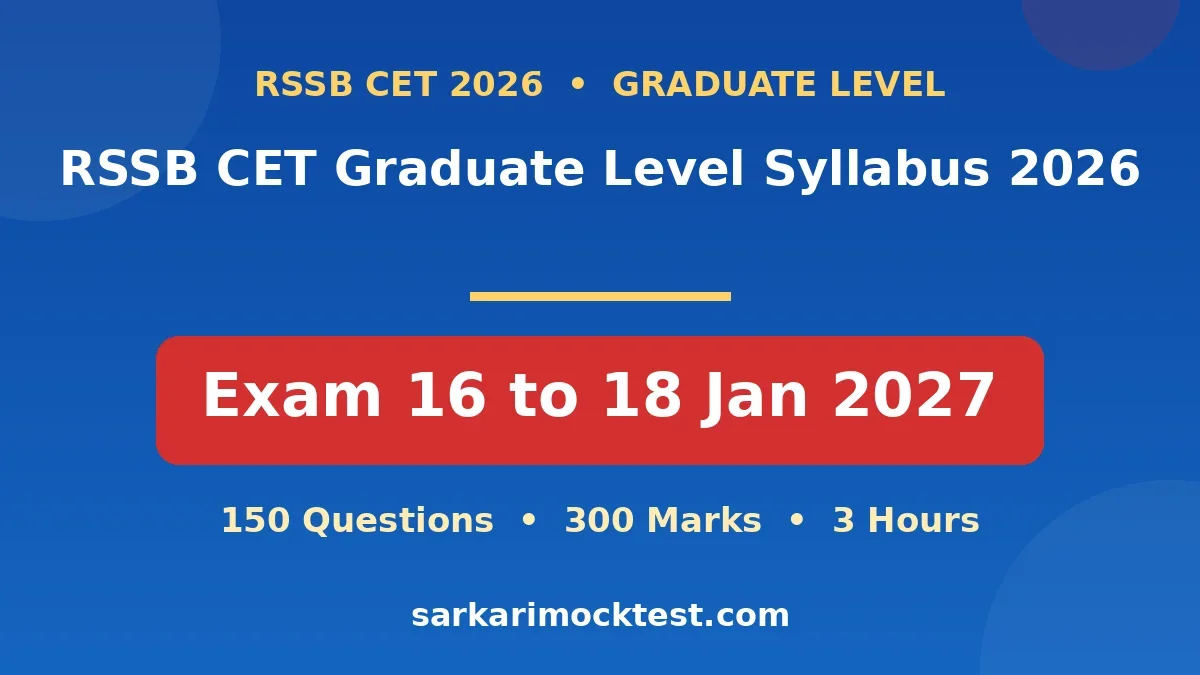
The board runs CET at two levels, and the two tests are easy to confuse. The Senior Secondary CET is for posts that need a Class 12 pass. The Graduate Level CET is for posts that need a degree. The Senior Secondary exam runs from 1 to 3 December 2026.
The Graduate Level exam runs from 16 to 18 January 2027. A candidate who holds a degree can sit the Graduate Level test. A candidate who holds only a Class 12 pass cannot.
| Part | Senior Secondary Level | Graduate Level |
|---|---|---|
| Advertisement | 08/2026 | 09/2026 |
| Eligibility | Class 12 pass | Bachelor's degree |
| Questions | 120 | 150 |
| Marks | 240 | 300 |
| Time | 2 hours 30 minutes | 3 hours |
| Syllabus areas | 13 | 14 |
| Exam dates | 1 to 3 December 2026 | 16 to 18 January 2027 |
| Applications closed | 23 July 2026 | 2 August 2026 |
| Negative marking | One third of the question's marks | One third of the question's marks |
| Qualifying marks | 40 percent (35 percent SC and ST) | 40 percent (35 percent SC and ST) |
| Score validity | 3 years | 3 years |
| Services opened | 14 | 12 |
The Senior Secondary syllabus has 13 areas. It drops the separate Economy of India area, and it folds the India history area into Rajasthan history and culture. Science and Technology becomes Everyday Science. The Graduate Level paper is longer, wider and harder in the same proportion.
The Rajasthan CET Graduate Level syllabus page on this site covers the Graduate Level test in full. Read it only for the Graduate Level test. Nothing on that page applies to the December dates.
One correction belongs here. Some pages on the internet say the Senior Secondary syllabus has 11 areas. That count is wrong.
The advertisement lists 13 areas, and the overview table above names all 13. Count them before trusting any page that prints 11.
What should you study first with seven days left?
Today is 24 November 2026, and the exam starts on 1 December 2026. That is seven days, and the admit card comes out in the middle of them, on 26 November. Seven days is enough to cover the weak areas once and revise them once, if the days are planned by area and not by mood.
The plan below gives each day one job. It starts with Rajasthan, because Rajasthan topics appear in almost every area of this paper.
| Day | Date | Job |
|---|---|---|
| Day 1 | Wednesday 25 November | Rajasthan history, art, culture and heritage: sites, rulers, movements, folk music |
| Day 2 | Thursday 26 November | Download the admit card first, then geography of India and Rajasthan: maps, rivers, minerals, tribes |
| Day 3 | Friday 27 November | Polity: Constitution, Union and Rajasthan bodies, then Rajasthan economy: schemes, MGNREGA, VB-G RAM G |
| Day 4 | Saturday 28 November | Everyday science, then computer knowledge and public health: first aid, CPR, drug abuse |
| Day 5 | Sunday 29 November | Reasoning and maths with timed practice, 75 seconds per question |
| Day 6 | Monday 30 November | General Hindi and General English, then current affairs of 2026 |
| Exam day | Your allotted day, 1, 2 or 3 December | Revision only, admit card, photo ID, centre route check, OMR practice |
Two rules make the plan work. First, every day ends with a mock test on that day's areas, with the real marking: plus 2 for a right answer, minus 2 by 3 for a wrong one, and E darkened for every skipped question. Second, no new topic starts on the exam day.
The exam day is for revision and for the admit card, not for a new book. A candidate who follows the plan will have seen every weak area twice before the exam.
What mistakes cost marks?
Most marks in CET are lost to rules, not to hard questions. The paper is school level in most areas. The rules are what punish a careless candidate. The table below lists the mistakes that cost the most, and what to do instead.
| Mistake | What it costs | What to do instead |
|---|---|---|
| Trusting the old 23 to 25 October date | Reaching the centre a month early, or missing the December exam | Follow the revised date, 1 to 3 December 2026, and check the admit card |
| Trusting pages that say 150 questions | Preparing for a paper that does not exist | Prepare for 120 questions, 240 marks, 2 hours 30 minutes, as the advertisement states |
| Leaving a question blank without darkening E | Minus 2 by 3 mark for every such question | Darken E for every question skipped |
| Leaving more than 12 questions blank without E | Disqualification from the exam | Count the blanks in every mock test, and keep them under 12 |
| Blind guessing on every doubtful question | 2 by 3 of a mark lost per guess | Guess only when two options can be ruled out, else darken E |
| Skipping Rajasthan topics | Marks lost in almost every area of the paper | Start with Rajasthan history, geography and polity, as the plan above does |
| Ignoring Public Health | Easy marks lost in a new area with only four topics | Cover it in one sitting, first aid, CPR, drug abuse, fitness, social media |
| Assuming CET has a vacancy count | Waiting for a vacancy list that will never come for CET itself | Treat CET as the gate, and watch for the main exam advertisements of the 14 services |
| Missing the admit card | No entry to the exam hall | Download it on 26 November from the SSO Recruitment Portal |
Where do you download the admit card?
The admit card comes out on 26 November 2026, and the board announced the date in its notice of 19 November 2026. When it comes, it will be online only. Nothing comes by post.
The candidate logs in to the SSO portal, opens the Recruitment Portal, and downloads it from there. Keep the application number, the date of birth and the SSO ID ready before the admit card window opens.
| Detail | Admit card |
|---|---|
| Status | Comes out on 26 November 2026 |
| Date announced | 19 November 2026 notice |
| Mode | Online only, nothing by post |
| Where | SSO portal, Recruitment Portal (recruitment.rajasthan.gov.in) |
| Keep ready | Application number, date of birth and SSO ID |
| What it carries | Exam day, shift, centre name and address, reporting time |
| City slip | Out on 21 November 2026, shows the district only |
| Districts | 38 districts of Rajasthan |
The city slip and the admit card are two different documents. The slip came out on 21 November 2026 and shows the district. The admit card shows the exact centre.
Check the district on the slip first, then the centre on the admit card, and plan travel from the district, not from the centre name alone. The board announces the admit card release in newspapers and on its website, rssb.rajasthan.gov.in. Check the board website, not a tracker page, for the release.
Candidates waiting on other admit cards can read the SSC CHSL exam city slip page, the TSLPRB SI admit card page, and the CLAT 2027 admit card page on this site. The SSC CHSL syllabus page, the CLAT 2027 syllabus page and the UP Super TET syllabus page carry the same style of full syllabus for their exams. The full list of exams is on the states mock test page, and the 12th ke baad govt job list covers the exams open right after Class 12.
Check the board website for the admit card first, then take the weakest of the 13 areas of the RSSB CET 10+2 Syllabus 2026 and give it the next two days. Seven days is enough, if the days are used by area and not by mood.
Sources
Rajasthan Staff Selection Board, rssb.rajasthan.gov.in: Common Eligibility Test (Senior Secondary Level) 2026, Advertisement Number 08/2026, dated 23 June 2026, scheme of examination and syllabus; revised exam calendar of 28 September 2026, exam from 1 to 3 December 2026; exam schedule notice of 16 November 2026, six shifts, 10:00 AM to 12:30 PM and 3:00 PM to 5:30 PM; admit card notice of 19 November 2026, exam district from 21 November 2026, provisional e-admit card from 26 November 2026. Department of Personnel, Government of Rajasthan: notification of 16 January 2025, CET score validity of three years; notification of 3 August 2024, minimum qualifying marks of 40 percent, with 5 percent relaxation for SC and ST candidates.
Internal links in this article point to live pages on sarkarimocktest.com, verified on 24 November 2026: the Rajasthan CET exam city page, the RSSB CET Graduate Level syllabus page, the RSSB Clerk Grade II and Junior Assistant page, the Rajasthan RSSB JEN recruitment page, the SSC CHSL exam city slip page, the TSLPRB SI admit card page, the CLAT 2027 admit card page, the SSC CHSL syllabus page, the CLAT 2027 syllabus page, the UP Super TET syllabus page, the 12th ke baad govt job list, and the states mock test page.