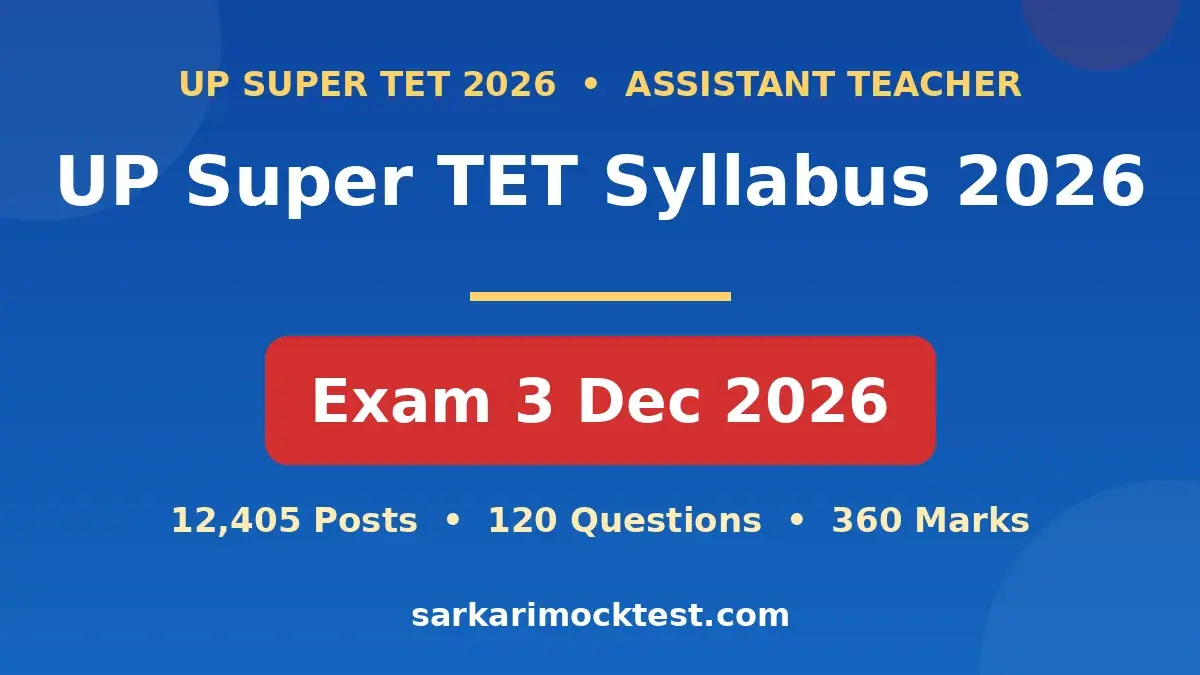
The UP Super TET 2026 paper has 120 questions for 360 marks. A right answer adds 3 marks and a wrong answer takes away 1 mark. The paper runs for 2 hours on an OMR sheet, in Hindi and English.
The exam falls on 3 December 2026, and the admit card comes out on 30 November 2026. This page gives the full UP Super TET Syllabus 2026, subject by subject, with the revised Super TET exam pattern, the merit rules, and a nine day plan for the time left.
The syllabus comes from the notification the Uttar Pradesh Education Service Selection Commission issued on 15 September 2026 for UP Super TET 2026, Advertisement Number 05/2026, for 12,405 Assistant Teacher posts in government primary schools. The commission runs the exam. The application portal sits at apply.upessc.org. The city slip came out on 23 November 2026, and the admit card follows on 30 November 2026.
The first thing to get right is the pattern, because the pattern changed. Guides still show the old paper: 150 questions, 150 marks, 2 hours 30 minutes, and no negative marking. That paper belongs to an earlier cycle. The notification carries a revised pattern, and the revised pattern is the one to prepare for.
120 questions, 360 marks, and a wrong answer costs 1 mark
The revised Super TET exam pattern is simple to state and easy to get wrong in practice. The paper holds 120 multiple choice questions for 360 marks, to be answered in 2 hours on an OMR sheet. Each correct answer adds 3 marks.
Each wrong answer, or each question with more than one answer marked, takes away 1 mark. A blank answer costs nothing. The paper comes in Hindi and English. If the commission runs the exam in more than one shift, it will apply normalisation to the scores, so a hard shift and an easy shift are levelled out before the merit list is drawn.
The OMR sheet needs care of its own. Fill the circle fully, and fill only one circle per question. A question with more than one circle marked counts as a wrong answer, and it costs 1 mark just like a wrong answer. Use the pen the admit card asks for, and keep the sheet flat and clean, because a torn or folded sheet can fail to scan.
| Part | Detail |
|---|---|
| Questions | 120 multiple choice |
| Marks | 360 |
| Time | 2 hours |
| Correct answer | +3 marks |
| Wrong answer | -1 mark |
| Blank answer | 0 marks |
| Mode | Offline, OMR sheet |
| Medium | Hindi and English |
| Normalisation | If more than one shift |
Normalisation needs one line of its own. If the exam runs in more than one shift, the commission adjusts the scores so that a hard shift and an easy shift count the same. The commission applies normalisation only when it runs more than one shift.
A single shift needs no adjustment, because every candidate sat the same paper. The raw marks go in, the normalised marks come out, and the merit list uses the normalised marks. A candidate should focus on the paper in front of them, because the shift they sat makes no difference to the final list after normalisation.
Two hours for 120 questions gives 1 minute per question. A minute per question sounds tight until you count the easy ones. Some questions take 20 seconds. Those saved seconds pay for the hard ones.
The candidates who run out of time usually spend too long on the first hard question they meet. Mark it, move on, and come back if time remains. Solve the questions in any order you like. The OMR sheet counts the marks, and the order you solved them in makes no difference.
Read the marking scheme twice, because it changes how a candidate should treat a doubtful question. A correct answer adds 3 marks. A wrong answer takes away 1 mark. A blank answer costs nothing.
The gap between a right guess and a wrong guess is 4 marks, and that gap punishes blind guessing across a 120 question paper. A candidate who guesses on 20 questions and gets 5 right will gain 15 marks and lose 15 marks on the other 15, and the guesswork will have bought nothing. A candidate who answers only the questions they know, and leaves the rest blank, keeps every mark they earned. That logic holds even for a candidate who feels short on time.
The old pattern still sits on many pages. It lists 150 questions and 2 hours 30 minutes, with no negative marking. That pattern came from an earlier cycle, and the notification replaced it.
Any page that still shows 150 questions for this exam is showing old information. Prepare for 120 questions, 360 marks, and 1 mark off for a wrong answer.
The UP Super TET city slip page on this site carries the exam city details, the admit card date, and the same revised pattern in full.
The UP Super TET Syllabus 2026: ten subject areas, and what each one actually asks
The UP Super TET Syllabus 2026 is the same for every candidate, whatever the post group. The syllabus lists ten subject areas. The paper draws all 120 questions from these ten areas, and the list below gives the topics inside each one.
Read it as a checklist, and tick off the topics you have already covered. Every topic below comes from the notification syllabus, and the order below follows the order the notification uses.
| Subject area | What it covers |
|---|---|
| Language: Hindi, English, Sanskrit | Grammar, unseen passage, comprehension |
| Mathematics | Number work, algebra, geometry, statistics |
| Science | Science in daily life, motion, energy, human body |
| Environment and Social Study | Earth, India, Constitution, economy, heritage |
| Teaching Methodology | Teaching methods, learning principles, evaluation |
| Child Psychology | Child development, learning theories, special needs |
| General Knowledge and Current Affairs | India, Uttar Pradesh, world events, awards |
| Logical Knowledge | Analogy, coding, series, puzzles, direction |
| Information Technology | Computers, internet, teaching apps |
| Life Skill, Management and Aptitude | Ethics, motivation, values, teacher roles |
Every candidate in this exam has already passed a teacher eligibility test, UP TET Paper 1 or CTET Paper 1, and that changes how to read this syllabus. The eligibility test already covered child development, language pedagogy, and classroom teaching, so those parts of the Super TET syllabus will feel familiar. The Super TET adds the parts the eligibility test did not cover in the same depth: Mathematics, Science, General Knowledge and Current Affairs, Reasoning, Information Technology, and Life Skill.
A candidate who treats the whole syllabus as new will waste days on ground they already covered. Start with the new parts, and revise the familiar parts last. Use your TET notes for the familiar parts, and buy no new book for them. Spend the hours on the new parts instead.
Language is the first area, and it covers three languages at once: Hindi, English, and Sanskrit. The shape is the same for all three: grammar, an unseen passage, and comprehension. Hindi asks for grammar and an unseen passage, and the grammar topics are alankar, samas, vilom, paryayvachi, ras, sandhi, tadbhav and tatsam, lokokti, muhavare, one word substitutes, anekarthi shabd, and sentence correction covering ling, vachan, karak, kaal, vartani, and truti. The passage tests comprehension, and the grammar questions reward a candidate who knows the rules rather than one who guesses.
English asks for active and passive voice, parts of speech, transformation of sentences, direct and indirect speech, punctuation and spellings, word meanings, vocabulary and usage, idioms and phrases, and fill in the blanks. The passage work is the same as Hindi: read the passage, then answer from it. Sanskrit follows the same shape as the other two languages, with grammar, an unseen passage, and comprehension, and a candidate who is strong in Hindi grammar will find the Sanskrit grammar questions familiar in shape, even if the words are different.
Mathematics splits into five kinds of work. Number work covers numerical ability, decimals, place value, fractions, divisibility, and factors. Arithmetic covers interest, profit and loss, percentage, average, ratio, and the unitary method.
Algebra covers general algebra and identities. Geometry covers area, volume, and general geometry. Statistics covers general statistics. The questions use school level maths, and the marks go to a candidate who can work fast and clean, because the paper gives about a minute per question.
Science stays close to daily life. The topics are science in daily life, motion, force, energy, distance, light, sound, the world of creatures, the human body, health, hygiene and nutrition, environment and natural resources, and the stages of matter and substance. Most of it is school level science, and the questions test whether a candidate can apply it, rather than whether they can recite a definition. A candidate who can explain why a bulb glows or why clean water matters will do better here than one who memorised a list.
Environment and Social Study is the widest section in the paper. The topics are the structure of the earth, rivers, mountains, continents, oceans and animals, natural resources, latitude and longitude, the solar system, Indian geography, the Indian freedom struggle, Indian social reformers, the Indian Constitution, the governance system, traffic and road safety, the Indian economy and its challenges, cultural heritage, environmental protection, and natural disaster management. It rewards a candidate who has read the same facts more than once, because the questions mix geography, history, polity, and the environment in a single section.
Teaching Methodology covers the working tools of a primary teacher. The topics are teaching methods and skills, the principles of teaching and learning, current Indian society and elementary education, inclusive education, new initiatives for elementary education, educational evaluation and measurement, early reading skills, and educational management and administration. The questions ask how a teacher would use these tools in a classroom, and a candidate with a D.El.Ed or B.Ed has already met most of them in training.
Child Psychology covers individual differences, the factors that affect child development, the identification of learning needs, creating environments for learning, theories of learning and their practical use in classroom teaching, and special arrangements for disabled students. The section tests whether a candidate understands how children learn. The questions usually describe a classroom situation and ask for the right response, so a candidate should think like a teacher answering, and not like a student memorising a theory.
General Knowledge and Current Affairs covers important contemporary events, current affairs, international and national events, important events related to the state, location and personality based questions, international and national awards and sports, and culture and art. The current affairs part covers the last few months, and a candidate who has read the news through the year has already done most of this work. A candidate starting now should read the last six months in short sittings, a month per sitting, rather than trying to cover a year in one week.
Logical Knowledge covers analogies, assertion and reasons, binary logic, classification, clocks and calendars, coded inequalities, coding and decoding, critical reasoning, cube and number series, puzzles, symbols and notations, Venn diagrams and dice, data interpretation, and direction sense and letter series. The questions are short and rule based, and they reward a candidate who has practised the same types before. A series question that does not yield in 45 seconds is a question to leave, because the marks for it are the same 3 marks as the easy one after it.
Information Technology covers information and the use of information technology, computers, the internet, smartphones, open education resources, apps useful in teaching, digital teaching material for teaching skill development, and classroom teaching and school management. The section is small, and it asks about technology a teacher actually uses, from a computer in the classroom to an app that helps with teaching.
Life Skill, Management and Aptitude covers professional conduct and ethics, motivation, the role of the teacher as facilitator, monitor, leader, guide, and counsellor, constitutional and human values, and the effective use of the punishment and reward system. The questions test judgement more than memory, and they usually describe a situation in a school and ask what a teacher should do.
Who can apply, and what it costs
The recruitment fills 12,405 Assistant Teacher posts in government primary schools under the UP Super TET 2026 notification. The posts split into two groups, Urban Primary and Attached Primary, and the table below gives the full split exactly as the notification lists it.
| Post group | Total posts | Category split |
|---|---|---|
| Urban Primary | 11,508 | UR 4,746, EWS 1,116, OBC 3,069, SC 2,379, ST 198 |
| Attached Primary | 897 | UR 378, EWS 7, OBC 164, SC 348, ST 0 |
| Total | 12,405 | Urban Primary 11,508 plus Attached Primary 897 |
A candidate needs a graduation degree with a D.El.Ed, also called BTC, or a B.Ed, or an equivalent professional qualification, and a pass in UP TET Paper 1 or CTET Paper 1 for primary classes. The age limit is 21 to 40 years, with a 5 year relaxation for eligible SC, ST, and OBC candidates of Uttar Pradesh. A candidate from another state cannot claim the same relaxation under this rule.
The fee depended on the category. General, OBC, and EWS candidates paid Rs 1,000. SC and ST candidates paid Rs 500. PwD candidates paid Rs 300.
The fee window closed on 15 October 2026, before the application window closed on 28 October 2026. The correction window ran till 19 October 2026. Applications are closed now, and no fresh applications are possible.
Three things the notification leaves open
The notification settles the pattern, the posts, and the dates for UP Super TET 2026. The Super TET exam pattern changed this cycle, while the ten subject areas stayed the same. The notification leaves three things open, and a candidate should know all three before the exam.
First, no subject-wise question count for the revised paper appears in the notification material published so far. The split that tracker pages print belongs to the old 150 mark paper, with 40 marks for Language and 30 for General Knowledge. Those numbers describe a paper that no longer exists.
Prepare all ten areas, and watch the admit card and the notification for the final split. A candidate who prepares only Language and General Knowledge, because the old split gave them the most marks, is betting on numbers that no longer apply.
Second, the commission has announced no official cut off or qualifying marks for 2026. The merit list follows the 100 point weightage, and the commission will draw the line after the result. A page that prints a 2026 cut off today is guessing, and the old cut offs from earlier cycles belong to different papers with different marks.
Third, the Sanskrit detail is thin. The UP Super TET Syllabus 2026 gives the Language section as grammar, an unseen passage, and comprehension, and it lists the Hindi and English topics in full. For Sanskrit it gives the same shape and no separate topic list. A candidate should prepare Sanskrit grammar and comprehension the same way as Hindi, and skip the search for a detailed Sanskrit list.
The written exam is 60 marks out of 100
The written exam is the biggest single part of the merit list, and it is still only 60 marks out of 100. The other 40 marks come from academic records. The commission gives 10 marks out of 100 for Class 10, 10 for Class 12, 10 for graduation, and 10 for teacher training, each counted as 10 percent of the percentage scored in that stage.
The written exam gives the remaining 60, counted as 60 percent of the percentage scored in the paper. Document verification and counselling follow the merit list.
| Part | Weight |
|---|---|
| Written exam | 60% |
| Class 10 | 10% |
| Class 12 | 10% |
| Graduation | 10% |
| Teacher training | 10% |
| Total | 100% |
Take a candidate with 80 percent in Class 10, 75 percent in Class 12, 70 percent in graduation, and 75 percent in teacher training, who scores 240 out of 360 in the written exam. The academic part gives 8 plus 7.5 plus 7 plus 7.5, which is 30 marks. The written exam gives 60 percent of 66.7 percent, which is 40 marks. The total is 70 out of 100.
The example shows why the written exam matters most, and why a strong academic record still helps: the same written score with a weak academic record would land several marks lower.
The weightage cuts both ways. A candidate with a strong academic record can afford a weaker written score and still make the list, because the academic part can add up to 40 marks. A candidate with a weak academic record needs a stronger written score to cover the gap, because the written exam is the only part they can still change.
The academic marks are already fixed. The written exam is the one part a candidate can still improve in the nine days left, and it carries 60 marks out of 100.
3 December, and why 4 December keeps appearing
The city slip notice, dated 23 November 2026, says the UP Super TET 2026 examination is on 3 December 2026. The earlier exam date announcement said 3 and 4 December 2026. The city slip is the newest official word, so this page leads with 3 December.
The slip you download will also carry a date, and that date is the one that applies to you. The admit card from 30 November 2026 will carry the final date and shift, and the admit card is the last word before the exam.
The admit card carries more than the date. It carries the shift, the centre name and address, the reporting time, and the instructions for the day, including what to carry and what to leave at home. Read it the day it comes out, and read it again the evening before the exam. A candidate who reads the admit card twice rarely faces a surprise at the gate.
Why would an exam need two days at all? A recruitment of 12,405 posts draws a very large number of candidates, and a single day may not hold them all in the available centres. That is the practical reason an earlier announcement named two days.
The city slip notice may name one day because the commission has now fixed each candidate to a single day, and your slip tells you which day is yours. That reading fits both statements. Treat it as a possible explanation, because no official note explains the change in words.
Plan for both days until your admit card arrives. Keep 4 December 2026 open as well. If your slip and your admit card both name 3 December 2026, you can tighten the plan then.
Nine days left: a plan that fits the time
The exam falls on 3 December, and today is 24 November. Nine days is enough to fix the plan, and it is not enough to start a new subject. The UP Super TET Syllabus 2026 is wide, and nine days is enough to revise it, not to learn it fresh. The work now is revision, mock tests, and the timer, in that order.
Day one and day two belong to Language and Mathematics, the two sections where practice converts fastest into marks. Solve one timed section of each, then read every solution, including the ones you got right. The solutions to right answers teach the faster method, and the faster method is what the timer rewards.
Day three belongs to Teaching Methodology and Child Psychology. Read the topic lists once more, then answer questions on classroom situations, because that is how this section asks its questions.
Day four belongs to General Knowledge, Science, and Environment and Social Study. Read the current affairs of the last six months in short sittings, a month per sitting, and revise the static facts that repeat every year: the Constitution, the national parks, the dams, the awards, and the sports events of 2026.
Day five belongs to Reasoning, Information Technology, and Life Skill. These three sections are short, and a day is enough to cover them with timed practice. Day six is a full mock test with the real pattern: 120 questions, 360 marks, 2 hours, with +3 for a right answer and -1 for a wrong one. Score it, and write down the section where the timer hurt most.
Score the mock with the real marking: +3 for a right answer, -1 for a wrong one, and 0 for a blank. A score built on the real marking tells you where you stand, and a score built on guesswork tells you nothing.
Review the mock the same day, while the questions are still fresh. Re-solve every question you got wrong, and write the topic next to it. Then open the syllabus list above and tick the topics that produced the wrong answers.
Those ticks show the work for day seven, and they show it better than a score alone. A mock that only gives a score wastes half its value. The review is where the marks come from.
Day seven is the weakest section, and only that section, with timed practice until the timer stops hurting. The admit card also comes out on day seven, 30 November, so download it the same day and check the date, the shift, and the centre on a map.
Day eight is light. Revise the formula sheet, read the current affairs of November once, and stop studying by the evening.
Day nine, 2 December, is lighter still. Check the centre route, keep the admit card and a photo ID in one folder, and sleep early. A tired candidate on exam morning is a candidate who has already lost marks.
If your admit card names 4 December, you get one more day. Use it for a mock test, and not for a new topic. One full mock test with a review of every wrong answer beats reading a new book.
Three mistakes that cost marks
The first mistake is preparing for the old paper. The 150 question, 150 mark, 2 hour 30 minute paper with no negative marking belongs to an earlier cycle, and every guide written before the notification describes a paper that no longer exists.
A candidate who practises with that pattern, or who plans to guess freely because there is no negative marking, is preparing for last year. Check the date on every guide you read. A guide with no mention of the 120 question paper and the -1 mark describes a different exam.
The second mistake is guessing under a -1 mark. A wrong answer costs 1 mark, and a blank answer costs nothing. The rule is simple.
If you can eliminate two options, answer. If you cannot eliminate even one, leave it blank. A blank question costs nothing, and that is the cheapest price for a question you cannot answer.
The third mistake is booking travel before the admit card arrives. The city slip names the city, and the admit card names the date, the shift, and the centre. Book a return ticket only after the admit card confirms your date and shift.
You can change a train ticket booked a day early. A missed train on exam morning leaves no second chance.
Other exams run on the same commission and the same calendar. The UPESSC TGT recruitment page on this site covers 17,735 teacher posts from the same commission. The UP Special TET result page covers the special educator teacher eligibility test.
Candidates waiting on other admit cards can read the SSC CHSL exam city slip page, the Rajasthan CET exam city page, and the TSLPRB SI admit card page. The full list of exams is on the states mock test page, and the 12th ke baad govt job list covers the exams open right after Class 12.
Check the admit card first, on 30 November. It carries the final date, the shift, and the centre. Then take the weakest of the ten subject areas in the UP Super TET Syllabus 2026 and give it the next two days.
Sources
Uttar Pradesh Education Service Selection Commission, upessc.up.gov.in: Super TET 2026 notification, Advertisement Number 05/2026, dated 15 September 2026; exam pattern, syllabus topics, vacancies 12,405, application dates, fee, age limit, and merit weightage. UPESSC application portal, apply.upessc.org: city slip notice, 23 November 2026; admit card from 30 November 2026; exam date 3 December 2026.
Internal links in this article point to live pages on sarkarimocktest.com, all verified on 24 November 2026: the UP Super TET city slip page, the UPESSC TGT recruitment page, the UP Special TET result page, the SSC CHSL exam city slip page, the Rajasthan CET exam city page, the TSLPRB SI admit card page, the 12th ke baad govt job list, and the states mock test page.