

Shubham Kumar Sah
VERIFIED AUTHORSarkari Job Analyst & Content Writer
Published Work & Notifications
Explore mock tests, syllabus guides, and official notification alerts posted by Shubham Kumar Sah.
 full
full
Delhi Police Constable 2027 Mock Test: Free PDF & CBT Sets
Last Updated: August 17, 2026 Delhi Police Constable 2027 Mock Test: Clear Written Exam and Running Easily Wearing the Khaki uniform in the national capital is a very big dream for lakhs of students. The Staff Selection Commission (SSC) takes this exam for Delhi Police. You must clear the written Computer Based Test (CBT) first to reach the physical running ground. The written paper has 100 questions, strict negative marking, and covers GK, Reasoning, Maths, and Computer. If you do not practice a Delhi Police Constable 2027 mock test on a computer screen, you will run out of time in the real exam hall. Read this simple and long guide to know the full SSC syllabus, physical running rules, exact cutoff trends, and daily study strategy. Why I Built This Mock Test Series Many aspirants see the word "Constable" and think that it is an examination which you have no need to prepare deeply for. It is precisely at this point that the majority of them make their huge mistake. My name is Shubham Kumar Sah and I operate MockTestCenter.com as I myself am preparing for the UPSC. I don't usually spend a great deal of time considering state constable exams, except that I come across candidates who regarded the Delhi Police Constable exam as a minor concern, relied only on reading books without practicing time limits, and were therefore eliminated by those who practiced daily mocks. That's the actual requirement of the exam: 100 objective questions worth 100 marks. The questions cover General Knowledge, Current Affairs, Reasoning, Numerical Ability, and Computer Fundamentals. It seems simple in theory. The difficulty people experience is what comes after the written exam—this selection process isn't limited to just knowing the answer. If you perform well in memorizing facts but go into the exam hall unprepared to skip hard questions, you'll have wasted the marks you had already earned fairly by guessing blindly and losing 0.25 marks per wrong answer. Furthermore, you must also pass a very tough Physical Endurance and Measurement Test (PE&MT) to get the job. The entire series is based on this combination. The mock exams offered here follow the actual 100-question, 100-mark format with a 0.25 negative marking, which means the written section is no longer a mystery. Since real-time exam pressure is neglected more than any other stage in exams of this type, we give it the same level of seriousness as the physical test—not treating it as an afterthought added at the end. The written test and the practice materials are available in both Hindi and English. A significant portion of the series remains free since the fact that 'Constable' is regarded as a less demanding exam does not imply that those preparing for it from small villages have less to gain from the result or that they have more money to spend in order to demonstrate that they are ready. I am doing my own exam preparation at the same time as I'm putting this together, so with every item I consider I ask myself this question: would it be of any use to someone before they know their results from the written exam? If the answer is no, then it will not be included on the site. Product Features: How We Train You to Top the Exam Smart preparation requires analyzing where you lose marks. Our testing platform offers modern tools designed to highlight your weak areas and measure your performance against thousands of serious candidates taking the Delhi police constable executive mock test free. 📊 Detailed Performance Analytics Track your subject-wise accuracy, check your average time-per-question, and view a weak-topic visual heatmap showing exactly where you need revision. 🏆 All India Rank + Percentile Real-Time Compete on a live national leaderboard. View your rank, peer comparison, and percentile compared against actual Delhi Police aspirants immediately. 🎯 Adaptive Mock Tests Our system features personalization and adaptive testing. The difficulty adjusts user ke level ke hisaab se. If you score high in Maths, it gives you harder arithmetic questions. 💡 AI-Based Weak Area Recommendation AI-based weak area recommendation matlab sectional analysis milta hai yaha. Kaunsi subject/topic weak hai, aur usko revise karne ka suggestion deta hai. Bilkul ek personal tutor jaisa jo tumhara performance dekh ke batata hai. 📚 Video/Text Explanations & Quality You get detailed Video/text explanations har question ke liye. The explanation quality/depth of answers helps you understand the logic behind every reasoning puzzle. We also offer a "Compare with toppers' answer sheet" feature to improve your attempt strategy. 🏅 Streak & Gamification Maintain your Streak/gamification with badges and daily goals to keep your preparation disciplined every single day without feeling bored. 🚀 Practice Free Daily Current Affairs Quiz Now Official Exam Updates for Delhi Police Constable 2027 The Staff Selection Commission (SSC) strictly manages the recruitment for Delhi Police. Make sure you understand the guidelines for the upcoming cycle. Look at the table below. Component SSC Official Rule Operational Impact Written Exam Format 100 Objective Questions, 100 Marks. The written exam decides if you go to the physical test. Your final rank is heavily based on this because the physical test is only qualifying. Negative Marking 0.25 Marks Penalty per wrong answer For every 4 wrong answers, 1 correct mark is deducted. Guessing blindly will destroy your score. Exam Mode Computer Based Examination (CBT) You must practice reading questions fast on a computer screen. Use a Mock Test of Delhi Police Constable to practice at home. Eligibility Criteria: Age Limit & Education Verify all qualifications before applying on the SSC portal to ensure your form is not rejected. Parameter Official Standards Details Educational Degree 12th Pass (10+2) from a recognized Board. Must be completed before the form's last date. (Relaxation for children of serving Delhi Police personnel). Driving License (Male Only) Valid LMV (Motorcycle or Car) Driving License. Male candidates must have a valid driving license on the date of PE&MT. Learner's license is NOT acceptable. Age (General / EWS) 18 to 25 Years Counted on the specific cutoff date (usually 1st July) of the notification year. Age Relaxation (OBC) Up to 28 Years 3 years of relaxation applied. Valid Central OBC certificate required. Age Relaxation (SC / ST) Up to 30 Years 5 years of relaxation applied. Delhi Police Constable 2027 Important Dates SSC releases a strict exam calendar every year. Keep track of the expected calendar for the upcoming cycle to plan your preparation. Official Notification Release: Expected in August 2027. Online Application Window: August – September 2027. Admit Card Download: November 2027. Written Examination (CBT) Date: November / December 2027. Written Result Declaration: January 2028. Physical Test (PE&MT): February / March 2028. Physical Standards and Efficiency Test (PE&MT) After passing the written exam, you must clear the physical test. It is qualifying in nature, but Delhi Police physicals are known to be very tough. Over 70% of students fail here. Physical Task Male Candidates Requirement Female Candidates Requirement Height 170 cm (Relaxation for ST/Hill areas: 5 cm) 157 cm (Relaxation for SC/ST/Hill areas: 2 cm) Chest Expansion 81 cm to 85 cm (with minimum 4 cm expansion) Not Applicable. Running (Race) 1600 Meters in 6 Minutes. 1600 Meters in 8 Minutes. Long Jump 14 Feet 10 Feet High Jump 3 Feet 9 Inches 3 Feet Written Exam Pattern & Passing Marks The written exam takes place in multiple shifts. Normalization is applied. Taking a Delhi Police Mock Test Free 2027 helps you build the necessary speed to complete 100 questions in 90 minutes. Subject Name Questions Total Marks Time Limit General Knowledge & Current Affairs 50 50 Marks Only 90 Minutes (1.5 Hours) for 100 questions. Reasoning 25 25 Marks Numerical Ability (Maths) 15 15 Marks Computer Fundamentals 10 10 Marks Total Paper 100 Questions 100 Marks Penalty: 0.25 Marks Subject-wise Weightage (What to Read First) Focus your energy where the marks are concentrated. We use Green, Yellow, and Red zones to help prioritize your daily revision schedule. Color Code Subjects Name Preparation Strategy GREEN ZONE(High Yield, Predictable) Reasoning & Computer Reasoning gives 25 direct questions. Computer gives 10 questions. These are the easiest sections to score 30+ marks combined. Practice a Delhi Police Reasoning Mock Test Free daily to increase speed. YELLOW ZONE(Needs Practice) Numerical Ability (Maths) & Current Affairs Maths takes time but has only 15 questions. Focus on Percentage, Profit-Loss, and Time-Work. Current Affairs brings 15-20 questions. Read monthly magazines. Use a Delhi police maths mock test free to test your formulas. RED ZONE(Vast & Time-Intensive) General Knowledge (Static India Level) History, Geography, and Polity are huge. Rely on basic Lucent summaries rather than spending weeks on thick reference books. Actual PYQ Question Distribution Analysis (Last 3 Cycles) Review the actual shift in question distribution across previous Delhi Police examinations to know what to study: Subject Area (Inside GK Section) Previous Cycle 1 Previous Cycle 2 Recent Exam Cycle Average Trend Current Affairs (Sports, Awards, Appts) 18 Qs 22 Qs 20 Qs 20 Questions Indian Polity & Constitution 06 Qs 08 Qs 07 Qs 07 Questions History & Culture (Festivals, Dances) 10 Qs 08 Qs 10 Qs 09 Questions Geography (Rivers, National Parks) 08 Qs 06 Qs 07 Qs 07 Questions General Science 08 Qs 06 Qs 06 Qs 07 Questions Note: The 50 marks of GK are heavily dependent on Current Affairs and Static GK (Culture/Festivals). Do not ignore them. Detailed Micro Syllabus for Written Exam Follow this clear topic-wise breakdown to structure your daily chapter preparation. Section Core Chapters to Master High Scoring Focus General Knowledge & CA Current Affairs: Last 8-10 months (Sports, Appointments, Military Exercises). Static GK: Art & Culture, Indian Festivals, Important Books & Authors. Polity & Geography: Constitution, Rivers, Mountains, Capitals. Current Affairs and Art & Culture give 25+ marks easily. Reasoning Non-Verbal: Figural Analogy, Paper folding, Mirror images. Verbal: Number Series, Coding-Decoding, Blood Relations, Venn Diagrams. Non-verbal figures and Number Series. Numerical Ability (Maths) Arithmetic: Percentages, Ratio, Averages, Interest (SI/CI), Profit/Loss. Time: Time/Distance, Time/Work. Mensuration: Basic 2D & 3D area and volume. Arithmetic forms 12 out of 15 questions. Computer Fundamentals Basics: Elements of Word Processing, MS Excel (Formulas), MS Word. Internet: Web Browsers, Search Engines, URL, HTTP, FTP, Emails. MS Excel formulas and Internet abbreviations. Category-wise Cutoff Trends (Last 5-10 Years) Delhi Police cutoff depends on normalization and the number of vacancies. Because millions of students fill the form, the cutoff is high. Downloading a Delhi Police Mock Test PDF Free Download in Hindi helps you check if you are crossing these marks. General (UR) Male Cutoff: Usually targets 68 to 72 marks out of 100 for final merit. OBC Male Cutoff: Generally settles very close to General, around 66 to 70 marks. EWS Male Cutoff: Ranges between 61 to 65 marks. SC Male Cutoff: Ranges between 58 to 62 marks. ST Male Cutoff: Ranges between 55 to 60 marks. Female Candidates: The cutoff for General females usually stays around 55 to 60 marks. How to Analyze Delhi Police Constable Mock Test Performance Giving a test is only 50% of the work. Analyzing it is the real secret to increasing marks. Check Negative Marking: Look at how many questions you guessed blindly and got wrong. Stop guessing if you cannot eliminate 2 options. Time Management: Check if you spent more than 1 minute on a single Math question. If yes, learn to skip it next time. GK should take less than 15 minutes. Subject Weakness: Use our AI tool to see if you are losing marks in Computer Excel or History. Focus your next 3 days of study only on that weak topic. Preparation Strategy: Written + Physical Together Balance your daily study hours with ground practice to ensure complete readiness. Morning Ground Session (6:00 AM to 7:30 AM): Run 1600 meters. Build stamina slowly. Do not sprint on the first day. Protect your shins from injury. Practice Long Jump twice a week. Morning Concept Block (9:00 AM to 12:00 PM): Study Current Affairs and Static GK. Memorize festivals and dances. Afternoon Practice Block (2:00 PM to 4:00 PM): Solve 50 Reasoning questions daily. Practice coding-decoding and number series. Night Mock & Revision Block (8:00 PM to 10:00 PM): Attempt one full-length Delhi police constable 2027 mock test free online. Review missed answers immediately. Common Mistakes Aspirants Make in Delhi Police Constable ⚠️ Avoid These Fatal Preparation Errors Ignoring Computer Section: Computer gives 10 easy marks. Many students think they know computers and don't study. You must score 8+ in computers to get a good rank. Poor Time Management: Spending 30 minutes on 15 Maths questions. You only have 90 minutes for 100 questions. You must solve GK and Computer in 20 minutes to save time for Reasoning and Maths. Ignoring Physical Training: Over 70% of students who pass the written exam fail the physical test. 1600 meters in 6 minutes is very tough. Start running today. How to Apply: Delhi Police Constable 2027 Application Process Follow these steps on the official SSC portal when registration opens in August 2027: Step 1: Visit the new official SSC portal `ssc.gov.in`. Step 2: Complete One Time Registration (OTR) if you are a new applicant. Keep your Aadhaar ready. Step 3: Log in and locate the "Constable (Executive) Male and Female in Delhi Police Examination-2027" application link. Step 4: Fill in personal details, educational qualifications (12th passing details), and select preferred examination centers. Step 5: Upload your passport photograph (without spectacles/cap) and signature. Live photo capture might be required. Step 6: Pay the application fee (Rs. 100 for General/OBC male candidates; exempt for Female/SC/ST/Ex-Servicemen candidates). Submit and save the PDF. Why Take & Attempt Delhi Police Constable 2027 Mock Test? Taking full-length simulated tests builds examination speed and tests your accuracy. Regular practice ensures you manage the strict 90-minute time limit effectively, master smart elimination techniques, and enter the examination hall fully prepared. Using an online Delhi police constable 2027 mock test helps you get used to the computer screen and timer. Free vs Paid Mock Test — What You Get We provide 2 free mock tests on our platform to let you evaluate our real-time interface, All-India leaderboard, and AI analytics without cost. Our premium series unlocks 30+ full-length practice sets with comprehensive video and text explanations for every single question. Important Books to Read Focus on standard, proven resources rather than collecting multiple books: Subject Standard Book & Resource General Knowledge & Science Lucent General Knowledge. For current affairs, read Speedy or Edu Teria monthly magazines. Reasoning Kiran SSC Reasoning Previous Year Solved Papers. Numerical Ability (Maths) R.S. Aggarwal Quantitative Aptitude or Rakesh Yadav Class Notes. Computer Fundamentals Lucent Computer Book or Arihant Computer Awareness. Practice Sets Take a Delhi police constable executive mock test free on our portal to get CBT experience. How to Use SarkariMockTest.com: From Homepage to Your Result.Getting started with your Delhi Police Constable 2027 Mock Test takes less than a minute. Here is exactly how to find your test and start practicing, step by step.Step 1: Find "Police" on the Homepage.Go to the SarkariMockTest.com homepage. You will see all exam categories listed there, including BPSC, JPSC, UPSC, Indian Army, SSC, Railways, Police, and State Government exams. Click on the "Delhi Police" category card to move ahead.Step 2: Open the Delhi Police Constable Sub-Category.Inside the Police category, you will see all Police-related exams listed as sub-categories — Delhi Police Constable, Delhi Police Head Constable, and more. Click on "Delhi Police Constable" to open all available mock tests for this exam.Step 3: Choose Your Mock Test.You will now see a list of mock tests — free and paid — each following the real Delhi Police Constable exam pattern. New aspirants should start with a free test first to get familiar with the format before moving to paid practice sets. Click on any test card to open it.Step 4: Attempt the Test on Our Exam-Style Interface.Once you click "Start Test," the test opens in a computer-based interface designed to feel like the real exam screen — with a running timer, a question navigation panel, and options to mark questions for review. You can switch between Hindi and English at any point during the test using the language toggle, so your English fluency never gets in the way of showing what you actually know.Step 5: Submit and Check Your Result Instantly.After you finish or the timer runs out, click "Submit Test" to see your result immediately — your score, number of correct and incorrect answers, and the negative marking deducted. You can also download the detailed answer key as a PDF to revisit every question offline and understand exactly where you went wrong. About the Author Shubham Kumar Sah is the founder of MockTestCenter.com, a mock test platform built for students preparing for competitive government exams across India. With over 4 years of experience in the Indian ed-tech and exam preparation space, he is also a UPSC Civil Services aspirant himself, which shapes how he designs and reviews every test on the platform — from the questions asked to the exam interface students see. Shubham has worked on exam preparation content for UPSC, SSC, Railways, Defence, Police, and State Government exams. His focus is simple: give students clear, honest, and free-to-access study material, especially those preparing from small towns and villages who cannot afford expensive coaching institutes in Delhi.
 full
full
Bihar Police Constable Mock Test 2027: Free PDF & Syllabus
Last Updated: August 12, 2026 Bihar Police Constable Mock Test 2027: Clear Written Exam and Running Easily Joining the Bihar Police as a Constable is a very big dream for many students in villages. To wear the Khaki uniform, you have to pass two main stages: the written exam and the physical test. But here is the biggest secret: the written exam is only for passing. Your final job depends completely on the marks you get in running, high jump, and shot put! Taking a Bihar Police Constable Mock Test 2027 helps you pass the written exam easily so you can focus on your physical training. Read this simple and long guide to know the full syllabus, physical marks distribution, and the exact preparation strategy. Why I Built This Mock Test Series I'm Shubham Kumar Sah, founder of Sarkarimocktest.com. My own prep is for UPSC, but Bihar Police SI is where I keep watching aspirants make the same costly miscalculation. Almost everyone studies General Hindi and General Studies with roughly equal effort during Mains. That effort isn't split evenly by the exam itself, though. Bihar SI's final merit comes entirely from Mains Paper 2, the General Studies paper. Hindi only has to clear 30% to qualify — the actual score never enters your final rank. Spend the same hours on both and you've handed half your prep time to a paper that can't move your result past a pass mark. This series is built around that one fact. Prelims mock tests here match the real exam exactly — 100 questions, 200 marks, two hours, 0.2 negative marking per wrong answer — so the screening stage never catches anyone unprepared. But the real weight sits on Paper 2: General Studies, Science, History, Geography, Maths, and Mental Ability. That's the paper that decides who gets selected, and it's where most of what's on this platform is aimed. Every test runs bilingual, in Hindi and English, matching the actual paper format. A good part of the series stays free too, for the reason it always is here — finding your weak subject shouldn't come with a price tag before you've even started. I'm preparing for my own exam at the same time I build this, so I judge everything here by one question: would this actually help someone before their Mains Paper 2 result comes out? If it wouldn't, it doesn't go up. Official Updates for Bihar Police Constable Exam The Central Selection Board of Constables (CSBC) conducts this exam. Before you start your daily study, you must know the exact rules. We have given the details in a simple table so anyone can read it easily without confusion. Update Type Official Information What This Means For You Exam Mode Offline OMR Sheet Exam. You will get a paper and an OMR sheet. You must color the circles with a black or blue pen. You must practice offline using a Bihar police constable mock test 2027 pdf to avoid filling wrong circles. Negative Marking No Negative Marking. This is great news! You will not lose marks for wrong answers. You must attempt all 100 questions in the exam hall. Do not leave any circle blank. Merit List Rule Final Merit is based ONLY on Physical Test. The written exam is only a qualifying step. The real marks that give you the job come from your running speed, high jump, and shot put throw. Bihar Police Constable Important Dates 2027 The CSBC usually releases thousands of vacancies for constables. Do not wait for the form to come out to start your running. Start today. Based on real-time tracking of previous cycles, here is the expected timeline for 2027. Official Notification Release: Expected in May 2027. Online Application Start Date: June 2027. Last Date to Apply: July 2027. Admit Card Download: September 2027. Written Exam (OMR Based): October 2027. Physical Efficiency Test (PET): January - February 2028. Eligibility Criteria: Age Limit & Education The police department has very strict physical and educational rules. If your height is even 1 cm less, you will be rejected on the ground. Please read this detailed table before you search for a Bihar police constable mock test 2027 download. Rule Type Official Requirement Simple Meaning Education Needed 12th Pass (Intermediate). You must have passed Class 12 from Bihar Board, CBSE, Madrasa Board, or any recognized board. Age Limit (Male & Female) General (UR) Male & Female: 18 to 25 Years. Your age must be minimum 18 years. Age is usually counted from 1st August of the exam year. Age Relaxation BC/EBC (Male): 18 to 27 Years.BC/EBC (Female): 18 to 28 Years.SC/ST: 18 to 30 Years. The government gives extra age relaxation to reserved categories. Home Guards get 5 extra years. Height (Male) General / BC: 165 cm.EBC / SC / ST: 160 cm. Check your height carefully before applying. EBC and SC/ST boys get 5 cm relaxation. Height & Weight (Female) All Category Females: 155 cm.Minimum Weight: 48 KG. Girls must be 155 cm tall. Also, your weight must be at least 48 kilograms, otherwise you will fail the medical test. Written Exam Pattern and Passing Marks The written exam has 100 questions. The questions are of 10th class level (Matric level). This makes the exam very easy if you read basic books. Look at the table below. Subject Name Questions Marks Time Limit General Knowledge & Current Affairs Approx 40 40 Marks Only 2 Hours (120 Minutes) for all 100 questions. General Science (Physics, Chem, Bio) Approx 30 30 Marks Hindi & English Approx 15 15 Marks Mathematics Approx 10 10 Marks Total Paper 100 Questions 100 Marks No Negative Marking Passing Marks: You must score at least 30% Marks (30 out of 100) to pass the written exam. If you get less than 30, you will be disqualified directly. However, to get selected for the physical test, you should target at least 70+ marks. Subject-wise Weightage (What to Read First) We use Green, Yellow, and Red colors to show you which subject gives high marks easily. Because time is less, you must study the green zone first. Color Code Subjects Name How to Study? (Action Plan) GREEN ZONE(Very Easy, High Marks) General Science & GK. These two subjects give 70 marks out of 100. Read Lucent book 10 times. Focus on Biology, Physics, and History. Getting a Bihar police constable mock test 2027 pdf free download will help you see the exact science questions asked. YELLOW ZONE(Needs Practice) Hindi & English. These subjects give 15 marks. Hindi grammar (Sandhi, Samas, Paryayvachi) is very easy. English asks basic grammar and spelling. Study these for just 30 minutes daily. RED ZONE(Hard & Time Taking) Mathematics. Math has only 10 questions. If your math is very weak, do not worry. Just learn simple formulas of Percentage, Profit-Loss, and Area. Since there is no negative marking, you can guess the hard math questions. Full Syllabus & Micro Syllabus Detail The syllabus for Bihar Police Constable is based on the 10th standard of the Bihar School Examination Board (BSEB). Do not read heavy UPSC books. Look at this huge table to understand every single topic. Main Subject Micro Syllabus (What exactly to read chapter by chapter) Most Important Area General Science (Science is King) Biology: Human body systems, Diseases and their causes, Vitamins, Plant biology, Cell structure. Physics: Units and Dimensions, Motion, Force, Work, Energy, Light, Sound, Electricity basics. Chemistry: Acids, Bases and Salts, Metals and Non-metals, Important chemical formulas (like Baking soda, Washing soda). Diseases, Vitamins, SI Units, and Chemical names. General Knowledge & Current Affairs History: Ancient India (Buddhism, Jainism, Mauryas), 1857 Revolt, Indian Freedom Struggle. Geography: Solar system, Continents, Indian Rivers, Mountains, Soils, Climate. Polity: Constitution of India, Fundamental Rights, President, Parliament, Panchayati Raj. Economy: Basic terms, Poverty, Five-year plans. Current Affairs: Recent sports, Awards, New government schemes, National news. Freedom Struggle, Constitution Articles, and Sports. Hindi (हिंदी) व्याकरण (Grammar), ध्वनि, शब्द, वाक्य. संज्ञा, सर्वनाम, विशेषण, क्रिया. पर्यायवाची (Synonyms), विलोम (Antonyms). मुहावरे और लोकोक्तियाँ (Idioms). संधि और समास (Sandhi & Samas). Synonyms, Antonyms, and Idioms give free marks. Mathematics Number System, Fractions, Decimals. Percentage, Profit and Loss, Discount. Simple Interest and Compound Interest. Ratio and Proportion, Average. Mensuration (Area of square, circle, rectangle). Profit-loss and Percentage carry the most weight. Physical Fitness Test (PFT): Run, Shot Put, High Jump THIS IS THE MOST IMPORTANT SECTION. In Bihar Police, the written exam is only for passing. Your final merit list and rank are made out of the 100 marks from this Physical Efficiency Test (PET). You must be an excellent athlete. Practicing a Bihar police constable mock test 2027 pdf helps you clear the written exam fast so you can focus entirely on the ground. 1. Running (Race) - Maximum 50 Marks Male Candidates (1.6 KM / 1 Mile) - Max 6 Mins Female Candidates (1 KM) - Max 5 Mins Marks Awarded Less than 5 Minutes Less than 4 Minutes 50 Marks 5 Mins to 5 Mins 20 Secs 4 Mins to 4 Mins 20 Secs 40 Marks 5 Mins 20 Secs to 5 Mins 40 Secs 4 Mins 20 Secs to 4 Mins 40 Secs 30 Marks 5 Mins 40 Secs to 6 Mins 4 Mins 40 Secs to 5 Mins 20 Marks 2. Shot Put (Gola Fek) - Maximum 25 Marks Male (16 Pound Ball) - Min 16 Feet Female (12 Pound Ball) - Min 12 Feet Marks Awarded More than 20 Feet More than 16 Feet 25 Marks 19 Feet to 20 Feet 15 Feet to 16 Feet 21 Marks 18 Feet to 19 Feet 14 Feet to 15 Feet 17 Marks 3. High Jump - Maximum 25 Marks Male Candidates - Min 4 Feet Female Candidates - Min 3 Feet Marks Awarded 5 Feet 4 Feet 25 Marks 4 Feet 8 Inches 3 Feet 8 Inches 21 Marks 4 Feet 4 Inches 3 Feet 4 Inches 17 Marks 4 Feet 3 Feet 13 Marks Category-wise Cutoff Trends (Last 5-10 Years) Remember, the cutoff that gives you the job is based on the 100 marks of the Physical Test, NOT the written test. The written test cutoff is only to select candidates (5 times the vacancy) for the physical round. Written Exam Expected Cutoff (Out of 100): General Males need around 72 to 76 marks. EWS/OBC males need around 68 to 72 marks. SC/ST males need around 58 to 65 marks. Female cutoffs are usually 10 to 12 marks lower than males. Practicing a Bihar Police Mock Test free will help you hit this 75+ target easily. Final Physical Merit Cutoff (Out of 100): To get the uniform, General Males usually need 76 to 86 marks in the physical test. This means you must get 40 marks in running, 21 in high jump, and 21 in shot put. Females need around 70 to 76 marks in physical to get selected. Preparation Strategy: Written + Physical Together You cannot pass this exam if you only read books. You also cannot pass if you only run. You must do both. Follow this daily routine: Morning (5:00 AM to 7:00 AM) - Ground Time: Go to the ground. Run slowly to build stamina. Practice high jump on sand. Throw the heavy shot put ball. Do not overtrain and break your bones. Morning Study (9:00 AM to 12:00 PM) - Science & GK: Read the Lucent GK book. Focus heavily on General Science (Biology, Physics). Underline important lines. Afternoon Study (2:00 PM to 4:00 PM) - Math & Hindi: Solve basic 10th level math questions. Read Hindi grammar ( पर्यायवाची, विलोम शब्द ). Night (8:00 PM to 10:00 PM) - Mock Test: Take a Bihar police constable mock test 2027 free download from our website. Take an OMR sheet and solve the 100 questions. Check your marks. Common Mistakes Aspirants Make in Bihar Police Constable ⚠️ Avoid These Fatal Traps Leaving OMR Circles Blank: There is NO NEGATIVE MARKING in this exam. Many students leave hard math questions blank. Never do this! Fill all 100 circles. Even blind guesses can give you 4-5 extra marks. Ignoring Physical Training: Many smart students score 85 in the written exam but fail to jump 4 feet on the ground. Your written score has zero value in the final merit list. Start running today. Reading Heavy UPSC Books: This is a 10th-level exam. Do not read heavy books. Stick to Lucent and practice sets. Using a Bihar police constable mock test 2027 free online will show you the real level of questions. How to Apply: Bihar Police Constable Application Process Filling the official form is easy, but you must be careful with your photo. Follow these simple steps when the notification comes: Step 1: Go to the official website `csbc.bih.nic.in`. Step 2: Click on the "Bihar Police" tab and click the new recruitment link. Step 3: Register with your valid Mobile Number and Email ID. Step 4: Pay the online fee first. (It is usually Rs. 675 for General/OBC and Rs. 180 for SC/ST/Female). Step 5: Fill in your details (Name, Father's Name, 10th and 12th marks). Step 6: Upload your clear recent photo (with both ears visible, no cap, no glasses) and signature (in both English and Hindi). Submit and print. Why Take Bihar Police Constable Mock Test 2027? Taking a mock test trains your brain. When you solve a Bihar police constable mock test 2027 download offline on an OMR sheet, you learn how to fill circles fast. Many students know the correct answer but fill the wrong bubble in panic. A mock test removes this fear. Why Should You Attempt Bihar Police Constable Mock Test 2027? If you do not attempt it, you will not know your weak points. A Bihar Police free Mock Test PDF will tell you exactly if your Science is weak or your History is weak. Since there is no negative marking, a mock test teaches you how to quickly guess the hard questions at the end of the 2 hours, saving your time for the easy ones. Free vs Paid Mock Test — What You Get We believe every boy and girl from every village should get a fair chance to wear the Khaki uniform. That is why we provide 2 free me mock tests on our platform. The free tests give you the real exam feeling and instant results. Our paid tests give you more volume (extra practice papers) and detailed PDF solutions. Start with the free tests first to check your preparation. Important Books to Read Do not fill your room with big books. Buy only these simple books and read them 10 times. Subject Best Book to Read & Practice General Knowledge & Science Lucent General Knowledge (Hindi). It is the most simple and best book for Bihar Police. Mathematics R.S. Aggarwal (Quantitative Aptitude). Solve basic level questions only. Hindi & English Lucent Samanya Hindi and Basic English Grammar of 10th Class. Practice Set Get a Bihar police constable mock test 2027 pdf download and print it to solve offline on an OMR sheet. About the Author Shubham Kumar Sah is the founder of Sarkarimocktest.com, a mock test platform built for students preparing for competitive government exams across India. With over 4 years of experience in the Indian ed-tech and exam preparation space, he is also a UPSC Civil Services aspirant himself, which shapes how he designs and reviews every test on the platform — from the questions asked to the exam interface students see. Shubham has worked on exam preparation content for UPSC, SSC, Railways, Defence, Police, and State Government exams. His focus is simple: give students clear, honest, and free-to-access study material, especially those preparing from small towns and villages in Bihar who cannot afford expensive coaching classes in Patna.
 full
full
UPSC Prelims 2027 Mock Test: Free GS & CSAT Practice Tests
UPSC Prelims 2027 Mock Test Series (GS & CSAT) Master the toughest civil services screening test. Practice with exact replication of the Union Public Service Commission's latest statement-based formats, complex CSAT reading comprehensions, and strict 1/3rd negative marking constraints. Clearing the UPSC Civil Services Preliminary Examination requires entirely different skills compared to the Mains stage. While Mains tests your depth of knowledge and expression, Prelims is a test of absolute precision, risk management, and nerve control. The competition gets harder every year, and preparing for the 2027 cycle means you must adapt to a format where traditional elimination techniques no longer work. Practicing with a carefully designed UPSC Prelims 2027 Mock Test is the only practical way to train your brain. Aspirants who limit themselves to reading standard books often face a brutal reality check in the examination hall when they see options like "Only one statement is correct," or "None of the above." You need active testing to survive the cut-throat qualification ratio. Strategic 12-Month Mock Test Execution Roadmap for UPSC 2027 You cannot randomly attempt full-length papers in your early preparation phase. Follow this 5-stage directional preparation model to systematically build your score from the base up. PHASE 01 (June - August) NCERT & Foundational Testing Subject-Wise Basic Mocks Read NCERTs (Class 6-12) and take 50-question basic tests. Your goal here is strictly factual retention. Do not worry about time limits; focus heavily on understanding the core concepts of Indian Polity and Physical Geography. ⬇️ PHASE 02 (September - December) Standard Book Integration Advanced Sectional Testing Shift to standard reference materials (Laxmikanth, Spectrum, Ramesh Singh). Begin attempting 100-question sectional mock tests. Start introducing basic CSAT quantitative aptitude tests on Sundays. ⬇️ PHASE 03 (January - March) Current Affairs Integration Current Affairs & Subject Overlaps Merge dynamic current affairs with static subjects. If you read about inflation in the news, test your static economy concepts. Start taking half-length mock sets that combine two subjects (e.g., Environment + Geography). ⬇️ PHASE 04 (April - May) Simulation & Time Pressure Full-Length 120-Minute Simulations Halt all new reading material. Execute full-length 100-question GS papers in exactly 110 minutes (save 10 minutes for OMR). Take CSAT mocks in the exact afternoon timing (2:30 PM) to adjust your biological clock. ⬇️ FINAL STAGE (Exam Month) Revision & Mindset Previous Year Papers (PYQ) Final Polish Revise your mock test error logs. Re-solve the UPSC PYQs from the last 10 years to recalibrate your mindset exactly to the Commission's language and phrasing. 1. UPSC Prelims 2027 Exam Structure & Paper Breakdown The Civil Services Preliminary Examination consists of two mandatory objective-type papers conducted on the same day. Understanding the exact mechanical structure of these papers determines how you allocate your time. Exam Paper Question Structure Scoring Mechanics Nature of Evaluation General Studies (Paper 1) 100 MCQs(2 Hours / 120 Mins) +2 Marks per correct answer-0.66 Marks per wrong answer Merit Deciding: Marks obtained here determine if you clear the cutoff to write the Mains examination. CSAT (Paper 2) 80 MCQs(2 Hours / 120 Mins) +2.5 Marks per correct answer-0.83 Marks per wrong answer Qualifying Only: You must score exactly 33% (66 Marks out of 200). It is not added to the final merit list. 2. The Changing Trend: How UPSC Defeats Elimination Techniques Until a few years ago, candidates relied heavily on elimination tricks. If they knew one statement was definitely wrong, they could easily eliminate two or three options. UPSC changed the game entirely. Your mock tests must reflect these new realities. The "Only One, Only Two" Pattern: Instead of asking which specific statements are correct (e.g., 1 and 2), UPSC now asks how many statements are correct. You can no longer arrive at the right answer by just knowing one wrong statement. You must know the exact factual truth of every single line. Assertion-Reasoning Rebirth: UPSC has brought back the classic Statement 1 and Statement 2 format, where you must not only identify if both are true but also confirm if Statement 2 is the correct logical explanation for Statement 1. Heavy Focus on Environment & Tech: Traditional history and geography remain, but the weightage has shifted heavily toward ecological terms, species in the news, and practical applications of emerging technologies (AI, Biotech, Space). 3. Comprehensive Micro-Syllabus for GS Paper 1 Syllabus documents provided by the UPSC are incredibly brief. To prepare for 2027, you must break down these broad subjects into highly targeted micro-topics. Ensure your mock tests cover the following domains comprehensively. Core Subject Micro-Syllabus (Conceptual & Static Focus) Current Affairs Overlap Focus Indian Economy Banking concepts (Repo, SLR, CRR), Balance of Payments (BoP), Inflation measures (WPI vs CPI), Currency manipulation, Bond yields, NBFC regulations. RBI Monetary Policy updates, Sovereign Gold Bonds, Digital Rupee (CBDC) mechanics. Environment & Ecology Biogeochemical cycles, Ocean acidification, Wildlife Protection Act schedules, National Parks mapping, IUCN Red List status of key species. UNFCCC COP Summits, New Ramsar Sites additions, Carbon trading and Green credits. Indian Polity & Constitution Fundamental Rights vs DPSP conflicts, Anti-Defection Law provisions, Pardoning powers of President vs Governor, Parliamentary Committees. Supreme Court landmark judgments, Election Commission appointments, Delimitation debates. Geography (World & India) Plate tectonics, Ocean currents, Climatology (El Nino, La Nina), Indian soil profiles, Peninsular vs Himalayan river drainage patterns. Mapping of conflict zones (Middle East, Eastern Europe), Critical mineral deposits. Science & Technology Recombinant DNA technology, Vaccines mechanism, Nuclear reactor types, Electromagnetic spectrum, Basic physics in everyday life. Generative AI, Web 3.0, ISRO Space Missions, Quantum computing applications. History (Ancient to Modern) Buddhism and Jainism philosophies, Mauryan and Gupta administration terms, Vijayanagara empire, 1857 Revolt causes, Acts from 1773 to 1935. Excavation sites recently discovered, Anniversaries of major freedom movement events. 4. The CSAT 2027 Challenge: Why Veterans Are Failing Paper 2 Do not underestimate the Civil Services Aptitude Test (CSAT). Many candidates who score 110+ in GS Paper 1 end up failing because they score 65 in CSAT (falling just 1 mark short of the 66 qualifying mark). The quantitative aptitude questions have shifted from basic arithmetic to CAT-level number system problems and complex permutations. Reading Comprehension Execution: UPSC passages are not direct. They ask for the "most logical and rational inference" or the "crux" of the passage. Practicing CSAT mock tests helps you align your logical thinking with the Commission's official answer keys. Number System Dominance: Stop focusing entirely on simple Speed-Time-Distance. Dedicate serious hours to Number Systems, Remainder theorems, and Statement-Sufficiency questions. The 40-Question Safety Net: You do not need to attempt 80 questions. Identify your strong zones. Attempting 45 to 50 highly accurate questions ensures you easily clear the 66-mark barrier without exposing yourself to negative penalties. 5. Risk Management: Navigating 1/3rd Negative Marking in Paper 1 ⚠️ The Mathematics of Disaster (-0.66 Marks) Every incorrect response wipes out 0.66 marks. If you blindly guess 3 questions and get them all wrong, you effectively destroy the points earned from 1 correct answer. Look at the probability matrix below. Total Attempts Correct (x 2 Marks) Incorrect (x -0.66) Positive Marks Negative Penalty Final Net Score Status (Assuming 95 Cutoff) 85 55 30 110.00 -19.80 90.20 BORDERLINE 90 60 30 120.00 -19.80 100.20 SAFE ZONE 95 50 45 100.00 -29.70 70.30 REJECTED The Takeaway: You cannot clear UPSC Prelims by attempting only 50 questions, even with 100% accuracy. You must push your attempts to the 85-90 range. This means you have to take calculated risks on questions where you can eliminate at least one or two options. Mock tests help you calibrate this specific risk-taking ability. 6. UPSC Prelims 2027 mock test Recommended Core Reading Material Do not hoard study materials. Stick to one standard source per subject and revise it ten times, rather than reading ten different books once. History: Brief History of Modern India (Spectrum), Themes in Indian History (New NCERTs). Geography: Class 11th NCERT (Physical Environment & India Physical), GC Leong (Part 1). Polity: Indian Polity by M. Laxmikanth (Latest Edition). Economy: Indian Economy by Nitin Singhania or Mrunal's Lecture Notes, accompanied by the Economic Survey summary. Environment: PMF IAS Environment or Shankar IAS Academy notes. 7. The 3-Hour Post-Test Analysis Protocol A two-hour mock test requires three hours of post-test analysis. If you only look at your final score and move on, you are wasting your effort. Implement this protocol after every test: Analyze the Correct Answers: Did you get it right because you knew the exact fact, or was it a lucky guess? If it was a guess, treat it as a concept you need to revise. Analyze the Incorrect Answers (The 3 Buckets): Was it a conceptual failure (you didn't understand the topic), a factual memory loss (you forgot the year or name), or a silly mistake (you misread "NOT correct")? Log these in an Excel sheet. Unattempted Questions: Why did you leave them? Was the topic entirely alien? If it belongs to a core syllabus area, you need to revisit your foundational books immediately. About the Author & Quality Integrity Shubham Kumar Sah is the Founder and CEO of Sarkari Mock Test, an active UPSC aspirant, and a seasoned educational platform developer. Understanding the real-time pressure, shifting UPSC dynamics, and precise syllabus requirements firsthand, Shubham structures these mock insights directly from active field experience. This ensures that every test metric, negative marking strategy, and syllabus breakdown provided here is grounded in absolute reality and expert curriculum design.
 full
full
73rd BPSC Prelims Mock Test
73rd BPSC Prelims Mock Test Series (2027 Pattern) Master the 150-Question Examination with 1/3 Negative Marking Precision, Micro-Syllabus Analysis, and High-Yield Bihar Special General Knowledge Practice. Qualifying the Bihar Public Service Commission (BPSC) Combined Competitive Examination (CCE) Preliminary Test demands a clear, structured preparation strategy. The exam tests factual recall, conceptual understanding, and quick decision-making under strict time limits. Candidates face 150 objective questions carrying 150 marks, with a strict 0.33 mark penalty for every wrong answer. Practicing regularly with a targeted 73rd BPSC Prelims Mock Test converts theoretical knowledge into exam-day accuracy. Candidates preparing for the 2027 exam cycle must move beyond traditional textbook reading and focus on active question practice across Indian History, Bihar Special General Knowledge, General Science, Geography, Polity, Economy, and Mental Ability. Strategic Step-by-Step Mock Test Execution Roadmap Follow this 5-stage directional preparation model to maximize your net score and eliminate avoidable negative marking deductions. STAGE 01 Diagnostic Benchmark Baseline Assessment Test Attempt 1 full-length previous year paper without preparation to measure raw scoring capacity and identify major weak subject domains. ⬇️ STAGE 02 Micro-Syllabus Building Sectional & Topic-Wise Drills Solve 50-question sets focused specifically on History, General Science, and Bihar Special GK until individual topic accuracy exceeds 85%. ⬇️ STAGE 03 Time & Speed Calibration Simulated 120-Minute Full-Length Mocks Practice 150-question full-length test papers. Train your mind to execute the 3-round pass strategy within exact 2-hour limits. ⬇️ STAGE 04 Negative Marking Audit Post-Test Error Analysis Log every incorrect response into a notebook. Separate conceptual misunderstandings from factual oversights to prevent repeated mistakes. ⬇️ STAGE 05 Target Qualifying Zone Consistent Cutoff Mastery Achieve a stable net score of 98 to 105+ marks across varying difficulty levels before entering the examination hall. 1. 73rd BPSC Prelims Exam Structure & Key Rules The preliminary examination operates as a screening test to filter candidates for the Main Written Examination. The table below provides the full technical breakdown of the test parameters. Feature / Parameter Official Specification Preparation Impact Question Count 150 Multiple Choice Questions Requires high reading speed and quick comprehension. Total Duration 2 Hours (120 Minutes) Allows roughly 48 seconds per question including OMR shading. Maximum Score 150 Marks (+1 per Correct Answer) Equal weightage across all subjects and difficulty levels. Negative Marking -0.33 Marks (1/3 Deduction per Wrong Attempt) Eliminates blind guessing; rewards calculated option elimination. Option Layout 4 Options (A, B, C, D) Standard single-choice format simplifies elimination logic. Language Medium Bilingual (English & Hindi) Enables cross-checking of translated technical terms. 2. Subject-Wise Question Trend & Priority Weightage Analyzing historical question distributions shows where candidates must allocate their study hours for maximum return on investment. Subject Sector Expected Questions Priority Tier High-Yield Core Topics Indian & Bihar History 30 - 35 Questions TIER 1 (CRITICAL) 1857 Revolt in Bihar, Champaran Satyagraha, Ancient Magadha, Modern Freedom Movements. General Science 28 - 30 Questions TIER 1 (CRITICAL) Applied Physics, Everyday Chemistry, Human Physiology, Vitamin Deficiencies, Biological Systems. Current Affairs (National/State) 28 - 30 Questions TIER 1 (CRITICAL) National Schemes, Bihar Government Welfare Policies, Awards, International Summits. Bihar Special GK 18 - 22 Questions TIER 2 (HIGH) Bihar Economic Survey, State Budget, River Systems, Soil Classifications, Population Census. Geography & Ecology 12 - 15 Questions TIER 2 (MODERATE) Indian Drainage System, Climate Zones, Ramsar Sites, Physical Divisions of Bihar. Indian Polity 10 - 12 Questions TIER 3 (STANDARD) Constitutional Amendments, Panchayati Raj, Fundamental Rights, Governor's Powers. Indian Economy 8 - 10 Questions TIER 3 (STANDARD) Macroeconomic Indicators, Inflation Concepts, Central Budget Highlights, Banking Policy. General Mental Ability 10 Questions SCORING Basic Arithmetic, Series Completion, Logical Reasoning, Time & Work. 3. Exhaustive Micro-Syllabus Coverage Matrix To secure a top rank, candidates must master the micro-level topics listed in the comprehensive syllabus grid below. Subject Domain Micro-Syllabus (National Focus) Micro-Syllabus (Bihar Regional Focus) Ancient & Medieval History Indus Valley Settlements, Vedic Literature, Mauryan Administration, Gupta Dynasty Art, Delhi Sultanate Taxation, Mughal Revenue Reforms. Magadha Empire Rise, Bimbisara Policies, Mahavira in Vaishali, Buddha in Bodh Gaya, Nalanda University, Sher Shah Suri Tomb at Sasaram. Modern History & Freedom Movement 1857 Revolt Outbreak, British Administrative Acts, INC Sessions, Non-Cooperation Movement, Civil Disobedience, Quit India Movement. Veer Kunwar Singh in Jagdishpur, Champaran Satyagraha 1917 (Rajkumar Shukla, Batak Mian), Bihar Kisan Sabha (Sahajanand Saraswati), Patna Secretariat Martyrs. Geography & Environment Physiographic Zones, Monsoons, Indian River Basins, Soil Types, National Parks, Ramsar Wetlands, Forest Status Reports. Bihar Plains Topography, Ganga River Tributaries (Ghaghra, Gandak, Kosi, Son, Punpun), Soil Belts (Bangar, Khadar), Valmiki National Park, Kanwar Lake. General Science Physics Units, Light & Lenses, Everyday Chemical Compounds, Polymers, Cell Biology, Human Digestive & Nervous Systems, Vitamins & Diseases. NCERT Science Class 6 to 10 Application, Environmental Challenges in North Bihar Floods and South Bihar Drought Management. Indian Polity Preamble, Fundamental Rights, Directive Principles, Emergency Provisions, Presidential Powers, Parliamentary Committees, Constitutional Bodies. 73rd Constitutional Amendment in Bihar (50% Reservation for Women), Bihar Legislative Council, State Human Rights Commission. Economy & Development GDP Metrics, Inflation Measures (CPI/WPI), Fiscal Policy, Monetary Policy Instruments (Repo Rate, CRR), Banking Sector Structure. Bihar Economic Survey Data, Bihar Annual Budget Allocations, GSDP Growth Trends, Saat Nischay Scheme Progress, Bihar Industrial Policy. General Mental Ability Number Sequences, Coding Patterns, Blood Relations, Direction Logic, Time & Distance, Profit & Loss, Venn Diagrams. Standard logical puzzle sets matching standard BPSC prelims paper trends. 4. Mathematical Risk Analysis of 1/3 Negative Marking ⚠️ Understanding the Penalty Impact (-0.33 Marks) In a 150-question paper, careless attempts degrade positive scores rapidly. The matrix below demonstrates how accuracy directly determines qualification viability. Attempt Volume Correct Attempts Incorrect Attempts Positive Score (+1) Negative Penalty (-0.33) Net Score Qualification Status 125 Questions 108 17 +108.00 -5.61 102.39 Marks HIGH QUALIFYING 135 Questions 105 30 +105.00 -9.90 95.10 Marks SAFE ZONE 145 Questions 100 45 +100.00 -14.85 85.15 Marks BORDERLINE 150 Questions 90 60 +90.00 -19.80 70.20 Marks REJECTED 5. 120-Minute Sectional Time Division Plan Managing two hours across 150 questions requires a structured round-by-round approach. Splitting the exam into three passes prevents time shortages. Execution Round Time Window Target Subject Focus Strategic Action Required Round 1: Rapid Direct Attempts 0 - 45 Minutes General Science, Static Bihar GK, Direct History Questions. Answer 100% sure factual items immediately. Spend no more than 25 seconds per item. Round 2: Elimination & Analytics 45 - 90 Minutes Current Affairs Statements, Conceptual Geography, General Mental Ability. Eliminate 2 incorrect choices before attempting. Solve math and reasoning problems. Round 3: OMR Verification & Review 90 - 120 Minutes Final check of marked questions and bubble alignment. Complete OMR shading systematically. Avoid last-minute speculative guessing. 6. 12-Week Strategic Test Schedule for 2027 Candidates A systematic testing schedule helps track progress over time. The 12-week schedule below balances topic coverage with full exam simulations. Phase & Timeline Primary Test Focus Weekly Test Volume Key Target Milestone Weeks 1 - 4: Foundation Building Sectional Tests (History, Science, Bihar Special) 3 Sectional Tests / Week Reach 85%+ accuracy on core factual questions. Weeks 5 - 8: Mixed Subject Practice 75-Question Combined Sets + Current Affairs Drills 2 Full Mocks / Week Master option elimination under timed conditions. Weeks 9 - 12: Real Exam Simulation 150-Question Full-Length Practice Exams (Strict 120 Mins) 3 Full Mocks / Week Maintain a net score above 98 marks consistently. 7. Standard Study Resources & Reference Material Aligning mock test revision with standard reference books builds strong conceptual depth. Subject Area Primary Text Source Supplementary Material History (India & Bihar) Modern India by Spectrum / Bipin Chandra Imtiaz Ahmad / KBC Nano Bihar History General Science NCERT Science Textbooks (Classes 6 to 10) Lucent General Science Compilation Bihar GK & Economy Bihar Economic Survey Document & State Budget Crown Bihar General Knowledge Polity Indian Polity by M. Laxmikanth Bare Act highlights for Constitutional Articles Geography NCERT Class 11 & 12 Physical Geography Detailed Atlas for Bihar River Mapping 8. Post-Mock Test Analysis Protocol Taking a mock test without reviewing performance yields limited improvement. Allocate at least 90 minutes after every 2-hour test to complete this post-analysis routine: Error Audit: Divide incorrect responses into three distinct categories: Factual Gap, Misread Question Stem, or Careless Calculation Error. Unattempted Question Review: Evaluate skipped questions to determine whether lack of subject knowledge or time pressure prevented an attempt. Error Notebook Logging: Record missed Bihar GK facts, scientific terms, and scheme details into a dedicated notebook. Review these notes before taking your next mock test. Cutoff Benchmarking: Measure your net score against recent official BPSC category cutoffs to monitor progress.
 current_affairs
AIBE Current Affairs 2027 Mock Test | Legal GK Practice
AIBE Current Affairs 2027 Mock Test: Master Legal GK & Landmark Judgments In recent All India Bar Examination cycles, the Bar Council of India (BCI) has significantly altered its question framing strategy. Standard static Bare Act lookups are no longer sufficient on their own. A major portion of high-yield questions now directly tests recentLandmark Supreme Court Judgments, Constitution Bench decisions, legal amendments, and BCI regulatory notifications. Practicing a specialized aibe current affairs 2027 mock test is essential to secure your Certificate of Practice (COP) comfortably. At Sarkari Mock Test, we engineered a dedicated testing module focused exclusively on legal current affairs. Unlike generic portals that clutter their mock tests with unrelated sports or award news, our aibe current affairs 2027 mock test sets focus strictly on legal developments, new criminal law provisions (BNS, BNSS, BSA implementation updates), Public Interest Litigation (PIL) landmarks, and key statutory amendments. Feature Parameter AIBE Current Affairs 2027 Mock Test Specification Target Key Phrase aibe current affairs 2027 mock test Primary Subject Focus Legal Current Affairs, Recent SC Judgments & Statutory Updates Exam Conducting Body Bar Council of India (BCI) Question Vector Format 100% Objective Multiple Choice Questions (MCQs) New Criminal Laws Coverage BNS 2023, BNSS 2023, & BSA 2023 Applied Judgments Medium of Test Bilingual (English & Hindi Mediums) Access Fee Structure 100% Free Interactive Practice Sets Why Sarkari Mock Test Dominates Competitors in Legal Current Affairs Most commercial test series platforms treat current affairs for legal exams identically to general competitive exams like Bank PO or Railway SSC. They flood candidates with non-legal data. Here is how our specialized aibe current affairs 2027 mock test dashboard stands out against legacy platforms like Testbook: Analysis Criterion Generic Competitor Platforms Sarkari Mock Test (AIBE Engine) Content Relevance Generic General Knowledge & Banking News 100% Focused on Legal Developments & SC Rulings Landmark Case Coverage Outdated Pre-2020 Judgments Only Latest 2025–2027 Supreme Court Bench Rulings New Criminal Law Case Mapping Minimal or Confusing Old IPC References Direct BNS, BNSS & BSA Precedent Sets Detailed Case Summaries One-line Answer Keys Ratio Decidendi & Bench Composition Included Access Transparency Hidden Behind Paid Subscription Passes 100% Free Full Interactive Mock Engine Syllabus Coverage: What is Included in AIBE Legal Current Affairs? To maximize your score on the aibe current affairs 2027 mock test, our subject specialists track five core categories of legal news and statutory updates: Category No. Legal Current Affairs Pillar Key Topics & Scope Covered Expected Question Weightage 1 Supreme Court Constitution Bench Rulings 8-Judge, 7-Judge, and 5-Judge Constitution Bench verdicts, dissent notes, and ratio decidendi. 25% - 30% 2 New Criminal Laws & Transitional Jurisprudence Procedural transitions from IPC/CrPC/Evidence Act to BNS/BNSS/BSA and high court clarifications. 20% - 25% 3 Recent Statutory Amendments & Acts Passed Bills passed in Parliament, environmental regulation updates, IPR amendments, and arbitration rules. 20% 4 Bar Council of India (BCI) Notifications Advocates Act amendments, COP renewal rules, foreign lawyer enrollment norms, and legal education rules. 15% 5 Landmark High Court Rulings & Public Interest Cases Significant High Court split verdicts, writ jurisdiction expansions, and fundamental rights developments. 10% - 15% The 3-Pillar Strategy to Tackle Legal Current Affairs Questions Unlike standard static legal provisions that can be looked up directly in Bare Act indices, legal current affairs questions require a structured elimination technique. Follow this framework while attempting our aibe current affairs 2027 mock test: 1. Focus on the 'Ratio Decidendi' Over General Facts Questions in AIBE rarely ask for simple party names alone. They frequently ask for the legal principle or statutory interpretation established by the Supreme Court (the Ratio Decidendi). When reviewing your mock solutions, always read the core legal reasoning behind the verdict. 2. Track Bench Strength & Authoring Judges High-yield questions often test whether a decision was unanimous or passed by a majority vote, as well as which Chief Justice or Bench headed the matter. Our mock test explanations highlight bench strength for every landmark ruling covered. 3. Link Current Judgments to Static Constitutional Articles A recent Supreme Court verdict regarding privacy, electoral reforms, or preventive detention is almost always linked back to static provisions like Article 14, Article 19, or Article 21. Use our mock tests to connect recent news events with static Bare Act sections. Case Study: Overcoming the Legal GK Hurdle in AIBE "During my preparation, I was confident about static Bare Act searching, but I got completely stuck on questions involving recent 2025 and 2026 Supreme Court judgments and new criminal law procedural updates. Switching to the specialized aibe current affairs 2027 mock test on Sarkari Mock Test helped me master recent case laws and BCI rules. I scored 68 marks without any stress on exam day." Advocate Sneha Kulkarni, Bombay High Court Sample Practice Vector: AIBE Current Affairs 2027 Mock Test Q1. In a significant Constitution Bench judgment regarding the appointment of judicial officers and legal practice standards, what key principle was reinforced by the Supreme Court concerning Bar Council enrollment? A) Pre-enrollment training is mandatory for all state bar councils without exception. B) The BCI holds statutory authority to prescribe qualification benchmarks under the Advocates Act, 1961. C) All India Bar Examination is optional for advocates practicing in tribunal courts. D) High Courts can independently override BCI COP requirements. Solution Hint: Under Section 49 of the Advocates Act 1961, BCI retains overarching regulatory authority to set legal standards and mandate AIBE qualification. Attempt full mock tests for complete case notes. How to Attempt Free AIBE Current Affairs 2027 Mock Test Online Visit Sarkari Mock Test and navigate to the AIBE Exam Category. Select the AIBE Current Affairs 2027 Mock Test module from the test menu. Click Start Mock Test to launch the interactive, real-time timer dashboard. Read each question carefully, analyze the option choices, and select your answer. Click Submit Test to instantly view your Total Marks, Detailed Ratio Decidendi Explanations, and All-India Percentile Standings.
 full
full
AIBE Mock Test 2027 | Free Online AIBE Test Series
AIBE Mock Test 2027: Free Online All India Bar Exam Practice Series Clearing the All India Bar Examination (AIBE) is the mandatory milestone for law graduates to obtain their Certificate of Practice (COP) from the Bar Council of India (BCI). With the recent structural integration of new criminal laws—Bharatiya Nyaya Sanhita (BNS), Bharatiya Nagarik Suraksha Sanhita (BNSS), and Bharatiya Sakshya Adhiniyam (BSA)—relying on outdated previous year question banks is a high-risk approach. Our interactive aibe mock test 2027 portal at Sarkari Mock Test is engineered to simulate the exact open-book exam environment. Featuring real-time speed tracking, section-wise accuracy analytics, and updated Bare Act lookup guides, this test series ensures you clear the 45% qualifying score threshold comfortably in your very first attempt. Feature Parameter AIBE Mock Test 2027 Details Exam Conducting Body Bar Council of India (BCI) Target Key Phrase aibe mock test 2027 Exam Mode & Type Offline OMR Simulation (100 Objective MCQs) Qualifying Criteria 45% for General/OBC | 40% for SC/ST/PWD Negative Marking NO Negative Marking New Laws Weightage Fully Updated with BNS, BNSS, & BSA Sections Medium of Test Bilingual (English & Hindi Mediums) Why Choose Sarkari Mock Test Over Traditional Platforms? Generic testing platforms often recycle outdated Indian Penal Code (IPC) and CrPC question sets or hide mock tests behind complex subscription plans. Here is a direct comparison showing how our specialized aibe mock test 2027 interface outperforms competitors like Testbook: Feature Matrix Legacy Platforms (Testbook/Others) Sarkari Mock Test (AIBE 2027 Engine) New Criminal Laws (BNS/BNSS/BSA) Limited / Mixed with Old IPC 100% Updated Dedicated Sets Bare Act Indexing Tips Not Provided Included in Solutions Content Clarity & Focus Heavy Payment/Refund Policy Text 100% Exam & Syllabus Oriented Mobile Optimization App Force-Redirects 100% Mobile Responsive Browser Engine Full Mock Access Locked Behind Subscription Passes Free Full-Length Practice Sets AIBE 2027 Subject-Wise Syllabus & Weightage Breakdown To pass the exam efficiently, candidates must prioritize high-weightage subjects first. Our aibe mock test 2027 sets are structured according to the official BCI syllabus blueprint: S.No. Subject Category No. of Questions Bare Act Strategy Focus 1 Constitutional Law 10 Articles, Amendments, & Landmark Cases 2 BNS, BNSS & BSA (New Criminal Laws) 18 Section Indexing & Transitional Provisions 3 Code of Civil Procedure (CPC) 10 Orders, Rules, & Key Definitions 4 Alternative Dispute Resolution (ADR) 04 Arbitration & Conciliation Act Sections 5 Family Law (Hindu & Muslim Law) 08 Personal Laws & Marriage/Succession Acts 6 Public Interest Litigation (PIL) 04 Landmark PIL Judgments & Guidelines 7 Administrative Law 03 Principles of Natural Justice & Writs 8 Professional Ethics & BCI Rules 04 Advocates Act 1961 & Misconduct Cases 9 Company Law & Environmental Law 04 Core Definitions & Key Environmental Acts 10 Labor, Tax, Cyber & Intellectual Property Laws 15 Basic Statutory Provisions & Offence Sections TOTAL QUESTION VECTOR 100 Questions 100 Marks (180 Minutes Duration) The 3-Step Bare Act Navigation Master Strategy AIBE is an open-book exam (allowing Bare Acts without notes). However, candidates often fail to complete the paper on time because they spend too much time searching through books. Follow our proven 3-step strategy when taking the aibe mock test 2027: 1. The Table of Contents Index Technique Do not turn pages randomly. Read the question statement, identify the core legal term (e.g., "Bail", "Anticipatory Bail", "Injunction"), and immediately jump to the Table of Contents Index at the front of the Bare Act to locate the exact section number within 15 seconds. 2. BNS to IPC Cross-Referencing Rule With new criminal laws active for the 2027 exam cycle, questions may test equivalent provisions between the old IPC and the new Bharatiya Nyaya Sanhita (BNS). Practice cross-referencing tables inside our mock test analytics to master section mapping instantly. 3. The Two-Pass Speed Algorithm Divide your 180 minutes into two passes: Pass 1 (0 to 60 Mins): Answer 40+ direct conceptual questions and landmark cases without opening Bare Acts. Pass 2 (60 to 180 Mins): Use Bare Acts strictly for procedural, section-based, and penal provision lookups. Case Study: How Practical Bare Act Mocking Secures First-Attempt Success "In my initial attempt, I managed to solve only 65 questions because I spent too much time searching through Bare Acts for every single question. When preparing for my re-attempt, I took 12 full-length sets on the aibe mock test 2027 portal. The timed interface trained me to rely on index searching and answer direct constitutional/case law questions first. I completed the paper in 140 minutes and passed easily with 72 marks." Advocate Vikramaditya Singh, Delhi High Court (Passed AIBE Exam) Sample Practice Vector: AIBE Mock Test 2027 Q1. Under the Bharatiya Nyaya Sanhita (BNS), 2023, which section defines 'Organized Crime'? A) Section 109 B) Section 111 C) Section 303 D) Section 318 Solution Hint: Refer to Chapter VI of BNS 2023. Organized crime is explicitly penalised under Section 111. Attempt full mock tests for comprehensive section-wise explanations. Step-by-Step Guide: How to Attempt Free AIBE Mock Test 2027 Navigate to the top menu bar of Sarkari Mock Test and select the AIBE category. Choose between Full-Length 100-Mark Tests or Subject-Wise Bare Act Practice Sets. Click on Start Test to launch the real-time exam simulator dashboard. Keep your unannotated Bare Acts beside your desk to simulate the actual open-book examination environment. Submit the test upon completion to view your Instant Mark Score, Percentile Rank, and Section-Wise Breakdown.
 LATEST ALERT
RRB Paramedical Recruitment 2026: 560 Posts, Apply Now!
Last Update: 09 September 2026 Introduction The indicative notice for RRB Paramedical Recruitment 2026 (CEN 05/2026) was issued on 8 September 2026, relating to 560 provisional positions in various paramedical roles such as Nursing Superintendent, Pharmacist, Radiographer, Lab Assistant, and others within the Indian Railways. The online applications will be available from 15 September and must be submitted by 14 October 2026 at rrbapply.gov.in. The Nursing Superintendent position has a pay scale of Pay Level-7 (with a basic pay of ₹44,900). However, the full CEN together with the breakdown of vacancies by post, the exact eligibility criteria, and the confirmed examination pattern are still to be received. .rrb-table-wrap{overflow-x:auto;-webkit-overflow-scrolling:touch;margin:16px 0;max-width:100%;} .rrb-table{width:100%;min-width:520px;border-collapse:collapse;font-size:14px;border-radius:8px;overflow:hidden;} .rrb-table th{background:#00695c;color:#ffffff;padding:10px 12px;text-align:left;} .rrb-table td{padding:9px 12px;text-align:left;vertical-align:top;word-break:break-word;border-bottom:1px solid #e0e0e0;} .rrb-table tr:nth-child(even) td{background:#e6f4f2;} .rrb-table tr:nth-child(odd) td{background:#ffffff;} @media (max-width:480px){.rrb-table{font-size:13px;}.rrb-table th,.rrb-table td{padding:7px 8px;}} .rrb-note{background:#fff8e1;border-left:4px solid #f0ad00;border-radius:0;padding:10px 14px;margin:16px 0;} .rrb-warn{background:#ffebee;border-left:4px solid #d32f2f;border-radius:0;padding:10px 14px;margin:16px 0;} .rrb-confirmed{color:#1b5e20;font-weight:600;} .rrb-tentative{color:#e65100;font-weight:600;} .rrb-awaited{color:#b71c1c;font-weight:600;} What Is the RRB Paramedical Recruitment 2026 (CEN 05/2026)? The 2026 RRB Paramedical Recruitment is a central employment advertisement put out by the Railway Recruitment Boards in order to fill positions such as Nursing Superintendent, Pharmacist, Radiographer, Lab Assistant, ECG Technician, Dialysis Technician, Health and Malaria Inspector, Optometrist, and Audiologist and Speech Therapist, in the various zones of Indian Railways. The following points should be known at the beginning since the current amount of coverage is going ahead of what has actually been confirmed: until now RRB has issued only an indicative notice, not the full CEN. The figure of 560, the application dates, and the pay scales have been officially confirmed. However, the vacancy splits by post, the exact CBT pattern, and the precise age and eligibility criteria for this particular cycle have not been confirmed — they are still 'as per the detailed CEN', which RRB has not yet published at the time of writing. We will clearly indicate, section by section, what is locked in and what is carried over from the previous paramedical cycle (CEN 03/2025) as a reasonable basis for planning. At-a-Glance Snapshot Particular Details Status Recruiting Body Railway Recruitment Boards (RRBs), Ministry of Railways Confirmed CEN Number 05/2026 Confirmed Indicative Notice Released 08 September 2026 Confirmed Total Tentative Vacancies 560 Confirmed (Tentative) Application Start 15 September 2026 Tentative Application Close 14 October 2026, 23:59 hrs Tentative Pay Level Range Level 3 to Level 7 (7th CPC) Confirmed Application Portal rrbapply.gov.in Confirmed Detailed CEN Not yet released Awaited RRB Paramedical 560 Vacancies: Post-Wise Breakdown The RRB has not yet released a post-wise breakdown of the vacancies for CEN 05/2026. The figures currently being circulated—available even on some of the websites of competing organisations—are those from the previous paramedical cycle (CEN 03/2025) and are being used merely as a reference for planning purposes, not as the confirmed figures for this cycle. Here's that reference structure, clearly labeled: Post Name Pay Level Initial Basic Pay (₹) CEN 05/2026 Vacancy Count Nursing Superintendent Level 7 44,900 Not yet released Health & Malaria Inspector Grade II Level 6 35,400 Not yet released Dialysis Technician Level 6 35,400 Not yet released Audiologist & Speech Therapist Level 6 35,400 Not yet released Pharmacist (Entry Grade) Level 5 29,200 Not yet released Radiographer / X-Ray Technician Level 5 29,200 Not yet released ECG Technician Level 4 25,500 Not yet released Optometrist Level 4 25,500 Not yet released Lab Assistant Grade II Level 3 21,700 Not yet released Total (CEN 05/2026 Tentative) — — 560 Here's a useful piece of advice: do not finalise your choice of post or begin preparing for a specific post on the basis of this table alone. You should wait for the detailed CEN, as the RRB has in previous cycles changed the number of posts between the indicative and detailed notices too—the total has decreased from an initial unofficial figure of 600 to the current tentative figure of 560 even at the stage of the indicative notice. RRB Paramedical Salary 2026: Pay Level & In-Hand Breakdown The confirmed pay scales for RRB Paramedical CEN 05/2026 vary from Level 3 (with a basic pay of ₹21,700) to Level 7 (with a basic pay of ₹44,900) according to the matrix established by the 7th Central Pay Commission—this salary range is mentioned in the indicative notice itself. Focusing on Nursing Superintendent, the highest-paying post in this notification, since it's your primary keyword target: Component Amount Pay Level Level 7 Basic Pay ₹44,900/month Dearness Allowance (DA) Applicable, revised periodically House Rent Allowance (HRA) As per posting city classification Transport Allowance Applicable The gross starting salary is approximately ₹65,000 to ₹75,000 per month (including basic pay and allowances, according to previous cycle patterns). Beyond monthly pay, Railway employment carries benefits most paramedical roles in the private or state sector don't offer: Free/concessional railway travel passes for self and dependents National Pension System (NPS) coverage Medical facility access for self and family across Railway hospitals Leave Travel Concession (LTC) Central government DA revisions (typically twice yearly) Application Fee & Refund Policy: The Detail Most Candidates Get Wrong The fee for General/OBC-NCL/EWS candidates for RRB Paramedical 2026 is ₹500 while that for SC/ST, Ex-Servicemen, PwBD, Female, Transgender, Minority, and EBC candidates is ₹250 – a partial refund being given only in the case of candidates who actually take the CBT. Category Application Fee Refund (Only If You Appear for CBT) General / OBC-NCL / EWS ₹500 ₹400 (after bank charges) SC / ST / Ex-Servicemen / PwBD / Female / Transgender / Minorities / EBC ₹250 ₹250 (full amount, after bank charges) The Part Competitors Skim Past: Refund Conditions The refund isn't issued automatically when you pay; it only takes place if you turn up for the CBT. If you pay the fee, obtain your admit card and then fail to take the exam for any reason, you lose the whole fee. There is no arrangement allowing for partial attendance. The method of payment is limited to online options, such as net banking, debit card, credit card, or UPI; there is no possibility of making an offline/challan payment for this notice. The bank charges are taken off before the refund is issued; the amounts of ₹400 and ₹250 already include the usual transaction fees, so do not expect the neat round figure to end up in your account since it will be a bit less. It is essential that your bank account information (including the account number, IFSC, and account holder's name) is entered accurately when you apply; a discrepancy in this regard is one of the most frequently cited reasons by candidates for refunds being delayed or not being issued after taking the CBT. Eligibility Criteria: Age Limit & Qualification The RRB has said that the age and medical requirements for CEN 05/2026 will be the same as those set out in the detailed CEN — although this has not yet been published — with the age being calculated as of 01 January 2027, in keeping with the precedent from the previous paramedical cycle. Educational Qualification (Post-Wise, Based on Standard RRB Paramedical Norms) Post Typical Qualification Required Nursing Superintendent Diploma in Nursing (3-year course) or B.Sc. in Nursing, with active registration with the State or Indian Nursing Council Pharmacist Diploma or degree in pharmacy (D.Pharm/B.Pharm) together with registration with the State Pharmacy Council Radiographer Diploma/Degree in Radiography or Medical Radiation Technology Lab Assistant DMLT or equivalent Diploma in Medical Laboratory Technology Dialysis Technician Diploma in haemodialysis together with a B.Sc or equivalent relevant experience Health and Malaria Inspector B.Sc. (Chemistry/Biology) with a relevant diploma Age Relaxation Norms (Standard Central Government / Railway Practice) While the exact relaxation table for CEN 05/2026 awaits confirmation, RRB recruitment has historically followed: OBC-NCL candidates: 3 years relaxation over the upper age limit SC/ST candidates: 5 years relaxation PwBD candidates: 10 years relaxation (15 for SC/ST-PwBD, 13 for OBC-PwBD) Ex-Servicemen: Relaxation equal to military service rendered, plus 3 years Check them off against the detailed CEN once it has been released—do not assume your specific relaxation bracket until the RRB publishes the final eligibility annexure. RRB Paramedical CBT Exam Pattern: What to Expect The exam pattern, as seen in the previous RRB Nursing Superintendent CBT, consists of 100 objective questions amounting to 100 marks to be completed in 90 minutes, including 70 questions from the professional or paramedical area and 30 from general subjects, with one-third negative marking for each incorrect answer. Although this pattern has not yet been officially confirmed for CEN 05/2026, it remains the most dependable basis for planning at this time. Section Approx. Questions Approx. Marks Professional/Paramedical Knowledge (Subject-Specific) 70 70 General Awareness, Arithmetic, Reasoning, General Science 30 30 Total 100 100 The reason the professional section scoring 70 marks requires a complete change to your preparation strategy is that most competitive RRB and SSC-type exams divide their content about equally between subject-specific knowledge and general aptitude. In this case, 70% of your marks will depend on the depth of your real clinical or technical knowledge—this could be the coursework you did as a GNM/B.Sc Nursing student, your understanding of pharmacology, or the specific details of laboratory techniques, depending on your job role. If you allocate the same amount of time to preparing for reasoning and for professional knowledge as you would for a typical government exam, you will in fact lower your score in this type of exam. For each incorrect answer, one-third of a mark is deducted (in accordance with the standard RRB paramedical convention) — thus, guessing without any basis does have real disadvantages here. The exam will be computer-based (CBT) and will take place at the various examination centres over a number of shifts. The stages involved are CBT, followed by document verification and then a medical examination (in contrast to some of the other RRB technical categories, there is no separate skill test for most paramedical posts). How to Apply for RRB Paramedical Recruitment 2026 Online Go to rrbapply.gov.in — the one unified portal for all the RRB zones; during the initial "One-Time Registration" you need not identify or choose your particular zonal RRB. If you haven't already, make sure to complete your one-time registration (OTR) since RRB makes use of a central registration system that is used across all notifications and as a result returning applicants may already have a profile. When the application window opens, find CEN 05/2026 in the 'Current Notifications' section. When entering the personal, educational, and category information please do so carefully since alterations are generally not allowed after submission for RRB notifications. Upload the photograph and signature in accordance with the specified format and file size. After you have had the detailed CEN clarify which zones are recruiting for which posts, please select the post(s) you prefer and the RRB zone(s) you would like to choose. You can pay the application fee online using net banking, a debit/credit card, or UPI. Get your application printout and download it for reference. Keep an eye out for the release of the admit card near the date of the CBT, where you can download it from the same portal using your registration details. People Also Ask Is the RRB Paramedical Recruitment 2026 notification official? Yes, but only partially — RRB has released an official indicative notice for CEN 05/2026 on 08 September 2026, confirming 560 tentative vacancies and application dates. The detailed CEN, which will carry post-wise vacancies, exact eligibility, and the confirmed exam pattern, is still awaited. What is the last date to apply for RRB Paramedical Recruitment 2026? The tentative closing date is 14 October 2026, 23:59 hrs, at rrbapply.gov.in. This date is marked "tentative" in the indicative notice, so confirm it against the detailed CEN once released before treating it as final. What is the salary for RRB Nursing Superintendent under CEN 05/2026? Nursing Superintendent carries Pay Level-7 with a starting basic pay of ₹44,900/month, plus DA, HRA, and Transport Allowance — bringing the approximate gross starting salary to ₹65,000–₹75,000/month based on comparable previous-cycle allowances. Will the RRB Paramedical application fee be refunded if I don't appear in the exam? No. The fee refund — ₹400 for General/OBC/EWS and ₹250 for SC/ST/PwBD/Female/Ex-Servicemen/Transgender/Minority/EBC — is issued only to candidates who physically appear for the CBT. Paying the fee and skipping the exam means forfeiting the entire amount. Resource / Purpose Direct Link & Anchor Text Apply Online Portal Click Here to Apply Online (RRB Apply Portal) Download Notification PDF Download Official RRB Paramedical CEN 05/2026 Notice PDF Official Railways Website Ministry of Railways Official Recruitment Portal Practice Railway Tests Attempt Free Railway & Paramedical Mock Tests Daily Science Quizzes Practice Daily General Science & Medical Awareness Quizzes Railway Jobs Tracker Latest Indian Railways Recruitment & Vacancy Alerts External Test Series Attempt Full-Length Railway Paramedical Test Series on MockTestCenter
 LATEST ALERT
DSSSB MTS Result 2026 Out: Download 812/24 Merit List Now
Last Update: 09 September 2026 DSSSB MTS Result 2026: Quick Summary The DSSSB announced the results for Post Code 812/24 on 04 September 2026. Of the 69,607 candidates who took the exam, 1,732 have now been provisionally shortlisted for 579 positions. The UR cut-off mark is 183.36 out of 200 and the e-Dossier submissions will take place from 07 to 21 September 2026 on the OARS portal. If you attended this CBT between 24 February and 14 May 2026, then this is your result. Be sure to check your marks before the e-Dossier window closes since missing that deadline will result in your being dropped out even if your score is good. .dsssb-table-wrap{overflow-x:auto;-webkit-overflow-scrolling:touch;margin:16px 0;max-width:100%;} .dsssb-table{width:100%;min-width:520px;border-collapse:collapse;font-size:14px;border-radius:8px;overflow:hidden;} .dsssb-table th{background:#1565c0;color:#ffffff;padding:10px 12px;text-align:left;} .dsssb-table td{padding:9px 12px;text-align:left;vertical-align:top;word-break:break-word;border-bottom:1px solid #e0e0e0;} .dsssb-table tr:nth-child(even) td{background:#eaf2fb;} .dsssb-table tr:nth-child(odd) td{background:#ffffff;} @media (max-width:480px){.dsssb-table{font-size:13px;}.dsssb-table th,.dsssb-table td{padding:7px 8px;}} .dsssb-links-table th{background:#c2185b;color:#ffffff;padding:10px 12px;text-align:left;} .dsssb-links-table td{padding:9px 12px;vertical-align:top;word-break:break-word;border-bottom:1px solid #f5d9e4;} .dsssb-links-table tr:nth-child(even) td{background:#fdf0f5;} .dsssb-links-table tr:nth-child(odd) td{background:#ffffff;} .dsssb-links-table{width:100%;min-width:520px;border-collapse:collapse;font-size:14px;border-radius:8px;overflow:hidden;} .dsssb-note{background:#fff8e1;border-left:4px solid #f0ad00;border-radius:0;padding:10px 14px;margin:16px 0;} .dsssb-warn{background:#ffebee;border-left:4px solid #d32f2f;border-radius:0;padding:10px 14px;margin:16px 0;} At-a-Glance Snapshot Particular Details Recruiting Body Delhi Subordinate Services Selection Board (DSSSB) Post Name Multi-Tasking Staff (MTS) Post Code 812/24 Advertisement No. 03/2024 Departments Covered 15 GNCTD Departments Total Vacancies 579 Candidates Appeared 69,607 Candidates Shortlisted 1,732 Exam Mode Computer-Based Test (CBT) Maximum Marks 200 Result Declared 04 September 2026 Next Stage e-Dossier Document Upload e-Dossier Window 07 – 21 September 2026 Marks Portal dsssbonline.nic.in (OARS) Official Website dsssb.delhi.gov.in A few words about the vacancy figures: the exam was first advertised as being for 567 posts; however, the DSSSB's final result notice for Post Code 812/24 shows that there are 579 vacancies among the 15 departments taking part. Any instances where '567' has been mentioned before refer to the number that was advertised before the exam, not the figure at the result stage. How to Check Your DSSSB MTS Result: By Means of OARS or the Official Website Two portals are relevant here, and candidates often confuse them: The OARS (Online Application Registration System) login page, known as dsssbonline.nic.in, is the one you use to check your personal marks with your registration details. The result notices, the category-wise cut-off marks, and the PDF of the shortlisted roll numbers for Post Code 812/24 are published on dsssb.delhi.gov.in. You need both—the official website will let you know if you've met the cut-off and OARS will display your actual score. How to Check Your Marks on OARS Go to dsssbonline.nic.in. Enter your Registration Number, your Date of Birth, and your password. On your candidate dashboard, open the 'View Marks' section. Select Multi-Tasking Staff — Post Code 812/24. The score from your written exam appears on the screen. Check the score you have against the cut-off table listed below by category. Take a screenshot or PDF copy for your records since you'll need this figure once more when you carry out e-Dossier verification. DSSSB MTS Cut-Off Marks 2026 (Out of 200) The figure that most competing websites either leave out or hide behind general "expected cut-off" ranges is the real declared cut-off for Post Code 812/24: Category Cut-Off Marks UR (Unreserved) 183.36 EWS 175.61 OBC (Delhi) 167.43 SC 176.20 ST 161.25 PwBD Category (a) 169.78 PwBD Category (b) 106.97 PwBD Category (c) 94.43 PwBD Category (d and e) 155.10 Ex-Servicemen 95.25 Sports Person 128.69 Minimum Qualifying Marks (Separate From Cut-Off) Don't confuse the cut-off above with the minimum qualifying percentage — they're two different thresholds: Category Minimum Qualifying % General / EWS 40% (80 marks) OBC (Delhi) 35% (70 marks) SC / ST / PwD 30% (60 marks) Ex-Servicemen 5% relaxation on category minimum, floor of 30% Meeting the minimum qualifying percentage entitles you to merit consideration, but this does not mean that you have been shortlisted—whether or not you are shortlisted depends on how your score compares with the cut-off score in your category, since only the number of candidates required to fill the vacancies (together with a buffer) are called for e-Dossier. Why SC Cut-Off Sits Higher Than OBC and ST Here This often causes a great deal of difficulty for candidates: the SC cut-off (176.20) is higher than both the OBC-Delhi cut-off (167.43) and the ST cut-off (161.25). It is not a mistake in the data since cut-offs are determined entirely by the number of candidates in each category who achieve high scores, not by any predetermined order among the categories. A category with fewer vacancies but a large number of high-scoring applicants will have a higher internal cut-off than a category which has more relative room. You should not assume that SC candidates need to 'beat' OBC candidates or vice versa — each category's cut-off is worked out separately in relation to its own number of vacancies. The Delhi OBC Certificate Rule Almost Nobody Explains Properly This is the main reason why OBC candidates are quietly reclassified as UR at the e-Dossier stage – and it is the gap that most competing articles fail to mention. The DSSSB will only accept OBC certificates which are issued by the Government of the NCT of Delhi. If your OBC certificate was obtained from any other state government—even if your caste is included in the central OBC list—then the DSSSB will not recognize it for this recruitment. What actually happens if you submit a non-Delhi OBC certificate: You are not immediately turned down. You are automatically placed in the Unreserved (UR) category when it comes to merit. Your application is assessed in relation to the UR cut-off (183.36), not the OBC cut-off (167.43)—that is a difference of almost 16 marks. Important point to note: whenever you are an OBC candidate who moved to Delhi from a different state or possess a certificate that was awarded before you acquired residence in Delhi, you should at once check whether your certificate clearly indicates that it was issued by a competent authority of the Government of the NCT of Delhi. If it does not state this, then you will need to obtain a new certificate issued by Delhi before the e-Dossier deadline, not afterwards. The same reasoning applies to SC/ST certificates in the majority of the DSSSB recruitment rounds, although it is the OBC rule that most frequently catches candidates by surprise, since the OBC lists and the creamy layer criteria differ significantly from state to state. e-Dossier Submission: Dates, Process & What Happens If You Miss It e-Dossier window is from 07 September 2026 to 21 September 2026. The e-Dossier is compulsory paperwork; it actually serves as the verification checkpoint between being "shortlisted" and being "selected". If you miss this opportunity by just one day you will usually lose your candidature even if your score is good. How to Submit Your e-Dossier Log in to dsssbonline.nic.in with the credentials that you have registered. The e-Dossier/Document Upload link should be found, although it is only active for candidates who have been shortlisted. Upload scans of all the necessary certificates in the format and file size specified. Before you finally submit it, check all the documents you have uploaded against the original—one usually can't make corrections after having submitted them. Save the submission acknowledgment/'receipt' for your records. Standard Documents Required for e-Dossier Class 10 marksheet and certificate (proof of qualification and DOB) Category certificate — OBC certificates must be Delhi-issued, per the rule above EWS certificate (current financial year, where applicable) Domicile/residence proof for Delhi, where relevant to the post Ex-Servicemen discharge certificate, Sports Person certificate, or PwBD certificate, as applicable to your claimed category A valid government photo ID Passport-size photograph matching your application record If the e-Dossier you have submitted is not submitted within the time frame or if the document you submit does not correspond to the category you have claimed, the DSSSB will proceed to the next candidate on the shortlist — which is why the distinction between the OBC certificates mentioned above is so important at this particular stage. Department-Wise MTS Postings: What "579 Vacancies" Actually Means The 579 positions are not all assigned to one department; instead, they are distributed among 15 departments under the Government of the NCT of Delhi. The department you are ultimately assigned to will be determined by your rank in the merit list for your category and by the department-wise breakdown of vacancies that was published together with the original Advertisement No. 03/2024. If you care about department preferences, you should refer to the annexure in the original notice rather than suppose that the posting process is the same everywhere—in the case of MTS appointments in departments recruited by DSSSB, the allocations are made according to merit rank, not solely on the basis of the candidate's choice. People Also Ask How do I get the DSSSB MTS results? The results for the DSSSB MTS position with Post Code 812/24 are available on dsssb.delhi.gov.in in the 'Result' section, and once you have logged into the OARS portal at dsssbonline.nic.in using your registration number and date of birth, your individual marks can be seen. What is the cutoff score for the DSSSB MTS? For the DSSSB MTS post with code 812/24, the UR cut-off is 183.36 out of 200, the EWS cut-off is 175.61, the SC cut-off is 176.20, the OBC (Delhi) cut-off is 167.43, and the ST cut-off is 161.25. What is the lowest mark required to pass the DSSSB MTS exam? The lowest qualifying percentages are 40% for the General/EWS category, 35% for OBC (Delhi), and 30% for SC/ST/PwD candidates—this being separate from the higher merit cutoff required for actual shortlisting. When is the DSSSB MTS exam expected to take place? The computer-based test (CBT) organised by the DSSSB for Post Code 812/24 had already taken place from 24 February to 14 May 2026 in three daily shifts, and the results of this exam are the ones discussed in this article; there is no expected date for the exam in this particular cycle. Important Links Table Resource Link OARS Login (Check Marks) dsssbonline.nic.in Free Mock Tests Attempt Free DSSSB & Central MTS Mock Tests Daily Free Quizzes Practice Daily General Awareness & Reasoning Quizzes Latest Jobs Latest Delhi State & DSSSB Recruitment Alerts Disclaimer: All details above are based on DSSSB's official result notice for Post Code 812/24, dated 04 September 2026, as available at the time of writing. Candidates must verify their exact score, cut-off status, and e-Dossier deadline directly from their individual OARS login at dsssbonline.nic.in and dsssb.delhi.gov.in before taking any action.
 LATEST ALERT
UKSSSC Group C Recruitment 2026: 553 Posts, Apply Now!
Last Update: 09 September 2026 UKSSSC Group C Recruitment 2026: Quick Summary The UKSSSC issued Advertisement No. 80/UKSSSC/2026 on 31 August 2026, offering 553 Group C positions — including Junior Assistant, Computer Assistant, Registration Clerk, Survey Lekhpal, and others — in various departments of the Uttarakhand government. Applications can be made online at sssc.uk.gov.in from 08 September to 07 October 2026. The written examination will take place on 15 November 2026, which means you have about 65 days to prepare for a 100-mark paper of which 40 marks are devoted solely to Uttarakhand-specific general knowledge. The point I just mentioned is the one that most list articles tend to overlook. About half of your marks will depend on how familiar you are with your own state—not with national current affairs, not with reasoning techniques. We will go into more detail about what this 40-point section includes later on. .uksssc-table-wrap{overflow-x:auto;-webkit-overflow-scrolling:touch;margin:16px 0;max-width:100%;} .uksssc-table{width:100%;min-width:520px;border-collapse:collapse;font-size:14px;border-radius:8px;overflow:hidden;} .uksssc-table th{background:#2e7d32;color:#ffffff;padding:10px 12px;text-align:left;} .uksssc-table td{padding:9px 12px;text-align:left;vertical-align:top;word-break:break-word;border-bottom:1px solid #e0e0e0;} .uksssc-table tr:nth-child(even) td{background:#eef7ee;} .uksssc-table tr:nth-child(odd) td{background:#ffffff;} @media (max-width:480px){.uksssc-table{font-size:13px;}.uksssc-table th,.uksssc-table td{padding:7px 8px;}} .uksssc-links-table th{background:#8e24aa;color:#ffffff;padding:10px 12px;text-align:left;} .uksssc-links-table td{padding:9px 12px;vertical-align:top;word-break:break-word;border-bottom:1px solid #ecd9f0;} .uksssc-links-table tr:nth-child(even) td{background:#f9f1fb;} .uksssc-links-table tr:nth-child(odd) td{background:#ffffff;} .uksssc-links-table{width:100%;min-width:520px;border-collapse:collapse;font-size:14px;border-radius:8px;overflow:hidden;} .uksssc-note{background:#fff8e1;border-left:4px solid #f0ad00;border-radius:0;padding:10px 14px;margin:16px 0;} At-a-Glance Snapshot Particular Details Recruiting Body Uttarakhand Subordinate Services Selection Commission (UKSSSC) Advertisement No. 80/UKSSSC/2026, dated 31.08.2026 Total Vacancies 553 Post Category Group C (Inter-Level / Intermediate) Application Window 08 September – 07 October 2026 Correction Window 12 – 14 October 2026 Written Exam Date 15 November 2026 Exam Mode Offline, Objective (MCQ) Official Website sssc.uk.gov.in 553 Vacancies: Where the Posts Actually Are While most of the competing pages give the figure of '553 vacancies' and stop there, here is the actual breakdown by post, since your preparation priorities should be based on where the seats are rather than on the post with the most attractive name. Post Name Vacancies Pay Level Pay Scale (₹) Junior Assistant (various departments) 420 Level-3 21,700 – 69,100 Registration Clerk 55 Level-3 21,700 – 69,100 Assistant Mineral Supervisor 22 Level-3 21,700 – 69,100 Survey Lekhpal 16 Level-2 19,900 – 63,200 Computer Assistant 9 Level-4 25,500 – 81,100 Land Acquisition Amin/Inspector 8 Level-3 21,700 – 69,100 Junior Assistant / Co-Data Entry Operator 3 Level-4 25,500 – 81,100 Grihamata (House Mother) 3 Level-3 21,700 – 69,100 Ahalmad & Cashier 2 Level-3 21,700 – 69,100 Senior Assistant 1 Level-4 25,500 – 81,100 Telephone Operator 1 Level-5 29,200 – 92,300 Store Keeper 1 Level-3 21,700 – 69,100 76 per cent of all the positions (420 out of 553) are Junior Assistant roles. You will find the odds — as well as the pattern of the exam — are in your favour if you are preparing without a clear preference for a particular post. The following departments — the State Tax department, the Rural Construction department, and the Employees' State Insurance Scheme — have posts which are still awaiting confirmation and will be included in the notice at a later stage. If you are aiming to apply for those departments, keep an eye on sssc.uk.gov.in for the addendum. UKSSSC Junior Assistant Salary & Pay Matrix, Explained The pay scale isn't uniform across posts — it scales with Pay Level under the Uttarakhand 7th Pay Commission matrix: Level-2 (₹19,900 – ₹63,200): Survey Lekhpal Level-3 (₹21,700 – ₹69,100): Most Junior Assistant roles, Registration Clerk, Assistant Mineral Supervisor, Store Keeper, Grihamata, Ahalmad & Cashier Level-4 (₹25,500 – ₹81,100): Computer Assistant, Junior Assistant-cum-DEO, Senior Assistant Level-5 (₹29,200 – ₹92,300): Telephone Operator In addition to your basic salary, you should expect to receive the usual state government allowances—such as the DA, HRA, and any other components that apply to your posting location. The amount you will actually receive in your first year is generally higher than the basic pay figure on its own indicates when these allowances are taken into account. Eligibility: Age Limit & Qualification The educational qualification needed is a pass in Intermediate (Class 12) from the Uttarakhand Board, the UP Board, or a board that is recognised as equivalent; this satisfies the basic requirement for the majority of positions. For certain posts—such as Computer Assistant and Senior Assistant—there are extra requirements like typing speed, proficiency in MS Office, or a certificate in a computer course. Before deciding which post to apply for, refer to the annexure given separately for each post in the notification. Age Limit (Calculated as on 01 July 2026) Category Age Range Most posts 18 – 42 years Junior Assistant (Tourism Development Board, Department of Internal and Provincial Affairs, Advocate General's Office, Judicial and Legal Academy), Store Keeper 21 – 42 years Age Relaxation Category Relaxation Uttarakhand SC/ST/OBC 5 years Uttarakhand PwBD (Divyang) 10 years Uttarakhand Dependents of Freedom Fighters 5 years Ex-Servicemen Military service years deducted from actual age; up to 3 years beyond ceiling condoned The matter of domicile is important here; the relaxations regarding category and age under the Uttarakhand rules apply only to candidates who are domiciled in Uttarakhand—applicants from outside the state may apply but do not benefit from these relaxations. UKSSSC Group C 100-Mark Exam Pattern A single paper, with the aim of assessing candidates, lasting two hours and involving no qualifying preliminary exams or a multi-stage written test—instead, it is this one 100-mark exam that determines who proceeds to the typing test and the DV stage. Section Questions Marks General Hindi 20 20 General Knowledge & General Studies 40 40 Uttarakhand General Knowledge 40 40 Total 100 100 For each incorrect answer, 0.25 marks are deducted. The minimum qualifying percentages are 45% for the UR, EWS, and OBC categories and 35% for the SC and ST categories (in accordance with the standard UKSSSC norms — this should be verified against the final notification for this particular advertisement). Merit is entirely determined by the marks obtained in written exams. The typing test that takes place for posts which require typing serves only as a qualifying exercise and does not count towards your score. Why the 40-Mark Uttarakhand GK Section Decides This Exam What most guidebooks fail to emphasize is that this one section is as important as General Hindi and General Studies put together; if you overlook it, your own score will be capped at 60% regardless of how good your reasoning or knowledge of current affairs is. The Uttarakhand GK syllabus specifically covers: History: Formation of the state, freedom movement contributions from the region, historical dynasties (Katyuri, Chand, Parmar/Panwar) Geography: Garhwal and Kumaon physical divisions, major Himalayan peaks, glaciers, rivers (Ganga, Yamuna, Alaknanda, Bhagirathi origins), lakes, forest cover Flora & Fauna: State animal, bird, tree; national parks and wildlife sanctuaries (Jim Corbett, Rajaji, Valley of Flowers); biodiversity hotspots Culture & Heritage: Festivals (Nanda Devi Raj Jat, Harela), folk dances, traditional attire, local dialects (Garhwali, Kumaoni), pilgrimage circuits (Char Dham) Economy: State budget highlights, major crops, horticulture, hydroelectric projects, tourism industry data Local Governance & Current Affairs: Panchayati Raj structure in the state, recent state government schemes, administrative divisions and district reorganization For maths preparation, since the exam is on 15 November 2026 and the applications start on 8 September, that gives you about 65 days from the time the applications open until the exam day. You should allocate about 25 days to Uttarakhand GK, 25 days to General Studies and reasoning, 10 days to Hindi, and then use the remaining time for mock tests and revision. How to Apply Online for UKSSSC Group C 2026 Go to sssc.uk.gov.in — that is the sole official portal. Do not use any third-party "apply here" links. To generate your login details, you must register using a valid mobile number and email address. Complete the application form by giving your personal information, educational qualification, category, and preferred position. Upload documents—scan in the photograph, signature, and category/domicile certificates in the required format and size. Pay the application fee: ₹300 for General/OBC/EWS, ₹150 for SC/ST/PwD, Nil for Orphan candidates. Check and submit — make sure the posts have been selected correctly and that your personal details are accurate before finally submitting; alterations can only be made during the correction period. If you notice an error, you should use the correction window (12–14 October 2026) — that will be your only opportunity before the admit card is generated. Save your application printout by downloading it for future reference. Important Dates: UKSSSC Group C Recruitment 2026 Event Date Notification Released 31 August 2026 Online Application Start 08 September 2026 Last Date to Apply & Pay Fee 07 October 2026 Application Correction Window 12 – 14 October 2026 Admit Card Release Before the exam date, on sssc.uk.gov.in Written Examination 15 November 2026 Typing Test (Qualifying) Date announced after written result Final Result To be announced post-DV Important Links Table Resource Link Apply Online — UKSSSC Group C 2026 Application Portal Link State Subordinate & Clerical Practice Attempt State Subordinate & Clerical Practice Sets Sibling Central Clerical Post SSC Combined Higher Secondary 10+2 Recruitment State Subordinate job Tracker Latest State Government & Subordinate Job Alerts Disclaimer: All details above are based on UKSSSC's official notification, Advertisement No. 80/UKSSSC/2026, dated 31 August 2026, as available at the time of writing. Candidates must download and verify the complete official notification PDF from sssc.uk.gov.in before applying, particularly regarding post-wise annexure qualifications and category-wise vacancy breakup.
 LATEST ALERT
UGC NET Re-Exam Admit Card 2026 Out: Download Hall Ticket for Sept 9-1
Last Update: 09 September 2026 The UGC NET re-exam admission ticket 2026 has been issued: download your hall ticket for the June session exam on 09 and 10 September from ugcnet.nta.ac.in and check the shift timings and the guidelines. The UGC NET Re-Exam Admit Card 2026 was made available on 04 September 2026 for those candidates who are taking the re-exam in English, Commerce, and Sociology. The re-examination will take place on 09 and 10 September 2026 at ugcnet.nta.ac.in. You can download the admit card using your Application Number and Date of Birth — although this procedure applies only to the three subjects mentioned, not to all of the 84 UGC NET papers. You need not be concerned by this if you did not take English, Commerce, or Sociology in June; your result remains as originally declared. .net-table-wrap{overflow-x:auto;-webkit-overflow-scrolling:touch;margin:16px 0;max-width:100%;} .net-table{width:100%;min-width:520px;border-collapse:collapse;font-size:14px;border-radius:8px;overflow:hidden;} .net-table th{background:#1f4e8c;color:#ffffff;padding:10px 12px;text-align:left;} .net-table td{padding:9px 12px;text-align:left;vertical-align:top;word-break:break-word;border-bottom:1px solid #e0e0e0;} .net-table tr:nth-child(even) td{background:#eef4fb;} .net-table tr:nth-child(odd) td{background:#ffffff;} @media (max-width:480px){.net-table{font-size:13px;}.net-table th,.net-table td{padding:7px 8px;}} .net-links-table th{background:#a6321f;color:#ffffff;padding:10px 12px;text-align:left;} .net-links-table td{padding:9px 12px;vertical-align:top;word-break:break-word;border-bottom:1px solid #f0d8cc;} .net-links-table tr:nth-child(even) td{background:#fdf1ee;} .net-links-table tr:nth-child(odd) td{background:#ffffff;} .net-links-table{width:100%;min-width:520px;border-collapse:collapse;font-size:14px;border-radius:8px;overflow:hidden;} .net-note{background:#e8f6ec;border-left:4px solid #2e9e4c;border-radius:0;padding:10px 14px;margin:16px 0;} .net-warn{background:#fff3e0;border-left:4px solid #ef8c00;border-radius:0;padding:10px 14px;margin:16px 0;} At-a-Glance Snapshot Particular Details Exam UGC NET June 2026 (Re-Examination) Subjects Affected English, Commerce, Sociology Admit Card Released 04 September 2026 Re-Exam Dates 09 & 10 September 2026 Mode Computer-Based Test (CBT) Conducting Body National Testing Agency (NTA) Official Portal ugcnet.nta.ac.in Additional Fee None Negative Marking None What Is the Reason for the UGC NET Re-Exam in September 2026? The UGC NET June 2026 examination took place from 22nd to 30th June and covered 84 subjects. Following the exam, a review committee identified errors of a factual, typographical, translation, and repeated-question nature, particularly in the English, Commerce, and Sociology papers. The NTA concluded that the only just course of action was to conduct a full reconduct for these three subjects, rather than awarding partial grace marks or making subjective corrections. The results for the remaining 84 subjects who were not affected were announced as planned. For you, if your case is not among these three, this re-examination has no effect on your result. There is no additional charge; candidates who have already signed up for the June session and have been confirmed by the NTA need not pay once more in order to take the reconduct. UGC NET Re-Exam 2026 Subject-Wise Schedule Subject Date Shift Timing English 09 September 2026 Shift 1 9:00 AM – 12:00 Noon Commerce 09 September 2026 Shift 2 3:00 PM – 6:00 PM Sociology 10 September 2026 Shift 1 9:00 AM – 12:00 Noon Make sure to look at your own admit card to see which slot you have been given, since you shouldn't assume it based just on this table, as in some cases a city/centre reallocation may change a candidate's exact reporting details. How to Download UGC NET Re-Exam Admit Card 2026 Go to the official NTA website at ugcnet.nta.ac.in; some of the regional mirrors also pass through ugcnet.nta.nic.in, since both sites are operated by the NTA. On the homepage you can find the link to the re-exam admit card; this link is given separately from the one for the original June admit card. You can log in with your Application Number and Date of Birth (or with your password, as specified during your registration). Check your details. Look at your name, photo, signature, subject, exam date, shift, and centre address. Get the admit card and print it out; a digital version on your phone will not be accepted at the gate — you must have a physical printed copy. Check that the city and centre you have been assigned match those that were allocated to you during the original June attempt — they might have been altered for the reconduct. If you carried out a search using the terms "ugcnet.nta.ac.in 2026 mains result" or "NTA UGC NET Hall Ticket 2026 download" in order to arrive at this page, then the following is the right and up-to-date link for the September reconduct. Exam Pattern: What's Different (and What Isn't) for the Re-Exam The total time allowed is 3 hours for both Paper-1 and Paper-2, with no break between the two papers. You will need to decide on your own how to allocate this time; the exam system will not compel you to switch from one paper to the other. Total questions: 150. Paper-1 has 50 questions. Paper-2 has 100 questions. This follows the usual UGC NET format. There is no negative marking; each question has only a positive consequence since there is no penalty for getting an answer wrong. You should attempt all 150 questions because leaving one blank is equivalent to answering it incorrectly, meaning that guessing costs you nothing. The criteria for qualification are that, in order to be eligible for the position of Assistant Professor, the number of candidates who qualify will be determined by 6 per cent of all those who took the exam — this being calculated from the higher of the two figures, namely the total number who sat the exam in June or the number who took the re-test in September. UGC NET Exam Day Guidelines: Reporting Time & Gate Closing Shift Exam Timing Reporting Time Gate Closing Shift 1 9:00 AM – 12:00 Noon Report 2 hours early 8:30 AM Shift 2 3:00 PM – 6:00 PM Report 2 hours early 2:30 PM Make a report at least two hours before your shift begins so that there will be enough time for the search, biometric verification, and assigning of seats. The registration desk will close thirty minutes before the exam starts, and if you arrive after the gate-closing time you will not be admitted — neither because of traffic, weather, nor transport delays. Stay only in the seat that has been assigned to you. When you arrive at the door the centre staff will check your allocated seat against your admit card. Mandatory Documents to Carry Printed copy of the UGC NET Re-Exam Admit Card 2026 (physical printout, not a phone screenshot) One original government-issued photo ID — Aadhaar, PAN, Passport, Voter ID, or Driving Licence One recent passport-size photograph, matching the one uploaded during application PwD/PwBD certificate, if applicable, along with any scribe-request documentation already approved by NTA Items Not Allowed Inside the Exam Hall Mobile phones, smartwatches, Bluetooth devices, calculators Textbooks, notes, or any printed/written study material Food and beverages (check your specific admit card — some centres permit a transparent water bottle) Any bag, pouch, or wallet beyond what's explicitly permitted What If There's a Mistake on Your Admit Card? Should your name, photograph, signature, subject, or assigned centre be wrong on the re-exam admit card, you should raise the issue immediately through your NTA candidate login — do not delay until the day of the exam. It is not guaranteed that corrections can be made at the centre, and NTA's opportunity to resolve any discrepancies on the admit card before the re-exam deadline closes quickly due to the tight re-exam schedule. Important Links Table Resource Link UGC NET Re-Exam Admit Card Download Download Admit Card Free UGC NET & Teaching mock tests Attempt Free UGC NET & Teaching Exam Mock Tests Daily Quizzes Practice Daily Teaching & Research Aptitude Quizzes Latest Jobs Update Latest UGC NET & Higher Education Updates Disclaimer: All details above are based on NTA's official notices for the UGC NET June 2026 Re-Examination, as available at the time of writing. Candidates must verify their exact shift, reporting time, and exam centre directly from their individually issued re-exam admit card on ugcnet.nta.ac.in before traveling on 09 or 10 September 2026.
 LATEST ALERT
UPSSSC Nakshanavish Result 2026 Out: Download 997 Merit List PDF
Last Update: 08 September 2026 UPSSSC Nakshanavish & Manchitrak Mains Result 2026 Declared: Download 997 Shortlisted Merit List PDF & Check Official Cut-Off UPSSSC declared the Nakshanavish (Cartographer) and Manchitrak Mains Result on 07 September 2026 under Advertisement No. 11-Exam/2023. Against 283 total posts, 997 candidates have been shortlisted for Eligibility/Document Verification. General cut-off stands at 51.50, OBC 50.00, EWS 47.50, SC 41.25, and ST 38.75. This is not the final selection. It's the qualifying list for the next stage — records scrutiny. Being on the list of 997 gets you a DV call letter. It doesn't get you the job yet. .upsssc-table-wrap{overflow-x:auto;-webkit-overflow-scrolling:touch;margin:16px 0;max-width:100%;} .upsssc-table{width:100%;min-width:520px;border-collapse:collapse;font-size:14px;border-radius:8px;overflow:hidden;} .upsssc-table th{background:#0d6e6e;color:#ffffff;padding:10px 12px;text-align:left;} .upsssc-table td{padding:9px 12px;text-align:left;vertical-align:top;word-break:break-word;border-bottom:1px solid #e0e0e0;} .upsssc-table tr:nth-child(even) td{background:#f2fbfa;} .upsssc-table tr:nth-child(odd) td{background:#ffffff;} @media (max-width:480px){.upsssc-table{font-size:13px;}.upsssc-table th,.upsssc-table td{padding:7px 8px;}} .upsssc-links-table th{background:#c1440e;color:#ffffff;padding:10px 12px;text-align:left;} .upsssc-links-table td{padding:9px 12px;vertical-align:top;word-break:break-word;border-bottom:1px solid #f0d8cc;} .upsssc-links-table tr:nth-child(even) td{background:#fff4ee;} .upsssc-links-table tr:nth-child(odd) td{background:#ffffff;} .upsssc-links-table{width:100%;min-width:520px;border-collapse:collapse;font-size:14px;border-radius:8px;overflow:hidden;} .upsssc-note{background:#fff8e1;border-left:4px solid #f0ad00;border-radius:0;padding:10px 14px;margin:16px 0;} At-a-Glance Snapshot Particular Details Advertisement No. 11-Exam/2023 Post Names Nakshanavish (Cartographer), Manchitrak Conducting Body UP Subordinate Services Selection Commission (UPSSSC) Total Vacancies 283 Written Exam Date 16 November 2025 Mains Result Declared 07 September 2026 Candidates Shortlisted 997 Pay Level Level-5, ₹29,200 – ₹92,300 (UP 7th Pay Commission) Next Stage Eligibility / Document Verification (DV) Official Website upsssc.gov.in Key Highlights: Advt 11-Exam/2023 Selection Stats & Vacancy Ratio Here's the math behind the shortlist, because most portals just print "997" without explaining what it means. 283 posts → 997 shortlisted → roughly 3.52x screening ratio. That ratio isn't arbitrary. UPSSSC typically shortlists 3 to 4 times the number of vacancies for DV, because a chunk of candidates get rejected at the document stage — wrong caste certificate format, expired EWS income certificate, diploma from an unrecognized institute, and so on. A 3.52x buffer gives the commission enough surplus to still fill all 283 seats after rejections. Post-wise Vacancy Split (As Per the Original 2023 Notification) Post Name General EWS OBC SC ST Total Nakshanveesh (Cartographer) 86 17 29 112 4 250 Manchitrak 16 3 6 6 2 33 Total 102 20 35 118 6 283 Pay structure: Both posts sit at Level-5 of the UP State 7th Pay Commission matrix — ₹29,200 to ₹92,300 basic pay, plus applicable DA, HRA, and other standard state government allowances. This is a step below Level-6 (₹35,400–₹1,12,400) that some technical posts carry — if you've seen that figure floating around for this exam, it's incorrect. Level-5 is what's attached to Nakshanavish/Manchitrak specifically. Official UPSSSC Nakshanavish & Manchitrak Cut-Off Marks 2026 (Advt 11-Exam/2023) Vertical (Category-Wise) Cut-Off Category Cut-Off Marks UR / General 51.50 OBC 50.00 EWS 47.50 SC 41.25 ST 38.75 Horizontal Reservation Cut-Off Category Cut-Off Marks Women 34.00 Dependents of Freedom Fighters (DFF) 28.00 Ex-Servicemen (ESM) 7.00 PwBD – Hearing Handicap (H.H.) 1.25 PwBD – One Arm (O.A.) 26.25 PwBD – One Leg (O.L.) 31.25 PwBD – Both Leg (B.L.) 22.75 PwBD – Locomotor (L.C.) 13.50 The notice also states that candidates were not available in a few PwBD sub-categories (including Dwarfism and Acid Attack Victims), and some horizontal categories weren't advertised for these two posts at all — so don't be alarmed if your specific sub-category doesn't appear. Why the Ex-Servicemen and DFF Cut-Offs Look "Low" If you're comparing this to other UPSSSC exams, the Ex-Servicemen cut-off of 7.00 and DFF cut-off of 28.00 might look surprisingly low next to the general cut-off of 51.50. This isn't a typo — horizontal cut-offs are calculated within the pool of candidates who qualify under that specific reservation category and clear the minimum eligibility threshold, not against the full applicant pool. A small number of ESM/DFF applicants for a niche technical post like Nakshanavish naturally produces a lower internal cut-off. It doesn't mean the exam was "easier" for that category — it means fewer people competed within it. Cut-Off Dynamics: What Actually Moved the Needle Two things typically decide where a technical-post cut-off lands: PET 2022 score weightage in the applicant pool — since eligibility to sit the mains exam was gated by UPSSSC PET, the pool skewed toward candidates who'd already cleared a competitive screening, which tends to push cut-offs up slightly compared to open-entry exams. Paper difficulty on 16 November 2025 — technical/drafting-heavy papers (civil engineering diploma-level content) usually produce a wider score spread than generic GK papers, which is part of why SC/ST cut-offs sit noticeably lower than UR/OBC/EWS here — a steeper drop-off in the mid-score range is typical for technical papers. How to Download UPSSSC Nakshanavish / Manchitrak Mains Result 2026 PDF Go to the official portal — open upsssc.gov.in in your browser. Don't use third-party mirror links; UPSSSC results are only authoritative from the official domain. Open the "Result" section on the homepage menu. Locate Advertisement No. 11-Exam/2023 — search "Nakshanavish and Manchitrak Mains Result" in the results list. Click the result/merit-list link, which redirects you to the candidate login dashboard. Log in using: Registration Number, Date of Birth, Gender, and the Verification Code (captcha). Submit to view your status — shortlisted or not shortlisted for DV. Download and save the PDF. Take a screenshot too; portal links occasionally go down under heavy traffic right after a result is declared. If "Sarkari Result UPSSSC Nakshanavish" or "upsssc.gov.in 2026 mains result" is what brought you here — this is the exact path. Skip any site asking for payment or additional personal details to "unlock" your result; UPSSSC never charges for result access. UPSSSC Nakshanavish / Manchitrak Document Verification (DV): What's Confirmed and What Isn't Status as of this writing: UPSSSC has not yet released a formal DV schedule (dates, reporting slots, or venue notice) for Advt 11-Exam/2023. The commission's result notice states only that eligibility/document verification is the next stage — candidates need to keep checking upsssc.gov.in for the call letter and schedule. Any site giving you a specific DV date right now is guessing; treat it as unconfirmed until UPSSSC publishes an actual notice. What we do know: UPSSSC's headquarters — where DV for most of its central recruitment drives is conducted — is located at 3rd Floor, Pickup Bhawan, Vibhuti Khand, Gomti Nagar, Lucknow – 226010. This is the commission's standard verification venue for Lucknow-based DV rounds, though UPSSSC can also assign satellite venues for large candidate pools. The DV call letter, when released, will be downloadable the same way as the mains result — via registration number and DOB login on the official portal. Technical Eligibility Scrutiny: Civil Engineering Diploma vs. ITI Draftsman Certificate This is the part most portals gloss over, and it's where a real chunk of the 997 candidates could get rejected. The original notification lists two separate qualification routes to the same post: Route 1 — Diploma in Civil Engineering (3-year, AICTE/state board recognized) OR Certificate in Cartography from specified institutions (Roorkee University, AMU, BHU, Govt. Art College Lucknow) Route 2 — ITI Certificate in Nakshanveesh (Draftsman trade) At DV, scrutiny officers verify these very differently: Check Point Civil Engineering Diploma Route ITI Draftsman Certificate Route Recognizing Body AICTE / State Board of Technical Education NCVT / SCVT Duration Requirement Full 3-year diploma (part-time/lateral entry diplomas face extra scrutiny) 2-year ITI trade certificate, typically accepted as-is if from a recognized ITI Marksheet Cross-Check All semester marksheets + provisional/final diploma certificate Trade certificate + NCVT/SCVT verification Common Rejection Reason Diploma from an unrecognized private polytechnic, or a "diploma equivalent" certificate not on the state's approved list Certificate from an unrecognized private ITI, or an expired/unrenewed registration Typically Favored For General technical drafting proficiency + broader civil engineering fundamentals Post-specific drafting and tracing skill validation The practical takeaway: candidates coming through the diploma route need their institution to appear on the UP Directorate of Technical Education's recognized list, and candidates coming through the ITI route need NCVT/SCVT affiliation proof, not just the certificate itself. Scrutiny officers commonly ask for the original registration/enrollment number alongside the certificate — carry that even if it's not explicitly listed on the checklist. Mandatory DV Document Checklist (Standard for UPSSSC Technical Posts) Based on UPSSSC's standard document-verification format for technical drafting/cartography posts, keep these ready: High School (Class 10) marksheet and certificate — for DOB and name verification Intermediate (Class 12) marksheet, if applicable to your route Diploma in Civil Engineering / Cartography Certificate / ITI Draftsman Certificate (original + attested photocopy) UPSSSC PET 2022 scorecard Category certificate (SC/ST/OBC), issued within the validity window UPSSSC specifies in the DV notice EWS certificate for the current financial year (EWS certificates typically expire annually — an old one will get you rejected on the spot) Domicile / residency certificate for Uttar Pradesh Aadhaar card or another government photo ID Character certificate, where required Passport-size photographs matching the ones uploaded during application Original mains admit card and result printout Important Dates & Timeline (Advt 11-Exam/2023) Event Date Application Window 18 December 2023 – 08 January 2024 Correction Window Closed 15 January 2024 Eligibility (PET-based) Result 17 May 2025 Written (Mains) Exam 16 November 2025 Mains Result Declared 07 September 2026 DV Call Letter / Schedule Awaited — check upsssc.gov.in Final Selection Result To be announced after DV completion Important Links Table Resource Link UPSSSC Official Website upsssc.gov.in Related UP State Result UPSSSC Female Health Worker Selection Result Free mock tests Attempt Free UPSSSC & Civil Engineering Mock Tests Latest Govt jbs Latest Uttar Pradesh Government Recruitment Alerts Admit Cards Latest Admit Cards 2026 UPSSSC changes its direct PDF links periodically — always navigate via the official homepage rather than bookmarking a deep link, to avoid outdated URLs.
 LATEST ALERT
SSC Stenographer Tier 1 Admit Card 2026: Download at ssc.gov.in
Last Update: 08 September 2026 SSC Stenographer Tier 1 Admit Card 2026 Released: Download Grade C & D Hall Ticket, Check Exam City Status & Shift Timings The admit card for the SSC Stenographer Tier-1 Grade 'C' and Grade 'D' Computer-Based Examination has been issued by the Staff Selection Commission. Candidates were able to view their hall tickets by region from 6 September 2026 onwards, prior to the exam period beginning on 9 September 2026. The one thing you need to make sure of before doing anything else if you're taking this exam is that the paper contains no section on Mathematics or Numerical Aptitude. If your preparation has simply become focused on quantitative practice because of the way previous SSC exams were structured, then it would be better to spend that time somewhere else. All the details have been confirmed—see the download instructions, the precise 200-mark breakdown by subject, the shift and gate rules, and the ID document requirement, which catches more candidates by surprise than any other rule on this admit card. .steno-table-wrap{overflow-x:auto;-webkit-overflow-scrolling:touch;margin:16px 0;max-width:100%;} .steno-table{width:100%;min-width:520px;border-collapse:collapse;font-size:14px;} .steno-table th,.steno-table td{border:1px solid #ddd;padding:8px 10px;text-align:left;vertical-align:top;word-break:break-word;} .steno-table th{background:#f5f5f5;font-weight:600;} @media (max-width:480px){.steno-table{font-size:13px;}.steno-table th,.steno-table td{padding:6px 8px;}} SSC Stenographer Tier-1 Admit Card 2026 — Quick Overview Particulars Details Conducting Body Staff Selection Commission (SSC), New Delhi Exam Name Stenographer Grade 'C' & Grade 'D' Examination, 2026 Governing Notice SSC Notice No. HQ-C1102/2026 Exam Stage Tier-I / Computer-Based Examination (CBE) Total Vacancies About 1,275 (Revised and Tentative) City Intimation Slip Released 31 August 2026 Admit Card Release Date 6 September 2026 onward (region-wise) Tier-I Exam Window 9 – 12 September 2026 Selection Stages Tier-I (CBE), Skill Test (Stenography Dictation & Transcription) Official Website ssc.gov.in A Note on the Exam Date Window You might have come across slightly different dates for the exam window being given out — certain sources refer to a temporary extension until 15 September before the SSC cancelled the change to the schedule. According to the latest official update, the Tier-I Computer-Based Examination will take place from 9 to 12 September 2026. As this timetable has already been altered once this cycle, the exam date printed on your personal admit card should be regarded as the final one, even if it differs from that in any third-party article. The Differentiator Every Candidate Must Get Right: No Maths, But a Strict ID Rule More than any other item on the syllabus side, two facts are what define this exam. First of all, there is no section on Quantitative Aptitude or Mathematics in this paper at all; the 200 marks are completely divided among English Language & Comprehension (100 marks), General Intelligence & Reasoning (50 marks), and General Awareness (50 marks). If you've been preparing for the SSC CGL or CHSL exams where the Maths section makes up a quarter of the paper, you should adjust your approach now since all 200 of your marks here come from language, logic, and general awareness, not from calculation. The second point—this is the rule which causes otherwise well-prepared candidates problems on the day of the exam—is that your original photo identification must show your full date of birth exactly as it appears on your admit card. If the ID you are using—for example, a PAN Card or a Voter ID that only displays your age and not your full date of birth—does not include your complete date of birth, then you must also carry an original 10th class (Matriculation) marksheet or certificate as proof of your date of birth. Otherwise, the exam centre staff are entitled to refuse your entry completely, no matter how correctly you have filled in and downloaded all the other information. How to Download Your SSC Stenographer Tier-I Admit Card 2026 Go to the official website at ssc.gov.in. The fact that SSC provides Stenographer admission cards on a regional basis means that you should go to the website of the particular Regional SSC Office if the hall ticket does not show up on the main portal. Check under the Admit Card or Notice Board section for the notice titled 'Admit Card for Stenographer Grade 'C' & 'D' Examination, 2026'. Click on the link and log in with your Registration Number or Roll Number and your Date of Birth or Password. Make sure that your Tier-I hall ticket appears on the screen and carefully check your name, photograph, roll number, exam date, shift, reporting time, gate closure time, and the address of the centre. Get the PDF and print out at least two clear copies before the date of your exam. If your admit card still isn't appearing: the SSC will activate the download links on a regional basis in stages rather than releasing all the regions at the same time. Instead of thinking that there is a technical error, keep checking near your particular exam date during the 9 to 12 September period. SSC Stenographer Tier-I: 200-Mark Subject Distribution Section Subject Number of Questions Maximum Marks Part I General Intelligence & Reasoning 50 50 Part II General Awareness 50 50 Part III English Language & Comprehension 100 100 Total — 200 200 Key Exam Rules The total time allowed is two hours, with the time for each section strictly enforced—usually 30 minutes for Part I and Part II and 60 minutes for Part III—making a total of the full two hours. Candidates who are eligible for scribe assistance are given extra time, the total amount being about two hours and forty minutes (the time being increased in proportion for each section). For each wrong answer, 0.25 marks are deducted. The exam does not have a Quantitative Aptitude/Mathematics section at any stage of the CBT. The questions are given in both Hindi and English with the exception of the English Language & Comprehension section, which consists solely of English. Shift Timings & Gate Closing Protocol At each centre, the Tier-I exam takes place in a number of shifts each day throughout the period from 9 to 12 September. Detail Guidance Number of Shifts Typically 2–3 shifts per day per centre Reporting Time As specifically printed on your individual admit card — arrive well ahead of this Gate Closure Time Strictly enforced; typically closes 30 minutes before the shift's scheduled start Candidates Without Aadhaar Authentication Advised to report at least 2 hours before the scheduled shift time for additional verification Exam Duration Per Shift 2 hours (extended for eligible scribe candidates) This must absolutely be adhered to: if the gate closing time has passed, you will in no way be allowed in, even if your shift has not yet technically begun. The exact times for reporting and for the gate closing are specific to each shift and are given only on your personal hall ticket—do not use a general timing table from any source, including this one, when planning your personal schedule on the day of the exam. Mandatory ID Document Checklist for Exam Day Carry every item below without exception — SSC exam centres apply these rules strictly and uniformly: Printed copy of the SSC Stenographer Tier-I Admit Card 2026 (clear printout, both pages if applicable) One valid original photo ID proof — Aadhaar Card, Voter ID, Driving Licence, Passport, or PAN Card If your photo ID does not display your complete Date of Birth, you must additionally carry an original 10th (Matriculation) pass certificate, or another accepted DOB proof such as a birth certificate, as specified in the official notice Two recent passport-size colour photographs, especially if you have not completed Aadhaar-based authentication during application Category certificate (if applicable), for reserved-category candidates PwBD/Scribe-related documentation, if applicable to your case The following items are not permitted in the examination room: mobile phones, smartwatches, calculators, all kinds of electronic devices, bags, and any form of written material. Since most examination centres do not offer secure storage, it is advisable to leave them with someone who is outside the venue or in your car. Important Dates for SSC Stenographer 2026 Event Date Notification Release Date 24 April 2026 Online Application Start Date 24 April 2026 Last Date to Apply Online 15 May 2026 Last Date for Fee Payment 16 May 2026 Application Correction Window 20–21 May 2026 Exam City Intimation Slip Released 31 August 2026 Tier-I Admit Card Release 6 September 2026 onward (region-wise) Tier-I Computer-Based Examination 9–12 September 2026 Answer Key Release Approximately 10 to 15 days after the exam Skill Test (Stenography) To be announced, post Tier-I result Important Links Table Resource Link SSC Stenographer Tier-I Admit Card Login Direct Admit Card Login Link Free Mock tests Attempt Free SSC Steno & Clerical Mock Tests Latest Jobs Latest SSC Examination Schedules & Call Letter Updates Disclaimer: All details above are based on SSC Notice No. HQ-C1102/2026 and related official announcements for the Stenographer Grade 'C' & 'D' Examination 2026, as available at the time of writing. Since the exam schedule has already seen one revision this cycle, candidates must verify their exact exam date, shift, reporting time, and gate closure time directly from their individually issued admit card on ssc.gov.in before traveling.
 LATEST ALERT
SSC CHSL Recruitment 2026: Apply for 2536 LDC/DEO Posts
For the SSC CHSL recruitment in 2026, apply online for 2,536 LDC, JSA and DEO positions at ssc.gov.in, check your eligibility with a 10+2 qualification, and find out the salary levels 2 to 4 and the exam pattern. The SSC Staff Selection Commission has issued the notification for the Combined Higher Secondary (10+2) Level Examination in 2026, providing for 2,536 tentative positions for the posts of Lower Divisional Clerk (LDC), Junior Secretariat Assistant (JSA), Data Entry Operator (DEO), and DEO Grade 'A' across the Central Government's Ministries, Departments and Offices. The online applications became available on 7 September 2026 and must be submitted by 7 October 2026 at 11:00 PM. For a 12th-pass candidate who is looking to secure your first post with the Central Government, this notice includes more alterations than is the case with the usual annual repetition—there is now a new sectional timing, a rule requiring exam centres to be locked according to region, and a compulsory need to carry out a fresh registration on the SSC's new portal. Below is all that has been confirmed, set out in such a way that you will know precisely what is different this year and what has not changed. .chsl-table-wrap{overflow-x:auto;-webkit-overflow-scrolling:touch;margin:16px 0;max-width:100%;} .chsl-table{width:100%;min-width:520px;border-collapse:collapse;font-size:14px;} .chsl-table th,.chsl-table td{border:1px solid #ddd;padding:8px 10px;text-align:left;vertical-align:top;word-break:break-word;} .chsl-table th{background:#f5f5f5;font-weight:600;} @media (max-width:480px){.chsl-table{font-size:13px;}.chsl-table th,.chsl-table td{padding:6px 8px;}} SSC CHSL Recruitment 2026 — Quick Overview Particulars Details Recruiting Body Staff Selection Commission (SSC), New Delhi Exam Name Combined Higher Secondary (10+2) Level Examination, 2026 Advertisement Number HQ-C1102/5/2026-C-1 Posts LDC/JSA, DEO, DEO Grade 'A' Total Vacancies About 2,536 (Tentative) Notification Release Date 7 September 2026 Application Start Date 7 September 2026 Last Date to Apply Online 7 October 2026, 11:00 PM Last Date for Fee Payment 8 October 2026, 11:00 PM Application Correction Window 14–16 October 2026 Age Limit 18 to 27 years (as on 1 August 2026) Selection Stages Tier-I (CBE), Tier-II (CBE + Skill/Typing Test), Document Verification Official Website ssc.gov.in Why This Year's Notification Is Different: Changes Every Candidate Must Know Do not regard this as a simple repetition of last year's CHSL cycle since SSC has introduced several structural changes this time which have a direct impact on your preparation and application. Vacancies Down Nearly 19% From 2025 The SSC CHSL 2025 recruitment included 3,131 vacancies; the 2,536 tentative positions for this year amount to about a 19% decrease. This does not indicate that your chances have diminished – instead, it suggests that the competition for each post will be more intense, so you should approach both Tier-I and Tier-II with equal seriousness rather than treating Tier-I as if it were a formality. New Sectional Timing Introduced in Tier-I and Tier-II SSC is making sectional timing available for both parts of the CHSL test for the first time. This represents a significant change from the previous composite-timing system, under which candidates were free to move between sections within the total time allowed. Nowadays, once the time allowed for a section has expired, you can no longer go back to it—so you should plan your pacing section by section during your preparation, not on the day of the exam. Exam Centre Choice Now Locked to a Single SSC Region Before now, candidates have at times been able to choose exam centre preferences that included centres in different regions. However, according to the 2026 notification, all three of your centre preferences must be within the same SSC region. Make sure to carefully check the list of centres for your region before you submit your application, as you can no longer do it to make it more convenient or because of availability. Correction Window Extended to 3 Days The period allowed for making corrections to the application has now been extended from the previous two-day timeframe to 14–16 October 2026 — that is, by three full days. Make good use of this time to rectify any errors in your application, since this is your last opportunity to make changes after having submitted it. Post-wise Breakdown: LDC, JSA, DEO & DEO Grade 'A' Post Pay Level Nature of Work Typing/Skill Requirement Lower Divisional Clerk (LDC) / Junior Secretariat Assistant (JSA) Level-2 General clerical and secretarial assistance duties in Central Government Ministries/Departments Typing Test: 35 wpm (English) or 30 wpm (Hindi) on computer Data Entry Operator (DEO) Level-4 Data entry and computer-based operational work in specified departments Data Entry Speed Test: 8,000 key depressions per hour on computer Data Entry Operator Grade 'A' Level-4 Similar to DEO, typically posted in specific offices such as C&AG under stricter speed norms Data Entry Speed Test: 8,000 key depressions per hour on computer As for deciding your preference, it should be noted that LDC/JSA positions are available in a wider range of ministries, whereas DEO and DEO Grade 'A' posts, although offering a higher salary, are limited to certain departments and include a strict requirement regarding typing speed and data entry. If your typing speed isn't already good, begin practicing at this time — this is a qualifying requirement which you cannot omit no matter how well you do in the written examinations. SSC CHSL 2026 Eligibility Criteria Educational Qualification It is necessary to have passed the Class 12 (10+2) or a similar qualification from a recognised board or university. People who are waiting for their 12th result or whose results have already been announced by 7 October 2026 are also entitled to apply, on the condition that they can provide evidence of having passed by the date given in the notice. Age Limit Minimum Age: 18 years Maximum Age: 27 years The age is that as of 1 August 2026. For the SC/ST category, a relaxation of 5 years; for OBC, 3 years; for PwBD, 10 years (and in the case of combinations of PwBD with OBC or SC/ST, an additional relaxation is provided); and for the ex-servicemen category, the relaxations are in accordance with the norms of the Government of India. SSC CHSL Salary 2026: Level-2 vs Level-4 Pay Level Applicable Posts Pay Scale Range Approx. Starting Gross Salary Level-2 LDC / JSA ₹19,900 to ₹63,200 About ₹25,000 to ₹29,000 per month Level-4 DEO / DEO Grade 'A' ₹25,500 to ₹81,100 Approx. ₹31,000 to ₹36,000 per month The actual amount you take home will depend on the classification of the city where you are posted (X/Y/Z) since the rates for the Dearness Allowance and the House Rent Allowance differ according to this classification. Posts held by DEO and DEO Grade 'A' have a considerably higher pay level than those of LDC/JSA right from the start, so this point should be taken into account if you are deciding which post to prefer and are confident of passing the data-entry speed test. SSC CHSL Application Fee 2026 Category Application Fee General / OBC / EWS (Male) ₹100 All Female Candidates (Any Category) Exempted SC / ST Exempted PwBD (Persons with Benchmark Disabilities) Exempted Ex-Servicemen Exempted You have the option of paying the fees online using BHIM UPI, net banking, or eligible debit or credit cards. If you belong to any of the categories that are exempt, you can leave out the payment stage when you submit your application. Step-by-Step: How to Apply for SSC CHSL 2026 on the New SSC Portal Step 1: Complete One-Time Registration (OTR) The SSC is now carrying out all its operations on its new website. In the event that your OTR was produced using the earlier portal, it will not be transferred to you and therefore you will have to complete a new OTR based on your Aadhaar on the present ssc.gov.in system before you can go ahead with an application. Do not suppose that a previous registration from an earlier CHSL or another SSC exam cycle will still be valid; you must first check your OTR status. Step 2: Capture Your Live Photograph A rule which causes many applicants who are applying for the first time to make a mistake is that the new application module demands a live photograph to be taken directly through the portal, either by means of your webcam or an Android device—photos that have been stored earlier or already saved are not accepted. When taking the photograph keep the following points in mind: Select a spot that has good and even lighting and a simple background. Set your webcam or camera so that it is at eye level. Look directly ahead and meet the camera. While the photograph is being taken, don't wear a cap, a mask, sunglasses, or spectacles. Step 3: Fill Personal, Educational & Exam Centre Details Log in with your Registration Number and Password, then click 'Apply' for the CHSL 2026 notification. Carefully enter your personal information, details of your educational qualification, and your category information. When you are choosing exam centres, make sure that all three of your preferences are within the same SSC Region. Step 4: Upload Signature and Pay the Fee Scan your signature and upload it in JPEG format (the file size is usually between 10 and 20 KB, as stated in the notification). If you are not in an exempted group, pay the application fee online. Step 5: Preview, Submit, and Print Check all the details that have been entered on the Preview page. When you are certain that all the information is correct, click to submit the form and print or save the confirmation page together with your registration number. Errors which cause applications to be flagged or rejected include using an old photograph rather than carrying out live capture, choosing examination centres in different SSC Regions, having a mismatched signature file size, and providing incomplete details of the category certificate for applicants in reserved categories. Before making the final submission, check all of these points. SSC CHSL 2026 Exam Pattern: Tier-I and Tier-II Tier-I Pattern (Computer-Based Examination) Section Subject Number of Questions Maximum Marks 1 General Intelligence 25 50 2 General Awareness 25 50 3 Quantitative Aptitude 25 50 4 English Language 25 50 Total — 100 200 Tier-I lasts for a total of 60 minutes (this is extended to 80 minutes in the case of candidates who are eligible for scribe assistance). There is a negative marking of 0.50 marks for each incorrect answer, and Tier-I functions as a qualifying stage by which candidates are shortlisted for Tier-II according to the cut-offs set by category. Tier-II Pattern: Two Sessions, One Day Tier-II takes place over two sessions on the same day, the first session being for the written portions and the second session for the Skill Test/Typing Test. Section Components Questions Marks Duration Section-I Mathematical Abilities + Reasoning & General Intelligence 60 180 1 hour Section-II English Language & Comprehension + General Awareness 60 180 1 hour Section-III Computer Knowledge Test 15 45 15 minutes Session-I Total — 135 405 2 hours 15 minutes Session-II Skill Test / Typing Test Qualifying — Post-specific duration Candidates must qualify all sections of Tier-II individually, not just the overall total — a strong score in one section cannot compensate for failing to meet the minimum in another. How the New Sectional Timing Changes Your Strategy Since both Tier-I and Tier-II now enforce section-wise time limits rather than one composite timer, you can no longer "borrow" extra time from a section you finish early to spend on a harder one. If General Awareness typically takes you longer than Quantitative Aptitude, for instance, you need to build that pacing into your practice now, since the exam interface will lock you out of a section the moment its allotted time expires. Skill Test / Typing Test (Session-II / Tier-III Equivalent) LDC/JSA: Typing Test at 35 words per minute (English) or 30 words per minute (Hindi) on computer. DEO/DEO Grade 'A': Data Entry Speed Test at 8,000 key depressions per hour on computer. This stage is purely qualifying — candidates must clear the prescribed speed but don't earn additional merit marks for exceeding it. Documents Required for SSC CHSL 2026 Application Valid OTR generated on the new ssc.gov.in portal Aadhaar Card (mandatory for OTR) Class 10 Marksheet, for date of birth verification Class 12 Marksheet/Certificate, or proof of appearing status with expected result date Caste/Category Certificate, if applicable (SC/ST/OBC/EWS) PwBD Certificate, if applicable Ex-Servicemen discharge certificate, if applicable Live-captured photograph (via webcam/mobile during application) Scanned signature in the specified JPEG format and size Important Links Table Resource Link Apply Online — SSC CHSL 2026 (OTR/Login) Direct Application Portal Attempt Free SSC CHSL Mock Tests Attempt Free SSC CHSL Tier-1 & Tier-2 Mock Tests Latest Jobs Latest 10+2 & Central Government Job Alerts Daily Quizzes Practice Daily SSC Math, Reasoning & English Quizzes Disclaimer: All details above are based on the Staff Selection Commission's official notification (Advt. No. HQ-C1102/5/2026-C-1) dated 7 September 2026, as available at the time of writing. Tier-I and Tier-II exam dates were not announced at the time of writing. Candidates must download and verify the complete notification PDF from ssc.gov.in before applying, and regularly check the official website for exam date updates.
 LATEST ALERT
UIIC AO Scale-I Recruitment 2026: Apply for 225 Posts
Last Update: 07 September 2026 To apply online for 225 Administrative Officer positions through the UIIC AO Scale-I Recruitment 2026, visit uiic.co.in, and find out the salary, eligibility criteria and the scheme for the pre-mains exam. The notification for Administrative Officer (Scale-I) posts by United India Insurance Company Limited (UIIC) was issued on 7 September 2026, with 225 positions available — 200 for generalists and 25 for Hindi officers. Online applications started on 8 September 2026 and had to be submitted by 28 September 2026, the preliminary examination being held on 22 October 2026 and the main examination on 30 November 2026. For a graduate or postgraduate considering this option in comparison with other opportunities in the PSU sector such as those with LIC AAO, NIACL AO, or GIC Re, the following information has been taken directly from the notification — regarding the split of the vacancies, eligibility, the two-stage examination pattern, and the actual pay scale. .uiic-table-wrap{overflow-x:auto;-webkit-overflow-scrolling:touch;margin:16px 0;max-width:100%;} .uiic-table{width:100%;min-width:520px;border-collapse:collapse;font-size:14px;} .uiic-table th,.uiic-table td{border:1px solid #ddd;padding:8px 10px;text-align:left;vertical-align:top;word-break:break-word;} .uiic-table th{background:#f5f5f5;font-weight:600;} @media (max-width:480px){.uiic-table{font-size:13px;}.uiic-table th,.uiic-table td{padding:6px 8px;}} UIIC AO Scale-I Recruitment 2026 — Quick Overview Particulars Details Recruiting Organisation United India Insurance Company Limited (UIIC), Head Office, Chennai Post Name Administrative Officer (Scale-I) Disciplines Generalists and Hindi Officers Total Vacancies 225 (Provisional) Notification Date 7 September 2026 Online Application Start Date 8 September 2026 Last Date to Apply Online 28 September 2026 Phase-I (Preliminary) Exam Date 22 October 2026 (Tentative) Phase-II (Main) Exam Date 30 November 2026 (Tentative) Age Limit 21 to 30 years (as on 30 June 2026) Official Website uiic.co.in The Key Differentiator: This Isn't Just a Generalist-Only Drive The reason why this recruitment deserves to be read carefully rather than just glanced at is that out of the 225 posts, 200 are open to any graduate—whether they have a B.A., B.Sc., B.Com., B.Tech., or indeed any other degree—as long as they achieve the required minimum of 60% (55% for candidates from SC/ST/PwBD communities). It is not necessary to have a specific background in finance, insurance, or commerce if you are applying for the Generalist stream. The 25 posts left are set aside for Hindi Officers and are intended for candidates who have the appropriate academic background in Hindi and English translation, generally meaning that they hold a postgraduate degree in Hindi with English studied at the degree level or the other way around — however, it is essential to check the exact qualification requirement for this particular stream in the official notification PDF before applying. The two streams adhere to the same examination and selection schedule: the Phase-I Preliminary on 22 October 2026, the Phase-II Main on 30 November 2026, and then an interview stage. Stream-wise Vacancy Breakdown Post Discipline Vacancies Minimum Educational Qualification Administrative Officer (Scale-I) Generalists 200 Graduation in any discipline from a recognized university, minimum 60% marks (55% for SC/ST/PwBD) Administrative Officer (Scale-I) Hindi Officers 25 Postgraduate degree in Hindi with English as a subject at graduation level (or equivalent combination as specified in the official notification) Total — 225 — It should be noted that the number of vacancies is provisional and may be altered according to UIIC's organizational needs when the final selection is made. The breakdown of vacancies by category (UR/OBC/SC/ST/EWS/PwBD) within each stream is given in the official notification PDF and should be checked directly according to your own category. Eligibility Criteria Educational Qualification (Generalists) Graduation from any discipline at a university that is recognized by the UGC. General, EWS, and OBC candidates need at least 60% total marks. SC/ST/PwBD candidates must obtain a minimum of 55% in the aggregate. Age Limit Minimum Age: 21 years Maximum Age: 30 years The age will be calculated as of 30 June 2026, obliging candidates to have been born no earlier than 30 June 1996 and no later than 30 June 2005 (both dates being inclusive). In accordance with the norms of the Government of India, age relaxation is available to reserved categories and the total age relaxation that can be granted to candidates who are eligible under more than one category should not exceed 45 years. Nationality Indian citizens are eligible, together with all the other categories of nationality, as expressly allowed under the official notification (for example, subjects of Nepal, Bhutan, certain categories of Tibetan refugees, and persons of Indian origin who have migrated from specified countries, in accordance with the standard eligibility rules of the Government of India for such recruitments). Phase-I & Phase-II Examination Pattern Phase-I: Preliminary Examination (22 October 2026) Section Number of Questions Maximum Marks Duration English Language 30 30 Composite time Reasoning Ability 35 35 Composite time Numerical Ability 35 35 Composite time Total 100 100 60 Minutes The Preliminary Examination serves only as a qualifying stage; although candidates have to meet both the sectional and the overall cut-offs in order to be shortlisted for Phase-II, their Prelims marks are not included in the final merit list. Phase-II: Main Examination (30 November 2026) Section Number of Questions Maximum Marks Duration Reasoning Ability & Computer Aptitude 40 40 Composite time (Objective) English Language 40 40 Composite time (Objective) General Awareness 40 40 Composite time (Objective) Quantitative Aptitude 40 40 Composite time (Objective) Insurance & Financial Market Awareness 30 30 Composite time (Objective) Descriptive Test (Essay/Letter/Précis) 2 25 Separate timed section Total (Objective + Descriptive) — 215 — In the objective sections of both the Prelims and the Mains, a deduction of 0.25 marks is made for each incorrect answer, which is why it is important to make calculated attempts rather than guess randomly at this stage. Interview Those who pass the Main Examination (with the combined cut-off of the objective and descriptive portions) are invited to take a Personal Interview, this interview being given additional weight in the preparation of the final merit list together with the marks obtained in the Main Examination. Salary & Allowances Breakdown Component Details Starting Basic Pay ₹82,485 per month Pay Scale ₹82,485 – 4,050 (14) – ₹1,39,185 – 4,390 (4) – ₹1,56,745 Estimated Gross Monthly Income (Metro Centres) About ₹1,10,000 Estimated Gross Monthly Income (Other Centres) Could be a bit less than the metro figure, depending on the relevant City Compensatory Allowance and HRA rate bracket — some sources have quoted ₹88,000 for non-metro appointments as well Additional Perks Dearness Allowance, House Rent Allowance, City Compensatory Allowance, Leave Travel Subsidy, Medical Benefits, Group Personal Accident Insurance, Performance Linked Incentive, National Pension System, Leased Accommodation (as applicable) Probation Period 1 year, extendable as per organizational discretion Minimum Service Bond 5 years, including probation period As for the total gross amount, UIIC's own figures relating to salaries most frequently give an approximate monthly gross pay of ₹1,10,000 at Metropolitan Centres. Figures around ₹88,000 probably apply to non-metropolitan areas or to postings in lower-classified cities, where the HRA and City Compensatory Allowance bands are smaller. The amount you actually receive home after deductions will vary according to your posting location — see the detailed allowances table in the official notification for the exact figures by city. Step-by-Step UIIC Application Guide Go to the official website at uiic.co.in and look for the 'Careers' or 'Recruitment' section. Before you proceed, make sure you find and download the notification called "Recruitment of Administrative Officers (Scale-I) – Generalists and Hindi Officers 2026". Click on the "Apply Online" link and sign up using a valid email address and mobile number. Log in and fill in the application form with information about your personal details, educational background, and category. Choose the discipline you would like — either Generalist or Hindi Officer — and also select your city preference for the exam. You must upload the following documents: a recent passport-sized photograph, a scanned signature, and any category or education certificates. Pay the required application fee using the available online payment methods. It is advisable to check your entire application on the Preview page before you finally submit it — corrections are usually not allowed after submission. Fill in the form and then download or print the confirmation page together with your registration number for future reference. Important Links Table Resource Link Apply Online — UIIC AO Recruitment 2026 Application Portal Link Free Mock tests Attempt Free Insurance AO & Banking Mock Tests Practice Daily Quizzes Practice Daily Reasoning, Quant & English Quizzes Latest Jobs Latest General Insurance & Administrative Officer Alerts External practice Series Attempt Full-Length Insurance Officer Practice Series on MockTestCenter Disclaimer: All details above are based on United India Insurance Company Limited's official notification dated 7 September 2026, as available at the time of writing. Prelims and Mains exam dates are tentative as per the notification. Candidates must download and verify the complete notification PDF from uiic.co.in before applying, particularly regarding the exact Hindi Officer qualification clause and city-wise salary/allowance figures.
 LATEST ALERT
Bihar DElEd 2nd Merit List 2026: Download at deledbihar.in
Last Update: 07 September 2026 The second merit list for Bihar's DElEd in 2026 has been announced: you can download your college seat allotment intimation letter and check the admission schedule at results.deledbihar.in. The Bihar School Examination Board published its Bihar DElEd 2nd Merit List 2026 on 5 September 2026, and should your name be on the list you will have a strict four-day period in which to take action. Applications based on this list will only be accepted from 5 to 8 September 2026 — if you fail to do so, the BSEB may permanently cancel your candidacy for this counselling cycle, no matter what your merit rank is. The guide shows you the steps for downloading your seat allotment letter, explains precisely how the slide-up option functions this year, and, most important of all, makes clear a rule which confuses more candidates than any other aspect of the process: you cannot use slide-up as a substitute for securing admission. .deled-table-wrap{overflow-x:auto;-webkit-overflow-scrolling:touch;margin:16px 0;max-width:100%;} .deled-table{width:100%;min-width:520px;border-collapse:collapse;font-size:14px;} .deled-table th,.deled-table td{border:1px solid #ddd;padding:8px 10px;text-align:left;vertical-align:top;word-break:break-word;} .deled-table th{background:#f5f5f5;font-weight:600;} @media (max-width:480px){.deled-table{font-size:13px;}.deled-table th,.deled-table td{padding:6px 8px;}} Bihar DElEd 2nd Merit List 2026 — Quick Overview Particulars Details Conducting Body Bihar School Examination Board (BSEB), Patna Exam Name D.El.Ed Joint Entrance Test 2026 Course 2-Year Diploma in Elementary Education (2026–28 Session) Total Seats 30,750 (Government: 9,100 across 60 colleges; Private: 21,650 across 246 colleges) 2nd Merit List Release Date 5 September 2026 Admission Period (2nd List) 5 September – 8 September 2026 Slide-Up Window (2nd Round) 5 September – 8 September 2026 Security Deposit Required ₹3,000 (one-time, at first admission) Official Websites results.deledbihar.in, bsebdeled.com, and secondary.biharboardonline.com Why This Diploma Matters Beyond the Merit List If you're applying for this place, you will already be aware of the endgame, namely that the D.El.Ed qualification is the diploma which makes it possible for you to take the BPSC Teacher Recruitment Examination (TRE) for elementary-level teaching positions in Bihar. This second merit list is not merely about securing a college place—it is the first step onto that longer career pathway for teachers. Which is precisely the reason why it is so important to get the admission ranking right this week. The Rule That Will Cost You Your Seat If You Get It Wrong Before you carry out anything else, read this section twice. You are required to pay the ₹3,000 security deposit and to officially apply for admission to the college that has been allocated to you in this second Merit List by 8 September 2026 if you are to consider attempting the Slide-Up option. Slide-Up is not an alternative to admission; it is a request which can only be made after you have already obtained the place you currently have. The reason this causes problems for candidates is that a large number of them think that, since their aim is to get into a better college by means of slide-up, they can skip the formal admission process at the college to which they have currently been allotted and just wait around. This is quite the reverse of the correct approach and represents a serious error. Should you not finish your admission and make the payment within the 5 to 8 September period, BSEB will regard this as abandoning the opportunity. Your position in this round will then be permanently cancelled and you will also be excluded from consideration for the next round's allotment — your merit rank will not shield you from this result. The Correct Sequence Get your letter allocating your second Merit List quota. Go to the college that has been assigned to you and leave the security deposit of ₹3,000. Enroll fully and formally at that institute by 8 September 2026. At that point you should log back into the student portal and if you want one, make a Slide-Up request for a higher-preference university. If a seat with a higher priority becomes available to you in a subsequent list, then the seat you currently have becomes vacant and is redistributed, but your admission status remains secure during this time. The one-time payment of ₹3,000 will be transferred to your new college instead of being charged again if you are moved to a different one by slide-up. Has the Second Merit List for the Bihar DElEd Course in 2026 Been Released? Yes, the BSEB announced on 5 September 2026 the release of the second Merit List, the category-wise cut-off ranks, and the individual allotment letters, all of which could be viewed directly via the candidate's login on results.deledbihar.in and bsebdeled.com. Step-by-Step: How to Download Your Seat Allotment Intimation Letter Go to the official website — results.deledbihar.in or bsebdeled.com. Find the link on the homepage marked 'D.El.Ed Admission 2nd Merit List 2026' or 'Download Allotment Letter'. By clicking on the link, you will be taken to the page where you can log in or view the results. Input your Application Number / Application ID and Date of Birth exactly as they were recorded when you completed your Common Application Form (CAF). Load your result and allotment status by clicking on View or Submit. If you are given a seat, the letter informing you of your college seat allocation will show on screen — be sure to check the name of the college, its code, the category, and the reporting deadline. Download the PDF and get yourself at least two printed copies, keeping one for the college and one as a personal record. If your name isn't shown among the allotments, look to see if it appears under 'waiting' or 'not selected', as these statuses have different subsequent actions. You can get your results by going to secondary.biharboardonline.com, which uses the same login system as that used for the other BSEB counselling processes. Mandatory Documents Checklist for Admission Carry these originals plus one self-attested photocopy of each when reporting to your allotted institute — colleges will not process admission with incomplete documentation: 2nd Merit List Seat Allotment Intimation Letter (printed copy) Admit Card and Scorecard for the D.El.Ed Joint Entrance Test 2026 Intermediate (12th) or Graduation marksheet and certificate, as applicable to your qualifying criteria Matriculation certificate, for date of birth proof Caste/Category certificate (if applicable — SC/ST/BC/EBC/EWS) Domicile certificate (Bihar residence proof) Income certificate, if claiming EWS or fee concession Valid original photo ID (Aadhaar Card, Voter ID, or equivalent) Recent passport-size photographs (as specified by the institute) Proof of ₹3,000 security deposit payment (receipt/transaction record) Any category-specific relaxation certificate used during CAF filling Bihar DElEd Counselling 2026: Full Round-by-Round Schedule Event Date Online CAF Application Period 10 August – 16/24 August 2026 (Extended) First Selection List Release 20 August 2026 Admission on First Selection List 20 – 24 August 2026 Slide-Up After First Admission 20 – 24 August 2026 Institute Seat Update (Round 1) 25 August 2026 New Choice Filling for Unselected Candidates Till 3 September 2026 Second Selection List Release 5 September 2026 Admission on Second Selection List 5 – 8 September 2026 Slide-Up After Second Admission 5 – 8 September 2026 Institute Final Seat Update (Round 2) After 8 September 2026 Regarding the numbering: different sources refer to the counselling rounds using slightly different numbers (such as the 2nd versus the 3rd list) because the timing of when the schedule was published varies, as the BSEB has extended the dates more than once during this cycle. This article adopts the numbering used by BSEB itself — treating the list issued on 5 September 2026, with admissions due by 8 September, as the 2nd Merit List — this is in line with the information available on the official websites deledbihar.in and bsebdeled.com. The dates that you see on your personal login should always be taken as final, even if they conflict with any third-party schedule, including this one. What Will Occur If You Are Not Included in This List? That doesn't mean you're finished just because your name isn't on the 2nd Merit List. Generally, the BSEB permits candidates who have not yet been selected to submit new or altered preferences for institutes for consideration in the following round, especially in view of seats that have become vacant due to slide-up movements and non-joiners. During this period, you should regularly check your login status on results.deledbihar.in rather than simply assuming that your chances have disappeared. Important Links Table Resource Link Download 2nd Merit List / Allotment Letter Download Bihar DElEd 2nd Seat Allotment Letter Free Bihar Mock tests Attempt Free Bihar State Exam Mock Tests Daily Teacher Fre Quizzes Practice Daily Teacher Aptitude & Hindi Quizzes Browse Latest Govt Jobs Latest Bihar Education & Teacher Recruitment News Admit cards 2026 Latest Admit Cards 2026 Disclaimer: All details above are based on BSEB's official notices for Bihar D.El.Ed Counselling 2026, as available at the time of writing. Since counselling dates have been revised more than once this cycle, candidates must verify their exact admission deadline, allotted institute, and slide-up eligibility directly from their individual login on results.deledbihar.in or bsebdeled.com before taking any action.
 LATEST ALERT
Rajasthan SET Admit Card 2026: Download at uok.ac.in
Last Update: 07 September 2026 Rajasthan SET Admit Card 2026 Released: Download UOK State Eligibility Test Hall Ticket, Check 13 September Exam Timings & Guidelines The University of Kota has released the Rajasthan SET Admit Card 2026 for candidates appearing in the State Eligibility Test on 13 September 2026 (Sunday). If you registered for this exam to secure your Assistant Professor eligibility certificate, this hall ticket is the one document you cannot afford to get wrong — it carries your exam center address, your reporting time, and the login details you'll need before gate closure. Here's what makes this exam different from a typical postgraduate eligibility test: it runs as a single, unbroken 3-hour session with zero break between Paper 1 and Paper 2, and there's no negative marking anywhere in the paper. Both of these facts should directly shape how you plan your exam day and how you approach the OMR sheet itself. Below is the complete breakdown — download steps, timing rules, exam centers, and the document checklist you need before 13 September. .rset-table-wrap{overflow-x:auto;-webkit-overflow-scrolling:touch;margin:16px 0;max-width:100%;} .rset-table{width:100%;min-width:520px;border-collapse:collapse;font-size:14px;} .rset-table th,.rset-table td{border:1px solid #ddd;padding:8px 10px;text-align:left;vertical-align:top;word-break:break-word;} .rset-table th{background:#f5f5f5;font-weight:600;} @media (max-width:480px){.rset-table{font-size:13px;}.rset-table th,.rset-table td{padding:6px 8px;}} Rajasthan SET Admit Card 2026 — Quick Overview Particulars Details Conducting Body University of Kota (UOK), Rajasthan Exam Name Rajasthan State Eligibility Test (SET) 2026 Purpose Eligibility for Assistant Professor / Lecturer posts in Rajasthan colleges and universities Number of Subjects 35+ subjects Exam Date 13 September 2026 (Sunday) Exam Timing 11:00 AM to 2:00 PM (Single Shift) Exam Duration 3 Hours (180 minutes), continuous, no break Admit Card Release On or around 5 September 2026 Application Closed On 10 August 2026 Exam Mode Offline (OMR-based, Pen & Paper) Official Website uok.ac.in Is the Rajasthan SET Admit Card 2026 Released? Yes — the University of Kota has made the hall ticket available on uok.ac.in in the days leading up to the 13 September exam, consistent with its usual practice of releasing admit cards roughly a week before the test date. If you don't see your card yet, don't panic; keep refreshing the official portal directly rather than relying on third-party mirror links, since only uok.ac.in and the linked SSO Rajasthan portal issue the authentic hall ticket. The Differentiator That Actually Changes Your Exam Strategy Most exam-alert articles treat "no negative marking" and "single continuous session" as throwaway facts. They shouldn't be. Here's why both matter more than they first appear: No break between Paper 1 and Paper 2 means you walk into the hall at 11:00 AM and don't get up again until 2:00 PM. Paper 1 (50 questions, teaching and research aptitude) and Paper 2 (100 questions, subject-specific) are administered as one continuous OMR exercise. Plan your hydration and washroom visit before 10:30 AM — once you're seated and the exam begins, there's no scheduled pause to step out. No negative marking changes how you should handle uncertain questions entirely. Each correct answer earns 2 marks, and a wrong answer costs you nothing. This means guessing is mathematically safer than leaving a question blank — with 150 questions worth 300 total marks and zero penalty for errors, every single question deserves an attempt, even a pure guess in your final few minutes. Strict 10:30 AM gate closure is the other detail candidates underestimate. Since the exam starts at 11:00 AM, University of Kota's gate closure rule typically locks entry 30 minutes before the shift begins. Arriving even five minutes past the cutoff, due to traffic or a wrong center address, can mean losing your seat entirely — plan to reach your center by 10:00 AM at the latest. Rajasthan SET 2026: 150-Question Examination Structure Paper Subject Focus Number of Questions Marks per Question Total Marks Duration Paper 1 Teaching & Research Aptitude, Reasoning, Comprehension (Common for All) 50 2 100 Part of the 3-hour combined session Paper 2 Candidate's Chosen Subject (Subject-Specific) 100 2 200 Part of the 3-hour combined session Total — 150 — 300 3 Hours (11:00 AM – 2:00 PM), No Break Key Exam Rules All questions are objective-type Multiple Choice Questions (MCQs). Question papers are bilingual — available in both Hindi and English. There is no negative marking for incorrect answers. Unanswered questions receive zero marks, with no penalty either way. Both Paper 1 and Paper 2 are compulsory for every candidate, regardless of subject. How to Download the Rajasthan SET Admit Card 2026 Visit the official website — uok.ac.in. On the homepage, locate the notice under "Important Links" titled "State Eligibility Test (SET) Admit Card 2026." Click the link — you'll be redirected to the admit card download page. Enter your Application Number and Date of Birth / Password, as generated during your original registration. Submit the details and your e-admit card will load on screen. Verify every detail carefully — your name, photograph, application number, subject, exam center address, and reporting time. Download the PDF and print at least two clear copies before exam day. Candidates can alternatively access their admit card through the Rajasthan SSO (Single Sign-On) portal, using the same login credentials linked to their SET application. Rajasthan SET 2026: Exam Centers Across Rajasthan's Divisions The University of Kota conducts the SET examination across notified centers spread throughout Rajasthan's administrative divisions, allowing candidates from across the state to appear without excessive travel. Division Representative District Centers (Illustrative) Jaipur Division Jaipur, Dausa, Alwar, Sikar Jodhpur Division Jodhpur, Barmer, Jaisalmer, Pali Kota Division Kota, Bundi, Baran, Jhalawar Bikaner Division Bikaner, Ganganagar, Hanumangarh, Churu Ajmer Division Ajmer, Bhilwara, Nagaur, Tonk Udaipur Division Udaipur, Chittorgarh, Rajsamand, Dungarpur Bharatpur Division Bharatpur, Dholpur, Karauli, Sawai Madhopur Pali Division Pali, Sirohi and surrounding areas Your exact center is finalized only on your individual admit card. The University allocates centers based on your application preferences and seat availability at the time of registration — this table is meant to show the general spread across divisions, not to indicate which center you specifically have been assigned. Always confirm your allotted center name, address, and city from your own downloaded hall ticket. Mandatory Document Checklist for Exam Day Carry these without exception — University of Kota exam centers strictly deny entry for missing documentation, even minutes before the gate closes: Printed copy of the Rajasthan SET Admit Card 2026 (clear, color printout preferred) One valid original photo ID — Aadhaar Card, PAN Card, Voter ID, Driving Licence, or Passport The same photo ID type/number used during online application, to avoid last-minute mismatch issues Two passport-size photographs, matching the one uploaded during registration A simple transparent/see-through pouch for carrying admit card and ID, since exam centers typically don't allow bags inside the hall Blue or black ballpoint pen for OMR sheet marking (centers may or may not provide one — don't rely on this) Not allowed inside the exam hall: mobile phones, smartwatches, calculators, bags, books, or any electronic device. Leave these with someone outside or in your vehicle, since most centers don't offer a secure storage facility. Important Dates for Rajasthan SET 2026 Event Date Notification Release Date 12–13 June 2026 Online Application Start Date 14 June 2026 Last Date to Apply Online (Extended) 10 August 2026 Original Exam Date 6 September 2026 Revised Exam Date 13 September 2026 Admit Card Release On or around 5 September 2026 Exam Timing 11:00 AM – 2:00 PM (Single Shift) Result Declaration To be announced Important Links Table Resource Link Rajasthan SSO Portal Download Admit Card Now Teaching Mock Tests Attempt Free UGC NET & Teaching Exam Mock Tests Practice Daily Teaching Quizzes Practice Daily Teaching & Research Aptitude Quizzes Latest Govt Jobs Latest Rajasthan Government & Teaching Alerts External Teaching series Attempt Full-Length Teaching Practice Series on MockTestCenter Disclaimer: All details above are based on University of Kota's official notices for Rajasthan SET 2026, as available at the time of writing. Candidates must verify their exact exam center, reporting time, and gate closure details directly from their individually issued admit card before traveling on 13 September 2026.
 LATEST ALERT
MP High Court Assistant Grade 3 2026: Apply for 1174 Posts
Last Update: 07 September 2026 Recruitment for the Grade 3 position with the MP High Court in 2026: Apply online for 1,174 posts at mphc.gov.in, see the CPCT requirements, the salary and the exam pattern. The High Court of Madhya Pradesh in Jabalpur is now accepting online applications for 1,174 Assistant Grade-III positions in the District and Sessions Court offices throughout the state. This recruitment initiative, which is advertised as No. 614/Exam/2026 and was issued on 14 August 2026, is one of the largest judicial clerical recruitment campaigns in Madhya Pradesh this year, the application period ending on 15 September 2026. This guide contains precisely the information that you need if you are a graduate with a CPCT scorecard or a computer diploma: it covers the eligibility rules, the CPCT/DCA exemption which most candidates get wrong, the two-stage structure of the exam, and the full MPOnline application procedure. Before proceeding any further, it should be stated that the notification in question applies exclusively to the Assistant Grade-III positions. It is incorrect to refer to this recruitment as involving stenographer vacancies; for the purpose of this particular advertisement, the MP High Court's stenographer recruitment is a separate notification with its own eligibility criteria and typing-speed requirements and is not included in these 1,174 posts. .mphc-table-wrap{overflow-x:auto;-webkit-overflow-scrolling:touch;margin:16px 0;max-width:100%;} .mphc-table{width:100%;min-width:520px;border-collapse:collapse;font-size:14px;} .mphc-table th,.mphc-table td{border:1px solid #ddd;padding:8px 10px;text-align:left;vertical-align:top;word-break:break-word;} .mphc-table th{background:#f5f5f5;font-weight:600;} @media (max-width:480px){.mphc-table{font-size:13px;}.mphc-table th,.mphc-table td{padding:6px 8px;}} MP High Court Assistant Grade 3 Recruitment 2026 — Quick Overview Particulars Details Recruiting Body High Court of Madhya Pradesh, Jabalpur Recruiting For District & Sessions Court establishments across Madhya Pradesh Advertisement Number 614/Exam/2026 Notification Date 14 August 2026 Post Name Assistant Grade-III (सहायक ग्रेड-III) Total Vacancies 1,174 Governing Rules MP District Court Establishment (Recruitment & Conditions of Service) Rules, 2016 Mode of Application Online only, through mponline.gov.in Application Start Date 17 August 2026, 12:00 PM Last Date to Apply 15 September 2026, 5:00 PM Pay Level Level-4 (7th CPC) Pay Matrix Range ₹19,500 – ₹62,000 Official Websites mphc.gov.in and mponline.gov.in The Real Differentiator: CPCT and DCA Aren't Both Always Required It is the one eligibility rule in this recruitment that is most commonly misinterpreted, and if you misjudge it you might end up applying for a post for which you are not actually qualified — or even worse, conclude that you are not eligible when in fact you are. The basic requirement is a degree in any subject from a recognized university, together with a valid CPCT (Computer Proficiency Certification Test) scorecard obtained from MAP-IT or another agency recognized by the MP government, or alternatively a one-year Diploma in Computer Applications (DCA) from an institution that is recognized by the UGC/DOEACC/NIELIT/Government Polytechnic/Government ITI (COPA). The point that most candidates overlook is that if you have a BE, MCA, BCA, B.Sc-IT, M.Sc-IT, or M.Tech degree, you are exempt from the one-year separate computer diploma requirement since your degree meets the computer qualification criterion. This exemption has been provided specifically for people who already possess a formal degree related to computer science, so they are not obliged to obtain an extra DCA certificate merely to fulfill a procedural requirement. However, a CPCT scorecard is still generally necessary, even with this exemption — make sure to read the exact clause in the official notification before concluding that you are fully exempt from all computer-related requirements. Post-wise Vacancy & Category Breakdown Post Total Vacancies Pay Level Minimum Qualification Assistant Grade-III 1,174 Level-4 (₹19,500 – ₹62,000) Graduation + CPCT Scorecard or 1-Year DCA Regarding the breakdown of reservations by category: the official notification provides, for each district cadre, the detailed reservation figures by category (UR/OBC/SC/ST/EWS) and by group (Women/PwBD/Ex-Servicemen). As the figures are specific to each cadre and are given in detail for a number of districts, candidates should download the full official notification PDF from mphc.gov.in in order to see the exact number of vacancies that applies to their category and the district they have preferred. Eligibility Criteria Educational & Technical Qualification Graduation from any discipline by means of a degree awarded by a recognized university. A valid CPCT scorecard from MAP-IT (the Madhya Pradesh Agency for Promotion of Information Technology) or any other agency recognised by the Madhya Pradesh government. Or a one-year Diploma in Computer Applications (DCA) from an institution recognised by the Government of Madhya Pradesh. Candidates who possess a BE, MCA, BCA, B.Sc-IT, M.Sc-IT, or M.Tech degree are exempted from the requirement of the separate DCA diploma. Age Limit Minimum Age: 18 years Maximum Age: 40 years, applicable to both Madhya Pradesh domicile and other-state candidates Reserved category and women candidates from Madhya Pradesh get age relaxation as per state government norms Reservation and age-relaxation benefits apply only to original residents of Madhya Pradesh; candidates from other states must apply strictly under the Unreserved category Other Eligibility Conditions One must be an Indian citizen. People who have more than one spouse still alive are not eligible. According to the MP Civil Service (General Conditions of Service) Rules of 1961, people who have more than two children — in the case where one of the children was born on or after 26 January 2001 — are not eligible. CPCT & DCA Exemption Guidelines at a Glance Candidate's Background Is CPCT Scorecard Required? Is a Separate DCA Diploma Required? Graduate with no computer-specific degree Yes Yes, unless CPCT scorecard already held Graduate with BCA, B.Sc-IT, or M.Sc-IT Generally yes Exempted BE or B.Tech in Computer Science or IT Generally yes Exempted MCA / M.Tech graduate Generally yes Exempted The fact that the exemption only relates to the requirement regarding the computer diploma and does not automatically extend to the CPCT scorecard condition in all cases means that candidates coming from exempted backgrounds should still check the exact wording in the official notification PDF, as eligibility clauses of this kind are strictly interpreted when documents are verified. Two-Stage Examination Scheme The process for selecting candidates for the Assistant Grade-III position consists of two stages, and it is more important than most people realize to understand which of these stages actually determines your rank. Stage 1: Online Preliminary Examination (100 Marks) Section Number of Questions Maximum Marks Medium General Knowledge & Science (including MP GK) 20 20 Bilingual (Hindi & English) Mathematics & Logical Reasoning 20 20 Bilingual (Hindi & English) General Hindi 20 20 Hindi Medium Only English Knowledge 20 20 English Medium Only Computer Knowledge 20 20 English Medium Only Total 100 100 120 Minutes The Preliminary Examination serves solely as a qualifying or screening stage and the marks you obtain in it are not carried forward to the final merit list; the minimum qualifying marks are usually given as 45% for UR/OBC candidates and 40% for SC/ST candidates, and candidates are shortlisted for Stage 2 according to their merit and in accordance with the prescribed shortlisting ratio. Stage 2: Hindi Typing Skill Test (50 Marks) — This Is What Actually Decides Your Rank This stage is one that most candidates fail to appreciate. The Preliminary Exam being purely a qualifying exercise, your final merit ranking is almost entirely based on your performance in this Hindi Typing Skill Test. Parameter Details Test Type Practical Hindi typing test Software/Layout Remington Gail keyboard layout Passage Length Approximately 350 words Time Allotted 10 minutes Total Marks 50 Minimum Qualifying Marks Approximately 50% Nature Qualifying and merit-deciding — this score forms your final rank Now, if you've mostly devoted your preparation time to General Knowledge and Reasoning for the Preliminary stage, it's time to make adjustments. The Preliminary Exam not being taken into account in your final selection means that your real advantage lies in speed and accuracy when doing the Remington Gail Hindi typing — here, consistent and disciplined daily practice brings far greater benefits than further revision of General Knowledge. Stage 3: Document Verification The candidates who have been shortlisted have their original certificates checked, including those for graduation, the CPCT scorecard or DCA diploma, category certificates, and identity documents. Application Fee Category Exam Fee Portal & Service Charges Total Payable Candidates from outside Madhya Pradesh / MP General/EWS ₹200 ₹743.40 ₹943.40 MP OBC / SC / ST / EWS Candidates (MP Domicile) ₹0 ₹743.40 ₹743.40 All PwBD (Divyang) Candidates ₹0 ₹743.40 ₹743.40 The fees have to be paid online using a Credit Card, a Debit Card, Net Banking, or one of the other methods available on the MPOnline portal. Step-by-Step MPOnline Application Guide Go to mponline.gov.in or use the recruitment link on mphc.gov.in. Look for the notice entitled 'Recruitment for the post of Assistant Grade-III, Advt. No. 614/Exam/2026'. You must register by providing your personal information, mobile number, and email address in order to obtain a User ID and a Password. Log in and carefully complete the entire application form, filling in the personal, educational, and category information. You must upload the following documents: your graduation marksheet or degree, CPCT scorecard or DCA diploma certificate, a recent photograph, and your signature. Choose the district/cadre options you prefer in accordance with the instructions given in the application form. You can pay the relevant application fee online using the available payment methods. Carefully go through your entire application — check the accuracy of all the fields before you finally submit it. Fill in the form and then download or print the confirmation page for your own records. If you need to make any corrections to your application you have already submitted, you should use the correction window which is available from 19 to 21 September 2026 — this window is not intended for late submissions, only for correcting previously submitted forms. Documents Required Graduation degree/marksheet CPCT Score Card One-year Computer Diploma certificate (if applicable, based on your qualification) Hindi Typing certificate, if separately held Aadhaar Card or other valid photo ID Date of birth proof Domicile certificate, if applicable Caste certificate, if applicable EWS certificate, if applicable PwBD certificate, if applicable Recent passport-size photograph Signature (scanned, as per specified format) Important Links Table Resource Link Apply Online — Assistant Grade-III Application Portal Link Court & Judicial Mock Tests Attempt Free High Court & Judicial Mock Tests Madhya Pradesh job Alerts Latest Madhya Pradesh & Court Job Alerts External Practice series Attempt Full-Length Court Assistant Test Series on MockTestCenter Disclaimer: All details above are based on the High Court of Madhya Pradesh's official notification, Advertisement No. 614/Exam/2026, dated 14 August 2026, as available at the time of writing. Category-wise vacancy breakup varies by district cadre — candidates must download and verify the complete official notification PDF from mphc.gov.in for the exact figures applicable to their category and preferred posting district before applying.
 LATEST ALERT
Bank of Baroda SO Recruitment 2026: Apply 1,100 Posts
Last Updated: 07 September 2026 Bank of Baroda SO Recruitment 2026: Apply Online for 1,100 Wealth Executive & Credit Analyst Posts at bankofbaroda.in, Check Salary, Eligibility & Interview Pattern The Bank of Baroda has launched one of its biggest Specialist Officer recruitment drives this year, accepting applications for 1,100 regular positions — specifically, 1,000 Wealth Executives and 100 Credit Analysts (in the areas of Corporate & Institutional Credit). The notice was published on 4 September 2026 under advertisement number BOB/HRM/REC/ADVT/2026/17 and the closing date for applications is 24 September 2026. For an experienced professional in wealth management or a Chartered Accountant who has worked in the banking sector, this represents a real opportunity to secure a permanent officer position with one of India's largest public sector banks. The following is a full explanation—covering the vacancies, the pay scale, the eligibility criteria, and precisely how the selection process works. .bob-table-wrap{overflow-x:auto;-webkit-overflow-scrolling:touch;margin:16px 0;max-width:100%;} .bob-table{width:100%;min-width:520px;border-collapse:collapse;font-size:14px;} .bob-table th,.bob-table td{border:1px solid #ddd;padding:8px 10px;text-align:left;vertical-align:top;word-break:break-word;} .bob-table th{background:#f5f5f5;font-weight:600;} @media (max-width:480px){.bob-table{font-size:13px;}.bob-table th,.bob-table td{padding:6px 8px;}} Bank of Baroda SO Recruitment 2026 — Quick Overview Particulars Details Recruiting Organisation Bank of Baroda (BOB), Corporate Centre, Mumbai Advertisement Number BOB/HRM/REC/ADVT/2026/17 Posts Wealth Executive, Credit Analyst – C&IC Total Vacancies 1,100 Notification Release Date 4 September 2026 Application Start Date 4 September 2026 Last Date to Apply 24 September 2026, 11:59 PM Nature of Appointment Regular (Permanent) Age Reckoning Date 1 September 2026 Official Website bankofbaroda.in The Key Differentiator: Two Posts, Two Very Different Candidate Profiles This recruitment is not a standard exercise in appointing officers—it has been designed with two particular professional backgrounds in mind. There are 1,000 positions for Wealth Executives, aimed at people who are already engaged in the sale of wealth products, regardless of whether they work in banks, broking firms, or asset management companies. Separate-wise, there are 100 posts for Credit Analysts, which are set aside exclusively for Chartered Accountants who have at least one year's experience in corporate credit within the banking sector. It isn't intended for absolute beginners. Wealth Executive does require a minimum of two years' relevant sales experience together with a mandatory IC 38 or NISM certification, whereas Credit Analyst demands the CA qualification plus one year's banking experience. If you have come across this recruitment being described online as being open 'to freshers', be careful about it — the required experience and certification eliminate anyone who does not have previous experience in the industry. Regarding fees, women candidates, together with SC/ST and PwBD applicants, have to pay an application fee of ₹175 which is subsidised, as against ₹850 for General/EWS/OBC candidates. The process of selection places great emphasis on the shortlisting and the interview stage—only an online test is administered if the Bank receives an unmanageably large number of applications, and even in such a case the interview is still the factor that determines final merit. Post-wise Vacancy Breakdown Post Grade/Scale Total Vacancies UR OBC SC ST EWS PwBD Wealth Executive JMG/S-I 1,000 405 270 150 75 100 40 Credit Analyst – C&IC MMG/S-II 100 40 27 15 8 10 4 Total — 1,100 445 297 165 83 110 44 Eligibility Criteria Wealth Executive (JMG/S-I) Parameter Requirement Educational Qualification Graduation in any discipline from a recognized university Mandatory Certification Any one of: IC 38 (Insurance Institute of India), NISM Series V-A (Mutual Fund Distributors), NISM Series XXI-A (PMS Distributors), or NISM Series V-D (Mutual Fund Specialised Investment Fund Distributors) Preferred Qualification 2-year full-time PG Degree/Diploma in Management or MBA (Finance/Marketing/Banking) Experience Minimum 2 years in sales of wealth products, with public/private/foreign banks, broking firms, securities firms, or asset/wealth management companies Age Limit 22 to 32 years (as on 1 September 2026) Credit Analyst – C&IC (MMG/S-II) Parameter Requirement Educational Qualification Graduation in any discipline Mandatory Professional Qualification Chartered Accountant (CA) Experience Minimum 1 year of banking experience in a Scheduled Commercial Bank; experience in Corporate Credit preferred Age Limit 21 to 33 years (as on 1 September 2026) Age Relaxation (Upper Age Limit) Category Relaxation SC / ST 5 years OBC (Non-Creamy Layer) 3 years PwBD – General/EWS 10 years PwBD – OBC 13 years PwBD – SC/ST 15 years Ex-Servicemen – General/EWS 5 years Ex-Servicemen – OBC 8 years Ex-Servicemen – SC/ST 10 years CTC, Pay Scale & Allowances Post Grade Pay Scale Structure Starting Basic Pay Approximate Gross Monthly Salary Wealth Executive JMG/S-I 48,480–2,000/7–62,480–2,340/2–67,160–2,680/7–85,920 48,480 About ₹65,000 to ₹72,000 (at joining) Credit Analyst – C&IC MMG/S-II ₹64,820–2,340 per 1 year/₹67,160–2,680 per 10 years/₹93,960 ₹64,820 approximately ₹85,000 to ₹93,000 (at joining) Here's a clear explanation regarding the ₹85,000 figure: For a Wealth Executive, ₹85,920 is the highest point on the pay scale that is achieved only after a number of salary increments over a number of years, not the initial take-home pay. The gross salary you will receive when you join will be based on the starting basic pay of ₹48,480, together with the Dearness Allowance, the House Rent Allowance, and other benefits specific to the bank. In cases where you have come across the figure of '₹85,000 salary' in relation to this recruitment, it more precisely refers to the upper end of what a Credit Analyst earns from the very beginning, or what a Wealth Executive attains only after a number of years of gradual salary increases — not the starting salary package of a Wealth Executive. Therefore, it is advisable to refer to the detailed pay structure in the official notification before setting your salary expectations. The selected candidates also go through a probationary period of 12 months and are subject to a three-year service agreement (or they must pay an amount equal to three months' gross salary, with a cap, if they leave early). Step-by-Step BOB Portal Application Guide Go to the official Bank of Baroda website, at bankofbaroda.in, and click on the 'Careers' section. Find the notice called "Recruitment of Wealth Executive and Credit Analyst-C&IC on Regular Basis" in advertisement number BOB/HRM/REC/ADVT/2026/17. Before carrying on, please download and read the complete official notification in PDF format. Click on the "Apply Online" link and sign up using a valid email address and mobile number. Log in and complete the application form by entering your personal details, educational background, certification information, and experience. You need to upload the necessary documents, which should include a recent passport-sized photograph, a scanned signature, and evidence of your required certification (IC 38/NISM) or CA qualification, as applicable to the position you have chosen. It is important to enter your experience details carefully, since both postings have mandatory minimum experience requirements which will be verified later. You can pay the relevant application fee online using a Debit Card, Credit Card, Net Banking, or UPI. It is advisable to look over the entire form on the Preview page before you carry out the final submission since corrections are usually not allowed after submission has taken place. Fill in the application and save or print the confirmation page together with your registration number for future reference. Selection Process The applications are checked to ensure that they meet the eligibility, qualification, and experience requirements. Online Test (in the case it is held) – It is only carried out when the Bank receives a very large number of applications for a particular post. The proposed format includes English Language, Reasoning & Quantitative Aptitude, General/Economic & Banking Awareness (20 marks for each of these, and these sections are qualifying in character), together with a Professional Knowledge section (60 marks) which by itself determines merit if this stage is initiated, there being a negative mark of 0.25 for each incorrect answer. Psychometric Test (if applicable). Group Discussion and/or Personal Interview — This is usually the most important stage and in many cases the only one that decides anything for most of the candidates in this recruitment cycle, and it may be carried out over several rounds. The verification of documents and the medical examination—these are carried out with regard to candidates who have been provisionally selected before they are finally appointed. In order to pass the interview round, candidates must obtain at least 60 per cent marks if they are in the General or EWS category and 55 per cent if they are in any of the other reserved categories. Those who fail to meet this threshold are not taken into account for final selection even if they have performed well in the previous stages. Important Links Table Resource Link Apply Online — Bank of Baroda Careers Portal Application Portal Link Banking Related Mock Tests Attempt Free Bank PO & SO Mock Tests Free Quzzies Practice Daily Banking & Financial Awareness Quizzes Latest Banking Jobs Latest Bank Jobs & Specialist Officer Alerts Disclaimer: All details above are based on Bank of Baroda's official notification, Advertisement No. BOB/HRM/REC/ADVT/2026/17, dated 4 September 2026, as available at the time of writing. Candidates must download and verify the full notification PDF from bankofbaroda.in before applying, particularly regarding certification requirements, experience proofs, and the exact CTC/allowance structure.
 LATEST ALERT
HPSC PGT Computer Science Final Result 2026 Out
Last updated: September 2026 The final result for the HPSC PGT Computer Science exam 2026 has been announced: you can download the merit list of the selected candidates in PDF form and check the cut-off at hpsc.gov.in. The preparation took several months, involved a Subject Knowledge Test which lasted three hours, and also included an interview process that took place over a number of sessions in July — all of this has now led to the release of one PDF. The Haryana Public Service Commission has announced the HPSC PGT Computer Science Final Result 2026, indicating the candidates who have been recommended for permanent appointment as Post Graduate Teachers in the Rest of Haryana (ROH) and Mewat areas. If you applied for this post through Advertisement No. 23/2026, the result that is relevant to you is the one I am now giving you—not the previous list from the Subject Knowledge Test, which had only informed you that you would go to interview. This is your final selection status. The following points have so far been confirmed: how to find out your roll number, the way in which the 87.5:12.5 scoring was calculated, what document verification entails, and what takes place between this point and the time when you receive your joining letter. HPSC PGT Computer Science Final Result 2026 — Quick Overview Particulars Details Conducting Body Haryana Public Service Commission (HPSC), Panchkula Post Name Post Graduate Teacher (PGT) – Computer Science Advertisement Number 23/2026 Department Secondary Education Department, Haryana Total Advertised Vacancies 1,672 (ROH Cadre: 1,594 + Mewat Cadre: 78) Subject Knowledge Test Date 17 May 2026 SKT Result Declared 4 July 2026 Interview / Viva-Voce Conducted 24 July – 1 August 2026 Interview Marks Released 1 August 2026 Final Result (Result-I) Declared 12 August 2026 Final Result-II (Additional List) Declared 21 August 2026 Official Website hpsc.gov.in The Real Story Behind This Result: Merit, Not Just Marks The differences between this latest result and the earlier SKT list that you might have looked at back in July are as follows: the previous result had only stated that you had passed the written Subject Knowledge Test and had therefore progressed to the interview stage; it gave no information regarding your actual rank or your chances of being selected. This result is the one that matters since it combines both stages into a single weighted score and clearly tells you whether or not you have been recommended for appointment. The final merit is made up of 87.5% from the Subject Knowledge Test and 12.5% from the interview or viva voce. The Subject Knowledge Test was worth 150 marks and candidates had to score at least 35% to be eligible for an interview. Approximately twice as many candidates were shortlisted for interview as there were advertised posts—this meant that a large number of those who had passed the SKT were still having to compete fiercely for the small number of final positions. The way the marks are weighted has an effect on the way you should assess your own performance. It is impossible for a strong interview to make up for a weak score in the Subject Knowledge Test, as the written exam accounts for the majority of your total marks. If you are dissatisfied with your final rank even though you had a good interview, then this marking system is very likely the reason. The official notice also states that the HPSC has decided to leave 4 posts (3 general and 1 BC-A) vacant due to ongoing court cases, and has withheld the results of 456 candidates until it receives clarifications from the Government/Department. If your roll number is not found in either the Result-I or Result-II list, you should consider checking the withheld category before concluding that you have not been selected — HPSC usually issues a separate notice to clarify the cases that have been withheld. Selection Statistics — Cadre-wise Breakdown Cadre General SC BC-A BC-B EWS Total Advertised Rest of Haryana (ROH) 859 327 163 82 163 1,594 Mewat 43 15 08 04 08 78 Grand Total 1,672 Regarding the final selection figures: Although several online reports mention 622 candidates as having been finally recommended for appointment out of the 1,672 posts that were advertised, the HPSC's official result notices state that 456 candidates were excluded and 4 posts remain vacant because of ongoing litigation; however, the consolidated "total recommended" figure is not given in any of the PDFs published by the Commission that were available at the time of writing. Therefore, candidates should regard any specific number of selected candidates, such as 622, as provisional until it has been verified directly against the roll-number list in the official Result-I and Result-II PDFs on hpsc.gov.in. 87.5:12.5 Scoring Breakdown Component Total Marks Weightage in Final Merit Minimum Qualifying Requirement Subject Knowledge Test (SKT) 150 87.5% 35% required to be eligible for interview Interview / Viva-Voce In accordance with the notification 12.5% No separate published minimum; combined with SKT for final merit Final Selection — 100% Based on combined weighted score The Subject Knowledge Test lasted for 180 minutes, took place in English and examined the essential aspects of Computer Science at the post-graduate teaching level. Since it accounts for almost nine-tenths of your total score, those preparing for future HPSC PGT cycles in other subjects should take note of this feature – it is a feature that is found throughout HPSC's PGT recruitment system, not something specific to Computer Science. How to Check the HPSC PGT Computer Science Final Result 2026 Go to the official website at hpsc.gov.in. Go to the "What's New" or "Results" section from the homepage. Find the notice labelled "Final Result for the post of Post Graduate Teacher (Computer Science), Rest of Haryana Cadre & Mewat Cadre, Advt. No. 23/2026", which is dated 12 August 2026, and also the subsequent Result-II notice from 21 August 2026. Click on the PDF to open it — you don't need to log in or register since this is a public list of roll numbers. The recommended roll numbers are given in ascending order, separately for the ROH Cadre and the Mewat Cadre. To search for your roll number directly within the document use Ctrl+F (or Cmd+F on a Mac). When your roll number is displayed, save the page and print it as proof for your own records. Document Verification Checklist The recommendation given in this result is for now and will have to be verified by the Secondary Education Department, Haryana with regard to your qualifications and category status. In accordance with the verification requirements stated in the official notice, make sure that you have the following items ready: ☐ Your original Post-Graduate degree certificate and photocopies of it (an M.Sc. in Computer Science, an MCA, or a B.E./B.Tech in CS/IT as applicable) ☐ HTET or STET qualifying certificate ☐ Proof of Hindi or Sanskrit as a subject studied at Matriculation or higher level ☐ Caste/category certificate, where applicable (SC/BC-A/BC-B/EWS) ☐ Valid original photo identity proof ☐ HPSC admit card and SKT/Interview call letters ☐ Recent passport-size photographs ☐ Any other document specifically listed in your individual call letter for document verification Regarding the verification site: Although some sources link this stage to Shiksha Sadan in Panchkula—since that is the known administrative office of the Haryana Education Department and has in the past been used as a venue for document verification in various previous HPSC teacher recruitment rounds—the exact venue, date, and reporting time for your individual document verification will be informed to you separately by the Secondary Education Department of Haryana; you should always verify this directly in your official call letter or in an official notice from the department itself, not by referring to any third-party article, including this one. What Happens After This Result The dossiers of the candidates who have been recommended are sent on to the Secondary Education Department in Haryana for further processing. To verify documents, the department checks the candidates' educational qualifications, category certificates, and eligibility conditions. When verification has been completed, the candidates then attend counselling and are allocated a station, the school postings in Haryana being assigned according to your merit rank and cadre. A medical examination is generally necessary before final joining, in accordance with the standard procedure for teaching appointments by the Haryana government. After all the verification and medical formalities have been completed, the appointment letters are sent. Keep a watch on both hpsc.gov.in and the official communication channels of the Secondary Education Department during this time since the allocation of posts and the joining instructions are issued by the department, not by the HPSC itself. Important Dates Event Date Online Application Period 16 February 2026 – 9 March 2026 Admit Card Released 11 May 2026 Subject Knowledge Test (SKT) 17 May 2026 SKT Result Declared 4 July 2026 Interview / Viva-Voce Conducted 24 July – 1 August 2026 Interview Marks (Roll Number-wise) Released 1 August 2026 Final Result (Result-I) Declared 12 August 2026 Final Result-II Declared 21 August 2026 Document Verification To be notified by Secondary Education Department, Haryana Important Links Table Resource Link Official HPSC Website hpsc.gov.in Related National Teaching Result UGC NET Assistant Professor & JRF Result Teaching Mock Tests Attempt UGC NET & Teaching Exam Mock Tests Practice Daily Quizzes Practice Daily Computer Science & IT Quizzes Latest Jobs Alerts Latest State PSC & Teaching Job Alerts Disclaimer: All details above are based on HPSC's official result notices dated 12 August 2026 and 21 August 2026, along with related notices, as available at the time of writing. Specific figures such as the total number of finally recommended candidates and the exact document verification venue could not be independently confirmed from official sources at the time of writing — candidates must verify their selection status, and all subsequent verification details, directly from hpsc.gov.in and their official call letter.
 LATEST ALERT
IOCL Recruitment 2026: Apply for Grade A Engineer Posts
Last updated: September 2026 For the IOCL Recruitment 2026: Apply online for the positions of Executive Engineer and for experienced professionals at iocl.com; check the Grade A salary, the eligibility requirements and the experience criteria. In September 2026 the Indian Oil Corporation Limited will be conducting two distinct recruitment exercises, and the simplest way to apply for the wrong position is to confuse the two – or to completely miss a deadline. One of these is an Executive recruitment drive aimed at freshers and includes more than 400 posts. The other is a small recruitment exercise at a senior level for experienced plant professionals who are to join IOCL's new Poly Butadiene Rubber facility. The guide clearly distinguishes between the two and gives the exact salary, eligibility, and experience requirements as stated in IOCL's own advertisements. If you are an engineering graduate who hopes to begin your executive career at a Maharatna PSU, or if you are an experienced production professional aiming for a senior plant leadership position, you will find the path suitable for your particular situation below. IOCL Recruitment 2026 — Quick Overview Particulars Executive Recruitment (RECTT/2026/01) Experienced Professionals (RECTT/2026/02) Organisation Indian Oil Corporation Limited (IOCL) Indian Oil Corporation Limited (IOCL) Advertisement Date 14 August 2026 3 September 2026 Posts Graduate Engineer, Officer (Marketing), Law Officer, Assistant Quality Control Officer, Diploma Engineer Production Manager, Senior Production Manager, Senior Manager (PBR-Marketing) Total Vacancies 470 3 Grades Grade A, Grade A0, Grade E0 Grade C, Grade D Experience Needed Not required for Engineer/Diploma posts; 2 years for Law Officer and AQCO 10 to 14 years, post-qualification Application Window 14 August – 3 September 2026 3 September – 16/17 September 2026 Official Website iocl.com The Key Differentiator: Two Very Different Hiring Tracks Do not think that these two are the same recruitment process using different names. RECTT/2026/01 refers to IOCL's normal annual Executive intake—an permanent and pensionable career entry route for new engineering graduates and young professionals—and this is mostly filled via IOCL's own Computer-Based Test with no requirement for a GATE score. RECTT/2026/02, on the other hand, is a specific lateral hiring initiative for exactly three senior positions linked to IOCL's new PBR plant in Panipat—there is no CBT in this case; selection is based entirely on documented industry experience and an interview. For a new graduate or one who has less than two years' experience, RECTT/01 is the only option available. However, if you are a seasoned professional in chemical engineering or the polymer industry with ten years or more of experience in running plant operations, then RECTT/02 is worth considering — although it should be noted that it has only three places available nationwide, so you should view it as a long shot among your other applications, not as your main choice. Discipline-wise Qualification Breakdown — Executive Recruitment (RECTT/2026/01) Post Grade Vacancies Eligible Disciplines Minimum Marks Experience Required Graduate Engineer A 411 Chemical, Civil, Computer Science/IT, Electrical, Electronics & Communication, Instrumentation, Mechanical 65% (Gen/EWS/OBC-NCL), 55% (SC/ST/PwBD) Not required Officer (Marketing) A Included in 411 Full-time MBA/PGDBA with Marketing specialization 60% Not required Law Officer A Included in 411 Graduation + LLB, or 5-year Integrated LLB, recognized by Bar Council of India 60% (Gen/EWS/OBC-NCL), 55% (SC/ST/PwBD) Minimum 2 years post-qualification legal practice Assistant Quality Control Officer A0 9 M.Sc. in Chemistry As stated in the notification Minimum 2 years' experience in lab testing (petroleum, petrochemicals, polymers, fertilisers, or NABL-accredited lab) Diploma Engineer E0 50 3-year Engineering Diploma in relevant discipline As per notification Not required Regarding the date of the experience cut-off: in the case of posts which have a requirement for prior experience—such as Law Officer and Assistant Quality Control Officer—the required amount of experience is based on 30 June 2026. Experience gained through internships, teaching duties, and short-term training does not count towards this requirement. When assessing your own eligibility for any post that is based on experience, apply the same rule: only confirmed work experience carried out after qualification should be taken into account, not that obtained through apprenticeships or training periods. Executive Pay Scale & CTC Breakdown (RECTT/2026/01) Grade Initial Basic Pay (Monthly) Pay Scale Approximate Annual CTC Graduate Engineer / Officer-Marketing / Law Officer – Grade A ₹50,000 ₹50,000 to ₹1,60,000 ₹18.4 Lakh Assistant Quality Control Officer (Grade A0) ₹40,000 ₹40,000 – ₹1,40,000 ₹14.8 Lakh Diploma Engineer (Grade E0) ₹30,000 ₹30,000 to ₹1,20,000 ₹11.1 Lakh The amount represented by the CTC consists of the basic salary together with the Dearness Allowance, the House Rent Allowance, and other benefits typical of Maharatna-level executives such as medical benefits, the leave travel concession, the provident fund, and the performance-linked pay which apply to IOCL executives. This is a permanent appointment within the executive cadre and not a contractual, fixed-term, or apprentice one – the candidates who are selected join the regular IOCL workforce and are entitled to all the benefits of employment from the very first day. Experienced Professionals Recruitment Details (RECTT/2026/02) Post Grade Vacancies Pay Scale Approx. Annual CTC Minimum Experience Production Manager C 1 ₹80,000 – ₹2,20,000 ~₹30 Lakh 10 years post-qualification, including 5 years in PBR/synthetic rubber production Senior Production Manager D 1 ₹90,000 – ₹2,40,000 ~₹35 Lakh 14 years post-qualification, including 7 years in senior plant production roles Senior Manager (PBR-Marketing) D 1 ₹90,000 – ₹2,40,000 ~₹35 Lakh 14 years post-qualification in polymer/synthetic rubber marketing or business development The posts are for IOCL's forthcoming Poly Butadiene Rubber (PBR) plant and for the PBR Business Marketing Group based in Panipat; eligibility is restricted to Indian nationals and all three positions are Unreserved. For the roles of Production Manager and Senior Production Manager, a full-time B.E./B.Tech in Chemical Engineering is required together with a minimum of 60% marks, while the Senior Manager (PBR-Marketing) position requires either an engineering degree or a Science graduate degree along with a full-time MBA or PGDM, in each case obtaining at least 60% marks. Step-by-Step IOCL Portal Application Guide Go to the official website at iocl.com and look in the "Latest Job Openings" or "Careers" section. To select the right notification for your track, get the one numbered IOCL/CO-HR/RECTT/2026/01 if you are applying for Executive/Graduate Engineer positions, or obtain the one numbered IOCL/CO-HR/RECTT/2026/02 for Experienced Professional positions. Carefully download and read the full advertisement PDF since detailed lists of the eligible degree names and equivalent subjects are provided and a close match is important for being shortlisted. To create your login details, you must register on the portal using a valid email address and mobile number. Log in and fill in the online application form with details about your personal circumstances, education, category, and experience. Upload the required documents. These include a recent passport-size photograph, a scanned signature, and for experienced-track applicants, detailed employment or experience certificates. When applying under RECTT/2026/01, please choose your preferred exam cities (a maximum of three cities from those listed). You can pay the relevant application fee online using a Debit Card, Credit Card, Net Banking, or UPI, if this applies to your category. It is generally not permitted to make corrections after final submission, so you should carefully go through each entry on the Preview tab before clicking Complete Registration. Save the confirmation page and the application summary for your records by downloading them. Application Fee (RECTT/2026/01 — Executive Recruitment) Category Application Fee General / EWS / OBC-NCL ₹1,000 + applicable GST SC / ST / PwBD / Ex-Servicemen Exempted (Nil) Once the fees have been submitted, they are not refundable regardless of the category or any subsequent disqualification. Important Dates Event RECTT/2026/01 (Executive) RECTT/2026/02 (Experienced Professionals) Notification Release 14 August 2026 3 September 2026 Application Start 14 August 2026 3 September 2026 Last Date to Apply 3 September 2026, 5:00 PM 16–17 September 2026, 5:00 PM Admit Card Release 15 September 2026 Not applicable (interview-based) Computer-Based Test 24 September 2026 (Tentative) Not applicable Group Discussion / Group Task After CBT shortlisting Not applicable Personal Interview October 2026 (Tentative) To be scheduled after application screening Important Links Table Resource Link Official IOCL Website iocl.com Apply Online — Executive Recruitment Direct Application Portal Link Related Central Engineering Jobs SSC Junior Engineer Technical Recruitment BEL Deputy Engineer Job BEL Deputy Engineer Recruitment 2026 Practive Engineering Mock tests Attempt Free PSU & Mechanical/Chemical Engineering Mock Tests PSU Job Tracker Hub Latest Maharatna & Central PSU Engineering Alerts Disclaimer: All figures, dates, and eligibility criteria above are based on IOCL's official notifications IOCL/CO-HR/RECTT/2026/01 and IOCL/CO-HR/RECTT/2026/02, as available at the time of writing. Since both notifications are advertised separately with their own PDFs, candidates must download and verify the exact document relevant to their intended post from iocl.com before applying.
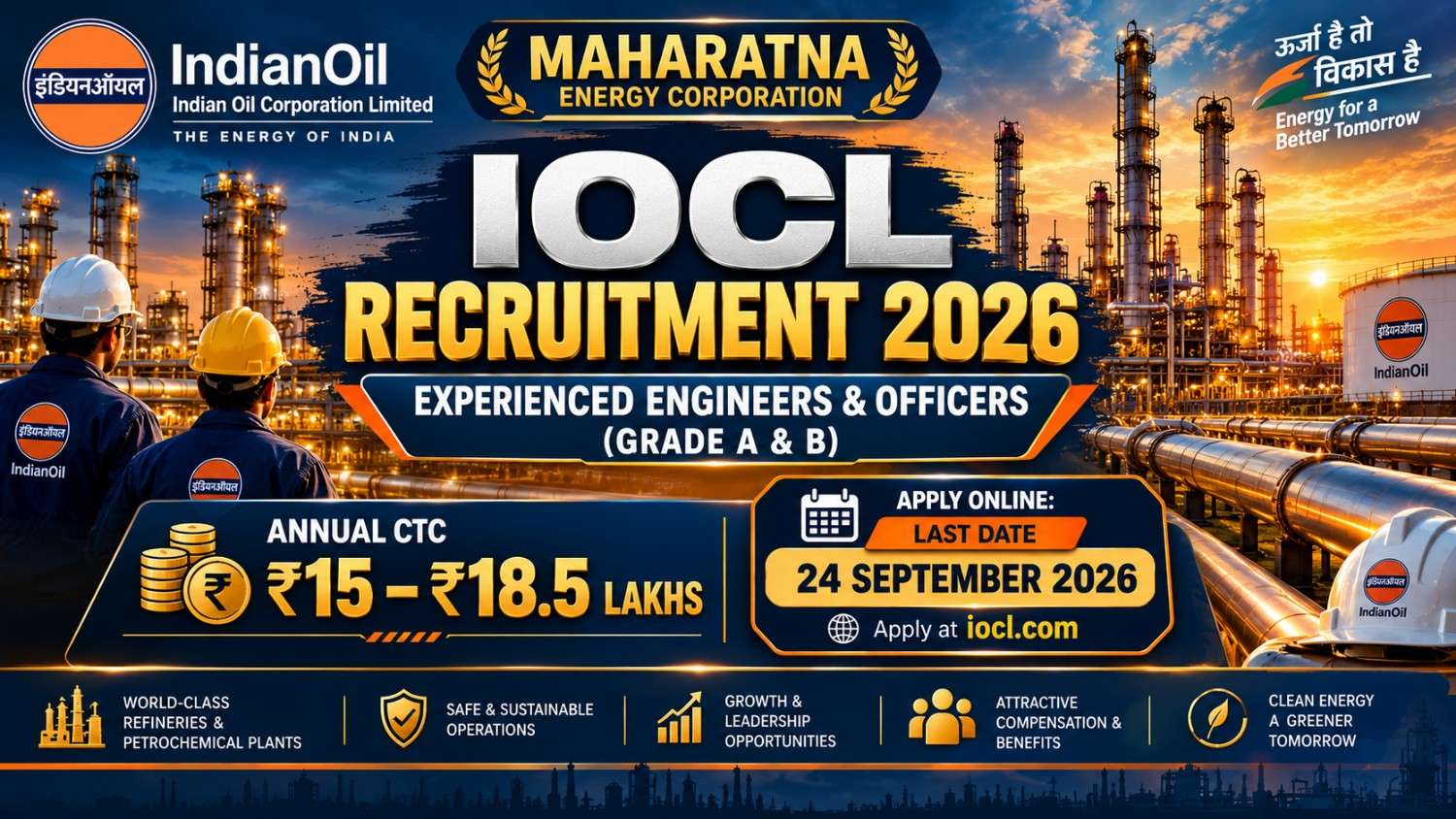 LATEST ALERT
IOCL Recruitment 2026: Apply for Grade A Engineer Posts
Last updated: September 2026 For the IOCL Recruitment 2026: Apply online for the positions of Executive Engineer and for experienced professionals at iocl.com; check the Grade A salary, the eligibility requirements and the experience criteria. In September 2026 the Indian Oil Corporation Limited will be conducting two distinct recruitment exercises, and the simplest way to apply for the wrong position is to confuse the two – or to completely miss a deadline. One of these is an Executive recruitment drive aimed at freshers and includes more than 400 posts. The other is a small recruitment exercise at a senior level for experienced plant professionals who are to join IOCL's new Poly Butadiene Rubber facility. The guide clearly distinguishes between the two and gives the exact salary, eligibility, and experience requirements as stated in IOCL's own advertisements. If you are an engineering graduate who hopes to begin your executive career at a Maharatna PSU, or if you are an experienced production professional aiming for a senior plant leadership position, you will find the path suitable for your particular situation below. IOCL Recruitment 2026 — Quick Overview Particulars Executive Recruitment (RECTT/2026/01) Experienced Professionals (RECTT/2026/02) Organisation Indian Oil Corporation Limited (IOCL) Indian Oil Corporation Limited (IOCL) Advertisement Date 14 August 2026 3 September 2026 Posts Graduate Engineer, Officer (Marketing), Law Officer, Assistant Quality Control Officer, Diploma Engineer Production Manager, Senior Production Manager, Senior Manager (PBR-Marketing) Total Vacancies 470 3 Grades Grade A, Grade A0, Grade E0 Grade C, Grade D Experience Needed Not required for Engineer/Diploma posts; 2 years for Law Officer and AQCO 10 to 14 years, post-qualification Application Window 14 August – 3 September 2026 3 September – 16/17 September 2026 Official Website iocl.com The Key Differentiator: Two Very Different Hiring Tracks Do not think that these two are the same recruitment process using different names. RECTT/2026/01 refers to IOCL's normal annual Executive intake—an permanent and pensionable career entry route for new engineering graduates and young professionals—and this is mostly filled via IOCL's own Computer-Based Test with no requirement for a GATE score. RECTT/2026/02, on the other hand, is a specific lateral hiring initiative for exactly three senior positions linked to IOCL's new PBR plant in Panipat—there is no CBT in this case; selection is based entirely on documented industry experience and an interview. For a new graduate or one who has less than two years' experience, RECTT/01 is the only option available. However, if you are a seasoned professional in chemical engineering or the polymer industry with ten years or more of experience in running plant operations, then RECTT/02 is worth considering — although it should be noted that it has only three places available nationwide, so you should view it as a long shot among your other applications, not as your main choice. Discipline-wise Qualification Breakdown — Executive Recruitment (RECTT/2026/01) Post Grade Vacancies Eligible Disciplines Minimum Marks Experience Required Graduate Engineer A 411 Chemical, Civil, Computer Science/IT, Electrical, Electronics & Communication, Instrumentation, Mechanical 65% (Gen/EWS/OBC-NCL), 55% (SC/ST/PwBD) Not required Officer (Marketing) A Included in 411 Full-time MBA/PGDBA with Marketing specialization 60% Not required Law Officer A Included in 411 Graduation + LLB, or 5-year Integrated LLB, recognized by Bar Council of India 60% (Gen/EWS/OBC-NCL), 55% (SC/ST/PwBD) Minimum 2 years post-qualification legal practice Assistant Quality Control Officer A0 9 M.Sc. in Chemistry As stated in the notification Minimum 2 years' experience in lab testing (petroleum, petrochemicals, polymers, fertilisers, or NABL-accredited lab) Diploma Engineer E0 50 3-year Engineering Diploma in relevant discipline As per notification Not required Regarding the date of the experience cut-off: in the case of posts which have a requirement for prior experience—such as Law Officer and Assistant Quality Control Officer—the required amount of experience is based on 30 June 2026. Experience gained through internships, teaching duties, and short-term training does not count towards this requirement. When assessing your own eligibility for any post that is based on experience, apply the same rule: only confirmed work experience carried out after qualification should be taken into account, not that obtained through apprenticeships or training periods. Executive Pay Scale & CTC Breakdown (RECTT/2026/01) Grade Initial Basic Pay (Monthly) Pay Scale Approximate Annual CTC Graduate Engineer / Officer-Marketing / Law Officer – Grade A ₹50,000 ₹50,000 to ₹1,60,000 ₹18.4 Lakh Assistant Quality Control Officer (Grade A0) ₹40,000 ₹40,000 – ₹1,40,000 ₹14.8 Lakh Diploma Engineer (Grade E0) ₹30,000 ₹30,000 to ₹1,20,000 ₹11.1 Lakh The amount represented by the CTC consists of the basic salary together with the Dearness Allowance, the House Rent Allowance, and other benefits typical of Maharatna-level executives such as medical benefits, the leave travel concession, the provident fund, and the performance-linked pay which apply to IOCL executives. This is a permanent appointment within the executive cadre and not a contractual, fixed-term, or apprentice one – the candidates who are selected join the regular IOCL workforce and are entitled to all the benefits of employment from the very first day. Experienced Professionals Recruitment Details (RECTT/2026/02) Post Grade Vacancies Pay Scale Approx. Annual CTC Minimum Experience Production Manager C 1 ₹80,000 – ₹2,20,000 ~₹30 Lakh 10 years post-qualification, including 5 years in PBR/synthetic rubber production Senior Production Manager D 1 ₹90,000 – ₹2,40,000 ~₹35 Lakh 14 years post-qualification, including 7 years in senior plant production roles Senior Manager (PBR-Marketing) D 1 ₹90,000 – ₹2,40,000 ~₹35 Lakh 14 years post-qualification in polymer/synthetic rubber marketing or business development The posts are for IOCL's forthcoming Poly Butadiene Rubber (PBR) plant and for the PBR Business Marketing Group based in Panipat; eligibility is restricted to Indian nationals and all three positions are Unreserved. For the roles of Production Manager and Senior Production Manager, a full-time B.E./B.Tech in Chemical Engineering is required together with a minimum of 60% marks, while the Senior Manager (PBR-Marketing) position requires either an engineering degree or a Science graduate degree along with a full-time MBA or PGDM, in each case obtaining at least 60% marks. Step-by-Step IOCL Portal Application Guide Go to the official website at iocl.com and look in the "Latest Job Openings" or "Careers" section. To select the right notification for your track, get the one numbered IOCL/CO-HR/RECTT/2026/01 if you are applying for Executive/Graduate Engineer positions, or obtain the one numbered IOCL/CO-HR/RECTT/2026/02 for Experienced Professional positions. Carefully download and read the full advertisement PDF since detailed lists of the eligible degree names and equivalent subjects are provided and a close match is important for being shortlisted. To create your login details, you must register on the portal using a valid email address and mobile number. Log in and fill in the online application form with details about your personal circumstances, education, category, and experience. Upload the required documents. These include a recent passport-size photograph, a scanned signature, and for experienced-track applicants, detailed employment or experience certificates. When applying under RECTT/2026/01, please choose your preferred exam cities (a maximum of three cities from those listed). You can pay the relevant application fee online using a Debit Card, Credit Card, Net Banking, or UPI, if this applies to your category. It is generally not permitted to make corrections after final submission, so you should carefully go through each entry on the Preview tab before clicking Complete Registration. Save the confirmation page and the application summary for your records by downloading them. Application Fee (RECTT/2026/01 — Executive Recruitment) Category Application Fee General / EWS / OBC-NCL ₹1,000 + applicable GST SC / ST / PwBD / Ex-Servicemen Exempted (Nil) Once the fees have been submitted, they are not refundable regardless of the category or any subsequent disqualification. Important Dates Event RECTT/2026/01 (Executive) RECTT/2026/02 (Experienced Professionals) Notification Release 14 August 2026 3 September 2026 Application Start 14 August 2026 3 September 2026 Last Date to Apply 3 September 2026, 5:00 PM 16–17 September 2026, 5:00 PM Admit Card Release 15 September 2026 Not applicable (interview-based) Computer-Based Test 24 September 2026 (Tentative) Not applicable Group Discussion / Group Task After CBT shortlisting Not applicable Personal Interview October 2026 (Tentative) To be scheduled after application screening Important Links Table Resource Link Official IOCL Website iocl.com Apply Online — Executive Recruitment Direct Application Portal Link Related Central Engineering Jobs SSC Junior Engineer Technical Recruitment BEL Deputy Engineer Job BEL Deputy Engineer Recruitment 2026 Practive Engineering Mock tests Attempt Free PSU & Mechanical/Chemical Engineering Mock Tests PSU Job Tracker Hub Latest Maharatna & Central PSU Engineering Alerts Disclaimer: All figures, dates, and eligibility criteria above are based on IOCL's official notifications IOCL/CO-HR/RECTT/2026/01 and IOCL/CO-HR/RECTT/2026/02, as available at the time of writing. Since both notifications are advertised separately with their own PDFs, candidates must download and verify the exact document relevant to their intended post from iocl.com before applying.
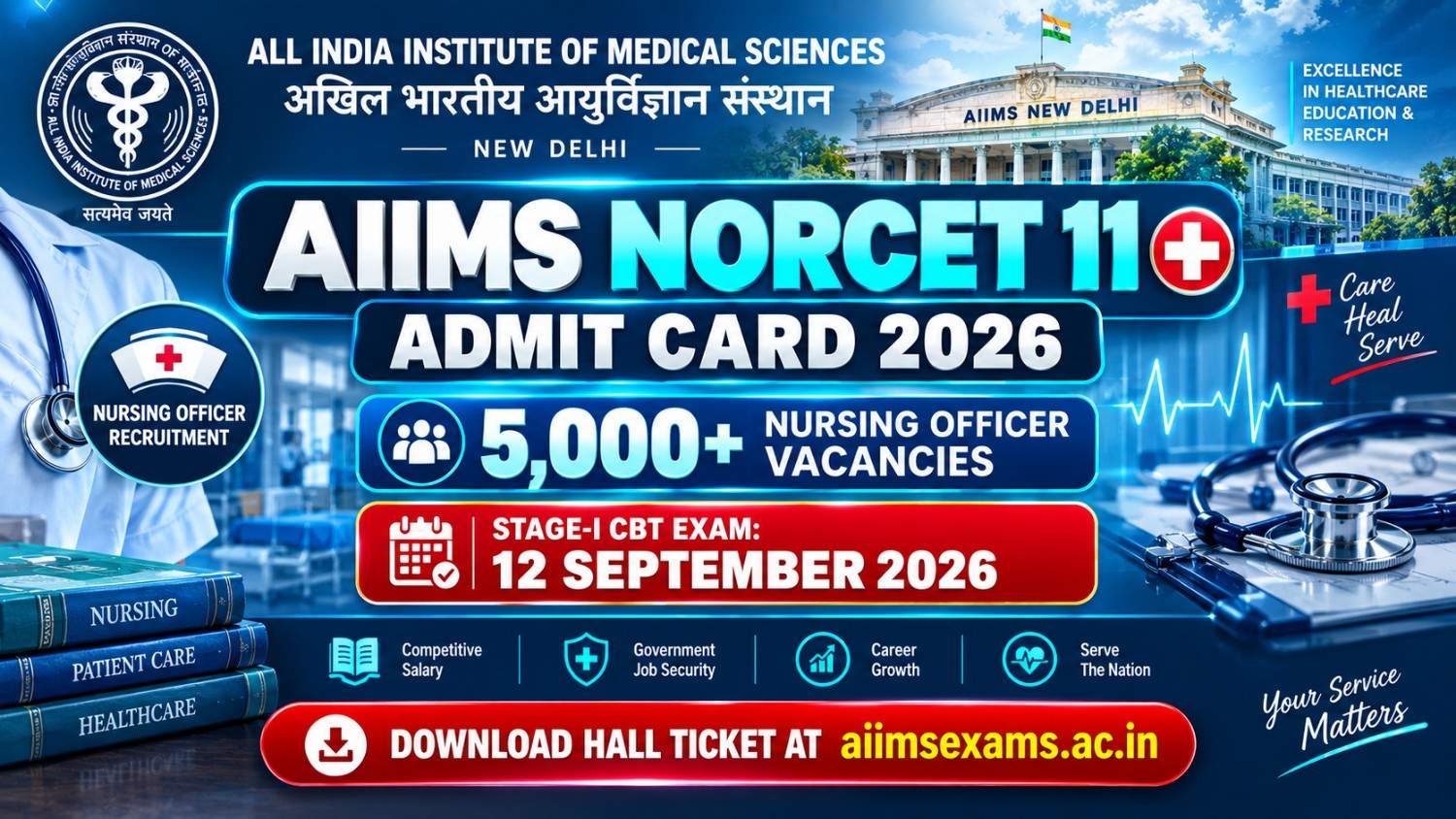 LATEST ALERT
AIIMS NORCET 11 Admit Card 2026 Out: Download Hall Ticket
Last updated: 9 September 2026 The AIIMS NORCET 11 admit card for 2026 has been issued: download your Stage 1 Nursing Officer hall ticket and check the CBT exam times on 12 September at aiimsexams.ac.in For those who have signed up for NORCET 11, the following four days are more important than the four months of preparation that came before. The AIIMS NORCET 11 Admit Card 2026 was made available on 9 September 2026 and the Stage 1 CBT will take place on 12 September 2026 at various exam centres in India. The one hall ticket you receive includes information about your exam centre, your reporting shift, and most important of all the login details that you'll need before AIIMS closes the portal on the day of the exam. This year the exam is being conducted using a strict sectional timer, and that single decision affects the way in which you should tackle the paper as compared to the nursing exams you took previously. The following points have so far been confirmed — the steps for downloading the exam, the rules to observe on the day of the exam, the structure of the sectional timing, and the actual cost to you of getting a question wrong. AIIMS NORCET 11 Admit Card 2026 — Quick Overview Particulars Details Conducting Body All India Institute of Medical Sciences (AIIMS), New Delhi Exam Name Nursing Officer Recruitment Common Eligibility Test (NORCET) – 11 Advertisement Number 103/2026 Post Name Nursing Officer Total Vacancies 2,218 Exam City Intimation Slip 3 September 2026 Admit Card Release Date 9 September 2026 Stage 1 (Preliminary) Exam Date 12 September 2026 Stage 2 (Mains) Exam Date 30 September 2026 Exam Mode Online, Computer-Based Test (CBT) Official Website aiimsexams.ac.in The Rule Every Candidate Needs to Read Before 12 September The differences between this year's NORCET and a normal MCQ exam are as follows, and they might be overlooked if you quickly go through the admit card instructions. The Stage 1 paper, which lasts 90 minutes, is divided into five sections with 20 questions in each section and each section is given exactly 18 minutes. When the 18-minute time limit for a section ends, that section automatically submits itself and you cannot go back; it is not possible to finish a question that has not been answered in Section 2 while you are in Section 3. The questions that have been answered when the timer reaches zero are the ones that count, all the others are recorded as unattempted. Your approach to the exam has to be entirely different. In a standard 90-minute paper you would normally deal with your slower topics towards the end. In this case, however, if General Knowledge and Aptitude questions appear in an early section and you spend too long second-guessing a single question, you will lose all the other questions in that section forever, with no possibility of coming back to them later in the exam. If a one-third negative marking penalty is applied for each incorrect answer, guessing quickly becomes a costly option. In fact, three wrong guesses result in the loss of a full mark—a amount big enough to cause a noticeable change in your rank in an examination in which thousands of candidates are competing for a limited number of qualifying positions. How to Download AIIMS NORCET 11 Admit Card 2026 Visit the official AIIMS examinations website at aiimsexams.ac.in. On the homepage, check the section headed 'Important Announcements' for the notice stating: 'Admit Card for Nursing Officer Recruitment Common Eligibility Test (NORCET-11)'. By clicking on the link, you will be directed to the NORCET-11 Admit Card Download page. Input your Candidate ID (or registration number) and password together with the captcha code which is shown. Click Login/Submit. The admit card will appear on the screen. Before downloading it, check all the details — your name, photograph, roll number, the exam date, the reporting time, and the centre address. Get the PDF and make sure you have at least two clear printed copies. Admit cards will not be posted; AIIMS will send only an SMS and email notification when the card is live – you will have to download the actual document from the portal yourself. If You Can't Log In On the same login page, select the 'Forgot Candidate ID/Password' option. Recovery of access will require the mobile number or email address associated with your registration. It's not a good idea to wait until the evening before the exam to deal with this — the helpline and the portal become very busy in the 24 hours leading up to a CBT of this scale. What's Printed on Your Admit Card ✔ Candidate's name and photograph ✔ Candidate ID / registration number and roll number ✔ Date of birth and category (UR/OBC/SC/ST/EWS/PwBD) ✔ Exam date, shift, and reporting time ⚠ Entry closing time — after this, you will not be let in, regardless of your scheduled exam time ✔ Exam center name, address, and code ✔ Exam-day conduct instructions Documents to Carry to the Exam Center ☐ A printed copy of the AIIMS NORCET 11 admit card (color printout preferred) ☐ One valid original photo ID — Aadhaar Card, PAN Card, Voter ID, or Passport ☐ A recent passport-size photograph, matching the one uploaded during registration ☐ Any category or PwBD certificate mentioned as mandatory on your specific admit card You should arrive well in advance of the reporting time on your card since the entry closing time is strict, gate checks at CBT centres involving biometric and frisking procedures regularly turn away candidates who arrive as little as 10 to 15 minutes after the cutoff. AIIMS NORCET 11 Stage 1 Exam Pattern 2026 Component Details Exam Nature Qualifying only — not counted toward final merit Duration 90 minutes Total Questions 100 MCQs Subject Split 20 questions – General Knowledge & Aptitude, 80 questions – Nursing subjects Total Marks 100 Negative Marking 1/3 mark deducted per wrong answer Sectional Structure 5 sections of 20 questions each Sectional Timing 18 minutes per section, auto-submitted when time expires AIIMS NORCET 11 Stage 2 Exam Pattern 2026 (For Reference) The only candidates who pass Stage 1 will advance to Stage 2 on 30 September 2026, and it is this stage which determines your final merit and All India Rank. Component Details Exam Nature Merit-deciding — final ranking based solely on Stage 2 marks Duration 180 minutes Total Questions 160 MCQs Subject Coverage Full nursing syllabus, including case-scenario-based questions Total Marks 160 Negative Marking 1/3 mark deducted per wrong answer Sectional Structure 4 sections of 40 questions each Sectional Timing 45 minutes per section, auto-submitted when time expires Although your score in Stage 1 does not show up on your final scorecard since it is just a qualifying stage, you still have to meet the category-wise qualifying percentile if you want to take Stage 2. You shouldn't regard the sectional timer as a problem that only affects Stage 2; the same rule applies from your very first CBT attempt on 12 September. Important Dates for AIIMS NORCET 11 Event Date Notification Release 24 July 2026 Application Start Date 24 July 2026 Last Date to Apply 13 August 2026, 5:00 PM Application Status Available 24 August 2026 Exam City Intimation Slip 3 September 2026 Admit Card Release 9 September 2026 Stage 1 (Preliminary) Exam 12 September 2026 Stage 2 (Mains) Exam 30 September 2026 Important Links Resource Link AIIMS NORCET 11 Admit Card Login Admit Card Login Link UPSSSC Femal Health Worker Related UPSSSC Female Health Worker Selection Result Related Paramedical Admit Card CISF ASI Paramedical Staff PST Hall Ticket Attempt Free Mock tests Attempt Free AIIMS Nursing & Medical Mock Tests Latest Jobs Track Latest Medical & Nursing Officer Recruitments Disclaimer: All details above are based on AIIMS's official notices and admit card announcements available at the time of writing. Candidates must verify their exact exam center, reporting time, and entry closing time from their individually issued admit card before traveling on 12 September 2026.
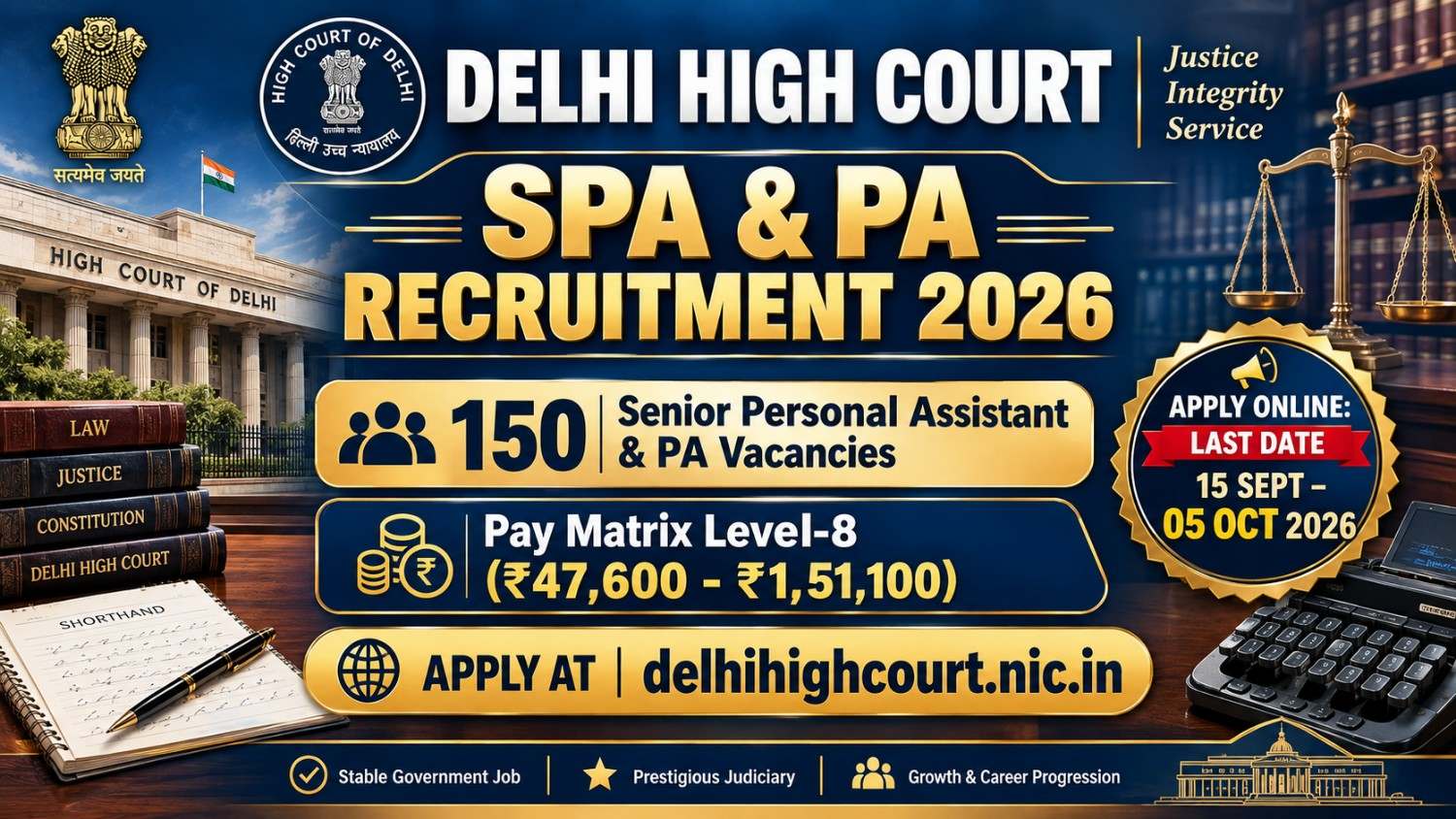 LATEST ALERT
Delhi HC SPA PA Recruitment 2026: Apply for 150 Posts
Last updated: 6 September 2026 For the 2026 Senior Personal Assistant and Personal Assistant recruitment by the Delhi High Court: apply online at delhihighcourt.nic.in for 150 posts and find out about the Level-8 salary, the eligibility requirements and the shorthand requirements. The official announcement of the Delhi High Court's SPA PA Recruitment 2026 has just been made, and it is one of the most distinguished opportunities available this year for the clerical cadre within India's judicial system. The Delhi High Court has called for online applications for 150 Group 'B' positions — consisting of 117 Senior Personal Assistants (SPA) and 33 Personal Assistants (PA) — with the starting pay being among the highest offered to stenographers throughout the country. The post is well worth applying for if you are a graduate possessing good English shorthand and typing abilities. However, before you start filling in the application form, it is important that you clearly understand what kind of position suits your skill level, how the four-stage selection process actually functions, and where most candidates fail to get marks even though they aren't aware of it. This guide provides a full explanation of all the official details given in the notification issued by the Delhi High Court on 2 September 2026. Delhi High Court SPA PA Recruitment 2026 — Quick Overview Recruiting Body High Court of Delhi, New Delhi Exam Name Senior Personal Assistant and Personal Assistant Examination 2026 Post Category Group 'B' Total Vacancies 150 Notification Release Date 2 September 2026 Application Mode Online Only Application Start Date 15 September 2026, 11:00 AM Last Date to Apply 5 October 2026, 11:00 PM Correction Window 12 October 2026 (11:00 AM) to 14 October 2026 (11:00 PM) Age Limit 18 to 32 years (on 01.01.2026) Job Location New Delhi Official Website delhihighcourt.nic.in The Real Differentiator: Two Posts, Two Separate Applications This is the section that most candidates fail to notice until it's too late. SPA and PA are considered to be two separate recruitment processes even though they are issued under the same notification. In the case where you are eligible for both positions and wish to increase your chances of success, you have to file two individual online applications and pay two separate application fees—one cannot take the place of the other and there is no combined application form. This has a strategic implication. Although SPA requires a more demanding shorthand speed (110 wpm) it provides a higher Pay Level (8), whereas PA has a slightly less strict requirement in terms of shorthand (100 wpm) but offers only Pay Level 7. A candidate who is only confident at 100 wpm should not simply decide to skip applying just because SPA appears more prestigious—instead, if eligible they should apply for both, since doing so actually doubles your chance of being selected. Post-wise Vacancy Breakdown Post Vacancies Pay Level (7th CPC) Minimum Shorthand Speed Minimum Typing Speed Senior Personal Assistant (SPA) 117 Level 8 110 words per minute 40 words per minute Personal Assistant (PA) 33 Level 7 100 words per minute 40 words per minute Total 150 — — — Eligibility Criteria Educational Qualification A bachelor's degree from any field of study at a university that is recognized. The ability to write in English shorthand at the speed required for the relevant position (110 wpm for SPA and 100 wpm for PA). Typing in English at a speed of at least 40 words per minute on a computer. A good knowledge of computer applications. Age Limit Minimum age: 18 years Maximum age: 32 years The age is that as of 1 January 2026. The age relaxation is in accordance with the norms of the Government of India — for the exact number of years available by category, refer to the official notification. Delhi High Court SPA & PA Salary 2026 — Pay Level 8 vs Level 7 This is one of the main reasons why this recruitment attracts stenographers from all over the country. Post Pay Level Pay Scale Range (Approximate) Senior Personal Assistant (SPA) Level 8 ₹47,600 – ₹1,51,100 per month Personal Assistant (PA) Level 7 ₹44,900 – ₹1,42,400 per month In addition to their basic salary, certain candidates are given a Dearness Allowance (DA), a House Rent Allowance (HRA), and other allowances which are applicable to appointments in Delhi, as a result of which their actual in-hand salary is much higher than the basic amount alone. Four-Stage Selection Workflow The process used for selecting candidates for both SPA and PA is the same in that it has four stages, but different criteria are applied at each stage. Stage I — English Typing Test (Qualifying Only) It is a computer-administered typing test of 10 minutes' duration and a minimum speed of 40 words per minute, the rate being calculated using the 'characters with space' method. The maximum number of errors allowed is 3% of the total number of words typed. This section is entirely for qualifying purposes and the marks obtained in it are not included in your final merit, so you should regard it simply as a clearance hurdle and not as a chance to score points. Stage II — English Shorthand Test Candidates are only admitted to this stage if they have passed Stage I, and it is at this point that merit actually begins to count. SPA: The dictation was carried out at a speed of 110 words per minute for a 550-word passage lasting over five minutes, and then there was an additional 45 minutes for transcription. The total score was 120. PA: The dictation was carried out at a speed of 100 words per minute for a 500-word passage, taking five minutes, and then there was 45 minutes allocated to transcription. The total score was 110. A candidate has two tries at the shorthand dictation-transcription test and the higher of the two scores is taken as the result. Stage III — Main (Descriptive) Examination The paper should be written over a period of 120 minutes and be worth 100 marks; the minimum qualifying marks are 50 out of 100 for candidates in the General category and 45 out of 100 for those in the Reserved category, this including eligible candidates with permanent disabilities. Stage IV — Interview The last stage consists of 15 marks and looks at the candidate's overall suitability, their communication skills, and their general awareness with regard to the role of a judicial secretarial appointee. Shorthand Accuracy & Transcription Parameters It is actually accuracy — not speed — that leads to the majority of eliminations; the precise method of marking according to the official pattern is as follows: Parameter Senior Personal Assistant (SPA) Personal Assistant (PA) Shorthand Dictation Speed 110 words per minute 100 words per minute Passage Length 550 words 500 words Dictation Duration 5 minutes 5 minutes Transcription Time 45 minutes (no extra reading time) 45 minutes (no extra reading time) Total Marks 120 110 Maximum Permissible Mistakes 27.5 mistakes (5% of total words) 25 mistakes (5% of total words) Marking Deduction 4 marks per full mistake, 2 marks per half mistake 4 marks per full mistake, 2 marks per half mistake Disqualification Threshold Over 27.5 errors Over 25 errors Attempts Given 2 (better of the two considered) 2 (better of the two considered) This should be made clear: the 3% allowance for mistakes refers only to the Stage I Typing Test; the Shorthand Test at Stage II has its own, more strict 5% mistake tolerance, which is calculated based on the total number of words dictated. It is a typical error that candidates make when preparing themselves — you should practice each stage according to its individual benchmark. Application Fee Category Application Fee General / OBC-NCL / EWS ₹1,500 SC / ST / PwBD / Ex-Servicemen ₹1,300 The fees can only be paid online using a Debit Card, a Credit Card, Net Banking, or UPI. Remember that when you are applying for both SPA and PA, the fee is charged separately for each application. Step-by-Step Online Application Guide Go to the official website at delhihighcourt.nic.in. Go to the 'Recruitment' or 'Notices' section and find the link for the SPA & PA Examination 2026. To generate your login details, you must register using a valid email address and mobile number. Sign in and complete the application form by entering your personal, educational, and category information. Upload scans of your photograph, signature, and the necessary certificates in the format and size specified. Decide whether you are submitting an application for SPA, PA, or for both of them—just remember that applying for both means you have to make two separate submissions. Make the application fee payable using the online payment methods that are available. Before finally submitting the entries, please go through them carefully—corrections can only be made during the specified correction period. Fill in the form and then download or print the confirmation page for your own records. Delhi High Court SPA & PA Recruitment 2026: Important Dates Event Date Notification Release Date 2 September 2026 Online Application Start Date 15 September 2026, 11:00 AM Last Date to Apply Online 5 October 2026, 11:00 PM Last Date for Fee Payment 5 October 2026 Correction Window Opens 12 October 2026, 11:00 AM Correction Window Closes 14 October 2026, 11:00 PM Typing Test / Exam Date To be announced Admit Card Release Before the respective exam stage Important Links Table Resource Link Apply Online (Active from 15 Sept 2026) Application Portal Link Latest Jobs Latest Judicial & High Court Job Notifications SSC Stenographer Fina Selection SSC Stenographer Final Selection Result Punjab & Haryana High Court Recruitment Punjab and Haryana High Court Recruitment Free Mock Tests Free High Court & Judicial Mock Tests Daily Free Quizzes Daily English Comprehension & Grammar Quizzes Disclaimer: All figures above — vacancy numbers, dates, fee structure, and shorthand parameters — are based on the Delhi High Court's official notification dated 2 September 2026, as available at the time of writing. Candidates must verify the final exam date, admit card details, and any addenda directly from delhihighcourt.nic.in before applying or appearing for any stage.
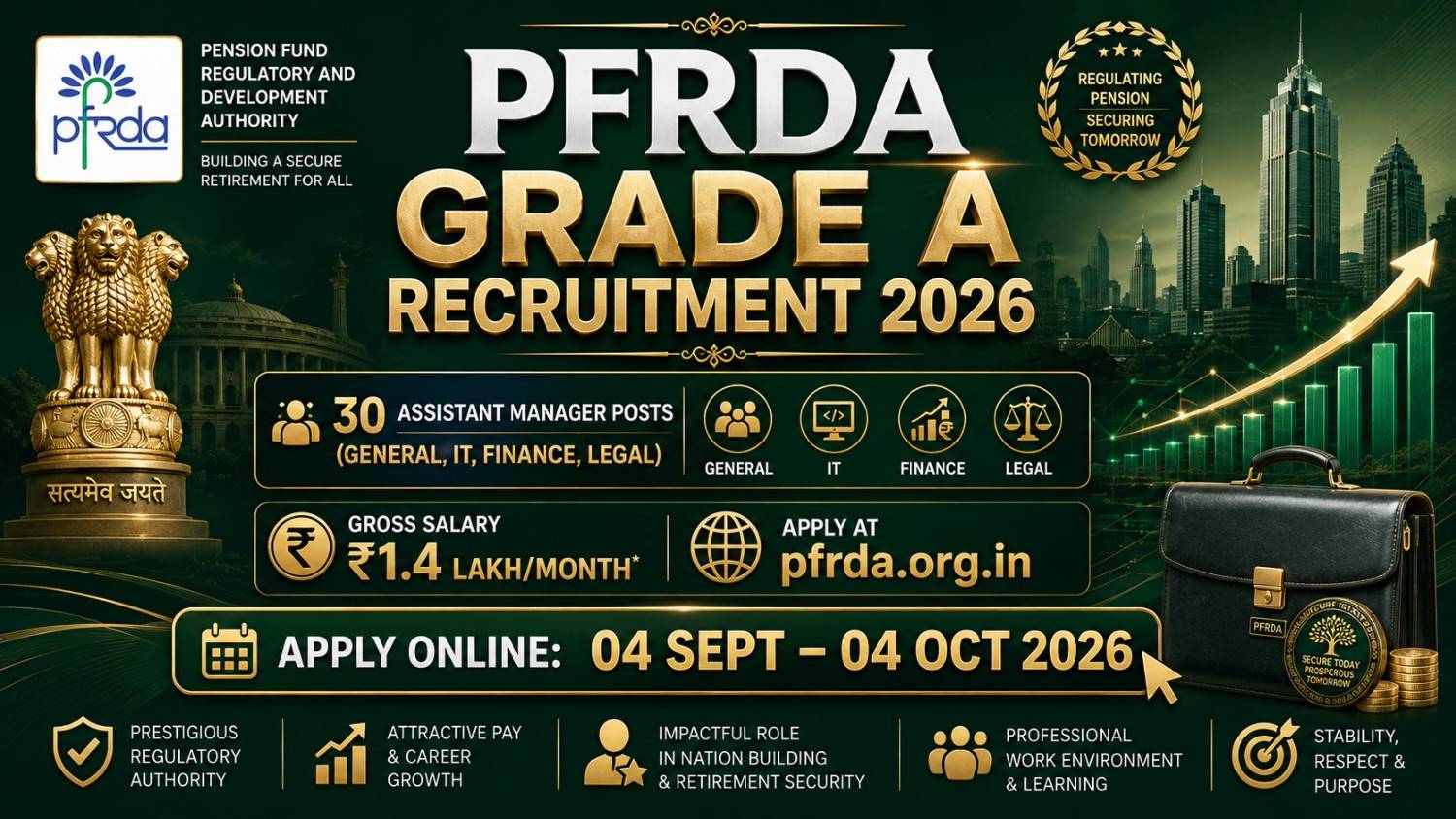 LATEST ALERT
PFRDA Grade A Recruitment 2026 - 30 Posts, Apply Now
Last updated: 5 September 2026 PFRDA Grade A Recruitment 2026 — Overview The notification for the PFRDA Grade A Recruitment 2026 has now been issued, and for those in finance, law, IT, and among postgraduate professionals who are considering a career in regulation, this is one that is well worth keeping an eye on. The Pension Fund Regulatory and Development Authority put out Advertisement No. 03/2026 on 3 September 2026, offering 30 Officer Grade A (Assistant Manager) positions, and the applications period is open at pfrda.org.in until 24 September 2026. In short, there are 30 positions in four different streams, with a revised pay scale beginning at a basic pay of ₹62,500, and the selection will take place through three stages—Phase I, Phase II, and the Interview. Organization Pension Fund Regulatory and Development Authority (PFRDA), New Delhi Advertisement No. 03/2026, dated 3 September 2026 Post Name Officer Grade 'A' (Assistant Manager) Total Vacancies 30 Application Window 3 September – 24 September 2026 Age Limit Not exceeding 30 years as on 31 July 2026 (born on or after 1 August 1996) Selection Stages Phase I → Phase II → Interview Official Website pfrda.org.in PFRDA Grade A Vacancy Details (Stream-Wise) Stream Posts General 25 Research 2 Actuary 2 Official Language (Rajbhasha) 1 Total 30 The General stream includes the majority of the available places this cycle, making it the most competitive one but also the most accessible route for applicants seeking an MBA (Finance), or for those with a graduate or postgraduate qualification without a specific stream qualification. Streams such as Actuary and Rajbhasha have only a small number of spots — it's important to be aware of this before deciding to spend time preparing for a specialist stream that offers just one or two places. PFRDA Grade A Eligibility Criteria 2026 Educational qualification depends entirely on the stream applied for: In the General Stream, graduation is offered, although those who hold a professional qualification—such as CA, MBA Finance, or a similar postgraduate degree—usually have a advantage since the PFRDA arranges the Phase II specialisation papers in this way. For the various specialized fields such as Finance & Accounts, IT, and Legal, a relevant professional degree or certification (specifically, CA or CFA in the case of Finance, B.Tech or MCA for IT, and LLB for Legal) as stated in the criteria for each stream in the official notification is required. For the Research and Actuary streams: a relevant postgraduate qualification or actuarial certification as specified. It is also necessary for candidates to be computer literate and familiar with MS-Office (Word and Excel) – this is a definite requirement, not just a matter of formality, since it is verified at the document verification stage. Age limit: 30 years at the latest as of 31 July 2026. The usual government relaxations apply in the cases of the SC/ST/OBC/PwBD/Ex-Servicemen categories. One point to note is that candidates who fall within the OBC 'Creamy Layer' are not eligible for OBC reservation and have to apply in the UR/General category. PFRDA Grade A Salary Structure 2026 — What Changed This Year The headline change is that this cycle the PFRDA has increased the basic pay for Grade A officers from ₹44,500 to ₹62,500 a month. This represents a significant rise and is the principal reason why this recruitment is attracting more attention than in earlier PFRDA cycles. The lowest monthly income figures on the scale range from ₹1.4 to ₹2.05 lakh, depending on the source and the various allowances (HRA, DA, and other perquisites differing according to the posting location). The exact amount you will receive in hand will depend on your city category and the deductions made; therefore, you should check the detailed breakdown in the official notification PDF rather than depend on a single figure that is circulating online. The fact that working at the PFRDA places you in the same prestigious category as officers at SEBI, the RBI, and the IFSCA — India's other main regulators in the financial and pension sectors — is one of the reasons why competition for these 30 positions is so intense throughout each cycle. PFRDA Grade A Phase 1-2 Exam Pattern 2026 Selection runs through three stages, and each one filters out a large chunk of applicants: Phase I (Preliminary): There are two papers, each containing 100 marks. This year there has been one notable change – the number of Reasoning questions in Prelims Paper 1 has gone up to 30, as compared to earlier years. When using old PFRDA previous year questions for practice, you should take into account this change before concluding that the paper format is the same. In Phase II (Mains) there are two papers each carrying 100 marks, the papers covering knowledge of the subject relevant to the stream as well as including English and general awareness components according to the stream applied for. In Phase III (the interview), candidates who meet both the Phase I and Phase II cut-offs are interviewed. For each incorrect answer in the relevant papers, negative marking is applied by deducting one-fourth of the marks that would have been awarded to that answer — a rule established by the PFRDA which targets candidates who make careless guesses in Phase I. The final assessment is based on a ratio of 85:15 between the Phase II CBT and the interview — so your written results have much more influence than the interview, although a bad interview can still have a significant negative effect on an otherwise good Phase II score. PFRDA Grade A Application Fee 2026 Candidates belonging to the General/OBC/EWS categories have to pay the standard application fee as announced for each stream (a separate fee applies for each stream if one is applying to more than one stream). The point worth noting is that all female candidates, together with those from the SC/ST/PwBD communities, are completely exempt from having to pay the application fee—a wider exemption than is generally available in most PSU or regulatory recruitment exercises, which usually limit exemption to SC/ST/PwBD candidates only. Once a fee has been paid, it cannot be refunded under any circumstances, and if you are applying to more than one stream you must make separate applications together with separate fee payments. How to Apply for PFRDA Grade A Recruitment 2026 Go to pfrda.org.in to find the advertisement for the Officer Grade A (Assistant Manager) recruitment in 2026. Sign up using a valid email address and mobile number. Please carefully enter the information regarding your personal details, education, and preferences for streams. Upload a photograph, your signature, and the certificates relating to your education and category. You need to pay the fee that applies to the stream that you have selected (those that are exempted may omit this step). Before you finally submit the form, please check it in preview mode since no alterations can then be made. Make the submission by 24 September 2026 and then obtain the confirmation document for future reference. PFRDA Grade A Important Dates Event Date Notification Released 3 September 2026 Online Application Start 3 September 2026 Last Date to Apply Online 24 September 2026 Phase I Exam (Expected) October 2026 Phase II Exam (Expected) November 2026 Important Links Resource Link Apply Online PFRDA Careers Portal Free Mock tests Solve Free Regulatory Body & Commerce Mock Tests Quizzes Practice Financial Sector Awareness Quizzes Latest Jobs 2026 Explore Ongoing RBI, SEBI & Banking Notifications Closing PFRDA Grade A Recruitment 2026 opens a genuinely lucrative door into India's pension-sector regulatory space, with the revised ₹62,500 basic pay making this cycle more attractive than previous years. Applications close 24 September 2026 — confirm your stream-specific eligibility and fee details from the official notification before submitting, and start Phase I prep now given the increased Reasoning question count this time around.
 LATEST ALERT
BEL Deputy Engineer Recruitment 2026 - 14 Posts
Last updated: September 2026 BEL Deputy Engineer Recruitment 2026: Apply Online for 14 Permanent E-II Grade Posts Quick Answer: Bharat Electronics Limited has opened the BEL Deputy Engineer Recruitment 2026 for 14 Deputy Engineer (E-II) posts under Advt No. 383/HR/DE-FTE/NS-S&CS/2026-27, dated 2 September 2026. Apply online at bel-india.in between 2 and 23 September 2026. Posting is at Kochi under the Naval Systems (S&CS) SBU, with a starting pay scale of ₹40,000–3%–₹1,40,000 and an approximate annual CTC around ₹12.5 lakh (verify exact figure against the official notification). BEL Deputy Engineer Recruitment 2026 — Overview Field Details Organization Bharat Electronics Limited (BEL), Navratna PSU, Ministry of Defence Advertisement No. 383/HR/DE-FTE/NS-S&CS/2026-27, dated 2 September 2026 Post Name Deputy Engineer, Grade E-II Total Vacancies 14 Engagement Type Fixed Tenure Engagement (FTE) — initial 5 years, extendable up to 2 more years Business Unit Naval Systems (S&CS) SBU, Bengaluru Complex Unit Posting Location Kochi, Kerala Application Window 2 September – 23 September 2026 Age Limit 28 years, as on 1 September 2026 Pay Scale ₹40,000 – 3% – ₹1,40,000 (plus DA, HRA, perquisites, PF, medical benefits) Official Website bel-india.in Important clarification: This is a permanent executive cadre position at Grade E-II, engaged on a Fixed Tenure basis — not a temporary contract or outsourced role. Candidates confusing FTE with a short-term contract often skip applying unnecessarily. Also note: this 14-post Kochi notification is separate from an earlier 35-post BEL Bengaluru notification (Civil/Architecture/Horticulture) whose application window already closed — don't mix the two up while researching. BEL Deputy Engineer Vacancy Details (Discipline-Wise) Discipline Vacancies Electronics 06 Mechanical 03 Computer Science 05 Total 14 Category-Wise Reservation Category Posts UR 07 EWS 01 OBC (NCL) 03 SC 02 ST 01 Total 14 BEL Deputy Engineer Eligibility Criteria 2026 Educational Qualification A full-time, regular 4-year B.E. / B.Tech degree in Electronics & Communication, Electronics & Instrumentation, Mechanical, or Computer Science / IT (or an allied recognized branch matching the discipline applied for) from a recognized university or institute. Post-Qualification Experience Candidates need relevant post-qualification industrial or engineering experience in the discipline applied for. As per the recruitment brief circulating for this cycle, a minimum of 2 years post-qualification experience is expected — confirm the exact figure and any relaxation for reserved categories against the official notification PDF before applying, since experience norms can be revised discipline-wise in the detailed advertisement. Age Limit Maximum 28 years as on 1 September 2026. Age relaxation applies for OBC-NCL, SC, ST, PwBD, and Ex-Servicemen candidates as per standard Government of India norms. BEL Deputy Engineer Salary & CTC Breakdown Component Details Pay Scale ₹40,000 – 3% annual increment – ₹1,40,000 Grade E-II (Executive Cadre) Approximate Annual CTC ~₹12.5 lakh (indicative; verify exact figure from the official notification PDF) Allowances Dearness Allowance, House Rent Allowance, Perquisites (up to 35% of Basic Pay), Performance Related Pay (PRP) Other Benefits Provident Fund, Gratuity, Medical Benefits, Group Insurance BEL Deputy Engineer Application Fee 2026 Category Fee General / OBC / EWS ₹400 + 18% GST = ₹472 SC / ST / PwBD / Ex-Servicemen 100% Exempted Fee is payable through SBI Collect or the online payment gateway integrated with the BEL application portal. BEL Deputy Engineer Selection Process 2026 Stage 1: Shortlisting Applications are screened against eligibility criteria (qualification, experience, age); only eligible candidates move forward. Stage 2: Written Test (85 Marks) Shortlisted candidates appear for a Written Test carrying 85 marks. The test typically evaluates core technical knowledge in the candidate's engineering discipline, along with general aptitude components — exact BEL Written Test Pattern 2026 section-wise breakup should be confirmed from the detailed notification once released. Stage 3: Interview Based on Written Test performance, candidates are shortlisted for interview in a 1:5 ratio, category-wise. Final selection depends on combined Written Test and Interview performance. How to Apply Online for BEL Deputy Engineer Recruitment 2026 Visit bel-india.in and go to the Careers / Job Notifications section. Open the notification titled "Recruitment of Deputy Engineer E-II for Kochi Unit." Click the online application link to access candidate registration. Register using a valid personal email address and mobile number. Fill in personal, educational (B.Tech marks/semester scores), and experience details carefully. Upload photograph, signature, 10th marksheet, B.E./B.Tech degree and consolidated marksheet, category certificate (if applicable), and experience certificates. Pay the application fee via SBI Collect or the online gateway (SC/ST/PwBD candidates are exempt). Preview all entries carefully — no corrections are allowed after final submission. Submit before 23 September 2026 and download/print the confirmation for future reference. BEL Deputy Engineer Important Dates Event Date Notification Released 2 September 2026 Online Application Start 2 September 2026 Last Date to Apply Online 23 September 2026 Written Test (Expected) To be notified on bel-india.in Important Links Resource Link Apply Online BEL Careers Portal Official Website bel-india.in Free Engineering Mock Tests Free Engineering & PSU Mock Tests BEL Probationary Engineer Recruitment Updates Latest Central Government & Engineering Job Alerts Daily Quizzes Daily General Intelligence & Aptitude Quizzes Online Mock Test Portal Sarkari Mock Test Online Practice Portal Closing BEL Deputy Engineer Recruitment 2026 offers 14 permanent E-II grade posts at Kochi under a Navratna Defence PSU, with applications open until 23 September 2026. Engineering professionals in Electronics, Mechanical, and Computer Science with relevant post-qualification experience should confirm exact experience and pay details from the official notification before applying — and double-check you're not confusing this with the earlier, separate BEL Bengaluru notification.
 LATEST ALERT
SSC Stenographer Final Result 2026 Declared - 1715 Posts
Last updated: 5 September 2026 SSC Stenographer Final Result 2026 Declared: Grade C & D Merit List, Cut Off & Department Allocation The final result for the SSC Stenographer exam in 2026 is now available, and for those who took the Grade C or Grade D Skill Test, this is the document which determines what happens next. The Staff Selection Commission announced the result on 18 June 2026, suspended it the following day, and then released an amended version. The fact that it was announced, paused and then revised is important—so if you're only reading one article on this result, you should read the section about the revision before any other part. In short, 1,715 candidates have been shortlisted in the first round of tentative allocation, with them being distributed between the Grade C and Grade D positions, and the next stage of the process is department-level sliding and document verification. Overview Table Field Details Conducting Body Staff Selection Commission (SSC), New Delhi Exam Name Stenographer Grade 'C' & 'D' Examination 2025 CBT Held On 6–8 August 2025 Result Type Final Result — First Round of Tentative Allocation (FRTA) Result Declared On 18 June 2026 (revised after Skill Test re-evaluation) Total Candidates Shortlisted 1,715 Grade C Shortlisted About 232 Grade D Shortlisted About 1,483 Official Website ssc.gov.in Why This Result Has Two Versions — Not a Typo The section that most articles omit refers to the fact that on 18 June the SSC announced the SSC Stenographer Final Result 2026, including the FRTA department allocations. On the following day, 19 June, the Commission suspended the process since candidates had objected to the way their Skill Test dictation and transcription had been assessed. This led to a re-examination, after which a revised result was issued based on the updated Sliding Mechanism. It's to be expected if you save a screenshot or PDF of the site on 18 June and it doesn't match the current version, since the amended one is the one that matters for department allocation and all the subsequent steps. Grade C & D Selection Breakdown Stage Grade C Grade D Qualified in CBT for Skill Test 8,624 22,456 Actually Appeared for Skill Test 4,907 12,564 Shortlisted in Final Result (FRTA) ~232 ~1,483 Grade D has about six times as many vacancies as Grade C this cycle—something to bear in mind if you are deciding which preference to rank higher when sliding. Understanding the Sliding Process Sliding is not a separate examination; rather, it is the method by which the SSC decides which department each eligible candidate will enter when more than one candidate is eligible for a particular post. From 19 to 22 June 2026, candidates who were eligible had the opportunity to log in and select their preferred venue, date, and time slot for the sliding exercise — this being a compulsory step if you wanted to have any influence over the outcome of your department allocation. If you miss that window, you'll be assigned by SSC according to its merit-and-vacancy criteria rather than your preferred order. Department Code Guide The SSC Stenographer posts are assigned to the various central ministries and departments, not to any one office. Previous cycles—along with this one—have included the following allocations: Ministry of External Affairs (MEA) Central Board of Direct Taxes (CBDT) Central Board of Indirect Taxes and Customs (CBIC) Ministry of Defence Ministry of Home Affairs Various attached and subordinate offices under different central ministries The department code is listed next to your roll number in the result PDF; you should match it carefully since two candidates who have similar roll numbers may be assigned to completely different ministries and errors in reading the code are a common mistake which can be avoided. How to Download the SSC Stenographer Final Result 2026 PDF Visit ssc.gov.in. On the homepage, click on the 'Results' section. Open the "Stenographer" category. Choose the 'Stenographer Grade 'C' and 'D' Examination — Declaration of Final Result (Revised). Download the PDF. Press the Ctrl and F keys and search for your roll number. If you see your roll number, write your department code beside it. Keep the PDF file since you'll have to verify it again during the document verification process. SSC Steno Cut Off Marks 2026 The cut-off score for Stenographer Grade C and D is determined by combining the results from the CBT with qualification in the Skill Test, and this cut-off differs according to category and post preference. The SSC has not set a single fixed figure that applies to all candidates—the only sure way to find out where you stand is to check the cut-off figure for your specific category in the official result PDF. As a general trend observed in recent cycles, the cut-off for Grade C is considerably higher than that for Grade D, since there are fewer vacancies for Grade C. Pre-Appointment Verification Formalities Before your appointment is confirmed, keep these ready — department verification teams are strict about originals, not photocopies: ☐ Original 12th (Intermediate) passing certificate ☐ Shorthand/typing skill certificate issued at the time of the Skill Test ☐ Caste/category certificate, if claiming reservation ☐ Valid photo ID (Aadhaar, Voter ID, or equivalent) ☐ Recent passport-size photographs ☐ SSC Stenographer admit card (CBT and Skill Test both) ☐ Any experience or additional qualification certificates mentioned in your application The ministry that has been allocated to you—whether it be MEA, CBDT, CBIC, or the one to which you have been assigned—will get in touch with you directly about the next steps. Since the dossiers have already been sent to these departments, there's no need to wait for a general announcement from the SSC; instead, you should keep an eye out for messages from your particular ministry. Important Dates Event Date CBT Held 6–8 August 2025 Skill Test Conducted Late 2025 / Early 2026 (as per SSC regional schedule) First Result Declared 18 June 2026 Result Withheld Pending Review 19 June 2026 Sliding Process Window 19–22 June 2026 Revised Final Result Released Following review completion Important Links Resource Link Official Result PDF ssc.gov.in — Results section Free Mock tests Attempt Free SSC Steno & Central Exam Mock Tests Daily English & GK Questions Practice Daily English Grammar & Reasoning Quizzes Latest Results Browse Latest Govt Exam Results 2026 Closing The SSC Stenographer Final Result 2026 marks the near-final stage for 1,715 candidates heading into central government stenographer roles across Grade C and Grade D posts. The revision after 18 June caught many candidates off guard, so treat the current PDF — not the first one — as authoritative. Keep your documents ready, watch for direct contact from your allotted ministry, and confirm every date against ssc.gov.in before making travel or joining arrangements.