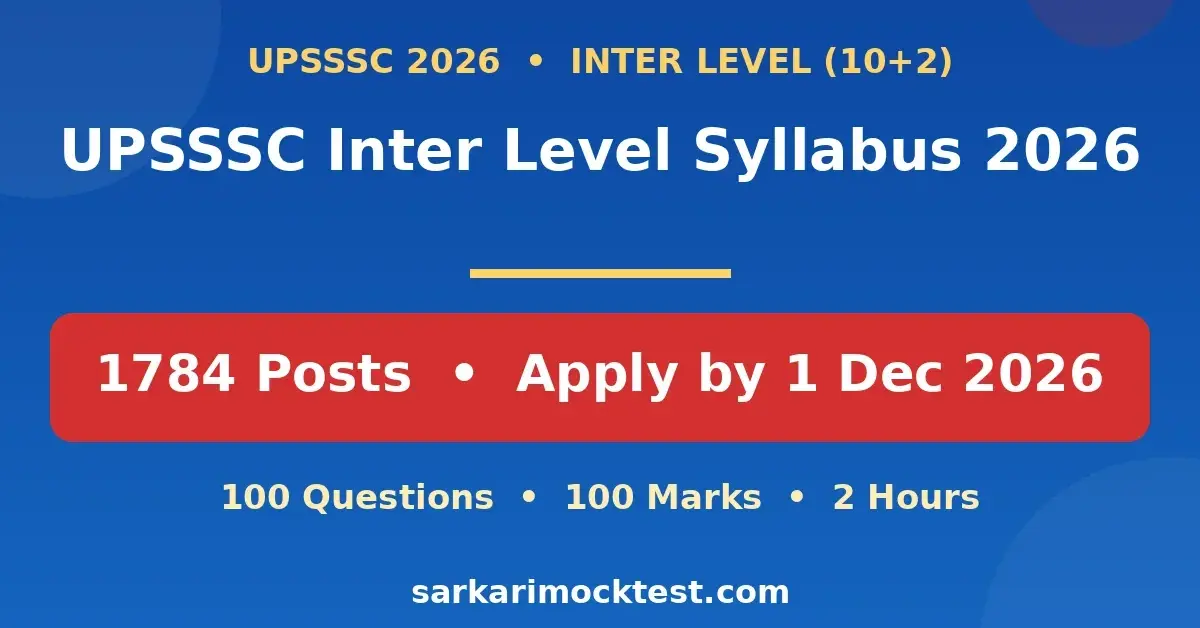
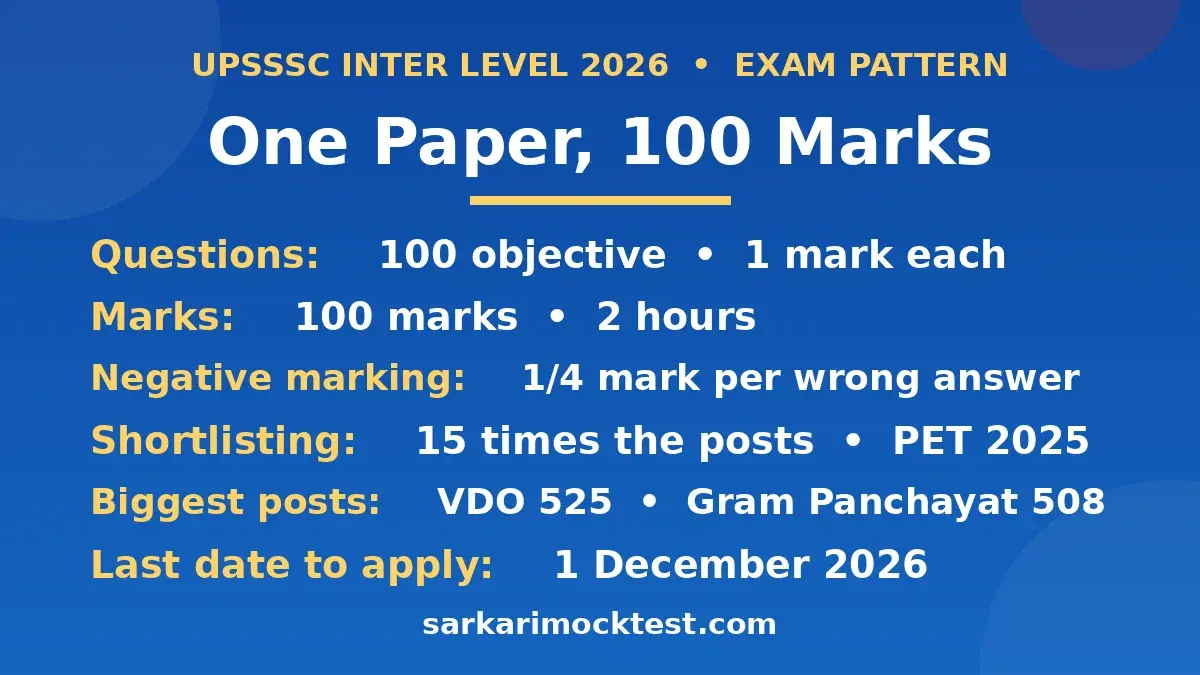
The UPSSSC Inter Level Syllabus 2026 is the syllabus for the Combined Lower Subordinate Services (Intermediate Level) Mains Examination, advertisement number 26-Exam/2026, dated 16 October 2026, for 1,784 posts. The mains exam is one paper of 100 objective questions, 100 marks, in 2 hours, with negative marking of one fourth mark per wrong answer. You can apply online from 10 November to 1 December 2026, and only candidates who appeared in UPSSSC PET 2025 and hold its score card can apply. No exam date has been announced yet.
Listen to this article in 1 minute:
The Uttar Pradesh Subordinate Services Selection Commission, known as UPSSSC, runs this exam to fill 1,784 posts that need only an Intermediate, or Class 12, pass. The biggest groups are Village Development Officer with 525 posts and Gram Panchayat Adhikari with 508 posts. This page gives the full UPSSSC Inter Level Syllabus 2026, the mains pattern, the marks, the dates, the fee, the age limit, and the post wise vacancy list. Every fact here comes from the commission's own advertisement number 26-Exam/2026.
Read this page in order if you are new to the exam. The first table gives the whole exam at a glance. The second section clears the biggest confusion about this exam, because many candidates mix it up with the Graduate Level Lower PCS exam.
The syllabus tables give every topic the commission has listed, so you can plan your study without guessing. The last sections tell you how to apply and which mistakes cost candidates their chance.
What is the UPSSSC Inter Level 2026 exam?
UPSSSC Inter Level 2026 is the short name for the Combined Lower Subordinate Services (Intermediate Level) Mains Examination (PET-2025)/26. The commission holds it for direct recruitment to 12 posts in different departments of the Uttar Pradesh government. The posts are at the Intermediate level, which means Class 12 pass is the basic qualification. The full official name is long, so candidates and coaching pages shorten it to UPSSSC Inter Level, or UPSSSC 10+2 Inter Level.
| Detail | UPSSSC Inter Level 2026 |
|---|---|
| Exam | Combined Lower Subordinate Services (Intermediate Level) Mains Examination (PET-2025)/26 |
| Commission | Uttar Pradesh Subordinate Services Selection Commission (UPSSSC), Lucknow |
| Advertisement | Number 26-Exam/2026, dated 16 October 2026 |
| Posts | 1,784 posts in 12 post entries |
| Qualification | Intermediate (Class 12) pass from UP Board or equivalent, plus PET-2025 score card |
| Apply | 10 November 2026 to 1 December 2026, online only |
| Mains exam | One paper, 100 objective questions, 100 marks, 2 hours |
| Negative marking | One fourth (1/4) mark per wrong answer |
| Selection | PET-2025 shortlist, then Mains written exam, then document verification |
| Pay | Level 2, Rs 19,900 to Rs 63,200, and Level 3, Rs 21,700 to Rs 69,100 |
| Exam date | Not announced yet |
| Official website | upsssc.gov.in |
The most important fact in the UPSSSC Inter Level Syllabus 2026 is the PET rule. This exam has no separate preliminary test of its own. The UPSSSC PET 2025 score is the screening test.
Only candidates who appeared in PET 2025 and hold its score card can apply, and the commission calls 15 times the number of posts for the mains on the basis of the PET 2025 normalised score. A candidate who did not sit PET 2025 cannot apply for this cycle, even with a Class 12 pass and all other conditions met.
Is this the same as UPSSSC Lower PCS?
No, and this is the point where most candidates go wrong. The two exams share the words Lower Subordinate Services in their names, and both are run by UPSSSC, but they are two different recruitments, with different advertisements, different qualifications, different post counts, and different dates. The table below puts the two side by side, so you can see the difference in one look.
| Point | Lower PCS (Graduate Level) | Inter Level (10+2 Level) |
|---|---|---|
| Advertisement | Number 07-Exam/2026 | Number 26-Exam/2026 |
| Full name | Combined Lower Subordinate Services (Graduate Level) Main Examination (P.A.P.-2025)/08 | Combined Lower Subordinate Services (Intermediate Level) Mains Examination (PET-2025)/26 |
| Qualification | Graduation | Intermediate (Class 12) |
| Posts | 2,587 | 1,784 |
| Mains admit card | Released 19 August 2026 | Not released yet |
| Mains exam | Held on 23 August 2026, Sunday, 10 AM to 12 PM | Not announced yet |
| Form status | Closed, exam over | Open, apply till 1 December 2026 |
| Shortlisted for mains | 1,00,492 candidates | 15 times the posts, category wise |
The Graduate Level Lower PCS mains exam was held on 23 August 2026, and its admit card came out on 19 August 2026. That exam is over. If you are reading a page that talks about the Lower PCS admit card or the 23 August exam, that page is about the Graduate Level exam, not this one. This page is about the Inter Level exam, advertisement 26-Exam/2026, with 1,784 posts and the form open till 1 December 2026.
The UPSSSC Lower PCS Mains Admit Card 2026 page on this site covers the Graduate Level exam, with its admit card and its 23 August 2026 exam. Read that page if you appeared in the Graduate Level exam. Read this page if you hold a PET 2025 score card and want one of the 1,784 Inter Level posts.
What are the important dates?
The advertisement came out on 16 October 2026, a Friday, and the online application started on 10 November 2026, a Tuesday. The last date to apply and pay the fee is 1 December 2026, a Tuesday. After that, the commission gives one more week for fee reconciliation and correction of the form, till 8 December 2026, also a Tuesday. The mains exam date has not been announced, not even a tentative month, so do not trust any date a tracker page prints for the exam.
| Event | Date |
|---|---|
| Advertisement published | 16 October 2026 (Friday) |
| Online application starts | 10 November 2026 (Tuesday) |
| Last date to apply online | 1 December 2026 (Tuesday) |
| Last date for fee payment | 1 December 2026 (Tuesday) |
| Fee reconciliation and correction till | 8 December 2026 (Tuesday) |
| Mains exam date | Not announced yet |
| Admit card | Not announced yet |
| Result | After the mains exam and document verification |
One date rule is easy to miss. The fee reconciliation and correction window runs till 8 December 2026, but it only helps a candidate who has already applied by 1 December. A candidate who has not applied by 1 December cannot apply in the correction window.
The correction window lets you fix a form you have already submitted, and lets a fee you have already paid get reconciled. It does not open the form again.
The syllabus in this advertisement was approved by the Uttar Pradesh Government by letter number 735/47-Ka-3-2025, dated 2 December 2025. The advertisement itself is dated 16 October 2026. Both dates sit in the advertisement, and both are given here so you can check them against the official notice on upsssc.gov.in.
How many posts are there?
There are 1,784 posts in total, across 12 post entries in different departments. The table below gives the full post wise list from the advertisement, with the department for each post. The two biggest groups are Village Development Officer with 525 posts and Gram Panchayat Adhikari with 508 posts.
Together they make 1,033 posts, which is more than half of the total. The smallest groups are Salesman with 1 post and Farm Clerk and Storekeeper and Clerk (Special Selection) with 2 posts each.
| Post | Department | Posts |
|---|---|---|
| Commercial Tax Collection Amin (Vanijya Kar Sangrah Amin) | State Tax Commissioner Office | 235 |
| Land Acquisition Amin (Bhumi Arjan Amin) | Land Acquisition Directorate, Board of Revenue | 187 |
| Storekeeper and Clerk (Bhandar Pal Evam Lipik) | Directorate of Medical and Health Services | 118 |
| Storekeeper and Clerk (Special Selection) | Directorate of Medical and Health Services | 2 |
| Cooperative Agriculture Supervisor (Sahkari Krishi Paryavekshak) | Commissioner and Registrar, Cooperative | 50 |
| Grihmata (House Mother) | Tribal Development Directorate | 5 |
| Saraniyak (Tabulator) | Chakbandi (Consolidation) Commissioner Office | 14 |
| Social Welfare Supervisor (Samaj Kalyan Paryavekshak) | Social Welfare Directorate | 137 |
| Village Development Officer (VDO, Social Welfare) | Social Welfare Directorate | 525 |
| Gram Panchayat Adhikari | Panchayati Raj Directorate | 508 |
| Farm Clerk (Farm Lipik) | Prison Administration and Reform Services | 2 |
| Salesman (Bikri Karta) | Prison Administration and Reform Services | 1 |
| Total | 12 post entries | 1,784 |
Add the numbers in the table and they come to 1,784. The advertisement gives the same total, so the list is complete. The posts are both temporary and permanent in nature, and the pay levels are mostly Level 2 and Level 3. The next section explains what each post does, in plain words, so you can pick the posts you want when you fill the form.
When you fill the application form, you must select every post you want. A post you do not select will not be considered for you. Read the post list before you open the form, and decide your order of preference in advance. The form will not let you add a post after you submit it.
What does each post do?
The post names tell you the work in most cases, and the department tells you where the work happens. The table below explains each post in one line, in plain words. These are the duties the post names and departments point to. The advertisement gives the post, the department and the qualification, and leaves the day to day duties to the department.
| Post | What the work is |
|---|---|
| Commercial Tax Collection Amin | Collects commercial tax dues in the field for the State Tax Commissioner Office |
| Land Acquisition Amin | Measures land and keeps land records for land acquisition work under the Board of Revenue |
| Storekeeper and Clerk | Keeps stores and records and does clerical work in medical and health offices |
| Storekeeper and Clerk (Special Selection) | The same store and clerical work, filled through a special selection of 2 posts |
| Cooperative Agriculture Supervisor | Supervises cooperative agriculture work under the Commissioner and Registrar, Cooperative |
| Grihmata (House Mother) | Looks after children in residential homes and hostels under the Tribal Development Directorate |
| Saraniyak (Tabulator) | Does tabulation work in the Chakbandi, or consolidation, office |
| Social Welfare Supervisor | Supervises social welfare schemes and field work under the Social Welfare Directorate |
| Village Development Officer (VDO) | Does village development work under the Social Welfare Directorate |
| Gram Panchayat Adhikari | Works in the village panchayat office, keeps panchayat records and runs panchayat schemes |
| Farm Clerk | Does clerical work on prison farms under the Prison Administration and Reform Services |
| Salesman | Sells farm produce and products for the Prison Administration and Reform Services |
The Gram Panchayat Adhikari post deserves one extra line, because it has the second largest number of posts, 508, and it is the post most candidates ask about. A Gram Panchayat Adhikari works in the Panchayati Raj Directorate, at the village panchayat level, and the post needs a NIELIT CCC certificate or its equivalent in addition to the Intermediate pass. The Village Development Officer post, with 525 posts, also needs the CCC certificate. The CCC rule is explained in full in its own section below.
The Gram Panchayat Bharti 2026 page on this site also points to this UPSSSC Inter Level drive, because it carries the same Gram Panchayat Adhikari post name. That page is mainly about the Bihar BSSC Inter Level exam, which is a different recruitment. Do not mix the two.
The Bihar exam has 26,426 posts and its own pattern. This page is only about the Uttar Pradesh UPSSSC Inter Level exam, advertisement 26-Exam/2026.
Who can apply?
The advertisement lists the conditions in one place, and a candidate must meet all of them. The basic condition is the Intermediate pass. The second condition is the PET 2025 score card.
The third condition is the age limit. The fourth condition is the extra certificate or experience that some posts need. The table below gives them in plain words.
| Condition | What the advertisement asks for |
|---|---|
| Education | Intermediate (Class 12) pass from UP Board or a board recognised as equivalent |
| PET 2025 | Must have appeared in UPSSSC PET 2025 and hold its score card |
| PET score | Zero or negative PET 2025 score, absolute or normalised, is not shortlisted |
| Age | 18 to 40 years as on 1 July 2026, Farm Clerk 21 to 30 years |
| CCC certificate | Needed for Social Welfare Supervisor, Village Development Officer and Gram Panchayat Adhikari |
| Experience | Farm Clerk needs 3 years of agricultural work experience, Salesman needs 3 years of sales work experience |
| Hindi | Farm Clerk and Salesman need a working knowledge of Hindi in Devanagari script |
The PET 2025 rule is the strictest condition in this recruitment. Only candidates who appeared in the Preliminary Eligibility Test 2025 and got its score card can apply. The commission shortlists 15 times the number of posts in each category, on the PET 2025 normalised score, and ties at the cut off are included. A candidate with a zero or negative PET score, whether absolute or normalised, is not shortlisted at all.
The application form pulls your PET 2025 details, your photo and your signature on its own, and you cannot change them in this form. That is why the advertisement says to check the PET details first. If your photo or signature in the PET record is wrong, the mains form will carry the same error, and you cannot fix it here.
What is the age limit?
The age limit is 18 to 40 years as on 1 July 2026. That means your age is counted on 1 July 2026, a Wednesday, not on the date you apply. The Farm Clerk post is different: its age limit is 21 to 30 years. Age relaxation is given as per the Uttar Pradesh Government rules, and Uttar Pradesh Government employees get 5 years of relaxation in the upper age limit.
| Rule | Detail |
|---|---|
| Minimum age | 18 years as on 1 July 2026 |
| Maximum age | 40 years as on 1 July 2026 |
| Age counted as on | 1 July 2026 (Wednesday) |
| Farm Clerk age | 21 to 30 years |
| Age relaxation | As per Uttar Pradesh Government rules |
| UP Government employees | 5 years relaxation in the upper age limit |
Work out your own age before you apply. If you were born on 1 July 2008, you turn 18 on 1 July 2026 and you meet the minimum age. If you were born on 2 July 2008, you turn 18 only after 1 July 2026 and you do not meet it.
The same rule works at the top end. If you were born on 1 July 1986, you turn 40 on 1 July 2026 and you are inside the limit. If you were born before 1 July 1986, you are over age unless a relaxation applies to you.
The Farm Clerk age rule is the only post specific age rule in this advertisement. A Farm Clerk candidate must be 21 to 30 years old. The 3 years of agricultural work experience that the post needs is a separate condition, and it sits on top of the age rule. Both must be met.
What is the application fee?
The application fee is Rs 25 for every candidate, General, OBC, SC and ST alike. The advertisement calls it an online processing fee. Dependents of Freedom Fighters, Ex-Servicemen, Women, Persons with Disabilities and Sportspersons pay as per their main category, which means they also pay Rs 25. There is no separate fee table by category in this advertisement.
| Category | Application fee |
|---|---|
| General | Rs 25, online processing fee |
| Other Backward Classes (OBC) | Rs 25, online processing fee |
| Scheduled Caste (SC) | Rs 25, online processing fee |
| Scheduled Tribe (ST) | Rs 25, online processing fee |
| Dependents of Freedom Fighters, Ex-Servicemen, Women, PwD, Sportspersons | Rs 25, as per main category |
One fee point is easy to miss. The mains exam fee is paid separately, and only by the shortlisted candidates, before the admit card. The Rs 25 in the table above is the application fee for this form.
The mains exam fee is a separate payment, made after the shortlist, and the advertisement does not give its amount in the same place. Do not confuse the two payments.
You can pay by Credit Card, Debit Card, Net Banking, UPI or SBI e-Challan. The last date for fee payment is 1 December 2026, the same as the last date to apply. After you pay, the fee has to be reconciled, and the reconciliation window runs till 8 December 2026. Check that your payment shows as reconciled before that date.
How does the selection work?
The selection has three steps, and there is no interview in this recruitment. The first step is the PET 2025 score, which decides who is called for the mains. The second step is the mains written exam, one paper of 100 marks, which decides the merit.
The third step is document verification, where your real papers are checked. The final merit list comes from the written exam marks.
| Step | What happens |
|---|---|
| Step 1: PET 2025 shortlist | Candidates shortlisted on PET 2025 normalised score, 15 times the posts in each category, ties at the cut off included |
| Step 2: Mains written exam | One paper, 100 objective questions, 100 marks, 2 hours |
| Step 3: Document verification | Original certificates, age proof, education proof, CCC certificate where needed, and experience proof where needed |
| Final merit | Made from the mains written exam marks only |
| Interview | No interview in this recruitment |
| Shortlisting rule | Detail |
|---|---|
| Called for mains | 15 times the number of posts, in each category |
| Basis | PET 2025 normalised score |
| Ties at the cut off | Included, all candidates tied at the cut off are called |
| Zero or negative PET score | Not shortlisted, whether absolute or normalised |
| Posts | 1,784, so about 26,760 candidates will be called for the mains |
The 15 times rule gives a useful number. With 1,784 posts, 15 times the posts comes to 26,760 candidates called for the mains. The exact number will be higher in practice, because ties at the cut off are included, and because the shortlisting is done category wise.
The number is an estimate from the rule, not a figure the advertisement prints. The advertisement prints only the rule, 15 times the posts in each category.
The final merit comes from the written exam only, so the mains paper is the whole exam in marks. There is no interview to add marks, and no second paper to balance a weak first paper. A candidate who scores high in the one paper ranks high. A candidate who scores low in it has no other stage to recover in, except document verification, which only checks papers and adds no marks.
What is the mains exam pattern?
The mains exam is one paper with 100 objective multiple choice questions, 100 marks, in 2 hours. Each question carries 1 mark. A wrong answer costs one fourth of a mark, which is 0.25 marks.
The paper has three parts, and the parts carry different marks. Part 1 carries 65 marks, Part 2 carries 15 marks, and Part 3 carries 20 marks. The three parts add up to 100.
| Part | Subject | Questions | Marks |
|---|---|---|---|
| Part 1 (1) | History of India and Indian National Movement | 5 | 5 |
| Part 1 (2) | Indian Polity and Indian Constitution | 5 | 5 |
| Part 1 (3) | Geography of India and World | 5 | 5 |
| Part 1 (4) | Indian Economy and Social Development | 5 | 5 |
| Part 1 (5) | Rural Society and Development | 5 | 5 |
| Part 1 (6) | Current Events of National and International Importance | 5 | 5 |
| Part 1 (7) | Science and Technology | 5 | 5 |
| Part 1 (8) | Environmental Ecology and Disaster Management | 10 | 10 |
| Part 1 (9) | Data Interpretation | 10 | 10 |
| Part 1 (10) | General Hindi | 10 | 10 |
| Part 2 | Computer and Information Technology | 15 | 15 |
| Part 3 | General information related to the State of Uttar Pradesh | 20 | 20 |
| Total | One paper, three parts | 100 | 100 |
| Rule | What happens |
|---|---|
| Total questions | 100 objective multiple choice questions |
| Total marks | 100, one mark per question |
| Time | 2 hours, 120 minutes |
| Right answer | Plus 1 mark |
| Wrong answer | Minus one fourth mark, 0.25 marks |
| Blank question | No marks, no penalty, as per the standard objective rule |
| More than one shift or day | Scores are normalised as per the UPSSSC notice dated 22 May 2019 |
| Language of the paper | As per the advertisement, Hindi and English |
The negative marking rule is worth working out in numbers. If you attempt 80 questions, get 60 right and 20 wrong, you score 60 marks minus 5 marks, which is 55 marks. The 20 wrong answers cost 20 times 0.25, which is 5 marks.
If you attempt all 100 questions with the same accuracy, the penalty grows. A blank question costs nothing, so leave a question blank when you cannot narrow it down to one or two options.
The normalisation rule matters if the exam runs in more than one shift or on more than one day. The advertisement says the scores are normalised as per the UPSSSC notice dated 22 May 2019. Normalisation adjusts the scores so that candidates in a harder shift are not punished for the harder paper.
You do not need to calculate it. You only need to know that the normalised score is the final score when the exam runs in more than one shift.
What is Part 1 of the syllabus?
Part 1 is the biggest part of the paper, with 65 marks out of 100. It has ten subjects. Seven of them carry 5 marks each, and three of them carry 10 marks each.
The seven 5 mark subjects are History, Polity, Geography, Economy, Rural Society, Current Events, and Science and Technology. The three 10 mark subjects are Environmental Ecology and Disaster Management, Data Interpretation, and General Hindi. The table below gives the ten subjects with their marks, and the sections after this one explain each subject in full.
| Number | Subject | Marks |
|---|---|---|
| Part 1 (1) | History of India and Indian National Movement | 5 |
| Part 1 (2) | Indian Polity and Indian Constitution | 5 |
| Part 1 (3) | Geography of India and World | 5 |
| Part 1 (4) | Indian Economy and Social Development | 5 |
| Part 1 (5) | Rural Society and Development | 5 |
| Part 1 (6) | Current Events of National and International Importance | 5 |
| Part 1 (7) | Science and Technology | 5 |
| Part 1 (8) | Environmental Ecology and Disaster Management | 10 |
| Part 1 (9) | Data Interpretation | 10 |
| Part 1 (10) | General Hindi | 10 |
| Part 1 total | Ten subjects | 65 |
The 5 mark subjects look small, but they add up to 35 marks, which is more than one third of the paper. A candidate who skips them loses 35 marks before the 10 mark subjects begin. The 10 mark subjects add up to 30 marks.
Together the ten subjects make 65 marks, which is nearly two thirds of the paper. Part 1 is where the exam is won or lost.
The next sections explain each subject in the order the advertisement lists them. Each section gives the topics the advertisement names, in plain words, so you can match your study material to the official syllabus without guessing.
What does the History syllabus cover?
The History subject covers the social, cultural, economic and political aspects of Indian history. It also covers the Indian National Movement, with three points named in the advertisement: the freedom movement, the rise of nationalism, and the attainment of independence. The subject carries 5 marks, which means about 5 questions in the paper.
| Topic | What it covers |
|---|---|
| Social aspects of Indian history | Society, social structure and social change in Indian history |
| Cultural aspects | Culture, art, literature and traditions in Indian history |
| Economic aspects | Economy, trade, agriculture and industry in Indian history |
| Political aspects | Kingdoms, empires, administration and political change in Indian history |
| Indian National Movement | Freedom movement, rise of nationalism, attainment of independence |
Study History as a story with dates, not as a list of names. The freedom movement questions usually ask for the year of an event, the leader of a movement, or the reason a movement started. The rise of nationalism questions ask how the Congress was formed, how the early moderates worked, and how the movement changed after 1919. The attainment of independence questions ask about the last phase, from the Quit India Movement to the transfer of power in 1947.
Five questions is a small number, so do not spend a month on History alone. Give it one week of steady reading, revise it twice, and move on. The same rule applies to the other 5 mark subjects. Each one is worth 5 marks, so each one deserves the same share of your time.
What does the Polity syllabus cover?
The Polity subject covers constitutional development in India, the Indian Constitution, the Indian political system and governance, Panchayati Raj and local self governance, public policy and official issues, and community development. It carries 5 marks, which means about 5 questions in the paper.
| Topic | What it covers |
|---|---|
| Constitutional development in India | How the Constitution was made, and the Acts that came before it |
| Indian Constitution | Preamble, fundamental rights, duties, directive principles, Union and State structure |
| Indian political system and governance | Parliament, State Legislatures, executive, judiciary, elections |
| Panchayati Raj and local self governance | Panchayats, municipalities, 73rd and 74th Amendments |
| Public policy and official issues | Government policy, schemes, and official matters |
| Community development | Community development programmes and local development |
Polity is the subject where this exam connects to the posts themselves. The Gram Panchayat Adhikari and the Village Development Officer work in the Panchayati Raj system, so the Panchayati Raj topic is the daily work of the two biggest post groups as well as a syllabus point. Learn the three tier Panchayat structure, the Gram Sabha, the Gram Panchayat, the Kshetra Panchayat and the Zila Panchayat, and the subjects in the Eleventh Schedule.
The Constitution questions usually ask for an Article number, a fundamental right, or the meaning of a term like secular or federal. Learn the Preamble word by word, the six fundamental rights with their Article numbers, and the directive principles. Five questions is a small number, but Polity questions are the easiest to score in, because the answers are fixed and the facts do not change.
What does the Geography syllabus cover?
The Geography subject covers the physical, social and economic geography of India, with agriculture, horticulture, forestry and animal husbandry named in the advertisement. It also covers population and urbanization patterns, smart cities and smart villages, and general information about world geography. It carries 5 marks, which means about 5 questions in the paper.
| Topic | What it covers |
|---|---|
| Physical geography of India | Mountains, rivers, plains, plateaus, climate, soils |
| Social geography of India | Population, distribution, density, migration, urbanization patterns |
| Economic geography of India | Agriculture, horticulture, forestry, animal husbandry, industry, minerals |
| Smart cities and smart villages | Smart city and smart village concepts and programmes |
| World geography | General information about world geography, continents, oceans, countries |
Geography questions usually ask for a place, a river, a crop, or a fact about a state. Learn the major rivers and their tributaries, the major crops and the states that grow them, the major minerals and where they are found, and the population facts from the latest Census. The smart cities and smart villages topic is new in this syllabus, so read the Smart Cities Mission and the basic idea of a smart village before the exam.
The Uttar Pradesh geography in Part 3 overlaps with this subject, so the reading you do here carries into Part 3. Learn the geography of Uttar Pradesh once, well, and it will serve you in both parts. The rivers of Uttar Pradesh, the Ganga, the Yamuna, the Gomti, the Ghaghra, and the soil types of the state are the facts that come up in both places.
What does the Economy syllabus cover?
The Economy subject covers economic planning in India, with its objectives and achievements, the role of NITI Aayog, and the Sustainable Development Goals. It also covers the components of the government budget and the financial system, the development of agriculture, industry and trade commerce, land reforms in India after independence, the effects of globalization and liberalization, changes in industrial policy and their impact on industrial development, and infrastructure, which means power, ports, roads, airports and railways. It carries 5 marks, which means about 5 questions in the paper.
| Topic | What it covers |
|---|---|
| Economic planning in India | Planning objectives and achievements, Five Year Plans, NITI Aayog |
| Sustainable Development Goals (SDGs) | The 17 SDGs, their targets, and India's progress |
| Government budget and financial system | Components of the budget, revenue, expenditure, deficit, banking |
| Agriculture, industry and trade | Development of agriculture, industry and trade commerce in India |
| Land reforms after independence | Land reforms, zamindari abolition, land ceiling, tenancy |
| Globalization and liberalization | Effects of globalization and liberalization in India, 1991 reforms |
| Industrial policy | Changes in industrial policy and their impact on industrial development |
| Infrastructure | Power, ports, roads, airports and railways |
Economy is the subject where current facts matter most. The budget questions ask for the latest budget figures, the NITI Aayog questions ask for its role and its reports, and the SDG questions ask for the goal numbers and the targets. Read the latest Union Budget summary and the latest Economic Survey summary before the exam, and note the growth rate, the fiscal deficit, and the big scheme allocations.
The land reforms topic connects to two posts in this exam, the Land Acquisition Amin and the Saraniyak in the consolidation office. Land acquisition and consolidation are the daily work of those posts. Learn what land acquisition means, what consolidation of holdings means, and which law governs each one. The advertisement names land reforms after independence as a syllabus point, and the posts make it a practical point too.
What does the Rural Society syllabus cover?
The Rural Society and Development subject covers rural development in the Indian context, rural development programmes, rural development schemes and management, rural development research systems, rural health schemes, rural social development, rural development and land reforms, and the central and state government schemes related to rural development. It carries 5 marks, which means about 5 questions in the paper.
| Topic | What it covers |
|---|---|
| Rural development in the Indian context | Meaning, need and approach of rural development in India |
| Rural development programmes | Major programmes, their aims and their target groups |
| Rural development schemes and management | Schemes, their management, and their implementation |
| Rural development research systems | Research systems and institutions for rural development |
| Rural health schemes | Health schemes for rural areas |
| Rural social development | Social development in villages, education, women, weaker sections |
| Rural development and land reforms | Land reforms and their link to rural development |
| Central and state schemes | Schemes of the central government and the Uttar Pradesh government for rural development |
Rural Society is the subject closest to the posts in this exam. The Village Development Officer, the Gram Panchayat Adhikari, the Social Welfare Supervisor and the Cooperative Agriculture Supervisor all work in villages, on rural schemes. The questions ask for the name of a scheme, its target group, or its main benefit. Learn the big rural schemes by name: MGNREGA, Pradhan Mantri Awaas Yojana Gramin, Jal Jeevan Mission, Swachh Bharat Mission Gramin, and the Uttar Pradesh rural schemes.
The rural health schemes topic asks for the schemes that take health to villages, like the National Health Mission and the Ayushman Bharat scheme. The rural social development topic asks for the schemes for women, children and weaker sections in villages. Learn each scheme as one line: its name, its target group, and its main benefit. Five questions is a small number, but these are the easiest marks in the paper for a candidate who knows the scheme names.
What do Current Events and Science cover?
Current Events covers knowledge of recent events at both the national and the international level. Science and Technology covers the applications of the Science and Technology Policy of India in everyday life, development and national security, the achievements of Indians in science and technology, the indigenization of technology, the development of new technologies, and mutually beneficial and technologically useful technologies. Each subject carries 5 marks, which means about 5 questions each, 10 marks together.
| Subject | What it covers |
|---|---|
| Current Events | Recent events at the national level and the international level |
| Science and Technology Policy | Applications in everyday life, development and national security |
| Achievements of Indians | Achievements of Indians in science and technology |
| Indigenization of technology | Making technology in India, reducing dependence on imports |
| New technologies | Development of new technologies |
| Space technology | ISRO missions, satellites, launch vehicles |
| Defence technology | Defence research, missiles, aircraft, ships |
| Energy sources | Solar, wind, hydro, nuclear and other energy sources |
| Nanotechnology | Nano science and its uses |
| Microbiology and biotechnology | Microbes, vaccines, genetic engineering, biotechnology |
| Intellectual property rights and digital rights | Patents, copyright, digital rights and related issues |
Current Events is the subject that changes every month, so it is the last subject to revise and the first to forget. Read the news of the last six months before the exam, and note the big events: national awards, sports, appointments, international summits, and government schemes. The advertisement says recent events at both levels, so do not read only national news. The international events, like a G20 summit or a major election abroad, can also appear.
Science and Technology is the subject where the new terms matter. Learn what ISRO launched in the last two years, what DRDO built, what AI means in plain words, and what nanotechnology and biotechnology do in everyday life. The advertisement names Artificial Intelligence only in Part 2, but the Science subject names new technologies in general, so a question can ask about any new technology that made news.
What do Environment and Data Interpretation cover?
Environmental Ecology and Disaster Management carries 10 marks, and Data Interpretation carries 10 marks. Together they make 20 marks, which is one fifth of the paper. These are the two 10 mark subjects in Part 1 that are not language, and they are the two subjects where a candidate can score full marks with the least reading, because the questions are direct and the facts are fixed.
| Topic | What it covers |
|---|---|
| Environmental protection and ecosystems | Protection of the environment, ecosystems, food chains, food webs |
| Wildlife conservation | Wildlife protection, sanctuaries, national parks, Project Tiger, Project Elephant |
| Biodiversity | Biodiversity, hotspots, endangered species, Red Data Book |
| Environmental pollution and degradation | Air, water, soil and noise pollution, and degradation |
| Environmental impact assessment | EIA, its process and its purpose |
| Climate change | Causes, effects, agreements, India's commitments |
| Disaster mitigation and management | Disaster as a non traditional security and safety challenge |
| Disaster Management Act 2005 | The Act, its structure, NDMA, SDMA, NDRF, SDRF |
| Agencies in disaster management | Agencies working in disaster management in India |
| Global efforts | Efforts and achievements in disaster mitigation and management at the global level |
The Disaster Management Act 2005 is the single most important fact in the Environment subject. Learn the Act, the National Disaster Management Authority, the State Disaster Management Authority, the National Disaster Response Force, and the State Disaster Response Force. A question can ask which body does what, or which force is called first. Learn the four bodies as one set, with their full names and their roles.
Data Interpretation is the only subject in the paper that tests calculation, not memory. The advertisement says it tests the interpretation and analysis of data, statistical analysis with graphs and diagrams, and the ability to draw general knowledge conclusions from information given in statistical and graphical diagrams. The questions give you a table, a bar chart, a pie chart or a line graph, and ask you to read a value, to find a percentage, or to compare two years.
| Skill | What to practise |
|---|---|
| Reading a table | Find a value in a row and a column, add a column, find a total |
| Reading a bar chart | Compare two bars, find the highest and the lowest |
| Reading a pie chart | Find a share as a percentage, find the biggest slice |
| Reading a line graph | Find a trend, find a rise or a fall over years |
| Percentage and average | Calculate a percentage, calculate an average, find a ratio |
Practise Data Interpretation with a timer, because the questions are easy but slow. A candidate who spends 15 minutes on 10 Data Interpretation questions has used one eighth of the paper time on one tenth of the marks. The target is one minute per question. Read the question first, then look at the chart, then calculate only what the question asks for.
What does the General Hindi syllabus cover?
General Hindi carries 10 marks, which means about 10 questions in the paper. It is the biggest single language subject in the exam, and it is the subject where a Hindi medium candidate scores the easiest marks. The advertisement lists the topics in detail, and the table below gives them in the same order, in plain words.
| Topic | What it covers |
|---|---|
| Official letters and documents | Letters, office orders, notifications and circulars on official, semi official, personal and business matters |
| Letters and sounds | Pronunciation, writing, vowels, consonants, matra recognition and use, classification of sounds |
| Word formation | Sandhi and sandhi viched, samas, upsarg, pratyay |
| Word types | Tatsam, ardhtatsam, tadbhav, deshaj, videshi, noun, pronoun, adjective, verb, avyay |
| Avyay in detail | Adverb, sambandh suchak, vismayabodhak, nipat |
| Vocabulary | Synonyms, antonyms, difference in meaning of word pairs, one word for a phrase, similar sounding words, words of same meaning, right word choice, relationship words |
| Word correction | Word correction, spelling and usage |
| Grammatical categories | Postposition, gender, number, person, tense, mood, aspect, voice |
| Sentence formation | Simple, compound and complex sentences, sentence correction, punctuation marks |
| Idioms and proverbs | Muhavare and lokoktiyan, their meanings and use |
General Hindi is a grammar paper, not a literature paper. The questions ask for the sandhi of a word, the samas of a compound, the synonym or antonym of a word, the correct spelling, the gender or number of a noun, or the meaning of an idiom. There is no essay and no long passage. A candidate who revises the grammar rules from a standard Hindi grammar book can score 8 or more out of 10 in this subject.
The vocabulary topics are the biggest group inside Hindi. Synonyms, antonyms, word pairs with different meanings, one word for a phrase, and similar sounding words with different meanings together make up most of the 10 questions. Learn them as pairs, not as single words.
A synonym question gives you a word and four options, and only one option is the true synonym. A similar sounding words question gives you two words that sound alike and asks for the difference in their meanings.
What is Part 2 Computer and IT syllabus?
Part 2 covers the knowledge of concepts of Computer and Information Technology, and contemporary technological development and innovation in this field. It carries 15 marks, which means about 15 questions in the paper. It is the second biggest part of the paper, after Part 1, and it is the part where a candidate with basic computer knowledge scores well.
| Topic | What it covers |
|---|---|
| History and introduction | History, introduction and application of computer, information technology, internet and World Wide Web |
| Hardware and software | Hardware, software, input and output devices |
| Internet Protocol and IP address | Internet Protocol, IP address, its types and use |
| IT gadgets | IT gadgets and their applications |
| Creation of e-mail ID, use and operation of e-mail | |
| Printer, tablet and mobile | Operation of printer, tablet and mobile |
| MS Word and MS Excel | Important elements of Word Processing (MS Word) and Excel Processing (MS Excel) |
| Operating system | Operating system, its types and functions |
| Social networking | Social networking sites and their use |
| E-governance | E-governance, its services and its benefits |
| Digital financial tools | Digital financial tools and applications, UPI, net banking, wallets |
| Future skills and cyber security | Future skills, cyber security, safe use of the internet |
| Artificial Intelligence | AI, its meaning, its uses, and India's achievements |
| Big Data, Deep Learning, Machine Learning | Big Data Processing, Deep Learning, Machine Learning, their meaning and use |
| Internet of Things | IoT, connected devices, and India's achievements in this field |
Part 2 is the most practical part of the paper. The questions ask what a device does, what a shortcut does, what an IP address is, or how e-mail works. A candidate who uses a computer every day knows half of this part already.
The other half is the new technology terms: Artificial Intelligence, Big Data, Deep Learning, Machine Learning, and the Internet of Things. Learn each term in one line: what it is, and one example of where it is used.
The digital financial tools topic is the one that connects to everyday life in villages. UPI, net banking, mobile wallets, and the digital payment apps are the tools the question asks about. The e-governance topic asks for the government services that are online, like DigiLocker, UMANG, and the state service portals. The cyber security topic asks for safe practices, like strong passwords, not sharing OTPs, and spotting fake links.
What is Part 3 Uttar Pradesh GK syllabus?
Part 3 covers general information related to the State of Uttar Pradesh. It carries 20 marks, which means about 20 questions in the paper. It is the single biggest part of the paper, one fifth of the total marks, and it is the part that decides the rank in this exam, because it is the part most candidates from other states do not know, and most candidates from Uttar Pradesh know only in part.
| Topic | What it covers |
|---|---|
| History of Uttar Pradesh | History of the state, ancient, medieval and modern periods |
| Culture, art and architecture | Culture, art, architecture, festivals, folk dances, literature, regional languages, heritage |
| Social customs and tourism | Social customs, tourist places, tourism in Uttar Pradesh |
| Geographical features and environment | Geographical features, environment, natural resources |
| Climate, soil, forests, wildlife | Climate, soil types, forests, wildlife, national parks and sanctuaries |
| Mines and minerals | Mines and minerals found in Uttar Pradesh |
| Economy | Economy of Uttar Pradesh, agriculture, industry, business and employment |
| Polity and administration | Polity and administration of Uttar Pradesh, districts, divisions, local bodies |
| Current events of Uttar Pradesh | Current events and news of the state |
| Achievements of Uttar Pradesh | Achievements of the state in various fields |
Twenty questions is a big number, so give Part 3 the biggest share of your study time. Learn the history of Uttar Pradesh from the ancient period to the freedom movement, the culture and festivals of the state, the folk dances, the literature, and the regional languages. Learn the geography of the state, its rivers, its soil, its forests, and its wildlife. Learn the economy of the state, its crops, its industries, and its employment schemes.
The current events of Uttar Pradesh are the questions that change every month, so read the state news of the last six months before the exam. The achievements topic asks for what the state has done in various fields, like the expressways, the airports, the One District One Product scheme, and the big fairs and festivals. A candidate who lives in Uttar Pradesh and follows its news has an advantage in this part, and that advantage is worth 20 marks.
Which posts need the CCC certificate?
Three posts need a NIELIT CCC certificate or its equivalent, in addition to the Intermediate pass. The CCC is the Course on Computer Concepts, run by NIELIT, the National Institute of Electronics and Information Technology. The three posts are Social Welfare Supervisor, Village Development Officer, and Gram Panchayat Adhikari. Together they make 1,170 posts, which is nearly two thirds of the total 1,784 posts.
| Post | Posts | CCC needed |
|---|---|---|
| Social Welfare Supervisor | 137 | Yes, NIELIT CCC certificate or equivalent |
| Village Development Officer (VDO) | 525 | Yes, NIELIT CCC certificate or equivalent |
| Gram Panchayat Adhikari | 508 | Yes, NIELIT CCC certificate |
| Total posts needing CCC | 1,170 | Nearly two thirds of all posts |
| All other 9 posts | 614 | No, Intermediate pass only, except Farm Clerk and Salesman experience |
The CCC rule is the condition that catches the most candidates, because it is easy to miss. A candidate with an Intermediate pass and a PET 2025 score card, but no CCC certificate, cannot apply for the three biggest post groups. The same candidate can still apply for the other nine post entries, which make 614 posts, but not for the 1,170 CCC posts. Check your CCC certificate before you open the form.
The advertisement says NIELIT CCC certificate or equivalent for the Social Welfare Supervisor and the Village Development Officer, and NIELIT CCC certificate for the Gram Panchayat Adhikari. An equivalent certificate means a certificate the commission accepts as equal to CCC. If you hold a computer diploma or a degree that includes computer papers, check the advertisement for the exact equivalence rule before you apply.
Do not assume a certificate is equivalent. The commission decides equivalence, not the candidate.
What is the salary and pay level?
The posts in this exam are paid in Level 2 and Level 3 of the pay matrix. Seven post entries are in Level 3, with pay from Rs 21,700 to Rs 69,100. Five post entries are in Level 2, with pay from Rs 19,900 to Rs 63,200. The pay is the basic pay in the pay matrix, and the total salary in hand adds the dearness allowance, the house rent allowance, and the other allowances the Uttar Pradesh Government gives.
| Post | Pay level | Pay scale |
|---|---|---|
| Commercial Tax Collection Amin | Level 3 | Rs 21,700 to Rs 69,100 |
| Land Acquisition Amin | Level 3 | Rs 21,700 to Rs 69,100 |
| Cooperative Agriculture Supervisor | Level 3 | Rs 21,700 to Rs 69,100 |
| Grihmata (House Mother) | Level 3 | Rs 21,700 to Rs 69,100 |
| Social Welfare Supervisor | Level 3 | Rs 21,700 to Rs 69,100 |
| Village Development Officer (VDO) | Level 3 | Rs 21,700 to Rs 69,100 |
| Gram Panchayat Adhikari | Level 3 | Rs 21,700 to Rs 69,100 |
| Storekeeper and Clerk | Level 2 | Rs 19,900 to Rs 63,200 |
| Storekeeper and Clerk (Special Selection) | Level 2 | Rs 19,900 to Rs 63,200 |
| Saraniyak (Tabulator) | Level 2 | Rs 19,900 to Rs 63,200 |
| Farm Clerk | Level 2 | Rs 19,900 to Rs 63,200 |
| Salesman | Level 2 | Rs 19,900 to Rs 63,200 |
Level 3 is the higher of the two levels in this exam, and it covers 1,665 posts out of the total 1,784. Level 2 covers the other 119 posts. The difference between the two levels is Rs 1,800 at the starting basic pay, Rs 21,700 against Rs 19,900. The pay rises with annual increments, and the level decides the ceiling of the pay, Rs 69,100 for Level 3 and Rs 63,200 for Level 2.
The pay in this exam is lower than the pay in the Graduate Level Lower PCS exam, because the qualification is lower. The Graduate Level posts are Group B posts with higher pay levels. The Inter Level posts are Group C posts.
A candidate who wants the higher pay should also watch for the Graduate Level recruitments, which need a graduation degree. A candidate with only a Class 12 pass should take this exam as it is, because it is the biggest 12th pass recruitment UPSSSC has run in this cycle.
How do you apply step by step?
The application is online only, on the UPSSSC website. There is no offline form. The steps below follow the advertisement. The first step is to open the advertisement itself, because the form will ask you to select the posts, and you need the post list in front of you before you start.
| Step | What to do |
|---|---|
| Step 1 | Go to upsssc.gov.in and click advertisement number 26-Exam/2026 under Live Advertisements on the homepage |
| Step 2 | Log in with your PET 2025 Registration Number, using the OTP sent to your registered mobile number or e-mail |
| Step 3 | Check your PET 2025 details, photo and signature, which appear on their own and cannot be changed here |
| Step 4 | Select every post you want, a post you do not select will not be considered for you |
| Step 5 | Fill your qualification details, and the Yes or No option for preferential qualifications such as Territorial Army or NCC |
| Step 6 | Enter the verification code, Save and Submit the form |
| Step 7 | Pay the fee of Rs 25 online, or by SBI e-Challan |
| Step 8 | After the fee is reconciled, the form is submitted, download and print it for document verification |
Keep three things ready before you start the form: your PET 2025 Registration Number, the mobile number and e-mail you registered with PET 2025, because the OTP goes there, and your qualification details, including your CCC certificate number if you apply for a CCC post. The form will ask for them, and a wrong registration number will lock you out of the form.
The preferential qualifications, Territorial Army and NCC, are the Yes or No options the form asks for. A preferential qualification does not make you eligible by itself, and it does not replace the Intermediate pass or the PET score. It gives you a preference in the selection, as per the rules the advertisement sets. Give the true answer, because document verification will check it.
What mistakes cost candidates their chance?
Most candidates who fail this exam lose their chance on the rules around the exam, rather than on the exam itself. The table below lists the mistakes that cost the most, and what to do instead. Every row comes from the advertisement itself.
| Mistake | What it costs | What to do instead |
|---|---|---|
| Applying without a PET 2025 score card | Rejection, only PET 2025 candidates can apply | Check your PET 2025 score card first, before you open the form |
| Applying for CCC posts without a CCC certificate | Rejection for 1,170 posts, the three biggest groups | Get the CCC certificate, or apply only for the other 9 post entries |
| Missing the 1 December last date | No form at all, the correction window does not reopen the form | Apply by 1 December 2026, do not wait for the last day |
| Not selecting all the posts you want | A post you do not select is not considered for you | Select every post you want before you submit the form |
| Trusting a tracker exam date | Preparing for a date that does not exist | No exam date is announced yet, check upsssc.gov.in only |
| Ignoring Part 3, Uttar Pradesh GK | Losing up to 20 marks, one fifth of the paper | Give Part 3 the biggest share of study time |
| Ignoring Part 2, Computer and IT | Losing up to 15 marks | Learn the basic computer terms and the new technology terms |
| Guessing blind in the paper | One fourth mark lost per wrong answer | Leave a question blank if you cannot narrow it down |
| Skipping Data Interpretation practice | Losing up to 10 marks on easy calculation questions | Practise tables, bar charts, pie charts and line graphs with a timer |
| Missing the fee reconciliation window | An unpaid application even after paying | Check the payment status before 8 December 2026 |
| Mixing this exam with the Graduate Level Lower PCS | Preparing for the wrong syllabus and the wrong dates | This is advertisement 26-Exam/2026, Inter Level, 1,784 posts, exam date not announced |
How should you prepare, subject by subject?
The paper is 100 marks in 2 hours, so the preparation has two parts: the knowledge and the speed. The knowledge is the syllabus in this page. The speed is the practice of answering 100 questions in 120 minutes, which is 72 seconds per question, including the time to read the question, think, and mark the answer. A candidate who knows the syllabus but has never practised under time will leave questions unattempted.
| Subject | Marks | How to prepare |
|---|---|---|
| Part 3, Uttar Pradesh GK | 20 | Biggest share of time, history, culture, geography, economy and current events of the state |
| Part 2, Computer and IT | 15 | Basic computer terms, MS Word and Excel, internet, e-mail, AI, Big Data, IoT |
| Part 1, General Hindi | 10 | Grammar rules, synonyms, antonyms, sandhi, samas, idioms, daily revision |
| Part 1, Environment and Disaster Management | 10 | Disaster Management Act 2005, NDMA, SDMA, NDRF, SDRF, climate change |
| Part 1, Data Interpretation | 10 | Daily practice with tables and charts, one minute per question |
| Part 1, seven 5 mark subjects | 35 | One week each, History, Polity, Geography, Economy, Rural Society, Current Events, Science |
| Mock tests | 100 | Take mock tests with the real marking, minus one fourth per wrong answer, blank costs nothing |
The SSC CHSL syllabus page on this site covers another 12th pass exam with its own full syllabus, and the RSSB CET 10+2 syllabus page, the UP Super TET syllabus page, and the exams after Class 12 page carry the same style of full syllabus for their exams. The full list of exams is on the states mock test page. Use the mock tests on this site to practise the 100 question pattern under time, and to find the subjects where you lose marks.
A practical plan for the weeks left is simple. Week one: Part 3, Uttar Pradesh GK, and Part 2, Computer and IT, because together they make 35 marks. Week two: General Hindi and Environment, 20 marks together.
Week three: Data Interpretation daily, and the seven 5 mark subjects one by one. Week four: full mock tests, 100 questions in 2 hours, with the real negative marking, and revision of the weak subjects the mock tests show up.
Where do you apply and check updates?
The UPSSSC website is the only place to apply and the only place to trust for dates. The advertisement, the application link, the correction window, the admit card and the results will all appear there first. No tracker page, no coaching page, and no social media post can replace it.
| What | Official link |
|---|---|
| UPSSSC website | upsssc.gov.in |
| Live Advertisements | upsssc.gov.in, click advertisement number 26-Exam/2026 |
| Advertisement 26-Exam/2026 | upsssc.gov.in, Combined Lower Subordinate Services (Intermediate Level) Mains Examination (PET-2025)/26 |
| PET 2025 | upsssc.gov.in, Preliminary Eligibility Test 2025 |
Check the UPSSSC website once a week till the exam date is announced. When the date comes, the commission will publish it there, with the admit card notice and the exam schedule. Till then, the work is the syllabus.
Part 3 is 20 marks, Part 2 is 15 marks, and Part 1 is 65 marks. Learn them in that order of weight, and the paper will follow.
Start with the Gram Panchayat Bharti 2026 page if you want the background of the Gram Panchayat Adhikari post, then come back to this UPSSSC Inter Level Syllabus 2026 page for the topics. The two pages together cover the post and the syllabus, and both point to the same official advertisement.
Sources
Uttar Pradesh Subordinate Services Selection Commission, upsssc.gov.in: Advertisement Number 26-Exam/2026, Combined Lower Subordinate Services (Intermediate Level) Mains Examination (PET-2025)/26, dated 16 October 2026, 1,784 posts in 12 post entries, application from 10 November to 1 December 2026, fee payment till 1 December 2026, fee reconciliation and correction till 8 December 2026, fee Rs 25, age 18 to 40 years as on 1 July 2026, Farm Clerk 21 to 30 years, shortlisting 15 times the posts on PET 2025 normalised score, mains one paper of 100 questions and 100 marks in 2 hours, negative marking one fourth mark per wrong answer, normalisation as per UPSSSC notice dated 22 May 2019, syllabus approved by Uttar Pradesh Government letter number 735/47-Ka-3-2025 dated 2 December 2025. Uttar Pradesh Subordinate Services Selection Commission, upsssc.gov.in: Advertisement Number 07-Exam/2026, Combined Lower Subordinate Services (Graduate Level) Main Examination (P.A.P.-2025)/08, 2,587 posts, mains admit card released 19 August 2026, mains exam held 23 August 2026.
Internal links in this article point to live pages on sarkarimocktest.com, verified on 25 November 2026: the UPSSSC Lower PCS Mains Admit Card 2026 page, the Gram Panchayat Bharti 2026 page, the SSC CHSL syllabus page, the RSSB CET 10+2 syllabus page, the UP Super TET syllabus page, the exams after Class 12 page, and the states mock test page.