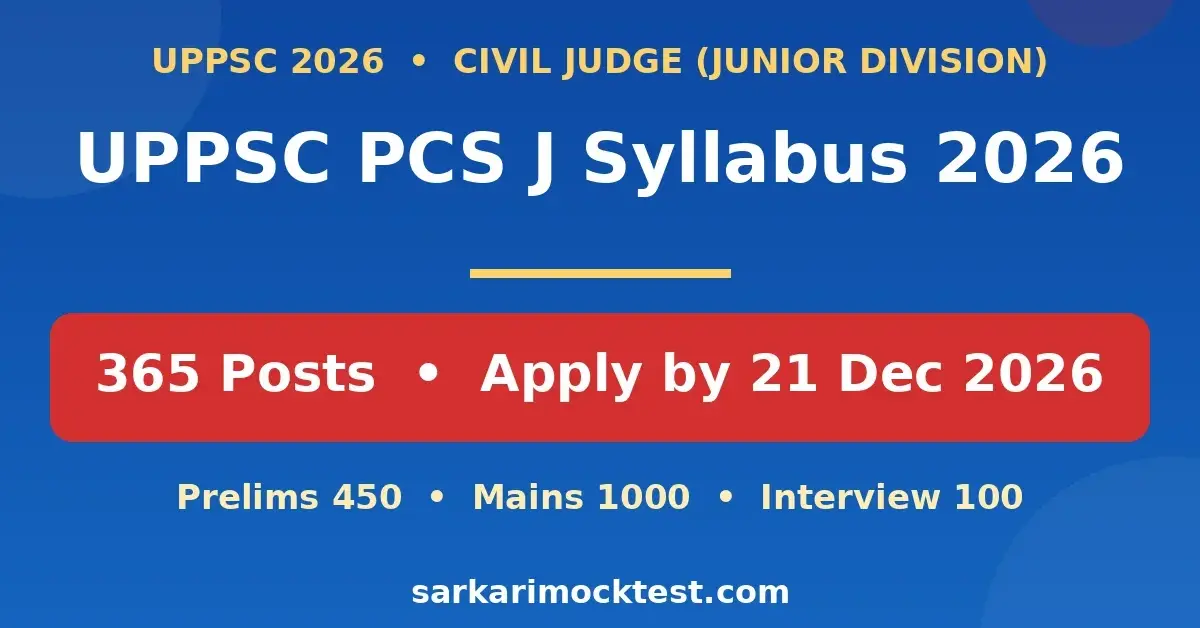
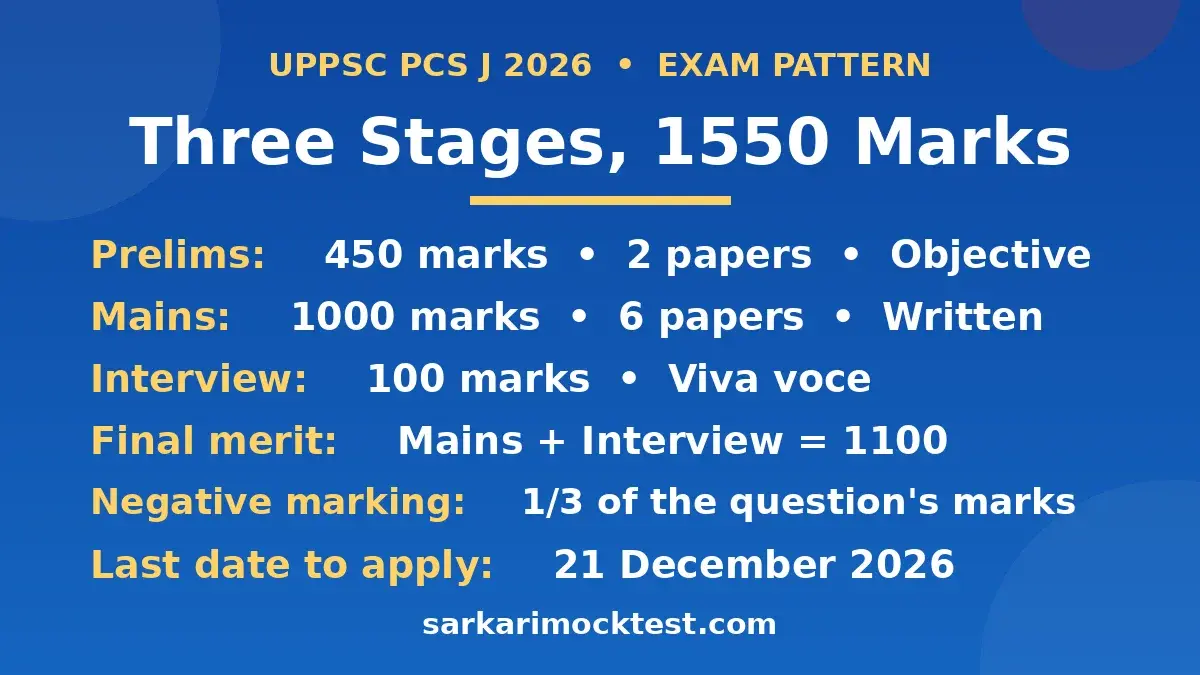
The UPPSC Civil Judge (Junior Division) Examination 2026, also called UPPSC PCS J 2026, is open for 365 posts under advertisement A-6/E-1/2026, dated 20 November 2026, and you can apply online from 20 November to 21 December 2026. The selection has three stages: Prelims of 450 marks, Mains of 1,000 marks, and an interview of 100 marks. The final merit comes from the Mains and the interview only, a total of 1,100 marks. No exam date has been announced yet.
Listen to this article in 1 minute:
The Uttar Pradesh Public Service Commission, known as UPPSC, runs this exam to pick Civil Judges for the Junior Division of the Uttar Pradesh Judicial Service. It is one of the most wanted law exams in Uttar Pradesh, because a Civil Judge starts as a Group B Gazetted officer and rises through the judicial service. This page gives the full UPPSC PCS J Syllabus 2026, the Prelims and Mains pattern, the marks, the qualifying line, the fee, the age limit, and the one year practice rule. Every fact here comes from the commission's own advertisement A-6/E-1/2026 and its Appendix 2 and Appendix 3.
Read this page in order if you are new to the exam. The first table gives the whole exam at a glance. The dates table tells you the last date to apply.
The syllabus tables give every topic the commission has listed, so you can plan your study without guessing. The last sections tell you how to apply and which mistakes cost candidates their chance.
What is the UPPSC PCS J Civil Judge 2026 exam?
UPPSC PCS J is the short name for the Uttar Pradesh Judicial Service Civil Judge (Junior Division) Examination. The commission holds it for direct recruitment to the post of Civil Judge (Junior Division). The post is Group B, Gazetted, and the pay is Level 10.
The post is temporary at present, but the advertisement says it is likely to continue. The exam has three stages, and you must clear each stage to reach the next one.
| Detail | UPPSC PCS J Civil Judge 2026 |
|---|---|
| Exam | U.P. Judicial Service Civil Judge (Junior Division) Examination 2026 |
| Commission | Uttar Pradesh Public Service Commission (UPPSC), Prayagraj |
| Advertisement | Number A-6/E-1/2026, dated 20 November 2026 |
| Posts | 365 Civil Judge (Junior Division) posts |
| Post type | Group B, Gazetted, temporary but likely to continue |
| Pay | Level 10, Rs 77,840 to Rs 1,36,520 |
| Apply | 20 November 2026 to 21 December 2026, online only |
| Stages | Prelims, then Mains, then Interview |
| Prelims | 450 marks, objective, two papers |
| Mains | 1,000 marks, written, six papers |
| Interview | 100 marks, viva voce, personality test |
| Final merit | Mains plus Interview, 1,100 marks |
| Exam date | Not announced yet |
| Official website | uppsc.up.nic.in |
The most important fact in the UPPSC PCS J Syllabus 2026 is the final merit rule. The Prelims marks do not count in the final merit at all. The Prelims only decides who sits the Mains.
Your rank comes from the Mains papers and the interview, out of 1,100 marks. A candidate who tops the Prelims but slips in the Mains will not top the final list.
What are the important dates?
The advertisement came out on 20 November 2026, and the online application started the same day. The last date to apply and pay the fee is 21 December 2026. After that, the commission gives one more week for correction of the form and for fee reconciliation, till 28 December 2026.
The advertisement stays visible on the commission website till 28 December 2026. No exam date has been announced, not even a tentative month, so do not trust any date a tracker page prints for the Prelims.
| Event | Date |
|---|---|
| Advertisement published | 20 November 2026 (Friday) |
| Online application starts | 20 November 2026 |
| Last date to apply and pay fee | 21 December 2026 (Monday) |
| Correction and fee reconciliation till | 28 December 2026 (Monday) |
| Advertisement visible on UPPSC website till | 28 December 2026 |
| Prelims exam date | Not announced yet |
| Mains exam date | Not announced yet |
| Admit card | Not announced yet |
| Result | After each stage |
One date rule is easy to miss. The One Time Registration, called OTR, is mandatory, and you must complete it at least 72 hours before you submit the application. A candidate who starts the OTR on 20 December will be too late to apply by 21 December. Do the OTR first, then fill the form.
The age is counted as on 1 July 2027, not as on the date you apply. The next sections explain the age limit, the practice rule, and the fee in full.
How many posts are there?
There are 365 posts in total. The advertisement splits them by category, and the table below gives the full split. The number may increase or decrease, the advertisement says so in plain words.
The horizontal reservations sit inside these 365 posts. They are not extra posts on top of the total.
| Category | Posts |
|---|---|
| Unreserved (UR) | 148 |
| Other Backward Classes (OBC) | 98 |
| Scheduled Caste (SC) | 76 |
| Scheduled Tribe (ST) | 7 |
| Economically Weaker Section (EWS) | 36 |
| Total | 365 |
| Horizontal reservation | Posts (inside the 365) |
|---|---|
| Women | 71 |
| Ex-Servicemen | 15 |
| Persons with Disabilities (PwD) | 12 |
| Dependents of Freedom Fighters | 4 |
The 71 posts for women are split further by category. Unreserved gets 29, SC gets 15, ST gets 1, OBC gets 19, and EWS gets 7. Add them up and they come to 71.
A woman candidate who belongs to a reserved category gets the benefit only if she is a permanent resident of Uttar Pradesh. Candidates from other states do not get the reservation or the age relaxation benefits of Uttar Pradesh.
Read the post count with the recruitment post on this site. The UPPSC PCS J Civil Judge Recruitment 2026 page covers the same 365 posts, the same dates, and the same fee, from the recruitment side. This page covers the syllabus. The two pages together give the whole exam.
Who can apply for Civil Judge Junior Division?
The advertisement lists five conditions, and a candidate must meet all five by the last date of application. The table below gives them in plain words. Two of them catch candidates out every year, the one year practice rule and the final year rule, so the next section explains the practice rule in full.
| Condition | What the advertisement asks for |
|---|---|
| Nationality | Must be a national of India, under Rule 9 of the Uttar Pradesh Judicial Service Rules 2001 |
| Law degree | LL.B. from a university established by law in Uttar Pradesh, or any other university in India recognised for this purpose by the Governor |
| Advocate enrolment | Must be enrolled as an advocate under the Advocates Act 1961, and entitled to practise in the court or courts subordinate to the High Court |
| Legal practice | At least one year of legal practice as on 20 November 2026, or such other experience as may be prescribed by law from time to time |
| Hindi | Thorough knowledge of Hindi in Devanagari script |
Three more rules sit in the same part of the advertisement. First, candidates who are still appearing for the final LL.B. examination are NOT eligible.
You must hold the degree by the last date of application. Second, the maximum number of attempts is four. Third, the marriage rule applies: a male candidate with more than one wife living, or a female candidate married to a man who already has a wife living, is not eligible, unless the Governor grants an exemption.
The U.P. Public Examination (Prevention of Unfair Means) Act 2024 applies to this exam. The OMR answer sheet comes in three copies, pink as the original, green preserved, and blue for the candidate. Only a black ballpoint pen may be used on the OMR sheet.
What is the one year practice rule?
The one year practice rule is the most talked about rule in this advertisement, because the Supreme Court changed how it works in 2026. The rule itself is simple. You must have completed at least one year of legal practice as on 20 November 2026, the date the advertisement came out. The practice is counted from the date of your provisional enrolment or registration with the State Bar Council.
The Supreme Court gave its judgment on 21 August 2026, in Writ Petition (Civil) 1110 of 2025, Bhumika Trust versus Union of India and others, paragraph 73. The judgment made a transitional rule for this exam. You are deemed to have been in active practice for the period from the date you passed the LL.B. examination to 21 August 2026.
For that period, you do not need to produce a Certificate of Practice. The one year requirement itself still applies. Only the certificate is waived for that period.
| Point | What it means for you |
|---|---|
| One year of practice | Must be complete as on 20 November 2026 |
| Counted from | Date of provisional enrolment or registration with the State Bar Council |
| Supreme Court judgment | 21 August 2026, Bhumika Trust versus Union of India, Writ Petition (Civil) 1110 of 2025, paragraph 73 |
| Transitional rule | Period from LL.B. pass date to 21 August 2026 counts as active practice |
| Certificate of Practice | Not required for that period; required for practice after 21 August 2026, in the manner the competent authority prescribes |
| Final year LL.B. students | Not eligible, the degree must be held by the last date of application |
| Maximum attempts | Four |
Work your own dates before you apply. If you passed LL.B. in 2023 and enrolled in 2023, the transitional rule covers you till 21 August 2026, and the one year is complete well before 20 November 2026.
If you passed LL.B. in 2026 and enrolled only a few months before the advertisement, count the months from your provisional enrolment date. If the count is under one year on 20 November 2026, you are not eligible for this cycle.
What is the age limit?
The age limit is 22 to 35 years as on 1 July 2027. That means you must have been born not before 2 July 1992 and not after 1 July 2005. The general age is counted on 1 July 2027, so a candidate who turns 36 on 30 June 2027 is over age, and a candidate who turns 22 on 2 July 2027 is under age.
| Rule | Detail |
|---|---|
| Minimum age | 22 years as on 1 July 2027 |
| Maximum age | 35 years as on 1 July 2027 |
| Born not before | 2 July 1992 (Thursday) |
| Born not after | 1 July 2005 (Friday) |
| Age counted as on | 1 July 2027 (Thursday) |
| Category | Age relaxation |
|---|---|
| SC, ST and OBC candidates of Uttar Pradesh | 5 years in the upper age limit |
| Skilled players of Uttar Pradesh | 5 years in the upper age limit |
| Emergency Commissioned Officers, Short Service Commissioned Officers and Ex-Army personnel of Uttar Pradesh | 3 years plus the period of qualifying Army service |
| Persons with Disabilities | 15 years in the upper age limit (not born before 2 July 1977) |
| Government employees | No age relaxation is admissible |
There is one more age rule, and it helps candidates who lost years when the exam was not held. If you were eligible by age to appear in the examinations of 2023, 2024 or 2025, you are deemed eligible by age for this exam, provided you were not born before 2 July 1989. This is the lifeline clause of the advertisement. Check your birth date against 2 July 1989 before you decide you are over age.
The upper age limit was NOT raised to 40 years. Some pages on the internet say it was. That is wrong. The limit is 35 years, with the relaxations in the table above, and the 2023 to 2025 lifeline.
What is the application fee?
You pay the fee twice, once for the Prelims and once for the Mains. The Mains fee is paid only by candidates who qualify the Prelims. The fee has two parts, the exam fee and a processing fee of Rs 25. The tables below give the full fee for each stage, including the processing fee.
| Category | Prelims exam fee | Processing fee | Total Prelims fee |
|---|---|---|---|
| Unreserved, EWS, OBC and candidates of other states | Rs 100 | Rs 25 | Rs 125 |
| SC and ST of Uttar Pradesh | Rs 40 | Rs 25 | Rs 65 |
| Persons with Disabilities of Uttar Pradesh | Nil | Rs 25 | Rs 25 |
| Ex-Servicemen of Uttar Pradesh | Rs 40 | Rs 25 | Rs 65 |
| Category | Mains exam fee | Processing fee | Total Mains fee |
|---|---|---|---|
| Unreserved, EWS, OBC and candidates of other states | Rs 200 | Rs 25 | Rs 225 |
| SC and ST of Uttar Pradesh | Rs 80 | Rs 25 | Rs 105 |
| Persons with Disabilities of Uttar Pradesh | Exempt | Rs 25 | Rs 25 |
| Ex-Servicemen of Uttar Pradesh | Rs 80 | Rs 25 | Rs 105 |
Two fee points matter at the time of payment. First, the Mains fee is paid only after the Prelims result, and only by the candidates who are called for the Mains. Second, the fee reconciliation window runs till 28 December 2026, the same date as the correction window. If your payment does not reconcile, use that window and do not wait for the exam date.
How does the selection work?
The selection has three stages, and the commission has written the scheme in Appendix 2 of the advertisement. The Prelims is objective and multiple choice. The Mains is written and conventional.
The interview is a viva voce, which is a personality test. You must clear the Prelims to sit the Mains, and you must clear the Mains to sit the interview.
| Stage | Type | Marks |
|---|---|---|
| Stage 1: Preliminary Examination | Objective, multiple choice | 450 |
| Stage 2: Main Written Examination | Written, conventional | 1,000 |
| Stage 3: Interview (viva voce) | Personality test | 100 |
| Final merit | Mains plus Interview | 1,100 |
| Rule | Detail |
|---|---|
| Called for Mains | 1 candidate for every 10 posts, that is a ratio of 1 to 10 |
| Called for Interview | 1 candidate for every 3 posts, that is a ratio of 1 to 3 |
| Final merit | Aggregate of Mains (1,000) and Interview (100), total 1,100 |
| Prelims marks in final merit | Do not count, Prelims is only a screening test |
| Minimum efficiency standard, general | 40 percent, in both Prelims and Mains |
| Minimum efficiency standard, SC, ST and benchmark PwD | 35 percent, in both Prelims and Mains |
The call ratios are the prescribed ratios, and the commission applies them subject to the examination rules. With 365 posts, a ratio of 1 to 10 means about 3,650 candidates will be called for the Mains, and a ratio of 1 to 3 means about 1,095 candidates will be called for the interview. The exact numbers depend on the rules the commission applies at each stage.
The minimum efficiency standard is a qualifying floor, not a cut off. It means you must score at least 40 percent, or 35 percent for SC, ST and benchmark PwD candidates, in the Prelims and again in the Mains, to stay in the race. Scoring above the floor does not guarantee a call, because the call depends on the ratio and on the marks of other candidates.
What is the Prelims exam pattern?
The Prelims has two objective papers, and both run on the same day in most cycles. Paper 1 is General Knowledge, of 150 marks in 2 hours. Paper 2 is Law, of 300 marks in 2 hours.
The total is 450 marks. Both papers are multiple choice, and you answer them on an OMR sheet.
| Paper | Subject | Time | Marks |
|---|---|---|---|
| Paper 1 | General Knowledge | 2 hours | 150 |
| Paper 2 | Law | 2 hours | 300 |
| Total | Two papers | 4 hours | 450 |
| Rule | What happens |
|---|---|
| Wrong answer | One third (0.33) of the marks assigned to that question is deducted |
| More than one answer marked | Counted as a wrong answer, the same deduction applies |
| Question left blank | No penalty, no marks deducted |
| Answer language | Hindi or English, for the General Knowledge and Law papers |
| OMR sheet | Three copies: pink is the original, green is preserved, and blue is for the candidate |
| Pen | Black ballpoint pen only |
| Exam Act | U.P. Public Examination (Prevention of Unfair Means) Act 2024 applies |
The negative marking rule is worth reading twice. The deduction is one third of the marks assigned to that question, not one third of a mark. If a question carries 3 marks, a wrong answer costs 1 mark.
If a question carries 1 mark, a wrong answer costs one third of a mark. The advertisement does not publish the number of questions in each paper, so do not trust any page that prints a fixed question count for the Prelims. The marks per paper are fixed, 150 and 300, and the deduction rule is fixed, one third per wrong answer.
A blank question costs nothing, so leave a question blank when you do not know the answer. A blank earns nothing either. Attempt the questions you can narrow down, and leave the rest blank. The plan in the last sections of this page uses that rule: answer what you know, attempt what you can narrow down, and leave the rest blank.
What is the Prelims General Knowledge syllabus?
The General Knowledge paper of the Prelims covers the subjects a well educated person is expected to know, without specialised study. That is the standard the advertisement sets. The paper also covers topics of Uttar Pradesh, including Education, Culture, Agriculture, Industry, Trade, and the Living and Social Traditions of the state. The table below gives the full topic list from Appendix 3.
| Topic | What it covers |
|---|---|
| History of India and Indian Culture | Indian history and culture |
| Geography of India | Indian geography |
| Indian Polity | Indian polity |
| Current National Issues | Current national issues |
| Socially relevant topics | Sensitivity towards persons with disabilities, senior citizens, women and children |
| India and the World | India and the world |
| Indian Economy | Indian economy |
| International Affairs and Institutions | International affairs and institutions |
| Science and Technology, Communications and Space | Developments in science, technology, communications and space |
| Uttar Pradesh topics | Education, Culture, Agriculture, Industry, Trade, Living and Social Traditions of Uttar Pradesh |
The same paper also asks for the salient features of nine Acts. These nine Acts are about the people the GK paper is sensitive to: persons with disabilities, senior citizens, women and children. Learn the name, the year, and the main purpose of each Act. A question can ask which Act covers which group, or which year an Act was passed.
| Number | Act | Year |
|---|---|---|
| 1 | Rights of Persons with Disabilities Act | 2016 |
| 2 | Maintenance and Welfare of Parents and Senior Citizens Act | 2007 |
| 3 | Dowry Prohibition Act | 1961 |
| 4 | Protection of Women from Domestic Violence Act | 2005 |
| 5 | Sexual Harassment of Women at Workplace (Prevention, Prohibition and Redressal) Act | 2013 |
| 6 | Pre-Conception and Pre-Natal Diagnostic Techniques (Prohibition of Sex Selection) Act | 1994 |
| 7 | Medical Termination of Pregnancy Act | 1971 |
| 8 | Indecent Representation of Women (Prohibition) Act | 1986 |
| 9 | Protection of Children from Sexual Offences Act | 2012 |
Two of these Acts are easy to confuse by year. The Medical Termination of Pregnancy Act is from 1971, and the Dowry Prohibition Act is from 1961. The Protection of Children from Sexual Offences Act is the newest of the nine in spirit, from 2012, and the Rights of Persons with Disabilities Act is from 2016. Learn the nine as one list, and revise them as one list.
What is the Prelims Law syllabus?
The Law paper of the Prelims carries 300 marks, twice the General Knowledge paper. It covers ten entries, and the advertisement says you must also follow legal developments in India and abroad alongside them. The most important point in this list is the last line of the table: the old criminal laws and the new criminal laws both appear in the syllabus. You must study both.
| Number | Subject |
|---|---|
| 1 | Jurisprudence |
| 2 | International Organisations |
| 3 | Current International Affairs |
| 4 | Indian Constitution |
| 5 | Transfer of Property Act |
| 6 | Indian Evidence Act 1872 and Bharatiya Sakshya Adhiniyam 2023 |
| 7 | Indian Penal Code 1860 and Bharatiya Nyaya Sanhita 2023 |
| 8 | Code of Civil Procedure |
| 9 | Code of Criminal Procedure 1973 and Bharatiya Nagarik Suraksha Sanhita 2023 |
| 10 | Law of Contract |
The three new criminal laws, Bharatiya Nyaya Sanhita 2023, Bharatiya Nagarik Suraksha Sanhita 2023, and Bharatiya Sakshya Adhiniyam 2023, replaced the Indian Penal Code, the Code of Criminal Procedure, and the Indian Evidence Act. The syllabus lists the old Act and the new Act side by side for each of the three. A question can ask for the old section, the new section, or the difference between the two. Study them in pairs, old with new, so the comparison stays clear.
The Law paper is where the Mains is won or lost in advance, because the same subjects return in the Mains in descriptive form. Jurisprudence, the Constitution, the Transfer of Property Act, and the Law of Contract return in Law I. Evidence, the Criminal Procedure Code and the new BNSS, and the Civil Procedure Code return in Law II.
The Penal Code and the BNS return in Law III. Learn each subject once, well, and it will serve you in both stages.
What is the Mains exam pattern?
The Mains is a conventional written examination, which means you write long answers by hand, not tick boxes on an OMR sheet. There are six papers, each of 3 hours. The total is 1,000 marks. Every paper is a separate sitting, so the Mains runs over several days.
| Paper | Subject | Time | Marks |
|---|---|---|---|
| Paper 1 | General Knowledge | 3 hours | 200 |
| Paper 2 | English Language | 3 hours | 100 |
| Paper 3 | Hindi Language | 3 hours | 100 |
| Paper 4 | Law I: Substantive Law | 3 hours | 200 |
| Paper 5 | Law II: Procedure and Evidence | 3 hours | 200 |
| Paper 6 | Law III: Penal, Revenue and Local Laws | 3 hours | 200 |
| Total | Six papers | 18 hours | 1,000 |
Two rules of the Mains are different from the Prelims. First, there is no negative marking in the Mains, because the answers are descriptive and the examiner awards marks for what you write. Second, the General Knowledge and Law papers may be answered in Hindi or English, as you choose. The English Language paper is answered in English and the Hindi Language paper in Hindi, for obvious reasons.
The Mains is 1,000 marks out of the final 1,100, so it decides more than 90 percent of your rank. The interview is 100 marks. A candidate who leads the Mains by 30 marks will almost never lose the top rank in the interview, and a candidate who trails the Mains by 30 marks will almost never catch up in it. Prepare for the Mains as if it were the whole exam, because in marks it nearly is.
What is the Mains General Knowledge syllabus?
The Mains General Knowledge paper is worth 200 marks, 50 more than the Prelims General Knowledge paper, and it runs for 3 hours instead of 2. The syllabus is the same list as the Prelims General Knowledge paper, but the questions are descriptive and analytical, not multiple choice. You must write answers, give reasons, and connect the topics, not just pick the right option.
| Topic | What it covers |
|---|---|
| History of India and Indian Culture | Indian history and culture |
| Geography of India | Indian geography |
| Indian Polity | Indian polity |
| Current National Issues | Current national issues |
| Socially relevant topics | Sensitivity towards persons with disabilities, senior citizens, women and children |
| India and the World | India and the world |
| Indian Economy | Indian economy |
| International Affairs and Institutions | International affairs and institutions |
| Science and Technology, Communications and Space | Developments in science, technology, communications and space |
| Uttar Pradesh topics | Education, Culture, Agriculture, Industry, Trade, Living and Social Traditions of Uttar Pradesh |
The Mains paper also covers the same nine Acts as the Prelims General Knowledge paper, the Rights of Persons with Disabilities Act 2016, the Maintenance and Welfare of Parents and Senior Citizens Act 2007, the Dowry Prohibition Act 1961, the Protection of Women from Domestic Violence Act 2005, the Sexual Harassment of Women at Workplace Act 2013, the Pre-Conception and Pre-Natal Diagnostic Techniques Act 1994, the Medical Termination of Pregnancy Act 1971, the Indecent Representation of Women Act 1986, and the Protection of Children from Sexual Offences Act 2012. In the Mains, a question can ask you to discuss the salient features of an Act, or to apply it to a social problem. Learn the purpose and the main provisions of each Act, not just its name and year.
The difference between the two GK papers is the depth. In the Prelims, a question asks what a fact is. In the Mains, a question asks why it matters and what should be done about it.
The same topic list serves both papers, so the reading you do for the Prelims GK paper carries straight into the Mains GK paper. The Mains paper adds analysis on top of that base.
What do the English and Hindi language papers cover?
Paper 2 is English Language and Paper 3 is Hindi Language. Each paper is worth 100 marks and runs for 3 hours. Each paper has only three questions, and the marks are fixed: the essay carries 50 marks, the precis carries 30 marks, and the translation carries 20 marks. The two papers are mirror images of each other.
| Part | English Language (Paper 2) | Hindi Language (Paper 3) |
|---|---|---|
| Essay | 50 marks | 50 marks |
| Precis writing | 30 marks | 30 marks |
| Translation | 20 marks, Hindi passage to English | 20 marks, English passage to Hindi |
| Total | 100 marks | 100 marks |
The essay is half of each paper, so it is the part to prepare first. A good essay needs a clear structure, an introduction, three or four points with reasons, and a conclusion. The precis needs the opposite skill: cut a long passage to one third of its length, keep every important point, and lose no meaning. The translation needs accuracy in both languages, because a wrong word in translation changes the meaning of the passage.
These two papers are worth 200 marks together, which is as much as one Law paper. Candidates who treat them as minor papers lose 200 marks before the Law papers begin. A candidate who writes well in both languages can score more here than in a hard Law paper, and the marks count the same in the final merit.
What is the Law I Substantive Law syllabus?
Paper 4 is Law I, Substantive Law, worth 200 marks in 3 hours. It covers the law that gives people their rights and duties, as opposed to the law that tells them how to enforce those rights in court. The table below gives the full list from Appendix 3.
| Topic | What it covers |
|---|---|
| Law of Contracts | Law of Contracts |
| Law of Partnership | Law of Partnership |
| Easements and Torts | Law concerning Easements and Torts |
| Transfer of Property | Law relating to Transfer of Property, including the principles of Equity |
| Equity, Trust and Specific Relief | Principles of Equity, with special reference to the Law of Trust and Specific Relief |
| Hindu Law | Hindu Law |
| Mohammedan Law | Mohammedan Law |
| Constitutional Law | Constitutional Law, 50 marks specifically |
One mark split is fixed inside this paper. The paper will include 50 marks specifically relating to Constitutional Law. That is one fourth of the paper.
The Constitution is also in the Prelims Law paper, so it is the single most repeated subject in the whole exam. Give it the time its weight deserves, in both stages.
The rest of the paper is the core of private law. Contracts, partnership, easements, torts, transfer of property, trusts, specific relief, Hindu law and Mohammedan law. These are the subjects a Civil Judge uses every day in civil cases. Learn the principles first, then the sections, then the leading cases that show how the principles work.
What is the Law II Procedure and Evidence syllabus?
Paper 5 is Law II, Procedure and Evidence, worth 200 marks in 3 hours. It covers the law that runs a case through the court: how evidence is taken, how a criminal trial moves, how a civil suit is filed and decided, and how a lawyer pleads a case. The table below gives the full list.
| Topic | What it covers |
|---|---|
| Indian Evidence Act 1872 | Indian Evidence Act 1872 |
| Bharatiya Sakshya Adhiniyam 2023 | Bharatiya Sakshya Adhiniyam 2023 |
| Code of Criminal Procedure 1973 | Code of Criminal Procedure 1973 |
| Bharatiya Nagarik Suraksha Sanhita 2023 | Bharatiya Nagarik Suraksha Sanhita 2023 |
| Code of Civil Procedure | Code of Civil Procedure, including the principles of pleading |
The questions in this paper will mainly concern practical matters. The advertisement names four of them: framing of charges and issues, dealing with the evidence of witnesses, writing of judgments, and the conduct of cases. The paper will not be restricted to these areas, the advertisement says so, but these four are the core. A candidate who can frame a charge, frame an issue, weigh a witness, and write a short judgment has the practical skill this paper tests.
As in the Prelims, the old laws and the new laws sit side by side. The Evidence Act 1872 sits next to the Bharatiya Sakshya Adhiniyam 2023, and the Criminal Procedure Code 1973 sits next to the Bharatiya Nagarik Suraksha Sanhita 2023. The Civil Procedure Code has no new replacement, so it stands alone. Study the old and the new in pairs, and note where the new law changed a section number, a definition, or a procedure.
What is the Law III Penal, Revenue and Local Laws syllabus?
Paper 6 is Law III, Penal, Revenue and Local Laws, worth 200 marks in 3 hours. It is the paper that separates the UPPSC PCS J exam from other judicial service exams, because more than half of it is about Uttar Pradesh itself. The marks are split in a fixed way: the penal law questions carry 50 marks, and the revenue and local law questions carry 150 marks.
| Part | Marks |
|---|---|
| Penal Laws: Indian Penal Code 1860 and Bharatiya Nyaya Sanhita 2023 | 50 |
| Revenue and Local Laws of Uttar Pradesh, with the rules framed under them | 150 |
| Total | 200 |
The local law questions are compulsory. You cannot skip them and score well in this paper, because they are three fourths of the marks. The table below gives the eight enactments the advertisement lists. Learn each one with the rules framed under it, because the advertisement says the paper covers the Acts together with the rules.
| Number | Enactment |
|---|---|
| 1 | Indian Penal Code 1860 and Bharatiya Nyaya Sanhita 2023 (penal part, 50 marks) |
| 2 | Uttar Pradesh Revenue Code 2006 |
| 3 | Uttar Pradesh Urban Building (Regulation of Letting, Rent and Eviction) Act 1972 |
| 4 | Uttar Pradesh Regulation of Urban Premises Tenancy Act 2021 |
| 5 | Uttar Pradesh Municipalities Act |
| 6 | U.P. Panchayat Raj Act |
| 7 | U.P. Consolidation of Holdings Act |
| 8 | Uttar Pradesh Urban Planning and Development Act 1973 |
Two of these Acts are easy to confuse, because both deal with rented buildings in towns. The 1972 Act regulates letting, rent and eviction in urban buildings, and the 2021 Act regulates urban premises tenancy. They are separate Acts with separate rules.
Learn them as two different laws, not as one. The Revenue Code 2006 is the largest of the local laws, and the Consolidation of Holdings Act is the one most candidates leave till last, which is a mistake, because it is a fixed part of the 150 marks.
What happens in the interview?
The interview is a viva voce, which means a spoken test, and it is also called the personality test. It carries 100 marks. The commission assesses your suitability for appointment to the Uttar Pradesh Judicial Service, with regard to your merit, ability, character, personality and physique.
Book knowledge alone will not carry you through it. The interview tests whether you can think, speak, and behave like a judge.
| Point | Detail |
|---|---|
| Marks | 100 |
| Type | Viva voce, personality test |
| Called in the ratio of | 1 candidate for every 3 posts |
| Assessed on | Merit, ability, character, personality and physique |
| Weight in final merit | 100 out of 1,100 marks |
One rule of the interview is worth knowing before you reach it. The commission reserves the right to decline an interview call if your marks in the Law papers are not enough, in its judgment, to justify a call. The ratio of 1 to 3 is the prescribed ratio, but the Law paper marks are the gate. A candidate who clears the Mains on the strength of General Knowledge and the language papers, but scores low in the Law papers, can be held back from the interview.
Prepare for the interview by reading the law you have already studied, and by following current legal developments. The interviewers will ask about your own background, your district, your law college, and the cases in the news. They will test your reasoning, not your memory. Answer in your own words, and say plainly when you do not know an answer.
How is the final merit made?
The final merit is simple to state and hard to earn. It is the aggregate of the Mains written papers and the interview. The Mains gives 1,000 marks and the interview gives 100 marks, so the total is 1,100 marks.
The Prelims gives no marks to the final merit. The table below puts the whole calculation in one place.
| Stage | Marks counted in final merit |
|---|---|
| Prelims | 0 (screening only) |
| Mains, six papers | 1,000 |
| Interview | 100 |
| Final merit total | 1,100 |
| Paper | Marks |
|---|---|
| Mains Paper 1, General Knowledge | 200 |
| Mains Paper 2, English Language | 100 |
| Mains Paper 3, Hindi Language | 100 |
| Mains Paper 4, Law I | 200 |
| Mains Paper 5, Law II | 200 |
| Mains Paper 6, Law III | 200 |
| Interview | 100 |
| Total | 1,100 |
The minimum efficiency standard applies at two stages. You must score at least 40 percent in the Prelims and at least 40 percent in the Mains, or 35 percent if you belong to SC, ST, or the benchmark PwD category. These are floors, not cut offs.
The actual cut off at each stage depends on the ratio and on the marks of the other candidates. The floors only decide who is out. The ratios decide who is in.
What is the salary of a Civil Judge Junior Division?
A Civil Judge (Junior Division) is paid in Level 10 of the pay matrix, from Rs 77,840 to Rs 1,36,520. The post is Group B, Gazetted. The post is temporary at present, but the advertisement says it is likely to continue, which is the normal wording for a new recruitment to a sanctioned post. The pay is the starting point of the judicial service, and a Civil Judge rises to higher grades with seniority and with the higher judicial service examination.
| Detail | Civil Judge (Junior Division) |
|---|---|
| Pay level | Level 10 |
| Pay scale | Rs 77,840 to Rs 1,36,520 |
| Group | Group B, Gazetted |
| Service | Uttar Pradesh Judicial Service |
| Post status | Temporary, but likely to continue |
The salary is only one part of the post. A Civil Judge holds a judicial office, decides civil and criminal cases, and carries the authority of the court. That is why the exam tests character and personality in the interview, and why the advertisement sets the one year practice rule. The commission picks a candidate who knows the law and can practise it.
How do you apply step by step?
The application is online only, on the UPPSC website. There is no offline form. The steps below follow the advertisement. The first step is the most urgent, because it takes 72 hours.
| Step | What to do |
|---|---|
| Step 1 | Complete the One Time Registration (OTR) on otr.pariksha.nic.in, at least 72 hours before you submit the application |
| Step 2 | Open the UPPSC website, uppsc.up.nic.in, and go to the notifications page |
| Step 3 | Open Advertisement A-6/E-1/2026, Civil Judge (Junior Division) Examination 2026, and read it in full |
| Step 4 | Fill the online application form with your personal, education, enrolment and practice details |
| Step 5 | Pay the Prelims fee online: Rs 125 for UR, EWS and OBC, Rs 65 for SC and ST of Uttar Pradesh, Rs 25 for PwD of Uttar Pradesh, Rs 65 for Ex-Servicemen of Uttar Pradesh |
| Step 6 | Submit the form on or before 21 December 2026 |
| Step 7 | If you need to correct the form, or if the fee needs reconciliation, use the window till 28 December 2026 |
Keep three things ready before you start the form: your LL.B. degree details, your State Bar Council enrolment number and date of provisional enrolment, and your practice details for the one year rule. The form will ask for them, and a wrong date of enrolment can cost you the whole application. Check the date on your enrolment certificate, not on your memory.
The correction window only lets you correct a form you have already submitted, and reconcile a fee you have already paid. A candidate who has not applied by 21 December 2026 cannot apply in the correction window.
What mistakes cost candidates their chance?
Most candidates who fail this exam lose their chance on the rules around the law, rather than on the law itself. The table below lists the mistakes that cost the most, and what to do instead. Every row comes from the advertisement itself.
| Mistake | What it costs | What to do instead |
|---|---|---|
| Starting the OTR late | You cannot apply by 21 December, because the OTR needs 72 hours | Complete the OTR first, days before the last date |
| Applying without one year of practice | Rejection of the application | Count your practice from the provisional enrolment date, and apply the Supreme Court transitional rule |
| Final year LL.B. students applying | Not eligible, the degree must be held by the last date | Apply only when you hold the LL.B. degree |
| Trusting a tracker exam date | Preparing for a date that does not exist | No exam date is announced yet; check uppsc.up.nic.in only |
| Studying only the old criminal laws | Losing marks on the new BNS, BNSS and BSA | Study the old and the new laws in pairs |
| Skipping the UP local laws | Losing up to 150 marks in Law III | Learn the eight enactments of Law III, local law questions are compulsory |
| Ignoring the language papers | Losing up to 200 marks in English and Hindi | Practise the essay, the precis and the translation every week |
| Ignoring the nine Acts in GK | Losing easy marks in both GK papers | Learn the nine Acts as one list, name and year and purpose |
| Guessing blind in the Prelims | One third of the question's marks lost per wrong answer | Leave a question blank if you cannot narrow it down |
| Missing the fee reconciliation window | An unpaid application even after paying | Check the payment status before 28 December 2026 |
How should you prepare, stage by stage?
The exam has three stages, so the preparation has three parts, and they must run in order. The Prelims comes first, so it gets the first months. But the Mains is 1,000 marks, so the descriptive writing must start long before the Prelims result. A candidate who starts Mains writing only after the Prelims result has too little time left.
| Stage | What to do |
|---|---|
| Prelims first | Cover the ten Law subjects and the GK topics with objective practice; learn the nine Acts as one list; revise the old and new criminal laws in pairs |
| Mains writing, alongside | Write one essay and one precis every week in English and in Hindi; practise translation both ways; write short answers for Law I, II and III |
| Law III first among the Law papers | Learn the eight UP enactments early, because they carry 150 marks and most candidates leave them till last |
| Language papers weekly | Essay, precis and translation need handwriting practice, not just reading; 200 marks ride on them |
| Interview last | Read current legal developments, revise your own background and district, and practise speaking your answers aloud |
| Mock tests | Take mock tests for the Prelims with the real marking: minus one third per wrong answer, blank costs nothing; take mock tests for the Mains with a timer of 3 hours per paper |
The CLAT 2027 syllabus page on this site covers another law entrance exam with its own full syllabus, and the SSC CHSL syllabus page, the RSSB CET Graduate Level syllabus page, the RSSB CET 10+2 syllabus page, and the UP Super TET syllabus page carry the same style of full syllabus for their exams. The full list of exams is on the states mock test page. Use the mock tests on this site to practise the Prelims pattern under time, and to find the subjects where you lose marks.
Where do you apply and check updates?
The UPPSC website is the only place to apply and the only place to trust for dates. The advertisement, the application link, the correction window, the admit card and the results will all appear there first. No tracker page, no coaching page, and no social media post can replace it.
| What | Official link |
|---|---|
| UPPSC website | uppsc.up.nic.in |
| Notifications page | uppsc.up.nic.in/CandidatePages/Notifications.aspx |
| Advertisement A-6/E-1/2026, detailed advertisement | uppsc.up.nic.in/OuterPages/View_Enclosure.aspx?ID=406&flag=E&FID=954 |
| Advertisement details page | uppsc.up.nic.in/OuterPages/View_Advertisement.aspx?ID=406&flag=E |
| One Time Registration (OTR) | otr.pariksha.nic.in |
Check the notifications page once a week till the exam date is announced. When the date comes, the commission will publish it there, with the admit card notice and the exam schedule. Till then, the work is the syllabus.
The Prelims Law paper is 300 marks, the Mains Law papers are 600 marks, and the interview tests the same law in speech. Learn the law well, and the stages will follow.
Start with the recruitment post, the UPPSC PCS J Civil Judge Recruitment 2026 page, for the 365 posts and the fee, then come back to this UPPSC PCS J Syllabus 2026 page for the topics. The two pages together cover the whole exam, and both point to the same official advertisement.
Sources
Uttar Pradesh Public Service Commission, uppsc.up.nic.in: Advertisement Number A-6/E-1/2026, U.P. Judicial Service Civil Judge (Junior Division) Examination 2026, dated 20 November 2026, 365 posts, application from 20 November to 21 December 2026, correction and fee reconciliation till 28 December 2026, age 22 to 35 years as on 1 July 2027, LL.B. with one year of legal practice as on 20 November 2026, maximum four attempts, Prelims 450 marks, Mains 1,000 marks, interview 100 marks, final merit 1,100 marks, Appendix 2 scheme of examination, Appendix 3 syllabus. Supreme Court of India: judgment dated 21 August 2026, Writ Petition (Civil) 1110 of 2025, Bhumika Trust versus Union of India and others, paragraph 73, transitional rule on the Certificate of Practice.
Internal links in this article point to live pages on sarkarimocktest.com, verified on 24 November 2026: the UPPSC PCS J Civil Judge Recruitment 2026 page, the CLAT 2027 syllabus page, the SSC CHSL syllabus page, the RSSB CET Graduate Level syllabus page, the RSSB CET 10+2 syllabus page, the UP Super TET syllabus page, and the states mock test page.