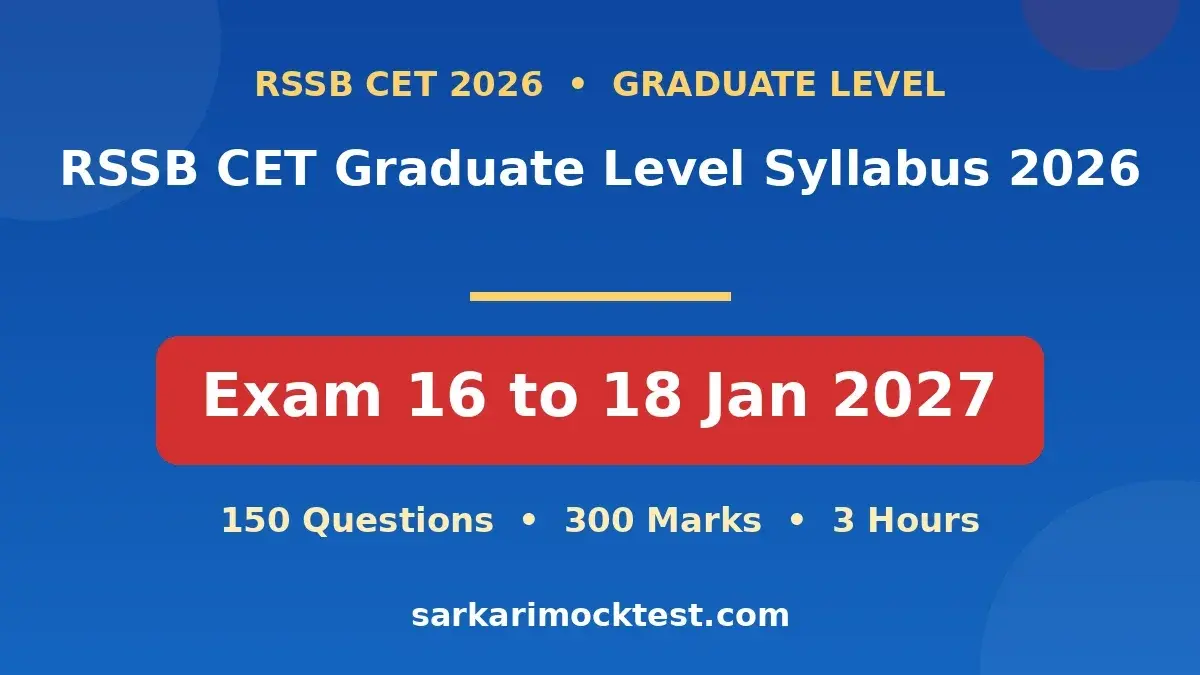
The RSSB CET Graduate Level 2026 paper has 150 multiple choice questions for 300 marks, to be answered in 3 hours on an OMR sheet. The exam runs from 16 to 18 January 2027, after the board moved it from 1 to 3 December 2026. A candidate needs 40 percent to qualify, 35 percent for SC and ST candidates, and the score stays valid for three years.
Listen to this article in 1 minute:
The Rajasthan Staff Selection Board, known as RSSB, runs this test for graduates who want a state government post in Rajasthan. The notification is Advertisement Number 09/2026, dated 1 July 2026. This page gives the full RSSB CET Graduate Level Syllabus 2026, all 14 areas, the revised exam pattern, the qualifying marks, and the 12 services this one test opens. Every fact here comes from the board's own advertisement and its press note of 28 September 2026.
What is the RSSB CET Graduate Level 2026?
The Common Eligibility Test, or CET, is a qualifying test. It is not a job by itself. A qualifying score lets a candidate sit the main exam for a post, when the board advertises that post.
The Graduate Level CET is for posts that need a degree. The Senior Secondary CET is a separate test for posts that need only a Class 12 pass. The board holds CET under the Rajasthan Subordinate and Ministerial Service (Common Eligibility Test) Rules, 2022.
The table below gives the whole test at a glance.
| Detail | RSSB CET Graduate Level 2026 |
|---|---|
| Exam | Common Eligibility Test (CET), Graduate Level 2026 |
| Board | Rajasthan Staff Selection Board (RSSB), Jaipur |
| Advertisement | Number 09/2026, dated 1 July 2026 |
| Exam date | 16 to 18 January 2027 (revised, tentative) |
| Mode | Offline, pen and paper, OMR answer sheet |
| Questions | 150 multiple choice questions |
| Marks | 300 marks, 2 marks for each question |
| Time | 3 hours |
| Negative marking | One third of the question's marks for each wrong answer |
| Qualifying marks | 40 percent (35 percent for SC and ST) |
| Score validity | 3 years from the date of the result |
| Applications | Closed on 2 August 2026 |
| Admit card | Not out yet |
| Official website | rssb.rajasthan.gov.in |
When is the exam, and why did the date change?
The exam runs from 16 to 18 January 2027. That is the revised date. The first date in the advertisement was 1 to 3 December 2026.
The board changed both CET dates in its press note of 28 September 2026, because the municipal and panchayat elections in October 2026 clashed with the exam calendar. The December dates now belong to the Senior Secondary CET. The Graduate Level CET moved to January.
The board calls the new dates tentative, which means they can still change. A candidate should check the board website in the last week before the exam, and trust only the date printed on the admit card.
| Day | Date | Shifts |
|---|---|---|
| Day 1 | Saturday 16 January 2027 | Two shifts |
| Day 2 | Sunday 17 January 2027 | Two shifts |
| Day 3 | Monday 18 January 2027 | One shift, morning only |
The board allots each candidate one day and one shift across the three days and five shifts. The admit card will carry the exact day, shift, centre name and address. No candidate can choose a day or a shift.
| Event | Date |
|---|---|
| Notification | 1 July 2026 (Advertisement 09/2026) |
| Online application starts | 4 July 2026 |
| Online application closes | 2 August 2026, 11:59 PM |
| One Time Registration fee, last date | 2 August 2026 |
| First exam date announced | 1 to 3 December 2026 |
| Revised exam date (press note) | 16 to 18 January 2027 |
| Admit card | Not announced yet |
| Answer key | To come after the exam |
| Result | To come after the exam |
What is the exam pattern?
One paper, one sitting, 150 questions. Every question carries the same marks. There is no section wise question split in the advertisement, so no subject has a fixed number of questions.
The paper mixes all 14 areas in one paper. A candidate cannot skip an area and still score well, because the questions can come from any part of the list.
| Part | Detail |
|---|---|
| Questions | 150 multiple choice questions |
| Marks | 300 marks, 2 marks for each question |
| Time | 3 hours |
| Mode | Offline, OMR answer sheet, pen and paper |
| Options | 5 options for each question, A, B, C, D and E |
| Section wise split | None published by the board |
| Normalisation | Yes, when the exam runs in more than one shift |
| Medium | Hindi and English |
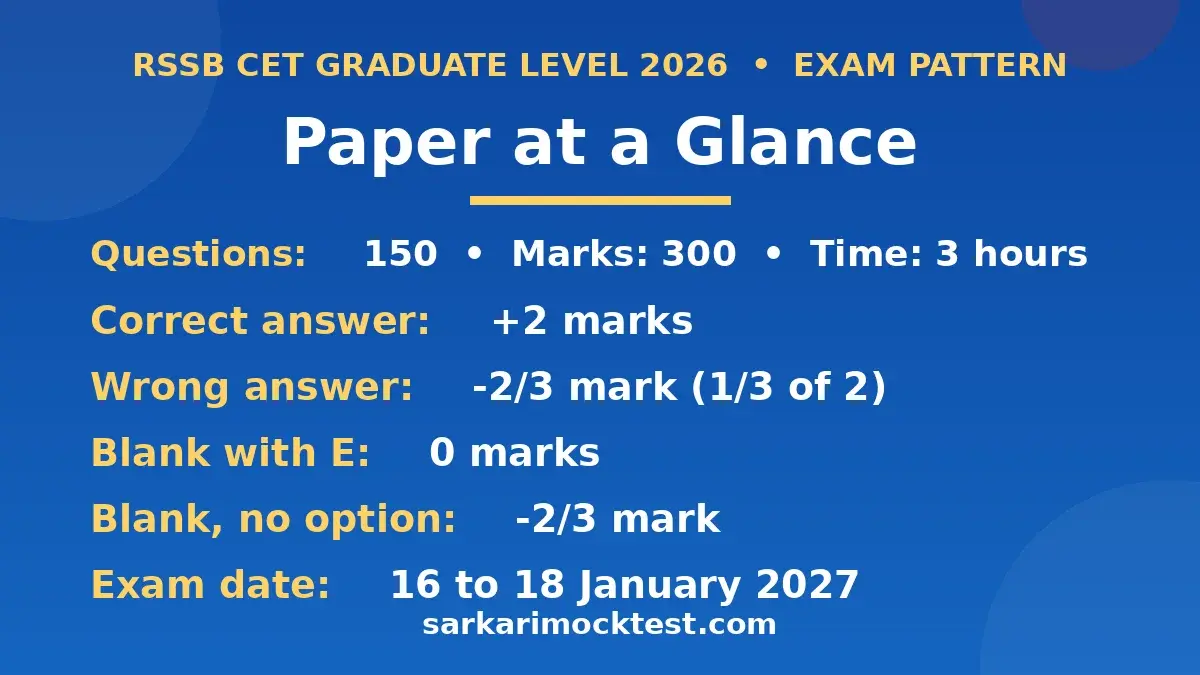
How does negative marking work?
| Answer | Marks |
|---|---|
| Right answer | Plus 2 marks |
| Wrong answer | Minus 2 by 3 mark (one third of 2 marks) |
| Question left blank, option E darkened | 0 marks |
| Question left blank, no option darkened | Minus 2 by 3 mark |
| More than 15 questions blank without E | Disqualification |
| Qualifying marks | 120 marks out of 300 (40 percent) |
The negative marking is easy to get wrong. Each question is worth 2 marks, and the board deducts one third of the question's marks for a wrong answer. One third of 2 is 2 by 3, so a wrong answer costs 2 by 3 of a mark. Some pages on the internet say a wrong answer costs 1 by 3 of a mark.
That is wrong. It costs 2 by 3. The advertisement states the rule in plain words, and the numbers above follow the advertisement.
The table below shows what five different attempts score. The last column is the percent out of 300. Only the first four attempts cross the 40 percent line.
| Right | Wrong | E marked | Score | Percent |
|---|---|---|---|---|
| 120 | 20 | 10 | 226.67 | 75.6 percent |
| 100 | 30 | 20 | 180 | 60 percent |
| 90 | 40 | 20 | 153.33 | 51.1 percent |
| 80 | 50 | 20 | 126.67 | 42.2 percent |
| 60 | 60 | 30 | 80 | 26.7 percent |
Read the fourth row twice. A candidate who gets 80 right and 50 wrong still qualifies, because the 50 wrong answers cost only 33.33 marks in total. A candidate who guesses on every doubtful question loses marks slowly, but a candidate who leaves questions blank without marking E loses the same 2 by 3 of a mark and risks disqualification as well. The next section explains the rule that decides this.
What is Option E, and why does it matter?
Every question has five options. A, B, C and D are answers. E means not attempted.
If a candidate wants to skip a question, the candidate must darken the E circle with a blue ballpoint pen. That is the whole rule, and it decides marks in two ways.
| Rule | What happens |
|---|---|
| E darkened for a question | 0 marks lost, the question is counted as not attempted |
| No option darkened at all | Minus 2 by 3 mark, the same as a wrong answer |
| More than 15 questions left blank without E | Disqualification from the exam |
| Pen to use | Blue ballpoint pen for the OMR sheet |
| How many E marks are allowed | No limit, as long as E is darkened for each skipped question |
The number 15 comes from the advertisement. Ten percent of 150 questions is 15 questions. A candidate who leaves 16 questions blank without darkening any option is disqualified, even if the other 134 answers are all right. A candidate who darkens E for those same 16 questions loses nothing for them.
The habit to build in mock tests is simple. Never leave a circle empty. If the answer is not known, darken E and move on.
The board prints these instructions on the OMR answer sheet itself. Read them on exam day before marking the first answer. A candidate who learns the rule in the hall has already lost marks.
What are the 14 syllabus areas?
The RSSB CET Graduate Level Syllabus 2026 lists 14 areas in one combined syllabus. The board publishes no section wise question split, so the areas below carry no official weight. Some websites print weightages, such as 9 percent for history or 13 percent for reasoning.
Those numbers are estimates counted from the 2024 papers, not the board's figures. Treat them as a rough guide at best, and prepare every area.
| Number | Area | What it covers in one line |
|---|---|---|
| 1 | History of India and Rajasthan | Indian history, the freedom movement, Rajasthan in 1857, integration of Rajasthan |
| 2 | History, art, culture, literature, traditions and heritage of Rajasthan | Ancient sites, rulers, forts, painting, folk music, saints and folk deities |
| 3 | Geography of India | Physical features, climate, rivers, crops, minerals, energy, population |
| 4 | Geography of Rajasthan | Land, climate, water, soils, crops, tribes, minerals, tourism, transport |
| 5 | Indian political system, with special reference to Rajasthan | Constitution, rights, Parliament, courts, Rajasthan state bodies |
| 6 | Economy of India | Budget, banking, GST, national income, sectors, plans, reforms |
| 7 | Economy of Rajasthan | Crops, irrigation, industries, poverty, schemes, MGNREGA, VB-G RAM G |
| 8 | Science and Technology | Everyday science, health, environment, space, defence, Rajasthan science |
| 9 | Logical reasoning and Mathematics | Reasoning, series, clock, algebra, geometry, data and graphs |
| 10 | Current Affairs and Civic Duties | State, national and world events, famous people, duties, the 2022 Act |
| 11 | Public Health | First aid, CPR, drug abuse, youth fitness, social media risks (new in 2026) |
| 12 | Computer Knowledge | Computers, operating system, internet, MS Office, cyber security, AI |
| 13 | General Hindi | Grammar, sandhi, samas, vocabulary, letter writing, official Hindi |
| 14 | General English | Articles, tense, voice, narration, translation, passages, letters |
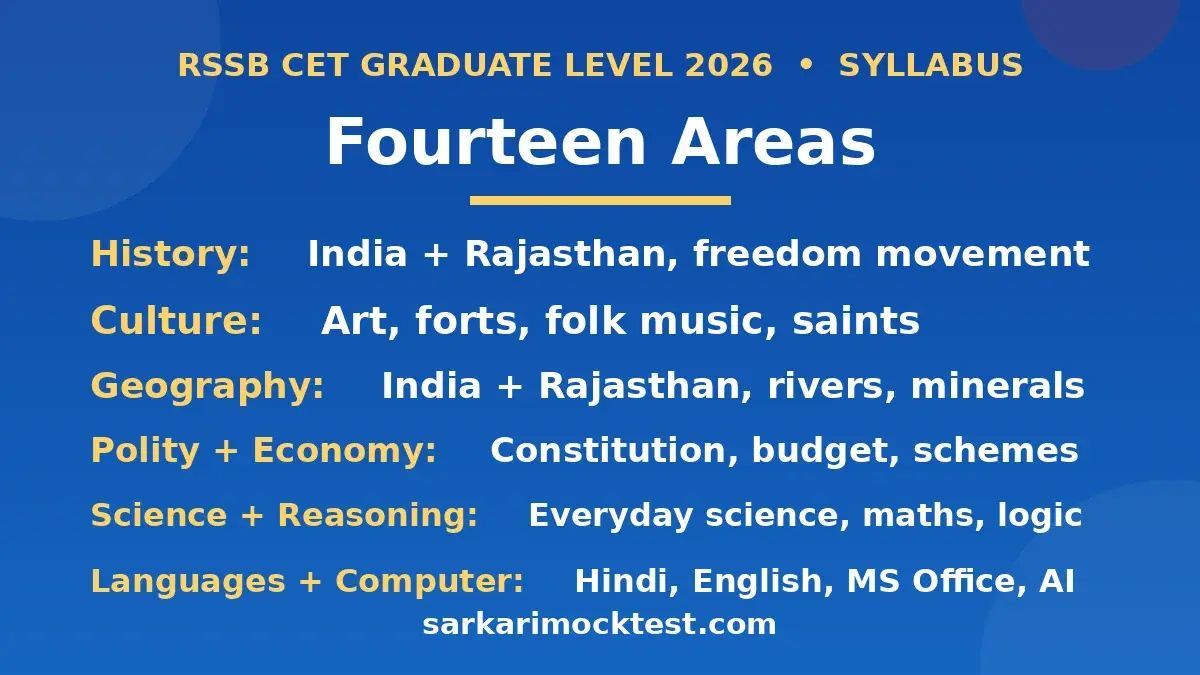
Three areas are new or changed in the 2026 advertisement. Public Health is new in full. Computer Knowledge now names cyber security, e-services and artificial intelligence.
The Rajasthan economy section now names MGNREGA and the Viksit Bharat Guarantee for Rozgar and Aajeevika Mission Gramin, called VB-G RAM G. A candidate who studies from an old list will miss these topics. The sections below give the full topic list for each area, exactly as the advertisement prints it.
What does the history syllabus cover?
History covers India and Rajasthan together, with special stress on the Indian National Movement. The board lists the topics in the advertisement, and the table below follows that list.
| Topic group | What to cover |
|---|---|
| Important events in Indian history | The main events, in order, from ancient times to independence |
| Social and religious reform movements | The reform movements of the 19th and 20th centuries |
| Indian Freedom Movement | Its phases, major events, and the freedom fighters from different regions and their contributions |
| Rajasthan in the Revolt of 1857 | The role of Rajasthan in the revolt |
| Tribal and peasant movements in Rajasthan | The tribal and peasant movements, and the political awakening behind them |
| Praja Mandal movement | The Praja Mandal movement in Rajasthan |
| Post-independence nation building | The Nehruvian era, national integration, reorganisation of states |
| Institution building | Institution building and the development of science and technology after independence |
| Integration of Rajasthan | How Rajasthan came together as one state |
The second area stays in Rajasthan, and it is about art, culture and heritage. The ancient sites matter most here. Kalibangan, Ahar, Ganeshwar, Balathal and Bairath appear by name in the advertisement, so learn what each site is known for.
| Topic group | What to cover |
|---|---|
| Ancient civilisations and sites | Kalibangan, Ahar, Ganeshwar, Balathal, Bairath and other sites |
| Rulers and administration | Significant events, prominent rulers, their administrative and revenue systems |
| Architecture | Salient features of architecture, forts and monuments |
| Art forms | Paintings and handicrafts of Rajasthan |
| Literature and dialects | Major literary works and regional dialects of Rajasthani literature |
| Fairs and festivals | Fairs, festivals, folk music and folk dances |
| Culture, traditions and heritage | Rajasthani culture, traditions and heritage as a whole |
| Religious movements | Religious movements, saints and folk deities of Rajasthan |
| Historical sites | Important historical sites of the state |
The questions ask for the event, the person and the place together, not for a single date alone. A candidate who reads one page on each ancient site, each movement and each ruler will cover most of this area.
What does the geography syllabus cover?
Geography splits into two areas, India and Rajasthan. The India part is physical first, then human. The Rajasthan part follows the same shape, but every topic is about the state. Learn the India topics with a map in front of you, and the Rajasthan topics with the state map.
| Topic group | What to cover |
|---|---|
| Physical features | Mountains, plateaus, deserts and plains |
| Climate and monsoon | Climate and the monsoon system |
| Rivers, dams, lakes and oceans | Major rivers, dams, lakes and oceans |
| Wildlife and sanctuaries | Wildlife and sanctuaries |
| Major crops | Wheat, rice, cotton, sugarcane, tea, coffee and others |
| Major minerals | Iron ore, manganese, bauxite, mica and others |
| Energy resources | Conventional and non-conventional energy resources |
| Industries and industrial regions | Major industries and industrial regions |
| Transport and trade | National highways, means of transport and trade |
| Population | Growth, density, literacy and sex ratio |
| Disaster management | Disaster management and climate change |
| Topic group | What to cover |
|---|---|
| Geological structure | Geological structure and physiographic divisions of Rajasthan |
| Climate | Climatic conditions and regions of the state |
| Drainage and water | Drainage system, lakes, ponds, dams and water conservation methods |
| Vegetation and wildlife | Natural vegetation, wildlife and sanctuaries |
| Soils | Soils of Rajasthan |
| Crops | Major crops of Rabi and Kharif seasons |
| Population | Distribution, growth, density, literacy, sex ratio and urbanisation |
| Tribes | Major tribes of Rajasthan |
| Minerals | Metallic and non-metallic minerals |
| Energy | Energy resources, renewable and non-renewable |
| Tourism | Tourism in Rajasthan |
| Transport | National highways, rail and air transport |
Two topics in the Rajasthan list catch candidates out. The first is water conservation, which the advertisement names as a separate topic, not as a footnote under rivers. The second is the Rabi and Kharif crop split, which the board asks for by season. Learn the crops season by season, and the minerals by metallic and non-metallic groups.
What does the polity syllabus cover?
Polity starts with the making of the Constitution and ends with the panchayat in the village. The Rajasthan part is as long as the India part, so give it the same time. A candidate who knows only the Union topics will lose half the questions in this area.
| Topic group | What to cover |
|---|---|
| Constituent Assembly | The Constituent Assembly, and the role of Dr B. R. Ambedkar in framing the Constitution |
| Constitution | Nature and features of the Indian Constitution, Preamble, Fundamental Rights, Directive Principles of State Policy, federal structure |
| Amendments and emergency | Constitutional amendments, emergency provisions, public interest litigation |
| Union institutions | President, Prime Minister and Council of Ministers, Parliament, Supreme Court |
| National bodies | Election Commission, Comptroller and Auditor General, Finance Commission, Lokpal, National Human Rights Commission, NITI Aayog, National Information Commission |
| Rajasthan political system | Governor, Chief Minister, State Legislative Assembly, High Court, Rajasthan Public Service Commission |
| Rajasthan administration | District administration, State Human Rights Commission, Lokayukta, State Election Commission, State Finance Commission, State Information Commission |
| Local government | Local self government and Panchayati Raj |
The list of national bodies is the part to revise last, because it is a list of names and posts. Learn one line for each body: what it does, who heads it, and whether it is constitutional or statutory. The same method works for the Rajasthan bodies.
What does the economy syllabus cover?
Economy also splits into two areas, India and Rajasthan. The India part is about the system: budget, banking, tax, growth. The Rajasthan part is about the ground: crops, irrigation, industries, poverty and the schemes that fight it. The two scheme names in the Rajasthan list are the newest part of the syllabus, so learn them exactly.
| Topic group | What to cover |
|---|---|
| Budget and banking | Budget making, banking, public finance, Goods and Services Tax |
| National income and growth | National income, basic knowledge of growth and development |
| Fiscal and monetary policy | Fiscal and monetary policies |
| Subsidies and distribution | Subsidies, Public Distribution System |
| E-commerce | E-commerce |
| Major sectors | Current status, issues and initiatives in agriculture, industry, service and trade sectors |
| Revolutions | Green Revolution, White Revolution and Blue Revolution |
| Planning | Five Year Plans and the planning system |
| Problems and reforms | Major economic problems and government initiatives, economic reforms and liberalisation |
| Topic group | What to cover |
|---|---|
| Crops | Food crops and commercial crops of Rajasthan |
| Irrigation | Irrigation and river valley projects, wasteland and drought-prone area development projects |
| Industries | Development of industries and their location, agro-based industries, mineral-based industries, small, cottage and village industries, export goods, Rajasthani handicrafts |
| Poverty and unemployment | Concept, types, causes, solutions and current flagship schemes |
| Social justice | Social justice and empowerment provisions for weaker sections |
| Welfare and institutions | Various welfare schemes and Acts, development institutions, cooperative movement, small enterprises and financial institutions, role of Panchayati Raj institutions in rural development |
| MGNREGA | Mahatma Gandhi National Rural Employment Guarantee Act |
| VB-G RAM G | Viksit Bharat Guarantee for Rozgar and Aajeevika Mission, Gramin |
VB-G RAM G is the new name in the list. The advertisement prints it in full, and a question can ask for the full form. MGNREGA is the older scheme in the same row of the syllabus. Learn both names, and learn which one is the current flagship scheme for rural employment.
What does the science and technology syllabus cover?
Science in this paper is everyday science, not research science. The topics are the ones a school science book covers, plus health, environment and technology with a Rajasthan angle. A candidate with a science background should not spend too long here. A candidate without one should read the school level facts and move on.
| Topic group | What to cover |
|---|---|
| Changes in matter | Physical and chemical changes |
| Acids and salts | Acids, alkalis and salts |
| Current, heat and energy | Electric current, heat, work and energy |
| Food and blood | Diet and nutrition, blood groups and Rh factor |
| Health care | Health care, infectious, non-infectious and zoonotic diseases |
| Environment | Environmental and ecological changes and their effects |
| Biodiversity | Biodiversity, conservation of natural resources and sustainable development |
| Animals and plants | Economic importance of animals and plants |
| Agriculture science | Agriculture, horticulture, forestry and animal husbandry, with special reference to Rajasthan |
| Information technology | Information and Communication Technology |
| Defence and space | Defence technology, space technology and satellites |
| Science in Rajasthan | Science and technology development, with special reference to Rajasthan |
The health rows overlap with the Public Health area, which the advertisement lists separately. The difference is the angle. Science asks how a disease spreads and what a blood group is.
Public Health asks what to do about it, from first aid to drug abuse. Study the two areas together and the overlap becomes revision, not extra work.
What does the reasoning and maths syllabus cover?
Reasoning and maths is one area, and it is the most scoring part of the paper for a candidate who practises. The topics are fixed and the question types repeat. The list below is the full list from the advertisement. A mock test on this area alone is worth more than reading notes, because speed is the skill being tested.
| Topic group | What to cover |
|---|---|
| Blood relation | Blood relation problems |
| Series | Number series, alphabet series |
| Clock and calendar | Clock, calendar |
| Mental ability | Mental ability and analytical ability |
| Roots and powers | Square, square root, cube root of whole numbers |
| Algebra | Factoring, quadratic equations, logarithms |
| Arithmetic | LCM and HCF, average, profit and loss, percentage, simple interest, compound interest, ratio and proportion |
| Time and work | Time, speed, distance, work and time |
| Geometry lines | Angles and lines formed at a point, rectilinear figures, congruence of triangles |
| Geometry area | Area of triangles, circles, ellipses, rectangles, spheres and cylinders |
| Trigonometry | Trigonometric ratios, standard problems on heights and distances |
| Central tendency | Measures of central tendency: mean, median and mode |
| Volume | Volume of spheres, cylinders, cubes and cones |
| Data and graphs | Graphical representation of data: graphs, bar charts, pie charts, line graphs |
The maths list is long, but it is all school level maths. No topic here needs a degree in mathematics. The trap is time.
Three hours for 150 questions gives 72 seconds per question, and a long calculation can eat the time for three easy questions. In a mock test, mark a hard maths question, move on, and come back only if time remains.
What do current affairs and public health cover?
Current affairs is the only area with no fixed list, because the news keeps changing. The advertisement fixes the fields, and the candidate fills them with the news of the months before the exam. For a January 2027 exam, the news of 2026 matters most, with extra weight on the last six months.
| Topic group | What to cover |
|---|---|
| Contemporary events | Major contemporary events at the state, national and international level, in politics, economy, society, culture, technology, geography, ecology, sports and other fields |
| Famous personalities | Famous personalities |
| Programmes and policies | State and national level programmes and policies |
| Civic duties | Fundamental Duties and moral values |
| Unfair Means Act | Salient provisions of the Rajasthan Public Examination (Measures for Prevention of Unfair Means in Recruitment) Act, 2022 |
The 2022 Act is in the syllabus for a reason. It is the law that governs this very exam. A candidate caught using unfair means in a Rajasthan public exam can be debarred for up to three years and fined at least Rs 1,00,000 under the Act. The advertisement prints the salient provisions as a syllabus topic, so a question can ask what the Act covers.
Public Health is new in the 2026 advertisement. It has only four topics, and all four are practical. A candidate can cover this area in one sitting, and should, because a new area is where easy questions come from.
| Topic group | What to cover |
|---|---|
| First aid and CPR | Basics of first aid, cardiopulmonary resuscitation (CPR) |
| Drug abuse | Types of drug abuse and measures to prevent it |
| Youth fitness | Physical and mental fitness of youth |
| Social media risks | Health risks of social media addiction and its preventive measures |
What does the computer syllabus cover?
Computer Knowledge is a short area with seven topics. Three of them are new in 2026: cyber security, e-services and artificial intelligence. The rest is basic computer knowledge, the kind a candidate uses every day.
| Topic group | What to cover |
|---|---|
| Computers | Characteristics and applications of computers |
| Operating system and internet | Operating system, internet and email |
| Computer organisation | Computer organisation including memory (RAM, ROM), file system, input and output devices |
| MS Office | MS Office: MS Word, MS Excel and Spreadsheet, MS PowerPoint |
| Cyber Security | Cyber security |
| E-Services | E-services |
| Artificial Intelligence | Artificial intelligence (AI) |
The MS Office row is the one to practise, not just read. A question can ask which menu holds a function, or what a file extension means. Open Word, Excel and PowerPoint once, click through the menus, and the answers will stick better than any note.
What do General Hindi and General English cover?
The two language areas test grammar and use, not literature. Hindi has the longer list, because it covers grammar, vocabulary, official language and official letter writing. English tests the standard grammar topics plus translation, comprehension and letter writing. Both areas are objective, including the letter writing questions, which ask about the structure of a letter.
| Topic group | What to cover |
|---|---|
| Articles and determiners | Use of articles and determiners |
| Tense | Tense and sequence of tenses |
| Voice | Voice: active and passive |
| Narration | Narration: direct and indirect |
| Prepositions | Use of prepositions |
| Translation | Translation of ordinary English sentences into Hindi and vice versa |
| Synonyms and antonyms | Synonyms and antonyms |
| Comprehension | Comprehension of a given passage |
| Glossary | Glossary of official and technical terms, with their Hindi version |
| Letter writing | Letter writing: official, demi-official, informal. Questions will be objective, on the structure of a letter |
| Idioms and phrases | Idioms and phrases |
| One word substitution | One word substitution |
| Topic group | What to cover |
|---|---|
| Parts of speech | Sangya, sarvanam, visheshak, kriya, kriya visheshak, karak, avyay |
| Sandhi | Sandhi and sandhi vichhed |
| Samas | Samas, its types, formation and vigrah of samasik words |
| Upsarg and pratyay | Upsarg and pratyay |
| Vocabulary | Vilom, paryayvachi and anekarthi words |
| Punctuation | Viram chinh |
| Technical terms | Paribhashik shabdavali: Hindi equivalents of English technical terms |
| Word correction | Shabd shuddhi: correction of wrong words |
| Sentence correction | Vakya shuddhi: correction of wrong sentences |
| One word | One word for a phrase |
| Idioms and proverbs | Muhavare and lokoktiyan |
| Official Hindi | Rajbhasha Hindi and its constitutional position |
| Official letters | Knowledge of official letters: karyalaya aadesh, paripatra, adhisuchana, ardh-shaskiya patra, nivida, press vigyapti |
The Hindi list uses Hindi terms because the advertisement prints them in Hindi. A candidate who studies Hindi grammar in English will not recognise the question words. Learn the Hindi terms for each topic, and practise with Hindi questions.
How many marks do you need to qualify?
Forty percent. That is 120 marks out of 300. For SC and ST candidates, the board allows a relaxation of up to 5 percent, which takes the line to 35 percent, or 105 marks.
The qualifying line is the same for every candidate in a category, and it does not move with the paper. A hard paper and an easy paper have the same 40 percent line.
| Rule | Detail |
|---|---|
| Qualifying marks, general | 40 percent, 120 marks out of 300 |
| Qualifying marks, SC and ST | 35 percent, 105 marks out of 300 (5 percent relaxation) |
| Normalisation | Scores are normalised when the exam runs in more than one shift |
| Attempts | No limit on attempts |
| Best score | The best valid score counts for the next main exam |
| Score validity | 3 years from the date of the result |
| 2024 scores | Expired: Graduation scores expired on 11 February 2026 |
Normalisation matters here because the exam runs in five shifts. A hard shift and an easy shift are levelled out before the merit list is drawn, so a candidate in a hard shift is not punished for it. The board normalises the scores, and the normalised score is the one that counts. A candidate cannot calculate the normalised score at home, because it needs the scores of all candidates in all shifts.
The three year validity is the newest rule in this section. The Personnel Department notification of 16 January 2025 fixed the CET score validity at three years from the result date. The 2024 scores expired in February 2026, which is why candidates from 2024 had to apply again for the 2026 test. A 2026 score will stay valid till the result date in 2030, and the best valid score is the one that counts for the next main exam.
Which 12 services does a CET score open?
A CET score opens 12 services. The CET itself has no vacancy count of its own. The board announces the vacancies for each post later, in that post's own main exam advertisement.
A candidate who asks how many posts CET 2026 has is asking the wrong question. CET is the gate. The posts sit behind it.
| Number | Service | Post |
|---|---|---|
| 1 | Rajasthan Home Guard Subordinate Service | Platoon Commander |
| 2 | Rajasthan Irrigation Engineering Service | Patwari |
| 3 | Rajasthan Subordinate Accounts Service | Junior Accountant |
| 4 | Rajasthan Revenue Service | Tehsil Revenue Accountant |
| 5 | Rajasthan Women Empowerment Service | Supervisor |
| 6 | Rajasthan Integrated Child Development Service | Supervisor |
| 7 | Rajasthan Jail Service | Deputy Jailer |
| 8 | Rajasthan Social Welfare Service | Hostel Superintendent Grade II |
| 9 | Rajasthan Revenue Service (Land Records) | Patwari |
| 10 | Rajasthan Panchayati Raj Service | Gram Vikas Adhikari |
| 11 | Rajasthan State Agricultural Marketing Board Service | Junior Accountant |
| 12 | Rajasthan Tribal Area Development Service | Hostel Superintendent Grade II (men and women) |
Two posts share a name and differ by department. Patwari appears twice, once in Irrigation and once in Revenue. Junior Accountant appears twice, once in the Subordinate Accounts Service and once in the State Agricultural Marketing Board.
Hostel Superintendent Grade II appears twice, once in Social Welfare and once in Tribal Area Development. The main exam advertisement for each post will carry its own qualification, age and experience rules, which come from that post's service rules, not from the CET advertisement.
The RSSB Clerk Grade II and Junior Assistant page on this site covers a related RSSB recruitment, and the Rajasthan RSSB JEN recruitment page covers the Junior Engineer posts from the same board. Both show how a board advertisement turns into a post with its own vacancy count, which is exactly what CET does not have.
Who could apply, and what did it cost?
Applications closed on 2 August 2026, so no candidate can apply now. The rules below still matter, because they decide who can sit the main exams later, and they will be the same shape when CET runs again. The education rule is simple.
A bachelor's degree, or an equivalent qualification, from a recognised university. Candidates in the final year of graduation could also apply, but they must hold the qualification the service rules ask for before final selection.
| Rule | Detail |
|---|---|
| Education | Bachelor's degree or equivalent from a recognised university |
| Final year students | Could apply, must meet the qualification per service rules before final selection |
| Minimum age | 18 years |
| Maximum age | 40 years |
| Age counted as on | 1 January 2027 |
| Category | Age relaxation |
|---|---|
| General category women | 5 years more |
| SC, ST, OBC, MBC and EWS men of Rajasthan | 5 years more |
| Women of those categories of Rajasthan | 10 years more |
| Other cases | As listed in the advertisement |
The fee is a One Time Registration fee, paid once through the SSO portal. It covers every later application, so a candidate who has paid it before pays nothing again. The fee depends on the category, and the table below gives the full list.
| Category | One Time Registration fee |
|---|---|
| General category, and creamy layer OBC and MBC | Rs 600 |
| Non creamy layer OBC and MBC, EWS, SC and ST of Rajasthan | Rs 400 |
| Candidates with disabilities | Rs 400 |
| Reserved categories from other states | Rs 600, the general fee |
| Anyone who has paid OTR before | Nothing again |
One rule in the advertisement surprises candidates. A candidate who stays absent from two exams in one financial year, from 1 April to 31 March, has the One Time Registration blocked. Unblocking it costs Rs 750 the first time and Rs 1,500 the second time.
The rule exists to stop candidates from blocking seats they never use. A candidate who applied for CET 2026 and cannot sit the exam should remember this before skipping a second exam in the same year.
How is this CET different from the Senior Secondary CET?
The board runs CET at two levels, and the two tests are easy to confuse. The Senior Secondary CET is for posts that need a Class 12 pass. The Graduate Level CET is for posts that need a degree. The Senior Secondary exam runs from 1 to 3 December 2026.
The Graduate Level exam runs from 16 to 18 January 2027. A candidate who holds a degree can sit the Graduate Level test. A candidate who holds only a Class 12 pass cannot.
| Part | Graduate Level | Senior Secondary Level |
|---|---|---|
| Advertisement | 09/2026 | 08/2026 |
| Eligibility | Bachelor's degree | Class 12 pass |
| Questions | 150 | 120 |
| Marks | 300 | 240 |
| Time | 3 hours | 2 hours 30 minutes |
| Syllabus areas | 14 | 11 |
| Exam dates | 16 to 18 January 2027 | 1 to 3 December 2026 |
| Applications closed | 2 August 2026 | 23 July 2026 |
| Negative marking | One third of the question's marks | One third of the question's marks |
| Qualifying marks | 40 percent (35 percent SC and ST) | 40 percent (35 percent SC and ST) |
| Score validity | 3 years | 3 years |
The Senior Secondary syllabus has 11 areas. It drops the separate India history area, the separate India economy area, and General English as a separate area, and it folds the rest together. The Graduate Level paper is longer, wider and harder in the same proportion.
The Rajasthan CET exam city page on this site covers the Senior Secondary exam, with its city slip and its 1 to 3 December dates. Read it only for the Senior Secondary test. Nothing on that page applies to the Graduate Level dates.
What should you study first with seven weeks left?
Today is 24 November 2026, and the exam starts on 16 January 2027. That is seven full weeks, plus a few days. Seven weeks is enough to cover the syllabus once and revise it once, if the weeks are planned by area and not by mood.
The plan below gives each week one job. It starts with Rajasthan, because Rajasthan topics appear in almost every area of this paper.
| Week | Dates | Job |
|---|---|---|
| Week 1 | 24 to 30 November | Rajasthan history, art, culture and heritage: sites, rulers, forts, folk music, saints |
| Week 2 | 1 to 7 December | History of India and the freedom movement, plus geography of India |
| Week 3 | 8 to 14 December | Geography of Rajasthan, then polity: Constitution, Union and Rajasthan bodies |
| Week 4 | 15 to 21 December | Economy of India and Rajasthan: budget, banking, crops, schemes, MGNREGA, VB-G RAM G |
| Week 5 | 22 to 28 December | Science and technology, then reasoning and maths with timed practice |
| Week 6 | 29 December to 4 January | Current affairs of 2026, public health, computer knowledge |
| Week 7 | 5 to 11 January | General Hindi and General English, then full mock tests on the real pattern |
| Last days | 12 to 15 January | Revision only, admit card download, centre route check, OMR practice |
Two rules make the plan work. First, every week ends with a mock test on that week's areas, with the real marking: plus 2 for a right answer, minus 2 by 3 for a wrong one, and E darkened for every skipped question. Second, no new topic starts in the last four days.
The last days are for revision and for the admit card, not for a new book. A candidate who follows the plan will have seen every area twice before 16 January.
What mistakes cost marks?
Most marks in CET are lost to rules, not to hard questions. The paper is school level in most areas. The rules are what punish a careless candidate. The table below lists the mistakes that cost the most, and what to do instead.
| Mistake | What it costs | What to do instead |
|---|---|---|
| Trusting the old 1 to 3 December date | Reaching the centre a month early, or missing the January exam | Follow the revised date, 16 to 18 January 2027, and check the admit card |
| Trusting pages that say 100 questions | Preparing for a paper that does not exist | Prepare for 150 questions, 300 marks, 3 hours, as the advertisement states |
| Leaving a question blank without darkening E | Minus 2 by 3 mark for every such question | Darken E for every question skipped |
| Leaving more than 15 questions blank without E | Disqualification from the exam | Count the blanks in every mock test, and keep them under 15 |
| Blind guessing on every doubtful question | 2 by 3 of a mark lost per guess | Guess only when two options can be ruled out, else darken E |
| Skipping Rajasthan topics | Marks lost in almost every area of the paper | Start with Rajasthan history, geography and polity, as the plan above does |
| Ignoring Public Health | Easy marks lost in a new area with only four topics | Cover it in one sitting, first aid, CPR, drug abuse, fitness, social media |
| Assuming CET has a vacancy count | Waiting for a vacancy list that will never come for CET itself | Treat CET as the gate, and watch for the main exam advertisements of the 12 services |
| Missing the admit card | No entry to the exam hall | Check the SSO Recruitment Portal regularly, download it the day it comes out |
Where do you download the admit card?
The admit card is not out yet, and the board has not announced a date for it. When it comes, it will be online only. Nothing comes by post.
The candidate logs in to the SSO portal, opens the Recruitment Portal, and downloads it from there. Keep the application number and the SSO ID ready before the admit card window opens.
| Detail | Admit card |
|---|---|
| Status | Not out yet |
| Date announced | No date announced by the board |
| Mode | Online only, nothing by post |
| Where | SSO portal, Recruitment Portal |
| Keep ready | Application number and SSO ID |
| What it carries | Exam day, shift, centre name and address, reporting time |
The board announces the admit card release in newspapers and on its website, rssb.rajasthan.gov.in. The Senior Secondary admit card will come first, because that exam runs in December. The Graduate Level admit card follows, a few days before 16 January. Check the board website, not a tracker page, for the release.
Candidates waiting on other admit cards can read the SSC CHSL exam city slip page, the TSLPRB SI admit card page, and the CLAT 2027 admit card page on this site. The SSC CHSL syllabus page, the CLAT 2027 syllabus page and the UP Super TET syllabus page carry the same style of full syllabus for their exams. The full list of exams is on the states mock test page, and the 12th ke baad govt job list covers the exams open right after Class 12.
Check the board website for the admit card first, then take the weakest of the 14 areas of the RSSB CET Graduate Level Syllabus 2026 and give it the next two days. Seven weeks is enough, if the weeks are used by area and not by mood.
Sources
Rajasthan Staff Selection Board, rssb.rajasthan.gov.in: Common Eligibility Test (Graduate Level) 2026, Advertisement Number 09/2026, dated 1 July 2026, scheme of examination and syllabus in section 17, pages 15 to 23; press note of 28 September 2026, revised exam calendar, exam from 16 to 18 January 2027. Department of Personnel, Government of Rajasthan: notification of 16 January 2025, CET score validity of three years; notification of 3 August 2024, minimum qualifying marks of 40 percent, with 5 percent relaxation for SC and ST candidates.
Internal links in this article point to live pages on sarkarimocktest.com, verified on 24 November 2026: the Rajasthan CET exam city page, the RSSB Clerk Grade II and Junior Assistant page, the Rajasthan RSSB JEN recruitment page, the SSC CHSL exam city slip page, the TSLPRB SI admit card page, the CLAT 2027 admit card page, the SSC CHSL syllabus page, the CLAT 2027 syllabus page, the UP Super TET syllabus page, the 12th ke baad govt job list, and the states mock test page.