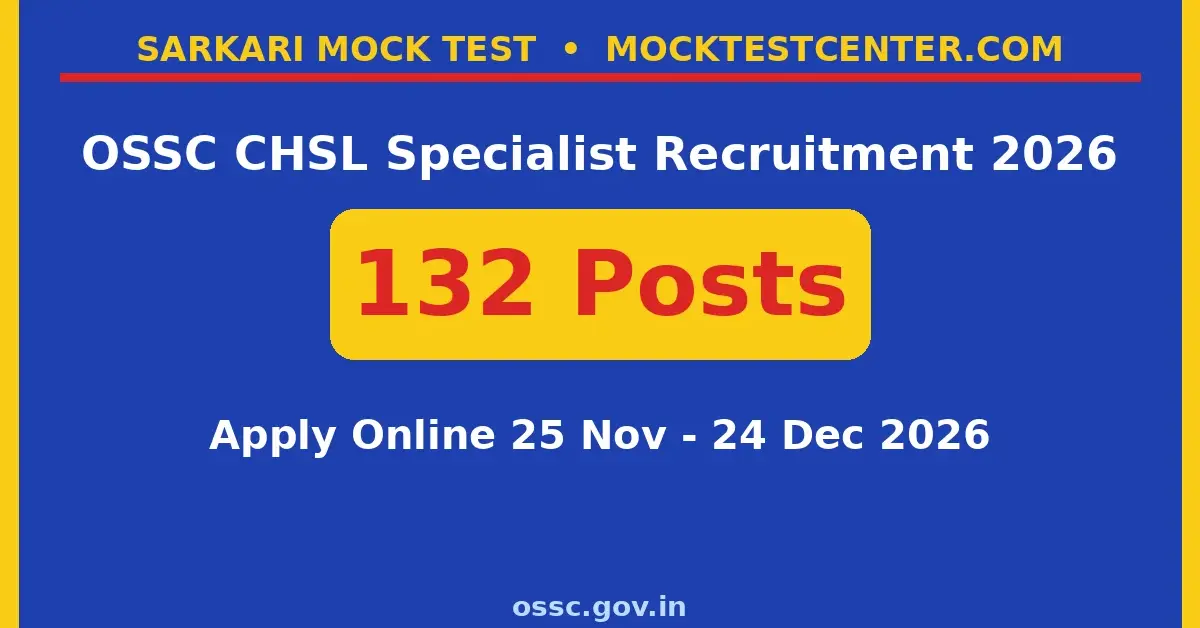
OSSC CHSL Specialist Recruitment 2026: 132 Posts, Apply Online from 25 November
OSSC CHSL Specialist Recruitment 2026 offers 132 posts across five specialist posts in Odisha. The Odisha Staff Selection Commission published the notification on 19 November 2026 as Advertisement IIE-21/2026-4273/OSSC with Post Code 367. Online registration opens on 25 November 2026.
That opening line carries the whole recruitment in three facts. The count is 132. The recruiter is the Odisha Staff Selection Commission, known as OSSC. The route is online only through www.ossc.gov.in.
The window runs long enough for a careful form and short enough to punish delay. Registration and fee payment run from 25 November 2026 to 24 December 2026. Submission of the online application form runs from 25 November 2026 to 28 December 2026. Editing of the online application form runs from 25 November 2026 to 30 December 2026.
Women hold 41 of the 132 posts. That share works out to 31.06 percent of the total. The Tax and Fees Collector post alone carries 26 of those 41 women posts, and it also carries the largest single block of posts in the whole recruitment.
This article works only from the official OSSC notification, Advertisement IIE-21/2026-4273/OSSC dated 19 November 2026, Post Code 367, all 34 pages of it. Every number below comes from those pages. Where the notification stays silent, this article says so in plain words and gives no number.
The exam date, the admit card date and the pay in rupees sit in that silent list. The age limit, the per post qualification, the exam pattern and the syllabus all sit in the notification itself, and this article prints them in full. OSSC CHSL Recruitment 2026 deserves a careful read for exactly that reason. A candidate who files a form on a guessed age limit or a guessed qualification risks a rejection that no later correction can undo.
How many posts does OSSC CHSL Specialist Recruitment 2026 offer?
The total is 132. Five posts share that total, and the shares differ so sharply that the choice of post shapes the whole application. Tax and Fees Collector takes 80 posts.
Technical Assistant takes 32 posts. Weaving Supervisor takes 15 posts. Primary Investigator takes 3 posts. Caretaker takes 2 posts.
Add the five numbers and the total closes cleanly. 2 plus 15 plus 3 plus 32 plus 80 equals 132.
No post hides outside the total. No post overlaps another. The notification prints all five numbers in one vacancy table, so the split comes from a single document and not from two different reports stitched together.
| Post | Posts | Women posts | Group | Pay level |
|---|---|---|---|---|
| Caretaker | 2 | 0 | Group-B | Level-9 (Cell-1) |
| Weaving Supervisor | 15 | 5 | Group-B | Level-9 (Cell-1) |
| Primary Investigator | 3 | 0 | Group-C | Level-5 |
| Technical Assistant | 32 | 10 | Group-C | Level-4 |
| Tax and Fees Collector | 80 | 26 | Group-C | Level-4 |
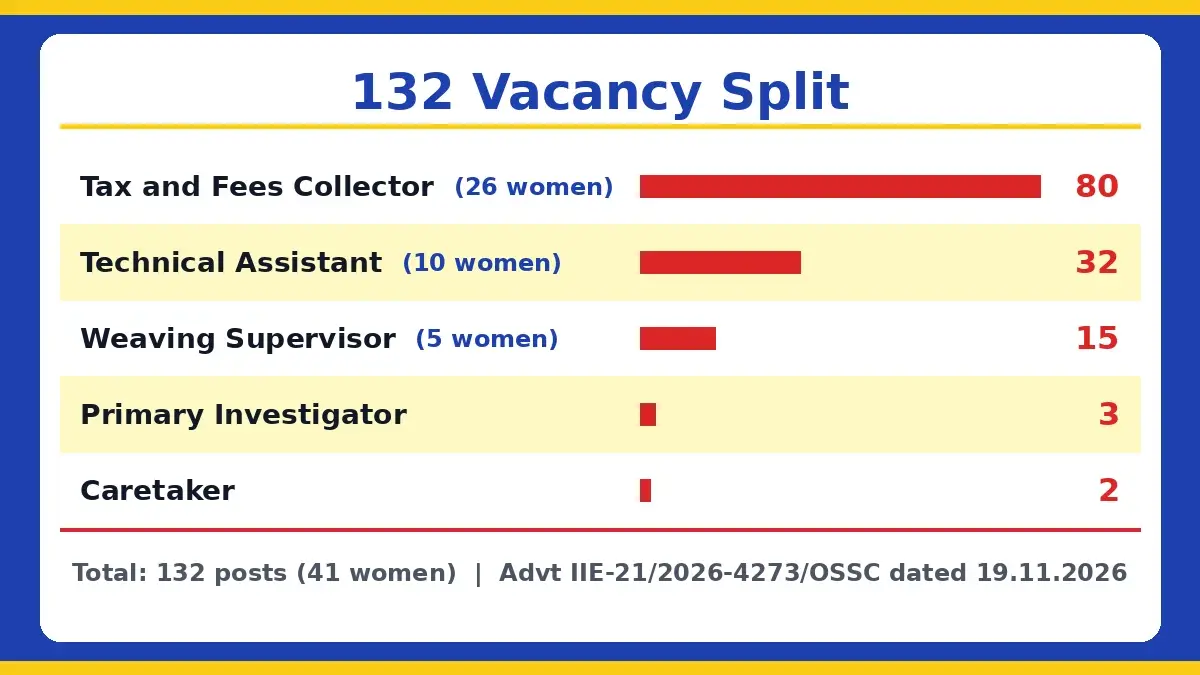 The women numbers add up the same way. 0 plus 5 plus 0 plus 10 plus 26 equals 41. The notification prints the women figure for each post in brackets next to the post total, and the five figures meet the headline figure of 41 exactly.
Tax and Fees Collector dominates the recruitment. Its 80 posts form 60.61 percent of the total, which means more than six in every ten posts in OSSC CHSL Specialist Recruitment 2026 belong to this single post. A candidate who qualifies for it chases the largest pool by a wide margin. The next post, Technical Assistant, carries 32 posts, which is less than half the Tax and Fees Collector figure.
Technical Assistant forms 24.24 percent of the total. Weaving Supervisor forms 11.36 percent. Primary Investigator forms 2.27 percent.
Caretaker forms 1.52 percent. Those shares matter because a small pool draws a narrow field and a large pool draws a wide one. Two posts at Caretaker level will see sharp competition for each seat, while eighty posts at Tax and Fees Collector level spread the same pressure across far more seats.
Two posts sit in Group B. Caretaker and Weaving Supervisor both carry Level-9 (Cell-1) of ORSP 2017. Three posts sit in Group C.
Primary Investigator carries Level-5. Technical Assistant and Tax and Fees Collector carry Level-4. The notification gives the pay matrix level for each post and gives no pay amount in rupees for any post, so this article quotes the level only and leaves the rupee figure blank until OSSC prints it.
Three different departments share the five posts. The Directorate of Textiles, Odisha, Bhubaneswar takes three posts. Weaving Supervisor sits under Textiles. Primary Investigator sits there too.
Technical Assistant sits there too. Those three posts together carry 50 posts.
The Director, Municipal Administration under the H and UD Department takes one post. That post is Tax and Fees Collector, and it carries 80 posts. The Gopabandhu Academy of Administration, Odisha, Bhubaneswar takes one post, Caretaker, with 2 posts.
Appointments will come on a regular basis. The notification states that line plainly, and it ties the pay level for each post to ORSP Rules 2017. A regular appointment carries the pay level printed in the vacancy table, and it carries no other pay promise in the notification.
The exam carries the full name Combined Higher Secondary (10+2) Level or Equivalent Recruitment Examination for Specialist Posts/Services 2026. That name tells a candidate two things.
The level is Higher Secondary, which is the 10+2 level. The posts are specialist posts, which is why five different posts with five different departments sit in one examination. OSSC runs the examination for all five posts under one advertisement and one post code, and candidates give post options at the time they submit the online form.
What are the five posts in this recruitment?
Each post carries its own count, its own group, its own level and its own department. Read them one by one before you rank them in the form, because the form asks for post options at submission time and the final allotment follows merit cum preference.
Caretaker, 2 posts
Caretaker carries 2 posts, the smallest count in the recruitment. The notification gives no women figure for this post, which the table shows as W-Nil. The post sits in Group-B and carries Level-9 (Cell-1) of ORSP 2017. The department is the Gopabandhu Academy of Administration, Odisha, Bhubaneswar.
The category split for Caretaker is short. UR takes 02 posts. No other category takes a post here.
A candidate who wants this post competes for two UR seats, and the small count means the merit list will close high. The post suits a candidate who wants a Group B Level 9 seat and who ranks the academy posting above a larger pool elsewhere. Rank it first only if you mean it, because merit cum preference gives you the post you rank first when your rank reaches it.
Weaving Supervisor, 15 posts
Weaving Supervisor carries 15 posts. Women hold 5 of those 15 posts. The post sits in Group-B and carries Level-9 (Cell-1) of ORSP 2017. The department is the Directorate of Textiles, Odisha, Bhubaneswar.
The category split gives UR 11 posts with 4 women posts inside that figure, SC 01 post, ST 03 posts with 1 woman post inside that figure, and PwD 01 post. The UR share dominates this post, with 11 of 15 posts. The ST share takes 3 posts, and the SC share takes 1 post. The PwD figure sits inside the total of 15 and does not sit on top of it, because 11 plus 1 plus 3 already equals 15.
A Group B Level 9 post with 15 seats will draw candidates who want the higher level and who accept a smaller pool. Five women posts out of fifteen give women candidates a real share here, at one in three seats.
Primary Investigator, 3 posts
Primary Investigator carries 3 posts. The notification gives no women figure for this post, which the table shows as W-Nil. The post sits in Group-C and carries Level-5. The department is the Directorate of Textiles, Odisha, Bhubaneswar.
The category split gives UR 01 post, SC 01 post and ST 01 post. Each category takes exactly one seat.
Three posts across three categories leave no room for error. A candidate who ranks this post first bets on a single seat in the candidate's own category. The post will suit a candidate who wants the Textiles department and who accepts that the pool is tiny.
Technical Assistant, 32 posts
Technical Assistant carries 32 posts, the second largest block in the recruitment. Women hold 10 of those 32 posts. The post sits in Group-C and carries Level-4. The department is the Directorate of Textiles, Odisha, Bhubaneswar.
The category split gives UR 17 posts with 6 women posts inside that figure, SEBC 07 posts with 2 women posts inside that figure, SC 07 posts with 2 women posts inside that figure, ST 01 post, PwD 01 post and Ex-SM 01 post. The UR share takes more than half the post, at 17 of 32.
SEBC and SC take 7 posts each. ST takes 1 post. The PwD and Ex-SM figures sit inside the total of 32 and do not sit on top of it, because 17 plus 7 plus 7 plus 1 already equals 32.
Ten women posts out of thirty two give women candidates nearly one seat in three here. The post carries the largest women count among the Textiles posts, and it carries the second largest total in the whole recruitment. A candidate who wants the Textiles department and a fair sized pool will look hard at this post.
Tax and Fees Collector, 80 posts
Tax and Fees Collector carries 80 posts, the largest block in OSSC CHSL Specialist Recruitment 2026 by a distance. Women hold 26 of those 80 posts. The post sits in Group-C and carries Level-4. The department is the Director, Municipal Administration under the H and UD Department.
The notification calls this post a special drive for ST and SC Category. That line sits in the vacancy table against the Tax and Fees Collector row, and this article repeats it as printed.
The split runs SC 09 posts with 3 women posts inside that figure and ST 71 posts with 23 women posts inside that figure. UR takes no post here, and SEBC takes no post here. The two figures add to 80, and the women figures add to 26.
PwD takes 03 posts with 1 woman post inside that figure. Ex-Servicemen take 02 posts, and Sports Person takes 01 post. All three figures sit inside the total of 80, and they do not sit on top of it. The notification calls this post a special drive for ST and SC Category, and the split matches that line, since every seat sits in SC or ST.
One line in the notification changes how a candidate should read this post. Municipal Employees who hold the Tax and Fees Collector post are Urban Local Bodies employees, not government employees. A candidate who takes this post joins an Urban Local Body, and the service rules of that body will apply.
Candidates from the Transgender community are also eligible to apply for these posts. The notification adds that the number of vacancies can change without any prior notice, so check www.ossc.gov.in for any fresh notice before you file.
Eighty posts change the shape of the recruitment. One post holds more posts than the other four posts put together, since 2 plus 15 plus 3 plus 32 equals 52, and 80 beats 52 on its own. Twenty six women posts form the largest women block in the recruitment, at nearly one seat in three. A candidate who ranks this post first chases the widest door in the whole examination.
How does the category split work?
The notification prints a category wise split for all five posts. Read the table row by row, and check the women figures inside each category figure before you pick a post.
| Post | UR | SEBC | SC | ST | PwD | Ex-SM |
|---|---|---|---|---|---|---|
| Caretaker | 02 | 0 | 0 | 0 | 0 | 0 |
| Weaving Supervisor | 11 (w-04) | 0 | 01 | 03 (w-01) | 01 | 0 |
| Primary Investigator | 01 | 0 | 01 | 01 | 0 | 0 |
| Technical Assistant | 17 (w-06) | 07 (w-02) | 07 (w-02) | 01 | 01 | 01 |
| Tax and Fees Collector | Nil | Nil | 09 (w-03) | 71 (w-23) | 03 (w-01) | 02 |
Read the table with care. The letters w- mark women posts inside a category figure.
UR 11 (w-04) for Weaving Supervisor means 11 UR posts in all, and 4 of those 11 posts go to women candidates. The women figure never adds seats. It marks seats inside the category figure.
PwD and Ex-SM work the same way. They mark seats inside the total. Weaving Supervisor shows UR 11 plus SC 01 plus ST 03, and those three figures already reach 15.
The PwD 01 figure sits inside that 15. Technical Assistant shows UR 17 plus SEBC 07 plus SC 07 plus ST 01, and those four figures already reach 32. The PwD 01 figure and the Ex-SM 01 figure sit inside that 32.
Add the five posts together and the category totals come out clean. UR takes 31 posts across the five posts, from 2 plus 11 plus 1 plus 17 plus 0. SEBC takes 7 posts.
SC takes 18 posts, from 0 plus 1 plus 1 plus 7 plus 9. ST takes 76 posts, from 0 plus 3 plus 1 plus 1 plus 71. Add 31 plus 7 plus 18 plus 76 and you reach 132, which equals 2 plus 15 plus 3 plus 32 plus 80. The arithmetic closes, so the table holds together.
Women posts across the five posts total 41, from 0 plus 5 plus 0 plus 10 plus 26. Inside the categories, UR women posts total 10, from 4 plus 6. SEBC women posts total 2.
SC women posts total 5, from 2 plus 3. ST women posts total 24, from 1 plus 23. Add 10 plus 2 plus 5 plus 24 and you reach 41. Caretaker and Primary Investigator carry no women posts, so they add nothing to that sum.
Tax and Fees Collector needs its own note. Its 80 posts carry 26 women posts, and its row in the vacancy table calls it a special drive for ST and SC Category. The split proves the label, since SC takes 9 posts and ST takes 71 posts, and no other category takes a seat here.
Tax and Fees Collector also carries 01 Sports Person post. PwD takes 03 posts, and Ex-Servicemen take 02 posts. All three figures sit inside the total of 80, so they add no seats on top of it. Check the PwD figure the same way you check the women figures, as a mark inside the total.
One more point on categories deserves a plain line. The fee rule and the category split use the same category names, but they answer different questions. The split decides how many seats each category holds.
The fee rule decides who pays Rs 500 and who pays nothing. A candidate can sit in a category that holds seats and still pay no fee, because SC/ST/PwD candidates pay no fee under this notification. Keep the two rules apart when you read the form.
What is the age limit for this recruitment?
The notification fixes the age for each post as on 01 January 2026. Caretaker asks for 21 to 42 years. Weaving Supervisor asks for the same range. Tax and Fees Collector asks for the same range as well.
Primary Investigator asks for 18 to 42 years. Technical Assistant asks for 20 to 42 years. The upper age limit stays at 42 years for every post, and only the minimum age changes from post to post.
| Post | Minimum age as on 01.01.2026 | Maximum age as on 01.01.2026 |
|---|---|---|
| Caretaker | 21 years | 42 years |
| Weaving Supervisor | 21 years | 42 years |
| Primary Investigator | 18 years | 42 years |
| Technical Assistant | 20 years | 42 years |
| Tax and Fees Collector | 21 years | 42 years |
The upper age limit carries relaxation of 5 years for SEBC candidates. SC candidates get the same relaxation. ST candidates get it too.
All Women candidates get the same 5 year relaxation. PwD candidates get relaxation of 10 years. Ex-Servicemen get relaxation equal to the total period of service in defence service. PwD candidates in the ST and SC category get cumulative relaxation of 10 years over and above the normal relaxation for the category.
A candidate who falls under more than one category gets only one benefit, and OSSC will apply the benefit that helps the candidate most.
Candidates with no relaxation must not have been born earlier than 02 January 1984. For Caretaker the last birth date is 01 January 2005. Weaving Supervisor shares that date. Tax and Fees Collector shares that date as well.
| Post | Last birth date (no relaxation) |
|---|---|
| Caretaker | 01 January 2005 |
| Weaving Supervisor | 01 January 2005 |
| Primary Investigator | 01 January 2008 |
| Technical Assistant | 01 January 2006 |
| Tax and Fees Collector | 01 January 2005 |
Primary Investigator closes at 01 January 2008. Technical Assistant closes at 01 January 2006. OSSC will accept only the date of birth entered in the High School Certificate Examination, so check that certificate before you file.
What qualification does each post need?
Caretaker needs two qualifications together. The candidate needs 10+2 in Arts, Science or Commerce or an equivalent qualification, and a Diploma in Hospitality or Hotel Management from a recognised institution or university. One without the other will not pass the eligibility check.
Weaving Supervisor needs a Diploma in Handloom Technology or Textile Technology from IIHT or another recognised institution. The diploma alone settles eligibility for this post, and no separate degree is asked for.
Primary Investigator needs Plus 2 with Economics or Statistics. An equivalent course also counts, as long as Economics or Statistics sits in it as a subject.
Technical Assistant needs HSC or Matriculation with PMF or Handloom Weaving and Design Training in a government organisation. Candidates who hold a diploma or another course in Textile Technology or Handloom and Textile Technology from a government recognised institute other than IHWD Khordha must obtain a certificate from the Head of the Institute of Handloom Weaving and Design at Khordha. The candidate must upload that certificate with the online form. The certificate must state that the diploma or training course covers the syllabus of the Technical Assistant course in this advertisement.
Two groups of candidates need no such certificate. Candidates who hold a Diploma in Textiles Technology from the Institute of Textile Technology, Choudwar, need no IHWD certificate. Candidates who hold a Diploma in Handloom and Textiles Technology from the Indian Institute of Handloom Technology, Bargarh, need no IHWD certificate either. OSSC treats both diplomas at par with the IHWD certificate.
Tax and Fees Collector needs Higher Secondary or Plus 2 in Arts, Science or Commerce from CHSE or an equivalent examination from a government recognised institution or college. Basic Computer Knowledge is also needed for this post, so a candidate should hold a computer certificate or a computer course before filing.
| Post | Essential educational qualification |
|---|---|
| Caretaker | 10+2 in Arts, Science or Commerce, or an equivalent qualification, plus a Diploma in Hospitality or Hotel Management from a recognised institution or university |
| Weaving Supervisor | Diploma in Handloom Technology or Textile Technology from IIHT or another recognised institution |
| Primary Investigator | Plus 2 with Economics or Statistics, or an equivalent course with Economics or Statistics as a subject |
| Technical Assistant | HSC or Matriculation with PMF or Handloom Weaving and Design Training in a government organisation |
| Tax and Fees Collector | Higher Secondary or Plus 2 in Arts, Science or Commerce from CHSE or an equivalent examination from a government recognised institution or college, with Basic Computer Knowledge |
Every post also needs Odia. A candidate must be able to read Odia, write Odia and speak Odia fluently. The notification gives four ways to prove it.
The candidate must have passed the Middle School Examination with Odia as a language subject, or the HSC Examination with Odia as the medium of examination in a non-language subject, or Odia as a language subject in the final examination of Class 7 or above from a recognised school, or a test in Odia of Middle English School standard held by the School and Mass Education Department of the Government of Odisha. Any one of the four proofs is enough.
The qualification must be held on the closing date of the online application, so a course that finishes after that date will not count.
What is the exam pattern?
The recruitment runs in three stages. Stage 1 is the Preliminary Examination, held through OMR or CBRE. It carries one paper of 150 marks, and every question is of MCQ type.
Each wrong answer loses 0.25 marks. The notification also states the rule as one fourth of the total mark for a wrong answer where four options are given.
At least five times the number of vacancies in each category move from the Preliminary Examination to the Main Written Examination. The Commission may also fix minimum qualifying marks for different stages and different categories.
Stage 2 is the Main Written Examination, held through OMR or CBRE. It carries a Technical Paper based on the qualification prescribed for the post, and it carries 200 marks. Twice the number of vacancies in each category and each post move from the Main Written Examination to the verification of original documents, in order of merit based on the marks in the Written Examination.
Stage 3 is Certificate Verification. A candidate who fails to attend the document verification will not be considered for the post, so the last stage still decides the final list.
| Stage | Examination | Papers | Total marks |
|---|---|---|---|
| Stage 1 | Preliminary Examination (OMR or CBRE) | One paper | 150 |
| Stage 2 | Main Written Examination (OMR or CBRE) | Technical Paper as per the qualification for the post | 200 |
| Stage 3 | Certificate Verification | No paper | No marks |
Both the Preliminary and the Main examination will be held in Odia and English. The notification cites GA and PG Department Notification No. 29246 dated 18 October 2022 for that rule. A candidate must choose the medium of language in the online application form, and that choice cannot be changed later.
The merit list rests on the marks in the Main Written Examination. If two candidates score the same marks, the candidate with higher marks in the Preliminary Examination ranks above. If the tie still stands, the older candidate ranks above.
If the tie still stands after that, the candidates rank in alphabetical order. OSSC will allow no re-evaluation or re-checking of answer scripts in any case.
OSSC will announce the exam date through a Notice or the Admission Letter, with the time and the venue in the same notice, so candidates must check www.ossc.gov.in regularly. No admission letter will be sent by post.
What is the syllabus for the Preliminary and Main examinations?
The detailed syllabus of the Preliminary Examination and the Main Written Examination sits published at Annexure C of the notification, on pages 19 to 33. This section gives the subject heads from that annexure, so a candidate can plan study before reading the full pages.
The Preliminary Examination carries five subject heads, all of 10th standard. Arithmetic opens the list. Data Interpretation follows. It covers charts and graphs and tables and data sufficiency.
Logical Reasoning and Analytical Ability with General Mental Ability comes next. Current Events of National and International Importance follow. Computer and Internet Awareness closes the list.
The Main Written Examination carries a Technical Paper for each post, based on the qualification prescribed for that post. The Caretaker paper covers Odia and General English and General Studies of HSC standard. It also covers Hospitality and Hotel Management subjects. Front Office Operation leads that list, with Accommodation Operation and Customer Relation Management beside it.
For Weaving Supervisor, the Technical Paper covers Fibre Science, Yarn Manufacture, Fabric Manufacture, Textile Chemical Processing and Textile Testing.
For Technical Assistant, the paper follows the 10th standard certificate course in Handloom Weaving and Design. It covers eight heads. Fabric Structure and Cloth Analysis opens the list. Weaving Mechanism follows, with Textile Chemistry beside it.
Textiles Calculation and Tie and Dye come next. Made Up Garments and Handloom Economics and Management follow. Computer Aided Designs closes the list.
For Primary Investigator, the Main Written Examination carries two papers. Paper 1 is a composite paper of HSC standard. It covers General English and Odia Language and Computer Fundamentals and General Studies. Paper 2 is a Technical Paper on Economics and Statistics.
For Tax and Fees Collector, the paper covers Arithmetic and English and Odia and General Knowledge and Computer. The Arithmetic head lists Simple Interest and Compound Interest. It also lists profit and loss and discount. Time and Work and Time and Distance sit in the same head, among other topics.
The English head lists verbs and tenses. It also lists active and passive voice and direct and indirect speech. The Computer head lists basic knowledge of computers. It covers MS Word and MS Windows and MS Excel and MS PowerPoint and Internet communication.
Read Annexure C on pages 19 to 33 of the notification for the full topic lists. The subject heads above come from those pages, and no topic here comes from any other source.
When do the forms open and close?
OSSC CHSL Specialist Recruitment 2026 runs three windows at once, and each window carries its own closing date.
The notification gives three windows, and each window carries its own closing date. Mix them up and a candidate can pay the fee on time yet miss the form, or file the form on time yet miss the edit chance.
| Event | Dates | Days |
|---|---|---|
| Online registration and fee payment | 25 November 2026 to 24 December 2026 | 30 days |
| Submission of online application form | 25 November 2026 to 28 December 2026 | 34 days |
| Editing of online application form | 25 November 2026 to 30 December 2026 | 36 days |
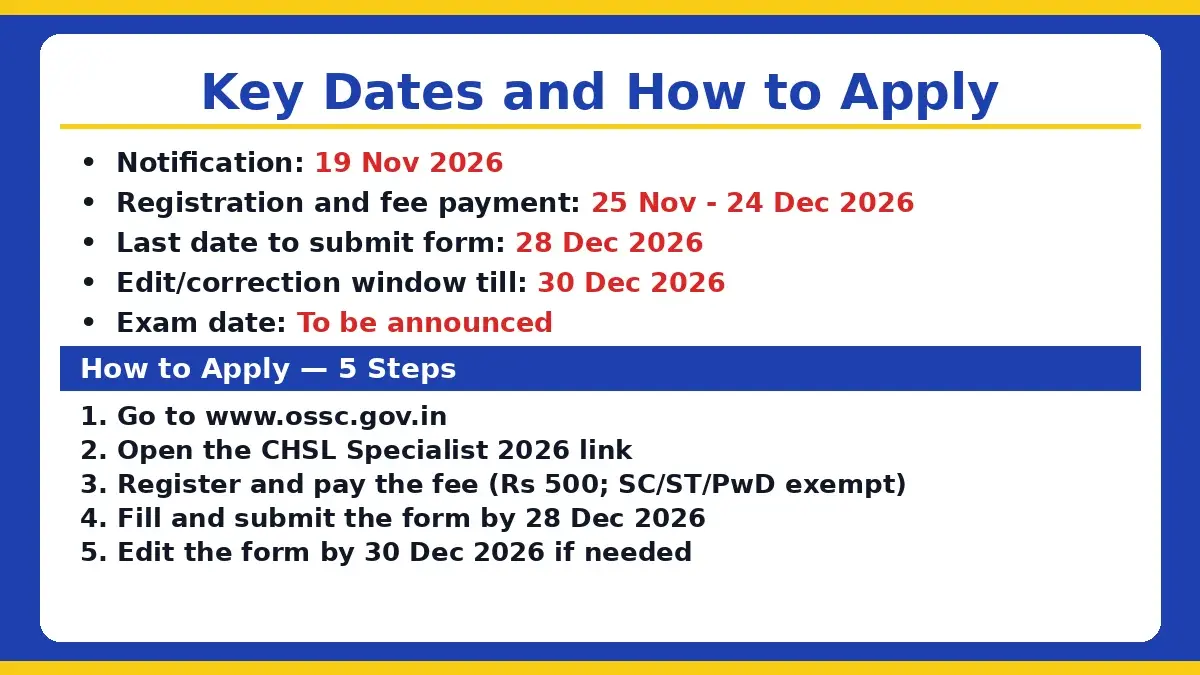 Registration and fee payment open on 25 November 2026 and close on 24 December 2026. Count both end dates and the window runs 30 days. Six days in November, from 25 November to 30 November, plus twenty four days in December, from 1 December to 24 December, give 30 days in all.
Submission of the online application form opens on the same day, 25 November 2026, and closes on 28 December 2026. Count both end dates and the window runs 34 days. The submission window runs four days past the registration and fee window, so a candidate who registers and pays by 24 December still holds time to submit the form by 28 December. The gap spans 24 December to 28 December, which is five days counting both end dates, and four days after the fee window closes.
Editing of the online application form opens on 25 November 2026 and closes on 30 December 2026. Count both end dates and the window runs 36 days.
The editing window runs two days past the submission window, so a candidate who submits the form by 28 December still holds 29 December and 30 December to correct it. Use those two days only for genuine corrections. A form that needs a full rewrite on 30 December was filed too fast.
The notification itself carries the date 19 November 2026. Registration opens six days after that date, on 25 November 2026. That six day gap gave candidates time to read the notification before the portal opened. A candidate who reads it now holds the same advantage, because the portal stays open for a full month after 25 November.
File the form early. The last day brings server load and payment failures. The clock waits for nobody.
A candidate who files in the first week never has to argue about a closing date. A candidate who waits till 24 December for the fee and 28 December for the form bets the whole application on two single days. The notification gives no extension, so plan as if all three closing dates stand firm.
Mark three dates in your calendar today. 24 December 2026 for registration and fee payment. 28 December 2026 for submission of the form.
30 December 2026 for editing. One missed date breaks the chain, because each later step needs the earlier step done. Pay first, submit next, edit last. That order follows the notification, and it also follows common sense.
How much is the fee, and who gets it back?
That is the full fee rule for OSSC CHSL Recruitment 2026.
The fee rule is short, and it is also the most generous rule in the notification. Candidates other than SC/ST/PwD pay Rs 500. SC/ST/PwD candidates pay no fee. That is the whole fee table.
| Candidate | Fee |
|---|---|
| Candidates other than SC/ST/PwD | Rs 500 |
| SC candidates | No fee |
| ST candidates | No fee |
| PwD candidates | No fee |
Pay the fee inside the registration window, from 25 November 2026 to 24 December 2026. The fee payment window opens and closes with registration, so a candidate who registers late and pays late misses both together.
Keep the payment receipt. The receipt proves the payment, and the application number proves the form. Keep both in one place.
OSSC returns the fee to candidates who actually appear in the first stage of the recruitment examination. Read that line as it stands.
The refund goes to candidates who pay Rs 500 and then sit for the first stage. A candidate who pays and then skips the first stage gets no refund under that line. A candidate who pays no fee has nothing to claim back.
That refund rule changes how a candidate should think about the fee. Think of Rs 500 as a deposit that comes back after the examination for a candidate who appears for the test. The rule rewards the candidate who turns up, and it asks nothing at all from SC/ST/PwD candidates at the payment stage.
The notification gives no other fee figure. It gives no separate fee for any post, no late fee and no second fee at any later stage. A page that quotes a different fee for this recruitment quotes a figure the notification lacks. Use Rs 500 for general candidates and no fee for SC/ST/PwD candidates, and check www.ossc.gov.in if OSSC prints any fresh fee notice.
Pay the fee only through the online mode in the Odisha Treasury portal linked with the online application form. The notification names no other payment route, and the fee payment sits inside the online process on www.ossc.gov.in. Pay nobody outside the portal, and trust no payment link that arrives by message or mail.
Every candidate must fill bank account details in the form, with the Account Number, the IFSC code, the name of the account holder and the name of the bank branch. The bank account must be valid and active, because the refund will reach that account. A form without fee payment counts as incomplete and faces rejection. This rule does not apply to SC, ST or PwD candidates.
How does post choice work in OSSC CHSL Recruitment 2026?
OSSC appoints a candidate against one post only. That line sits in the notification, and it shapes the whole form. A candidate may apply for more than one post, but the final appointment covers a single post.
Candidates give post options at the time they submit the online form. The ranking happens once at submission. It cannot wait for the result.
Final allotment follows merit cum preference for candidates who apply for more than one post. Merit decides the order. Preference decides the post.
A higher rank reaches the posts ranked first. A lower rank takes the posts that remain when the turn comes. Rank your posts in the order you want them most, because the allotment will follow that order when your rank reaches a post you listed.
Think through the ranking before you open the form. A candidate who wants the largest pool will rank Tax and Fees Collector first. A candidate who wants Group B Level 9 will rank Caretaker or Weaving Supervisor first.
A candidate who wants the Textiles department will rank its three posts in the order the candidate prefers them. No ranking is right for every candidate. The right ranking is the one that matches the candidate's own aim, because merit cum preference will hold the candidate to it.
The notification also speaks about how OSSC will hold the examination. The Commission may hold the examination through OMR mode or CBRE mode.
OMR means a paper answer sheet. CBRE means a computer based recruitment examination. The notification leaves the choice open, so candidates should prepare for either mode and watch www.ossc.gov.in for the mode OSSC picks.
If OSSC holds the examination through CBRE or OMR in multiple batches, the Commission will use a Normalisation Formula. The notification cites Notice No.2444/OSSC dated 02 September 2021 for that formula. Normalisation adjusts scores across batches so that a candidate in one batch does not gain or lose only because that batch faced a different paper.
The notification gives no formula and no worked example, so this article gives none. The point for a candidate is simple. Batches may differ, and the formula exists to keep the comparison fair across them.
The recruitment follows the Combined Higher Secondary (10+2) Level or Equivalent Recruitment Examination for Specialist Posts/Services Rules, 2022 as amended. That line sits in the notification, and it names the rule book that guides the whole process. Candidates need no copy of the rules to file the form, but the line matters when any dispute arises, because the rules decide it.
What does the notification still leave open?
Only three details stay open, and this section lists them plainly so no reader mistakes silence for a fact. The notification runs to 34 pages. It covers every part of the recruitment except the exam timetable and the pay in rupees.
| Detail | Position in the notification |
|---|---|
| Exam date | The notification gives no date |
| Admit card date | The notification gives no date |
| Pay amounts in rupees | The notification gives Level-9, Level-5 and Level-4 only |
The exam date sits at the top of that list because every candidate asks for it first. The notification gives no exam date and no admit card date. The date of the examination will come through a Notice or the Admission Letter, with the time and the venue in the same notice, and the notification tells candidates to check www.ossc.gov.in regularly for the application status, the admission letter and the exam date. That instruction is the only exam timetable the notification carries.
Pay in rupees sits in the same gap. The notification gives Level-9 (Cell-1) for two posts, Level-5 for one post and Level-4 for two posts, all under ORSP Rules 2017.
It gives no monthly pay figure for any post. A candidate who quotes a salary figure today quotes a figure the notification lacks. The level tells the pay band family, and only OSSC can turn that level into a rupee figure on its site.
The gap between 19 November 2026, when OSSC published this notification, and 25 November 2026, when registration opens, is six days. The gap between registration and the examination will run far longer, and OSSC will use that time to print the exam date and the admission letter.
How do you apply online for this recruitment?
Apply online only through www.ossc.gov.in. The notification repeats that route, and it needs no physical copy and no hard copy of the form.
A paper form sent by post counts for nothing. A form filed at any office counts for nothing. The OSSC website is the only route.
| Step | What to do |
|---|---|
| 1 | Open www.ossc.gov.in from 25 November 2026 |
| 2 | Find Advertisement IIE-21/2026-4273/OSSC, Post Code 367 |
| 3 | Read the notification fully before you touch the form |
| 4 | Register with a valid email ID and a valid mobile number |
| 5 | Fill the form with details as they appear on your certificates |
| 6 | Give your post options in the order you want them most |
| 7 | Pay Rs 500 if the fee rule covers you, and pay nothing if you are SC/ST/PwD |
| 8 | Submit the form by 28 December 2026 and save the application details |
| 9 | Edit the form by 30 December 2026 if any detail needs a correction |
| 10 | Check www.ossc.gov.in regularly for application status / admission letter / exam date |
Keep a valid email ID and a valid mobile number ready before you register. The notification asks for both, and OSSC will use them to reach you through the process. A dead email address or a dead mobile number can lock a candidate out of the candidate's own form. Check both before you type them, and keep them active till the recruitment ends.
Hold the qualification on the closing date of the online application. That line comes from the notification, and it fixes the eligibility date. A qualification earned after the closing date will not help for this recruitment. Check the date against your own certificates before you file.
Fill the form with the details exactly as they appear on your certificates. Spelling mismatches between the form and the certificate cause trouble at verification. Check the name, the date of birth and the other details letter by letter before you submit. The editing window runs to 30 December 2026, and it exists for genuine corrections, but a careful first filing beats a corrected filing every time.
Give the post options with care, because the form asks for them at submission and merit cum preference will follow them. Rank the posts in the order you want them, not in the order of their size. Size matters, but it is not the only thing that matters. A candidate who ranks a large pool first and a preferred post second will get the large pool when the rank reaches it, and the preferred post will wait behind it.
Save the application number and the payment receipt after submission. Those two records prove the registration and the payment.
Share the application number with one person in your family, so a broken phone or a lost email still leaves a backup. Then check www.ossc.gov.in regularly. OSSC sends no admission letter by post, so the website is the only place the admission letter will appear.
What mistakes can get a form rejected?
The notification names three faults in plain words. Incomplete applications face rejection.
False information can lead to cancellation and debarment. A qualification missing on the closing date fails eligibility. Those three lines cover most rejected forms, and each one is easy to avoid with a slow and careful filing.
An incomplete form is the most common fault. A blank field, a missing upload, a skipped post option or an unpaid fee can leave the form incomplete. The portal may accept the click, but OSSC may still reject the form later.
Read the form twice before you submit it. Check every field and every upload. Check the fee receipt before the final click.
False information is the most serious fault. A wrong date of birth, a wrong category, a wrong qualification or a fake certificate can lead to cancellation of the candidature and debarment from future examinations. The notification names cancellation. It also names debarment.
A candidate should take both seriously. Type only what the certificates say. Claim only the category the certificate proves. Upload only genuine documents.
A late form is the most avoidable fault. The fee window closes on 24 December 2026. The submission window closes on 28 December 2026. The editing window closes on 30 December 2026.
A candidate who files on 23 December, submits on 27 December and checks the form on 29 December faces no rush at all. A candidate who starts on 24 December bets everything on one day. Start early and finish early. Keep the last days free for a calm check.
A wrong email ID or a wrong mobile number is a quiet fault. The form may still submit, but OSSC cannot reach the candidate after that.
Type the email address slowly. Type the mobile number digit by digit. Ask the portal to send a test message if it offers one, and confirm that it arrives before you move on.
A careless post ranking is a fault of a different kind. It will not reject the form, but it can allot the wrong post. Merit cum preference follows the ranking the candidate gives, so a ranking typed in a hurry can bind the candidate to a post the candidate never wanted at all. Rank the posts after reading the vacancy table in this article, and rank them in the order you would accept them.
More admit cards and results to track
OSSC CHSL Specialist Recruitment 2026 opens on 25 November 2026, and while you wait for that date, other recruitments move on their own clocks. The Kolkata Police Constable admit card 2026 is out, and candidates for that drive can download the hall ticket now. The SSC CPO admit card 2026 is out for Paper 1, and the hall ticket carries the exam centre and the reporting time.
The SSC Stenographer Grade C LDCE 2026 notification covers 320 posts, and the apply link sits in that post. The BPSC APO result 2026 is out, and 3,175 candidates have qualified the mains.
The RRB Paramedical admit card 2026 is out for railway paramedical posts. The CLAT 2027 admit card is out, and the exam falls on 6 December.
The SBI PO interview call letter 2026 is out for Phase 3, and shortlisted candidates can download it now. The IBPS PO mains result 2026 is out, and candidates can check the result from that post.
The BPSC 72nd CCE prelims exam date 2027 is set for 17 January, and the post carries the date notice. The HP Patwari admit card 2026 is out, and the hall ticket link sits in that post.
The OSSSC Nursing Officer result 2026 is out with the document verification list. The SIDBI Grade A and Grade B recruitment 2026 covers 68 posts, and the apply link sits in that post.
Each of those posts follows the same rule as this one. The facts come from the official notice, and the gaps stay labelled as gaps.
Sources
The vacancy numbers; the women figures; the groups; the pay levels; the departments; the category split for all five posts; the age limits and relaxations; the per post qualifications; the Odia language rule; the three stage exam pattern with marks and negative marking; the Annexure C syllabus; the three application windows; the fee rule; the refund rule; the bank details rule; the post option rule; the merit cum preference rule; the normalisation citation; the OMR and CBRE modes; the 2022 Rules citation; the instruction to check the OSSC website. All of those facts come from the official OSSC notification, Advertisement IIE-21/2026-4273/OSSC dated 19 November 2026, Post Code 367, read on the Odisha Staff Selection Commission website. The Normalisation Formula citation in that notification is Notice No.2444/OSSC dated 02 September 2021. Apply online only through www.ossc.gov.in.
Open www.ossc.gov.in on 25 November 2026, read Advertisement IIE-21/2026-4273/OSSC once more, and file the form in the first week while the portal runs calm.