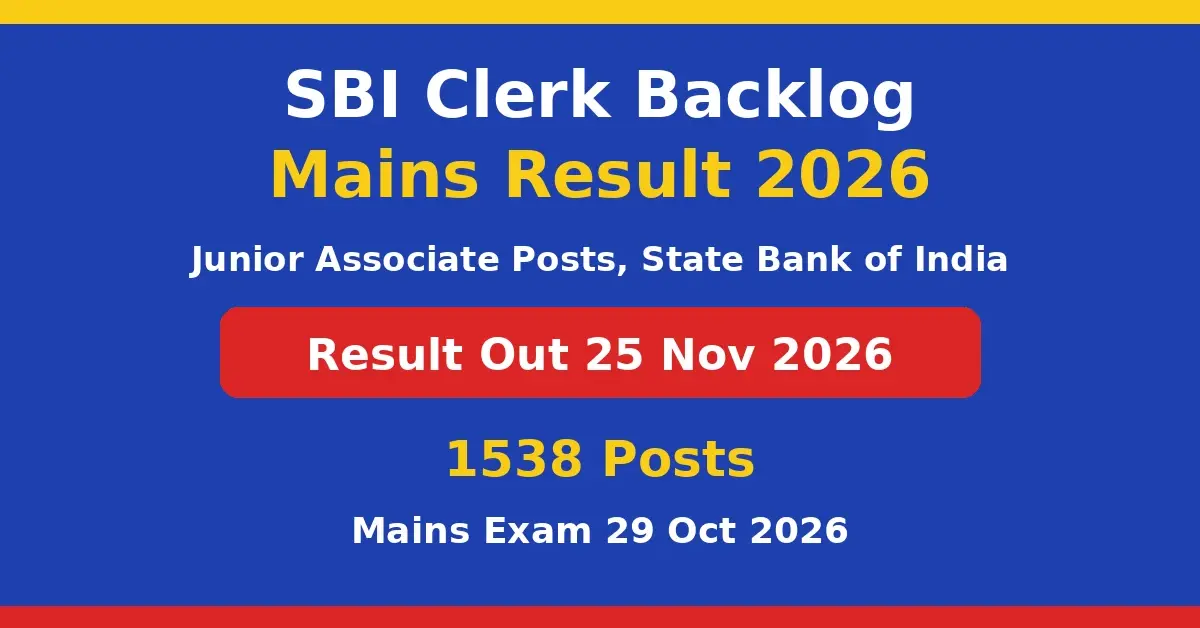
SBI Clerk Backlog Mains Result 2026 Out for 1538 Posts
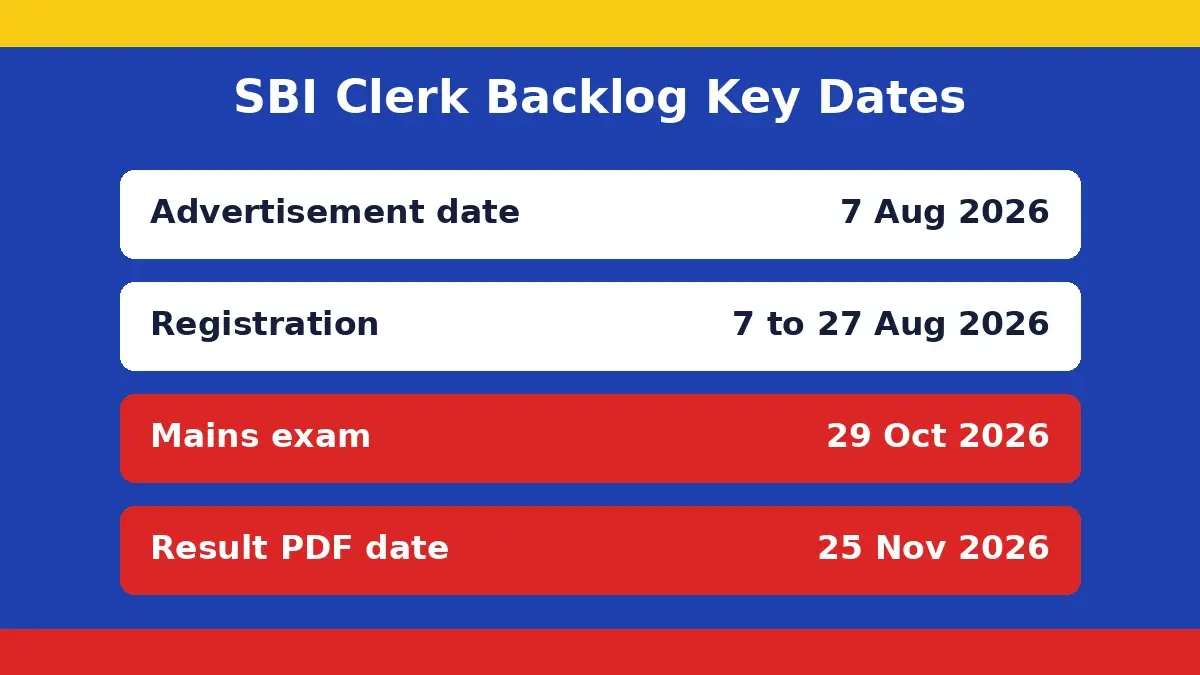
SBI Clerk Backlog Mains Result 2026 is out, and State Bank of India has released the final result for the Junior Associate backlog recruitment with 1538 posts. The result PDF carries the date 25 November 2026, and it lists the roll numbers of provisionally selected candidates for appointment. The Main Examination for this recruitment took place on 29 October 2026.
Candidates can check the result through the official SBI careers page and the official result PDF linked from this article. Selected candidates should now wait for further instructions from the SBI Local Head Office of their State, and the bank will advise provisionally selected candidates by SMS separately. Selection stays provisional till the local language test and the eligibility checks finish.
Listen to this article in 1 minute:
What does the SBI Clerk Backlog Mains Result 2026 announce?
The result announces the final outcome of the Main Examination for the special backlog recruitment of Junior Associates, and the post name in full reads Junior Associate (Customer Support and Sales) in the clerical cadre of State Bank of India. The bank ran this recruitment as a Special Recruitment Drive for SC, ST and OBC backlog vacancies. The result PDF holds 2 pages, and it prints 1540 roll numbers of provisionally selected candidates for appointment. The roll number count stands 2 above the 1538 vacancy count, and candidates should read the list as the bank printed it.
The word provisional carries real weight in this result, and a roll number in the list means the candidate has cleared the Main Examination merit stage. Appointment still depends on later checks. The candidate must qualify in the proficiency test in the local language, must fulfil the eligibility criteria of the advertisement dated 7 August 2026, and must stand by the correctness of the information given at registration.
| Point | Details |
|---|---|
| Post | Junior Associate (Customer Support and Sales), clerical cadre |
| Bank | State Bank of India |
| Recruitment type | Special Recruitment Drive for SC, ST and OBC backlog vacancies |
| Total vacancies | 1538 posts |
| Main Examination date | 29 October 2026 |
| Result PDF date | 25 November 2026 |
| Result content | 1540 roll numbers of provisionally selected candidates for appointment |
| Result PDF length | 2 pages |
 The official Current Openings page of SBI carries this recruitment entry with the words MAIN EXAM RESULT ANNOUNCED in the entry title, and the same entry links the preliminary exam result and the main exam result. Candidates should open the SBI Current Openings page and follow the main exam result link for this recruitment. The direct official result PDF also sits in the Sources section of this article.
Today stands at 26 November 2026 in this update, and the result PDF date reads 25 November 2026, so the result is fresh. Candidates who sat in the Main Examination on 29 October 2026 should check the roll number list now. A candidate who finds the roll number in the list should then read the next steps with full care, since the bank will send separate advice by SMS and the Local Head Office will guide the joining stage.
How can candidates check the result?
Candidates can check the result in a few simple steps on the official SBI website, and the safe route starts at the SBI Current Openings page. The entry for this backlog recruitment shows the words MAIN EXAM RESULT ANNOUNCED. The entry links the preliminary exam result and the main exam result, and candidates should open the main exam result link for the final list.
| Step | Action |
|---|---|
| Step 1 | Open the official SBI Current Openings page |
| Step 2 | Find the Junior Associate backlog recruitment entry |
| Step 3 | Open the main exam result link in that entry |
| Step 4 | Read the final result PDF with the date 25 November 2026 |
| Step 5 | Search the roll number list in the 2 page PDF |
| Step 6 | Save a copy of the result PDF in a safe place |
The result PDF lists roll numbers, and each candidate should search the personal roll number with care. A candidate can use the find option of the PDF reader and type the roll number in full. A slow manual read of the full list also works, and the PDF holds only 2 pages, so a careful read takes little time.
Candidates should match the roll number digit by digit, and a similar looking roll number can mislead a fast reader. The list holds roll numbers of provisionally selected candidates for appointment. A candidate who finds an exact match of the personal roll number stands in the provisionally selected group for the next stage.
A saved copy of the result PDF helps in the coming weeks, and candidates should keep the copy with the application record. The bank will advise provisionally selected candidates by SMS separately. The SBI Local Head Office of the State will send further instructions, and the saved result copy keeps the roll number proof ready for every later step.
Candidates who followed the earlier stage of this bank cycle can also read the SBI Clerk prelims result scorecard update and the SBI Clerk prelims result 2026 update, and those pages cover the SBI Clerk prelims stage. This page covers the backlog Mains final result, and candidates should keep the two stages apart in their records.
Which recruitment does this result belong to?
This result belongs to the Special Recruitment Drive for SC, ST and OBC backlog vacancies in the Junior Associate cadre, and State Bank of India issued the advertisement with the number CRPD/CR/SPLDRIVE/2026-27/16. The advertisement carries the date 7 August 2026. Online registration and fee payment ran from 7 August 2026 to 27 August 2026.
| Point | Details |
|---|---|
| Advertisement number | CRPD/CR/SPLDRIVE/2026-27/16 |
| Advertisement date | 7 August 2026 |
| Online registration and fee payment | 7 August 2026 to 27 August 2026 |
| Post | Junior Associate (Customer Support and Sales) |
| Cadre | Clerical cadre |
| Drive type | Special Recruitment Drive for SC, ST and OBC backlog vacancies |
| Total vacancies | 1538 posts |
The backlog nature of this drive shapes the whole result, and the vacancies belong to SC, ST and OBC categories only. The category split reads SC 207 posts, ST 1219 posts and OBC 112 posts. The three category counts add up to 1538 posts, and the ST share forms the largest part of this drive.
Candidates applied for one State or Union Territory only in this recruitment, and the vacancy split runs State wise and category wise. Final merit also stands State wise and category wise. A candidate should thus read the result with the applied State and the personal category in mind, since the competition pool followed those lines from the start.
The advertisement gave tentative timing for the exam stages, and the Preliminary Examination stood tentatively in September 2026. The Main Examination stood tentatively in October or November 2026. The result PDF now fixes the actual Main Examination date at 29 October 2026, and candidates should use this actual date in every record.
How many vacancies stand behind this result?
A total of 1538 vacancies stand behind this result, and the category split reads SC 207, ST 1219 and OBC 112. The ST category holds the largest share with 1219 posts. The SC category holds 207 posts. The OBC category holds 112 posts, and the three counts add up to the full total of 1538.
| Category | Vacancies |
|---|---|
| SC | 207 |
| ST | 1219 |
| OBC | 112 |
| Total | 1538 |
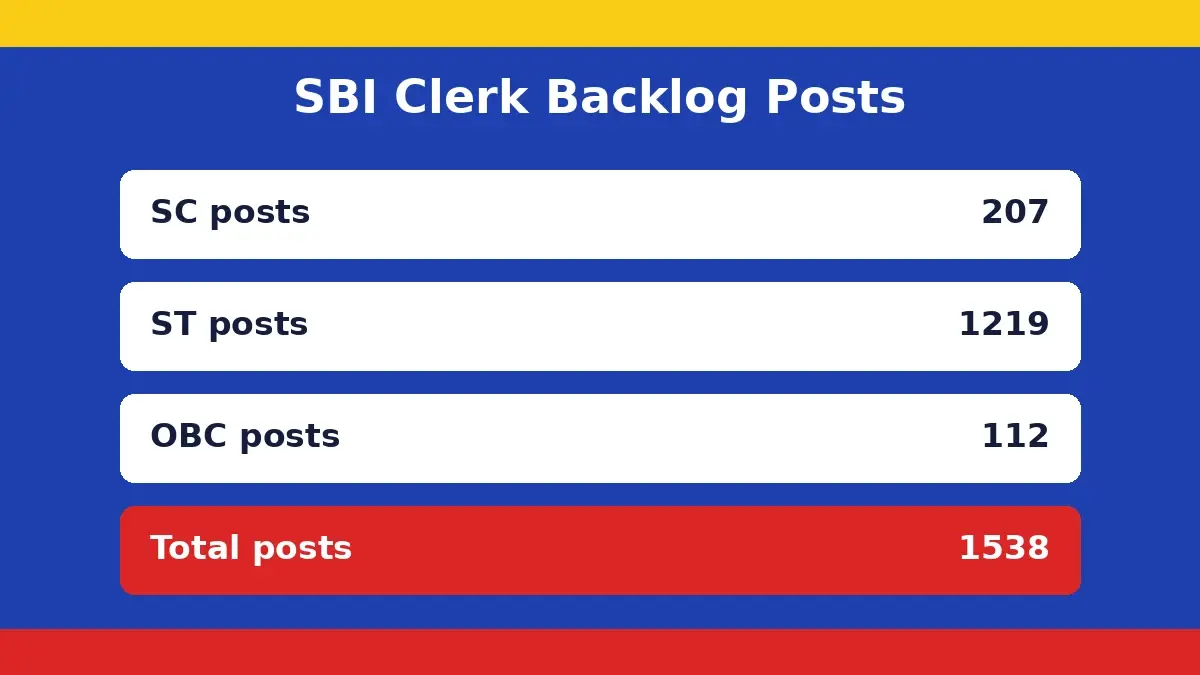 The category split explains the shape of the merit list, and final merit stands State wise and category wise for this recruitment. An ST candidate competed inside the ST pool of the applied State. An SC candidate competed inside the SC pool of the applied State. An OBC candidate competed inside the OBC pool of the applied State, and the roll number list follows this State and category structure.
The wait list rule also follows the same lines, and the bank can hold a wait list of up to 50 percent of the vacancies State wise and category wise. Candidates near the merit edge should read the wait list section of this article with care. The wait list opens space against non joining and resignation from the current batch.
Candidates who track bank recruitment news can also read the SBI SO recruitment last date update, and that page covers a different SBI recruitment with its own calendar. The 1538 posts on this page belong to the Junior Associate backlog drive only, and candidates should keep the two recruitments apart.
What is the State wise vacancy split?
The State wise split spreads 1538 posts across many States and one Union Territory entry, and Gujarat holds the largest State share with 289 ST posts. Maharashtra holds 165 ST posts. Madhya Pradesh holds 134 ST posts. Jharkhand holds 133 posts across SC and ST, and Karnataka holds 120 posts across SC and ST.
| State or UT | SC | ST | OBC | Total |
|---|---|---|---|---|
| Andhra Pradesh (Amaravati) | 0 | 88 | 0 | 88 |
| Karnataka (Bengaluru) | 85 | 35 | 0 | 120 |
| Madhya Pradesh (Bhopal) | 0 | 134 | 0 | 134 |
| Chhattisgarh | 0 | 26 | 0 | 26 |
| Odisha (Bhubaneswar) | 0 | 111 | 0 | 111 |
| Chandigarh UT | 0 | 0 | 22 | 22 |
| Jammu and Kashmir | 0 | 42 | 0 | 42 |
| Himachal Pradesh | 11 | 0 | 0 | 11 |
| Punjab | 0 | 0 | 18 | 18 |
| Tamil Nadu (Chennai) | 65 | 0 | 0 | 65 |
| Telangana (Hyderabad) | 0 | 32 | 0 | 32 |
| Rajasthan (Jaipur) | 20 | 86 | 0 | 106 |
| West Bengal (Kolkata) | 0 | 0 | 55 | 55 |
| Uttar Pradesh (Lucknow) | 0 | 31 | 0 | 31 |
| Maharashtra (Mumbai Metro) | 0 | 165 | 0 | 165 |
| Delhi (New Delhi) | 0 | 0 | 17 | 17 |
| Gujarat (Gandhinagar) | 0 | 289 | 0 | 289 |
| Assam (Guwahati) | 0 | 39 | 0 | 39 |
| Tripura | 0 | 22 | 0 | 22 |
| Bihar (Patna) | 12 | 0 | 0 | 12 |
| Jharkhand | 14 | 119 | 0 | 133 |
| Total | 207 | 1219 | 112 | 1538 |
The State table shows clear patterns, and most States in this drive hold ST vacancies only. Karnataka, Rajasthan and Jharkhand hold SC and ST posts together. Chandigarh UT, Punjab, West Bengal and Delhi hold OBC posts only. Himachal Pradesh, Tamil Nadu and Bihar hold SC posts only, and each candidate applied inside one State pool with one category line.
State size varies a great deal in this drive, and Gujarat at 289 posts stands far above Himachal Pradesh at 11 posts. Bihar holds 12 posts. Delhi holds 17 posts. Punjab holds 18 posts, and small State pools make each merit place carry heavy weight for candidates in those States.
The Local Head Office link also runs through the State, and provisionally selected candidates will receive further instructions from the SBI Local Head Office of their State. A selected candidate should watch for the SMS advice from the bank and should follow the Local Head Office instructions for the joining stage. The State of application decides the office for every later step.
What happens after the final result?
The result PDF gives the next steps in plain words, and provisionally selected candidates are being advised by SMS separately. Candidates should await further instructions from the SBI Local Head Office of their State. The bank will guide the joining stage through that office, and candidates should act only on instructions from the bank.
| Next step | Detail |
|---|---|
| SMS advice | Provisionally selected candidates are being advised by SMS separately |
| Local Head Office | Await further instructions from the SBI Local Head Office of your State |
| Local language test | Qualify in the proficiency test in the local language or languages |
| Eligibility check | Fulfil the eligibility criteria of the advertisement dated 7 August 2026 |
| Information check | Stand by the correctness of information given at registration |
The SMS advice matters, and selected candidates should keep the registered mobile number active. A missed SMS can delay the next step for a candidate. Candidates should read the SMS in full and should note every instruction with care, and the Local Head Office instructions will carry the joining detail for the State.
Patience also matters at this stage, and the result PDF asks candidates to await further instructions. Candidates should avoid travel or expense plans based on guesswork. The bank will send the next instruction through the proper channel, and a candidate should prepare documents and stay ready while the wait runs.
Document readiness helps during the wait, and candidates should keep the application record and the education record in order. The eligibility check will test the candidate against the advertisement dated 7 August 2026. The information check will test the correctness of the details given at registration, and clean records protect a selected candidate at this stage.
What conditions apply to provisional selection?
Provisional selection carries three conditions in the result PDF, and each condition can decide the final appointment. The candidate must qualify in the proficiency test in the local language or languages. The candidate must fulfil the eligibility criteria given in the advertisement dated 7 August 2026. The candidate must also stand by the correctness of the information given at registration.
| Condition | What the candidate must show |
|---|---|
| Local language proficiency | Qualify in the proficiency test in the local language or languages |
| Eligibility criteria | Fulfil the eligibility criteria of the advertisement dated 7 August 2026 |
| Registration information | Correctness of the information given at registration |
| Selection status till checks end | Provisional |
The local language condition holds special force, and a candidate who fails the language test will not receive appointment. Candidates with a Class 10 or Class 12 mark sheet or certificate showing study of the specified opted local language need not take the language test. Other selected candidates must face the test after the Main Examination stage and before joining.
The eligibility condition reaches back to the advertisement, and age and qualification rules of the advertisement dated 7 August 2026 will guide the check. Candidates should read the eligibility section of this article and should match the personal record against each rule. A mismatch can end the appointment path even after a place in the roll number list.
The information condition covers the registration record, and the details given at registration must stand correct. Candidates should compare the registration details with the official records in hand. A candidate who spots a mismatch should stay ready with the correct record for the verification stage, and honest records keep the appointment path safe.
How does the local language test work?
The local language rule starts at the application stage, and a candidate could apply for one State or Union Territory only. The candidate must hold proficiency in the specified opted local language of that State. The bank tests this proficiency after a candidate qualifies in the Main Examination and before joining, and the test carries appointment force.
| Local language point | Detail |
|---|---|
| State choice | Apply for one State or Union Territory only |
| Language need | Proficiency in the specified opted local language |
| Test timing | After qualifying in the Main Examination and before joining |
| Test exemption | Class 10 or Class 12 mark sheet or certificate showing study of the specified opted local language |
| Failure effect | No appointment |
The exemption rule helps many candidates, and a Class 10 or Class 12 mark sheet or certificate with the specified opted local language as a studied subject removes the test need. Candidates should keep that mark sheet or certificate ready for the verification stage. The document should show the language study in clear form.
The advertisement also gives the pattern of the local language proficiency test, and the pattern holds three parts. The Non Verbal Objective part holds 3 passages with 15 questions for 15 marks. The Subjective part holds 3 passages with 15 questions for 15 marks. The Verbal Test holds 20 marks, and the advertisement table presents the pattern in these exact parts.
| Test part | Pattern |
|---|---|
| Non Verbal Objective | 3 passages, 15 questions, 15 marks |
| Subjective | 3 passages, 15 questions, 15 marks |
| Verbal Test | 20 marks |
Candidates who must face the test should prepare in the opted local language, and reading practice in that language builds speed for the passage based parts. Writing practice helps the Subjective part. Speaking practice helps the Verbal Test, and steady daily practice in the local language gives the best cover for all three parts.
The stakes stay clear, and failure in the language test means no appointment. A selected candidate should treat the language test as a full selection stage. The Main Examination merit opens the door, and the language test guards the final entry for candidates without the mark sheet exemption.
Who could apply for this recruitment?
The advertisement set age and qualification rules for applicants, and the age rule asked for age 20 to 28 years as on 1 April 2026. The birth date window reads born not earlier than 2 April 1998 and not later than 1 April 2006. Age relaxation applied for reserved categories and for PwBD candidates under the advertisement rules.
| Eligibility point | Detail |
|---|---|
| Age | 20 to 28 years as on 1 April 2026 |
| Birth date window | Not earlier than 2 April 1998 and not later than 1 April 2006 |
| OBC relaxation | 3 years |
| SC and ST relaxation | 5 years |
| PwBD (OBC) relaxation | 13 years |
| PwBD (SC and ST) relaxation | 15 years |
| Qualification | Graduation in any discipline from a recognised university as on 31 December 2026 |
| Final year candidates | Could apply provisionally and must produce proof of passing by 31 December 2026 |
The qualification rule asked for graduation in any discipline from a recognised university, and the qualification date reads 31 December 2026. Final year or final semester candidates could apply on a provisional basis. Such candidates must produce proof of passing by 31 December 2026, and selected candidates from this group should keep the passing proof ready.
Age relaxation follows category lines, and OBC candidates held 3 years of relaxation. SC and ST candidates held 5 years of relaxation. PwBD candidates in the OBC group held 13 years, and PwBD candidates in the SC and ST groups held 15 years, and the eligibility check will apply these rules as the advertisement states them.
Selected candidates should recheck the personal record against each eligibility line, and the age date of 1 April 2026 decides the age test. The qualification date of 31 December 2026 decides the degree test. A candidate who matches every line stands ready for the verification stage with a clean record.
What fee did candidates pay?
The fee rule split by category, and SC, ST, PwBD, XS and DXS candidates paid Nil fee. OBC candidates paid Rs 750. The fee stands non refundable under the advertisement, and the fee stage closed with registration on 27 August 2026.
| Category | Fee |
|---|---|
| SC, ST, PwBD, XS, DXS | Nil |
| OBC | Rs 750 |
| Refund | Non refundable |
The fee split matches the backlog design of the drive, and the SC and ST groups faced no fee barrier at application. The OBC group paid Rs 750 at registration. Candidates should keep the fee record with the application record, and the record may help if a query arises during verification.
How did the Prelims exam work?
The selection process opened with an online Preliminary Examination, and the paper held 100 questions for 100 marks in 1 hour. English Language held 30 questions for 30 marks in 20 minutes. Numerical Ability held 35 questions for 35 marks in 20 minutes. Reasoning Ability held 35 questions for 35 marks in 20 minutes, and each section ran inside a fixed time block.
| Prelims section | Questions | Marks | Time |
|---|---|---|---|
| English Language | 30 | 30 | 20 minutes |
| Numerical Ability | 35 | 35 | 20 minutes |
| Reasoning Ability | 35 | 35 | 20 minutes |
| Total | 100 | 100 | 1 hour |
Negative marking applied in the Prelims paper, and each wrong answer deducted one fourth of a mark. The Prelims stage served as the first filter for the Mains stage. Prelims marks do not join the final merit count, and the advertisement states this rule in clear words.
The section timing shaped the Prelims challenge, and each section allowed 20 minutes only. A candidate had to finish English Language inside its block and then move to the next section. Speed with accuracy decided the Prelims outcome, and candidates who cleared this stage moved to the Main Examination.
Candidates who want the earlier stage record can read the SBI Clerk prelims result scorecard update, and that page covers the prelims result stage of the SBI Clerk cycle. The backlog final result on this page rests on the Mains stage, and Prelims marks play no part in the final merit order.
How did the Mains exam work?
The Main Examination decided the final merit, and the online paper held 190 questions for 200 marks in 2 hours 40 minutes. The paper ran on 29 October 2026 for this recruitment. Four sections formed the paper, and each section held a fixed time block and a fixed marks count.
| Mains section | Questions | Marks | Time |
|---|---|---|---|
| General and Financial Awareness | 50 | 50 | 35 minutes |
| General English | 40 | 40 | 35 minutes |
| Quantitative Aptitude | 50 | 50 | 45 minutes |
| Reasoning Ability and Computer Aptitude | 50 | 60 | 45 minutes |
| Total | 190 | 200 | 2 hours 40 minutes |
General and Financial Awareness held 50 questions for 50 marks in 35 minutes, and General English held 40 questions for 40 marks in 35 minutes. Quantitative Aptitude held 50 questions for 50 marks in 45 minutes. Reasoning Ability and Computer Aptitude held 50 questions for 60 marks in 45 minutes, and this section carried the highest marks count in the paper.
Negative marking applied in the Mains paper as well, and each wrong answer deducted one fourth of a mark. Final merit comes from the Mains aggregate marks, and the merit order stands State wise and category wise. Prelims marks stay outside the final count, so the Mains paper alone decided the roll number list in this result.
The Mains pattern helps candidates read the result with context, and a high Mains aggregate inside the State and category pool placed a candidate in the selected list. Candidates below the merit edge should study the section pattern for the next bank cycle. Section wise practice with the same time blocks builds the right pace for a future attempt.
Candidates tracking other exam updates can also read the JKSSB Sub Inspector admit card update and the BSSC Stenographer exam city slip update, and those pages cover different recruitments. The Mains pattern on this page follows the SBI advertisement for the backlog drive, and candidates should keep the patterns apart.
How does the wait list work?
The advertisement holds a wait list rule for this recruitment, and the bank can prepare a wait list of up to 50 percent of the vacancies State wise and category wise. The wait list covers candidates near the merit edge. The bank releases wait list candidates in quarterly rounds against non joining and resignation from the current batch.
| Wait list point | Detail |
|---|---|
| Size | Up to 50 percent of vacancies, State wise and category wise |
| Release | Quarterly, against non joining and resignation from the current batch |
| Validity | One year from the declaration of the final result |
The wait list validity runs for one year from the declaration of the final result, and the final result declaration date reads 25 November 2026 in the result PDF. Candidates near the merit edge should stay alert through this validity period. A quarterly release can open a place when a selected candidate does not join or resigns from the current batch.
Candidates outside the roll number list should hold a balanced view, and the wait list gives a real but limited path. The path depends on non joining and resignation counts in the same State and category pool. Candidates should keep documents ready and should watch official SBI updates through the validity period.
What pay will selected candidates get?
The advertisement gives the pay scale for the Junior Associate post, and the scale reads Rs 24050-1340/3-28070-1650/3-33020-2000/4-41020-2340/7-57400-4400/1-61800-2680/1-64480. The starting basic pay reads Rs 26730. Total starting emoluments stand around Rs 46,000 per month at a metro like Mumbai, and this figure includes DA and allowances.
| Pay point | Detail |
|---|---|
| Pay scale | Rs 24050-1340/3-28070-1650/3-33020-2000/4-41020-2340/7-57400-4400/1-61800-2680/1-64480 |
| Starting basic pay | Rs 26730 |
| Total starting emoluments | Around Rs 46,000 per month at a metro like Mumbai, including DA and allowances |
| Probation | Minimum 6 months, with e-lessons required for confirmation |
The probation rule asks for a minimum of 6 months, and e-lessons form a requirement for confirmation. New joiners should complete the e-lessons with care during probation. The confirmation stage follows the probation record, and steady work in the first months builds a strong base for the banking career.
The pay figures help selected candidates plan the joining stage, and the starting basic pay of Rs 26730 forms the base of the salary structure. The metro emolument figure near Rs 46,000 per month includes DA and allowances. Actual emoluments follow the place of posting and the allowance rules of the bank, and the appointment documents will carry the personal pay detail.
What should selected candidates do now?
Selected candidates hold a short and clear task list now, and the first task is a roll number match in the official result PDF. The second task is patience for the SMS advice and the Local Head Office instructions. The third task is document readiness for the eligibility and language checks, and each task protects the appointment path.
| Task | Action |
|---|---|
| Check roll number | Match the roll number in the official result PDF dated 25 November 2026 |
| Save result copy | Keep a copy of the 2 page result PDF with the application record |
| Watch SMS | Keep the registered mobile number active for the SMS advice |
| Wait for instructions | Await further instructions from the SBI Local Head Office of your State |
| Prepare documents | Keep graduation proof and registration record ready for verification |
| Language readiness | Keep Class 10 or Class 12 language proof ready, or prepare for the language test |
The advertisement helpdesk line can help with recruitment queries, and the number reads 022-22820427. The helpdesk runs between 11:00 AM and 05:00 PM on Bank working days. Candidates should use this official line for queries and should avoid unknown numbers from forwarded messages.
Selected candidates should also protect the registration record, and the correctness of information given at registration forms a selection condition. A candidate should compare the registration details with official records in hand. Clean and matching records make the verification stage smooth and quick.
Language readiness deserves early work, and candidates without the mark sheet exemption should start local language practice now. Reading, writing and speaking practice in the opted local language covers the three test parts. A candidate with the exemption should keep the Class 10 or Class 12 mark sheet or certificate ready for the document check.
Candidates who follow other government job updates can also read the UKSSSC Sub Inspector recruitment update and the NHPC Trainee Engineer and Officer recruitment update, and those pages cover different recruitments. Selected SBI candidates should keep full focus on the Local Head Office instructions for this appointment.
What should candidates who missed the list do?
Candidates who miss the roll number list should first recheck the list with care, and the PDF holds 2 pages only. A digit by digit match removes doubt. A candidate who still finds no match should read the wait list rule, since the wait list can release places in quarterly rounds against non joining and resignation.
The wait list validity runs one year from the final result declaration, and candidates near the merit edge should watch official SBI updates through this period. Document readiness still helps, since a wait list release can move fast. Candidates should keep the application record and education record in order.
Preparation for the next bank cycle should start from the Mains pattern, and the Mains paper held 190 questions for 200 marks in 2 hours 40 minutes. Section wise practice with fixed time blocks builds exam pace. Negative marking of one fourth of a mark per wrong answer rewards careful answer choice, and practice sets should train this care.
Candidates can also read the Odisha Police SI exam date update for another exam calendar, and that page covers a different recruitment. The SBI Junior Associate result on this page closes the Mains stage of this drive, and the next bank cycle will bring fresh chances for prepared candidates.
A calm review of the Mains attempt helps the next cycle, and candidates should note the weak sections from the attempt. General and Financial Awareness and General English each allowed 35 minutes. Quantitative Aptitude and Reasoning Ability with Computer Aptitude each allowed 45 minutes, and practice inside these blocks builds the right speed for the next attempt.
Sources
State Bank of India official Current Openings page: SBI Current Openings page
State Bank of India official final result PDF dated 25 November 2026: official result PDF
State Bank of India official advertisement PDF, Advertisement No. CRPD/CR/SPLDRIVE/2026-27/16 dated 7 August 2026: official advertisement PDF