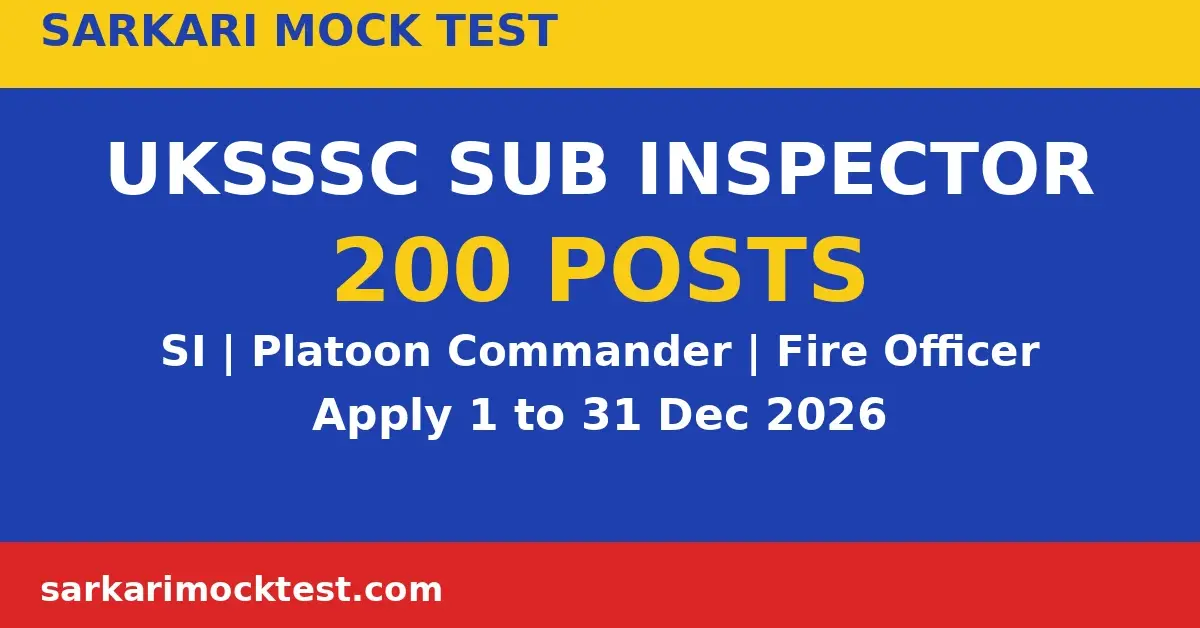
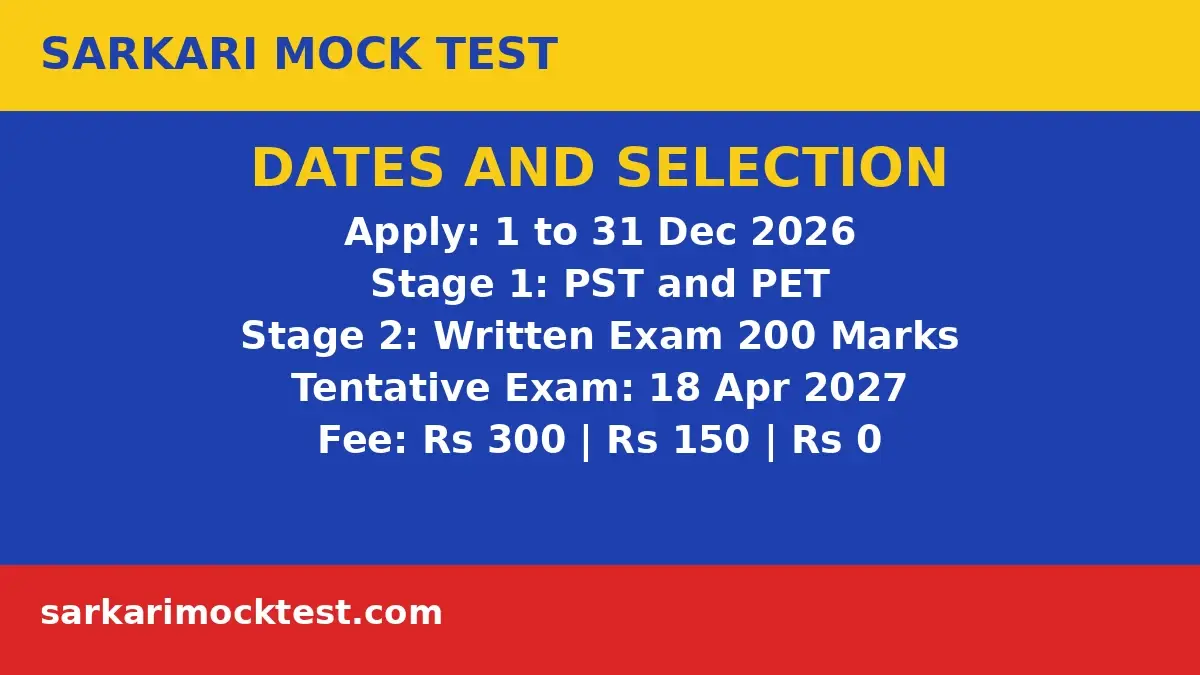
UKSSSC Sub Inspector Recruitment 2026 brings 200 uniformed posts through Advertisement 85/2026 dated 25 November 2026. You apply online from 1 December 2026 to 31 December 2026. The physical test comes first. A 200 mark written paper then decides the merit list.
Read the order with care, because the physical test can end your run before the written paper begins, while the written paper alone prepares the merit list for candidates who clear the ground stage. The tentative written exam date is 18 April 2027. The PDF gives no subject break-up, no question count and no exam time, so this page claims none of those details.
What is UKSSSC Sub Inspector Recruitment 2026?
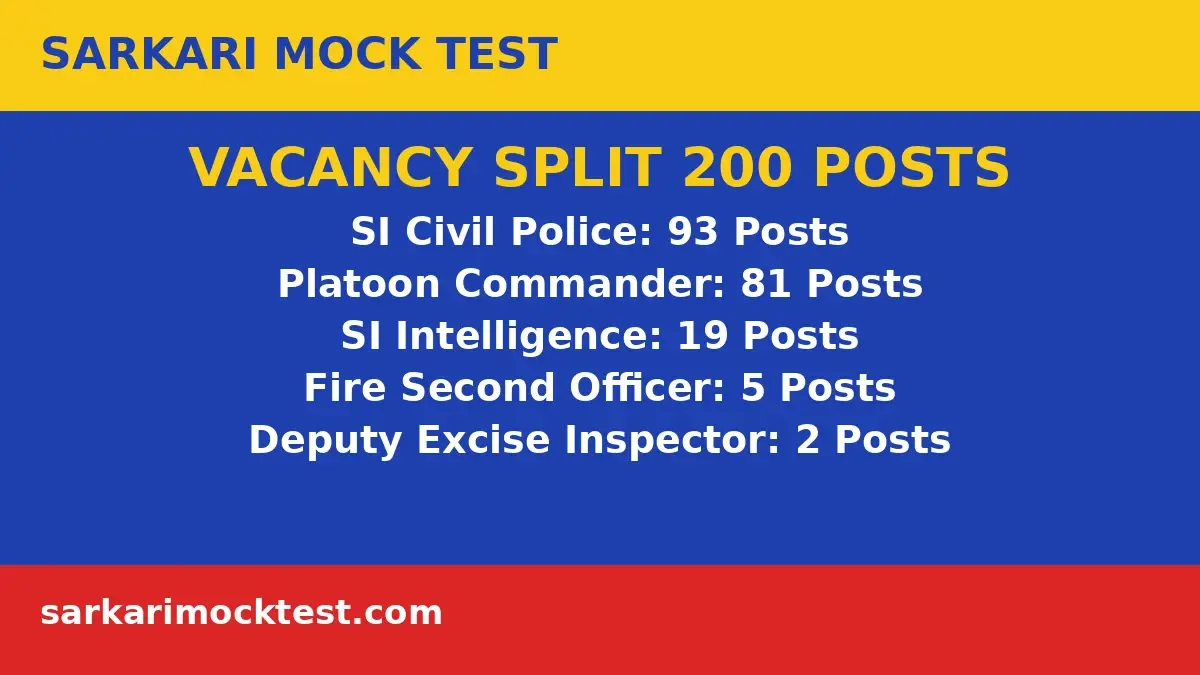
The Uttarakhand Subordinate Service Selection Commission runs this recruitment for uniformed Group C posts, and Advertisement 85/2026 carries the date 25 November 2026 with a printed total of 200 posts. Sub Inspector Civil Police holds 93 posts, and Platoon Commander PAC/IRB holds 81 posts. Those two posts alone make 174 of the 200 seats.
Sub Inspector Intelligence has 19 posts, Fire Second Officer has 5 posts, and Deputy Excise Inspector has 2 posts, so the smaller posts need a sharper category check before you choose your preference. The posts are non-gazetted and permanent.
The advertisement places them under contributory pension. Candidates must hold Indian citizenship.
Your first filter sits on the ground, where Stage 1 covers the Physical Standard Test and the Physical Efficiency Test before any candidate reaches the written paper. Stage 2 covers the written paper for candidates who clear Stage 1.
Document verification follows the written paper. Medical fitness controls the final appointment step.
One point needs a clear head from the start, because physical success keeps you in the race while physical marks add nothing to the merit score that decides the final seat. The written paper alone prepares the final merit.
That rule changes your study plan. You train for the ground test to stay in the race, and you study for the written paper to win the seat.
| Item | Detail |
|---|---|
| Conducting body | Uttarakhand Subordinate Service Selection Commission |
| Advertisement | 85/2026 dated 25 November 2026 |
| Total posts | 200 |
| Application dates | 1 December 2026 to 31 December 2026 |
| Correction dates | 4 January 2027 to 6 January 2027 |
| Tentative written exam | 18 April 2027 |
| Selection order | PST and PET, written exam, document verification, medical fitness |
| Merit base | Written exam marks only |
Which posts carry the 200 vacancies?
Civil Police and Platoon Commander carry the bulk of this recruitment, so a candidate who reads only the total misses the shape of the race and the weight of the two largest post rows. Civil Police has 93 seats.
Platoon Commander has 81 seats. Intelligence has 19 seats, Fire Second Officer has 5 seats, and Deputy Excise Inspector has 2 seats.
Platoon Commander posts are for male candidates, while the other post rows carry their own category split in the table below for a post-first and category-next reading. Read your post row before you read your category row. A category seat helps only inside a post you can actually claim.
The Commission may change the number of vacancies, so treat 200 as the printed total in Advertisement 85/2026 and check the official website again before you submit the form. A late change on the official site carries more weight than any summary page.
| Post | Posts | Pay level |
|---|---|---|
| Sub Inspector Civil Police | 93 | Level 7 |
| Sub Inspector Intelligence | 19 | Level 7 |
| Platoon Commander PAC/IRB, Male | 81 | Level 7 |
| Fire Second Officer | 5 | Level 7 |
| Deputy Excise Inspector | 2 | Level 5 |
| Total | 200 | Level 7 and Level 5 |
How do category seats split inside each post?
Category columns decide your real competition, because Civil Police gives UR 52 seats, SC 11 seats, ST 8 seats, OBC 13 seats and EWS 9 seats inside its 93 post total. Intelligence gives UR 15 seats and EWS 4 seats. Intelligence gives SC, ST and OBC zero seats in the printed table.
Platoon Commander gives UR 43 seats, SC 14 seats, ST 3 seats, OBC 12 seats and EWS 9 seats, while Fire Second Officer gives SC 2 seats, OBC 1 seat and UR 2 seats in a much smaller row. Deputy Excise Inspector gives UR 2 seats. The excise post gives SC, ST, OBC and EWS no seat in this advertisement.
Horizontal seats sit inside these totals, so women, ex-servicemen, orphan candidates, skilled players, freedom-fighter dependents and state-movement agitators claim seats inside the vertical columns rather than above them. Add nothing on top. A reader who adds horizontal seats again will reach a wrong total and a wrong plan.
Vertical reservation shares stand at SC 19 percent, ST 4 percent, OBC 14 percent and EWS 10 percent. Horizontal reservation shares stand at Uttarakhand women 30 percent, ex-servicemen 5 percent, freedom-fighter dependents 2 percent, orphan children 5 percent, skilled players 4 percent and state-movement agitators 10 percent. The post tables give the seat count you should use for your form.
Read the horizontal table after the vertical table, because a horizontal claim can sit inside a vertical column and still need its own certificate at document verification. A woman candidate in the UR column and an ex-serviceman candidate in the OBC column face different paper checks. Your form entry, your uploaded certificate and your document verification file must tell the same story.
| Post | SC | ST | OBC | EWS | UR | Total |
|---|---|---|---|---|---|---|
| Sub Inspector Civil Police | 11 | 8 | 13 | 9 | 52 | 93 |
| Sub Inspector Intelligence | 0 | 0 | 0 | 4 | 15 | 19 |
| Platoon Commander PAC/IRB, Male | 14 | 3 | 12 | 9 | 43 | 81 |
| Fire Second Officer | 2 | Nil | 1 | Nil | 2 | 5 |
| Deputy Excise Inspector | Nil | Nil | Nil | Nil | 2 | 2 |
| Post | Horizontal seats inside the total |
|---|---|
| Sub Inspector Civil Police | SC Women 3 and Agitator 1. ST Women 2 and Agitator 1. OBC Women 4, Ex-serviceman 1, Orphan 1, Skilled player 1 and Agitator 1. EWS Women 3 and Agitator 1. UR Women 15, Freedom-fighter dependent 1, Ex-serviceman 3, Orphan 3, Skilled player 2 and Agitator 5. |
| Sub Inspector Intelligence | EWS Women 1. UR Women 4 and Agitator 1. |
| Platoon Commander PAC/IRB, Male | SC Ex-serviceman 1, Orphan 1, Skilled player 1 and Agitator 2. OBC Ex-serviceman 1, Orphan 1 and Agitator 1. EWS Agitator 1. UR Freedom-fighter dependent 1, Ex-serviceman 2, Orphan 2, Skilled player 2 and Agitator 4. |
| Fire Second Officer | UR Women 1. |
| Deputy Excise Inspector | No horizontal reservation row appears for this post. |
What dates should you mark first?
Mark 1 December 2026 and 31 December 2026 first, because the online form opens on 1 December 2026 and closes on 31 December 2026 with no clock time printed for either edge of the window. Plan your submission for a safe day inside the window.
The correction window runs from 4 January 2027 to 6 January 2027, and the tentative written exam date is 18 April 2027, with the word tentative carrying real weight for your calendar. The Commission can move a tentative date through a later notice. Keep checking the official website after you submit.
The PDF gives no admit card date, no PST or PET date and no result date, so candidates must watch the Commission website for the download notice and the physical test schedule. Candidates download admit cards from the Commission website.
The Commission sends no admit card by post. A candidate who waits for a letter at home will miss the download step.
| Event | Date |
|---|---|
| Advertisement date | 25 November 2026 |
| Online application starts | 1 December 2026 |
| Online application ends | 31 December 2026 |
| Correction window | 4 January 2027 to 6 January 2027 |
| Tentative written exam | 18 April 2027 |
| Admit card date | No date in the PDF |
| PST and PET dates | No date in the PDF |
| Result date | No date in the PDF |
What qualification does each post ask for?
Sub Inspector Civil Police and Sub Inspector Intelligence ask for a Bachelor degree from a university established by law in India, and an equivalent qualification with Government recognition also counts for the same posts. Ex-servicemen need Intermediate or an equivalent qualification for these posts. Platoon Commander carries the same essential qualification rule.
Fire Second Officer asks for a Bachelor degree in Science from a university established by law in India. An equivalent qualification with Government recognition also counts.
The advertisement lists a Computer Application certificate of at least 6 months from a Central or State Government recognized institution with preference wording. Read that line with care. This page treats the science degree as the essential qualification and treats the computer certificate line as preference wording from the advertisement.
Deputy Excise Inspector asks for Intermediate from the Uttarakhand Board of Secondary Education, and an equivalent qualification with Government recognition also counts for this two post row. The PDF gives no driving licence rule for any post. It gives no other subject rule and no other diploma rule.
Preference rules sit beside the essential rules, because at least 2 years of Territorial Army service gives preference when other things stand equal, and an NCC B or C certificate gives preference under the same condition. Preference helps in the printed tie and selection setting. It does not replace the degree or Intermediate rule.
| Post | Essential qualification | Preference note |
|---|---|---|
| Sub Inspector Civil Police | Bachelor degree or Government recognized equivalent. Ex-servicemen need Intermediate or equivalent. | Territorial Army service of at least 2 years or NCC B or C certificate gives preference when other things stand equal. |
| Sub Inspector Intelligence | Bachelor degree or Government recognized equivalent. Ex-servicemen need Intermediate or equivalent. | Territorial Army service of at least 2 years or NCC B or C certificate gives preference when other things stand equal. |
| Platoon Commander PAC/IRB, Male | Bachelor degree or Government recognized equivalent. Ex-servicemen need Intermediate or equivalent. | Territorial Army service of at least 2 years or NCC B or C certificate gives preference when other things stand equal. |
| Fire Second Officer | Bachelor degree in Science or Government recognized equivalent. Ex-servicemen need Intermediate or equivalent. | The advertisement lists a Computer Application certificate of at least 6 months with preference wording. Territorial Army or NCC preference also applies. |
| Deputy Excise Inspector | Intermediate from Uttarakhand Board of Secondary Education or Government recognized equivalent. | Territorial Army service of at least 2 years or NCC B or C certificate gives preference when other things stand equal. |
What age limit applies on 1 July 2026?
Age counts on 1 July 2026, and Sub Inspector Civil Police, Sub Inspector Intelligence, Platoon Commander and Fire Second Officer carry an age band of 21 years to 35 years on that date. Deputy Excise Inspector carries an age band of 21 years to 42 years. Check your birth date against 1 July 2026 before you pay the fee.
Uttarakhand SC, ST and OBC candidates get 5 years of relaxation in the maximum age, and dependents of Uttarakhand freedom fighters also get 5 years under the printed relaxation table. Ex-servicemen follow a service deduction rule.
The Commission deducts the service period from the actual age. The candidate meets the upper age limit when the resulting age stands no more than 3 years above the prescribed maximum.
Use your High School certificate for the birth date check, because the form asks you to upload that certificate for name and date of birth verification at the application stage. A birth date mismatch can hurt you at document verification. Match the form entry with the certificate entry, letter by letter and digit by digit.
| Post group | Minimum age | Maximum age | Age date |
|---|---|---|---|
| Sub Inspector Civil Police | 21 years | 35 years | 1 July 2026 |
| Sub Inspector Intelligence | 21 years | 35 years | 1 July 2026 |
| Platoon Commander PAC/IRB | 21 years | 35 years | 1 July 2026 |
| Fire Second Officer | 21 years | 35 years | 1 July 2026 |
| Deputy Excise Inspector | 21 years | 42 years | 1 July 2026 |
| Relaxation group | Rule |
|---|---|
| Uttarakhand SC, ST and OBC | 5 years in maximum age |
| Dependents of Uttarakhand freedom fighters | 5 years in maximum age |
| Uttarakhand ex-servicemen | Service period comes off the actual age. The resulting age can stand up to 3 years above the prescribed maximum. |
What pay scale will you get?
Four posts pay at Level 7, and Sub Inspector Civil Police, Sub Inspector Intelligence, Platoon Commander and Fire Second Officer carry Level 7 pay from Rs 44,900 to Rs 1,42,400. Deputy Excise Inspector pays at Level 5 from Rs 29,200 to Rs 92,300.
Read the pay line with the bond line, because selected candidates must serve for 5 years from the start of training under the service term printed in the advertisement. A candidate who resigns before 5 years must refund training expenditure and stipend or salary paid during training under the rules. The same refund rule applies when a candidate takes relief for another service on request before 5 years.
The PDF gives no probation period and no training duration, so this page claims neither detail and leaves both points for the appointment papers that follow selection. Judge the post on the printed pay scale, the printed bond term and the printed selection route. A guess on probation helps no candidate.
| Post | Pay level | Pay scale |
|---|---|---|
| Sub Inspector Civil Police | Level 7 | Rs 44,900 to Rs 1,42,400 |
| Sub Inspector Intelligence | Level 7 | Rs 44,900 to Rs 1,42,400 |
| Platoon Commander PAC/IRB | Level 7 | Rs 44,900 to Rs 1,42,400 |
| Fire Second Officer | Level 7 | Rs 44,900 to Rs 1,42,400 |
| Deputy Excise Inspector | Level 5 | Rs 29,200 to Rs 92,300 |
How does selection move from ground to merit list?
Stage 1 comes first, and you face the Physical Standard Test and the Physical Efficiency Test under the Uttarakhand Police Subordinate Service Rules 2025, as amended in 2026. You must qualify in each PET event. One failed event ends the run at Stage 1.
Stage 2 brings the written paper, and candidates who clear Stage 1 sit for a 200 mark objective paper on offline OMR triplicate sheets. Document verification follows the written paper. Absence from document verification cancels candidature.
The merit list rests on written marks alone, so physical success keeps you in the race while physical marks add nothing to the score that decides your final rank. A tie puts the older candidate higher. Equal age then gives preference to a candidate with at least 2 years of Territorial Army service or an NCC B or C certificate.
Post allotment uses three inputs, because the Commission uses the prescribed PST and PET standards, written merit and your preference to place each selected candidate. Medical fitness controls appointment. The PDF gives no separate stage order for the medical examination beyond the appointment condition.
| Stage | What happens | Merit effect |
|---|---|---|
| Stage 1 PST and PET | Height, chest, weight and physical events face a check. Each PET event needs a qualifying result. | Qualifying stage. Marks stay outside merit. |
| Stage 2 Written exam | 200 mark objective MCQ paper on offline OMR triplicate sheets. | Written marks prepare the merit list. |
| Document verification | The Commission checks certificates and claims after the written paper. | Absence cancels candidature. |
| Medical fitness | The candidate must meet the medical standards for appointment. | Appointment depends on fitness. |
| Tie rule | Older candidate ranks higher. Equal age gives preference to Territorial Army service of at least 2 years or NCC B or C certificate. | Tie order only. |
What height and chest standards must you meet?
Measure yourself before you apply. For Sub Inspector Civil Police, Sub Inspector Intelligence and Platoon Commander, male height stands at 167.7 cm for General, SC and OBC candidates.
ST male height stands at 160 cm. Hill area male height stands at 162.6 cm. Female height stands at 152 cm for General, SC and OBC candidates.
ST and hill area female height stands at 147 cm.
Chest rules apply to male candidates, and unexpanded chest stands at 78.8 cm for General, SC and OBC candidates while ST and hill area unexpanded chest stands at 76.5 cm. Expanded chest stands at 83.8 cm and 81.5 cm for the same groups.
Female chest carries no rule in the annexure. Female candidates need a minimum weight of 45 kg.
Fire Second Officer uses the same height lines, while Fire chest expansion differs with expanded chest at 84.3 cm for General, SC and OBC candidates and 82 cm for ST and hill area candidates. Deputy Excise Inspector male height stands at 167.6 cm for General, SC and OBC candidates. That one decimal point matters at the measurement table.
| Post group | Male height | Female height | Male chest |
|---|---|---|---|
| SI Civil Police, SI Intelligence and Platoon Commander | General, SC and OBC 167.7 cm. ST 160 cm. Hill area 162.6 cm. | General, SC and OBC 152 cm. ST 147 cm. Hill area 147 cm. | Unexpanded 78.8 cm for General, SC and OBC. Unexpanded 76.5 cm for ST and hill area. Expanded 83.8 cm and 81.5 cm. |
| Fire Second Officer | General, SC and OBC 167.7 cm. ST 160 cm. Hill area 162.6 cm. | General, SC and OBC 152 cm. ST 147 cm. Hill area 147 cm. | Unexpanded 78.8 cm and 76.5 cm. Expanded 84.3 cm for General, SC and OBC. Expanded 82 cm for ST and hill area. |
| Deputy Excise Inspector | General, SC and OBC 167.6 cm. ST 160 cm. Hill area 162.6 cm. | General, SC and OBC 152 cm. ST 147 cm. Hill area 147 cm. | Unexpanded 78.8 cm and 76.5 cm. Expanded 83.8 cm and 81.5 cm. |
| Standard | Rule |
|---|---|
| Female chest | No chest rule in the annexure |
| Female minimum weight | 45 kg |
| Hill area claim | Upload the hill area certificate where you claim the hill area standard |
| Measurement caution | Deputy Excise Inspector male height reads 167.6 cm, while the SI group reads 167.7 cm |
What PET events must you clear?
PET success needs every event, and for Sub Inspector posts, Platoon Commander and Deputy Excise Inspector, male candidates throw a cricket ball 50 metres while female candidates throw 20 metres. Male long jump stands at 13 feet.
Female long jump stands at 8 feet. Male candidates complete chinning-up 5 times.
The run and walk event carries the longest clock, with male candidates covering 5 km in 32 minutes and female candidates covering 2 km in 15 minutes. Female candidates also complete the shuttle race of 25 by 4 metres in 30 seconds.
Train each event on its own clock. A strong run cannot repair a failed jump.
Fire Second Officer changes one event, while the throw, jump, chinning-up and shuttle standards stay in the same printed family for Fire candidates. The weighted run asks for 90 metres with 65 kg weight in 1 minute for male and female candidates as printed. Female shuttle race stands at 30 seconds.
| Event | Male standard | Female standard |
|---|---|---|
| Cricket ball throw | 50 metres | 20 metres |
| Long jump | 13 feet | 8 feet |
| Chinning-up | 5 times | No female standard in the printed table |
| Run and walk for SI, Platoon Commander and Deputy Excise Inspector | 5 km in 32 minutes | 2 km in 15 minutes |
| Shuttle race 25 by 4 metres | No male standard in the printed table | 30 seconds |
| Fire Second Officer weighted run | 90 metres with 65 kg weight in 1 minute | 90 metres with 65 kg weight in 1 minute as printed |
What does the written exam look like?
The written paper carries 200 marks, and questions follow an objective multiple choice format on offline OMR triplicate sheets for candidates who clear the physical stage. The paper rests on the educational qualification of the post.
That line gives the level of the paper. It gives no subject list.
Qualifying marks stand at 45 percent for UR, EWS and OBC candidates, while SC and ST candidates need 35 percent under the printed qualifying rule. Wrong answers cost one fourth mark each.
Accuracy carries real value under that rule. A blind guess can pull a borderline score under the qualifying line.
The PDF gives no subject-wise marks, no question count and no exam duration, so syllabus information will come separately through a later Commission note. Build your base at your qualification level for now. Shift your plan when the Commission releases the syllabus note.
Answer key objections follow a paid online route. Candidates may file objections online within the prescribed time at Rs 50 per question.
The Commission rejects offline objections. It also rejects late objections. Mobile phones, calculators and electronic devices stay outside the examination centre.
| Written exam point | Printed rule |
|---|---|
| Total marks | 200 marks |
| Format | Objective multiple choice questions |
| Mode | Offline OMR triplicate sheets |
| Paper base | Educational qualification of the post |
| Qualifying marks | 45 percent for UR, EWS and OBC. 35 percent for SC and ST. |
| Negative marking | One fourth mark for each wrong answer |
| Subject-wise marks | No subject break-up in the PDF |
| Question count | No question count in the PDF |
| Duration | No duration in the PDF |
| Syllabus | Syllabus information will come separately |
What medical standards can stop an appointment?
Medical fitness can stop an appointment after a strong written score, because the candidate must hold sound mental and physical health with no physical defect that blocks efficient discharge of duties. Read the vision rule with special care.
One eye needs 6/6 vision. The other eye needs vision of at least 6/9 without glasses.
Handedness changes the strong eye rule, with right-handed candidates needing the right eye at 6/6 and left-handed candidates needing the left eye at 6/6. Colour blindness blocks appointment.
Squint also blocks appointment. A candidate with a vision concern should take a proper eye check before the medical stage.
The medical board checks knock-knee, bow-legs, flat feet and varicose veins, and it also checks distant vision, near vision, colour blindness and hearing through Rinne test, Weber test and Vertigo test. Knock-knee, flat foot, bow-leg, varicose vein, stammering, disability and other duty-blocking deformities can disqualify a candidate. The PDF gives no other post-specific medical condition.
| Medical point | Printed standard |
|---|---|
| General fitness | Sound mental and physical health with no duty-blocking physical defect |
| Vision | One eye 6/6 and the other eye at least 6/9 without glasses |
| Strong eye rule | Right eye 6/6 for right-handed candidates. Left eye 6/6 for left-handed candidates. |
| Colour vision | Colour blindness disqualifies the candidate |
| Squint | Squint disqualifies the candidate |
| Board checks | Knock-knee, bow-legs, flat feet, varicose veins, distant vision, near vision, colour blindness and hearing |
| Hearing tests | Rinne test, Weber test and Vertigo test |
| Female weight | Minimum 45 kg |
Which documents should you keep ready?
Document work starts at the form stage, where you upload both sides of the Aadhaar photocopy and the High School certificate for name and date of birth verification. Upload vertical and horizontal category certificates where you claim them. Upload the hill area certificate where you claim the hill area standard.
Certificates need the right issue date, because a certificate must carry an issue date on or before the last application date and you must produce the certificate at document verification. The Commission rejects a reserved category claim when you fail to produce the required certificate at document verification.
EWS and OBC dates need a close check, because an EWS certificate must carry an issue date between 1 April 2026 and 31 December 2026 while an OBC certificate holds validity for 3 years from issue. It must stay valid by the last date. A stale certificate can turn a strong score into a rejected claim.
Special claims carry special proof, and the Deputy District Magistrate issues the orphan certificate on the recommendation of the District Probation Officer for orphan candidates. State-movement agitator or dependent candidates submit an affidavit on earlier horizontal reservation benefit.
Skilled players need a certificate from the competent authority of the recognized sports association or federation. Government employees submit a No Objection Certificate from the employer.
| Document | Rule |
|---|---|
| Aadhaar photocopy | Upload both sides at application |
| High School certificate | Upload for name and date of birth verification |
| Category certificates | Upload vertical and horizontal certificates where claimed |
| Hill area certificate | Upload where the hill area standard applies |
| Certificate issue date | Issue date must fall on or before the last application date |
| EWS certificate | Issue date between 1 April 2026 and 31 December 2026 |
| OBC certificate | Valid for 3 years from issue and valid by the last date |
| Educational certificates | Produce proof for the prescribed qualification |
| Orphan certificate | Deputy District Magistrate issues it on District Probation Officer recommendation |
| State-movement claim | Affidavit on earlier horizontal reservation benefit |
| Skilled player claim | Certificate from competent authority of recognized sports association or federation |
| Government employee | No Objection Certificate from the employer |
How do you apply online without a form error?
Start with registration and personal details, where Aadhaar supports one-time registration and your own mobile number and email address carry later messages from the Commission. The form treats both contact details as mandatory. A borrowed mobile number can lock you out of later messages.
Move to educational and other details after registration, then handle the photo and signature step with care because the system captures the photo live with face detection. Upload signature and left thumb impression in JPG or JPEG format at 150 width by 100 height pixels. Upload Aadhaar sides, High School certificate and claim certificates in the application flow.
Pay the fee online, print the application after submission, and read every entry before the final submit click with special care for the fields outside correction. Name, parent names, age and examination centre sit outside the correction facility. Those fields need a slow check on the first attempt.
Submit one application for a post, because multiple applications for the same post cancel every application under the printed multiple application rule. You may cancel an application before the last date and apply afresh.
Use that route for a serious error inside the window. A second live form creates a bigger problem than the first error.
| Step | Action |
|---|---|
| 1 | Register and fill personal details with Aadhaar based one-time registration |
| 2 | Fill educational and other details |
| 3 | Capture live photo with face detection |
| 4 | Upload signature and left thumb impression in JPG or JPEG at 150 by 100 pixels |
| 5 | Upload Aadhaar sides, High School certificate and claim certificates |
| 6 | Pay the fee online where your category needs a fee |
| 7 | Read name, parent names, age and centre choice with care |
| 8 | Submit once for the post and print the application |
What fee will the portal ask for?
UR and OBC candidates pay Rs 300, SC, ST and EWS candidates pay Rs 150, and orphan candidates pay Rs 0 under the printed fee table. Payment runs online only. Credit Card, Debit Card, Net Banking and UPI carry the payment step.
A technical payment failure brings a refund, while a cancelled application brings no fee refund under the printed refund rule. Check your bank record after a failed payment screen.
Pay again only after you confirm the first attempt status. A careless second payment can create a refund chase with no form gain.
Fee payment needs a successful finish inside the application window, so keep the payment proof with your printed application and save the proof on your phone as well. A clean payment record helps when a status screen raises a doubt.
| Category | Fee | Payment mode |
|---|---|---|
| UR | Rs 300 | Online only |
| OBC | Rs 300 | Online only |
| SC | Rs 150 | Online only |
| ST | Rs 150 | Online only |
| EWS | Rs 150 | Online only |
| Orphan | Rs 0 | No fee |
| Payment channels | Credit Card, Debit Card, Net Banking and UPI | Online only |
What can the correction window fix?
The correction window runs one time from 4 January 2027 to 6 January 2027, and you should use it for a genuine entry error after reading the limit on locked fields. Candidate name sits outside correction.
Mother name and father name also sit outside correction. Age and examination centre sit outside correction as well.
Centre choice needs care at the first submission, because you give a centre preference in the form while the Commission allots the centre with final and binding effect. The PDF gives no centre list. Plan travel after the admit card shows the allotted centre.
Correction cannot repair a wrong category claim with a missing certificate, because certificate issue dates still face the last application date rule after the correction window opens. A correction click cannot create a valid certificate after the deadline. Check every claim paper before 31 December 2026.
| Correction point | Rule |
|---|---|
| Correction window | 4 January 2027 to 6 January 2027 |
| Facility count | One time Edit or correction facility |
| Candidate name | Outside correction |
| Mother name and father name | Outside correction |
| Age | Outside correction |
| Examination centre | Outside correction |
| Centre allotment | Commission allotment stands final and binding |
| Centre list | No centre list in the PDF |
What mistakes can cancel your form?
Incomplete information, false information, fee failure and ineligibility can cancel a form, and multiple applications for one post cancel every application under the printed rule. Absence from document verification cancels candidature.
Signature mismatch also carries risk, so sign in the same style across the form and later stages whenever the process asks for your signature. A category claim without the required certificate by the last date can fail. A reserved category certificate missing at document verification can fail the claim at the final check.
Eligibility carries an Uttarakhand link. You need employment exchange registration in Uttarakhand by the last date, an Uttarakhand domicile or permanent residence certificate, or High School and Intermediate from institutions in Uttarakhand.
Printed exceptions cover military, paramilitary and government employees and their families. Exceptions also cover permanent residents living outside for livelihood or study.
Unfair means carry legal risk, and the advertisement cites the Uttarakhand Competitive Examinations (Prevention and Remedy of Unfair Means in Recruitment) Act, 2023 for that risk. Keep prohibited devices outside the centre. A clean paper protects your score and your future forms.
| Risk | Printed result |
|---|---|
| Incomplete or false information | Cancellation risk |
| Fee unpaid | Cancellation risk |
| Ineligibility | Cancellation risk |
| Multiple applications for one post | Every application faces cancellation |
| Absence from document verification | Candidature cancellation |
| Signature mismatch | Cancellation risk |
| Category claim without required certificate by last date | Claim failure risk |
| Prohibited devices in centre | Barred items include mobile phones, calculators and electronic devices |
What bond and service terms apply after selection?
Selected candidates must serve for 5 years from the start of training, so read that term before you accept the post and before you plan any early exit. Resignation before 5 years triggers a refund duty.
Relief for another service on your request before 5 years also triggers the refund duty. Training expenditure and stipend or salary paid during training go back to the Police Department under the rules.
Character and antecedents face police verification, and the PDF gives no separate character certificate format for candidates to prepare in advance. Government employees need a No Objection Certificate from the employer.
Ask for that paper early. Office paper moves slowly when a deadline stands close.
Posts are non-gazetted and permanent, contributory pension applies, and the PDF gives no probation period or training duration for this page to claim. This page leaves both points open. Your appointment papers will carry the service detail that the advertisement leaves out.
| Service point | Printed term |
|---|---|
| Service term | 5 years from the start of training |
| Early resignation | Refund training expenditure and stipend or salary paid during training |
| Relief for another service on request | Refund rule applies before 5 years |
| Post nature | Non-gazetted and permanent |
| Pension | Contributory pension |
| Character check | Police verification of character and antecedents |
| Probation period | No period in the PDF |
| Training duration | No duration in the PDF |
How should you prepare before the syllabus note arrives?
Train for the ground first, and measure your height and chest at home with a straight scale and a firm tape before the form window closes. Practise the cricket ball throw with a clear release line.
Practise long jump with a measured landing mark. Build chinning-up strength in small sets. Run the 5 km or 2 km distance on a clock each week.
Study at your qualification level, because the paper rests on the educational qualification of the post and a graduate post needs graduate level revision. The Deputy Excise Inspector post needs Intermediate level revision.
The syllabus note will sharpen the subject list later. Your base work still counts.
Use timed mock tests for accuracy, because negative marking punishes loose guessing and a falling wrong count shows real progress over repeated practice. Mark your score after each test.
Count wrong answers apart from unattempted questions. Speed matters after accuracy holds steady.
Keep documents in one folder, and put Aadhaar copies, High School certificate, degree or Intermediate proof, category papers and claim papers in date order. Check EWS and OBC dates in December itself. A ready folder saves panic in the final week of the form window.
| Preparation area | Action |
|---|---|
| Height and chest | Measure at home and compare with the printed standard |
| PET events | Train throw, jump, chinning-up, run and shuttle race on measured marks |
| Written base | Revise at your post qualification level till the syllabus note arrives |
| Mock test habit | Use timed tests and track wrong answers under negative marking |
| Documents | Keep Aadhaar, High School, qualification and claim papers in one folder |
| Official updates | Check sssc.uk.gov.in for syllabus, admit card and PST or PET notices |
Where can you read the official notice?
Read Advertisement 85/2026 on the official UKSSSC website before you submit, and trust the PDF over a summary line when the two differ on dates, seats or standards. The Sources section below links the official PDF and the official homepage. Dates, seats, physical standards and document rules in this page come from that PDF.
You can also read more Uttarakhand updates on this site. The news section lists fresh posts.
The home page shows the newest updates first. Candidates who also track constable posts can read the UKSSSC Police Constable Recruitment 2026 post and compare its dates with this Sub Inspector form.
Fill the form in December with a calm head, and check the post row, category row, age date and certificate dates in one sitting before the final click. Print the application after submission.
Then train for the ground test and study for the written paper in the same week. That twin routine fits this recruitment.
Sources
UKSSSC Advertisement 85/2026 dated 25 November 2026 and UKSSSC official homepage. Read November 2026.