SBI SO Recruitment 2026 Last Date Extended to 2 December for 77 Posts
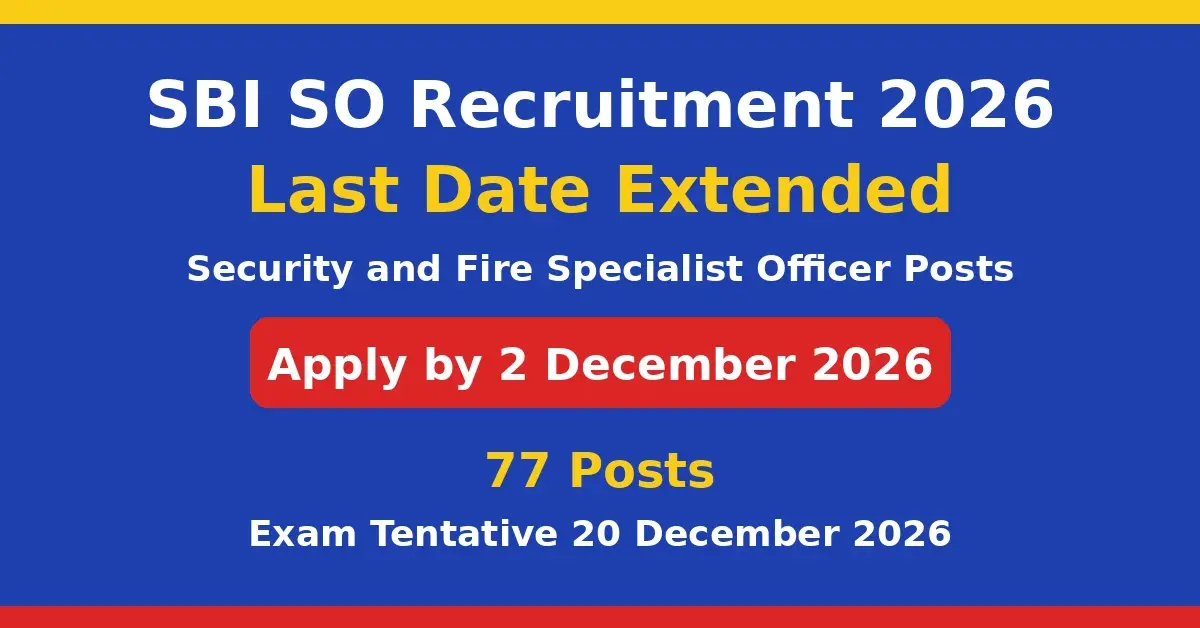
State Bank of India has extended the last date to apply for SBI SO Recruitment 2026, and candidates can now fill the online form till 2 December 2026, and the bank has announced 77 specialist officer posts under two advertisements. One advertisement covers Security Officer posts. The other advertisement covers Assistant Manager Engineer (Fire) posts, and both posts are on regular basis.
The change matters because the printed advertisement files still show the old date, and the SBI Current Openings page shows the new date, and candidates should follow the new date shown on the official careers page. The last date to apply is 02-12-2026 for both advertisements. The online test is tentatively fixed for 20 December 2026, and candidates who missed the first deadline now have a fresh chance to apply.
Listen to this article in 1 minute:
What has changed in SBI SO Recruitment 2026?
The only change is the last date, and online registration and fee payment started on 4 November 2026 for both advertisements, and the advertisement files print the original last date as 25 November 2026. The SBI Current Openings page now shows online registration extended till 2 December 2026. The page also shows the last date to apply as 02-12-2026.
The extension changes the application window. The post count, fee rule, age limits and exam pattern in the advertisements remain the reference points for applicants.
Candidates who have not applied yet should complete the form before 2 December 2026.
Many candidates check only the advertisement file and stop there, and that file can mislead now, and the file was printed with the 25 November date. The careers page carries the extended date. When the two dates differ, the live careers page date controls the application window, and the extended date is shown on that page.
So the working last date for a fresh applicant is 2 December 2026.
This point needs care, and a candidate may open the advertisement file, see 25 November 2026, and think the form has closed, and the form has not closed on that date. The bank has given more time. The extra time runs till 2 December 2026, and a candidate who trusts only the old printed date may lose the chance to apply.
A candidate who checks the careers page will see the correct last date.
| Point | Details |
|---|---|
| Bank | State Bank of India, Central Recruitment and Promotion Department |
| Total posts | 77 posts |
| Advertisements | CRPD/SCO/2026-27/28 and CRPD/SCO/2026-27/29 |
| Apply start date | 4 November 2026 |
| New last date | 2 December 2026 |
| Written test date | 20 December 2026 tentative |
| Selection stages | Online written test and interview |
| Apply mode | Online through SBI careers Current Openings page |
The table above gives the full picture in one place, and two advertisements run side by side, and both opened on the same start date. Both now close on the same extended date. Both use the same selection stages, and the posts differ in work area and in eligibility rules.
A Security candidate and a Fire candidate follow different qualification rules. Both candidates follow the same fee rule and the same test pattern.
Candidates should read the full page before they fill the form, and a small mistake in eligibility can end the application later, and eligibility should match the advertisement rules. The safest path is simple. Read the rules for your post, and check your age on the fixed date.
Check your qualification and experience on the fixed date. Then fill the form and pay the fee if your category needs fee payment.
Which date should candidates follow, 25 November or 2 December?
Candidates should follow 2 December 2026, and the reason is plain, and the bank itself shows the extended date on its Current Openings page. The advertisement file shows the date that applied when the file was printed. The careers page shows the date that applies now, and a live page update from the bank carries more weight than an old printed date in a file.
The SBI Current Openings page shows online registration extended till 2 December 2026 for both advertisements, and it shows the last date to apply as 02-12-2026, and that is the date a candidate should plan around. Fee payment also runs with online registration. So a candidate who needs to pay the fee should pay it within the same window.
| Event | Date |
|---|---|
| Online registration and fee payment start | 4 November 2026 |
| Original last date printed in advertisement files | 25 November 2026 |
| Extended last date on SBI Current Openings page | 2 December 2026 |
| Online written test, tentative | 20 December 2026 |
| Interview, tentative | January 2027 |
| Call letter download | 10 days before the test or interview |
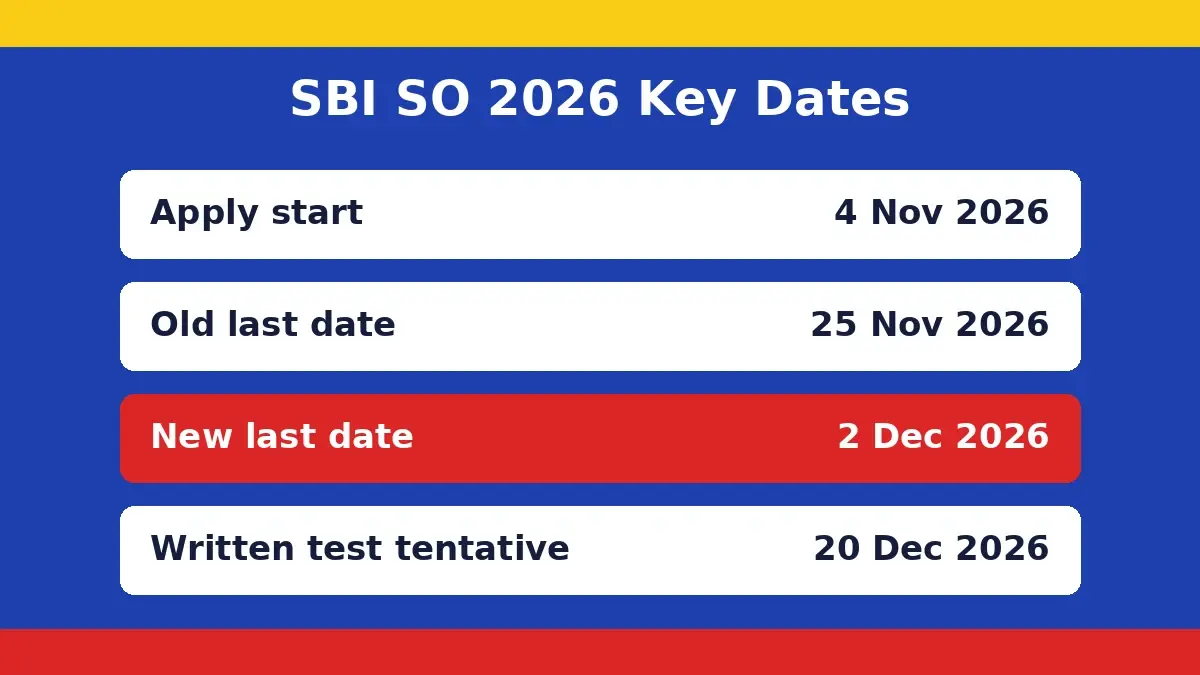 The gap between the new last date and the test date is short, and the form closes on 2 December 2026, and the test may fall on 20 December 2026. That leaves a small window for study and for call letter download. Candidates should not wait for the last day to fill the form, and a form filled early leaves more days for preparation.
A form filled at the last hour leaves no room for a payment problem or a slow internet connection.
The call letter line also needs attention, and call letters are downloadable 10 days before the test or interview, and so a candidate should watch the official careers page in that window. The bank gives the call letter through its own route. Candidates should keep their email and mobile number active, and the bank may use those details for updates linked to the application.
How many posts are open under both advertisements?
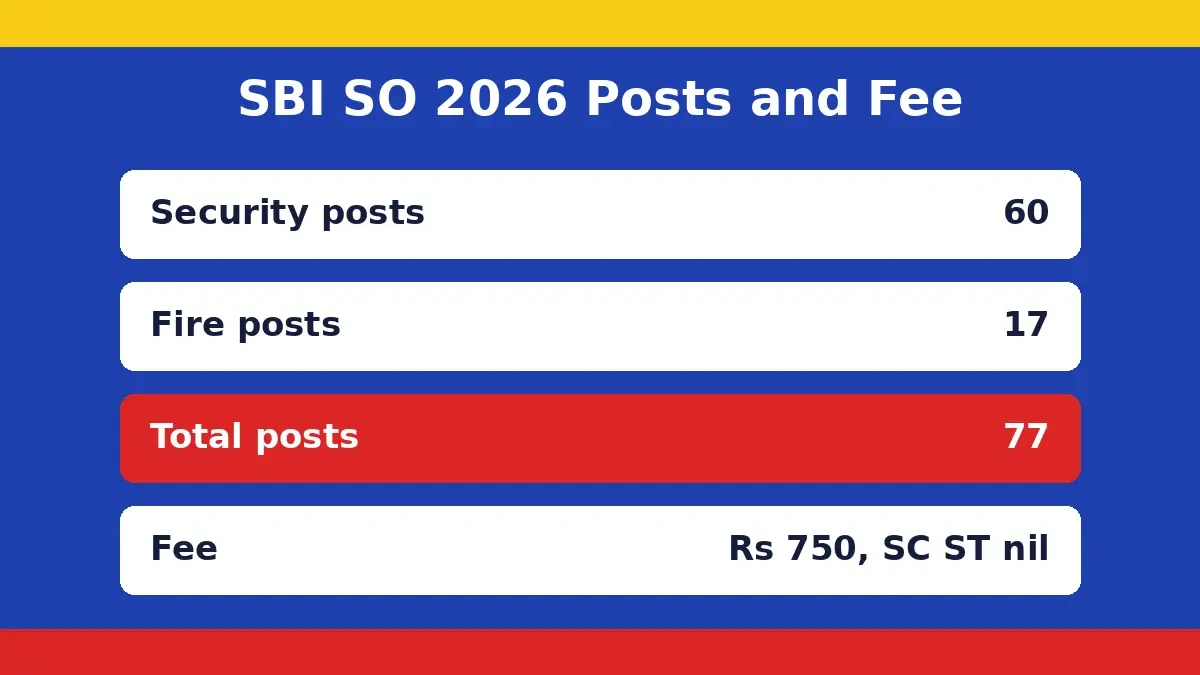
The bank has announced 77 posts in total, and advertisement CRPD/SCO/2026-27/28 covers 60 Security Officer posts, and advertisement CRPD/SCO/2026-27/29 covers 17 Assistant Manager Engineer (Fire) posts. The two numbers add up to 77. Both advertisements are for regular posts, and both advertisements follow the same extended last date.
The Security advertisement covers two grades, and the grades are Manager (Security) in MMGS-III and Deputy Manager (Security) in MMGS-II, and the bank has given one combined total of 60 vacancies for this advertisement. The advertisement does not give separate counts for Manager and Deputy Manager. Candidates should not guess a split, and the grade a selected candidate gets depends on experience.
That rule is explained in a later section.
| Advertisement | Post | Vacancies |
|---|---|---|
| CRPD/SCO/2026-27/28 | Manager (Security) MMGS-III and Deputy Manager (Security) MMGS-II | 60 |
| CRPD/SCO/2026-27/29 | Assistant Manager Engineer (Fire) JMGS-I | 17 |
| Total | Both advertisements | 77 |
The category split for Security posts is clear, and SC candidates have 9 vacancies, and ST candidates have 4 vacancies. OBC candidates have 16 vacancies. EWS candidates have 6 vacancies, and UR candidates have 25 vacancies.
These five numbers add up to 60. A candidate should check the vacancy count for the category that applies to that candidate, and the count shows the size of the pool for each category.
| Category | Security vacancies |
|---|---|
| SC | 9 |
| ST | 4 |
| OBC | 16 |
| EWS | 6 |
| UR | 25 |
| Total | 60 |
The Fire advertisement has a smaller pool, and regular vacancies are SC 2, ST 1, OBC 1, EWS 1 and UR 11, and one backlog vacancy for ST also applies. The regular count adds up to 16. The backlog vacancy takes the total to 17, and candidates should read the backlog line with care.
It is part of the total count. It is not an extra count above 17.
| Category | Fire vacancies |
|---|---|
| SC regular | 2 |
| ST regular | 1 |
| OBC regular | 1 |
| EWS regular | 1 |
| UR regular | 11 |
| ST backlog | 1 |
| Total | 17 |
 It also raises the value of subject knowledge. The Professional Knowledge paper carries the largest share of marks, and a candidate with strong subject grip holds an edge.
How does the 7 year rule decide Manager or Deputy Manager?
The Security advertisement uses one simple rule for grade, and a selected candidate with 7 years or more experience gets Manager (Security), and a selected candidate with less than 7 years experience gets Deputy Manager (Security). The rule uses total experience. The rule applies after selection, and the grade follows the experience of the selected candidate.
The minimum experience for the Security post is 5 years, and so a candidate can enter with 5 years of experience, and that candidate would fall in the Deputy Manager grade if selected, because 5 years is below the 7 year line. A candidate with 8 years of experience would fall in the Manager grade if selected. The line is clear, and seven years or more means Manager.
Below seven years means Deputy Manager.
Candidates sometimes ask for separate vacancy counts for the two grades, and the advertisement gives no separate counts, and the bank has given one combined total of 60. Candidates should work with that combined total. Any split a candidate reads elsewhere needs a check against the official advertisement, and the experience rule decides the grade after selection.
Who can apply for the Security Officer posts?
The age limit for Security posts is 25 to 40 years as on 31 October 2026, and a candidate must fall in that age band on that date, and the date is fixed. Age on the day of form filling does not control the check. Age on 31 October 2026 controls the check, and candidates should count their age with care against that date.
The qualification rule is broad, and a candidate needs a graduate degree in any discipline, and the degree must come from a government recognised university, institution or board. The subject of the degree is open. A graduate from any stream can apply if the experience and rank rules also fit, and the experience rule carries the real weight for this post.
Experience must run to at least 5 years as on 31 October 2026, and the experience can come from Defence Forces, CAPFs, State Police, Central Police Organisations, Para Military Forces or Home Guard, and experience can also come from security service in government, PSU, banks, financial institutions or the corporate sector. A candidate should match personal service history against this list. Experience outside this list may not count.
The rank rule adds one more filter, and the candidate must hold officer rank at or above a fixed level, and the levels are Captain in the Army, Assistant Commandant in CAPF or Police, and Assistant Manager (Security). An equivalent rank also counts. A candidate below these levels does not fit the rank rule, and candidates should check rank with the same care as years of service.
| Security eligibility point | Rule |
|---|---|
| Age limit | 25 to 40 years as on 31 October 2026 |
| Qualification | Graduate in any discipline from a government recognised university, institution or board |
| Experience | Minimum 5 years as on 31 October 2026 in Defence Forces, CAPFs, State Police, Central Police Organisations, Para Military Forces, Home Guard, or security service in government, PSU, banks, financial institutions or corporate sector |
| Rank | Officer not below Captain (Army), Assistant Commandant (CAPF or Police), Assistant Manager (Security), or equivalent rank |
| Grade rule | 7 years or more experience for Manager (Security), below 7 years for Deputy Manager (Security) |
The bank also gives preference for certain training and experience areas, and the areas include security and surveillance, firefighting, disaster management, intelligence gathering, industrial security, VIP protection and access control, and similar areas also count for preference. Preference helps a candidate stand out. Preference does not replace the basic rules, and a candidate still needs the degree, the 5 years of experience and the officer rank.
Age relaxation follows a general rule for both advertisements, and reserved category candidates get relaxation in the upper age limit as per Government of India guidelines wherever applicable. Candidates should not assume a fixed number of years. The official advertisement is the reference for the age position of each category.
A candidate who falls short on that date cannot fix the gap by waiting a few weeks.
Who can apply for the Fire Engineer posts?
The age limit for Fire posts is 21 to 40 years as on 31 October 2026, and the lower age line sits below the Security line, and the upper age line matches the Security line at 40 years. Candidates should check age against 31 October 2026. The fixed date rule applies here too.
The qualification rule for Fire posts offers four routes, and a candidate needs to fit any one route, and the first route is a BE or B.Tech degree in Fire Technology, Fire Engineering, or Safety and Fire Engineering. The second route is a graduate degree in any discipline with the Sub-Officers Course from National Fire Service College Nagpur plus 3 years of fire safety experience. The third route is the Divisional Officers Course from National Fire Service College Nagpur, and the fourth route is a graduate degree in any discipline with Membership of Institution of Fire Engineers (India or UK) plus 3 years of fire safety experience.
Plain words help here, and route one suits engineering graduates in fire subjects, and route two suits general graduates who hold the Sub-Officers Course and fire safety experience. Route three suits candidates who hold the Divisional Officers Course. Route four suits general graduates who hold fire engineers membership and fire safety experience, and a candidate should find the route that matches personal papers.
A candidate who fits no route should not apply for this post.
| Fire route | Qualification needed |
|---|---|
| Route 1 | BE or B.Tech in Fire Technology, Fire Engineering, or Safety and Fire Engineering |
| Route 2 | Graduate in any discipline with Sub-Officers Course from National Fire Service College Nagpur plus 3 years fire safety experience |
| Route 3 | Divisional Officers Course from National Fire Service College Nagpur |
| Route 4 | Graduate in any discipline with Membership of Institution of Fire Engineers (India or UK) plus 3 years fire safety experience |
Experience adds a second filter for Fire posts, and a candidate needs a minimum of 3 years of experience in fire safety as on 31 October 2026, and the experience can come from Central or State Government, PSUs, large corporate sector or any other organisation of repute. BE or B.Tech candidates also need this 3 years experience. A degree alone does not clear the experience filter, and fresh graduates without fire safety experience do not fit this post.
| Fire eligibility point | Rule |
|---|---|
| Age limit | 21 to 40 years as on 31 October 2026 |
| Qualification | Any one of the four routes listed above |
| Experience | Minimum 3 years in fire safety as on 31 October 2026 in Central or State Government, PSUs, large corporate sector or any other organisation of repute |
| Grade | Assistant Manager Engineer (Fire), JMGS-I |
Route two and route four already carry a 3 years experience line inside the qualification, and the general experience rule also asks for 3 years, and candidates should read both lines together. The safe reading is simple. A Fire candidate needs the qualification route plus 3 years of fire safety experience as on 31 October 2026, and a candidate short on experience should wait for a later recruitment.
Candidates who track other bank posts may also check the SBI Data Scientist recruitment update for a different specialist stream. That post covers a separate set of posts. This page covers only Security and Fire posts under the two advertisements named here.
What is the application fee for both posts?
The fee rule is the same for both advertisements, and General, EWS and OBC candidates pay Rs 750, and the fee is non refundable. SC and ST candidates pay no fee. Candidates should check their category before they pay, and a candidate in a no fee category should not pay.
A candidate in a fee category should complete payment inside the registration window.
| Category | Fee |
|---|---|
| General | Rs 750 non refundable |
| EWS | Rs 750 non refundable |
| OBC | Rs 750 non refundable |
| SC | No fee |
| ST | No fee |
Fee payment runs with online registration, and both started on 4 November 2026, and both now run till 2 December 2026. A candidate who fills the form on the last day still needs to finish payment on time. Early payment avoids last day trouble, and candidates should keep payment proof safe after payment.
What is the exam pattern for the online test?
Selection runs in two stages for both posts, and stage one is an online written test, and stage two is an interview. The online test has two papers. English Language carries 50 questions for 50 marks in 40 minutes, and Professional Knowledge carries 75 questions for 75 marks in 80 minutes.
The full test carries 125 questions for 125 marks in 2 hours.
| Paper | Questions | Marks | Time |
|---|---|---|---|
| English Language | 50 | 50 | 40 minutes |
| Professional Knowledge | 75 | 75 | 80 minutes |
| Total | 125 | 125 | 2 hours |
Professional Knowledge holds the larger share, and it carries 75 of the 125 marks, and English Language carries 50 marks. A candidate should split study time with that weight in mind. Subject study deserves the larger share of time, and English study still matters.
A weak English score can hurt the total. A balanced plan covers both papers with more hours for Professional Knowledge.
Time also splits by paper. English Language gives 40 minutes for 50 questions. Professional Knowledge gives 80 minutes for 75 questions.
Candidates should practise with a clock. Speed in English needs quick reading and quick choice. Speed in Professional Knowledge needs subject recall under time pressure. Mock Test practice with the same paper split builds that speed.
Candidates can also read the SBI Clerk prelims result update to see how bank test cycles move from one stage to the next.
Is there negative marking in the test?
There is no penalty for wrong answers, and a wrong answer costs no marks, and that rule changes test strategy. A candidate should attempt every question. A blank answer earns nothing, and a guessed answer can earn a mark.
With no penalty, a guess carries no downside in marks. Candidates should use the full time and mark an answer for each question.
The no penalty rule does not remove the need for care, and random guessing without reading wastes the chance to pick the right option, and a candidate should read each question, drop the clearly wrong options, and pick the best option left. That method lifts the score. Blind marking without reading gives a weaker result, and the rule rewards attempts.
Reading still decides how many attempts turn correct.
How do the test and interview decide the final merit?
The interview carries 100 marks, and final merit uses aggregate marks of the online test and interview, and aggregate means the two scores add up. A candidate must qualify in both stages separately. A high test score cannot cover a failed interview, and a high interview score cannot cover a failed test.
Both stages need a pass on their own.
| Stage | Marks | Rule |
|---|---|---|
| Online written test | 125 marks | Must qualify separately |
| Interview | 100 marks | Must qualify separately |
| Final merit | Aggregate of test and interview | Both stages must be cleared |
The separate qualify rule needs respect, and some candidates treat the interview as a formality after a strong test, and that view can fail. The interview carries its own pass line. A candidate should prepare for the interview with the same seriousness as the test, and subject knowledge helps in both stages.
Clear speaking helps in the interview. Work experience stories from real service help a candidate answer with weight.
The tentative test date is 20 December 2026. The tentative interview window is January 2027. Call letters are downloadable 10 days before the test or interview.
Candidates should plan study in two blocks. Block one runs till the test. Block two runs between the test and the interview. Candidates who follow bank cycles may also track the SBI PO interview call letter update for a sense of interview stage timing in bank recruitment.
What pay and benefits do the posts carry?
Pay follows the grade, and Manager (Security) sits in MMGS-III, and Deputy Manager (Security) sits in MMGS-II. Assistant Manager Engineer (Fire) sits in JMGS-I. Each grade carries its own pay scale, and the table below lists the three pay scales as given by the bank.
Candidates should read the scale for the grade that applies to them.
| Post | Pay scale |
|---|---|
| Manager (Security) MMGS-III | Rs 85920-2680/5-99320-2980/2-105280 |
| Deputy Manager (Security) MMGS-II | Rs 64820-2340/1-67160-2680/10-93960 |
| Assistant Manager Engineer (Fire) JMGS-I | Rs 48480-2000/7-62480-2340/2-67160-2680/7-85920 |
Pay comes with allowances and benefits, and the posts carry pay plus DA, HRA and CCA, and benefits include Provident Fund and NPS. Leave Fare Concession and medical facility also apply. Other perquisites apply as per rules, and candidates should read pay as a full package.
Basic pay forms one part. Allowances and benefits form the rest.
The place of posting can fall anywhere in India, and a selected candidate should stay ready for posting in any part of the country, and probation runs for 6 months. The probation period applies to both posts. Candidates should plan for a move after selection, and family plans and house plans may need a fresh look after the posting order comes.
Security candidates should link pay with the experience rule, and a candidate with 7 years or more experience gains the Manager grade after selection, and that grade carries the higher pay scale. A candidate below 7 years gains the Deputy Manager grade. That grade carries its own pay scale, and experience thus shapes both grade and pay for Security posts.
How should candidates apply online?
Candidates apply through the SBI careers Current Openings page, and the steps are simple, and open the Current Openings page. Find the advertisement entry for the post. Click Apply Online, and fill the form with correct details.
Pay the fee if your category needs payment. Submit the form before 2 December 2026.
Details in the form must match official papers, and name, date of birth, category, qualification and experience entries should match documents, and a mismatch can create trouble at a later stage. Candidates should keep papers near while filling the form. Care beats speed here.
Keep email and mobile number active through the full process, and a dead email account can hide a key update. A changed mobile number can block a message. Candidates should use an email account they open every day, and candidates should keep the same mobile number active through the test and interview stages.
Candidates who watch bank recruitment cycles may also read the IBPS PO mains result update and the SIDBI Grade A and Grade B recruitment update. Those pages cover other bank posts. This page covers only the two SBI advertisements named here. Candidates should apply for the post that matches their qualification and experience.
What should candidates do in the days left?
First, check eligibility, and Security candidates should check age, degree, 5 years experience and officer rank against 31 October 2026, and Fire candidates should check age, one qualification route and 3 years fire safety experience against 31 October 2026. A candidate who clears every line should move to the form. A candidate who fails a line should stop and save the fee.
Next, fill the form early, and the window closes on 2 December 2026, and early filling leaves room to fix a payment problem. Early filling also leaves more study days. The test may fall on 20 December 2026, and study days between the form and the test carry real value.
Guard those days.
Study should follow the paper weight, and Professional Knowledge carries 75 marks, and English Language carries 50 marks. A candidate should give more hours to Professional Knowledge. English practice should run every day in short timed sets, and full Mock Test practice should mirror the real split.
Two papers, 125 questions, 2 hours. Practice under the same clock builds calm for test day.
Interview preparation should start after the test, and the interview carries 100 marks, and a candidate must qualify in the interview separately. Subject revision should continue after the test. Work experience points should stay fresh in mind, and a candidate should prepare clear answers on past service, current duties and the reason for joining the bank.
Plain and honest answers serve well in an interview room.
Call letter timing needs a note in the diary, and call letters are downloadable 10 days before the test or interview, and candidates should check the official careers page in that window. A missed call letter can end the attempt. A timely download keeps the attempt safe, and candidates should download the call letter as soon as the window opens.
Which points should candidates double check before applying?
The last date needs a double check, and the working last date is 2 December 2026, and the old printed date of 25 November 2026 no longer controls the window. Candidates should trust the careers page date. Candidates should finish the form and fee payment before the window closes.
Age needs a double check, and Security age runs from 25 to 40 years as on 31 October 2026, and Fire age runs from 21 to 40 years as on 31 October 2026. Reserved category candidates get upper age relaxation as per Government of India guidelines wherever applicable. Candidates should confirm the relaxation that applies to their category from the official advertisement.
Experience needs a double check, and Security experience needs 5 years with officer rank, and Fire experience needs 3 years in fire safety. Both counts run as on 31 October 2026. Experience after that date does not add to the count, and candidates should count service years with care and keep service papers ready.
Fee needs a double check, and General, EWS and OBC candidates pay Rs 750, and SC and ST candidates pay no fee. The fee is non refundable for paying categories. Candidates should pay through the official route inside the form, and payment proof should stay safe with the candidate.
The SBI Specialist Officer selection path rewards subject strength, and Professional Knowledge carries the largest marks share, and the interview adds a second test of subject grip and clear speaking. Candidates with real service experience hold useful material for both stages. The task now is plain, and apply on time.
Study with the paper weight in mind. Attempt every question, since wrong answers carry no penalty, and prepare for the interview as a separate pass stage.
Sources
State Bank of India Current Openings page: SBI careers Current Openings
Security Officer advertisement CRPD/SCO/2026-27/28: SBI Security Officer advertisement PDF
Fire Engineer advertisement CRPD/SCO/2026-27/29: SBI Fire Engineer advertisement PDF