RVUNL JE Admit Card 2026 Out for 812 Posts, Exam on 29 and 30 November
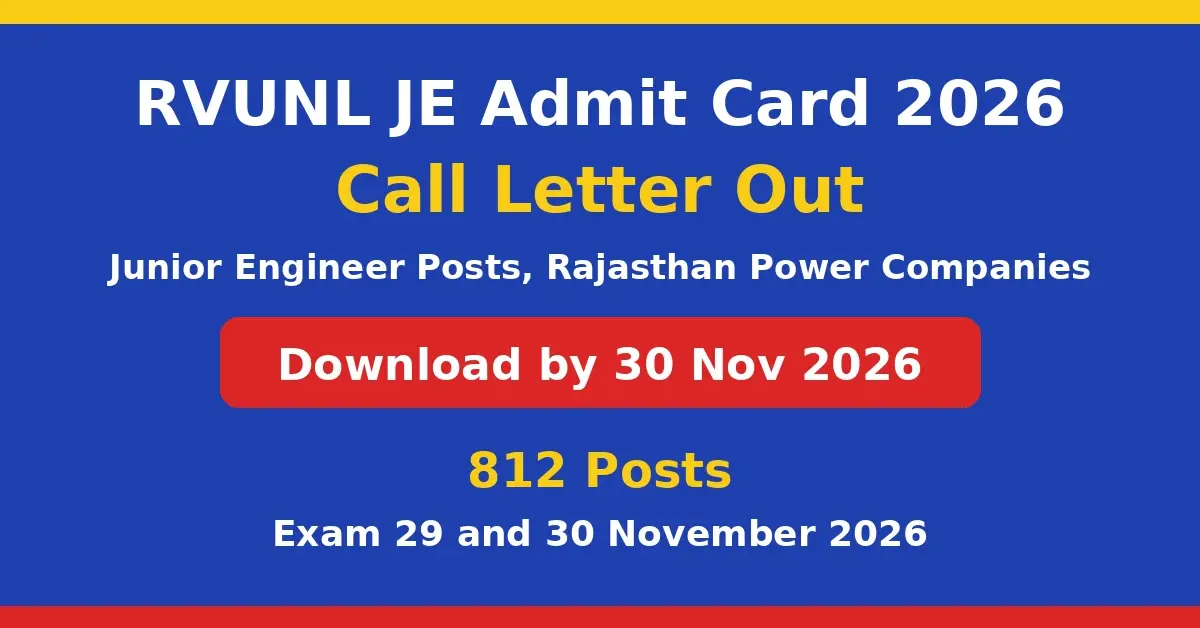
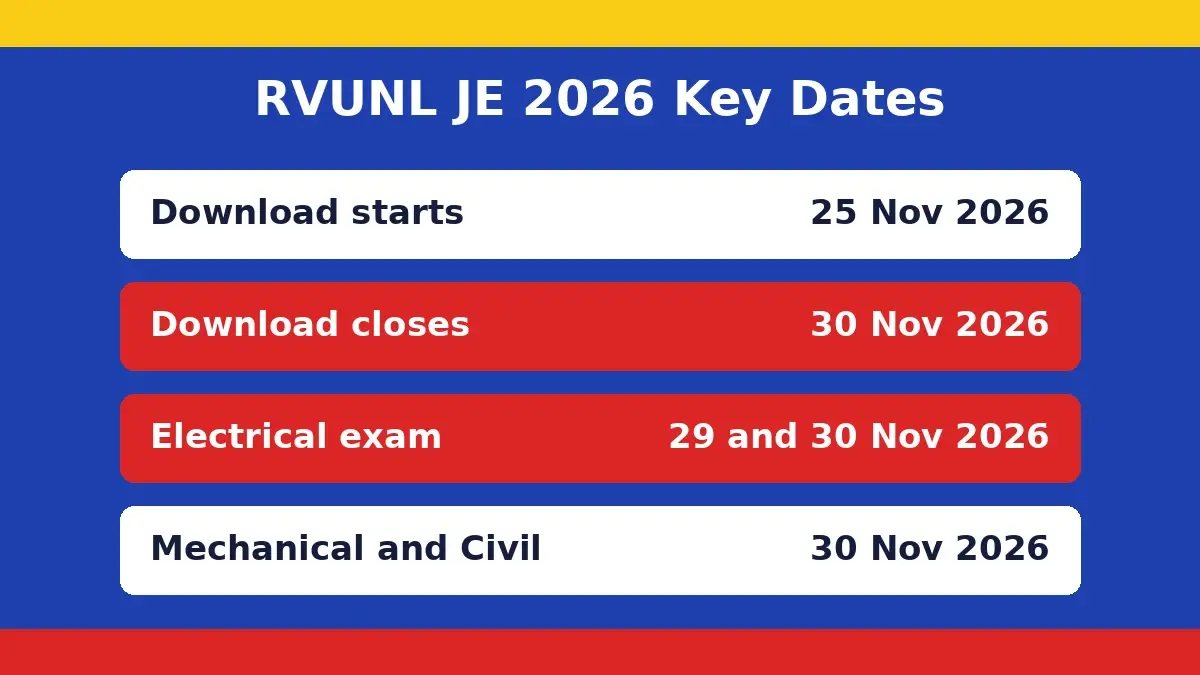
RVUNL JE Admit Card 2026 is now active for candidates of the Junior Engineer recruitment, and the call letter download window runs from 25 November 2026 to 30 November 2026, and Rajasthan Rajya Vidyut Utpadan Nigam Limited runs this common recruitment for the State Power Companies of Rajasthan. The recruitment covers 812 Junior Engineer posts across Electrical, Mechanical and Civil disciplines. Electrical candidates face the nearest exam dates, since the Electrical exam falls on 29 and 30 November 2026.
Candidates should download the call letter now and read the exam date, shift and centre printed on it, and the official examination schedule gives discipline dates, and the call letter gives the personal exam detail for each candidate. Mechanical and Civil exams fall on 30 November 2026. A candidate who waits for the last download day gains nothing, because the exam window opens while the download window still runs.
Listen to this article in 1 minute:
What does the RVUNL JE Admit Card 2026 cover?
The call letter belongs to the common recruitment of Junior Engineers for the State Power Companies of Rajasthan, and Rajasthan Rajya Vidyut Utpadan Nigam Limited, also written as RVUNL or RRVUN, issued the recruitment under Advertisement Number RVUN/Rectt.-2026-27/02. The detailed advertisement carries the number RVUN/P&A/Rectt.26-27/F.103/D. 186 and the date 04.08.2026, and candidates should match these advertisement details with their application record before they download the call letter.
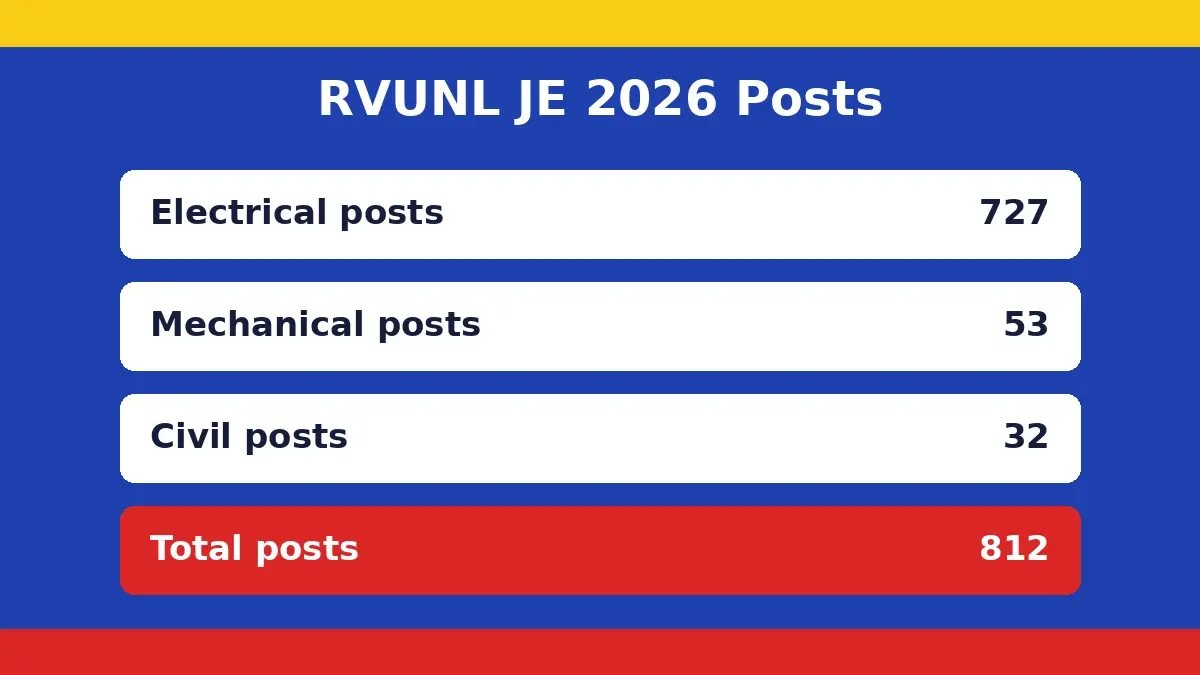
The recruitment covers three disciplines, and Electrical carries the largest share with 727 posts. Mechanical carries 53 posts. Civil carries 32 posts, and the three discipline counts add up to 812 posts, and every candidate in this recruitment competes inside the discipline and category linked with the application.
| Point | Details |
|---|---|
| Recruitment | Junior Engineer common recruitment for State Power Companies of Rajasthan |
| Conducting body | Rajasthan Rajya Vidyut Utpadan Nigam Limited (RVUNL/RRVUN) |
| Advertisement | RVUN/Rectt.-2026-27/02 |
| Total posts | 812 posts |
| Call letter download | 25 November 2026 to 30 November 2026 |
| Electrical exam | 29 and 30 November 2026 |
| Mechanical and Civil exam | 30 November 2026 |
One point needs care at the start, and the word admit card and the words call letter point to the same download in this update. The official call letter page opens through the recruitment page route, and candidates reach the login page from there. Candidates should trust the official route and the official page names, since the exam stands only days away and a wrong page wastes the short time left.
The exam dates in the official schedule carry the word tentative in the schedule heading, and that word matters. The schedule dated 29 October 2026 lists Electrical on 29 and 30 November 2026, Mechanical on 30 November 2026 and Civil on 30 November 2026. The same schedule says any change will come through a notice on the Vidyut Nigam websites, and candidates should keep watching the official recruitment page till exam day.
How can candidates download the call letter?
Candidates can download the call letter from 25 November 2026 to 30 November 2026, and the download sits on the official IBPS call letter page linked from the RRVUN recruitment page. The safe route starts at the official recruitment page and moves to the call letter login page from there. Candidates should open the recruitment page first and follow the call letter route given for this recruitment.
| Event | Date |
|---|---|
| Call letter download starts | 25 November 2026 |
| Call letter download closes | 30 November 2026 |
| Electrical exam | 29 and 30 November 2026 |
| Mechanical exam | 30 November 2026 |
| Civil exam | 30 November 2026 |
| Examination schedule date | 29 October 2026, dates tentative |
The login page asks for registration details, and A candidate enters Registration Number or Roll Number. The same form asks for Password or Date of Birth. The date of birth format reads DD-MM-YY, and the form also asks for the captcha shown on the page. A candidate should type each field slowly and check the screen before submission.
Speed helps nobody here, and A single wrong digit in the registration number can block the login. A date of birth typed in a wrong order can also block the login. Candidates should keep the application details near the screen while they type, and care at this stage saves repeated attempts during a short download window.
After login, the candidate should open the call letter and read every line with care, and the call letter carries the exact exam date for that candidate. It also carries the shift and the centre. The schedule gives discipline level dates, and the call letter gives candidate level detail, and candidates should treat the call letter detail as the personal exam plan.
A candidate should save a copy of the downloaded call letter in a safe place, and A second copy in another safe place gives backup if one copy goes missing. Candidates should also read the call letter again after saving it. A quick glance can miss the shift line or the centre line, and those lines decide the exam day plan.
Which login details open the call letter page?
The login form accepts Registration Number or Roll Number in the first field, and candidates can use the registration number from the application record. Candidates who hold a roll number can use that number in the same field. The form then asks for Password or Date of Birth, and candidates who remember the password can use the password. Candidates who use the date of birth route must follow the DD-MM-YY format shown for the field.
| Login field | What to enter |
|---|---|
| First field | Registration Number or Roll Number |
| Second field | Password or Date of Birth |
| Date of birth format | DD-MM-YY |
| Captcha | Characters shown on the login page |
The format line deserves attention, and DD-MM-YY means the day comes first, the month comes next and the year comes last in short form. A candidate who types the year first may face a failed login. A candidate who mixes the day and month may also face a failed login, and the page gives the format, and the candidate should copy that order exactly.
The captcha field also needs exact typing, and the candidate should read the captcha characters on the screen and type them in the field. A fresh captcha may appear after a failed attempt. Candidates should read the fresh characters again instead of repeating the old entry from memory, and slow typing beats fast typing on this page.
Official documents for this recruitment state no recruitment helpline number, and candidates should avoid numbers shared through unknown pages or messages. The official recruitment page remains the public route for recruitment updates. A candidate with a login problem should recheck the registration number, the password or date of birth entry and the captcha entry on the official page itself.
What should candidates check on the call letter?
The first check is identity detail, and the candidate should read the name and application detail shown on the call letter, and the second check is discipline. Electrical, Mechanical and Civil candidates follow different exam date lines in the schedule, so the discipline line on the call letter should match the application, and the third check is the exam date. The fourth check is the shift. The fifth check is the centre.
| Check | Why it matters |
|---|---|
| Name and application detail | Confirms the call letter belongs to the candidate |
| Discipline | Electrical, Mechanical and Civil follow different date lines |
| Exam date | Electrical candidates can hold 29 or 30 November 2026 |
| Shift | Official documents state no common shift timing |
| Centre | Travel planning starts from the centre line |
Electrical candidates need extra care with the date check, and the Electrical exam runs on 29 and 30 November 2026, so an Electrical candidate can hold either of these two dates. A candidate who assumes 30 November without reading the call letter may miss a 29 November exam. The call letter settles the date for that candidate, and candidates should plan travel and rest around the date printed for them.
Mechanical candidates face the exam on 30 November 2026, and Civil candidates also face the exam on 30 November 2026. Even with a single discipline date, the shift and centre still come from the call letter. Official documents state no common shift timing for all candidates, and each candidate should follow the shift printed on the personal call letter.
Centre detail also needs a calm read, and the candidate should note the centre name and place exactly as printed. Travel planning should start from that centre detail. A candidate who reads the centre line early gains time to plan the route, and A candidate who reads it on exam morning invites panic.
Candidates tracking other admit card updates can also read the JKSSB Sub Inspector admit card update and the BSSC Stenographer exam city slip update, and those pages cover different recruitments. This page covers the RVUNL Junior Engineer call letter, and candidates should keep the RVUNL dates separate from other exam dates.
When will the Electrical exam take place?
The Electrical exam will take place on 29 and 30 November 2026 under the official examination schedule dated 29 October 2026, and the schedule heading calls these dates tentative. Candidates should still prepare for these dates, since the call letter download window already runs and the schedule gives no later Electrical date. The call letter decides whether an Electrical candidate sits on 29 November or on 30 November.
| Discipline | Exam date |
|---|---|
| Electrical | 29 and 30 November 2026 |
| Mechanical | 30 November 2026 |
| Civil | 30 November 2026 |
| Schedule note | Dates tentative, change through Vidyut Nigam websites |
Today stands at 26 November 2026 in this update, and an Electrical candidate with a 29 November date holds a very short preparation window now. That candidate should finish the call letter download at once and shift full attention to revision. An Electrical candidate with a 30 November date holds a little more room, and that extra room should go to revision and rest, and the download task should still close today itself.
The download window closes on 30 November 2026, and an Electrical candidate who delays the download till 30 November risks a clash with exam day duties. The exam may fall on the same day for that candidate. Early download removes that risk, and candidates should treat 30 November as the outer limit of the window, and personal planning should aim for a download well before that limit.
When will the Mechanical and Civil exams take place?
The Mechanical exam will take place on 30 November 2026, and the Civil exam will also take place on 30 November 2026. The official examination schedule dated 29 October 2026 gives these dates with the tentative heading. Candidates in both disciplines should prepare for 30 November and keep watch on the official recruitment page for any change notice.
Mechanical and Civil candidates hold the same exam date and the same download closing date, and the call letter download window closes on 30 November 2026, and the exam also falls on 30 November 2026. A candidate who leaves the download for exam day carries needless risk. Download today, and read the shift and centre lines today. Plan the exam day from those lines with a calm mind.
Shift timing needs a clear note, and official documents state no common shift timing for Mechanical candidates. Official documents also state no common shift timing for Civil candidates. The call letter carries the shift for each candidate, and candidates should follow the personal shift line and should avoid shift claims from any other page.
The schedule note on changes applies to every discipline, and any change in the exam schedule will come through a notice on the Vidyut Nigam websites. Candidates should check the official recruitment page during the final days. A change notice on an official website carries weight, and A claim on an unknown page carries no weight for exam planning.
How many posts stand behind this call letter?
The call letter stands behind 812 Junior Engineer posts, and Electrical holds 727 posts. Mechanical holds 53 posts. Civil holds 32 posts, and the Electrical share towers over the other two disciplines, and the Electrical exam also spreads across two dates. Mechanical and Civil candidates face a single exam date with smaller post counts.
| Discipline | Posts |
|---|---|
| Junior Engineer-I (Electrical) | 727 |
| Junior Engineer-I (Mechanical) | 53 |
| Junior Engineer-I (Civil) | 32 |
| Total | 812 |
Electrical posts split across Non-TSP and TSP areas, and Non-TSP Electrical posts count 694. TSP Electrical posts count 33. The two area counts add up to 727, and candidates should read the area split with care, since the application category and area shape the competition pool for each candidate.
The Non-TSP Electrical split runs across five companies, and RVUN holds 108 posts, and RVPN holds 156 posts. JVVN holds 189 posts, and AVVN holds 122 posts. JdVVN holds 119 posts.
| Company | Electrical Non-TSP posts |
|---|---|
| RVUN | 108 |
| RVPN | 156 |
| JVVN | 189 |
| AVVN | 122 |
| JdVVN | 119 |
| Total Non-TSP | 694 |
These five company counts add up to 694. JVVN carries the largest Non-TSP Electrical share, and RVPN carries the next largest share in this split.
| Company | Electrical TSP posts |
|---|---|
| RVUN | 1 |
| RVPN | 6 |
| AVVN | 22 |
| JdVVN | 4 |
| Total TSP | 33 |
The TSP Electrical split runs across four companies, and RVUN holds 1 post, and RVPN holds 6 posts. AVVN holds 22 posts, and JdVVN holds 4 posts. These four company counts add up to 33. AVVN carries the largest TSP Electrical share by a clear margin.
| Discipline | Company | Non-TSP | TSP | Total |
|---|---|---|---|---|
| Mechanical | RVUN | 51 | 2 | 53 |
| Civil | RVPN | 31 | 1 | 32 |
Mechanical posts count 53 in total, and RVUN holds 51 Non-TSP Mechanical posts, and RVUN also holds 2 TSP Mechanical posts. The Mechanical discipline thus sits fully with RVUN in the official post split, and Civil posts count 32 in total. RVPN holds 31 Non-TSP Civil posts.
RVPN also holds 1 TSP Civil post. The Civil discipline thus sits fully with RVPN in the official post split.
One correction note belongs in this section, and A corrigendum dated 14 October 2026 corrected one figure in the RVPN Electrical Non-TSP split. The UR Female figure changed from 23 to 24 in that correction. The RVPN Electrical total stays at 156 after the correction, and candidates should use the corrected figure for that cell and should keep the RVPN total at 156.
Post counts guide expectation, and exam performance decides the result, and A candidate in a large pool still needs a strong score. A candidate in a small pool also needs a strong score, since document verification follows merit order within limits. Candidates should read the post split for clarity and should give full focus to the exam paper in the final days.
Candidates who follow engineering recruitment updates can also read the NHPC Trainee Engineer and Officer recruitment update, and that page covers a different recruitment. The RVUNL post split on this page follows the RVUNL advertisement and the correction note named above.
How does Part A work in the exam?
Part A covers Professional and Technical Knowledge, and the official scheme of examination dated 6 November 2026 gives Part A a clear shape, and Part A carries 60 questions. Part A carries 120 marks, and Part A allows 60 minutes. The scheme names the English version for Part A. Candidates should prepare for technical questions in English under a one hour clock.
| Part A point | Scheme detail |
|---|---|
| Subject | Professional and Technical Knowledge |
| Questions | 60 |
| Marks | 120 |
| Time | 60 minutes |
| Version | English version |
| Weightage | 60 percent |
Part A carries the heavier marks load in the paper, and the full paper carries 200 marks, and Part A alone carries 120 marks, and the official weightage line gives Part A a 60 percent weightage. A candidate with strong discipline knowledge gains the largest scoring ground in Part A, and Electrical candidates should revise Electrical subjects. Mechanical candidates should revise Mechanical subjects. Civil candidates should revise Civil subjects.
The Part A clock runs apart from the Part B clock, and the scheme gives separate timing for Part A and Part B. A candidate cannot switch between the two parts during the exam. Time saved in Part A cannot move to Part B, and time saved in Part B cannot move to Part A. Candidates should practise with separate clocks for the two parts.
Question style also needs attention, and the exam uses multiple choice questions with five options. One option gives the correct answer. A candidate must pick the single correct option from five choices, and five options raise the reading load on each question. Candidates should read every option before they mark an answer, since a close option can trap a hurried reader.
Part A practice in the final days should mirror the real clock, and candidates should solve technical questions under time pressure. Candidates should review wrong answers after each practice set. A wrong answer in practice points to a weak topic, and A repeated wrong answer on the same topic points to a topic that needs one more revision pass before exam day.
How does Part B work in the exam?
Part B carries 80 questions and 80 marks across its sections, and the scheme gives Part B a 60 minute clock. Reasoning and Mental Ability carries 8 questions for 8 marks. General Knowledge and Everyday Science carries the largest Part B share, and Hindi General carries 8 questions for 8 marks. English General carries 8 questions for 8 marks.
The General Knowledge block splits into two rows in the scheme, and General Knowledge related to Rajasthan carries 44 questions for 44 marks. General Knowledge related to World, India and Everyday Science carries 12 questions for 12 marks. Rajasthan General Knowledge thus dominates Part B by question count, and candidates should give Rajasthan General Knowledge the largest share of Part B revision time.
| Part B section | Questions | Marks |
|---|---|---|
| Reasoning and Mental Ability | 8 | 8 |
| GK related to Rajasthan | 44 | 44 |
| GK related to World, India and Everyday Science | 12 | 12 |
| Hindi General | 8 | 8 |
| English General | 8 | 8 |
| Part B total | 80 | 80 |
The full paper totals need a clean read, and Part A carries 60 questions and Part B carries 80 questions. The full paper carries 140 questions. Part A carries 120 marks and Part B carries 80 marks, and the full paper carries 200 marks. The full exam allows 120 minutes, with 60 minutes for Part A and 60 minutes for Part B under separate timing.
| Paper point | Part A | Part B | Total |
|---|---|---|---|
| Questions | 60 | 80 | 140 |
| Marks | 120 | 80 | 200 |
| Time | 60 minutes | 60 minutes | 120 minutes |
| Weightage | 60 percent | 40 percent | 100 percent |
Weightage gives another view of the same paper, and Part A holds 60 percent weightage. Part B holds 40 percent weightage. A candidate who ignores Part B leaves a large marks block weak, and A candidate who ignores Part A leaves the largest marks block weak. Balanced preparation across both parts protects the total score.
One syllabus note needs careful words, and the detailed advertisement outline lists Mathematics at Class XII level among Part B syllabus areas. The scheme table gives no separate Mathematics row with its own question count. Candidates should read this point exactly as the documents present it, and the scheme table rows named in this article carry the official question counts, and candidates should avoid any separate Mathematics count claim from other pages.
Part B revision should follow the row weights, and Rajasthan General Knowledge deserves the deepest revision. Reasoning and Mental Ability deserves steady practice. Hindi General and English General deserve short daily practice in the final days, and World, India and Everyday Science deserves a focused revision pass. Candidates should keep Part B practice inside a 60 minute clock so the exam day pace feels familiar.
Candidates who track police recruitment updates can also read the UKSSSC Sub Inspector recruitment update and the Odisha Police SI exam date update, and those pages cover different exams. The Part B rows on this page follow the RVUNL scheme of examination dated 6 November 2026.
How does negative marking change answer choices?
The scheme deducts one fourth of the marks of a question for each wrong answer, and A wrong answer thus costs marks, and a blank answer avoids that cost. Candidates should mark an answer when knowledge supports the choice. Candidates should leave a question blank when the choice rests on pure guesswork with no knowledge support.
| Answer result | Marks effect |
|---|---|
| Correct answer | Marks of the question added |
| Wrong answer | One fourth of the marks of that question deducted |
| Blank answer | No deduction under the wrong answer rule |
| Options per question | Five options, one correct answer |
Five options shape the guessing risk, and A blind guess among five options holds weak odds. The deduction rule punishes a wrong blind guess. Candidates should first remove options that look clearly wrong, and A smaller option set improves the quality of the final choice. A candidate who cannot remove any option with confidence should consider leaving the question blank.
Part A and Part B carry different marks per question, and Part A questions carry higher marks per question than Part B questions under the scheme totals. A wrong answer in Part A thus costs more than a wrong answer in Part B under the one fourth rule. Candidates should apply extra care in Part A before they mark an answer, and careful reading in Part A protects the largest marks block.
Speed and care must travel together, and A candidate who rushes may mark wrong answers in bulk. A candidate who moves too slowly may leave known questions untouched. Practice sets under the real clock build the middle path, and candidates should review each practice set and count wrong answers with the deduction rule in mind.
How will selection move after the written exam?
Selection starts with a computer based common written competitive exam, and the exam runs online for 2 hours. The exam uses objective multiple choice questions only. Candidates face Part A and Part B under separate timing inside this online exam, and the written exam score drives the merit order for the next stage.
| Stage | Detail |
|---|---|
| Written exam | Computer based common written competitive exam, online, 2 hours |
| Question type | Objective multiple choice questions only |
| Document verification | Successful candidates in merit order, about two times the vacancies per category, post and discipline |
| Interview | No interview stage stated in official selection facts |
Document verification follows the written exam, and successful candidates move to document verification in merit order. The verification pool stays limited to about two times the vacancies for each category, post and discipline. A candidate must first reach the successful group through the written exam, and document verification then checks the candidate record against the recruitment rules.
Official selection facts name no interview stage for this recruitment, and candidates should prepare for the written exam as the scoring stage. Candidates should also keep application linked documents in order for the verification stage. A strong written score opens the verification door, and clean documents protect the candidate at the verification stage.
Merit order runs within category, post and discipline lines, and an Electrical candidate competes within the Electrical pool. A Mechanical candidate competes within the Mechanical pool. A Civil candidate competes within the Civil pool, and category lines also shape the verification pool. Candidates should read the post split and the selection rule together for a full picture of the competition.
What should candidates do between 26 November and exam day?
The first task is the call letter download, and candidates should download the call letter today and read the date, shift and centre lines. Electrical candidates with a 29 November date hold the shortest runway. Mechanical and Civil candidates hold a 30 November exam date, and every candidate gains calm from an early download.
| Task | Action |
|---|---|
| Download | Download the call letter before 30 November 2026 |
| Read | Note exam date, shift and centre from the call letter |
| Revise Part A | Give discipline revision the largest study block |
| Revise Part B | Give Rajasthan GK the largest Part B block |
| Practice | Use separate 60 minute clocks for Part A and Part B |
| Watch updates | Check the official recruitment page till exam day |
The second task is a personal exam plan, and candidates should write the exam date and shift in a visible place. Candidates should plan travel from the centre detail on the call letter. Candidates should keep the call letter copy safe and reachable, and A written plan removes morning confusion on exam day.
The third task is revision with the paper weight in mind, and Part A carries 120 marks and 60 percent weightage. Candidates should give discipline revision the largest block of study time. Part B carries 80 marks and 40 percent weightage, and candidates should give Rajasthan General Knowledge the largest Part B block. Reasoning, Hindi General, English General and the World, India and Everyday Science row should receive steady shorter blocks.
Practice should copy the exam clock, and candidates should solve Part A practice inside 60 minutes. Candidates should solve Part B practice inside 60 minutes. Separate clocks in practice build the same discipline that the exam demands, and candidates should review wrong answers after each practice set and should revise the weak topics again.
Rest also counts as preparation, and A tired mind reads options poorly. A fresh mind spots close options with better care. Candidates should protect sleep in the final nights, and candidates should keep the last evening light and should avoid a heavy new topic load near exam day.
Candidates who follow bank recruitment cycles can also read the SBI SO recruitment last date update, and that page covers a bank recruitment with a different calendar. RVUNL candidates should keep the RVUNL exam dates at the centre of the final days plan.
Which mistakes can waste the last days?
One mistake is delay in the call letter download, and the window closes on 30 November 2026, and exams start on 29 November 2026 for a part of the Electrical pool. A candidate who delays the download carries risk for no gain. Download early, and read the call letter early. Plan from the call letter lines early.
Another mistake is trust in shift claims from unknown pages, and official documents state no common shift timing. The call letter carries the shift for each candidate. A candidate who plans around an unknown shift claim may reach the centre at a wrong time, and the personal call letter line should drive the exam day plan.
A third mistake is study without the weightage map, and Part A carries 60 percent weightage. Rajasthan General Knowledge carries the largest Part B row. A candidate who spreads time evenly across every row wastes the weightage signal, and study time should follow marks weight. Weak topics inside heavy rows deserve quick repair.
A fourth mistake is blind guessing under the deduction rule, and each wrong answer deducts one fourth of the marks of that question. A candidate who guesses in bulk may lose marks in bulk. Candidates should answer from knowledge, and candidates should leave pure guess questions blank.
A fifth mistake is silence on official updates, and the schedule dates carry a tentative heading. Any change will come through a notice on the Vidyut Nigam websites. Candidates should check the official recruitment page during the final days, and A short daily check keeps the exam plan current.
What should candidates do if exam details change?
Candidates should follow the official recruitment page for any change notice, and the examination schedule note says any change will come through a notice on the Vidyut Nigam websites. A change notice on an official website should replace the earlier plan. Candidates should read such a notice in full and should note the new date or detail with care.
Candidates should also recheck the call letter after any change notice, and A change notice may alter the exam plan for a discipline or a group. The call letter and the change notice should guide the final plan together. Candidates should avoid action based on forwarded messages without an official notice behind them.
The download window still closes on 30 November 2026 under the current official update, and candidates should complete the download inside this window. Candidates should keep the downloaded copy safe. Candidates should keep checking the official recruitment page till the exam ends.
Sources
RRVUN official recruitment page: RRVUN recruitment page
Official IBPS call letter page for RVUNL Junior Engineer recruitment: IBPS call letter login page