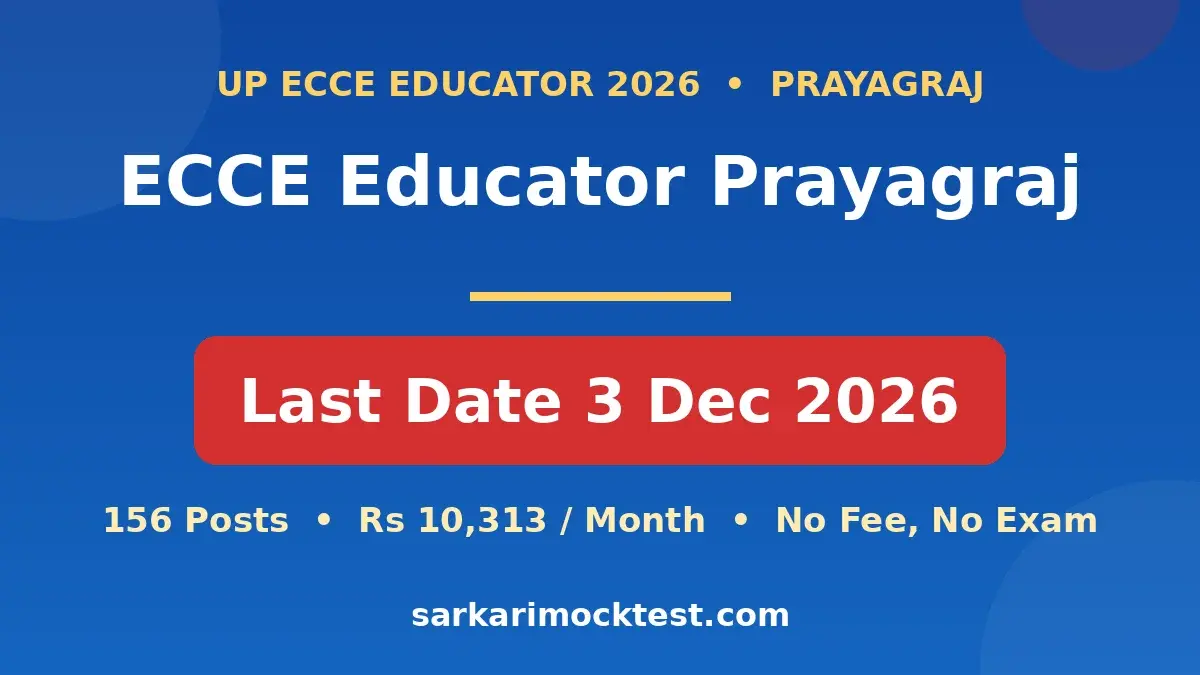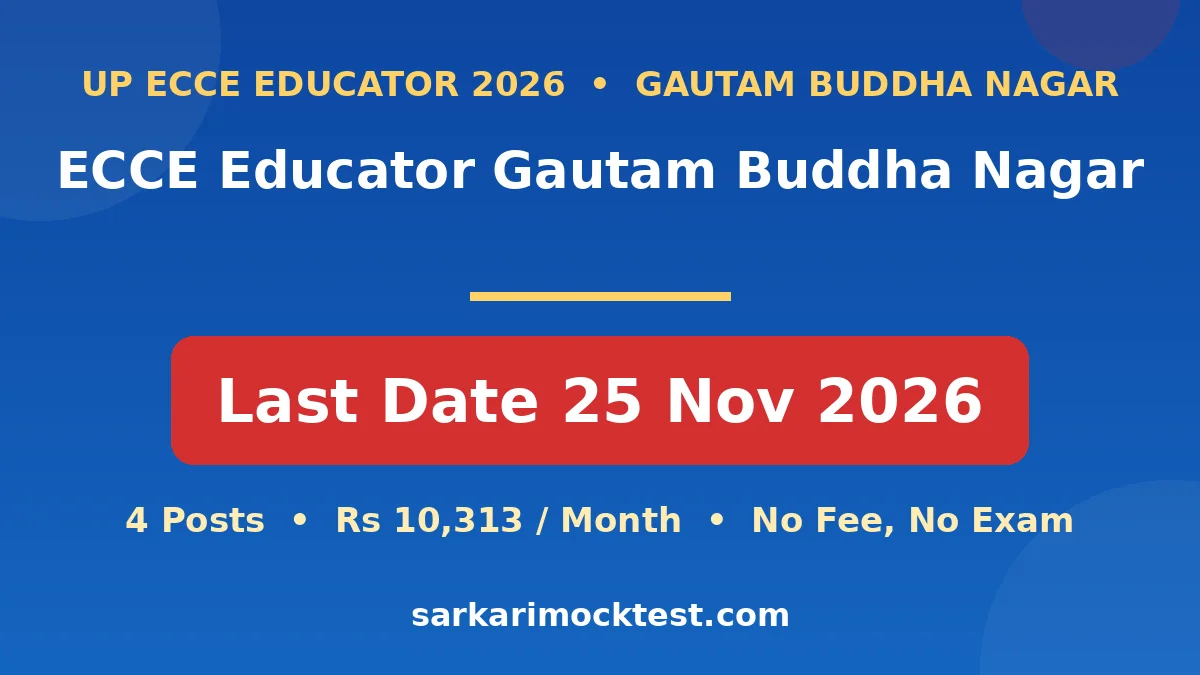
Prayagraj has 156 ECCE Educator posts open till 3 December 2026. It is the largest single district listing in the Uttar Pradesh ECCE Educator recruitment so far, and the form runs on the UP Rojgar Sangam (Sewayojan) portal at sewayojan.up.nic.in. Applications opened on 17 November 2026. There is no application fee, and there is no written exam.
The monthly honorarium is Rs 10,313. The engagement is through a third party agency, WIZTECH Services Pvt. Ltd., for the UP Basic Education Department. This page gives the full details of the Prayagraj listing, who can apply, what the work is, and the steps to apply before 3 December.
The eligibility for Prayagraj works differently from the Gautam Buddha Nagar listing that ran alongside it. In Gautam Buddha Nagar, a candidate needed both a Home Science degree and a nursery diploma. In Prayagraj, either one is enough. That single difference decides whether thousands of candidates can apply, and it is the first thing to check.
156 posts, and why Prayagraj has so many
A hundred and fifty six posts looks like a typing error next to the numbers other districts are showing. Gautam Buddha Nagar has 4 posts open till 25 November 2026. Kanpur Nagar had 100 posts, and its form closed on 20 November 2026.
Sant Kabir Nagar had 24 posts, and its form closed on 22 November 2026. Bulandshahr had 160 posts in its listing.
Prayagraj has 156. The number is large because Prayagraj is filling its posts in one listing. Other districts ran their listings in waves through the year and filled most of their posts already, and the count here is the posts the district still needs.
The recruitment runs district by district, not as one state wide list. The UP ECCE Educator Recruitment 2026 puts up a separate listing for each district of Uttar Pradesh on the Sewayojan portal, with its own post count and its own last date. The state wide scheme behind it is large. Uttar Pradesh planned about 8,800 ECCE Educator posts for Balvatika pre-primary classes in primary and composite schools across 75 districts, for 10,684 schools.
Each district fills its own posts through its own agency, and there is no single state wide total. The district lists come out in waves through the year, and a district lists only the posts it still needs. Prayagraj needs 156 educators.
That is the whole story behind the number, and it is also why the last date matters so much. A listing this large draws candidates from across the district and from nearby districts too, and the portal will be busy in the last days.
A candidate who can work in Prayagraj should not wait for the last week. The form is open now, the fee is zero, and there is no written exam, so the cost of applying is one evening and a set of scans. The only thing the form needs is the right qualification, and the next section is about that, because Prayagraj reads the qualification differently from the district next door.
The dates that matter
The application window for the ECCE Educator Prayagraj post runs from 17 November to 3 December 2026. That is seventeen days, and the last date is Thursday 3 December 2026. The portal does not extend district windows as a rule, and the last date is the last date. A form submitted on 4 December will not be accepted.
| Detail | ECCE Educator Prayagraj 2026 |
|---|---|
| Department | UP Basic Education Department (Basic Shiksha Vibhag) |
| Post | ECCE Educator |
| Total posts | 156 |
| Application start | 17 November 2026 |
| Last date to apply | 3 December 2026 |
| Application fee | None printed in the notice |
| Age limit | 21 to 40 years |
| Monthly honorarium | Rs 10,313 |
| Engagement | Outsourcing, third party agency |
| Official portal | sewayojan.up.nic.in |
One line in that table needs a note, because the notice prints no application fee at all. The vacancy notice for Prayagraj does not carry a fee column, and it does not ask for a payment. The other district listings in the same scheme charge nothing for any category, and the Prayagraj form follows the same portal.
A candidate should still read the fee line on the portal before submitting, because the portal notice is the final word, and a fee page that appears at the end of the form would be new information. If no fee page appears, the form submits without payment, which is how the scheme has run in every district so far.
The notice also gives no age cut-off date, which is the date the age is counted from. It gives the limit as 21 to 40 years and no more. It gives no category-wise age relaxation either. A candidate who needs an age relaxation should read the notice on the portal, because the notice is the document that carries the relaxation, and this page will not guess the numbers the notice does not print.
Registration on the Sewayojan portal comes before the application itself, and it is the step candidates leave too late. You cannot apply for the post until you have a registration on the UP Rojgar Sangam portal, with a valid email ID and mobile number. Registration takes a few minutes when the portal is quiet and much longer when thousands of candidates log in on the last day.
Do the registration today, even if you plan to fill the form tomorrow. The form itself takes about half an hour once the documents are ready. The registration is what decides whether you can open the form at all on 3 December.
No merit-list date has been announced, and no document-verification date has been announced either. The notice gives the application window and nothing after it. The merit list will appear on the Sewayojan portal, and that is the only place to watch for it. Check the portal once a day after 3 December, on the same listing page where the form was filed.
Who can apply: a degree or a diploma, not both
The eligibility for the ECCE Educator Prayagraj post has two routes, and either one is enough. That is the most important sentence on this page, so read it twice. A candidate needs one of the two routes below, not both of them.
The first route is a graduation with Home Science as the main subject, with at least 50 percent marks, from a university established by law and recognised by the University Grants Commission. Home Science here means the degree itself, not a subject taken alongside another degree. Both the BSc and the BA in Home Science count, because the degree is what matters, not the stream label. A graduation in any other subject does not count on this route.
The notice gives a 5 percent relaxation in the minimum marks for reserved categories, as per the rules, which means a reserved category candidate needs 45 percent marks on this route.
The second route is a two year diploma in nursery teacher training, from a recognised institute. The notice lists the Diploma in Nursery Teacher Education, called NTT, the Certificate of Teaching in Nursery, called CT (Nursery), and the Diploma in Pre School Education, called DPSE. It also lists equivalent qualifications recognised by NCTE, the National Council for Teacher Education, and it names the Diploma in Preschool Education and Nursery Teacher Training among them. Any one of these diplomas meets the second route.
A one year nursery certificate does not meet it. A diploma from an institute the state does not recognise does not meet it either.
| Route | What it asks for |
|---|---|
| Route 1, graduation | Bachelor degree in Home Science as the main subject, at least 50 percent marks (45 percent for reserved categories), UGC recognised university |
| Route 2, diploma | Two year NTT, CT (Nursery), or DPSE diploma, or an equivalent qualification recognised by NCTE |
No experience is asked for on either route. The notice lists no experience condition, and a fresh graduate with the degree or a fresh diploma holder can apply. The notice lists male, female, Divyang, ex-servicemen, and sportsperson candidates among the categories it covers, which means the post is open to all of them, subject to the qualification on one of the two routes.
The difference from Gautam Buddha Nagar is worth spelling out, because the two listings ran in the same weeks and search results mix them. The Gautam Buddha Nagar listing asked for both parts together: a Home Science degree and a two year nursery diploma, both compulsory. A Home Science graduate without the diploma could not apply there, and a nursery trained candidate without the Home Science degree could not apply there either.
Prayagraj asks for one part or the other. A Home Science graduate without a diploma can apply in Prayagraj. A nursery diploma holder without a Home Science degree can apply in Prayagraj. A candidate who holds both can apply too, and should file the form with the qualification that is stronger on the record.
The two routes are separate doors into the same post, and a candidate needs only one of them open.
That difference also changes who should read this page. If you finished a Home Science degree and never did a nursery diploma, this listing is for you, and the Gautam Buddha Nagar listing was not. If you finished a two year NTT or DPSE course and your graduation was in another subject, this listing is for you too. If your graduation was in another subject and you hold no nursery diploma, neither route is open, and no form filed on this listing will pass verification.
Check the institute on the diploma before you apply, because a form filed on an unrecognised diploma is a form wasted. The notice asks for a diploma recognised by NCTE or an equivalent qualification the council recognises. The certificate itself carries the recognition, and the portal asks for the certificate at the upload step. A candidate who is unsure whether the institute is recognised should check the certificate and the institute before the last date, not after it.
The age limit is 21 to 40 years. Age relaxation follows the recruitment rules, which means the categories the rules cover get the relaxation the rules allow. The notice on the portal carries the exact relaxation, and it is the document to read for it. There is no application fee printed in the notice for any category.
Keep these documents ready before you open the form. A passport size photograph and a signature, scanned clearly. The Home Science degree certificate and marksheet, if you are applying on the graduation route. The NTT, DPSE, or CT (Nursery) diploma certificate and marksheet, if you are applying on the diploma route.
An ID proof such as Aadhaar. A caste certificate if you claim a reserved category, and a domicile certificate for Uttar Pradesh if the form asks for it.
The portal lists the exact documents in the notice, and the list above is the set to keep on the desk. A blurry scan is the most common reason a form gets stuck at the upload step, so scan each page flat, check it on the screen, and upload only when you can read every word on it.
Candidates who do not meet the eligibility should not file the form to test it. The ECCE Educator Prayagraj post needs a graduation in Home Science or a nursery diploma, so a candidate who has finished Class 12 and is waiting for a degree cannot apply this time. The page on this site about government exams after 12th lists the exams open right after Class 12, and those are the ones to look at instead. A candidate with a graduation in another subject and no nursery diploma should look at the UP teacher recruitments on this site, such as the UP Super TET city slip page and the UPESSC TGT recruitment page, where the eligibility runs wider.
What the job actually is
ECCE stands for Early Childhood Care and Education. It is the pre-primary stage of schooling, for children aged 3 to 6, and it sits below Class 1.
The National Education Policy 2020 made this stage a formal part of schooling, and the Balvatika classes in government primary schools are how Uttar Pradesh runs it. A Balvatika class is a pre-primary classroom inside a government primary or composite school, often sharing space with the local Anganwadi centre. The ECCE Educator is the teacher of that classroom.
A day in a Balvatika class looks nothing like a day in a primary class. There are no textbooks and no written exams for the children. The day runs on play, stories, songs, rhymes, drawing, building blocks, counting games, and outdoor play. The educator reads a story and asks the children what happened in it.
The children sort coloured blocks and learn to count without knowing they are counting. They wash their hands before food and learn why. They learn to sit in a circle, to wait for a turn, and to speak in front of the room.
The work is slow and physical, and it runs on patience more than on lesson plans. A candidate who expects a quiet desk job will not last a week in it. A candidate who likes small children and can hold a room of twenty of them will find it the most rewarding work in the school.
The educator also keeps the records of the class. Attendance, health notes, growth observations, and the simple assessments the programme asks for. The Anganwadi worker and the primary school teachers are the people the educator works with most, because the Balvatika class sits between the Anganwadi and the primary school, and the child moves from one to the other. The educator is the bridge, and the handover from the Anganwadi to Class 1 runs through this classroom.
The engagement is a contract, and the terms are fixed. The educator is appointed on an outsourcing basis through an agency named in the portal listing. For Prayagraj, the agency is WIZTECH Services Pvt. Ltd.
The monthly honorarium is Rs 10,313, inside a stated band of Rs 10,001 to Rs 20,000 a month.
The notice does not state how long the engagement runs. The scheme notification from 2025 used 11 month contracts with renewal based on performance, and the district listings describe the engagement as outsourcing or contract. The Prayagraj notice itself gives no term, so a candidate should read the portal listing for the term before applying, and should not assume a number the notice does not print.
The post is a contract engagement. It carries no government service benefits, no pension, and no transfer. It is not a permanent government job, and no page should call it one. The candidates who apply should apply with their eyes open, knowing the post is a contract and the honorarium is Rs 10,313 a month.
That said, the post is worth applying for. The first is the work itself. Balvatika teaching is real teaching experience in a government school, and it counts when the candidate applies for the next teaching post. The second is the posting.
The educator works in Prayagraj district, close to home for a local candidate, with no transfer to another district. The third is the timing. The form is open now, the fee is zero, and there is no written exam, so the cost of applying is one evening and a set of scans. A candidate who meets the eligibility loses nothing by filing the form before 3 December, and gains a year of classroom work if the merit list names them.
How selection works
There is no written exam for the ECCE Educator Prayagraj post. The notice lists no test, no syllabus, and no exam date.
The notice also states no selection method at all. It gives the post, the eligibility, the pay, and the dates, and it stops there.
That silence is worth stating plainly, because a page that invents a selection process would be guessing. The scheme behind the listing runs on merit and document verification, and that is how the other district listings in the same scheme have selected their educators. The portal takes the applications, the merit list is drawn from the academic record in the application, and the candidates on the list report for document verification with their originals. A candidate who waits for an admit card will wait forever.
Merit here means the marks in the qualification the listing asks for. The Home Science degree marks, or the diploma marks, are the record the list is drawn from, and a higher record stands higher on the list.
The notice does not publish a formula for combining marks, and this page will not invent one. What a candidate can do is file the form with the correct marks and the correct certificates, because a wrong mark in the form is the one thing that can push a deserving candidate off the list. Check every mark against the marksheet before you submit, digit by digit.
Document verification is the second half, and it is where applications fail. The candidate carries the original degree or diploma certificate, the marksheets, the ID proof, and the caste or domicile certificate if one was claimed. The verifying officer matches each original against the scan and the form.
A certificate that does not match the form, a marksheet that shows different marks from the ones entered, or a diploma from an unrecognised institute ends the application at that table. There is no interview mentioned in the notice. If the portal asks for an interview, it will appear in the listing, and this page will not guess about it.
The merit list appears on the Sewayojan portal, and that is the only place to watch for it. No date for the list has been announced, and this page will not print one.
Check the portal once a day after 3 December, on the same listing page where the form was filed. The list will name the candidates called for verification, and it will carry the date and the venue. A candidate who finds their name on the list should report on the date given, with the originals in one folder, and keep a photocopy set at home.
How to apply, step by step
The application runs on the UP Rojgar Sangam (Sewayojan) portal, sewayojan.up.nic.in, and only there. No other website takes the form, and no agent or helpline number found in a search result can file it for you. The login needs your own email ID and mobile number, and those details should not be typed into any page except sewayojan.up.nic.in. Open the portal by typing the address yourself.
First, register on the portal. Open sewayojan.up.nic.in and find the job seeker registration. Enter your name, email ID, and mobile number, and complete the registration.
The portal sends a confirmation to the email and the mobile number, and the registration ID and password from that confirmation are what you log in with. Keep them written down. A candidate who registers on 3 December and finds the portal slow has left the one step that cannot be rushed to the last day.
Second, log in and find the listing. After registration, log in with the registration ID and password, and search for the ECCE Educator listing for Prayagraj.
Check the post count, 156, and the last date, 3 December 2026, before you open the form. If the listing shows a different post count or a different last date, it is another district's listing. Go back and find the Prayagraj one.
Third, fill the form. Enter your personal details, your educational details, and your category exactly as the certificates show them.
Enter the Home Science degree marks or the diploma marks from the marksheets, not from memory. Select the route you are applying on, graduation or diploma, and enter the institute name as the certificate shows it. Read each field once more before you move to the next page, because the portal does not promise a correction window after submission.
Fourth, upload the documents. Upload the photograph and the signature first, then the degree or diploma certificate and marksheet, then the ID proof and the caste or domicile certificate if the form asks for them.
Each scan should be clear enough to read on the screen. If a scan looks blurred, scan it again. A form with an unreadable certificate is a form that fails verification later, even if it submits now.
Fifth, submit the form. The notice prints no application fee, so there should be no payment page. The portal asks for a final confirmation, and then it shows the submitted form.
Read the confirmation page once, check the name, the post, and the district on it, and then print it. Save a copy on the phone and a copy on a computer. The printout is the only proof that the form went in, and the portal will not keep the form open forever.
Prayagraj or Gautam Buddha Nagar: which form to file
Two ECCE Educator listings are open in Uttar Pradesh at the same time, and they are easy to confuse. Gautam Buddha Nagar has 4 posts with a last date of 25 November 2026. Prayagraj has 156 posts with a last date of 3 December 2026. Both sit under the UP ECCE Educator Recruitment 2026, and both run on the same portal, for the same department, under the same scheme.
The forms are separate. A form filed for Gautam Buddha Nagar does not count for Prayagraj, and a form filed for Prayagraj does not count for Gautam Buddha Nagar. Each district needs its own form, its own upload, and its own confirmation page.
The eligibility differs between the two, and that is the reason to read both notices before choosing. Gautam Buddha Nagar asks for both parts together, a Home Science degree and a two year nursery diploma. Prayagraj asks for one part or the other, a Home Science degree or a two year nursery diploma.
A candidate with a Home Science degree and a nursery diploma can apply to both districts. A candidate with only the degree can apply to Prayagraj and not to Gautam Buddha Nagar. A candidate with only the diploma can apply to Prayagraj and not to Gautam Buddha Nagar.
The last dates differ by eight days. The Gautam Buddha Nagar form closes on 25 November 2026. The Prayagraj form stays open till 3 December 2026. A candidate who misses the Gautam Buddha Nagar date still has the Prayagraj window, if the eligibility fits.
The post counts differ too, and the count changes the odds. Four posts in Gautam Buddha Nagar means four names on the merit list. A hundred and fifty six posts in Prayagraj means a much longer list. A candidate who can work in either district should weigh the count alongside the distance, because the posting is in the district applied for, and there is no transfer to another district.
Read the post count and the last date first on every listing you open, before you read anything else. The open listing for Prayagraj shows 156 posts and 3 December 2026.
If the listing you opened shows 4 posts and 25 November 2026, you are on the Gautam Buddha Nagar page. Both are real listings. The question is only which district you are applying to.
Five mistakes that cost candidates the form
The first mistake is leaving the Sewayojan registration for the last day. Registration is a separate step from the application, and it is the step that breaks when the portal is busy. Thousands of candidates log in on the last date of every district listing, and the portal slows down.
A candidate who registers on 2 December can fill the form calmly on 3 December. A candidate who tries to register and apply on the same last evening can lose the form to a slow page. Register today.
The second mistake is reading the eligibility wrong. The Prayagraj notice gives two routes, and either one is enough. A Home Science graduate who assumes the diploma is also needed will not apply, and will lose a post they could have had. A diploma holder who assumes a Home Science degree is also needed will make the same error in the other direction.
Read the two routes once more. Graduation with Home Science, or a two year nursery diploma. One of them is enough. The Gautam Buddha Nagar rule, both parts together, does not apply to Prayagraj.
The third mistake is treating the post as a permanent government job. It is a contract engagement through an outsourcing agency, with an honorarium of Rs 10,313 a month and no government service benefits. A candidate who joins expecting a government salary scale and a pension will be disappointed in the first month. Read the terms on the notice before you apply, and apply because the work suits you, not because the post sounds like a government job.
The fourth mistake is uploading scans nobody can read. A photograph of a certificate taken in dim light, a marksheet folded at the corner, a signature cropped halfway, all of these pass the upload step and fail at verification. Scan each page flat on a scanner or a scanning app, in daylight, and read the scan on the screen before you upload it. If you cannot read a number on the scan, neither can the verifying officer.
The fifth mistake is not printing the confirmation page. The portal shows the submitted form once, and the printout is the proof that the form went in with the right name, the right post, and the right district. A candidate who closes the page without printing has no proof if the portal later shows no record. Print two copies, keep one at home, and keep a soft copy on the phone.
What to do after you apply
After the form is in, the work is waiting, and the waiting has a routine. Check the Sewayojan portal once a day for the merit list, on the same listing page where the form was filed. Keep the originals in one folder: the Home Science degree and marksheet or the NTT or DPSE or CT (Nursery) diploma and marksheet, the ID proof, and the caste or domicile certificate if one was claimed. If the merit list names you, the verification will ask for those originals, and a candidate who has to search for them on the morning of verification has already lost half the day.
Other Uttar Pradesh recruitments are running on the same calendar, and a candidate who misses this list still has options. The UP Super TET city slip page on this site carries the exam city details for the Assistant Teacher recruitment, and the UP Special TET result page carries the teacher eligibility test result. The UPESSC TGT recruitment page covers 17,735 teacher posts from the same commission family.
The UP Police Constable admit card page covers the constable recruitment, and the India Post GDS recruitment page covers the post office recruitment. The SSC CHSL exam city slip page, the Rajasthan CET exam city page, and the TSLPRB SI admit card page cover the exams running in the same weeks. The full list of exams is on the states mock test page, and the page about government exams after 12th covers the exams open right after Class 12.
The form closes on 3 December 2026. Register on sewayojan.up.nic.in today, check the Home Science degree or the diploma against the listing, upload clear scans, and print the confirmation. A hundred and fifty six posts, seventeen days, no fee, and no exam. That is the whole opportunity, and it ends on Thursday.
Sources
UP Rojgar Sangam (Sewayojan) Portal, sewayojan.up.nic.in: ECCE Educator Prayagraj listing, 156 posts, applications 17 November to 3 December 2026, registration and online application.
UP Basic Education Department (Basic Shiksha Vibhag): the department running the ECCE Educator recruitment for Balvatika pre-primary classes in government primary schools, under the National Education Policy 2020 and Samagra Shiksha.