
AIBE Full Length Mock Test: Free Practice Sets, Syllabus & Bare Act Guide
All India Bar Examination Overview:
| Exam Name | All India Bar Examination (AIBE) | Conducting Body | Bar Council of India (BCI) |
| Target Purpose | Certificate of Practice (COP) for Advocates | Exam Mode | Offline OMR Sheet / Computer Based Test |
| Total Questions | 100 Multiple Choice Questions (MCQs) | Total Marks | 100 Marks (1 Mark per Question) |
| Duration | 3 Hours 30 Minutes (210 Minutes) | Negative Marking | Zero Negative Marking (0 Penalty) |
| Passing Marks | General/OBC: 45% (45 Marks) | SC/ST: 40% (40 Marks) | Book Allowance | Bare Acts without notes / with short notes allowed |
The All India Bar Examination (AIBE) is a requirement for all law graduates if they wish to practice before the courts in India. It is organised by the Bar Council of India (BCI) in accordance with Section 24 and Section 49(1)(ah) of the Advocates Act 1961, and passing the examination entitles one to obtain the Certificate of Practice (COP). Advocates who have been provisionally enrolled and do not hold a valid COP cannot continue to practice before the District Courts, the High Courts or the Supreme Court more than two years after the date of their enrollment with the state bar council.
The idea that, since AIBE includes bare acts, it is unnecessary to study is held by a great many candidates, and this one misconception leads to the failure of thousands of advocates. The test consists of 100 questions based on 19 different subjects and lasts for 210 minutes, which means you have about two minutes for each question. If you haven't previously practiced finding the relevant sections, exceptions, and procedural rules in the physical bare acts while working under time limits, you'll be out of time well before you get to question 100.
The full-length mock test facility that we offer on sarkarimocktest.com provides you with the necessary practice. You are able to take authentic practice sets consisting of 100 questions, check your speed at finding sections, and become proficient in the more weighty topics such as Constitutional Law, CrPC / BNSS, CPC, IPC / BNS, and the Indian Evidence Act / BS.
Start AIBE Full Length Mock Test 2026-2027
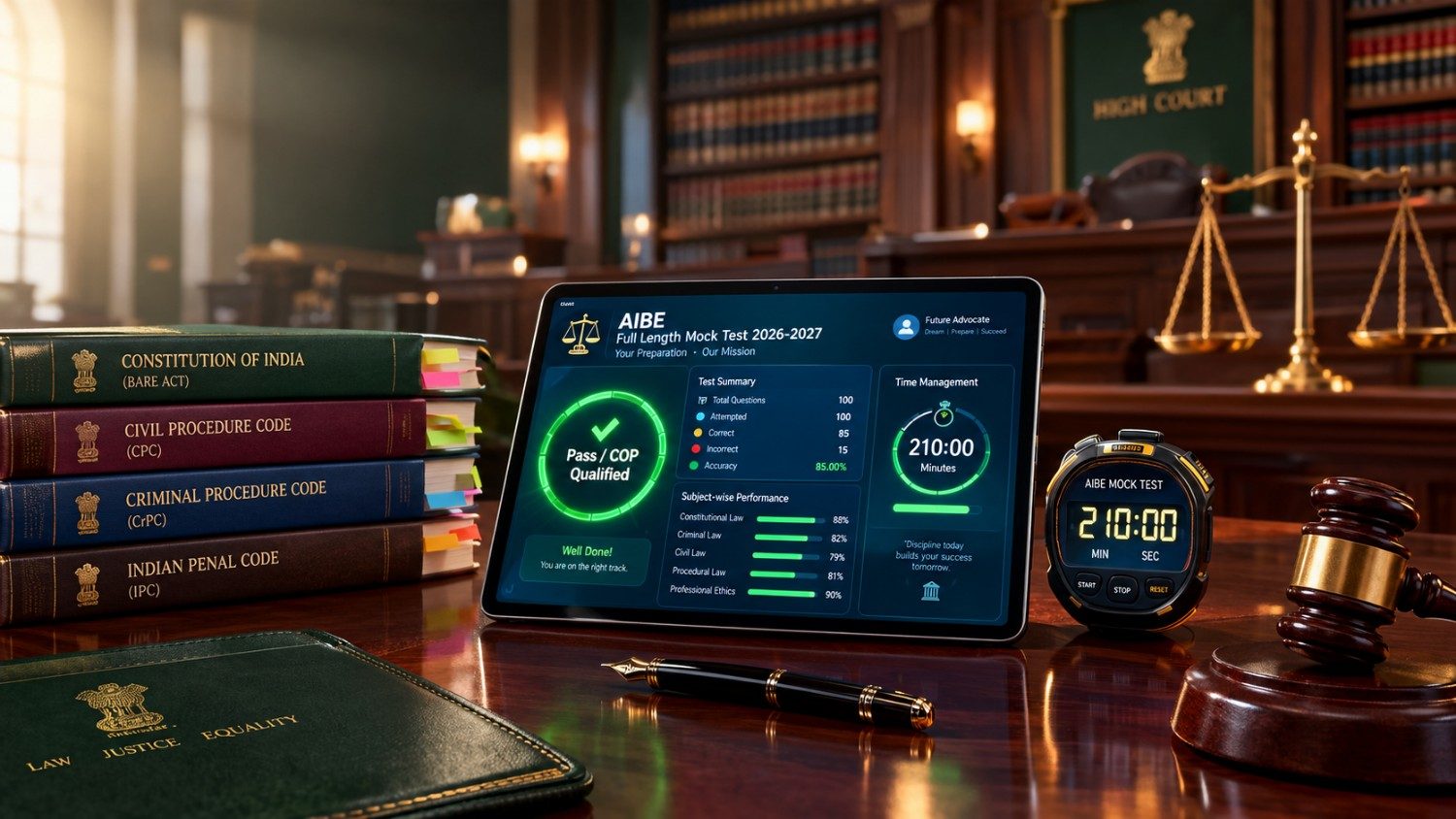
Attempt a complete 100-question, 100-mark mock test with a 210-minute live timer. Test your ability to search bare acts, practice zero-negative-marking tactics, and get instant explanations with section numbers.
Attempt Free AIBE Questions Practice Set2 Full-Length Tests Free • Sectional Bare Act Drills • Bilingual Support
Official Updates and Examination Status
The Bar Council of India makes available its timetables and details on how the tests are to be carried out via its official examinations website. The table given below shows the present situation regarding the forthcoming testing cycles:
| Recruitment / Exam Milestone | Official Status | Official Source | Candidate Action |
|---|---|---|---|
| AIBE XXI (2026-2027 Cycle) Notification | Scheduled / Official Updates Regular | allindiabarexamination.com | Keep State Bar Council enrollment certificate ready |
| Bare Acts Policy | Bare Acts with short notes allowed | BCI Guidelines | Acquire unannotated or short-noted bare acts only |
| New Criminal Laws Transition | BNS, BNSS & BSA introduced alongside IPC, CrPC & IEA | BCI Circulars | Practice questions featuring cross-referenced sections |
| Minimum Qualifying Benchmark | 45% for General/OBC | 40% for SC/ST/PwD | Supreme Court of India Directives | Target at least 65 marks in practice to stay safe |
Why Take AIBE Full Length Mock Test 2026-2027?
Law school exams reward lengthy essays, case commentaries, and theoretical discussions. AIBE is entirely different; it is an objective test of speed, search ability, and knowledge of the statutes. The following is why it is essential to take an online practice set consisting of 100 AIBE questions:
- 1. To build up speed in answering questions: if you don't have the index, it will take you too long to go through 1,000 pages of the Civil Procedure Code or the Bharatiya Nagarik Suraksha Sanhita during an exam. Mock tests show you how to check the table of contents and go directly to the particular section within 45 seconds.
- 2. Ten-minute clock: Focusing on the statutory text by staying in one place for three hours and thirty minutes leads to mental fatigue, while taking full-length practice tests develops both your physical and mental stamina.
- 3. Take advantage of the fact that there is no negative marking: since wrong answers do not carry a penalty, each question left unanswered is a missed chance. Doing timed practice tests will teach you to answer all the questions before the final bell rings.
- 4. The seven main subject areas are worth mastering since more than 60 of the 100 questions are drawn from them: Constitutional Law, Criminal Procedure (CrPC/BNSS), Civil Procedure (CPC), Penal Law (IPC/BNS), Evidence (IEA/BSA), Family Law, and Contract Law. Taking mock tests will enable you to achieve full marks in these basic subjects.
AIBE Exam Pattern: Detailed Breakdown
The All India Bar Examination follows an established objective format. The table below details the examination structure:
| Examination Feature | Official Specification | Preparation Impact |
|---|---|---|
| Question Type | Objective Multiple Choice Questions (MCQs) | 4 options provided; only 1 option is correct |
| Total Questions | 100 Questions | Sourced from 19 distinct BCI syllabus domains |
| Total Marks | 100 Marks | Each question carries exactly 1 mark |
| Exam Duration | 3 Hours 30 Minutes (210 Minutes) | Approximately 126 seconds available per question |
| Negative Marking | None (0 Marks Deducted) | You should attempt 100% of the questions |
| Examination Medium | English, Hindi, and 20+ Regional Languages | Questions are presented according to your selected choice |
| Testing Format | Offline OMR Paper (or CBT where notified) | Requires careful bubbling of answer choices |
| Allowed Materials | Bare Acts without notes / with minimal short notes | No textbooks, guides, or mobile devices allowed |
Subject-Wise Marks Weightage: All 19 BCI Subjects
The Bar Council of India gives each subject a certain weight. The 19 subjects can be naturally divided into three groups: those which are Core and High-Yield (62 Marks), the ones relating to Moderate Procedure and Public Law (26 Marks), and the Specialized Commercial and Environmental Laws (12 Marks).
| Subject Category | Law Subject / Statutory Code | Questions / Marks | Preparation Priority |
|---|---|---|---|
| Core Tier 1 | Constitutional Law | 10 Marks | High Priority (Fundamental Rights & Articles) |
| Core Tier 1 | Code of Criminal Procedure (CrPC) / BNSS | 10 Marks | High Priority (Arrest, Bail, Trial, FIR) |
| Core Tier 1 | Code of Civil Procedure (CPC) | 10 Marks | High Priority (Pleadings, Execution, Orders) |
| Core Tier 1 | Indian Penal Code (IPC) / BNS | 8 Marks | High Priority (Offences, General Exceptions) |
| Core Tier 1 | Indian Evidence Act / Bharatiya Sakshya Adhiniyam | 8 Marks | High Priority (Relevancy, Burden, Estoppel) |
| Core Tier 1 | Family Law (Hindu Law & Muslim Law) | 8 Marks | High Priority (Marriage, Divorce, Succession) |
| Core Tier 1 | Law of Contract, Specific Relief, Property, Negotiable Instruments | 8 Marks | High Priority (Agreements, Breach, Remedies) |
| Medium Tier 2 | Law of Torts, Motor Vehicles Act, Consumer Protection | 5 Marks | Moderate (Negligence, Claims, Consumer Rights) |
| Medium Tier 2 | Professional Ethics & BCI Rules under Advocates Act | 4 Marks | Moderate (Contempt, Duty to Client & Court) |
| Medium Tier 2 | Public Interest Litigation (PIL) | 4 Marks | Moderate (Locus Standi, Landmark Petitions) |
| Medium Tier 2 | Alternative Dispute Resolution (ADR & Arbitration) | 4 Marks | Moderate (Arbitration Clauses, Conciliation) |
| Medium Tier 2 | Administrative Law | 3 Marks | Moderate (Natural Justice, Delegated Legislation) |
| Medium Tier 2 | Labor and Industrial Laws | 4 Marks | Moderate (Industrial Disputes, Trade Unions) |
| Medium Tier 2 | Law of Taxation | 4 Marks | Moderate (Basic Income Tax concepts) |
| Specialized Tier 3 | Company Law | 2 Marks | Focused (Incorporation, Directors, Meetings) |
| Specialized Tier 3 | Environmental Law | 2 Marks | Focused (EPA 1986, Pollution Boards, NGT) |
| Specialized Tier 3 | Cyber Law (Information Technology Act) | 2 Marks | Focused (Penalties, Digital Signatures, Section 66) |
| Specialized Tier 3 | Intellectual Property Laws (IPR) | 2 Marks | Focused (Patents, Copyrights, Trademarks) |
Detailed Micro-Syllabus for All 19 AIBE Subjects
Take this micro-syllabus and use it as your basic list of items to study. It sets out the particular statutory sections, constitutional articles, and legal doctrines which you must note in your index:
| Subject | Core Statute | Key Sections / Articles to Flag | Common Question Patterns |
|---|---|---|---|
| Constitutional Law | Constitution of India | Articles 12 to 35 (Part III), Articles 36 to 51 (Part IV), Articles 136, 141, 226, 300A, 368 | Landmark judgments, fundamental right exceptions, writ jurisdictions, constitutional amendments |
| Criminal Procedure | CrPC 1973 / BNSS 2023 | Arrest (Sections 41-46), FIR (Section 154), Charge (211), Bail (436-439), Inherent Powers (482) | Time limits for investigation, anticipatory bail conditions, compounding of offences, trial procedures |
| Civil Procedure | CPC 1908 | Res Judicata (Section 11), Place of Suing (15-20), Execution (36-74), Orders VI, VII, VIII, IX, XXI, XXXIX | Temporary injunction conditions, pleadings rules, execution steps, appeals vs revisions |
| Penal Law | IPC 1860 / BNS 2023 | General Exceptions (Sections 76-106), Culpable Homicide vs Murder (299-304), Theft, Cheating, Defamation | Factual illustrations, exception thresholds (self-defence, insanity), distinction between intention and knowledge |
| Evidence Law | Evidence Act 1872 / BSA 2023 | Relevancy (Sections 5-16), Admissions & Confessions (17-31), Dying Declaration (32), Burden of Proof (101-105) | Admissibility of electronic records, privileged communications, leading questions, estoppel principles |
| Family Law | Hindu & Muslim Personal Laws | Hindu Marriage Act (Sec 5, 9, 13, 13B), Hindu Succession Act (Sec 6, 8), Talaq forms, Mehr, Maintenance | Grounds for divorce, mutual consent waiting periods, coparcenary rights of daughters, valid marriage conditions |
| Contracts & Relief | Contract Act 1872 & SRA 1963 | Offer & Acceptance (Sec 2-9), Void Agreements (23-30), Breach & Damages (73-75), Specific Relief (Sec 10, 14, 16) | Frustration of contract, minor's agreement status, liquidated damages, contracts that cannot be specifically enforced |
| Law of Torts | Tort Principles & Motor Vehicles Act | Vicarious Liability, Negligence, Strict & Absolute Liability, MV Act No-Fault Liability, Consumer Protection Act | Legal maxims (Injuria sine damno, Volenti non fit injuria), consumer forum jurisdiction limits, claims tribunal powers |
| Professional Ethics | Advocates Act 1961 & BCI Rules | Chapter V Advocates Act (Disciplinary proceedings), BCI Rules on duty to court, client, and colleagues | Professional misconduct cases, restrictions on advocates taking outside employment, contempt of court rules |
| Public Interest Litigation | Constitutional Jurisprudence | Locus standi relaxation, letter petitions, guidelines in landmark environmental and human rights PILs | Originator of PIL in India (Justice P.N. Bhagwati), non-adversarial litigation concepts, epistolary jurisdiction |
| ADR & Arbitration | Arbitration & Conciliation Act 1996 | Arbitration Agreement (Section 7), Interim Measures (Section 9 & 17), Setting Aside Award (Section 34) | Grounds to challenge arbitral awards, appointment of arbitrators, conciliation settlement enforceability |
| Administrative Law | Administrative Principles | Principles of Natural Justice (Audi alteram partem, Nemo judex in causa sua), Wednesbury unreasonableness | Exceptions to natural justice, control over delegated legislation, ombudsman/lokpal jurisdiction |
| Labor Laws | Industrial Disputes Act 1947 | Definition of Workman, Strike & Lockout (Sec 22-24), Layoff & Retrenchment (Sec 25F), Trade Unions Act | Conditions precedent to retrenchment, illegal strikes, registration and rights of trade unions |
| Law of Taxation | Income Tax Act 1961 | Heads of Income (Section 14), Capital Gains vs Business Income, Deductions, Residential Status rules | Assessment year vs previous year, agricultural income exemption, advance tax payment obligations |
| Company Law | Companies Act 2013 | Types of Companies (OPC, Private, Public), Memorandum & Articles, Board Meetings, Corporate Social Responsibility | Independent director criteria, lifting the corporate veil, minimum capital requirements, CSR thresholds |
| Environmental Law | Environment Protection Act 1986 | Sections 3, 5, 7, National Green Tribunal (NGT) Act 2010 jurisdiction and powers, Water & Air Acts | Precautionary principle, polluter pays principle, public trust doctrine, NGT appeal timeframes |
| Cyber Law | Information Technology Act 2000 | Digital Signatures, Section 43 (Damage to computer system), Section 66, Section 67 (Obscenity), Intermediary guidelines | Cyber appellate tribunal, electronic record authenticity, penalties for data theft and unauthorized access |
| IPR Laws | Patent, Copyright & Trademark Acts | Term of Copyright, Patentable inventions vs Non-patentable (Sec 3 Patents Act), Trademark infringement vs Passing off | Duration of protection (Patent: 20 years, Copyright: Life + 60 years), compulsory licensing conditions |
Previous Year Question (PYQ) Trend Analysis
Looking at past AIBE question papers shows clear patterns in the way questions are distributed. The exam focuses on section numbers, legal exceptions, and direct quotes from the law.
Indicative Data Notice: The chart below reflects the question distribution across major subject domains compiled from past AIBE papers (AIBE XV through AIBE XX):
Question Style Breakdown in Recent AIBE Papers
| Question Style | Estimated Share | Typical Question Format | Bare Act Lookup Technique |
|---|---|---|---|
| Direct Section Finding | 45% of Paper | "Which section of CPC deals with Res Sub-Judice?" | Open the subject bare act index/table of contents. Locate heading in 30 seconds. |
| Illustration & Fact Application | 30% of Paper | "A puts jewels into a box belonging to B with intent to cause B to be convicted..." | Check the illustrations printed directly below the section in your bare act. |
| Landmark & Recent Case Law | 15% of Paper | "In which case did the Supreme Court lay down the guidelines for arrest?" (D.K. Basu) | Requires basic legal memory or checking footnotes in bare acts with short notes. |
| Exception & Proviso Details | 10% of Paper | "Which of the following is NOT an exception to Section 300 of IPC?" | Read the complete section, paying close attention to words like 'Provided that' and 'Except'. |
How to Find Sections in Bare Acts Fast: The 4-Step Rule
The main ability tested in AIBE is how quickly you can find statutory answers. It would be a waste of time to open a statute and then read page by page. When you are doing your practice tests, follow this four-step method for searching:
- Step 1: Identify the Governing Act First: Carefully read the question in order to determine the area of law involved. If the question refers to a 'temporary injunction', then the CPC bare act should be consulted rather than the Specific Relief Act.
- Step 2: Use the Table of Contents / Index: Do not go through the main body of the statute. Instead, open to the first 4 to 8 pages, where the full Chapter and Section arrangement is given, and look at the bold section headings to see if your keyword appears there.
- Step 3: Check the Definition Clause: If the question asks whether a specific item counts as a "document", "public servant", or "movable property", jump straight to the interpretation section (Section 2, 3, or equivalent) of that statute.
- Step 4: check the illustrations that are located below the section: when it comes to practical problems, you should read the illustrations printed directly beneath the statutory text, since BCI examiners often copy the questions from these illustrations word for word.
What You Get in the AIBE Mock Test Series 2026-2027
Our practice platform on sarkarimocktest.com gives you complete tools for your bar examination preparation:
| Platform Feature | What You Receive | Direct Benefit to You |
|---|---|---|
| Full-Length 100-Question Tests | Complete 100-mark tests mapped to the 19 BCI subjects with a 210-minute countdown. | Builds the focus needed to handle a 3.5-hour exam without running out of time. |
| Bare Act Cross-Reference Solutions | Every answer displays the exact section number, Act name, and statutory text. | Shows you exactly where to look in your book next time. |
| Subject-Wise Sectional Quizzes | Dedicated 10 to 25 question drills for CPC, CrPC, Evidence, and Constitution. | Helps you master high-weightage subjects individually. |
| Bilingual Support (Hindi & English) | Toggle language seamlessly on screen for questions and explanations. | Lets Hindi-medium law graduates practice with familiar statutory terminology. |
| Downloadable PDF Sets with Answers | Printable question papers and answer keys. | Practice with physical bare acts on your desk, replicating the offline exam hall. |
| New Criminal Laws (BNS, BNSS, BSA) Drills | Specialized question modules cross-referencing old and new provisions. | Prepares you for questions based on both old and new statutory provisions. |
AI-Based Weak Area Recommendation
It is not until the results have been announced that most candidates can identify the sections they have difficulty with. Our platform has an AI-based weak area recommendation engine which analyzes your attempts in the test:
- In the Monitors Section, regarding finding speed: the system keeps a record of the exact number of seconds you take on each question. Should the time spent looking for a CrPC provision exceed 180 seconds, that section will be flagged for review.
- It monitors your accuracy at the subject level by keeping track of the correct answers you give in each of the 19 domains of the BCI syllabus.
- Creates a Visual Heatmap: The dashboard includes a visual heatmap showing the information in coloured zones: green is used for subjects that you have mastered since your accuracy is above 75%, yellow for areas that are inconsistent (between 50% and 74%), and red for subjects at below 50%.
- Suggests targeted study drills: when your grade in Family Law or in the Law of Torts moves into the red zone, the system creates a drill consisting of 15 questions that focus on those particular statutes.
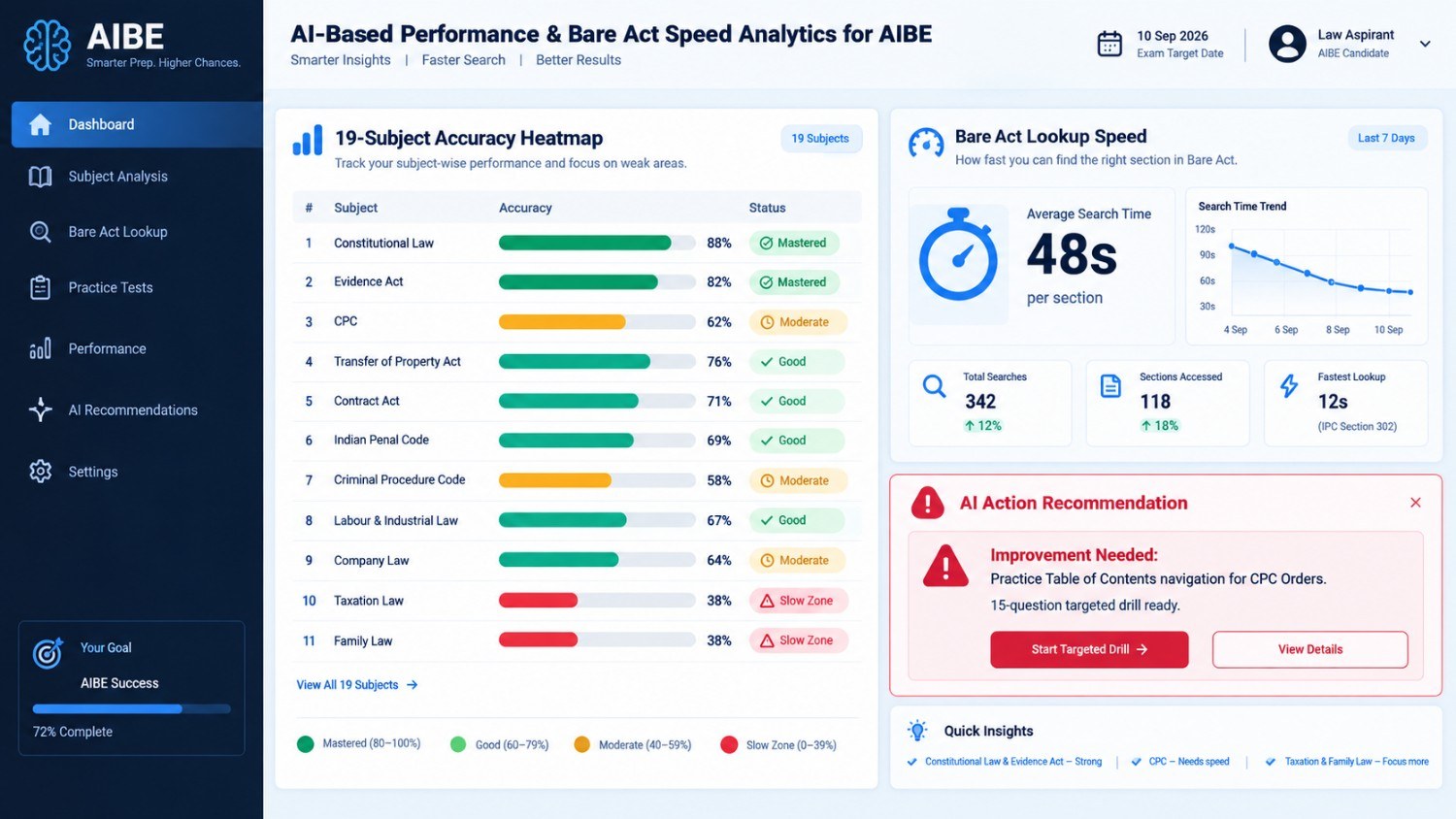
Caption: AI-driven AIBE performance dashboard displaying subject-wise accuracy heatmaps, bare act lookup speed metrics, and targeted revision recommendations.
All India Rank, Percentile, and Live Leaderboard
AIBE is a qualifying examination rather than a competitive ranking test. However, knowing how your preparation compares with other law graduates gives you confidence:
- All India Rank (AIR): See your relative position among all candidates who attempted that specific mock test.
- Percentile Score: Understand what percentage of test-takers scored lower than you. Scoring in the 70th percentile or above indicates you are safely beyond the 45% passing mark.
- Topper Search-Speed Comparison: Review how fast top-scoring candidates answered direct section-based questions compared to your own search time.
Free Daily Current Legal Affairs Quiz
The question paper often includes recent landmark judgments by the Supreme Court, constitutional bench rulings and new legislative amendments, whereas AIBE places a strong emphasis on statutory bare acts. By keeping up with current legal developments you can avoid being caught off guard by such questions.
Practice daily 10-minute legal quizzes on our partner testing portal:
Category-Wise Passing Marks Trends (Last 5-10 Years)
AIBE differs from competitive recruitment examinations in that it does not have cutoff marks that vary according to the number of vacancies; instead, the passing mark is a fixed qualifying percentage set by the Bar Council of India and approved by the Supreme Court:
| Candidate Category | Minimum Qualifying Percentage | Passing Marks (Out of 100) | Recommended Safe Mock Target |
|---|---|---|---|
| General Category Advocates | 45% Qualifying Mark | 45 Marks | 65+ Marks (Safe Buffer) |
| Other Backward Classes (OBC) | 45% Qualifying Mark | 45 Marks | 65+ Marks (Safe Buffer) |
| Scheduled Caste (SC) | 40% Qualifying Mark | 40 Marks | 60+ Marks (Safe Buffer) |
| Scheduled Tribe (ST) | 40% Qualifying Mark | 40 Marks | 60+ Marks (Safe Buffer) |
| Persons with Disabilities (PwD) | 40% Qualifying Mark | 40 Marks | 60+ Marks (Safe Buffer) |
Regarding the deletion of questions: In some of the previous cycles (AIBE XVII, XVIII, XIX) the BCI Monitoring Committee rejected or withdrew between 2 and 7 questions which were ambiguous on the grounds of objections to the answer key. When questions are deleted,the total score is calculated out of the number of remaining questions (for example, out of 97 or 93 marks) with the qualifying marks being adjusted proportionally.
Free vs. Paid Mock Test: What You Get
All law graduates should be able to get foundational bar exam preparation. The following shows how our free option compares to the full test package.
| Feature Component | Free Tier Access | Full Pro Test Series |
|---|---|---|
| Full-Length 100-Question Tests | 2 Full-Length Tests Free | 15 Complete Full-Length Mock Papers |
| Subject-Wise Sectional Tests | 5 Core Subject Quizzes | 35+ Chapter & Bare Act Specific Tests |
| Statutory Explanations | Included for All Questions | Included for All Questions |
| Printable Offline PDF with Answers | Sample Paper PDF Included | All 15 Full Mocks Available as PDFs |
| AI Weak Area Heatmap | Basic Summary Overview | Full Topic Heatmap & Custom Drills |
| New Criminal Laws Cross-Drills | Included in Free Mocks | Dedicated BNS, BNSS, BSA Modules |
| All India Ranking & Percentile | Included for Free Tests | Comprehensive Leaderboard & Cohort Analytics |
Eligibility Criteria: LL.B Degree & State Bar Council Enrollment
You must fulfill two key prerequisites before you can sit for the All India Bar Examination:
| Eligibility Criterion | Official Statutory Requirement | Key Clarifications |
|---|---|---|
| Law Degree Qualification | LL.B Degree (3-Year or 5-Year Integrated Course) | Must be awarded by a university recognized by the Bar Council of India (BCI). |
| State Bar Council Enrollment | Active Provisional Enrollment as an Advocate | Must hold a provisional enrollment number issued by your respective State Bar Council. |
| Minimum Law Degree Marks | No Minimum Percentage Mandated for AIBE | You only need to have passed your LL.B degree. |
| Age Limit | No Upper or Lower Age Limit | Candidates of any age who hold an LL.B degree and enrollment may apply. |
| Number of Attempts Allowed | No Cap on Attempts | You can take the examination as many times as needed to pass. |
AIBE 2026-2027 Important Dates
The schedule below outlines expected dates based on standard annual testing cycles:
| Recruitment / Testing Event | Expected Date / Period | Official Verification Source |
|---|---|---|
| Official Notification Release | September - October 2026 | allindiabarexamination.com |
| Online Registration Opens | October 2026 | BCI Official Testing Portal |
| Application Submission Closes | November 2026 | Online Registration Desk |
| Admit Card Release Date | Late November / Early December 2026 | Hall Ticket Download Link |
| Written Examination Date | December 2026 / January 2027 | Designated Offline Centers Nationwide |
| Provisional Answer Key Release | Within 48 to 72 Hours Post-Exam | BCI Portal Document Section |
| Final Result & Certificate of Practice | February - March 2027 | COP issued through State Bar Councils |
Preparation Strategy: Bare Acts Mastery + Timed Full Mocks
The main reason why law graduates fail is that they rely on mere acts without any prior practice. To develop section-searching speed, use this balanced daily study framework.
| Daily Time Slot | Study Focus | Actionable Preparation Drill |
|---|---|---|
| Morning (08:00 AM - 10:30 AM) | Core Procedural Laws (CPC, CrPC / BNSS) | Read the index of the bare act. Learn the chapter division, order numbers, and locate 25 sections based on random keywords. |
| Midday (11:30 AM - 01:30 PM) | Substantive Law (Constitution, IPC / BNS, Evidence) | Read the statutory illustrations printed below major sections. Mark fundamental rights articles and general exceptions. |
| Afternoon (03:00 PM - 05:00 PM) | Minor & Specialized Laws (Ethics, ADR, PIL, Family) | Review the Advocates Act 1961, BCI rules on professional ethics, and landmark public interest litigation case names. |
| Evening (06:30 PM - 10:00 PM) | Full-Length 100-Question Timed Mock | Attempt a complete 100-question practice set with your physical bare acts on your desk. Complete the test within 210 minutes. |
Important Bare Acts to Carry to the Examination Hall
Having too many books can be confusing so it is important to select clear, well-indexed bare acts published by reputable companies (for example, Universal, LexisNexis or Commercial Law Publishers). The following are the essential bare acts that should be prioritised:
| Priority Rank | Bare Act Title | Approximate Marks Covered | Why It Is Essential |
|---|---|---|---|
| 1 | Constitution of India | 10 Marks | Covers fundamental rights, writ jurisdictions, directive principles, and emergency powers. |
| 2 | Code of Civil Procedure, 1908 (CPC) | 10 Marks | Questions quote orders, rules, and section numbers directly from the statute. |
| 3 | Code of Criminal Procedure, 1973 (CrPC) & BNSS | 10 Marks | Covers search powers, bail provisions, arrest rules, and charge structures. |
| 4 | Indian Penal Code, 1860 (IPC) & BNS | 8 Marks | Questions are often drawn directly from the printed illustrations under major offences. |
| 5 | Indian Evidence Act, 1872 & BSA | 8 Marks | Covers burden of proof, dying declarations, electronic evidence, and relevancy rules. |
| 6 | Family Laws (Hindu Marriage, Hindu Succession, Special Marriage) | 8 Marks | Covers grounds for divorce, maintenance provisions, and intestate succession schedules. |
| 7 | Indian Contract Act, 1872 & Specific Relief Act, 1963 | 8 Marks | Questions test basic contract formation, breach, damages, and injunction clauses. |
| 8 | Advocates Act, 1961 & Bar Council of India Rules | 4 Marks | Covers professional ethics, disciplinary committees, and duties of an advocate. |
| 9 | Arbitration and Conciliation Act, 1996 | 4 Marks | Direct questions on Section 7, 9, 11, 34, and 37 are common. |
| 10 | Motor Vehicles Act, 1988 & Consumer Protection Act, 2019 | 5 Marks | Covers compensation provisions, claims tribunals, and consumer forum jurisdictions. |
15 Common Mistakes Law Graduates Make in AIBE
- Carrying Full Commentaries: Bringing heavy reference books instead of clean bare acts. Hall invigilators often confiscate books that contain detailed notes or study guides.
- Neglecting Bare Act Indexes: Attempting to search for sections by turning random pages rather than checking the table of contents.
- Leaving Questions Unanswered: Forgetting that AIBE has zero negative marking and leaving 10 to 15 questions blank before time expires.
- Getting Stuck on Complex Case Laws: Spending 8 minutes trying to remember a recent Supreme Court bench decision while leaving 5 simple section questions unread.
- Ignoring High-Weightage Subjects: Spending days reading Company Law and Environmental Law (2 marks each) while ignoring CPC and CrPC (10 marks each).
- Failing to Practice with Physical Books: Preparing exclusively on computer screens and struggling to flip through paper bare acts during the offline exam.
- Overlooking Illustrations: Failing to read the factual illustrations printed directly below statutory sections in penal and contract laws.
- Misreading Negative Keywords: Skimming past words like "NOT", "INCORRECT", or "EXCEPT" in the question stem.
- Poor Time Management: Spending over 2.5 hours on the first 50 questions, forcing hasty guesses on the remaining half.
- Forgetting Personal Law Statutes: Forgetting to carry the Hindu Succession Act or Muslim Personal Law acts, giving away 8 accessible marks.
- Ignoring Professional Ethics: Skipping the Advocates Act 1961 and BCI rules, which provide 4 straightforward statutory marks.
- Writing on Bare Acts: Making long handwritten notes inside bare acts, which can lead to confiscation during hall inspections.
- Failing to Cross-Check OMR Bubbles: Marking question 42's answer in row 43 on the OMR answer sheet.
- Ignoring the New Criminal Codes: Not reviewing the transition between IPC/CrPC/IEA and BNS/BNSS/BSA.
- Treating AIBE Too Casually: Assuming an open-book format guarantees an easy pass without practicing under timed conditions.
How to Analyze a Mock Test: Error Classification Framework
Although it takes a good deal of effort to take a 210-minute mock test, it is the analysis of your mistakes that guarantees your improvement. Divide each error into this four-part framework:
Although it takes a good deal of effort to take a 210-minute mock test, it is the analysis of your mistakes that guarantees your improvement. Divide each error into this four-part framework:
| Error Category | Underlying Reason | Action to Fix It |
|---|---|---|
| Index Navigation Delay | You knew the governing Act, but took more than 2 minutes to locate the section. | Open the bare act table of contents and highlight the chapter title. Practice finding 10 sections in that statute. |
| Wrong Statute Selection | You looked in the wrong bare act (e.g., searching for injunctions in Contract Act instead of CPC or SRA). | Review the subject boundaries in our micro-syllabus table and write down overlapping concepts. |
| Misread Question Stem | You missed words like "NOT" or confused an exception with the main rule. | Underline key qualifying words in the question stem before opening your bare act. |
| Case Law Memory Gap | The question asked for a landmark judgment name not found in bare act text. | Compile a 2-page list of landmark Supreme Court rulings for Constitution, PIL, CrPC, and Torts. |
30-Day AIBE Preparation & Mock Test Plan
Follow this structured 30-day schedule to balance bare act indexing, topic revision, and full test simulations:
| Day Bracket | Core Academic Focus | Bare Act Practice Component | Mock Test Target |
|---|---|---|---|
| Days 1 to 6 | Constitutional Law (Part III & IV, Writs) + IPC / BNS General Exceptions | Index drills: Find 20 constitutional articles and 20 penal sections daily | Take 2 Subject Quizzes (Constitution & IPC) |
| Days 7 to 12 | Code of Civil Procedure (CPC: Orders, Injunctions, Res Judicata) | Learn the CPC Order index and rules for Orders VI, VII, VIII, IX, XXI, XXXIX | Take 1 CPC Sectional Practice Set |
| Days 13 to 18 | Criminal Procedure (CrPC / BNSS: Bail, FIR, Arrest) + Evidence / BSA | Cross-reference old sections with new codes for bail and police reports | Attempt Full-Length Mock Test 1 (210 Mins) |
| Days 19 to 23 | Family Law (HMA, HSA) + Law of Contract & Specific Relief | Read the printed illustrations under Contract Act sections 1 to 75 | Analyze Mock 1 + Take Family Law Quiz |
| Days 24 to 27 | Law of Torts, Motor Vehicles Act, Advocates Act & Professional Ethics | Read BCI rules regarding advocate misconduct and court duties | Attempt Full-Length Mock Test 2 (210 Mins) |
| Days 28 to 30 | Minor Acts (Arbitration, PIL, Cyber, Environment, Taxation) | Organize your physical bare act stack and review your error logbook | Rest, review, and pack bare acts for the exam hall |
How to Apply: AIBE 2026-2027 Registration Process
Follow these steps to complete your registration on the BCI examination portal:
- 1. Go to the official registration website:
allindiabarexamination.com. - 2. Click on the registration link for the current AIBE cycle.
- Select your State Bar Council and enter your provisional enrollment number and enrollment year.
- 3. Enter your full name, father's name, date of birth, and communication address exactly as recorded in your bar enrollment papers.
- 4. Select your preferred examination language (English, Hindi, Marathi, Bengali, Tamil, etc.) and choose three exam city preferences.
- 5. Upload scanned copies of your enrollment certificate, LL.B degree or provisional certificate, passport photograph, and signature.
- 6. Pay the examination fee online through the payment gateway.
- 7. Verify all details on the confirmation screen before final submission.
- 8. Download and save printed copies of the completed application form and payment receipt for your records.
Your Next Step
Clearing AIBE on your first attempt is straightforward with the right practice routine:
- 1. Gather your primary bare acts for the top 7 subjects (Constitution, CPC, CrPC, IPC, Evidence, Family, Contract).
- 2. Take your first free full-length mock test on our practice portal.
- 3. Time how long it takes you to find sections using physical book indexes.
- 4. Check your scorecard and note which subjects fall into your red zone on the heatmap.
- 5. Take today's daily legal quiz to keep your case law knowledge sharp.