

Published Work & Notifications
Explore mock tests, syllabus guides, and official notification alerts posted by Ali Hassan.
 full
full
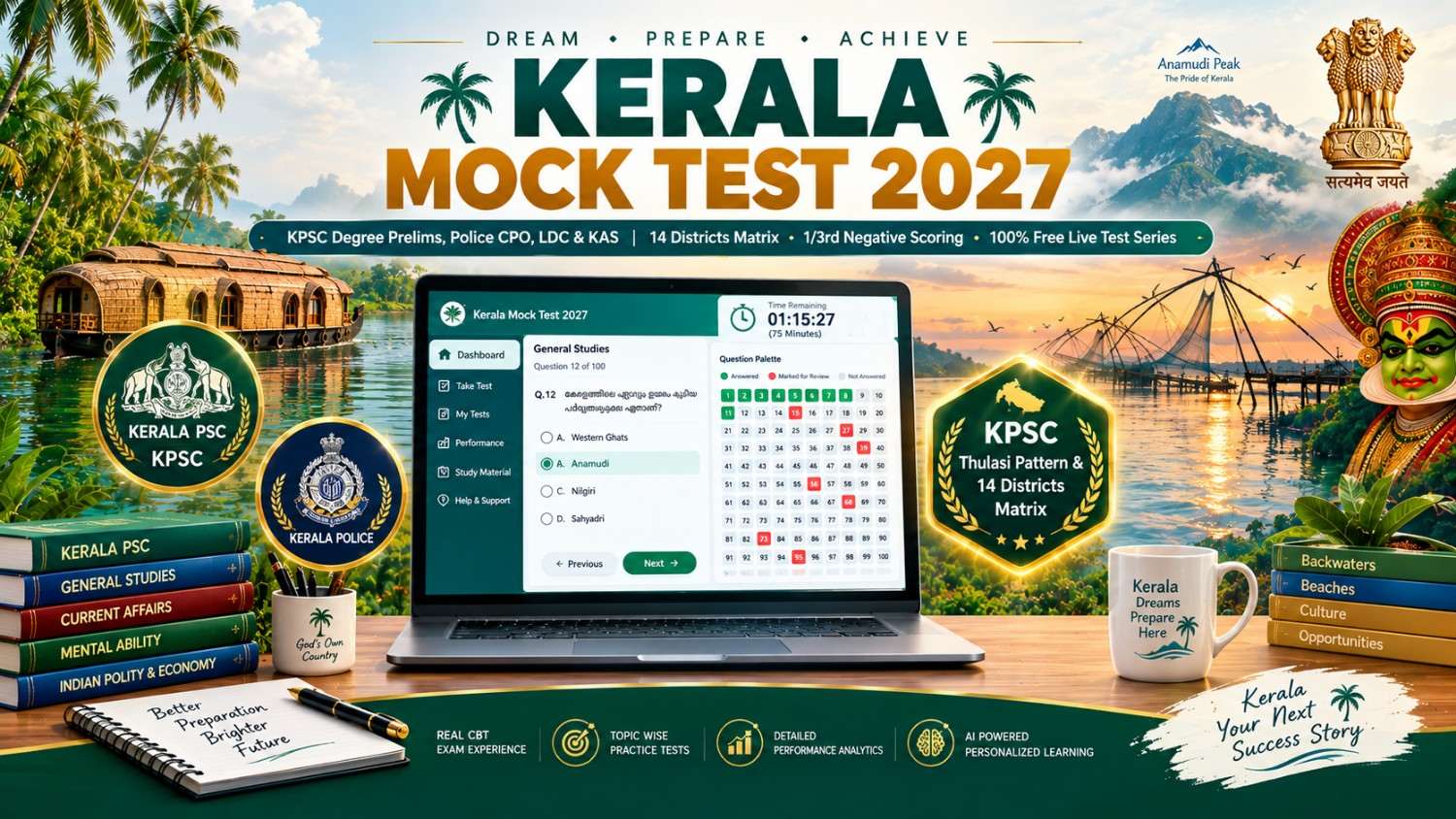
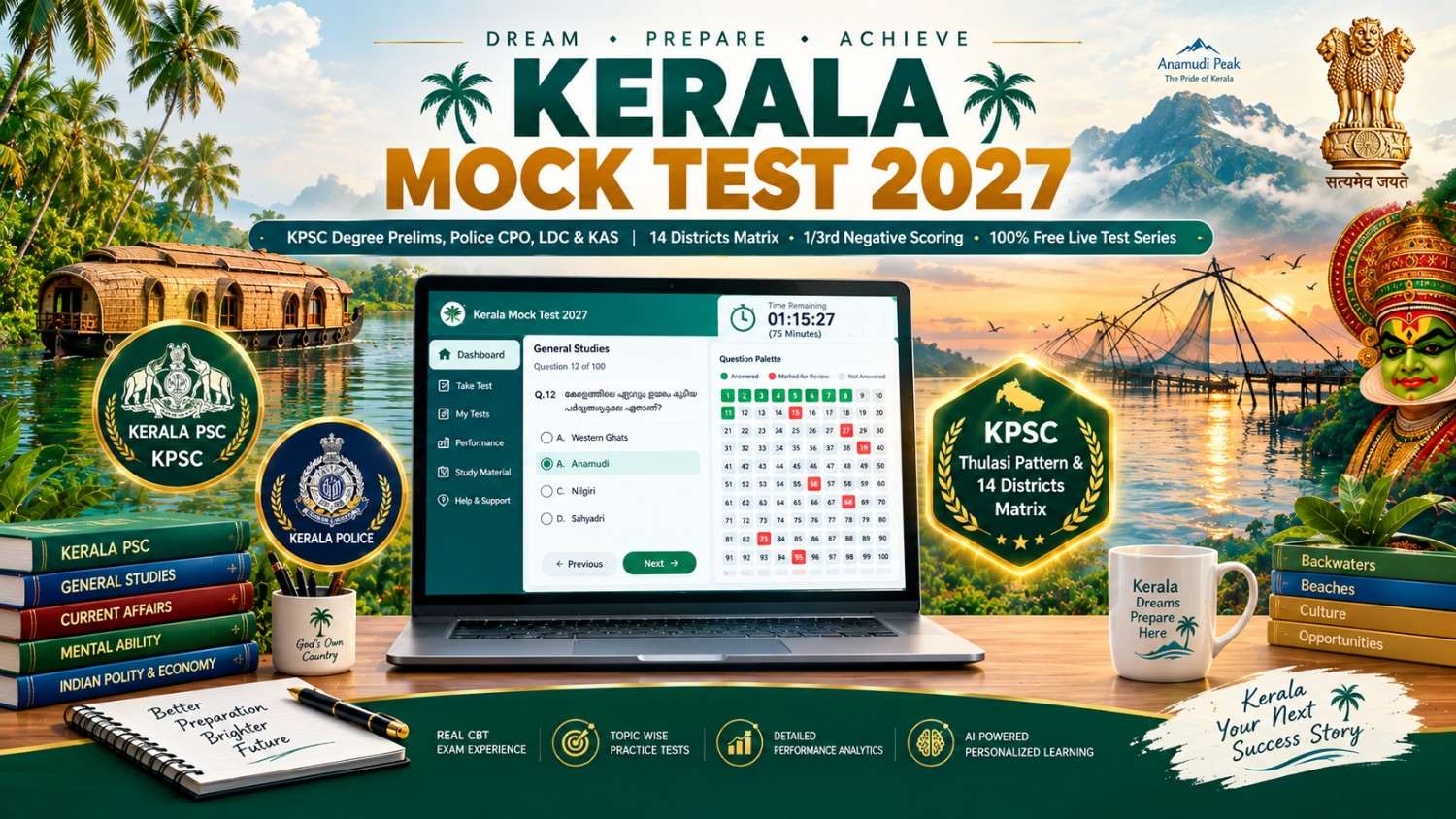
Kerala Mock Test 2027: Free KPSC Degree, +2 & 10th Series
Kerala Competitive Examinations 2027: Master Preparation Hub for KPSC Degree, +2, 10th Level & KAS Series The following statement concerns the Three-Tier Freshness Protocol and the Anti-Deceptive Cycle: the page is divided into three sections—which are the established historical and social reform facts, the exam pattern as stated in the latest notification, and the references concerning the 2027 cycle. Historical timelines and cultural events are permanent. The exam pattern, the confirmation periods, and the vacancies specific to each cycle will be updated when they have been published in the official gazette. In order to ensure complete transparency, the current 2026 recruitment notifications are kept separate from the mock preparation classes which are being conducted for candidates who intend to take the 2027 exam. Before you plan your preparations, you must always verify the confirmation periods and test schedules on the official KPSC Thulasi portal. The SarkariMockTest Kerala Mock Test 2027 Hub provides an open-access platform whereby candidates can prepare for all the stages of the examination structure set by the Kerala Public Service Commission, including the Degree Level Common Prelims and Mains, the Plus Two (+2) Level Prelims, the 10th / SSLC Level Prelims (LDC/LGS), KAS, and KTET. It enables applicants to take full-length simulations in real Malayalam and English, the tests being tailored to conform to the KPSC's strict one-third negative marking penalty and its demanding 75-minute time limit. People frequently ask things like "how to attempt the Kerala mock test", "what is KPCS confirmation and when it should be carried out", and "how much negative marking there is in the Kerala PSC exam". In order to score highly in the state examinations, it is necessary to know about the Thulasi confirmation period, to avoid negative marking when answering all 100 questions within 75 minutes, and to master important topics such as the Kerala Renaissance and Malayalam grammar. The testing engine provides timed practice papers, full explanations for each question, and immediate evaluation of one's rank at the state level, with no paywalls. Why This Mock Test Series Was Created My name is Shubham Kumar Sah and I am the founder of SarkariMockTest.com. When I have reviewed many exam platforms, I have found that most of them never mention the fact that Thulasi registration has to be confirmed separately, and that they treat Kerala Renaissance as a secondary issue rather than as a section that regularly influences rank. Two things are most often overlooked. First, candidates lose their chance to take an exam not because of how they prepared, but simply because they did not realize that confirmation is a separate step with its own deadline. Second, the Malayalam language and Kerala Renaissance sections are very important, yet most free test series either run them through machine translation or omit them almost entirely. This hub has been built around both of these points. The confirmation process is clearly and separately explained. Dedicated modules for Kerala Renaissance and Malayalam grammar are provided, written with accuracy and not translated from another language. Every explanation includes the reasoning behind the answer, not just the answer key. The test series remains free as long as the exam-specific page is live, because a state-specific diagnostic shouldn't require a paywall. As I continue to develop this hub, I check each exam page to see if it answers one key question: does it cover the procedural and content traps that actually cost Kerala candidates their rank? If the answer is no, then the page is not included. Quick Overview: Kerala State Examinations Hub Exam Tier Conducting Authority Paper Architecture Total Questions & Marks Allotted Duration Negative Marking Rule Core Syllabus Focus The KPSC Degree Level Preliminary Examination takes place in Thiruvananthapuram by means of a single composite OMR/CBT method, consisting of 100 questions and a total score of 100 marks, the time allowed being 75 minutes (that is, one hour and 15 minutes); a penalty of one-third of a mark (−0.33 marks) is applied and the subjects included are General Studies, Renaissance, Science, Mathematics, Malayalam and English. The Common Screening Test for the KPSC Plus Two (+2) level exam is held in Thiruvananthapuram Common Screening Test and includes 100 questions worth a total of 100 marks; the time allowed for the test is 75 minutes (1 hour and 15 minutes) and a penalty of one-third of a mark (–0.33 marks) is applied; the positions for which this test is held are CPO, Fireman, Forest Officer and Excise Inspector. At the KPSC 10th (SSLC) level the exam takes place in Thiruvananthapuram and is called the Common Screening Test; it has 100 questions and is worth 100 marks, with a time limit of 75 minutes (1 hour and 15 minutes) and a penalty of one-third of a mark (–0.33 marks) for wrong answers. The posts for which this applies are LDC, LGS and Village Field Assistant (according to district merit). The KAS (Kerala Administrative Service) KPSC Thiruvananthapuram examination includes Paper 1 (General Studies) and Paper 2 (General Studies and Language), the total number of questions and marks being 200; each paper lasts for 90 minutes and includes a penalty of one-third of a mark (–0.33 marks); the prelims merit rank is determined by taking both Paper 1 and Paper 2 into consideration. The KTET (for Categories I to IV) examination takes place at the Pareeksha Bhavan in Kerala and consists of one paper for each category level, containing 150 questions and 150 marks and lasting for 150 minutes (2.5 hours), without any penalty being applied for incorrect answers, the subjects included being Child Pedagogy, Language I and II, and the Domain Subject. Kerala PSC State Competitive Examinations: Master Exam Architecture 2026–2027 It is often questioned what the difference is between the degree level and the plus two level preliminary exams and how district-wise selection lists differ from state-wide merit lists. One has to understand the rules that apply at each stage if they are to succeed in KPSC recruitment. The table below gives the testing frameworks, the marks assigned, the minimum educational qualifications, and the selection procedures in the various recruitment streams in Kerala. State Exam Track Official Commission Paper Structure & Split Total Marks Time Limit Minimum Educational Qualification Selection Pipeline KPSC Degree Level Prelims KPSC Thiruvananthapuram 100 Objective MCQs (History, Polity, Geo, Sci, Math, Lang) 100 Marks 75 Minutes Bachelor's Degree in any discipline Common Prelims Screening > Post-Specific Mains Exam > Document Verification KPSC Plus Two (+2) Level KPSC Thiruvananthapuram 100 Objective MCQs (Secondary standard GS, Math, Lang) 100 Marks 75 Minutes Higher Secondary (Plus Two / 10+2) Pass Common Prelims > Physical Measurement & Efficiency (PET) > Mains / DV KPSC 10th (SSLC) Level KPSC Thiruvananthapuram 100 Objective MCQs (GK, Current Affairs, Math, Lang) 100 Marks 75 Minutes SSLC (Class 10 Pass) or equivalent Common Prelims > District-Wise Shortlist > Post-Specific Mains Exam > Ranking KAS (Kerala Admin Service) KPSC Thiruvananthapuram Prelims: Paper 1 (100M) + Paper 2 (100M); Mains: 3 Papers (300M) 200M (Prelims) 90 Mins each Bachelor's Degree (Stream 1, 2, or 3 rules apply) Prelims Screening (Both papers count) > Mains Written (Descriptive) > Interview In the case of the KTET Category I (Lower Primary) examination the Pareeksha Bhavan Kerala is the authority responsible for administering it; the test comprises 150 objective multiple choice questions in the subjects of Pedagogy, Language I, Language II, Math and EVS; the total mark allocation is 150 marks and the time allowed is 150 minutes; in order to be eligible candidates must have completed their Higher Secondary education and must have secured at least 45% together with a D.El.Ed or TTC qualification; possession of the State Eligibility Certificate is required in order to be appointed as a District LP School Teacher. The KTET Category II (Upper Primary) exam is carried out by the Pareeksha Bhavan in Kerala and includes 150 objective multiple-choice questions on the subjects of Pedagogy, Language I, Language II, Math/Sci/SS; the paper is worth 150 marks and has a time limit of 150 minutes; to be eligible one must have a Bachelor's Degree as well as a B.Ed or D.El.Ed or D.Ed and it is necessary for the candidate to possess a State Eligibility Certificate if they are to be appointed as a school teacher at the district level. The exam for the KTET Category III (High School) position at Pareeksha Bhavan Kerala comprises 150 multiple-choice questions (in the areas of Pedagogy, Language I, and Subject Discipline) amounting to 150 marks and has a duration of 150 minutes; in order to be eligible, candidates must have a Bachelor's Degree in the subject with at least 45% and also a B.Ed, together with a State Eligibility Certificate which entitles them to the post of High School Assistant (HSA). KTET Category IV (Specialists) Pareeksha Bhavan Kerala 150 Objective MCQs (Pedagogy, Language, Specialized Craft/Art) 150 Marks 150 Minutes Recognized Certificate / Diploma in relevant discipline State Eligibility Certificate > Specialist Teacher Appointments It should be noted that the pattern structures, the ways in which the papers split, and the qualifying criteria are taken from earlier official notices. Candidates should look at the exact requirements for the post in the latest notification before filling in their application forms. KERALA STATE COMPETITIVE EXAMS MASTER HUB ARCHITECTURE Hub Blueprint – 100 questions at the KPSC degree level, 100 marks, 75 minutes, with a penalty of one-third of a mark (–0.33M) – | 2. KPSC Plus Two Level: 100 Questions | 100 Marks | 75 Minutes | One-third penalty (-0.33M) | 3. KPSC 10th (SSLC) level: 100 questions | 100 marks | 75 minutes | One-third penalty (-0.33M) | 4. KAS (State Civil Service) – Paper 1 (100 marks) and Paper 2 (100 marks) | The Prelims merit comprises both papers | | 5. KTET (Teacher Eligibility), 150 Questions | 150 Marks | 150 Minutes | NO NEGATIVE MARKING | The KPSC Confirmation Trap: Why Registration Alone Isn't Enough A candidate joins Thulasi, spends many months getting ready, but is still unable to take the exam since the test series in most countries do not refer to such a confirmation period. In other states—just as is the case with the public service commissions there—filling in the application automatically leads to a hall ticket being issued, while the Kerala Public Service Commission requires you to go through an Online Examination Confirmation stage. Important Advisory Warning: The steps involved in applying for a post via the KPSC Thulasi One-Time Registration (OTR) system represent only the first stage. When an examination is advertised, KPSC sets up a particular Confirmation Window (this is usually 30 to 45 days before the exam date). Candidates must log in to their Thulasi account, select the confirmation link, and confirm their intention to sit for the exam. If you do not meet this deadline, your application will be automatically rejected and no Admission Ticket (Hall Ticket) will be issued. THE THREE-STAGE KPSC THULASI EXAMINATION CONFIRMATION PIPELINE Pipeline Stages | Stage 1: Notification and Application -> the candidate applies online via Thulasi OTR. | | Stage 2: The Confirmation Window -> KPSC publishes exam calendar; candidate MUST click "Confirm"|Within the given time frame, an admission token must be generated. | Stage 3: Issuance of Admission Ticket → A hall ticket is given out solely to candidates who have confirmed. | | FAILURE TO CONFIRM: The candidate will be disqualified right away in that recruitment cycle with no exceptions! | KPSC Thulasi Procedural Checklist Be sure to watch the Official Exam Calendar: verify the monthly examination timetable which is issued on keralapsc.gov.in. Look at the confirmation dates: take down the exact start and end dates of the confirmation period for your post category code. Thulasi should log in to thulasi.psc.kerala.gov.in using her User ID and password, then select the 'Confirmation' tab and click 'Submit'. Ensure that you receive an automated SMS receipt from KPSC confirming that your token has been recorded. You can download your admission ticket: once the confirmation period has ended, KPSC will put the hall ticket in your profile approximately 15 days before the exam date. 1/3rd Negative Marking Across Every KPSC Tier (Except KTET) People frequently ask whether in KPSC the negative marking is equal to one-third (1/3rd or -0.33 marks). In objective exams conducted by KPSC, each wrong answer leads to a deduction of exactly one-third (1/3rd or -0.33) marks. KPSC SPEED-TO-ACCURACY MATHEMATICAL MATRIX Scoring Matrix | Total Questions Allotted -> 100 Multiple Choice Questions || Total Time Allotted -> 75 Minutes (4,500 Seconds) | | Time Allowed Per Question -> Exactly 45 SECONDS per question || If you get the question correct, you will receive +1.00 Mark | A penalty of one third of a mark, that is -0.33 marks, is given for each error. If you give three incorrect answers, one correct mark will be completely cancelled! The 75-Minute Speed Constraint In the State PSC exams, attempting 100 questions in 75 minutes leads to one of the strictest speed-accuracy ratios, since for each question you have only 45 seconds in which to read the question, evaluate the four answer options, eliminate the incorrect ones and fill in the OMR bubble. Making random guesses when there is a penalty of 1/3 is quickly harmful to your score. If you make three blind guesses and don't eliminate any of the answer choices, you will have a net loss of 1.00 mark since all three of them are wrong, indicating that you have lost a question which you had answered correctly after careful study. The KTET Exception: Zero Negative Marking The Kerala Teacher Eligibility Test (KTET), which is organised by Pareeksha Bhavan, differs from the KPSC screening papers in that it has no negative marking. The scoring rules are that one mark is given for each correct answer and no marks are taken off for incorrect ones. When attempting the questions, candidates should maintain an attempt rate of 100 per cent by answering all of the questions in the 150 items, since not answering any questions in KTET would amount to a wasted opportunity. Why Most Kerala Mock Tests Fall Short Many commercial platforms fail to prepare candidates effectively for state recruitments: The national websites fail to mention the need for confirmation, which causes candidates to have no knowledge of the procedural step required in order to get a hall ticket. If English questions are input into generic test programs via automated translation software, the resulting Malayalam sentences become unnatural and thus distort technical and grammatical concepts. National-level outlets give a superficial treatment of the Kerala Renaissance because they do not report on the different social movements, publications, and the chronological developments which are included in the KPSC syllabus. The notion that the KAS Prelims Paper 2 is merely a qualifying paper, like the UPSC CSAT, is misleading; in reality, the marks from Paper 1 and Paper 2 are added together to determine the preliminary cutoff list. To provide state test series, commercial websites charge expensive monthly or annual subscription fees and only offer basic general questions for free. Choose Your Exam: Free Kerala Online Mock Tests If you want to obtain the full practice papers together with the detailed diagnostic reports, please select the examination track which interests you. A mock examination for the KPSC Degree Level Common Preliminary and Main Exams Designed for administrative appointments, including Secretariat Assistant, University Assistant, Sub-Inspector of Police (Trainee), and Excise Inspector: The preliminary exam has 100 questions summing to 100 marks and lasts for 75 minutes; it tests the candidates in the following areas: General Studies, the Kerala Renaissance, General Science, Simple Arithmetic, English, and Malayalam, and has one-third negative marking (-0.33 marks). The paper is worth 100 marks and can be in the form of either a descriptive or an objective type, with the aim of testing the candidate's thorough knowledge of the subject. Status: Available Now 2. KPSC Plus Two (+2) Level Common Preliminary Mock Test (for CPO, Fireman and Excise) Tailored for intermediate-qualification recruitments, including Civil Police Officer (CPO), Fire and Rescue Officer, Beat Forest Officer, and Civil Excise Officer: The exam has 100 questions for a total of 100 marks and includes sections on general knowledge, everyday science, mental ability and languages, with a negative marking penalty of one-third, after which come the physical efficiency tests (PET). Status: Available Now 3. A simulated exam at the level of the KPSC 10th (SSLC) for positions such as LDC, LGS and VFA Built for the large-volume recruitments across district cadres, including Lower Division Clerk (LDC), Last Grade Servants (LGS), and Village Field Assistant (VFA): The exam has 100 questions and is worth a total of 100 marks; it is evaluated using a merit list drawn up on a district basis, with an emphasis placed on basic mathematics, mental ability, regional geography and language skills. Status: Available Now Mock test for the Kerala Administrative Service (KAS) Structured for the premier gazetted administrative cadre of Kerala across Streams 1, 2, and 3: Paper One: General Studies I (100 questions, 100 marks, 90 minutes) covering the topics of History, the Culture of Kerala, the Indian Constitution and the Economy. Paper 2: General Studies II (100 questions, 100 marks, 90 minutes) covering Science and Technology, the Environment, proficiency in the Malayalam language (or Tamil or Kannada), English, and mental ability. For the Merit Rule, the marks from Paper 1 and Paper 2 are added together to work out the preliminary cutoff rank. Status: Available Now 5. The KTET mock test (for categories I to IV) Aligned with the teacher eligibility tests administered by Pareeksha Bhavan Kerala: Category I (Lower Primary) covers Classes 1 to 5 and has 150 questions in the subjects of Child Development, Malayalam, English, Mathematics, and Environmental Studies. In the case of Category II (the category applicable to the upper primary level) the classes cover 6 to 8, the total number of questions being 150 and these being in the subjects of Pedagogy, Languages, and Mathematics & Science or Social Science. In the case of Category III (High School): Classes 8 to 10 there are 150 questions concerning Adolescent Psychology, Language, and Subject Discipline. Category IV consists of specialist teachers (in the subjects of language, art, craft and sports). None of the categories have negative marking. Status: Available Now Kerala Renaissance: The Section That Decides Rank, Not Just General Studies The final rank list is not entirely based on the General Studies portion, since it is the combination of languages and the Kerala Renaissance (കേരള നവോത്ഥാനം) section that makes the difference between clearing the cutoff and not clearing it. The KPSC exams include questions on the socio-religious reform movements of the 19th and early 20th centuries as part of the General Knowledge section, and the paragraphs that follow summarize the facts which are tested in the state examinations. KERALA RENAISSANCE: FOUR CORE HISTORICAL REFORM PILLARS Renaissance Pillars | Pillar 1: Sree Narayana Guru -> Aruvippuram (1888), Sivagiri, Daiva Dasakam, SNDP Yogam (1903)| | Pillar 2: Mahatma Ayyankali -> Villuvandi Samaram (1893), Kallumala (1915), SJPS (1907) | | Pillar 3: Anti-Caste Agitations -> Vaikom (1924-25), Guruvayur (1931-32), Temple Entry (1936) | | Pillar 4: Other Reform Pioneers -> Chattampi Swamikal, Sahodaran Ayyappan, Vakkom Moulavi | Sree Narayana Guru, Ayyankali & the Social Reform Movements Sree Narayana Guru, born in 1856 and dying in 1928, was born at Chempazhanthy near Thiruvananthapuram and is considered the spiritual father of the Kerala Renaissance. In 1888 he set up a stone image from the Neyyar River at Aruvippuram (this being known as the Aruvippuram Pratishtha) and declared the temple open to all people regardless of caste, thereby challenging the priests' traditional monopoly. The Sree Narayana Dharma Paripalana (SNDP) Yogam was founded on 15 May 1903 and Aiyer served as its president for life, the first general secretary of which was the poet Kumaran Asan. The principle of Philosophical Universalism promoted the maxim "One Caste, One Religion, One God for Man" (ഒരു ജാതി, ഒരു മതം, ഒരു ദൈവം മനുഷ്യന്). In 1913 he established the Advaita Ashram in Aluva, the building bearing the motto "Not to argue and win, but to know and inform". He also authored a number of spiritual works, including the Daiva Dasakam, the Atmopadesha Satakam, and the Darshana Mala. Mahatma Ayyankali, born in Venganoor, fought for the civil rights of both Dalits and those of agricultural workers. In 1893, as part of the Villuvandi Samaram, people broke the caste-based restrictions by riding in a decorated bullock cart (a Villuvandi) on the public roads in Venganoor, a area which was reserved for the higher castes, in order to claim their right to free movement. The Sadhu Jana Paripalana Sangham (SJPS) was set up in 1907 with the objective of securing educational access, civil dignity, and the right to a fair wage for marginalized labourers; it arranged Kerala's first ever agricultural strike between 1907 and 1908, during which the workers refused to work in the paddy fields until Dalit children were permitted to attend public schools. The 1915 Perinad strike (referred to as Kallumala Samaram) was led by Kallumala and involved a campaign in which Dalit women were called upon to stop wearing the bead necklaces (called Kallumala) which had been forced upon them as a symbol of their subjugation and to gain the right to wear clean clothes. Vaikom Satyagraha, Guruvayur Satyagraha & the Temple Entry Proclamation The Vaikom Satyagraha, lasting from 30 March 1924 to 23 November 1925, was the first organized non-violent satyagraha in India which demanded that members of the lower castes should have the right to use the public roads surrounding the Shiva Temple at Vaikom; it was led by T.K. Madhavan, K.P. Kesava Menon, George Joseph and K. Kelappan. Upon his visit to Vaikom in March 1925 Mahatma Gandhi negotiated with the Regent Maharani of Travancore and Periyar E.V. Ramasamy took an active role in the campaign, as a result of which the movement came to be known as Vaikom Veerar. The Guruvayur Satyagraha, lasting from 1 November 1931 to 2 October 1932, was a campaign which urged that all Hindus should be permitted entry to the Guruvayur Sree Krishna Temple. It was organised by the Kerala Provincial Congress Committee, and K. Kelappan, who was known as Kerala Gandhi, carried out a fast unto death until it was finally halted at the request of Mahatma Gandhi; A.K. Gopalan served as leader of the volunteer marches and Subramanian Thirumambu was secretary of the temple satyagraha. The temple entry proclamation of 12 November 1936 was issued by the Maharaja of Travancore, Chithira Thirunal Balarama Varma, upon the recommendation of his Dewan, Sir C.P. Ramaswami Iyer, and it abolished the caste restrictions which had been grounded in birth, thereby enabling all Hindus to enter the temples which were maintained by the government in Travancore. Other Major Reform Figures: Chattampi Swamikal, who was born in Kannammoola, showed as a scholar that religious orthodoxy should be questioned through works like Pracheena Malayalam and Vedadhikara Nirupanam on the basis that Vedic knowledge should be equally available to all of humanity. Sahodaran Ayyappan, who was a follower of Narayana Guru, established the Sahodara Sangham in 1917 and organised the historic inter-caste meal (Mishra Bhojanam) at Cherai, bringing in a modified motto which stated "No Caste, No Religion, No God for Man". Vakkom Abdul Khader Moulavi (1873–1932) was a social reformer and is regarded as the founder of Muslim journalism in Kerala; he launched the influential newspaper Swadeshabhimani in 1905 and appointed Ramakrishna Pillai as its editor. Malayalam Language (സാഹിത്യം & വ്യാകരണം): Grammar Beyond Machine Translation In the KPSC Degree and SSLC exams the 20-mark language section (this comprising 10 marks for Malayalam and 10 marks for English) has a direct impact on the final ranking, the questions being based on standard grammar rules and not on automated translations. The Malayalam modules on SarkariMockTest are written in the natural Malayalam script and comply with the curriculum standards of the Kerala State Board. High-Yield Syllabus Components for Malayalam സാഹിത്യ ചരിത്രം (Literary Heritage): Thunchaththu Ramanujan Ezhuthachan is regarded as the Father of the modern Malayalam language and it was he who established the 51-character Malayalam script as well as composing the spiritual epics, Adhyathmaramayanam Kilipattu and Mahabharatham Kilipattu. Jnanpith Award Winners in Malayalam: G. Sankara Kurup received the very first Jnanpith Award in India in 1965 for the poetry collection Odakkuzhal (The Flute). S.K. Pottekkatt was awarded the prize for his semi-autobiographical travelogue novel Oru Desathinte Katha in 1980. Thakazhi Sivasankara Pillai was awarded in 1984 for his novel Kayar, a book famous for its social realism in Chemmeen. M.T. Vasudevan Nair was considered to be the master of prose fiction after independence, on the grounds of his whole body of literary work (this including Randamoozham and Kaalam). O.N.V. Kurup was acknowledged as a lyricist and poet for his works including Agni Salabhangal and Ujjayini. Akkitham Achuthan Namboothiri was awarded for his contributions (Irupatham Noottandinte Ithihasam) in 2019. വ്യാകരണം (Functional Malayalam Grammar): സന്ധി (Phonetic Junctions): These rules control ലdelicious സന്ധി (insertion. For example, തിരു + ഓണം becomes തിരുവോണം), ആദേശ സന്ധി (substitution. For example, മരം + കഷ്ണം becomes മരക്കഷ്ണം), and ലോപ സന്ധി (elision. For example, പത്ത് + രണ്ട് becomes പന്ത്രണ്ട്). Compounds may be classified as those in which the second element is predominant (tatpurusha), those in which both elements are equal (adachchanaammaar), those which indicate a third external element (bahuvrihi), and those that have a number prefix (dvigu). The correction of spelling and grammar involves the elimination of spelling and structural errors, such as those occurring between the subject, verb, and case, as well as the use of redundant plural markers. ശൈലികളും പഴഞ്ചൊല്ലുകളും (Idioms & Proverbs): This section looks at how to use classical idioms in the right context. For example, അണ്ണാൻ മൂത്താലും മരംകേറ്റം മറക്കുമോ. Lifelong habits remain intact. Administrative Translation (Translation): The accurate translation of official administrative terminology from English into formal Malayalam. Kerala Geography & Ecology: 14 Districts, Peaks & Protected Habitats The Kerala Public Service Commission conducts examinations on state geography, the Western Ghats ecosystem, and the 14 administrative districts; the paragraphs that follow give the main facts which are tested in the state exams. KERALA SPECIAL GEOGRAPHY: FOUR STRUCTURAL PILLARS Geography Pillars | Pillar 1: Administrative Units -> 14 Districts, Kasaragod 14th District, 3 Historic Regions | | Pillar 2: Highlands & Peaks -> Sahyadri Range, Anamudi (2,695m), Agasthyarkoodam, Palakkad Gap| | Pillar 3: River Drainage -> 44 Total Rivers (41 West-Flowing + 3 East-Flowing Tributaries) | | Pillar 4: Wetlands & Parks -> Silent Valley, Vembanad Lake Ramsar Site, Kuttanad FAO Heritage| Anamudi, Silent Valley & the Western Ghats Biosphere Anamudi Peak is situated in the Eravikulam National Park in the Idukki district and reaches a height of 2,695 metres (8,842 feet); it is the highest mountain peak in South India and in peninsular India and is frequently called the "Everest of South India." Agasthyarkoodam is located in the southern part of the Western Ghats (in the Thiruvananthapuram district) at an elevation of 1,868 meters and is well known for its rare medicinal plants; it is named after the sage Agastya and has been designated as a UNESCO Biosphere Reserve. The Palakkad Gap is a substantial natural gap in the Western Ghats, about 30 kilometres wide, lying between the Nilgiri Hills to the north and the Anaimalai Hills to the south and functions as an important rail and road route for commercial traffic linking Kerala with Coimbatore and Tamil Nadu. National Parks & Sanctuaries: Silent Valley National Park (Palakkad) is situated in the Kundali Hills near the Kunthipuzha River and contains one of the last areas of tropical rainforest in India untouched by human interference. The park is well known because of the save-the-forest campaign of the 1970s and is home to a viable wild population of the endangered Lion-tailed Macaque (Macaca silenus). The endangered Nilgiri Tahr (Nilgiritragus hylocrius) and the rare Neelakurinji flower (Strobilanthes kunthiana), which blooms once every 12 years, are found in Eravikulam National Park (Idukki). Periyar National Park (in Thekkady, Idukki) is a reserve known for its tigers and wild elephants, the area revolving around an artificial reservoir created by the Mullaperiyar Dam. Vembanad, Kuttanad & Kerala's Backwater Geography The 14 Administrative Districts: Categorized under three historic administrative divisions: Malabar Region (Northern): Kasaragod, Kannur, Wayanad, Kozhikode, Malappuram, Palakkad. Kasaragod became the 14th district on 24 May 1984. It was split from Kannur. Kochi Region (Central): Thrissur, Ernakulam. The southern part of the Travancore region consists of Idukki, Kottayam, Alappuzha, Pathanamthitta, Kollam, and Thiruvananthapuram. Pattern & Negative Marking Across Kerala PSC Tiers Understanding the rules regarding negative marking in the various tiers of the Kerala PSC exams helps candidates to prevent losing marks on the day of the exam. In Kerala, all the competitive screening stages organised by KPSC apply a one-third penalty, whereas the teacher eligibility tests have no deduction. Pattern & Negative Marking Comparison Table State Examination Tier Paper Name & Category Total Questions & Marks Allotted Duration Negative Marking Penalty Operational Strategy KPSC Degree Level Prelims Common Preliminary Paper 100 Questions / 100 Marks 75 Minutes (45 sec per question) 1/3rd Penalty (-0.33 Marks) Eliminate two options before answering; avoid random guesses KPSC Plus Two (+2) Level Common Preliminary Paper 100 Questions / 100 Marks 75 Minutes (45 sec per question) 1/3rd Penalty (-0.33 Marks) Focus on questions that you are confident about in the fields of science and math KPSC 10th (SSLC) Level Common Preliminary Paper 100 Questions / 100 Marks 75 Minutes (45 sec per question) 1/3rd Penalty (-0.33 Marks) A high degree of accuracy is needed in order to clear the high district-level cutoffs KAS (Kerala Administrative Service) Paper 1 & Paper 2 Prelims 200 Questions / 200 Marks 90 minutes per paper 1/3rd Penalty (-0.33 Marks) The preliminary cutoff rank is determined by the combined scores of both Paper 1 and Paper 2 KTET (Categories I to IV) Teacher Eligibility Test 150 Questions / 150 Marks 150 Minutes (2.5 Hours) Zero Penalty (No Negative Marks) All questions must be attempted; no blanks are to be left Time Allocation Blueprint for a 75-Minute Paper (100 Questions) In the KPSC preliminary examinations, you have 75 minutes to answer 100 questions (45 seconds per question). The three-round method described below ensures that you finish the paper without having to rush: Round 1: Direct Factual Questions (Minutes 00 to 30): Answer the direct factual questions in General Studies, the Kerala Renaissance, Regional Geography, and Language Grammar. Factual questions do not require any scratch work. Aim to solve 45 to 50 questions correctly during this first pass. Round 2: Reasoning and Mental Ability (Minutes 30 to 55): Go through the statement-based polity questions, basic arithmetic, and logical series on scratch paper. Allocate 25 minutes to answering about 25 to 30 questions. Round 3: Calculations and Final OMR Verification (Minutes 55 to 75): Use your final 20 minutes to solve the remaining quantitative problems, check the items you have flagged where you have eliminated two choices, and make sure all the answer bubbles are neatly filled in. RECOMMENDED TIME ALLOCATION: KPSC COMMON PRELIMS (100 QUESTIONS / 75 MINUTES) Time Allocation | [===] Round 1: Direct Renaissance, GK & Lang (30 Mins) -> ~48 Questions Cleared (Zero Delay) | | [===] Round 2: Reasoning & Subject Concepts (25 Mins) -> ~28 Questions Analyzed | | [==] Round 3: Math Calculations & OMR Completion (20 Mins) -> Scratch Work & Checks | | TOTAL DURATION: 75 MINUTES | 100 QUESTIONS | PACING: 45 SECONDS PER QUESTION | Structure of the Test Series and Coverage Matrix Our testing programme guides your preparation in a step-by-step manner, progressing from individual topic exercises to full-length exam simulations: Level and Segment Sections Covered Tests Offered Question Format Focus and Alignment with the Exam Tier 1: Sectional Drills Renaissance, Kerala Geography, Math, Malayalam, English 24 Tests (25 questions / 20 minutes) Timed drills at the topic level Develops speed and mechanical memory Tier 2: Full Simulations Complete Multi-Tier Composite Formats 14 Tests (100 questions / 75 minutes) A real exam simulation, -0.33 Builds stamina for the 75-minute exam Tier 3: Renaissance Labs Social Reformers, Temple Agitations, 14 Districts 6 Labs (50 questions / 40 minutes) Focus on chronology and movement leaders Targets the high-yield state modules Tier 4: Shift-Style Mocks Complete Composite Syllabus 4 Tests (100 questions each) Questions in the style of past shifts Familiarity with current exam trends and format Worked Sample Questions with Complete Explanations Review these sample questions which illustrate regional depth, Renaissance history, and the 4-option explanations that are used in all our practice sets. Sample 1: Kerala Renaissance and Social Reform History SAMPLE QUESTION: KERALA NAVODHANAM (RENAISSANCE MOVEMENTS) Renaissance Sample | Question: In 1893, which social reformer of Kerala challenged caste-based restrictions on freedom | How can one demonstrate mobility by riding a decorated bullock cart (Villuvandi) on the public roads in Venganoor? | (A) Sree Narayana Guru | | (B) Mahatma Ayyankali | | (C) Chattampi Swamikal | | (D) Sahodaran Ayyappan | | CORRECT ANSWER: (B) Mahatma Ayyankali | | Step-by-Step Concept Explanation: | | Why Option (B) is Correct: | | In 1893, Mahatma Ayyankali carried out the historic Villuvandi Samaram (Bullock Cart Strike) at | Near Thiruvananthapuram is Venganoor. Contrary to the traditional caste rules which prohibited Dalits from doing so, | agricultural laborers from using public thoroughfares reserved for upper castes, he rode a cart | By means of loud brass bells rung along the public streets, the right to freedom of movement was established. | Why Other Options Are Incorrect: | - Option (A): In 1888 Sree Narayana Guru conducted the consecration of the Aruvippuram idol. (C) Chattampi Swamikal wrote Vedadhikara Nirupanam and thereby challenged the monopolies of the Vedic texts. (D) Sahodaran Ayyappan arranged the historic Mishra Bhojanam (inter-dining) in 1917. Sample 2: Malayalam Grammar (സന്ധി നിർണ്ണയം) SAMPLE QUESTION: MALAYALAM VYAKARAN (SANDHI RULES) Grammar Sample | ചോദ്യം: 'തിരുവോണം' എന്ന പദം പിരിച്ചെഴുതുമ്പോൾ ഉണ്ടാകുന്ന സന്ധി ഏതാണ്? | | (തിരു + ഓണം = തിരുവോണം) | | (A) ലോപസന്ധി | | (B) ആഗമസന്ധി | | (C) ആദേശസന്ധി | | (D) ദ്വിത്വസന്ധി | | ശരിയായ ഉത്തരം: (B) ആഗമസന്ധി | | വ്യാകരണ വിശകലനം (Step-by-Step Concept Explanation): | | ഓപ്ഷൻ (B) എന്തുകൊണ്ട് ശരിയാണ്: | രണ്ട് വാക്കുകൾ ചേർന്നാൽ അവയുടെ ഇടയിൽ പുതിയ ഒരു അക്ഷരം വരുന്നു. അതിനെയാണ് 'ആഗമസന്ധി' എന്ന് വിളിക്കുന്നത്. 'തിരു' എന്ന പദവും 'ഓണം' എന്ന പദവും ചേർക്കുമ്പോൾ ഇടയിൽ 'വ്' എന്ന വ്യഞ്ജനാക്ഷരം പുതുതായി ചേർക്കുന്നു. (തിരു + വ് + ഓണം = തിരുവോണം). അതിനാൽ ഇത് 'വകാര ആഗമസന്ധി'യ്ക്ക് ഉദാഹരണമാണ്. | മറ്റു ഓപ്ഷനുകൾ എന്തുകൊണ്ട് തെറ്റാണ്: | | - ഓപ്ഷൻ (A): ലോപസന്ധിയിൽ രണ്ട് അക്ഷരങ്ങൾ ചേർന്നാൽ ഒന്നോ അതിലധികമോ അക്ഷരങ്ങൾ കാണാതാകും. | (ഉദാഹരണത്തിന്: പത്ത് കൂട്ടിയാല് രണ്ട് പന്ത്രണ്ട് ആകുന്നു.) | - ഓപ്ഷൻ (C): ആദേശസന്ധിയിൽ ഒരു വർണ്ണം മാറി മറ്റൊന്ന് വരുന്നു. ഉദാഹരണം: മരം, കഷ്ണം = | | മരക്കഷ്ണം). | | - ഓപ്ഷൻ (D): ദ്വിത്വസന്ധിയിൽ അക്ഷരം രണ്ടുതവണ എഴുതുകയാണ് ചെയ്യുന്നത്. | Product Features: How Our Analytics Work Our practice platform includes analytical tools designed to help you prepare across state examinations: Renaissance and Malayalam Diagnostic Dashboard The scoring method keeps the results for state-specific questions separate from those for the national General Studies; if your accuracy decreases in social reform history, in 14 districts, or regarding Malayalam grammar, the system will indicate the specific module that needs to be revised. 75-Minute Pacing Simulator For KPSC Common Prelims simulations, the test console monitors the number of seconds you take on average per question compared with the 45-second standard and will warn you if you spend too long on numerical questions. All India and All-Kerala State Rank Leaderboard The All India and All-Kerala State Rank Leaderboard: compare your score, pacing speed, and accuracy with other candidates who are currently taking the test in Thiruvananthapuram, Kochi, Kozhikode, Thrissur, Kollam, and Palakkad. 📊 View All India & State Rank Leaderboard 🤖 AI-Based Weak Area Diagnostic Tool Personalized Diagnostics There is an explanation for all four options: for each question an explanation box shows why the correct answer is right and details why the other answers are wrong, with references to publications by the standard regional historians and the official state gazettes. Diagnostic Summary: Real-time tracking across 14-district geography, the Kerala Renaissance reform timeline, functional Malayalam grammar, and the 75-minute pacing speed constraint. Generates targeted corrective sprint drills based on your test logbook. ⚡ Launch AI Weak-Area Diagnostic Tool ⚡ Daily State & National Booster 15-Min Daily Quiz Free Daily Current Affairs Practice Maintain broader awareness across national developments and Kerala state cabinet decisions with our free daily quiz: 👉 Take the Free Daily Current Affairs Quiz How to Attempt Free Kerala Mock Tests on Sarkari Mock Test Getting started on our platform takes less than two minutes: To access the portal: go to SarkariMockTest.com and, from the navigation menu, choose State Government Exams then Kerala Hub. Choose the exam tier that you want: KPSC Degree Level Prelims, Plus Two Level, 10th (SSLC) Level, KAS, or KTET. Start the Simulator: Click on Start Free Mock Test. The testing console will appear and include a countdown timer specific to the exam, a palette showing the status of the questions, and displays in simple language. Solve and Submit: Finish the test while taking into account the one-third negative marking penalty, then click Submit Examination to see your immediate scorecard, the percentile rank according to your state, and the explanations for each question. Preparation Strategy + Important Books & Resources for Each Tier Adhere to this organized preparation strategy and make use of well-known academic reference books: Examination Tier Key Topics to Master Authoritative Reference Books KPSC Degree Level Prelims Kerala Renaissance, the Indian Constitution, General Science, Mathematics, Malayalam Grammar A Survey of Kerala History by A. Sreedhara Menon; Kerala Renaissance by the standard state publishers; Indian Polity by M. Laxmikanth; Nalla Malayalam by the standard linguistic scholars KPSC Plus Two (+2) Level General Science, Reasoning, Elementary Mathematics, Physical Efficiency Standards The SCERT Kerala textbooks for High School Science and Mathematics (Classes 8 to 12); Quantitative Aptitude by R.S. Aggarwal KPSC 10th (SSLC) Level General Knowledge, Mental Ability, Malayalam Grammar, District Geography The SCERT Kerala textbooks for Social Science and Basic Science (Classes 5 to 10); Vyakarana Mithram; local current affairs yearbooks KAS (Kerala Administrative Service) World and Indian History, Governance, Malayalam Literature, Administrative Ethics Kerala History by A. Sreedhara Menon; Ethics, Integrity and Aptitude by Subba Rao; advanced Malayalam literary anthologies KTET (Categories I to IV) Child Development and Pedagogy, Language Pedagogy, Environmental Studies, Mathematics The D.El.Ed and B.Ed curriculum textbooks published by SCERT Kerala; the NCERT curriculum guides for the relevant school stages Common Mistakes Made by Kerala Aspirants Failing to take advantage of the KPSC Thulasi Confirmation Window: Assuming that registering ensures a place in the exam, only to miss the confirmation deadline and have the application cancelled. Going too fast through the Mathematics section and wasting time: Spending two minutes on complex arithmetic questions in a 75-minute paper, which leaves insufficient time to answer straightforward questions on the Kerala Renaissance and language topics. Guessing carelessly under the one-third negative marking system: Treating KPSC exams like those of the central government which do not have negative marking, and thereby losing marks that were hard-earned due to penalty deductions. Ignoring the 20-mark Language Section: Leaving Malayalam and English grammar until the last week of preparation and thus losing easy marks in sections that determine final rank. Confusing KAS Paper 2 with the UPSC CSAT: Thinking that Paper 2 in the KAS is merely a qualifying paper and therefore not preparing for its language and science sections, which directly affect the preliminary cutoff. Why Attempt This Free Kerala Test Series Hub? Preparing with full-length simulations that match state standards helps improve both speed and conceptual understanding: Parameter Unorganized Fragmented Preparation SarkariMockTest Unified Kerala Hub Platform Model Multiple paywalls in different coaching apps Single free, unified hub covering all major state exams Confirmation Guidance Completely ignored, resulting in missed exam opportunities Clear advisory alerts that track the Thulasi confirmation process Pacing Simulation 60 or 120-minute generic test timers Exact 75-minute countdown clock enforcing 45 seconds per question Language Standards Poor automated translations from Hindi or English Native bilingual Malayalam and English following KPSC standards Official Portals and Direct Practice Links Use these verified official websites to keep track of examination notifications, download syllabus documents, and submit your examination confirmation: Department / Commission Official Website Link Main Purpose for Candidates Kerala Public Service Commission (KPSC) keralapsc.gov.in Exam calendars, notification gazettes, ranked lists, and syllabus circulars KPSC Thulasi OTR Portal thulasi.psc.kerala.gov.in Online application submission, examination confirmation, and admission ticket downloads Pareeksha Bhavan Kerala (KTET) ktet.kerala.gov.in Portal for the Kerala Teacher Eligibility Test (KTET), including applications, results, and notifications SarkariMockTest Kerala Master Hub sarkarimocktest.com Free full-length mock tests, 75-minute timers, and state rank scorecards Practical Preparation Advice: Confirmation Discipline and Time Management To succeed in competitive examinations in Kerala, disciplined time management and attention to official procedural steps are essential. First, at the beginning of every month, log into your Thulasi profile to check the confirmation tab for any active examination windows. Set calendar reminders to submit your confirmation before the deadline, so that your admission ticket is generated without any problems. Second, practice managing your time under KPSC’s strict 75-minute time limit. Divide your test attempt into three distinct phases: answer the clear factual questions on Kerala Renaissance and language in the first 30 minutes, solve the reasoning and core concept questions in the next 25 minutes, and complete the calculations and OMR shading in the final 20 minutes. Eliminate at least two incorrect options before making any calculated guesses under the one-third negative marking rule. Take one full-length Kerala mock test in 2027 every weekend to build stamina in pacing. Consistent practice using verified state patterns is the most reliable way to clear your examinations. About the Author Ali Hassan is a Senior Content Editor at SarkariMockTest.com, specializing in the curricula of state public service commissions, regional police recruitment, and bilingual test preparation in Kerala and South India. Having analysed competitive examination trends for over three years, he reviews question sets to ensure they reflect current commission patterns and verified factual standards. .kl-mock-wrapper, .kl-mock-wrapper * { box-sizing: border-box !important; -webkit-tap-highlight-color: transparent; } .kl-mock-wrapper { width: 100% !important; max-width: 100% !important; margin: 0 !important; padding: 16px 12px !important; font-family: -apple-system, BlinkMacSystemFont, "Segoe UI", Roboto, Helvetica, Arial, sans-serif; line-height: 1.65; color: #212121; background-color: #ffffff; overflow-wrap: break-word; word-wrap: break-word; text-align: left !important; display: block !important; clear: both !important; float: none !important; } .kl-mock-wrapper p, .kl-mock-wrapper h1, .kl-mock-wrapper h2, .kl-mock-wrapper h3, .kl-mock-wrapper ul, .kl-mock-wrapper ol, .kl-mock-wrapper li, .kl-card-architecture, .kl-author-box, .kl-module-card, .kl-box-alert, .kl-ai-diagnostic-wrapper, .kl-quiz-container { text-align: left !important; } .kl-top-h2 { display: block !important; width: 100% !important; background: linear-gradient(135deg, #1b5e20, #2e7d32) !important; color: #ffffff !important; font-size: 22px !important; font-weight: 800 !important; padding: 16px 18px !important; border-radius: 8px !important; margin: 10px 0 18px 0 !important; line-height: 1.35 !important; border-left: 6px solid #fbc02d !important; box-shadow: 0 4px 12px rgba(27, 94, 32, 0.22) !important; } .kl-disclaimer-box { background-color: #fffde7; border-left: 5px solid #fbc02d; padding: 14px 16px; margin-bottom: 16px; border-radius: 0 6px 6px 0; font-size: 14px; color: #424242; } .kl-h2 { font-size: 21px; font-weight: 700; color: #1b5e20; margin: 28px 0 14px 0; border-bottom: 2px solid #e0e0e0; padding-bottom: 8px; line-height: 1.35; } .kl-h3 { font-size: 17px; font-weight: 600; margin: 20px 0 10px 0; line-height: 1.4; } .kl-p { font-size: 15px; color: #333333; margin: 0 0 16px 0; } .terminal-text { font-family: monospace; font-size: 13px; margin-bottom: 6px; color: #666; } .link-styled { color: #1b5e20; font-weight: 700; text-decoration: underline; } .link-styled:hover { color: #b71c1c; } .kl-action-btn-bar { display: flex; flex-wrap: wrap; gap: 12px; margin: 14px 0 18px 0; } .btn-rank { display: inline-block !important; background-color: #1b5e20 !important; color: #ffffff !important; font-size: 14px !important; font-weight: 700 !important; text-decoration: none !important; padding: 10px 20px !important; border-radius: 6px !important; box-shadow: 0 3px 8px rgba(27, 94, 32, 0.25) !important; transition: background-color 0.2s ease !important; } .btn-rank:hover { background-color: #0e3d13 !important; } .btn-ai { display: inline-block !important; background-color: #f57f17 !important; color: #ffffff !important; font-size: 14px !important; font-weight: 700 !important; text-decoration: none !important; padding: 10px 20px !important; border-radius: 6px !important; box-shadow: 0 3px 8px rgba(245, 127, 23, 0.25) !important; transition: background-color 0.2s ease !important; } .btn-ai:hover { background-color: #bc6502 !important; } .kl-table-wrap { width: 100% !important; max-width: 100% !important; overflow-x: auto !important; -webkit-overflow-scrolling: touch; margin: 18px 0 24px 0; border: 1px solid #e0e0e0; border-radius: 6px; background-color: #ffffff; } .kl-table { width: 100% !important; border-collapse: collapse; text-align: left !important; font-size: 14px; min-width: 620px; } .kl-table th { background-color: #1b5e20; color: #ffffff; padding: 11px 12px; font-weight: 700; border: 1px solid #1b5e20; white-space: normal; text-align: left !important; } .kl-table td { padding: 11px 12px; border: 1px solid #e0e0e0; color: #212121; vertical-align: top; text-align: left !important; } .kl-table tr:nth-child(even) { background-color: #f9fbe7; } .kl-table tr:hover { background-color: #fff9c4; } .kl-box-alert { width: 100% !important; background-color: #ffebee; border-left: 5px solid #c62828; padding: 16px; margin: 20px 0; border-radius: 0 6px 6px 0; font-size: 14px; } .kl-card-architecture { width: 100% !important; background: #ffffff; border: 1px solid #e0e0e0; border-radius: 8px; margin: 20px 0; overflow: hidden; box-shadow: 0 1px 4px rgba(0,0,0,0.04); } .kl-card-header { background-color: #1b5e20; color: #ffffff; padding: 12px 16px; font-weight: 700; font-size: 15px; display: flex; align-items: center; justify-content: space-between; flex-wrap: wrap; gap: 8px; text-align: left !important; } .kl-card-badge { background-color: #fbc02d; color: #212121; font-size: 12px; font-weight: 700; padding: 3px 8px; border-radius: 4px; } .kl-card-body { padding: 14px; text-align: left !important; } .section-green { background-color: #f1f8e9; border: 1px solid #c5e1a5; border-left: 5px solid #2e7d32; border-radius: 6px; padding: 12px 14px; text-align: left !important; } .section-yellow { background-color: #fffde7; border: 1px solid #fff59d; border-left: 5px solid #fbc02d; border-radius: 6px; padding: 12px 14px; text-align: left !important; } .section-blue { background-color: #e1f5fe; border: 1px solid #b3e5fc; border-left: 5px solid #0288d1; border-radius: 6px; padding: 12px 14px; text-align: left !important; } .section-red { background-color: #ffebee; border: 1px solid #ffcdd2; border-left: 5px solid #c62828; border-radius: 6px; padding: 12px 14px; text-align: left !important; } .kl-author-box { width: 100% !important; background-color: #ffffff; border: 1px solid #e0e0e0; border-left: 5px solid #1b5e20; border-radius: 8px; padding: 20px 18px; margin: 22px 0 28px 0; box-shadow: 0 2px 6px rgba(0,0,0,0.04); text-align: left !important; } .kl-author-header { color: #1b5e20; font-size: 20px; font-weight: 800; margin: 0 0 12px 0; padding-bottom: 8px; border-bottom: 1px solid #eef2f6; text-align: left !important; } .kl-module-card { background: #ffffff; border: 1px solid #e0e0e0; border-radius: 8px; padding: 18px 16px; margin: 20px 0; box-shadow: 0 1px 4px rgba(0,0,0,0.04); text-align: left !important; } .border-green { border-left: 5px solid #2e7d32; } .border-yellow { border-left: 5px solid #fbc02d; } .border-blue { border-left: 5px solid #0288d1; } .border-red { border-left: 5px solid #c62828; } .color-green { color: #1b5e20; } .color-yellow { color: #f57f17; } .color-blue { color: #0288d1; } .color-red { color: #c62828; } .font-15 { font-size: 15px; } .font-bold { font-weight: 700; } .mb-0 { margin-bottom: 0 !important; } .mb-6 { margin-bottom: 6px !important; } .mb-8 { margin-bottom: 8px !important; } .mt-14 { margin-top: 14px !important; } .block { display: block; } .kl-list { list-style-type: disc !important; margin: 0 0 16px 0 !important; padding-left: 24px !important; text-align: left !important; } .kl-list li { margin-bottom: 8px !important; color: #333333; display: list-item !important; text-align: left !important; } /* AI Diagnostic Wrapper */ .kl-ai-diagnostic-wrapper { width: 100% !important; background: #ffffff; border: 1px solid #e0e0e0; border-left: 6px solid #fbc02d; border-radius: 12px; padding: 22px 18px; margin: 26px 0; box-shadow: 0 4px 14px rgba(0,0,0,0.05); text-align: left !important; } .kl-ai-header { display: flex; align-items: center; justify-content: space-between; flex-wrap: wrap; gap: 10px; border-bottom: 1px solid #eef2f6; padding-bottom: 12px; margin-bottom: 14px; text-align: left !important; } .kl-ai-title { color: #1b5e20; font-size: 21px; font-weight: 800; margin: 0; display: flex; align-items: center; gap: 8px; text-align: left !important; } .kl-ai-badge { background-color: #fffde7; color: #f57f17; font-size: 11px; font-weight: 800; padding: 4px 10px; border-radius: 20px; border: 1px solid #fff59d; text-transform: uppercase; letter-spacing: 0.4px; } .kl-placeholder-box { border: 2px dashed #1b5e20; background-color: #f1f8e9; padding: 20px 16px; text-align: center; margin: 20px 0 16px 0; border-radius: 8px; } .icon-stat { font-size: 26px; margin-bottom: 6px; } .placeholder-desc { font-size: 13px; color: #555; text-align: left; background: #ffffff; padding: 10px 12px; border-radius: 6px; border: 1px solid #e0e0e0; line-height: 1.5; } /* Quiz Container */ .kl-quiz-container { width: 100% !important; background: #ffffff; border: 1px solid #c5e1a5; border-left: 6px solid #2e7d32; border-radius: 10px; padding: 22px 18px; margin: 28px 0; box-shadow: 0 3px 10px rgba(46, 125, 50, 0.07); text-align: left !important; } .kl-quiz-header { display: flex; align-items: center; justify-content: space-between; flex-wrap: wrap; gap: 8px; font-size: 13px; font-weight: 800; color: #2e7d32; text-transform: uppercase; letter-spacing: 0.5px; margin-bottom: 10px; } .kl-quiz-badge { background-color: #f1f8e9; color: #2e7d32; font-size: 11px; font-weight: 800; padding: 3px 10px; border-radius: 20px; border: 1px solid #c5e1a5; text-transform: uppercase; letter-spacing: 0.4px; } .kl-quiz-title { color: #1b5e20; font-size: 20px; font-weight: 800; margin: 0 0 12px 0; padding-bottom: 8px; border-bottom: 1px solid #eef2f6; text-align: left !important; line-height: 1.35; } .btn-wrap-center { text-align: center !important; margin: 20px 0 24px 0; clear: both !important; } .btn-green-cta { display: inline-block !important; background-color: #2e7d32 !important; color: #ffffff !important; font-size: 15px !important; font-weight: 700 !important; text-decoration: none !important; padding: 13px 28px !important; border-radius: 6px !important; box-shadow: 0 4px 10px rgba(46, 125, 50, 0.28) !important; border: 1px solid #1b5e20 !important; transition: background-color 0.2s ease, transform 0.15s ease !important; cursor: pointer !important; text-align: center !important; } .btn-green-cta:hover { background-color: #1b5e20 !important; color: #ffffff !important; text-decoration: none !important; } @media (min-width: 768px) { .kl-mock-wrapper { padding: 24px 16px !important; } .kl-top-h2 { font-size: 25px !important; } .kl-h2 { font-size: 23px; } .kl-h3 { font-size: 19px; } .kl-p { font-size: 16px; } .kl-table { font-size: 15px; } } @media (max-width: 600px) { .kl-mock-wrapper { padding: 12px 6px !important; } .kl-top-h2 { font-size: 20px !important; } .kl-h2 { font-size: 18px; } .kl-h3 { font-size: 16px; } .btn-green-cta, .btn-rank, .btn-ai { width: 100% !important; display: block !important; text-align: center !important; } .kl-action-btn-bar { flex-direction: column; } }
 full
full
Madhya Pradesh Mock Test 2027: Free MPPSC & Police Series
Madhya Pradesh State Examinations Gateway 2027: Master Preparation Hub for MPPSC, Vyapam & Police Services Disclaimer regarding the Three-Tier Freshness Protocol and the Anti-Deceptive Cycle: This page separates the established historical and geographical facts from the exam pattern as stated in the latest notification, and also contains forward-looking references concerning the 2027 cycle. Although historical timelines and physical boundaries are permanent, the exam pattern, district reorganizations, and vacancies specific to a particular cycle may be altered once they have been officially published in the gazette. To ensure complete transparency, the current 2026 recruitment notifications are clearly differentiated from the series of mock tests which are intended for candidates who are preparing for the 2027 exams. Applicants must always verify the dates and rules on the official websites before submitting their applications. The SarkariMockTest Madhya Pradesh Mock Test 2027 Hub provides a free full-length test series for the MPPSC Prelims (this having been adjusted to correspond with the new scheme of three marks per question and a one-mark negative penalty), the MP Police Constable exam, the MP Patwari exam, and the MPTET, all in accordance with the updated 55-district curriculum. Those who are preparing for posts in the administrative services, in the police uniform, in the revenue departments, and in the field of school education can use the tests which are in authentic Hindi and English. Each practice paper strictly follows the syllabus weightings, marking rules, and time limits that have been set by the examination boards in Indore and Bhopal. Candidates often pose questions like "Is negative marking applicable in the MPPSC Prelims 2026–2027?" and "How many districts are there in Madhya Pradesh for the purpose of MPPSC GK preparation?" In order to do well in state-level recruitment examinations, it is necessary to know the MPPSC's new negative marking formula, the fact that CSAT Paper 2 is a qualifying paper, and the combined written and physical assessment system employed in the MP Police Bharti. The practice papers offered by our testing system include time limits, full explanations for each question, and instant state-wise rank evaluations, all without any paywalls. Important Notice: The MPPSC Prelims is now different from the earlier exam pattern in that it has negative marking (1 mark is deducted for each incorrect answer). Ensure that you do not use outdated question banks which lack negative marking. Why This Mock Test Series Was Put Together My name is Shubham Kumar Sah and I am the founder of SarkariMockTest.com. The exam system in Madhya Pradesh has changed in such a way that many question banks have not yet kept up with it. The MPPSC Prelims originally had no negative marking, but this is no longer the case. Each question is now worth three marks and a wrong answer results in a loss of one mark—this is known as the 3R-W formula. A candidate who practices using an old question bank which doesn't have negative marking is therefore developing a habit of guessing that will actually disadvantage them when taking the actual exam. The geography of the state also changed since Madhya Pradesh now has 55 districts rather than 52; Mauganj, Pandhurna, and Maihar were created in 2023, and a great deal of coaching content has not updated its district maps and GK sets to take this into account. This hub has dedicated, clearly labelled sections for all five exams — MPPSC, Police Constable, Patwari, Vanrakshak, and MPTET — with the correct and up-to-date marking schemes for each, thus avoiding any confusion between MPPSC's new penalty and the zero-negative-marking rule which still applies to Police, Vanrakshak, and MPTET. With regard to Police Constable preparation, the site provides a complete overview: while the 100 marks from the written exam are important, the 100-mark Physical Efficiency Test, which is added to them for final merit, is also covered — a point that many mock test platforms that only offer written exam preparation neglect to include. In most of the series the content remains free throughout all the modules. You shouldn't have to pay in order to find out beforehand whether your weak point is the revised Prelims penalty imposed by MP, the correct district count, or your readiness for the Physical Test. When I am developing and updating the tests for those preparing for Madhya Pradesh, I constantly check all the material on this website by asking myself one question: will this actually enable someone to face their particular 2027 exam – whatever that five-exam option is – with the current pattern rather than an outdated one? If the answer is no, then it is not included. Quick Snapshot: Overview of the 5 Exams Examination Title Conducting Authority Paper Architecture Total Questions & Marks Allotted Duration Negative Marking Structure Core Syllabus Focus MPPSC State Service (Prelims) MPPSC Indore Paper 1 (GS) + Paper 2 (CSAT) 200 Questions / 600 Marks Total 120 Minutes per Paper -1 Mark penalty per wrong answer (3R - W) GS-I (Merit) + CSAT (Qualifying: 40% UR, 33% Res) MP Police Constable – MPESB (Vyapam) – Stage 1: Written CBT and Stage 2: PET – 100 questions worth 100 marks (written test) – 120 minutes (2.0 hours) – No negative marking in the written test – Merit is determined on the basis of the written test and PET (GK, Reasoning, Science, and Math) MP Patwari (Group 2, Sub-Group 4) MPESB Bhopal Composite paper consisting of eight subjects 200 Questions / 200 Marks 180 Minutes (3.0 Hours) Zero negative marking (in accordance with the standard board rule) Science, Hindi, English, Math, GK, Logic, Management MP Vanrakshak and Jail Prahari MPESB, Bhopal Composite five-subject examination 100 questions / 100 marks 120 minutes (2.0 hours) No negative marking General Knowledge, Hindi, English, Mathematics and Science MPTET (Varg 1, 2, 3) – MPESB, Bhopal – One paper for each Target Level – 150 questions and 150 marks – 150 minutes (2.5 hours) – No negative marking – Child Pedagogy, Languages, Math/EVS/Domain What Most Platforms Get Wrong Evaluation Area What Most Traditional Platforms Offer SarkariMockTest Differentiator For MPPSC negative marking the old pattern is still being followed, that is, either no penalty or a penalty of 2 marks per question; under the new pattern it is 3 marks per question with a deduction of -1 mark (3R - W). The Districts Matrix: an outdated geography is still seen in 90% of the websites, whereas a fully updated 55-district framework has been introduced, this time including Mauganj, Pandhurna, and Maihar. The Police Bharti Scoring system only takes into account the written examination and ignores the 100-mark physical test. It also features an Integrated Merit Simulator which combines the 100-mark written test with the 100-mark physical efficiency test. The language and medium quality relies on automated translations which distort the Hindi legal and administrative terms and offers the content in standard Hindi and English, using terminology as defined by the Madhya Pradesh Hindi Granth Akademi. The Unified State Gateway has separate pages for each department since its interfaces are fragmented and includes a single master hub which covers all five major state recruitment tracks in one place. Free vs Paid Mock Test Comparison Preparation Parameter Typical Commercial Coaching Portals SarkariMockTest Unified Madhya Pradesh Hub Access Policy: Fees are charged by paywalls for each individual pass of an exam. All five state recruitment modules offer open access. For Negative Marking Calibration, a fixed penalty is applied to all tests without checking with the board. However, the penalties have been calibrated by board: 3R – W for MPPSC, and zero penalty for Police Bharti, Vanrakshak, and MPTET. The district geography refers to the 52-district arrangement that existed before 2023. It has now been fully updated to take into account the new 55-district layout, which includes Mauganj, Pandhurna, and Maihar. The direct machine translations cause technical terms to become confusing. Hindi that is written to the standard required in official MPPSC and MPESB question papers. For Full-Length Tests, only a single sample test is available before the papers are locked behind a paywall. However, for each module there are several full simulations along with complete answer keys. Master Exam Architecture Matrix Table Examination Name Conducting Authority Papers & Subject Marking Breakdown Test Duration Negative Marking Structure Selection Pathway MPPSC State Service (Prelims) MPPSC Indore Paper 1: General Studies (100 Qs / 300M); Paper 2: CSAT (100 Qs / 300M) 120 Mins each -1 Mark Penalty per wrong answer (3R - W); CSAT Qualifying (40% UR, 33% Reserved) Prelims Screening > Mains Written Exam > Interview MP Police Constable MPESB (Vyapam) Stage 1: Written Exam (100 Qs / 100M); Stage 2: Physical Test (100 Marks) 120 Minutes Zero Negative Marking (Written); Composite Merit: Written (100M) + PET (100M) Written Exam > Physical Efficiency Test (PET) > Medical Check MP Patwari (Group 2 Sub-Group 4) MPESB Bhopal Part A (100M: Science, Hindi, English, Math) + Part B (100M: GK, Reasoning, Management, Comp) 180 Minutes Zero Negative Marking (Standard Board Rule) Single-Stage Written CBT > Document Verification MP Vanrakshak & Jail Prahari MPESB Bhopal GK (20M), Hindi (20M), English (20M), Maths (20M), General Science (20M) 120 Minutes Zero Negative Marking (100 Questions / 100 Marks) Written CBT > Physical Walking / Fitness Trials > Medical MPTET (Varg 1, 2, 3) MPESB Bhopal Child Development (30M), Lang I (30M), Lang II (30M), Subject Domain (60M) 150 Minutes Zero Negative Marking (150 Questions / 150 Marks) Eligibility Test > Teacher Selection Exam (Mains) Madhya Pradesh Special GK Foundation: Geography, History & Wildlife To do well in the public service recruitment exams held in Madhya Pradesh it is necessary to have a good knowledge of the state's geography, its historical landmarks, its forest resources, and its tribal culture. This module provides the main body of factual information for all the state exams. Study these concepts here since they form the common basis for Modules 1 to 5. MADHYA PRADESH SPECIAL GENERAL KNOWLEDGE: FIVE CORE PILLARS Foundations | Pillar 1: 55 Districts Setup -> 10 Divisions, Mauganj (53rd), Pandhurna (54th), Maihar (55th) | | Pillar 2: Freedom & Dynasties -> Raja Bhoj, Rani Durgavati, Avantibai, Chandrashekhar Azad | | Pillar 3: Wildlife Heritage -> Tiger State (785 Tigers), 7 Tiger Reserves, Kuno Project Cheetah| | Pillar 4: Tribal Culture & Arts -> Bhil, Gond, Baiga, Bhagoria Haat, Pithora Paintings | | Pillar 5: UNESCO & Hydrology -> Khajuraho, Sanchi, Bhimbetka, Narmada River, Dhupgarh Peak | 55 Districts & 10 Administrative Divisions (Mauganj, Pandhurna, Maihar — The 3 Newest Districts) An old study guide states that Madhya Pradesh has 52 districts, whereas in order to achieve an accurate score in the state exams candidates are required to use the present administrative map. The state of Madhya Pradesh is made up of 55 administrative districts which are grouped within 10 revenue divisions. In 2023 the Madhya Pradesh state government published official gazette notices to establish three new districts: The 53rd district, Mauganj, was formed from Rewa district and includes the tehsils of Mauganj, Hanumana, Naigarhi and Deotalab. The 54th district, Pandhurna, was formed from Chhindwara district and includes the Pandhurna and Sausar tehsils; it is famous for the traditional Gotmar fair which takes place on the Jam River. The 55th district, Maihar, was notified in October 2023 and was formed from the Satna district; it is well known for the Maa Sharda Devi temple located on Trikuta hill and for the Maihar classical music gharana linked with Ustad Allauddin Khan. The following table shows the 55 districts grouped within their 10 administrative divisions, including information about regional landmarks and the headquarters of each division. Administrative Division Divisional Headquarters Total Districts District Names Under Division Key Administrative Details Bhopal Division Bhopal 5 Districts Bhopal, Raisen, Rajgarh, Sehore, Vidisha It includes the state capital, Sanchi Stupa, and Bhimbetka Rock Shelters. Indore Division Indore 8 districts Indore, Dhar, Jhabua, Alirajpur, West Nimar (Khargone), East Nimar (Khandwa), Barwani, and Burhanpur The area is a business center. It is also known for Omkareshwar Jyotirlinga and the Maheshwar textile center. Ujjain Division Ujjain 7 Districts Ujjain, Dewas, Ratlam, Shajapur, Agar Malwa, Mandsaur, Neemuch Mahakaleshwar Jyotirlinga stands on the Shipra River. Malwa is known for opium farming. Gwalior Division Gwalior 5 districts Gwalior, Shivpuri, Guna, Ashoknagar and Datia known for the Gwalior Fort (the Gibraltar of India) and the weaving of textiles in Chanderi. Chambal Division Morena 3 districts Morena, Sheopur and Bhind the ravines of the Chambal basin and Kuno National Park in Sheopur. The Jabalpur Division Jabalpur 9 districts Jabalpur, Katni, Dindori, Mandla, Balaghat, Seoni, Narsinghpur, Chhindwara and Pandhurna it has a high court seat and features the Bhedaghat marble rocks, and Pandhurna is the 54th district. Narmadapuram Division Narmadapuram 3 Districts Narmadapuram (Hoshangabad), Harda, Betul Pachmarhi hill station, Dhupgarh peak, Satpura Tiger Reserve. The Rewa Division Rewa 5 districts Rewa, Satna, Sidhi, Singrauli and Mauganj It is known as the white tiger country and as the energy centre of Singrauli; Mauganj is the 53rd district. The Shahdol Division Shahdol 3 districts Shahdol, Umaria, and Anuppur it is the source area of the Narmada and Son rivers at Amarkantak and also contains the Bandhavgarh tiger reserve. Sagar Division Sagar 6 districts Sagar, Damoh, Panna, Chhatarpur, Tikamgarh, Niwari, and Maihar The area features the Bundelkhand plateau, Khajuraho temples, and Panna diamond mines. Maihar is the 55th. History & Freedom Movement (Rani Durgavati, Rani Avantibai, Chandrashekhar Azad, Raja Bhoj) Raja Bhoj, who belonged to the Paramara dynasty and ruled from Dhar between 1010 and 1055 CE, founded the planned city of Bhopal (also known as Bhojpal) and built the large Shiva temple at Bhojpur; he was a famous scholar-king and authored a number of classic Sanskrit works, including the Samarangana Sutradhara (a work on architecture) and the Saraswati Kanthabharana. Rani Durgavati, a member of the Chandel family, was a princess who married into the royal family of the Gonds of Garha-Mandla. Following the death of Dalpat Shah she served as regent for her young son, Vir Narayan, established public water systems (referred to as Ranital and Cherital), and defended her kingdom against the Mughal forces led by Asaf Khan, before dying in battle on 24 June 1564 at Narrai Nala near Jabalpur. Rani Avantibai Lodhi of Ramgarh (1831–1858) was the heroine of the First War of Independence in 1857 in the Mahakoshal region; when the British authorities transferred Ramgarh under the authority of the Court of Wards, she drove out the British officials, defeated the colonial forces at Kheri, and went on fighting until she died in the Devhargarh forests in March 1858. Tribal Freedom Fighters: Tantia Bhil (also known as Tantia Mama) was called the 'Robin Hood of India' and headed armed opposition to British exploitation in the Nimar region between 1878 and 1889; the railway station at Patalpani near Mhow is named in his honour. Bheema Nayak was in charge of the Bhil resistance in the Nimar and Barwani regions during the 1857 revolt and fought against the colonial forces before he was captured and afterwards executed in the Andaman Islands. Raja Shankar Shah and Kunwar Raghunath Shah, the royal father and son of Garha-Mandla, wrote patriotic verses in order to encourage their native regiments during 1857 and were then shot out of the cannons by the British authorities in Jabalpur on 18 September 1857. Chandrashekhar Azad was born on 23 July 1906 in Bhabhra (this place is today known as Azad Nagar in the Alirajpur district). While serving as commander-in-chief of the Hindustan Socialist Republican Association (HSRA), he carried out revolutionary activities throughout North India and kept to his promise of remaining at large until his death at Alfred Park in Allahabad in February 1931. Wildlife & Forests: Tiger State (785 Tigers, 7 Tiger Reserves) & Kuno National Park The state in India that is known as the Tiger State is Madhya Pradesh, which has been formally given that title and includes 785 tigers as recorded in the national tiger census, the highest number of tigers of any state in India. The 7 Tiger Reserves of Madhya Pradesh: The Kanha Tiger Reserve (located in Mandla/Balaghat) is the oldest national park in Madhya Pradesh and is famous for the recovery of the hard-ground swamp deer, or Barasingha (Rucervus duvaucelii branderi), which is the official mascot of the reserve, Bhoorsingh the Barasingha. The Royal Bengal tiger population makes the Bandhavgarh Tiger Reserve (Umaria) famous, the site has registered historical observations of white tigers, and there are also the ancient ruins of the Bandhavgarh fort. The area known as the Pench Tiger Reserve (which is located in the districts of Seoni and Chhindwara) is the one referred to in Rudyard Kipling's The Jungle Book and is famous for the forest corridor linked with Maharashtra. The tiger population has now been re-established in the Panna Tiger Reserve (Panna/Chhatarpur), even though it had earlier become locally extinct; the reserve is separated by the Ken River. The Satpura Tiger Reserve (Narmadapuram) is known for its rich biodiversity, its sandstone hills, and its walking forest safaris. The Sanjay-Dubri Tiger Reserve (located in Sidhi) is an important wildlife migration corridor which links the forests of central India with those of Chhattisgarh. The Veerangana Durgavati Tiger Reserve, which is the seventh tiger reserve, was established by joining the Nauradehi Wildlife Sanctuary (located in Sagar, Damoh and Narsinghpur) with the Veerangana Durgavati Sanctuary (in Damoh) and covers an area of more than 2,339 square kilometres. Kuno National Park and Project Cheetah: The park is located in the Sheopur district of the Vindhyan hills and has therefore been selected as the site for India's national initiative aimed at reintroducing cheetahs. The first batch of wild African cheetahs (Acinonyx jubatus) from Namibia was released into Kuno on 17 September 2022, while a second translocation from South Africa occurred in February 2023. Tribal Heritage & Arts (Bhil, Gond, Baiga, Bhagoria Festival, Pithora Paintings) Madhya Pradesh houses India's largest tribal population, comprising over 21% of the state's total demographic across 43 recognized Scheduled Tribes: The Bhil community is the largest tribal group in Madhya Pradesh and resides mostly in the western districts of Jhabua, Alirajpur, Dhar and Khargone; they are well known for their tradition of archery with bow and arrow (Vil), for their rich body of folklore, and for the ritual Pithora wall paintings carried out by traditional artists (Lakhindra), such as Bhuri Bai, who has received the Padma Shri. The Gond community is the second largest group of tribal people residing in the Satpura and Narmada basins and is famous for its elaborate paintings in which nature and folk deities are depicted using fine lines and dot patterns. Particularly Vulnerable Tribal Groups (PVTGs): The state recognizes three distinct PVTGs: The Baiga live in the forested regions of Mandla, Dindori and Balaghat and are famous for their method of shifting cultivation (referred to as Bewar), for their use of herbal medicine, and for their traditional tattooing (known as Godna). Bharia lives in the deep natural bowl valley at Patalkot in the Chhindwara district and maintains isolation in order to preserve the rare medicinal plants. Sahariya is located in the northwestern parts of Morena, Sheopur, Gwalior and Shivpuri. The Bhil and Bhilala tribes hold the Bhagoria Haat Festival in the week prior to Holi in the districts of Jhabua, Alirajpur and Barwani; the festival is an agricultural celebration marking the arrival of spring and includes large community markets, traditional flute music, collective dances and customs related to matchmaking. The handloom traditions feature Chanderi sarees (which come from the Ashoknagar district and are woven from pure silk, cotton, and gold zari and have a Geographical Indication tag) as well as Maheshwari sarees (from the Khargone district, introduced by Rajmata Ahilyabai Holkar along the banks of the Narmada). The UNESCO World Heritage Sites and geographical features of Madhya Pradesh The three UNESCO World Heritage Sites in Madhya Pradesh: The group of monuments at Khajuraho (which was included on the list in 1986) is in the Chhatarpur district and was constructed between 950 and 1050 CE by the rulers of the Chandela dynasty; it is well known for its stone temples of the Nagara style, such as the Kandariya Mahadeva Temple, the Lakshmana Temple and the Chaunsath Yogini Temple. The great stupa (Stupa No. 1) at Sanchi, which contains the sacred Buddhist relics, and the carved stone toranas (gateways) in the Raisen district were ordered to be built by Emperor Ashoka in the 3rd century BCE. The rock shelters at Bhimbetka, which were inscribed in 2003, are situated in the Raisen district in the foothills of the Vindhyan range; they were discovered in 1957 by the archaeologist Dr. V.S. Wakankar and include over 750 rock shelters from the Paleolithic and Mesolithic periods as well as rock art showing scenes of hunting and community rituals. Dhupgarh Peak (since it is the highest point in Madhya Pradesh) has a height of 1,350 metres (4,429 feet) on the Mahadeo Hills in the Satpura range near Pachmarhi (in the Narmadapuram district) and is regarded as the highest geographical point in the state. The Narmada River begins at the holy spring in Amarkantak, in the Anuppur district at an altitude of 1,057 metres and then flows westward for 1,077 km through Madhya Pradesh via a rift valley lying between the Vindhya and Satpura mountain ranges, where it is famous for the marble rock gorge at Bhedaghat and the powerful Dhuandhar Falls near Jabalpur before reaching the Gulf of Khambhat in Gujarat. Module 1: MPPSC State Service (SSE Prelims) Mock Test The State Service Examination, which is organised by the Madhya Pradesh Public Service Commission (MPPSC), is responsible for appointing the administrative officers for the posts of Deputy Collector, Deputy Superintendent of Police (DSP), Commercial Tax Officer and Chief Municipal Officer. MPPSC STATE SERVICE PRELIMINARY EXAMINATION BLUEPRINT SSE Blueprint | Paper 1: General Studies -> 100 Questions | 300 Marks | 2 Hours | Penalty: -1 Mark (3R - W) |The list of candidates who are being cut off for admission to the Mains is decided according to the marks obtained in Paper 1! | Paper 2: General Aptitude -> 100 Questions | 300 Marks | 2 Hours | Penalty: -1 Mark (3R - W) || (Qualifying only: 40% for UR/General, 33% for Reserved Categories) | Paper 1: General Studies (100 questions / 300 marks) and Paper 2: CSAT (100 questions / 300 marks) Under the new examination pattern, both of the preliminary papers consist of 300 marks based on 100 objective questions (3 marks per question): Paper 1: General Studies (100 questions, 300 marks, 120 minutes) includes the History, Culture, and Literature of Madhya Pradesh; the History of India; the Geography of Madhya Pradesh; the Geography of India and the World; the Constitutional System and Economy of Madhya Pradesh; the Constitution and Governance of India; Science, Environment, and Health; Current International and National Affairs; and Information and Communication Technology (ICT). This paper is used to establish your preliminary cutoff rank. Paper 2: General Aptitude / CSAT (100 questions, 300 marks, 120 minutes) consists of questions that assess reading comprehension based on passages in Hindi and English, as well as skills in interpersonal communication, logical reasoning, analytical ability, decision-making, general mental ability, and basic mathematics at the class 10 level. The Revised Negative Marking Formula: 3R - W Explained The notion that the MPPSC Prelims has no negative marking is still being given by a large number of coaching websites, and this is outdated information which is detrimental to candidates. Negative marking is now applied to the objective type screening papers in the preliminary examination: You get +3 marks for each question that you answer correctly. A mark of -1 is taken off for each incorrect answer. Questions which are not attempted are given a score of zero. $$\text{Final Net Score} = 3R - W$$ R stands for the number of correct answers and W for the number of wrong ones. If you make three random guesses without eliminating any of the options, you will lose 3 marks when all three of your answers are wrong, equivalent to losing one fully correct answer. CSAT Qualifying Threshold: 40% for UR/General, 33% for Reserved Categories Candidates often do not understand the qualifying standard for Paper 2. The official criteria for qualification are: For the Unreserved/General Category one must achieve a minimum score of 40% (120 out of 300 marks) in Paper 2. For the Reserved Categories (SC, ST, OBC, EWS, and PwD), a minimum score of 33 per cent (that is, 99 out of 300 marks) is needed in Paper 2. For general category candidates, if they get 117 marks in Paper 2, Paper 1 will be ignored and they will therefore be disqualified even though their Paper 1 score is above the cutoff. As concerning the State Forest Service, anyone taking the State Forest Service examination should know that the marks obtained in Paper 1 and Paper 2 are added together in order to determine the cutoff score for the Forest Service. Module 2: MP Police Constable Mock Test The Home Police Department recruits Police Constables (GD) and Special Armed Force (SAF) members via the MP Employees Selection Board (MPESB, Bhopal). MP POLICE CONSTABLE RECRUITMENT SELECTION BLUEPRINT Police Blueprint | Stage 1: Written CBT Exam -> 100 Questions | 100 Marks | 2 Hours | ZERO NEGATIVE MARKING | | Stage 2: Physical Test -> 100 Marks (Running trials, shot put, long jump performance) | | Final Merit Calculation -> Composite Score = Written Exam (100M) + Physical Test (100M) = 200M | Stage 1: Written Exam (100 Qs / 100 Marks) — Zero Negative Marking The written examination is a single-session computer-based test lasting 120 minutes: The section on general knowledge and logical reasoning (40 questions worth 40 marks) covers Madhya Pradesh state history, the geography of its 55 districts, Indian polity, and reasoning puzzles. The section on intellectual ability and mental aptitude (30 questions worth 30 marks) consists of items such as analogies, coding and decoding, completion of series, and spatial orientation. Science and Simple Arithmetic (30 Questions / 30 Marks): Everyday science at the secondary level (covering physics, chemistry, and biology) and arithmetic for Class 10. The written examination includes no negative marking and candidates must maintain a 100 per cent attempt rate by answering all of the questions in the 100 items. Stage 2: Physical Efficiency Test (100 Marks) — The Integrated Merit Simulator Unlike central police exams where physical tests are merely qualifying, MP Police Constable uses a 100-mark Physical Efficiency Test (PET) that directly counts toward the final selection merit list: In the 800-metre race (40 marks), the score is based on the runner's time, with full marks being given for a time of under 2 minutes and 4 seconds and reduced scores being awarded for slower times. In the shot put competition (30 marks), men receive the maximum number of marks when they throw an iron ball weighing 7.26 kg a distance of over 28 feet. In the case of the long jump (30 marks), top-level marks are given if the jump is more than 18 feet. The candidate's final position is determined by a Composite Merit Score on a scale of 200 (100 points from the Written part and 100 points from the Physical part), and even if a candidate does well in the written exam it does not guarantee selection if their physical scores are low. Module 3: MP Patwari & Group 2 Sub-Group 4 Mock Test The MPESB holds in Bhopal the combined recruitment examination for the post of Patwari (in the Revenue Department) and for the subordinate executive posts belonging to Group 2 Sub-Group 4. MP PATWARI & GROUP 2 SUB-GROUP 4 EXAMINATION BLUEPRINT Patwari Blueprint | Total Questions Allotted -> 200 Objective Multiple Choice Questions || Total Marks Allocated -> 200 Marks (1 Mark per correct answer) | The time allowed in total is 180 minutes (3.0 hours). | Negative Marking Rule -> Zero Negative Marking (Standard Board Rule) || Structure (8 Sections) -> Part A: 100 Marks (4 Subjects) + Part B: 100 Marks (4 Subjects) | General Science, Hindi, English, Maths, GK, Reasoning, Management (200 Qs / 200 Marks) Candidates solve 200 questions across eight distinct subject sections: Part A (100 Questions / 100 Marks): General Science (25 marks): This covers the basics of physics, chemistry, biology, and health. General Hindi: Hindi grammar, idioms, compound words, word joining, synonyms, and spelling — 25 marks. General English: It includes grammar, reading comprehension, vocabulary, and sentence ordering — 25 marks. General Mathematics (25 marks): This section covers basic arithmetic, percentages, algebra, and mensuration. Part B (100 Questions / 100 Marks): The part dealing with General Knowledge and Aptitude (25 marks) contains general knowledge and current affairs related to the 55 districts of Madhya Pradesh. General Computer Knowledge (25 marks): The topics covered are computer hardware, operating systems, MS Office, internet security, and digital administration. The part dealing with general reasoning ability (25 marks) consists of verbal and non-verbal reasoning together with series and logic puzzles. General Management (सामान्य प्रबंधन - 25 Marks): The principles of management, organizational planning, leadership, budgeting, and administrative ethics. Regarding the marking procedure: negative marking does not apply when the standard board rules are followed, and the multi-shift tests make use of the official normalization formulae. Module 4: MP Vanrakshak & Jail Prahari Mock Test The MPESB carries out the selection of Forest Guards (Vanrakshak), Field Guards (Kshetrapal), and Prison Wardens (Jail Prahari) by means of a combined recruitment examination. MP VANRAKSHAK & JAIL PRAHARI EXAMINATION BLUEPRINT Vanrakshak Blueprint | Total Questions Allotted -> 100 Objective Multiple Choice Questions || Total Marks Allocated -> 100 Marks (1 Mark per correct answer) | The test duration is 120 minutes (2.0 hours). | Negative Marking Rule -> ZERO NEGATIVE MARKING (No deduction for wrong answers) || Structure -> 5 Sections of 20 Marks Each | General Knowledge, Hindi, English, Maths, General Science (100 Qs / 100 Marks) The section on general knowledge includes 20 questions and 20 marks, and deals with the history of Madhya Pradesh, national affairs, geography, and wildlife reserves. For the Hindi language (20 questions / 20 marks): knowledge of Hindi grammar, vocabulary, and the ability to complete sentences at the level of Class 10. The section on General English (20 Questions / 20 Marks) includes basic grammar topics such as tense agreement, the active and passive voices, and vocabulary. The section on General Mathematics (which consists of 20 questions carrying 20 marks) includes topics such as simple arithmetic, fractions, ratios, profit and loss, and interest. The section on general science (comprising 20 questions worth a total of 20 marks) covers basic subjects in environmental science, botany, and zoology as well as physics. The physical walking test involves candidates taking a walking endurance test (25 km for men to be completed within four hours; 14 km for women to be completed within four hours), the aim being to qualify. Module 5: MPTET (Varg 1, 2, 3) Mock Test The Madhya Pradesh Teacher Eligibility Test (MPTET) is conducted by the MPESB on behalf of both the School Education Department and the Tribal Affairs Department in order to find out if people are eligible for teaching positions in schools. MPTET PRIMARY & UPPER PRIMARY EXAMINATION BLUEPRINT MPTET Blueprint | Varg 3 (Primary Teacher) -> Classes 1 to 5 | 150 Questions | 150 Marks | 150 Minutes || Varg 2 (Middle Teacher) -> Classes 6 to 8 | 150 Questions | 150 Marks | 150 Minutes | | Mandatory Passing Mark -> 60% Unreserved (90 Marks) | 50% Reserved Categories (75 Marks) | | Negative Marking Rule -> ZERO NEGATIVE MARKING (No deductions for wrong answers) | Core Pedagogy, Language 1 & 2, Subject Domain (150 Qs / 150 Marks) Structure of MPTET Varg 3 (Primary Teachers): Child Development and Pedagogy (बाल विकास एवं शिक्षाशास्त्र - 30 Marks): The subjects covered are child growth, cognitive psychology, inclusive education, and learning assessment. Language I (in Hindi / Sanskrit / English / Urdu – 30 marks): An understanding of language, grammar, and the methods for teaching language. For the second language (30 marks), coverage includes grammar, vocabulary, and methods of teaching. Mathematics was worth 30 marks and included arithmetic, shapes, geometric calculations, and math pedagogy. Environmental Studies (पर्यावरण अध्ययन - 30 Marks): Family, food, housing, animals, water, and environmental pedagogy. Structure of MPTET Varg 2 (Middle School Teachers): Part A (compulsory – 30 marks) consists of General Hindi (8 marks), General English (5 marks), General Knowledge and Current Affairs (7 marks), and Pedagogy (10 marks). Part B (Main Subject Area – 120 Marks): A detailed essay on the subject which you have selected (Mathematics, Science, Social Science, Hindi, English, Sanskrit, or Urdu). There is no negative marking on the exam, and it is advisable for the candidates to try all of the 150 questions before the time elapses. Comprehensive Eligibility Criteria: Age Limits & Educational Qualifications Examination Module Conducting Body General Category Age Bracket Minimum Educational Qualification Required For the Indore MPPSC State Service exam MPPSC Indore the age requirement is between 21 and 40 years (for posts in the police uniform the maximum age is 33; there is a relaxation of up to 45 years for candidates from the ST/SC/OBC communities and for women) a bachelor's degree in any discipline from a recognized university. To apply for the MP Police Constable position under Module 2 through MPESB in Bhopal candidates must be between the ages of 18 and 36 years (this includes the age relaxations granted by the state; members of reserved categories may be up to 41 years old) and in the case of the General and OBC/SC categories a certificate obtained by passing the Class 10 (High School) examination is required, while for the ST category a certificate obtained by passing the Class 8 examination is required. In Module 3 for the position of MP Patwari with the MPESB in Bhopal the age requirement is 18 to 40 years (this can be extended to 45 years in the case of reserved categories) and a bachelor's degree in any discipline along with a CPCT scorecard or a computer diploma. For Module 4: the MP Vanrakshak post with the MPESB in Bhopal the candidate must be between 18 and 33 years of age (in the case of reserved categories this upper age limit may be extended to 38 years) and should have passed Class 10 (the secondary school qualification within the 10+2 system) from a recognized board. For Module 5: MPTET Group 3 MPESB Bhopal the minimum age must be 21 years (as specified in the revised state education rules) having completed the 10+2 with 50% marks and also obtaining a two-year D.El.Ed / D.Ed (Special Education). For Module 5: MPTET Group 2 MPESB Bhopal a minimum age of 21 years is required (there is no maximum age limit for eligibility) and you must have a graduation degree in the relevant subject with 50% marks or a B.Ed or a two-year D.El.Ed. Madhya Pradesh 2027 Important Dates (Anticipated Schedule) These dates are forward-looking estimates for the 2027 recruitment cycle and have been obtained from previous notification trends. The precise timetable will be confirmed by official announcements from the MPPSC, the Home Department, and MPESB Bhopal. Recruitment Examination Track Anticipated Official Notification Window Anticipated Application Portal Closure Anticipated Written / Preliminary Exam Date Official Cycle Status MPPSC State Service (SSE) 2027 Expected November – December 2026 Expected January 2027 Expected April – May 2027 Yet to be officially announced MP Police Constable 2027 Expected February – March 2027 Expected April 2027 Expected Written: June; PET: August 2027 Yet to be officially announced MP Patwari / Sub-Group 4 2027 Expected March – April 2027 Expected May 2027 Expected July – August 2027 Yet to be officially announced MP Vanrakshak & Jail Prahari 2027 Expected May – June 2027 Expected July 2027 Expected September – October 2027 Yet to be officially announced MPTET (Varg 2 & 3) 2027 Expected August – September 2026 Expected October 2026 Expected December 2026 – January 2027 Yet to be officially announced Critical Exam-Wise Negative-Marking Differentiation Rule & Pacing Blueprint Exam Module Question Value Negative Penalty Status Deduction Per Error Operational Attempt Strategy In the case of the MPPSC Prelims (Paper 1 GS) the mark is 3.00 and the Active 3R - W Rule is in effect, a penalty of –1.00 mark being applied and therefore great care must be taken to eliminate at least two of the options before attempting the question. In the MPPSC Prelims (Paper 2 CSAT) section, a mark of 3.00 is given and the Active 3R - W Rule is in effect, carrying a penalty of -1.00 mark; it is essential to focus on reading comprehension if one is to secure the required qualifying scores (40% for the UR category and 33% for the Res category). For the MP Police Constable position — 1.00 mark — no penalty — 0.00 marks — a 100% attempt rate is required; each question must be solved without hesitation. For MP Patwari (Group 2, Sub-Group 4): 1.00 mark, with no penalty, 0.00 marks — according to the standard rules of the board all 200 questions must be attempted within 180 minutes. For MP Vanrakshak & Jail Prahari: 1.00 mark — zero penalty — 0.00 marks — attempt all 100 questions, with a special focus on secondary mathematics and science. For MPTET (Varg 1, 2, 3): 1.00 mark, with no penalty, 0.00 marks, and a compulsory 100% attempt rate together with all 150 questions having to be answered. Test Series Structure & Coverage Matrix Our 4-tier testing program organizes your preparation from basic topic drills to full composite exam papers: Testing Tier Scope of Coverage Total Sets Provided Operational Format Strategic Exam Preparation Goal Level 1: Sectional Drills – MP GK, Polity, History, Science, Math, Hindi – 24 topic tests (25 questions / 25 minutes) – timed online topic drills – helps to build basic problem-solving speed and factual memory. Level 2: Full Simulations – Complete multi-module exam blueprints – 14 full practice exams (between 100 and 200 questions) – Involves a real exam simulation (with a deduction of one mark or zero) – Aids in building stamina during the official exam period. Level 3: MP Special GK Labs – covering 55 districts, including areas with tribal heritage and tiger reserves – consists of 6 specialized labs (50 questions to be answered in 50 minutes) – the multiple choice questions are based on both factual and situational knowledge – the aim is to cover 30 to 40 per cent of the state's knowledge base. Tier 4: This Shift-Style Mock package includes full composite syllabus formats, four complete tests (each consisting of between 100 and 200 questions), questions in the past-shift style, and is intended to get candidates used to the way questions are framed in the official examinations. Worked Sample Questions with Complete Explanations Sample 1: MPPSC State Service Prelims (Revised 3R - W Marking Pattern) SAMPLE QUESTION: MPPSC PRELIMS PAPER 1 (REVISED 3-MARK PATTERN) Revised Pattern | Question: In October 2023, the Government of Madhya Pradesh officially notified the creation of | Maihar is the fifty-fifth administrative district of the state; which district was the parent one that was divided up into two What about setting up the Maihar district? | (A) Rewa District | | (B) Satna District | | (C) Chhindwara District | | (D) Panna District | | CORRECT ANSWER: (B) Satna District | | Step-by-Step Concept Explanation: | | Why Option (B) is Correct: | | Maihar was formally notified as the 55th administrative district of Madhya Pradesh in October | In 2023 the Sagar-Rewa administrative zone was formed out of Satna district. It is known for the ancient | temple of Maa Sharda atop Trikuta hill and the musical heritage of the Maihar Gharana founded by | The district was established in order to achieve a decentralisation of administrative control, since Ustad Allauddin Khan was involved. | Marking Evaluation under 3R - W Pattern: | If you select (B), you will get: +3.00 marks. | Should you select one of the wrong answers (A, C, or D), then: a mark of –1.00 will be deducted. | If the question is not attempted, the mark obtained will be zero. | Why Other Options Are Incorrect: | - (A) In 2023 the Rewa district was split up in order to set up Mauganj (and Mauganj thereby became the 53rd district). - Option (C): In 2023 Pandhurna was set up by splitting off the Chhindwara district (it then became the 54th district). Option (D): Panna district is still the only diamond-producing district in Sagar Division. Sample 2: Madhya Pradesh Tribal Heritage & Culture SAMPLE QUESTION: MADHYA PRADESH TRIBAL ETHNOGRAPHY & TRADITIONAL FESTIVALS Tribal Heritage | Question: The famous cultural festival 'Bhagoria Haat', celebrated with community fairs, flute | | music, and traditional dances in the week preceding Holi, is predominantly observed by which | Does there happen to be an indigenous tribal community in Madhya Pradesh? | (A) Baiga Tribe | | (B) Bhil and Bhilala Tribes | | (C) Sahariya Tribe | | (D) Bharia Tribe | | CORRECT ANSWER: (B) Bhil and Bhilala Tribes | | Step-by-Step Concept Explanation: | | Why Option (B) is Correct: | | Bhagoria is a celebrated traditional agricultural and cultural festival observed by the Bhil and | | Bhilala indigenous communities across the western districts of Jhabua, Alirajpur, Dhar, and | In the state of Madhya Pradesh there is a place called Barwani, and people celebrate it during the week prior to Holi; the celebrations include village bazaars, or haats. It signifies the end of the rabi harvest, alongside the traditional dances and the custom of matchmaking. | Why Other Options Are Incorrect: | | - Option (A): The Baiga tribe is renowned for shifting cultivation (*Bewar*) and Godna tattoo art | The Bhagoria festival does not take place in Mandla and Dindori. | - Option (C): The Sahariya tribe resides in the Gwalior-Chambal region, celebrating festivals | such as Tevte and Janmashtami. – Option (D): The Bharia tribe reside in the deep natural bowl valley of Patalkot in Chhindwara. Product Features: How Our Analytics Work Our practice platform includes analytical tools designed to help you prepare across state examinations: AI-Based Weak Area Diagnostic Tool The tool based on artificial intelligence for detecting weak areas functions by keeping an eye on your performance in all five modules after each test; if your accuracy drops in the MPPSC CSAT comprehension section, in the MP 55-district geography section, or in elementary arithmetic, the system will highlight those topics on your dashboard and generate a set of specific 10-question practice exercises to address the areas in which you are weak. Real-Time State Percentile Ranking When you have completed a full-length mock test, our scoring system will compare your results with those of all the other candidates taking the exam in Bhopal, Indore, Gwalior, Jabalpur, Ujjain, and Rewa, and then display your state rank and percentile score on our live leaderboard. 📊 View All India & State Rank Leaderboard 🤖 Adaptive Testing Engine & Board-Calibrated Deductions Personalized Diagnostics A special negative marking system is used for each exam: the test engine varies the penalties according to the specific exam, applying a deduction of -1.00 for the MPPSC Prelims (3R - W pattern), while leaving no deduction for the Police Constable, Vanrakshak, and MPTET papers, so that you receive accurate projections of your net score. The practice system uses an Adaptive Testing Engine which adjusts the difficulty of the questions based on your performance, giving you simpler questions when you are trying to get a clear understanding of the concepts and more difficult questions as your accuracy improves. Diagnostic Summary: Tracks accuracy percentages across 55-district geography, the 3R - W negative penalty formula, tribal cultural heritage, and CSAT qualifying thresholds. Generates targeted corrective sprint drills based on your test logbook. ⚡ Launch AI Weak-Area Diagnostic Tool Standard Language Terminology & Full Explanations The explanations and questions are formulated directly in formal Hindi and English, using the standard terminology as prescribed by the Madhya Pradesh Hindi Granth Akademi rather than relying on incomprehensible machine translations. ⚡ Daily State & National Booster 15-Min Daily Quiz Free Daily Current Affairs Practice Maintain broader awareness across national news and Madhya Pradesh state government initiatives with our free daily quiz: 👉 Take the Free Daily Current Affairs Quiz How to Attempt Free Madhya Pradesh Mock Tests on Sarkari Mock Test Getting started on our platform takes less than two minutes: To access the portal: go to SarkariMockTest.com and, from the navigation menu, choose States then Madhya Pradesh Hub. Choose the module you want from among MPPSC State Service, MP Police Constable, MP Patwari, MP Vanrakshak, and MPTET. Start the Simulator: Click on 'Start Free Mock Test'. The testing console will appear and include a countdown timer specific to the exam, a palette showing the status of the questions, and a button for switching the language. Solve and Submit: Finish the test while following the negative marking rules that are specific to your exam, then click Submit Examination to see your immediate scorecard, the percentile rank you have achieved in your state, and the explanations for each question. Preparation Strategy: MP GK Foundation + Module-Specific Depth Together Succeeding in competitive examinations in Madhya Pradesh requires a two-step study plan: Step 1: Master the Shared State Foundation In step 1 you should learn the Shared State Foundation by spending 45 minutes each morning studying the physical geography of Madhya Pradesh, the administrative arrangement of the 55 districts, the tiger reserves, and the ethnography of the tribal populations as well as the history of the freedom fighters. Since knowledge specific to the state makes up 30% to 45% of the questions in the MPPSC, Police and Patwari exams, becoming proficient in this foundation gives you an immediate advantage in terms of scoring. Step 2: Focus on Module-Specific Exam Patterns To take the MPPSC State Service examination, practice controlled elimination techniques in order to guard against the loss of marks under the new 3R - W penalty system and work through regular CSAT comprehension passages so as to clear the qualifying threshold (40% for general candidates / 33% for reserved categories). For the post of MP Police Constable: carry out in the morning physical training consisting of running, the long jump and the shot put, and at the same time carry out every day practice in basic reasoning, arithmetic and general science, making sure to answer all the questions with zero negative marking. With regard to MP Patwari and Group 2 Sub-Group 4, it is necessary to distribute the study hours equally among all eight sections, with particular focus on General Management and Computer Awareness. For the MP Vanrakshak and Jail Prahari personnel: Keep up a high standard in the basic subjects of science, mathematics, and Hindi grammar. For those preparing for the MPTET: focus on child development and subject-specific pedagogy and make sure that you attempt all the questions on the day of the exam. Common Mistakes Aspirants Make in Madhya Pradesh Competitive Exams Suppose that the MPPSC still has no negative marking: this causes candidates to use previous question banks which do not penalise incorrect answers and thus leads to random guesses that are then heavily deducted under the new one-mark penalty system. Because outdated 52-district geographical maps were used, errors occurred on the questions about Mauganj, Pandhurna, and Maihar, since the resources being relied upon predate the late 2023 administrative reorganization. Neglecting physical fitness in the MP police recruitment: treating the physical trials as no more than a qualifying hurdle while failing to take into account the fact that the score obtained in the 100-mark Physical Efficiency Test is added directly to the written score to determine the candidate's final selection merit. Misunderstanding the requirement for CSAT qualification: believing that one's CSAT marks will be added to the merit score in the MPPSC prelims, or not meeting the minimum passing threshold (40% for the General category / 33% for the Reserved categories). Failing to look at the error logs after finishing practice tests: by only examining your final score and not checking the explanation boxes for the questions you got wrong, you miss the chance to clear up any misunderstandings before the exam day. Why Attempt This Free Madhya Pradesh Test Series Hub Preparing with full-length simulations matched to state standards builds both speed and conceptual clarity: Parameter Unorganized Fragmented Preparation SarkariMockTest Unified Madhya Pradesh Hub Platform Model The platform offers multiple paywalls throughout the various coaching apps, whereas another provides a single free and comprehensive hub for all the major state exams. Marking Accuracy The MPPSC marking system teaches outdated zero-penalty or two-mark rules and has been calibrated for the revised scheme of three marks per question with a minus one mark penalty (3R - W). District Geography The previous set of questions based on the 52-district system from older question banks has been replaced by a fully updated framework with 55 districts, including Mauganj, Pandhurna, and Maihar. Police Bharti Scoring The scoring for Police Bharti is based solely on the written test, with no regard to the physical fitness marks. The Integrated Merit Simulator, on the other hand, takes into account both the written test and physical test scores. Language Standards Awkward text translated from Hindi by a machine. Native Hindi as required by the official state examination standards. Official Madhya Pradesh Government Portals & Verified Resources Use these verified official portals to track examination notifications, download syllabus documents, and review declared results: Department / Commission Official Website Link Primary Purpose for Candidates The Madhya Pradesh Public Service Commission (MPPSC) mppsc.mp.gov.in provides notifications for the State Service (SSE), the State Forest Service, along with circulars and results. The website for the MP Employees Selection Board (MPESB/Vyapam) esb.mp.gov.in provides application portals as well as results for the Police Constable, Patwari, Vanrakshak, and MPTET exams. The official website of the Government of Madhya Pradesh mp.gov.in provides official state gazettes, notices regarding the creation of new districts, and administrative circulars. SarkariMockTest Madhya Pradesh Master Hub sarkarimocktest.com free full-length mock tests, 55-district GK drills, and state scorecards at sarkarimocktest.com. Practical Preparation Advice: Module Prioritization Without Clichés To do well in the competitive examinations held in Madhya Pradesh you need to adjust your daily study time to match the particular pattern of the examination you are aiming to take. The fact that the 1-mark penalty has been introduced in the MPPSC Prelims greatly alters the way candidates approach their cutoff strategy; guessing at all 100 questions is now certain to bring them below the Paper I cutoff. Divide your preliminary study time in an 80:20 ratio by spending 80% of it on Paper 1 General Studies (with a focus on the history, geography and tribal heritage of Madhya Pradesh) and 20% on CSAT problem-solving until you have safely gone above the 40% (General) or 33% (Reserved) qualifying threshold. In the recruitment process for MP Police Constables, passing the written examination is only half the task; it is now the 100-mark Physical Efficiency Test that determines the final merit rankings. To prepare, spend the afternoon working on reasoning, basic mathematics, and general knowledge of the state, and in the morning carry out physical training consisting of running, the shot put, and the long jump. Those aiming for the Patwari and Group 2 Sub-Group 4 positions should evenly distribute their revision among all eight subjects and take timed 180-minute practice tests in order to get a good sense of pacing. The most reliable method of ensuring your passage of the exams is to carry out consistent practice using verified state examination patterns. About the Author Ali Hassan works as a Senior Content Editor at SarkariMockTest.com, focusing on the curricula of state public service commissions, regional police recruitment exams, and the preparation of bilingual tests in Madhya Pradesh and central India. Since he has been studying competitive examination trends for more than three years, he examines question sets to make sure that they match the current patterns of the commissions and adhere to verified factual standards. .mp-mock-wrapper, .mp-mock-wrapper * { box-sizing: border-box !important; -webkit-tap-highlight-color: transparent; } .mp-mock-wrapper { width: 100% !important; max-width: 100% !important; margin: 0 !important; padding: 16px 12px !important; font-family: -apple-system, BlinkMacSystemFont, "Segoe UI", Roboto, Helvetica, Arial, sans-serif; line-height: 1.65; color: #212121; background-color: #ffffff; overflow-wrap: break-word; word-wrap: break-word; text-align: left !important; display: block !important; clear: both !important; float: none !important; } .mp-mock-wrapper p, .mp-mock-wrapper h1, .mp-mock-wrapper h2, .mp-mock-wrapper h3, .mp-mock-wrapper ul, .mp-mock-wrapper ol, .mp-mock-wrapper li, .mp-card-architecture, .mp-author-box, .mp-module-card, .mp-box-alert, .mp-ai-diagnostic-wrapper, .mp-quiz-container { text-align: left !important; } .mp-top-h2 { display: block !important; width: 100% !important; background: linear-gradient(135deg, #1b5e20, #2e7d32) !important; color: #ffffff !important; font-size: 22px !important; font-weight: 800 !important; padding: 16px 18px !important; border-radius: 8px !important; margin: 10px 0 18px 0 !important; line-height: 1.35 !important; border-left: 6px solid #fbc02d !important; box-shadow: 0 4px 12px rgba(27, 94, 32, 0.22) !important; } .mp-disclaimer-box { background-color: #fffde7; border-left: 5px solid #fbc02d; padding: 14px 16px; margin-bottom: 16px; border-radius: 0 6px 6px 0; font-size: 14px; color: #424242; } .mp-h2 { font-size: 21px; font-weight: 700; color: #1b5e20; margin: 28px 0 14px 0; border-bottom: 2px solid #e0e0e0; padding-bottom: 8px; line-height: 1.35; } .mp-h3 { font-size: 17px; font-weight: 600; margin: 20px 0 10px 0; line-height: 1.4; } .mp-p { font-size: 15px; color: #333333; margin: 0 0 16px 0; } .mp-formula-box { background-color: #f1f8e9; border: 1px solid #c5e1a5; border-left: 5px solid #2e7d32; padding: 12px 16px; font-family: monospace; font-size: 15px; border-radius: 6px; color: #1b5e20; margin: 12px 0; line-height: 1.6; } .terminal-text { font-family: monospace; font-size: 13px; margin-bottom: 6px; color: #666; } .link-styled { color: #1b5e20; font-weight: 700; text-decoration: underline; } .link-styled:hover { color: #b71c1c; } .mp-action-btn-bar { display: flex; flex-wrap: wrap; gap: 12px; margin: 14px 0 18px 0; } .btn-rank { display: inline-block !important; background-color: #1b5e20 !important; color: #ffffff !important; font-size: 14px !important; font-weight: 700 !important; text-decoration: none !important; padding: 10px 20px !important; border-radius: 6px !important; box-shadow: 0 3px 8px rgba(27, 94, 32, 0.25) !important; transition: background-color 0.2s ease !important; } .btn-rank:hover { background-color: #0e3d13 !important; } .btn-ai { display: inline-block !important; background-color: #f57f17 !important; color: #ffffff !important; font-size: 14px !important; font-weight: 700 !important; text-decoration: none !important; padding: 10px 20px !important; border-radius: 6px !important; box-shadow: 0 3px 8px rgba(245, 127, 23, 0.25) !important; transition: background-color 0.2s ease !important; } .btn-ai:hover { background-color: #bc6502 !important; } .mp-table-wrap { width: 100% !important; max-width: 100% !important; overflow-x: auto !important; -webkit-overflow-scrolling: touch; margin: 18px 0 24px 0; border: 1px solid #e0e0e0; border-radius: 6px; background-color: #ffffff; } .mp-table { width: 100% !important; border-collapse: collapse; text-align: left !important; font-size: 14px; min-width: 620px; } .mp-table th { background-color: #1b5e20; color: #ffffff; padding: 11px 12px; font-weight: 700; border: 1px solid #1b5e20; white-space: normal; text-align: left !important; } .mp-table td { padding: 11px 12px; border: 1px solid #e0e0e0; color: #212121; vertical-align: top; text-align: left !important; } .mp-table tr:nth-child(even) { background-color: #f9fbe7; } .mp-table tr:hover { background-color: #fff9c4; } .mp-box-alert { width: 100% !important; background-color: #fff8e1; border-left: 5px solid #ffa000; padding: 16px; margin: 20px 0; border-radius: 0 6px 6px 0; color: #b78103; font-size: 14px; } .mp-card-architecture { width: 100% !important; background: #ffffff; border: 1px solid #e0e0e0; border-radius: 8px; margin: 20px 0; overflow: hidden; box-shadow: 0 1px 4px rgba(0,0,0,0.04); } .mp-card-header { background-color: #1b5e20; color: #ffffff; padding: 12px 16px; font-weight: 700; font-size: 15px; display: flex; align-items: center; justify-content: space-between; flex-wrap: wrap; gap: 8px; text-align: left !important; } .mp-card-badge { background-color: #fbc02d; color: #212121; font-size: 12px; font-weight: 700; padding: 3px 8px; border-radius: 4px; } .mp-card-body { padding: 14px; text-align: left !important; } .section-green { background-color: #f1f8e9; border: 1px solid #c5e1a5; border-left: 5px solid #2e7d32; border-radius: 6px; padding: 12px 14px; text-align: left !important; } .section-yellow { background-color: #fffde7; border: 1px solid #fff59d; border-left: 5px solid #fbc02d; border-radius: 6px; padding: 12px 14px; text-align: left !important; } .section-blue { background-color: #e1f5fe; border: 1px solid #b3e5fc; border-left: 5px solid #0288d1; border-radius: 6px; padding: 12px 14px; text-align: left !important; } .section-red { background-color: #ffebee; border: 1px solid #ffcdd2; border-left: 5px solid #c62828; border-radius: 6px; padding: 12px 14px; text-align: left !important; } .mp-author-box { width: 100% !important; background-color: #ffffff; border: 1px solid #e0e0e0; border-left: 5px solid #1b5e20; border-radius: 8px; padding: 20px 18px; margin: 22px 0 28px 0; box-shadow: 0 2px 6px rgba(0,0,0,0.04); text-align: left !important; } .mp-author-header { color: #1b5e20; font-size: 20px; font-weight: 800; margin: 0 0 12px 0; padding-bottom: 8px; border-bottom: 1px solid #eef2f6; text-align: left !important; } .mp-module-card { background: #ffffff; border: 1px solid #e0e0e0; border-radius: 8px; padding: 18px 16px; margin: 20px 0; box-shadow: 0 1px 4px rgba(0,0,0,0.04); text-align: left !important; } .border-green { border-left: 5px solid #2e7d32; } .border-yellow { border-left: 5px solid #fbc02d; } .border-blue { border-left: 5px solid #0288d1; } .border-red { border-left: 5px solid #c62828; } .color-green { color: #1b5e20; } .color-yellow { color: #f57f17; } .color-blue { color: #0288d1; } .color-red { color: #c62828; } .font-15 { font-size: 15px; } .font-bold { font-weight: 700; } .mb-0 { margin-bottom: 0 !important; } .mb-6 { margin-bottom: 6px !important; } .mb-8 { margin-bottom: 8px !important; } .mt-14 { margin-top: 14px !important; } .block { display: block; } .mp-list { list-style-type: disc !important; margin: 0 0 16px 0 !important; padding-left: 24px !important; text-align: left !important; } .mp-list li { margin-bottom: 8px !important; color: #333333; display: list-item !important; text-align: left !important; } /* AI Diagnostic Wrapper */ .mp-ai-diagnostic-wrapper { width: 100% !important; background: #ffffff; border: 1px solid #e0e0e0; border-left: 6px solid #fbc02d; border-radius: 12px; padding: 22px 18px; margin: 26px 0; box-shadow: 0 4px 14px rgba(0,0,0,0.05); text-align: left !important; } .mp-ai-header { display: flex; align-items: center; justify-content: space-between; flex-wrap: wrap; gap: 10px; border-bottom: 1px solid #eef2f6; padding-bottom: 12px; margin-bottom: 14px; text-align: left !important; } .mp-ai-title { color: #1b5e20; font-size: 21px; font-weight: 800; margin: 0; display: flex; align-items: center; gap: 8px; text-align: left !important; } .mp-ai-badge { background-color: #fffde7; color: #f57f17; font-size: 11px; font-weight: 800; padding: 4px 10px; border-radius: 20px; border: 1px solid #fff59d; text-transform: uppercase; letter-spacing: 0.4px; } .mp-placeholder-box { border: 2px dashed #1b5e20; background-color: #f1f8e9; padding: 20px 16px; text-align: center; margin: 20px 0 16px 0; border-radius: 8px; } .icon-stat { font-size: 26px; margin-bottom: 6px; } .placeholder-desc { font-size: 13px; color: #555; text-align: left; background: #ffffff; padding: 10px 12px; border-radius: 6px; border: 1px solid #e0e0e0; line-height: 1.5; } /* Quiz Container */ .mp-quiz-container { width: 100% !important; background: #ffffff; border: 1px solid #c5e1a5; border-left: 6px solid #2e7d32; border-radius: 10px; padding: 22px 18px; margin: 28px 0; box-shadow: 0 3px 10px rgba(46, 125, 50, 0.07); text-align: left !important; } .mp-quiz-header { display: flex; align-items: center; justify-content: space-between; flex-wrap: wrap; gap: 8px; font-size: 13px; font-weight: 800; color: #2e7d32; text-transform: uppercase; letter-spacing: 0.5px; margin-bottom: 10px; } .mp-quiz-badge { background-color: #f1f8e9; color: #2e7d32; font-size: 11px; font-weight: 800; padding: 3px 10px; border-radius: 20px; border: 1px solid #c5e1a5; text-transform: uppercase; letter-spacing: 0.4px; } .mp-quiz-title { color: #1b5e20; font-size: 20px; font-weight: 800; margin: 0 0 12px 0; padding-bottom: 8px; border-bottom: 1px solid #eef2f6; text-align: left !important; line-height: 1.35; } .btn-wrap-center { text-align: center !important; margin: 20px 0 24px 0; clear: both !important; } .btn-green-cta { display: inline-block !important; background-color: #2e7d32 !important; color: #ffffff !important; font-size: 15px !important; font-weight: 700 !important; text-decoration: none !important; padding: 13px 28px !important; border-radius: 6px !important; box-shadow: 0 4px 10px rgba(46, 125, 50, 0.28) !important; border: 1px solid #1b5e20 !important; transition: background-color 0.2s ease, transform 0.15s ease !important; cursor: pointer !important; text-align: center !important; } .btn-green-cta:hover { background-color: #1b5e20 !important; color: #ffffff !important; text-decoration: none !important; } @media (min-width: 768px) { .mp-mock-wrapper { padding: 24px 16px !important; } .mp-top-h2 { font-size: 25px !important; } .mp-h2 { font-size: 23px; } .mp-h3 { font-size: 19px; } .mp-p { font-size: 16px; } .mp-table { font-size: 15px; } } @media (max-width: 600px) { .mp-mock-wrapper { padding: 12px 6px !important; } .mp-top-h2 { font-size: 20px !important; } .mp-h2 { font-size: 18px; } .mp-h3 { font-size: 16px; } .btn-green-cta, .btn-rank, .btn-ai { width: 100% !important; display: block !important; text-align: center !important; } .mp-action-btn-bar { flex-direction: column; } }
 full
full
Maharashtra Mock Test 2027: Free MPSC & Police Series
Maharashtra Competitive Examinations 2027: Complete Preparation Portal for MPSC, Police Bharti & State Recruitment Disclaimer concerning the Three-Tier Freshness Protocol and the Anti-Deceptive Cycle: This central hub divides established historical facts from the exam pattern as given in the most recent official notification and includes forward-looking references for the 2027 cycle. The historical events remain unaltered. The pattern rules, the names of the districts, and the cycle-specific figures are updated immediately when a new official notification or gazette is issued. In order to ensure transparency, the current 2026 recruitment notifications are separated from the continuous series of preparation mock tests designed for candidates aiming at 2027. It is essential to check the related official website before applying. To prepare for public service posts in Maharashtra, it is necessary to have a clear understanding of the specific examination rules set by each board, the recent administrative changes in the region, and general knowledge relevant to the state. The Maharashtra mock test 2027 website on SarkariMockTest offers an open-access preparation platform which includes papers for the MPSC Rajyaseva (Civil Services Prelims), the MPSC Group B and Group C Combined Prelims, the Maharashtra Police Bharti (for Constable and SRPF), the Talathi and Zilla Parishad recruitment, and MAHATET. Each practice paper exactly reproduces the negative marking rules and the official time limits prescribed by the state recruitment boards. People often ask whether there is negative marking in the MPSC Rajyaseva and Group B C exams and if the Maharashtra Police Constable written examination has negative marking. To perform well in the state tests, it is necessary to have a clear understanding of the one-fourth negative marking rule applied by MPSC, the qualifying nature of CSAT Paper II, and the zero-penalty rules applicable to Police Bharti and MAHATET. Our testing engine offers timed practice papers, full explanations for the questions, and immediate state rank assessments, all without any paywalls. Why This Mock Test Series Was Put Together I am Shubham Kumar Sah, the founder of SarkariMockTest.com. The competitive exam landscape in Maharashtra includes five different recruitment routes — MPSC Rajyaseva, MPSC Group B and C, Police Bharti, Talathi and ZP recruitment, and MAHATET — and there are two things that confuse candidates in almost all of them. The first is negative marking. MPSC imposes a 1/4th penalty on both its Rajyaseva and Group B/C preliminary exams. There is no penalty at all for Maharashtra Police Bharti and MAHATET. I have seen mock test pages state one rule but then apply it everywhere, which teaches the wrong approach to attempting questions for any exam that doesn't actually follow that rule. The second is geography that has not been updated. Aurangabad is now Chhatrapati Sambhajinagar. Osmanabad is now Dharashiv. Ahmednagar is now Ahilyanagar. These aren't minor details — they are exactly the type of current-affairs-related general knowledge that appears in state exams, and question banks that still use the old names are testing outdated information. This hub keeps each of the five exams in its own clearly labelled section, with its own correct marking scheme, while treating Maharashtra's core general knowledge — including geography, Shivaji Maharaj's administrative history, the 19th-century social reform movements, and Marathi grammar — as a shared foundation that is developed in depth just once, not repeated five times in a thin way. The Marathi used throughout is at a standard MPSC level, not run through a translation tool and left to read awkwardly. A large part of the series is kept free across all modules. It shouldn't cost you money to find out whether your weakness is in CSAT, Marathi Vyakaran, or the history of a particular district before you even begin. As I continue to build and update the tests for aspirants in Maharashtra, I check everything on this site to see if it will really help someone walk into their specific 2027 exam — whichever of the five it is — with the correct pattern and marking scheme in mind. If it won't, it doesn't get included. Quick Snapshot: 5 Exams Overview Examination Title Conducting Authority Paper Architecture Total Questions & Marks Allotted Duration Negative Marking Structure Core Syllabus Focus MPSC Rajyaseva (Prelims) MPSC Mumbai Paper 1 (GS) and Paper 2 (CSAT) 180 questions / 400 marks in total 120 minutes per paper one-fourth penalty (–0.25 of the value of each item) GS-I (for merit) and CSAT (with a 33% qualifying threshold) For MPSC Group B and C together the exam at MPSC Mumbai consists of a single composite paper with 100 questions and a total of 100 marks, lasting 60 minutes (which is 1.0 hour), with a penalty of one-quarter of a mark (–0.25 marks for each error), and the subjects covered are General Studies, Aptitude and Mental Ability. Maharashtra Police Bharti Maharashtra Police Physical Test (PET) plus Written CBT 100 questions worth 100 marks 90 minutes (1 hour and 30 minutes) No penalty (no negative marking) Marathi, General Knowledge, Mathematics and Reasoning Talathi & ZP Bharti (Group C) Revenue / Rural Department Single composite paper 100 questions / 200 marks 120 minutes (2.0 hours) Check cycle notice (Zero / Standard Rule) Marathi, English, General Knowledge and Math MAHATET (Papers 1 and 2) MSCE Pune One paper for each target level 150 questions and 150 marks 150 minutes (2 hours and a half) no penalty (there is no negative marking) Child Pedagogy, Languages, Math/EVS/Social Free vs Paid Mock Test Comparison Preparation Parameter Typical Commercial Coaching Portals SarkariMockTest Unified Maharashtra Hub Access Policy Fees are charged by paywalls for each individual exam attempt. All five state recruitment modules are available with open access. Negative Marking Calibration A flat penalty of 0.25 was applied to all tests without verification. The penalty was calibrated according to each board: 1/4 for MPSC, zero for Police Bharti and MAHATET. District Geography whereas the earlier eight-district map had been mentioned in the questions. The district geography has been fully updated to reflect the 36-district structure, with the districts now having their new names. Marathi Vyakaran Depth The depth of Marathi grammar questions consists of vocabulary questions copied from general translation tools, while the standard questions include those on Prayog, Samas, Sandhi, and traditional proverbs. Full-Length Tests With regard to full-length tests, users are often given only one sample test before paywalls come into effect. However, for each module several full simulations are available together with complete answer keys. Maharashtra Special GK Foundation: Geography, History & Marathi Grammar Success in the public service examinations in Maharashtra starts from a common base in state geography, administrative milestones, the history of social reform, and Marathi grammar. This module acts as the main reference for all the competitive exams in the state. Study these fundamental topics here as the common foundation for Modules 1 to 5. MAHARASHTRA SPECIAL GENERAL KNOWLEDGE: FOUR STRUCTURAL PILLARS Foundation Pillars | Pillar 1: Physical Geography -> Sahyadri Ranges, Kalsubai Peak, River Drainage Basins, Passes | | Pillar 2: 36-District Setup -> 6 Divisions, 36th District Palghar, Officially Renamed Cadres | | Pillar 3: Historical Movements -> Chhatrapati Shivaji Maharaj, Social Reformers, 1960 Statehood | | Pillar 4: Marathi Grammar, including usage, compound words, word joins, and idioms (M.R. Walambe Standard), | State Geography & Sahyadri (Kalsubai Peak, River Systems, Ghats) The Sahyadri Range, also known as the Western Ghats, forms the physical core of Maharashtra and runs parallel to the coast of the Arabian Sea; it lies between the coastal lowlands of the Konkan and the large Deccan plateau (Desh). The highest peak is Kalsubai Peak, which is located in the Kalsubai Harishchandragad Wildlife Sanctuary on the boundary between the Ahilyanagar and Nashik districts and is the tallest mountain in Maharashtra at an altitude of 1,646 metres (5,400 feet). Other notable peaks are Salher (1,567 m), Mahabaleshwar (1,438 m), Harishchandragad (1,424 m), and Saptashrungi (1,416 m). Major Mountain Passes (Ghats): Thal Ghat (also known as Kasara Ghat) lies on both the National Highway 160 and the main railway line linking Mumbai with Nashik. The Bhor Ghat (also known as Khandala Ghat) lies on both the National Highway 48 and the Mumbai-Pune Expressway as a route from Mumbai to Pune. Varandha Ghat links Bhor, located in the Pune district, with Mahad in the Raigad district. Amba Ghat is the route that links Kolhapur with Ratnagiri. Kumbharli Ghat connects Karad in Satara to Chiplun in Ratnagiri. Amboli Ghat connects Sawantwadi in Sindhudurg to Belagavi in Karnataka. It gets the highest yearly rainfall in Maharashtra. Drainage Basins: The Godavari River Basin begins at Trimbakeshwar near Nashik in the Brahmagiri hills and flows eastward through Marathwada and Vidarbha, where it is the longest river in both Maharashtra and peninsular India and is commonly known as the Dakshin Ganga. Its major tributaries are the Pravara, Mula, Purna, Manjra, Penganga, Wardha, and Wainganga; the Pranhita River, which is formed by the confluence of the Wardha, Wainganga, and Penganga, makes up the eastern border of the Gadchiroli district. The Krishna River Basin begins near Mahabaleshwar in the Satara district and then flows southward through the districts of Satara, Sangli, and Kolhapur before entering Karnataka. Among its main tributaries are the Koyna (at which the Koyna Dam is located, being known as Maharashtra's lifeline or Bhagyarekha), the Venna, the Warana, and the Panchganga. The Bhima River Basin begins at Bhimashankar in the Pune district (this place being one of the sites of a Jyotirlinga). It flows in a southeast direction through Pune, then through Solapur and into Karnataka before joining the Krishna River; in the area of Pandharpur it is known as the Chandrabhaga. The rivers that flow westward are the Tapi River, which starts in the Satpura range in Betul, Madhya Pradesh and passes through Khandesh via Jalgaon, Dhule and Nandurbar, and the Narmada River, which forms the northern border of the Nandurbar district for about 54 km; in the Konkan region there are also short, fast-flowing westward rivers such as the Vaitarna, Ulhas, Savitri, Shastri and Vashishti. The Renamed Districts of Maharashtra: Chhatrapati Sambhajinagar, Dharashiv, Ahilyanagar People frequently ask "what are the recently renamed districts in Maharashtra regarding general knowledge?" Since older question banks still use the names that were in use before the revision, state examinations now include questions on these official geographical changes. Following formal cabinet resolutions, central approvals, and state gazette notifications, three historical districts have been officially renamed: The Aurangabad District has now become the Chhatrapati Sambhajinagar District; the area being named in recognition of Chhatrapati Sambhaji Maharaj, who was the second Chhatrapati of the Maratha Empire. The administrative division is likewise known as Chhatrapati Sambhajinagar Division. The Osmanabad District is now known as the Dharashiv District: the name change refers to the historic 6th-century rock-cut Dharashiv Caves which are situated near the district headquarters. The district is now known as Ahilyanagar: it has been given this new name in recognition of Punyashlok Rajmata Ahilyabai Holkar, who was the ruler of the Malwa kingdom and was born at Chaundi in the district. The following table shows the 36 districts grouped according to their 6 administrative revenue divisions, with particular reference to the 36th district and including the most recent administrative changes. Division Headquarters Total Districts Included Specific District Names Under Division Key Administrative Details Mumbai, Konkan Division 7 districts namely Mumbai City, Mumbai Suburban, Thane, Palghar, Raigad, Ratnagiri and Sindhudurg had Palghar established on 1 August 2014 as the 36th district of Maharashtra (it was separated from Thane). Pune Division (West Maharashtra) 5 districts Pune, Satara, Sangli, Solapur, Kolhapur It is an area that serves as an industrial and sugar-producing centre and has a border with Karnataka. Nashik Division (Khandesh & North) 5 Districts Nashik, Dhule, Nandurbar, Jalgaon and Ahilyanagar The district formerly called Ahmednagar is the largest by area. Chhatrapati Sambhajinagar (Marathwada) 8 districts Chhatrapati Sambhajinagar, Jalna, Parbhani, Hingoli, Nanded, Beed, Latur and Dharashiv It used to be known as the Aurangabad Division and Dharashiv was earlier called Osmanabad. Amravati Division (West Vidarbha) 5 districts Amravati, Akola, Buldhana, Yavatmal and Washim the region is engaged in cotton growing and has the Lonar meteorite crater lake in Buldhana. Nagpur Division (East Vidarbha) 6 districts Nagpur, Wardha, Bhandara, Gondia, Chandrapur and Gadchiroli It is a region that is rich in minerals and forests and the Tadoba-Andhari Tiger Reserve is situated in Chandrapur. History and Social Reform Movements (Shivaji Maharaj, Phule, Ambedkar, Samyukta Maharashtra) Chhatrapati Shivaji Maharaj and the Maratha Administration: In the 17th century he founded the Maratha sovereign state (Hindavi Swarajya) and was crowned at Raigad Fort on 6 June 1674. He set up the Ashta Pradhan Mandal (Council of Eight Ministers), which consisted of the following offices: Peshwa: The prime minister responsible for general administration. Amatya (Majumdar): The minister in charge of finance and revenue. Sachiv (Surnis): The person responsible for the king's correspondence and records. Mantri (Waqia-Navis): The minister in charge of home affairs, intelligence, and internal security. Senapati (Sari-Naubat): The commander-in-chief of the armed forces. Sumant (Dabir): The official in charge of foreign affairs and external diplomacy. Nyayadhish: The chief judicial officer. Panditrao: The one who looked after religious and charitable matters. Naval and Fort Architecture: He pioneered maritime defence by constructing sea fortresses such as Sindhudurg at Malvan, Vijaydurg, Suvarnadurg and Padmadurg and by setting up a naval force under Kanhoji Angre. Important hill fortresses included Shivneri (his birthplace), Torna (the first fort captured in 1646), Rajgad (the first long-term capital) and Pratapgad (the site of the battle against Afzal Khan in 1659). Pioneers of Social Reform: Mahatma Jyotirao Phule (1827–1890): On 24 September 1873 he founded the Satyashodhak Samaj in order to eliminate caste exploitation, promote rationalism and secure the rights of peasants. In 1848, together with his wife Savitribai Phule, he established the first indigenous school for girls at Bhidewada, Pune. He wrote several influential works, including Gulamgiri (Slavery) and Shetkaryacha Asud (The Cultivator's Whipcord). Krantijyoti Savitribai Phule (1831–1897): She was the first female headmistress in modern India; a social reformer who in 1863 set up the Balhatya Pratibandhak Griha (a shelter to prevent infanticide) and looked after plague victims in Pune until her death. Dr. B.R. Ambedkar (1891–1956): He was the chief architect of the Constitution of India. On 20 March 1927 he led the historic Mahad Satyagraha to secure access for marginalised communities to drinking water from the public Chavdar Tale tank. In 1924 he founded the Bahishkrit Hitakarini Sabha and in 1936 the Independent Labour Party. On 14 October 1956 he led the mass conversion to Buddhism at Deekshabhoomi, Nagpur. Rajarshi Chhatrapati Shahu Maharaj of Kolhapur (1874–1922): On 26 July 1902 he issued the historic decree reserving 50% of state appointments for the backward and depressed classes in the Kolhapur princely state, thus laying the foundation for affirmative action in India. He also provided financial support to Dr. Ambedkar's weekly newspaper Mooknayak. Gopal Ganesh Agarkar (1856–1895): A rationalist, he was a co-founder of Fergusson College in Pune and edited the social reform weekly Sudharak. The Samyukta Maharashtra Movement: It organised a civic and political struggle to demand a unified Marathi-speaking state that included Mumbai (Bombay). Led by the Samyukta Maharashtra Samiti, which was established in Belgaum on 6 February 1956 under the leadership of figures such as Acharya P.K. Atre, Shripad Amrit Dange, S.M. Joshi, Senapati Bapat and Prabodhankar Thackeray. After civil protests in which 106 people lost their lives (a memorial to them is located at Hutatma Chowk in Mumbai), the Parliament passed the Bombay Reorganisation Act, 1960. On 1 May 1960 (Maharashtra Day) the separate State of Maharashtra was officially inaugurated. Marathi Grammar Essentials (M.R. Walambe Standard) The part of the syllabus concerning the Marathi language in the MPSC Group B and C examinations for the Talathi and Police Bharti posts adheres to standard grammar rules: प्रयोग (Voice / Concordance): कर्तरी प्रयोग (Subjective Concord): The verb matches the subject (कर्ता) in gender, number and person (for example, तो आंबा खातो). कर्मणी प्रयोग (Objective Concord): The verb agrees with the object (कर्म) in gender and number, the subject being generally shown by an instrumental case suffix (for example, त्याने आंबा खाल्ला). भावे प्रयोग (Neutral Concord): The verb remains in a neutral form (third person, neuter, singular) and does not agree with either the subject or the object (for example, रामाने रावणास मारले). समास (Compounds): अव्ययीभाव समास: The first word is an unchangeable prepositional prefix and contains the main meaning (for example, प्रतिदिन, यथाशक्ती). तत्पुरुष समास: The second word carries the main meaning (for example, राजपुत्र, कमलनयन). द्वंद्व समास: Both of the constituent words are of equal semantic importance (for example, आई-वडील, पाप-पुण्य). बहुव्रीही समास: The compound word indicates an external third entity which is not directly expressed by either of the terms (for example, लंबोदर — गणपती, नीलकंठ). Module 1: MPSC Rajyaseva (Civil Services Prelims) Mock Test MPSC RAJYASEVA PRELIMINARY EXAMINATION ARCHITECTURE Rajyaseva Blueprint Paper 1 on General Studies contains 100 questions, is worth 200 marks, takes two hours to complete and has negative marking of one-fourth (−0.50 marks).It is the marks earned in Paper 1 that are used to prepare the list for admission to the Mains! | Paper 2: CSAT Aptitude -> 80 Questions | 200 Marks | 2 Hours | 33% Pass Floor (66 Marks) || This rule applies only; the CSAT marks are not included in the preliminary merit! | Paper 1: General Studies and Paper 2: CSAT Paper 1: General Studies (100 questions / 200 marks / 120 minutes) consists of questions on current events of national and international importance, the history of India with a particular emphasis on Maharashtra, Indian and world geography, Indian polity and governance, economic and social development, general science, and environmental ecology. Each question carries 2.00 marks. Paper 2: The Civil Services Aptitude Test (80 questions, 200 marks, 120 minutes) examines reading comprehension (using passages in English and Marathi which are bilingual), interpersonal skills, logical reasoning, analytical ability, decision-making, general mental ability, and basic numeracy at the level of Class 10. Each question is awarded 2.50 marks. The 33% CSAT qualifying filter: The reason Paper 1 is not assessed without it The MPSC carries out its preliminary screening of civil service candidates in the same way as the central UPSC does. If anyone asks "what is the qualifying pass mark for the MPSC rajyaseva CSAT Paper II" they should realise that this two-stage assessment procedure exists. There is a compulsory qualifying limit: candidates have to score at least 33 per cent (66.00 marks out of 200) in Paper 2 (CSAT). The rule based on sequential evaluation states that if a candidate obtains 65.50 marks or fewer in Paper 2, their Paper 1 answer sheet will not be assessed for merit. For merit purposes, the marks earned in Paper 2 are not included in your preliminary ranking. A candidate who gets 180 in CSAT is in just the same position as one who scores 68; it is solely your score in Paper 1, General Studies, that determines the cutoff required for admission to the Mains Written Examination. There is a negative marking of 1/4 (-0.25) in the MPSC Rajyaseva. MPSC enforces a standardized one-fourth (1/4th) negative marking deduction on its objective preliminary examinations: In Paper 1 (with each question carrying 2.00 marks) a wrong answer results in a deduction of 0.50 marks (25% of 2.00). In Paper 2 (with each question carrying 2.50 marks), a wrong answer results in a deduction of 0.625 marks (25% of 2.50). Questions which are not attempted suffer no penalty. When a candidate shades more than one bubble for a single question, this is regarded as a wrong answer and the candidate is penalized in accordance with the rules. Module 2: MPSC Group B & C Combined Prelims Mock Test The personnel recruited in the MPSC Non-Gazetted Group B and Group C Combined Competitive Preliminary Examination are taken across a number of subordinate departments, such as Police Sub-Inspector (PSI), State Tax Inspector (STI), Assistant Section Officer (ASO in Mantralaya), Sub-Registrar, Tax Assistant, Clerk-Typist, and Excise Sub-Inspector. MPSC GROUP B & C COMBINED PRELIMINARY EXAMINATION BLUEPRINT Group B & C | Total Questions Allotted -> 100 Objective Multiple Choice Questions || Total Marks Allocated -> 100 Marks (1 Mark per correct answer) | | The time allowed is 60 minutes (1.0 hour) |Penalty for negative marking → deduction of one quarter (-0.25 marks deducted for each incorrect answer) | Assessment Subjects -> Current Events, Polity, History, Geography, Science, Math & Reasoning| Single Paper Structure: General Studies, Maths & Reasoning Candidates face a fast-paced 60-minute test consisting of 100 questions carrying 100 marks: Questions about current events: developments at the national, international, and Maharashtra levels. Questions on politics and government: the state legislature, the high court, the panchayati raj, and municipal government. A history course consisting of ten questions, focusing on modern Indian history with a particular emphasis on the social reformers of Maharashtra in the 19th and 20th centuries. Questions on geography (15 in number): the physical geography of Maharashtra, its soils, crops, irrigation methods, the distribution of minerals among the 36 districts, and the census demographic data. Questions on the economy: national income, Indian economic planning, banking, the state fiscal budget, and agricultural markets. A group of questions in the field of general science, including physics, chemistry, botany, zoology, and hygiene. The arithmetic and mental ability section (20 questions) includes numerical calculations, percentages, ratios, coding and decoding, sequences, syllogisms, and questions on direction. 1/4th (-0.25) Negative Marking — Same as Rajyaseva Each wrong answer results in a loss of 0.25 marks (one quarter of the 1-mark value of the question). Since only 36 seconds are allowed per question, it is essential to maintain a good pace and to select questions carefully if you are not to have positive marks taken away by the penalty deductions. Module 3: Maharashtra Police Bharti (Constable/SRPF) Mock Test The hiring of Police Constables, Police Drivers, Armed Police Constables (State Reserve Police Force / SRPF), and Bandsmen is carried out by the Maharashtra Police Recruitment Board. MAHARASHTRA POLICE BHARTI SELECTION BLUEPRINT Police Blueprint | Stage 1: Physical Test (PET)-> 50 Marks (Running trials, shot put / running fitness evaluation) |(In order to progress to Stage 2, candidates must obtain at least 50% which is 25 marks!) | Stage 2: Written CBT Exam -> 100 Questions | 100 Marks | 90 Minutes || CRITICAL FACTUAL RULE → Zero negative marking! (A penalty is not deducted for incorrect answers) Stage 1: PET Physical Test (50 Marks) Physical endurance tests evaluate running speed and stamina: Male Candidates: 1,600-meter run (20 marks), 100-meter sprint (15 marks), and Shot Put (Gola Phek, 7.26 kg, 15 marks). Female Candidates: 800-meter run (20 Marks), 100-meter sprint (15 Marks), and Shot Put with 4 kg (15 Marks). To pass the threshold, candidates need to score at least 50% (which is 25 out of 50) in the physical trials if they are to be shortlisted for the written exam (the ratio is usually 1:10 based on the number of vacancies advertised). Stage 2: Written Exam (100 Qs / 100 Marks) — Zero Negative Marking Candidates clearing physical standards appear for a 100-mark written test: Marathi Grammar and Vocabulary (मराठी व्याकरण - 25 Questions / 25 Marks): Proverbs, idioms, sandhi, samas, synonyms, and antonyms. General Knowledge and Current Affairs (25 Questions / 25 Marks): Includes topics on the history of Maharashtra, the basics of police administration, the geography of the 36 districts, Indian polity, and sports. Arithmetic and numerical skills (अंकगणित - 25 Questions / 25 Marks): fractions, percentages, averages, time and work, profit and loss, and simple interest. Mental Ability and Intellectual Reasoning (बुद्धिमत्ता चाचणी - 25 Questions / 25 Marks): This includes number series, alphabetic coding, visual analogies, relationships, and spatial puzzles. In contrast to the MPSC exams, the Maharashtra Police Bharti exam has a zero negative marking policy. If a candidate gives an incorrect answer, no marks are deducted. It is therefore necessary for candidates to attempt all the questions and to answer each of the 100 items before the 90-minute timer runs out. Module 4: Talathi & ZP Bharti (Group C) Mock Test The selection of revenue clerical officers (Talathi) and of those entering the district administration cadre under the Zilla Parishads (for example, Gram Sevak, Junior Assistant, Arogya Sevak and Agricultural Assistant) takes place through computerised examinations conducted by TCS or IBPS. TALATHI & ZP BHARTI (GROUP C) EXAMINATION BLUEPRINT Talathi & ZP | Total Questions Allotted -> 100 Objective Multiple Choice Questions || Total Marks Allocated -> 200 Marks (2 Marks per correct answer) | | The time allowed for the test is 120 minutes (2.0 hours). || Subject Balance (4 Units) -> Marathi (25Q/50M), English (25Q/50M), GK (25Q/50M), Math/Logic(25Q/50M)| The subjects and syllabi are as follows: Marathi Language (25 questions / 50 marks) – this section is based on the grammar rules of M.R. Walambe's curriculum and includes sentence arrangement, vocabulary, spelling corrections and references to well-known authors in Marathi literature. English Language (25 questions / 50 marks) – it covers English grammar, comprehension passages, error spotting, idioms, phrases and vocabulary. General Knowledge (25 questions / 50 marks) – this relates to the history of the 36 districts of Maharashtra, geographical landmarks, social reformers, basic science and Indian polity. Mental Ability and Mathematics (25 questions / 50 marks) – this includes logical deductions, reasoning series, speed calculations, data interpretation and quantitative problem solving. Rules concerning marking and normalization: Two marks are awarded for each question. Unless stated otherwise in an official advertisement, recruitment exams conducted by a central agency for the purpose of testing use a normalized multi-shift scoring system. For details about the penalty rules applicable in a particular cycle, you should refer to the relevant recruitment advertisement. Module 5: MAHATET (Paper 1 and Paper 2) Mock Test The Maharashtra Teacher Eligibility Test (MAHATET), organised by the Maharashtra State Council of Examination (MSCE, Pune), determines the eligibility criteria for posts in primary and upper primary school teaching. MAHATET EXAMINATION BLUEPRINT: PAPER 1 (PRIMARY) & PAPER 2 (UPPER PRIMARY) MAHATET Blueprint | Paper 1: Primary Level -> Classes I to V | 150 Questions | 150 Marks | 150 Minutes || Paper 2: Upper Primary -> Classes VI to VIII | 150 Questions | 150 Marks | 150 Minutes | The required qualifying mark is 60 per cent in the general category (90 marks) and 55 per cent in the reserved categories (82.5 marks). | CRITICAL FACTUAL RULE → THERE WILL BE NO NEGATIVE MARKING! (Marks are not deducted for incorrect answers) | Child Development, Language 1 & 2, Maths, EVS/Social (150 questions / 150 marks) The subject area includes educational psychology, the development of children aged between 6 and 14, inclusive education, and the ways in which teachers interact in the classroom. Language 1 (Language I – 30 questions / 30 marks): This includes the choice of the first language (either Marathi, English, Urdu, Hindi, Sindhi, Gujarati, Telugu, Bengali, or Kannada) and involves testing grammar, passage comprehension, and linguistic pedagogy. Language 2 (Language II – 30 questions / 30 marks): This involves choosing the second language (English in the case of candidates whose first language is Marathi) and tests knowledge of vocabulary, functional grammar, and reading skills. Subject Stream Specialisation (60 questions / 60 marks): Paper 1 (Primary): Mathematics (30 questions / 30 marks) on basic arithmetic and shapes, and Environmental Studies (परिसर अभ्यास – 30 questions / 30 marks) which examines everyday science, local geography, and social life. For Paper 2 (Upper Primary), science teachers take the Mathematics and Science stream (60 questions / 60 marks), while humanities teachers take the Social Studies stream (सामाजिक शास्त्रे – 60 questions / 60 marks), the content including Indian history, the constitution, and geography. Zero Negative Marking in MAHATET It is just like the Police Bharti examination in that MAHATET has no negative marking. Attempt Discipline: Wrong answers do not lower your score. You must answer all 150 questions before time is up. The Hesitation Trap should be avoided: when candidates are preparing for both the MPSC civil services and the MAHATET, they often bring over too much caution into the MAHATET exam, which causes them to leave difficult pedagogy questions unanswered. In MAHATET, each question not attempted results in a loss of marks that could have been earned. Master the Exam Architecture Matrix Table Examination Name Conducting Authority Papers & Subject Marking Breakdown Test Duration Negative Marking Structure Selection Pathway MPSC Rajyaseva (Prelims) MPSC Mumbai Paper 1: GS (100 questions / 200 marks); Paper 2: CSAT (80 questions / 200 marks) 120 minutes each A penalty of one quarter (−0.25); the CSAT has to be cleared at 33% (66 marks) Prelims Screening > Mains Written Exam > Interview MPSC Group B & C Combined MPSC Mumbai Single Paper: GS, Mental Ability & Arithmetic (100 questions / 100 marks) 60 minutes A penalty of one-quarter (-0.25) (-0.25 marks for each error) Prelims Screening > Mains Written Exam > Typing / DVE Maharashtra Police Bharti Maharashtra Police Stage 1: PET Physical (50 marks); Stage 2: Written Exam (100 questions / 100 marks) 90 minutes Zero negative marking (no penalty for wrong choices) Physical Trials (50 marks) > Written CBT (100 marks) > Medical Talathi & ZP Bharti Revenue / ZP Department Marathi (50 marks), English (50 marks), GK (50 marks), Math/Reasoning (50 marks) 120 minutes Check Cycle Notice (Standard Vendor Normalized Rule) Single-Stage Written CBT > Document Verification MAHATET (Paper 1 & Paper 2) MSCE Pune Child Development (30 marks), Language I (30 marks), Language II (30 marks), Subject Stream (60 marks) 150 minutes Zero negative marking (no penalty for wrong choices) Written Eligibility Test > Certificate Award (Lifetime) Comprehensive Eligibility Criteria: Age Limits and Educational Qualifications Examination Module Conducting Body General Category Age Bracket Minimum Educational Qualification Required Module 1: MPSC Rajyaseva MPSC Mumbai 19 to 38 years (extendable to 43 for Backward Classes) A bachelor's degree in any field from a university that is recognised. Module 2: MPSC Group B & C MPSC Mumbai 19 to 38 years (19 to 31 for PSI; relaxations applicable) A graduation in any stream, and a certificate in typing for the Clerk-Typist categories. Module 3: Police Constable Maharashtra Police 18 to 28 years (extendable to 33 for Reserved Categories) Certificate of Higher Secondary (having passed the 10+2 or Class 12 examination). Module 4: Talathi & ZP Bharti Revenue / ZP Department 19 to 38 years (extendable to 43 for Reserved Categories) A bachelor's degree in any field together with MS-CIT computer certification. Module 5: MAHATET Paper 1 MSCE Pune Minimum 18 years (no upper age limit for eligibility) A senior secondary certificate (10+2) together with at least 50% marks and a two-year D.El.Ed or D.T.Ed. Module 5: MAHATET Paper 2 MSCE Pune Minimum 18 years (no upper age limit for eligibility) Graduating with a minimum of 50 per cent and also having a B.Ed or a two-year D.El.Ed. Maharashtra 2027 Important Dates (Anticipated Schedule) The dates for the 2027 recruitment cycle are forward-looking estimates which are based on past notification trends. The exact schedule will be confirmed by official notifications from MPSC, the Home Department, and MSCE Pune. Recruitment Examination Track Anticipated Official Notification Window Anticipated Application Portal Closure Anticipated Written / Preliminary Exam Date Official Cycle Status MPSC Rajyaseva 2027 Expected December 2026 – January 2027 Expected February 2027 Expected April – May 2027 Yet to be officially announced MPSC Group B & C Combined 2027 Expected February – March 2027 Expected April 2027 Expected June – July 2027 Yet to be officially announced Maharashtra Police Bharti 2027 Expected November – December 2026 Expected January 2027 Physicals: February; Written: April 2027 Yet to be officially announced Talathi / ZP Recruitment 2027 Expected March – April 2027 Expected May 2027 Expected July – August 2027 Yet to be officially announced MAHATET 2027 Expected September – October 2026 Expected November 2026 Expected January – February 2027 Yet to be officially announced Rule for negative marking and the strategy for pacing Exam Module Question Value Negative Marking Rule Penalty per error Strategy for attempts MPSC Rajyaseva (Paper 1 GS) 2.00 Marks Active under the 1/4th rule -0.50 Marks Take a highly cautious approach and eliminate at least two options before attempting the question. MPSC Rajyaseva (Paper 2 CSAT) 2.50 Marks Active under the 1/4th rule -0.625 Marks Focus on accurate comprehension so that the 33% pass mark can be met. MPSC Group B & C Combined 1.00 Mark Active under the 1/4th rule -0.25 Marks Carry out rapid execution (36 seconds per question); avoid guessing speculatively. Maharashtra Police Constable 1.00 Mark NO PENALTY 0.00 Marks Maintain a 100% attempt rate; do not leave any questions unanswered. Talathi & ZP Recruitment 2.00 Marks Check Cycle Notice Vendor specific Proceed with high precision and answer the questions you know first. MAHATET (Paper 1 & Paper 2) 1.00 Mark NO PENALTY 0.00 Marks Maintain a 100% attempt rate; answer all 150 questions. Matrix of test series structure and coverage Our 4-level testing program arranges your preparation from basic topic drills to full composite exam papers: Testing Tier Scope of coverage Total sets provided Operational format Strategic goal for exam preparation Tier 1: Sectional Drills History, Polity, Marathi Vyakaran, Math, Science 24 topic tests (25 questions / 25 minutes) Timed online topic drills Develops basic solving speed and factual memory. Tier 2: Full Simulations Complete Multi-Module Exam Blueprints 14 full mocks (100–180 questions) Real exam simulation Builds endurance during the official exam time. Tier 3: Maharashtra GK Labs 36 Districts, Social Reformers, Shivaji Administration 6 focused labs (50 questions / 50 minutes) Factual and situational MCQs Targets the 25% to 35% of state-related knowledge. Tier 4: Shift-Style Mocks Complete Composite Syllabus Formats 4 full tests (100–150 questions each) Past-shift style questions Gets candidates used to the way official questions are framed. Worked sample questions with complete explanations Sample 1: Maharashtra Social Reform History SAMPLE QUESTION: 19TH-CENTURY MAHARASHTRA SOCIAL REFORM MOVEMENTS History Sample On 24 September 1873 in Pune Mahatma Jyotirao Phule established the Satyashodhak Samaj. What was the main institutional slogan and aim of this social reform organisation? | (A) Promotion of classical Vedic rituals among the merchant classes | | (B) Liberation of Shudras and Ati-Shudras from religious exploitation and Brahminical dominance | | (C) Demand for complete political independence from British colonial rule through armed struggle | | (D) Revival of the traditional Peshwa administrative framework in Western Maharashtra | | CORRECT ANSWER: (B) Liberation of Shudras and Ati-Shudras from religious exploitation and Brahminical dominance | | Step-by-Step Concept Explanation: | | Why Option (B) is Correct: | | Mahatma Jyotirao Phule established the Satyashodhak Samaj (Truth-Seekers' Society) at Pune on | | 24 September 1873 with the motto "सर्वसाक्षी जगत्पति । त्याला नकोच मध्यस्थी ॥" (The Creator of the| The whole world can see it; no intermediary or priest is needed between people and God). Its | foundational goal was to promote education, rational thinking, and social equality among the | | marginalized Shudras and Ati-Shudras, freeing them from the social oppression of intermediate | | priestly classes. | | Why Other Options Are Incorrect: | | - Option (A): The Satyashodhak Samaj rejected priestly rituals and promoted simple marriage rites | (Satyashodhak Vivah) without Brahmin priests. | - Option (C): The Samaj focused on social emancipation, universal education, and human rights, | rather an armed political movement against the British. | - Option (D): Phule was a staunch critic of the orthodox feudal social hierarchy associated with | | Peshwa rule. | Sample 2: Marathi Grammar (प्रयोग विचार) SAMPLE QUESTION: MARATHI VYAKARAN (PRAYOG DETERMINATION) Grammar Sample | प्रश्न: 'शिक्षकांनी विद्यार्थ्यांना व्याकरण शिकवले.' या वाक्यातील कर्तृवाच्य प्रयोग आहे. | | (A) प्रधानकर्तृक कर्मणी प्रयोग | | (B) कर्तरी प्रयोग | | (C) भावे प्रयोग | | (D) कर्मकर्तरी प्रयोग | | योग्य उत्तर: (C) भावे प्रयोग | | व्याकरणिक विश्लेषण (Step-by-Step Explanation): | | पर्याय (C) का बरोबर आहे: | १. या वाक्यात कर्ता 'शिक्षक' आहे. त्याला 'नी' हा तृतीया विभक्तीचा प्रत्यय लागला आहे, म्हणजे 'शिक्षकांनी'. | २. वाक्यातील कर्म 'विद्यार्थी' आहे. त्याला 'ना' हा द्वितीया विभक्तीचा सप्रत्यय लागला आहे. | | (विद्यार्थ्यांना). | | ३. वाक्यातील क्रियापदाचे रूप कधीच कर्त्याच्या किंवा कर्माच्या लिंग किंवा वचनानुसार बदलत नाही, ते नेहमी | | तृतीयपुरुषी, नपुंसकलिंगी, एकवचनी आणि स्वतंत्र असते, तेव्हा तिथे 'भावे प्रयोग' होतो. | | ४. येथे कर्ता आणि कर्म दोन्ही प्रत्यययुक्त आहेत, म्हणून हा 'सकर्मक भावे प्रयोग' आहे. | | इतर पर्याय का चुकीचे आहेत: | | - पर्याय (A): कर्मणी प्रयोगात कर्म प्रथमा विभक्तीत, म्हणजेच प्रत्ययाशिवाय, असणे गरजेचे असते. | | - पर्याय (B): कर्तरी प्रयोगात कर्ता नेहमी प्रथमा विभक्तीत, म्हणजेच अप्रत्ययी, असतो. | | - पर्याय (D): कर्मकर्तरी वापरात कर्म कर्त्यासारखे वाटते. उदाहरण, 'चोर पकडला गेला'. | Product Features: How Our Analytics Work The practice platform comes with a range of analytical tools to help you get ready for the state-level examinations: AI-Based Weak Area Diagnostic Tool After each test, the diagnostic system monitors your performance across all five modules. If your accuracy falls in areas such as MPSC CSAT comprehension, Marathi grammar (for example, Prayog or Samas), or regional physical geography, the system shows these topics on your dashboard and creates tailored 10-question practice exercises to tackle your weak points. Real-Time State Percentile Ranking As soon as you finish a full-length mock test, our scoring system compares your performance with that of all the candidates who have taken the exam in Mumbai, Pune, Nagpur, Nashik, and Chhatrapati Sambhajinagar, and then displays your state rank and percentile on our live leaderboard. Board-Specific Negative Marking Engine The test system adjusts the deductions according to the particular exam — it applies a deduction of -0.50 for the MPSC Rajyaseva Paper 1, -0.25 for the MPSC Group B and C papers, and no deduction at all for the Police Bharti and MAHATET papers, so you get accurate projections of your net score. 📊 View All India & State Rank Leaderboard 🤖 Adaptive Testing Engine & Performance Heatmap Personalized Diagnostics The practice system changes the difficulty of the questions based on how you are performing; it gives you basic questions when you are working on building a clear understanding of the concepts and more difficult questions as your accuracy improves. Explanations Covering All Four Options: For every question there is an explanation box that explains why the correct answer is right and also details why the other options are wrong, all written in standard MPSC Marathi rather than in broken machine translations. Diagnostic Summary: Tracks accuracy percentages across the 36-district geography, renamed districts (Chhatrapati Sambhajinagar, Dharashiv, Ahilyanagar), Marathi Vyakaran, and CSAT 33% qualifying filters. Generates targeted corrective sprint drills based on your test logbook. ⚡ Launch AI Weak-Area Diagnostic Tool ⚡ Daily State & National Booster 15-Min Daily Quiz Free Daily Current Affairs Practice Stay informed about national news and decisions made by the Maharashtra state cabinet with our free daily quiz – take the Free Daily Current Affairs Quiz. 👉 Take the Free Daily Current Affairs Quiz How to Attempt Free Maharashtra Mock Tests on Sarkari Mock Test Getting started on our platform takes under two minutes: Access the Portal: Go to SarkariMockTest.com and from the navigation menu select States > Maharashtra Hub. Select Your Target Module: Pick one of the following – MPSC Rajyaseva, MPSC Group B & C Combined, Police Bharti, Talathi, or MAHATET. Launch the Simulator: Click Start Free Mock Test. The testing console will then load with a countdown timer specific to the exam, a question status palette, and a language toggle button. Solve and Submit: Complete the test, making sure to follow the negative marking rules of the particular exam, and then click Submit Examination to see your immediate scorecard, your state percentile rank, and the explanations for each question. Preparation Strategy: Maharashtra GK Foundation plus Module-Specific Depth To do well in competitive exams in Maharashtra you need to follow a two-step study plan: Step 1: Master the Shared State Foundation Spend 45 minutes each morning reviewing Maharashtra's physical geography, the layout of the 36 districts including the recently renamed ones, the 19th-century social reform movements, and the essentials of Marathi grammar. Since state-specific general knowledge makes up 25% to 40% of the questions in the MPSC, Police, and Talathi exams, gaining a solid grasp of this foundation gives you an immediate advantage in scoring. Step 2: Focus on the Exam Patterns Specific to Each Module For MPSC Rajyaseva: Focus on Paper 1 General Studies to maximise your merit score and practice CSAT reading comprehension so that you can safely clear the 33% (66 marks) qualifying threshold. For MPSC Group B & C Combined: Develop the habit of working quickly so that you can solve 100 questions in 60 minutes and use elimination techniques to avoid the 1/4th penalty. For Maharashtra Police Bharti: Combine morning running and shot put training with daily practice in basic arithmetic, reasoning, and Marathi grammar, and remember to attempt every question since there is no negative marking. For Talathi & ZP Recruitment: Practice equal amounts of Marathi, English, General Knowledge, and Mental Ability. For MAHATET: Concentrate on child development and subject pedagogy and take timed practice tests to make sure you attempt all 150 questions without leaving any blank. Common Mistakes Aspirants Make in Maharashtra Competitive Exams Confusing the Negative Marking Rules Between MPSC and Police Bharti: Using a cautious elimination strategy for Police Bharti or MAHATET, where incorrect answers carry no penalty, and therefore leaving questions unanswered that could have earned marks. Using Outdated Pre-Revision District Names: Preparing with older materials that refer to Aurangabad, Osmanabad, or Ahmednagar instead of Chhatrapati Sambhajinagar, Dharashiv, and Ahilyanagar, which results in errors on administrative questions. Treating MPSC CSAT as a Merit-Ranked Paper: Spending too many study hours trying to get the highest possible score in CSAT rather than securing the 33% qualifying floor (66 marks) and focusing instead on Paper 1, which is the one that determines the Mains cutoff list. Taking Marathi Vyakaran for Granted: Assuming that native fluency means you don't need to revise grammar, only to lose easy marks on Prayog, Samas, and classical idioms. Neglecting to Review Your Error Logs After Completing Practice Tests: Only looking at your final score without checking the explanation boxes for the wrong answers, thus missing the chance to correct any misunderstandings before the exam day. Official Maharashtra Government Portals and Verified Resources Use these official and verified government websites to keep track of examination notifications, download syllabus circulars, and check the declared results: Department / Commission Official Website Link Primary Purpose for Candidates Maharashtra Public Service Commission (MPSC) mpsc.gov.in Rajyaseva, Group B & C Combined circulars, answer keys, and declared merit lists. Maharashtra Police Recruitment Portal mahapolice.gov.in Notifications for Police Constable, Driver, and SRPF recruitment and notices regarding physical trials. Maharashtra State Council of Examination (MSCE Pune) mahatet.in Notifications, syllabi, and certificates for the Maharashtra Teacher Eligibility Test (MAHATET). Government of Maharashtra Official Portal maharashtra.gov.in Official state gazettes, administrative renaming orders, and departmental announcements. SarkariMockTest Maharashtra Master Hubs sarkarimocktest.com Free full-length mock tests, board-specific negative marking simulators, and state scorecards. Practical Preparation Advice: Module Prioritization Without Clichés Succeeding across competitive examinations in Maharashtra requires matching your daily study hours to the specific testing pattern of your target recruitment. If your target is MPSC Rajyaseva, divide your study hours in an 80:20 ratio: spend 80% of your time on Paper 1 General Studies (focusing on Indian polity, Maharashtra geography, and modern social reformers) and 20% on CSAT problem-solving until you consistently score above 85 marks on Paper 2 practice tests. If you are preparing for MPSC Group B and C Combined, practice timed 60-minute tests twice weekly to build solving speed under the 1/4th penalty rule. For Police Bharti aspirants, balance morning physical conditioning with regular practice in basic mathematics, reasoning, and Marathi grammar, ensuring you attempt all 100 questions on test day. Consistent practice on verified state patterns is the most dependable way to clear your examinations. About the Author Ali Hassan is a Senior Content Editor at SarkariMockTest.com, specializing in state public service commission curricula, regional police recruitments, and bilingual test preparation across Maharashtra and Western India. Having analyzed competitive examination trends for over three years, he reviews question sets to ensure they reflect current commission patterns and verified factual standards. .mh-mock-wrapper, .mh-mock-wrapper * { box-sizing: border-box !important; -webkit-tap-highlight-color: transparent; } .mh-mock-wrapper { width: 100% !important; max-width: 100% !important; margin: 0 !important; padding: 16px 12px !important; font-family: -apple-system, BlinkMacSystemFont, "Segoe UI", Roboto, Helvetica, Arial, sans-serif; line-height: 1.65; color: #212121; background-color: #ffffff; overflow-wrap: break-word; word-wrap: break-word; text-align: left !important; display: block !important; clear: both !important; float: none !important; } .mh-mock-wrapper p, .mh-mock-wrapper h1, .mh-mock-wrapper h2, .mh-mock-wrapper h3, .mh-mock-wrapper ul, .mh-mock-wrapper ol, .mh-mock-wrapper li, .mh-card-architecture, .mh-author-box, .mh-module-card, .mh-box-alert, .mh-ai-diagnostic-wrapper, .mh-quiz-container { text-align: left !important; } .mh-top-h2 { display: block !important; width: 100% !important; background: linear-gradient(135deg, #1b5e20, #2e7d32) !important; color: #ffffff !important; font-size: 22px !important; font-weight: 800 !important; padding: 16px 18px !important; border-radius: 8px !important; margin: 10px 0 18px 0 !important; line-height: 1.35 !important; border-left: 6px solid #fbc02d !important; box-shadow: 0 4px 12px rgba(27, 94, 32, 0.22) !important; } .mh-disclaimer-box { background-color: #fffde7; border-left: 5px solid #fbc02d; padding: 14px 16px; margin-bottom: 16px; border-radius: 0 6px 6px 0; font-size: 14px; color: #424242; } .mh-h2 { font-size: 21px; font-weight: 700; color: #1b5e20; margin: 28px 0 14px 0; border-bottom: 2px solid #e0e0e0; padding-bottom: 8px; line-height: 1.35; } .mh-h3 { font-size: 17px; font-weight: 600; margin: 20px 0 10px 0; line-height: 1.4; } .mh-p { font-size: 15px; color: #333333; margin: 0 0 16px 0; } .terminal-text { font-family: monospace; font-size: 13px; margin-bottom: 6px; color: #666; } .link-styled { color: #1b5e20; font-weight: 700; text-decoration: underline; } .link-styled:hover { color: #b71c1c; } .mh-action-btn-bar { display: flex; flex-wrap: wrap; gap: 12px; margin: 14px 0 18px 0; } .btn-rank { display: inline-block !important; background-color: #1b5e20 !important; color: #ffffff !important; font-size: 14px !important; font-weight: 700 !important; text-decoration: none !important; padding: 10px 20px !important; border-radius: 6px !important; box-shadow: 0 3px 8px rgba(27, 94, 32, 0.25) !important; transition: background-color 0.2s ease !important; } .btn-rank:hover { background-color: #0e3d13 !important; } .btn-ai { display: inline-block !important; background-color: #f57f17 !important; color: #ffffff !important; font-size: 14px !important; font-weight: 700 !important; text-decoration: none !important; padding: 10px 20px !important; border-radius: 6px !important; box-shadow: 0 3px 8px rgba(245, 127, 23, 0.25) !important; transition: background-color 0.2s ease !important; } .btn-ai:hover { background-color: #bc6502 !important; } .mh-table-wrap { width: 100% !important; max-width: 100% !important; overflow-x: auto !important; -webkit-overflow-scrolling: touch; margin: 18px 0 24px 0; border: 1px solid #e0e0e0; border-radius: 6px; background-color: #ffffff; } .mh-table { width: 100% !important; border-collapse: collapse; text-align: left !important; font-size: 14px; min-width: 620px; } .mh-table th { background-color: #1b5e20; color: #ffffff; padding: 11px 12px; font-weight: 700; border: 1px solid #1b5e20; white-space: normal; text-align: left !important; } .mh-table td { padding: 11px 12px; border: 1px solid #e0e0e0; color: #212121; vertical-align: top; text-align: left !important; } .mh-table tr:nth-child(even) { background-color: #f9fbe7; } .mh-table tr:hover { background-color: #fff9c4; } .mh-box-alert { width: 100% !important; background-color: #ffebee; border-left: 5px solid #c62828; padding: 16px; margin: 20px 0; border-radius: 0 6px 6px 0; } .mh-card-architecture { width: 100% !important; background: #ffffff; border: 1px solid #e0e0e0; border-radius: 8px; margin: 20px 0; overflow: hidden; box-shadow: 0 1px 4px rgba(0,0,0,0.04); } .mh-card-header { background-color: #1b5e20; color: #ffffff; padding: 12px 16px; font-weight: 700; font-size: 15px; display: flex; align-items: center; justify-content: space-between; flex-wrap: wrap; gap: 8px; text-align: left !important; } .mh-card-badge { background-color: #fbc02d; color: #212121; font-size: 12px; font-weight: 700; padding: 3px 8px; border-radius: 4px; } .mh-card-body { padding: 14px; text-align: left !important; } .section-green { background-color: #f1f8e9; border: 1px solid #c5e1a5; border-left: 5px solid #2e7d32; border-radius: 6px; padding: 12px 14px; text-align: left !important; } .section-yellow { background-color: #fffde7; border: 1px solid #fff59d; border-left: 5px solid #fbc02d; border-radius: 6px; padding: 12px 14px; text-align: left !important; } .section-blue { background-color: #e1f5fe; border: 1px solid #b3e5fc; border-left: 5px solid #0288d1; border-radius: 6px; padding: 12px 14px; text-align: left !important; } .section-red { background-color: #ffebee; border: 1px solid #ffcdd2; border-left: 5px solid #c62828; border-radius: 6px; padding: 12px 14px; text-align: left !important; } .mh-author-box { width: 100% !important; background-color: #ffffff; border: 1px solid #e0e0e0; border-left: 5px solid #1b5e20; border-radius: 8px; padding: 20px 18px; margin: 22px 0 28px 0; box-shadow: 0 2px 6px rgba(0,0,0,0.04); text-align: left !important; } .mh-author-header { color: #1b5e20; font-size: 20px; font-weight: 800; margin: 0 0 12px 0; padding-bottom: 8px; border-bottom: 1px solid #eef2f6; text-align: left !important; } .mh-module-card { background: #ffffff; border: 1px solid #e0e0e0; border-radius: 8px; padding: 18px 16px; margin: 20px 0; box-shadow: 0 1px 4px rgba(0,0,0,0.04); text-align: left !important; } .border-green { border-left: 5px solid #2e7d32; } .border-yellow { border-left: 5px solid #fbc02d; } .border-blue { border-left: 5px solid #0288d1; } .border-red { border-left: 5px solid #c62828; } .color-green { color: #1b5e20; } .color-yellow { color: #f57f17; } .color-blue { color: #0288d1; } .color-red { color: #c62828; } .font-15 { font-size: 15px; } .font-bold { font-weight: 700; } .mb-0 { margin-bottom: 0 !important; } .mb-6 { margin-bottom: 6px !important; } .mb-8 { margin-bottom: 8px !important; } .mt-14 { margin-top: 14px !important; } .block { display: block; } .mh-list { list-style-type: disc !important; margin: 0 0 16px 0 !important; padding-left: 24px !important; text-align: left !important; } .mh-list li { margin-bottom: 8px !important; color: #333333; display: list-item !important; text-align: left !important; } /* AI Diagnostic Wrapper */ .mh-ai-diagnostic-wrapper { width: 100% !important; background: #ffffff; border: 1px solid #e0e0e0; border-left: 6px solid #fbc02d; border-radius: 12px; padding: 22px 18px; margin: 26px 0; box-shadow: 0 4px 14px rgba(0,0,0,0.05); text-align: left !important; } .mh-ai-header { display: flex; align-items: center; justify-content: space-between; flex-wrap: wrap; gap: 10px; border-bottom: 1px solid #eef2f6; padding-bottom: 12px; margin-bottom: 14px; text-align: left !important; } .mh-ai-title { color: #1b5e20; font-size: 21px; font-weight: 800; margin: 0; display: flex; align-items: center; gap: 8px; text-align: left !important; } .mh-ai-badge { background-color: #fffde7; color: #f57f17; font-size: 11px; font-weight: 800; padding: 4px 10px; border-radius: 20px; border: 1px solid #fff59d; text-transform: uppercase; letter-spacing: 0.4px; } .mh-placeholder-box { border: 2px dashed #1b5e20; background-color: #f1f8e9; padding: 20px 16px; text-align: center; margin: 20px 0 16px 0; border-radius: 8px; } .icon-stat { font-size: 26px; margin-bottom: 6px; } .placeholder-desc { font-size: 13px; color: #555; text-align: left; background: #ffffff; padding: 10px 12px; border-radius: 6px; border: 1px solid #e0e0e0; line-height: 1.5; } /* Quiz Container */ .mh-quiz-container { width: 100% !important; background: #ffffff; border: 1px solid #c5e1a5; border-left: 6px solid #2e7d32; border-radius: 10px; padding: 22px 18px; margin: 28px 0; box-shadow: 0 3px 10px rgba(46, 125, 50, 0.07); text-align: left !important; } .mh-quiz-header { display: flex; align-items: center; justify-content: space-between; flex-wrap: wrap; gap: 8px; font-size: 13px; font-weight: 800; color: #2e7d32; text-transform: uppercase; letter-spacing: 0.5px; margin-bottom: 10px; } .mh-quiz-badge { background-color: #f1f8e9; color: #2e7d32; font-size: 11px; font-weight: 800; padding: 3px 10px; border-radius: 20px; border: 1px solid #c5e1a5; text-transform: uppercase; letter-spacing: 0.4px; } .mh-quiz-title { color: #1b5e20; font-size: 20px; font-weight: 800; margin: 0 0 12px 0; padding-bottom: 8px; border-bottom: 1px solid #eef2f6; text-align: left !important; line-height: 1.35; } .btn-wrap-center { text-align: center !important; margin: 20px 0 24px 0; clear: both !important; } .btn-green-cta { display: inline-block !important; background-color: #2e7d32 !important; color: #ffffff !important; font-size: 15px !important; font-weight: 700 !important; text-decoration: none !important; padding: 13px 28px !important; border-radius: 6px !important; box-shadow: 0 4px 10px rgba(46, 125, 50, 0.28) !important; border: 1px solid #1b5e20 !important; transition: background-color 0.2s ease, transform 0.15s ease !important; cursor: pointer !important; text-align: center !important; } .btn-green-cta:hover { background-color: #1b5e20 !important; color: #ffffff !important; text-decoration: none !important; } @media (min-width: 768px) { .mh-mock-wrapper { padding: 24px 16px !important; } .mh-top-h2 { font-size: 25px !important; } .mh-h2 { font-size: 23px; } .mh-h3 { font-size: 19px; } .mh-p { font-size: 16px; } .mh-table { font-size: 15px; } } @media (max-width: 600px) { .mh-mock-wrapper { padding: 12px 6px !important; } .mh-top-h2 { font-size: 20px !important; } .mh-h2 { font-size: 18px; } .mh-h3 { font-size: 16px; } .btn-green-cta, .btn-rank, .btn-ai { width: 100% !important; display: block !important; text-align: center !important; } .mh-action-btn-bar { flex-direction: column; } }
 full
full
Manipur Mock Test 2027: Free MPSC, Police & MTET Series
Manipur Competitive Examinations 2027: Master Preparation Hub for MPSC MCSCCE, Police & Allied Services The following statement relates to the Three-Tier Freshness Protocol and the Anti-Deceptive Cycle: on this page, settled historical facts are separated from the exam pattern as set out in the most recent notification, and forward-looking references concerning the 2027 cycle are also included. The historical timelines remain unaltered, but administrative boundaries, syllabus weightings, and cycle numbers will be updated once the official gazette is published. In order to ensure complete transparency, the current 2026 recruitment notifications are made distinct from the series of mock tests prepared for candidates who are preparing for the 2027 cycle. Applicants are advised to verify all the dates on the official commission websites before completing their applications. In order to prepare for the state recruitment exams in Manipur, one must have a good understanding of the local administrative structure, the special constitutional provisions specified in Article 371C, and the new system of 16 districts. The Manipur mock test 2027 website, which is provided by SarkariMockTest, offers an open-access site for preparing for the MPSC Combined Competitive Examination (MCSCCE: MCS, MPS, MFS), the Manipur Police Constable exam, the Manipur Rifles (MR) and IRBn Riflemen, Sub-Inspectors, and MTET. Each of the practice papers adheres precisely to the negative marking rules and time limits set by the state recruitment boards. People frequently ask things like "how to attempt the Manipur mock test" and "what is the negative marking in the MPSC MPCSCE prelims". In order to do well in state exams, it is essential to understand the one-third negative marking rule used by MPSC, the qualifying nature of CSAT Paper II, and the fact that the physical endurance requirements differ among various police and riflemen battalions. The testing system provides timed practice papers along with full explanations of the questions and instant evaluations of your rank in the state, all without any paywalls. Quick Overview: Manipur State Examinations Hub Exam Title Conducting Authority Paper Architecture Total Questions & Marks Allotted Duration Negative Marking Rule Core Syllabus Focus The MPSC MCSCCE (Prelims) exam specifically the MPSC Imphal paper consists of Paper I (General Studies) and Paper II (CSAT), with a total of 200 questions worth 400 marks, and each paper lasts for 120 minutes; there is a one-third penalty (that is, 0.67 marks are deducted for each two-mark question); merit is determined on the basis of the General Studies portion while the CSAT has a 33% qualifying limit. The Physical Trials and Written Examination for the position of Manipur Police Constable Written Examination consist of 100 questions amounting to a total of 100 marks and have a duration of 120 minutes (2.0 hours); the check cycle notice is usually fixed at zero; the subjects covered are General Knowledge, Math, Reasoning and English. For the Physical Endurance and Written Test organised by the State Police Headquarters, the Manipur Rifles (MR) riflemen the written part is out of 100 marks the time allowed is 120 minutes (2.0 hours) – candidates should check the most recent official notification – the topics include General Awareness, Elementary Math and Aptitude. The Physical Trials combined with the Objective Written Examination Police Selection Board Objective Written Examination have a total mark of 100 and last for 120 minutes (2.0 hours); one must refer to the latest official notification concerning General Awareness, Elementary Math and Aptitude. Manipur Police Sub-Inspector Police Board / MPSC Paper I (English) + Paper II (GS & Logic) 200 Marks Total Written 120 Mins per Paper Check latest official notification English Composition, GS & Mental Ability For MTET (Paper 1 and Paper 2) Department of Education one paper for each target level 150 questions and 150 marks 150 minutes (2 hours and 30 minutes) no penalty (negative marking is not applied) Child Pedagogy, Languages, Math/EVS/Social Why This Mock Test Series Was Put Together I am Shubham Kumar Sah and I have founded SarkariMockTest.com. Even though a number of the exam sites I have looked at still indicate that Manipur has nine districts, many years after seven further districts had been established, they regard the way in which the hill districts of Manipur are administered as being similar to that in Assam or Meghalaya. The two points most frequently ignored are these: first, the MPSC's CSAT paper is in fact seen only as a simple formality, whereas it actually functions as a stringent filter which has turned down candidates who scored marks well above the cutoff in Paper I; and second, the Hill Areas Committee provided for under Article 371C is a completely separate constitutional arrangement from the Sixth Schedule councils which are found elsewhere in the Northeast, and the failure to acknowledge this distinction leads to a loss of marks in the Manipur Polity section. The system is based on both of them; the district map illustrates the current arrangement with sixteen districts, and the rule concerning CSAT has its own individual explanation. Article 371C is explained in its own terms and not by referring to the template in the Sixth Schedule. The test series will continue to be free as long as the exam-specific page is online, since the state-specific diagnostic does not need a paywall. As I work on this hub, I always check each exam page to ensure that it agrees with the actual rules of Manipur, as stated in the source, rather than adopting a general model for the Northeastern region; and if it doesn't comply, then it is excluded. Manipur State Competitive Examinations: Master Exam Architecture 2027 People often inquire as to whether there is a difference between the MPCS and the NSSB or how the criteria for district-level recruitment vary from those of the state commission in the North East, and success can only be obtained by understanding the operational rules of each recruitment body. The table below gives the testing frameworks, the marks assigned, the minimum educational qualifications, and the selection procedures in the principal recruitment streams in Manipur. State Exam Track Official Commission Paper Structure & Split Total Marks Time Limit Minimum Educational Qualification Selection Pipeline MPSC MCSCCE (Civil Services) MPSC Imphal Prelims (400M) + Mains (Conventional, 8 Papers) 400M (Prelims) 120 Mins each Bachelor's Degree in any discipline Preliminary Screening > Main Written Exam > Personality Test Manipur Police Constable (Civil) Police Recruitment Board Physical Trials (PET/PST) + Written Test 100 Marks (Written) 120 Minutes Class 10 (HSLC Pass) Physical Measurements & Endurance > Written Test > Medical Check Manipur Rifles (MR) Riflemen State Police Headquarters Physical Trials + Written Test 100 Marks (Written) 120 Minutes Class 10 (HSLC Pass) Physical Endurance > Written Test > Viva-Voce / Medical IRBn Riflemen Police Selection Board Physical Trials + Written Test 100 Marks (Written) 120 Minutes Class 10 (HSLC Pass) Physical Endurance > Written Test > Document Verification Manipur Police Sub-Inspector Police Board / MPSC Physical Trials + Dual Written Exam Papers 200 Marks Total 120 Mins each Bachelor's Degree in any discipline Physical Efficiency Tests > Written Exam > Interview To become a Primary Teacher, Department of Education it is necessary to have a qualification at the Class 12 level with 50% marks 150 Marks 150 minutes Class 12 with 50% marks and a State Eligibility Certificate for MTET (Paper 1: Classes 1 to 5) – administered by the Department of Education – consisting of 150 objective multiple choice questions worth a total of 150 marks and to be completed within 150 minutes. For MTET (Paper 2: Classes 6 to 8) — Department of Education — there are 150 objective multiple choice questions — a total of 150 marks — the time allowed is 150 minutes — in order to be eligible one must have a graduation degree or a two-year D.El.Ed degree — and in order to be employed as a Graduate Teacher one must hold a State Eligibility Certificate It should be noted that the pattern structures, the ways in which the papers split, and the qualifying criteria are drawn from earlier official notices. Candidates should look at the exact requirements for each post in the most recent notification before submitting their application forms. MANIPUR STATE COMPETITIVE EXAMS MASTER HUB ARCHITECTURE Hub Blueprint | For the MPSC MCSCCE Civil Services: Paper I GS (200 marks) and Paper II CSAT (200 marks, with a 33 per cent pass rate) | One-third penalty | To take the Manipur Police Constable position, candidates must undergo the Physical Standard Trials and complete a written test consisting of 100 marks, the entire process having a total time limit of 120 minutes. The Physical Endurance Standards of the Manipur Rifles (MR) are increased by 100 marks and the written examination is extended to 120 minutes. The IRBn Riflemen must undergo special physical tests along with taking a written examination out of 100 marks, the whole thing lasting 120 minutes. The Physical Efficiency Test and two written examinations (totaling 200 marks) for the post of Sub-Inspector in the Manipur Police, each of which lasts 120 minutes. The MTET (Paper 1 and Paper 2) consists of 150 questions which carry a total of 150 marks and take 150 minutes to complete, and there is no penalty for giving incorrect answers. Critical Corrections: Manipur Administrative Geography & Exam Pitfalls When you are studying state-level materials it is necessary to use up-to-date facts, as candidates frequently rely on out-of-date administrative maps or on general penalty figures taken from other states. Two key facts must be made clear prior to taking the state mock tests. TWO PRIMARY FACTUAL CORRECTIONS FOR MANIPUR ASPIRANTS Key Corrections The geographic correction indicates that Manipur has officially 16 districts, not 9, comprising seven new districts.Their official inauguration took place on 8 and 9 December 2016. | Scoring Correction -> MPSC Civil Services enforces a strict ONE-THIRD (1/3rd) PENALTY deduction|| on objective papers, while CSAT Paper II requires a 33% QUALIFYING FLOOR | Correcting the 9 vs 16 Districts Outdated Data (Valley vs Hill Administration) People often ask, "How many districts are there in Manipur?" Older sources say that the state has nine districts, and as a result candidates easily lose marks when answering questions on current affairs and regional geography. On 8th and 9th December 2016 the Manipur government published an official Gazette notification whereby seven new administrative districts were created and the total number of districts was therefore increased from 9 to 16. The purpose of the reorganisation was to decentralise administration and to improve the delivery of governance in both the valley and the upland areas. The table below sets out a list of all 16 administrative districts, including the locations of their administrative headquarters, the geographical classifications, and the distinct regional identities linked to each area. District Name District Headquarters Geographical Division Parent District (Pre-2016) Creation Milestone Distinct Regional Characteristic Imphal West Lamphelpat Valley District Historic Imphal District Statehood Era Capital district, Kangla Fort, Bir Tikendrajit International Airport Imphal East Porompat Valley District Historic Imphal District Statehood Era Historical sites, Nandankanan flora, borders hill ranges Thoubal Thoubal Valley District Historic Base Statehood Era Agricultural center, Khongjom War Memorial Complex Bishnupur Bishnupur Valley District Historic Base Statehood Era Historical Vishnu Temple (1467 CE), Loktak Lake shoreline Kakching Kakching Valley District Carved from Thoubal 8 December 2016 Cleanest town in North East (cleanliness awards), agricultural hub Jiribam Jiribam Plain / Border Zone Carved from Imphal East 8 December 2016 Western railhead gateway on Assam border, Jiri River valley Churachandpur Churachandpur Hill District Historic Base Statehood Era Largest southern administrative center, Khuga Dam Pherzawl Pherzawl Hill District Carved from Churachandpur 8 December 2016 Southern frontier district bordering Assam and Mizoram Senapati Senapati Hill District Historic Base Statehood Era Major transit corridor on NH-2, agricultural terraced slopes Kangpokpi Kangpokpi Hill District Carved from Senapati 8 December 2016 Formerly Sadar Hills civil subdivision, central hill highway belt Tamenglong Tamenglong Hill District Historic Base Statehood Era Land of Hornbills, orange cultivation capital, Barak River waterfalls Noney Noney (Longmai) Hill District Carved from Tamenglong 8 December 2016 Site of the world's tallest railway pier bridge over Ijai River Ukhrul Ukhrul Hill District Historic Base Statehood Era Land of the Shirui Lily, Shirui Kashong Peak, Tangkhul heritage Kamjong Kamjong Hill District Carved from Ukhrul 8 December 2016 Eastern international border district adjacent to Myanmar Chandel Chandel Hill District Historic Base Statehood Era Southern hill district, border trade corridor via Moreh Tengnoupal Tengnoupal Hill District Carved from Chandel 8 December 2016 High-altitude border ridge, commercial access point to Moreh border MPSC MCSCCE Prelims: 1/3rd Negative Scoring & CSAT 33% Qualifying Filter To have a good score in GS Paper I is just about enough, but it isn't. Paper II acts as a further screening stage, and even those who have cleared Paper I with a large margin can still be disqualified since they never reached 33 per cent on a paper which they had regarded as a mere formality. The rule regarding the negative marking: According to the official regulations of the MPSC examination, when taking the objective preliminary screening papers, one-third (1/3rd) of the marks allocated to each question are deducted for each incorrect answer. In Paper I, in which each question is worth 2.00 marks, each wrong answer results in a deduction of 0.67 marks. Many candidates practise by using a general penalty of 0.25 and guess carelessly, thereby losing a large number of marks due to the penalty deductions. For the 33% qualifying CSAT threshold: Paper II (General Studies II / CSAT) has a total of 200 marks and consists of between 80 and 100 questions. Candidates are required to obtain at least 33% (that is, 66 marks out of 200) as a absolute qualification. In the case of Merit Isolation: the CSAT scores are not included in the preliminary merit score and the list of candidates who are eligible for admission to the Mains Written Examination is prepared entirely on the basis of the marks earned in Paper I (General Studies), on the condition that the candidate obtains 66 or more marks in Paper II. Constitutional Speciality: Article 371C & Hill Areas Committee (HAC) vs Sixth Schedule People often mix up the constitutional position of the hill district administration in Manipur with the Sixth Schedule arrangements found in neighbouring states such as Assam or Meghalaya; this distinction is one that appears in the state civil services exams. CONSTITUTIONAL DISTINCTION: ARTICLE 371C vs SIXTH SCHEDULE Constitutional Matrix | Manipur Model (Article 371C) -> Special constitutional provision enacted via 27th Amendment, 1971 |Sets up the Hill Areas Committee (HAC) within the State Assembly. | District Councils operate under state law (1971 Act), NOT the Sixth Schedule! | | Sixth Schedule Model -> Operates in Assam, Meghalaya, Tripura, Mizoram under Article 244(2) grants direct constitutional autonomy to tribal ADCs. | The Legal Framework of Article 371C It was inserted into the Constitution of India by the Constitution (Twenty-seventh Amendment) Act, 1971, at the same time that full statehood was granted to Manipur in 1972. The Committee for the Hill Areas (HAC): Article 371C gives the President the power to prescribe the constitution and functions of a committee of the Manipur Legislative Assembly which consists of all the members elected from the Hill Areas. With regard to the legislative veto and consultation, any bill passed by the state assembly which concerns hill area governance, land administration, forest rights or customary tribal practices must first be referred to the Hill Areas Committee. The Governor of Manipur is required to submit an annual report to the President on the administration of the hill areas. The Autonomous District Councils (ADCs) in Manipur—namely Churachandpur, Senapati, Sadar Hills/Kangpokpi, Ukhrul, Tamenglong, and Chandel—were set up by means of a state law, the Manipur (Hill Areas) District Councils Act of 1971. Rather than obtaining their administrative powers directly from the Sixth Schedule of the Constitution, they get them through state legislation under Article 371C. Police & Riflemen Cadre Differentiation: Civil Police, MR & IRBn Candidates often do not differentiate between the civil and armed cadres when preparing for service in the uniformed forces. Recruitment is carried out by the state government among three separate law enforcement divisions, each having its own operational mandate and physical requirements. MANIPUR UNIFORM SERVICES CADRE BREAKDOWN Uniform Cadres | Civil Police Constable → carries out the main policing duties, is in charge of police station management and conducts investigations| The Manipur Rifles (MR) are elite battalions of the state's armed police responsible for internal security operations. | 3. India's reserve battalions → armed battalions at the central-state level, responsible for border security and tactical operations | Civil Police Constable Function and role: Carries out everyday law enforcement, community policing, crime investigations, and guards the police stations in both the valley and hill areas. The selection process involved first carrying out a physical measurement to assess clearance, then proceeding to a series of 1.6 km running endurance tests, and finally completing a 100-point written examination which covered basic mathematics, reasoning, general knowledge, and English. Manipur Rifles (MR) Riflemen Role and Function: The armed police force of the state of Manipur, which is made up of battalions (for example, the 1st MR and the 2nd MR) and is based in Imphal, acts as a tactical reserve for use in counter-insurgency operations, for the security of VIPs, and for controlling riots. The selection process involves physical endurance requirements which are demanding and put a test on physical stamina, ability to navigate obstacles, and suitability with regard to weapon handling as well as written aptitude tests. India Reserve Battalions (IRBn) Riflemen Function and role: The special armed battalions are jointly financed by the central government and the state; when they are based in Manipur carrying out duties related to state security they can be deployed anywhere in India in the event of elections or a national security emergency. The selection process involves physical efficiency tests which are similar to those of the Central Armed Police Forces, including tests of endurance, high-altitude marches, and general knowledge. Why Most Manipur Mock Tests Fall Short Many commercial platforms fail to prepare candidates effectively for state recruitments: The publication by national test portals of questions based on a nine-district system continues to take place, even though the seven new districts established in 2016 are entirely ignored, thus spreading outdated information about geography. Mixing up Article 371C with the Sixth Schedule: commercial websites copy general notes on the North-East polity and state that the hill councils in Manipur function under the Sixth Schedule, causing candidates to make mistakes when answering questions on constitutional matters. Applying the wrong negative marking penalty: national preparation apps impose a fixed penalty of 0.25 on all state tests. This leads candidates to a false sense of security and causes them to guess too extensively, resulting in large deductions when the actual MPSC rule of 1/3rd (-0.67 marks) is applied. The police and the riflemen are treated in the same way: generic police examinations are provided by the platforms, these ignoring the specific physical and operational needs of the Civil Police, the Manipur Rifles, and the IRBn battalions. Commercial websites require expensive monthly or annual subscription fees in order to provide state test series, offering only basic general questions for free. Choose Your Exam: Free Manipur Online Mock Tests To access the full practice papers and detailed diagnostic reports, please choose the examination you want to target from below. 1. A mock test for the Prelims of the MPSC MCSCCE (Civil Services) Designed for the preliminary screening examination for the Manipur Civil Service (MCS), Manipur Police Service (MPS), and Manipur Finance Service (MFS): Structure of the paper: Paper I, General Studies, consists of 100 questions worth a total of 200 marks and lasts for 120 minutes; it covers national history, polity, geography, and the heritage of Manipur, with a penalty of one-third (-0.67 marks). Paper II, the CSAT, includes between 80 and 100 questions for a total of 200 marks and tests reading comprehension, logic, and elementary numeracy, with a compulsory qualifying threshold of 33%. Status: Available Now 2. A mock test for Manipur Police Constable Tailored for recruitments in the Civil Police across all 16 districts: The paper is structured in the following way: it starts with a physical efficiency test and is then followed by a written examination out of 100 marks which assesses elementary mathematics, reasoning, general English, and general awareness of the state, the test lasting 120 minutes. Status: Available Now (Subject to recruitment cycle updates) 3. Manipur Rifles (MR) Riflemen Practice Test Configured for recruitment into the elite state armed police battalions: The paper consists of a physical endurance test followed by a written examination out of 100 marks which tests general knowledge, mental ability, basic maths, and current events. Status: Available Now 4. IRBn Riflemen Practice Test Built for tactical recruitment into the India Reserve Battalions: The paper consists of a section that tests physical endurance and general aptitude, followed by a written assessment made up of 100 questions on general awareness, logical reasoning, and basic language skills. Status: Available Now Mock test for the Manipur Police Sub-Inspector (SI) Structured for civil and armed Sub-Inspector recruitments: The paper is made up of two parts: Paper I on General English (100 marks over 120 minutes) and Paper II on General Studies and Logical Reasoning (100 marks over 120 minutes), together with physical efficiency awareness notes. Status: Available Now 6. The MTET mock test (Paper 1 and Paper 2) Aligned with the Manipur Teacher Eligibility Test: Paper 1 (for Primary Classes 1 to 5) consists of 150 questions in the areas of Child Development and Pedagogy, Language I, Language II (English), Mathematics, and Environmental Studies. Paper 2 (for the Upper Primary level, covering Classes 6 to 8) consists of 150 questions in the areas of Pedagogy, Languages, and the specialized subject streams (Mathematics & Science or Social Studies) and includes no negative marking. Status: Available Now High-Yield Manipur Special GK Blueprint: Loktak, Sangai & Heritage The state examinations in Manipur include assessments of cultural heritage, biodiversity, and regional history, and the sections below give a summary of the key facts that are tested. MANIPUR SPECIAL GENERAL KNOWLEDGE: FOUR STRUCTURAL FOUNDATIONS Core Pillars | Foundation 1: Biodiversity & Lakes -> Loktak Lake, Phumdis, Keibul Lamjao National Park, Sangai | | Foundation 2: Rare Flora -> Shirui Lily (Lilium mackliniae), Shirui Kashong Peak | | Foundation 3: Historical Sites -> Kangla Fort, Khongjom War Memorial (1891 Anglo-Manipur War) | | Foundation 4: Cultural Traditions -> Sagol Kangjei (Traditional Polo), Classical Manipuri Dance | Keibul Lamjao, Loktak Phumdis & Shirui Lily Flora Loktak Lake, in the Bishnupur district, is the largest freshwater lake in north-east India and was given the status of a Ramsar Wetland of International Importance in 1990; it is famous for its floating masses of vegetation, soil and organic matter known as Phumdis. Keibul Lamjao National Park lies in the southern part of Loktak Lake and is usually considered to be the world's only floating national park; it became a national park in 1977 so as to give protection to the critically endangered Sangai deer. The brow-antlered deer or dancing deer, the Sangai (Rucervus eldii eldii), is the state animal of Manipur and is adapted to walking on floating vegetation; its natural wild habitat is limited to Keibul Lamjao National Park. The Shirui Lily (Lilium mackliniae), which is the state flower of Manipur, is a rare flower with bell-shaped blossoms that appear seasonally in May and June; it grows naturally only on the upper slopes of Shirui Kashong Peak in the Ukhrul district at an altitude of over 2,500 metres and cannot be transplanted to other areas. Kangla Fort, Khongjom War 1891 & Traditional Sagol Kangjei (Polo) Kangla Fort is located in the central section of Imphal along the banks of the Imphal River and has for ever been the original centre for both the administrative and religious matters of the Meitei kings of Manipur; it features holy shrines, the historic hall in which the kings were crowned (called Kangla Uttra), and stone statues of the sacred dragon-lion (Kangla Sha). The Khongjom War (it is also referred to as the Anglo-Manipur War of 1891) occurred in April 1891 because of disagreements regarding the issue of succession between the Kingdom of Manipur and the British Empire. The decisive Battle of Khongjom took place on 23 April 1891 at Kheba Ching in the Thoubal district. The Manipuri forces, under the command of Major Paona Brajabashi, fought bravely against the superior British artillery and chose death rather than surrender. Each year on 23 April Manipur observes Khongjom Day as a tribute to these martyrs. Modern polo is said to have originated in Manipur. The native equestrian sport known as Sagol Kangjei was played by both the royal family and the general population using native Manipuri horses, the number of players on each side being seven. In the 1850s the British military officers stationed in Silchar and Imphal became acquainted with the game, worked out its rules and then introduced it all over the world as polo. The state animal is the Sangai (Rucervus eldii eldii), the state bird is Mrs. Hume's Pheasant (Nongin / Syrmaticus humiae), the state tree is Uningthou (Phoebe hainesiana) and the state flower is the Shirui Lily (Lilium mackliniae). Pattern & Negative Marking Across Manipur Exams If people understand the deduction rules, they will be able to prevent marks from being deducted on the day of the exam. In Manipur the Civil Service Commission applies a one-third penalty to the objective screening papers, but makes no deduction in the case of teaching eligibility tests. Pattern & Negative Marking Comparison Table State Examination Paper Name & Category Total Questions & Marks Allotted Duration Negative Marking Penalty Operational Strategy In the MPSC MCSCCE (Prelims) exam, Paper I (General Studies) contains 100 questions summing to 200 marks and has a duration of 120 minutes (2.0 hours); since there is a penalty of one-third of a mark (−0.67 marks), it is advisable to eliminate two answer options before making your choice and to avoid guessing purely by chance. The MPSC MCSCCE (Prelims) – Paper II (CSAT Aptitude) contains between 80 and 100 questions summing to a total of 200 marks, has a time limit of 120 minutes (2.0 hours) and includes a penalty of one-third (−0.67 marks); attention should therefore be given to sound logical reasoning in order to achieve the 33% (66 mark) pass rate. The written examination for the position of Police Constable in Manipur Written Examination comprises 100 questions and carries a total of 100 marks, with a time limit of 120 minutes (2.0 hours); you should check the latest official notice and start by answering the basic math and local general knowledge questions. The written examination for the Manipur Rifles (MR) Written Examination has 100 questions and is worth 100 marks, with a time limit of 120 minutes (2.0 hours); it is important to refer to the latest official notice and to maintain a steady pace when answering the general awareness questions. The written examination for the IRBn Riflemen Written Examination comprises 100 questions amounting to 100 marks and lasts for 120 minutes (2.0 hours); it is essential to consult the latest official notice and to answer the questions in which you are most confident while at the same time managing your remaining time properly. The written examination for the position of Manipur Police Sub-Inspector Paper I & Paper II includes Paper I and Paper II, totaling 200 marks and with each paper lasting 120 minutes; it is necessary to check the latest official notice and score highly in the English composition section of Paper I. The Teacher Eligibility Test (MTET), which includes Paper 1 and Paper 2, has 150 questions and carries 150 marks, with a time limit of 150 minutes (2.5 hours) and does not impose a penalty for incorrect answers; all of the questions must be attempted and none of them can be left blank. Time Allocation Blueprint: MPSC MCSCCE Prelims (120 Minutes for 100 Questions) In the first round of the MPSC exam you have 120 minutes to answer 100 questions (which works out at 72 seconds per question). By following the three-round method described below you will be able to complete the paper without feeling the need to rush. In the first round—this being the period from minute 00 to 45—you are to answer direct factual questions concerning the history of Manipur State, the institutions provided for in Article 371C, the geography of the 16 districts, and general studies at the national level; and for the factual questions, no scratch work is necessary and it is your aim to get between 45 and 50 of them correct in this first attempt. In the second round you should attempt the questions based on polity, those on environmental science, the ones concerning modern Indian history, and the logical deduction questions, taking 45 minutes to answer about 35 to 40 questions. In the third round, between the 90th minute and the 120th minute, use your final 30 minutes to carry out the arithmetic scratch work, to check the items that have been marked since you have eliminated two answer options, and to ensure that all the answer bubbles have been neatly filled in. RECOMMENDED TIME ALLOCATION: MPSC MCSCCE PRELIMS (100 QUESTIONS / 120 MINUTES) Time Profile | [=====] Round 1: Direct State & National Facts (45 Mins) -> ~48 Questions Cleared (Zero Delay) | | [======] Round 2: Multi-Statement Analytical & Polity (45 Mins) -> ~38 Questions Analyzed | | [====] Round 3: Verification & Bubble Completion (30 Mins) -> Pacing Buffer & Checks | | TOTAL DURATION: 120 MINUTES | 100 QUESTIONS | PACING: 72 SECONDS PER QUESTION | Test Series Structure & Coverage Matrix Our testing program organizes your preparation step-by-step from individual topic drills to full-length exam simulations: Level & Segment Sections Covered Tests Offered Question Format Focus & Exam Alignment Tier 1: Sectional Drills Manipur GK, Indian Polity, Modern History, Science, Math 24 Tests (25 Qs / 25 Mins) Timed topic-level drills Builds speed and mechanical recall Tier 2: Full Simulations include Multi-Paper Composite Formats with 14 Tests (100 to 150 questions), involving a real exam simulation, with a difficulty level of -0.67, and help build stamina for taking tests over a period of 120 to 180 minutes. Tier 3: Manipur GK Labs 16 Districts, Article 371C, Loktak, Sangai, Heritage 6 Labs (50 Qs / 50 Mins) Chronology, district landmarks Targets high-yield state modules Tier 4: Shift-Style Mocks Complete Composite Syllabus 4 Tests (100–150 Qs each) Past-shift style questions Real exam trend and format familiarity Worked Sample Questions with Complete Explanations Consider the sample questions listed below, since they demonstrate regional depth, constitutional analysis, and the use of four-option explanations in our practice sets. Sample 1: Constitutional Law & Hill Governance (Article 371C) SAMPLE QUESTION: ARTICLE 371C & TRIBAL HILL GOVERNANCE Article 371C | Question: Under Article 371C of the Constitution of India, which special statutory body of the | | Manipur Legislative Assembly must be consulted on legislative matters concerning the | How is the administration of the hill areas carried out within the state? | (A) Autonomous Regional Council | | (B) Hill Areas Committee (HAC) | | (C) Tribal Advisory Council | | (D) Sixth Schedule Administrative Board | | CORRECT ANSWER: (B) Hill Areas Committee (HAC) | | Step-by-Step Concept Explanation: | | Why Option (B) is Correct: | | Article 371C of the Constitution of India specifically provides for the constitution and functions| | of the Hill Areas Committee (HAC) within the Manipur Legislative Assembly, consisting of all | The committee is responsible for looking after the interests of those members who have been elected to represent the hill constituencies. | the hill areas, ensuring that proposed legislative enactments regarding land, customary laws, | It is referred to local development prior to being considered by the legislature. | Why Other Options Are Incorrect: | Option (A): Autonomous Regional Councils are provided for under the Sixth Schedule in other states. | - Option (C): Tribal Advisory Councils are established under the Fifth Schedule of the | The Constitution is in the central Indian states. | - Option (D): The Sixth Schedule does not apply to Manipur; hill councils operate under state law | by Article 371C. Sample 2: Reorganized Administrative Geography SAMPLE QUESTION: 16-DISTRICT REORGANIZATION IN MANIPUR District Setup | Question: On 8 December 2016, the Government of Manipur gazetted the creation of seven new | | administrative districts; the parent district which was split to form the new district was Is the town of Pherzawl located in the southern section of the state? | (A) Tamenglong District | | (B) Churachandpur District | | (C) Chandel District | | (D) Senapati District | | CORRECT ANSWER: (B) Churachandpur District | | Step-by-Step Concept Explanation: | | Why Option (B) is Correct: | | Pherzawl district was carved out of Churachandpur district on 8 December 2016 to improve public | Owing to having administrative access in the southern border hills which border Assam and Mizoram, the district The organisation is located in Pherzawl and has a large area of forest within the Barak basin. | Why Other Options Are Incorrect: | – Option (A): The Tamenglong district was split up so that the Noney (Longmai) district could be set up. (C) The Chandel district was divided so that the Tengnoupal district could be established. – Option (D): The Senapati district was divided so that the Kangpokpi district could be set up. Product Features: How Our Analytics Work Our practice platform includes analytical tools designed to help you prepare across state examinations: 16-District & Article 371C Diagnostic Dashboard With respect to the 16-District and Article 371C Diagnostic Dashboard, the scoring method maintains the results for the state-specific questions separate from those for the national General Studies; the system will show which specific module needs to be revised if your accuracy drops in areas such as customary governance, district administrative histories, or biodiversity conservation. CSAT 33% Qualifying Filter Simulation The criterion for obtaining 33 per cent in CSAT involves the system comparing your score in Paper II with the required minimum of 66 marks in the MPSC full simulations. When you do well in Paper I but still fail to reach 33 per cent in CSAT, a diagnostic message will appear on your dashboard to explain why your paper will not be eligible for mains evaluation. All India & State Rank Leaderboard A leaderboard that displays the rankings for India and for the state of Manipur: you can compare your score, pacing speed, and accuracy with other candidates who are currently sitting the test in Imphal, Churachandpur, Thoubal, Ukhrul, Bishnupur, and Senapati. 📊 View All India & State Rank Leaderboard 🤖 AI-Based Weak Area Diagnostic Tool Personalized Diagnostics Each of the four options has an explanation: for any given question there is an explanation box which states why the correct answer is right and also gives the reasons why the other answers are incorrect, including references to publications by the standard regional historians and to the official state gazettes. Diagnostic Summary: Real-time tracking across 16-district geographical divisions, Article 371C Hill Areas Committee powers, Keibul Lamjao ecology, and CSAT qualifying metrics. Generates targeted corrective sprint drills based on your test logbook. ⚡ Launch AI Weak-Area Diagnostic Tool ⚡ Daily State & North-East Booster 15-Min Daily Quiz Free Daily Current Affairs Practice Maintain broader awareness across national developments and North-Eastern regional policies with our free daily quiz: 👉 Take the Free Daily Current Affairs Quiz How to Attempt Free Manipur Mock Tests on Sarkari Mock Test Getting started on our platform takes less than two minutes: To get to the portal, go to SarkariMockTest.com and then select 'State Government & North East Exams > Manipur Hub' from the navigation menu. You should select the exam that you want; the choices are the MPSC MCSCCE Prelims, the Manipur Police Constable, the Manipur Rifles, IRBn, Police SI, or MTET. To begin the Simulator, you should click on Start Free Mock Test. A testing console will then appear, featuring a countdown timer particular to the exam, a palette indicating the status of the questions, and easy-to-understand display messages. Solve and Submit: Complete the test and then click Submit Examination to view your scorecard instantly, along with your percentile rank within the state and the explanations for each question. Preparation Strategy + Important Books & Resources per Exam Follow this structured preparation strategy and use standard academic reference books: Examination Track High-Yield Topics to Master Authoritative Reference Books The books that are relevant for the MPSC MCSCCE (Civil Services) The subjects required include Article 371C, the history of Manipur, Indian polity, modern history, and CSAT logic. are History of Manipur by Gangmumei Kamei, Geography of Manipur, Indian Polity by M. Laxmikanth, and the CSAT Manual published by the standard publishers. The test for the positions of Manipur Police Constable and Sub-Inspector includes sections on General Awareness, Reasoning, Elementary Mathematics, and English Composition. In order to prepare for it, candidates should use the Mathematics textbooks issued by the State board for Classes 9 and 10, as well as Tarun Goyal's General Knowledge and Lucent's General Knowledge, together with workbooks on both verbal and non-verbal reasoning. The Manipur Rifles and the IRBn Riflemen ought to study General Knowledge, Current Affairs, Elementary Arithmetic, and Physical Stamina; they can do so by using basic mathematics guides from high school, the standard North-East yearbooks, and general English handbooks. For MTET (Paper 1 and Paper 2): Child Development and Pedagogy, Language I and II, and Environmental Studies together with Mathematics, using the textbooks that go with the SCERT Manipur curriculum (for Classes 1 to 8) and the standard B.Ed / D.El.Ed pedagogical reference modules. Common Mistakes Manipur Aspirants Make If you use older materials which do not take into consideration the seven districts set up in 2016, you will make unnecessary errors when dealing with questions on regional geography since these materials are based on the outdated nine-district maps. Not attempting the MPSC CSAT Paper II by treating the CSAT as a mere formality and therefore obtaining a score below the required 33% threshold (66 marks) and as a result disqualifying an otherwise strong General Studies score. If one takes Article 371C for granted in the case of the Sixth Schedule, then the significant questions about the constitutional powers of the Hill Areas Committee are ignored. Treatting the Civil Police, MR, and IRBn as if they are the same thing fails to consider the different physical and operational requirements associated with civil police duties and those of the armed tactical battalion. When you are doing the MTET you may fail to remember that negative marking does not apply to this test, which implies that every question left blank is an opportunity lost for obtaining marks. Why Attempt This Free Manipur Test Series Hub Preparing with full-length simulations matched to state standards builds both speed and conceptual clarity: Parameter Unorganized Fragmented Preparation SarkariMockTest Unified Manipur Hub Platform Model Multiple paywalls across different coaching apps Single free, unified hub covering all major state exams District Geography Outdated 9-district maps from older publications Fully updated to the 16 reorganized districts including Pherzawl and Noney CSAT Evaluation Mock tests fail to track the 33% qualifying floor Automatic qualifying engine tracking CSAT pass criteria Constitutional Depth Generic national polity omitting local autonomy Detailed modules covering Article 371C, the Hill Areas Committee, and state acts Here are the official portals and direct links for practice: To keep track of examination announcements, download the syllabus, and check the declared results, use the following verified official websites: Department / Commission Official Website Link Main reason for candidates Manipur Public Service Commission (MPSC) http://mpscmanipur.gov.in Information regarding the Civil Services (MCSCCE), departmental recruitments, and notifications as well as results. Manipur Police Department http://manipurpolice.gov.in The recruitment advertisements for the positions of Police Constable, Manipur Rifles, IRBn, and Sub-Inspector. Government of Manipur State Portal http://manipur.gov.in Official gazette notifications, updates from the district administration, and government orders. SarkariMockTest Manipur Master Hubs http://sarkarimocktest.com Free full-length mock tests, 16-district GK drills, and state scorecards. Advice on practical preparation: mastering the 16 districts and maintaining a good time discipline To do well in competitive exams in Manipur, it is necessary to carry out structured revision covering regional history, tribal geography, and the administrative systems. Since specific regional knowledge is very important in exams such as those for MPSC Civil Services and state police appointments, depending solely on national-level study materials will leave many gaps in your knowledge. Each morning spend 45 minutes going over the chronological sequence of key historical events, starting from the ancient Kangla rulers up to the 1891 Anglo-Manipur War, and also look at the constitutional safeguards provided under Article 371C. Make summary charts for the 16 reorganized districts, the high-altitude peaks, and the sacred water bodies. Every day do 20 questions on quantitative and reasoning topics in order to earn a solid number of marks in the preliminary aptitude sections. Once a week, take one full-length Manipur mock test in 2027 under timed conditions and keep your attempts disciplined so as not to incur the 1/3rd negative marking penalty on the merit papers. The most reliable way to pass your exams is through consistent practice of these state-specific facts. About the Author Ali Hassan is a Senior Content Editor at SarkariMockTest.com, with expertise in the curricula of state public service commissions, regional police recruitment, and administrative testing in Manipur and the North-Eastern states. Having studied competitive exam trends for over three years, he reviews question sets to make sure they match current commission patterns and meet verified factual standards. .mn-mock-wrapper, .mn-mock-wrapper * { box-sizing: border-box !important; -webkit-tap-highlight-color: transparent; } .mn-mock-wrapper { width: 100% !important; max-width: 100% !important; margin: 0 !important; padding: 16px 12px !important; font-family: -apple-system, BlinkMacSystemFont, "Segoe UI", Roboto, Helvetica, Arial, sans-serif; line-height: 1.65; color: #212121; background-color: #ffffff; overflow-wrap: break-word; word-wrap: break-word; text-align: left !important; display: block !important; clear: both !important; float: none !important; } .mn-mock-wrapper p, .mn-mock-wrapper h1, .mn-mock-wrapper h2, .mn-mock-wrapper h3, .mn-mock-wrapper ul, .mn-mock-wrapper ol, .mn-mock-wrapper li, .mn-card-architecture, .mn-author-box, .mn-module-card, .mn-box-alert, .mn-ai-diagnostic-wrapper, .mn-quiz-container { text-align: left !important; } .mn-top-h2 { display: block !important; width: 100% !important; background: linear-gradient(135deg, #1b5e20, #2e7d32) !important; color: #ffffff !important; font-size: 22px !important; font-weight: 800 !important; padding: 16px 18px !important; border-radius: 8px !important; margin: 10px 0 18px 0 !important; line-height: 1.35 !important; border-left: 6px solid #fbc02d !important; box-shadow: 0 4px 12px rgba(27, 94, 32, 0.22) !important; } .mn-disclaimer-box { background-color: #fffde7; border-left: 5px solid #fbc02d; padding: 14px 16px; margin-bottom: 16px; border-radius: 0 6px 6px 0; font-size: 14px; color: #424242; } .mn-h2 { font-size: 21px; font-weight: 700; color: #1b5e20; margin: 28px 0 14px 0; border-bottom: 2px solid #e0e0e0; padding-bottom: 8px; line-height: 1.35; } .mn-h3 { font-size: 17px; font-weight: 600; margin: 20px 0 10px 0; line-height: 1.4; } .mn-p { font-size: 15px; color: #333333; margin: 0 0 16px 0; } .terminal-text { font-family: monospace; font-size: 13px; margin-bottom: 6px; color: #666; } .link-styled { color: #1b5e20; font-weight: 700; text-decoration: underline; } .link-styled:hover { color: #b71c1c; } .mn-action-btn-bar { display: flex; flex-wrap: wrap; gap: 12px; margin: 14px 0 18px 0; } .btn-rank { display: inline-block !important; background-color: #1b5e20 !important; color: #ffffff !important; font-size: 14px !important; font-weight: 700 !important; text-decoration: none !important; padding: 10px 20px !important; border-radius: 6px !important; box-shadow: 0 3px 8px rgba(27, 94, 32, 0.25) !important; transition: background-color 0.2s ease !important; } .btn-rank:hover { background-color: #0e3d13 !important; } .btn-ai { display: inline-block !important; background-color: #f57f17 !important; color: #ffffff !important; font-size: 14px !important; font-weight: 700 !important; text-decoration: none !important; padding: 10px 20px !important; border-radius: 6px !important; box-shadow: 0 3px 8px rgba(245, 127, 23, 0.25) !important; transition: background-color 0.2s ease !important; } .btn-ai:hover { background-color: #bc6502 !important; } .mn-table-wrap { width: 100% !important; max-width: 100% !important; overflow-x: auto !important; -webkit-overflow-scrolling: touch; margin: 18px 0 24px 0; border: 1px solid #e0e0e0; border-radius: 6px; background-color: #ffffff; } .mn-table { width: 100% !important; border-collapse: collapse; text-align: left !important; font-size: 14px; min-width: 620px; } .mn-table th { background-color: #1b5e20; color: #ffffff; padding: 11px 12px; font-weight: 700; border: 1px solid #1b5e20; white-space: normal; text-align: left !important; } .mn-table td { padding: 11px 12px; border: 1px solid #e0e0e0; color: #212121; vertical-align: top; text-align: left !important; } .mn-table tr:nth-child(even) { background-color: #f9fbe7; } .mn-table tr:hover { background-color: #fff9c4; } .mn-box-alert { width: 100% !important; background-color: #ffebee; border-left: 5px solid #c62828; padding: 16px; margin: 20px 0; border-radius: 0 6px 6px 0; } .mn-card-architecture { width: 100% !important; background: #ffffff; border: 1px solid #e0e0e0; border-radius: 8px; margin: 20px 0; overflow: hidden; box-shadow: 0 1px 4px rgba(0,0,0,0.04); } .mn-card-header { background-color: #1b5e20; color: #ffffff; padding: 12px 16px; font-weight: 700; font-size: 15px; display: flex; align-items: center; justify-content: space-between; flex-wrap: wrap; gap: 8px; text-align: left !important; } .mn-card-badge { background-color: #fbc02d; color: #212121; font-size: 12px; font-weight: 700; padding: 3px 8px; border-radius: 4px; } .mn-card-body { padding: 14px; text-align: left !important; } .section-green { background-color: #f1f8e9; border: 1px solid #c5e1a5; border-left: 5px solid #2e7d32; border-radius: 6px; padding: 12px 14px; text-align: left !important; } .section-yellow { background-color: #fffde7; border: 1px solid #fff59d; border-left: 5px solid #fbc02d; border-radius: 6px; padding: 12px 14px; text-align: left !important; } .section-blue { background-color: #e1f5fe; border: 1px solid #b3e5fc; border-left: 5px solid #0288d1; border-radius: 6px; padding: 12px 14px; text-align: left !important; } .section-red { background-color: #ffebee; border: 1px solid #ffcdd2; border-left: 5px solid #c62828; border-radius: 6px; padding: 12px 14px; text-align: left !important; } .mn-author-box { width: 100% !important; background-color: #ffffff; border: 1px solid #e0e0e0; border-left: 5px solid #1b5e20; border-radius: 8px; padding: 20px 18px; margin: 22px 0 28px 0; box-shadow: 0 2px 6px rgba(0,0,0,0.04); text-align: left !important; } .mn-author-header { color: #1b5e20; font-size: 20px; font-weight: 800; margin: 0 0 12px 0; padding-bottom: 8px; border-bottom: 1px solid #eef2f6; text-align: left !important; } .mn-module-card { background: #ffffff; border: 1px solid #e0e0e0; border-radius: 8px; padding: 18px 16px; margin: 20px 0; box-shadow: 0 1px 4px rgba(0,0,0,0.04); text-align: left !important; } .border-green { border-left: 5px solid #2e7d32; } .border-yellow { border-left: 5px solid #fbc02d; } .border-blue { border-left: 5px solid #0288d1; } .border-red { border-left: 5px solid #c62828; } .color-green { color: #1b5e20; } .color-yellow { color: #f57f17; } .color-blue { color: #0288d1; } .color-red { color: #c62828; } .font-15 { font-size: 15px; } .font-bold { font-weight: 700; } .mb-0 { margin-bottom: 0 !important; } .mb-6 { margin-bottom: 6px !important; } .mb-8 { margin-bottom: 8px !important; } .mt-14 { margin-top: 14px !important; } .block { display: block; } .mn-list { list-style-type: disc !important; margin: 0 0 16px 0 !important; padding-left: 24px !important; text-align: left !important; } .mn-list li { margin-bottom: 8px !important; color: #333333; display: list-item !important; text-align: left !important; } /* AI Diagnostic Wrapper */ .mn-ai-diagnostic-wrapper { width: 100% !important; background: #ffffff; border: 1px solid #e0e0e0; border-left: 6px solid #fbc02d; border-radius: 12px; padding: 22px 18px; margin: 26px 0; box-shadow: 0 4px 14px rgba(0,0,0,0.05); text-align: left !important; } .mn-ai-header { display: flex; align-items: center; justify-content: space-between; flex-wrap: wrap; gap: 10px; border-bottom: 1px solid #eef2f6; padding-bottom: 12px; margin-bottom: 14px; text-align: left !important; } .mn-ai-title { color: #1b5e20; font-size: 21px; font-weight: 800; margin: 0; display: flex; align-items: center; gap: 8px; text-align: left !important; } .mn-ai-badge { background-color: #fffde7; color: #f57f17; font-size: 11px; font-weight: 800; padding: 4px 10px; border-radius: 20px; border: 1px solid #fff59d; text-transform: uppercase; letter-spacing: 0.4px; } .mn-placeholder-box { border: 2px dashed #1b5e20; background-color: #f1f8e9; padding: 20px 16px; text-align: center; margin: 20px 0 16px 0; border-radius: 8px; } .icon-stat { font-size: 26px; margin-bottom: 6px; } .placeholder-desc { font-size: 13px; color: #555; text-align: left; background: #ffffff; padding: 10px 12px; border-radius: 6px; border: 1px solid #e0e0e0; line-height: 1.5; } /* Quiz Container */ .mn-quiz-container { width: 100% !important; background: #ffffff; border: 1px solid #c5e1a5; border-left: 6px solid #2e7d32; border-radius: 10px; padding: 22px 18px; margin: 28px 0; box-shadow: 0 3px 10px rgba(46, 125, 50, 0.07); text-align: left !important; } .mn-quiz-header { display: flex; align-items: center; justify-content: space-between; flex-wrap: wrap; gap: 8px; font-size: 13px; font-weight: 800; color: #2e7d32; text-transform: uppercase; letter-spacing: 0.5px; margin-bottom: 10px; } .mn-quiz-badge { background-color: #f1f8e9; color: #2e7d32; font-size: 11px; font-weight: 800; padding: 3px 10px; border-radius: 20px; border: 1px solid #c5e1a5; text-transform: uppercase; letter-spacing: 0.4px; } .mn-quiz-title { color: #1b5e20; font-size: 20px; font-weight: 800; margin: 0 0 12px 0; padding-bottom: 8px; border-bottom: 1px solid #eef2f6; text-align: left !important; line-height: 1.35; } .btn-wrap-center { text-align: center !important; margin: 20px 0 24px 0; clear: both !important; } .btn-green-cta { display: inline-block !important; background-color: #2e7d32 !important; color: #ffffff !important; font-size: 15px !important; font-weight: 700 !important; text-decoration: none !important; padding: 13px 28px !important; border-radius: 6px !important; box-shadow: 0 4px 10px rgba(46, 125, 50, 0.28) !important; border: 1px solid #1b5e20 !important; transition: background-color 0.2s ease, transform 0.15s ease !important; cursor: pointer !important; text-align: center !important; } .btn-green-cta:hover { background-color: #1b5e20 !important; color: #ffffff !important; text-decoration: none !important; } @media (min-width: 768px) { .mn-mock-wrapper { padding: 24px 16px !important; } .mn-top-h2 { font-size: 25px !important; } .mn-h2 { font-size: 23px; } .mn-h3 { font-size: 19px; } .mn-p { font-size: 16px; } .mn-table { font-size: 15px; } } @media (max-width: 600px) { .mn-mock-wrapper { padding: 12px 6px !important; } .mn-top-h2 { font-size: 20px !important; } .mn-h2 { font-size: 18px; } .mn-h3 { font-size: 16px; } .btn-green-cta, .btn-rank, .btn-ai { width: 100% !important; display: block !important; text-align: center !important; } .mn-action-btn-bar { flex-direction: column; } }
 full
full
Meghalaya Mock Test 2027: Free MPSC, Police & DSC Series
Meghalaya Competitive Examinations 2027: Gateway to MPSC MCS, Police & DSC State Recruitment Series Three-Tier Freshness Protocol and Anti-Deceptive Cycle Disclaimer: This page divides settled historical facts from the exam pattern as stated in the most recent official notification, and includes forward-looking references relating to the 2027 cycle. Historical information remains unchanged; administrative boundaries, syllabus weightings, and cycle numbers are subject to update once the official gazette is published. In order to ensure full transparency, current 2026 recruitment notifications are clearly distinguished from future 2027 preparatory batches. All dates should be checked on the official commission websites before applying. The competitive examinations conducted in Meghalaya require a thorough understanding of local governance as provided for under the Sixth Schedule, knowledge of the distinct matrilineal tradition, and an up-to-date 12-district administrative map. The Meghalaya mock test 2027 section on SarkariMockTest offers an open-access preparation platform that includes practice materials for the MPSC Meghalaya Civil Services (MCS), MPSC Assistant Section Officer (ASO), Meghalaya Police, District Selection Committee (DSC Grade III and IV), and MTET. Each practice paper exactly follows the negative marking rules and the official time limits set by the state recruitment boards. Candidates frequently inquire about "how to attempt the Meghalaya mock test" and "where to find free online tests for the Meghalaya exams." Performing well in these state-level exams calls for a clear understanding of the 1/3rd negative marking rule applied by MPSC, the qualifying nature of CSAT Paper II, and the mandatory local language requirements set by the District Selection Committees. Our testing system offers timed practice papers, full explanations of questions, and real-time state rank assessments, all without any paywalls. Quick Overview: Meghalaya State Examinations Hub Exam Title Conducting Authority Paper Architecture Total Questions & Marks Allotted Duration Negative Marking Rule Core Syllabus Focus MPSC MCS (Prelims) MPSC Shillong Paper I (GS) + Paper II (CSAT) 200 Questions / 400 Marks Total 120 Mins per Paper 1/3rd Penalty (-0.67 Marks on 2M Qs) GS (Merit) + CSAT (33% Qualifying Floor) MPSC ASO (Secretariat) MPSC Shillong General English, GK & Arithmetic 300 Marks Composite 180 Minutes (3.0 Hours) 1/3rd Penalty (as per official notice) English Composition, Reasoning & GK Meghalaya Police Constable Police CRB Physical Trials + Single Written CBT 100 Questions / 100 Marks 120 Minutes (2.0 Hours) Check cycle notice (Conventionally Zero) Elementary Math, Reasoning, English & GK Meghalaya Police Sub-Inspector Police CRB / MPSC Paper I (English) + Paper II (GS & Logic) 200 Marks Total Written 120 Mins per Paper Check latest official notification English Composition, GS & Mental Ability DSC Grade III & IV District Committees General Studies + Local Language Paper 100 to 150 Marks 120 to 150 Minutes Check district-specific notification General Knowledge & Khasi/Garo Language MTET (Paper 1 & Paper 2) DERT / Education Dept Single Paper per Target Level 150 Questions / 150 Marks 150 Minutes (2.5 Hours) Zero Penalty (No Negative Marking) Child Pedagogy, Languages, Math/EVS/Social Why was this mock test series put together? My name is Shubham Kumar Sah and I am the founder of SarkariMockTest.com. When I have reviewed many exam platforms, I have found that most of them still display Meghalaya with eleven districts, apply a generic one-quarter penalty regardless of what MPSC actually states, and never mention that the DSC recruitment has its own language requirement. Two things are most often overlooked. The first is that MPSC's negative marking and its CSAT qualifying rule are handled in the same way as those of other states' civil services exams, when in fact they are not identical. The second is that candidates for DSC Grade III and IV rarely come across any material on the Khasi or Garo language component, even though it can determine the outcome of the examination on its own. This hub has been designed to address both of these points. The district map shows the current arrangement. The actual marking scheme of MPSC has its own separate explanation. The DSC language requirement is treated as a proper section, not just a side note. The test series remains free as long as the exam-specific page is live, because a state-specific diagnostic shouldn't require a paywall. As I continue to develop this hub, I check each exam page by asking myself one question: does it accurately reflect Meghalaya's actual rules, having verified them against the official source, rather than simply copying a generic template from elsewhere? If the answer is no, then the page is not included. Meghalaya State Competitive Examinations: Mastering the Exam Structure 2026–2027 Candidates often ask "what is the negative marking in the MPSC prelims" and how the recruitment criteria at the district level differ from those of the state commission. Achieving success demands that one understands the operational rules of each recruitment body. The table below details the testing frameworks, mark allocations, minimum educational qualifications, and selection processes across the major recruitment streams in Meghalaya. State Exam Track Official Commission Paper Structure & Split Total Marks Time Limit Minimum Educational Qualification Selection Pipeline MPSC MCS (Civil Services) MPSC Shillong Prelims (400M) + Mains (Conventional, 6 Papers) 400M (Prelims) 120 Mins each Bachelor's Degree in any discipline Preliminary Screening > Main Written Exam > Personality Test MPSC Assistant Section Officer MPSC Shillong Written Objective Test + Computer Practical 300 Marks Total 180 Minutes Bachelor's Degree + Computer Certification Written Screening Exam > Basic Computer Test > Verification Meghalaya Police Constable Central Recruitment Board Physical Trials (PET/PST) + Written Test 100 Marks (Written) 120 Minutes Class 9 Pass (Armed) / Class 10 Pass (Unarmed) Physical Endurance > Written CBT > Medical & Document Check Meghalaya Police Sub-Inspector Central Recruitment Board Physical Trials + Dual Written Exam Papers 200 Marks Total 120 Mins each Bachelor's Degree in any discipline Physical Screening > Written Exam > Viva-Voce Interview DSC Grade III (Clerical Cadres) District Selection Board Written Test (GK, Math, English) + Language 100 to 150 Marks 120 Minutes Class 12 (HSSLC) / Graduate (post-specific) Written Examination > Khasi/Garo Test > Typing Skill Test DSC Grade IV (Multi-Tasking) District Selection Board Elementary Written Paper + Vernacular Reading 100 Marks Total 120 Minutes Class 6 to Class 8 Pass (as per cadre) Written Evaluation > Practical Verification of Credentials MTET (Paper 1: Classes 1 to 5) DERT Meghalaya 150 Objective Multiple Choice Questions 150 Marks 150 Minutes Class 12 with 50% Marks + 2-Year D.El.Ed State Eligibility Certificate > District Teacher Appointment MTET (Paper 2: Classes 6 to 8) DERT Meghalaya 150 Objective Multiple Choice Questions 150 Marks 150 Minutes Graduation + B.Ed or 2-Year D.El.Ed State Eligibility Certificate > Graduate Teacher Hiring Note: The structures of the examination patterns, the splits of the papers, and the qualifying criteria are based on previous official notices. Candidates must check the exact requirements for each post in the latest notification before submitting their application forms. MEGHALAYA STATE COMPETITIVE EXAMS MASTER HUB ARCHITECTURE Hub Blueprint | MPSC MCS Civil Services – Paper I GS (200 marks) and Paper II CSAT (200 marks, 33% pass) | One-third penalty| The Secretariat of the MPSC ASO is required to sit for the 300-mark Composite Written Examination, the duration of which is 180 minutes. Physical trials (5 km/3 km run) conducted by the Meghalaya Police (UB/AB), 100-mark written test | 120 minutes| | DSC Grade III and IV — District Selection Papers including a mandatory evaluation in the local language | | 5. MTET (Paper 1 and Paper 2) — 150 questions | 150 marks | 150 minutes | Penalty not applied | Critical Corrections: Meghalaya Administrative Geography & Negative Marking If you want to study state-level materials it is essential to use up-to-date facts, as candidates frequently prepare using out-of-date administrative maps or by taking general penalty figures from other states. Two important facts should be made clear prior to taking the state mock tests. TWO PRIMARY FACTUAL CORRECTIONS FOR MEGHALAYA ASPIRANTS Crucial Corrections | Geographic Correction — Meghalaya officially consists of 12 DISTRICTS, not 11, specifically Eastern West Khasi Hills || was formally established on 10 November 2021 with headquarters at Mairang| | Scoring Correction -> MPSC Civil Services enforces a strict ONE-THIRD (1/3rd) PENALTY deduction|| on objective papers, while CSAT Paper II requires a 33% QUALIFYING FLOOR | The 12th District Reality (Eastern West Khasi Hills vs Outdated 11 Districts) It is often asked by candidates, "What is the number of districts in Meghalaya?" Older sources say that the state has 11 districts, which causes candidates to lose marks on questions about current affairs. On 10 November 2021 the Governor of Meghalaya officially raised the earlier Mairang Civil Sub-Division to district status as the state's 12th administrative district, the Eastern West Khasi Hills District, the headquarters of which is in Mairang. The district was established within the West Khasi Hills so that administrative services could be made available closer to the rural upland communities. The table below sets out a list of all 12 administrative districts, including their administrative headquarters, the important points regarding their establishment, and their principal cultural characteristics. District Name District Headquarters Creation Milestone Parent Territory Dominant Tribal Population Distinct Regional Landmark East Khasi Hills Shillong Statehood Era (1972) Historic Khasi Hills Khasi (Khynriam) State Capital, Umiam Lake, Sohra (Cherrapunji) Rain Belt West Khasi Hills Nongstoin October 1976 Divided from Khasi Hills Khasi (Maram, Lyngngam) Nongkhnum River Island, Langshiang Falls South West Khasi Hills Mawkyrwat August 2012 Carved from West Khasi Khasi Hot springs at Jakrem, Synrang Mawrin rock formations Ri-Bhoi Nongpoh June 1992 Carved from East Khasi Khasi (Bhoi), Karbi Northern Gateway Corridor, Orchid preservation belts Eastern West Khasi Hills Mairang 10 November 2021 Carved from West Khasi Khasi Kyllang Rock, Memorial of Freedom Fighter U Tirot Sing West Jaintia Hills Jowai July 2012 (Reorganized) Original Jaintia District Pnar (Jaintia) Syntu Ksiar valley, Memorial of Martyr U Kiang Nangbah East Jaintia Hills Khliehriat July 2012 Carved from Jaintia Hills Pnar (Jaintia) Mineral belts, Narpuh Wildlife Sanctuary, ancient limestone caves West Garo Hills Tura Statehood Era (1972) Original Garo Hills Garo (A·chik) Tura Peak, Pelga Falls, cultural center of western Meghalaya East Garo Hills Williamnagar October 1976 Divided from Garo Hills Garo Historic battlefield of Rongrenggiri (Pa Togan Sangma) South Garo Hills Baghmara June 1992 Carved from West Garo Garo Balpakram National Park, Siju Limestone Cave, Simsang River North Garo Hills Resubelpara July 2012 Carved from East Garo Garo Traditional pottery villages, northern border transit trade South West Garo Hills Ampati August 2012 Carved from West Garo Garo, Hajong Mir Jumla tomb at Thakuranbari, international border plains Exact 1/3rd Negative Scoring & CSAT 33% Qualifying Trap A candidate might do well in GS Paper I and yet still not pass the MPSC Prelims; in most cases the reason for this is not the General Studies paper. Even if Paper II (CSAT) is seen as an easy formality, it can still cause a successful attempt to fail if the 33 per cent qualifying mark is not met. As for the negative marking: The official rules of the MPSC examination state that when sitting the objective preliminary screening papers, one-third (1/3rd) of the marks assigned to each question are deducted for every incorrect answer. Since each question carries 2.00 marks, each wrong answer results in a deduction of 0.67 marks. Many of the candidates use a general penalty of 0.25 and guess carelessly, thus losing a large number of marks as a result of the penalty deductions. To meet the 33% CSAT qualification level, Paper II (General Studies II / CSAT) has 100 questions carrying a total of 200 marks, and candidates must score at least 33 per cent (which is 66 out of 200) as a strict qualifying requirement. For Merit Isolation, the CSAT scores are not taken into account when calculating the preliminary merit score and the list of candidates who are eligible for admission to the Mains Written Examination is prepared wholly on the basis of the marks obtained in Paper I (General Studies), provided that the candidate has secured 66 or more marks in Paper II. Why Most Meghalaya Mock Tests Fall Short Many commercial platforms fail to prepare candidates effectively for state recruitments: The national test questions available on the websites still refer to the 11-district system and therefore do not include those for Eastern West Khasi Hills together with its administrative centre, Mairang, thus disseminating outdated geographical information. Imposing the incorrect negative marking penalty: national preparation apps apply a fixed penalty of 0.25 to all state tests. This causes candidates to feel unnecessarily certain and causes them to guess too widely, leading to big deductions when the real MPSC rule of 1/3rd (-0.67 marks) is used. Commercial websites ignore the District Selection Committee's recruitment efforts by failing to include the qualifying Khasi and Garo language papers, and as a result the candidates are left unprepared for the district-level tests. Regarding trivia on tribal governance in the North-East, most question banks give only a superficial treatment of the subject and fail to cover the more detailed institutional matters such as Article 244(2), the three Autonomous District Councils, Syiemships, and customary land tenure. To provide state test series, commercial websites charge expensive monthly or annual subscription fees and only give basic general questions for free. Choose Your Exam: Free Meghalaya Online Mock Tests If you want to access the full practice papers and the detailed diagnostic reports, please select the examination you would like to target from the list below. 1. A mock examination for the MPSC MCS (Civil Services) Prelims Designed for the preliminary screening examination for the Meghalaya Civil Service (Junior Grade) and allied state services: The structure of the paper: Paper I, the General Studies paper, has 100 questions summing to 200 marks and lasts for 120 minutes; it includes content on national history, polity, geography, and the heritage of the state of Meghalaya, with a penalty of one-third (−0.67 marks). Paper II, which is the CSAT, also contains 100 questions for a total of 200 marks and tests reading comprehension, logic, and elementary numeracy, with a mandatory qualifying threshold of 33%. Status: Available Now 2. A mock test for the MPSC Assistant Section Officer (ASO) / Secretariat Structured for ministerial and executive secretariat appointments in Shillong: The paper includes a written examination composed of 300 marks which evaluates general English composition, general knowledge with a focus on regional developments, and mental ability, along with a practical computer application test that is required as a qualification.Status: Available Now 3. A fake examination for police constables in Meghalaya Tailored for recruitments in the Unarmed Branch (UB) and Armed Branch (AB / Battalions): The paper has two sections: a physical efficiency test in which men run a distance of 5 kilometres in 24 minutes and women run 3 kilometres in 19 minutes; and a written test made up of 100 marks which examines elementary mathematics, reasoning, general English, and general awareness of the state.Status: Available Now (Subject to recruitment cycle updates) 4. Practice test for the post of Sub-Inspector in the Meghalaya Police Built for technical, investigation, and armed battalion Sub-Inspector recruitments: The paper consists of two parts: Paper I, which is on General English (100 marks for a duration of 120 minutes), and Paper II, which covers General Studies and Logical Reasoning (100 marks over 120 minutes), together with notes on physical efficiency awareness.Status: Available Now Practice Test for DSC Grades III and IV Configured for district-level clerical, field assistant, and multi-tasking posts: The paper includes sections dealing with general studies, basic arithmetic, and functional reasoning, together with an assessment of the candidate's chosen vernacular language (this being either Khasi or Garo).Status: Available Now 6. The MTET sample test (Paper 1 and Paper 2) Aligned with the Meghalaya Teacher Eligibility Test conducted by DERT: Paper 1, which is intended for Classes 1 to 5, includes 150 questions covering the areas of Child Development and Pedagogy, Language I (Khasi / Garo / Assamese / Bengali / Hindi / Urdu), Language II (English), Mathematics, and Environmental Studies. In Paper 2, which is aimed at students in the upper primary level from Classes 6 through 8, there are 150 questions covering the areas of Pedagogy, Languages, and the specialized subject streams (Mathematics & Science or Social Studies) and no negative marking is applied. Status: Available Now District Selection Committee (DSC) & Local Language Mandate (Khasi & Garo) People often ask whether it is necessary to know a local language for DSC grade 3 and 4. Although state-level MPSC exams are held in English, the recruitment processes carried out by the District Selection Committees (DSC) require knowledge of a local language DSC LOCAL LANGUAGE MANDATE & DISTRICT JURISDICTION Language Mandate | Khasi & Jaintia Districts -> Assessment evaluates proficiency in functional Khasi language grammar | | Garo Hills Districts -> Assessment evaluates proficiency in functional Garo language grammar | | Exemption & Compliance -> Candidates must demonstrate basic reading, writing, and conversational|| ability in the district's local language for administrative delivery | Operational Rules of the DSC Language Test The system of administration includes District Selection Committees appointing staff to work in the decentralised district offices, the primary health centres, the rural development blocks, and the field revenue circles; the public officials who hold these positions come into direct contact with people who speak nothing but their own native mother tongue. The exam will have a language paper or a translation part that assesses candidates' abilities in comprehension, spelling, and sentence construction in either Khasi (in the case of the East Khasi Hills, the West Khasi Hills, the South West Khasi Hills, the Eastern West Khasi Hills, Ri-Bhoi, the West Jaintia Hills and the East Jaintia Hills) or in Garo (for the West Garo Hills, the East Garo Hills, the South Garo Hills, the North Garo Hills and the South West Garo Hills). The result regarding scoring is that candidates who perform well in General Studies end up losing a number of marks for not attempting the section in their local language and therefore have their rank lowered below the district selection cutoff. High-Yield Syllabus Blueprint: Sixth Schedule, Matrilineal Heritage & Geography The state exams in Meghalaya examine knowledge of the constitutional provisions, the traditional tribal institutions, and the high-altitude geography; the following sections set out the main facts which are tested in these exams. MEGHALAYA SPECIAL GENERAL KNOWLEDGE: FOUR STRUCTURAL FOUNDATIONS Foundations | Foundation 1: Constitutional Law -> Article 244(2), Sixth Schedule ADCs (KHADC, JHADC, GHADC) | | Foundation 2: Traditional Systems -> Khasi Syiems, Jaintia Dolois, Garo Nokmas, Village Durbars | | Foundation 3: Matrilineal Culture -> Khadduh Property Custodianship, Clan Lineage (Kpoh) | | Foundation 4: Natural Heritage -> Living Root Bridges (Jingkieng Jri), Nokrek, Balpakram | Autonomous District Councils (KHADC, JHADC, GHADC) & Constitutional Status The indigenous communities enjoy legislative, executive, and judicial autonomy since the tribal areas of Meghalaya are governed by the Sixth Schedule to the Indian Constitution, as is stated in Article 244(2). The Three Autonomous District Councils (ADCs): The Khasi Hills Autonomous District Council (KHADC), which has its head office in Shillong, is responsible for administering the autonomous areas in the East Khasi Hills, the West Khasi Hills, the South West Khasi Hills, the Eastern West Khasi Hills and the Ri-Bhoi districts. The Jaintia Hills Autonomous District Council (JHADC), which is located in Jowai, has the responsibility of administering the autonomous areas in both the West Jaintia Hills and East Jaintia Hills districts. The Garo Hills Autonomous District Council (GHADC), which is based in Tura, is responsible for administering the autonomous areas located in all five districts of the Garo Hills. Traditional Institutional Framework: The indigenous tribal states known as Himas are governed by the traditional rulers of the Khasis, the Syiems, who carry out their duties with the aid of a council of ministers (Myntris) and the village durbars (Durbar Shnong). Thus, the Khasi state of Nongkhlaw was ruled by U Tirot Sing Syiem, who at the time opposed British encroachment during the Anglo-Khasi War (1829–1833). The Jaintias have traditional provincial governors, the Dolois, who are in charge of the indigenous areas known as Elakas; in 1860 U Kiang Nangbah, a freedom fighter belonging to the Jaintia group, led a revolt against British taxation and was subsequently hung as a public execution by the British at Jowai on 30 December 1862. In the Garo Hills the Nokma—who acts as the traditional head of a village and is at the same time a clan elder (usually the husband of the woman in charge of the clan)—is in charge of the communal ancestral land (referred to as A·king land). The heroic resistance mounted against the British expeditions was carried out by the warrior Pa Togan Nengminja Sangma, who died while battling the colonial forces at Rongrenggiri on 12 December 1872. Tribal Traditions, Living Root Bridges & UNESCO Biosphere The Matrilineal Social Structure: The Khasi, Jaintia, and Garo communities follow a matrilineal social system where descent and kinship are traced strictly through the mother's clan (Kur or Kpoh): Under Khasi customary law, the youngest daughter (referred to as Ka Khadduh) inherits the family's ancestral property and is in charge of acting as custodian of the family's heirlooms and of carrying out the religious ceremonies. She does not possess absolute ownership; instead, she acts as a custodian in consultation with her maternal uncles (the Kni). By the custom of the Garo people a daughter who has been designated (the Nokna Dongpa) inherits the family's property and her husband (the Nokkrom) takes part in the management of the family estate. The Jingkieng Jri, also known as Living Root Bridges, are special examples of bio-engineered structures in which the aerial roots of the Indian Rubber Tree (Ficus elastica) are guided across fast-flowing mountain rivers. The indigenous Khasi and Jaintia peoples have cultivated them over many decades and there are now well-known multi-level bridges at Nongriat, Cherrapunji (Sohra) and Mawlynnong, all of which are currently featured on India's UNESCO World Heritage Tentative List. Major Cultural Festivals: The Hundred Drums Festival, which is also called the Wangala Festival, is the principal harvest thanksgiving festival of the Garos and occurs in the autumn (that is, in November) in order to celebrate Misi Saljong, the Sun God of fertility; male dancers and female drummers then produce a coordinated rhythm on 100 traditional long drums (Dama). The "Dance of Peaceful Hearts" (Shad Suk Mynsiem) festival of the Khasi people, which occurs every year in spring (in April) and is held at the Weiking Ground in Shillong, is held in order to celebrate fertility and community renewal. The Nongkrem Dance Festival is a religious festival that lasts for five days and takes place at Smit (since this is the cultural headquarters of the Khyrim Syiemship), during which a rite involving the sacrifice of a goat (called Pomblang) is carried out in order to obtain blessings for the harvest. The Jaintias (Pnars) hold the Behdienkhlam festival in July at Jowai, the ceremony involving rituals intended for driving away plagues, evil spirits and pestilence. Ecology and Protected Sanctuaries: The West Garo Hills house the Nokrek Biosphere Reserve, which is centred at Nokrek Peak (1,412 m) and includes rich biological diversity, for example the endangered Hoolock Gibbon and the rare wild mother orange (Citrus indica). The Balpakram National Park is located in the South Garo Hills, a place which is often called the "Land of Perpetual Winds", and contains deep canyons, the rare pitcher plant (Nepenthes khasiana), and a variety of wildlife. The fact that Mawsynram and Sohra (Cherrapunji), which are in the East Khasi Hills, receive a great deal of rainfall is caused by the southwest monsoon winds travelling over the plains of Bangladesh, and the two places are often described as among the wettest inhabited regions on Earth. The official state animal is the clouded leopard (Neofelis nebulosa), the state bird is the hill myna (Gracula religiosa), the state tree is gamhar / white teak (Gmelina arborea), and the state flower is the lady's slipper orchid (Paphiopedilum insigne). Pattern & Negative Marking Across Meghalaya Exams If candidates understand the deduction rules, they will be able to prevent marks being deducted on the day of the exam. In Meghalaya the Civil Service Commission applies a one-third penalty to the objective screening papers, but makes no deduction in the case of teaching eligibility tests. Pattern & Negative Marking Comparison Table State Examination Paper Name & Category Total Questions & Marks Allotted Duration Negative Marking Penalty Operational Strategy In the MPSC MCS (Prelims) exam, Paper I (General Studies) contains 100 questions summing to 200 marks and has a time limit of 120 minutes (2.0 hours); since there is a penalty of one-third of a mark (−0.67 marks), it is advisable to eliminate two answer options before choosing one and to avoid guessing entirely. The MPSC MCS (Prelims) – Paper II (CSAT Aptitude) has 100 questions summing to a total of 200 marks, with a time limit of 120 minutes (2.0 hours) and a penalty of one-third (–0.67 marks); it follows that the focus must be on sound logical reasoning in order to achieve the 33% (66 mark) pass rate. For the post of MPSC ASO (Secretariat), the cut-off mark in the Composite Written Test will be 300M, the time allowed will be 180 minutes (3.0 hours), a penalty of one-third as stated in the notice will apply, and it is important to maintain a balanced speed in both the English and General Studies sections. The written examination for the position of Meghalaya Police Constable Written Examination consists of 100 questions carrying a total of 100 marks and has a time limit of 120 minutes (2.0 hours); you should refer to the latest official notice and start by answering the basic math and general knowledge questions related to the local area. For the Meghalaya Police Sub-Inspector position, the written examination consists of Paper I and Paper II with a total of 200 marks and each paper lasts for 120 minutes; you should check the latest official notice and aim to achieve high marks in the English composition section of Paper I. DSC Grade III & IV Written & Language Test 100 to 150 Marks 120 to 150 Minutes Check district notification Prepare thoroughly for the Khasi/Garo qualifying paper For MTET (Paper 1 and Paper 2) the qualification required is that of a teacher, with 150 questions and 150 marks, the time allowed being 150 minutes (2.5 hours) and there is no penalty for wrong answers (no negative marks). Mandatory 100% attempt rate; leave zero blanks. Time Planning Guide for the MPSC MCS Preliminary Exam (120 minutes for 100 questions) In MPSC Paper I, you have 120 minutes to answer 100 questions (that is 72 seconds per question). The three-stage method described below will enable you to finish the paper without having to rush. First Round: Direct Factual Questions (from minute 00 to 45): Answer the direct factual questions relating to Meghalaya State History, the institutions provided for in the Sixth Schedule, the geography of the 12 districts, and general studies at the national level. Since factual questions do not involve any kind of calculation, aim to solve between 45 and 50 of them correctly in this initial go-through. Second Round: Analytical and Multi-Statement Questions (from minute 45 to 90): Tackle the statement-based questions on polity, environmental science, modern Indian history, and logical deductions. Allocate 45 minutes to answering about 35 to 40 of these questions. Third Round: Questions Requiring Scratch Work and Final OMR Check (from minute 90 to 120): Use your last 30 minutes to do the arithmetic scratch work, go over the questions where you have eliminated two options, and make sure that all the answer bubbles have been neatly filled in. RECOMMENDED TIME ALLOCATION: MPSC MCS PRELIMS (100 QUESTIONS / 120 MINUTES) Time Blueprint | [=====] Round 1: Direct State & National Facts (45 Mins) -> ~48 Questions Cleared (Zero Delay) | | [======] Round 2: Multi-Statement Analytical & Polity (45 Mins) -> ~38 Questions Analyzed | | [====] Round 3: Verification & Bubble Completion (30 Mins) -> Pacing Buffer & Checks | | TOTAL DURATION: 120 MINUTES | 100 QUESTIONS | PACING: 72 SECONDS PER QUESTION | Structure of the Test Series and Coverage Matrix Our testing programme guides your preparation step by step, starting with individual topic exercises and progressing to full-length exam simulations: Level and Segment Sections Covered Tests Offered Question Format Focus and Alignment with the Exam Tier 1: Sectional Drills Meghalaya GK, Indian Polity, Modern History, Science, Math 24 Tests (25 questions / 25 minutes) Timed drills at the topic level Develops speed and mechanical recall Tier 2: Full Simulations Complete Multi-Paper Composite Formats 14 Tests (100–150 questions) Real exam simulation, -0.67 Builds stamina for 120 to 180 minutes of testing Tier 3: Meghalaya GK Labs 12 Districts, Sixth Schedule, Matrilineal Heritage 6 Labs (50 questions / 50 minutes) Chronology, district landmarks Focuses on high-yield state topics Tier 4: Shift-Style Mocks Complete Composite Syllabus 4 Tests (100–150 questions each) Questions in the past-shift style Familiarity with real exam trends and format Worked Sample Questions with Complete Explanations Review these sample questions which show regional depth, constitutional analysis, and the 4-option explanations used in all our practice sets. Sample 1: Constitutional Law and Tribal Administration (Sixth Schedule) SAMPLE QUESTION: ARTICLE 244(2) & TRIBAL INSTITUTIONS Customary Law | Question: In the context of traditional tribal governance in Meghalaya, what is the official | | designation given to the traditional village headman and custodian of communal ancestral land | What is "A·king land" in the Garo community? | (A) Syiem | | (B) Doloi | | (C) Nokma | | (D) Myntri | | CORRECT ANSWER: (C) Nokma | | Step-by-Step Concept Explanation: | | Why Option (C) is Correct: | | In Garo customary administration, a Nokma is the traditional village elder and headman, | acting in its capacity as the officially recognized keeper of the ancestral land owned by the clan, known as A·king land. While | land ownership descends matrilineally through the female clan line (the Nokna), the executive | | management and external representation of the estate are handled by her husband, who holds the | | the customary title of Nokma | | Why Other Options Are Incorrect: | Option (A): Syiem is the hereditary chief of the indigenous Khasi state known as Hima. | - Option (B): Doloi is the traditional provincial governor administering an Elaka in the Jaintia | | Hills. | Option (D): Myntri denotes the traditional councilors and ministers who assist the Khasi Syiem. Sample 2: Reorganized Administrative Geography SAMPLE QUESTION: 12-DISTRICT REORGANIZATION IN MEGHALAYA Geography Sample | Question: On 10 November 2021, the Government of Meghalaya inaugurated Eastern West Khasi Hills | | as one of the twelfth administrative districts of the state. What is the seat of administration of | What about this newly carved district? | (A) Nongstoin | | (B) Mawkyrwat | | (C) Mairang | | (D) Nongpoh | | CORRECT ANSWER: (C) Mairang | | Step-by-Step Concept Explanation: | | Why Option (C) is Correct: | Mairang is the administrative centre of the Eastern West Khasi Hills District. Officially | inaugurated on 10 November 2021 by upgrading the former Mairang Civil Sub-Division, the district | It was formed from the West Khasi Hills in order that public administration might be brought closer to the rural communities. It contains historic sites, such as Kyllang Rock and memorials to U Tirot Sing. | Why Other Options Are Incorrect: | Option (A): Nongstoin serves as the administrative headquarters of the West Khasi Hills district. Option (B) states that Mawkyrwat is the administrative headquarters of the South West Khasi Hills district. Option (D) states that Nongpoh is the administrative centre of the Ri-Bhoi district. Product Features: An Overview of How Our Analytics Work The practice platform offers a range of analytical tools to help you prepare for the state examinations: 12-District & Sixth Schedule Diagnostic Dashboard The scoring system keeps your performance on state-specific questions separate from the national General Studies section. If your accuracy decreases in areas such as customary law, district administrative histories, or tribal cultural festivals, the system will indicate the specific module that needs to be revised. CSAT 33% Qualifying Indicator During MPSC full simulations, the system compares your Paper II score with the required 66-mark minimum. If you perform well in Paper I but fail to reach 33% in the CSAT, your dashboard shows a diagnostic message explaining why your paper would not be eligible for main examination evaluation. All India & All-Meghalaya State Rank Leaderboard You can compare your score, pacing speed, and accuracy with other candidates who are currently active in Shillong, Tura, Jowai, Nongstoin, Nongpoh, and Williamnagar. 📊 View All India & State Rank Leaderboard 🤖 AI-Based Weak Area Diagnostic Tool Personalized Diagnostics Explanations Covering All Four Options: For each question, there is an explanation box that shows why the correct answer is right and also explains why the other options are wrong, citing publications by well-known regional historians and official state gazettes. Diagnostic Summary: Tracks accuracy percentages across the 12 reorganized districts, Article 244(2) Sixth Schedule provisions, matrilineal property customs, and CSAT qualifying thresholds. Generates targeted corrective sprint drills based on your test logbook. ⚡ Launch AI Weak-Area Diagnostic Tool ⚡ Daily State & North-East Booster 15-Min Daily Quiz Free Daily Current Affairs Practice Stay informed about national developments and North-Eastern regional policies through our free daily quiz – take the Free Daily Current Affairs Quiz. 👉 Take the Free Daily Current Affairs Quiz How to Take the Free Meghalaya Mock Tests on Sarkari Mock Test Setting up on our platform takes under two minutes: Access the Portal: Go to SarkariMockTest.com and from the navigation menu select State Government & North East Exams > Meghalaya Hub. Select Your Target Exam: Pick one of the following exams – MPSC MCS Prelims, MPSC ASO, Meghalaya Police Constable, Sub-Inspector, DSC Grade III/IV, or MTET. Launch the Simulator: Click on Start Free Mock Test. The testing console will then load with a countdown timer specific to the exam, a question status palette, and easy-to-understand displays. Solve and Submit: Finish the test and then click Submit Examination to see your immediate scorecard, your state percentile rank, and the detailed explanations for each question. Preparation Strategy + Important Books & Resources for Each Exam Adhere to this structured preparation strategy and use standard academic reference books: Examination Track High-Yield Topics to Master Authoritative Reference Books MPSC MCS (Civil Services) Sixth Schedule, Matrilineal Heritage, Indian Polity, Modern History, CSAT Logic. History and Culture of the Khasi People by Hamlet Bareh; The Garos by Major A. Playfair; Indian Polity by M. Laxmikanth; CSAT Manual by standard publishers. MPSC Assistant Section Officer General English Composition, Current Affairs, Everyday Science, Mental Ability. Wren & Martin's High School English Grammar; Objective General Knowledge by Lucent; A Modern Approach to Verbal Reasoning by R.S. Aggarwal. Meghalaya Police (Constable & SI) General Awareness, Reasoning, Elementary Mathematics, English Composition. The state board Class 9 and 10 Mathematics textbooks; General Knowledge by Tarun Goyal / Lucent; verbal and non-verbal reasoning workbooks. DSC Grade III & IV District Geography, Basic Arithmetic, Functional Khasi / Garo Grammar. The regional school textbooks published by the Meghalaya Board of School Education (MBOSE); local Khasi and Garo grammar manuals. MTET (Paper 1 & Paper 2) Child Development & Pedagogy, Language I & II, Environmental Studies, Mathematics. The DERT Meghalaya curriculum textbooks (for Classes 1 to 8); standard B.Ed / D.El.Ed pedagogical reference modules. Common Mistakes Made by Meghalaya Aspirants The common mistakes made by Meghalaya aspirants include using out-of-date 11-district maps, which fail to show the Eastern West Khasi Hills and its headquarters at Mairang, thereby causing unnecessary errors when answering questions on regional geography. They also neglect the MPSC CSAT Paper II, treating it as a mere formality and as a result falling below the required 33% pass mark (66 marks) and thus disqualifying a otherwise good score in General Studies. Another mistake is ignoring the DSC local language component: by concentrating only on English and General Studies and omitting a revision of Khasi or Garo grammar, candidates end up scoring less in the district recruitment tests. Because of the one-third negative marking, candidates often make random guesses on uncertain questions in the MPSC Prelims, since for each two-mark question the penalty is one-third of a mark (–0.67 marks), which quickly nullifies the marks they have earned. In the MTET, aspirants sometimes leave questions unanswered, not realising that MTET has no negative marking and that every unattempted question is a missed opportunity to score. About the AuthorAli Hassan works as a Senior Content Editor for SarkariMockTest.com and focuses on the curricula of the state public service commissions, the regional police recruitment, and the administrative examinations in Nagaland and the northeastern states. Since he has been studying trends in competitive exams for more than three years, he checks question papers to ensure that they conform to the present patterns of the commissions and meet established factual standards. Why should you take this free Meghalaya Test Series Hub? Practising with full-length simulations that conform to state standards develops both speed and a clear understanding of the concepts: Parameter Unorganised fragmented preparation SarkariMockTest Unified Meghalaya Hub Platform model There are multiple paywalls on different coaching apps A single free, unified hub that covers all the major state exams District Geography Uses out-of-date 11-district maps from older publications Fully updated to reflect the 12 reorganised districts, including Mairang CSAT Evaluation Practice mock tests do not monitor the 33% qualifying limit Has an automatic qualifying system that tracks the CSAT pass criteria Constitutional Depth Offers only general national polity, without mentioning local autonomy Includes detailed modules on Article 244(2), the Sixth Schedule, and tribal customs .ml-mock-wrapper, .ml-mock-wrapper * { box-sizing: border-box !important; -webkit-tap-highlight-color: transparent; } .ml-mock-wrapper { width: 100% !important; max-width: 100% !important; margin: 0 !important; padding: 16px 12px !important; font-family: -apple-system, BlinkMacSystemFont, "Segoe UI", Roboto, Helvetica, Arial, sans-serif; line-height: 1.65; color: #212121; background-color: #ffffff; overflow-wrap: break-word; word-wrap: break-word; text-align: left !important; display: block !important; clear: both !important; float: none !important; } .ml-mock-wrapper p, .ml-mock-wrapper h1, .ml-mock-wrapper h2, .ml-mock-wrapper h3, .ml-mock-wrapper ul, .ml-mock-wrapper ol, .ml-mock-wrapper li, .ml-card-architecture, .ml-author-box, .ml-module-card, .ml-box-alert, .ml-ai-diagnostic-wrapper, .ml-quiz-container { text-align: left !important; } .ml-top-h2 { display: block !important; width: 100% !important; background: linear-gradient(135deg, #1b5e20, #2e7d32) !important; color: #ffffff !important; font-size: 22px !important; font-weight: 800 !important; padding: 16px 18px !important; border-radius: 8px !important; margin: 10px 0 18px 0 !important; line-height: 1.35 !important; border-left: 6px solid #fbc02d !important; box-shadow: 0 4px 12px rgba(27, 94, 32, 0.22) !important; } .ml-disclaimer-box { background-color: #fffde7; border-left: 5px solid #fbc02d; padding: 14px 16px; margin-bottom: 16px; border-radius: 0 6px 6px 0; font-size: 14px; color: #424242; } .ml-h2 { font-size: 21px; font-weight: 700; color: #1b5e20; margin: 28px 0 14px 0; border-bottom: 2px solid #e0e0e0; padding-bottom: 8px; line-height: 1.35; } .ml-h3 { font-size: 17px; font-weight: 600; margin: 20px 0 10px 0; line-height: 1.4; } .ml-p { font-size: 15px; color: #333333; margin: 0 0 16px 0; } .terminal-text { font-family: monospace; font-size: 13px; margin-bottom: 6px; color: #666; } .link-styled { color: #1b5e20; font-weight: 700; text-decoration: underline; } .link-styled:hover { color: #b71c1c; } .ml-action-btn-bar { display: flex; flex-wrap: wrap; gap: 12px; margin: 14px 0 18px 0; } .btn-rank { display: inline-block !important; background-color: #1b5e20 !important; color: #ffffff !important; font-size: 14px !important; font-weight: 700 !important; text-decoration: none !important; padding: 10px 20px !important; border-radius: 6px !important; box-shadow: 0 3px 8px rgba(27, 94, 32, 0.25) !important; transition: background-color 0.2s ease !important; } .btn-rank:hover { background-color: #0e3d13 !important; } .btn-ai { display: inline-block !important; background-color: #f57f17 !important; color: #ffffff !important; font-size: 14px !important; font-weight: 700 !important; text-decoration: none !important; padding: 10px 20px !important; border-radius: 6px !important; box-shadow: 0 3px 8px rgba(245, 127, 23, 0.25) !important; transition: background-color 0.2s ease !important; } .btn-ai:hover { background-color: #bc6502 !important; } .ml-table-wrap { width: 100% !important; max-width: 100% !important; overflow-x: auto !important; -webkit-overflow-scrolling: touch; margin: 18px 0 24px 0; border: 1px solid #e0e0e0; border-radius: 6px; background-color: #ffffff; } .ml-table { width: 100% !important; border-collapse: collapse; text-align: left !important; font-size: 14px; min-width: 620px; } .ml-table th { background-color: #1b5e20; color: #ffffff; padding: 11px 12px; font-weight: 700; border: 1px solid #1b5e20; white-space: normal; text-align: left !important; } .ml-table td { padding: 11px 12px; border: 1px solid #e0e0e0; color: #212121; vertical-align: top; text-align: left !important; } .ml-table tr:nth-child(even) { background-color: #f9fbe7; } .ml-table tr:hover { background-color: #fff9c4; } .ml-box-alert { width: 100% !important; background-color: #ffebee; border-left: 5px solid #c62828; padding: 16px; margin: 20px 0; border-radius: 0 6px 6px 0; } .ml-card-architecture { width: 100% !important; background: #ffffff; border: 1px solid #e0e0e0; border-radius: 8px; margin: 20px 0; overflow: hidden; box-shadow: 0 1px 4px rgba(0,0,0,0.04); } .ml-card-header { background-color: #1b5e20; color: #ffffff; padding: 12px 16px; font-weight: 700; font-size: 15px; display: flex; align-items: center; justify-content: space-between; flex-wrap: wrap; gap: 8px; text-align: left !important; } .ml-card-badge { background-color: #fbc02d; color: #212121; font-size: 12px; font-weight: 700; padding: 3px 8px; border-radius: 4px; } .ml-card-body { padding: 14px; text-align: left !important; } .section-green { background-color: #f1f8e9; border: 1px solid #c5e1a5; border-left: 5px solid #2e7d32; border-radius: 6px; padding: 12px 14px; text-align: left !important; } .section-yellow { background-color: #fffde7; border: 1px solid #fff59d; border-left: 5px solid #fbc02d; border-radius: 6px; padding: 12px 14px; text-align: left !important; } .section-blue { background-color: #e1f5fe; border: 1px solid #b3e5fc; border-left: 5px solid #0288d1; border-radius: 6px; padding: 12px 14px; text-align: left !important; } .section-red { background-color: #ffebee; border: 1px solid #ffcdd2; border-left: 5px solid #c62828; border-radius: 6px; padding: 12px 14px; text-align: left !important; } .ml-author-box { width: 100% !important; background-color: #ffffff; border: 1px solid #e0e0e0; border-left: 5px solid #1b5e20; border-radius: 8px; padding: 20px 18px; margin: 22px 0 28px 0; box-shadow: 0 2px 6px rgba(0,0,0,0.04); text-align: left !important; } .ml-author-header { color: #1b5e20; font-size: 20px; font-weight: 800; margin: 0 0 12px 0; padding-bottom: 8px; border-bottom: 1px solid #eef2f6; text-align: left !important; } .ml-module-card { background: #ffffff; border: 1px solid #e0e0e0; border-radius: 8px; padding: 18px 16px; margin: 20px 0; box-shadow: 0 1px 4px rgba(0,0,0,0.04); text-align: left !important; } .border-green { border-left: 5px solid #2e7d32; } .border-yellow { border-left: 5px solid #fbc02d; } .border-blue { border-left: 5px solid #0288d1; } .border-red { border-left: 5px solid #c62828; } .color-green { color: #1b5e20; } .color-yellow { color: #f57f17; } .color-blue { color: #0288d1; } .color-red { color: #c62828; } .font-15 { font-size: 15px; } .font-bold { font-weight: 700; } .mb-0 { margin-bottom: 0 !important; } .mb-6 { margin-bottom: 6px !important; } .mb-8 { margin-bottom: 8px !important; } .mt-14 { margin-top: 14px !important; } .block { display: block; } .ml-list { list-style-type: disc !important; margin: 0 0 16px 0 !important; padding-left: 24px !important; text-align: left !important; } .ml-list li { margin-bottom: 8px !important; color: #333333; display: list-item !important; text-align: left !important; } /* AI Diagnostic Wrapper */ .ml-ai-diagnostic-wrapper { width: 100% !important; background: #ffffff; border: 1px solid #e0e0e0; border-left: 6px solid #fbc02d; border-radius: 12px; padding: 22px 18px; margin: 26px 0; box-shadow: 0 4px 14px rgba(0,0,0,0.05); text-align: left !important; } .ml-ai-header { display: flex; align-items: center; justify-content: space-between; flex-wrap: wrap; gap: 10px; border-bottom: 1px solid #eef2f6; padding-bottom: 12px; margin-bottom: 14px; text-align: left !important; } .ml-ai-title { color: #1b5e20; font-size: 21px; font-weight: 800; margin: 0; display: flex; align-items: center; gap: 8px; text-align: left !important; } .ml-ai-badge { background-color: #fffde7; color: #f57f17; font-size: 11px; font-weight: 800; padding: 4px 10px; border-radius: 20px; border: 1px solid #fff59d; text-transform: uppercase; letter-spacing: 0.4px; } .ml-placeholder-box { border: 2px dashed #1b5e20; background-color: #f1f8e9; padding: 20px 16px; text-align: center; margin: 20px 0 16px 0; border-radius: 8px; } .icon-stat { font-size: 26px; margin-bottom: 6px; } .placeholder-desc { font-size: 13px; color: #555; text-align: left; background: #ffffff; padding: 10px 12px; border-radius: 6px; border: 1px solid #e0e0e0; line-height: 1.5; } /* Quiz Container */ .ml-quiz-container { width: 100% !important; background: #ffffff; border: 1px solid #c5e1a5; border-left: 6px solid #2e7d32; border-radius: 10px; padding: 22px 18px; margin: 28px 0; box-shadow: 0 3px 10px rgba(46, 125, 50, 0.07); text-align: left !important; } .ml-quiz-header { display: flex; align-items: center; justify-content: space-between; flex-wrap: wrap; gap: 8px; font-size: 13px; font-weight: 800; color: #2e7d32; text-transform: uppercase; letter-spacing: 0.5px; margin-bottom: 10px; } .ml-quiz-badge { background-color: #f1f8e9; color: #2e7d32; font-size: 11px; font-weight: 800; padding: 3px 10px; border-radius: 20px; border: 1px solid #c5e1a5; text-transform: uppercase; letter-spacing: 0.4px; } .ml-quiz-title { color: #1b5e20; font-size: 20px; font-weight: 800; margin: 0 0 12px 0; padding-bottom: 8px; border-bottom: 1px solid #eef2f6; text-align: left !important; line-height: 1.35; } .btn-wrap-center { text-align: center !important; margin: 20px 0 24px 0; clear: both !important; } .btn-green-cta { display: inline-block !important; background-color: #2e7d32 !important; color: #ffffff !important; font-size: 15px !important; font-weight: 700 !important; text-decoration: none !important; padding: 13px 28px !important; border-radius: 6px !important; box-shadow: 0 4px 10px rgba(46, 125, 50, 0.28) !important; border: 1px solid #1b5e20 !important; transition: background-color 0.2s ease, transform 0.15s ease !important; cursor: pointer !important; text-align: center !important; } .btn-green-cta:hover { background-color: #1b5e20 !important; color: #ffffff !important; text-decoration: none !important; } @media (min-width: 768px) { .ml-mock-wrapper { padding: 24px 16px !important; } .ml-top-h2 { font-size: 25px !important; } .ml-h2 { font-size: 23px; } .ml-h3 { font-size: 19px; } .ml-p { font-size: 16px; } .ml-table { font-size: 15px; } } @media (max-width: 600px) { .ml-mock-wrapper { padding: 12px 6px !important; } .ml-top-h2 { font-size: 20px !important; } .ml-h2 { font-size: 18px; } .ml-h3 { font-size: 16px; } .btn-green-cta, .btn-rank, .btn-ai { width: 100% !important; display: block !important; text-align: center !important; } .ml-action-btn-bar { flex-direction: column; } }
 full
full
Mizoram Mock Test 2027: Free MPSC, MSSSB & Police Series
Mizoram Mock Test 2027: Free MPSC, MSSSB, Police & MTET Test Series Three-Tier Freshness Protocol and Disclaimer: The historical facts listed on this page are separated from the exam pattern as stated in the latest official notification and from the information relating to the 2027 cycle. Facts concerning the past are immutable; the pattern rules, the number of districts, and the cycle-specific figures are revised as soon as a new official notification or gazette is published. It is important that you visit the relevant official website before applying. The platform serves as the principal centre for state-level subjects related to government recruitment exams in Mizoram and provides full-length online practice papers for the MPSC Civil Services (MCS, MPS, MIS, MFrS), the MSSSB Combined Recruitment (UDC, LDC, Assistant Jailor, Revenue Inspector), the Mizoram Police Constable, the Sub-Inspector, and the MTET. The practice papers comply with the official board guidelines, contain material on local history, deal with tribal administration as it functions under customary law, and reflect the reorganised 11-district administrative system. People frequently ask things like "How can I take the Mizoram mock test?" and "Where can I get free online tests for Mizoram exams?" The section on the Mizoram mock test 2027 available on SarkariMockTest provides full practice sets which match the standards established by the official commissions. The questions are drawn from standard state reference books, regional history, and administrative enactments, so that you can carry out timed examination practice without the need to subscribe. Quick Snapshot: 5 Modules Overview Module Name Conducting Body Target Examinations Negative Marking Rule Test Language Primary Assessment Focus Module 1 Shared Foundation All Mizoram State Competitive Exams Shared State Knowledge Base English & Mizo History, Art 371-G, 11 Districts, Geography, Ethics For Module 2 at MPSC Aizawl for the Civil Services (MCS, MPS, MIS, MFrS) there is a one-third penalty (that is, a deduction of 0.67 for two questions) in the English paper – the merit score in GS-I plus the CSAT score, with a 33 per cent pass mark. Module 3: MSSSB Aizawl - Combined Recruitment (for the posts of UDC, LDC, and RI) - A penalty of one-third (a deduction of -0.33 from the total of 1 million questions) - English - Paper 1 (General Knowledge and State General Knowledge) and Paper 2 (General) Module 4 Police Board Constable & Sub-Inspector (IRBn) Check cycle notice (Conventionally Zero/Board Rule) English & Mizo Physical Screening (PST/PET) + Written Paper Module 5 SCERT Mizoram MTET (Paper 1 & Paper 2) Zero Penalty (No Negative Marks) English & Mizo Child Pedagogy, Languages, Math/EVS/Social What Most Platforms Get Wrong Search Intent Type Competitor Gap on Other Portals Our Hub Implementation With the primary transactional type you have general timed tests that do not adhere to any pattern particular to a module and you can begin them with a single click by using simulators consisting of 100 or 200 multiple-choice questions specific to the exam together with the official timers. Commercial Investigation Customers are required by commercial platforms to pay for bundles without being given a breakdown by area. The platform can be used fully without any paywalls, along with updated questions for all 11 districts and full solutions. Informational Applying negative marking to all exams in a general way and confusing MTET with MPSC; having a separate negative marking system for each module and stressing the 33% qualifying rule for CSAT. Navigational For navigation there are outdated or broken links to the state boards and commissions and reliable links to the official commission websites (MPSC, MSSSB, Police, SCERT). Free vs Paid Mock Test Comparison Preparation Parameter Typical Commercial Coaching Portals SarkariMockTest Unified Mizoram Hub Access Policy For paid subscriptions, various high commercial fees are offered; free access is given to all five state recruitment modules. Negative Marking Calibration In the case of the Negative Marking Calibration, a penalty of 0.25 was given to all tests which lacked verification; the rate was one-third for MPSC/MSSSB and zero for MTET. District Geography The geographical layout of the district has changed and now adheres to the arrangement comprising eleven districts, including Saitual, Khawzawl, and Hnahthial, whereas the earlier eight-district map had been mentioned in the questions. State GK Integration As for State GK Integration, the only part that has been taken from the general central question banks is basic information concerning the North-East. The module includes a thorough treatment of Article 371-G, the Sixth Schedule ADCs, and Mizo culture. Full-Length Tests As far as the full-length tests are concerned, users are typically shown only one sample test before the paywalls are introduced. Yet, for each module there are a number of full simulations available along with complete answer keys. Module 1: Mizoram Special GK & Cultural Heritage (Foundation for All Exams) Anyone who is preparing for civil services, ministerial posts, or appointments with the uniform services in Mizoram should have a solid grasp of the area's history, the statutory safeguards, and the local geography. Module 1 serves as the common body of knowledge for all the competitive examinations in the state; it is better to learn these facts here and use them as the foundation for Modules 2, 3, and 4. MIZORAM SPECIAL GENERAL KNOWLEDGE: FIVE CORE FOUNDATIONS Core Pillars | Foundation 1: History & Statehood -> Lushai Hills, 1959 Mautam, Peace Accord 1986, 1987 Statehood | | Foundation 2: Constitutional Law -> Article 371-G Safeguards, Sixth Schedule ADCs (Lai, Mara, CADC)| | Foundation 3: District Framework -> 11 Administrative Districts (Including 2019 Additions) | | Foundation 4: Physical Geography -> Phawngpui, Kaladan Project, River Drainage, Protected Lakes| | Foundation 5: Culture & Ethics -> Tlawmngaihna Code, YMA, Chapchar Kut, Cheraw Dance | History, Peace Accord & Statehood (1959 Mautam Famine to 1987 Statehood) During the period of British colonial rule the area was administered as the Lushai Hills District within Assam, and after India obtained its independence in 1947 it continued to be an administrative district of Assam by reason of the Sixth Schedule. The Mautam Famine (1959): The bamboo species Melocanna baccifera has a flowering cycle that lasts between 48 and 50 years, leading to a large increase in the population of black rats, which in turn ate the standing paddy crops and thereby caused starvation in a wide area of the hills. As a result of the general dissatisfaction with the way the Assam government had managed the famine, the Mizo National Famine Front (MNFF) was set up with leaders including Laldenga. The formation of the Mizo National Front and the 1966 uprising: On 22 October 1961 the MNFF changed its name to the Mizo National Front (MNF) and made a demand for sovereign independence. On 28 February 1966 the MNF carried out Operation Jericho, capturing a number of government buildings in both Aizawl and Lunglei. The central government then deployed its security forces, including carrying out air strikes in early March 1966. In order to counter the insurgency the army introduced the system of grouping villages (this being known as Protected and Progressive Villages), thus altering the traditional pattern of village settlement. The change of status to that of a Union Territory in 1972 was due to the North-Eastern Areas (Reorganisation) Act of 1971, as a result of which the Lushai Hills District was separated from Assam and became the Union Territory of Mizoram on 21 January 1972. The Historic Mizoram Peace Accord (30 June 1986): After prolonged negotiations that had taken place secretly, the Mizoram Peace Accord was signed in New Delhi on 30 June 1986. At the time of the signing the Union Home Secretary R.D. Pradhan, the President of the MNF, Laldenga, and the Mizoram Chief Secretary, Lalkhama, were present. The accord is considered one of the most successful peace agreements in modern Indian history since it brought to an end two decades of insurgency. The MNF laid down its weapons and abandoned violence. The State of Mizoram Act, 1986, was passed by Parliament on 20 February 1987, and on that same day Prime Minister Rajiv Gandhi announced that Mizoram was to be the 23rd state of the Indian Union. Constitutional Special Status: Article 371-G and the Autonomous District Councils (Sixth Schedule) Article 371-G of the Indian Constitution: This clause was introduced by the 53rd Constitutional Amendment Act of 1986 and is designed to safeguard local self-government. Any Act of Parliament relating to the following four areas shall not apply to the State of Mizoram unless the Mizoram Legislative Assembly passes a resolution approving it: the religious or social practices of the Mizo people, Mizo customary law and procedures, the administration of civil and criminal justice when decisions are made in accordance with Mizo customary law, and the ownership and transfer of land. The Sixth Schedule and the Autonomous District Councils (ADCs): In southern Mizoram there are three separate Autonomous District Councils set up under the Sixth Schedule of the Indian Constitution, which have executive, legislative, and judicial powers over local matters concerning land, forestry, and customary practices. The Lai Autonomous District Council (LADC): Based in Lawngtlai, it looks after the Lai community. The Mara Autonomous District Council (MADC): With its headquarters in Siaha, it administers the Mara community. The Chakma Autonomous District Council (CADC): Headquartered at Kamalanagar (Chawngte), it serves the Chakma community along the international border. Village Councils: In areas outside the ADCs, rural local administration is carried out by elected Village Councils (VCs) under the Lushai Hills District (Village Councils) Act of 1953, acting as the local democratic body in place of the traditional chieftainship (Lal) system, which was abolished in 1954. The 11 Administrative Districts Framework Mizoram changed from its previous arrangement of eight districts to one comprising eleven administrative districts. Three new districts—Saitual, Khawzawl, and Hnahthial—were first notified in 2008 and were officially put into operation by the Government of Mizoram on 3 June 2019. District Name District Headquarters Creation and Operational Status Geographical Scope and Key Landmarks Aizawl Aizawl State capital and historic centre State Secretariat, High Court Bench, Mizoram University, Durtlang Hills Lunglei Lunglei Historic southern base Second largest urban centre, Bridge of Rock landmark, Khawhnuhi lung Champhai Champhai Eastern border district Rice bowl of Mizoram, international border trade route via Zokhawthar Kolasib Kolasib Northern gateway district Borders Cachar (Assam), National Highway 306 transit corridor, Bairabi railhead Serchhip Serchhip Central district Highest literacy rate in India (according to Census benchmarks), Vantawng Falls Mamit Mamit Western border district Borders Tripura and Bangladesh, headquarters of the Dampa Tiger Reserve Lawngtlai Lawngtlai Southern hill district Headquarters of the Lai Autonomous District Council, Phawngpui Mountain Siaha Siaha Deep southern district Headquarters of the Mara Autonomous District Council, Palak Dil lake basin Saitual Saitual Operationalised on 3 June 2019 Carved from Aizawl and Champhai; includes Tam Dil lake and tourist centres Khawzawl Khawzawl Operationalised on 3 June 2019 Carved from the Champhai district; an agricultural production and transit belt Hnahthial Hnahthial Operationalised on 3 June 2019 Carved from the Lunglei district; Tuipui river valley, ironwood reserves Geography, Mountains, Rivers & Biodiversity Phawngpui (The Blue Mountain) is in the Lawngtlai district, located on the other side of the Chhimtuipui River near the border with Myanmar and stands at an elevation of 2,157 metres (7,077 feet). It is the highest mountain peak in Mizoram, considered to be the mythical home of the good spirits (Thasiama Seno Neihna), and is maintained as Phawngpui National Park. Major River Systems: The Kaladan River, the largest river in southern Mizoram, originates in Chin State (Myanmar), enters Mizoram through the Siaha and Lawngtlai districts, and then flows southwards to reach Rakhine State, where it empties into the Bay of Bengal at the Sittwe Port. The river is at the heart of the Kaladan Multi-Modal Transit Transport Project. The Tlawng (Dhaleswari) is a river which goes north through central Mizoram, passing Aizawl, and has at one time functioned as a water route to the Barak Valley in Assam. The Tuirial (Sonai) and Tuivawl rivers constitute the principal river systems in the north and are used for the purpose of hydroelectric power generation (for example, the 60 MW Tuirial Hydroelectric Project). Pareeksha The Karnaphuli River (Khawthlangtuipui) flows along the western border as far as Bangladesh and emptying into the Chittagong port basin. Pareeksha Sacred & Natural Lakes: Palak Dil (also known as Pala Tipo) is situated near Phura village in the Mara Autonomous District Council (in the Siaha district) and is the largest natural lake in Mizoram, its area being more than 30 hectares since it is surrounded by tropical evergreen forests. Tam Dil is a natural lake with scenic features situated near Saitual and was created as a reservoir to support the local fisheries. Pareeksha Rih Dil is a natural lake having the shape of a heart and is located just on the other side of the international border in Chin State, Myanmar; in the ancient folklore of the Mizo it is considered to be the place by which the spirits of the dead pass into the afterlife (Pialral). Protected Wildlife Sanctuaries: The Dampa Tiger Reserve lies in the Mamit district at the international border with Bangladesh and covers an area of more than 500 square km; it was established as a wildlife sanctuary in 1985 and was upgraded to become a Tiger Reserve as part of Project Tiger in 1994. Murlen National Park is located in the Champhai district, near the border with Myanmar, and is well known for its dense sub-tropical forests which allow only a limited amount of sunlight to pass through. Culture, Festivals, Ethics & State Symbols The Moral Code of Tlawmngaihna is the philosophical basis which supports both the traditional and the modern way of life among the Mizo. Tlawmngaihna holds that a person ought to be selfless, show kindness to guests, be courteous, display bravery, and be willing to assist others without expecting any reward or personal recognition. The Young Mizo Association (YMA), established on 15 June 1935 (it was originally called the Young Lushai Association), is the largest and most influential civil society organisation in Mizoram; it has offices in all the villages as well as in each of the towns and is engaged in enforcing community welfare, providing assistance at funerals and weddings, starting environmental projects, and keeping the cultural values. The Three Great Kuts (Festivals): Chapchar Kut is a festival which takes place in the spring (it is most commonly held in March) since the hard process of Jhum clearing (slash-and-burn) has been completed; it is the happiest of all the festivals and features feasts, music and community folk dancing. Mim Kut is held in memory of those souls who have died and takes place in August or September, after the first harvest of maize (Mim). Pawl Kut is a festival held in December as a thanksgiving festival after the harvest to celebrate the successful gathering of the main paddy crop. Traditional Dances and State Emblems: The traditional dances are Cheraw (which is the well-known Mizo bamboo dance consisting of women stepping rhythmically between bamboo poles that are struck together by men), Khuallam (the dance performed for invited guests at ceremonies), and Chheihlam (an informal dance carried out at celebrations with the use of drums and traditional songs). The official animal is the serow (Saza / Capricornis sumatraensis), the official bird is Mrs. Hume's pheasant (Vavu / Syrmaticus humiae), the official tree is Indian rose chestnut or ironwood (Herhse / Mesua ferrea), and the official flower is the red vanda (Senhri / Renanthera imschootiana). Module 2: MPSC Civil Services (MCS, MPS, MIS, MFrS) Mock Test The Combined Competitive Examination is arranged by the Mizoram Public Service Commission with the aim of appointing officers to the Mizoram Civil Service (MCS), the Mizoram Police Service (MPS), the Mizoram Information Service (MIS), and the Mizoram Forest Service (MFrS); the examination includes an objective preliminary stage and is then followed by the descriptive main papers. MPSC CIVIL SERVICES PRELIMINARY EXAMINATION BLUEPRINT Civil Services Paper I: General Studies — 100 questions, 200 marks, 2 hours, with one-third negative marking (-0.67M) The cutoff mark for merit in the Mains exam is entirely based on the scores achieved in Paper I! | Paper II: Aptitude (CSAT) -> 100 Questions | 200 Marks | 2 Hours | 33% Pass Floor (66 Marks) | | This rule applies only; CSAT marks are not included in the merit score! Prelims Paper I: General Studies (100 Qs / 200 Marks / 1/3rd Negative Marking) Paper I looks at general knowledge in a comprehensive way with reference to a wide variety of subjects and topics that are specific to each state. Each question carries 2.00 marks and if an answer is wrong, one-third (1/3rd) of the mark value of the question (approximately 0.67 marks) is subtracted. Detailed Micro-Syllabus Breakdown (Paper I): As for current events (at the state level, at the national level and on the international scene) there is information regarding state development programmes, details about projects connected with regional connectivity (the Kaladan Multi-Modal project), updates concerning the national economy, and information on multilateral summits (approximately 15 questions). The history of India and the struggle for independence by the Indian national movement—covering the ancient, medieval, and modern periods—along with the social reform movements and the administrative measures introduced by the colonial government (about 15 questions). Regarding Indian and world geography—covering physical features, climate, river basins, soils, natural resources, and agricultural belts (about 15 questions). There are about 15 questions on Indian Polity and Governance, the topic including the Constitution of India, Panchayati Raj, fundamental rights, public policy, and administrative commissions. Questions concerning economic and social development: this covers poverty alleviation, sustainable development, demographic problems, inclusion, and fiscal budgets (~10 questions). Questions on science, technology and the environment, covering environmental ecology, climate change, biodiversity, everyday physics, chemistry and the life sciences (~10 questions). Here are some questions concerning general knowledge about Mizoram (including those related to the state): questions on the history of the Lushai Hills, the Mautam famine, the Peace Accord, Article 371-G, the ADCs as provided for in the Sixth Schedule, the topography of the 11 districts, folk culture, and the measures which the state government has taken (approximately 20 questions – all taken directly from Module 1). Prelims Paper II: CSAT (100 Qs / 200 Marks / 33% Qualifying, No Merit-Counting) SPM IAS Academy Paper II contains questions in the areas of logical reasoning, comprehension, and numerical aptitude and each question carries 2.00 marks with a negative mark of one third. In order to satisfy the 33% Qualifying Rule, candidates need to score at least 33% (which is 66.00 marks out of 200) in Paper II for Paper I to be assessed. The situation has nothing to do with merit; when preparing the initial merit list the marks earned in Paper II are completely left out. Scoring 180 in CSAT is no more advantageous than scoring 70. Your rank is decided entirely on the basis of your score in Paper I and it is on this score that your admission to the Mains Written Examination is based. The syllabus includes reading comprehension, interpersonal skills such as communication, logical reasoning and the ability to analyse situations, decision making, general mental ability, basic numeracy (which involves numbers, fractions and ratios at the Class 10 level), and data interpretation (of graphs, charts and tables). Module 3: MSSSB Combined Recruitment Examination (Group B & C) Mock Test The Mizoram Subordinate Services Selection Board (MSSSB), located in Aizawl, was established by the MSSSB Act of 2019 with the objective of centralising direct appointments for Group B (Non-Gazetted) and Group C clerical and executive posts in the different departments of the state government. MSSSB COMBINED RECRUITMENT WRITTEN EXAMINATION BLUEPRINT Group B & C Paper 1: General Knowledge — 100 questions | 100 marks | 2 hours | One-third negative mark (–0.33 marks) Paper 2: The General Paper – 100 questions, 100 marks, 2 hours in duration, with one-third negative marking (–0.33 marks) | Total Evaluation Scale -> 200 Marks Composite Written Merit + Post-Specific Typing Test | Universal Framework for UDC, LDC, Assistant Jailor, Revenue Inspector Recruitment for Upper Division Clerks (UDC), Lower Division Clerks (LDC), Assistant Jailors, and Revenue Inspectors uses a standardized testing model: Paper 1: General Knowledge (100 Questions / 100 Marks / 120 Minutes) examines current events, Indian history, Indian polity, fundamental general science, and the local heritage of the state; about 30% of the questions in Paper 1 deal with Mizoram's history, the geography of the districts, and the state's culture. Paper 2: General Paper (100 Questions / 100 Marks / 120 Minutes): The paper is made up of three functional assessment units – a section on General English (40 Marks), which includes vocabulary, grammar, error detection, sentence completion, synonyms, antonyms, and reading comprehension; a section on Simple Arithmetic & Numerical Ability (30 Marks), covering topics such as number systems, percentages, ratios, averages, simple and compound interest, time and work, and basic data tables; and a section on Basic Computer Knowledge & Mental Ability (30 Marks), comprising hardware, operating systems, word processing, spreadsheets, internet navigation, and verbal reasoning. Negative marking is applied in both Paper 1 and Paper 2: for each incorrect answer, one-third (1/3rd or -0.33 marks) is deducted. Candidates who qualify in the written examination for Lower Division Clerk (LDC) positions must pass a qualifying computer typing test at a speed of 30 words per minute (WPM) in English. Module 4: Mock Test for Mizoram Police Constable & Sub-Inspector (SI/IRBn) The recruitment process for the Police Department of Mizoram, which covers the executive district police and the Indian Reserve Battalions (IRBn), involves both physical efficiency tests and objective written examinations. MIZORAM POLICE RECRUITMENT SELECTION BLUEPRINT Police Blueprint | Stage 1: Physical Trials -> Physical Measurement (PST) + Endurance Trials (PET: 1600m run, jumps)| | Stage 2: Written Constable -> 100 Questions | 100 Marks | 2 Hours (GK, Logic, Math, English/Mizo) | | Stage 2: Written Sub-Inspector Paper I English/Mizo (100 marks), Paper II General Studies (100 marks) | Candidates have to meet the physical measurement standards before they can take the endurance tests: The Physical Endurance Test (PET) includes a run of 1,600 metres within a given time limit, a 100-metre sprint, a long jump, and a high jump; the endurance components of the test are intended as a qualifying exercise. Breakdown of the Written Examination (for Police Constable) Those candidates who have cleared the physical standards sit for one written examination out of a total of 100 marks: The section on general knowledge and current affairs (40 marks) consists of content relating to Indian affairs, the geographical features of the North-Eastern region, and general knowledge concerning the state of Mizoram. The section on General Mental Ability and Reasoning (20 marks) contains non-verbal sequences, analogies, coding and decoding, and spatial reasoning. Simple Arithmetic (20 marks): This includes numerical calculations at the Class 10 level together with percentages and averages. The ability to understand English and the Mizo Language (20 marks) includes basic comprehension of sentences, grammar, and vocabulary. As for negative marking, the appropriate notification for that cycle should be consulted since written recruitment exercises involving physical entry in Mizoram often have rules which are particular to the board or might impose no penalty. The Two-Part Examinations for Sub-Inspectors Recruitment for Sub-Inspectors (in the Executive and Armed Battalions / IRBn) is carried out through a two-paper system: Paper I: General English and Mizo Language (100 marks / 120 minutes) – this paper includes advanced comprehension, essay writing, vocabulary, and grammar. Paper II: General Studies and Mental Ability (100 marks over 120 minutes) includes topics such as Indian polity, modern history, general science, analytical reasoning, and Mizoram history. Mock Tests for Paper 1 and Paper 2 of the MTET (Mizoram Teacher Eligibility Test) The minimum qualification requirements for appointments in school teaching are established by the Mizoram Teacher Eligibility Test (MTET), which is carried out by the SCERT Mizoram in cooperation with the Mizoram Board of School Education (MBSE). MTET EXAMINATION BLUEPRINT: PAPER 1 (PRIMARY) & PAPER 2 (UPPER PRIMARY) Teacher Eligibility | Paper 1: Primary Level -> Classes I to V | 150 Questions | 150 Marks | 150 Minutes | | Paper 2: Upper Primary -> Classes VI to VIII | 150 Questions | 150 Marks | 150 Minutes | The necessary qualifying mark is 60 per cent in the general category (90 marks) and 55 per cent in the reserved categories (82.5 marks). | CRITICAL FACTUAL RULE -> ZERO NEGATIVE MARKING! (Students will not lose marks for giving incorrect answers) | Both Paper 1 and Paper 2 have a similar pedagogical and linguistic structure: The section on Child Development and Pedagogy (30 Questions / 30 Marks) includes topics such as educational psychology, learning theories, inclusive education, and methods of child assessment. Language I (30 Questions / 30 Marks): The paper concentrates on language ability in Mizo or Alternative English, with a focus on reading comprehension, methods of teaching language, and grammar. Language II (30 Questions / 30 Marks): This assessment evaluates skills in the English language, such as reading comprehension, vocabulary, and teaching methods. Difference between Paper 1 and Paper 2 by subject Paper 1 (for Primary Teachers, in Classes I to V): The mathematics section (30 questions / 30 marks) includes foundational arithmetic, geometry, shapes, measurements, and methods of teaching mathematics. The Environmental Studies section (30 Questions / 30 Marks) covers topics including the family, work, plants, animals, food, shelter, water, and the teaching of environmental studies. Paper 2 (for Elementary / Upper Primary Teachers, in Classes VI to VIII): The Mathematics and Science stream (60 questions / 60 marks) includes 30 questions on Mathematics and 30 questions on General Science (which covers Physics, Chemistry, and Biology), together with guidance on the teaching methods for these subjects. The Social Studies Stream (60 Questions / 60 Marks) includes topics such as History, Geography, Social and Political Life, and the pedagogical aspects of Social Studies. The MTET does not have any negative marking; this is in contrast to the MPSC and MSSSB examinations (which do impose a strict one-third penalty). In the MTET there is no mark given for a wrong answer and candidates are required to attempt all the questions reaching a 100 per cent attempt rate over the 150 items. Don't fall into the habit of being hesitant: When preparing for both the MPSC and MTET, candidates tend to become excessively cautious during the teaching examination and therefore leave difficult questions blank. In the case of the MTET, every question not attempted is just a missed opportunity. Comprehensive eligibility criteria: Age limits and educational qualifications Examination Module Conducting Authority General Category Age Bracket Minimum Educational Qualification Required Module 2: MPSC Civil Services Aizawl age between 21 and 35 years (with relaxation in accordance with the rules) a bachelor's degree in any subject from a recognised university. For Module 3: the UDC and LDC positions with the MSSSB in Aizawl 18 to 35 Years the candidate must have a graduation qualification (in the case of UDC) or a 10+2 qualification or a graduate qualification together with a typing speed of 30 words per minute (for the LDC post). For the Police Constable Police Board candidates must be between 18 and 22 years of age (with relaxation available in the case of ST/SC candidates) and have passed the Class 10 (HSLC) examination with the necessary physical standards. For the position of Police Sub-Inspector on the Police Board / MPSC the eligibility criteria are 20 to 25 years (with relaxation available for candidates from ST and SC communities) and a bachelor's degree in any field together with physical efficiency clearance. Module 5: MTET Paper 1 SCERT Mizoram As per state school education norms requires the Senior Secondary (10+2) qualification with at least 50% marks and two years of D.El.Ed. In Module 5 of the MTET Paper 2 conducted by the SCERT of Mizoram As per state school education norms graduation is required together with at least 50% marks and one year of B.Ed or two years of D.El.Ed. Important rule on negative marking and pacing strategy Exam Module Question Value Negative Penalty Status Deduction per error Operational attempt strategy For the MPSC Civil Services (Paper I) two marks are awarded for a correct answer minus 0.67 marks if the 1/3rd rule applies -0.67 Marks and a high level of caution is advised which requires at least two of the options to be eliminated before guessing. The MPSC Civil Services (Paper II) carries 2.00 marks and the Active 1/3rd Rule awards –0.67 marks; -0.67 Marks emphasis must be placed on accuracy in order to clear the 33% (66 mark) qualifying limit. In the MSSSB Combined Recruitment 1.00 Mark Active 1/3rd Rule a penalty of -0.33 Marks is applied and it is essential to ensure strict accuracy by avoiding random guesses. The Mizoram Police Constable paper carries a mark of 1.00 according to the specifications on the Notice Board: Check Cycle Notice answer the general knowledge and reasoning questions first since they require rapid pacing. For MTET (Paper 1 and Paper 2) a mark of ZERO is not penalised and the score is 0.00; 0.00 Marks you must attempt 100 per cent of the questions and not leave any questions blank. Structure of the test series and coverage matrix Our four-level testing programme organises your preparation from basic topic drills to full composite exam papers: Testing Tier Scope of Coverage Total Sets Provided Operational Format Strategic Exam Preparation Goal Level 1: Sectional drills consisting of history, polity, mathematics, reasoning and English with 24 topic tests (25 questions / 25 minutes) online timed drills which develop basic problem-solving speed and factual memory. Tier 2: Full Simulations Complete multi-module exam blueprints. 14 full mock exams, each with 100 to 200 questions. Real exam simulation. Builds stamina under the official exam time limit. Tier 3: The Mizoram GK Labs Peace Accord, involving the ADCs and 11 districts, with a focus on the culture 6 labs (50 questions to be answered in 50 minutes) consists of factual and situational multiple-choice questions and aims at covering the 30% to 40% of the state's knowledge base. Tier 4: The composite syllabus includes mock exam papers in the past-shift style, with four full tests (each containing between 100 and 200 questions), Past-shift style questions in order to make candidates familiar with the way the official questions are framed. Worked sample questions with complete explanations Sample 1: Mizoram Special GK (Sixth Schedule Autonomous District Councils) SAMPLE QUESTION: SIKKIM / MIZORAM CONSTITUTIONAL TRIBAL GOVERNANCE Tribal Governance | Question: Under the Sixth Schedule of the Constitution of India, which of the following towns | | functions as the official administrative headquarters of the Mara Autonomous District Council | What is there regarding (MADC) in southern Mizoram? | (A) Lawngtlai | | (B) Siaha | | (C) Kamalanagar | | (D) Hnahthial | | CORRECT ANSWER: (B) Siaha | | Step-by-Step Concept Explanation: | | Why Option (B) is Correct: Siaha is the administrative headquarters of the Mara Autonomous District Council (MADC) in | In southern Mizoram, the council has legislative and executive powers regarding customary land, and inheritance, as well as local development within the area assigned to it. | Why Other Options Are Incorrect: | Option (A): Lawngtlai serves as the headquarters of the Lai Autonomous District Council (LADC). | - Option (C): Kamalanagar (Chawngte) is the headquarters of the Chakma Autonomous District | | Council (CADC). | | - Option (D): Hnahthial is the headquarters of Hnahthial district, which is not an Autonomous | | The District Council as provided under the Sixth Schedule. Sample 2: MPSC Civil Services CSAT (Logical Elimination) SAMPLE QUESTION: MPSC PRELIMS PAPER II (DATA SUFFICIENCY & LOGIC) CSAT Logic | Question: Among five friends A, B, C, D, and E who appeared for the MPSC examination, who scored | What are the highest marks? Statement I: B obtained a higher score than both D and E, but a lower score than A. Statement II: C obtained a lower score than A but a higher one than B. What of the following choices is the correct one? | Statement I on its own is enough to answer the question. | | II alone is enough to answer the question. | (C) In order to answer the question, both Statement I and Statement II are required. | D ) Statements I and II together are still not enough to answer the question. | | The correct answer is (A), since Statement I by itself is enough to answer the question. | | Step-by-Step Concept Explanation: | | Why Option (A) is Correct: | Look at Statement I: B is greater than D, B is greater than E, and A is greater than B. This means that the order is A > B > (D, E). | Since A scored higher than B, and B scored higher than both D and E, A scored higher than B, | For D and E; although C's position with respect to B is not known from Statement I, A's position is already established. A is higher than B, D, and E. Statement II shows that C is less than A, which means that A is still the highest. Yet, if we look only at Statement I: A is greater than B, and B is greater than both D and E, then if C is | since statement I gives no information about C, we check whether C can be greater than A. | The two statements must be combined. | 2. Reassessing the combined data: From Statement I it follows that A > B > D and A > B > E. From Statement II, | A is greater than C, which in turn is greater than B. When both statements are combined, we get A > C > B > (D, E). | 3. A is the only one to be identified as the highest scorer only if statements I and II are | | they are combined; both statements together are necessary. | | Correct answer: (C) The two statements I and II together are necessary in order to answer the question. | Product Features: How Our Analytics Work The practice platform comes with a range of analytical tools to help you prepare for the state examinations: AI-Based Weak Area Diagnostic Tool After each test, the diagnostic system monitors your performance in all five modules. If your accuracy falls in Mizo customary law, 11-district topography, or quantitative problem solving, the system will show those topics on your dashboard and create tailored 10-question practice exercises to tackle your weaker areas. State-Wide Percentile Ranking in Real-Time As soon as you finish a full-length mock test, our scoring system compares your performance with that of all the other candidates who took the exam in Aizawl, Lunglei, Champhai, and Kolasib, and then displays your state rank and percentile on our live leaderboard. 📊 View All India & State Rank Leaderboard 🤖 Adaptive Testing Engine & Performance Analytics Personalized Diagnostics The practice system adjusts the difficulty of the questions according to your performance, offering basic questions when you are working on building a clear understanding of the concepts and more difficult questions as your accuracy improves. You can monitor your accuracy, the average time you spend on each question, and your strengths in different sections using an interactive heatmap at the topic level. Diagnostic Summary: Real-time tracking across 11-district geography, Article 371-G safeguards, Sixth Schedule ADCs, and CSAT aptitude qualifying metrics. Generates targeted corrective sprint drills based on your test logbook. ⚡ Launch AI Weak-Area Diagnostic Tool Step-by-Step Explanations for Every Question For each question there is an explanation box which explains why the correct answer is right and also details why the other options are wrong, referring to official publications from the state government. ⚡ Daily State & National Booster 15-Min Daily Quiz Free Daily Current Affairs Practice Keep up to date with national news and recent decisions of the Mizoram state cabinet through our free daily quiz: 👉 Take the Free Daily Current Affairs Quiz How to Attempt Free Mizoram Mock Tests on Sarkari Mock Test Getting started on our platform takes under two minutes: Access the Portal: Go to SarkariMockTest.com and from the navigation menu select States > Mizoram Hub. Select Your Target Module: Pick one of the following: MPSC Civil Services, MSSSB Combined Recruitment, Mizoram Police, or MTET. Launch the Simulator: Click on Start Free Mock Test. The testing console will then load with a countdown timer specific to the exam, a question palette, and a language toggle button. Solve and Submit: Complete the test, following the negative marking rules of your chosen module, and then click Submit Examination to see your immediate scorecard, your state percentile rank, and the explanations for each question. Preparation Strategy: Build a Strong Foundation in Mizoram GK Plus Deep Focus on the Specific Module To do well in competitive exams in Mizoram you need to follow a two-step study plan: Step 1: Master the Shared State Foundation (Module 1) Spend 45 minutes each morning going over Mizoram's political history, the provisions of Article 371-G, how the three Sixth Schedule Autonomous District Councils function, and the geographic features of the 11 districts. Since questions about the state are worth 20% to 40% of the marks in the MPSC, MSSSB, and Police examinations, gaining a solid understanding of this foundation gives you an immediate advantage in scoring. Step 2: Focus on the Specific Patterns of the Exam Module For MPSC Civil Services: Make Paper I General Studies your priority in order to get the highest possible merit score, and work on CSAT reading comprehension so that you can safely clear the 33% qualifying threshold. For MSSSB Combined Recruitment: Spread your preparation equally between General Knowledge, Arithmetic, English, and basic computer applications, while also practicing your typing speed for the LDC posts. For Mizoram Police: Combine morning physical exercise with practice in elementary arithmetic, reasoning, and local history. For MTET: Concentrate on child pedagogy, methods of teaching languages, and the subject disciplines, and remember to attempt every question in order to make the most of the zero negative marking rule. Common Mistakes Made by Aspirants in Mizoram Competitive Exams Applying MPSC Caution to the MTET Examination: Treating the MTET as if it had negative marking, and therefore leaving questions you are unsure about blank, which causes you to lose marks you could have earned on a test that has no negative marking. Using Outdated 8-District Geography Maps: Preparing with older materials that were published before the 2019 administrative reorganization, which results in mistakes when answering questions about Saitual, Khawzawl, and Hnahthial. Treating MPSC CSAT as a Merit-Ranked Paper: Spending too much time studying to get a high score in CSAT rather than making sure you clear the 33% qualifying limit (66 marks) and focusing instead on Paper I, which is the one that determines your shortlisting for the Mains. Skimming Article 371-G and the Sixth Schedule Protections: Only memorising the article number without understanding the four protected areas that require resolutions by the state legislative assembly before central laws can be applied. Neglecting to Review Your Error Logs After Completing Practice Tests: Only looking at your final score without checking the explanation boxes for the questions you got wrong, and thus missing the chance to correct any misunderstandings before the actual exam. Why This Mock Test Series Was Created My name is Shubham Kumar Sah and I am the founder of SarkariMockTest.com. The competitive exam scene in Mizoram is unusually fragmented. MPSC is in charge of civil services recruitment, MSSSB manages Group B and Group C posts, the Police Department runs its own selection process, and SCERT Mizoram conducts the MTET separately — five different organisations, five different exam patterns, and the one thing that confuses candidates the most is that the negative marking is not the same across all of them. Both MPSC and MSSSB apply a strict 1/3rd penalty, but MTET has none. A candidate who studies for the MTET as if negative marking applies — as they would for the MPSC — is using the completely wrong strategy, and I have seen general mock test websites fail to recognise this difference. This hub is designed to keep the five modules separate while still acknowledging what they have in common. Article 371-G, the Peace Accord, the eleven-district structure, and Mizoram's Autonomous District Councils — all of this foundational state knowledge appears in the MPSC, MSSSB, and Police exams too, so it is given its own dedicated section rather than being repeated five times with decreasing depth each time. A major part of the series is available for free in all modules. It shouldn't cost you money to find out whether your weak point is due to a lack of Mizoram-specific GK or to the particular pattern of your target exam before you even begin. As I continue to develop and update the tests for candidates in Mizoram, I always check everything on this site to answer one question: will this actually help someone walk into their specific 2027 exam — whichever of the five it is — with the correct pattern and marking scheme in mind? If the answer is no, then it doesn't get included. Official Mizoram Government Portals and Verified Resources Use these official and verified websites to keep track of examination notifications, download syllabus documents, and check the results that have been declared: Department / Commission Official Website Link Primary Purpose for Candidates Mizoram Public Service Commission (MPSC) mpsc.mizoram.gov.in Civil Services, departmental examinations, recruitment circulars, and declared results. Mizoram Subordinate Services Selection Board (MSSSB) msssb.mizoram.gov.in Group B (Non-Gazetted) and Group C recruitment notifications, syllabi, and scorecards. Mizoram Police Department police.mizoram.gov.in Police Constable, Sub-Inspector recruitments, physical test schedules, and call letters. SCERT Mizoram scert.mizoram.gov.in Mizoram Teacher Eligibility Test (MTET) circulars, guidelines, and curriculum updates. SarkariMockTest Mizoram Master Hub sarkarimocktest.com Free full-length mock tests, module-specific test series, and state rank scorecards. Practical Preparation Advice: Prioritising Modules Without Relying on Clichés To succeed in competitive examinations in Mizoram you need to match your daily study hours to the specific pattern of the exam you are preparing for. If you are aiming for the MPSC Combined Civil Services, divide your preparation between 70% on Paper I General Studies (focusing on Indian polity, modern history, and Mizoram-specific general knowledge) and 30% on CSAT problem-solving until you are consistently scoring above 85 marks on Paper II practice tests. If your goal is the MSSSB Combined Recruitment, spend an equal amount of time on General Knowledge and the General Paper, practising mental math shortcuts and keeping up your English. About the Author Ali Hassan is a Senior Content Editor at SarkariMockTest.com, specializing in state public service commission curricula, regional police recruitments, and bilingual test preparation across North-Eastern states. Having analyzed competitive examination trends for over three years, he reviews question sets to ensure they reflect current commission patterns and verified factual standards. .miz-mock-wrapper, .miz-mock-wrapper * { box-sizing: border-box !important; -webkit-tap-highlight-color: transparent; } .miz-mock-wrapper { width: 100% !important; max-width: 100% !important; margin: 0 !important; padding: 16px 12px !important; font-family: -apple-system, BlinkMacSystemFont, "Segoe UI", Roboto, Helvetica, Arial, sans-serif; line-height: 1.65; color: #212121; background-color: #ffffff; overflow-wrap: break-word; word-wrap: break-word; text-align: left !important; display: block !important; clear: both !important; float: none !important; } .miz-mock-wrapper p, .miz-mock-wrapper h1, .miz-mock-wrapper h2, .miz-mock-wrapper h3, .miz-mock-wrapper ul, .miz-mock-wrapper ol, .miz-mock-wrapper li, .miz-card-architecture, .miz-author-box, .miz-module-card, .miz-box-alert, .miz-ai-diagnostic-wrapper, .miz-quiz-container { text-align: left !important; } .miz-top-h2 { display: block !important; width: 100% !important; background: linear-gradient(135deg, #1b5e20, #2e7d32) !important; color: #ffffff !important; font-size: 22px !important; font-weight: 800 !important; padding: 16px 18px !important; border-radius: 8px !important; margin: 10px 0 18px 0 !important; line-height: 1.35 !important; border-left: 6px solid #fbc02d !important; box-shadow: 0 4px 12px rgba(27, 94, 32, 0.22) !important; } .miz-disclaimer-box { background-color: #fffde7; border-left: 5px solid #fbc02d; padding: 14px 16px; margin-bottom: 16px; border-radius: 0 6px 6px 0; font-size: 14px; color: #424242; } .miz-h2 { font-size: 21px; font-weight: 700; color: #1b5e20; margin: 28px 0 14px 0; border-bottom: 2px solid #e0e0e0; padding-bottom: 8px; line-height: 1.35; } .miz-h3 { font-size: 17px; font-weight: 600; margin: 20px 0 10px 0; line-height: 1.4; } .miz-p { font-size: 15px; color: #333333; margin: 0 0 16px 0; } .terminal-text { font-family: monospace; font-size: 13px; margin-bottom: 6px; color: #666; } .link-styled { color: #1b5e20; font-weight: 700; text-decoration: underline; } .link-styled:hover { color: #b71c1c; } .miz-action-btn-bar { display: flex; flex-wrap: wrap; gap: 12px; margin: 14px 0 18px 0; } .btn-rank { display: inline-block !important; background-color: #1b5e20 !important; color: #ffffff !important; font-size: 14px !important; font-weight: 700 !important; text-decoration: none !important; padding: 10px 20px !important; border-radius: 6px !important; box-shadow: 0 3px 8px rgba(27, 94, 32, 0.25) !important; transition: background-color 0.2s ease !important; } .btn-rank:hover { background-color: #0e3d13 !important; } .btn-ai { display: inline-block !important; background-color: #f57f17 !important; color: #ffffff !important; font-size: 14px !important; font-weight: 700 !important; text-decoration: none !important; padding: 10px 20px !important; border-radius: 6px !important; box-shadow: 0 3px 8px rgba(245, 127, 23, 0.25) !important; transition: background-color 0.2s ease !important; } .btn-ai:hover { background-color: #bc6502 !important; } .miz-table-wrap { width: 100% !important; max-width: 100% !important; overflow-x: auto !important; -webkit-overflow-scrolling: touch; margin: 18px 0 24px 0; border: 1px solid #e0e0e0; border-radius: 6px; background-color: #ffffff; } .miz-table { width: 100% !important; border-collapse: collapse; text-align: left !important; font-size: 14px; min-width: 620px; } .miz-table th { background-color: #1b5e20; color: #ffffff; padding: 11px 12px; font-weight: 700; border: 1px solid #1b5e20; white-space: normal; text-align: left !important; } .miz-table td { padding: 11px 12px; border: 1px solid #e0e0e0; color: #212121; vertical-align: top; text-align: left !important; } .miz-table tr:nth-child(even) { background-color: #f9fbe7; } .miz-table tr:hover { background-color: #fff9c4; } .miz-box-alert { width: 100% !important; background-color: #ffebee; border-left: 5px solid #c62828; padding: 16px; margin: 20px 0; border-radius: 0 6px 6px 0; } .miz-card-architecture { width: 100% !important; background: #ffffff; border: 1px solid #e0e0e0; border-radius: 8px; margin: 20px 0; overflow: hidden; box-shadow: 0 1px 4px rgba(0,0,0,0.04); } .miz-card-header { background-color: #1b5e20; color: #ffffff; padding: 12px 16px; font-weight: 700; font-size: 15px; display: flex; align-items: center; justify-content: space-between; flex-wrap: wrap; gap: 8px; text-align: left !important; } .miz-card-badge { background-color: #fbc02d; color: #212121; font-size: 12px; font-weight: 700; padding: 3px 8px; border-radius: 4px; } .miz-card-body { padding: 14px; text-align: left !important; } .section-green { background-color: #f1f8e9; border: 1px solid #c5e1a5; border-left: 5px solid #2e7d32; border-radius: 6px; padding: 12px 14px; text-align: left !important; } .section-yellow { background-color: #fffde7; border: 1px solid #fff59d; border-left: 5px solid #fbc02d; border-radius: 6px; padding: 12px 14px; text-align: left !important; } .section-blue { background-color: #e1f5fe; border: 1px solid #b3e5fc; border-left: 5px solid #0288d1; border-radius: 6px; padding: 12px 14px; text-align: left !important; } .section-red { background-color: #ffebee; border: 1px solid #ffcdd2; border-left: 5px solid #c62828; border-radius: 6px; padding: 12px 14px; text-align: left !important; } .miz-author-box { width: 100% !important; background-color: #ffffff; border: 1px solid #e0e0e0; border-left: 5px solid #1b5e20; border-radius: 8px; padding: 20px 18px; margin: 28px 0; box-shadow: 0 2px 6px rgba(0,0,0,0.04); text-align: left !important; } .miz-author-header { color: #1b5e20; font-size: 20px; font-weight: 800; margin: 0 0 12px 0; padding-bottom: 8px; border-bottom: 1px solid #eef2f6; text-align: left !important; } .miz-module-card { background: #ffffff; border: 1px solid #e0e0e0; border-radius: 8px; padding: 18px 16px; margin: 20px 0; box-shadow: 0 1px 4px rgba(0,0,0,0.04); text-align: left !important; } .border-green { border-left: 5px solid #2e7d32; } .border-yellow { border-left: 5px solid #fbc02d; } .border-blue { border-left: 5px solid #0288d1; } .border-red { border-left: 5px solid #c62828; } .color-green { color: #1b5e20; } .color-yellow { color: #f57f17; } .color-blue { color: #0288d1; } .color-red { color: #c62828; } .font-15 { font-size: 15px; } .font-bold { font-weight: 700; } .mb-0 { margin-bottom: 0 !important; } .mb-6 { margin-bottom: 6px !important; } .mb-8 { margin-bottom: 8px !important; } .mt-14 { margin-top: 14px !important; } .block { display: block; } .miz-list { list-style-type: disc !important; margin: 0 0 16px 0 !important; padding-left: 24px !important; text-align: left !important; } .miz-list li { margin-bottom: 8px !important; color: #333333; display: list-item !important; text-align: left !important; } /* AI Diagnostic Wrapper */ .miz-ai-diagnostic-wrapper { width: 100% !important; background: #ffffff; border: 1px solid #e0e0e0; border-left: 6px solid #fbc02d; border-radius: 12px; padding: 22px 18px; margin: 26px 0; box-shadow: 0 4px 14px rgba(0,0,0,0.05); text-align: left !important; } .miz-ai-header { display: flex; align-items: center; justify-content: space-between; flex-wrap: wrap; gap: 10px; border-bottom: 1px solid #eef2f6; padding-bottom: 12px; margin-bottom: 14px; text-align: left !important; } .miz-ai-title { color: #1b5e20; font-size: 21px; font-weight: 800; margin: 0; display: flex; align-items: center; gap: 8px; text-align: left !important; } .miz-ai-badge { background-color: #fffde7; color: #f57f17; font-size: 11px; font-weight: 800; padding: 4px 10px; border-radius: 20px; border: 1px solid #fff59d; text-transform: uppercase; letter-spacing: 0.4px; } .miz-placeholder-box { border: 2px dashed #1b5e20; background-color: #f1f8e9; padding: 20px 16px; text-align: center; margin: 20px 0 16px 0; border-radius: 8px; } .icon-stat { font-size: 26px; margin-bottom: 6px; } .placeholder-desc { font-size: 13px; color: #555; text-align: left; background: #ffffff; padding: 10px 12px; border-radius: 6px; border: 1px solid #e0e0e0; line-height: 1.5; } /* Quiz Container */ .miz-quiz-container { width: 100% !important; background: #ffffff; border: 1px solid #c5e1a5; border-left: 6px solid #2e7d32; border-radius: 10px; padding: 22px 18px; margin: 28px 0; box-shadow: 0 3px 10px rgba(46, 125, 50, 0.07); text-align: left !important; } .miz-quiz-header { display: flex; align-items: center; justify-content: space-between; flex-wrap: wrap; gap: 8px; font-size: 13px; font-weight: 800; color: #2e7d32; text-transform: uppercase; letter-spacing: 0.5px; margin-bottom: 10px; } .miz-quiz-badge { background-color: #f1f8e9; color: #2e7d32; font-size: 11px; font-weight: 800; padding: 3px 10px; border-radius: 20px; border: 1px solid #c5e1a5; text-transform: uppercase; letter-spacing: 0.4px; } .miz-quiz-title { color: #1b5e20; font-size: 20px; font-weight: 800; margin: 0 0 12px 0; padding-bottom: 8px; border-bottom: 1px solid #eef2f6; text-align: left !important; line-height: 1.35; } .btn-wrap-center { text-align: center !important; margin: 20px 0 24px 0; clear: both !important; } .btn-green-cta { display: inline-block !important; background-color: #2e7d32 !important; color: #ffffff !important; font-size: 15px !important; font-weight: 700 !important; text-decoration: none !important; padding: 13px 28px !important; border-radius: 6px !important; box-shadow: 0 4px 10px rgba(46, 125, 50, 0.28) !important; border: 1px solid #1b5e20 !important; transition: background-color 0.2s ease, transform 0.15s ease !important; cursor: pointer !important; text-align: center !important; } .btn-green-cta:hover { background-color: #1b5e20 !important; color: #ffffff !important; text-decoration: none !important; } @media (min-width: 768px) { .miz-mock-wrapper { padding: 24px 16px !important; } .miz-top-h2 { font-size: 25px !important; } .miz-h2 { font-size: 23px; } .miz-h3 { font-size: 19px; } .miz-p { font-size: 16px; } .miz-table { font-size: 15px; } } @media (max-width: 600px) { .miz-mock-wrapper { padding: 12px 6px !important; } .miz-top-h2 { font-size: 20px !important; } .miz-h2 { font-size: 18px; } .miz-h3 { font-size: 16px; } .btn-green-cta, .btn-rank, .btn-ai { width: 100% !important; display: block !important; text-align: center !important; } .miz-action-btn-bar { flex-direction: column; } }
 full
full
Nagaland Mock Test 2027: Free NPSC, NSSB & Police Series
Nagaland Mock Test 2027: Free NPSC, NSSB & Police Test Series Three-Tier Freshness Protocol and Disclaimer: The historical facts listed on this page are separated from the exam pattern as stated in the latest notification and from the forward-looking references concerning the 2027 cycle, such as the revised NPSC structure. As history cannot be altered, the pattern rules, the number of districts, and the cycle-specific figures are promptly updated whenever a new official notification or gazette is released—please check the linked official website before applying. The platform serves as the principal centre for state-level examinations concerning recruitment conducted by the Nagaland government and provides full-length online practice papers for the NPSC Combined Civil Services Examination (NCS, NPS, NSS), the NSSB Combined Staff Recruitment Examination (CSRE Group C), the positions of Nagaland Police Constable and Sub-Inspector, and the N-TET. Each test series contains the official commission rules, local history, tribal administration as determined by customary law, and the reorganised 16-district geographical arrangement. People frequently ask things like "how to attempt the Nagaland mock test" and "what is the difference between NPSB and NSSB?" The SarkariMockTest page for the Nagaland mock test 2027 provides full practice sets which match the standards set by the official commission. The questions are drawn from standard state reference books, regional history, and administrative enactments, so that you can carry out timed examination practice without the need to subscribe.Quick Overview: Nagaland State Examinations Hub Exam Title Conducting Agency Paper Architecture Total Questions & Marks Allotted Duration Negative Marking Structure Core Syllabus Focus The NPSC Civil Services (Prelims) examination NPSC includes a paper on General Studies and Nagaland State Affairs, with 200 questions and a total of 200 marks, the time allowed being 180 minutes (3.0 hours) and a penalty of one-third of a mark (–0.33 marks). General Studies & Nagaland State Affairs The NSSB CSRE group C papers NSSB are Paper 1 (GK) and Paper 2 (General) with a total of 200 questions and 200 marks, and each paper lasts 120 minutes; there is a one-third penalty (that is, –0.33 marks) and the subjects covered are GK, State Heritage, English and Math. The Police Constable post with the Nagaland Police Police Selection Board, this consisting of a Physical Screening and a Written Test with 100 questions giving a total score of 100 marks and of a duration of 120 minutes (2.0 hours); candidates should look at the latest official notice, the test including State General Knowledge, Reasoning, Arithmetic and English. Nagaland Police Sub-Inspector NPSC / Police Board Paper I (English) + Paper II (GS) 200 Marks Total Written 120 Mins per Paper Check latest official notice General English, Mental Ability & GS N-TET (Paper 1 and Paper 2) DoSE Nagaland One paper for each target level 150 questions / 150 marks 150 minutes (2 hours and a half) no penalty (negative marking is not applicable) Child Pedagogy, Languages, Math/EVS/Social Nagaland State Competitive Examinations 2027 – Master Overview & Paper Matrix People often ask "nagaland mein ab kitne district hain" and also wish to find out how the recruitment posts are divided between the State Public Service Commission and the subordinate selection board. If one wants to prepare for exams administered by different state boards, it is necessary to keep up with the exact blueprint for each recruitment route. The table below gives the various testing formats, the number of questions, the educational standards, and the recruitment stages linked to the major public service examinations in Nagaland. State Exam Track Official Commission Paper Structure & Split Total Marks Time Limit Minimum Educational Qualification Selection Pipeline NPSC Civil Services (NCS/NPS/NSS) NPSC Preliminary Exam (200M) + Main Exam (3 Papers, 600M) 200 Marks (Prelims) 180 Minutes Bachelor's Degree in any discipline Preliminary Screening > Main Written Exam (Conventional) > Viva-Voce NSSB CSRE (Group C Combined) NSSB Paper 1: General Knowledge (100M) + Paper 2: General Paper (100M) 200 Marks Total 120 Mins each Bachelor's Degree / 10+2 (Post-specific) Written Examination > Computer Proficiency / Skill Test > Document Verification NPSC Combined Technical (CTSE) NPSC Paper I (General Ability, 100M) + Paper II & III (Engineering / Technical) As per technical post Staggered Shifts Degree / Diploma in relevant technical branch Written Technical Exam > Interview / Practical Evaluation Nagaland Police Constable Police Board Stage 1: Physical Screening + Stage 2: Written Examination 100 Marks (Written) 120 Minutes Class 10 (HSLC Pass) Physical Measurement & Endurance (PST/PET) > Written Test > Medical Check Nagaland Police Sub-Inspector NPSC / Police Board Paper I: English (100M) + Paper II: General Studies & Reasoning (100M) 200 Marks Total 120 Mins each Bachelor's Degree Physical Efficiency Tests > Written Examination > Personality Interview In the case of N-TET (Paper 1: Classes 1 to 5), the DoSE Nagaland administers a paper consisting of 150 objective multiple choice questions carrying a total of 150 marks which candidates with Senior Secondary and D.El.Ed / equivalent qualifications are required to complete within 150 minutes Senior Secondary + D.El.Ed / Equivalent as part of the State Eligibility Certificate Examination for teacher recruitment. For N-TET (Paper 2: Classes 6 to 8) DoSE Nagaland the State Eligibility Certificate Examination for the appointment of graduate teachers is offered with 150 objective multiple choice questions carrying 150 marks and to be completed in 150 minutes. Eligibility requires a graduation degree plus a B.Ed or equivalent. State Eligibility Certificate Examination > Graduate Teacher Hiring It should be noted that the pattern structures, the ways in which the papers split, and the qualifying criteria are taken from earlier official notices. Candidates should look at the exact requirements for the post in the most recent notification before filling in their application forms. NAGALAND STATE COMPETITIVE EXAMS 2027 MASTER HUB ARCHITECTURE Hub Blueprint The NPSC Civil Services Preliminary examination consists of 200 questions, carries 200 marks, has a duration of 180 minutes and includes negative marking for one-third. For NSSB CSRE (Group C) – Paper 1 (100M) and Paper 2 (100M) – a penalty of one-third (-0.33 Marks) applies. | 3. In the case of the position of Nagaland Police Constable, there will be Physical Standard Tests (PET/PST) and a Written Test (100 Marks)| The position of Sub-Inspector in the Nagaland Police includes physical trials as well as Paper I in English (100 marks) and Paper II in General Studies (100 marks). The N-TET (Paper 1 and Paper 2) consists of 150 questions worth a total of 150 marks and lasting for 150 minutes, and it includes no negative marking. The 16-District Reality: Why Outdated Maps Still Cost Candidates Marks The average person still retains in their mind an image of Nagaland being divided into either eleven or twelve districts, as this arrangement is still displayed in most available materials. If someone asks which district Niuland or Shamator is in, the answer cannot be found on the map that they have remembered. A state that has established five new districts in under two years needs examination papers that keep up with these changes, not a system that is still based on the old boundary lines. A person asking 'nagaland mein ab kitne district hain' should understand that there has been a major reorganisation of the administrative arrangement in Nagaland; the state has changed from its original set of 11 districts (which included the creation of Kiphire, Longleng, and Peren in 2004) to having 16 full administrative districts. THE EVOLUTION TO 16 ADMINISTRATIVE DISTRICTS IN NAGALAND District Evolution | Historic Base Districts -> Kohima, Mokokchung, Tuensang, Mon, Wokha, Zunheboto, Phek, Dimapur| | 2004 Expansion -> Peren (from Kohima), Kiphire (from Tuensang), Longleng (Tuensang) | | 12th District (Noklak) -> Carved out of Tuensang; officially operationalized in January 2021 | | 13th, 14th, 15th Districts -> Tseminyu (from Kohima), Chumoukedima (from Dimapur), and Niuland || (from Dimapur); officially created on 20 December 2021 | | 16th District (Shamator) -> Carved out of Tuensang district; officially notified in Jan 2022 | Full 16-District Administrative Matrix The table that is given below contains information about all the districts, including the locations of their headquarters, the significant ethnic groups residing in them, and their primary geographical or cultural identities. District Name Headquarters Date of Operational Creation Parent District Primary Ethnic Inhabitants Key Identity & Landmarks Kohima Kohima Statehood Era (1963) Original District Angami, Rengma State Capital, Kisama Heritage Village, War Cemetery, Japfu Peak Dimapur Dimapur December 1997 Carved from Kohima Multi-ethnic, Kachari Commercial Capital of Nagaland, Railway Junction, Kachari Ruins Mokokchung Mokokchung Statehood Era (1963) Original District Ao Intellectual & Cultural Capital of Nagaland, Impur Mission Station Tuensang Tuensang Statehood Era (1963) Original NEFA Block Chang, Khiamniungan Largest eastern administrative centre, traditional craft traditions Mon Mon December 1973 Carved from Tuensang Konyak Land of the Anghs, Longwa international border village, wood carving Wokha Wokha December 1973 Carved from Mokokchung Lotha Land of Plenty, Doyang Hydro Project, Amur Falcon global roosting hub Zunheboto Zunheboto December 1973 Carved from Mokokchung Sumi Land of the Martial Sumis, Asuqa cultural landscape, Sümi Baptist Church Phek Phek December 1973 Carved from Kohima Chakhesang, Pochury Terrace rice cultivation, Pfutsero high-altitude town, Glory Peak Peren Peren January 2004 Carved from Kohima Zeliang (Zeme/Liangmai) Intanki National Park, eco-tourism valleys, traditional salt production Kiphire Kiphire January 2004 Carved from Tuensang Sangtam, Yimkhiung Mount Saramati (highest peak in Nagaland), Fakim Wildlife Sanctuary Longleng Longleng January 2004 Carved from Tuensang Phom Traditional bamboo handicrafts, Day of Peace heritage Noklak Noklak January 2021 Carved from Tuensang Khiamniungan The Frontier District, international trade route to Myanmar border Tseminyu Tseminyu 20 December 2021 Carved from Kohima Rengma Historical land of the Rengmas, ancient iron-smelting traditions Chumoukedima Chumoukedima 20 December 2021 Carved from Dimapur Angami, Multi-ethnic Educational & Police administrative hub, Police Training School (PTS) Niuland Niuland 20 December 2021 Carved from Dimapur Sumi, Multi-ethnic Agricultural plains, agro-forestry reserves, industrial growth zone Shamator Shamator 19 January 2022 Carved from Tuensang Yimkhiung, Tikhir Confluence of ethnic peace accord, high-altitude forested ranges Article 371-A and Naga Customary Law: The Constitutional Foundation That Every Aspirant Must Know The questions based on the constitutional provisions concerning regional autonomy make up a significant portion of the marks in the NPSC and NSSB examinations. People who ask "article 371a kya hai nagaland ke liye" should understand that this constitutional provision applies only to the state of Nagaland and not be able to answer it by using the general patterns of national polity. THE FOUR PILLARS OF CONSTITUTIONAL PROTECTION UNDER ARTICLE 371-A Article 371-A The religious or social practices of the Nagas. | 2. The traditional laws and procedures of the Naga.| The administration of civil and criminal justice by taking decisions in accordance with Naga custom. | law. | | 4. The possession and the transfer of land and its resources.| | MANDATORY LEGISLATIVE CLAUSE: No Act of Parliament in respect of these four subjects applies to |Provided that the Legislative Assembly of Nagaland passes a resolution to that effect. 1. Background of the historical situation: The 16-Point Agreement (1960) The provision known as Article 371-A was inserted into Part XXI of the Constitution of India by the Constitution (Thirteenth Amendment) Act, 1962, on the basis of the political agreement formulated in the 16-Point Agreement of July 1960. The parties who entered into the negotiations were the Naga People's Convention (NPC), of which Dr. Imkongliba Ao was President, and the Government of India, headed by Prime Minister Jawaharlal Nehru. Key Demands Realized: The establishment of an independently governing state under the Ministry of External Affairs (this ministry later being renamed the Ministry of Home Affairs in 1972). The inclusion of direct constitutional protections which stop central legislation from altering indigenous land tenure, their rights regarding natural resources, and their customary methods of settling disputes. A special administrative regime will be set up for the Tuensang district for an initial period of ten years. On 1 December 1963 President Dr. S. Radhakrishnan officially inaugurated Nagaland as the 16th state of the Indian Union at Kohima, with P. Shilu Ao being its first Chief Minister. 2. Traditional justice and the administration of the village The civil society of the Naga people maintains an indigenous administrative system that operates alongside the modern judicial courts: The Village Council Act grants traditional village councils (referred to as Village Development Boards or VDBs) with statutory authority and makes the village council the highest body in regard to decision-making at the grassroots level of rural community administration. The Gaon Bura (GB) are traditional village elders who are appointed to look after village administration, keep public order, collect the local taxes, and settle civil disputes in accordance with customary laws that are not written down. The Dobashi courts (DB Courts): These were institutions established during the colonial era to interpret the tribal languages and to settle customary disputes. They functioned under the district commissioners and dealt with cases concerning land, matters relating to inheritance and customary marital issues without the aid of formal lawyers, sticking strictly to tribal customary law. Why Most Mock Tests in Nagaland Fall Short Many commercial preparation platforms do not provide adequate support to candidates aiming for civil service and subordinate positions in Nagaland: The current 11 or 12-district boundary maps are outdated and the national test papers still base their geography questions on these obsolete maps, failing to include questions concerning Noklak, Tseminyu, Chumoukedima, Niuland, and Shamator and thus providing candidates with incorrect information about the local geography. The Dedicated NSSB Group C Simulator is omitted: the Nagaland Staff Selection Board (NSSB) was established with the aim of centralising the hiring of positions at the state level in the Group C category. Most of these platforms fail to include the NSSB syllabus and instead provide general central clerical examinations which do not contain state general knowledge. The fact that the general websites do not clearly indicate whether the preliminary screening examination consists of one combined paper or of separate sessions has caused confusion among students as to how they should manage their time. The treatment of Article 371-A by national question banks is no different from that of any other special-status provision since they do not include questions about the four protected areas, the rules concerning assembly resolutions, and the manner in which Dobashi courts function. Each department has its own subscription: aspirants are required to purchase separate packages for the NPSC, NSSB, Police, and TET, which creates unnecessary payment obstacles for exams taking place within the same state. Choose Your Exam: Free Online Mock Tests in Nagaland To access the full practice papers and detailed diagnostic reports, please choose the examination you would like to take from below. 1. Mock test for the NPSC Civil Services Preliminary Exam (NCS, NPS, NSS) Designed for the preliminary screening examination for the Nagaland Civil Service (Executive Branch), the Nagaland Police Service (Deputy SP), the Nagaland Secretariat Service (Section Officer), and other related administrative posts: The paper consists of 200 multiple choice questions amounting to 200 marks to be completed within 180 minutes, and the questions cover the topics of General Studies, World Geography, Indian History, Indian Polity, General Science, Mental Ability, and there is also a special section on the History, Geography and Socio-Economic Governance of the Nagaland state. For each answer that is wrong, one-third (-0.33 marks) is deducted. Status: Now available Access Link: Start the NPSC Civil Services Prelims Mock Test.. 2. Mock test for the combined staff recruitment exam (CSRE) by NSSB Structured for the non-technical Group C recruitment tracks conducted by the Nagaland Staff Selection Board: Paper 1 (100 questions, 100 marks, 120 minutes): General Knowledge with a special focus on Nagaland, Current Affairs, and the regional geography of the North-East. Paper 2 consists of 100 questions worth 100 marks and has a time limit of 120 minutes: it covers General English, Elementary Mathematics, and Computer Awareness, together with guidance on the basic skills test. There is a negative marking of one-third of a mark (-0.33 marks for each incorrect answer). Status: Available Now Access Link: Launch NSSB CSRE Group C Mock Test 3. Mock test for police constable in Nagaland Tailored for executive, armed reserve, and Nagaland Armed Police (NAP / IRBn) recruitments: The procedure consists of Stage 1, which involves a physical screening comprising a 1.6 km run, a high jump, and a long jump, followed by a 100-mark written test on Nagaland general knowledge, Indian history, basic reasoning, and elementary English. Status: Available Now (Subject to recruitment cycle updates) Access Link: Launch Nagaland Police Constable Mock 4. A mock test for the post of Sub-Inspector in the Nagaland Police Built for technical, intelligence, and armed battalion Sub-Inspector recruitments: The structure consists of Paper I, General English (100 marks over 120 minutes) and Paper II, General Studies and Logical Reasoning (100 marks over 120 minutes), together with physical efficiency awareness notes. Status: Available Now Access Link: Launch Nagaland Police SI Test Series 5. The N-TET Mock Test (Paper 1 and Paper 2) Aligned with the Nagaland Teacher Eligibility Test conducted by the Directorate of School Education (DoSE): Paper 1 (for primary teachers teaching Classes 1 to 5): consists of 150 questions in the areas of Child Development & Pedagogy, Language I, Language II, Mathematics, and Environmental Studies. Paper 2 (for the Upper Primary level, covering Classes 6 to 8) consists of 150 questions on Child Pedagogy, Languages, and the specialized subject streams (Mathematics & Science or Social Studies) and includes no negative marking. Status: Available Now Access Link: Launch N-TET Practice Test Nagaland Special GK: History, Tribes & Natural Heritage The examination papers in Nagaland include questions on deep state-specific history, tribal sociology, and local topography, while the SarkariMockTest modules deal with regional political developments, the Second World War in Kohima, tribal traditions, and high-altitude geography in all 16 districts. NAGALAND SPECIAL GENERAL KNOWLEDGE: FOUR STRUCTURAL PILLARS GK Pillars | Pillar 1: Political Evolution -> Naga Club (1918), Simon Memorandum (1929), Statehood (1963) | | Pillar 2: World War II In Nagaland -> The Battle of Kohima (1944), Kohima War Cemetery Memorial | | Pillar 3: Tribal Cultural Fabric -> Major Recognized Tribes, Hornbill Festival, Customary Fasts | | Pillar 4: Physical Topography -> Mount Saramati, Dzukou Valley, Doyang River Falcon Habitat | 1. The journey from the Naga Club to statehood: towards 1963 The Naga Club—founded in Kohima by educated Nagas, government officials and veterans who had returned from the World War I Labour Corps in France—submitted a substantial memorandum to the Simon Commission on 10 January 1929 and in it made it plain that the Naga Hills should be excluded from any constitutional arrangement which might be suggested for British India and should instead be given the right to determine for themselves their traditional system of self-government. The Naga Hills District Tribal Council (1945) and the NNC (1946) were established with the assistance of the Deputy Commissioner C.R. Pawsey and later became the Naga National Council (NNC) at Wokha in 1946; when A.Z. Phizo was in charge, the NNC declared Naga independence on 14 August 1947 and conducted a voluntary plebiscite in May 1951. In August 1957, following many years of armed conflict, Dr. Imkongliba Ao served as leader of the Naga People's Convention (NPC), which was held in Kohima; the NPC then arranged for the creation of the Naga Hills-Tuensang Area (NHTA) under the central government, drafted the 16-Point Agreement in 1960 and finally achieved full statehood within the Indian Union on 1 December 1963. 2. The importance of the Battle of Kohima for the history of World War II In the period from April to June 1944, while the Burma Campaign of World War II was underway, the Japanese 15th Army, which was commanded by Lieutenant-General Renya Mutaguchi, launched an offensive with the object of cutting the Allied supply railway line in the Brahmaputra Valley by seizing control of Kohima and Imphal. From 4 April to 22 June 1944 a small Allied garrison, consisting of the 4th Battalion Queen's Own Royal West Kent Regiment, the Assam Rifles and some Indian troops, put up a resistance to the Japanese 31st Division in the area near the Deputy Commissioner's bungalow and the tennis court; during the Battle of the Tennis Court hand-to-hand fighting occurred on the terrace lawn before the Allied reinforcements from the British 2nd Division relieved the garrison. Military historians generally consider the Battle of Kohima and Imphal to be the turning point of the war in Asia as it halted the eastward advance of Imperial Japan. In 2013, a poll carried out by the British National Army Museum ranked the combined battles of Kohima and Imphal as "Britain's Greatest Battle" and positioned them ahead of the battles of Waterloo and D-Day. The Allied soldiers are buried in the Kohima War Cemetery, which is kept by the Commonwealth War Graves Commission on the slopes of Garrison Hill, and the main memorial includes the well-known Kohima Epitaph: As soon as you've got home, let them know about us and state that we have given you for the future our present. 3. The tribes, the Hornbill Festival and the customs of the Village Council The major indigenous tribes recognised in Nagaland are the Angami, Ao, Chakhesang, Chang, Khiamniungan, Konyak, Lotha, Phom, Pochury, Rengma, Sangtam, Sumi, Yimkhiung, Zeliang, Tikhir, Kuki, and Kachari; each of these communities has its own particular spoken dialect, traditional clothing, and agricultural festivals: The Sekrenyi (Angami) festival held in February consists of rituals designed for the purification of both the body and the soul. Moatsü and Tsüngremong (Ao): They are celebrated in May, following the completion of sowing, and are also celebrated in August in order to invoke blessings for a bountiful harvest. The Tokhü Emong (Lotha) is a festival of thanksgiving which takes place in November and includes community feasting and reconciliation. The Aoleang (Konyak) festival takes place in the first week of April in order to mark the beginning of the new year and to ask for prosperity. Tuluni (Sumi): An event taking place in July which includes the presentation of agricultural offerings and communal feasts. The Rengma tribe in Ngada hold an eight-day agricultural festival following the harvest, which occurs in late November. The Government of Nagaland came up with the Hornbill Festival in December 2000 with the objective of encouraging cultural exchange among the different tribes and of increasing tourism; the event occurs annually from 1st to 10th December at the Naga Heritage Village, Kisama (this place being about 12 km from Kohima); the festival is called after the Indian Great Hornbill, a bird which in traditional folklore is regarded for its alertness and beauty. The state animal is the mithun (Bos frontalis), the state bird is the Blyth's tragopan (Tragopan blythii), the state tree is the alder (Alnus nepalensis) and the state flower is the tree rhododendron (Rhododendron arboreum). 4. Mountains, Rivers and Wildlife as shown on the New Map of 16 Districts Mount Saramati (3,841 metres) lies on the international boundary between the Kiphire district (in Nagaland) and Myanmar; it is the highest mountain peak in Nagaland and, in winter, is covered with snow and serves as the source of the Likimro River. Japfü Peak, which has a height of 3,048 metres, is the second highest mountain in Nagaland and lies in the Kohima district; the rainforests around it include large rhododendron trees, one of which has previously been recorded as attaining a height of over 108 feet. The Dzükou Valley is a high-altitude valley situated on the border between the Kohima district (in Nagaland) and the Senapati district (in Manipur), its elevation being approximately 2,452 metres; it is famous for its characteristic rolling hills, its winding cold streams, and for the fact that the endemic Dzukou Lily (Lilium chitrangadae) blooms seasonally in June and July. Major River Systems: The Doyang River, the longest river in Nagaland, starts in the southern mountain ranges and passes through the Wokha district, this being the area in which the Doyang Hydro Electric Project (75 MW) is located. The reservoir serves as a global stopover roosting site for millions of migratory Amur Falcons (Falco amurensis) on their journey from Siberia to southern Africa in October and November, which is why Nagaland has been awarded the title of "Falcon Capital of the World". The Dhansiri River runs through the western plains which lie between Dimapur and Chumoukedima before it joins the Brahmaputra in Assam. The Dikhu River flows through the districts of Zunheboto, Mokokchung and Longleng. The Tizu River is situated in the east and empties into Myanmar, thereby forming part of the Chindwin-Irrawaddy drainage system. The wildlife areas that are protected consist of Intanki National Park (which is in the Peren district and houses the Hoolock Gibbon, the Clouded Leopard, and the Asian Elephant), Fakim Wildlife Sanctuary (located in the Kiphire district and on the border with Myanmar, and noted for its rich floral and faunal diversity), and Puliebadze Wildlife Sanctuary (in the Kohima district, where the catchment forests and the Blyth's Tragopan are protected). Pattern & Negative Marking Across Nagaland Exams When taking the exam it is important to understand the deduction rules adopted by various examining boards; in Nagaland the NPSC and NSSB apply negative marking to the objective screening papers, whereas the teaching eligibility test (N-TET) does not impose penalties for wrong answers. Pattern & Negative Marking Comparison Table State Examination Paper Name & Category Total Questions & Marks Allotted Duration Negative Marking Penalty Operational Strategy In the NPSC Civil Services (Prelims) examination, the paper includes General Studies and Nagaland, containing 200 questions for a total of 200 marks and a time limit of 180 minutes (3.0 hours); a one-third penalty is applied (that is, 0.33 marks are deducted); candidates are advised to eliminate two options before attempting any question and to avoid guessing without basis. In Paper 1 of the NSSB CSRE the section is General Knowledge (GK) consisting of 100 questions and 100 marks and lasting for 120 minutes (2.0 hours), with a penalty of one-third of a mark (−0.33 marks); it is recommended that you concentrate on the questions relating to Nagaland affairs of which you are confident. Paper 2 of the NSSB CSRE consisted of 100 questions in English, Mathematics and Computers, worth a total of 100 marks, and had a duration of 120 minutes (2.0 hours), with a one-third penalty (-0.33 marks) and a high degree of precision required in both grammar and in the calculations. The Nagaland Police Constable written examination Written Examination consists of 100 questions amounting to 100 marks and has a time limit of 120 minutes (2.0 hours); you should check the latest official notice and start by completing the Nagaland general knowledge and reasoning questions. In the examination for the position of Sub-Inspector in the Nagaland Police, Papers I and II together have a maximum score of 200 marks and each paper must be completed in 120 minutes; it is therefore necessary for candidates to refer to the latest official notice and to obtain high marks in the English composition section of Paper I. The Teacher Eligibility Test for N-TET (Paper 1 and Paper 2) Teacher Eligibility Test has 150 questions and is worth 150 marks, with a time limit of 150 minutes (2 hours and 30 minutes) and with no penalty for incorrect answers (negative marking is not included); all of the questions must be attempted and blank answers are not permitted. Time Allocation Blueprint: NPSC Civil Services Prelims (180 Minutes for 200 Questions) For the NPSC preliminary exam you are given 180 minutes to answer 200 questions (which amounts to 54 seconds per question). The three-round method described below ensures that you willpreliminary exam you have 180 minutes to answer 200 questions (that is 54 seconds per question). The three-round method described below guarantees that you will finish the paper without having to rush: In the first round, from minutes 00 to 55, answer the direct factual questions covering Nagaland State History, Article 371-A, the 16-District Geography, and National General Studies. Since factual recall involves no scratch work, try to correctly solve between 70 and 80 of the questions during this initial hour. In round two, deal with the statement-based polity questions, environmental policies, modern Indian history, and logical reasoning problems, spending 70 minutes on the 70 to 75 questions. In round 3, from minute 125 to minute 180, spend 35 minutes on basic numeracy and mental ability questions using clean scratch paper, and in the last 20 minutes go over the items you have flagged since you eliminated two options and make sure that all the entries on the answer sheet have been completed.In round 3, between minute 125 and minute 180, spend 35 minutes on the basic numeracy and mental ability questions using clean scratch paper and then, in the final 20 minutes, go back and check the questions in which you have eliminated two options, making certain that all the answers on the answer sheet have been completed. RECOMMENDED TIME ALLOCATION: NPSC CIVIL SERVICES PRELIMS (200 QUESTIONS / 180 MINUTES) Pacing Guide | [====] Round 1: Direct Nagaland & National Facts (55 Mins) -> ~75 Questions Cleared (Zero Delay) | | [=====] Round 2: Multi-Statement Analytical & Polity (70 Mins) -> ~72 Questions Analyzed | | [===] Round 3: Math Scratch Calculations (35 Mins) -> Quantitative Solutions | | [==] Final Review Pass (20 Mins) -> Verify Answers & Check Borderline Questions | | TOTAL DURATION: 180 MINUTES | 200 QUESTIONS | PACING: 54 SECONDS PER QUESTION | Test Series Structure & Coverage Matrix Our testing program organizes your preparation step-by-step from individual topic drills to full-length exam simulations: Level & Segment Sections Covered Tests Offered Question Format Focus & Exam Alignment Tier 1: Sectional Drills Nagaland GK, Indian Polity, Modern History, Science, Math 24 Tests (25 Qs / 25 Mins) Timed topic-level drills Builds speed and mechanical recall Tier 2: Full Simulations Complete Multi-Paper Composite Formats 14 Tests (100–200 questions) Actual exam simulation, -0.33 Builds up a testing stamina of 120 to 180 minutes Tier 3: Nagaland GK Labs 16 Districts, Article 371-A, Tribes, Battle of Kohima 6 Labs (50 Qs / 50 Mins) Chronology, district landmarks Targets high-yield state modules Tier 4: Shift-Style Mocks Complete Composite Syllabus 4 Tests (100–200 Qs each) Past-shift style questions Real exam trend and format familiarity Worked Sample Questions with Complete Explanations Consider the sample questions listed below, since they demonstrate regional depth, require an analysis of the constitution, and include the four-option explanations as found in our practice sets. Sample 1: Constitutional Law & Regional Autonomy (Article 371-A) SAMPLE QUESTION: ARTICLE 371-A CONSTITUTIONAL SAFEGUARDS Article 371-A | Question: Under Article 371-A of the Constitution of India, which of the following subjects is | | explicitly protected such that no Act of Parliament in respect thereof applies to the State of | Shall the Legislative Assembly of Nagaland pass a resolution to that effect? | (A) Higher education and university curricula | | (B) Ownership and transfer of land and its resources | | (C) Corporate income tax and banking regulations | | (D) Inter-state highway connectivity and civil aviation | | CORRECT ANSWER: (B) Ownership and transfer of land and its resources | | Step-by-Step Concept Explanation: | | Why Option (B) is Correct: | | Clause (1)(a) of Article 371-A explicitly provides that no Act of Parliament regarding four | | specific areas shall apply to the State of Nagaland unless the Legislative Assembly by resolution| | so decides: (i) Religious or social practices of the Nagas, (ii) Naga customary law and procedure,| | (iii) Administration of civil and criminal justice involving decisions according to Naga | and fourthly, the ownership of land and the transfer of its resources. This ensures completeness The state assembly still holds the authority to make laws concerning indigenous land and mineral rights. | Why Other Options Are Incorrect: | – Option (A): Higher education is governed in accordance with the guidelines of the central UGC and is part of the Concurrent List. – (C): Corporate taxation and banking are among the main fields of fiscal responsibility that fall within the Union List I. — (D) National highways and aviation are examples of the main sectors which come within the scope of infrastructure jurisdictions. Sample 2: Reorganized District Geography SAMPLE QUESTION: 16-DISTRICT REORGANIZATION IN NAGALAND 16 Districts | Question: In December 2021, the Government of Nagaland announced the creation of three new | The three administrative districts are Tseminyu, Chumoukedima, and Niuland. So, which of the original districts was divided into two? What concerning the establishment of the new administrative districts of Chumoukedima and Niuland? | (A) Kohima District | | (B) Dimapur District | | (C) Peren District | | (D) Wokha District | | CORRECT ANSWER: (B) Dimapur District | | Step-by-Step Concept Explanation: | | Why Option (B) is Correct: | The Nagaland state cabinet formally approved the creation of three districts on 20 December 2021. | While Tseminyu was carved out of Kohima district, the southern and rural administrative areas of | | the existing Dimapur district were bifurcated to create two independent districts: Chumoukedima | It was established as a police and educational centre and Niuland was established as an agricultural centre. The Dimapur district continued to function as an urban and commercial centre. | Why Other Options Are Incorrect: | – Option (A): The Tseminyu district was set up by dividing the Kohima district in December 2021. (C) In 2004 the Peren district was set up from the Kohima district. Option (D): Although the Wokha district has borders in common with both Mokokchung and Kohima, it did not undergo any change in December 2021. Product Features: How Our Analytics Work Our practice platform includes analytical tools designed to help you prepare across state examinations: 16 Districts & Article 371-A Diagnostic Dashboard The Diagnostic Dashboard, which covers the 16 districts and the Article 371-A sections, keeps the assessment of your performance on questions specific to each state separate from that on the national General Studies; the system will show the exact module that needs to be revised if your accuracy drops in the areas of customary law, district administrative histories, or tribal cultural festivals. Automated Negative Marking Calibration In the case of the Automated Negative Marking Calibration, the test engine adjusts its deduction rates depending on the particular exam in question by using a deduction of -0.33 for the NPSC Civil Services and the NSSB CSRE, while applying no deduction at all to the N-TET papers, thereby giving you accurate projections of your net score. All India and Nagaland State Rank Leaderboard You can view a leaderboard that lists the rankings for India and the Nagaland state: compare your score, pacing speed, and accuracy with other candidates who are at present taking the test in Kohima, Dimapur, Mokokchung, Tuensang, Mon, and Wokha. 📊 View All India & State Rank Leaderboard 🤖 AI-Based Weak Area Diagnostic Tool Personalized Diagnostics For each of the four options there is an explanation: this is why the correct answer is correct and sets out the reasons why the other answers are incorrect, with references to publications by the standard regional historians and to the official state gazettes. Diagnostic Summary: Tracks accuracy percentages across 16-district geography, Article 371-A customary provisions, Hornbill tribal heritage, and elementary arithmetic. Generates targeted corrective sprint drills based on your test logbook. ⚡ Launch AI Weak-Area Diagnostic Tool ⚡ Daily State & North-East Booster 15-Min Daily Quiz Free Daily Current Affairs Practice Free Daily Current Affairs Practice: Maintain broader awareness across national developments and North-Eastern regional policies with our free daily quiz: 👉 Take the Free Daily Current Affairs Quiz To try the free Nagaland mock tests on Sarkari Mock Test, you only need less than two minutes to get started: Visit the website: SarkariMockTest.com and in the navigation menu select State Government & North East Exams then the Nagaland Hub. Choose the exam that you would like to take: you may select the NPSC Civil Services Prelims, the NSSB CSRE Group C, the Nagaland Police Constable, the Sub-Inspector, or the N-TET. Begin the simulator: When you click on Start Free Mock Test the testing console will appear, featuring a countdown timer specific to the exam, a palette indicating the status of each question, and displays that are easy to understand. Finish the test and hand it in: after you have completed it, click Submit Examination to view your immediate scorecard, your percentile rank among other students in the state, and the detailed explanations for each question. A preparation strategy plus important books and resources for each exam Follow this organised preparation strategy and use well-known academic reference books: Exam Focus Key Topics to Study Authoritative Reference Books NPSC Civil Services (NCS/NPS) Nagaland History and Culture, Article 371-A, Indian Polity, Modern History, Mental Ability The following books have been written by respected regional scholars: Nagaland: Society and Culture; Indian Polity by M. Laxmikanth; and A Modern Approach to Verbal Reasoning by R.S. Aggarwal. NSSB CSRE (Group C) General Knowledge with a focus on Nagaland, Basic Arithmetic, Everyday English, Computers General Knowledge was published by local publishers in Nagaland; Wren & Martin produced the English Grammar for High School; Quantitative Aptitude was written by R.S. Aggarwal. Nagaland Police (Constable & SI) General Knowledge, Reasoning, Elementary Mathematics, English Composition The State Board Mathematics textbooks for Classes 9 and 10; General Knowledge by Tarun Goyal / Lucent; workbooks on verbal and non-verbal reasoning N-TET (Paper 1 & Paper 2) Child Development and Pedagogy, Language I and II, Environmental Studies, Mathematics The textbook materials in the SCERT Nagaland curriculum (covering Classes 1 through 8) and the standard B.Ed/D.El.Ed pedagogical reference modules Common mistakes made by Nagaland aspirants The use of 11 or 12-district boundary maps that are out of date: this arises from preparing with materials that were produced before the most recent administrative reorganisations and as a result leads to incorrect answers when questions are asked about Noklak, Tseminyu, Chumoukedima, Niuland, and Shamator. To treat Article 371-A as a standard special provision is to merely skim over it without studying the four protected areas, the rules of the assembly resolutions, and the way the Dobashi courts function. Ignoring the syllabus blueprint of the NSSB Group C course: using general central clerical study materials as a result of failing to include the state-specific general knowledge questions which account for half the marks in Paper 1. Guessing at random when you don't know the answer in the NPSC Prelims or in the NSSB CSRE is risky because of the one-third negative marking system, which swiftly deducts the marks you have earned for each wrong answer. In the N-TET, if questions are left blank, this is because it is forgotten that there is no negative marking on the N-TET and therefore each unanswered question results in a mark being lost. Why it's worthwhile to do this free Nagaland test series hub Using full-length simulations that match state standards helps improve both speed and understanding of the concepts: Parameter Unorganised, fragmented preparation SarkariMockTest Unified Nagaland Hub Platform model There are many paywalls on different coaching websites A single free, unified hub covering all the major state exams District Geography Uses out-of-date 11 or 12-district maps from old publications Fully updated to show the 16 reorganised districts and their headquarters NSSB Group C Engine Not available on any national test portals Has its own dedicated Paper 1 and Paper 2 simulator with tracking of the one-third penalty Constitutional depth General national polity that omits local autonomy Detailed modules covering Article 371-A, the 16-Point Agreement, and customary law The reason this mock test series was created My name is Shubham Kumar Sah and I am the founder of the website SarkariMockTest.com. Having looked at a number of exam platforms, I have noticed that most of them still display Nagaland with eleven or twelve districts, even though the state has added some more in recent years, and that none of them offer a working simulator for the NSSB's own recruitment exam. The two points most frequently ignored are this: on the one hand, the district map of Nagaland has changed quickly, and if outdated geography is used without realizing it, candidates will lose marks in a section which they believe they already know; on the other hand, there is no actual practice option available for the NSSB's Combined Staff Recruitment Exam, even though this exam covers a large portion of the Group C appointments in the state. It has been constructed in order to deal with both of these issues. The module on districts and geography displays the existing sixteen-district arrangement. The NSSB CSRE has its own specific mock test, as opposed to using a general one that has been borrowed. All the explanations give the reason for the answers, not merely the answer key. So long as the exam-specific page remains online, the test series will continue to be free, since a state-specific diagnostic shouldn't have a paywall. While I am still developing this hub, I go through each exam page to ask myself one thing: does it show Nagaland as it is nowadays, rather than as it was a few years ago? And if the answer is negative, the page won't be accepted. Here are the official portal and recruitment notification links to use if you want to keep track of examination notices, download syllabi, and check the results declared: Department / Commission Official Website Link Main reason for candidates The Nagaland Public Service Commission (NPSC) www.npsc.nagaland.gov.in provides notices and results for civil services, technical services, and departmental posts. The Nagaland Staff Selection Board (NSSB) nssb.nagaland.gov.in provides notifications, syllabi, and application forms for the Combined Staff Recruitment Exam (CSRE) for Group C. Portal of the Government of Nagaland nagaland.gov.in Contains official gazette notifications, updates from the district administration, and links to the various departments. SarkariMockTest Nagaland Master Hub www.sarakimocktest.com Offers free full-length mock tests, 16-district general knowledge drills, and state scorecards. Advice on practical preparation: mastering the 16 districts and adhering to customary law If one is to perform well in competitive examinations in Nagaland, it is essential to carry out systematic revision of the subject areas including regional history, tribal geography, and the administrative systems. The fact that a detailed knowledge of the region is important in exams such as those held by the NPSC for civil services and those conducted by the NSSB for the CSRE means that relying only on national-level study materials will result in many important topics being left out. Every morning spend 45 minutes reviewing the sequence of political agreements starting with the 1929 Simon Commission memorandum and ending with the 1960 16-Point Agreement, as well as looking at the constitutional protections specified in Article 371-A. Prepare summary charts for the 16 reorganized districts, the high-altitude mountain passes, and the sacred monastic centres. Each day work through 20 quantitative and reasoning questions in order to secure a good score in the preliminary aptitude sections. Once a week, take one full-length Nagaland mock test in 2027 under timed conditions and make sure your attempts are disciplined so that you do not suffer the 1/3rd negative marking penalty on the merit papers. Regular practice of these state-specific facts is the most dependable way of passing your exams. About the Author Ali Hassan works as a Senior Content Editor for SarkariMockTest.com and focuses on the curricula of the state public service commissions, the regional police recruitment, and the administrative examinations in Nagaland and the northeastern states. Since he has been studying trends in competitive exams for more than three years, he checks question papers to ensure that they conform to the present patterns of the commissions and meet established factual standards. .nl-mock-wrapper, .nl-mock-wrapper * { box-sizing: border-box !important; -webkit-tap-highlight-color: transparent; } .nl-mock-wrapper { width: 100% !important; max-width: 100% !important; margin: 0 !important; padding: 16px 12px !important; font-family: -apple-system, BlinkMacSystemFont, "Segoe UI", Roboto, Helvetica, Arial, sans-serif; line-height: 1.65; color: #212121; background-color: #ffffff; overflow-wrap: break-word; word-wrap: break-word; text-align: left !important; display: block !important; clear: both !important; float: none !important; } .nl-mock-wrapper p, .nl-mock-wrapper h1, .nl-mock-wrapper h2, .nl-mock-wrapper h3, .nl-mock-wrapper ul, .nl-mock-wrapper ol, .nl-mock-wrapper li, .nl-card-architecture, .nl-author-box, .nl-module-card, .nl-box-alert, .nl-ai-diagnostic-wrapper, .nl-quiz-container { text-align: left !important; } .nl-top-h2 { display: block !important; width: 100% !important; background: linear-gradient(135deg, #1b5e20, #2e7d32) !important; color: #ffffff !important; font-size: 22px !important; font-weight: 800 !important; padding: 16px 18px !important; border-radius: 8px !important; margin: 10px 0 18px 0 !important; line-height: 1.35 !important; border-left: 6px solid #fbc02d !important; box-shadow: 0 4px 12px rgba(27, 94, 32, 0.22) !important; } .nl-disclaimer-box { background-color: #fffde7; border-left: 5px solid #fbc02d; padding: 14px 16px; margin-bottom: 16px; border-radius: 0 6px 6px 0; font-size: 14px; color: #424242; } .nl-h2 { font-size: 21px; font-weight: 700; color: #1b5e20; margin: 28px 0 14px 0; border-bottom: 2px solid #e0e0e0; padding-bottom: 8px; line-height: 1.35; } .nl-h3 { font-size: 17px; font-weight: 600; margin: 20px 0 10px 0; line-height: 1.4; } .nl-p { font-size: 15px; color: #333333; margin: 0 0 16px 0; } .terminal-text { font-family: monospace; font-size: 13px; margin-bottom: 6px; color: #666; } .link-styled { color: #1b5e20; font-weight: 700; text-decoration: underline; } .link-styled:hover { color: #b71c1c; } .nl-action-btn-bar { display: flex; flex-wrap: wrap; gap: 12px; margin: 14px 0 18px 0; } .btn-rank { display: inline-block !important; background-color: #1b5e20 !important; color: #ffffff !important; font-size: 14px !important; font-weight: 700 !important; text-decoration: none !important; padding: 10px 20px !important; border-radius: 6px !important; box-shadow: 0 3px 8px rgba(27, 94, 32, 0.25) !important; transition: background-color 0.2s ease !important; } .btn-rank:hover { background-color: #0e3d13 !important; } .btn-ai { display: inline-block !important; background-color: #f57f17 !important; color: #ffffff !important; font-size: 14px !important; font-weight: 700 !important; text-decoration: none !important; padding: 10px 20px !important; border-radius: 6px !important; box-shadow: 0 3px 8px rgba(245, 127, 23, 0.25) !important; transition: background-color 0.2s ease !important; } .btn-ai:hover { background-color: #bc6502 !important; } .nl-table-wrap { width: 100% !important; max-width: 100% !important; overflow-x: auto !important; -webkit-overflow-scrolling: touch; margin: 18px 0 24px 0; border: 1px solid #e0e0e0; border-radius: 6px; background-color: #ffffff; } .nl-table { width: 100% !important; border-collapse: collapse; text-align: left !important; font-size: 14px; min-width: 620px; } .nl-table th { background-color: #1b5e20; color: #ffffff; padding: 11px 12px; font-weight: 700; border: 1px solid #1b5e20; white-space: normal; text-align: left !important; } .nl-table td { padding: 11px 12px; border: 1px solid #e0e0e0; color: #212121; vertical-align: top; text-align: left !important; } .nl-table tr:nth-child(even) { background-color: #f9fbe7; } .nl-table tr:hover { background-color: #fff9c4; } .nl-box-alert { width: 100% !important; background-color: #ffebee; border-left: 5px solid #c62828; padding: 16px; margin: 20px 0; border-radius: 0 6px 6px 0; } .nl-card-architecture { width: 100% !important; background: #ffffff; border: 1px solid #e0e0e0; border-radius: 8px; margin: 20px 0; overflow: hidden; box-shadow: 0 1px 4px rgba(0,0,0,0.04); } .nl-card-header { background-color: #1b5e20; color: #ffffff; padding: 12px 16px; font-weight: 700; font-size: 15px; display: flex; align-items: center; justify-content: space-between; flex-wrap: wrap; gap: 8px; text-align: left !important; } .nl-card-badge { background-color: #fbc02d; color: #212121; font-size: 12px; font-weight: 700; padding: 3px 8px; border-radius: 4px; } .nl-card-body { padding: 14px; text-align: left !important; } .section-green { background-color: #f1f8e9; border: 1px solid #c5e1a5; border-left: 5px solid #2e7d32; border-radius: 6px; padding: 12px 14px; text-align: left !important; } .section-yellow { background-color: #fffde7; border: 1px solid #fff59d; border-left: 5px solid #fbc02d; border-radius: 6px; padding: 12px 14px; text-align: left !important; } .section-blue { background-color: #e1f5fe; border: 1px solid #b3e5fc; border-left: 5px solid #0288d1; border-radius: 6px; padding: 12px 14px; text-align: left !important; } .section-red { background-color: #ffebee; border: 1px solid #ffcdd2; border-left: 5px solid #c62828; border-radius: 6px; padding: 12px 14px; text-align: left !important; } .nl-author-box { width: 100% !important; background-color: #ffffff; border: 1px solid #e0e0e0; border-left: 5px solid #1b5e20; border-radius: 8px; padding: 20px 18px; margin: 28px 0; box-shadow: 0 2px 6px rgba(0,0,0,0.04); text-align: left !important; } .nl-author-header { color: #1b5e20; font-size: 20px; font-weight: 800; margin: 0 0 12px 0; padding-bottom: 8px; border-bottom: 1px solid #eef2f6; text-align: left !important; } .nl-module-card { background: #ffffff; border: 1px solid #e0e0e0; border-radius: 8px; padding: 18px 16px; margin: 20px 0; box-shadow: 0 1px 4px rgba(0,0,0,0.04); text-align: left !important; } .border-green { border-left: 5px solid #2e7d32; } .border-yellow { border-left: 5px solid #fbc02d; } .border-blue { border-left: 5px solid #0288d1; } .border-red { border-left: 5px solid #c62828; } .color-green { color: #1b5e20; } .color-yellow { color: #f57f17; } .color-blue { color: #0288d1; } .color-red { color: #c62828; } .font-15 { font-size: 15px; } .font-bold { font-weight: 700; } .mb-0 { margin-bottom: 0 !important; } .mb-6 { margin-bottom: 6px !important; } .mb-8 { margin-bottom: 8px !important; } .mt-14 { margin-top: 14px !important; } .block { display: block; } .nl-list { list-style-type: disc !important; margin: 0 0 16px 0 !important; padding-left: 24px !important; text-align: left !important; } .nl-list li { margin-bottom: 8px !important; color: #333333; display: list-item !important; text-align: left !important; } /* AI Diagnostic Wrapper */ .nl-ai-diagnostic-wrapper { width: 100% !important; background: #ffffff; border: 1px solid #e0e0e0; border-left: 6px solid #fbc02d; border-radius: 12px; padding: 22px 18px; margin: 26px 0; box-shadow: 0 4px 14px rgba(0,0,0,0.05); text-align: left !important; } .nl-ai-header { display: flex; align-items: center; justify-content: space-between; flex-wrap: wrap; gap: 10px; border-bottom: 1px solid #eef2f6; padding-bottom: 12px; margin-bottom: 14px; text-align: left !important; } .nl-ai-title { color: #1b5e20; font-size: 21px; font-weight: 800; margin: 0; display: flex; align-items: center; gap: 8px; text-align: left !important; } .nl-ai-badge { background-color: #fffde7; color: #f57f17; font-size: 11px; font-weight: 800; padding: 4px 10px; border-radius: 20px; border: 1px solid #fff59d; text-transform: uppercase; letter-spacing: 0.4px; } .nl-placeholder-box { border: 2px dashed #1b5e20; background-color: #f1f8e9; padding: 20px 16px; text-align: center; margin: 20px 0 16px 0; border-radius: 8px; } .icon-stat { font-size: 26px; margin-bottom: 6px; } .placeholder-desc { font-size: 13px; color: #555; text-align: left; background: #ffffff; padding: 10px 12px; border-radius: 6px; border: 1px solid #e0e0e0; line-height: 1.5; } /* Quiz Container */ .nl-quiz-container { width: 100% !important; background: #ffffff; border: 1px solid #c5e1a5; border-left: 6px solid #2e7d32; border-radius: 10px; padding: 22px 18px; margin: 28px 0; box-shadow: 0 3px 10px rgba(46, 125, 50, 0.07); text-align: left !important; } .nl-quiz-header { display: flex; align-items: center; justify-content: space-between; flex-wrap: wrap; gap: 8px; font-size: 13px; font-weight: 800; color: #2e7d32; text-transform: uppercase; letter-spacing: 0.5px; margin-bottom: 10px; } .nl-quiz-badge { background-color: #f1f8e9; color: #2e7d32; font-size: 11px; font-weight: 800; padding: 3px 10px; border-radius: 20px; border: 1px solid #c5e1a5; text-transform: uppercase; letter-spacing: 0.4px; } .nl-quiz-title { color: #1b5e20; font-size: 20px; font-weight: 800; margin: 0 0 12px 0; padding-bottom: 8px; border-bottom: 1px solid #eef2f6; text-align: left !important; line-height: 1.35; } .btn-wrap-center { text-align: center !important; margin: 20px 0 24px 0; clear: both !important; } .btn-green-cta { display: inline-block !important; background-color: #2e7d32 !important; color: #ffffff !important; font-size: 15px !important; font-weight: 700 !important; text-decoration: none !important; padding: 13px 28px !important; border-radius: 6px !important; box-shadow: 0 4px 10px rgba(46, 125, 50, 0.28) !important; border: 1px solid #1b5e20 !important; transition: background-color 0.2s ease, transform 0.15s ease !important; cursor: pointer !important; text-align: center !important; } .btn-green-cta:hover { background-color: #1b5e20 !important; color: #ffffff !important; text-decoration: none !important; } @media (min-width: 768px) { .nl-mock-wrapper { padding: 24px 16px !important; } .nl-top-h2 { font-size: 25px !important; } .nl-h2 { font-size: 23px; } .nl-h3 { font-size: 19px; } .nl-p { font-size: 16px; } .nl-table { font-size: 15px; } } @media (max-width: 600px) { .nl-mock-wrapper { padding: 12px 6px !important; } .nl-top-h2 { font-size: 20px !important; } .nl-h2 { font-size: 18px; } .nl-h3 { font-size: 16px; } .btn-green-cta, .btn-rank, .btn-ai { width: 100% !important; display: block !important; text-align: center !important; } .nl-action-btn-bar { flex-direction: column; } }
 full
full
Odisha Mock Test 2027: Free OPSC, OSSSC & OSSC Test Series
Odisha Mock Test 2027: Free OPSC OCS, OSSSC CRE, OSSC CGLRE & Police Online Test Series Three-Tier Freshness Procedure and Disclaimer: The information presented on this page consists of verified historical facts, the exam pattern as stated in the most recent official notification, and references relating to the 2027 cycle. Since history cannot be altered, the pattern rules and the figures specific to that cycle are promptly updated whenever a new official notification is issued—please consult the relevant official website before applying. It is the main centre for state-level subjects in the government recruitment exams held in Odisha and offers full-length online practice papers for the OPSC OCS/OAS, the OPSC ASO, the OSSSC CRE (which includes the Revenue Inspector, the ARI, the Amin and the PEO), the OSSC CGLRE, the Odisha Police Constable, the Sub-Inspector, and the OTET/OSSTET. Each test series includes the official commission rules, the negative marking rules as specified by each board, information about regional history, and details concerning the geographical structure of the 30 districts. People often ask themselves both "how to take the Odisha mock test" and "what is the difference between OPSC and OSSSC?". The section on the Odisha mock test 2027 available on SarkariMockTest includes complete practice sets that meet the standards established by the official commissions. The questions are taken from the standard state reference books and administrative notifications, enabling you to get timed examination practice without having to subscribe. Quick Overview: Odisha State Examinations Hub Exam Title Conducting Board Paper Architecture Total Questions & Marks Allotted Duration Negative Marking Structure Core Syllabus Focus For the OPSC OCS (OAS Prelims) examination OPSC the papers included OPSC Paper I (GS) and Paper II (CSAT), making a total of 180 questions and 400 marks, with each paper lasting 120 minutes; each question was worth one-third of the total mark (approximately 0.67 marks); the result takes GS-I into account when determining merit and the CSAT, which is a qualifying paper at 33%. The written examination for the post of OPSC Assistant Section Officer OPSC consists of Paper I, Paper II and Paper III, the total mark for the written test being 400, the duration of both Paper I and Paper II being 1.5 hours and that of Paper III being 2.0 hours; one must refer to the most recent official notice and the subjects included are General Awareness, Reasoning, Mathematics, English and Odia. The preliminary examination (100 million) and the main examination (180 million) for OSSSC CRE (RI / ARI / Amin) OSSSC Combined Recruitment consist of 100 questions and 180 questions respectively and the time allowed is 90 minutes and 180 minutes respectively; a one-third penalty (−0.33 marks) is imposed and the subjects are Mathematics, General Studies, English, Odia and Reasoning. The Prelims (150 marks) and Mains (200 marks) parts of the OSSC CGLRE (Group B & C) exam OSSC [150 questions / 200 marks] 150 questions / 200 marks each last 150 minutes and impose a penalty of one-fourth (-0.25 marks) for incorrect answers, the subjects comprising Arithmetic, DI, Reasoning, GS and Languages. The Police Selection Board conducts a single Computer-Based Test for the post of Police Constable, Police Selection Board Single CBT Paper the test consisting of 100 questions worth a total of 100 marks, the time allowed being 120 minutes (2.0 hours) and there is a penalty of one-fourth (−0.25 marks); the test sections are Odia, English, Arithmetic, General Knowledge and Logic. The Police Selection Board when choosing Sub-Inspectors Police Selection Board offers Paper I (100 marks) and Paper II (200 marks), so that the total number of questions and marks is 300, with 90 minutes allowed for Paper I and 180 minutes for Paper II; a penalty of one quarter (that is, a deduction of 0.25 marks) is applied; the two papers are Paper I (on Languages) and Paper II (on General Studies). The OTET and OSSTET (Paper 1 and Paper 2) BSE Odisha examination consists of a single paper for each level, with 150 questions and a total of 150 marks, the time allowed being 150 minutes (2.5 hours) and there being no penalty for wrong answers (negative marking does not apply); the subjects covered are Child Development, Languages, Math/EVS/Social. Odisha State Competitive Examinations 2027 – Master Overview & Paper Matrix It is common for people to ask how many districts there are in Odisha and also to find out the way in which the state recruitment boards divide administrative positions. If one wants to prepare for the examinations organised by the various state boards, it is necessary to stay informed about the exact blueprint of each recruitment route. The following table lists the different testing formats, the number of questions, the educational standards, and the recruitment stages associated with the main public service examinations in Odisha. State Exam Track Official Commission Paper Structure & Split Total Marks Time Limit Minimum Educational Qualification Selection Pipeline OPSC OCS / OAS (Prelims) OPSC Paper I GS (100 Qs / 200M) + Paper II CSAT (80 Qs / 200M) 200 Marks (Merit) 120 Mins each Bachelor's Degree Prelims Screening > Mains Written (Descriptive) > Personality Test OPSC ASO (Secretariat Cadre) OPSC Paper I (100M) + Paper II (100M) + Paper III (200M) 400 Marks Total Staggered Shifts Bachelor's Degree Written Examination > Computer Application Skill Test > Document Check OSSSC CRE (Combined Recruitment) OSSSC Preliminary Exam (100M) + Main Written Exam (180M) 180 Marks (Merit) 90 + 180 Mins 10+2 / Graduation (As per post) Preliminary Screening > Main Written Exam > Practical Skill Test (Basic Computers) OSSC CGLRE (Auditor / Inspector) OSSC Prelims Stage (150M) + Mains Written (200M) 200 Marks (Merit) 150 Mins each Bachelor's Degree Preliminary Screening > Mains Written Exam > Computer Skill Test / Certificate Verification Odisha Police Constable Police Board Single Objective CBT Paper 100 Marks (Merit) 120 Minutes Class 10 (Matriculation) Computer-Based Written Test > Physical Measurement & Efficiency (PST/PET) > Medical Odisha Police Sub-Inspector Police Board Paper I Languages (100M) + Paper II GS (200M) 300 Marks (Merit) 90 + 180 Mins Bachelor's Degree Computer-Based Written Exam > Physical Measurement & Efficiency (PST/PET) > Verification For OTET (Paper 1 and Paper 2) the BSE Odisha includes 150 multiple choice questions worth a total of 150 marks to be completed within 150 minutes, and the eligibility requirements are a 10+2 qualification or a graduation degree along with a D.El.Ed or a B.Ed; the eligibility screening examination obtained by going through this process is valid for life and is used for the purpose of recruiting teachers. For OSSTET (Paper 1 and Paper 2), the bias evaluation in Odisha consists of 150 multiple-choice questions summing to 150 marks and must be completed within 150 minutes as part of the eligibility screening exam for the recruitment of high school teachers, the necessary qualification being a graduation degree combined with a B.Ed in secondary teaching. Eligibility Screening Examination > High School Teacher Recruitment It is necessary to point out that the pattern of the structures, the manner in which the papers split, and the qualifying criteria are based on previous official notices. When completing their application forms, candidates should refer to the exact requirements for the post in the most recent notification. ODISHA STATE COMPETITIVE EXAMS 2027 MASTER HUB ARCHITECTURE Hub Blueprint The OPSC OCS Preliminary examination includes Paper I in General Studies (carrying 200 marks for the purpose of merit) and Paper II in CSAT (carrying 200 marks with a minimum passing rate of 33%). The ASO (Secretariat) of the OPSC comprises three written papers (400 marks) and a skill test (50 marks, which is necessary for qualification). | 3. OSSSC CRE (RI/ARI/Amin) → Prelims (100 million with a one-third penalty) + Mains (180 million with a one-third penalty) | | 4. OSSC CGLRE → Prelims (150 marks, with a one-fourth penalty) + Mains (200 marks, with a one-fourth penalty) | The candidate for the position of Odisha Police Constable must take a single Computer-Based Test (100 marks, with a penalty of one quarter) and also undergo the Physical Efficiency Tests (PET/PST). | 6. Odisha Police Sub-Inspector – Paper I (100 marks) and Paper II (200 marks) | A penalty of one-fourth (–0.25 marks) is applied | OTET and OSSTET: 150 questions, 150 marks, 150 minutes, no negative marking Why Odisha's Negative Marking Rules Change by Board, Not by Exam Type Most candidates choose a single, constant penalty figure because it is the one employed in all the standard mock exams. The candidates expecting the same one-third deduction that they were used to from the OPSC thus miscalculate their chances with respect to the last ten questions before they even begin. In Odisha the board alters the maths, not merely the syllabus. In contrast to situations in which a single commission prepares uniform rules for the examinations, in Odisha recruitment is carried out by four different bodies: the OPSC, the OSSSC, the OSSC, and the Police Selection Board. Each of these bodies has its own set of procedures. When anybody asks 'osssc cre aur ossc cgl mein negative marking kitni hai' they should modify their level of risk tolerance for each exam. ODISHA BOARD-SPECIFIC NEGATIVE MARKING ENGINE Penalty Rules | Conducting Board: OPSC | Target Examinations Covered: OCS / OAS Prelims Paper I | For each incorrect answer you lose one-third of the mark for that question (that is, 0.67 marks are deducted for each mistake).| | OSSSC | Combined Recruitment (RI, Amin) | A penalty of one-third (-0.33 marks) is applied for each incorrect 1M item | The penalty for each incorrect answer in the 1M item under the CGLRE, which comprises the Combined Technical Exams, is one-quarter of a mark (–0.25 marks). Odisha Police – Constable and Sub-Inspector (CBT) – One-fourth penalty (a deduction of 0.25 marks for each incorrect 1M item) | BSE Odisha | OTET, OSSTET (Teacher Eligibility)| Zero Penalty (No negative deduction) | 1. Clarifying two common sources of confusion in the OPSC Civil Services Preliminary Examination There are two points which frequently cause confusion in the OPSC Civil Services Preliminary Examination and therefore need to be made clear: The CSAT qualifying requirement: According to the revised OPSC OCS Rules, which are in line with the UPSC system, Paper II (CSAT) is strictly a qualifying paper with a mandatory pass mark of 33% (66 marks out of 200). The marks earned in Paper II are not taken into account when computing your total preliminary score; it is solely the marks obtained in Paper I (General Studies) that determine whether you meet the cutoff and are thus eligible to take the Mains Written Examination. The -0.67 arithmetic mismatch: In Paper I, 100 questions are awarded 200 marks, so each question is worth 2.00 marks. The official negative marking is one-third (1/3rd) of the marks given for each question: $$\text{OPSC Negative Penalty} = \frac{2.00}{3} \approx 0.6667\text{ Marks}$$ A common error made by candidates is to suppose a general deduction of -0.33. In this system where each question is worth 2 marks, choosing three incorrect answers results in the loss of 2.00 full marks and therefore nullifies the value of one correct answer. 2. OSSSC versus OSSC: The difference between a one-third and a one-fourth penalty OSSSC Combined Recruitment Examination (CRE): Both the Preliminary Examination (100 questions / 100 marks) and the Main Written Examination (180 questions / 180 marks) apply a strict one-third (1/3rd or -0.33 mark) penalty for each incorrect response. In this case, making a random guess without doing any calculation involves a considerable statistical risk. OSSC Combined Graduate Level (CGLRE): The Preliminary Examination imposes a one-fourth (1/4th or -0.25 mark) penalty for each incorrect answer. Although this rule is less strict than that of the OSSSC, carelessly guessing on 16 questions still results in a net deduction of 4.00 marks from your scorecard. Practising in the native Odia language (ଓଡ଼ିଆ ଭାଷା): Grammar beyond machine translation In state-level recruitment exams such as the OSSSC CRE, the OSSC CGLRE Mains, and the Odisha Police examination, the Odia language section is a key element. Using national websites that depend on automated machine translation leads to errors, since these automated tools often distort classical verb roots (Dhatu), compound words (Samasa), and formal idioms (Rudhi). The Odia modules on SarkariMockTest are written directly in the natural Odia script and adhere to the grammatical standards established by the Board of Secondary Education (BSE) Odisha. Core syllabus areas for the Odia language test: ବ୍ୟାକରଣ (Odia Grammar): ବିଶେଷ୍ୟ (Nouns), ବିଶେଷଣ (Adjectives), ସର୍ବନାମ (Pronouns), କ୍ରିୟା (Verbs), and ଅବ୍ୟୟ (Invariables). ସନ୍ଧି ଓ ସମାସ (Junctions & Compounds): ସ୍ୱରସନ୍ଧି, ବ୍ୟଞ୍ଜନସନ୍ଧି, ତତ୍ପୁରୁଷ, କର୍ମଧାରୟ, ବହୁବ୍ରୀହି, and ଦ୍ୱନ୍ଦ୍ୱ ସମାସ. କୃଦନ୍ତ ଓ ତଦ୍ଧିତ (Derivatives): Extracting the primary root verbs (ଧାତୁ) from derived verbal adjectives and nominal affixes. ରୂଢ଼ି ଓ ଲୋକବାଣୀ (Idioms & Proverbs): Classical sayings, such as ଅନ୍ଧାରରେ ବାଡ଼ି ବୁଲାଇବା (acting blindly without direction), ଅକଲ ଗୁଡୁମ (perplexed), and କୂପମଣ୍ଡୂକ (narrow-minded person). ଶୁଦ୍ଧ ବନାନ ଓ ବାକ୍ୟ ସଂଶୋଧନ (Spelling & Syntax Corrections): Correcting orthographic errors involving ଣତ୍ୱ-ଷତ୍ୱ ବିଧି, ODISHA SPECIAL GENERAL KNOWLEDGE: FOUR STRUCTURAL PILLARS GK Pillars | Pillar 1: Dynastic Heritage -> Kalinga War, Kharavela, Somavamsis, Gangas, Gajapatis | | Pillar 2: Freedom Movements -> Paika Rebellion (1817), Salt Satyagraha, Utkala Dibasa (1936)| | Pillar 3: Language & Culture -> Classical Odia, Jagannath Cult, Odissi Dance, Ratha Yatra | | Pillar 4: 30 Districts & Resources -> Mahanadi, Chilika Ramsar, Similipal, Chromite & PVTGs | 1. From the Kalinga War to the Eastern Ganga and Gajapati Dynasties The war known as the Kalinga War (261 BCE) took place between the Maurya Empire, headed by Emperor Ashoka, and the state of Kalinga situated along the Daya River close to the Dhauli hills (in Bhubaneswar). The huge amount of bloodshed caused Ashoka to give up on military expansion (Digvijaya) and instead adopt a course of moral rectitude (Dhammavijaya). The Major Rock Edict XIII, the Dhauli Edict, and the Jaugada Edict (in the Ganjam district) contain Ashoka's administrative edicts. Mahameghavahana Kharavela, who reigned from the 1st to the 2nd Century BCE, was the third ruler of the Chedi/Mahameghavahana dynasty. The accomplishments of this king are stated in the well-known 17-line Hathigumpha inscription, which is written in the Prakrit language and in the Brahmi script and is located on the Udayagiri hill near Bhubaneswar; he carried out repairs to the canal built by the Nandas, launched an invasion into northern India, and extended Kalinga's maritime trade network. The Somavamsi Dynasty, which ruled from the 9th to the 11th century CE, brought the coastal and western areas of Odisha under its control through kings such as Yayati I and Yayati II. It founded the traditional Kalinga style of architecture, this being defined by the Rekha Deula (the curvilinear sanctum) and the Pidha Deula (the pyramidal assembly hall). Among its major architectural accomplishments were the Mukteshvara Temple, known as the 'Gem of Odishan Architecture', and the Lingaraja Temple in Bhubaneswar. Eastern Ganga Dynasty (11th–15th Century CE): Anantavarman Chodaganga Deva (1077–1147 CE) unified the coastal region of Odisha and started the building of the present-day monumental Jagannath Temple at Puri in the 12th century. Langula Narasimhadeva I (1238–1264 CE) built the impressive Konark Sun Temple (Black Pagoda), which was designed to resemble a huge stone chariot of the Sun God pulled by seven horses, in order to celebrate his military successes against the Islamic sultanates. It was inscribed as a UNESCO World Heritage Site in 1984. The Suryavamsi Gajapati Empire (15th–16th century CE) was founded by Kapilendra Deva (reigned from 1434 to 1466 CE), who extended the empire's borders from the Ganges in the north to the Kaveri in the south; it was subsequently ruled by Purushottama Deva (who is connected with the Kanchi-Kaveri legend) and Prataparudra Deva (who was a contemporary of Sri Chaitanya Mahaprabhu). 2. The Paika Rebellion and the establishment of separate Odisha (1936) After the British East India Company had taken over Odisha from the Marathas in 1803, the ruler of Khordha and his royal tutor, Jayee Rajguru (also known as Jayakrushna Rajguru), carried out armed resistance against the British revenue settlements. Jayee Rajguru was betrayed to the colonial forces and was then severely executed on 6 December 1806 at Baghitota (Midnapore). The Paika Rebellion (Paika Bidroha: 1817) was an organized armed revolt carried out by the traditional landed militia (the Paikas) of Khordha against the British land revenue laws, the abolition of cowrie currency, and the salt taxes; it was led by Bakshi Jagabandhu Bidyadhar Mohapatra Bhramarabar Rai (who was the military commander of the Raja of Khordha), together with Dinabandhu Santra and the tribal chiefs. In March 1817 the Paikas attacked Banapur and Khordha, expelling the British detachments before the rebellion was put down by the imposition of martial law. The Linguistic Awakening and the formation of the Utkala Sammilani: In the late 19th century a movement which aimed at substituting Odia for the regional languages in schools caused a literary resistance headed by Fakir Mohan Senapati, Radhanath Ray and Madhusudan Rao; in 1903 Utkal Gourab Madhusudan Das founded the Utkala Sammilani with the object of bringing together all the areas where Odia is spoken which are spread throughout Bengal, Madras, Bihar and the Central Provinces. On 1 April 1936, the British Parliament passed the Government of India (Constitution of Orissa) Order, 1936, with the support of various leaders such as Utkalmani Gopabandhu Das (the founder of the Satyabadi Bana Bidyalaya and The Samaja) and Maharaja Krushna Chandra Gajapati Narayan Deb of Paralakhemundi (who had presented the case for statehood before the Round Table Conferences in London); Odisha thus became the first Indian province to be established entirely on a linguistic basis, its temporary capital being Cuttack (the capital was later moved to Bhubaneswar in 1948). 3. Jagannath Culture, Odissi Dance, and Classical Odia Literature On 20 February 2014 the Union Cabinet formally granted Odia the status of a Classical Language of India (making it the sixth language in India to be given this designation), the reason being its antiquity, the fact that it has an independent literary tradition, and ancient epigraphic records which stretch back over 1,500 years. Among the early works are the 15th-century Sarala Mahabharata by Adikabi Sarala Das and the devotional poetry composed by the Panchasakha (Balarama Das, Jagannatha Das, Achyutananda Das, Jasobanta Das and Ananta Das). At the Jagannath Temple in Puri the sacred trinity—consisting of Lord Jagannath, Lord Balabhadra, and Devi Subhadra—is honoured with the Sudarshana Chakra. The Ratha Yatra which takes place every year includes three wooden chariots: Nandighosa: the chariot of Lord Jagannath, with sixteen wheels made of yellow and red fabrics. Taladhwaja: the chariot of Lord Balabhadra, with fourteen wheels and made of blue and red materials. Darpadalana (Debadalana): the chariot of Devi Subhadra, with twelve wheels and made of black and red fabrics. Nabakalebara involves the periodic replacement of the wooden deities with new sacred neem logs (Daru), the ceremony taking place in an intercalary month (Adhika Masa). The traditional performing arts include Odissi dance (which is one of the eight classical dances of India, originating from the Mahari temple dancers and the Gotipua traditions, and was systematized by Guru Kelucharan Mohapatra, Pankaj Charan Das and Deba Prasad Das), the Chhau dance from Mayurbhanj, and the Sambalpuri folk dance. Cultural Festivals and GI Crafts: The cultural festivals include Bali Yatra, which takes place on Kartika Purnima on the Mahanadi riverbed in Cuttack and is held in memory of the ancient mariners or Sadhabas who sailed to Bali, Java, and Sumatra in Boitas; Raja Parba, a three-day festival in June celebrating womanhood and the fertility of the earth; Nuakhai, an agrarian festival in western Odisha where people offer the newly harvested rice to Goddess Samaleswari; and the Dhanu Jatra in Bargarh, which is widely regarded as the world's largest open-air theatre. The geographical indications (GI) crafts include Pattachitra (which is traditional cloth-scroll painting from Raghurajpur), Cuttack Silver Filigree (from Tarakasi), Pipili Applique Work, Sambalpuri Bandha Saree (a tie-and-dye weave), and Kotpad Handloom Fabric (an organic tribal textile dyed with vegetable dyes from Koraput). 4. Rivers, wildlife sanctuaries and mineral wealth in 30 districts The state of Odisha is made up of 30 administrative districts which are divided among three revenue divisions (the Central Division at Cuttack, the Northern Division at Sambalpur, and the Southern Division at Berhampur). Drainage Systems: The Mahanadi River starts in the Sihawa hills in Chhattisgarh and flows into Odisha in the Jharsuguda district. The Hirakud Dam, which is situated near Sambalpur and spans the Mahanadi, is a huge composite dam consisting of a main earth and concrete section that is 4.8 km long and the entire dam measures 25.8 km, creating one of the largest man-made reservoirs in Asia. The Brahmani River is formed by the joining of the Sankh and South Koel rivers at Vedvyas near Rourkela, flows by Talcher and then joins the Baitarani in order to enter the Bay of Bengal at Dhamra. The Baitarani begins in the Gonasika hills in Keonjhar and the Rushikulya runs through southern Odisha, its river mouth being an important site for turtle nesting. Wetlands, Waterfalls & Wildlife: Chilika Lake, which lies within the Puri, Khordha, and Ganjam districts, is Asia's largest brackish water coastal lagoon and was named as the first Indian wetland of international importance in 1981 under the Ramsar Convention; the lake includes the Nalabana Bird Sanctuary and also has an endangered population of Irrawaddy dolphins (Orcaella brevirostris). The Barehipani Falls are a stepped waterfall situated within Similipal National Park on the Budhabalanga River and have a height of about 399 metres. The Similipal National Park and Biosphere Reserve (Mayurbhanj) is a site included in the UNESCO World Network of Biosphere Reserves and is home to royal Bengal tigers, wild Asian elephants, and rare melanistic (black) tigers. The Ramsar mangrove ecosystem at Bhitarkanika National Park (in Kendrapara) supports the world's largest population of estuarine saltwater crocodiles (Crocodylus porosus), white crocodiles, and various kinds of kingfishers. The Gahirmatha Marine Sanctuary lies next to Bhitarkanika and is known around the world as the largest mass-nesting site (Arribada) for Olive Ridley sea turtles (Lepidochelys olivacea). Odisha is a state rich in minerals, accounting for more than 90% of India's chromite reserves (which are concentrated in the Sukinda Valley in the Jajpur district), over 50% of the nation's bauxite reserves (found in the Kalahandi, Rayagada, and Koraput areas), and possessing large deposits of hematite iron ore (in Keonjhar, Sundargarh, and Mayurbhanj). The Rourkela Steel Plant (RSP), which was set up in 1959 with the assistance of Germany, was India's first fully integrated steel plant in the public sector. In terms of tribal populations, the state has 62 different Scheduled Tribes (making up more than 22% of the population), among which are 13 Particularly Vulnerable Tribal Groups (PVTGs), such as the Dongria Kondh (of the Niyamgiri hills), the Bonda (of Malkangiri), the Paudi Bhuyan, the Juang, the Saora, the Lodha, and the Chuktia Bhunjia. Pattern & Negative Marking Across Odisha Exams It is important to understand the negative marking rules if one wants to do well in state recruitment exams. In the case of the OPSC and OSSSC examinations, wrong answers are heavily penalised according to a one-third rule, whereas the OSSC and Police exams use a one-quarter penalty and the eligibility tests for teaching (OTET/OSSTET) have no negative marking. Negative Marking & Duration Comparison Table State Examination Paper Name & Split Question Count Marks Duration Negative Penalty Per Error Tactical Execution Guideline For the OPSC OCS (Prelims) Paper I (General Studies) General Studies there are 100 questions, worth 200 marks, with a time limit of 120 minutes and a deduction of one-third of a mark (~0.67 marks); candidates should eliminate two options before answering and avoid guessing at random. For OPSC OCS (Prelims), Paper II (CSAT Aptitude): CSAT Aptitude 80 questions, 200 marks, 120 minutes, with a deduction of one-third (~0.83 marks), and a target of getting 40 questions right in order to clear the 33% qualifying threshold. For the OSSSC CRE (Prelims) — combined recruitment — Combined Recruitment there are 100 questions, 100 marks, and the time allowed is 90 minutes; a deduction of one-third of a mark (–0.33 marks) applies and there is a one-third penalty, so avoid making speculative guesses. For the OSSSC CRE (Mains) Main Written Examination Main Written Exam there are 180 questions, worth 180 marks and to be completed in 180 minutes, with a deduction of one-third of a mark (–0.33 marks), and you should concentrate on the sections involving high accuracy (Math and Odia). For the OSSC CGLRE (Prelims) Screening Stage the screening stage consists of 150 questions, carries 150 marks, has a time limit of 150 minutes and includes a deduction of one-quarter of a mark (–0.25 marks); you should maintain a fast pace and take calculated risks. OSSC CGLRE (Mains) Main Written Exam 2 Papers 200 Marks 150 Minutes 1/4th Deduction (-0.25 Marks) High score needed in GS Paper 2 for merit rank The Computer-Based Test (CBT) paper for the Odisha Police Constable exam Single CBT Paper contains 100 questions for a total score of 100 marks and has a duration of 120 minutes, with one-quarter of a mark (−0.25 marks) being deducted for each wrong answer; it is recommended that candidates spend 72 seconds on each question and that they attempt those questions in which they have a high level of confidence. In the Odisha Police SI examination, both Paper I and Paper II contain 300 questions worth a total of 300 marks and have time limits of 90 minutes and 180 minutes respectively, with a deduction of one-fourth of a mark (−0.25 marks); it is necessary to perform well in the language sections of Paper I if one is to have a buffer. OTET & OSSTET Eligibility Test 150 Questions 150 Marks 150 Minutes Zero Penalty (No Negative Marks) Mandatory 100% attempt rate; leave zero blanks Time Allocation Blueprint: OSSSC CRE Prelims (90 Minutes for 100 Questions) For the OSSSC CRE Preliminary test you will have 90 minutes in which to answer 100 questions (that is 54 seconds per question), and the three-round method described below will make it possible for you to complete the paper without having to rush. In the first round, between minute 00 and 30, you should begin by answering the 20 questions in Odia and the 20 in English, and then proceed to the direct factual General Studies questions; for both the grammar and the general knowledge based on facts, mathematical scratch work is not necessary and you must make sure to solve between 45 and 50 questions correctly within the first 30 minutes. In the second round, from the 30th minute to the 55th minute, do the 20 logical reasoning questions together with the other conceptual general studies questions and spend 25 minutes on them, answering around 25 questions. For Round 3, the one that looks at Mathematics Calculations & Review between minute 55 and minute 90, allocate 25 minutes to the 20 numerical mathematics questions by using clean scratch paper and then spend the final 10 minutes checking over the questions you have marked, since two options have been eliminated, and be certain that all your answers have been entered. RECOMMENDED TIME ALLOCATION: OSSSC CRE PRELIMS (100 QUESTIONS / 90 MINUTES) Time Profile | [===] Round 1: Odia, English & Direct GS (30 Mins) -> ~48 Questions Cleared (Zero Math Delay) | | [===] Round 2: Logical Reasoning & GS Concepts (25 Mins) -> ~25 Questions Analyzed | | [===] Round 3: Math Scratch Calculations (25 Mins) -> 20 Arithmetic Solutions | | [=] Final Review Pass (10 Mins) -> Verify Answers & Check Borderline Questions | | TOTAL DURATION: 90 MINUTES | 100 QUESTIONS | STRATEGY: CONTROL 1/3RD DEDUCTION RISK | Test Series Structure & Coverage Matrix Our testing program organizes your preparation step-by-step from individual topic drills to full-length exam simulations: Level & Segment Sections Covered Tests Offered Question Format Focus & Exam Alignment Tier 1: Sectional Drills Odia Language, Odisha GK, Math, Reasoning, Computers 24 Tests (25 Qs / 25 Mins) Timed topic-level drills Builds speed and mechanical recall Tier 2: Full Simulations Complete Composite Syllabus Formats 14 Tests (100–150 Qs) Exact board-specific penalty Builds stamina for full testing hours Tier 3: Odisha GK Labs Dynasties, Paika Rebellion, 30 Districts, Ecology 6 Labs (50 Qs / 50 Mins) Chronology, district landmarks Targets high-yield regional modules Tier 4: Shift-Style Mocks Complete Composite Syllabus 4 Tests (100–150 Qs each) Past-shift style questions Real exam trend and format familiarity Worked Sample Questions with Complete Explanations Consider the following sample questions; they illustrate regional details, adherence to Odia grammar rules, and the use of four-option explanations found in our practice sets. Sample 1: Native Odia Language (ରୂଢ଼ି ଓ ଲୋକବାଣୀ) SAMPLE QUESTION: ODIA GRAMMAR & CONTEXTUAL IDIOMS Odia Language | ପ୍ରଶ୍ନ: କୌଣସି ବିଷୟରେ କିଛି ନ ଜାଣି ଅଯଥାରେ ଅନୁମାନ କରି କାର୍ଯ୍ୟ କରିବା ଅର୍ଥରେ ନିମ୍ନଲିଖିତ ମଧ୍ୟରୁ କେଉଁ ରୂଢ଼ିପ୍ରୟୋଗଟି | | ସମ୍ପୂର୍ଣ୍ଣ ଭାବେ ଉପଯୋଗୀ କି? | | (A) ଅନ୍ଧାରରେ ବାଡ଼ି ବୁଲାଇବା | | (B) ଆକାଶ କୁସୁମ | | (C) କୂପମଣ୍ଡୂକ | | (D) ଗୋବର ଗଣେଶ | | ସଠିକ ଉତ୍ତର: (A) ଅନ୍ଧାରରେ ବାଡ଼ି ବୁଲାଇବା | | ବିସ୍ତୃତ ବ୍ୟାକରଣଗତ ବିଶ୍ଳେଷଣ: | | ବିକଳ୍ପ (A) କାହିଁକି ସଠିକ: | | ଓଡ଼ିଆ ଭାଷାରେ 'ଅନ୍ଧାରରେ ବାଡ଼ି ବୁଲାଇବା' ଏକ କ୍ରିୟାଯୁକ୍ତ ରୂଢ଼ି, ଯାହାର ପ୍ରକୃତ ଅର୍ଥ ହେଉଛି କୌଣସି ନିର୍ଦ୍ଦିଷ୍ଟ ଉପାୟ | | ବା ତଥ୍ୟ ନ ଥାଇ କେବଳ ଅନୁମାନ ଉପରେ ନିର୍ଭର କରି କାମ କରିବା। | | ଅନ୍ୟ ବିକଳ୍ପଗୁଡ଼ିକ କାହିଁକି ଭୁଲ: | | - ବିକଳ୍ପ (B): 'ଆକାଶ କୁସୁମ' ରୂଢ଼ିର ଅର୍ଥ ହେଉଛି ଅସମ୍ଭବ କଳ୍ପନା ବା ଯାହା କଦାପି ସତ୍ୟ ହୋଇପାରିବ ନାହିଁ। | | - ବିକଳ୍ପ (C): 'କୂପମଣ୍ଡୂକ' ରୂଢ଼ିଟି ସଂକୀର୍ଣ୍ଣମନା ବା ସୀମିତ ପରିବେଶରେ ରହି ନିଜକୁ ସର୍ବଜ୍ଞ ମନେ କରୁଥିବା ବ୍ୟକ୍ତିଙ୍କ | | ପାଇଁ ପ୍ରଯୁଜ୍ୟ। | | - ବିକଳ୍ପ (D): 'ଗୋବର ଗଣେଶ' ରୂଢ଼ିର ଅର୍ଥ ହେଉଛି ନିର୍ବୋଧ ବା ଅକର୍ମଣ୍ୟ ବ୍ୟକ୍ତି। | Sample 2: Odisha Dynastic History & Architectural Heritage SAMPLE QUESTION: KALINGA TEMPLE ARCHITECTURE & DYNASTIES History Sample | Question: The famous Sun Temple at Konark, designed as a monumental chariot of the Sun God drawn | | by seven sculpted horses and inscribed as a UNESCO World Heritage Site in 1984, was constructed | What king was a member of the Eastern Ganga Dynasty? | (A) Anantavarman Chodaganga Deva | | (B) Langula Narasimhadeva I | | (C) Bhanudeva IV | | (D) Kapilendra Deva | | CORRECT ANSWER: (B) Langula Narasimhadeva I | | Step-by-Step Concept Explanation: | | Why Option (B) is Correct: | | The Konark Sun Temple was constructed in the mid-13th century (circa 1238–1264 CE) by Maharaja | | Langula Narasimhadeva I of the Eastern Ganga Dynasty to commemorate his military triumphs over the | Bisu Maharana was the principal architect of the forces of Tughral Tughan Khan from Bengal. | engineering, while legend records that his twelve-year-old son Dharmapada crowned the temple's | The last (Dadhinauti) action took place before he sacrificed himself. | Why Other Options Are Incorrect: | | - Option (A): Anantavarman Chodaganga Deva began construction of the Jagannath Temple at Puri in | — in the year 1200. C. Bhanudeva IV was the last king of the Ganga dynasty and was overthrown by his minister Kapilendra Deva. D) In 1434 CE Kapilendra Deva founded the later Suryavamsi Gajapati Empire. Product Features: How Our Analytics Work Our practice platform includes analytical tools designed to help you prepare across state examinations: Board-Calibrated Negative Marking Simulator The Negative Marking Simulator has been calibrated by the board so that the test engine adjusts its deduction rates depending on the particular exam, charging a deduction of -0.67 for the OPSC OCS Paper I, -0.33 for the OSSSC CRE, -0.25 for the OSSC CGLRE and Police, and no deduction in the case of the TET papers, thereby giving you accurate estimates of your net score. 30-District Regional GK Diagnostics 30-District Regional GK Diagnostics: The diagnostic system keeps an eye on your performance in the Central, Northern, and Southern regions, and if your score drops in Kalinga history, the tribal PVTG demographics, or coastal wetland geography it will generate a set of 10-question practice exercises to address those weak areas. All India & Odisha State Rank Leaderboard The leaderboard showing the All India and all-Odisha state rankings is as follows: you will be able to compare your score, pacing speed, and percentile with other candidates who are currently active in Bhubaneswar, Cuttack, Rourkela, Berhampur, Sambalpur, and Balasore. 📊 View All India & State Rank Leaderboard 🤖 AI-Based Weak Area Diagnostic Tool Personalized Diagnostics Each of the four options has an explanation: for every question there is an explanation box which states why the correct answer is right and also gives the reasons why the other three options are wrong, citing publications by the Odisha State Bureau of Textbook Preparation and Production. Diagnostic Summary: Tracks accuracy percentages across board-calibrated negative marking, 30-district geography, Kalinga & Gajapati dynasties, and Odia grammar rules. Generates targeted corrective sprint drills based on your test logbook. ⚡ Launch AI Weak-Area Diagnostic Tool ⚡ Daily State & National Booster 15-Min Daily Quiz Free Daily Current Affairs Practice Free Daily Current Affairs Practice: Maintain broader awareness across national developments and Odisha state cabinet policies with our free daily quiz: 👉 Take the Free Daily Current Affairs Quiz How to Attempt Free Odisha Mock Tests on Sarkari Mock Test Getting started on our platform takes less than two minutes: To get to the portal, you should go to SarkariMockTest.com and select State Government & Eastern India Exams > Odisha Hub from the navigation menu. You should select the exam that you want to take from the following: OPSC OCS/OAS, OPSC ASO, OSSSC CRE (RI/ARI/Amin), OSSC CGLRE, Odisha Police, or OTET. To begin the Simulator: click on Start Free Mock Test. A testing console will then appear, featuring a countdown timer particular to the exam, a palette indicating the status of the questions, and a button for changing the language. Solve and Submit: When you want to respond to your questions, click on Submit Examination and you will then be able to view your immediate scorecard, your percentile rank within your state, and the explanations for each question. Preparation Strategy + Important Books & Resources per Exam Follow this structured preparation strategy and use standard academic reference books: Examination Track High-Yield Topics to Master Authoritative Reference Books For the OPSC OCS / OAS (Prelims) the subjects were History and Geography of Odisha, Indian Polity, the Economy, and Environmental Ecology, together with CSAT. The history of Odisha is based on the work of Dr. Harihar Panda, the Odisha Reference Yearbook, M. Laxmikanth's book on Indian Polity, and Shankar IAS's book on the environment. OSSSC CRE (RI / ARI / Amin) – Odia Grammar, High School Arithmetic, General Studies, Basic Computer Skills. Odia Byakarana Prabodha by BSE Odisha; Quantitative Aptitude by R.S. Aggarwal; Objective General Knowledge by Lucent. The reason for offering this free Odisha test series is that practicing with full-length simulations aligned with state standards develops both speed and a clear understanding of the concepts: Parameter Unorganised, fragmented preparation SarkariMockTest Unified Odisha Hub Platform model Multiple paywalls in various commercial apps A single free, comprehensive hub that covers all the major state exams Negative marking A generic 0.25 deduction is applied to all state exams The exact marking scheme specific to the examining board is used (OPSC at 1/3rd, OSSC at 1/4th, TET at zero) Quality of Odia language Questions are machine-translated and contain corrupted text Odia script questions are carefully reviewed by humans and follow the grammar rules of BSE Odisha Depth of regional coverage Only includes surface-level facts, omitting regional history Includes detailed modules on Kalinga, the Paika rebellion, and the 30 districts Why this mock test series was created My name is Shubham Kumar Sah and I am the founder of SarkariMockTest.com. In the various exam platforms that I have reviewed, most apply the same general negative marking rule to every Odisha exam, even though the actual penalty varies depending on which board is conducting the exam. Two things are usually overlooked. The first is that when a candidate moves from one exam to another—such as between the OPSC, OSSC, OSSC, and the Odisha Police exams—they have to re-calculate the risk each time, and most free test series don't make this distinction. The second is that the Odia language sections often contain questions that have been machine-translated and which a native speaker can at once see are incorrect. This hub has been put together to address both of these points. Each full mock exam uses the exact negative marking rule that applies to the board conducting it. The Odia language module is written with accuracy, not translated from another language. All explanations include the reasoning behind the answers, not just the answer key. The test series remains free wherever the exam-specific page is active, because a state-specific diagnostic shouldn't require a paywall. As I continue to develop this hub, I check each exam page to make sure it meets one simple criterion: does it use the real rules of the board that is actually conducting the exam? If it doesn't, then it is not included. Here are the official portal and recruitment notification links to use if you want to keep track of examination notifications, download syllabi, and check the preliminary schedules: Department / Commission Official Website Link Main reason for candidates Odisha Public Service Commission (OPSC) opsc.gov.in Notifications for OCS/OAS, ASO, and Judicial Services, admit cards, and the declared results. Odisha Sub-ordinate Staff Selection Commission osssc.gov.in Circulars, schedules, and application forms for CRE (RI, ARI, Amin, PEO, ICDS Supervisor). Odisha Staff Selection Commission (OSSC) ossc.gov.in Notifications for CGLRE, Auditor, and the combined technical services, as well as trial schedules. Odisha Police Recruitment Board odishapolice.gov.in Circulars for Police Constable and Sub-Inspector positions, and notices regarding physical trials. Board of Secondary Education Odisha (BSE) bseodisha.ac.in Guidelines, syllabi, and eligibility certificates for the Teacher Eligibility Tests (OTET and OSSTET). SarkariMockTest Odisha Master Hub sarkarimocktest.com Free full-length mock tests, board-specific negative marking simulators, and state scorecards. Advice on Practical Preparation: Board Calibration and Mastery of the 30 Districts To do well in competitive exams in Odisha, it is necessary to carry out organised revision of regional history, geography, and language standards. Since specialised knowledge of the region is very important in recruitment processes such as those by the OPSC Civil Services and the OSSC CRE, depending solely on national-level study materials results in a number of knowledge gaps. Allocate 45 minutes each morning to studying the chronological order of the Eastern Ganga and Gajapati dynasties, the key events of the Paika Rebellion, and the establishment of the state in 1936. Make summary charts for the 30 administrative districts, the major river basins, the Ramsar wetlands such as Chilika and Bhitarkanika, and the 13 PVTG tribal classifications. Each day practice 20 Odia grammar and vocabulary questions taken from the standard BSE Odisha textbooks in order to gain marks in the language sections. Once a week take one full-length Odisha mock test in 2027 under timed conditions, and adjust your guessing strategy depending on whether the examination board applies a one-third, one-fourth, or zero penalty for wrong answers. Regular practice on these state-specific facts is the most reliable method of passing your exams. About the Author Ali Hassan is a Senior Content Editor at SarkariMockTest.com, with expertise in the curricula of state public service commissions, regional police recruitment, and bilingual test preparation in Odisha and Eastern India. Having studied competitive exam trends for over three years, he reviews question sets to make sure they match current commission patterns and adhere to verified factual standards. .od-mock-wrapper, .od-mock-wrapper * { box-sizing: border-box !important; -webkit-tap-highlight-color: transparent; } .od-mock-wrapper { width: 100% !important; max-width: 100% !important; margin: 0 !important; padding: 16px 12px !important; font-family: -apple-system, BlinkMacSystemFont, "Segoe UI", Roboto, Helvetica, Arial, sans-serif; line-height: 1.65; color: #212121; background-color: #ffffff; overflow-wrap: break-word; word-wrap: break-word; text-align: left !important; display: block !important; clear: both !important; float: none !important; } .od-mock-wrapper p, .od-mock-wrapper h1, .od-mock-wrapper h2, .od-mock-wrapper h3, .od-mock-wrapper ul, .od-mock-wrapper ol, .od-mock-wrapper li, .od-card-architecture, .od-author-box, .od-module-card, .od-box-alert, .od-ai-diagnostic-wrapper, .od-quiz-container { text-align: left !important; } .od-top-h2 { display: block !important; width: 100% !important; background: linear-gradient(135deg, #1b5e20, #2e7d32) !important; color: #ffffff !important; font-size: 22px !important; font-weight: 800 !important; padding: 16px 18px !important; border-radius: 8px !important; margin: 10px 0 18px 0 !important; line-height: 1.35 !important; border-left: 6px solid #fbc02d !important; box-shadow: 0 4px 12px rgba(27, 94, 32, 0.22) !important; } .od-disclaimer-box { background-color: #fffde7; border-left: 5px solid #fbc02d; padding: 14px 16px; margin-bottom: 16px; border-radius: 0 6px 6px 0; font-size: 14px; color: #424242; } .od-h2 { font-size: 21px; font-weight: 700; color: #1b5e20; margin: 28px 0 14px 0; border-bottom: 2px solid #e0e0e0; padding-bottom: 8px; line-height: 1.35; } .od-h3 { font-size: 17px; font-weight: 600; margin: 20px 0 10px 0; line-height: 1.4; } .od-p { font-size: 15px; color: #333333; margin: 0 0 16px 0; } .od-formula-box { background-color: #f1f8e9; border: 1px solid #c5e1a5; border-left: 5px solid #2e7d32; padding: 12px 16px; font-family: monospace; font-size: 14px; border-radius: 6px; color: #1b5e20; margin: 12px 0; line-height: 1.6; } .terminal-text { font-family: monospace; font-size: 13px; margin-bottom: 6px; color: #666; } .link-styled { color: #1b5e20; font-weight: 700; text-decoration: underline; } .link-styled:hover { color: #b71c1c; } .od-action-btn-bar { display: flex; flex-wrap: wrap; gap: 12px; margin: 14px 0 18px 0; } .btn-rank { display: inline-block !important; background-color: #1b5e20 !important; color: #ffffff !important; font-size: 14px !important; font-weight: 700 !important; text-decoration: none !important; padding: 10px 20px !important; border-radius: 6px !important; box-shadow: 0 3px 8px rgba(27, 94, 32, 0.25) !important; transition: background-color 0.2s ease !important; } .btn-rank:hover { background-color: #0e3d13 !important; } .btn-ai { display: inline-block !important; background-color: #f57f17 !important; color: #ffffff !important; font-size: 14px !important; font-weight: 700 !important; text-decoration: none !important; padding: 10px 20px !important; border-radius: 6px !important; box-shadow: 0 3px 8px rgba(245, 127, 23, 0.25) !important; transition: background-color 0.2s ease !important; } .btn-ai:hover { background-color: #bc6502 !important; } .od-table-wrap { width: 100% !important; max-width: 100% !important; overflow-x: auto !important; -webkit-overflow-scrolling: touch; margin: 18px 0 24px 0; border: 1px solid #e0e0e0; border-radius: 6px; background-color: #ffffff; } .od-table { width: 100% !important; border-collapse: collapse; text-align: left !important; font-size: 14px; min-width: 620px; } .od-table th { background-color: #1b5e20; color: #ffffff; padding: 11px 12px; font-weight: 700; border: 1px solid #1b5e20; white-space: normal; text-align: left !important; } .od-table td { padding: 11px 12px; border: 1px solid #e0e0e0; color: #212121; vertical-align: top; text-align: left !important; } .od-table tr:nth-child(even) { background-color: #f9fbe7; } .od-table tr:hover { background-color: #fff9c4; } .od-box-alert { width: 100% !important; background-color: #ffebee; border-left: 5px solid #c62828; padding: 16px; margin: 20px 0; border-radius: 0 6px 6px 0; } .od-card-architecture { width: 100% !important; background: #ffffff; border: 1px solid #e0e0e0; border-radius: 8px; margin: 20px 0; overflow: hidden; box-shadow: 0 1px 4px rgba(0,0,0,0.04); } .od-card-header { background-color: #1b5e20; color: #ffffff; padding: 12px 16px; font-weight: 700; font-size: 15px; display: flex; align-items: center; justify-content: space-between; flex-wrap: wrap; gap: 8px; text-align: left !important; } .od-card-badge { background-color: #fbc02d; color: #212121; font-size: 12px; font-weight: 700; padding: 3px 8px; border-radius: 4px; } .od-card-body { padding: 14px; text-align: left !important; } .section-green { background-color: #f1f8e9; border: 1px solid #c5e1a5; border-left: 5px solid #2e7d32; border-radius: 6px; padding: 12px 14px; text-align: left !important; } .section-yellow { background-color: #fffde7; border: 1px solid #fff59d; border-left: 5px solid #fbc02d; border-radius: 6px; padding: 12px 14px; text-align: left !important; } .section-blue { background-color: #e1f5fe; border: 1px solid #b3e5fc; border-left: 5px solid #0288d1; border-radius: 6px; padding: 12px 14px; text-align: left !important; } .section-red { background-color: #ffebee; border: 1px solid #ffcdd2; border-left: 5px solid #c62828; border-radius: 6px; padding: 12px 14px; text-align: left !important; } .od-author-box { width: 100% !important; background-color: #ffffff; border: 1px solid #e0e0e0; border-left: 5px solid #1b5e20; border-radius: 8px; padding: 20px 18px; margin: 28px 0; box-shadow: 0 2px 6px rgba(0,0,0,0.04); text-align: left !important; } .od-author-header { color: #1b5e20; font-size: 20px; font-weight: 800; margin: 0 0 12px 0; padding-bottom: 8px; border-bottom: 1px solid #eef2f6; text-align: left !important; } .od-module-card { background: #ffffff; border: 1px solid #e0e0e0; border-radius: 8px; padding: 18px 16px; margin: 20px 0; box-shadow: 0 1px 4px rgba(0,0,0,0.04); text-align: left !important; } .border-green { border-left: 5px solid #2e7d32; } .border-yellow { border-left: 5px solid #fbc02d; } .border-blue { border-left: 5px solid #0288d1; } .border-red { border-left: 5px solid #c62828; } .color-green { color: #1b5e20; } .color-yellow { color: #f57f17; } .color-blue { color: #0288d1; } .color-red { color: #c62828; } .font-15 { font-size: 15px; } .font-bold { font-weight: 700; } .mb-0 { margin-bottom: 0 !important; } .mb-6 { margin-bottom: 6px !important; } .mb-8 { margin-bottom: 8px !important; } .mt-14 { margin-top: 14px !important; } .block { display: block; } .od-list { list-style-type: disc !important; margin: 0 0 16px 0 !important; padding-left: 24px !important; text-align: left !important; } .od-list li { margin-bottom: 8px !important; color: #333333; display: list-item !important; text-align: left !important; } .od-sub-list { list-style-type: circle !important; margin: 6px 0 6px 0 !important; padding-left: 20px !important; } .od-sub-list li { margin-bottom: 6px !important; display: list-item !important; } /* AI Diagnostic Wrapper */ .od-ai-diagnostic-wrapper { width: 100% !important; background: #ffffff; border: 1px solid #e0e0e0; border-left: 6px solid #fbc02d; border-radius: 12px; padding: 22px 18px; margin: 26px 0; box-shadow: 0 4px 14px rgba(0,0,0,0.05); text-align: left !important; } .od-ai-header { display: flex; align-items: center; justify-content: space-between; flex-wrap: wrap; gap: 10px; border-bottom: 1px solid #eef2f6; padding-bottom: 12px; margin-bottom: 14px; text-align: left !important; } .od-ai-title { color: #1b5e20; font-size: 21px; font-weight: 800; margin: 0; display: flex; align-items: center; gap: 8px; text-align: left !important; } .od-ai-badge { background-color: #fffde7; color: #f57f17; font-size: 11px; font-weight: 800; padding: 4px 10px; border-radius: 20px; border: 1px solid #fff59d; text-transform: uppercase; letter-spacing: 0.4px; } .od-placeholder-box { border: 2px dashed #1b5e20; background-color: #f1f8e9; padding: 20px 16px; text-align: center; margin: 20px 0 16px 0; border-radius: 8px; } .icon-stat { font-size: 26px; margin-bottom: 6px; } .placeholder-desc { font-size: 13px; color: #555; text-align: left; background: #ffffff; padding: 10px 12px; border-radius: 6px; border: 1px solid #e0e0e0; line-height: 1.5; } /* Quiz Container */ .od-quiz-container { width: 100% !important; background: #ffffff; border: 1px solid #c5e1a5; border-left: 6px solid #2e7d32; border-radius: 10px; padding: 22px 18px; margin: 28px 0; box-shadow: 0 3px 10px rgba(46, 125, 50, 0.07); text-align: left !important; } .od-quiz-header { display: flex; align-items: center; justify-content: space-between; flex-wrap: wrap; gap: 8px; font-size: 13px; font-weight: 800; color: #2e7d32; text-transform: uppercase; letter-spacing: 0.5px; margin-bottom: 10px; } .od-quiz-badge { background-color: #f1f8e9; color: #2e7d32; font-size: 11px; font-weight: 800; padding: 3px 10px; border-radius: 20px; border: 1px solid #c5e1a5; text-transform: uppercase; letter-spacing: 0.4px; } .od-quiz-title { color: #1b5e20; font-size: 20px; font-weight: 800; margin: 0 0 12px 0; padding-bottom: 8px; border-bottom: 1px solid #eef2f6; text-align: left !important; line-height: 1.35; } .btn-wrap-center { text-align: center !important; margin: 20px 0 24px 0; clear: both !important; } .btn-green-cta { display: inline-block !important; background-color: #2e7d32 !important; color: #ffffff !important; font-size: 15px !important; font-weight: 700 !important; text-decoration: none !important; padding: 13px 28px !important; border-radius: 6px !important; box-shadow: 0 4px 10px rgba(46, 125, 50, 0.28) !important; border: 1px solid #1b5e20 !important; transition: background-color 0.2s ease, transform 0.15s ease !important; cursor: pointer !important; text-align: center !important; } .btn-green-cta:hover { background-color: #1b5e20 !important; color: #ffffff !important; text-decoration: none !important; } @media (min-width: 768px) { .od-mock-wrapper { padding: 24px 16px !important; } .od-top-h2 { font-size: 25px !important; } .od-h2 { font-size: 23px; } .od-h3 { font-size: 19px; } .od-p { font-size: 16px; } .od-table { font-size: 15px; } } @media (max-width: 600px) { .od-mock-wrapper { padding: 12px 6px !important; } .od-top-h2 { font-size: 20px !important; } .od-h2 { font-size: 18px; } .od-h3 { font-size: 16px; } .btn-green-cta, .btn-rank, .btn-ai { width: 100% !important; display: block !important; text-align: center !important; } .od-action-btn-bar { flex-direction: column; } }
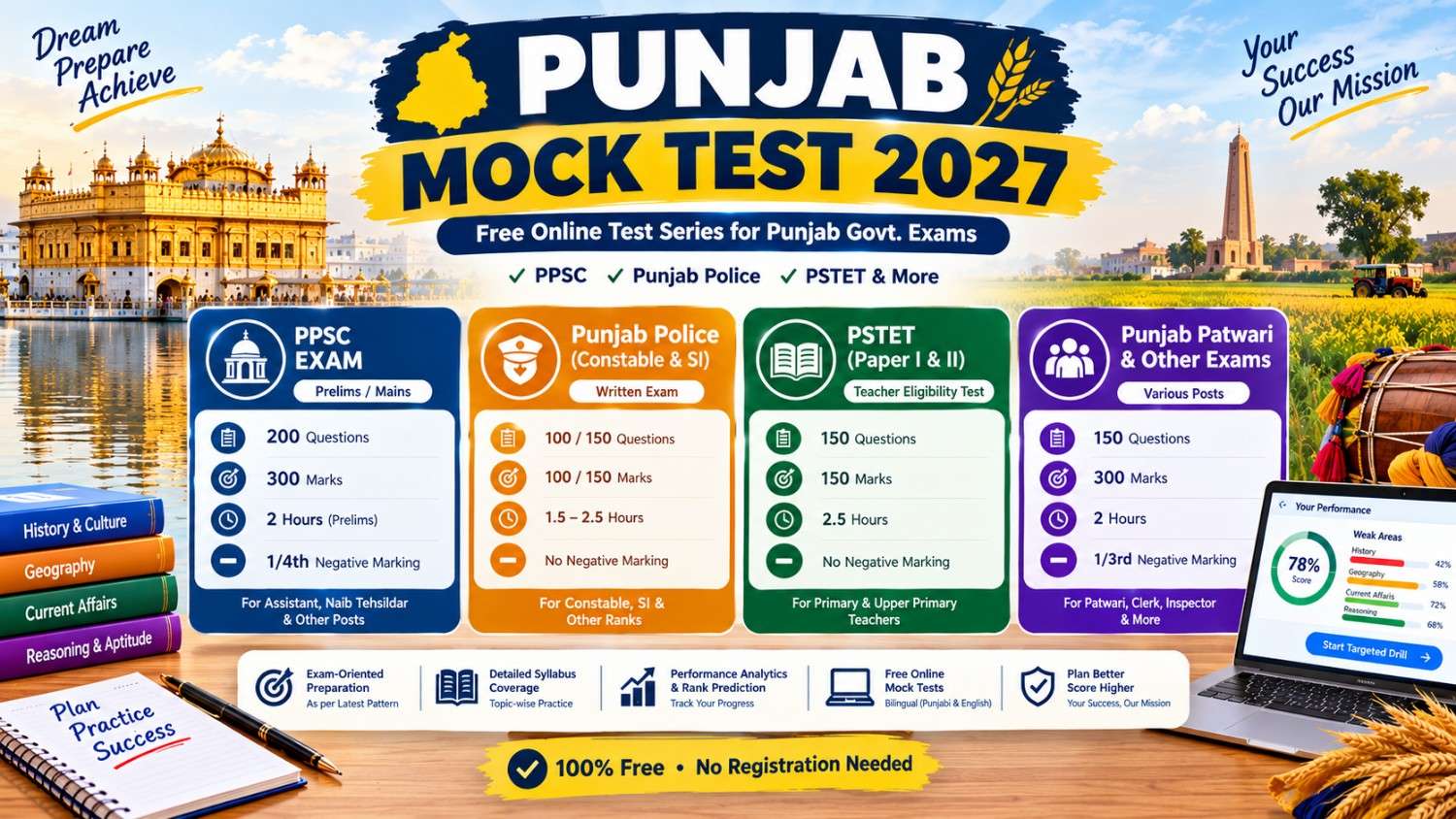 full
full
Punjab Mock Test 2027: Free PPSC, PSSSB & Police Series
Punjab Mock Test 2027: Free PPSC, PSSSB & Police Test Series Three-Tier Freshness Protocol and Disclaimer: The page separates the already established historical facts from the exam pattern as stated in the latest official notification and also contains forward-looking references concerning the 2027 cycle. As history cannot be altered, the pattern rules and the figures specific to each cycle are promptly updated whenever a new official notification is released—please refer to the linked official website to obtain the most current version before using the page. The platform serves as the central point for the Punjab government's organisation of recruitment exams at the state level and provides full-length online practice papers for the PPSC PCS, the PSSSB Group C (which covers posts such as Clerk, Patwari, Excise Inspector and VDO), the Punjab Police Constable, the Punjab Police Sub-Inspector, and the PSTET. In each test series the official rules published by the commission are included, such as the required 50-mark Part A Punjabi language qualification and the present 23-district geographical arrangement. People frequently ask things like "how to take the Punjab mock test" and "what is the difference between Part A and Part B of the PSSSB"? The portal for the Punjab mock test 2027 on SarkariMockTest provides full practice sets which conform to the official commission's standards. The questions are drawn from the standard state reference books and therefore enable you to obtain timed examination practice without the need to pay for a subscription. Quick Overview: Punjab State Examinations Hub Exam Title Conducting Agency Paper Architecture Total Questions & Marks Allotted Duration Negative Marking Structure Core Syllabus Focus PPSC PCS (Prelims) PPSC Paper I (GS) + Paper II (CSAT) 180 Qs / 400 Marks 120 Mins each Zero (No negative marking) GS (Merit) + CSAT (40% Qualifying) The PSSSB Group C (Universal) exam PSSSB consists of Part A (in Punjabi) and Part B (based on merit), with 150 questions and 150 marks; the time allowed is 60 minutes for Part A and 90 minutes for Part B; only one-quarter (0.25) of Part B is required and the passing criteria are 50% for Part A and 100 questions for Part B. Punjab Police Constable Police Selection Board Paper 1 (CBT) + Paper 2 (Punjabi) 150 Qs / 150 Marks 120 Mins + 60 Mins Zero (No negative marking) Core CBT (100M) + Punjabi (50% Pass) Punjab Police Sub-Inspector Police Selection Board Paper I + Paper II + Paper III 250 Qs / 850 Marks 120 + 120 + 120 Mins 25% (-1 Mark per error in P1 & P2) Dual 400M Papers + Qualifying Punjabi The papers for PSTET (Paper 1 and Paper 2) are conducted by SCERT Punjab and PSEB; at each level there is one paper, which includes 150 questions and carries 150 marks, the time allowed is 150 minutes (2.5 hours), negative marking does not apply and the subjects involved are Child Pedagogy, Languages and Math/EVS. Punjab State Competitive Examinations 2027 – Master Overview & Paper Matrix It is rather common for people to ask about the number of districts in Punjab as well as how the state's screening tests relate to appointments by department. When one is preparing for exams organised by various state boards, it is important to keep note of the particular blueprint for each method of recruitment. The table below gives the various testing formats, the number of questions, the educational standards, and the stages of recruitment in the major public service examinations in Punjab. State Exam Track Official Commission Paper Structure & Split Total Marks Time Limit Minimum Qualification Selection Pipeline PPSC PCS (Prelims) PPSC Paper I GS (100 Qs / 200M) + Paper II CSAT (80 Qs / 200M) 200 Marks (Merit) 120 Mins each Bachelor's Degree Prelims Screening > Mains Written (7 Papers) > Interview PSSSB Group C (Clerk/Patwari) PSSSB Part A Qualifying (50 Qs) + Part B Merit (100 Qs) 100 Marks (Merit) 150 Mins total Bachelor's Degree + Computer Course Single Written Exam > Punjabi/English Typing (for Clerk) > DV Punjab Police Constable Police Board Paper 1 Merit (100 Qs) + Paper 2 Punjabi (50 Qs) 100 Marks (Merit) 180 Mins total 10+2 (Senior Secondary) Computer-Based Test > Physical Screening (PST/PET) > DV Punjab Police Sub-Inspector Police Board Paper I (100 Qs / 400M) + Paper II (100 Qs / 400M) + Paper III 800 Marks (Merit) 120 Mins each Bachelor's Degree CBT Written Papers > Physical Screening (PST/PET) > DV For the PSTET (Paper 1: Classes 1–5) the SCERT Punjab sets 150 objective multiple choice questions amounting to 150 marks to be finished in 150 minutes, and the requirement for eligibility is the State Eligibility Certificate for teacher recruitment. For the PSTET (Paper 2: Classes 6–8) the SCERT Punjab will administer 150 objective multiple choice questions carrying a total of 150 marks to be completed within 150 minutes, and as part of the State Eligibility Certificate Test for the Master Cadre Exams, a graduate qualification with a B.Ed or its equivalent is required. It should be noted that the pattern structures, the ways in which the papers split, and the qualifying criteria are drawn from earlier official notices. Candidates should look at the exact requirements for the post in the latest notification before filling in their application forms. PUNJAB STATE COMPETITIVE EXAMS 2027 MASTER HUB ARCHITECTURE Hub Blueprint | 1. PPSC PCS Prelims: Paper I GS (200 marks), Paper II CSAT (200 marks, 40% pass) | 400 marks total | | 2. The Universal Group C — Part A in Punjabi (50 million, 50% pass) + Part B by Merit (100 million) | 150 questions / 150 million | | 3. Punjab Police Constable: Paper 1 CBT (100 marks) and Paper 2 Punjabi (50 marks, 50% Pass) | 180 minutes total | Paper I of the Punjab Police Sub-Inspector examination (400 marks), Paper II (400 marks) and Paper III (50 marks) make a total of 850 marks. | 5. PSTET (Paper 1 and Paper 2) — 150 questions | 150 marks | 150 minutes | No penalty | Part A Punjabi Qualifying Paper: Why 50% Here Decides Everything Students spend their whole preparation time on Part B and treat Part A Punjabi as something they can go through without putting in any real effort. Consequently, whenever they come across a grammar question concerning a word which they only half-remember, they lose the five marks that are the difference between passing and having a paper which is never assessed. In Punjab the qualifying exam is not just a warm-up; it functions as a gateway. O2 IAS Academy Since the Government of Punjab has altered the situation in order to promote the state language, it is now necessary for everyone taking part in state recruitment procedures to pass a separate test in the Punjabi language at the matriculation level. People who ask 'part a punjabi qualifying na kiya to kya hota hai' should understand that this exam functions as a total barrier. PART A PUNJABI LANGUAGE MANDATORY QUALIFYING FRAMEWORK Qualifying Engine | Total Questions Allotted -> 50 Multiple Choice Questions (Matriculation / 10th Standard) | | Total Marks Allocated -> 50 Marks (1 Mark per correct answer) | To pass the examination on the floor, a score of 50% is required (the candidate must score at least 25.00 marks). | Negative Marking Penalty -> Zero (No deduction for incorrect responses in Part A) | A candidate's Part B will be considered if they score 24.50 marks or less in Part A.The merit paper will not be assessed and as a result will be automatically disqualified! | Contribution to Merit -> Zero (Marks in Part A are not added to final selection ranking) | High-Yield Syllabus Units for Part A Part A tests functional Gurmukhi orthography and secondary-school grammar: ਵਿਆਕਰਨ (Punjabi Grammar) ਵਿੱਚ ਨਾਂਵ (Nouns), ਪੜਨਾਂਵ (Pronouns), ਕਿਰਿਆ (Verbs), ਵਿਸ਼ੇਸ਼ਣ (Adjectives), ਕਾਲ (Tenses), ਅਤੇ ਕਾਰਕ (Cases) ਸ਼ਾਮਲ ਹਨ. ਸ਼ਬਦ ਜੋੜ ਅਤੇ ਸ਼ੁੱਧ ਅਸ਼ੁੱਧ (Spelling Accuracy): ਸਹੀ ਲਿਖੇ ਸ਼ਬਦ ਪਛਾਣਣੇ. ਬਿੰਦੀ, ਟਿੱਪੀ ਅਤੇ ਅਧਕਾ ਨੂੰ ਠੀਕ ਥਾਂ ਤੇ ਲਗਾਉਣਾ. ਸਮਾਨ ਅਰਥ ਵਾਲੇ ਅਤੇ ਵਿਰੋਧੀ ਸ਼ਬਦ (Vocabulary): ਆਮ ਵਿਰੋਧੀ. ਸਮਾਨ ਸ਼ਬਦ. ਸੰਦਰਭ 'ਤੇ ਨਿਰਭਰ ਕਰਨ ਵਾਲੀਆਂ ਸ਼ਬਦ ਜੋੜੀਆਂ. Idioms and proverbs (Idioms & Proverbs): Questions relating to the appropriate use of classical Punjabi proverbs (ਅਖੌਤਾਂ) and idioms (ਮੁਹਾਵਰੇ). ਇਕ ਸ਼ਬਦ ਦੀ ਥਾਂ ਬਹੁਤੇ ਸ਼ਬਦ (One-Word Substitutions): ਰੋਜ਼ਾਨਾ ਬੋਲਚਾਲ ਦੀਆਂ ਮਿਸਾਲਾਂ ਜੋ ਇਕ ਗੁਰਮੁਖੀ ਸ਼ਬਦ ਵਿੱਚ ਇਕੱਠੀਆਂ ਕੀਤੀਆਂ ਜਾਂਦੀਆਂ ਹਨ. The administrative translation between English and Punjabi involves the official administrative vocabulary and functional terminology. The entire range of full-length PSSSB and Police practice tests offered on SarkariMockTest features an independent Part A section with an automated function that monitors a 50% threshold, ensuring that you will never be in danger of being disqualified on the day of the exam. Why Most Punjab Mock Tests Fall Short Many online test platforms fail to prepare candidates for state examinations: The Part A Punjabi Simulator has been left out; the general portals have combined the ten basic language questions into one general paper without considering the separate 50-question qualifying paper and its requirement to pass with at least 50%. The questions which are based on the previous arrangement comprising 22 districts still reuse the same question banks, failing to take into account the fact that Malerkotla is the 23rd district and as a result they confuse the administrative boundaries. The rules of the PPSC PCS CSAT set up a confusion since commercial websites tend to add the marks obtained in Paper I and Paper II together to make a combined merit total of 400, without explaining that Paper II (CSAT) is a paper which has a 40% qualifying requirement and it is only Paper I that determines the shortlist for the Mains. O2 IAS Academy The police SI negative marking data is contradictory: general-purpose applications give conflicting figures for negative marking without explaining that a 25% penalty on a four-mark question amounts to an exact deduction of 1.00 mark for each incorrect answer. Regional test blogs often show corrupted Punjabi fonts, missing vowel marks (Lagamatras), and wrong spellings which confuse the candidates when going over the material. Choose Your Exam: Free Punjab Online Mock Tests To get access to complete practice sets and diagnostic tools, please choose the exam you would like to take from the list given below. 1. Mock test for the PPSC PCS Prelims (Paper I GS and Paper II CSAT) This mock test is designed for the preliminary combined screening examination for the Executive Branch, DSP, and Tehsildar posts: Section I: General Studies (100 questions / 200 marks / 120 minutes): This part includes topics on Indian History, Geography, Indian Polity, the Economy, Science, and general knowledge specific to Punjab. It is employed in determining whether or not you will be shortlisted for the Mains exam. Paper II: Civil Services Aptitude Test (80 questions, 200 marks, 120 minutes) examines skills in reading comprehension, logical reasoning, mental ability and basic numeracy, and candidates have to achieve at least the required passing mark of 40% (which equals 80 marks). Status: Now available 2. PSSSB Group C Mock Test (Clerk, Patwari, Excise, VDO) This test follows the standard two-part selection system: Part A (50 questions / 50 marks / 60 minutes) contains a compulsory Punjabi language section with a 50% pass mark and does not include negative marking. Part B (100 questions worth 100 marks and lasting 90 minutes) includes General Knowledge and Punjab-specific GK (30 questions), Mental Ability and Reasoning (15 questions), Arithmetic (15 questions), General English (10 questions), General Punjabi (10 questions), Computer Basics (10 questions), and Punjab Culture (10 questions), with a penalty of one-quarter of a mark for incorrect answers. Status: Now available 3. Mock test for Punjab Police Constable (Paper 1 and Paper 2) The test is structured for candidates applying for District and Armed Police posts: Paper 1 has 100 questions, 100 marks, and lasts 120 minutes. It covers General Awareness with 35 questions, Quantitative Aptitude with 20 questions, Mental Ability and Reasoning with 20 questions, English Language with 10 questions, Punjabi Language with 10 questions, and Digital Literacy with 5 questions. There is no negative marking. Paper 2 (50 questions, 50 marks, 60 minutes) includes a compulsory Punjabi Language paper for which a minimum passing mark is 50%. Status: Now available 4. Mock test for sub-inspector of the Punjab Police This test is intended for those applying for technical, intelligence, and investigation positions: Paper I has 100 questions, 400 marks, and lasts 120 minutes. It covers General Awareness with 50 questions, Quantitative Aptitude and Numerical Skills with 30 questions, and Punjabi Language with 20 questions. Each question gives 4 marks. You lose 1 mark for every wrong answer, which is 25 percent of the question's value. Paper II (100 questions, 400 marks, 120 minutes) consists of Logical and Analytical Reasoning (50 questions), Digital Literacy and Computer Awareness (30 questions), and English Language (20 questions), with a penalty of 1.00 mark for each incorrect answer. Paper III (50 questions / 50 marks / 120 minutes) is a compulsory qualifying paper in Punjabi Language, requiring a minimum score of 50% to pass and with no penalty for incorrect answers. Status: Now available 5. The PSTET mock test (Paper 1 and Paper 2) This test is in line with the Punjab State Teacher Eligibility Test conducted by SCERT Punjab: Paper 1 (for Primary Teachers in Classes I to V): consists of 150 questions in the areas of Child Development and Pedagogy, Language I (Punjabi), Language II (English), Mathematics, and Environmental Studies. Paper 2 (for the Upper Primary and Master Cadre students in Classes VI to VIII) consists of 150 questions in the areas of Child Development, Language I, Language II, and the specialised subject streams (Mathematics & Science or Social Studies). Status: Now available (negative marking is not applied) Punjab Special GK: Sikh History, the Freedom Struggle and Regional Geography The regional history, the lineage of the Sikh Gurus, the struggle for national freedom, and the geography of the 23 administrative districts are all given great importance by the examinations conducted by PPSC, PSSSB and the Punjab Police. PUNJAB SPECIAL GENERAL KNOWLEDGE: FOUR STRUCTURAL PILLARS GK Pillars | Pillar 1: Sikh Gurus & Empire -> Guru Nanak Dev Ji to Guru Gobind Singh Ji, Ranjit Singh | | Pillar 2: Freedom Struggle -> Kuka, Ghadar Movement, Jallianwala Bagh, Bhagat Singh | | Pillar 3: Post-Independence Era -> PEPSU (1948-1956), Shah Commission & 1966 Reorganisation | | Pillar 4: 23 Districts & Regions -> Majha, Doaba, Malwa Cultural Divisions, River Drainage | 1. The Ten Sikh Gurus (1469–1708 CE) The spiritual, social, and martial traditions of Punjab were established during the period of the Ten Sikh Gurus (1469–1708 CE): Guru Nanak Dev Ji (1469–1539 CE) was born in Rai Bhoi Ki Talwandi (which is now Nankana Sahib, in Pakistan); he founded Sikhism, established the institutions of Guru Ka Langar (the community kitchen) and Sangat (congregation), composed the Japji Sahib, and founded the settlement of Kartarpur on the banks of the Ravi River. Guru Angad Dev Ji (1504–1552 CE) standardised and promoted the Gurmukhi script, gathered together the hymns of Guru Nanak Dev Ji, and encouraged physical fitness by means of the Mal Akhara. Guru Amar Das Ji (1479–1574 CE) established the Manji system (which consisted of 22 administrative divisions) in order to disseminate the teachings, opposed the practice of Sati and the custom of wearing the veil (Purdah), and constructed the historic Baoli (a stepwell having 84 steps) in Goindwal Sahib. Guru Ram Das Ji (1534–1581 CE) founded the holy city of Amritsar (at first known as Chak Ram Das or Ramdaspur) on land which was given to him by the Mughal emperor Akbar, excavated the sacred Sarovar, and composed the Lavan hymns for use at the Sikh wedding ceremony (Anand Karaj). Guru Arjan Dev Ji (1563–1606 CE) finished the building of Sri Harmandir Sahib and laid its foundation stone in 1589 together with the Sufi saint Mian Mir. In 1604 he compiled the Adi Granth and put it at Harmandir Sahib, with Baba Buddha Ji acting as the first Granthi. He was the first Sikh martyr since, under the orders of the Mughal Emperor Jahangir, he was executed at Lahore in 1606. Guru Hargobind Ji (1595–1644 CE) introduced the concept of Miri and Piri (temporal and spiritual sovereignty), constructed the Akal Takht (the Throne of the Timeless) in 1606 opposite Sri Harmandir Sahib, kept a standing military force, and fought defensive battles against the Mughal forces. Guru Har Rai Ji (1630–1661 CE) and Guru Har Krishan Ji (1656–1664 CE): Guru Har Rai maintained cavalry units and established herbal dispensaries; Guru Har Krishan (who was the youngest Guru and became Guru at the age of five) looked after those suffering from smallpox and cholera at the site of Gurdwara Bangla Sahib in Delhi before he died. Guru Tegh Bahadur Ji (1621–1675 CE) was known as Hind Di Chadar (Protector of Humanity); he founded the town of Anandpur Sahib in 1665 and was executed at Chandni Chowk in Delhi on 11 November 1675 on the orders of the Mughal Emperor Aurangzeb because he had defended the religious freedom of the Kashmiri Pandits. Guru Gobind Singh Ji (1666–1708 CE) was born in Patna Sahib. On Baisakhi Day (13 April 1699) at Anandpur Sahib he founded the Khalsa Panth and gave the Panj Pyare (the Five Beloved Ones) Amrit, at the same time prescribing the Five Ks (Kesh, Kangha, Kara, Kachera and Kirpan). He fought several heroic defensive battles against the imperial forces, among these being the Battle of Chamkaur (in which his elder sons, Sahibzada Ajit Singh and Jujhar Singh, were killed) and the Battle of Muktsar (in 1705). His younger sons, Sahibzada Zorawar Singh and Fateh Singh, were crushed to death at Sirhind as a result of orders issued by Wazir Khan. He brought to an end the line of human Gurus at Nanded in 1708 by conferring upon Sri Guru Granth Sahib Ji eternal spiritual authority. 2. Maharaja Ranjit Singh and the Sikh Empire Banda Singh Bahadur (1670–1716 CE) was given the task by Guru Gobind Singh Ji of leading the struggle in Punjab; he captured Samana, defeated Wazir Khan at the Battle of Chappar Chiri (in May 1710), established the first independent Sikh state with its capital at Mukhlisgarh (Lohgarh), abolished the feudal Zamindari system, and put into circulation coins inscribed with the names of Guru Nanak and Guru Gobind Singh. In the 18th century the Sikh warriors established 12 separate military confederacies (the Misls), such as the Bhangi, Ahluwalia, Sukerchakia, Phulkian, Ramgarhia, and Kanheya misls, and gathered at the Akal Takht to adopt the biannual Sarbat Khalsa resolutions (Gurmata). Maharaja Ranjit Singh (The Lion of Punjab: 1780–1839 CE): Coming from the Sukerchakia Misl, Ranjit Singh united the region of Punjab: In 1799 he took Lahore and made it his imperial capital; he was then crowned as Maharaja on Baisakhi Day in 1801. In 1802 he took Amritsar, in 1818 Multan, in 1819 Kashmir, and in 1834 Peshawar. He agreed to the Treaty of Amritsar (on 25 April 1809) with the British East India Company (whose representative was Charles Metcalfe) and fixed the Sutlej River as the permanent border between his empire and the areas held by the British. He modernised his army (the Fauj-i-Khas) by hiring European military instructors (for example, General Allard and General Ventura) and in 1830 he covered the upper domes of Sri Harmandir Sahib with gold-plated copper sheets. The decline and British annexation: After the death of Ranjit Singh in 1839, political instability resulted in the First Anglo-Sikh War (1845–1846), which ended with the Treaty of Lahore. The Second Anglo-Sikh War (1848–1849) concluded with the defeat of the Sikh forces, and on 29 March 1849 Governor-General Lord Dalhousie formally annexed Punjab into the British Empire. 3. Freedom Struggle: Ghadar, Jallianwala Bagh, and Bhagat Singh The socio-political anti-colonial movement known as the Kuka (Namdhari) Movement was started by Baba Balak Singh and was developed by Satguru Ram Singh, who promoted Swadeshi, non-cooperation, and the protection of cows. In January 1872, following the disturbances in Malerkotla, the British authorities executed 66 of the Namdhari followers by blowing them up with artillery fire without first trying them. The Ghadar Party, established in 1913 by Punjabi emigrants in North America, had its origins in Astoria, Oregon, and its headquarters was located at the Yugantar Ashram in San Francisco; the main figures in the party were Lala Hardayal, Sohan Singh Bhakna (who served as the first President), Kartar Singh Sarabha, and Rash Behari Bose. The party published a weekly journal named Ghadar in both Gurmukhi and Urdu, promoting an armed revolution in British India. In 1914 the Komagata Maru incident concerned a Japanese steamship which had been organised by Baba Gurdit Singh and on which 376 passengers (mostly Punjabi Sikhs and Muslims) were travelling to Vancouver in Canada. The passengers were turned away because of discriminatory immigration laws and the ship then returned to Budge Budge near Calcutta in September 1914, where the British police opened fire on them, killing 20 of the passengers and putting the rest into prison. On the day of Baisakhi, 13 April 1919, thousands of peaceful civilians gathered in Jallianwala Bagh in Amritsar in order to object to the arrests of the nationalist leaders Dr. Saifuddin Kitchlew and Dr. Satyapal, who had been arrested under the Rowlatt Act. Brigadier-General Reginald Dyer blocked the only narrow entrance and ordered the troops to open fire on them without any warning, which caused a great many deaths. As a protest, Rabindranath Tagore renounced his British knighthood. The colonial government then established the Hunter Commission to investigate the matter. The Amritsar massacre had a great effect on Udham Singh, who later killed Michael O'Dwyer, the Lieutenant Governor of Punjab during the 1919 shootings, at Caxton Hall in London on 13 March 1940; he was then executed at Pentonville Prison on 31 July 1940. Shaheed Bhagat Singh and the HSRA: He was born in 1907 in Banga (Lyallpur). In 1926 he founded the Naujawan Bharat Sabha. He joined the Hindustan Socialist Republican Association (HSRA) along with Sukhdev, Rajguru and Chandrashekhar Azad. After Lala Lajpat Rai had died as a result of the police batons being used on him during the protests against the Simon Commission in 1928, Bhagat Singh and Rajguru carried out the assassination of John Saunders, the assistant police superintendent, in Lahore in December 1928. On 8 April 1929 Bhagat Singh and Batukeshwar Dutt threw non-lethal smoke bombs into the Central Legislative Assembly in Delhi with the aim of 'making the deaf hear'. Bhagat Singh, Rajguru and Sukhdev were executed at the Lahore Central Jail on 23 March 1931 (Shaheed Diwas). 4. The reorganization of PEPSU in 1966 and the three cultural areas PEPSU (Patiala and East Punjab States Union 1948–1956) was formed on 15 July 1948 by the union of eight princely states, namely Patiala, Nabha, Jind, Faridkot, Kapurthala, Malerkotla, Kalsia and Nalagarh; Yadavindra Singh, who was the Maharaja of Patiala, was made Rajpramukh and Gian Singh Rarewala served as the first Chief Minister, the administrative capital remaining Patiala. PEPSU was then officially incorporated into Punjab on 1 November 1956 as a result of the States Reorganisation Act. Because of the peaceful mass demonstrations organised by the Akali Dal as part of the Punjabi Suba Movement (a movement led by Master Tara Singh and Sant Fateh Singh), the Central Government established the Justice J.C. Shah Commission in 1966 with a view to defining the boundaries on a linguistic basis; the Punjab Reorganisation Act then came into effect on 1 November 1966: The southern districts in which Hindi is spoken were created with the aim of setting up the new state of Haryana. The hilly districts (Kangra, Shimla and Kullu) were assigned to Himachal Pradesh. Chandigarh was established as a Union Territory and served as the common capital for both Punjab and Haryana. The Three Cultural & Geographic Regions: The Middle (Majha) region is the historical centre located between the Ravi and Beas rivers and comprises four districts: Amritsar, Gurdaspur, Tarn Taran and Pathankot; it is the core area of religious heritage and stands as the standard variety of the Punjabi language (the Majhi dialect). The region of Doaba, which translates as "Between Two Rivers", is a fertile alluvial area lying between the Beas and Sutlej rivers and comprises the four districts of Jalandhar, Hoshiarpur, Kapurthala and Shaheed Bhagat Singh Nagar (Nawanshahr); it is famous for NRI emigration and the growing of potatoes. The region of Malwa is the largest in area, situated to the south of the Sutlej River and made up of 15 districts (including Ludhiana, Patiala, Bathinda, Sangrur, Malerkotla, Ferozepur, Fazilka, Mansa, Moga, Sri Muktsar Sahib, Barnala, Faridkot, Fatehgarh Sahib, SAS Nagar Mohali and Rupnagar); it is the main area for agricultural production and for the cultivation of cotton. The area known as the 23rd District (Malerkotla): On 14 May 2021 (that is, Eid-ul-Fitr) the state government formally announced that Malerkotla should be detached from Sangrur district and be established as the 23rd administrative district of Punjab, thus preserving the historical legacy of Nawab Sher Mohammad Khan, who had in 1704 opposed the execution of the younger Sahibzadas. The Ramsar Wetlands in Punjab consist of the Harike Wetland (situated at the point where the Beas and Sutlej rivers converge in Tarn Taran/Ferozepur and thus serves as a principal wintering ground for migratory ducks), the Kanjli Wetland (located in Kapurthala on the Kali Bein rivulet), and the Ropar Wetland (in Rupnagar on the Sutlej). Pattern & Negative Marking Across Punjab Exams People frequently ask, "In the Punjab exams, how much is the negative marking?" and get confused by the different advice given online. In Punjab the rules about negative marking are essentially different depending on the examining board. Negative marking is used in the merit lists for the PSSSB and Punjab Police SI examinations, but there is no negative marking in the PPSC PCS Prelims and Punjab Police Constable tests. O2 IAS Academy Negative Marking & Duration Comparison Table State Examination Paper Name & Category Total Questions & Marks Allotted Duration Negative Marking Penalty Operational Strategy PPSC PCS (Prelims) Paper I (General Studies) 100 Qs / 200 Marks 120 Minutes Zero (No Negative Marking) 100% attempt rate; only Paper I decides Mains shortlist PPSC PCS (Prelims) Paper II (CSAT Aptitude) 80 Qs / 200 Marks 120 Minutes Zero (No Negative Marking) Secure 40% pass floor (80 Marks); marks do not add to merit PSSSB Group C Part A (Qualifying Punjabi) 50 Qs / 50 Marks 60 Minutes Zero (No Negative Marking) Must score 25+ marks; zero penalty enables full attempt The PSSSB Group C Part B (Main Merit Paper) consists of 100 questions carrying a total of 100 marks, the time allowed is 90 minutes and a penalty of one-quarter of a mark (–0.25 marks) is imposed; candidates are required to eliminate two options before attempting them and should avoid random guessing. Punjab Police Constable Paper 1 (CBT Merit) 100 Qs / 100 Marks 120 Minutes Zero (No Negative Marking) Complete all 100 questions; zero deduction for errors Punjab Police Constable Paper 2 (Qualifying Punjabi) 50 Qs / 50 Marks 60 Minutes Zero (No Negative Marking) Must score 25+ marks to qualify for physical assessment The Punjab Police Sub-Inspector Paper I (covering General Awareness, Mathematics, and Punjabi) consists of 100 questions worth a total of 400 marks, with a time limit of 120 minutes and a 25% penalty (resulting in a deduction of 1.00 mark); each question is awarded 4 marks but a wrong answer leads to a deduction of 1 mark. Paper II of the Punjab Police Sub-Inspector examination (in the subjects of Reasoning and English) had 100 questions summing to 400 marks, with a time limit of 120 minutes, a 25% penalty (that is, 1.00 mark was deducted) and a requirement for a high degree of accuracy since each error cost one mark. The Paper III (Qualifying Language) for the Sub-Inspector level of the Punjab Police consists of 50 questions carrying 50 marks and has a time limit of 120 minutes; negative marking is not used and in order to qualify for the gatekeeper paper a candidate must score 25 marks or more. PSTET (Paper 1 & 2) Teacher Eligibility 150 Qs / 150 Marks 150 Minutes Zero (No Negative Marking) Mandatory 100% attempt rate; leave zero blanks Time Allocation Blueprint: PSSSB Group C (150 Minutes for Part A & Part B) Managing your time properly across both sessions ensures you pass Part A and score high on Part B: In session 1, part A, the Punjabi qualifying section (from minute 00 to 60), you will have 60 minutes in which to answer 50 questions on grammar and spelling. Since no mathematical calculations are required in Punjabi, be sure to read each question carefully and answer it steadily. You should complete all 50 questions within 35 to 40 minutes and achieve a passing score of 25 marks or higher without suffering any negative marking. O2 IAS Academy In Session 2, during Round 1: Part B, which covers the direct factual questions (from minute 60 to 95), start the 100-question merit paper by answering the factual questions in the areas of General Knowledge, Punjab History, Computer Basics, and Language Grammar, andtry to correctly solve between 45 and 50 of them within 35 minutes. GoTest Pk In session two, during the second round on reasoning and mental ability (from minute 95 to minute 130), work through the numerical aptitude questions, series puzzles, and logical deductions by using scratch paper, spending 35 minutes on the 30 mathematical and logical questions. In session two, round three, from minute 130 to minute 150, spend your last 20 minutes going over the items that have been flagged, eliminating two options from them, checking your calculations, and making sure that all the entries on the answer sheet are complete. RECOMMENDED TIME ALLOCATION PROFILE: PSSSB GROUP C (PART A + PART B) Time Profile | [====] Part A: Punjabi Qualifying (60 Mins) -> 50 Questions | Secure 25+ Marks Safely | | [===] Part B - Round 1: GK, Comp, Lang (35 Mins) -> ~48 Direct Factual Questions Cleared | | [===] Part B - Round 2: Math & Reasoning (35 Mins)-> ~30 Arithmetic & Logic Solutions | | [==] Part B - Round 3: Review & Checks (20 Mins) -> Verification & Calculated Risk Control | | TOTAL DURATION: 150 MINUTES | 150 QUESTIONS | PASS GATEKEEPER FIRST, THEN MAXIMIZE MERIT | Test Series Structure & Coverage Matrix Our testing program organizes your preparation step-by-step from individual topic drills to full-length exam simulations: Level & Segment Sections Covered Tests Offered Question Format Focus & Exam Alignment Tier 1: Sectional Drills Part A Punjabi, Punjab GK, Math, Logic, Computers 24 Tests (25 Qs / 25 Mins) Timed topic-level drills Builds speed and mechanical recall Tier 2: Full Simulations Complete Composite Syllabus Formats 14 Tests (150 Qs / 150 Mins) Full multi-part simulation Builds complete exam stamina & accuracy Tier 3: Punjab GK Labs Sikh History, 23 Districts, Rivers, Freedom Struggle 6 Labs (50 Qs / 50 Mins) Chronology, district landmarks Targets high-weightage state modules Tier 4: Shift-Style Mocks Complete Composite Syllabus 4 Tests (100 Qs each) Past-shift style questions Real exam trend and format familiarity Worked Sample Questions with Complete Explanations Look at these sample questions. They show local detail, language rules, the order of questions, and explanations for four answer choices. Sample 1: Part A Mandatory Punjabi Language (Grammar & Orthography) SAMPLE QUESTION: PART A MANDATORY QUALIFYING PUNJABI Punjabi Grammar | ਪ੍ਰਸ਼ਨ: ਹੇਠ ਲਿਖੇ ਸ਼ਬਦਾਂ ਵਿੱਚੋਂ ਕਿਹੜਾ ਸ਼ਬਦ 'ਅਗਵਾਈ' ਦੇ ਸਮਾਨ ਅਰਥ ਵਾਲਾ ਸ਼ਬਦ ਸਹੀ ਤਰੀਕੇ ਨਾਲ ਵਰਤਿਆ ਜਾਂਦਾ ਹੈ? | | (A) ਅਧੀਨਗੀ | | (B) ਨੇਤ੍ਰਿਤਵ (ਲੀਡਰਸ਼ਿਪ) | | (C) ਬੇਵੱਸੀ | | (D) ਅਸਮਰੱਥਾ | | ਸਹੀ ਉੱਤਰ: (B) ਨੇਤ੍ਰਿਤਵ (ਲੀਡਰਸ਼ਿਪ) | | ਸੰਕਲਪ ਦੀ ਵਿਆਖਿਆ: | | ਵਿਕਲਪ (B) ਕਿਉਂ ਸਹੀ ਹੈ: | | ਪੰਜਾਬੀ ਵਿਆਕਰਨ ਅਨੁਸਾਰ 'ਅਗਵਾਈ' ਦਾ ਅਰਥ ਕਿਸੇ ਮੁਹਿੰਮ, ਜਥੇਬੰਦੀ ਜਾਂ ਸਮੂਹ ਨੂੰ ਅੱਗੇ ਹੋ ਕੇ ਰਸਤਾ ਦਿਖਾਉਣਾ ਜਾਂ | | ਅਗਵਾਈ ਕਰਨਾ ਹੁੰਦਾ ਹੈ, ਜਿਸਦਾ ਸਮਾਨਾਰਥੀ ਸ਼ਬਦ 'ਨੇਤ੍ਰਿਤਵ' ਜਾਂ 'ਰਹਿਨੁਮਾਈ' ਹੈ। | | ਬਾਕੀ ਵਿਕਲਪ ਕਿਉਂ ਗਲਤ ਹਨ: | | - ਵਿਕਲਪ (A): 'ਅਧੀਨਗੀ' ਦਾ ਅਰਥ ਕਿਸੇ ਦੇ ਅਧੀਨ ਹੋਣਾ ਜਾਂ ਗੁਲਾਮੀ ਸਵੀਕਾਰ ਕਰਨਾ ਹੈ (ਵਿਰੋਧੀ ਭਾਵ)। | | - ਵਿਕਲਪ (C): 'ਬੇਵੱਸੀ' ਦਾ ਅਰਥ ਲਾਚਾਰੀ ਜਾਂ ਮਜਬੂਰੀ ਹੁੰਦਾ ਹੈ। | | - ਵਿਕਲਪ (D): 'ਅਸਮਰੱਥਾ' ਕਿਸੇ ਕੰਮ ਨੂੰ ਕਰਨ ਦੇ ਯੋਗ ਨਾ ਹੋਣ ਨੂੰ ਦਰਸਾਉਂਦੀ ਹੈ। | Sample 2: Punjab Special GK (Freedom Struggle & Peasant Agitations) SAMPLE QUESTION: MODERN PUNJAB FREEDOM STRUGGLE & REBELLIONS Freedom Struggle | Question: In January 1872, British colonial authorities executed 66 peaceful followers of the | The Kuka (Namdhari) movement received artillery fire which blew them up without first carrying out any regular trials. In which of the princely states of Punjab did this historic event take place? | (A) Patiala | | (B) Nabha | | (C) Malerkotla | | (D) Kapurthala | | CORRECT ANSWER: (C) Malerkotla | | Step-by-Step Concept Explanation: | | Why Option (C) is Correct: | | In January 1872, following clashes over cattle slaughter, a contingent of Namdhari (Kuka) Sikhs | went into the princely state of Malerkotla; the British Deputy Commissioner, L. Cowan, gave the order to| | summary execution of 66 Namdhari prisoners at the parade ground in Malerkotla by tying them to | The cannons were put into use without any trial being conducted; this is remembered by the historic Kuka Smarak in Malerkotla. The sacrifice made in Punjab's struggle for freedom. | Why Other Options Are Incorrect: | – Option (A): Even though Patiala was the largest of the Phulkian states it was not the place where the cannon was fired. — Option (B): Nabha was ruled by Maharaja Ripudaman Singh, who was an ally of the nationalist movement. (D) Kapurthala was a princely state which was part of the Ahluwalia misl and lay in the Doaba region. Product Features: How Our Analytics Work Our practice platform includes analytical tools designed to help you prepare across state examinations: Part A 50% Threshold Tracking The dashboard maintains its own record of your performance in the required qualifying language paper, and the system will immediately notify you that your Part B paper will not be assessed if your score in Part A is below 25.00 marks. 23-District Regional GK Diagnostics The diagnostic system included in the 23-District Regional GK Diagnostics keeps an eye on your performance in the Majha, Doaba, and Malwa regions and, if your accuracy drops with regard to Sikh history, events from the freedom struggle, or wetland geography, generates a set of specific 10-question practice exercises to address those areas of weakness. All India & Punjab State Rank Leaderboard A leaderboard that displays the rankings for India and the Punjab state allows you to compare your score, pacing speed, and percentile with other candidates who are currently active in Ludhiana, Amritsar, Jalandhar, Patiala, Bathinda, and Mohali. 📊 View All India & State Rank Leaderboard 🤖 AI-Based Weak Area Diagnostic Tool Personalized Diagnostics For each of the four options there is an explanation: for a given question, the explanation section makes it clear why the correct answer is right and also explains why the other three answers are wrong, referring to publications by the Punjab School Education Board (PSEB) and Punjabi University Patiala. Diagnostic Summary: Tracks accuracy percentages across Part A Gurmukhi grammar, 23-district geography, Sikh history, and quantitative aptitude. Generates targeted corrective sprint drills based on your test logbook. ⚡ Launch AI Weak-Area Diagnostic Tool ⚡ Daily State & National Booster 15-Min Daily Quiz Free Daily Current Affairs Practice Maintain broader awareness across national developments and Punjab state cabinet policies with our free daily quiz: 👉 Take the Free Daily Current Affairs Quiz How to Attempt Free Punjab Mock Tests on Sarkari Mock Test Getting started on our platform takes less than two minutes: To get to the portal, you should go to SarkariMockTest.com and then select Punjab Hub from the navigation menu. You should select the exam that you want to take from the following: PPSC PCS Prelims, PSSSB Group C (Clerk/Patwari), Punjab Police Constable, Punjab Police SI, or PSTET. To begin the Simulator: click on 'Start Free Mock Test'. A testing console will then appear, featuring a countdown timer particular to the exam, a palette which displays the status of the questions, and a button for changing the language. To solve it and submit your answers, complete Part A (the qualifying section) and Part B (the merit section), then click Submit Examination in order to view your immediate scorecard, the percentile rank for your state, and the explanations for each question. Preparation Strategy + Important Books & Resources per Exam Follow this structured preparation strategy and use standard academic reference books: Examination Track High-Yield Topics to Master Authoritative Reference Books The subjects covered in the PPSC PCS (Prelims) are Punjab History and Culture, Indian Polity, the Economy, the Environment, and Logical Reasoning. The books that are recommended are 'A History of the Sikhs' by Khushwant Singh; 'Punjab Economy', published by the standard university presses; 'Indian Polity' by M. Laxmikanth; and the 'CSAT Manual' by the standard publishers. PSSSB Group C (Clerk/Patwari) Part A Punjabi (Matric Level), Punjab GK, Mental Ability, Everyday Computers. Use Vadda Punjabi Vyakaran by Punjab School Education Board (Classes 9 and 10), Punjab Darpan or standard state compendiums, and Quantitative Aptitude by R.S. Aggarwal. In the case of the Punjab Police (for the Constable and SI positions) the topics covered were General Awareness, Reasoning, Numerical Skills, Basic Digital Literacy, and Punjabi. The prescribed textbooks were the Mathematics textbooks from the PSEB for Classes 9 and 10, together with Computer Awareness from standard publications and Objective General Knowledge by Lucent. For PSTET (Paper 1 and Paper 2) the subjects include Child Development and Pedagogy, Language I in Punjabi, and Environmental Studies together with Mathematics, using the PSEB textbooks for primary and upper primary schools (for Classes 1 to 8) as well as the standard B.Ed and D.El.Ed pedagogical reference modules. Common Mistakes Punjab Aspirants Make If you spend all your time studying general studies and only give Punjabi grammar a casual look, you will end up scoring below the 25-mark pass level and as a result your entire merit paper will be disqualified. The use of materials which are based on the previous geographical arrangement of the 22 districts—since they make use of the resources prepared before May 2021—leads to incorrect answers in cases involving Malerkotla and the regional boundaries. Taking the PPSC CSAT into account when assessing merit by rather than focusing on meeting the required 40% qualifying standard while also aiming for a high score in Paper I, including Paper II of the PCS Prelims in the merit calculation. The error of failing to take account of the negative marking in the police Sub-Inspector examinations—specifically, the fact that when people guess at random on the 400-mark Sub-Inspector papers they have a full 1.00 mark deducted (which amounts to a 25% penalty)—can cancel out scores which have been carefully achieved. In exams that carry no penalty it should be remembered that the PPSC PCS Prelims, the Punjab Police Constable exam, and the PSTET all have no negative marking, which would otherwise mean that each question left blank is a lost opportunity for obtaining marks. O2 IAS Academy Why Attempt This Free Punjab Test Series Hub Preparing with full-length simulations matched to state standards builds both speed and conceptual clarity: Parameter Unorganized Fragmented Preparation SarkariMockTest Unified Punjab Hub Platform Model Multiple paywalls across different commercial apps Single free, unified hub covering all major state exams Part A Punjabi Simulation Omitted or treated as a minor addition Standalone 50-mark simulator with automated 50% pass tracking District Geography Outdated 22-district materials Fully updated to the 23-district setup including Malerkotla Marking Accuracy Conflicting or generic negative marking numbers Exact exam-specific penalties applied (1/4th, 25% of 4 marks, or Zero) Why This Mock Test Series Was Put Together I am Shubham Kumar Sah and I have founded SarkariMockTest.com; even though a number of the exam platforms that I have examined leave out the Part A Punjabi qualifying paper completely, they continue to show Punjab with twenty-two districts, long after Malerkotla had become the twenty-third district. The two points most frequently ignored are these: first, Part A decides whether or not Part B is assessed, even though very few free test series pay it the attention it deserves; and second, a candidate taking preparation for more than one Punjab examination has to gather patterns from a number of different sources, with no single reliable starting point. The system makes use of both options; for each exam there is a particular Part A Punjabi simulator that shows clearly if the candidate has passed or failed. The district map displays the twenty-three districts which are currently in existence. In all the explanations both the reasoning and the answer key are included. Scribd The test series will continue to be free as long as the exam-specific page is live, since the state-specific diagnostic does not need a paywall. As I work on this hub, I make it a point of checking every exam page to ensure that it is testing the actual gatekeeper rules according to which the exam functions, rather than a simplified national template; and if it isn't doing so, the page is not included. Official Portals & Recruitment Notification Links Use these verified official portals to track examination notifications, download syllabus documents, and review declared results: Department / Commission Official Website Link Primary Purpose for Candidates The Punjab Public Service Commission (PPSC) ppsc.gov.in issues advertisements for recruitment and publishes the results for posts such as PCS, Section Officer, and Subordinate Gazetted officers. The website of the Punjab Subordinate Services Selection Board sssb.punjab.gov.in and on it notices relating to Group C recruitment (for example for the posts of Clerk, Patwari, Excise Inspector and VDO) and typing tests can be found. The Punjab Police Recruitment Board punjabpolice.gov.in publishes information regarding job advertisements for Police Constable and Sub-Inspector positions and also gives the dates of the physical trials. The State Council for Educational Research and Training scert.punjab.gov.in issues notices, publishes syllabi and provides scorecards for the Punjab State Teacher Eligibility Test (PSTET). The Punjab Master Hub on sarkarimocktest.com sarkarimocktest.com provides free full-length mock tests, practice exercises for the Punjabi qualifying section (Part A), and state scorecards. Practical Preparation Advice: Part A Discipline and 23-District Mastery If people want to pass the competitive exams in Punjab they must carry out systematic revision of the subject matter concerning regional history, geography and language standards. The fact that Part A Punjabi serves as an absolute qualifying hurdle in the cases of recruitment by the PSSSB and that regional general knowledge is very important in the PPSC PCS examinations means that depending only on national-level study materials leads to a number of blind spots. Every morning allocate 45 minutes to going through the standard Gurmukhi grammar textbooks for Classes 9 and 10 that are published by the Punjab School Education Board, paying particular attention to spelling rules, the case markers (ਕਾਰਕ), and classical Punjabi proverbs (ਅਖੌਤਾਂ). Each day spend 45 minutes studying the chronological order of the Ten Sikh Gurus, the military and administrative reforms introduced by Maharaja Ranjit Singh, and the geographical features of the 23 administrative districts. Prepare summary charts relating to the Majha, Doaba, and Malwa cultural regions, the points where the rivers meet, and the Ramsar wetland reserves such as Harike and Kanjli. Each day do 20 quantitative and reasoning questions in order to achieve a good score in the mental ability section. Once every weekend take one full-length Punjab mock test in 2027 under timed conditions and make sure to keep your answers disciplined in order to avoid suffering negative marking penalties on the merit papers. The best way to pass your exams is by consistently practicing these state-specific facts. About the Author Ali Hassan is a Senior Content Editor at SarkariMockTest.com, specializing in the curricula of the state public service commissions, the regional police recruitment exams, and the preparation of bilingual tests in Punjab and northern India. Having studied trends in competitive examinations for over three years, he reviews question sets to ensure that they align with the current patterns of the commissions and meet verified factual standards. .pb-mock-wrapper, .pb-mock-wrapper * { box-sizing: border-box !important; -webkit-tap-highlight-color: transparent; } .pb-mock-wrapper { width: 100% !important; max-width: 100% !important; margin: 0 !important; padding: 16px 12px !important; font-family: -apple-system, BlinkMacSystemFont, "Segoe UI", Roboto, Helvetica, Arial, sans-serif; line-height: 1.65; color: #212121; background-color: #ffffff; overflow-wrap: break-word; word-wrap: break-word; text-align: left !important; display: block !important; clear: both !important; float: none !important; } .pb-mock-wrapper p, .pb-mock-wrapper h1, .pb-mock-wrapper h2, .pb-mock-wrapper h3, .pb-mock-wrapper ul, .pb-mock-wrapper ol, .pb-mock-wrapper li, .pb-card-architecture, .pb-author-box, .pb-module-card, .pb-box-alert, .pb-ai-diagnostic-wrapper, .pb-quiz-container { text-align: left !important; } .pb-top-h2 { display: block !important; width: 100% !important; background: linear-gradient(135deg, #1b5e20, #2e7d32) !important; color: #ffffff !important; font-size: 22px !important; font-weight: 800 !important; padding: 16px 18px !important; border-radius: 8px !important; margin: 10px 0 18px 0 !important; line-height: 1.35 !important; border-left: 6px solid #fbc02d !important; box-shadow: 0 4px 12px rgba(27, 94, 32, 0.22) !important; } .pb-disclaimer-box { background-color: #fffde7; border-left: 5px solid #fbc02d; padding: 14px 16px; margin-bottom: 16px; border-radius: 0 6px 6px 0; font-size: 14px; color: #424242; } .pb-h2 { font-size: 21px; font-weight: 700; color: #1b5e20; margin: 28px 0 14px 0; border-bottom: 2px solid #e0e0e0; padding-bottom: 8px; line-height: 1.35; } .pb-h3 { font-size: 17px; font-weight: 600; margin: 20px 0 10px 0; line-height: 1.4; } .pb-p { font-size: 15px; color: #333333; margin: 0 0 16px 0; } .terminal-text { font-family: monospace; font-size: 13px; margin-bottom: 6px; color: #666; } .link-styled { color: #1b5e20; font-weight: 700; text-decoration: underline; } .link-styled:hover { color: #b71c1c; } .pb-action-btn-bar { display: flex; flex-wrap: wrap; gap: 12px; margin: 14px 0 18px 0; } .btn-rank { display: inline-block !important; background-color: #1b5e20 !important; color: #ffffff !important; font-size: 14px !important; font-weight: 700 !important; text-decoration: none !important; padding: 10px 20px !important; border-radius: 6px !important; box-shadow: 0 3px 8px rgba(27, 94, 32, 0.25) !important; transition: background-color 0.2s ease !important; } .btn-rank:hover { background-color: #0e3d13 !important; } .btn-ai { display: inline-block !important; background-color: #f57f17 !important; color: #ffffff !important; font-size: 14px !important; font-weight: 700 !important; text-decoration: none !important; padding: 10px 20px !important; border-radius: 6px !important; box-shadow: 0 3px 8px rgba(245, 127, 23, 0.25) !important; transition: background-color 0.2s ease !important; } .btn-ai:hover { background-color: #bc6502 !important; } .pb-table-wrap { width: 100% !important; max-width: 100% !important; overflow-x: auto !important; -webkit-overflow-scrolling: touch; margin: 18px 0 24px 0; border: 1px solid #e0e0e0; border-radius: 6px; background-color: #ffffff; } .pb-table { width: 100% !important; border-collapse: collapse; text-align: left !important; font-size: 14px; min-width: 620px; } .pb-table th { background-color: #1b5e20; color: #ffffff; padding: 11px 12px; font-weight: 700; border: 1px solid #1b5e20; white-space: normal; text-align: left !important; } .pb-table td { padding: 11px 12px; border: 1px solid #e0e0e0; color: #212121; vertical-align: top; text-align: left !important; } .pb-table tr:nth-child(even) { background-color: #f9fbe7; } .pb-table tr:hover { background-color: #fff9c4; } .pb-box-alert { width: 100% !important; background-color: #ffebee; border-left: 5px solid #c62828; padding: 16px; margin: 20px 0; border-radius: 0 6px 6px 0; } .pb-card-architecture { width: 100% !important; background: #ffffff; border: 1px solid #e0e0e0; border-radius: 8px; margin: 20px 0; overflow: hidden; box-shadow: 0 1px 4px rgba(0,0,0,0.04); } .pb-card-header { background-color: #1b5e20; color: #ffffff; padding: 12px 16px; font-weight: 700; font-size: 15px; display: flex; align-items: center; justify-content: space-between; flex-wrap: wrap; gap: 8px; text-align: left !important; } .pb-card-badge { background-color: #fbc02d; color: #212121; font-size: 12px; font-weight: 700; padding: 3px 8px; border-radius: 4px; } .pb-card-body { padding: 14px; text-align: left !important; } .section-green { background-color: #f1f8e9; border: 1px solid #c5e1a5; border-left: 5px solid #2e7d32; border-radius: 6px; padding: 12px 14px; text-align: left !important; } .section-yellow { background-color: #fffde7; border: 1px solid #fff59d; border-left: 5px solid #fbc02d; border-radius: 6px; padding: 12px 14px; text-align: left !important; } .section-blue { background-color: #e1f5fe; border: 1px solid #b3e5fc; border-left: 5px solid #0288d1; border-radius: 6px; padding: 12px 14px; text-align: left !important; } .section-red { background-color: #ffebee; border: 1px solid #ffcdd2; border-left: 5px solid #c62828; border-radius: 6px; padding: 12px 14px; text-align: left !important; } .pb-author-box { width: 100% !important; background-color: #ffffff; border: 1px solid #e0e0e0; border-left: 5px solid #1b5e20; border-radius: 8px; padding: 20px 18px; margin: 28px 0; box-shadow: 0 2px 6px rgba(0,0,0,0.04); text-align: left !important; } .pb-author-header { color: #1b5e20; font-size: 20px; font-weight: 800; margin: 0 0 12px 0; padding-bottom: 8px; border-bottom: 1px solid #eef2f6; text-align: left !important; } .pb-module-card { background: #ffffff; border: 1px solid #e0e0e0; border-radius: 8px; padding: 18px 16px; margin: 20px 0; box-shadow: 0 1px 4px rgba(0,0,0,0.04); text-align: left !important; } .border-green { border-left: 5px solid #2e7d32; } .border-yellow { border-left: 5px solid #fbc02d; } .border-blue { border-left: 5px solid #0288d1; } .border-red { border-left: 5px solid #c62828; } .color-green { color: #1b5e20; } .color-yellow { color: #f57f17; } .color-blue { color: #0288d1; } .color-red { color: #c62828; } .font-15 { font-size: 15px; } .font-bold { font-weight: 700; } .mb-0 { margin-bottom: 0 !important; } .mb-6 { margin-bottom: 6px !important; } .mb-8 { margin-bottom: 8px !important; } .mt-14 { margin-top: 14px !important; } .block { display: block; } .pb-list { list-style-type: disc !important; margin: 0 0 16px 0 !important; padding-left: 24px !important; text-align: left !important; } .pb-list li { margin-bottom: 8px !important; color: #333333; display: list-item !important; text-align: left !important; } /* AI Diagnostic Wrapper */ .pb-ai-diagnostic-wrapper { width: 100% !important; background: #ffffff; border: 1px solid #e0e0e0; border-left: 6px solid #fbc02d; border-radius: 12px; padding: 22px 18px; margin: 26px 0; box-shadow: 0 4px 14px rgba(0,0,0,0.05); text-align: left !important; } .pb-ai-header { display: flex; align-items: center; justify-content: space-between; flex-wrap: wrap; gap: 10px; border-bottom: 1px solid #eef2f6; padding-bottom: 12px; margin-bottom: 14px; text-align: left !important; } .pb-ai-title { color: #1b5e20; font-size: 21px; font-weight: 800; margin: 0; display: flex; align-items: center; gap: 8px; text-align: left !important; } .pb-ai-badge { background-color: #fffde7; color: #f57f17; font-size: 11px; font-weight: 800; padding: 4px 10px; border-radius: 20px; border: 1px solid #fff59d; text-transform: uppercase; letter-spacing: 0.4px; } .pb-placeholder-box { border: 2px dashed #1b5e20; background-color: #f1f8e9; padding: 20px 16px; text-align: center; margin: 20px 0 16px 0; border-radius: 8px; } .icon-stat { font-size: 26px; margin-bottom: 6px; } .placeholder-desc { font-size: 13px; color: #555; text-align: left; background: #ffffff; padding: 10px 12px; border-radius: 6px; border: 1px solid #e0e0e0; line-height: 1.5; } /* Quiz Container */ .pb-quiz-container { width: 100% !important; background: #ffffff; border: 1px solid #c5e1a5; border-left: 6px solid #2e7d32; border-radius: 10px; padding: 22px 18px; margin: 28px 0; box-shadow: 0 3px 10px rgba(46, 125, 50, 0.07); text-align: left !important; } .pb-quiz-header { display: flex; align-items: center; justify-content: space-between; flex-wrap: wrap; gap: 8px; font-size: 13px; font-weight: 800; color: #2e7d32; text-transform: uppercase; letter-spacing: 0.5px; margin-bottom: 10px; } .pb-quiz-badge { background-color: #f1f8e9; color: #2e7d32; font-size: 11px; font-weight: 800; padding: 3px 10px; border-radius: 20px; border: 1px solid #c5e1a5; text-transform: uppercase; letter-spacing: 0.4px; } .pb-quiz-title { color: #1b5e20; font-size: 20px; font-weight: 800; margin: 0 0 12px 0; padding-bottom: 8px; border-bottom: 1px solid #eef2f6; text-align: left !important; line-height: 1.35; } .btn-wrap-center { text-align: center !important; margin: 20px 0 24px 0; clear: both !important; } .btn-green-cta { display: inline-block !important; background-color: #2e7d32 !important; color: #ffffff !important; font-size: 15px !important; font-weight: 700 !important; text-decoration: none !important; padding: 13px 28px !important; border-radius: 6px !important; box-shadow: 0 4px 10px rgba(46, 125, 50, 0.28) !important; border: 1px solid #1b5e20 !important; transition: background-color 0.2s ease, transform 0.15s ease !important; cursor: pointer !important; text-align: center !important; } .btn-green-cta:hover { background-color: #1b5e20 !important; color: #ffffff !important; text-decoration: none !important; } @media (min-width: 768px) { .pb-mock-wrapper { padding: 24px 16px !important; } .pb-top-h2 { font-size: 25px !important; } .pb-h2 { font-size: 23px; } .pb-h3 { font-size: 19px; } .pb-p { font-size: 16px; } .pb-table { font-size: 15px; } } @media (max-width: 600px) { .pb-mock-wrapper { padding: 12px 6px !important; } .pb-top-h2 { font-size: 20px !important; } .pb-h2 { font-size: 18px; } .pb-h3 { font-size: 16px; } .btn-green-cta, .btn-rank, .btn-ai { width: 100% !important; display: block !important; text-align: center !important; } .pb-action-btn-bar { flex-direction: column; } }
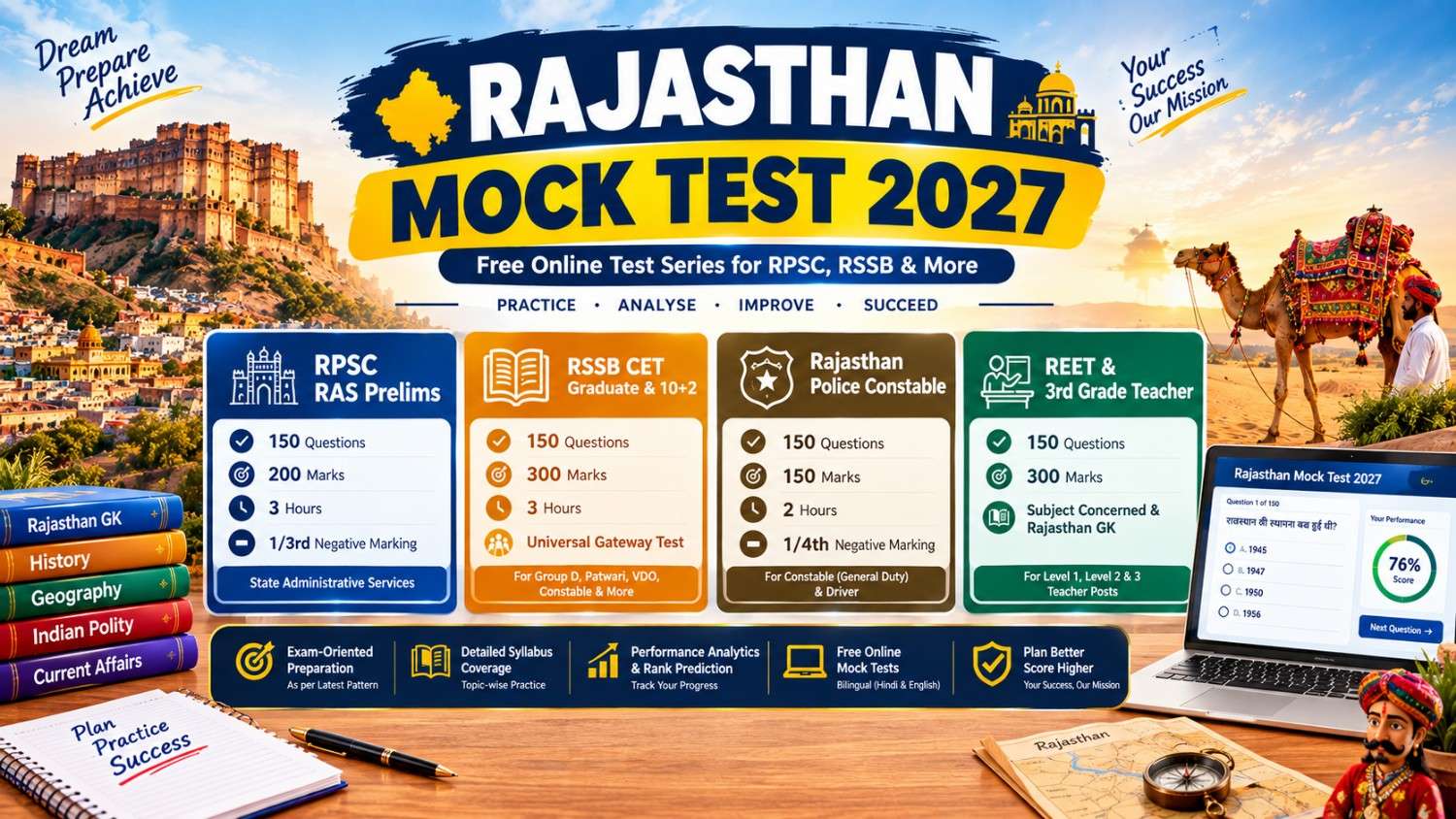 full
full
Rajasthan Mock Test 2027: Free RPSC RAS, CET & REET Series
Rajasthan Mock Test 2027: Free RPSC RAS, CET and REET Test Series Three-Tier Freshness Protocol and Disclaimer: This page divides up established historical facts, the exam pattern as stated in the most recent official notification, and projections relating to the 2027 cycle. Since history doesn't change, the rules regarding the pattern and the cycle-specific figures are updated immediately upon the release of a new official notification – therefore, before applying it is essential to check the linked official website for the most up-to-date version. This website acts as the main centre for Rajasthan state category examinations, offering full-length online practice papers for the RPSC RAS/RTS, the RSSB CET (at both the Graduate and Senior Secondary levels), the Rajasthan Police Constable exam, the Rajasthan Patwari exam, and the REET. Each test series includes verified guidelines from the commission, such as the requirement to bubble in the mandatory fifth option ('E') and the current 50-district geographical structure. People frequently ask "how to attempt a Rajasthan mock test" and "what happens if the fifth option is not bubbled". The Rajasthan mock test 2027 section on SarkariMockTest provides complete practice sets that are in accordance with the official commission standards. The questions are based on standard state reference books, enabling you to get timed practice for the exam without having to pay subscription fees. Quick Overview: Rajasthan State Examinations Hub Exam Title Conducting Agency Question and Mark Split Test Duration Negative Marking Structure Core Syllabus Focus RPSC RAS / RTS (Prelims) RPSC 150 questions / 200 marks 180 minutes (3.0 hours) 1/3rd penalty (~0.44 marks) General Knowledge and General Science RSSB CET (Graduate Level) RSSB 150 questions / 300 marks 180 minutes (3.0 hours) No penalty for wrong answers Multi-disciplinary Screening Gateway RSSB CET (Senior Secondary) RSSB 150 questions / 300 marks 180 minutes (3.0 hours) No penalty for wrong answers Senior Secondary Standard Subjects Rajasthan Police Constable Police Department / RSSB 150 questions / 150 marks 120 minutes (2.0 hours) 1/4th penalty (0.25 mark) Reasoning, Computer, GK and Rajasthan GK Rajasthan Patwari RSSB 150 questions / 300 marks 180 minutes (3.0 hours) 1/3rd penalty (~0.66 marks) Science, History, Polity, Geography, Math REET (Level 1 and Level 2) RBSE 150 questions / 150 marks 150 minutes (2.5 hours) No penalty (zero) Child Pedagogy, Languages, Math/EVS/Social RSSB 3rd Grade Teacher Mains RSSB 150 questions / 300 marks 150 minutes (2.5 hours) 1/3rd penalty (~0.66 marks) Rajasthan Heritage, School Subjects, Pedagogy Rajasthan State Competitive Examinations 2027 – Comprehensive Overview and Paper Matrix Candidates often inquire "what is the difference between the RPSC RAS and the RSSB CET" and also how the state screening tests relate to departmental recruitment. When preparing for exams across different state boards, it is necessary to keep track of the exact blueprint for each recruitment stream. The table below details the testing formats, question distributions, educational standards, and recruitment stages for the major public service examinations in Rajasthan. State Exam Track Official Board Question and Mark Split Time Limit Penalty per Error Educational Base Selection Pipeline RPSC RAS/RTS (Prelims) RPSC 150 MCQs (200 Marks; ~1.33 Marks per Question) 180 Minutes 1/3rd of Question Value (~0.44 Marks) Bachelor's Degree Preliminary Screening > Mains Written Examination (4 Papers) > Personality Test RSSB CET (Graduate Level) RSSB 150 MCQs (300 Marks; 2 Marks per Question) 180 Minutes Zero Deduction (the fifth option applies) Bachelor's Degree Eligibility Screening Gate > Shortlist for Departmental Mains RSSB CET (Senior Secondary) RSSB 150 MCQs (300 Marks; 2 Marks per Question) 180 Minutes Zero Deduction (the fifth option applies) Class 12 (10+2) Eligibility Screening Gate > Shortlist for Subordinate Posts Rajasthan Police Constable Police Department / RSSB 150 MCQs (150 Marks; 1 Mark per Question) 120 Minutes (2.0 hours) 1/4th of Question Value (0.25 Marks) Senior Secondary (10+2) Physical Screening (PET/PST) > Written Examination > Document Check Rajasthan Patwari RSSB 150 MCQs (300 Marks; 2 Marks per Question) 180 Minutes 1/3rd of Question Value (~0.66 Marks) Bachelor's Degree + RSCIT Single-Stage Written Examination > Document Verification REET (Level 1: Classes 1–5) RBSE 150 MCQs (150 Marks; 1 Mark per Question) 150 Minutes (2.5 hours) Zero (No Deduction) 10+2 + D.El.Ed / B.El.Ed Eligibility Screening Certificate (valid for life) > Mains Examination REET (Level 2: Classes 6–8) RBSE 150 MCQs (150 Marks; 1 Mark per Question) 150 Minutes (2.5 hours) Zero (No Deduction) Graduation + B.Ed / D.El.Ed Eligibility Screening Certificate (valid for life) > Mains Examination RSSB 3rd Grade Teacher Mains RSSB 150 MCQs (300 Marks; 2 Marks per Question) 150 Minutes 1/3rd of Question Value (~0.66 Marks) REET Qualified + B.Ed/D.El.Ed Final Selection Written Examination > Document Verification Note: The structures of the exam pattern, the distribution of questions, and the qualifying criteria are based on previous official notices. Candidates must check the exact requirements for each post in the latest notification before submitting their application forms. RAJASTHAN STATE COMPETITIVE EXAMS 2027 MASTER HUB ARCHITECTURE Hub Blueprint RPSC RAS/RTS Prelims: 150 questions, 200 marks, 180 minutes, one-third penalty (-0.44 M) RSSB CET (Graduate) – 150 questions | 300 marks | 180 minutes | Screening Gateway | 3. RSSB CET (Senior Secondary) – 150 Questions | 300 Marks | 180 Minutes | Screening Gateway | | 4. Rajasthan Police Const. – 150 Questions | 150 Marks | 120 Minutes | One-fourth penalty (-0.25 Mark) | | Rajasthan Patwari — 150 Questions | 300 Marks | 180 Minutes | One-third penalty (-0.66 M) | | Level 1 and Level 2 REET: 150 questions | 150 marks | 150 minutes | No penalty (for qualifying) | | RSSB Third Grade Mains — 150 questions | 300 marks | 150 minutes | One-third penalty (-0.66 M) | The Rule Regarding the Mandatory Fifth Option ('E'): What Makes Rajasthan Exams Different Most candidates stick to the usual four-option answer sheet and only come across the fifth option on the day of the exam, when the time they spend deciding whether or not to mark it is actually lost. A examination designed for Rajasthan should be based on a rule specific to Rajasthan, rather than adopting a general national pattern from elsewhere. The Rajasthan Public Service Commission (RPSC) and the Rajasthan Staff Selection Board (RSSB) have introduced a rule requiring the use of a fifth option ('E') in their competitive exams. This rule was implemented in order to promote transparency and prevent tampering with blank answer circles after the exam has taken place, and as a result changes the way in which candidates have to allocate their time. THE 5TH OPTION ('E') OMR BUBBLING DISCIPLINE Option 'E' Rule | To answer the question, darken one of the options A, B, C, or D. | If you decide not to attempt the question then you must darken the box. If the question mark is not darkened, a penalty of one-third of the question mark is applied! | Disqualification -> If more than 10% of total questions are left completely blank (no circle | If the candidate goes from A to E the candidate is automatically disqualified! | Extra Time Allotted-> An additional 10 minutes are granted after regular exam time to verify | | for each and every question one of the five circles is filled in. | The way in which option 'E' – choosing not to attempt a question – works is that if you don't know the answer and wish to leave the question unattempted, you cannot just leave all the options blank as is the case in other state exams; instead, you have to deliberately fill in circle 'E' (अनुत्तरित प्रश्न / Question Not Attempted). The penalty for leaving circles blank: if all five circles (A, B, C, D, and E) are left blank for any question, one-third (1/3rd) of the marks assigned to that question will be deducted as a penalty. Even in exams such as RSSB CET where incorrect answers (A, B, C, D) are not subject to negative marking, not filling in circle 'E' results in a deduction of marks. The 10% disqualification rule: if a candidate does not bubble any circle for more than 10% of the total questions (for instance, if 16 or more questions are left completely blank on a 150-question paper), their entire answer sheet is canceled and they are directly disqualified. The 10-minute buffer: in order to avoid candidates running out of time while filling in option 'E', the examining boards give 10 extra minutes after the standard test time has ended. Each full-length practice paper on SarkariMockTest includes an authentic 5-option interface. The test engine detects questions that have not been bubbled, warns you when you are approaching the 10% danger zone, and imposes the same negative penalty if a question is left without a selected option. CET versus Mains: Understanding the Gateway-Funnel System Candidates often ask how the Common Eligibility Test (CET) is connected to final appointments. In Rajasthan, the CET conducted by the RSSB functions as an initial screening stage, not as the final selection examination. THE RAJASTHAN CET-TO-MAINS RECRUITMENT FUNNEL Recruitment Funnel | Stage 1: Take the CET Exam → Attend an open screening test (at the graduate or senior secondary level). | | Stage 2: Eligibility Score -> Scorecard issued with percentile ranking (valid for designated cycle)| | Stage 3: Post Notification -> Department releases recruitment notice for specific posts || (for example, Junior Accountant, Patwari, Forester, Constable). | | Stage 4: 15-Times Funnel -> Top CET scorers (typically 15 times the total advertised vacancies || or a fixed qualifying benchmark) are selected in order to apply for the Mains. | At Stage 5 the Departmental Exam consists of a written test which is specific to the post and determines the final merit. For the Graduate level, the CET functions as the required screening stage for positions such as Junior Accountant, Tehsil Revenue Accountant, Supervisor (Women Empowerment), Jailor, and Patwari (in certain departments). At the Senior Secondary level, it acts as the screening stage for posts including Police Constable, Forester, Junior Assistant, Clerk Grade-II, and Hostel Superintendent. According to the 15-Times Rule, when a department announces 1,000 vacancies for a particular post, only the candidates who rank highest according to their CET scores—specifically those whose scores are approximately 15 times the number of vacancies per category (or those who meet a specified qualifying percentile)—are issued admit cards for the final recruitment examination. Takeaway: Simply scoring the minimum required in the CET is not enough; you must obtain a high percentile score in order to be included within the shortlist of 15 times the number of vacancies when recruitment notices with fewer vacancies are published. Choose Your Exam: Free Rajasthan Online Mock Tests If you want to access the full practice sets and the detailed diagnostic reports, please select the examination you would like to take from the list given below. 1. A mock exam for the RPSC RAS/RTS Prelims (150 questions • 200 marks) It is intended for use in the initial screening test for civil service positions. The paper includes 150 questions covering Rajasthan's history and culture, Indian history, geography, Indian polity, the economy, science and technology, and mental ability, the time allowed being 180 minutes and there being a penalty of one-third (that is, –0.44 marks for each error). Status: Available Now Access Link: Launch RPSC RAS Prelims Mock Test 2. A mock exam at the graduate level for the RSSB CET It was designed to act as a gateway for graduate screening and could be used by various departments. The test consists of assessments in Rajasthan History, the Indian Economy, Geography, Science, Reasoning, General English and General Hindi comprising 150 questions (300 Marks). Status: Available Now Access Link: Launch RSSB CET Graduate Mock Test 3. A mock test of the RSSB CET at the senior secondary level It is designed for the recruitment programmes directed at candidates who have passed class 12 (such as Constable, Junior Assistant, and Clerk). The paper contains 150 questions (amounting to 300 marks) and places a focus on science at the secondary level, mental ability, simple everyday mathematics, and Rajasthan's heritage. Status: Available Now Access Link: Launch RSSB CET Senior Secondary Mock 4. Mock test for Rajasthan Police Constable It is designed to prepare people for the exam needed to become a state police constable and follows the official blueprint which includes 150 questions—60 on Reasoning and Computer Basics, 45 on General Knowledge, Science, and Contemporary Affairs, and 45 on Rajasthan History, Art, and Culture—with a negative marking of 0.25. Status: Available Now Access Link: Launch Rajasthan Police Constable Mock 5. Practice test for Rajasthan Patwari The selection of a patwari is carried out within the framework set up by the Board of Revenue. The paper includes 150 questions summing to 300 marks and has to be completed within 180 minutes; it consists of the following subjects: General Science, the History and Polity of India, Rajasthan Geography and Culture, General Hindi and English, and Mental Ability, with one-third negative marking (-0.66 marks). Status: Available Now Access Link: Launch Rajasthan Patwari Mock Test 6. Practice Test for REET Level 1 and Level 2 The exam is in line with the one carried out by the Board of Secondary Education Rajasthan (RBSE) and consists of 150 questions in the areas of Child Development and Pedagogy, Language I, Language II, Mathematics, and Environmental Studies / Social Studies, with no negative marking. Status: Available Now Access Link: Launch REET Online Practice Set 7. Practice test for the Mains examination for third grade teachers with the RSSB It is designed to be used in the final selection examination following the acquisition of REET qualification and consists of specialized test sets totaling 300 marks, covering Rajasthan's geographical and cultural heritage, educational psychology, the various school subjects, and pedagogy, with one-third negative marking. Status: Available Now Access Link: Launch 3rd Grade Teacher Mains Mock Rajasthan Special GK: History, Culture, Geography Across 50 Districts The exams in Rajasthan place a strong emphasis on regional heritage, even though the national textbooks do not cover it. If anyone is looking for a 'Rajasthan GK in Hindi mock test', they should study the state's history, instances of peasant resistance, its cultural monuments, and the updated 50-district geography. RAJASTHAN SPECIAL GENERAL KNOWLEDGE: FOUR CORE FOUNDATIONS Four Foundations | Foundation 1: Monarchy & Dynasties -> Mewar Sisodias, Marwar Rathores, Amer Kachhwahas, Ekikaran | | Foundation 2: Peasant Movements -> Bijolia, Begun, Eki Movement, Mangarh Dham Tribal Uprising | | Foundation 3: Culture & Heritage -> 6 UNESCO Hill Forts, Folk Deities, Art Schools, Folk Dances | | Foundation 4: 50-District Terrain -> Thar Desert, Aravalli, Hadoti, River Drainage & Tiger Parks | 1. The dynasties and the process of integration: Mewar, Marwar, Amer and the route leading to Ekikaran The Mewar Dynasty (which traces its origins to the Guhil or Sisodia families): goes back to Bappa Rawal, who established the Rawal rule at Chittorgarh in the 8th century. Notable rulers of this dynasty included: Maharana Kumbha, who lived from 1433 to 1468 CE, was a king with scholarly abilities and erected the Vijay Stambha (Tower of Victory) at Chittorgarh as a result of his victory over Mahmud Khilji of Malwa; traditional historical sources also state that he carried out the construction or restoration of more than 30 hill forts in Mewar, including Kumbhalgarh. Before the historic Battle of Khanwa (which took place in March 1527) Maharana Sanga (Sangram Singh I) united the Rajput confederacies. Maharana Pratap (1572–1597 CE) represents the Rajput resistance to Mughal expansionism; he fought the well-known Battle of Haldighati on 18 June 1576 against Akbar's imperial army commanded by Man Singh I and then launched a military counter-offensive at the Battle of Dewair in October 1582, as a result of which most of Mewar was recovered. The Marwar Dynasty (governed by the Rathores) was founded by either Rao Shekha or Rao Chanda, and in 1459 CE Rao Jodha set up the dynasty's permanent capital at Jodhpur while at the same time constructing the Mehrangarh Fort on Chidiyatunk Hill; Rao Maldeo expanded the dynasty's borders, and Rao Chandrasen carried out guerrilla warfare against Mughal rule in the areas of Bhadrajun and Siwana and thereby earned the historical title of "The Forgotten Hero of Marwar". The Kachhwaha dynasty, also known as the Amer/Jaipur dynasty, traces its origins back to Dulha Rai. Raja Man Singh I served as one of Akbar's main military commanders and was responsible for extending the empire's influence as well as for the construction of the Amer Palace. Sawai Jai Singh II, who reigned from 1699 to 1743 CE, founded the planned city of Jaipur on 18 November 1727 (the plan having been drawn up by the Bengali architect Vidyadhar Bhattacharya) and built astronomical stone observatories (Jantar Mantar) in five cities: Jaipur, Delhi, Ujjain, Varanasi and Mathura. Integration of Rajasthan (The 7 Stages of Ekikaran: 1948–1956): The Matsya Union was established on 18 March 1948 through the union of Alwar, Bharatpur, Dholpur and Karauli, the capital of the new union being Alwar. On 25 March 1948 the Rajasthan Union was formed by bringing together the nine southeastern princely states, namely Banswara, Bundi, Dungarpur, Jhalawar, Kishangarh, Kota, Pratapgarh, Shahpura and Tonk; the capital was Kota. On 18th April 1948 the State of Rajasthan (Mewar section) was brought into the Rajasthan Union, the ceremony being performed by Jawaharlal Nehru. The states of Jaipur, Jodhpur, Bikaner and Jaisalmer united, an initiative that was started by Sardar Vallabhbhai Patel on 30 March 1949 (Rajasthan Day). The United State of Greater Rajasthan, established on 15 May 1949, was the result of the Matsya Union joining Greater Rajasthan as recommended by the Dr. Shankar Rao Deo Committee. On 26 January 1950 the Sirohi district (with the exceptions of Delwara and Abu) came together. The present-day political boundaries were established by incorporating Ajmer-Merwara, Abu-Delwara, and Sunel Tappa into Rajasthan and by transferring Sironj to Madhya Pradesh, on the basis of the recommendations of the States Reorganisation Commission (the Fazal Ali Commission). 2. The peasant and tribal movements: Bijolia, Eki, and the Bhagat Movement The Indian peasant movement in Bijolia between 1897 and 1941 was the longest non-violent agrarian struggle in the country's history, lasting for 44 years. The farmers of the Dhakar community in the Bijolia Jagir (in the region of Mewar) objected to 84 kinds of oppressive feudal taxes (referred to as Lagh-Bagh) and were made to perform forced labour (Baith-Begar). The movement went through three phases: at first it was led by Sadhu Sitaram Das, then it was turned into an organised mass movement by Vijay Singh Pathik (Bhup Singh), and finally ended under the joint leadership of Manikya Lal Verma and Jamnalal Bajaj. The Eki (Bhumat) Movement of 1921 was an agrarian tribal movement initiated by Motilal Tejawat in Matrikundiya (in the Rashmi, Chittorgarh district); he assembled the Bhil and Garasia tribes in opposition to feudal oppression and submitted to the Maharana of Mewar a 21-point statement of demands (referred to as the Mewar Ki Pukar). The Bhagat Movement, initiated by the socio-religious reformer Govind Guru among the Bhil communities in southern Rajasthan and in the neighbouring region of Gujarat, resulted in the establishment of the Samp Sabha in 1883 with the objective of advancing moral reform, temperance, and social unity. On 17 November 1913 British and princely forces surrounded Mangarh Dham (located in the Banswara district) and fired on gatherings of tribal people who were assembled in peace, causing more than 1,500 of the tribal participants to die; this event is usually referred to in the area's history as the Jallianwala Bagh of Rajasthan. 3. Art, Architecture, Folk Deities, and UNESCO Hill Forts The six UNESCO-listed hill forts of Rajasthan (inscribed in June 2013) are as follows: The Chittorgarh Fort is known for the historical sieges and the memorials of Jauhar, and has the Vijay Stambha and Kirti Stambha. The Kumbhalgarh Fort (located in Rajsamand) was built by Rana Kumbha and features the second longest uninterrupted defensive wall in the world (measuring about 36 km) as well as the Badal Mahal palace. The Ranthambore Fort (in Sawai Madhopur) is situated in the national park forest and is well known for the historic siege conducted by Alauddin Khilji as well as the Trinetra Ganesha Temple. The Gagron Fort (in Jhalawar) was constructed at the point where the Ahu and Kali Sindh rivers meet; it is a typical instance of a water fortress (Jal Durg). Amer Fort, located in Jaipur, lies overlooking Maota Lake and is known for the fusion of Rajput and Mughal architectural styles, as well as the Sheesh Mahal and the Shila Devi Temple. The Jaisalmer Fort (also known as Sonar Qila) is a large fortress made of yellow sandstone, located in the desert on Trikuta Hill and containing ancient Jain temples. Folk Deities & Cultural Heritage: The five revered saints who are worshipped among various religions are Ramdevji (in Runicha/Ramdevra, Jaisalmer; founder of the Kamadiya sect), Pabuji (in Kolumand, Phalodi; the patron deity of camels), Gogaji (in Dadrewa, Churu and Gogamedi, Hanumangarh), Harbhuji (in Bengti, Phalodi), and Mehajee Mangaliya (in Bapini, Jodhpur). Other deities who are highly regarded are Veer Tejaji (in Karnal, Nagaur and Parbatsar), Karni Mata (in Deshnoke, Bikaner; famous for the sacred white rats/Kabas), and Jeen Mata (in Rewasa, Sikar). The folk paintings and traditional crafts include the Kishangarh style (famously represented by the Bani Thani painting carried out by Nihal Chand while Raja Sawai Singh was on the throne, a piece frequently known as India's Mona Lisa), the Pichwai paintings (which are cloth devotional pictures depicting Lord Krishna at Nathdwara), blue pottery from Jaipur (a type of pottery popularised by Kripal Singh Shekhawat), thewa art (the delicate gold foil work on glass that is carried out solely in Pratapgarh), and usta art (the technique of gold embossing on camel hide from Bikaner). The traditional dances include Ghoomar, which is danced by women in the royal family, Kalbelia, the serpentine dance of the snake-charmer community that was included on the UNESCO Intangible Cultural Heritage List in 2010, Chari, practiced in the Kishangarh area and consisting of balancing brass pots with burning cotton seeds, and Terahtaali, a dance carried out by the women of the Kamad sect in dedication to Ramdevji and which involves 13 cymbals attached to the body. 4. Geography, Rivers and Wildlife within the new District Framework A frequent question asked by candidates is "How many districts are there in Rajasthan?" In August 2023 the state government reorganized the administrative boundaries and raised the number of districts from the previous total of 33 to 50, the districts now being divided into 10 administrative divisions (Sikar, Banswara and Pali being named the new divisional heads). FOUR DISTINCT GEOGRAPHICAL REGIONS OF RAJASTHAN Regions The Western Sandy Plains (also known as the Thar Desert) account for about 61 percent of the area of the state; this region is known for its sand dunes, arid climate, and the Luni basin. The Aravalli Mountain Range covers about 9% of the area; they are the oldest range of folded mountains; Guru Shikhar (1722 metres) -> approximately 23% of the area; it includes the fertile basins of the Banas and Chambal rivers | The southeastern part of the Hadoti Plateau accounts for about 7% of the total area; it has volcanic black soil; the districts included are Kota, Baran and Jhalawar | The Aravalli Range and its peaks extend diagonally from the southwest to the northeast; Guru Shikhar, which is in Mount Abu in the Sirohi district, is the highest peak in Rajasthan at 1,722 metres (and belongs to the Arbuda mountain block), while other significant peaks include Ser (1,597 m), Dilwara (1,442 m), and Jarga (1,431 m). Drainage Basins: The area is divided into three drainage systems: The drainage of the Arabian Sea comprises the Luni River (which originates at Nag Pahar in Ajmer; the water is fresh until it reaches Balotra, when it then becomes saline before flowing into the Rann of Kutch), the Sabarmati, and the Mahi (a river which crosses the Tropic of Cancer twice). The drainage in the Bay of Bengal includes the Chambal River (which starts at the Janapav hills in Madhya Pradesh; it is a major perennial river in Rajasthan and establishes the National Chambal Sanctuary for gharials, featuring among its major dams the Gandhi Sagar, Rana Pratap Sagar, Jawahar Sagar and the Kota Barrage), the Banas (originating at the Khamnor hills in Rajsamand; it is known as "Van Ki Asha"), and the Gambhiri. Inland drainage basins include rivers which do not empty into the sea, for example the Ghaggar (which is the ancient bed of the Saraswati River), the Kantli (located in Sikar and Jhunjhunu), the Ban Ganga, and the Ruparel. Notable lakes include Sambhar Salt Lake (located in the Jaipur/Nagaur/Ajmer districts; it is India's largest inland saline lake and is designated as a Ramsar Wetland), Pichola, Fateh Sagar, Rajsamand, and Nakki Lake (in Mount Abu, which is the highest lake in the state). The wildlife sanctuaries and tiger reserves include Ranthambore National Park, located in Sawai Madhopur and which is the main tiger reserve, Sariska Tiger Reserve in Alwar, Mukundra Hills Tiger Reserve in both Kota and Jhalawar, Ramgarh Vishdhari Tiger Reserve in Bundi since it has been designated as India's 52nd Tiger Reserve, the Dholpur-Karauli Tiger Reserve, and Keoladeo Ghana National Park in Bharatpur, a UNESCO World Heritage Site and a well-known site for migratory Siberian Cranes to spend the winter. Pattern and Negative Marking in Rajasthan Exams It is important to understand the rules about negative marking if one is to do well in the state-level recruitment exams. Negative marking is introduced in competitive selections by RPSC and RSSB, but there is no deduction of marks for wrong answers in the teaching eligibility tests (REET). Negative Marking and Duration Comparison Table State Examination Question Count Total Marks Allotted Duration Penalty Deducted per Error Operational Strategy For the RPSC RAS / RTS (Prelims) exam there are 150 questions, 200 marks, and the time allowed is 180 minutes (3.0 hours); there is a one-third deduction (approximately 0.44 marks); candidates should eliminate two options before attempting any question and indicate 'E' for questions that are skipped. RSSB CET (Graduate Level) 150 Questions 300 Marks 180 Minutes (3.0 Hours) No penalty for wrong answers. Answer all questions. Mark 'E' if you leave a question unattempted. RSSB CET (Senior Secondary) – 150 questions, 300 marks, 180 minutes (3.0 hours), no penalty for incorrect answers, and you must achieve a 100% attempt rate by not leaving any blank circles. The Rajasthan Police Constable exam consists of 150 questions carrying a total of 150 marks and has a time limit of 120 minutes (2 hours); there is a deduction of one quarter of a mark (0.25 marks) and a fast pace is needed (48 seconds per question). The Rajasthan Patwari examination consists of 150 questions, carries a total of 300 marks, has a time limit of 180 minutes (3.0 hours), involves a deduction of one-third of the mark (~0.66 marks) for each incorrect answer, and requires a high degree of accuracy so that random guessing should be avoided. Level 1 and Level 2 REET: 150 questions, 150 marks, 150 minutes (2 hours and 30 minutes), no penalty for wrong answers, with all questions having to be attempted; none may be left blank. The RSSB third grade teacher mains examination consists of 150 questions worth a total of 300 marks and has a time limit of 150 minutes (2.5 hours), with a deduction of one-third of a mark (~0.66 marks) and a controlled attempt rate, stressing pedagogical precision. Time Allocation Blueprint: 180 Minutes for 150 Questions Most of the selection tests administered by RPSC and RSSB consist of 150 questions to be completed within 180 minutes (that is, 72 seconds per question). By following the three-stage method described below, you will be able to finish the paper and satisfy the requirements of the fifth option. In the first round, which covers the period from minute 00 to 60, you are to answer the direct factual questions on the history, geography, polity, and current affairs of Rajasthan. If a question involves some sort of calculation or needs more than a quick read, leave it at this stage. During this first hour your aim should be to get between 60 and 70 questions correct. In Round 2, which covers the analytical and multi-statement questions (from minute 60 to minute 125), you should do the statement-based polity questions, the pair-matching questions, the science-based application questions, and the language questions. Spend 65 minutes on solving between 50 and 55 questions. In the third round, from minute 125 to minute 180, spend 35 minutes doing mental ability calculations on clean scratch paper and then use the other 20 minutes to go through the questions which had not been attempted, putting a circle around the letter 'E' for each question that was skipped. RECOMMENDED 180-MINUTE TIME ALLOCATION PROFILE (150-QUESTION FORMAT) Time Profile | [======] Round 1: Direct Factual Questions (60 minutes). This took 33.3% of the time. About 65 questions answered. | | [=======] Round 2: Multi-Statement Analytical (65 minutes) -> 36.1% of the time | About 55 questions were solved | [====] In Round 3, when solving math problems and selecting option 'E', this occurred 30.6% of the time| Regarding the calculations and filling in the bubbles | TOTAL ALLOCATION: 180 MINUTES | 150 QUESTIONS | MANDATORY 100% CIRCLE COMPLETION (A to E) | Test Series Structure & Coverage Matrix Our testing program organizes your preparation step-by-step from individual topic drills to full-length exam simulations: Level & Segment Sections Covered Tests Offered Question Format Focus & Exam Alignment Tier 1: Sectional Drills Rajasthan History, Geography, Polity, Science, Math 24 Tests (25 Qs / 25 Mins) Timed topic-level drills Builds speed and mechanical recall Tier 2: Full Simulations Complete Composite Syllabus Formats 14 Tests (150 Qs / 180 Mins) Full OMR 5-option simulation Builds 180-minute stamina & bubble discipline Tier 3: Rajasthan GK Labs Mewar, 50 Districts, UNESCO Forts, Folk Deities 6 Labs (50 Qs / 50 Mins) Chronology, district landmarks Targets high-yield state modules Tier 4: Shift-Style Mocks Complete Composite Syllabus 4 Tests (150 Qs each) Past-shift style questions Real exam trend and format familiarity Worked Sample Questions with Complete Explanations Consider these sample questions; they demonstrate regional depth and include questions that are presented in chronological order. Each of them has five answer options together with detailed explanations. Sample 1: Rajasthan Peasant & Tribal Movements SAMPLE QUESTION: TRIBAL RESISTANCE MOVEMENTS IN RAJASTHAN Tribal Movements | Question: On 17 November 1913, British troops and forces from the surrounding princely states | | surrounded and opened fire on a peaceful assembly of Bhil tribesmen at Mangarh Dham, leading to | This is a historic massacre; in which district of present-day Rajasthan is Mangarh Dham located? | (A) Dungarpur | | (B) Banswara | | (C) Pratapgarh | | (D) Sirohi | | (E) Question Not Attempted | | CORRECT ANSWER: (B) Banswara | | Step-by-Step Concept Explanation: | | Why Option (B) is Correct: | | Mangarh Dham is situated on the forested border hills of Banswara district (Anandpuri block) in | It is in southern Rajasthan, bordering Gujarat. On 17 November 1913 (the full moon day of Margashirsha), the British armed forces| | units from the Mewar Bhil Corps and Rajputana Agency surrounded the hill and opened fire on a | | congregation organized by spiritual reformer Govind Guru and the Samp Sabha, resulting in the | Over 1,500 participants from the tribes died peacefully. | Why Other Options Are Incorrect: | | - Option (A): Dungarpur was the birthplace of Govind Guru (Bansiya village), but not the massacre | The site at Mangarh. Pratapgarh is located east of Banswara and is famous for its Thewa art. – (D) Sirohi was the region where the Doli movement and the Mount Abu uprisings occurred. Sample 2: Rajasthan Geography & River Systems SAMPLE QUESTION: RAJASTHAN PHYSICAL HYDROLOGY & BASINS Hydrology Sample | Question: The Luni River originates in the Nag Pahar hills near Ajmer and flows southwest across | At what particular location in the arid plains of western Rajasthan does its water become saline? | (A) Bilara (Jodhpur) | | (B) Samdari (Balotra) | | (C) Balotra (Balotra District) | | (D) Sanchore (Sanchore District) | | (E) Question Not Attempted | | CORRECT ANSWER: (C) Balotra (Balotra District) | | Step-by-Step Concept Explanation: | | Why Option (C) is Correct: | | The Luni River (historically termed the Sagarmati at its origin) maintains fresh, potable water | For about the first 100 kilometres, upon arriving at Balotra (which is now the administrative headquarters | of the newly carved Balotra district), the river flows through soil strata rich in sodium chloride | Because of the alkaline minerals present, the water becomes completely brackish and saline as you go further downstream. | Why Other Options Are Incorrect: | – Option (A): Bilara is located in the middle upper part of the river, in an area where the water is not saline. - (B) Samdari is a railway junction located in Balotra, upstream of the main saline region. – Option (D): Sanchore is located in the lower deltaic regions near the Rann of Kutch. Product Features: How Our Analytics Work Our practice platform includes analytical tools designed to help you prepare across state examinations: 5th Option Bubbling Analytics The 'Bubbling Analytics' feature under the 5th Option tracks the way you deal with question 'E' on each practice test, and if you leave questions unattempted without selecting option 'E', the system will show the penalty deductions and issue a warning to you when you exceed the 10% disqualification limit. Reorganized 50-District Weak Area Diagnostics The way in which the 50-District Weak Area Diagnostics have been reorganized is that the diagnostic system now keeps an eye on your performance in each of the 10 administrative areas; if your score lies in the Hadoti Plateau region, in Mewar history, or in secondary-standard arithmetic, the system will provide a series of 10-question practice exercises designed for the purpose of overcoming those weaknesses. All India & Rajasthan State Rank Leaderboard A leaderboard which displays the rankings for India and for the state of Rajasthan will enable you to compare your score, pacing speed, and accuracy with those of thousands of other aspirants who are based in Jaipur, Jodhpur, Kota, Udaipur, Bikaner, and Ajmer. 📊 View All India & State Rank Leaderboard 🤖 AI-Based Weak Area Diagnostic Tool Personalized Diagnostics The diagnostic system keeps an eye on your performance across all sections. There is an explanation box with each question which not only explains why the correct answer is right but also provides a detailed account of why the other options are incorrect, citing publications from the Rajasthan Hindi Granth Akademi. Diagnostic Summary: Tracks accuracy percentages across the 50-district geography, Mewar & Marwar history, 5th option OMR bubbling discipline, and secondary-standard mathematics. Generates targeted corrective sprint drills based on your test logbook. ⚡ Launch AI Weak-Area Diagnostic Tool ⚡ Daily State & National Booster 15-Min Daily Quiz Free Daily Current Affairs Practice Maintain broader awareness across national news and Rajasthan state government policies with our free daily quiz: 👉 Take the Free Daily Current Affairs Quiz How to Attempt Free Rajasthan Mock Tests on Sarkari Mock Test Getting started on our platform takes less than two minutes: To get to the portal, you should go to SarkariMockTest.com and then select Rajasthan Hub from the navigation menu. Choose the exam that you want; you have the option of taking either the RPSC RAS Prelims, the RSSB CET (for the Graduate or Senior Secondary level), the Police Constable exam, the Patwari exam, or the REET. To begin the Simulator, you should click on Start Free Mock Test. A testing console will then appear, featuring a countdown timer that is specific to the exam, a multiple-choice section with the options A, B, C, D, and E, and also a button for changing the language. Solve and Submit: to answer the questions (be sure to bubble in 'E' for any questions you are skipping) and then click Submit Examination in order to view your immediate scorecard, the percentile rank for your state, and the explanations for each question. Preparation Strategy + Important Books & Resources per Exam Follow this structured preparation strategy and use standard academic reference books: Examination Track High-Yield Topics to Master Authoritative Reference Books To take the RPSC RAS / RTS (Prelims) examination, the required subjects are Rajasthan History, Art and Culture, 50-District Geography, and Indian Polity and Economy. The recommended books are 'Rajasthan Ka Itihas, Kala evam Sanskriti' by Dr. Hukam Chand Jain and Dr. Narayan Mali (published by the Rajasthan Hindi Granth Akademi); 'Indian Polity' by M. Laxmikanth; and the Rajasthan Economic Survey for the current year. For the position of RSSB CET (Graduate & 10+2), the subjects were Everyday Science, Mental Ability, Rajasthan Geography, Hindi and English Grammar. The prescribed texts were the Class 9 and 10 Science textbooks (RBSE/NCERT), Samanya Hindi by Dr. Raghav Prakash, and A Modern Approach to Verbal & Non-Verbal Reasoning by R.S. Aggarwal. The syllabus for the Rajasthan Police Constable exam includes Reasoning, Computer Awareness, Women & Child Safety Laws, and Rajasthan History. In the case of Computer Awareness, the textbooks to be used are those issued by well-known publishers, while for the other subjects the Class 8 to 10 Social Science books from the Rajasthan Board and basic reasoning handbooks should be consulted. The positions of Patwari require knowledge of General Science, Rajasthan Geography, elementary Mathematics and Mensuration, and an understanding of Computer Basics, together with Quantitative Aptitude by R.S. Aggarwal and the official circulars issued by the Board of Revenue concerning land records, as well as Rajasthan Pariksha Vani. At Levels 1 and 2 the subjects for REET are Child Development and Pedagogy, Teaching Methods, Environmental Studies and Mathematics; the textbooks used in RBSE schools (for Classes 1 to 10) as well as the standard D.El.Ed and B.Ed pedagogical reference modules. Common Mistakes Rajasthan Aspirants Make Ignoring the Mandatory 5th Option Rule by treating practice tests in the same way as regular exams and not filling in the answers to the questions that were skipped, which led to a loss of one-third of the score and the possibility of being disqualified on the day of the exam. The use of study materials that are out of date on the basis of the 33-district system: this involves using older geography books which do not contain the 50 reorganized districts and the 10 divisions, and as a result leads to wrong answers when questions come up regarding the new district boundaries and administrative centres. Considering the RSSB CET to be a final job selection exam is a mistake since the CET is actually a competitive screening stage and only the highest scorers are eligible to enter the 15-times Mains recruitment round. When dealing with different exams, one should apply a uniform risk assessment by making random guesses in tests that have a one-third penalty—for example, in the RAS Prelims or the Patwari exam—on the basis of one's experience with exams that have no negative marking, such as the REET or the CET. Failing to carry out post-test diagnostic reviews: merely looking at the final score without checking the explanation boxes relating to the questions that were answered incorrectly, and thus missing the chance to clarify any misunderstandings before the day of the exam. Why Attempt This Free Rajasthan Test Series Hub Preparing with full-length simulations matched to state standards builds both speed and conceptual clarity: Parameter Unorganized Fragmented Preparation SarkariMockTest Unified Rajasthan Hub Platform Model Multiple paywalls across different coaching apps Single free, unified hub covering all major state exams OMR 5th Option Engine Standard 4-option test engines with no option 'E' Real 5-option interface tracking unbubbled penalties and the 10% rule District Geography Outdated 33-district question banks Fully updated to the 50 reorganized districts and 10 divisions Content Alignment Generic central SSC questions with superficial state GK Detailed state modules based on Rajasthan Hindi Granth Akademi references Why This Mock Test Series Was Put Together I am Shubham Kumar Sah and I have founded SarkariMockTest.com. Even though I have examined a variety of exam platforms, most of them still employ the standard four-option test engine for a state which has had a compulsory fifth option for years and continue to show district maps that are from before the most recent reorganisation. The two points most frequently ignored are the following: first of all, the 5th option rule changes the way a candidate should approach each and every question, even though very few free mock exams cover it; secondly, RSSB's CET system confuses those aspirants who do not realise that it is a screening test and not the final exam. The system is based on both of them and each complete mock exam makes use of the real five-option interface. For each post group the route from CET to Mains is clearly outlined. The Rajasthan GK section is structured so that you can see exactly where your understanding is lacking. The test series will continue to be free as long as the exam-specific page is online, since the state-specific diagnostic does not need a paywall. As I work on this hub, I ensure that each exam page is checked to see whether or not it actually tests the subject matter that the exam candidates will be dealing with under the real rules, rather than employing a simplified national template. In the case where the answer to that question is no, the page is excluded. Official Portals & Recruitment Notification Links Use these verified official portals to track examination notifications, download syllabus documents, and review declared results: Department / Commission Official Website Link Primary Purpose for Candidates The Rajasthan Public Service Commission (RPSC) rpsc.rajasthan.gov.in can be accessed at rpsc.rajasthan.gov.in for information regarding circulars, admit cards, and results for the RAS/RTS, 1st and 2nd Grade Teacher, and Sub-Inspector posts. The Rajasthan Staff Selection Board (RSSB) rsmssb.rajasthan.gov.in can be found at rsmssb.rajasthan.gov.in and publishes notifications relating to the recruitment of graduates and candidates who have passed the 10+2 examination for the positions of Patwari and Third Grade Teacher. The Rajasthan Police Department police.rajasthan.gov.in can be found at police.rajasthan.gov.in, where information on police constable recruitment notifications, the schedules for the physical test and the results is provided. The Board of Secondary Education of Rajasthan (RBSE) rajeduboard.rajasthan.gov.in can be accessed at rajeduboard.rajasthan.gov.in for REET (Level 1 and Level 2) eligibility announcements, application portals, and certificates. SarkariMockTest Rajasthan Master Hub sarkarimocktest.com – free full-length 5-option mock tests, 50-district GK drills, and state scorecards at sarkarimocktest.com. Practical Preparation Advice: 5th-Option Discipline and 50-District Mastery To succeed in competitive examinations in Rajasthan it is necessary to carry out organised revision of regional history, mountain geography, and the administrative systems since specialised knowledge of the region is of great importance in recruitment exams such as the RPSC RAS and the RSSB CET, and therefore depending only on national-level study materials results in a number of blind spots. Allocate 45 minutes each morning to studying the chronological order of the Mewar, Marwar, and Amer dynasties, the seven phases of state integration, and the boundaries of the 50 reorganized districts. Prepare summary charts for the six UNESCO-listed hill forts, the river confluences, and the agrarian resistance movements such as Bijolia and Mangarh Dham. Each day work through 20 quantitative and reasoning questions in order to earn a solid foundation in the mental ability sections. Once a weekend, take a full Rajasthan mock test in 2027 under timed conditions and ensure that you mark circle 'E' for all questions that you skip so as not to have negative marks deducted. Maintaining consistent practice of these state-specific facts is the most reliable method of passing your examinations. About the Author Ali Hassan works as a Senior Content Editor for SarkariMockTest.com, focusing on the curricula of state public service commissions, regional police recruitment exams, and the preparation of bilingual tests in Rajasthan and northern India. Since he has been studying competitive examination trends for more than three years, he checks question sets to make sure they match the current patterns of the commissions and adhere to verified factual standards. .raj-mock-wrapper, .raj-mock-wrapper * { box-sizing: border-box !important; -webkit-tap-highlight-color: transparent; } .raj-mock-wrapper { width: 100% !important; max-width: 100% !important; margin: 0 !important; padding: 16px 12px !important; font-family: -apple-system, BlinkMacSystemFont, "Segoe UI", Roboto, Helvetica, Arial, sans-serif; line-height: 1.65; color: #212121; background-color: #ffffff; overflow-wrap: break-word; word-wrap: break-word; text-align: left !important; display: block !important; clear: both !important; float: none !important; } .raj-mock-wrapper p, .raj-mock-wrapper h1, .raj-mock-wrapper h2, .raj-mock-wrapper h3, .raj-mock-wrapper ul, .raj-mock-wrapper ol, .raj-mock-wrapper li, .raj-card-architecture, .raj-author-box, .raj-module-card, .raj-box-alert, .raj-ai-diagnostic-wrapper, .raj-quiz-container { text-align: left !important; } .raj-top-h2 { display: block !important; width: 100% !important; background: linear-gradient(135deg, #1b5e20, #2e7d32) !important; color: #ffffff !important; font-size: 22px !important; font-weight: 800 !important; padding: 16px 18px !important; border-radius: 8px !important; margin: 10px 0 18px 0 !important; line-height: 1.35 !important; border-left: 6px solid #fbc02d !important; box-shadow: 0 4px 12px rgba(27, 94, 32, 0.22) !important; } .raj-disclaimer-box { background-color: #fffde7; border-left: 5px solid #fbc02d; padding: 14px 16px; margin-bottom: 16px; border-radius: 0 6px 6px 0; font-size: 14px; color: #424242; } .raj-h2 { font-size: 21px; font-weight: 700; color: #1b5e20; margin: 28px 0 14px 0; border-bottom: 2px solid #e0e0e0; padding-bottom: 8px; line-height: 1.35; } .raj-h3 { font-size: 17px; font-weight: 600; margin: 20px 0 10px 0; line-height: 1.4; } .raj-p { font-size: 15px; color: #333333; margin: 0 0 16px 0; } .terminal-text { font-family: monospace; font-size: 13px; margin-bottom: 6px; color: #666; } .link-styled { color: #1b5e20; font-weight: 700; text-decoration: underline; } .link-styled:hover { color: #b71c1c; } .raj-action-btn-bar { display: flex; flex-wrap: wrap; gap: 12px; margin: 14px 0 18px 0; } .btn-rank { display: inline-block !important; background-color: #1b5e20 !important; color: #ffffff !important; font-size: 14px !important; font-weight: 700 !important; text-decoration: none !important; padding: 10px 20px !important; border-radius: 6px !important; box-shadow: 0 3px 8px rgba(27, 94, 32, 0.25) !important; transition: background-color 0.2s ease !important; } .btn-rank:hover { background-color: #0e3d13 !important; } .btn-ai { display: inline-block !important; background-color: #f57f17 !important; color: #ffffff !important; font-size: 14px !important; font-weight: 700 !important; text-decoration: none !important; padding: 10px 20px !important; border-radius: 6px !important; box-shadow: 0 3px 8px rgba(245, 127, 23, 0.25) !important; transition: background-color 0.2s ease !important; } .btn-ai:hover { background-color: #bc6502 !important; } .raj-table-wrap { width: 100% !important; max-width: 100% !important; overflow-x: auto !important; -webkit-overflow-scrolling: touch; margin: 18px 0 24px 0; border: 1px solid #e0e0e0; border-radius: 6px; background-color: #ffffff; } .raj-table { width: 100% !important; border-collapse: collapse; text-align: left !important; font-size: 14px; min-width: 620px; } .raj-table th { background-color: #1b5e20; color: #ffffff; padding: 11px 12px; font-weight: 700; border: 1px solid #1b5e20; white-space: normal; text-align: left !important; } .raj-table td { padding: 11px 12px; border: 1px solid #e0e0e0; color: #212121; vertical-align: top; text-align: left !important; } .raj-table tr:nth-child(even) { background-color: #f9fbe7; } .raj-table tr:hover { background-color: #fff9c4; } .raj-box-alert { width: 100% !important; background-color: #ffebee; border-left: 5px solid #c62828; padding: 16px; margin: 20px 0; border-radius: 0 6px 6px 0; } .raj-card-architecture { width: 100% !important; background: #ffffff; border: 1px solid #e0e0e0; border-radius: 8px; margin: 20px 0; overflow: hidden; box-shadow: 0 1px 4px rgba(0,0,0,0.04); } .raj-card-header { background-color: #1b5e20; color: #ffffff; padding: 12px 16px; font-weight: 700; font-size: 15px; display: flex; align-items: center; justify-content: space-between; flex-wrap: wrap; gap: 8px; text-align: left !important; } .raj-card-badge { background-color: #fbc02d; color: #212121; font-size: 12px; font-weight: 700; padding: 3px 8px; border-radius: 4px; } .raj-card-body { padding: 14px; text-align: left !important; } .section-green { background-color: #f1f8e9; border: 1px solid #c5e1a5; border-left: 5px solid #2e7d32; border-radius: 6px; padding: 12px 14px; text-align: left !important; } .section-yellow { background-color: #fffde7; border: 1px solid #fff59d; border-left: 5px solid #fbc02d; border-radius: 6px; padding: 12px 14px; text-align: left !important; } .section-blue { background-color: #e1f5fe; border: 1px solid #b3e5fc; border-left: 5px solid #0288d1; border-radius: 6px; padding: 12px 14px; text-align: left !important; } .section-red { background-color: #ffebee; border: 1px solid #ffcdd2; border-left: 5px solid #c62828; border-radius: 6px; padding: 12px 14px; text-align: left !important; } .raj-author-box { width: 100% !important; background-color: #ffffff; border: 1px solid #e0e0e0; border-left: 5px solid #1b5e20; border-radius: 8px; padding: 20px 18px; margin: 28px 0; box-shadow: 0 2px 6px rgba(0,0,0,0.04); text-align: left !important; } .raj-author-header { color: #1b5e20; font-size: 20px; font-weight: 800; margin: 0 0 12px 0; padding-bottom: 8px; border-bottom: 1px solid #eef2f6; text-align: left !important; } .raj-module-card { background: #ffffff; border: 1px solid #e0e0e0; border-radius: 8px; padding: 18px 16px; margin: 20px 0; box-shadow: 0 1px 4px rgba(0,0,0,0.04); text-align: left !important; } .border-green { border-left: 5px solid #2e7d32; } .border-yellow { border-left: 5px solid #fbc02d; } .border-blue { border-left: 5px solid #0288d1; } .border-red { border-left: 5px solid #c62828; } .color-green { color: #1b5e20; } .color-yellow { color: #f57f17; } .color-blue { color: #0288d1; } .color-red { color: #c62828; } .font-15 { font-size: 15px; } .font-bold { font-weight: 700; } .mb-0 { margin-bottom: 0 !important; } .mb-6 { margin-bottom: 6px !important; } .mb-8 { margin-bottom: 8px !important; } .mt-14 { margin-top: 14px !important; } .block { display: block; } .raj-list { list-style-type: disc !important; margin: 0 0 16px 0 !important; padding-left: 24px !important; text-align: left !important; } .raj-list li { margin-bottom: 8px !important; color: #333333; display: list-item !important; text-align: left !important; } .raj-sub-list { list-style-type: circle !important; margin: 6px 0 6px 0 !important; padding-left: 20px !important; } .raj-sub-list li { margin-bottom: 6px !important; display: list-item !important; } /* AI Diagnostic Wrapper */ .raj-ai-diagnostic-wrapper { width: 100% !important; background: #ffffff; border: 1px solid #e0e0e0; border-left: 6px solid #fbc02d; border-radius: 12px; padding: 22px 18px; margin: 26px 0; box-shadow: 0 4px 14px rgba(0,0,0,0.05); text-align: left !important; } .raj-ai-header { display: flex; align-items: center; justify-content: space-between; flex-wrap: wrap; gap: 10px; border-bottom: 1px solid #eef2f6; padding-bottom: 12px; margin-bottom: 14px; text-align: left !important; } .raj-ai-title { color: #1b5e20; font-size: 21px; font-weight: 800; margin: 0; display: flex; align-items: center; gap: 8px; text-align: left !important; } .raj-ai-badge { background-color: #fffde7; color: #f57f17; font-size: 11px; font-weight: 800; padding: 4px 10px; border-radius: 20px; border: 1px solid #fff59d; text-transform: uppercase; letter-spacing: 0.4px; } .raj-placeholder-box { border: 2px dashed #1b5e20; background-color: #f1f8e9; padding: 20px 16px; text-align: center; margin: 20px 0 16px 0; border-radius: 8px; } .icon-stat { font-size: 26px; margin-bottom: 6px; } .placeholder-desc { font-size: 13px; color: #555; text-align: left; background: #ffffff; padding: 10px 12px; border-radius: 6px; border: 1px solid #e0e0e0; line-height: 1.5; } /* Quiz Container */ .raj-quiz-container { width: 100% !important; background: #ffffff; border: 1px solid #c5e1a5; border-left: 6px solid #2e7d32; border-radius: 10px; padding: 22px 18px; margin: 28px 0; box-shadow: 0 3px 10px rgba(46, 125, 50, 0.07); text-align: left !important; } .raj-quiz-header { display: flex; align-items: center; justify-content: space-between; flex-wrap: wrap; gap: 8px; font-size: 13px; font-weight: 800; color: #2e7d32; text-transform: uppercase; letter-spacing: 0.5px; margin-bottom: 10px; } .raj-quiz-badge { background-color: #f1f8e9; color: #2e7d32; font-size: 11px; font-weight: 800; padding: 3px 10px; border-radius: 20px; border: 1px solid #c5e1a5; text-transform: uppercase; letter-spacing: 0.4px; } .raj-quiz-title { color: #1b5e20; font-size: 20px; font-weight: 800; margin: 0 0 12px 0; padding-bottom: 8px; border-bottom: 1px solid #eef2f6; text-align: left !important; line-height: 1.35; } .btn-wrap-center { text-align: center !important; margin: 20px 0 24px 0; clear: both !important; } .btn-green-cta { display: inline-block !important; background-color: #2e7d32 !important; color: #ffffff !important; font-size: 15px !important; font-weight: 700 !important; text-decoration: none !important; padding: 13px 28px !important; border-radius: 6px !important; box-shadow: 0 4px 10px rgba(46, 125, 50, 0.28) !important; border: 1px solid #1b5e20 !important; transition: background-color 0.2s ease, transform 0.15s ease !important; cursor: pointer !important; text-align: center !important; } .btn-green-cta:hover { background-color: #1b5e20 !important; color: #ffffff !important; text-decoration: none !important; } @media (min-width: 768px) { .raj-mock-wrapper { padding: 24px 16px !important; } .raj-top-h2 { font-size: 25px !important; } .raj-h2 { font-size: 23px; } .raj-h3 { font-size: 19px; } .raj-p { font-size: 16px; } .raj-table { font-size: 15px; } } @media (max-width: 600px) { .raj-mock-wrapper { padding: 12px 6px !important; } .raj-top-h2 { font-size: 20px !important; } .raj-h2 { font-size: 18px; } .raj-h3 { font-size: 16px; } .btn-green-cta, .btn-rank, .btn-ai { width: 100% !important; display: block !important; text-align: center !important; } .raj-action-btn-bar { flex-direction: column; } }
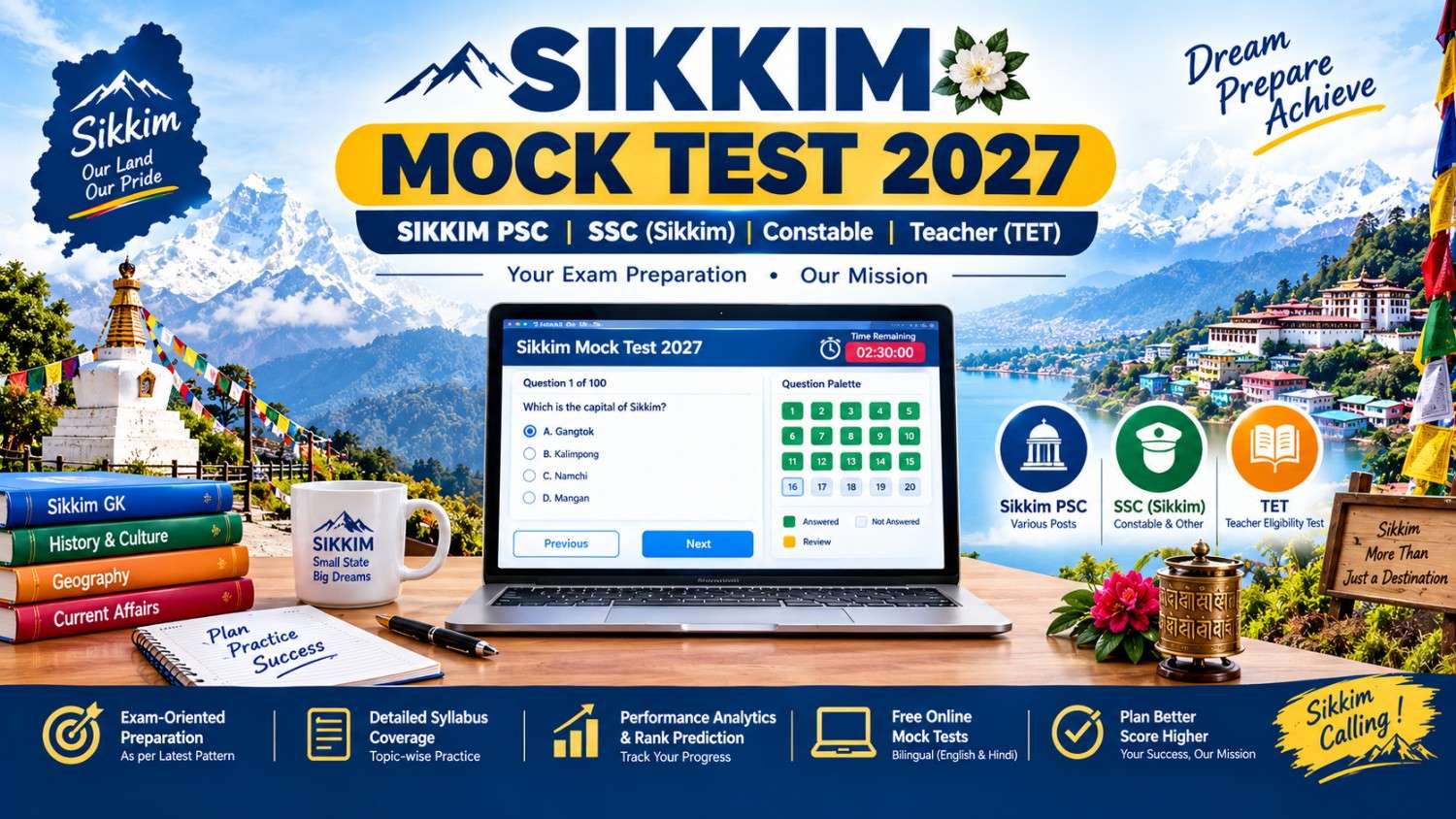 full
full
Sikkim Mock Test 2027: Free SPSC, Police & STET Series
Sikkim Mock Test 2027: Free Full-Length SPSC, Police & STET Online Test Series Disclaimer: This master hub is kept up to date with regard to the most recent patterns of the Sikkim exams listed here and for reference to the 2027 cycle. The pattern rules remain valid for each exam; information about exam dates, vacancies and cutoffs is updated whenever officially announced by the SPSC, the Sikkim Police and the Education Department. If you are preparing for state civil services, the police uniform cadre, or teaching positions in the Himalayan state of Sikkim, you will need a study plan that focuses on regional history, the provisions of the Constitution, and local geography. The Sikkim mock test 2027 platform on SarkariMockTest.com provides a comprehensive, open-access hub for the state category that covers the main competitive examinations in Sikkim: the SPSC State Civil Services (Combined Scheme for Under Secretary, DSP, and related cadres), the SPSC Subordinate Group C, the Sikkim Police Constable and Sub-Inspector, and the Sikkim Teacher Eligibility Test (STET). Many candidates ask "how to attempt the Sikkim mock test" and "where can one find free online tests for the Sikkim exams?" In previous examinations conducted by the Sikkim Public Service Commission (SPSC), state-specific general knowledge, the administrative heritage under Article 371-F, and environmental topics have made up a significant part of the written exam. We offer structured online mock tests based on the official examination patterns, providing you with realistic time tracking and performance analysis, with no paywalls. Quick Overview: Sikkim State Examinations Hub Exam Title Conducting Authority Paper Architecture Total Questions & Marks Allotted Duration Negative Marking Rule Core Syllabus Focus SPSC State Civil Services Prelims SPSC Paper I (GS) + Paper II (Aptitude) 200 questions / 400 marks 120 minutes per paper Negative marking applies (check the latest notice) General Studies, Sikkim Affairs & Aptitude SPSC Subordinate / Group C SPSC Written Screening Paper 100 marks (as per the post) 120 minutes Check the latest official notification General English, GK & Arithmetic Sikkim Police Constable Police Selection Board PET/PMT + Written Examination 100 marks written 120 minutes Check the latest official notification Sikkim GK, India GK, Reasoning, Elementary Writing Sikkim Police Sub-Inspector SPSC / Police Board Physical Tests + Dual Papers Paper I (100 marks) + Paper II (100 marks) 120 minutes per paper Check the latest official notification English, General Studies & Reasoning STET (Paper 1 & Paper 2) Education Department One paper per target level 150 questions / 150 marks 150 minutes (2.5 hours) Zero (no negative marking) Child Development, Languages, Math, EVS/Social Sikkim State Competitive Examinations 2027 – Master Overview and Paper Matrix Aspirants often ask "what is the exam pattern for the SPSC prelims" and how the police recruitment system differs from that of the civil services. Since preparation involves multiple state boards, it is necessary to keep track of the exact blueprint for each recruitment stream. The table below sets out the testing criteria, paper structures, educational qualifications required, and the various stages of recruitment for the main competitive examinations in Sikkim. State Exam Track Conducting Body Paper Structure & Marks Time Limit Marking Rule Minimum Eligibility Selection Pipeline SPSC State Civil Services SPSC Paper I GS (200 marks) + Paper II CSAT (200 marks) 120 minutes each Penalty applies per error Bachelor's degree Prelims Screening > Mains Written > Interview SPSC Subordinate / Group C SPSC Composite Paper (English & GK) 120 minutes Penalty applies per error Class 12 or graduate Written Examination > Scrutiny of Documents Sikkim Police Constable Police Selection Board Physical Test + Written Test (100 marks) 120 minutes Check the latest notice Class 10 (Class 8 for HG) Physical Tests (PET/PMT) > Written Exam > Viva-Voce Sikkim Police Sub-Inspector SPSC / Police Board Paper I English (100 marks) + Paper II GS (100 marks) 120 minutes each Check the latest notice Bachelor's degree Physical Test > Written Examination > Interview STET (Paper 1 - Primary) Education Department 150 MCQs (150 marks, 1 mark each) 150 minutes (2.5 hours) Zero (no penalty) Senior Secondary + D.El.Ed Written Eligibility Test > Document Verification STET (Paper 2 - Graduate) Education Department 150 MCQs (150 marks, 1 mark each) 150 minutes (2.5 hours) Zero (no penalty) Graduation + B.Ed Written Eligibility Test > Document Verification Note: The pattern structures, paper splits, and qualifying criteria are based on past official notices. Candidates must check the exact requirements for each post in the most recent official notification before submitting their applications. SIKKIM STATE COMPETITIVE EXAMS 2027 MASTER HUB ARCHITECTURE Hub Blueprint | SPSC State Civil Services: Paper I GS (200 marks) and Paper II Aptitude (200 marks) | 120 minutes for each paper | Paper for the SPSC Subordinate / Group C position – Composite English and General Knowledge – Total marks: 100 3. Sikkim Police Constable, PET/PMT plus Written Test (Sikkim GK, Reasoning). Total 100 Marks. | For the post of Sikkim Police Sub-Inspector: Physical Standard Tests and two Written Papers | Total marks: 200 | For Paper 1 and Paper 2 there are 150 questions, 150 marks, 150 minutes and there is no penalty. Sikkim Special GK: The section which most national-level platforms leave out Most candidates approach their preparation for Sikkim general knowledge in the same way that they do for national general knowledge—by rapidly going through a list of dates and names. If a question arises asking which district includes Yuksom or what Article 371-F protects, the candidate's hesitation results in losing marks. As the state exam is based on a small state, it gives the advantage to the candidate who has studied that state in depth rather than to one who has studied the rest of India. People often ask "what kind of questions are included in Sikkim GK". In examinations conducted by the Sikkim Public Service Commission and the departmental boards, questions specific to Sikkim fall into five clearly defined areas: dynastic history, the special constitutional provisions, the reorganized district structure, high-altitude ecology, and indigenous traditions. SIKKIM SPECIAL GENERAL KNOWLEDGE: FIVE CORE FOUNDATIONS Core Pillars | Foundation 1: Monarchy & Treaties -> Namgyal Dynasty (1642-1975), Titalia (1817), Tumlong (1861) | | Foundation 2: Constitutional Law -> Article 371-F, 36th Amendment 1975, Certificate of Identity | | Foundation 3: Reorganized Terrain -> 6 Administrative Districts (2021 Act), Mountain Passes | | Foundation 4: Mountain Ecology -> Khangchendzonga UNESCO Site, Organic Farming Policy | | Foundation 5: Cultural Traditions -> Lepcha, Bhutia & Nepali Heritage, Sacred Monasteries | History and the Monarchy: The Namgyal Dynasty up to the 1975 Merger The historical account of Sikkim as an independent kingdom extends over three centuries under the rule of the Chogyals (monarchs) of the Namgyal dynasty: The consecration at Yuksom in 1642 involved three highly respected Buddhist lamas—Lhatsun Namkha Jigme, Kathog Kuntu Zangpo, and Ngadak Sempa Chempo—travelling from Tibet to Yuksom (Norbugang) in western Sikkim, where they consecrated Phuntsog Namgyal as the first Chogyal (Dharma Raja) of Sikkim and thereby founded the Namgyal dynasty; the stone coronation throne (Norbugang Chorten) is still located at Yuksom. Historical Capitals: The government's seat moved to four different places due to foreign military pressures: Yuksom (1642): It was the original capital of western Sikkim. The second Chogyal, Tensung Namgyal, made Rabdentse the second capital, but it was subjected to numerous attacks by troops from Bhutan and the Gorkha area and the stone ruins of the site are still to be found near Pelling. The settlement was established in northern Sikkim following the destruction of Rabdentse. Gangtok was made the fourth and last capital in 1894 by the ninth Chogyal, Thutob Namgyal. Colonial Treaties: The Treaty of Titalia, signed in February 1817, was entered into between the British East India Company and the Chogyal of Sikkim as a consequence of the Anglo-Nepalese War. The British thus regained the territories lying between the Mechi and Teesta rivers which had previously been taken over by Nepal, as a result of which Sikkim came to be placed under the protection of the British. The Treaty of Tumlong (March 1861) was the result of military operations carried out under the command of Sir Ashley Eden and it established British rights to commercial transit through Sikkim to the Tibetan frontier, thereby reducing the kingdom to a de facto British protectorate. Democratic integration in 1975: During the early 1970s the demand by the public for democratic administration became stronger under political figures like Kazi Lhendup Dorjee. Following the adoption of a major resolution by the elected Sikkim Council and the conduct of a special referendum covering the whole state in April 1975, the monarchy was abolished. The Parliament then enacted the Constitution (Thirty-sixth Amendment) Act, 1975, by which Sikkim was officially made the 22nd State of the Indian Union, effective from 16 May 1975. Article 371-F, Certificate of Identification and Governance The constitutional structure of Sikkim includes special institutional provisions intended to safeguard historical civil rights: Special Provisions under Article 371-F: These were added to Part XXI of the Constitution of India through the 36th Amendment Act, 1975: Protection of Existing Laws: The laws which were in force immediately before the day appointed in the territories of Sikkim shall continue to be in effect until they are altered, amended, or repealed by a competent legislature. This clause guarantees the continuation of the historical land and tenancy laws. The Revenue Order No. 1 of 1917 is a historic ordinance issued before the merger and it prohibits the sale, mortgaging or transfer of agricultural land which belongs to the native Bhutia and Lepcha groups from being given to persons who are not native without the approval of the state. When applying for public employment in the state administrative services and aiming to be eligible for the state's educational reservations, a verified Certificate of Identification (CoI) is necessary. This certificate is primarily given to the descendants of people who were listed in the Sikkim Subject Register of 1961 under the pre-merger Sikkim Subject Regulation. Unique Composition of the Legislative Assembly: The Sikkim Legislative Assembly has 32 seats: Twelve seats have been set aside for the indigenous Bhutia-Lepcha (B-L) communities. There are two seats set aside for the Scheduled Castes (SC). There is one seat set aside for the Sangha (that is, a special non-territorial constituency consisting of Buddhist monks and lamas who are registered in the recognized monasteries in Sikkim, and this seat is determined by an electoral college composed of monks). 17 general seats. Open to all eligible citizens. The 6 Districts Matrix People frequently ask "how many districts are there in Sikkim?" Since the Sikkim Re-Organisation of Districts Act, 2021 (which was passed by the state assembly and came into force in December 2021) was implemented, Sikkim has changed from its earlier arrangement of four districts (East, West, North, South) to having six administrative districts. The four original districts were renamed after their administrative headquarters and two new districts were established in order to enhance administrative efficiency. District Name Headquarters Former Nomenclature / Origin Key Administrative & Geographic Landmark Gangtok Gangtok Former East Sikkim District State Capital, High Court, Enchey & Rumtek Namchi Namchi Former South Sikkim District Char Dham (Siddhesvara Dhaam), Samdruptse Mangan Mangan Former North Sikkim District Largest area, Gurudongmar, Yumthang Valley Gyalshing Gyalshing Former West Sikkim District Yuksom coronation site, Rabdentse, Pelling Pakyong Pakyong Carved out of East Sikkim Pakyong Greenfield Airport, Silk Route Soreng Soreng Carved out of West Sikkim Agriculture base, Varsey Rhododendron Gangtok District (with its headquarters in Gangtok): Functions as the administrative, commercial, and judicial capital of the state and houses the Sikkim Legislative Assembly, the High Court of Sikkim, and a number of historical institutions including the Namgyal Institute of Tibetology. Namchi District (with its headquarters in Namchi): Serves as the cultural and tourist centre of southern Sikkim and features the huge 135-foot statue of Guru Padmasambhava at Samdruptse Hill as well as the Siddhesvara Dhaam (the Char Dham cultural complex). Mangan District (with its headquarters in Mangan): Is the largest district in terms of geographical area (stretching over 4,200 square km) yet has the lowest population density; it contains several high-altitude landmarks such as Gurudongmar Lake (5,430 m / 17,800 ft), the Yumthang Valley of Flowers, Lachung, and Lachen. Gyalshing District (with its headquarters in Gyalshing): Is where Sikkimese history began and includes Yuksom, the archaeological ruins of Rabdentse, and the holy Khecheopalri Lake (a sacred "wishing lake" for both Buddhists and Hindus). Pakyong District (with its headquarters in Pakyong): Was established from the southern areas of the former East Sikkim district and has Sikkim's only operational civilian airport (the Pakyong Greenfield Airport) as well as the historic trade route heading towards the Tibetan frontier. Soreng District (with its headquarters in Soreng): Was transferred from the former West Sikkim district and shares borders with Nepal and West Bengal; it is famous for horticulture and the Varsey Rhododendron Sanctuary. Ecology, Khangchendzonga and the State's Organic Policy Khangchendzonga National Park (a UNESCO Mixed Site): In July 2016, Khangchendzonga National Park was named as India's first and only "Mixed" UNESCO World Heritage Site, having been recognised for its exceptional natural biodiversity (such as glaciers, alpine lakes, and virgin valleys) and cultural significance. Mount Khangchendzonga (8,586 metres, the third highest mountain in the world) is considered in Sikkimese spiritual beliefs to be a sacred protective deity. World's First 100% Organic State: In January 2016, Sikkim became the first state in the world to carry out 100% certified organic agriculture on all its cultivated farmlands by banning the commercial import and sale of synthetic chemical fertilisers and pesticides. In October 2018, the policy received international recognition when the UN Food and Agriculture Organisation (FAO) and the World Future Council presented Sikkim with the Future Policy Gold Award 2018. Drainage Basins and Mountain Passes: The Teesta River: This is the main river of Sikkim, starting at Tso Lhamo lake and the Teesta Khangse glacier in northern Sikkim, cutting through valleys to the south before joining its major tributary, the Rangit River, at Tribeni near Melli. Strategic Mountain Passes: Nathu La (4,310 m) and Jelep La (4,267 m) in eastern Sikkim have historically connected India with Lhasa in Tibet through the Chumbi Valley. Nathu La was reopened for bilateral border trade in 2006. Culture, Communities, Monasteries and Festivals The three main communities are the native Lepcha (also known as Rongpa, or "people of the ravine"), the Bhutia (descendants of Tibetan migrants who have been in the area since the 14th century), and the Nepali community (comprising a number of ethnic groups including the Limboo, Rai, Tamang, Gurung, Mangar, Newar, Chhetri, and Bahun). Sacred Buddhist Monasteries (Gumpas): The Dubti Monastery (Gyalshing) was founded in 1701 CE and is regarded as the oldest monastery still being operated in Sikkim. The Pemayangtse Monastery (Gyalshing) was built in 1705 and is the principal monastery of the Nyingma order and is meant for celibate monks (Ta-tshang). The Tashiding Monastery (Gyalshing) is located on a conical hill situated between the Rathong and Rangit rivers and is where the sacred annual Bhumchu (Holy Water) festival takes place. The Rumtek Monastery (in Gangtok): the Dharma Chakra Centre, which was established in the 1960s by the 16th Gyalwa Karmapa, is the main seat of the Karma Kagyu lineage among the exiles. Major Cultural Festivals: Pang Lhabsol: It is a special festival of the Sikkimese which takes place on the 15th day of the 7th Tibetan month and involves the consecration of Mount Khangchendzonga as guardian deity together with the celebration of the historic brotherhood agreement between the Lepcha patriarch Thekong Tek and the Bhutia chieftain Khye Bumsa at Kabi Lungchok. Saga Dawa celebrates the birth, enlightenment, and passing away (Parinirvana) of Gautama Buddha on the full moon of the fourth Tibetan month. The Losong/Namsoong festival, which takes place in December, marks the end of the agricultural season and is accompanied by Cham masked dances in the principal monasteries. State Emblems: State Animal: Red Panda (Ailurus fulgens); State Bird: Blood Pheasant (Ithaginis cruentus); State Tree: Rhododendron (Rhododendron niveum); State Flower: Noble Dendrobium Orchid (Dendrobium nobile); The state fish is the Katley / Chocolate Mahseer (Neolissochilus hexagonolepis). Why Most Sikkim Mock Tests Fall Short Many online test websites are unable to adequately prepare candidates for state-level recruitment: When generic central-level GK is included without any state-specific content, most national test apps obtain their question banks from the central SSC or Railway exams and refer to them as "SPSC Practice Tests". These papers include hundreds of questions at the national level but do not provide information about the Chogyal dynasties, the timelines of the Namgyal treaty, or the local administrative systems. The use of the old 4-district geographical arrangement: several regional preparation blogs still provide question banks which refer to the outdated 4-district geography (East, West, North, South), ignoring the six districts which have been reorganised under the 2021 Act. Different platforms offer inconsistent explanations regarding negative marking, which confuses civil services aspirants by giving varying deduction rates for different test papers. There is no separation in the standard test platforms between performance in national General Studies and that in Sikkim-specific General Knowledge, which means that students cannot tell where their weaknesses are in relation to local governance, history, and ecology. Choose Your Exam: Free Online Mock Tests for Sikkim To access the full practice sets and diagnostic tools, please choose the examination you would like below. 1. Mock test for the SPSC State Civil Services Preliminary Examination (Paper I and Paper II) Designed for the Combined Competitive Examination for Under Secretary, Deputy Superintendent of Police (DSP), and State Accounts Service posts: Paper I: General Studies (100 questions, 200 marks, 120 minutes) includes topics such as Indian History, World Geography, Indian Polity, the Economy, Science, and Sikkim-specific general knowledge. Paper II: The aptitude test consists of 100 questions worth a total of 200 marks and has a time limit of 120 minutes; it examines the candidate's reading comprehension, logical reasoning, general mental ability and basic numeracy, and it is necessary for candidates to meet the required qualifying standard of 33%. Status: Now available Access Link: Launch SPSC Civil Services Prelims Mock Test 2. SPSC Subordinate and Group C Mock Test It is designed for Junior Assistants, Lower Division Clerks (LDC), and Accounts Clerks in the different state secretariats and includes a combined objective paper which tests General English, General Knowledge with a special reference to Sikkim, and Basic Arithmetic. Status: Now available Access Link: Launch SPSC Subordinate Group C Mock Test 3. Mock test for Police Constable and Sub-Inspector in Sikkim Made for recruitment into executive and armed battalion positions carried out by the Sikkim Police Department: The written examination consists of 100 marks and covers knowledge of Sikkim, Indian history, basic reasoning, and elementary English or essay writing, together with notes on physical efficiency. Sub-Inspector (Executive & IRBn): a technical examination consisting of two papers, namely Paper I (General English) and Paper II (General Studies and Mental Ability). Status: Now available Access Link: Launch Sikkim Police Recruitment Mock Test 4. STET Mock Test (Paper 1 and Paper 2) Aligned with the Sikkim Teacher Eligibility Test conducted by the Education Department: Paper 1 (intended for primary teachers covering Classes I to V): consists of 150 questions in the areas of Child Development and Pedagogy, Language I (English), Language II (offering vernacular options), Mathematics, and Environmental Studies. Paper 2 (intended for Graduate Teachers teaching Classes VI to VIII): consists of 150 questions in the areas of Child Pedagogy, Language I, Language II, and the specialised subject streams (Mathematics and Science or Social Studies). Status: Now available (feature includes zero negative marking) Access Link: Launch Sikkim TET Practice Set Negative Marking Across Sikkim Exams People frequently ask things like "In Uttarakhand, how much is the negative marking?" or how the rules about negative marking differ between the various state boards. In the case of Sikkim, the rules concerning negative marking are entirely determined by the examining body. The SPSC objective preliminary papers include negative marking, whereas the teaching eligibility tests (STET) do not deduct marks for incorrect answers. Comparison Table of Pattern and Negative Marking by State Examination State Examination Paper Category Total Questions & Marks Allotted Time Penalty Deducted Per Error Operational Strategy SPSC Civil Services (Paper I) General Studies 100 Qs / 200 Marks 120 Minutes Negative marking applies (check notice) Focus on questions with high confidence; avoid random guesses SPSC Civil Services (Paper II) Aptitude Test 100 Qs / 200 Marks 120 Minutes Negative marking applies (check notice) Secure the 33% qualifying mark (66 marks) safely SPSC Subordinate Group C Composite Paper 100 Marks (as per notice) 120 Minutes Penalty applies (check notice) Maintain a balanced speed between English and GK Sikkim Police Constable Written Test 100 Marks (composite) 120 Minutes Check the latest official notice First complete the Sikkim history and reasoning questions Sikkim Police Sub-Inspector Dual Papers 200 Marks in total 120 Minutes each Check the latest official notice Prioritise grammatical accuracy in Paper I TET (Paper 1 & Paper 2) Teacher Eligibility 150 Qs / 150 Marks 150 Minutes Zero penalty (no negative marking) Mandatory 100% attempt rate Time Planning Guide for the SPSC Prelims (120 minutes for 100 questions) In Paper I you will have 120 minutes to answer 100 questions, that is 72 seconds per question. The three-stage method described below will enable you to finish the paper without having to rush. First Round: Direct Factual Questions (from minute 00 to 45): Go through the paper and answer the direct factual questions covering Sikkim Special GK, Indian Polity and History. If a question requires complex matching or if the timeline is unclear, put it aside and proceed. Try to correctly answer between 45 and 50 questions in this initial go-through. Second Round: Analytical and Conceptual Questions (from minute 45 to 90): Tackle the questions based on statements in the areas of the Indian Constitution, environmental science and economic development. Allocate 45 minutes to answer about 35 to 40 questions. Third Round: Scratch Work and Verification (from minute 90 to 120): Use your last 30 minutes to do arithmetic or mental ability scratch work, to check the items on which you have eliminated two options, and to make sure that all your answer bubbles have been neatly filled in. RECOMMENDED 120-MINUTE TIME ALLOCATION PROFILE (100-QUESTION FORMAT) Pacing Guide [=====] Round 1: Direct State and National Facts (45 Minutes) -> 37.5% of the time | About 48 questions cleared [======] Round 2: Multi-Statement Analytical (45 minutes) — 37.5% of the time | About 38 questions solved [====] Round 3: Verification and OMR Completion (30 Mins), 25.0% of time | Pacing Buffer and Checks TOTAL ALLOCATION: 120 MINUTES | 100 QUESTIONS | STRATEGY: THREE SYSTEMATIC PASSES Structure of the Test Series and Coverage Matrix Our testing programme guides your preparation step by step, starting with individual topic exercises and progressing to full-length exam simulations: Level and Segment Sections Covered Tests Offered Question Format Focus and Exam Alignment Tier 1: Sectional Drills Sikkim GK, Indian Polity, History, English, Logic 16 Tests (25 questions / 25 minutes) Timed drills at the topic level Develops speed and mechanical memory Tier 2: Full Simulations Complete Multi-Paper Formats 10 Tests (100 questions / 120 minutes) A real exam simulation Builds endurance for a full 120-minute exam Tier 3: Sikkim GK Labs Namgyal History, Article 371-F, 6 Districts 4 Labs (50 questions / 50 minutes) Questions focused on the state Targets the high-yield regional section Tier 4: Shift-Style Mocks Complete Composite Syllabus 2 Tests (100 questions each) Questions in the style of past shifts Familiarity with current exam trends and format Worked Sample Questions with Complete Explanations Review these sample questions, which illustrate the regional depth, chronological questions, and the four-option explanations that are used in our practice sets. Sample 1: Sikkim Royal History & Monarchy SAMPLE QUESTION: SIKKIM MONARCHY & HISTORICAL CAPITALS Monarchy Sample | Question: The historical capital of the Kingdom of Sikkim was shifted from Rabdentse to Tumlong | What repeated invasions carried out by forces of Gorkha took place under the rule of the Chogyal of the Namgyal dynasty? | (A) Phuntsog Namgyal | | (B) Tensung Namgyal | | (C) Tshudpud Namgyal | | (D) Thutob Namgyal | | CORRECT ANSWER: (C) Tshudpud Namgyal | | Step-by-Step Concept Explanation: | | Why Option (C) is Correct: | | During the late 18th century, the second capital at Rabdentse was repeatedly attacked and sacked | | by invading Gorkha armies from Nepal due to its close geographical proximity to the western | At the frontier, in 1814 CE the 7th Chogyal, Tshudpud Namgyal, officially moved the royal capital | to Tumlong in northern Sikkim, which was the seat of government until 1894. | Why Other Options Are Incorrect: | Option (A): Phuntsog Namgyal was the first Chogyal to be consecrated at Yuksom in 1642. | - Option (B): Tensung Namgyal was the second Chogyal who shifted the capital from Yuksom to | Rabdentse around 1670. | - Option (D): Thutob Namgyal was the ninth Chogyal who shifted the permanent capital from Tumlong | to Gangtok in 1894. Sample 2: Constitutional Law & Governance (Article 371-F) SAMPLE QUESTION: SPECIAL CONSTITUTIONAL PROVISIONS FOR SIKKIM Governance Sample | Question: Under Article 371-F of the Constitution of India, which specific sub-clause ensures that | | all laws in force immediately before the appointed day in the territories comprising the State of | Until altered or repealed by a competent legislature are the Sikkim laws still in force? | (A) Article 371-F, Clause (a) | | (B) Article 371-F, Clause (f) | | (C) Article 371-F, Clause (k) | | (D) Article 371-F, Clause (n) | | CORRECT ANSWER: (C) Article 371-F, Clause (k) | | Step-by-Step Concept Explanation: | | Why Option (C) is Correct: | | Clause (k) of Article 371-F is a vital constitutional protection inserted via the 36th Amendment | The Act of 1975 makes it explicit that all the laws which are in force in the territories of Sikkim shall | immediately before 16 May 1975 continue in force until modified or repealed by a competent | | the legislature, ensuring that the historical laws relating to land tenure such as Revenue Order No. 1 of 1917 are protected. | Why Other Options Are Incorrect: | | A) Clause (a) states that the Legislative Assembly must have at least 32 seats.| (B) Clause (f) gives Parliament the power to reserve seats for different sections. | - Option (D): The term 'clause (n)' grants the President the authority to extend enactments that are in force in other states. | Product Features: An Overview of How Our Analytics Function The practice platform features a range of analytical tools to assist you in your preparation for the state examinations: Automated Diagnostics for the Sikkim GK Module The scoring dashboard monitors your performance in relation to the Namgyal dynasty, Article 371-F, the six districts, and high-altitude ecology. Should your score in the state general knowledge area fall below the competitive level, the system will indicate the specific module that needs to be revised. The All India and All-Sikkim State Rank Leaderboard You can compare your score, completion time, and percentile with other candidates who are currently active in Gangtok, Namchi, Mangan, Gyalshing, Pakyong, and Soreng. 📊 View All India & State Rank Leaderboard 🤖 Recommendations for Weak Areas Based on AI Personalized Diagnostics The diagnostic system keeps an eye on your performance in various tests. Whenever your accuracy decreases in the 6-district matrix, the administrative treaty timelines, or in aptitude comprehension, the system will highlight those topics and recommend targeted 10-question drills to aid your improvement. Diagnostic Summary: Real-time tracking across Namgyal Monarchy History, Article 371-F, 6 Reorganized Districts, and High-Altitude Ecology. Generates targeted corrective sprint drills based on your attempt logbook. ⚡ Launch AI Weak-Area Diagnostic Tool Explanations for All Four Answer Options For each question there is an explanation box which explains why the correct answer is correct and also details why the other three options are wrong, citing standard state publications and gazettes. ⚡ Daily State & North-East Booster 15-Min Daily Quiz Free Daily Current Affairs Practice To keep your knowledge up to date on both national news and on developments in the North-East region, you can take our free daily quiz: Take the Free Daily Current Affairs Quiz 👉 Take the Free Daily Current Affairs Quiz To try the free Sikkim mock tests on Sarkari Mock Test, you only need less than two minutes to get started: Go to the website: Open SarkariMockTest.com and from the navigation menu choose State Government Exams then Sikkim Hub. Pick the exam you want to take: You can select SPSC State Civil Services, SPSC Subordinate Group C, Sikkim Police Constable/SI, or STET. Start the simulator: Click on Start Free Mock Test and the testing console will appear with a countdown timer specific to the exam, a display showing the status of each question, and a button to switch the language. Answer the questions and then click Submit Examination to see your immediate scorecard, your percentile rank among other candidates in the state, and detailed explanations for each question. A preparation strategy along with important books and resources for each exam Follow this organised preparation strategy and use standard academic reference books: Examination Track High-Yield Topics to Master Authoritative Reference Books SPSC State Civil Services Sikkim History & Culture, Indian Polity, Article 371-F, Environment, General Mental Ability. History of Sikkim by the standard state archives; Indian Polity by M. Laxmikanth; Environment & Ecology by Majid Husain; Quantitative Aptitude by R.S. Aggarwal. SPSC Subordinate / Group C General English, Sikkim Special GK, Elementary Arithmetic, Computer Basics. Wren & Martin’s High School English Grammar; Sikkim General Knowledge yearbooks; basic arithmetic workbooks. Sikkim Police (Constable & SI) General Knowledge, Reasoning, Elementary Mathematics, English Composition. The State Board Class 9 and 10 Mathematics textbooks; Lucent’s General Knowledge; handbooks on verbal and non-verbal reasoning. STET (Paper 1 & Paper 2) Child Development & Pedagogy, Language I & II, Mathematics, Science / Social Studies. The SCERT Sikkim textbooks for primary and upper primary levels (Classes 1 to 8); standard B.Ed / D.El.Ed pedagogical reference guides. Common mistakes made by Sikkim aspirants Treat Sikkim Special GK as a minor topic: Spending all your study time on central Indian history while ignoring the local dynastic lineages and the provisions of Article 371-F, and thus losing easy marks in the state section. Using out-of-date 4-district geography information: Preparing with older materials that refer to the four-district arrangement before 2021, which causes incorrect answers when questions concern Pakyong, Soreng, or the newly designated district headquarters. Confusing the consecration with the capital relocations: Mixing up the founding of Yuksom (1642), the move to Rabdentse (c. 1670), the shift to Tumlong (1814), and the relocation to Gangtok (1894). Making unthinking guesses when there is negative marking: Carelessly guessing on uncertain questions in the SPSC preliminary papers and thereby losing marks due to the penalty system. Leaving questions blank in the Sikkim TET: Forgetting that STET has no negative marking and that every unanswered question is a missed opportunity to score. Why it's worthwhile to do this free Sikkim test series hub Using full-length simulations that match state standards helps to improve both speed and conceptual understanding: Parameter Unorganised, fragmented preparation SarkariMockTest Unified Sikkim Hub Platform model Multiple paywalls on different commercial apps A single free, unified hub covering all the major state exams Regional depth Generic North-East trivia with very little focus on the state A detailed module for the state, covering the Namgyal dynasty, Article 371-F, and the six reorganised districts District geography Outdated materials based on the four-district layout Fully updated to reflect the six reorganised districts under the 2021 Act Marking accuracy Inconsistent or missing penalty settings The negative marking is correctly set up for the state papers How this mock test series was put together My name is Shubham Kumar Sah and I am the founder of SarkariMockTest.com. Among the exam platforms I've looked at, most offer thousands of tests for large states but very few have carefully developed ones for Sikkim. The two things are usually overlooked. The first is that Sikkim-specific knowledge—such as the Namgyal dynasty, Article 371-F, and the six reorganised districts—is often reduced to just a few questions. The second is that an aspirant preparing for more than one Sikkim exam has to gather information from various sources and has no single reliable starting point. This hub is designed to address both of these issues. Each exam is presented in one place with its own pattern. The Sikkim GK section is organised by topic so you can clearly see where your understanding is weak. The test series remains free as long as the exam-specific page is active, because a state-specific diagnostic shouldn't require a paywall. As I continue to develop this hub, I check each exam page to make sure it meets one simple criterion: does it actually test the Sikkim-specific knowledge that the exam is based on? If the answer is no, then it is not included. Official Portals & Recruitment Notification Links Use these verified official portals to track examination notifications, download syllabus circulars, and review declared results: Department / Commission Official Website Link Primary Purpose for Candidates The Sikkim Public Service Commission (SPSC) spsc.sikkim.gov.in publishes recruitment notices and results for positions in the Civil Services, as well as for the posts of Under Secretary, DSP, and Subordinate. The Sikkim Police Department police.sikkim.gov.in has the website police.sikkim.gov.in, where information on Police Constable appointments, Sub-Inspector circulars, and physical recruitment schedules is provided. The Education Department of the Government of Sikkim education.sikkim.gov.in provides STET notices, syllabi, and scorecards. SarkariMockTest Sikkim Master Hub sarkarimocktest.com Free full-length practice tests, Sikkim general knowledge quick drills, and state scorecards. Practical Preparation Advice: Module-Wise State GK and Exam Endurance To pass the competitive examinations in Sikkim it is necessary to carry out systematic revision of the region's history, its mountain geography, and its administrative systems. Since specialized knowledge of the region is very important in appointments such as those by the SPSC Civil Services, simply relying on study materials at the national level will result in a number of gaps in one's knowledge. Each morning, spend 45 minutes going over the chronological order of the Chogyals, the four past relocations of the capital, and the constitutional safeguards provided under Article 371-F. Make prepared summary charts for the six reorganized districts, the high-altitude mountain passes, and the sacred monastic centres. Each day do 20 quantitative and reasoning questions in order to earn a solid foundation in the preliminary aptitude sections. Once a weekend, take one full-length Sikkim mock test in 2027 under timed conditions and keep your attempts disciplined to prevent incurring negative marking penalties. The most reliable method of clearing your examinations is through consistent practice of these state-specific facts. About the Author Ali Hassan works as a Senior Content Editor for SarkariMockTest.com, focusing on the curricula of state public service commissions, on recruitment exams for the regional police, and on preparing students for bilingual tests in the Himalayan and North-Eastern states. Since he has been studying competitive examination trends for more than three years, he examines question sets to make sure that they match the current patterns of the commissions and adhere to verified factual standards. .sk-mock-wrapper, .sk-mock-wrapper * { box-sizing: border-box !important; -webkit-tap-highlight-color: transparent; } .sk-mock-wrapper { width: 100% !important; max-width: 100% !important; margin: 0 !important; padding: 16px 12px !important; font-family: -apple-system, BlinkMacSystemFont, "Segoe UI", Roboto, Helvetica, Arial, sans-serif; line-height: 1.65; color: #212121; background-color: #ffffff; overflow-wrap: break-word; word-wrap: break-word; text-align: left !important; display: block !important; clear: both !important; float: none !important; } .sk-mock-wrapper p, .sk-mock-wrapper h1, .sk-mock-wrapper h2, .sk-mock-wrapper h3, .sk-mock-wrapper ul, .sk-mock-wrapper ol, .sk-mock-wrapper li, .sk-card-architecture, .sk-author-box, .sk-module-card, .sk-box-alert, .sk-ai-diagnostic-wrapper, .sk-quiz-container { text-align: left !important; } .sk-top-h2 { display: block !important; width: 100% !important; background: linear-gradient(135deg, #1b5e20, #2e7d32) !important; color: #ffffff !important; font-size: 22px !important; font-weight: 800 !important; padding: 16px 18px !important; border-radius: 8px !important; margin: 10px 0 18px 0 !important; line-height: 1.35 !important; border-left: 6px solid #fbc02d !important; box-shadow: 0 4px 12px rgba(27, 94, 32, 0.22) !important; } .sk-disclaimer-box { background-color: #fffde7; border-left: 5px solid #fbc02d; padding: 14px 16px; margin-bottom: 16px; border-radius: 0 6px 6px 0; font-size: 14px; color: #424242; } .sk-h2 { font-size: 21px; font-weight: 700; color: #1b5e20; margin: 28px 0 14px 0; border-bottom: 2px solid #e0e0e0; padding-bottom: 8px; line-height: 1.35; } .sk-h3 { font-size: 17px; font-weight: 600; margin: 20px 0 10px 0; line-height: 1.4; } .sk-p { font-size: 15px; color: #333333; margin: 0 0 16px 0; } .terminal-text { font-family: monospace; font-size: 13px; margin-bottom: 6px; color: #666; } .link-styled { color: #1b5e20; font-weight: 700; text-decoration: underline; } .link-styled:hover { color: #b71c1c; } .sk-action-btn-bar { display: flex; flex-wrap: wrap; gap: 12px; margin: 14px 0 18px 0; } .btn-rank { display: inline-block !important; background-color: #1b5e20 !important; color: #ffffff !important; font-size: 14px !important; font-weight: 700 !important; text-decoration: none !important; padding: 10px 20px !important; border-radius: 6px !important; box-shadow: 0 3px 8px rgba(27, 94, 32, 0.25) !important; transition: background-color 0.2s ease !important; } .btn-rank:hover { background-color: #0e3d13 !important; } .btn-ai { display: inline-block !important; background-color: #f57f17 !important; color: #ffffff !important; font-size: 14px !important; font-weight: 700 !important; text-decoration: none !important; padding: 10px 20px !important; border-radius: 6px !important; box-shadow: 0 3px 8px rgba(245, 127, 23, 0.25) !important; transition: background-color 0.2s ease !important; } .btn-ai:hover { background-color: #bc6502 !important; } .sk-table-wrap { width: 100% !important; max-width: 100% !important; overflow-x: auto !important; -webkit-overflow-scrolling: touch; margin: 18px 0 24px 0; border: 1px solid #e0e0e0; border-radius: 6px; background-color: #ffffff; } .sk-table { width: 100% !important; border-collapse: collapse; text-align: left !important; font-size: 14px; min-width: 620px; } .sk-table th { background-color: #1b5e20; color: #ffffff; padding: 11px 12px; font-weight: 700; border: 1px solid #1b5e20; white-space: normal; text-align: left !important; } .sk-table td { padding: 11px 12px; border: 1px solid #e0e0e0; color: #212121; vertical-align: top; text-align: left !important; } .sk-table tr:nth-child(even) { background-color: #f9fbe7; } .sk-table tr:hover { background-color: #fff9c4; } .sk-box-alert { width: 100% !important; background-color: #ffebee; border-left: 5px solid #c62828; padding: 16px; margin: 20px 0; border-radius: 0 6px 6px 0; } .sk-card-architecture { width: 100% !important; background: #ffffff; border: 1px solid #e0e0e0; border-radius: 8px; margin: 20px 0; overflow: hidden; box-shadow: 0 1px 4px rgba(0,0,0,0.04); } .sk-card-header { background-color: #1b5e20; color: #ffffff; padding: 12px 16px; font-weight: 700; font-size: 15px; display: flex; align-items: center; justify-content: space-between; flex-wrap: wrap; gap: 8px; text-align: left !important; } .sk-card-badge { background-color: #fbc02d; color: #212121; font-size: 12px; font-weight: 700; padding: 3px 8px; border-radius: 4px; } .sk-card-body { padding: 14px; text-align: left !important; } .section-green { background-color: #f1f8e9; border: 1px solid #c5e1a5; border-left: 5px solid #2e7d32; border-radius: 6px; padding: 12px 14px; text-align: left !important; } .section-yellow { background-color: #fffde7; border: 1px solid #fff59d; border-left: 5px solid #fbc02d; border-radius: 6px; padding: 12px 14px; text-align: left !important; } .section-blue { background-color: #e1f5fe; border: 1px solid #b3e5fc; border-left: 5px solid #0288d1; border-radius: 6px; padding: 12px 14px; text-align: left !important; } .section-red { background-color: #ffebee; border: 1px solid #ffcdd2; border-left: 5px solid #c62828; border-radius: 6px; padding: 12px 14px; text-align: left !important; } .sk-author-box { width: 100% !important; background-color: #ffffff; border: 1px solid #e0e0e0; border-left: 5px solid #1b5e20; border-radius: 8px; padding: 20px 18px; margin: 28px 0; box-shadow: 0 2px 6px rgba(0,0,0,0.04); text-align: left !important; } .sk-author-header { color: #1b5e20; font-size: 20px; font-weight: 800; margin: 0 0 12px 0; padding-bottom: 8px; border-bottom: 1px solid #eef2f6; text-align: left !important; } .sk-module-card { background: #ffffff; border: 1px solid #e0e0e0; border-radius: 8px; padding: 18px 16px; margin: 20px 0; box-shadow: 0 1px 4px rgba(0,0,0,0.04); text-align: left !important; } .border-green { border-left: 5px solid #2e7d32; } .border-yellow { border-left: 5px solid #fbc02d; } .border-blue { border-left: 5px solid #0288d1; } .border-red { border-left: 5px solid #c62828; } .color-green { color: #1b5e20; } .color-yellow { color: #f57f17; } .color-blue { color: #0288d1; } .color-red { color: #c62828; } .font-15 { font-size: 15px; } .font-bold { font-weight: 700; } .mb-0 { margin-bottom: 0 !important; } .mb-6 { margin-bottom: 6px !important; } .mb-8 { margin-bottom: 8px !important; } .mt-14 { margin-top: 14px !important; } .block { display: block; } .sk-list { list-style-type: disc !important; margin: 0 0 16px 0 !important; padding-left: 24px !important; text-align: left !important; } .sk-list li { margin-bottom: 8px !important; color: #333333; display: list-item !important; text-align: left !important; } .sk-sub-list { list-style-type: circle !important; margin: 6px 0 6px 0 !important; padding-left: 20px !important; } .sk-sub-list li { margin-bottom: 6px !important; display: list-item !important; } /* AI Diagnostic Wrapper */ .sk-ai-diagnostic-wrapper { width: 100% !important; background: #ffffff; border: 1px solid #e0e0e0; border-left: 6px solid #fbc02d; border-radius: 12px; padding: 22px 18px; margin: 26px 0; box-shadow: 0 4px 14px rgba(0,0,0,0.05); text-align: left !important; } .sk-ai-header { display: flex; align-items: center; justify-content: space-between; flex-wrap: wrap; gap: 10px; border-bottom: 1px solid #eef2f6; padding-bottom: 12px; margin-bottom: 14px; text-align: left !important; } .sk-ai-title { color: #1b5e20; font-size: 21px; font-weight: 800; margin: 0; display: flex; align-items: center; gap: 8px; text-align: left !important; } .sk-ai-badge { background-color: #fffde7; color: #f57f17; font-size: 11px; font-weight: 800; padding: 4px 10px; border-radius: 20px; border: 1px solid #fff59d; text-transform: uppercase; letter-spacing: 0.4px; } .sk-placeholder-box { border: 2px dashed #1b5e20; background-color: #f1f8e9; padding: 20px 16px; text-align: center; margin: 20px 0 16px 0; border-radius: 8px; } .icon-stat { font-size: 26px; margin-bottom: 6px; } .placeholder-desc { font-size: 13px; color: #555; text-align: left; background: #ffffff; padding: 10px 12px; border-radius: 6px; border: 1px solid #e0e0e0; line-height: 1.5; } /* Quiz Container */ .sk-quiz-container { width: 100% !important; background: #ffffff; border: 1px solid #c5e1a5; border-left: 6px solid #2e7d32; border-radius: 10px; padding: 22px 18px; margin: 28px 0; box-shadow: 0 3px 10px rgba(46, 125, 50, 0.07); text-align: left !important; } .sk-quiz-header { display: flex; align-items: center; justify-content: space-between; flex-wrap: wrap; gap: 8px; font-size: 13px; font-weight: 800; color: #2e7d32; text-transform: uppercase; letter-spacing: 0.5px; margin-bottom: 10px; } .sk-quiz-badge { background-color: #f1f8e9; color: #2e7d32; font-size: 11px; font-weight: 800; padding: 3px 10px; border-radius: 20px; border: 1px solid #c5e1a5; text-transform: uppercase; letter-spacing: 0.4px; } .sk-quiz-title { color: #1b5e20; font-size: 20px; font-weight: 800; margin: 0 0 12px 0; padding-bottom: 8px; border-bottom: 1px solid #eef2f6; text-align: left !important; line-height: 1.35; } .btn-wrap-center { text-align: center !important; margin: 20px 0 24px 0; clear: both !important; } .btn-green-cta { display: inline-block !important; background-color: #2e7d32 !important; color: #ffffff !important; font-size: 15px !important; font-weight: 700 !important; text-decoration: none !important; padding: 13px 28px !important; border-radius: 6px !important; box-shadow: 0 4px 10px rgba(46, 125, 50, 0.28) !important; border: 1px solid #1b5e20 !important; transition: background-color 0.2s ease, transform 0.15s ease !important; cursor: pointer !important; text-align: center !important; } .btn-green-cta:hover { background-color: #1b5e20 !important; color: #ffffff !important; text-decoration: none !important; } @media (min-width: 768px) { .sk-mock-wrapper { padding: 24px 16px !important; } .sk-top-h2 { font-size: 25px !important; } .sk-h2 { font-size: 23px; } .sk-h3 { font-size: 19px; } .sk-p { font-size: 16px; } .sk-table { font-size: 15px; } } @media (max-width: 600px) { .sk-mock-wrapper { padding: 12px 6px !important; } .sk-top-h2 { font-size: 20px !important; } .sk-h2 { font-size: 18px; } .sk-h3 { font-size: 16px; } .btn-green-cta, .btn-rank, .btn-ai { width: 100% !important; display: block !important; text-align: center !important; } .sk-action-btn-bar { flex-direction: column; } }
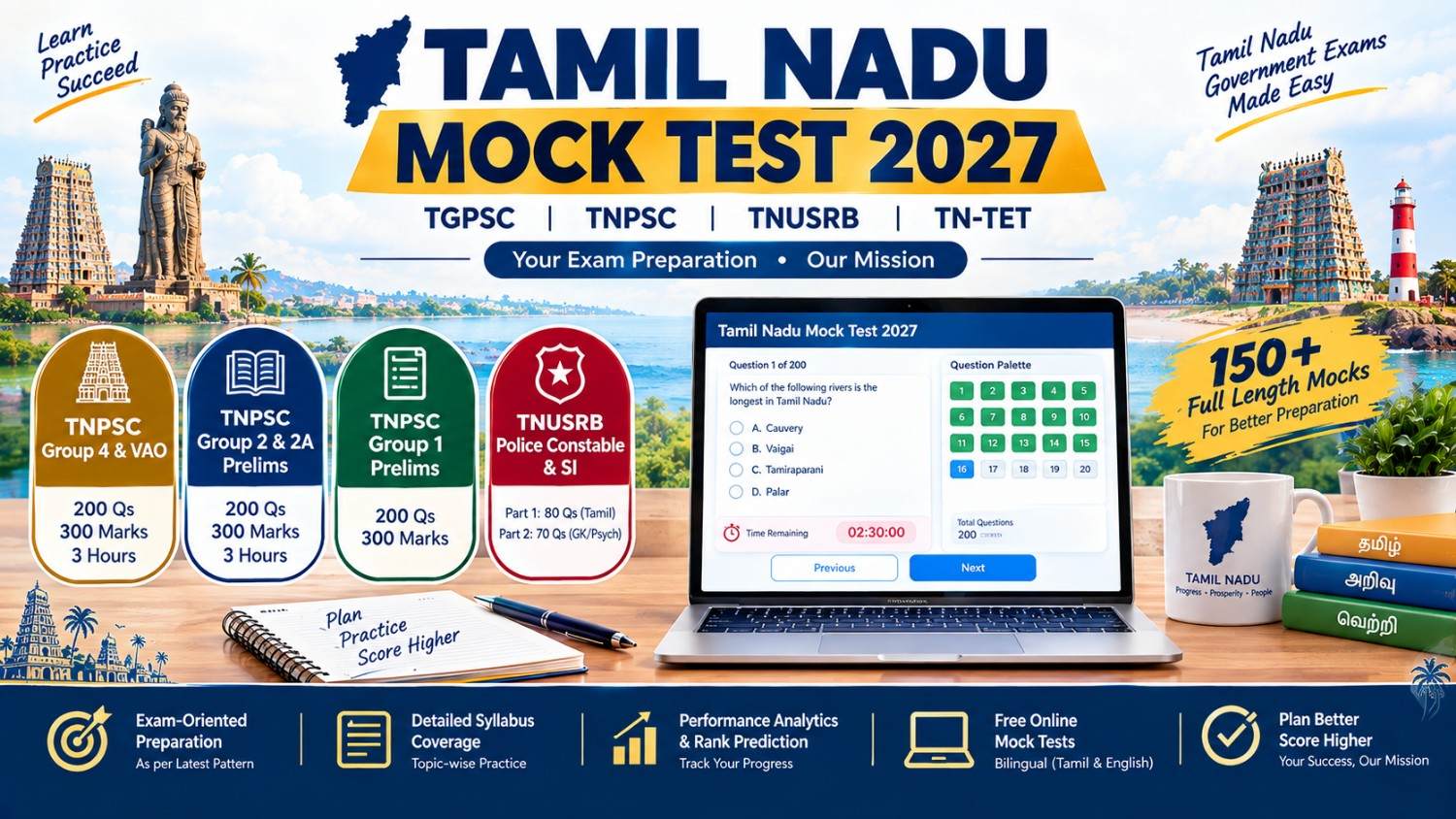 full
full
Tamil Nadu Mock Test 2027: Free TNPSC, Police & TRB Series
Tamil Nadu Mock Test 2027: Free Full-Length TNPSC Group 4, Police & TET Online Test Series The following disclaimer applies: this master hub has been brought up to date in light of the most recent patterns of the Tamil Nadu exams listed here as well as regarding references for the 2027 cycle. The pattern rules remain accurate for each individual exam; the exam dates, the vacancies and the cutoff scores are updated whenever officially announced by TNPSC, TNUSRB and TN TRB. The platform is the main hub for state-level category arrangements in Tamil Nadu concerning competitive examinations and provides full-length online mock tests for the TNPSC Group 4 and VAO, Group 2 and 2A, Group 1, the TNUSRB Police Constable, Sub-Inspector, and the TNTET. All the test series include verified distributions by subject, such as the required General Tamil (Pothu Tamil), Unit 8, Unit 9, and sections on psychology specific to police duties. People frequently search for "tamil nadu mock test kaise attempt karein" and "general tamil mein kitne marks hote hain". The Tamil Nadu mock test 2027 series on SarkariMockTest includes full bilingual practice sets that are aligned with the official commission standards. The questions are based on the Samacheer Kalvi school curriculum and on recent developments in state administration, providing timed simulations without charging any mandatory fees. Quick Overview: Tamil Nadu State Examinations Hub Examination Title Conducting Body Paper Structure & Split Total Questions & Marks Allotted Time Negative Marking Penalty Primary Subject Focus The TNPSC Group 4 and VAO exam TNPSC Part A (in Tamil) and Part B (in General Studies and Aptitude) 200 questions worth a total of 300 marks 180 minutes (3.0 hours) with no negative marking; the paper includes General Tamil (100 questions), General Studies (75 questions) and Aptitude (25 questions). The TNPSC Group 2 and 2A (Preliminary) examination TNPSC Preliminary Screening Paper 200 questions and a total of 300 marks 180 minutes (3.0 hours); No negative marks the paper includes sections on Language (100 questions), General Studies (75 questions) and Aptitude (25 questions). The TNPSC Group 1 (Preliminary) examination TNPSC Preliminary Examination 200 questions out of a total of 300 marks 180 minutes (3.0 hours); there are no negative marks, with the paper comprising Degree Standard General Studies (175 questions) and SSLC Aptitude (25 questions). TNUSRB Police Constable TNUSRB Part I (Tamil) + Part II (Main Written) 150 Qs / 150 Marks 160 Mins (Combined) No negative marks Tamil Eligibility (80 Qs), GK (45 Qs), Psychology (25 Qs) TNUSRB Sub-Inspector TNUSRB Part I (Tamil) + Part II (Main Exam) 240 Qs / 170 Marks 100 Mins + 150 Mins No negative marks Tamil Eligibility (100M), GK (40M), Psychology (30M) For TNTET (Papers I and II) TN TRB one paper for each target level, 150 questions and 150 marks, 180 minutes (3.0 hours); there are no negative marks, and the subjects included are Child Pedagogy, Language I and II, Math, and EVS/Social. Tamil Nadu State Competitive Examinations 2027 – Master Overview & Paper Matrix People frequently ask "What is the exam pattern for TNPC Group 4?" and also want to know how the police recruitment schemes differ from those of the civil services. To prepare through the various state boards, it is necessary to keep track of the exact blueprint for each recruitment route. The following table gives an account of the testing formats, the number of questions, the educational standards, and the various stages of recruitment in the major public service examinations in Tamil Nadu. State Exam Track Official Commission Question & Mark Split Time Limit Penalty Per Error Educational Base Selection Pipeline TNPSC Group 4 & VAO TNPSC 200 MCQs (Part A: 100 Qs / 150M; Part B: 100 Qs / 150M) 180 Minutes Zero (No Deduction) SSLC (Class 10 Pass) Single Written Exam > Certificate Verification > Counseling TNPSC Group 2 & 2A TNPSC 200 MCQs (Part A Language: 100 Qs; Part B: 100 Qs) 180 Minutes Zero (No Deduction) Bachelor's Degree Prelims Screening > Mains Examination > Oral Test / DV TNPSC Group 1 (Preliminary Examination) TNPSC 200 multiple choice questions (General Studies: 175 questions / 262.5 marks; Aptitude: 25 questions / 37.5 marks) 180 minutes No negative marking Bachelor's degree level Preliminary exam > Written main examination > Oral interview test TNUSRB Police Constable TNUSRB Part I: 80 Qs (Qualifying); Part II: 70 Qs (Evaluated) 80 + 80 Mins Zero (No Deduction) Class 10 (SSLC) Written Exam > PMT/ET/PET > Document Check TNUSRB Sub-Inspector TNUSRB Part I: 100 Qs (Qualifying); Part II: 140 Qs (70 Marks) 100 + 150 Mins Zero (No Deduction) Bachelor's Degree Written Exam > Physical Tests > Viva-Voce Interview The TNTET (Papers I and II) TN TRB 150 multiple choice questions (150 marks, 1 mark each) 180 minutes zero (no deduction) D.El.Ed / B.Ed written eligibility test > certificate verification Note: Note that the pattern structures, paper splits, and qualifying criteria are based on previous official notices. Before submitting their application forms, candidates should check the exact requirements for the position in the most recent notification. TAMIL NADU STATE COMPETITIVE EXAMS 2027 MASTER HUB ARCHITECTURE Hub Blueprint For TNPSC Group 4 and VAO: 200 questions | 300 marks | 180 minutes | Part A in Tamil and Part B in General Studies | 2. TNPSC Group 2 & 2A – 200 Questions | 300 Marks | 180 Minutes | Preliminary Screening | 3. TNPSC Group 1 (Prelims) — 200 Questions | 300 Marks | 180 Minutes | Degree GS (175) and Apt (25) | 4. TNUSRB Police Constable — 150 Questions | 150 Marks | 160 Minutes | Tamil (80) + Main Examination (70) | | 5. TNUSRB Sub-Inspector -> 240 Questions | 170 Marks | 250 Mins | Tamil (100) + Main (140 Qs) | TNTET (Paper I and II) : 150 questions | 150 marks | 180 minutes | Zero negative marking General Tamil (பொதுத் தமிழ்): The Half-Paper Most Platforms Under-Prepare Most candidates regard General Tamil as the simpler section and General Studies as the more difficult one. When a question comes up asking which work belongs to which anthology or requiring you to divide a compound word correctly, it is the easier section that ends up losing twenty marks. In Group 4, half of the paper is in Tamil. A candidate who has revised the Tamil section with the same care as they have revised General Studies is facing off against those who thought they already knew it. In the official structure of the TNPSC Group 4 and Combined Civil Services examination, Part A includes 100 questions worth a total of 150 marks out of the 300 marks available. Candidates are required to obtain at least 40 per cent (that is, 60 marks) in Part A as a compulsory qualifying criterion; if they do not meet this requirement, then Part B (General Studies and Aptitude) is not assessed. General Tamil cannot be regarded as a simple exercise in casual reading and must therefore involve a line-by-line revision of the Tamil Nadu State Board (Samacheer Kalvi) textbooks in the three specified sections. GENERAL TAMIL (பொதுத் தமிழ்) THREE-TIER SYLLABUS STRUCTURE Syllabus Structure | பகுதி அ: இலக்கணம் (Grammar) -> Rules, Sandhi, Root Words, Sentence Structure, Classifications | | பகுதி ஆ: இலக்கியம் (Literature) -> Thirukkural, Epics, Eighteen Lesser Texts, Devotional Hymns | | பகுதி இ: தமிழ் அறிஞர்களும் தமிழ்த் தொண்டும் -> Modern Poets, Scholars, Essayists, Social Reformers | பகுதி அ: Grammar (இலக்கணம்) Part A tests functional structural grammar, linguistic accuracy, and lexical rules: Matching: pairing the correct words with their definitions and matching root idioms with their meanings in context. Splitting and combining of compound words in accordance with the traditional Tamil grammatical junction rules (Sandhi). Identifying contextual antonyms and picking out the odd word from a group of lexical items. சந்திப்பிழை நீக்குதல்: Spelling mistakes are removed, including mistakes in doubling hard consonants (வல்லினம் மிகும் மற்றும் மிகா இடங்கள்), errors with structural case markers (வேற்றுமை உருபுகள்), and problems with pronoun agreement. வேர்ச்சொல் அறிதல்: Find root verbs from changed verbal participles, nouns, and verbal forms. For example, pull out the root verb from words like செய்தான், செய்த, செய்து. பெயர்ச்சொல் வகைகள்: Nouns fall into six traditional groups. These are பொருட்பெயர், இடப்பெயர், காலப்பெயர், சினைப்பெயர், பண்புப்பெயர், and தொழிற்பெயர். Alphabetical order: Arranging the vocabulary in accordance with the traditional Tamil phonetic alphabetical index (அ, ஆ, இ... க, கா, கி...). பகுதி ஆ: Literature (இலக்கியம்) Part B tests classical, medieval, and devotional literature preserved in the Sangam and post-Sangam archives: திருக்குறள் (Thirukkural): Detailed questions about ethical couplets, the meaning of classical idioms, and certain themed chapters (அன்புடைமை, பண்புடைமை, வாய்மை, கல்வி, ஒழுக்கமுடைமை, காலமறிதல், பெரியாரைத் துணைக் கோடல்). பதினெண்கீழ்க்கணக்கு நூல்கள்: The Eighteen Lesser Ethical Texts include நாலடியார், நான்மணிக்கடிகை, இன்னா நாற்பது, இனியவை நாற்பது, திரிகடுகம், ஆசாரக்கோவை, பழமொழி நானூறு, சிறுபஞ்சமூலம், and ஏலாதி. Epics include சிலப்பதிகாரம், written by Ilango Adigal. மணிமேகலை, written by Seethalai Sathanar. Other works are சீவக சிந்தாமணி, வளையாபதி, and குண்டலகேசி. பக்தி இலக்கியம்: Saiva Nayanmars wrote devotional hymns like தேவாரம், திருவாசகம், பெரியபுராணம். Vaishnava Alwars wrote hymns such as நாலாயிர திவ்வியப் பிரபந்தம். சிற்றிலக்கியங்கள்: Minor literary genres. These include குற்றாலக் குறவஞ்சி, முக்கூடற்பள்ளு, கலிங்கத்துப்பரணி (Jayakondar), and தூது texts. Folk songs, proverbs, and the oral traditions common in rural areas which reflect life in the villages. பகுதி இ: Tamil Scholars and Their Contribution (தமிழ் அறிஞர்களும் தமிழ்த் தொண்டும்) Part C evaluates the lives, publications, and institutional contributions of literary figures: National poets: Mahakavi Subramania Bharati (Parati), his patriotic songs, his journalistic work in India and that of Vijaya, and his poetic works. புரட்சிக் கவிஞர்: Bharathidasan (பாரதிதாசன்), his works talk about social reform, women's rights, and rationalist themes. Some examples are குடும்ப விளக்கு and பாண்டியன் பரிசு. நாமக்கல் கவிஞர் மற்றும் கவிமணி: Namakkal Kavignar V. Ramalingam Pillai (Gandhian poet), Kavimani Desigavinayagam Pillai. U.V. Swaminatha Iyer carried out the archival preservation and printing of the ancient palm-leaf manuscripts (oolai chuvadikalar), bringing the Sangam anthologies back into print. தமிழ் உரைநடை வளர்த்தோர்: Thiru. V. Kalyanasundaram (திரு.வி.க.), Maraimalai Adigal (மறைமலை அடிகள், leader of the Pure Tamil Movement / தனித்தமிழ் இயக்கம்), and Pandit Iyothee Thass (அயோத்திதாச பண்டிதர், early pioneer of social justice, anti-caste journalism, and the journal Oru Paisa Tamizhan). TNPSC Unit 8 & Unit 9: Heritage, Social Justice and Development Administration In civil services preliminary examinations (such as Group 1 and Group 2), two specialized modules—Unit 8 and Unit 9—form a substantialportion of the General Studies syllabus. Candidates asking "unit 8 aur unit 9 mein kya aata hai" should note that these sections test the cultural heritage, social reform history, and development indicators of Tamil Nadu. TNPSC UNIT 8 & UNIT 9 CONCEPTUAL FOUNDATIONS Foundations | Unit 8: History, Heritage & Culture -> Archaeological Excavations, Sangam Texts, Dravidian Politics | | Unit 9: Development Administration -> Socio-Economic Indices, 69% Reservation, Industrial Corridors | 1. Archaeology and Sangam Heritage: Keeladi, Adichanallur, Sivagalai Recent excavations across river valleys have established chronological benchmarks for ancient Tamil urbanism: Keeladi (Vaigai River Valley, Sivagangai District): Scientific carbon-dating of charcoal and stratigraphic layers conducted by international laboratories pushed the antiquity of the Sangam urbanization to the 6th century BCE (around 580 BCE). Artifacts indicate a literate, secular, urban mercantile society producing pottery incised with Tamil-Brahmi script (Tamili), terracotta structures, drainage channels, and weaving implements, without religious or monarchical structures. Adichanallur (Thamirabarani / Porunai River Basin, Thoothukudi District): Extensive urn-burial site excavated since the late 19th century (including excavations by Alexander Rea). Yielded bronze artifacts, iron weapons, and skeletal remains confirming a developed iron-age mortuary tradition. Sivagalai (Thamirabarani Basin): Radiocarbon analysis of paddy grains recovered inside burial urns yielded dates extending back to 1155 BCE, demonstrating early agrarian development along the Thamirabarani. Kodumanal (Noyyal River Basin, Erode District): Known in Sangam literature (Pathitrupathu) as an industrial and gemstone-cutting trading center with Roman trade contacts. Thirukkural as Secular Literature: Unit 8 treats Thirukkural as a universal ethical code. Questions test its secular philosophy: it contains no sectarian dogmas, mentions no theological deities, promotes administrative ethics for rulers, and provides universal moral principles applicable to all humanity. 2. The origin of the 69 per cent reservation and the socio-political movements This section examines anti-colonial armed resistance, the Dravidian movement, and the legal basis of social justice: Early Resistance Against British Rule: Puli Thevar (Nerkattumseval) was a Palayakkarar and, between 1755 and 1767, led the western confederacy in its struggle against the British forces and the Nawab of Arcot. Veerapandiya Kattabomman, who was the Palayakkarar of Panchalankurichi, refused to pay the land revenue (referred to as Kisti) to the East India Company and was subsequently betrayed and hanged at Kayathar in October 1799. Rani Velu Nachiyar was a queen who resisted the British, regained her kingdom in 1780 with military help from Hyder Ali, and made use of the female suicide squad (Udaiyal) led by Kuyili. The brothers, the Periya Maruthu and the Chinna Maruthu, proclaimed their independence in Tiruchirappalli in June 1801 and demanded united resistance to colonial rule regardless of religious differences. The Indian sepoys' revolt at Vellore Fort on 10 July 1806 was a reaction to the new regulations about dress which had been introduced by Sir John Cradock, who was Commander-in-Chief, and the incident took place before the 1857 revolt. Social Justice and the Dravidian Awakening: The Justice Party (also referred to as the South Indian Liberal Federation) was set up in November 1916 by Dr. C. Natesa Mudaliar, Sir P. Theagaraya Chetty and Dr. T.M. Nair; it produced the important Non-Brahmin Manifesto in December 1916 and gained office in the Madras Presidency through the Dyarchy system in 1920. The party introduced the Communal Government Orders (in 1921 and 1922), founded the Staff Selection Board (in 1924, this organisation later becoming the predecessor of TNPSC), granted women the right to vote (in 1921), and initiated the free mid-day meal scheme at the Thousand Lights Corporation school (in 1920). The Self-Respect Movement (1925): Periyar E.V. Ramasamy established it after leaving the Congress over disputes about communal representation. It promoted rationalism, the emancipation of women, marriages grounded in self-respect which did not include rituals performed by priests, and the elimination of caste hierarchies. The Justice Party was renamed Dravida Kazhagam (DK) at the Salem Conference in 1944. The Dravida Munnetra Kazhagam (DMK) was established in 1949 by C.N. Annadurai (Anna), who then became Chief Minister in 1967; the party also passed a resolution in the legislature stating that the name of Madras State should be changed to Tamil Nadu and was responsible for the legalisation of self-respect marriages. The 69% Reservation Framework: In 1970 the Sattanathan Commission suggested that the number of reservations for the Backward Classes should be increased, which caused the state government to raise the BC quota from 25 per cent to 31 per cent and that of the SC/ST groups from 16 per cent to 18 per cent (thus bringing the total to 49 per cent). In 1982 the Ambasankar Commission carried out an extensive socioeconomic survey and it was therefore in 1989 that the state government allocated 20% of the 50% BC quota to the Most Backward Classes (MBC). After the Supreme Court had given its ruling in the 1992 Indra Sawhney case, which set a ceiling of 50% for reservations, the Tamil Nadu legislature passed the Tamil Nadu Backward Classes, Scheduled Castes and Scheduled Tribes (Reservation of Seats in Educational Institutions and of Appointments or Posts in the Services under the State) Act, 1993 (TN Act 45 of 1994) without facing any opposition. The 76th Constitutional Amendment Act of 1994, introduced under the leadership of Chief Minister J. Jayalalithaa, placed the Tamil Nadu Act in the Ninth Schedule of the Constitution (through Article 31B) so as to ensure that the 69% reservation system would be free from judicial review. 3. Welfare programs and development measures Unit 9 looks at the economic development, human development indicators, and social infrastructure in Tamil Nadu: The figures shown by the Human Development Index indicate that Tamil Nadu has on more than one occasion been one of the top industrial states when it comes to public healthcare, the maternal mortality ratio (MMR), the infant mortality ratio (IMR), and the gross enrolment ratio (GER) in higher education—reaching a ratio of over 45 per cent, a figure that is well above the national average. Pioneering Welfare Schemes: Chief Minister's Breakfast Scheme (Mudhalvarin Kaalai Unavu Thittam): The scheme provides primary school children (those in Classes 1 to 5) with hot and nutritious breakfasts in order to help reduce the number of cases of dropout and child malnutrition. The scheme known as the Pudhumai Penn Scheme (alternatively called the Moovalur Ramamirtham Ammaiyar Higher Education Assurance Scheme) gives female students who have studied at government schools from Class 6 up to Class 12 a monthly cash payment of Rs. 1,000, which is credited directly to their bank accounts, until they have obtained their undergraduate degree or diploma. The programme called Kalaignar Magalir Urimai Thogai provides eligible women who are heads of households with a monthly financial payment of Rs. 1,000. Illam Thedi Kalvi is an educational programme designed for the purpose of addressing the basic learning gaps existing among children in schools. Makkalai Thedi Maruthuvam: a community healthcare scheme that offers home visits for the screening of non-communicable diseases and the distribution of essential medicines. Industrial and Economic Corridors: The Chennai Auto Cluster is usually called the "Detroit of Asia" and makes up a large share of India's exports of motor vehicles and components. Coimbatore goes by the name of the "Manchester of South India" and functions as a major centre for textile mills, precision engineering and agricultural water pumps. Tiruppur functions as a global hub for the export of cotton knitwear and garments. Sivakasi is the place where printing, safety matches, and fireworks are produced nationally. Why Most Tamil Nadu Mock Tests Fall Short Many online test platforms are unable to adequately prepare candidates for state-level examinations: The general test providers take the question banks from the Central Staff Selection Exams and simply re-label them as TNPSC tests, ignoring the 100-question General Tamil paper and the Samacheer Kalvi textbook syllabus. The treatment of Units 8 and 9 is superficial since these platforms consider Unit 8 and Unit 9 to be ordinary matter for national history and geography and fail to mention the dates of the Keeladi excavation, the social justice legislation, and the rules of the state welfare programmes. The practical behavioural deduction, visual patterns, and numerical logic tests which are included in the police recruitment exams administered by the Tamil Nadu Uniformed Services Recruitment Board have been replaced by questions on banking data interpretation, a form of content that is not in line with the police examination syllabus. The translation from regional languages is inconsistent because test websites usually make use of automated translation software, which causes language errors and as a result makes the questions hard to understand. The situation with regard to the paywalls for the state exams is that commercial companies provide the Group 4, Group 2, Police, and TET papers as separate subscriptions, so that candidates have to buy several packages if they want to take all the recruitment exams in the same state. Select the exam you want: Free online mock tests for Tamil Nadu Below, choose the particular examination you are interested in to get access to full practice papers and detailed diagnostic reports. 1. TNPSC Group 4 & VAO Mock Test (200 Questions • 300 Marks • 3 Hours) This test is intended for candidates applying for the Village Administrative Officer (VAO), Junior Assistant, Bill Collector, and Typist positions. It includes 200 questions: Part A on General Tamil (100 questions / 150 marks) and Part B on General Studies and Aptitude (100 questions / 150 marks), with no negative marking. Status: Now available Access: Full bilingual practice tests with automatic scoring and state percentile rankings. 2. TNPSC Group 2 & 2A Prelims Mock Test This is designed for the Assistant Section Officer (ASO), Sub-Registrar, Municipal Commissioner, and Revenue Inspector posts. It contains 200 questions covering Language (General Tamil / English, 100 questions), General Studies (75 questions), and Aptitude (25 questions). Status: Now available 3. TNPSC Group 1 Prelims Mock Test (GS + Aptitude) This is tailored to the Deputy Collector, DSP, and Assistant Commissioner (Commercial Taxes) posts. It has 200 questions (300 marks): Degree level General Studies (175 questions, with a strong representation of Unit 8 and Unit 9) and SSLC level Aptitude (25 questions). Status: Now available 4. TNUSRB Police Constable & Sub-Inspector Mock Tests These tests are prepared for the uniform recruitment processes carried out by the Tamil Nadu Uniformed Services Recruitment Board: Police Constable (Grade-II): Part I Tamil Eligibility (80 questions) + Part II Main Written Exam (70 questions: 45 on GK and 25 on Psychology). Sub-Inspector of Police: Part I Tamil Eligibility (100 questions) + Part II Technical Exam (140 questions / 70 marks: 80 on GK and 60 on Psychology). Status: Now available 5. TNTET Mock Test (Paper 1 and Paper 2) This is in line with the Tamil Nadu Teacher Eligibility Test conducted by the Teachers Recruitment Board (TN TRB). It provides complete 150-question simulations for Paper I (Classes 1–5) and Paper II (Classes 6–8 in the Mathematics/Science and Social Science streams), with no negative marking. Status: Now available Details on the pattern and negative marking in Tamil Nadu exams People often ask "in Tamil Nadu exams, how much negative marking is there?" In the major examinations conducted by TNPSC, TNUSRB, and TN TRB, objective screening tests do not impose negative marking (there is no deduction for incorrect answers). Since incorrect answers do not result in a penalty, not answering questions will lower your total score. In order to achieve a competitive rank, you must attempt all the questions before the exam timer runs out. Comparison table on negative marking and duration across Tamil Nadu examinations State Examination Question Count Total Marks Allotted Time Penalty Deducted Per Error Evaluation Strategy TNPSC Group 4 & VAO 200 Questions 300 Marks 180 Minutes (3.0 Hours) Zero (No Penalty) Attempt all 200 questions; score 90% or more in Tamil TNPSC Group 2 & 2A (Prelims) 200 Questions 300 Marks 180 Minutes (3.0 Hours) Zero (No Penalty) Complete all questions; pay special attention to Units 8 and 9 TNPSC Group 1 (Prelims) 200 Questions 300 Marks 180 Minutes (3.0 Hours) Zero (No Penalty) 100% attempt rate; focus on degree-level GST TNUSRB Police Constable 150 Questions 150 Marks 160 Minutes (combined) Zero (No Penalty) Complete Part I and Part II; achieve a high score in Psychology TNUSRB Sub-Inspector 240 Questions 170 Marks 250 Minutes (combined) Zero (No Penalty) Solve all 140 technical questions in Part II TNTET (Paper I & II) 150 Questions 150 Marks 180 Minutes (3.0 Hours) Zero (No Penalty) 100% attempt rate; meet the qualifying threshold of 60% / 50% A guide to time allocation for a 200-question paper (180 minutes) If you manage your 180 minutes properly, you can complete a 200-question paper such as the TNPSC Group 4 without feeling rushed: Round 1: General Tamil (from minute 00 to 60) – Solve the 100 General Tamil questions first. Questions on grammar, literature matching, and author attribution do not require any mathematical calculations. Finishing the Tamil section in 60 minutes earns you between 135 and 145 marks. Round 2: General Studies (from minute 60 to 125) – Spend 65 minutes on the 75 General Studies questions. Read the statement-based items in Unit 8 and Unit 9 carefully and systematically eliminate the wrong options. Round 3: Aptitude and Mental Ability (from minute 125 to 165) – Allocate 40 minutes to solving the 25 mathematics and reasoning problems on scratch paper. Round 4: Final OMR verification (from minute 165 to 180) – Use your final 15 minutes to review the questions you have flagged and make sure all your answer bubbles are neatly filled in. RECOMMENDED 180-MINUTE TIME ALLOCATION PROFILE (200-QUESTION FORMAT) Pacing Strategy [======] Part A: General Tamil (60 minutes) -> 33.3% of the time | 100 questions completed [=======] Part B: General Studies (65 minutes) -> 36.1% of the time | 75 questions analysed [====] Part B: Aptitude and Reasoning (40 minutes) -> 22.2% of the time | 25 Math Scratch Solutions [==] Final review and OMR verification (15 minutes) -> 8.3% of the time | Make sure that 100% bubble completion is achieved | TOTAL ALLOCATION: 180 MINUTES | 200 QUESTIONS | MANDATORY 100% ATTEMPT RATE | Structure of the Test Series and Coverage Matrix Our testing programme structures your preparation in a step-by-step manner, progressing from individual topic exercises to full-length exam simulations: Level and Segment Sections Covered Tests Offered Question Format Focus and Exam Alignment Tier 1: Sectional Drills General Tamil, GS, Unit 8, Unit 9, Math 20 Tests (25 questions / 25 minutes) Timed drills at the topic level Develops speed and mechanical recall Tier 2: Full Simulations The complete composite syllabus 14 Tests (200 questions / 180 minutes) A real exam simulation Builds stamina for the full 180-minute exam Tier 3: Specialized Labs General Tamil and Units 8 and 9 4 Labs (50 questions / 50 minutes) Literature matching, archaeology Targets the state modules that carry the most weight Tier 4: Shift-Style Mocks The complete composite syllabus 2 Tests (200 questions each) Questions in the style of previous shifts Familiarity with real exam trends and format Worked Sample Questions with Complete Explanations Review these sample questions which show the regional depth, literature matching, and the four-option explanations that are used in our practice sets. Sample 1: General Tamil (பகுதி ஆ: இலக்கியம்) SAMPLE QUESTION: GENERAL TAMIL (LITERATURE ATTRIBUTION) Literature Sample | வினா: 'தமிழ்த்தாத்தா' என்று அன்போடு அழைக்கப்படும் உ.வே. சாமிநாதையர் அவர்கள், பழந்தமிழ்ச் சுவடிகளைத் | தேடி அச்சிட்டுப் பதிப்பித்த நூல்களில் முதலில் பதிப்பித்த சங்க இலக்கிய நூல் எது? | (A) சிலப்பதிகாரம் | | (B) சீவக சிந்தாமணி | | (C) மணிமேகலை | | (D) புறநானூறு | | சரியான விடை: (B) சீவக சிந்தாமணி | | படிமுறை விளக்கக் குறிப்பு: | | ஏன் தெரிவு (B) சரியானது: | உ.வே. சாமிநாதையர் அவர்கள் திருநெல்வேலி, கும்பகோணம் போன்ற பல இடங்களுக்கு சென்று ஓலைச்சுவடிகள் சேகரித்தார். | சுவடிகளைக் கொண்டு, பல ஆண்டுகள் கடினமாக உழைத்து 1887-ஆம் ஆண்டு 'சீவக சிந்தாமணி' காப்பியத்தை முதன் | முதலில் முழுவதுமாக அச்சிட்டு வெளியிட்டார். இந்த நூலின் பதிப்பே பழந்தமிழ் செவ்விலக்கிய பதிப்பு. இது பணியில் ஒரு முக்கியமான திருப்புப்புள்ளியாக அமைந்தது. | மற்ற தெரிவுகள் ஏன் தவறானவை: | | - தெரிவு (A): சிலப்பதிகாரம் 1892-ஆம் ஆண்டில் உ.வே.சா அவர்கள் வெளியிட்டார். | | - தெரிவு (C): மணிமேகலை 1898-ஆம் ஆண்டில் அச்சிட்டு வெளியிடப்பட்டது. | | - தெரிவு (D): புறநானூறு சங்க இலக்கிய நூல் 1894-ஆம் ஆண்டு உ.வே.சா அவர்களால் பதிப்பிக்கப்பட்டது. | Sample 2: TNPSC Unit 8 (Archaeology & Ancient Urbanism) SAMPLE QUESTION: TNPSC UNIT 8 (ARCHAEOLOGY & SANGAM CHRONOLOGY) Unit 8 Sample | Question: The carbon-dating of organic samples excavated from the Keeladi archaeological site in | | the Vaigai River valley established that the Sangam era urbanization and literacy in Tamil Nadu | Which of the following centuries does it go back to? | (A) 3rd Century BCE | | (B) about 580 BCE | | (C) 1st Century CE | | (D) 4th Century CE | | Correct answer: (B) 6th century BCE (about 580 BCE) | | Step-by-Step Concept Explanation: | | Why Option (B) is Correct: | | Accelerator Mass Spectrometry (AMS) radiocarbon dating conducted by Beta Analytic Laboratory in | | Florida on organic samples recovered from the fourth phase of excavations at Keeladi by the Tamil | | Nadu State Department of Archaeology pushed the origin of Sangam culture and Tamil-Brahmi writing | Return to 580 BCE (the 6th century BCE); this shows that urban settlements and literacy flourished. While the urbanization of the Gangetic Plains was taking place. | Why Other Options Are Incorrect: | Option (A): Prior to Keeladi the timeline accepted in historical terms was the one from the 3rd century BCE. – Option (C): The first century CE lies within the timeframe of the early phase of Roman trade expansion. – Option (D): the 4th century CE represents the transitional phase that comes after the Sangam period. Product Features: How Our Analytics Work The practice platform features a range of analytical tools to help you prepare for the state examinations: Part A and Part B Performance Diagnostic Tracking For Part A and Part B, the scoring dashboard maintains a separate record of your results in General Tamil from those in General Studies and Aptitude and will immediately inform you if your score in General Tamil drops below 85 marks. All India & Tamil Nadu State Rank Leaderboard The rank leaderboard for all of India and for Tamil Nadu shows you the way to compare your score, completion time, and percentile with thousands of other active candidates in Chennai, Madurai, Coimbatore, Tiruchirappalli, Salem, and Tirunelveli. 📊 View All India & State Rank Leaderboard 🤖 AI-Based Weak Area Diagnostic Tool Personalized Diagnostics For Unit 8 and Unit 9, the diagnostic engine keeps a record of your accuracy on topics such as archaeological sites, Dravidian political landmarks, and state welfare schemes before generating specific 10-question practice exercises designed to help you improve in the areas where you are weak. Diagnostic Summary: Tracks accuracy percentages across General Tamil (Grammar, Literature, Scholars), Unit 8 & Unit 9 (Keeladi, Social Justice, Welfare), and SSLC Aptitude. Generates targeted corrective sprint drills based on your test logbook. ⚡ Launch AI Weak-Area Diagnostic Tool Explanations for all four options Together with each question there is an explanation box which not only shows why the correct answer is right but also explains why the other three answers are wrong, with reference to the Samacheer Kalvi school textbooks. ⚡ Daily State & National Booster 15-Min Daily Quiz Practice Daily Current Affairs for Free Remain up to date with national news and the various initiatives in Tamil Nadu by taking our free daily quiz – the Free Daily Current Affairs Quiz. 👉 Take the Free Daily Current Affairs Quiz How to Take the Free Tamil Nadu Mock Tests on Sarkari Mock Test Setting up on our platform takes under two minutes: To access the Portal: visit SarkariMockTest.com and then choose State Government Exams > Tamil Nadu Hub from the navigation menu. Select the particular exam that you want: TNPSC Group 4 and VAO, Group 2 and 2A, Group 1, TNUSRB Police Constable, Sub-Inspector, or TNTET. To begin the Simulator: click on Start Free Mock Test. The testing console will then display a countdown timer specific to the exam, together with a question status palette and a language toggle button. To answer and submit: answer the questions and then click on 'Submit Examination' in order to view your immediate scorecard, your state percentile rank, and the explanations for each question. Preparation Strategy along with Important Books and Resources for Each Exam Follow this organised preparation strategy and use standard academic reference books: Examination Track High-Yield Topics to Master Authoritative Reference Books TNPSC Group 4 & VAO General Tamil (Classes 6 to 12), Unit 8 & 9, Aptitude (SSLC Standard), General Science Samacheer Kalvi Tamil textbooks (Classes 6 to 12); Samanya Tamil by standard state publishers; Class 10 NCERT / TNSCERT Mathematics TNPSC Group 2 & 2A Part A Language, Units 8 & 9 (Heritage & Administration), Modern History, Polity History of Tamil Nadu by Dr. K. Rajayyan; Indian Polity by M. Laxmikanth; History and Economics from TNSCERT for Higher Secondary level TNPSC Group 1 (Prelims) Degree Standard General Studies, Units 8 & 9, Mental Ability, Environment & Science TNSCERT Classes 11 & 12 History, Political Science & Ethics; Indian Economy by Ramesh Singh; standard aptitude workbooks TNUSRB Police (PC & SI) Tamil Eligibility, Police Psychology, Reasoning, Numerical Ability, Basic Science R.S. Aggarwal's TNSCERT Science and Social Science (for Classes 6 to 10); A Modern Approach to Verbal and Non-Verbal Reasoning TNTET (Paper I & II) Child Development & Pedagogy, Language I Tamil, Environmental Studies, Mathematics The textbook materials used at TNSCERT for Classes 1 through 10, as well as the standard pedagogical reference modules for the D.El.Ed and B.Ed programmes Common Mistakes Made by Tamil Nadu Aspirants Treating General Tamil as a casual subject: assuming that since one is fluent in the native language there is no need to study it further, one will only end up losing marks on questions concerning the authors, literary anthologies, and grammar rules. Using standard national-level question sets: preparing with study materials from the central SSC or Railway that are not in line with the Samacheer Kalvi textbooks and fail to include the 100-mark General Tamil paper. In Unit 8 the archaeological chronology has been left out: by omitsing the exact excavation dates and the artifacts from Keeladi, Adichanallur, and Sivagalai, the straightforward evidence is lost. Failing to attempt any questions even though there is no negative marking: not realising that both the TNPSC and TNUSRB exams have no negative marking, so each unattempted question represents a mark that could have been earned. After finishing the mock tests, ignoring the error logs by only considering the final score and not reading the explanation boxes for the questions answered incorrectly, as a result of which the recurring misunderstandings are not corrected. Why Take This Free Tamil Nadu Test Series Hub Using full-length simulations that match state examination standards helps develop both speed and a clear understanding of the concepts: Parameter Unorganised, fragmented preparation SarkariMockTest Unified Tamil Nadu Hub Platform Model Multiple paywalls across different coaching apps A single free, unified hub that covers all the major state exams Tamil Language Coverage Only surface-level grammar questions with no literary content Full 100-question General Tamil modules based on the Samacheer Kalvi syllabus Depth of Unit 8 & Unit 9 General Indian history without a focus on the state Specific modules on Keeladi, social justice, and welfare governance Accuracy of Marking Inconsistent or incorrect application of negative marking Zero negative marking is correctly set up for state examinations Why This Mock Test Series Was Put Together My name is Shubham Kumar Sah and I am the founder of SarkariMockTest.com. Of the various exam platforms that I have looked at, many provide generic question sets for Tamil Nadu exams without giving much consideration to General Tamil or to the state-specific units. The two areas that are most frequently overlooked are this: although General Tamil accounts for a large proportion of the Group 4 paper it is usually covered with only a few superficial questions; and with regard to Unit 8 and Unit 9, topic by topic preparation is needed—from archaeology to social justice to welfare governance—and most of the free content leaves them out. The hub is based on both of them. Each exam has its own arrangement laid out in a single location, with the General Tamil and the Unit 8/9 modules being organised by topic so that you can see precisely where your understanding fails. As long as the exam-specific page is live, the test series remains free, since a state-specific diagnostic doesn't require a paywall. While I am developing this hub, I go through each exam page and ask myself one question: does it assess the knowledge that is specific to Tamil Nadu and which in fact this exam is based on? If the answer is no, then the page is not included. Official Portals & Recruitment Notification Links Here are the official portal and recruitment notification links to use if you want to keep track of examination notices, download syllabus documents, and check the preliminary schedules: Department / Commission Official Website Link Main purpose for candidates Tamil Nadu Public Service Commission (TNPSC) tnpsc.gov.in Notifications, applications, and results for Group 4, Group 2, and Group 1. Tamil Nadu Uniformed Services Recruitment Board tnusrbonline.org Circulars for Police Constable and Sub-Inspector positions, physical schedule details, and hall tickets. Teachers Recruitment Board Tamil Nadu (TN TRB) trb.tn.gov.in Notifications, guidelines, and results for the Teacher Eligibility Test (TNTET). SarkariMockTest Tamil Nadu Master Hubs sarkarimocktest.com Free full-length mock tests, General Tamil sprint exercises, and state scorecards. Advice on practical preparation: Focus on General Tamil and Regional Foundations Spend every morning for an hour reading the Samacheer Kalvi Tamil textbooks from Classes 6 to 12, with a focus on the Eighteen Lesser Ethical Texts, author chronologies, and grammar rules. Each day spend 45 minutes going over the archaeological findings from Keeladi and Sivagalai in Unit 8, the timeline of the Dravidian and Self-Respect movements, and current welfare schemes such as the Chief Minister's Breakfast Scheme. Each day do 25 aptitude and reasoning questions to earn the basic marks needed in mental ability. Once a week, take one full-length Tamil Nadu mock test 2027 under timed conditions of 180 minutes, making sure you attempt all 200 questions so that you can make the most of the zero negative marking rule. Regular practice on these state-specific facts is the most reliable method of passing your exams. About the Author Ali Hassan is a Senior Content Editor at SarkariMockTest.com, with expertise in the curricula of state public service commissions, regional police recruitment, and bilingual test preparation in Tamil Nadu and southern India. After analysing competitive exam trends for over three years, he reviews question sets to make sure they match current commission patterns and meet verified factual standards. .tn-mock-wrapper, .tn-mock-wrapper * { box-sizing: border-box !important; -webkit-tap-highlight-color: transparent; } .tn-mock-wrapper { width: 100% !important; max-width: 100% !important; margin: 0 !important; padding: 16px 12px !important; font-family: -apple-system, BlinkMacSystemFont, "Segoe UI", Roboto, Helvetica, Arial, sans-serif; line-height: 1.65; color: #212121; background-color: #ffffff; overflow-wrap: break-word; word-wrap: break-word; text-align: left !important; display: block !important; clear: both !important; float: none !important; } .tn-mock-wrapper p, .tn-mock-wrapper h1, .tn-mock-wrapper h2, .tn-mock-wrapper h3, .tn-mock-wrapper ul, .tn-mock-wrapper ol, .tn-mock-wrapper li, .tn-card-architecture, .tn-author-box, .tn-module-card, .tn-box-alert, .tn-ai-diagnostic-wrapper, .tn-quiz-container { text-align: left !important; } .tn-top-h2 { display: block !important; width: 100% !important; background: linear-gradient(135deg, #1b5e20, #2e7d32) !important; color: #ffffff !important; font-size: 22px !important; font-weight: 800 !important; padding: 16px 18px !important; border-radius: 8px !important; margin: 10px 0 18px 0 !important; line-height: 1.35 !important; border-left: 6px solid #fbc02d !important; box-shadow: 0 4px 12px rgba(27, 94, 32, 0.22) !important; } .tn-disclaimer-box { background-color: #fffde7; border-left: 5px solid #fbc02d; padding: 14px 16px; margin-bottom: 16px; border-radius: 0 6px 6px 0; font-size: 14px; color: #424242; } .tn-h2 { font-size: 21px; font-weight: 700; color: #1b5e20; margin: 28px 0 14px 0; border-bottom: 2px solid #e0e0e0; padding-bottom: 8px; line-height: 1.35; } .tn-h3 { font-size: 17px; font-weight: 600; margin: 20px 0 10px 0; line-height: 1.4; } .tn-p { font-size: 15px; color: #333333; margin: 0 0 16px 0; } .terminal-text { font-family: monospace; font-size: 13px; margin-bottom: 6px; color: #666; } .link-styled { color: #1b5e20; font-weight: 700; text-decoration: underline; } .link-styled:hover { color: #b71c1c; } .tn-action-btn-bar { display: flex; flex-wrap: wrap; gap: 12px; margin: 14px 0 18px 0; } .btn-rank { display: inline-block !important; background-color: #1b5e20 !important; color: #ffffff !important; font-size: 14px !important; font-weight: 700 !important; text-decoration: none !important; padding: 10px 20px !important; border-radius: 6px !important; box-shadow: 0 3px 8px rgba(27, 94, 32, 0.25) !important; transition: background-color 0.2s ease !important; } .btn-rank:hover { background-color: #0e3d13 !important; } .btn-ai { display: inline-block !important; background-color: #f57f17 !important; color: #ffffff !important; font-size: 14px !important; font-weight: 700 !important; text-decoration: none !important; padding: 10px 20px !important; border-radius: 6px !important; box-shadow: 0 3px 8px rgba(245, 127, 23, 0.25) !important; transition: background-color 0.2s ease !important; } .btn-ai:hover { background-color: #bc6502 !important; } .tn-table-wrap { width: 100% !important; max-width: 100% !important; overflow-x: auto !important; -webkit-overflow-scrolling: touch; margin: 18px 0 24px 0; border: 1px solid #e0e0e0; border-radius: 6px; background-color: #ffffff; } .tn-table { width: 100% !important; border-collapse: collapse; text-align: left !important; font-size: 14px; min-width: 620px; } .tn-table th { background-color: #1b5e20; color: #ffffff; padding: 11px 12px; font-weight: 700; border: 1px solid #1b5e20; white-space: normal; text-align: left !important; } .tn-table td { padding: 11px 12px; border: 1px solid #e0e0e0; color: #212121; vertical-align: top; text-align: left !important; } .tn-table tr:nth-child(even) { background-color: #f9fbe7; } .tn-table tr:hover { background-color: #fff9c4; } .tn-box-alert { width: 100% !important; background-color: #ffebee; border-left: 5px solid #c62828; padding: 16px; margin: 20px 0; border-radius: 0 6px 6px 0; } .tn-card-architecture { width: 100% !important; background: #ffffff; border: 1px solid #e0e0e0; border-radius: 8px; margin: 20px 0; overflow: hidden; box-shadow: 0 1px 4px rgba(0,0,0,0.04); } .tn-card-header { background-color: #1b5e20; color: #ffffff; padding: 12px 16px; font-weight: 700; font-size: 15px; display: flex; align-items: center; justify-content: space-between; flex-wrap: wrap; gap: 8px; text-align: left !important; } .tn-card-badge { background-color: #fbc02d; color: #212121; font-size: 12px; font-weight: 700; padding: 3px 8px; border-radius: 4px; } .tn-card-body { padding: 14px; text-align: left !important; } .section-green { background-color: #f1f8e9; border: 1px solid #c5e1a5; border-left: 5px solid #2e7d32; border-radius: 6px; padding: 12px 14px; text-align: left !important; } .section-yellow { background-color: #fffde7; border: 1px solid #fff59d; border-left: 5px solid #fbc02d; border-radius: 6px; padding: 12px 14px; text-align: left !important; } .section-blue { background-color: #e1f5fe; border: 1px solid #b3e5fc; border-left: 5px solid #0288d1; border-radius: 6px; padding: 12px 14px; text-align: left !important; } .section-red { background-color: #ffebee; border: 1px solid #ffcdd2; border-left: 5px solid #c62828; border-radius: 6px; padding: 12px 14px; text-align: left !important; } .tn-author-box { width: 100% !important; background-color: #ffffff; border: 1px solid #e0e0e0; border-left: 5px solid #1b5e20; border-radius: 8px; padding: 20px 18px; margin: 28px 0; box-shadow: 0 2px 6px rgba(0,0,0,0.04); text-align: left !important; } .tn-author-header { color: #1b5e20; font-size: 20px; font-weight: 800; margin: 0 0 12px 0; padding-bottom: 8px; border-bottom: 1px solid #eef2f6; text-align: left !important; } .tn-module-card { background: #ffffff; border: 1px solid #e0e0e0; border-radius: 8px; padding: 18px 16px; margin: 20px 0; box-shadow: 0 1px 4px rgba(0,0,0,0.04); text-align: left !important; } .border-green { border-left: 5px solid #2e7d32; } .border-yellow { border-left: 5px solid #fbc02d; } .border-blue { border-left: 5px solid #0288d1; } .border-red { border-left: 5px solid #c62828; } .color-green { color: #1b5e20; } .color-yellow { color: #f57f17; } .color-blue { color: #0288d1; } .color-red { color: #c62828; } .font-15 { font-size: 15px; } .font-bold { font-weight: 700; } .mb-0 { margin-bottom: 0 !important; } .mb-6 { margin-bottom: 6px !important; } .mb-8 { margin-bottom: 8px !important; } .mt-14 { margin-top: 14px !important; } .block { display: block; } .tn-list { list-style-type: disc !important; margin: 0 0 16px 0 !important; padding-left: 24px !important; text-align: left !important; } .tn-list li { margin-bottom: 8px !important; color: #333333; display: list-item !important; text-align: left !important; } /* AI Diagnostic Wrapper */ .tn-ai-diagnostic-wrapper { width: 100% !important; background: #ffffff; border: 1px solid #e0e0e0; border-left: 6px solid #fbc02d; border-radius: 12px; padding: 22px 18px; margin: 26px 0; box-shadow: 0 4px 14px rgba(0,0,0,0.05); text-align: left !important; } .tn-ai-header { display: flex; align-items: center; justify-content: space-between; flex-wrap: wrap; gap: 10px; border-bottom: 1px solid #eef2f6; padding-bottom: 12px; margin-bottom: 14px; text-align: left !important; } .tn-ai-title { color: #1b5e20; font-size: 21px; font-weight: 800; margin: 0; display: flex; align-items: center; gap: 8px; text-align: left !important; } .tn-ai-badge { background-color: #fffde7; color: #f57f17; font-size: 11px; font-weight: 800; padding: 4px 10px; border-radius: 20px; border: 1px solid #fff59d; text-transform: uppercase; letter-spacing: 0.4px; } .tn-placeholder-box { border: 2px dashed #1b5e20; background-color: #f1f8e9; padding: 20px 16px; text-align: center; margin: 20px 0 16px 0; border-radius: 8px; } .icon-stat { font-size: 26px; margin-bottom: 6px; } .placeholder-desc { font-size: 13px; color: #555; text-align: left; background: #ffffff; padding: 10px 12px; border-radius: 6px; border: 1px solid #e0e0e0; line-height: 1.5; } /* Quiz Container */ .tn-quiz-container { width: 100% !important; background: #ffffff; border: 1px solid #c5e1a5; border-left: 6px solid #2e7d32; border-radius: 10px; padding: 22px 18px; margin: 28px 0; box-shadow: 0 3px 10px rgba(46, 125, 50, 0.07); text-align: left !important; } .tn-quiz-header { display: flex; align-items: center; justify-content: space-between; flex-wrap: wrap; gap: 8px; font-size: 13px; font-weight: 800; color: #2e7d32; text-transform: uppercase; letter-spacing: 0.5px; margin-bottom: 10px; } .tn-quiz-badge { background-color: #f1f8e9; color: #2e7d32; font-size: 11px; font-weight: 800; padding: 3px 10px; border-radius: 20px; border: 1px solid #c5e1a5; text-transform: uppercase; letter-spacing: 0.4px; } .tn-quiz-title { color: #1b5e20; font-size: 20px; font-weight: 800; margin: 0 0 12px 0; padding-bottom: 8px; border-bottom: 1px solid #eef2f6; text-align: left !important; line-height: 1.35; } .btn-wrap-center { text-align: center !important; margin: 20px 0 24px 0; clear: both !important; } .btn-green-cta { display: inline-block !important; background-color: #2e7d32 !important; color: #ffffff !important; font-size: 15px !important; font-weight: 700 !important; text-decoration: none !important; padding: 13px 28px !important; border-radius: 6px !important; box-shadow: 0 4px 10px rgba(46, 125, 50, 0.28) !important; border: 1px solid #1b5e20 !important; transition: background-color 0.2s ease, transform 0.15s ease !important; cursor: pointer !important; text-align: center !important; } .btn-green-cta:hover { background-color: #1b5e20 !important; color: #ffffff !important; text-decoration: none !important; } @media (min-width: 768px) { .tn-mock-wrapper { padding: 24px 16px !important; } .tn-top-h2 { font-size: 25px !important; } .tn-h2 { font-size: 23px; } .tn-h3 { font-size: 19px; } .tn-p { font-size: 16px; } .tn-table { font-size: 15px; } } @media (max-width: 600px) { .tn-mock-wrapper { padding: 12px 6px !important; } .tn-top-h2 { font-size: 20px !important; } .tn-h2 { font-size: 18px; } .tn-h3 { font-size: 16px; } .btn-green-cta, .btn-rank, .btn-ai { width: 100% !important; display: block !important; text-align: center !important; } .tn-action-btn-bar { flex-direction: column; } }
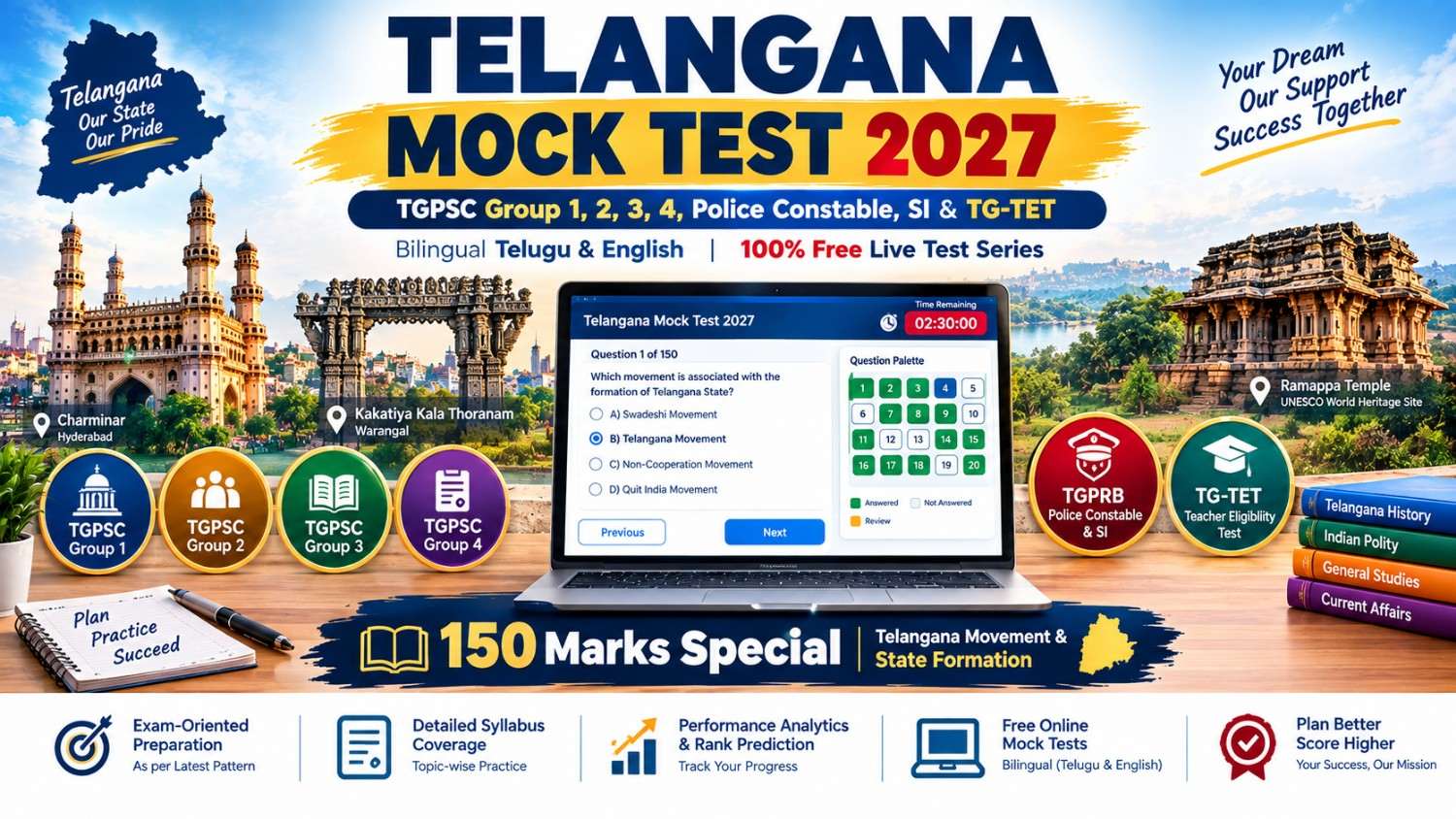 full
full
Telangana Mock Test Free 2027 | TGPSC, Police & TET Series
Telangana Mock Test 2027: Free Full-Length TGPSC, Police and TET Online Test Series Disclaimer: This comprehensive guide has been updated to reflect the most recent patterns of the Telangana exams listed here as well as for reference to the 2027 cycle. The pattern rules remain valid for each exam; information regarding exam dates, vacancies, and cutoffs is kept up to date as announced officially by TGPSC, TGPRB and the School Education Department. If you are preparing for civil services, police uniform posts, or teaching positions in Telangana, you need to adopt a focused strategy that includes knowledge of state-specific history, policies, and language skills. The Telangana mock test 2027 website on SarkariMockTest.com offers a single, free platform that covers the main recruitment exams in the state: TGPSC Group 1, Group 2, Group 3, Group 4, TGPRB Police Constable, TGPRB Sub-Inspector, and TG-TET. Each full-length exam follows the syllabus, duration, and marking scheme of the respective board. Many candidates ask "how to attempt the Telangana mock test" and "where can I find free online tests for the Telangana exams?" In examinations conducted by the Telangana Public Service Commission (TGPSC), specific modules such as the 150-mark Telangana Movement paper in Group 2 are used to determine the final selection. We provide tests that include regional history, public policies, and quantitative skills, available in clear Telugu and English, so that you can get realistic exam preparation without any subscription paywalls. Quick Overview: Hub for Telangana State Examinations Exam Title Conducting Agency Paper Structure Total Questions & Marks Allotted Duration Negative Marking Rule Core Syllabus Focus TGPSC Group 1 (Prelims) TGPSC Single Objective Paper 150 Qs / 150 Marks 150 Minutes Check latest official notification General Studies & Mental Ability TGPSC Group 2 (Mains) TGPSC 4 Objective Papers 600 Qs / 600 Marks 150 Mins per Paper Check latest official notification GS, History-Polity, Economy, Telangana Movement TGPSC Group 3 TGPSC 3 Objective Papers 450 Qs / 450 Marks 150 Mins per Paper Check latest official notification General Studies, History-Polity, Economy TGPSC Group 4 TGPSC 2 Objective Papers 300 Qs / 300 Marks 150 Mins per Paper Check latest official notification General Knowledge (150M) & Secretarial Abilities (150M) TGPRB Police Constable TGPRB PWT & Final Written Exam Check official notice 180 Minutes Check latest official notification English, Arithmetic, Reasoning, General Studies TGPRB Sub-Inspector TGPRB PWT & Final Written Exam Check official notice Check latest official notification Check latest official notification Arithmetic, Reasoning, General Studies TG-TET (Paper I & II) School Education Dept One paper per level 150 Qs / 150 Marks 150 Minutes Zero (No Penalty) Child Development, Languages, Math, Science / Social Telangana State Competitive Examinations 2027 – Master Overview and Paper Matrix Candidates frequently ask "what is Paper 4 in TGPSC Group 2" and how the various Group services differ in terms of their paper structures. When preparing for exams under the state boards, it is necessary to keep track of the exact blueprint for each recruitment stream. The table below details the testing criteria, number of papers, and selection processes for the major recruitment examinations in Telangana. State Exam Track Conducting Agency Papers & Mark Distribution Total Exam Marks Time Limit Educational Eligibility Selection Pipeline TGPSC Group 1 TGPSC Prelims (150M) + Mains (6 Papers, 900M) 900 Marks (Mains) 150 Mins per Paper Bachelor's Degree Prelims Screening > Mains Written (Conventional) > Selection TGPSC Group 2 TGPSC Paper I (150), Paper II (150), Paper III (150), Paper IV (150) 600 Marks Total 150 Mins each Bachelor's Degree Written Examination (Objective) > Document Verification TGPSC Group 3 TGPSC Paper I (150), Paper II (150), Paper III (150) 450 Marks Total 150 Mins each Bachelor's Degree Written Examination (Objective) > Document Verification TGPSC Group 4 TGPSC Paper I: GK (150) + Paper II: Secretarial Abilities (150) 300 Marks Total 150 Mins each Bachelor's Degree Written Examination (Objective) > Document Verification TGPRB Police Constable TGPRB Preliminary Test (PWT) + Final Written Exam (FWE) As per notification 180 Mins Intermediate (10+2) PWT > PMT/PET > Final Written Exam > Selection TGPRB Sub-Inspector TGPRB Preliminary Test (PWT) + Final Written Exam (4 Papers) Evaluated Papers 180 Mins each Bachelor's Degree PWT > PMT/PET > Final Written Exam > Selection TG-TET (Paper I & II) School Education Dept Single Paper of 150 Questions 150 Marks 150 Minutes D.El.Ed / B.Ed Eligibility Test > Certificate Award (Valid for Life) Note: The pattern rules and syllabus divisions are based on previous official recruitment notifications. Before submitting your application forms, please verify the exact requirements for each post in the most recent official notification. TELANGANA STATE COMPETITIVE EXAMS 2027 MASTER HUB ARCHITECTURE Hub Blueprint TGPSC Group 1 (Prelims) – 150 questions | 150 marks | 150 minutes | for screening the purpose of the Mains | | 2. TGPSC Group 2 (Mains) -> 4 Papers (600 Questions | 600 Marks | 600 Minutes) | Paper IV: 150 Marks | Group 3 of the TGPSC — three papers (450 questions | 450 marks | 450 minutes) — for the Administrative Cadres Group 4 of the TGPSC — two papers (300 questions | 300 marks | 300 minutes) — in the subject of Secretarial Abilities. The TGPRB Police (SI and PC) are required to go through Multi-Stage Physical and Written Tests according to State Law Enforcement. TG-TET (Paper I and II) — 150 questions | 150 marks | 150 minutes | Zero negative marking The Telangana Movement and the Creation of the State: The 150-Mark Paper That Most Platforms Overlook Most candidates regard the Telangana Movement section as a minor aspect of Indian history and only go through it during one weekend. When a question arises as to which of the two came first—the Gentlemen's Agreement or the Six-Point Formula—or what Article 371-D was intended to address, they have to make an educated guess. This is in fact a paper worth a full 150 marks. A candidate who has studied it step by step is up against those who have only briefly gone through it. In the official structure of the TGPSC Group 2 examination, Paper IV is entirely devoted to the "Telangana Movement and State Formation" and carries 150 marks out of the total 600. The same topic also makes up a significant part of the TGPSC Group 1, Group 3, and the police recruitment exams. Those who ask "which book should I read for the Telangana Movement" need to realise that this subject cannot be understood by referring to general history books and that it is necessary to study the regional political, legal, and economic struggles, which are divided into three separate historical phases. TELANGANA MOVEMENT AND STATE FORMATION: THE THREE CORE PHASES Movement Phases | Phase 1: The Idea of Telangana (1948-1970) -> Integration, 1952 Mulki, Gentlemen's Agreement | Phase 2: Mobilisational Phase (1971-1990). Court verdicts, 6-Point Formula, G.O. 610 | Phase 3: Towards State Formation (1991-2014) -> Political Alliances, JAC, Reorganisation Act | Phase 1 (1948-1970): Integration, Mulki Agitation & Gentlemen's Agreement This opening phase covers the political integration of the Hyderabad State into the Indian Union and early struggles over local employment protections: When Hyderabad State was integrated in 1948, the Nizam's government opposed the decision to join India. On 13 September 1948 the Indian government carried out Operation Polo (a police action conducted by Major General J.N. Chaudhuri). Hyderabad State then officially joined the Indian Union on 17 September 1948 and was later placed under a military and civil transitional administration by M.K. Vellodi. The agitation that took place in 1952 was founded on the Farman issued in 1919 by the 7th Nizam (Mir Osman Ali Khan), wherein it was stated that a 'Mulki' was a person who had lived in the Hyderabad State for at least 15 years. When non-residents were employed in educational institutions and in government posts after accession, large-scale student-led protests broke out in both Warangal and Hyderabad, the demonstrators holding the slogan "Idli Sambar Go Back, Non-Mulki Go Back". The tragic incident in which the police fired at City College occurred on 3–4 September 1952, and as a result the Justice Jaganmohan Reddy Commission of Inquiry was established. The Fazal Ali Report of the 1955 States Reorganisation Commission (SRC), which was made up of Justice Fazal Ali, K.M. Panikkar and H.N. Kunzru, observed the different levels of development and economy in Telangana and the Andhra region and proposed that Telangana should remain a separate state—that is, Hyderabad State—for a particular period, the union of the two areas being dependent on the obtaining of a two-thirds majority in the Telangana legislature. The Agreement between the two parties, the Gentlemen's Agreement of February 1956, was signed at Hyderabad House in New Delhi by the leaders of Andhra (B. Gopala Reddy, N. Sanjeeva Reddy, G. Latchanna and A. Satyanarayana Raju) and those of Telangana (Burgula Ramakrishna Rao, K.V. Ranga Reddy, M. Chenna Reddy and J.V. Narsing Rao). This agreement contained 14 specific safeguards, including reservations for regional expenditure, protections in the field of education, the creation of a Telangana Regional Council, and the clause that if the Chief Minister was from Andhra then the Deputy Chief Minister should be from Telangana. Andhra Pradesh was established on 1 November 1956. The widespread unrest in 1969, which arose due to a failure to abide by the Gentlemen's Agreement, began in Ravichettu Bazar (in Khammam) with student hunger strikes and quickly evolved into a mass movement led by the Telangana Praja Samithi (TPS), a organisation founded by Ananthula Madan Mohan and later headed by Dr. M. Chenna Reddy. There was great student participation in the agitation and there were tragic cases of police firing resulting in more than 360 deaths. In April 1969 Prime Minister Indira Gandhi presented the Eight-Point Formula with a view to promoting economic development and then put forward the Five-Point Formula. Phase 2 (1971–1990): the Six-Point Formula, Article 371-D and G.O. 610 The middle phase focused on legal conflicts regarding employment reservations and executive orders: When the Supreme Court ruled in October 1972 that the original Mulki Rules were legally valid in the case of public employment, the 'Jai Andhra Movement' arose in the coastal and Rayalaseema districts. The Six-Point Formula, drawn up by the Central Government in 1973, got rid of the Mulki Rules and the Telangana Regional Committee and replaced them with a single zonal employment system covering the entire state. The 32nd Constitutional Amendment and Article 371-D, which were introduced in 1973, were intended to give a constitutional basis to the Six-Point Formula. Article 371-D conferred on the President the power to issue orders for organizing the state into local educational and employment cadres, thus leading to the Presidential Order of 1975 that established six administrative zones in Andhra Pradesh (the zones designated V and VI being those allocated to Telangana). Government Order (G.O.) 610 (December 1985): In reply to the widespread protests by employees over the issue of non-local transfers to Zones V and VI, the N.T. Rama Rao administration issued this order, stating that all non-local employees who had been improperly appointed in the Telangana zones were to be sent back to their home zones by March 1986. In 2001 the state government established a commission in order to examine the fact that G.O. 610 had not been implemented, and this commission issued a detailed final report in 2004 in which it listed a number of irregularities, the unlawful diversion of posts, and the fact that the presidential zonal safeguards had not been carried out. Phase 3 (1991-2014): Statehood Movement to the 2014 Reorganisation Act The final phase transformed the agitation into an organized political and social campaign: The Telangana Rashtra Samithi (TRS) was founded on 27 April 2001 by K. Chandrashekar Rao (KCR) at Jala Drushyam in Hyderabad as a continuation of the movement for statehood, and intellectual figures including Prof. K. Jayashankar outlined the political, cultural and economic reasons why the state should be divided. The hunger strike in 2009 and the union's declaration: On 29 November 2009 KCR began an indefinite hunger strike, leading to extensive mobilisation at both Osmania University and Kakatiya University. On 9 December 2009 the Union Home Minister, P. Chidambaram, announced that the process for setting up the state of Telangana had been launched. Since there was political opposition to the decision it was postponed, and as a result the Telangana Joint Action Committee (TJAC) was established, the committee being chaired by Professor M. Kodandaram. The movement included historic public demonstrations, for example the Million March on 10 March 2011 along the Tank Bund, the 42-day general strike called Sakala Janula Samme (in September and October 2011) which brought the government's administration to a complete standstill, and Sagara Haram (the human chain placed around Hussain Sagar in September 2012). The government committee set up to investigate the situation in Andhra Pradesh consisted of five members and issued a report in which it looked at six specific alternatives, these ranging from maintaining the present situation to complete separation; the fifth option involved the state staying united by establishing a statutory Telangana Regional Council, while the sixth option called for the state to be divided into Telangana and Seemandhra. The Andhra Pradesh Reorganisation Act, 2014: The Andhra Pradesh Reorganisation Bill was passed by Parliament in February 2014 after the cabinet had given its approval; it received the President's assent on 1 March 2014 and on 2 June 2014 (the Appointed Day) Telangana became the 29th state of the Indian Union with Hyderabad to be named as a common capital for a period not exceeding ten years. Telangana GK Beyond the Movement: Dynasties, Culture and 33-District Geography The Telangana examinations contain material on regional heritage that is missing from the national textbooks, including a special master module on the ancient dynasties, Kakatiya architecture, cultural festivals, and the geographical arrangement of the 33 administrative districts. Kakatiya, Qutb Shahi, and Asaf Jahi Heritage The Satavahanas and the Vishnukundins both established their early administrative and monetary centres at Kotilingala, since it was there that coins of the king Simukha were discovered, and the Vishnukundins also built rock-cut cave temples at Keesaragutta (in Medchal-Malkajgiri). The Kakatiya Dynasty (1000–1323 CE): Emerged from subordinate chieftains under the Rashtrakutas and Western Chalukyas to establish an independent sovereign kingdom: Prola II claimed his sovereignty and laid the foundations of independent Kakatiya rule. Rudradeva, who was also called Prataparudra I, composed the Sanskrit text Nitisara and constructed the well-known Thousand Pillar Temple (Rudreshwara Temple) at Hanamkonda in the year 1163. Ganapati Deva, who lived from 1199 to 1262 CE, expanded the empire, moved the royal capital to Orugallu (that is, the Warangal Fort), established the Motupalli port pillar inscription in order to encourage overseas maritime trade, and had built the well-known Ramappa Temple (the Rudreshwara Temple at Palampet in the Mulugu district). The Ramappa Temple was added to the UNESCO World Heritage List in July 2021 and was lauded for its sandbox foundation, the carved black basalt pillars, and the use of lightweight floating bricks. Rani Rudrama Devi (1262–1289 CE) was one of the few queens to rule in medieval India and held power under the male title of Rudradeva Maharaja; she succeeded in defending the kingdom against the Yadavas of Devagiri and at the same time the Venetian traveller Marco Polo visited the country in her reign (at the port of Motupalli), providing very positive remarks about the way she governed. Prataparudra II, who was the final ruler of the dynasty, put up resistance to a number of attacks carried out by the Delhi Sultanate—first against him by Malik Kafur, who was the general of Alauddin Khilji, and later by Ulugh Khan/Muhammad bin Tughlaq, the son of Ghiyasuddin Tughlaq—until the war against Warangal came to an end in 1323 CE. The legacy of the Kakatiya period in the field of irrigation consisted of the construction of an extensive system of chain-tank irrigation (for example, that involving Ramappa Lake, Pakhal Lake, and Laknavaram Lake), a system which historically has served as the basis for current state-wide tank restoration initiatives. The Qutb Shahi Dynasty, which ruled Golconda from 1518 to 1687 CE, was founded by Sultan Quli Qutb Shah. Muhammad Quli Qutb Shah constructed the Charminar in 1591 to mark the end of an epidemic and established the city of Hyderabad. The dynasty was famous for its diamond trading (through the Kollur Mines) and for Dakhni Urdu literature before it was conquered by the Mughal Emperor Aurangzeb in 1687 following an eight-month siege of the Golconda Fort. The Asaf Jahi Dynasty (the Nizams: 1724–1948) was founded by Mir Qamar-ud-din Khan (Nizam-ul-Mulk, Asaf Jah I); in the 19th century the Prime Minister Salar Jung I (1853–1883) carried out substantial administrative reforms (the Zilabandi system), setting up modern revenue districts, state police forces, and treasury systems. 2. Festivals, Art Forms, and Crafts Given the Geographical Indication Tag Bathukamma is the floral festival observed by the women of Telangana during the Navaratri period, from Bhadrapada Amavasya to Durgashtami, when they arrange the seasonal medicinal flowers such as Thangedu, Gunugu, Banthi, and Chamanti in conical shapes as a way of showing respect to nature, life, and the preservation of water bodies. The Bonalu festival occurs in the month of Ashada in the two cities, Hyderabad and Secunderabad, when cooked rice, jaggery, and curd are offered to Goddess Mahakali in decorated brass or clay pots; the main processions include that of the Pothuraju and the oracle prophecies (Rangam). The Sammakka Sarakka Jatara (Medaram, Mulugu District) is Asia's largest tribal festival and occurs once every two years to commemorate the mother-and-daughter tribal warriors who resisted the Kakatiya taxes during a severe drought. At the sacred earthen platforms the pilgrims present Bangaram (an amount of jaggery equal to their own body weight). The Nagoba Jatara festival takes place in Keslapur, in the Adilabad District, and is a significant event for the Mesram clan, members of the Raj Gond and Pardhan tribal groups; it includes sacred rituals, ceremonies using holy water from the Godavari, and the traditional Gusadi dances. The traditional forms of performing art are Perini Sivatandavam (the warrior dance of Lord Shiva, which was revived by Dr. Nataraja Ramakrishna), Oggu Katha (the traditional singing of folklore by the Kuruma and Golla pastoral communities in honour of Mallanna and Beerappa), and Chindu Yakshaganam. The crafts with geographical indication status include Pochampally Ikat (a handwoven geometric tie-and-dye textile, since it was the first product from the area to be given a GI tag), Gadwal sarees, the handlooms of Narayanpet, Nirmal paintings and toys (which are made from soft Poniki wood), Dokra metal crafts (which use the lost-wax brass casting technique in Adilabad), and silver filigree from Karimnagar. The rivers, the irrigation missions and the geography of the districts Drainage Basins: The state lies within the Deccan plateau, drained by two perennial river systems: The Godavari Basin reaches Telangana at Kandakurthi in the Nizamabad district and is supplied by a number of tributaries, such as the Manjra, Pranahita, Penganga, Wardha, and Kinnerasani; afterwards the river passes by Bhadrachalam before going into Andhra Pradesh. The Krishna Basin reaches the state at Tangadigi (in the Narayanpet district) and is fed by tributaries including the Bhima, Tungabhadra, Dindi, Musi, and Munneru. Major Water Resources & Missions: The Kaleshwaram Lift Irrigation Project (KLIP) is a multi-stage system for lifting irrigation water, and it has been constructed across the Godavari River near Medigadda (in the Jayashankar Bhupalpally district) with the objective of lifting the water to the Kondapochamma Sagar reservoir so as to irrigate the upland districts. The Bhagiratha project is a complete system designed to ensure safe piped drinking water by connecting surface water sources to households in both rural and urban areas across the state. Mission Kakatiya is a scheme which aims at removing silt from, restoring the structures of, and bringing the chain-link systems of small irrigation tanks and lakes back to life. The country consists of 33 administrative districts, the largest of these in terms of geographical area being Bhadradri Kothagudem, while Hyderabad is the smallest and also the most densely populated. Pattern & Negative Marking Across Telangana Exams Those preparing for both the TGPSC civil services and the TGPRB police recruitment often study as if the two examinations are based on the same rules. However, they aren't; there are significant differences between the state commissions with respect to negative marking, the number of questions, and the section-level timers. Negative Marking & Pacing Across Commissions Table State Examination Total Questions & Marks Question Value Negative Penalty Status Official Evaluation Rule Recommended Strategy The TGPSC Group 1 (Prelims) consists of 150 questions and is worth 150 marks; candidates are awarded +1.00 mark; it is important to check the most recent official notice; the exam serves as a screening procedure for the conventional Mains; one should focus on questions involving high accuracy. In the TGPSC Group 2 (Mains) exam there are four papers (each with 150 questions and 150 marks) and aplus one mark is awarded; check the most recent official notice; a cumulative merit rank out of 600 marks is applied and it is necessary to obtain a well-balanced score in all four papers. TGPSC Group 3: three papers (150 questions and 150 marks each) +1.00 mark – check the most recent official notice – with a 450-mark cumulative merit rank that places a strong emphasis on Economy and Polity. The Group 4 exam set by the TGPSC includes two papers (each with 150 questions and 150 marks) and gives a plus one mark; candidates should refer to the most recent official notice; the merit ranking is determined by a cumulative total of 300 marks and a high degree of speed is needed in the Secretarial Abilities section. For the post of TGPRB Police Constable: in line with notification +1.00, verify the latest official notice regarding the Qualifying Screening and Final Written Examination which requires a fast pace (45 to 50 seconds per question) TGPRB Sub-Inspector As per notification Multi-tier papers Check latest official notice Combined technical & general papers High accuracy in Math and Reasoning TG-TET (Paper I and II) consists of 150 questions worth a total of 150 marks. You receive one mark for each correct answer and there is no penalty for getting questions wrong. In the General category you must score at least 60 per cent, 50 per cent if you are in the BC category, and 40 per cent if you are SC or ST. You should attempt all the questions and not leave any blank. Time Allocation Blueprint: 150 Minutes for 150 Questions Most of the question papers set by the TGPSC offer 150 minutes for 150 questions (one minute per question), and the three-round method explained below ensures that you will be able to complete the paper without feeling the need to rush. In the first round, from minute 00 to 50, go through the paper and give direct answers to any factual questions relating to General Studies, History, and the Telangana Movement; if a question involves a great deal of calculation or needs you to read a paragraph-long section, note it down and then move on. Make sure to answer between 55 and 65 questions correctly in this first attempt. In the second round, handle the conceptual and multi-part questions (from the 50-minute mark until the 110-minute mark), covering questions based on statements, pair-matching items, economic data sets, and problems which involve logical reasoning. Allocate 60 minutes to about 60 to 70 questions. In the third round, between the 110th and the 150th minute, use your last 40 minutes to carry out the mathematical calculations, to check the items for which two of the choices had been eliminated, and to make certain that all the answer bubbles have been neatly shaded. RECOMMENDED 150-MINUTE TIME ALLOCATION PROFILE Pacing Strategy [=====] In the first round, which consisted of direct factual questions (50 minutes in duration), 33.3% of the questions were answered | approximately 60 questions were cleared | | [======] Round 2: Multi-Statement Analytical (60 Mins) -> 40.0% of the time | About 65 questions were solved | | [====] Third round: Math Calculations and Review (40 Minutes) -> 26.6% of the time | Pacing Buffer and Checks| | TOTAL ALLOCATION: 150 MINUTES | 150 QUESTIONS | STRATEGY: THREE SYSTEMATIC PASSES | Why Most Telangana Mock Tests Fall Short Many online test platforms fail to prepare candidates for state examinations: The practice of using obsolete names for boards and question formats is still common, since a great many websites continue to refer to their exams by the old acronyms "TSPSC" or "TSLPRB". The websites of these platforms have not been altered to reflect the present administrative terminology (TGPSC and TGPRB) and the new question formats. To regard the Telangana Movement as general history—the national coaching apps usually include between ten and fifteen general questions on the Nizam era in their general history paper and then refer to this as a "Telangana Movement Test"—they completely omit the three distinct phases, the decisions of the legal courts, and the official committee's recommendations. The fact that bank clerk-style arithmetic is included in the Group 4 secretarial skills examination should be noted, since Paper II of the TGPSC Group 4 exam assesses functional administrative reasoning, basic comprehension, sentence logic, and numerical aptitude. However, general-purpose websites usually involve the interpretation of bank-clerk style data and complex trigonometry, both of which are not in line with the syllabus. In the case of Telugu, machine translations are employed on most national websites by means of entering English or Hindi text into automated translation software, leading to translation errors and causing historical terms, administrative departments, and government schemes to be distorted. Individual articles have their own paywalls; commercial websites provide the Group 1, Group 2, Police, and TET papers as separate paid subscriptions, so that students have to purchase more than one subscription in order to prepare for the exams taken in the same state. Choose Your Exam: Free Telangana Online Mock Tests If you want to access the full practice papers and the detailed diagnostic reports, please select the examination that you have in mind. Practice Test for the TGPSC Group 1 Prelims (150 questions, 150 minutes) It is intended to be used as part of the initial screening examination for those applying for the posts of Deputy Collector, Commercial Tax Officer, and DSP. The paper contains 150 questions on General Studies, Mental Ability, Telangana regional affairs, and current national issues. Status: Available Now Access is provided to full-length bilingual practice tests which include automated scoring and state percentile rankings. Mock exams for the TGPSC Group 2 (Papers I to IV, including the Telangana Movement) Covers all four 150-mark objective papers of the Group 2 selection framework: Paper I: General Studies and General Abilities (Available Now) Paper II: History, Polity and Society (Available Now) Paper III: Economy and Development (Available Now) Paper IV: Telangana Movement and State Formation (150 Marks) — Features phase-wise diagnostic drills covering 1948 to 2014 (Available Now) TGPSC Group 3 Mock Tests (Papers I to III) It is designed for senior administrative assistants, junior accountants, and clerical supervisors. The exam is based on the three-paper, 450-mark structure consisting of General Studies & Abilities (Paper I), History, Polity & Society (Paper II), and Economy & Development (Paper III). Status: Available Now Mock tests for Group 4 of the TGPSC (General Knowledge and Secretarial Abilities) Designed specifically for the 300-mark selection test for Junior Assistants, Typists, and Junior Stenographers, it includes separate modules for Paper I (General Knowledge, 150 Marks) and Paper II (Secretarial Abilities, 150 Marks), which covers mental ability, logical reasoning, numerical skills, and comprehension. Status: Available Now Mock tests for the position of Police Constable and Sub-Inspector under the TGPRB It was designed for the uniform recruitment processes carried out by the Telangana State Level Police Recruitment Board and includes preliminary screening tests as well as final written examination sections for both the civil and armed police categories. Status: Available Now (Subject to cycle-specific recruitment notification updates) The TG-TET Mock Test (Paper 1 and Paper 2) It is in line with the Telangana Teacher Eligibility Test organised by the Department of School Education and includes full-length simulations consisting of 150 questions for Paper I (for Classes I to V) and Paper II (for Classes VI to VIII in the Mathematics/Science and Social Studies streams), with no negative marking. Status: Available Now Worked Sample Questions with Complete Explanations Look at these sample questions. They show the local focus, time-based questions, and four-choice explanations found in our practice sets. Sample 1: Telangana Movement & State Formation (Phase 2 - Legal Frameworks) SAMPLE QUESTION: TELANGANA MOVEMENT (PRESIDENTIAL ORDERS & SAFEGUARDS) Movement Sample What year did the state government issue Government Order (G.O.) 610 to require | the repatriation of non-local employees irregularly appointed in Zone V and Zone VI back to their | | their own home zones? | | (A) 1969 | | (B) 1973 | | (C) 1975 | | (D) 1985 | | CORRECT ANSWER: (D) 1985 | | Step-by-Step Concept Explanation: | | Why Option (D) is Correct: | The Government Order (G.O.) 610 was issued on 30 December 1985 in the period when the Chief was in office. Minister N.T. Rama Rao; the enactment was the result of representations made by the Telangana employee unions In opposition to breaches of the 1975 Presidential Order, G.O. 610 established a strict deadline of 31 March 1986. The repatriation of non-local personnel who have been illegally appointed to cadre positions in Zone V and VI. The J.M. Girglani Commission was eventually set up because of administrative delays in carrying out the original decision. | in 2001 to look into the fact that it had not been implemented. | | Why Other Options Are Incorrect: | Option (A): The Telangana agitation of 1969 was a mass movement led by students and this led to the formation of the TPS. Option (B): The Six-Point Formula was announced and Article 371-D was enacted in 1973. Option (C): The Presidential Order which established the administrative zones was issued in 1975. Sample 2: Telangana Dynasties & Architecture (Kakatiya Heritage) SAMPLE QUESTION: KAKATIYA ARCHITECTURAL & INSCRIPTIONAL HERITAGE History Sample | Question: The famous Ramappa Temple (Rudreshwara Temple) located at Palampet in Mulugu district, | | inscribed as a UNESCO World Heritage Site in 2021, was constructed during the reign of which | Was the Kakatiya monarch being supervised by his commander Recharla Rudra? | (A) Rudradeva (Prataparudra I) | | (B) Ganapati Deva | | (C) Rani Rudrama Devi | | (D) Prataparudra II | | CORRECT ANSWER: (B) Ganapati Deva | | Step-by-Step Concept Explanation: | | Why Option (B) is Correct: | | Construction of the Ramappa Temple began around 1213 CE during the reign of Maharaja Ganapati | Dev a, who was supervised by his general and prime minister Recharla Rudra from the Malyala family, . | temple is named after its chief sculptor, Ramappa, and is celebrated for its sandbox foundation | black basalt carvings of dancers, intricate technology, and lightweight floating bricks. | Why Other Options Are Incorrect: | Option (A) has Rudradeva building the Thousand Pillar Temple at Hanamkonda in 1163 CE. Option (C) states that Rani Rudrama Devi was the daughter of Ganapati Deva and reigned from 1262 to 1289 CE. Option (D): Prataparudra II was the grandson of Rudrama Devi and the last ruler of the Kakatiya dynasty. Test Series Structure & Coverage Matrix Our testing program organizes your preparation step-by-step from individual topic drills to full-length exam simulations: Level & Segment Sections Covered Tests Offered Question Format Focus & Exam Alignment Tier 1: Sectional Drills History, Movement, Polity, Economy, Quant 20 Tests (25 Qs / 25 Mins) Timed topic-level drills Builds speed and mechanical recall Tier 2: Full Simulations Complete Multi-Paper Formats 14 Tests (150 Qs / 150 Mins) Real exam simulation Builds complete 150-minute exam stamina Tier 3: Movement Labs Phases 1, 2, and 3 of the Movement 4 Labs (50 Qs / 50 Mins) Chronology, committees, acts Targets the high-yield 150-mark paper Tier 4: Shift-Style Mocks Complete Composite Syllabus 2 Tests (150 Qs each) Past-shift style questions Real exam trend and format familiarity Product Features: How Our Analytics Work Our practice platform includes analytical tools designed to help you prepare across state examinations: Automated Telangana Movement Phase Diagnostics The dashboard used in the Automated Telangana Movement Phase Diagnostics keeps a record of your performance for each of the three phases: Phase 1 (1948–1970), Phase 2 (1971–1990), and Phase 3 (1991–2014). The system will indicate which specific phase needs to be revised if your score decreases in a court ruling or in a committee report. All India & Telangana State Rank Leaderboard A leaderboard showing the rank of candidates for the entire country and for the Telangana state will allow you to compare your score, pacing speed, and percentile with those of thousands of other aspirants based in Hyderabad, Warangal, Karimnagar, Nizamabad, and Khammam. 📊 View All India & State Rank Leaderboard 🤖 AI-Based Weak Area Diagnostic Tool Personalized Diagnostics The diagnostic engine monitors your performance in a number of tests; whenever your accuracy decreases in Telangana Economy, Kakatiya Dynasties, or Group 4 Secretarial Abilities, the system will point out those topics and recommend specific 10-question drills aimed at helping you improve. Diagnostic Summary: Tracks accuracy percentages across Phase 1, Phase 2, and Phase 3 of the Telangana Movement, Kakatiya & Nizam History, Economy, and Secretarial Abilities. Generates targeted corrective sprint drills based on your test logbook. ⚡ Launch AI Weak-Area Diagnostic Tool Step-by-Step Explanations for All Four Options Each question has an explanation box which explains why the correct answer is correct and also details why the other three options are wrong, referring to the standard publications of the Telugu Akademi. ⚡ Daily State & National Booster 15-Min Daily Quiz Free Daily Current Affairs Practice Free Daily Current Affairs Practice: Maintain broader awareness across national news and Telangana state initiatives with our free daily quiz: Take the Free Daily Current Affairs Quiz 👉 Take the Free Daily Current Affairs Quiz How to Attempt Free Telangana Mock Tests on Sarkari Mock Test Getting started on our platform takes less than two minutes: To access the portal: go to SarkariMockTest.com and choose State Government Exams > Telangana Hub from the navigation menu. Choose the exam you want to take from among TGPSC Group 1, Group 2 (Papers I to IV), Group 3, Group 4, Police, or TG-TET. Start the Simulator: Click on 'Start Free Mock Test'. The testing console will appear and include a countdown timer specific to the exam, a palette showing the status of the questions, and a button for switching the language. Solve and Submit: To answer the questions, click on Submit Examination and then you will be able to see your immediate scorecard, your percentile rank among the other students, and the explanations for each question. Preparation Strategy + Important Books & Resources per Exam Follow this structured preparation strategy and use standard academic reference books: Examination Track High-Yield Topics to Master Authoritative Reference Books TGPSC Group 1 and 2 Paper IV covers the Telangana Movement, Indian Polity, Telangana History and Culture, and Economy. Use the following books: Telangana Movement and State Formation by Telugu Akademi. History and Culture of Telangana by Telugu Akademi. Indian Polity by M. Laxmikanth. Telangana Economy by Telugu Akademi. TGPSC Group 3 The standard Telugu Akademi reference textbooks on TGPSC Group 3 General Studies, the Indian Constitution, social structures, and economic development, as well as the NCERT Economics textbooks for Classes 11 and 12 and the state's socioeconomic survey documents. TGPSC Group 4 The General Knowledge section, Paper I of the TGPSC Group 4 exam, along with Paper II on Secretarial Abilities (covering Mental Ability and Language Logic), includes Quantitative Aptitude according to R.S. Aggarwal's 'A Modern Approach to Verbal & Non-Verbal Reasoning', and also the High School textbooks on English and Telugu grammar. TGPRB Police (SI and PC) The arithmetic, reasoning, general studies, Indian national movement, and state general knowledge portions of the TGPRB Police (SI and PC) examination; the Class 9 and 10 mathematics textbooks; Lucent's General Knowledge; and the past-year compilations from state police recruitment exams. TG-TET (Paper I and Paper II) The TG-TET (Paper I and Paper II) covers Child Development and Pedagogy, Language I in Telugu, Mathematics, and Science or Social Studies. These are the SCERT Telangana school textbooks for Classes 1 through 10, as well as the standard B.Ed or D.El.Ed pedagogical reference modules. Common Mistakes Telangana Aspirants Make Treat Paper IV as if it were a general history of India by merely going through the section on the Telangana movement without studying the specific chronological dates, the names of the committee members, and the statutory provisions which form the basis of the 150-mark paper. Using study materials that are out of date by referring to those from earlier exam cycles—such as materials which show the old administrative boundaries rather than the present 33-district arrangement—or quoting outdated commission acronyms without first checking the latest syllabus notices. Treating the secretarial skills of Group 4 as equivalent to high-level mathematics: wasting time studying advanced calculus or corporate accounting when Paper II actually assesses functional administrative logic, numerical accuracy, and sentence comprehension. To apply the same guessing strategy to all state exams: regard each exam as if it had the same penalty system, rather than determining whether the test employs a negative marking penalty or a zero penalty (for example, the TG-TET). Failing to carry out an error review after finishing the practice tests: merely looking at the final score without checking the explanation section for the wrong answers, and thus missing the opportunity to correct any misunderstandings before the day of the exam. Why Attempt This Free Telangana Test Series Hub Preparing with full-length simulations matched to state standards builds both speed and conceptual clarity: Parameter Unorganized Fragmented Preparation SarkariMockTest Unified Telangana Hub Platform Model Multiple paywalls across different coaching apps Single free, unified hub covering all major state exams Movement Coverage Generic regional questions with minimal depth Complete phase-wise modules covering 1948 to 2014 Language Standards Poorly translated regional text Human-curated Telugu and English matching Telugu Akademi works Scoring Feedback Basic raw marks with no subject insights Detailed performance tracking with phase-wise diagnostic reports Why This Mock Test Series Was Put Together My name is Shubham Kumar Sah and I am the founder of SarkariMockTest.com. I have looked at a number of exam platforms and found that they still classify Telangana exams under their old names and regard state history as merely an extension of national history. The two points most often overlooked are this: firstly, the Telangana Movement paper should be prepared step by step, with the various commissions, agreements and constitutional provisions arranged in the correct sequence; and secondly, someone preparing for more than one Telangana exam has to compile patterns from a number of different sources, having no one honest starting point. The hub is based on both of them; each exam has its own arrangement in one location. The Telangana Movement module is organised by phase, so you can see exactly where your understanding breaks down. The test series stays free wherever the exam-specific page is live, because a state-specific diagnostic shouldn't need a paywall. As I keep building this hub, I check every exam page against one question: does it test the Telangana-specific knowledge this exam is actually built around? If it doesn't, it doesn't get included. Here are the official portal and recruitment notification links to use if you want to keep track of examination notices, download syllabus documents, and check the preliminary schedules: Department / Commission Official Website Link Main reason for candidates The Telangana Public Service Commission (TGPSC) www.tgpsc.gov.in provides notifications, applications, and results for the Group 1, Group 2, Group 3, and Group 4. The Telangana State Level Police Recruitment Board tgprb.in provides circulars relating to the recruitment of Police Constables and Sub-Inspectors, as well as the physical standards schedule and hall tickets. The Department of School Education, Telangana schooledu.telangana.gov.in – notifications, guidelines, and results for the Teacher Eligibility Test (TG-TET). SarkariMockTest Telangana Master Hubs sarkarimocktest.com – free full-length mock tests, Telangana Movement phase drills, and state scorecards. Practical Preparation Advice: Mastering the Movement in Phases and Managing Time If one wants to perform well in competitive exams in Telangana, it is essential to carry out systematic revision of the region's history, the statehood movements, and public administration. The fact that specialized knowledge of the area constitutes a major portion of the marks in recruitment exams such as those for TGPSC Group 2 and Group 4 means that relying only on national-level study materials will result in many important topics being left out. Each morning, allocate 45 minutes to study the three different phases of the Telangana Movement by referring to summary notes, with a focus on the order of the political agreements, the court rulings related to the Mulki rules, and the recommendations of the various committees. Prepare chronological tables for key events such as the 1952 Mulki agitation, the 1969 agitation, and the 2011 mass mobilizations. Every day do 20 quantitative and reasoning questions in order to score marks in the aptitude sections. Once a week, take one full-length Telangana mock test in 2027, working under timed conditions of 150 minutes and keeping a consistent pace throughout all the sections. Regular practice of these state-specific facts is the most dependable way of passing your exams. About the Author Ali Hassan, who is employed as a Senior Content Editor at SarkariMockTest.com, has special expertise in the curricula of the state public service commissions, in the recruitment of regional police forces, and in preparing people for bilingual exams in Telangana and southern India. Having studied competitive examination trends for more than three years, he checks question papers to ensure that they align with the current patterns of the commissions and meet verified factual standards. .tg-mock-wrapper, .tg-mock-wrapper * { box-sizing: border-box !important; -webkit-tap-highlight-color: transparent; } .tg-mock-wrapper { width: 100% !important; max-width: 100% !important; margin: 0 !important; padding: 16px 12px !important; font-family: -apple-system, BlinkMacSystemFont, "Segoe UI", Roboto, Helvetica, Arial, sans-serif; line-height: 1.65; color: #212121; background-color: #ffffff; overflow-wrap: break-word; word-wrap: break-word; text-align: left !important; display: block !important; clear: both !important; float: none !important; } .tg-mock-wrapper p, .tg-mock-wrapper h1, .tg-mock-wrapper h2, .tg-mock-wrapper h3, .tg-mock-wrapper ul, .tg-mock-wrapper ol, .tg-mock-wrapper li, .tg-card-architecture, .tg-author-box, .tg-module-card, .tg-box-alert, .tg-ai-diagnostic-wrapper, .tg-quiz-container { text-align: left !important; } .tg-main-h1 { display: block !important; width: 100% !important; background: linear-gradient(135deg, #1b5e20, #2e7d32) !important; color: #ffffff !important; font-size: 23px !important; font-weight: 800 !important; padding: 16px 18px !important; border-radius: 8px !important; margin: 10px 0 18px 0 !important; line-height: 1.35 !important; border-left: 6px solid #fbc02d !important; box-shadow: 0 4px 12px rgba(27, 94, 32, 0.22) !important; } .tg-disclaimer-box { background-color: #fffde7; border-left: 5px solid #fbc02d; padding: 14px 16px; margin-bottom: 16px; border-radius: 0 6px 6px 0; font-size: 14px; color: #424242; } .tg-h2 { font-size: 21px; font-weight: 700; color: #1b5e20; margin: 28px 0 14px 0; border-bottom: 2px solid #e0e0e0; padding-bottom: 8px; line-height: 1.35; } .tg-h3 { font-size: 17px; font-weight: 600; margin: 20px 0 10px 0; line-height: 1.4; } .tg-p { font-size: 15px; color: #333333; margin: 0 0 16px 0; } .terminal-text { font-family: monospace; font-size: 13px; margin-bottom: 6px; color: #666; } .link-styled { color: #1b5e20; font-weight: 700; text-decoration: underline; } .link-styled:hover { color: #b71c1c; } .tg-action-btn-bar { display: flex; flex-wrap: wrap; gap: 12px; margin: 14px 0 18px 0; } .btn-rank { display: inline-block !important; background-color: #1b5e20 !important; color: #ffffff !important; font-size: 14px !important; font-weight: 700 !important; text-decoration: none !important; padding: 10px 20px !important; border-radius: 6px !important; box-shadow: 0 3px 8px rgba(27, 94, 32, 0.25) !important; transition: background-color 0.2s ease !important; } .btn-rank:hover { background-color: #0e3d13 !important; } .btn-ai { display: inline-block !important; background-color: #f57f17 !important; color: #ffffff !important; font-size: 14px !important; font-weight: 700 !important; text-decoration: none !important; padding: 10px 20px !important; border-radius: 6px !important; box-shadow: 0 3px 8px rgba(245, 127, 23, 0.25) !important; transition: background-color 0.2s ease !important; } .btn-ai:hover { background-color: #bc6502 !important; } .tg-table-wrap { width: 100% !important; max-width: 100% !important; overflow-x: auto !important; -webkit-overflow-scrolling: touch; margin: 18px 0 24px 0; border: 1px solid #e0e0e0; border-radius: 6px; background-color: #ffffff; } .tg-table { width: 100% !important; border-collapse: collapse; text-align: left !important; font-size: 14px; min-width: 620px; } .tg-table th { background-color: #1b5e20; color: #ffffff; padding: 11px 12px; font-weight: 700; border: 1px solid #1b5e20; white-space: normal; text-align: left !important; } .tg-table td { padding: 11px 12px; border: 1px solid #e0e0e0; color: #212121; vertical-align: top; text-align: left !important; } .tg-table tr:nth-child(even) { background-color: #f9fbe7; } .tg-table tr:hover { background-color: #fff9c4; } .tg-box-alert { width: 100% !important; background-color: #ffebee; border-left: 5px solid #c62828; padding: 16px; margin: 20px 0; border-radius: 0 6px 6px 0; } .tg-card-architecture { width: 100% !important; background: #ffffff; border: 1px solid #e0e0e0; border-radius: 8px; margin: 20px 0; overflow: hidden; box-shadow: 0 1px 4px rgba(0,0,0,0.04); } .tg-card-header { background-color: #1b5e20; color: #ffffff; padding: 12px 16px; font-weight: 700; font-size: 15px; display: flex; align-items: center; justify-content: space-between; flex-wrap: wrap; gap: 8px; text-align: left !important; } .tg-card-badge { background-color: #fbc02d; color: #212121; font-size: 12px; font-weight: 700; padding: 3px 8px; border-radius: 4px; } .tg-card-body { padding: 14px; text-align: left !important; } .section-green { background-color: #f1f8e9; border: 1px solid #c5e1a5; border-left: 5px solid #2e7d32; border-radius: 6px; padding: 12px 14px; text-align: left !important; } .section-yellow { background-color: #fffde7; border: 1px solid #fff59d; border-left: 5px solid #fbc02d; border-radius: 6px; padding: 12px 14px; text-align: left !important; } .section-blue { background-color: #e1f5fe; border: 1px solid #b3e5fc; border-left: 5px solid #0288d1; border-radius: 6px; padding: 12px 14px; text-align: left !important; } .section-red { background-color: #ffebee; border: 1px solid #ffcdd2; border-left: 5px solid #c62828; border-radius: 6px; padding: 12px 14px; text-align: left !important; } .tg-author-box { width: 100% !important; background-color: #ffffff; border: 1px solid #e0e0e0; border-left: 5px solid #1b5e20; border-radius: 8px; padding: 20px 18px; margin: 28px 0; box-shadow: 0 2px 6px rgba(0,0,0,0.04); text-align: left !important; } .tg-author-header { color: #1b5e20; font-size: 20px; font-weight: 800; margin: 0 0 12px 0; padding-bottom: 8px; border-bottom: 1px solid #eef2f6; text-align: left !important; } .tg-module-card { background: #ffffff; border: 1px solid #e0e0e0; border-radius: 8px; padding: 18px 16px; margin: 20px 0; box-shadow: 0 1px 4px rgba(0,0,0,0.04); text-align: left !important; } .border-green { border-left: 5px solid #2e7d32; } .border-yellow { border-left: 5px solid #fbc02d; } .border-blue { border-left: 5px solid #0288d1; } .border-red { border-left: 5px solid #c62828; } .color-green { color: #1b5e20; } .color-yellow { color: #f57f17; } .color-blue { color: #0288d1; } .color-red { color: #c62828; } .font-15 { font-size: 15px; } .font-bold { font-weight: 700; } .mb-0 { margin-bottom: 0 !important; } .mb-6 { margin-bottom: 6px !important; } .mb-8 { margin-bottom: 8px !important; } .mt-14 { margin-top: 14px !important; } .block { display: block; } .tg-list { list-style-type: disc !important; margin: 0 0 16px 0 !important; padding-left: 24px !important; text-align: left !important; } .tg-list li { margin-bottom: 8px !important; color: #333333; display: list-item !important; text-align: left !important; } .tg-sub-list { list-style-type: circle !important; margin: 6px 0 6px 0 !important; padding-left: 20px !important; } .tg-sub-list li { margin-bottom: 6px !important; display: list-item !important; } /* AI Diagnostic Wrapper */ .tg-ai-diagnostic-wrapper { width: 100% !important; background: #ffffff; border: 1px solid #e0e0e0; border-left: 6px solid #fbc02d; border-radius: 12px; padding: 22px 18px; margin: 26px 0; box-shadow: 0 4px 14px rgba(0,0,0,0.05); text-align: left !important; } .tg-ai-header { display: flex; align-items: center; justify-content: space-between; flex-wrap: wrap; gap: 10px; border-bottom: 1px solid #eef2f6; padding-bottom: 12px; margin-bottom: 14px; text-align: left !important; } .tg-ai-title { color: #1b5e20; font-size: 21px; font-weight: 800; margin: 0; display: flex; align-items: center; gap: 8px; text-align: left !important; } .tg-ai-badge { background-color: #fffde7; color: #f57f17; font-size: 11px; font-weight: 800; padding: 4px 10px; border-radius: 20px; border: 1px solid #fff59d; text-transform: uppercase; letter-spacing: 0.4px; } .tg-placeholder-box { border: 2px dashed #1b5e20; background-color: #f1f8e9; padding: 20px 16px; text-align: center; margin: 20px 0 16px 0; border-radius: 8px; } .icon-stat { font-size: 26px; margin-bottom: 6px; } .placeholder-desc { font-size: 13px; color: #555; text-align: left; background: #ffffff; padding: 10px 12px; border-radius: 6px; border: 1px solid #e0e0e0; line-height: 1.5; } /* Quiz Container */ .tg-quiz-container { width: 100% !important; background: #ffffff; border: 1px solid #c5e1a5; border-left: 6px solid #2e7d32; border-radius: 10px; padding: 22px 18px; margin: 28px 0; box-shadow: 0 3px 10px rgba(46, 125, 50, 0.07); text-align: left !important; } .tg-quiz-header { display: flex; align-items: center; justify-content: space-between; flex-wrap: wrap; gap: 8px; font-size: 13px; font-weight: 800; color: #2e7d32; text-transform: uppercase; letter-spacing: 0.5px; margin-bottom: 10px; } .tg-quiz-badge { background-color: #f1f8e9; color: #2e7d32; font-size: 11px; font-weight: 800; padding: 3px 10px; border-radius: 20px; border: 1px solid #c5e1a5; text-transform: uppercase; letter-spacing: 0.4px; } .tg-quiz-title { color: #1b5e20; font-size: 20px; font-weight: 800; margin: 0 0 12px 0; padding-bottom: 8px; border-bottom: 1px solid #eef2f6; text-align: left !important; line-height: 1.35; } .btn-wrap-center { text-align: center !important; margin: 20px 0 24px 0; clear: both !important; } .btn-green-cta { display: inline-block !important; background-color: #2e7d32 !important; color: #ffffff !important; font-size: 15px !important; font-weight: 700 !important; text-decoration: none !important; padding: 13px 28px !important; border-radius: 6px !important; box-shadow: 0 4px 10px rgba(46, 125, 50, 0.28) !important; border: 1px solid #1b5e20 !important; transition: background-color 0.2s ease, transform 0.15s ease !important; cursor: pointer !important; text-align: center !important; } .btn-green-cta:hover { background-color: #1b5e20 !important; color: #ffffff !important; text-decoration: none !important; } @media (min-width: 768px) { .tg-mock-wrapper { padding: 24px 16px !important; } .tg-main-h1 { font-size: 26px !important; } .tg-h2 { font-size: 23px; } .tg-h3 { font-size: 19px; } .tg-p { font-size: 16px; } .tg-table { font-size: 15px; } } @media (max-width: 600px) { .tg-mock-wrapper { padding: 12px 6px !important; } .tg-main-h1 { font-size: 20px !important; } .tg-h2 { font-size: 18px; } .tg-h3 { font-size: 16px; } .btn-green-cta, .btn-rank, .btn-ai { width: 100% !important; display: block !important; text-align: center !important; } .tg-action-btn-bar { flex-direction: column; } }
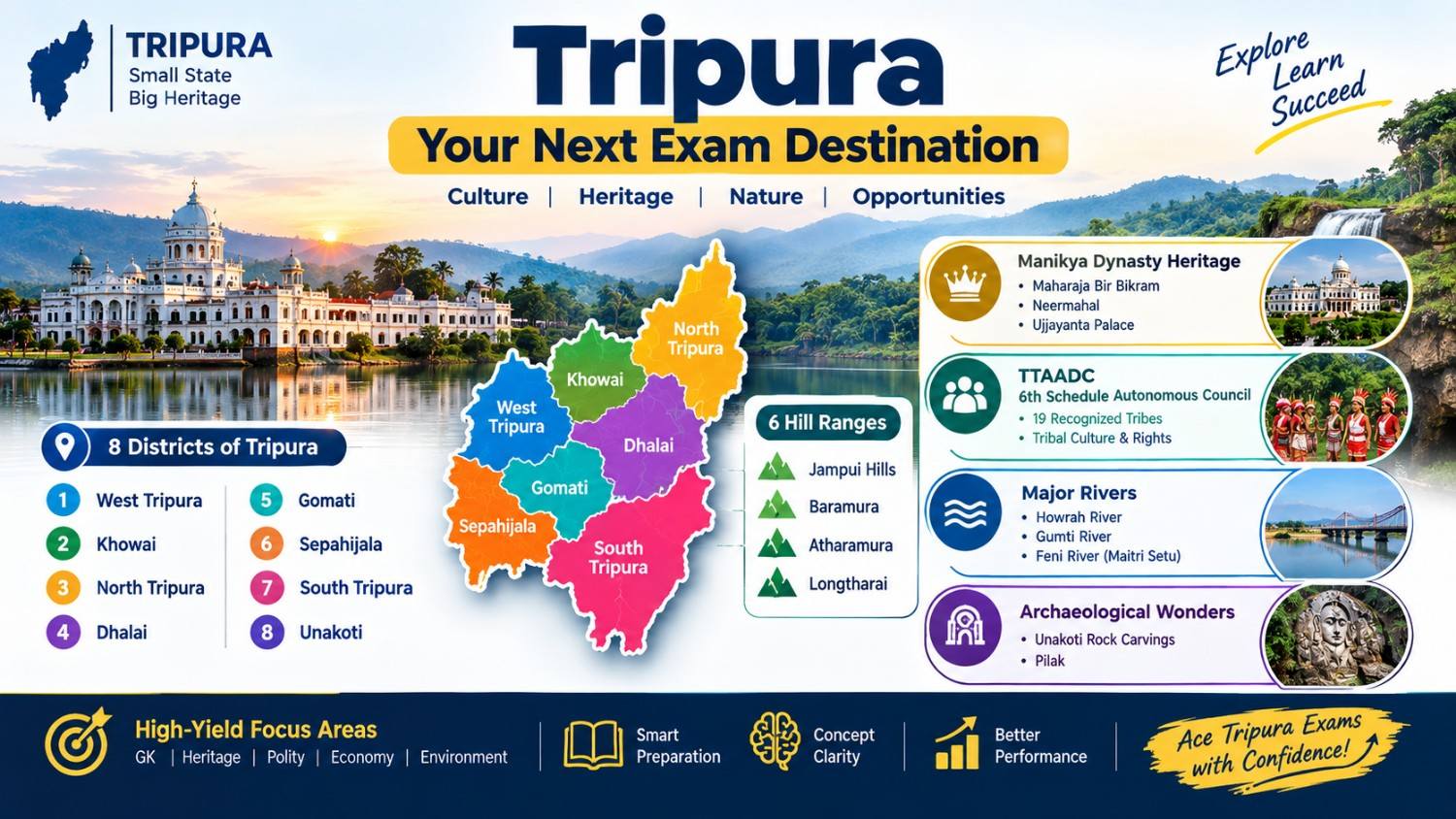 full
full
Tripura Mock Test 2027: Free TPSC, Police & TET Test Series
Tripura Mock Test 2027: Free Full-Length TPSC, Police Constable & TET Master Online Test Series The following disclaimer should be noted: this master hub is kept up to date concerning the most recent patterns of the Tripura exams referred to here and provides references for the 2027 cycle. The pattern rules apply to each exam individually; information regarding the exam dates, the number of vacancies, and the cutoff scores is updated each time the relevant authorities officially announce it. If you are taking part in public service examinations, including those for positions in the police force and administrative departments in Tripura, it is necessary to study carefully the way the region is governed, its local history and the standards regarding the language. The Tripura mock test 2027 master website on SarkariMockTest.com provides one free platform which includes all the main recruitment exams held in the state – the TPSC Combined Tripura Civil Service (TCS) and Tripura Police Service (TPS) Grade-II, the Tripura Police Constable exam, the TPSC Sub-Inspector exam, the Tripura Teachers' Eligibility Test (T-TET), and the JRBT Group C – with each practice set being designed to correspond to the number of questions, time limit and marking scheme established by the examining body. A lot of candidates ask things like 'how to take the Tripura mock test' and 'where one can find free online tests for the exams in Tripura'. In the examinations organised by the Tripura Public Service Commission (TPSC), state-specific general knowledge accounts for as much as 50% of the total marks in the preliminary stage. We offer valuable questions on the Manikya kings, the Autonomous District Council, regional geography, and tribal heritage, given in simple English and Bengali, so that you can carry out realistic exam preparation without the need to subscribe. Quick Overview: Tripura State Examinations Hub Exam Title Conducting Agency Questions & Marks Duration Negative Marking Core Focus Area The TPSC TCS and TPS (Grade-II) Preliminary Examination TPSC consists of 200 questions carrying 200 marks and has a time limit of 150 minutes; the marking scheme includes a deduction of one-fourth (–0.25), with the paper divided into English (30 questions), Tripura and NE General Knowledge (100 questions), Constitution (50 questions) and Mental Ability (20 questions). The Tripura Police Constable examination conducted by the Police Department / Selection Board consists of 85 questions worth 85 marks to be completed within 60 minutes, with a deduction of one quarter (–0.25) for each incorrect answer in the areas of General Awareness, Elementary Math, and Analytical Reasoning. The TPSC Sub-Inspector (Executive) examination TPSC consists of Paper 1 (100 marks) and Paper 2 (100 marks), with each paper lasting two hours, and a deduction of one-quarter of a mark (–0.25). Paper 1 is in English (100 marks) and Paper 2 is in General Studies and State Affairs (100 marks). Tripura TET (T-TET Paper I & II) TRBT 150 questions / 150 marks 150 minutes Zero (no penalty) Child Development, Language I & II, Mathematics / Science / Social Studies JRBT Group C (LDC & Allied) JRBT – 100 questions worth 100 marks – Duration: 120 minutes – Deduction of 1/4 mark (i.e. –0.25) for English Language (40 marks) and for General Knowledge & Current Affairs Tripura State Competitive Examinations 2027 – Master Overview & Exam Pattern It is common for candidates to ask "what is the pattern of the TPSC TCS TPS prelims?" and when preparing for exams organised by various state boards it is necessary to keep an eye on the different test blueprints. The following table sets out the testing metrics, the distribution of questions, and the scoring rules for the main recruitment examinations in Tripura. State Exam Track Conducting Agency Question & Mark Split Time Limit Penalty Per Error Educational Base Selection Pipeline The TPSC TCS and TPS (Grade-II) examination TPSC consists of 200 multiple choice questions (carrying a total of 200 marks, with 1 mark for each question), has a time limit of 150 minutes, and awards one-fourth of a mark (–0.25) for a wrong answer. A bachelor's degree is required for the preliminary screening, followed by the main examination (written), and then the personality test. The Tripura Police Constable Police Selection Board consists of 85 multiple choice questions (85 marks, 1 mark each) with a time limit of 60 minutes and a negative marking of one-fourth of a mark (-0.25); Madhyamik (Class 10) the written test is followed by a Physical Endurance / Measurement (PET/PMT) and then an interview. To become a TPSC Sub-Inspector (UB/AB) TPSC there are two papers: Paper 1 (100 marks) and Paper 2 (100 marks), with each paper lasting 120 minutes and carrying a penalty of one-quarter of a mark (-0.25). Applicants must obtain a Bachelor's degree and then take the Physical Test (PST/PET), followed by the Written Exam and finally the Personality Test. The Tripura TET (T-TET) TRBT consists of 150 multiple choice questions (150 marks, 1 mark each) with a time limit of 150 minutes and no penalty for wrong answers. Eligibility is Senior Secondary / Graduation plus D.El.Ed / B.Ed, followed by document verification and then the award of the certificate. JRBT Group C (Multi-Tasking / LDC) JRBT – 100 multiple choice questions (100 marks, 1 mark each) – 120 minutes – One quarter of a mark will be deducted (-0.25) Madhyamik / Higher Secondary Written Examination followed by Basic Computer Skills Test – Document Check It should be noted that the pattern rules and the syllabus divisions are based on the previous official recruitment notifications. Before filling in their application forms, candidates must check the exact requirements for each post in the most recent official notification. TRIPURA STATE COMPETITIVE EXAMS 2027 MASTER HUB ARCHITECTURE Hub Architecture The TPSC TCS and TPS Grade-II Preliminary Examination consists of 200 questions, carries 200 marks, has a time limit of 150 minutes and includes a one-fourth penalty (–0.25). The Tripura Police Constable exam consists of 85 questions worth a total of 85 marks, with a time limit of 60 minutes and a penalty of one-quarter (-0.25). TPSC Sub-Inspector (Executive) – 200 questions | 200 marks | 240 minutes | 2 papers (100 marks each) | 4. Tripura TET (T-TET Paper I and II) — 150 Questions | 150 Marks | 150 Minutes | No negative marks | JRBT Group C (Clerical Cadre): 100 questions, 100 marks, 120 minutes, with a one-fourth penalty (-0.25) The 50% Tripura GK Rule: How to win the TCS/TPS and State Exams Most people take on the Tripura civil services exam in the same way that they would approach any other state PCS exam—by studying a broad amount of national facts. However, if a question arises regarding which Manikya ruler is connected with the current layout of Agartala or what the Sixth Schedule really provides to the TTAADC, they are forced to make an educated guess. The fact that half the marks in the exam are allocated to the state and its neighbours means that a candidate who has only studied national subjects is in effect competing for just the other half. The official syllabus for the Combined Competitive Examination for the Tripura Civil Service (TCS) and the Tripura Police Service (TPS) allocates 100 of the 200 total marks to General Knowledge and Current Affairs, with a special focus on Tripura and the North-Eastern Region. Why 100 Marks in Tripura and North-East GK Are More Important Than General Studies The national civil services examinations set 80 to 90 percent of their questions on Indian polity, modern history and developments in the central economy; in the case of Tripura it is enough just to rely on the national General Studies to disqualify a candidate. The subject English Composition is worth 30 marks. The five-year plans and the Indian Constitution along with NITI Aayog are worth 50 marks. 20 marks are made up of simple arithmetic and mental ability. The General Knowledge section for Tripura and the North-East consists of 100 marks. Scoring 75 or above in this regional section provides a strong basis for your score. People who regard the state-related part as merely an additional element end up failing to make use of the biggest scoring section of the paper. The Royal Manikya Dynasty, the TTAADC’s Sixth Schedule and the Tribal Heritage Blueprint To master the regional section, one must concentrate on three key areas: Dynastic History: A account in chronological order of the periods during which the Manikya dynasty ruled, together with the administrative reforms carried out and the cultural achievements of the dynasty from Maha Manikya up to the 1949 Merger Agreement. Constitutional autonomy: the manner in which the Tripura Tribal Areas Autonomous District Council (TTAADC) is set up, its administrative structure, its legislative powers and its executive functions as prescribed in the Sixth Schedule. The sociological heritage includes the customs, social practices, traditional laws, and cultural festivals of the 19 Scheduled Tribes found throughout the state. Why Most Tripura Mock Tests Are Inadequate Many online test platforms do not adequately prepare candidates for the Tripura examinations: The lack of full-length tests: Commercial coaching agencies focus on the bigger states, such as Uttar Pradesh, Bihar, or West Bengal, and rarely prepare comprehensive practice papers consisting of 200 questions for the TPSC, so candidates from the local areas are left with only fragmented study materials. National websites often take a number of questions from the central SSC, add five rather superficial questions concerning the capitals of the North-Eastern states, and then rebrand the test as a "Tripura State Mock Test". Local blogs often provide unformatted, static question sheets without interactive timers or negative marking calculations, which means that students are unable to practice the time management required for the real exam. The regional GK section is not separately scored on general test platforms, which means that students cannot tell where their knowledge of state history and local governance is weak. Choose Your Exam: Free Tripura Mock Test 2027 Online Directory To access the full practice papers and detailed diagnostic reports, please choose the examination you want from the list below. 1. The TPSC Combined TCS and TPS (Grade-II) Preliminary Examination Mock Test (200 Questions • 2.5 Hours • OMR-Style Simulator) It is designed to be used in the initial examination for posts in the state civil service and the police service; the paper consists of 200 questions, including 30 on English Composition, 100 on Tripura and North-East general knowledge, 50 on the Indian Constitution and Planning/NITI Aayog, and 20 on Elementary Arithmetic and Mental Ability, with a negative marking of 0.25. Status: Now available 2. Tripura Police Constable Mock Test (85 Questions, 60 Minutes) Written specifically for the written examination for the position of Tripura Police Constable; it adheres to the standard format of 85 questions, covering General Knowledge, Elementary Mathematics, and Reasoning, all within a time limit of 60 minutes. Status: Now available (subject to updates in the recruitment notification for the specific cycle) 3. TPSC Sub-Inspector Mock Test (Paper 1 English + Paper 2 GS & Tripura Affairs) Built for the Sub-Inspector of Police (Unarmed Branch / Armed Branch) recruitment. It consists of two 100-mark papers: Paper 1 tests General English composition, and Paper 2 tests General Studies, current events, and Tripura regional administration. Status: Now available 4. Tripura TET (T-TET) Mock Test (150 Questions • Child Pedagogy & Language) Intended for the Tripura Teachers' Recruitment Board (TRBT) Paper I (for undergraduate teachers) and Paper II (for graduate teachers). It contains 150 questions covering Child Development and Pedagogy, Language I (Bengali or Kokborok), Language II (English), and subject disciplines, with no negative marking. Status: Now available 5. JRBT Group C Mock Test (100 Questions – English and State General Knowledge) The exam is intended for the clerical and administrative positions offered by the Joint Recruitment Board (namely for the Lower Division Clerk, Agri Assistant, and similar roles) and consists of a section on English Language (accounting for 40 marks) as well as another on General Knowledge and Current Affairs with a particular emphasis on Tripura (carrying 60 marks). Status: Available Now Tripura Special General Knowledge: The 100-Mark Scoring Engine People frequently ask what kinds of questions come up in tripura gk? The 100-mark section devoted to the state looks at four different areas: royal history, physical geography, tribal self-governance, and historical architecture. TRIPURA SPECIAL GENERAL KNOWLEDGE: FOUR STRUCTURAL PILLARS GK Pillars | Pillar 1: Royal Manikya Dynasty -> Maha Manikya to the 1949 Merger Agreement | | Pillar 2: Physical Geography -> Anticlinal Hill Ranges, River Basins, Feni River & Maitri Setu | | Pillar 3: Tribal Administration -> TTAADC Sixth Schedule, 19 Scheduled Tribes & Kokborok Language | | Pillar 4: Heritage & Tourism -> Ujjayanta Palace, Neermahal, Unakoti Relics & Matabari Shrine | 1. A description of the Manikya rulers, from Maha Manikya until the union in 1949 The state's history is chronicled in the Rajmala (the royal poetic chronicle of the Manikya court, begun during the reign of King Dharma Manikya I): Maha Manikya (in the early 15th century) was the first historical king to officially adopt the royal surname "Manikya" thereby bringing the different tribal groups in the Gomti river valley together. Dharma Manikya I (1431–1462 CE) began the compilation of the Rajmala and carried out the excavation of the historic Dharmasagar reservoir in Comilla (which is now Bangladesh). Ratna Manikya I, who was alive in the 14th or 15th century, spent a great many years in the Bengal Sultanate and reorganized the administrative system of Tripura, introducing the kingdom's first stamped coins based on the currency used by the Bengal Sultans. Dhanya Manikya, who was a military leader, extended the territorial boundaries and founded the holy Tripura Sundari Temple (Matabari) in Udaipur in 1501 CE. Bir Chandra Manikya (1862–1896) goes by the title of 'Father of Modern Tripura Administration'; he abolished the practice of Sati in 1888, stopped human trafficking, modernised the civil courts, founded the Agartala Municipality, and recognised the poetic ability of the young Rabindranath Tagore after having read Bhagnahriday in 1881. Radha Kishore Manikya (1896–1909) was a close friend and supporter of Rabindranath Tagore; he financed the educational reforms, provided financial assistance for Acharya Jagadish Chandra Bose's research in London, funded the creation of Shantiniketan, constructed the Victoria Memorial Hospital in Agartala, and completed the Ujjayanta Palace in 1901. Bir Bikram Kishore Manikya (1923–1947) was the architect of modern Agartala and designed the city's civic structure; he founded Maharaja Bir Bikram (MBB) College in 1947, planned the Agartala airfield, and prepared the early tenancy protections for the indigenous tribes. On the death of Maharaja Bir Bikram in May 1947, the regency of Tripura passed to his minor son, Maharaja Kirit Bikram Kishore Manikya, with the supervision of his mother, Maharani Kanchan Prabha Devi. Maharani Kanchan Prabha Devi signed the Tripura Merger Agreement on 9 September 1949 in New Delhi and the administration of Tripura was formally transferred to the Government of India on 15 October 1949, thereby making it a Part 'C' State (it later became a Union Territory in 1956 and achieved full statehood on 21 January 1972 under the North-Eastern Areas Reorganisation Act, 1971). 2. Geography, including the Jampui Hills, the Feni River (Maitri Setu) and the protected sanctuaries Understanding the physical terrain of Tripura is essential for state-level general knowledge: Five Parallel Anticlinal Hill Ranges: The state's topography features five primary north-south hill ranges: The Easternmost Range, the Jampui Hills, form a border with Mizoram; they are referred to as the "Seat of Spring" and have orange orchards. Betlingchhip (930 metres) is the highest mountain peak in Tripura. The Sakhan Hills are situated to the west of Jampui and stretch through the North Tripura and Dhalai districts. The Longtharai Hills form the boundary between the valleys of the Dhalai and Manu rivers. The Atharamura Hills run through the Khowai, Dhalai, and West Tripura districts. The westernmost range, Baramura/Hatai Kotor, lies near Agartala and serves as an important natural gas extraction reserve. Major Rivers and Connectivity: The principal rivers are the Gomti, the largest of them being formed by the confluence of the Raima and Sarma streams in the hills and then flowing past Udaipur and Sonamura before it reaches Bangladesh; the Dumbur Lake reservoir on the Gomti houses the state's principal hydroelectric power station; the Howrah River passes through Agartala; and the Feni River forms the international boundary with Bangladesh in southern Tripura. The India-Bangladesh Friendship Bridge, also known as the Maitri Setu, is a bridge 1.9 kilometres long that crosses the Feni River and connects Sabroom in south Tripura with Ramgarh in Bangladesh; it became operational in 2021 and therefore enables the landlocked areas of north-east India to gain access to the Chittagong International Seaport, which is roughly 72 km from Sabroom. The wildlife reserves are the Sepahijala Wildlife Sanctuary (which is situated at Bishalgarh and includes Clouded Leopard National Park and Phayre's Leaf Monkey), the Trishna Wildlife Sanctuary (in South Tripura and famous for the Indian Gaur / wild bison and Rajbari National Park), the Rowa Wildlife Sanctuary (in North Tripura), and the Gumti Wildlife Sanctuary. 3. Tribal Administration: the governance measures of the TTAADC, the provisions provided for under the 6th Schedule and those of the indigenous communities The constitutional status of the Tripura Tribal Areas Autonomous District Council (TTAADC) was originally established in 1979 by an act passed by the state and was subsequently reorganised in accordance with the Sixth Schedule of the Constitution of India because of the 49th Constitutional Amendment Act, 1984 (the amendment coming into force on 1 April 1985). The council, which is located in Khumulwng (in West Tripura), covers about 68% of the state's total area (7,132.56 sq km out of the total 10,491.69 sq km) and consists of 30 members, 28 of whom are elected by adult suffrage and 2 of whom are appointed by the Governor. The indigenous population consists of 19 different tribal groups, namely the Tripuri (Debbarma), the Reang (Bru), the Jamatia, the Chakma, the Halam, the Mog, the Kuki, the Garo, the Munda, the Lushai, the Oraon, the Santhal, the Uchai, the Noatia, the Khasi, the Bhil, the Lepcha, the Bhutia and the Chaimal. Kokborok is the native language of the Tripuri, Jamatia, Reang and other related indigenous groups and is a member of the Tibeto-Burman language family; it was granted official status as one of the languages of the state of Tripura along with Bengali in January 1979. The principal cultural festivals are: At Puran Agartala the Kharchi Puja is held in July and involves the veneration of the Fourteen Gods (Chaturdasha Devata). Ker Puja is a traditional form of defensive ritual that occurs two weeks after Kharchi and is marked by strict restrictions on community boundaries in order to avoid natural disasters. The Garia Puja is a ceremony held over seven days, at the time of Chaitra Sankranti and Baishakh, in order to show respect to Lord Garia and to ask for agricultural prosperity. The Hojagiri Festival features a kind of dance carried out by the Reang (Bru) people, who manage to balance themselves on earthen pots while having lamps on their heads. 4. Heritage and Tourism: Ujjayanta Palace, Neermahal, Unakoti, and Matabari Temple The neoclassical royal palace known as the Ujjayanta Palace in Agartala was built between 1899 and 1901 by Maharaja Radha Kishore Manikya and was named by Rabindranath Tagore; it served as the seat of the Tripura Legislative Assembly from 1973 to 2011 and is now occupied by the Tripura State Museum. The water palace known as Neermahal (Melaghar, Sepahijala District) was constructed between 1930 and 1938 by Maharaja Bir Bikram Kishore Manikya and is situated in the centre of Rudrasagar Lake, a Ramsar Wetland. It features a combination of Hindu and Mughal architectural styles. Unakoti (in the Kailashahar area of the Raghunandan Hills): This pilgrimage site, originating between the 7th and 9th centuries CE, features large stone reliefs carved into the hillside, the principal one depicting Unakotiswara Kal Bhairava (a 30-foot relief of Lord Shiva) together with images of Ganesha and Durga. The site of Pilak (in Jolaibari, South Tripura) lies between the 8th and 12th centuries and illustrates the fusion of Hindu and Buddhist cultures, as shown by the presence of terracotta plaques, stupas, and sculptures of Avalokiteshvara. The Temple of Tripura Sundari (also called Matabari, in Udaipur) is one of the 51 Shakti Peethas (the places where it is said that Sati's right foot fell). It was built in 1501 CE by Maharaja Dhanya Manikya and features as its architectural sanctuary a form similar to that of a tortoise (Kurmapitha), which is located on the shores of Kalyan Sagar lake. Kasba Kalibari (Kamalasagar, Sipahijala) is a historic Kali temple located on the international border with a view of Bangladesh. Maharaja Kalyan Manikya built it in the 17th century. Strategy involving negative marking: dealing with the 0.25 penalty in TPSC People often ask "What is the negative marking in the TPCS and Tripura Police exam?" In the examinations conducted by TPSC and JRBT, a negative marking of one-fourth (-0.25 marks for each wrong answer) is applied. On the other hand, the Tripura TET (T-TET) has no negative marking. Practice Attempt Target for TCS/TPS Prelims (Practice Benchmark Only) To secure a competitive score in the 200-question TCS/TPS preliminary screening examination without suffering heavy negative deductions, follow this balanced attempt model during your practice tests: BALANCED ATTEMPT MODEL FOR A 200-QUESTION / 200-MARK TPSC PAPER Target Pacing | Metric Category: Recommended Practice Range | Strategic Focus | | Total Questions Attempted: 160 to 170 Questions | Eliminate blind random guesses | | Target Correct Responses: 145 to 152 Questions | Focus on high-confidence questions | | Allowable Error Margin: 15 to 18 Questions | Room for calculated risks | | Penalty Marks Deducted: -3.75 to -4.50 Marks | Because 18 errors times 0.25 equals -4.50 Marks | | Net Competitive Target Score: between 140.50 and 147.50 Marks | there is a strong buffer above the screening cutoff | Note: The practice score given above is an observed preparation level, not an officially guaranteed cutoff, since the official cutoffs vary from recruitment cycle to cycle depending on candidate performance, the number of vacancies, and the difficulty of the paper. Time Allocation Blueprint (150 Minutes for 200 Questions) In the TPSC Prelims, you have 150 minutes to answer 200 questions, which means only 45 seconds are available for each question. Effective time allocation will enable you to finish the paper without having to rush: Exam Section Question Share Recommended Time Allotted Strategic Execution Pacing Tripura & North-East GK 100 Questions 55 Minutes Answer the factual questions about the states quickly (in 30 seconds per question). English Composition 30 Questions 25 Minutes Handle the questions on vocabulary, idioms, and grammatical errors accurately. Constitution & Planning 50 Questions 40 Minutes Assess the multi-statement constitutional provisions and the questions from NITI Aayog. Arithmetic & Mental Ability 20 Questions 20 Minutes Work through the basic quantitative calculations and series logic on scratch paper. Final Review Pass Flagged Items 10 Minutes Go back and check the questions you are unsure about in which two of the options have already been eliminated. RECOMMENDED 150-MINUTE TIME ALLOCATION PROFILE Pacing | [=========] Tripura and the North-East GK (55 Mins) – 36.6% of the time | 100 Questions (Largest Core) | | [====] English Composition (25 minutes) -> 16.6% of the time | 30 Questions (on Grammar and Synonyms)| [======] Constitution and Planning (40 minutes) -> 26.6% of the time | 50 Questions (Analytical Polity) | [===] Arithmetic and Mental Ability (20 minutes) -> 13.3% of the time | 20 questions (Math scratch work) | | [==] Final review and OMR check (10 minutes) -> 6.6% of the time | To verify answer accuracy | | TOTAL: 150 MINUTES | 200 QUESTIONS | ATTEMPT PACING: ~45 SECONDS PER QUESTION | Structure of the Test Series and Coverage Matrix The testing programme presents your preparation in a step-by-step manner, progressing from topic-specific drills to full-length simulations: Level and Segment Sections Covered Tests Offered Question Format Focus and Alignment with the Exam Tier 1: Sectional Drills English, Tripura GK, Polity, Math 16 Tests (25 questions / 20 minutes) Timed drills at the topic level Develops speed and mechanical memory Tier 2: Full Simulations The complete composite syllabus 10 Tests (200 questions / 150 minutes) Full-paper simulation, –0.25 mark Builds endurance for the full 150-minute exam Tier 3: Tripura GK Labs Manikya, TTAADC, Hills, Rivers 4 Labs (50 questions / 40 minutes) Questions focused on the state Targets the 100-mark regional section Tier 4: Shift-Style Mocks The complete composite syllabus 2 Tests (200 questions each) Questions in the style of previous shifts Familiarity with current exam trends and format Sample Questions with Complete Explanations Review these sample questions which illustrate the regional depth, the trap-style formatting, and the four-option explanations that are used in our practice papers. Sample 1: Tripura Royal History (Reforms of the Manikya Dynasty) SAMPLE QUESTION: TRIPURA ROYAL ADMINISTRATIVE HISTORY History Sample | Question: Which Maharaja of Tripura, recognized as a close friend and patron of Rabindranath | | Tagore, provided substantial financial assistance to scientist Acharya Jagadish Chandra Bose for | Did his research in London and was the Ujjayanta Palace completed in 1901? | (A) Maharaja Bir Chandra Manikya | | (B) Maharaja Radha Kishore Manikya | | (C) Maharaja Bir Bikram Kishore Manikya | | (D) Maharaja Kirit Bikram Kishore Manikya | | CORRECT ANSWER: (B) Maharaja Radha Kishore Manikya | | Step-by-Step Concept Explanation: | | Why Option (B) is Correct: | | Maharaja Radha Kishore Manikya (reigned 1896-1909) was an enlightened ruler and generous patron | | in the field of education and science. He enjoyed a close friendship with Rabindranath Tagore, who visited During his rule, Agartala granted substantial financial aid to Acharya J.C. Bose. | pursue physical research in England, funded Shantiniketan's early development, built the Victoria | The Ujjayanta Palace was completed in 1901 by the British company Martin Burn and the Memorial Hospital as well. | Why Other Options Are Incorrect: | | - Option (A): Bir Chandra Manikya (reigned 1862-1896) was the first to recognize Tagore's poetry | and a modernized civil administration, but he died before the Ujjayanta Palace was constructed. | - Option (C): Bir Bikram Kishore Manikya (reigned 1923-1947) constructed Neermahal, built MBB | The college and the modern town of Agartala in the 20th century. - Option (D): Kirit Bikram Kishore Manikya was the minor Maharaja from 1947 to 1949 under a regency. Sample 2: Tribal Administration (TTAADC & Sixth Schedule) SAMPLE QUESTION: TTAADC CONSTITUTIONAL GOVERNANCE Governance Sample | Question: Under which Constitutional Amendment Act was the Tripura Tribal Areas Autonomous | | District Council (TTAADC) brought within the purview of the Sixth Schedule of the Indian | | Constitution? | | (A) 42nd Constitutional Amendment Act, 1976 | | (B) 44th Constitutional Amendment Act, 1978 | | (C) 49th Constitutional Amendment Act, 1984 | | (D) 73rd Constitutional Amendment Act, 1992 | | CORRECT ANSWER: (C) 49th Constitutional Amendment Act, 1984 | | Step-by-Step Concept Explanation: | | Why Option (C) is Correct: | | The TTAADC was initially set up in 1979 under the Seventh Schedule via a Tripura state legislative| | act in order to give it greater constitutional autonomy and legislative protection | passed the 49th Constitutional Amendment Act in 1984, which amended the Sixth Schedule of the | The Constitution shall officially include the autonomous tribal areas of Tripura from 1 April 1985.| | Why Other Options Are Incorrect: | - Option (A): The 42nd Amendment (1976) brought about wide-ranging changes in the field of Fundamental Duties. - Option (B): The 44th Amendment (1978) reinstated civil liberties after the Emergency. (D) The 73rd Amendment of 1992 set up the constitutional Panchayati Raj system. Here's how our analytics work – Features of the practice platform The platform has analytical tools available to assist you in your preparation for the state-level examinations. Automated 100-Mark Tripura GK Indicator There is an automated 100-mark Tripura GK indicator: the scoring dashboard monitors your accuracy in the regional section and will immediately notify you if your Tripura general knowledge score falls below competitive levels. All India and Tripura State Rank Leaderboard A leaderboard showing All India and Tripura state ranks is available: you can compare your score, completion time, and percentile with those of thousands of other aspirants based in Agartala, Dharmanagar, Udaipur, Kailashahar, and Belonia. 📊 View All India & State Rank Leaderboard 🤖 AI-Based Weak Area Diagnostic Tool Personalized Diagnostics The system provides AI-based recommendations for weak areas: the diagnostic engine keeps a record of your performance in various tests. If your accuracy decreases in Manikya History, TTAADC governance, or English grammar, the system will point out those topics and recommend targeted 10-question drills to help you improve. Diagnostic Summary: Tracks accuracy percentages across the 100-mark Tripura & North-East GK module, English Composition, Indian Constitution, and Mental Ability. Generates targeted corrective sprint drills based on your test logbook. ⚡ Launch AI Weak-Area Diagnostic Tool Step-by-Step Explanations Covering All Four Options Each question comes with step-by-step explanations consisting of four options, explaining why the correct one is right and detailing why the other three are wrong, with references made to standard state history and geography publications. ⚡ Daily State & North-East Booster 15-Min Daily Quiz Free Daily Current Affairs Practice You can practise free daily current affairs: stay informed about national news and updates from the North-East region with our free daily quiz – take the Free Daily Current Affairs Quiz. 👉 Take the Free Daily Current Affairs Quiz How to take the free Tripura mock tests on Sarkari Mock Test Setting up on our platform takes under two minutes: Access the website: go to SarkariMockTest.com and from the navigation menu select State Government & North East Exams > Tripura Hub. Choose your target exam: you may pick from TPSC TCS/TPS Prelims, Tripura Police Constable, TPSC SI, T-TET, or JRBT Group C. Start the simulator: click on Start Free Mock Test. The testing console will then load with a countdown timer specific to the exam, a question status palette, and a language toggle button. Answer the questions and then submit them: after answering, click Submit Examination to see your immediate scorecard, your state percentile rank, and the explanations for each question. A preparation strategy along with important books and resources for each exam Follow this organised preparation strategy and use the standard academic reference books listed below: Exam Track High-Yield Topics to Master Authoritative Reference Books TPSC TCS & TPS (Grade-II) Tripura & NE GK (100 Marks), Constitution & Planning (50 Marks), English (30 Marks). Tripura: Through the Ages by J.C. Dutta; Statistical Abstract of Tripura; Indian Polity by M. Laxmikanth; Objective English by S.P. Bakshi. Tripura Police Constable General Awareness, Elementary Arithmetic, Reasoning, State Heritage. Madhyamik Mathematics textbooks (TBSE); Lucent's General Knowledge; elementary reasoning workbooks. TPSC Sub-Inspector English Composition (Paper 1), General Studies & Tripura Current Affairs (Paper 2). High School English Grammar by Wren & Martin; state administrative gazettes; current North-East yearbooks. Tripura TET (T-TET) Child Development & Pedagogy, Language I (Bengali/Kokborok), EVS, Basic Math. Standard D.El.Ed / B.Ed pedagogical modules; TBSE primary school textbooks. JRBT Group C (LDC) English Language (40 Marks), General Knowledge & Tripura State Affairs (60 Marks). Objective General English; local district handbooks; basic computer awareness guides. The common errors made by candidates aiming for Tripura include To treat the special general knowledge of Tripura as a minor issue—to devote all your study time to central Indian history while ignoring the local royal families and the topography of the districts—and therefore lose marks in a section that can make up as much as half of the total preliminary score. Mixing up the dates of the 1949 Merger—confusing the date on which the Merger Agreement was signed (9 September 1949) with the date when administration was actually handed over to the Government of India (15 October 1949). Disregarding the form of administration provided for in the Sixth Schedule—on the assumption that local government in Tripura is similar to that of municipal bodies in other areas, without examining the legislative powers and the boundaries of the TTAADC. Making quick guesses in cases where the negative marking is 0.25—randomly choosing answers to questions that are uncertain in the TPSC or JRBT exams and as a result losing net marks because of the penalty deductions. Failing to answer any questions in the Tripura TET—without taking into account the fact that the T-TET has no negative marking, it being the case that each question left unanswered is an opportunity lost. What's the reason for taking this Free Tripura Mock Test 2027 Series Hub? Preparation using full-length simulations that conform to state standards develops both speed and a clear understanding of the concepts: Parameter Unorganised, fragmented preparation SarkariMockTest Unified Tripura Hub Platform model Multiple paywalls in different coaching apps Single free, unified hub covering all the major state exams Regional depth Generic North-East questions with very little focus on the state A full 100-mark state module including the Manikya dynasty, the TTAADC, and the hills Language standards Question banks that are poorly translated or available only in English Human-reviewed English and Bengali options that match the textbooks used in the state Accuracy in marking Negative marking settings which are inconsistent or missing A negative mark of exactly 0.25 is applied to all of the TPSC practice papers Why this Mock Test Series was created My name is Shubham Kumar Sah and I am the founder of SarkariMockTest.com; of the exam platforms that I have reviewed, the majority provide thousands of tests for the larger states but only a small number are carefully designed for Tripura. The two points most frequently ignored are this: on the one hand, a candidate aiming to take the Tripura examination generally has to compile scanned PDFs and watch video lectures, with no opportunity for timed practice that resembles the real exam paper; on the other hand, Tripura and North-East General Knowledge is regarded as a minor addition, even though it has in fact made up a very large portion of the civil services preliminary examinations in past years. It has been constructed in order to deal with both of these problems; each exam is given its own pattern and rules regarding negative marking. The Tripura General Knowledge section covers the Manikya dynasty, the Sixth Schedule and the TTAADC, as well as geography and heritage, at the level of detail required by the papers. So long as the exam-specific page remains live, the test series will continue to be free, since a state-specific diagnostic doesn't require a paywall. While I am still working on this hub, I go through each exam page and ask myself one question: does it really test the knowledge about Tripura which this exam is intended to assess? And if the answer to that question is no, the exam page is not included. Here are the official portal and recruitment notification links that you can use to keep track of examination notices, download the syllabus documents, and check the declared results: Department / Commission Official Website Link Main reason for candidates Tripura Public Service Commission (TPSC) tpsc.tripura.gov.in Information about the recruitment for the positions of TCS/TPS, Sub-Inspector, and Engineering, including admission cards and results, can be obtained from the Tripura Public Service Commission (TPSC) at http://tpsc.tripura.gov.in. The Tripura Police Department tripurapolice.gov.in provides details regarding the recruitment of Police Constables and TSR riflemen as well as information on the schedules for the physical tests. The Teachers' Recruitment Board of Tripura (TRBT) trb.tripura.gov.in has issued recruitment circulars for the Tripura TET (T-TET Paper I and II) and for school teachers. SarkariMockTest Tripura Master Hubs sarkarimocktest.com Offering free full-length mock tests, Tripura GK sprint exercises, and state scorecards. Practical Preparation Advice: Mastering State General Knowledge and Managing Time If one is to perform well in the competitive exams held in Tripura, it is essential to carry out systematic revision of the state's history, geography, and system of governance. The fact that knowledge of the local area can account for as much as half of the total marks in the preliminary exam for major recruitment drives such as TCS/TPS means that relying only on national-level study materials will result in many important topics being left out. In the morning, spend forty-five minutes studying the reigns of the Manikya rulers, the administrative authorities of the TTAADC as specified in the Sixth Schedule, and the geographical characteristics of the five anticlinal hill ranges. Prepare summary tables for river confluences, tribal cultural festivals, and connectivity projects like the Maitri Setu. Each day do twenty questions on English vocabulary and grammar in order to obtain basic marks in the language sections. Once a week, take one full-length tripura mock test in the year 2027, working within the 150-minute time limit and making sure that you keep your number of attempts under control so as not to incur the 0.25 negative marking penalty. Regular practice of these state-specific facts is the most dependable way of passing your exams. About the Author Ali Hassan holds the position of Senior Content Editor at SarkariMockTest.com and has particular expertise in the curricula of the state public service commissions, the regional police recruitment exams, and the administrative tests held in Tripura and the northeastern states. Since he has been studying trends in competitive examinations for more than three years, he checks question papers to ensure that they align with the present patterns of the commissions and meet verified factual standards. .tripura-mock-wrapper, .tripura-mock-wrapper * { box-sizing: border-box !important; -webkit-tap-highlight-color: transparent; } .tripura-mock-wrapper { width: 100% !important; max-width: 100% !important; margin: 0 !important; padding: 16px 12px !important; font-family: -apple-system, BlinkMacSystemFont, "Segoe UI", Roboto, Helvetica, Arial, sans-serif; line-height: 1.65; color: #212121; background-color: #ffffff; overflow-wrap: break-word; word-wrap: break-word; text-align: left !important; display: block !important; clear: both !important; float: none !important; } .tripura-mock-wrapper p, .tripura-mock-wrapper h1, .tripura-mock-wrapper h2, .tripura-mock-wrapper h3, .tripura-mock-wrapper ul, .tripura-mock-wrapper ol, .tripura-mock-wrapper li, .tripura-card-architecture, .tripura-author-box, .tripura-module-card, .tripura-box-alert, .tripura-ai-diagnostic-wrapper, .tripura-quiz-container { text-align: left !important; } .tripura-top-h2 { display: block !important; width: 100% !important; background: linear-gradient(135deg, #1b5e20, #2e7d32) !important; color: #ffffff !important; font-size: 22px !important; font-weight: 800 !important; padding: 16px 18px !important; border-radius: 8px !important; margin: 10px 0 18px 0 !important; line-height: 1.35 !important; border-left: 6px solid #fbc02d !important; box-shadow: 0 4px 12px rgba(27, 94, 32, 0.22) !important; } .tripura-disclaimer-box { background-color: #fffde7; border-left: 5px solid #fbc02d; padding: 14px 16px; margin-bottom: 16px; border-radius: 0 6px 6px 0; font-size: 14px; color: #424242; } .tripura-h2 { font-size: 21px; font-weight: 700; color: #1b5e20; margin: 28px 0 14px 0; border-bottom: 2px solid #e0e0e0; padding-bottom: 8px; line-height: 1.35; } .tripura-h3 { font-size: 17px; font-weight: 600; margin: 20px 0 10px 0; line-height: 1.4; } .tripura-p { font-size: 15px; color: #333333; margin: 0 0 16px 0; } .terminal-text { font-family: monospace; font-size: 13px; margin-bottom: 6px; color: #666; } .link-styled { color: #1b5e20; font-weight: 700; text-decoration: underline; } .link-styled:hover { color: #0d47a1; } .tripura-action-btn-bar { display: flex; flex-wrap: wrap; gap: 12px; margin: 14px 0 18px 0; } .btn-rank { display: inline-block !important; background-color: #1565c0 !important; color: #ffffff !important; font-size: 14px !important; font-weight: 700 !important; text-decoration: none !important; padding: 10px 20px !important; border-radius: 6px !important; box-shadow: 0 3px 8px rgba(21, 101, 192, 0.25) !important; transition: background-color 0.2s ease !important; } .btn-rank:hover { background-color: #0d47a1 !important; } .btn-ai { display: inline-block !important; background-color: #f57f17 !important; color: #ffffff !important; font-size: 14px !important; font-weight: 700 !important; text-decoration: none !important; padding: 10px 20px !important; border-radius: 6px !important; box-shadow: 0 3px 8px rgba(245, 127, 23, 0.25) !important; transition: background-color 0.2s ease !important; } .btn-ai:hover { background-color: #bc6502 !important; } .tripura-table-wrap { width: 100% !important; max-width: 100% !important; overflow-x: auto !important; -webkit-overflow-scrolling: touch; margin: 18px 0 24px 0; border: 1px solid #e0e0e0; border-radius: 6px; background-color: #ffffff; } .tripura-table { width: 100% !important; border-collapse: collapse; text-align: left !important; font-size: 14px; min-width: 620px; } .tripura-table th { background-color: #1b5e20; color: #ffffff; padding: 11px 12px; font-weight: 700; border: 1px solid #1b5e20; white-space: normal; text-align: left !important; } .tripura-table td { padding: 11px 12px; border: 1px solid #e0e0e0; color: #212121; vertical-align: top; text-align: left !important; } .tripura-table tr:nth-child(even) { background-color: #f9fbe7; } .tripura-table tr:hover { background-color: #fff9c4; } .tripura-box-alert { width: 100% !important; background-color: #ffebee; border-left: 5px solid #c62828; padding: 16px; margin: 20px 0; border-radius: 0 6px 6px 0; } .tripura-card-architecture { width: 100% !important; background: #ffffff; border: 1px solid #e0e0e0; border-radius: 8px; margin: 20px 0; overflow: hidden; box-shadow: 0 1px 4px rgba(0,0,0,0.04); } .tripura-card-header { background-color: #1b5e20; color: #ffffff; padding: 12px 16px; font-weight: 700; font-size: 15px; display: flex; align-items: center; justify-content: space-between; flex-wrap: wrap; gap: 8px; text-align: left !important; } .tripura-card-badge { background-color: #fbc02d; color: #212121; font-size: 12px; font-weight: 700; padding: 3px 8px; border-radius: 4px; } .tripura-card-body { padding: 14px; text-align: left !important; } .section-green { background-color: #f1f8e9; border: 1px solid #c5e1a5; border-left: 5px solid #2e7d32; border-radius: 6px; padding: 12px 14px; text-align: left !important; } .section-yellow { background-color: #fffde7; border: 1px solid #fff59d; border-left: 5px solid #fbc02d; border-radius: 6px; padding: 12px 14px; text-align: left !important; } .section-blue { background-color: #e1f5fe; border: 1px solid #b3e5fc; border-left: 5px solid #0288d1; border-radius: 6px; padding: 12px 14px; text-align: left !important; } .section-red { background-color: #ffebee; border: 1px solid #ffcdd2; border-left: 5px solid #c62828; border-radius: 6px; padding: 12px 14px; text-align: left !important; } .tripura-author-box { width: 100% !important; background-color: #ffffff; border: 1px solid #e0e0e0; border-left: 5px solid #1b5e20; border-radius: 8px; padding: 20px 18px; margin: 28px 0; box-shadow: 0 2px 6px rgba(0,0,0,0.04); text-align: left !important; } .tripura-author-header { color: #1b5e20; font-size: 20px; font-weight: 800; margin: 0 0 12px 0; padding-bottom: 8px; border-bottom: 1px solid #eef2f6; text-align: left !important; } .tripura-module-card { background: #ffffff; border: 1px solid #e0e0e0; border-radius: 8px; padding: 18px 16px; margin: 20px 0; box-shadow: 0 1px 4px rgba(0,0,0,0.04); text-align: left !important; } .border-green { border-left: 5px solid #2e7d32; } .border-yellow { border-left: 5px solid #fbc02d; } .border-blue { border-left: 5px solid #0288d1; } .border-red { border-left: 5px solid #c62828; } .color-green { color: #1b5e20; } .color-yellow { color: #f57f17; } .color-blue { color: #0288d1; } .color-red { color: #c62828; } .font-15 { font-size: 15px; } .font-bold { font-weight: 700; } .mb-0 { margin-bottom: 0 !important; } .mb-6 { margin-bottom: 6px !important; } .mb-8 { margin-bottom: 8px !important; } .mt-14 { margin-top: 14px !important; } .block { display: block; } .tripura-list { list-style-type: disc !important; margin: 0 0 16px 0 !important; padding-left: 24px !important; text-align: left !important; } .tripura-list li { margin-bottom: 8px !important; color: #333333; display: list-item !important; text-align: left !important; } /* AI Diagnostic Wrapper */ .tripura-ai-diagnostic-wrapper { width: 100% !important; background: #ffffff; border: 1px solid #e0e0e0; border-left: 6px solid #fbc02d; border-radius: 12px; padding: 22px 18px; margin: 26px 0; box-shadow: 0 4px 14px rgba(0,0,0,0.05); text-align: left !important; } .tripura-ai-header { display: flex; align-items: center; justify-content: space-between; flex-wrap: wrap; gap: 10px; border-bottom: 1px solid #eef2f6; padding-bottom: 12px; margin-bottom: 14px; text-align: left !important; } .tripura-ai-title { color: #1b5e20; font-size: 21px; font-weight: 800; margin: 0; display: flex; align-items: center; gap: 8px; text-align: left !important; } .tripura-ai-badge { background-color: #fffde7; color: #f57f17; font-size: 11px; font-weight: 800; padding: 4px 10px; border-radius: 20px; border: 1px solid #fff59d; text-transform: uppercase; letter-spacing: 0.4px; } .tripura-placeholder-box { border: 2px dashed #1b5e20; background-color: #f1f8e9; padding: 20px 16px; text-align: center; margin: 20px 0 16px 0; border-radius: 8px; } .icon-stat { font-size: 26px; margin-bottom: 6px; } .placeholder-desc { font-size: 13px; color: #555; text-align: left; background: #ffffff; padding: 10px 12px; border-radius: 6px; border: 1px solid #e0e0e0; line-height: 1.5; } /* Quiz Container */ .tripura-quiz-container { width: 100% !important; background: #ffffff; border: 1px solid #c5e1a5; border-left: 6px solid #2e7d32; border-radius: 10px; padding: 22px 18px; margin: 28px 0; box-shadow: 0 3px 10px rgba(46, 125, 50, 0.07); text-align: left !important; } .tripura-quiz-header { display: flex; align-items: center; justify-content: space-between; flex-wrap: wrap; gap: 8px; font-size: 13px; font-weight: 800; color: #2e7d32; text-transform: uppercase; letter-spacing: 0.5px; margin-bottom: 10px; } .tripura-quiz-badge { background-color: #f1f8e9; color: #2e7d32; font-size: 11px; font-weight: 800; padding: 3px 10px; border-radius: 20px; border: 1px solid #c5e1a5; text-transform: uppercase; letter-spacing: 0.4px; } .tripura-quiz-title { color: #1b5e20; font-size: 20px; font-weight: 800; margin: 0 0 12px 0; padding-bottom: 8px; border-bottom: 1px solid #eef2f6; text-align: left !important; line-height: 1.35; } .btn-wrap-center { text-align: center !important; margin: 20px 0 24px 0; clear: both !important; } .btn-green-cta { display: inline-block !important; background-color: #2e7d32 !important; color: #ffffff !important; font-size: 15px !important; font-weight: 700 !important; text-decoration: none !important; padding: 13px 28px !important; border-radius: 6px !important; box-shadow: 0 4px 10px rgba(46, 125, 50, 0.28) !important; border: 1px solid #1b5e20 !important; transition: background-color 0.2s ease, transform 0.15s ease !important; cursor: pointer !important; text-align: center !important; } .btn-green-cta:hover { background-color: #1b5e20 !important; color: #ffffff !important; text-decoration: none !important; } @media (min-width: 768px) { .tripura-mock-wrapper { padding: 24px 16px !important; } .tripura-top-h2 { font-size: 25px !important; } .tripura-h2 { font-size: 23px; } .tripura-h3 { font-size: 19px; } .tripura-p { font-size: 16px; } .tripura-table { font-size: 15px; } } @media (max-width: 600px) { .tripura-mock-wrapper { padding: 12px 6px !important; } .tripura-top-h2 { font-size: 19px !important; } .tripura-h2 { font-size: 18px; } .tripura-h3 { font-size: 16px; } .btn-green-cta, .btn-rank, .btn-ai { width: 100% !important; display: block !important; text-align: center !important; } .tripura-action-btn-bar { flex-direction: column; } }
 full
full
Uttarakhand Mock Test 2027: Free UKPSC & UKSSSC Test Series
Uttarakhand Mock Test 2027: Free Full-Length UKPSC and UKSSSC Online Test Series in Hindi Last Updated: 27 September 2026 The following guide is updated to take into account the latest exam patterns for the UKPSC PCS, RO/ARO, UKSSSC VDO/VPDO, Patwari, Police and Forest Guard examinations, as well as to serve as a reference for the 2027 cycle. The pattern rules apply to all the exams; information concerning the exam dates, the positions available and the cutoff scores is kept up to date in line with the official announcements made by the relevant authorities. Anyone who is taking preparation for state civil services, ministerial posts, or positions in the uniformed forces in Uttarakhand should become acquainted with the specific examination structure. The Uttarakhand Mock Test 2027 master website on SarkariMockTest.com provides one free testing facility which includes the major recruitment examinations in the state such as the UKPSC Combined Upper PCS, the UKPSC RO/ARO, the UKSSSC VDO/VPDO, the Patwari/Lekhpal, the Uttarakhand Police SI and Constable, and the Forest Guard (Van Arakshi). Each of the practice papers is constructed to conform to the syllabus, time limit, and marking scheme of the relevant examination board. Many candidates are unsure about how to tackle the "uttarakhand mock test" and would like to know what the "20 40 40 pattern" means for the UKSSSC exam. In the Group 'C' recruitment exams, Uttarakhand Special General Knowledge accounts for 40% of the whole paper. The questions we provide are in clear administrative Hindi and are drawn from standard regional textbooks so that you receive a realistic imitation of the actual exam without any paywalls Quick Overview: The Uttarakhand State Examinations Hub Exam Title Conducting Agency Questions & Marks Duration Negative Marking Core Blueprint Structure UKSSSC Group 'C' Universal UKSSSC / UKPSC 100 questions – 100 marks 120 minutes one-fourth (-0.25) 20 Hindi + 40 UK GK + 40 GS & Reasoning UKPSC Upper PCS (Prelims) UKPSC Paper 1 has 150 questions. Paper 2 has 100 questions. Total time is 240 minutes. There is a penalty of 1/4th mark (minus 0.25) for each wrong answer. Paper 1 is General Studies (150 marks). Paper 2 is CSAT (150 marks, 33% passing marks needed). UKPSC RO/ARO (Prelims) UKPSC 150 questions and 150 marks 120 minutes one-fourth (-0.25) General Studies and UK General Knowledge (100) plus Aptitude (50) UKSSSC / UKPSC Uttarakhand Patwari / Lekhpal exam UKSSSC / UKPSC 100 questions / 100 marks 120 minutes 1/4th (-0.25) 20:40:40 Group 'C' standard layout UKSSSC - Uttarakhand Forest Guard UKSSSC 100 questions / 100 marks 120 minutes 1/4th (-0.25) 20:40:40 pattern (with a focus on Ecology and Geography) Uttarakhand Police Sub-Inspector UKPRB / UKPSC 300 questions – 300 marks 180 minutes one-fourth (-0.25) Hindi (100) – GK and UK GK (75) – Math (75) – Logic (50) Uttarakhand Competitive Examinations 2027 – Master Overview and Exam Pattern People often ask, "What is the difference between the UKPSC and the UKSSSC?" It is important when preparing for recruitment at the state level to know which commission is in charge of the examination you want to take and also what syllabus format it follows. The following table sets out the testing criteria, the distribution of the questions, and the marking rules for the main recruitment exams in Uttarakhand. State Exam Track Conducting Agency Question & Mark Split Time Limit Penalty Per Error Educational Base Selection Pipeline UKSSSC Universal Group 'C' UKSSSC 100 multiple choice questions (100 marks, 1 mark each) 120 minutes 1/4th mark (-0.25) Intermediate or graduate Written Examination followed by Document Verification UKPSC Upper PCS (Prelims) UKPSC Paper 1 consists of 150 questions (150 marks) and Paper 2 has 100 questions (150 marks) each paper lasts 120 minutes and carries a penalty of one-quarter of a mark (–0.25) a Bachelor's degree is required the process is Prelims > Mains Written (Descriptive) > Interview UKPSC RO/ARO (Prelims) UKPSC 150 multiple choice questions (150 marks, 1 mark each) 120 minutes 1/4th mark (-0.25) a bachelor's degree the process involves Prelims Screening followed by the Mains Written exam and then the Typing Test For the Uttarakhand Patwari / Lekhpal position by UKSSSC / UKPSC UKSSSC / UKPSC there will be 100 multiple choice questions (100 marks, 1 mark each) with a time limit of 120 minutes, a negative marking of one-fourth of a mark (-0.25), a requirement of a bachelor's degree, and the process will consist of a written exam followed by a Physical Standard / Efficiency Test. The written examination for Uttarakhand Forest Guard posts is conducted by the UKSSSC, UKSSSC consisting of 100 multiple choice questions (100 marks, 1 mark each), with a time limit of 120 minutes; a penalty of one-fourth of a mark (–0.25) is applied; the qualification required is Intermediate (10+2); and the process involves a Written Exam followed by a Physical Endurance Test (Running). For the Uttarakhand Police Sub-Inspector position, the UKPSC / UKPRB conducts UKPSC / UKPRB 300 multiple choice questions (300 marks, 1 mark each) which must be completed within 180 minutes; a negative mark of one-fourth (–0.25) is awarded for incorrect answers; a Bachelor's degree is required; the selection process includes a Physical Test (PST/PET), followed by the Written Exam, and then medical examination. UTTARAKHAND STATE COMPETITIVE EXAMS 2027 MASTER HUB ARCHITECTURE Hub Blueprint UKSSSC Universal Group 'C': 100 questions | 100 marks | 120 minutes | 20:40:40 standard formula The UKPSC Combined Upper PCS examination consists of 250 questions worth 300 marks to be completed in 240 minutes, comprising Paper 1 (General Studies) and Paper 2 (CSAT). For the UKPSC RO/ARO preliminary examination there are 150 questions worth a total of 150 marks to be completed within 120 minutes, 100 of which concern General Studies/UK General Knowledge and 50 Aptitude. | 4. UK Patwari and Lekhpal – 100 Questions | 100 Marks | 120 Minutes | 20:40:40 Standard Formula | UK Forest Guard – 100 Questions | 100 Marks | 120 Mins | 20:40:40 Standard Formula | 6. Uttarakhand Police Sub-Inspector – 300 Questions | 300 Marks | 180 Minutes | 100 Hindi Questions + 200 Core Mock Tests | How the 20:40:40 Master Formula Actually Works When It Comes to Passing the Group 'C' Exams People who are preparing for lower-grade positions—such as those in the VDO, VPDO, Junior Assistant, Patwari, and Forest Guard categories—often wonder how they should divide their time between the various subjects. For over ten years the UKSSSC and the different state employment agencies have prepared the question papers for the non-technical Group 'C' examinations in accordance with a set blueprint comprising 100 questions and 100 marks, referred to as the 20:40:40 pattern: 20 marks are assigned to Samanya Hindi, this including grammar and spelling rules at the Class 10 and 12 levels, Vartani Shuddhi, compound words, word substitutions, idioms, and 23 prescribed Hindi poets and writers. 40 marks are devoted to Uttarakhand Special General Knowledge, which covers regional history, geography, rivers, mountain passes, local dynasties, folk culture, and the state's welfare policies. The last 40 marks are for General Studies, Computer Literacy, and Mental Ability, with the subjects tested including Indian History, Polity, Geography, Economy, General Science, Current Affairs, basic Computer Literacy, and Logical Reasoning. The Reason Why Performance in the 40-Mark Uttarakhand Special GK Section Determines Most of the Outcome In the majority of national-level exams, knowledge of the state contributes only 10 to 15 per cent to the total mark. By contrast, in the Uttarakhand Group 'C' recruitment procedure, the Uttarakhand-specific general knowledge section accounts for 40 per cent of the whole paper. Most candidates achieve a comparable result—scoring between 14 and 17 marks—in the General Hindi section, and the national-level General Studies questions are the same in all competitive exams. The reason for being just above or below the cutoff is usually the performance in the 40-mark state-specific part. Only if a candidate scores 32 or more marks in the Uttarakhand General Knowledge section do they have the basis to attain a safe overall score. The Syllabus Based on Pariksha Vani and Ajay Rawat (With No Generic SSC Questions) Students who use national-level test apps often complain that the practice tests they get include generic SSC questions, with only four or five simple questions on the state added as a last-minute addition. The questions on SarkariMockTest are designed to reflect the level of academic depth found in well-respected state reference books: In the field of History and Heritage, the books by Dr. Ajay Singh Rawat—History of Garhwal and History of Uttarakhand—and by Badri Datt Pandey—Kumaon ka Itihas—are used. For detailed information on state-related topics, the thorough geographical, demographic, and administrative chapters from Uttarakhand Pariksha Vani (by Keshav Datt) are referred to. In cultural and literary studies, Dr. Shiv Prasad Dabral’s (Charan) multi-volume research on Himalayan history is followed. By working through questions that correspond to these standard state textbooks, candidates can be certain that they are studying at the same depth that the UKSSSC and UKPSC examiners expect. Why Most Uttarakhand Mock Tests Fail Candidates Many online test platforms fall short when preparing candidates for Himalayan state recruitments: Very little is known about Uttarakhand: the various national preparation websites always include question sets that have 85 national general studies questions and only 15 relating to the state, completely ignoring the official 20:40:40 ratio. Instead of featuring the kind of basic reasoning problems usually included in Group 'C' papers, generic test programmes use complicated puzzles similar to those employed in banking and advanced trigonometry. The difficulty of the exams has increased as a result of administrative reforms at the state level and because of the passage of the Uttarakhand Competitive Examination (Measures for Prevention and Redressal of Unfair Means in Recruitment) Act, with the questions now including more analytical ones based on several statements and thus requiring a greater understanding of the concepts. The earlier practice books still contain out-of-date single-line trivia. The generic paywalls used by the government for its mock tests include the Uttarakhand tests among the ones available in expensive "All-State Pass" subscriptions and only give one sample test before blocking access to the rest with paywalls. Answer keys that merely state 'Answer: B' without referring to the relevant district, treaty year, or dynasty do not allow candidates to understand their mistakes or to prepare useful revision notes. Choose Your Exam: Free Uttarakhand Online Mock Tests If you want to get access to the dedicated practice sets and diagnostic tools, please choose the recruitment that you are aiming for. A full mock test for UKSSSC VDO/VPDO and Group 'C' (100 questions • 120 minutes • OMR simulator) The examination is aimed at appointing candidates for the positions of Village Development Officer (Gram Vikas Adhikari), Village Panchayat Development Officer (VPDO), and Junior Assistant; it adheres to a strict 20:40:40 ratio, includes a 120-minute time limit, and has a negative marking of 0.25. Status: Available Now The format includes a complete series of 100-question practice papers, 20 of which are on Hindi, 40 on Uttarakhand general knowledge, and 40 on general studies and reasoning. Access Link: Launch UKSSSC VDO/VPDO Mock Test 2. A mock test for the Uttarakhand Patwari and Lekhpal posts (with a strong emphasis on revenue and land records) The system is set up for the purpose of the land records and administrative positions in the Department of Revenue and includes, within a time limit of 120 minutes, an assessment of the history of revenue administration, land records terminology, state geography, and Hindi grammar. Status: Available Now A set of tests containing 100 questions each with detailed solutions regarding the history of state land settlement. Access Link: Launch Uttarakhand Patwari Mock Test 3. A mock test for the preliminary examination of the UKPSC RO/ARO (150 questions – General Studies and Aptitude) The exam is intended for the Review Officer (Samiksha Adhikari) and the Assistant Review Officer (Sahayak Samiksha Adhikari), who carry out the screening process. The paper, with a total of 150 marks, is made up of two sections: General Studies and Uttarakhand Knowledge (100 questions) and General Intelligence and Reasoning (50 questions). Status: Available Now Through the use of a 150-question screening simulation with a 0.25 mark penalty. Access Link: Launch UKPSC RO/ARO Prelims Mock There is a mock test for Police Constable and SI posts in Uttarakhand (consisting of 300 marks with a pacing model of 100). It is a paper comprising 100 marks for the Constable recruitment and the more advanced 300-mark Sub-Inspector written examination (this consisting of 100 marks of General Hindi, 75 marks of General Intelligence and Math, and 125 marks of General Studies and Uttarakhand GK). Status: Available Now There are modules concerning time management, together with specific notes on being aware of physical standards. Access Link: Launch Uttarakhand Police Mock Test 5. A mock examination for the position of Uttarakhand Forest Guard (Van Arakshi) (intensive course in ecology and geography) It formed part of the Department of Forests' recruitment campaign and adheres to the 20:40:40 format, with an emphasis on the classification of the forests in the Himalayas, the national parks, the wildlife sanctuaries, the bugyals, and environmental legislation. Status: Available Now The tests include 100 questions as well as special sections that focus on Himalayan ecology and forestry. Access Link: Launch UK Forest Guard Mock Test 6. A mock examination for the UKPSC Combined Upper PCS Prelims (Paper 1 GS and Paper 2 CSAT) It follows the pattern of the official two-paper preliminary examination: Paper 1, General Studies (consisting of 150 questions and 150 marks, with a strong focus on the history and economy of Uttarakhand) and Paper 2, Aptitude/CSAT (with 100 questions and 150 marks, requiring a minimum qualifying score of 33%). Status: Available Now The format includes two paper-based test modules accompanied by an automated check of the CSAT qualification. Access Link: Launch UKPSC Upper PCS Mock Test Uttarakhand Special General Knowledge (40 Marks Master Module) People frequently ask what kinds of topics are covered in Uttarakhand GK. The 40-mark state module examines knowledge in four different areas: the history, geography, system of governance, and culture of the Himalayas. UTTARAKHAND SPECIAL GENERAL KNOWLEDGE: FOUR CORE PILLARS 4 Pillars | Pillar 1: Regional Dynasties -> Kuninda, Katyuri, Chand Kings of Kumaon, Panwar Kings of Garhwal | | Pillar 2: Physical Geography -> Panch Prayag, Bugyals, Glaciers, Mountain Passes, Drainage Basins | | Pillar 3: People's Movements -> Kuli Begaar, Chipko, Maiti, Dola-Palki, Statehood Agitations | | Pillar 4: Cultural Heritage -> Folk Dances, Fairs, State Emblems, 13 Administrative Districts | 1. The ancient and medieval dynasties were the Chand dynasty of Kumaon and the Panwar dynasty of Garhwal. Examiners frequently test chronological lines of descent, administrative capitals, and historic military engagements across Kumaon and Garhwal: The Kuninda Dynasty (in the Ancient Era) was the first dynasty to rule in the Central Himalayas; the king Amoghbhuti, who ruled from the late 2nd century down to the 1st century BCE, is known for the silver and copper coins which are bilingual, having inscriptions in both Brahmi and Kharosthi, and show images of deer and Lakshmi. The Katyuri Dynasty ruled from Joshimath (Kartikeyapura) and then moved its administrative centre to the Baijnath valley, which is now part of the Bageshwar district, and is said to have constructed some of the early stone temples, including the Katarmal Sun Temple (in Almora) and the Baijnath temple complex. The Chand dynasty of Kumaon was started by Somchand (who originated from Jhusi) and it was he who built the Rajbunga Fort at Champawat; in the 16th century King Bhishma Chand transferred the capital to Almora (the work being carried out by Kalyan Chand); notable rulers included Rudrachand (who lived at the same time as Akbar and introduced the Dharmashastriya social hierarchy) and Baz Bahadur Chand (who was contemporary with Shah Jahan and Aurangzeb and launched an invasion of Tibet as well as establishing control over the Terai). The Garhwal dynasty belonging to the Panwar/Parmar family was established in 888 CE by Kanakpal at Chandpur Garhi (in Chamoli). Approximately in 1500 CE King Ajaypal (the 37th ruler) brought the 52 independent Garhs (hill fortresses) come under a single administration, before transferring his capital first to Devalgarh and then to Srinagar. Notable rulers included Man Shah, Mahipat Shah (of Garh-Bhanjan), and Pradyumna Shah, who died while battling the Gorkha forces led by Amar Singh Thapa at the Battle of Khurbura (in Dehradun) on 14 May 1804. Tehri Riyasat (1815–1949): Following the British defeat of the Gorkhas in the Anglo-Nepalese War (the Treaty of Sagauli being signed in 1815), they incorporated the British-held areas of Garhwal (Pauri) and Kumaon. On 28 December 1815 King Sudarshan Shah re-established the Panwar dynasty in Tehri on the other side of the Bhagirathi river. The Tehri state then became part of the Indian Union on 1 August 1949 under King Manabendra Shah. 2. Geography, the Rivers and the Bugyals: the Panch Prayag, the Mountain Passes and the National Parks Understanding the river systems and mountain geography of Uttarakhand is essential for answering state GK questions: The Panch Prayag (Five Holy Confluences): Located along the course of the Alaknanda River before it becomes the Ganga: Vishnuprayag (in Chamoli). The Alaknanda river joins the Dhauliganga, which originates at Deoban. Nandaprayag (Chamoli). Alaknanda meets the Nandakini. Nandakini starts from Nanda Ghunti. Karnaprayag (in Chamoli): the Alaknanda River joins the Pindar River, which flows from the Pindari Glacier. At Rudraprayag the Alaknanda river joins the Mandakini river, which originates at the Chorabari Glacier near Kedarnath. At Devprayag, in Tehri Garhwal, the Alaknanda joins the Bhagirathi, the latter originating at Gaumukh on the Gangotri Glacier, and below Devprayag the river is known as the Ganga. High-Altitude Alpine Meadows (Bugyals): In Chamoli, Bedni Bugyal is the biggest alpine pasture and offers views of Trishul and Nanda Ghunti; it is also an important transit point on the Nanda Devi Raj Jat Yatra. The Anduri Utsav (a traditional festival of butter and milk which occurs every August) is well known at Dayara Bugyal (Uttarkashi). The area of Panwali Kantha in Tehri is famous for its rare medicinal plants and the rhododendrons which bloom there. The meadow situated at Ali Bugyal (in Chamoli) lies between Joshimath and Bedni. Famous glaciers (Himaani): Gangotri, in Uttarkashi, is the largest glacier in Uttarakhand and is about 30 km long. Pindari, in Bageshwar, has a trek that is easy to access. Milam, in Pithoragarh, is the source of the Goriganga. Kafni is in Bageshwar. The Himalayan mountain passes (Darre): The Himalayan mountain passes (Darre) are Lipulekh, Mana, and Niti. Lipulekh (in Pithoragarh) is the pass which links India with Tibet and has long been the usual route for the Kailash Mansarovar pilgrimage. Traill's Pass lies between Pithoragarh and Bageshwar, and Sin La connects the Darma and Kuthi Yangti valleys. 3. Social and political movements: the Kuli Begaar movement, the Chipko movement and the struggles for statehood Uttarakhand has a long history of grassroots environmental, social, and political movements: The colonial system of forced labour came to an end on 13–14 January 1921, when, as part of the Uttarayani fair taking place in Bageshwar on the banks of the Saryu River, more than 40,000 people from the area, with Badri Datt Pandey ('Kumaon Kesari'), Hargovind Pant and Chiranjilal leading them, threw the official documents relating to compulsory labour into the river, thereby bringing an end to the exploitative practice of providing unpaid porter service (Begaar). The Chipko Movement, originating in 1974, was an environmental campaign designed for the purpose of preserving the forests and it first took place in the village of Reni (in Chamoli). The women of that village, with Gaura Devi at their head, clung to the trees as a means of preventing commercial logging. The movement gained national support from Chandi Prasad Bhatt (the founder of the Dasholi Gram Swarajya Mandal and a Ramon Magsaysay award winner) and Sunderlal Bahuguna (who came up with the slogan 'Ecology is permanent economy'). The Maiti Movement, starting in 1995 at Gwaldam (in Chamoli), established a cultural tradition whereby newlyweds plant a sapling of a fruit-bearing tree on the day of their wedding. The 1930 Dola-Palki Movement was a campaign for social justice started by Jayanand Bharati with the objective of securing the right for Dalit (Shilpkar) bridegrooms to have palanquins (Dola-Palki) at the wedding processions, in order to put an end to the restrictions imposed by the higher castes. Uttarakhand Statehood Agitation (1994): Grassroots movement demanding a separate Himalayan hill state: On the 1st of September 1994 the police fired on demonstrators in Udham Singh Nagar, who were peacefully campaigning for statehood, and this resulted in several deaths. In Mussoorie on 2 September 1994, clashes at Jhulaghar caused further deaths among both the demonstrators and the DSP Uma Kant Tripathi. On 2 October 1994 the state police carried out an attack on some peaceful demonstrators who were en route to Delhi in order to take part in a protest rally. Because of these incidents there was a rise in political mobilisation and it was this that eventually resulted in Uttaranchal being set up on 9 November 2000 as the 27th state of India (it was then renamed Uttarakhand on 1 January 2007). 4. Cultural Heritage: Folk Dances, Festivals and Accounts of the Districts State Emblems: State Animal is the Alpine Musk Deer (Moschus chrysogaster). State Bird is the Himalayan Monal (Lophophorus impejanus). State Tree is Buransh or Rhododendron (Rhododendron arboreum). State Flower is Brahma Kamal (Saussurea obvallata). State Instrument is the Dhol, which was declared in 2015. Traditional folk arts consist of Chholiya, the martial sword dance of the Kumaon people performed at weddings, Jhora and Chanchari, which are circular songs and dances carried out by the community, and Aipan, a ritualistic form of geometric floor art carried out all over Kumaon. The administration is made up of two parts, namely Garhwal (which has 7 districts) and Kumaon (which has 6 districts), so that there are 13 administrative districts in all; Chamoli is the district with the largest geographical area and Haridwar is the most populous one as the official Census data shows. A strategy for managing the pacing and the negative marking: how to deal with the 0.25 penalty within 120 minutes. People often ask us, "In the Uttarakhand exams, what is the negative marking?" In the objective tests carried out by both UKSSSC and UKPSC, negative marking is applied at the rate of one-quarter (which means a penalty of –0.25 marks for each incorrect answer). Because each wrong answer results in a loss of 0.25 marks, you might well end up with a 5-mark loss altogether if you guess at 20 questions of which you are unsure, and as a result your total score would drop below the cutoff needed for selection. Practice Attempt Targets: A Safe Ratio When Doing 100 Questions To secure a competitive score without exposing yourself to heavy negative marking, adhere to this balanced approach to attempt questions during your practice tests: BALANCED ATTEMPT MODEL FOR A 100-QUESTION / 100-MARK PAPER Attempt Model | Total Questions Attempted | 84 to 88 Questions | Avoid blind random guessing | | Target Correct Responses | 76 to 80 Questions | Focus on high-confidence questions | | Allowable Error Margin | 6 to 8 Questions | Normal margin for calculated risks | | Penalty Marks Deducted | -1.50 to -2.00 Marks | This totals 8 errors, each carrying 0.25 marks, which amounts to a total of -2.00 Marks | | Net Competitive Target Score | in the range from 74.50 to 78.00 Marks | This represents a strong benchmark for the majority of Group 'C' companies | The score cited above is based on performance in the actual practice sessions and must not be considered a guaranteed minimum score; the real cutoff score depends on the type of post, the difficulty level, and the total number of vacancies in each recruitment cycle. Suggested Order of Execution (Our Recommended Plan) Since there are no mandatory sectional time limits in the Group 'C' exams, it is important to manage your 120 minutes carefully so that you can answer all the questions without having to rush: In the first round, from minute 00 to 20, answer the 20 questions on Hindi grammar and literature. None of the Hindi questions require arithmetic calculations and can be completed in 15 to 20 minutes, earning you your first 16 to 18 marks. In the second round, covering Uttarakhand Special General Knowledge (from the 20th to the 55th minute), go through the 40 questions on state general knowledge; for each question you either know the relevant historical treaty or geographical bugyal or you do not, and you must finish this section within 35 minutes without spending too long on the items about which you are uncertain. In Round 3, from minute 55 to 85, you should allocate 30 minutes to answering the 30 questions on national general studies, science, and computer skills. In round 4, which covers reasoning and arithmetic (from minute 85 to 110), you have 25 minutes to do the 10 questions on logical reasoning and elementary mathematics, working on clean scratch paper. In round 5, during the final review and bubble verification (from minute 110 to 120), you should use your final 10 minutes to go over the questions you have flagged for which you have eliminated two answer options and ensure that all your answers on the answer sheet are complete. Test Series Structure & Coverage Matrix The 30-module testing programme outlines your preparation in a step-by-step fashion, taking you from practicing individual topics to completing full-length exam simulations. Level and Segment Sections Covered Number of Tests Question Format Focus and Exam Alignment Tier 1: Sectional Drills Hindi, UK GK, GS, Reasoning 16 Tests (20 questions / 20 minutes each) Timed topic-level drills Develops speed and mechanical accuracy Tier 2: Full-Length Mock Exams All Three Sections Together 10 Tests (100 questions / 120 minutes each) A real simulation of 20:40:40, with a score penalty of -0.25 Develops full 120-minute exam stamina Tier 3: UK GK Sprint Labs Dynasties, Geography, Movements 3 Labs (40 questions / 40 minutes each) Focused regional questions Targets the 40-mark state module Tier 4: Physical Checklist Height, Chest, Running Standards 1 Printable Checklist Guide Physical awareness reference Provides guidance on ground readiness for PMT and PET Worked Sample Questions with Complete Explanations Look at these sample questions since they show the regional depth, the way traps are formatted, and the use of the four answer choices explained in the papers. Sample 1: Uttarakhand Geography & River Confluences SAMPLE QUESTION: PANCH PRAYAG GEOGRAPHICAL CONFLUENCES Geography Sample | Question: At which of the following Panch Prayags does the Alaknanda River meet the Mandakini | Which river flows down from the Chorabari Glacier near Kedarnath? | (A) Karnaprayag | | (B) Nandaprayag | | (C) Rudraprayag | | (D) Vishnuprayag | | CORRECT ANSWER: (C) Rudraprayag | | Step-by-Step Concept Explanation: | | Why Option (C) is Correct: | | At Rudraprayag (district headquarters of Rudraprayag), the Alaknanda River meets the Mandakini | The river (also called the Kali Ganga) begins at the Chorabari Glacier above It passes by Gaurikund, Guptkashi, and Tilwara before joining the Alaknanda. | Why Other Options Are Incorrect: | – Option (A): At Karnaprayag (in Chamoli) the Alaknanda river joins the Pindar river (which originates in Pindari). – (B): At Nandaprayag (in Chamoli) the Nandakini River converges with the Alaknanda River (at Nanda Ghunti). - (D) At Vishnuprayag in Chamoli the Alaknanda River joins the Dhauliganga River. Sample 2: Historical Dynasties of Kumaon Plaintext SAMPLE QUESTION: CHAND DYNASTY ADMINISTRATIVE HISTORY History Sample | Question: Which ruler of the Chand dynasty of Kumaon shifted the royal capital from Champawat to | What did Almora (which at that time bore the names Rajapur or Alamnagar) look like in the 16th century? | (A) Somchand | | (B) Bhishma Chand / Kalyan Chand | | (C) Baz Bahadur Chand | | (D) Rudrachand | | CORRECT ANSWER: (B) Bhishma Chand / Kalyan Chand | | Step-by-Step Concept Explanation: | | Why Option (B) is Correct: | | King Bhishma Chand selected the strategic hill site of Almora (Khagmara Fort) to relocate the | The administrative centre of Chand is situated removed from the borderlands of Champawat; after his death, his adopted | son Balo Kalyan Chand completed the construction of the palace and permanently shifted the | The capital was relocated to Almora about 1563 CE. | Why Other Options Are Incorrect: | - (A) Somchand established the Chand dynasty and founded Champawat. - Option (C): Baz Bahadur Chand then held the position of ruler (from 1638 to 1678 CE) and was an ally of Shah Jahan. D) Rudrachand built the Malla Mahal fort in Almora and set about preparing the 'Traivarnika'. Product Features: How Our Analytics Work The practice platform comes with a range of analytical tools to help you get ready for the state-level examinations: Automated 40-Mark Uttarakhand General Knowledge Indicator The automated 40-mark Uttarakhand general knowledge indicator: the scoring dashboard keeps an eye on how accurate you are in the 40-mark regional section and at once tells you if your score in state general knowledge drops below 30 marks. 🤖 AI-Based Weak Area Diagnostic Tool Personalized Diagnostics The system based on AI monitors your performance in different tests; if your accuracy drops in areas like the Himalayan Rivers, Chand History, or Hindi Grammar, it identifies those topics and suggests specific 10-question drills aimed at helping you improve. Diagnostic Summary: Tracks accuracy percentages across Samanya Hindi (20 Marks), Uttarakhand Special GK (40 Marks), and General Studies & Reasoning (40 Marks). Automatically identifies gaps in regional history, river confluences, and grammar. ⚡ Launch AI Weak-Area Diagnostic Tool All India & Uttarakhand State Rank Leaderboard The rank leaderboard for all of India and for the Uttarakhand state allows you to compare your score, the time you took to finish the test, and your percentile with those of thousands of other active candidates from places such as Dehradun, Haridwar, Haldwani, Almora, and Srinagar. Explanations given in a step-by-step manner with four possible options: for each question there is an explanation box which states why the correct answer is correct and also explains why the other three answers are wrong, citing the official state textbooks. 📊 View All India & State Rank Leaderboard ⚡ Daily Current Affairs Drill 15-Min Daily Quiz Free Daily Current Affairs Practice To stay informed about national news and recent state cabinet decisions, you can take our free daily quiz: Take the Free Daily Current Affairs Quiz 👉 Take the Free Daily Current Affairs Quiz How to Attempt the Free Uttarakhand Mock Tests on Sarkari Mock Test Setting up on our platform takes less than two minutes: To access the Portal: visit SarkariMockTest.com and then choose State Government Exams > Uttarakhand Hub from the navigation menu. Choose the exam that is specific to you: UKSSSC VDO/VPDO, Patwari/Lekhpal, UKPSC RO/ARO, Police Constable, Forest Guard, or Upper PCS. To start the Simulator: click on Start Free Mock Test. After that, the testing console will show up featuring a 120-minute countdown clock, a question status palette, and a bilingual language toggle button. Solve and Submit: When you have answered the questions, click on Submit Examination to view your immediate scorecard, your state percentile rank, and the explanations for each question. Section-Wise Preparation Strategy + Important Books for Each Exam Follow this organised preparation strategy and use the standard academic reference books: Examination Track High-Yield Topics to Master Authoritative Reference Books UKSSSC Group 'C' Universal UK Geography (40 marks), Hindi Grammar, and Elementary Reasoning. Uttarakhand Pariksha Vani by Keshav Datt. Samanya Hindi by Vasudev Nandan Prasad. History of Uttarakhand by Dr. Ajay Rawat. UKPSC Upper PCS (Prelims) Paper 2 CSAT Logic, Indian National Movement, UK History and Economy, Physical Geography. The history of Garhwal written by Ajay Rawat, Indian Polity by M. Laxmikanth, and standard CSAT aptitude handbooks. UKPSC RO/ARO (Prelims) The 100-mark exam is the GS and UK Special, and the 50-mark one is Mental Ability and General Intelligence. Pariksha Vani: A Modern Approach to Verbal and Non-Verbal Reasoning by R.S. Aggarwal. Uttarakhand Patwari & Lekhpal The terminology used in land records, together with the history of the British settlement (Beckett's Settlement), is given in layout 20:40:40. The circulars issued by the Official Board of Revenue; the book Kumaon ka Itihas by Badri Datt Pandey; Pariksha Vani. Uttarakhand Forest Guard Layout for the Himalayan Ecology, Wildlife Acts, National Parks, River Basins at 20 hours, 40 minutes, and 40 seconds. The NCERT Geography textbooks for Classes 11 and 12, specifically the Environment and Wildlife chapters from Pariksha Vani. Common Mistakes Made by Uttarakhand Aspirants Considering Uttarakhand GK as a minor topic—spending 80% of your study time on national history and central science while only giving it a casual treatment, failing to realise that the state portion carries 40 full marks in the Group 'C' exams. The misidentification of mountain passes and bugyal locations is due to the fact that no district-wise chart of geographical features has been prepared, leading to careless errors when questions require matching bugyals with their districts. In the case of the Panch Prayags mixing up which of the Mandakini, Nandakini, or Pindar rivers joins the Alaknanda and therefore losing 1.25 marks because of the negative marking. Guessing carelessly on questions that are doubtful under a system that imposes a negative mark of 0.25 turns what could have been a competitive raw score into a result that leads to elimination after the penalty marks have been deducted. Failing to give attention to physical training at police and forest guard posts by concentrating only on studying and postponing any running practice until after the results of the written exam have been announced, as a result of which one fails the physical test. Why Attempt This Free Uttarakhand Test Series Hub Using full-length simulations that match state examination standards helps develop both speed and a clear understanding of the concepts: Parameter Unorganised Fragmented Preparation SarkariMockTest Unified Uttarakhand Hub Platform Model Multiple paywalls across different coaching apps A single free, unified hub covering all the major state exams Content Alignment Generic SSC questions with little focus on the state Strictly in line with the 20:40:40 formula and Pariksha Vani State GK Depth Only 5 to 10 superficial state questions per test A full 40-mark state module covering dynasties, geography, and movements Marking Accuracy Inconsistent or missing penalty settings A negative mark of exactly 0.25 is given for each mock test. Why This Mock Test Series Was Created I am Shubham Kumar Sah and I run SarkariMockTest.com. The majority of the exam materials available for Uttarakhand either sell the different exams separately or contain tests made up of ordinary national general knowledge, which leaves the 40-mark Uttarakhand GK section badly underprepared. The two points most frequently neglected are this: on the one hand, if a candidate is preparing for more than one exam administered by Uttarakhand, they have to obtain information from a number of different sources, whereas it would be a great deal more useful if there were a single reliable source; on the other hand, most of the platforms regard Uttarakhand Special GK as a minor feature, even though it has a significant effect on the final score in almost every Group 'C' exam. It has been constructed with the aim of dealing with both of these problems. The major exams of Uttarakhand are all available in a single location, together with the precise pattern and the negative marking rules for each exam clearly given. The Uttarakhand GK section is based on the same standard that candidates currently trust — that is, Ajay Rawat's history and Pariksha Vani — rather than on general national trivia. So long as the exam-specific page remains online, the test series will continue to be free, since a diagnostic on a state level such as this one does not require a paywall. While I am still developing this hub, I go through each exam page to verify whether it really tests the state-specific knowledge that the exam is based on, instead of merely reproducing general national knowledge. In the case it does not, the page is not included. Portals of the Official Commission and UKPSC/UKSSSC Links Use the following official and verified websites to keep track of examination notifications, download syllabus circulars, and check the results that have been declared: Department / Commission Official Website Link Main Purpose for Candidates Uttarakhand Public Service Commission (UKPSC) psc.uk.gov.in Information about recruitment circulars and schedules for the Upper PCS, RO/ARO, Police SI, and Executive posts. Uttarakhand Subordinate Service Selection Commission (UKSSSC) sssc.uk.gov.in Notices concerning Group 'C' recruitment (for positions such as VDO, VPDO, Forest Guard and Junior Assistant). SarkariMockTest Uttarakhand Master Hubs sarkarimocktest.com Offers free full-length 20:40:40 mock tests, UK GK sprint exercises, and state scorecards. Practical Preparation Advice: Pariksha Vani Cycles and 40-Mark State Mastery To do well in the state examinations of Uttarakhand, it is necessary to carry out structured revision of the region's history and geography. Since Uttarakhand Special General Knowledge makes up 40% of the whole paper in most Group 'C' posts, you cannot depend solely on general knowledge at the national level. Allocate 45 minutes each morning to going over the Uttarakhand Pariksha Vani and Dr. Ajay Rawat's historical chapters using summary notes: concentrate on the succession of the Chand and Panwar rulers, the points where the rivers meet at the Panch Prayags, and the dates of the statehood movement. Each day practice 20 questions on Hindi grammar and vocabulary in order to earn the basic marks in the 20-mark language section. Take one full-length Uttarakhand Mock Test 2027 every weekend under timed conditions of 120 minutes, making sure to keep your number of attempts low in order to avoid the 0.25 negative marking penalty. Regular practice on these state-specific facts is the most reliable method of passing your state examinations. About the Author Ali Hassan is a Senior Content Editor at SarkariMockTest.com, with expertise in the curricula of state public service commissions, regional subordinate recruitment, and bilingual test preparation in Uttarakhand and northern India. Having studied competitive examination trends for over three years, he reviews question sets to make sure they match the current patterns of the UKPSC and UKSSSC and adhere to verified factual standards. .uk-mock-wrapper, .uk-mock-wrapper * { box-sizing: border-box !important; -webkit-tap-highlight-color: transparent; } .uk-mock-wrapper { width: 100% !important; max-width: 100% !important; margin: 0 !important; padding: 16px 12px !important; font-family: -apple-system, BlinkMacSystemFont, "Segoe UI", Roboto, Helvetica, Arial, sans-serif; line-height: 1.65; color: #212121; background-color: #ffffff; overflow-wrap: break-word; word-wrap: break-word; text-align: left !important; display: block !important; clear: both !important; float: none !important; } .uk-mock-wrapper p, .uk-mock-wrapper h1, .uk-mock-wrapper h2, .uk-mock-wrapper h3, .uk-mock-wrapper ul, .uk-mock-wrapper ol, .uk-mock-wrapper li, .uk-card-architecture, .uk-author-box, .uk-module-card, .uk-box-alert, .uk-ai-diagnostic-wrapper, .uk-quiz-container { text-align: left !important; } .uk-top-h2 { display: block !important; width: 100% !important; background: linear-gradient(135deg, #1b5e20, #2e7d32) !important; color: #ffffff !important; font-size: 22px !important; font-weight: 800 !important; padding: 16px 18px !important; border-radius: 8px !important; margin: 10px 0 18px 0 !important; line-height: 1.35 !important; border-left: 6px solid #fbc02d !important; box-shadow: 0 4px 12px rgba(27, 94, 32, 0.22) !important; } .uk-stamp { display: block !important; width: 100% !important; background-color: #e8f5e9; color: #1b5e20; font-size: 13px; padding: 10px 14px; border-radius: 4px; border-left: 5px solid #2e7d32; margin-bottom: 14px; line-height: 1.55; } .uk-disclaimer-box { background-color: #fffde7; border-left: 5px solid #fbc02d; padding: 14px 16px; margin-bottom: 16px; border-radius: 0 6px 6px 0; font-size: 14px; color: #424242; } .uk-h2 { font-size: 21px; font-weight: 700; color: #1b5e20; margin: 28px 0 14px 0; border-bottom: 2px solid #e0e0e0; padding-bottom: 8px; line-height: 1.35; } .uk-h3 { font-size: 17px; font-weight: 600; margin: 20px 0 10px 0; line-height: 1.4; } .uk-p { font-size: 15px; color: #333333; margin: 0 0 16px 0; } .terminal-text { font-family: monospace; font-size: 13px; margin-bottom: 6px; color: #666; } .link-styled { color: #1b5e20; font-weight: 700; text-decoration: underline; } .link-styled:hover { color: #b71c1c; } .uk-action-btn-bar { display: flex; flex-wrap: wrap; gap: 12px; margin: 14px 0 18px 0; } .btn-rank { display: inline-block !important; background-color: #1b5e20 !important; color: #ffffff !important; font-size: 14px !important; font-weight: 700 !important; text-decoration: none !important; padding: 10px 20px !important; border-radius: 6px !important; box-shadow: 0 3px 8px rgba(27, 94, 32, 0.25) !important; transition: background-color 0.2s ease !important; } .btn-rank:hover { background-color: #0e3d13 !important; } .btn-ai { display: inline-block !important; background-color: #f57f17 !important; color: #ffffff !important; font-size: 14px !important; font-weight: 700 !important; text-decoration: none !important; padding: 10px 20px !important; border-radius: 6px !important; box-shadow: 0 3px 8px rgba(245, 127, 23, 0.25) !important; transition: background-color 0.2s ease !important; } .btn-ai:hover { background-color: #bc6502 !important; } .uk-table-wrap { width: 100% !important; max-width: 100% !important; overflow-x: auto !important; -webkit-overflow-scrolling: touch; margin: 18px 0 24px 0; border: 1px solid #e0e0e0; border-radius: 6px; background-color: #ffffff; } .uk-table { width: 100% !important; border-collapse: collapse; text-align: left !important; font-size: 14px; min-width: 620px; } .uk-table th { background-color: #1b5e20; color: #ffffff; padding: 11px 12px; font-weight: 700; border: 1px solid #1b5e20; white-space: normal; text-align: left !important; } .uk-table td { padding: 11px 12px; border: 1px solid #e0e0e0; color: #212121; vertical-align: top; text-align: left !important; } .uk-table tr:nth-child(even) { background-color: #f9fbe7; } .uk-table tr:hover { background-color: #fff9c4; } .uk-box-alert { width: 100% !important; background-color: #ffebee; border-left: 5px solid #c62828; padding: 16px; margin: 20px 0; border-radius: 0 6px 6px 0; } .uk-card-architecture { width: 100% !important; background: #ffffff; border: 1px solid #e0e0e0; border-radius: 8px; margin: 20px 0; overflow: hidden; box-shadow: 0 1px 4px rgba(0,0,0,0.04); } .uk-card-header { background-color: #1b5e20; color: #ffffff; padding: 12px 16px; font-weight: 700; font-size: 15px; display: flex; align-items: center; justify-content: space-between; flex-wrap: wrap; gap: 8px; text-align: left !important; } .uk-card-badge { background-color: #fbc02d; color: #212121; font-size: 12px; font-weight: 700; padding: 3px 8px; border-radius: 4px; } .uk-card-body { padding: 14px; text-align: left !important; } .section-green { background-color: #f1f8e9; border: 1px solid #c5e1a5; border-left: 5px solid #2e7d32; border-radius: 6px; padding: 12px 14px; text-align: left !important; } .section-yellow { background-color: #fffde7; border: 1px solid #fff59d; border-left: 5px solid #fbc02d; border-radius: 6px; padding: 12px 14px; text-align: left !important; } .section-blue { background-color: #e1f5fe; border: 1px solid #b3e5fc; border-left: 5px solid #0288d1; border-radius: 6px; padding: 12px 14px; text-align: left !important; } .section-red { background-color: #ffebee; border: 1px solid #ffcdd2; border-left: 5px solid #c62828; border-radius: 6px; padding: 12px 14px; text-align: left !important; } .uk-author-box { width: 100% !important; background-color: #ffffff; border: 1px solid #e0e0e0; border-left: 5px solid #1b5e20; border-radius: 8px; padding: 20px 18px; margin: 28px 0; box-shadow: 0 2px 6px rgba(0,0,0,0.04); text-align: left !important; } .uk-author-header { color: #1b5e20; font-size: 20px; font-weight: 800; margin: 0 0 12px 0; padding-bottom: 8px; border-bottom: 1px solid #eef2f6; text-align: left !important; } .uk-module-card { background: #ffffff; border: 1px solid #e0e0e0; border-radius: 8px; padding: 18px 16px; margin: 20px 0; box-shadow: 0 1px 4px rgba(0,0,0,0.04); text-align: left !important; } .border-green { border-left: 5px solid #2e7d32; } .border-yellow { border-left: 5px solid #fbc02d; } .border-blue { border-left: 5px solid #0288d1; } .border-red { border-left: 5px solid #c62828; } .color-green { color: #1b5e20; } .color-yellow { color: #f57f17; } .color-blue { color: #0288d1; } .color-red { color: #c62828; } .font-15 { font-size: 15px; } .font-bold { font-weight: 700; } .mb-0 { margin-bottom: 0 !important; } .mb-6 { margin-bottom: 6px !important; } .mb-8 { margin-bottom: 8px !important; } .mt-14 { margin-top: 14px !important; } .block { display: block; } .uk-list { list-style-type: disc !important; margin: 0 0 16px 0 !important; padding-left: 24px !important; text-align: left !important; } .uk-list li { margin-bottom: 8px !important; color: #333333; display: list-item !important; text-align: left !important; } /* AI Diagnostic Wrapper */ .uk-ai-diagnostic-wrapper { width: 100% !important; background: #ffffff; border: 1px solid #e0e0e0; border-left: 6px solid #fbc02d; border-radius: 12px; padding: 22px 18px; margin: 26px 0; box-shadow: 0 4px 14px rgba(0,0,0,0.05); text-align: left !important; } .uk-ai-header { display: flex; align-items: center; justify-content: space-between; flex-wrap: wrap; gap: 10px; border-bottom: 1px solid #eef2f6; padding-bottom: 12px; margin-bottom: 14px; text-align: left !important; } .uk-ai-title { color: #1b5e20; font-size: 21px; font-weight: 800; margin: 0; display: flex; align-items: center; gap: 8px; text-align: left !important; } .uk-ai-badge { background-color: #fffde7; color: #f57f17; font-size: 11px; font-weight: 800; padding: 4px 10px; border-radius: 20px; border: 1px solid #fff59d; text-transform: uppercase; letter-spacing: 0.4px; } .uk-placeholder-box { border: 2px dashed #1b5e20; background-color: #f1f8e9; padding: 20px 16px; text-align: center; margin: 20px 0 16px 0; border-radius: 8px; } .icon-stat { font-size: 26px; margin-bottom: 6px; } .placeholder-desc { font-size: 13px; color: #555; text-align: left; background: #ffffff; padding: 10px 12px; border-radius: 6px; border: 1px solid #e0e0e0; line-height: 1.5; } /* Quiz Container */ .uk-quiz-container { width: 100% !important; background: #ffffff; border: 1px solid #c5e1a5; border-left: 6px solid #2e7d32; border-radius: 10px; padding: 22px 18px; margin: 28px 0; box-shadow: 0 3px 10px rgba(46, 125, 50, 0.07); text-align: left !important; } .uk-quiz-header { display: flex; align-items: center; justify-content: space-between; flex-wrap: wrap; gap: 8px; font-size: 13px; font-weight: 800; color: #2e7d32; text-transform: uppercase; letter-spacing: 0.5px; margin-bottom: 10px; } .uk-quiz-badge { background-color: #f1f8e9; color: #2e7d32; font-size: 11px; font-weight: 800; padding: 3px 10px; border-radius: 20px; border: 1px solid #c5e1a5; text-transform: uppercase; letter-spacing: 0.4px; } .uk-quiz-title { color: #1b5e20; font-size: 20px; font-weight: 800; margin: 0 0 12px 0; padding-bottom: 8px; border-bottom: 1px solid #eef2f6; text-align: left !important; line-height: 1.35; } .btn-wrap-center { text-align: center !important; margin: 20px 0 24px 0; clear: both !important; } .btn-green-cta { display: inline-block !important; background-color: #2e7d32 !important; color: #ffffff !important; font-size: 15px !important; font-weight: 700 !important; text-decoration: none !important; padding: 13px 28px !important; border-radius: 6px !important; box-shadow: 0 4px 10px rgba(46, 125, 50, 0.28) !important; border: 1px solid #1b5e20 !important; transition: background-color 0.2s ease, transform 0.15s ease !important; cursor: pointer !important; text-align: center !important; } .btn-green-cta:hover { background-color: #1b5e20 !important; color: #ffffff !important; text-decoration: none !important; } @media (min-width: 768px) { .uk-mock-wrapper { padding: 24px 16px !important; } .uk-top-h2 { font-size: 26px !important; } .uk-h2 { font-size: 23px; } .uk-h3 { font-size: 19px; } .uk-p { font-size: 16px; } .uk-table { font-size: 15px; } } @media (max-width: 600px) { .uk-mock-wrapper { padding: 12px 6px !important; } .uk-top-h2 { font-size: 20px !important; } .uk-h2 { font-size: 18px; } .uk-h3 { font-size: 16px; } .btn-green-cta, .btn-rank, .btn-ai { width: 100% !important; display: block !important; text-align: center !important; } .uk-action-btn-bar { flex-direction: column; } }
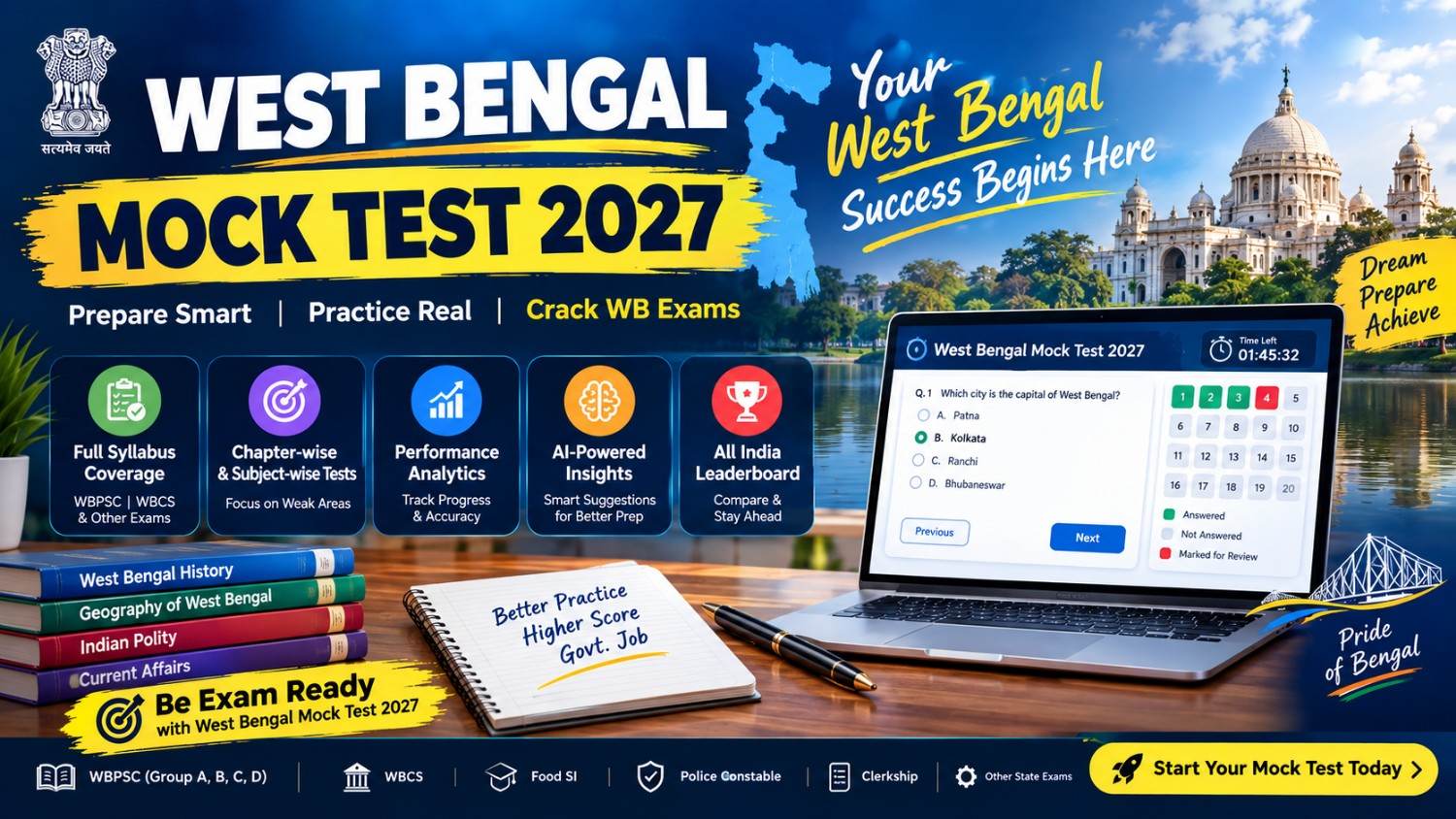 full
full
West Bengal Mock Test 2027: Free WBPSC & Police Test Series
West Bengal Mock Test 2027: Free Full-Length WBPSC, Police, Food SI & Clerkship Master Test Series in Bengali This hub is being updated to show the latest examination patterns for the WBCS, WBP Constable, WB Food SI, Clerkship, WB Police SI and WB Primary TET, as well as for reference with regard to the 2027 cycle. The pattern rules remain valid for each of the exams; details about the exam dates, vacancies and cutoffs are kept current in line with the official announcements by the respective examining bodies. People preparing for civil services, the various police uniform categories and the administrative departments in West Bengal should carry out focused study involving a range of examination patterns. The West Bengal mock test 2027 master portal on SarkariMockTest.com provides one free platform which includes the major recruitment examinations in the state such as WBCS (Executive), WBP Constable, Kolkata Police Constable, WBPSC Food SI, WBPSC Clerkship, WB Police SI and WB Primary TET. Each full-length version of the exam adheres to the syllabus, duration and marking scheme of the relevant board. Many candidates ask things like "how to attempt the West Bengal mock test" and "where can one find West Bengal exams in the Bengali medium?" This is dealt with by having humans carefully select the questions and then presenting them in genuine Bengali and English, thus giving you a precise simulation of the real exam completely free of charge. Quick Overview: West Bengal State Examinations Hub Exam Title Conducting Agency Total Questions & Marks Duration Negative Marking Core Focus Area WBCS (Executive) Preliminary Examination WBPSC 200 questions / 200 marks 150 minutes One-third mark deduction (-0.33) 8 sections, each carrying 25 marks WBP and KP Constable WBPRB 85 questions worth 85 marks 60 minutes One-fourth deduction (–0.25) General Awareness, Math, Reasoning, English WBPSC Food SI WBPSC 100 questions and 100 marks 90 minutes one-third deduction (–0.33) General Studies (50) and Madhyamik Math (50) WBPSC Clerkship (Part-I) WBPSC 100 questions worth 100 marks 90 minutes deduction of one quarter (-0.25) English (30), General Studies (40), Arithmetic (30) WB Police SI (Prelims) WBPRB 100 questions worth a total of 200 marks 90 minutes with one-fourth of the marks deducted (–0.50) for incorrect answers the paper consists of General Studies (100M), Reasoning (50M) and Math (50M). WB Primary TET WBBPE 150 questions / 150 marks 150 minutes Zero (no penalty) Child Pedagogy, Bengali, English, Math, EVS Overview of West Bengal State Competitive Exams 2027 – Master Overview and Exam Matrix People often ask "what is the exam pattern for WBCS and WBP Constable?" As the preparation has to do with different state boards, it is important to keep up with the various test blueprints. The following table gives a summary of the examination formats for all six of the main recruitment streams in West Bengal. State Exam Track Official Agency Question & Mark Split Time Limit Penalty Per Error Educational Base Selection Pipeline WBCS (Executive) Preliminary Examination WBPSC 200 multiple choice questions (200 marks, 1 mark each) 150 minutes One-third of a mark will be deducted (-0.33) A bachelor's degree is required The process is Prelims > Mains Written > Personality Test WB Police & KP Constable WBPRB 85 multiple choice questions (85 marks, 1 mark each) 60 minutes One-fourth of a mark (-0.25) Madhyamik (Class 10) Written examination > PMT/PET > Interview WBPSC Food Sub-Inspector (SI) WBPSC 100 multiple choice questions (100 marks, 1 mark each) 90 minutes One-third of a mark (-0.33) Madhyamik (Class 10) Written test > Personality test (20 marks) WBPSC Clerkship (Part-I) WBPSC 100 multiple choice questions (100 marks, 1 mark each) 90 minutes One quarter of a mark (-0.25) Madhyamik (Class 10) Part-I (Objective) then Part-II (Descriptive) then Typing The WB Police Sub-Inspector examination conducted by the WBPRB WBPRB consists of 100 multiple choice questions (carrying a total of 200 marks, 2 marks for each question) has a time limit of 90 minutes and one quarter of the marks are deducted for each wrong answer (i.e. –0.50) with a Bachelor's Degree being the required qualification the examination process is as follows: Preliminary examination > PMT/PET > Combined Mains > Interview. For the West Bengal Primary TET conducted by the WBBPE: WBBPE 150 multiple choice questions (150 marks, 1 mark each) duration 150 minutes no penalty for wrong answers Senior Secondary with D.El.Ed / Equivalent the process consists of the Eligibility Test, followed by Document Verification and then the Interview. WEST BENGAL STATE COMPETITIVE EXAMS 2027 MASTER HUB ARCHITECTURE Hub Blueprint The WBCS Executive Prelims consist of 200 questions, 200 marks, a time limit of 150 minutes, and have one-third negative marking. The WBP and KP Police Constable examination consists of 85 questions, carries 85 marks, lasts for 60 minutes and has one-fourth negative marking. For the WBPSC Food Sub-Inspector examination there are 100 questions, 100 marks, and the time allowed is 90 minutes, with one-third of a mark being deducted. | Clerkship (Part-I) with the WBPSC — 100 questions | 100 marks | 90 minutes | With one-fourth negative marking | | 5. WB Police Sub-Inspector — 100 Questions | 200 Marks | 90 Minutes | With a penalty of one-fourth (0.50 mark) | West Bengal Primary TET: 150 questions | 150 marks | 150 minutes | No negative marking Why Authentic Bengali (বাংলা) Preparation is the Key to Cracking State Exams The reason why proper preparation in Bengali (বাংলা) is essential for passing the state examinations is that a great many candidates in West Bengal complete both their schooling and their graduation in the Bengali medium. For exams such as the WBP Constable, Food SI, Clerkship, or the Primary TET, the ability to understand the questions swiftly in ordinary Bengali has a direct impact on reading speed and accuracy when it comes to scoring. The problem with poor translations on national websites is that most of the regional content of the preparation websites is produced by means of automated machine translation tools when translating questions from Hindi or English. As a result, confusing errors occur which mislead the students when they are revising. Consider specific examples of how automated machine translations cause confusion: With regard to historical terminology, the expression "Permanent Settlement of Bengal" (Chirosthayi Bandobasto / চিরস্থায়ী বন্দোবস্ত) is frequently literally translated as terms such as "Sthayi Bosobash" (স্থায়ী বসবাস / permanent residential living), completely failing to convey the link with land revenue under Lord Cornwallis. When it comes to administrative terminology, "Sub-Divisional Officer" (Mahukuma Shasok / মহকুমা শাসক) is generally rendered in clumsy expressions such as "Upo-Bibhagiya Kormochari" (উপ-বিভাগীয় কর্মচারী), causing confusion among candidates who are studying administrative and civics subjects. Basic physics terms such as 'Refraction of Light' (Alok-er Protisaron / আলোর প্রতিসরণ) are often expressed as 'Alor Bhango' (the breaking of light), which alters the meaning of the science questions for Class 10. By having Bengali-speaking teachers prepare and verify each question, SarkariMockTest avoids this issue. The technical, administrative, and historical terms comply with the standard language used by the West Bengal Board of Secondary Education (WBBSE) and the West Bengal Council of Higher Secondary Education (WBCHSE). High-Yield West Bengal Special GK: Geography, Renaissance History & State Schemes Generic test portals tend to ignore subjects that are specific to individual states and focus almost completely on general national knowledge. The exams arranged by WBPSC and WBPRB include state-specific questions on physiography, the intellectual awakening of the 19th century, and the current welfare schemes, which provide good opportunities for gaining marks. If you practice questions that are specifically designed for West Bengal, you will be able to earn marks that other candidates do not manage to obtain. Why Most West Bengal Mock Tests Fail Candidates Many commercial test providers fall short of preparing candidates for state exams: The different paywalls on the state's websites have the effect of treating each notification for West Bengal as an opportunity to earn revenue. A student who is preparing for both the Food SI and the Clerkship is normally required to purchase two separate test packages. The difficulty level is usually unrealistic because it is common for portals to transfer central SSC CGL questions into the WBP Constable exams or to include bank-clerk style puzzles in the WBPSC Clerkship tests. As a result, candidates find themselves having to study topics that are not part of the official Madhyamik curriculum. The general test banks place a nearly complete emphasis on national static facts and do not cover the geography, history, and the state's welfare schemes of West Bengal. The way in which negative marking is handled is inconsistent since a large number of free websites impose a general penalty of 0.25 on all mock exams but do not apply the specific one-third penalty that is required for the WBCS and Food SI examinations, thereby encouraging candidates to guess too quickly and this has a negative effect on them in the actual exam. Local regional blogs often display corrupt Bengali typefaces and have a lack of mathematical symbols, which causes unnecessary difficulty when practising. Choose Your Exam: Free West Bengal Online Mock Tests If you want to make use of the dedicated practice sets and diagnostic tools, you should select your particular target recruitment. 1. Mock test for the WBCS (Executive) Prelims (200 Questions • 200 Marks • 150 Minutes) The preliminary examination for the West Bengal Civil Service (Executive) tests broad academic knowledge by means of eight fixed sections, each of which is worth 25 marks: English Composition, General Science, Current Events, Indian History, Geography of India with particular reference to West Bengal, Indian Polity and Economy, the Indian National Movement, and General Mental Ability. It is a format consisting of 200 questions, presented in two languages, and includes a negative marking system under which one third of the marks are deducted. 2. A mock test for the WB Police Constable and KP Constable examinations (85 questions • at the same speed as the real exam) The book is aimed at people who are taking the examinations for the post of West Bengal Police Constable and Kolkata Police Constable. The paper, worth a total of 85 marks, consists of sections on General Awareness and GK (25 marks), Elementary Mathematics (25 marks), Reasoning (25 marks), and English (10 marks) and has to be completed within a strict 60-minute time limit. It involves a series of quick speed tests lasting sixty minutes and uses a negative marking system which calculates 0.25. 3. Practice test for Food SI with WBPSC (50 questions on General Studies and 50 on Madhyamik Arithmetic) The examination is aimed at the post of Sub-Inspector in the Subordinate Food & Supplies Service and has a total score of 100 marks, with 50 marks assigned to General Studies and 50 marks to Arithmetic at the Madhyamik level, and the duration of the exam is 90 minutes. The format consists of specialised 50-question math sprint labs and complete 100-question practice papers. 4. A mock exam for the first section of the WBPSC Clerkship (30 questions in English, 40 in General Studies and 30 in Arithmetic) The course is aimed at candidates applying for positions in the lower division assistant and clerkship categories. Part I includes 100 multiple-choice questions, 30 of which are on English, 40 on General Studies, and 30 on Arithmetic, with a time limit of 90 minutes. Prepare the objective papers for Part-I by using modules that are grouped by topic for grammar and arithmetic. 5. A mock examination for the position of West Bengal Police Sub-Inspector (SI) (100 questions • 200 marks) The preliminary screening test designed for the Sub-Inspectors of both the Unarmed and Armed divisions under the WBPRB comprises 100 questions carrying a total of 200 marks (2 marks per question): 50 questions in the field of General Studies (100 marks), 25 questions on Logical Reasoning (50 marks), and 25 questions on Arithmetic (50 marks). In the high-level screenings a deduction of 0.50 mark is made for each incorrect answer. 6. A simulated exam for the West Bengal Primary TET (consisting of 150 questions in the areas of Child Pedagogy and EVS) The test corresponds to the one carried out by the West Bengal Board of Primary Education (WBBPE) and consists of 150 questions on Child Development and Pedagogy, Language I (Bengali), Language II (English), Mathematics, and Environmental Studies. In this format you will get practice papers which are complete and last for 150 minutes with no negative marking. West Bengal Special General Knowledge: Guaranteed Scoring Module People often ask what kinds of questions come up in the West Bengal special general knowledge. In state-level exams, questions on the geography, cultural history, and welfare schemes of West Bengal make up a large portion of the General Studies section. WEST BENGAL SPECIAL GENERAL KNOWLEDGE: THREE CORE PILLARS Pillars | Pillar 1: State Physiography -> Himalayas, Terai-Dooars, Rarh Plain, Coastal Sundarbans Delta | | Pillar 2: Bengal Renaissance -> Reformers, Educational Societies, Anti-Colonial Uprisings | | Pillar 3: Welfare Initiatives -> Flagship Social Security & Education Schemes (Duare Sarkar) | 1. The landforms of West Bengal, ranging from the Darjeeling Himalayas to the Sundarbans Delta Examiners regularly test physical topography, mountain passes, and river basins across the state: Sandakphu, which is located on the Singalila Ridge and stands at a height of 3,636 metres, is the highest mountain peak in West Bengal; the Teesta (known as the "Tragedy of North Bengal"), the Torsa, the Jaldhaka and the Mahananda are some of the main rivers that originate in the northern mountains. The Terai and Dooars is a flat, wet region located at the foot of the Himalayas and is divided by the Teesta River with the Terai lying to the west of the river and the Dooars situated to the east of it, the area being famous for its tea plantations and Sal forests. The red laterite soil, which makes up the Rarh Plain and the Western Plateau Fringe, has developed on the eastern side of the Chota Nagpur plateau and covers Purulia, Bankura, Jhargram, and the western sections of Paschim Medinipur and Birbhum; the principal rivers that feed the plateau are the Damodar (historically referred to as the "Sorrow of Bengal"), the Subarnarekha, the Mayurakshi, and the Kangsabati. The Sundarbans Mangrove Delta is the biggest coastal mangrove delta in the world having been formed by the confluence of the Ganga (Hooghly), the Brahmaputra and the Meghna rivers; it is designated as a UNESCO World Heritage Site and a Ramsar Wetland and includes the Royal Bengal Tiger as well as extensive estuarine mangrove vegetation (Heritiera fomes / Sundari tree). 2. The intellectual figures of the Bengal Renaissance, the various reform movements and the revolutionary organisations The socio-religious awakening and revolutionary movements in Bengal form the foundation of historical questions in WBCS, Police SI, and Clerkship exams: The socio-religious reformers were Raja Ram Mohan Roy, who set up the Brahmo Samaj in 1828 and campaigned against the practice of Sati, which was then abolished by Regulation XVII in 1829; Ishwar Chandra Vidyasagar, who backed the Hindu Widows' Remarriage Act XV of 1856 and advocated for the education of women; and Swami Vivekananda, who founded the Ramakrishna Mission in 1897 at Belur Math. The academic and literary foundations consist of the founding of the Asiatic Society of Bengal in 1784 by Sir William Jones, the establishment of Hindu College in 1817 by David Hare and Radhakanta Deb (who afterwards became known as Presidency College), and Rabindranath Tagore's founding of Visva-Bharati at Santiniketan in 1921. In the 1820s and 1830s the Radical Intellectual Movements, headed by Henry Louis Vivian Derozio, advanced rationalist ideas as a way of opposing traditional orthodoxy. The peasant and tribal uprisings involved the Santhal revolt of 1855, this being carried out by the brothers Sidhu, Kanhu, Chand and Bhairav in the Rajmahal hills, and the indigo revolt (Nil Bidroha) between 1859 and 1860, which began in the Nadia district as shown in Dinabandhu Mitra's play Nil Darpan. The Anushilan Samiti (founded in 1902 by Pramathanath Mitra, Aurobindo Ghosh and Barindra Kumar Ghosh), the Alipore Bomb Case of 1908, the Jugantar revolutionary group, and the Chittagong Armoury Raid of 1930 carried out by Masterda Surya Sen and Pritilata Waddedar. Frequently asked questions regarding state welfare schemes in the WBPSC and WBP exams Questions regularly test eligibility criteria, financial provisions, and public goals of active state programs: The Kanyashree Prakalpa is a conditional cash transfer scheme which aims at improving the situation and well-being of girls by giving them incentives for their education and by helping to stop early marriage. As part of K1, unmarried girls aged between 13 and 18 who are studying in grades 8 to 12 are given an annual scholarship of Rs. 1,000; under K2 there is a one-off payment of Rs. 25,000 when a girl reaches 18 years of age provided that she remains enrolled in school. The scheme has received the UN Public Service Award. The Rupashree Prakalpa consists in giving economically disadvantaged families a single financial grant of 25,000 rupees at the time one of their adult daughters gets married. Lakshmir Bhandar: The giving of monthly financial aid directly to women who are heads of households (1,200 rupees per month for SC/ST families; 1,000 rupees per month for families in the general category). Swasthya Sathi is a simple type of cashless health insurance which offers coverage of up to Rs. 5,00,000 per family per year for secondary and tertiary healthcare and is issued in the name of the woman who heads the household. Krishak Bandhu offers farmers and sharecroppers (Bhagchasis) financial assistance on a guaranteed basis and provides families of farmers who are between 18 and 60 years of age with a death benefit of Rs. 2,00,000. The campaign for outreaching governance known as Duare Sarkar (Government at Doorstep) sets up local camps in order to handle citizens' enrolments for various public welfare schemes. Free bicycles are provided to students in classes 9 to 12 who are attending government schools under the Sabooj Sathi and Shikshashree schemes, and the Shikshashree scheme also gives financial help to SC/ST day scholars in classes 5 to 8. Food SI Arithmetic: The Madhyamik-Level Decider People frequently ask "wbpsc food si mein kitne marks arithmetic ke hote hain." In the WBPSC Food SI exam, arithmetic accounts for exactly 50 of the 100 marks in total. The maths section is based on the level set for Madhyamik (Class 10) by the WBBSE and does not involve advanced algebra, trigonometry, or calculus; it rather focuses on speed, accuracy, and basic logical reasoning in the main areas of commercial arithmetic. The topics in the area of mathematics that offer a high return are the Number System, the Divisibility Rules, HCF and LCM, Fractions and Decimals, Simplification (using BODMAS), Percentages, Profit and Loss, Simple Interest, Ratio and Proportion, Partnership Accounts, Averages, Time and Work, and Time, Speed and Distance. Regarding exam strategy, the General Studies paper takes between 25 and 30 minutes to complete, so you will have only 60 minutes in which to answer the 50 arithmetic questions. By mastering mental calculation shortcuts, you will be able to score 42 or more marks in maths and thus gain a good margin for qualifying. Pacing & Negative Marking Strategy Across Different West Bengal Exams Someone preparing for both the WBCS and the WB Police Constable examination usually studies as if the two tests are governed by the same set of rules. Actually they aren't; in the case of the first exam, a third of a mark is deducted for each wrong answer within a two-and-a-half-hour time period, whereas in the other exam a quarter of a mark is deducted over a period of sixty minutes. If a candidate fails to mentally differentiate between the two exams, they will either become excessively cautious when taking the one which rewards speed or too careless when sitting for the one in which guessing is penalised most heavily. Negative Marking Comparison Across Boards Table State Examination Total Marks Question Value Negative Penalty Per Error Effective Deduction Ratio Tactical Risk Threshold In the case of the WBCS (Exe.) Prelims, the total number of marks is 200, the reward being +1.00 mark, there being a penalty of –0.333 marks and the penalty amount being one-third (which is a heavy penalty); it is therefore advisable not to guess at random and to eliminate at least two options. In the case of the WBPSC Food SI post, the total number of marks is 100; a candidate is awarded +1.00 mark and loses -0.333 marks, the penalty being one-third (which is a heavy penalty), and it is therefore recommended to concentrate on calculated risks rather than making random guesses. For the WBP and KP Constable posts the mark is 85, with an increase of +1.00 mark and a deduction of -0.250 marks, that is one quarter (a moderate penalty), and it is essential to keep a fast pace and to take calculated risks. The first part of the WBPSC Clerkship consists of 100 marks, with one mark awarded for each correct answer, a deduction of 0.250 marks for each incorrect answer— which is one-quarter of a mark (a moderate penalty)— and it is advisable to attempt the questions in a balanced way by eliminating the obviously wrong ones. In the WB Police SI (Prelims) exam the total number of marks is 200, with a reward of +2.00 marks given for each correct answer, a penalty of -0.500 marks for each incorrect answer, and one-fourth of the mark value (that is -0.50) is deducted, so that two wrong answers will nullify half the mark of one question. The total mark for the West Bengal Primary TET is 150, including a bonus of +1.00 mark, with incorrect answers scoring 0.000 marks (so there is no penalty), no negative marking, and a requirement to attempt all the questions; this implies that no questions should be left blank. Time Management Blueprint: 60-Minute vs 90-Minute vs 150-Minute Exams In the 60-Minute Sprint (WBP & KP Constable) you must answer 85 questions in 3,600 seconds, that is 42 seconds per question; you should spend 15 seconds reading over the General Awareness questions and if a mathematical calculation takes longer than 60 seconds when you first look at the question, you should note it and then move on. For the 90-Minute Balance (Food SI & Clerkship) you will have 54 seconds per question since there are 100 questions, so complete the General Studies section in 25 minutes and then spend between 50 and 55 minutes on the Arithmetic and English sections without rushing. For the 150-Minute Endurance Marathon (WBCS Prelims & Primary TET): as the WBCS paper contains 200 questions, it is important to maintain a consistent level of stamina. You should allow 15 minutes for checking the answer sheets and for clearly transferring your answers without making any mistakes when filling in the bubbles. Worked Sample Questions with Complete Explanations Here are some real sample questions which illustrate the bilingual format, the regional context, and the use of four-option explanations found in our practice papers. Sample 1: WBCS Prelims (Indian National Movement in Bengal) SAMPLE QUESTION: WBCS PRELIMS (BENGAL REVOLUTIONARY STRUGGLE) History Sample | Question: Who was the founder-president of the Anushilan Samiti, established in Calcutta in 1902 | as a secret society consisting of revolutionaries who were determined to bring about the overthrow of British colonial rule? | (A) Barindra Kumar Ghosh | | (B) Pramathanath Mitra (P. Mitra) | | (C) Jatindranath Banerjee (Niralamba Swami) | | (D) Bipin Chandra Pal | | CORRECT ANSWER: (B) Pramathanath Mitra (P. Mitra) | | Step-by-Step Concept Explanation: | | Why Option (B) is Correct: | | In March 1902, the Calcutta Anushilan Samiti was formally founded under the presidency of Barrister | Pramathanath Mitra (P. Mitra); the principal organizers were Jatindranath Banerjee and Barindra Kumar Ghosh had the support of Sister Nivedita and obtained political advice from Aurobindo Ghosh. | Why Other Options Are Incorrect: | | - Option (A): Barindra Kumar Ghosh was an active leader who managed the operational inner wing | And he established the revolutionary journal 'Jugantar' in 1906, but was not the founder-president. | - Option (C): Jatindranath Banerjee was a key early organizer sent from Baroda by Aurobindo, | acting in the capacity of a lieutenant instead of that of president. | - Option (D): Bipin Chandra Pal was an extremist nationalist leader of the Lal-Bal-Pal triumvirate | who disseminated nationalist ideas via the English daily 'Bande Mataram'. Sample 2: WBPSC Food SI (Madhyamik Standard Arithmetic) SAMPLE QUESTION: WBPSC FOOD SI (PROFIT, LOSS & DISCOUNT) Math Sample | Question: A merchant marks an article 25% above its cost price and allows a customer a discount | What would the profit be if a profit of 10% is calculated on the marked price and the cost price of the article is Rs. 800? (A) Rs. 90 | (B) Rs. 100 | | (C) Rs. 120 | | (D) Rs. 150 | The right answer is (B) Rs. 100. | Step-by-Step Concept Explanation: | | Why Option (B) is Correct: | | 1. Find the marked price (MP): | The cost price is Rs. 800. | Marked Price = CP + 25% of CP = 800 + (0.25 * 800) = 800 + 200 = Rs. 1,000. | | 2. Calculate the selling price (SP) in the case where a discount of 10% is given: | The discount amounts to 10 per cent of the marked price, that is, 0.10 multiplied by 1,000 which makes Rs. 100. The selling price is the list price less the discount, which is 1,000 minus 100, coming to Rs. 900. | 3. Work out net profit: | Profit equals selling price minus cost price. That is, 900 minus 800, which gives Rs. 100. | Quick Shortcut: Net % Profit = Marked % - Discount % - (Marked * Discount / 100) | | = 25 minus 10 minus (25 times 10 divided by 100) equals 15 minus 2.5. That gives 12.5%. | Profit amounts to 12.5 per cent of 800, that is, (1/8) of 800, or Rs. 100. | Why Other Options Are Incorrect: | – Option (A): The amount of Rs. 90 results from wrongly applying a 15% discount to the marked price. — Option (C): The amount of Rs. 120 is due to the error of treating the markup on the marked price as 30%. — For option (D), Rs. 150 is reached by taking the discount directly off the markup percentage. Product Features: How Our Analytics Work Our practice platform includes analytical tools designed to help you prepare across multiple state examinations: The dashboard maintains a record of your accuracy rate for each state exam and computes your net scores in accordance with the negative marking rule—which is either 1/3rd, 1/4th, or zero—set by each examining board. An AI-based tool which identifies weak areas keeps an eye on your results from different tests; and if your accuracy drops below 45% in either the West Bengal Special GK or Class 10 Arithmetic, the system will detect those topics and then create a set of specific 10-question practice exercises to help you improve. Take the All India and State-Specific Rank Leaderboard test and compare your score, speed, and percentile with those of thousands of other candidates in West Bengal. The bilingual format has been prepared by people, with each question provided in real Bengali together with English, using terminology which is familiar to students of the state board. Daily Current Affairs Practice: Maintain broader awareness across national news and state cabinet initiatives with our free daily quiz: Take the Free Daily Current Affairs Quiz How to Attempt Free West Bengal Mock Tests on Sarkari Mock Test Getting started on our platform takes less than two minutes: To get to the portal, you should go to SarkariMockTest.com and select State Government & Police Exams then the West Bengal Hub from the navigation menu. Select the exam that you want; you may pick between WBCS Prelims, WBP Constable, WBPSC Food SI, Clerkship, WB Police SI, and Primary TET. To begin the Simulator: click on 'Start Free Mock Test'. A testing interface will then be displayed, featuring a countdown timer specific to the exam, a palette indicating the status of the questions, and a button for changing the language. Solve and Submit: If you want to obtain your instant scorecard, your state percentile rank, and the detailed explanations for each question, then you should answer the questions and afterwards click Submit Examination. Section-Wise Preparation Strategy + Important Books per Exam Follow this structured preparation strategy and use standard academic reference books: Examination Track High-Yield Subjects to Master Recommended Authoritative Reference Books In order to take the WBCS (Executive) examination one must study the following subjects: the Indian National Movement, WB Geography, Indian Polity, and General Mental Ability. The books that are recommended are West Bengal General Knowledge, published by the standard publishers; India's Struggle for Independence by Bipan Chandra; and Indian Polity by M. Laxmikanth. The examination for WB Police Constable covers subjects in the areas of General Awareness, Elementary Mathematics, Logical Reasoning, and Elementary English. When preparing for it, candidates should use the Mathematics textbooks from the WBBSE for Classes 9 and 10, Lucent's General Knowledge, and elementary reasoning handbooks. To apply for the WBPSC Food SI post, one must prepare in the following subjects: Madhyamik Arithmetic, Current Affairs, Science, Bengal Geography and Culture. The specified textbooks are Quantitative Aptitude by R.S. Aggarwal; the Class 10 Mathematics textbooks published by the WBBSE; and the standard West Bengal yearbooks. To obtain the Clerkship position with the WBPSC, the required subjects are English Grammar and Vocabulary, Arithmetic, General Studies, and Writing Skills (Part-II). The textbooks recommended are Wren and Martin's High School English Grammar, the Arithmetic textbooks suitable for Class 10, and collections of current affairs from the state. For the West Bengal Primary TET, the subjects include Child Development and Pedagogy, Language I in Bengali, Environmental Studies, and Basic Math— those being the standard D.El.Ed pedagogical reference modules and the WBBPE primary school curriculum textbooks. Common Mistakes West Bengal Aspirants Make Treating all the state exams as though they follow the same pattern—for example, assuming that the WBCS, the Food SI, and the WBP Constable are governed by the same rules—leads to poor time management on the day of the exam since the candidates' preparation is not adjusted to meet the specific time limits and negative marking penalties of each exam. The rules about negative marking are confusing in that if the same guessing strategy is used on different tests the statistical risk is higher when taking one which has a one-third penalty (for example the WBCS or Food SI) than when taking one which has a one-fourth penalty (for example the Constable or Clerkship). If one only considers the national history and central politics and neglects the special general knowledge concerning West Bengal—such as its geography, the locations of its district headquarters, the local rivers, and the state's welfare schemes. Using regional questions that have been machine-translated: dealing with applications which make use of automated translations, these distorting technical, administrative, and historical terms. Not making use of the rule concerning zero negative marking on the WB Primary TET, which implies that each question not answered is a chance lost for obtaining marks. Why Attempt This Free West Bengal Test Series Hub Preparing with full-length simulations matched to each board's standards builds both speed and conceptual clarity: Parameter Unorganized Fragmented Preparation SarkariMockTest Unified West Bengal Hub Platform Model Multiple paywalls across different websites Single free, unified hub covering all 6 major state exams Language Standard Awkward machine-translated regional text Human-curated Bengali and English by regional educators State Focus 90% generic national questions Dedicated modules on West Bengal Geography, Renaissance, and Schemes Marking Accuracy One-size-fits-all negative penalty settings Exact exam-specific penalties applied (1/3rd, 1/4th, or Zero) Why This Mock Test Series Was Put Together I am Shubham Kumar Sah and I have founded SarkariMockTest.com. Most of the exam materials available in West Bengal that I have examined are either sold separately with their own payment barriers or offer content in Bengali which sounds as though it has been translated by a machine rather than being written by someone familiar with the exam. The two points which are most frequently ignored are this: on the one hand, a candidate from West Bengal who is preparing for more than one state examination has to obtain information from a variety of paid sources, whereas it would be more useful if there were one dependable centre to supply it; on the other hand, Bengali-medium candidates should have terminology that has not lost its meaning in translation, especially in the case of historical and administrative terms. The system is based on both of them and brings together in a single place all the major exams carried out in West Bengal—such as the WBCS and the Primary TET—complete with the exact pattern and the rules about negative marking clearly outlined. The Bengali material is written in a way that a student for whom Bengali is the medium of instruction can read it easily, rather than being produced in another language. The test series will continue to be free as long as the exam-specific page is live, because a country of that size deserves to have a genuinely free and unified starting point. As I work on this hub, I make it a point of checking every exam page to see if it would really be of any use to an aspirant from West Bengal, considering the language that they use rather than concealing the actual exam rules behind confusion. In such a case, the page is not included. Official West Bengal Recruitment Portals & Commission Links The official websites and links of the West Bengal recruitment bodies can be used to keep track of exam notifications, download syllabus documents, and check the recruitment schedules: Department / Commission Official Website Link Main reason for candidates West Bengal Public Service Commission (WBPSC) psc.wb.gov.in Notifications regarding WBCS Executive, Food SI, and Clerk positions, as well as admit cards and results. West Bengal Police Recruitment Board (WBPRB) prb.wb.gov.in Circulars and schedules for the WBP Constable, Kolkata Police Constable, and WB Police SI posts. West Bengal Board of Primary Education (WBBPE) wbbpe.org Notifications, admit cards, and answer keys for the Primary Teacher Eligibility Test (TET). SarkariMockTest West Bengal Hubs sarkarimocktest.com Free full-length mock tests, Madhyamik-level math exercises, and bilingual scorecards. Advice on practical preparation: Adapting your pace and paying attention to regional details according to the different boards In order to do well in the state exams of West Bengal, it is necessary to adjust your pace to match the particular rules of each board. A method that is effective for the 150-minute WBCS paper will cause you to finish out of time in the 60-minute WBP Constable test. Each morning, spend 30 minutes going over West Bengal Special General Knowledge using summary notes: concentrate on the river systems of the different districts, the key dates of the Bengal Renaissance, and the eligibility rules for state welfare schemes such as Kanyashree and Swasthya Sathi. Every day practice 20 arithmetic problems at the Madhyamik level in order to prepare for the 50-mark mathematics sections in the Food SI and Clerkship exams. Once a week, take one full-length west bengal mock test in 2027 under timed conditions, and adjust your guessing strategy depending on whether the test imposes a 1/3rd, 1/4th, or no penalty. Regular practice on these regional facts and time limits is the most reliable way to pass your state examinations. About the Author Ali Hassan is a Senior Content Editor at SarkariMockTest.com, with special expertise in the curricula of state public service commissions, regional police recruitments, and bilingual test preparation in West Bengal and eastern India. After having studied competitive examination trends for over three years, he reviews question sets to make sure they reflect current commission patterns and adhere to verified factual standards. .wb-mock-wrapper, .wb-mock-wrapper * { box-sizing: border-box !important; -webkit-tap-highlight-color: transparent; } .wb-mock-wrapper { width: 100% !important; max-width: 100% !important; margin: 0 !important; padding: 16px 12px !important; font-family: -apple-system, BlinkMacSystemFont, "Segoe UI", Roboto, Helvetica, Arial, sans-serif; line-height: 1.65; color: #212121; background-color: #ffffff; overflow-wrap: break-word; word-wrap: break-word; text-align: left !important; display: block !important; clear: both !important; float: none !important; } .wb-mock-wrapper p, .wb-mock-wrapper h1, .wb-mock-wrapper h2, .wb-mock-wrapper h3, .wb-mock-wrapper ul, .wb-mock-wrapper ol, .wb-mock-wrapper li, .wb-card-architecture, .wb-author-box, .wb-module-card, .wb-box-alert { text-align: left !important; } .wb-top-h2 { display: block !important; width: 100% !important; background: linear-gradient(135deg, #1b5e20, #2e7d32) !important; color: #ffffff !important; font-size: 22px !important; font-weight: 800 !important; padding: 16px 18px !important; border-radius: 8px !important; margin: 10px 0 18px 0 !important; line-height: 1.35 !important; border-left: 6px solid #fbc02d !important; box-shadow: 0 4px 12px rgba(27, 94, 32, 0.22) !important; } .wb-disclaimer-box { background-color: #fffde7; border-left: 5px solid #fbc02d; padding: 14px 16px; margin-bottom: 16px; border-radius: 0 6px 6px 0; font-size: 14px; color: #424242; } .wb-h2 { font-size: 21px; font-weight: 700; color: #1b5e20; margin: 28px 0 14px 0; border-bottom: 2px solid #e0e0e0; padding-bottom: 8px; line-height: 1.35; } .wb-h3 { font-size: 17px; font-weight: 600; margin: 20px 0 10px 0; line-height: 1.4; } .wb-p { font-size: 15px; color: #333333; margin: 0 0 16px 0; } .terminal-text { font-family: monospace; font-size: 13px; margin-bottom: 6px; color: #666; } .link-styled { color: #1b5e20; font-weight: 700; text-decoration: underline; } .link-styled:hover { color: #b71c1c; } .wb-table-wrap { width: 100% !important; max-width: 100% !important; overflow-x: auto !important; -webkit-overflow-scrolling: touch; margin: 18px 0 24px 0; border: 1px solid #e0e0e0; border-radius: 6px; background-color: #ffffff; } .wb-table { width: 100% !important; border-collapse: collapse; text-align: left !important; font-size: 14px; min-width: 620px; } .wb-table th { background-color: #1b5e20; color: #ffffff; padding: 11px 12px; font-weight: 700; border: 1px solid #1b5e20; white-space: normal; text-align: left !important; } .wb-table td { padding: 11px 12px; border: 1px solid #e0e0e0; color: #212121; vertical-align: top; text-align: left !important; } .wb-table tr:nth-child(even) { background-color: #f9fbe7; } .wb-table tr:hover { background-color: #fff9c4; } .wb-box-alert { width: 100% !important; background-color: #ffebee; border-left: 5px solid #c62828; padding: 16px; margin: 20px 0; border-radius: 0 6px 6px 0; } .wb-card-architecture { width: 100% !important; background: #ffffff; border: 1px solid #e0e0e0; border-radius: 8px; margin: 20px 0; overflow: hidden; box-shadow: 0 1px 4px rgba(0,0,0,0.04); } .wb-card-header { background-color: #1b5e20; color: #ffffff; padding: 12px 16px; font-weight: 700; font-size: 15px; display: flex; align-items: center; justify-content: space-between; flex-wrap: wrap; gap: 8px; text-align: left !important; } .wb-card-badge { background-color: #fbc02d; color: #212121; font-size: 12px; font-weight: 700; padding: 3px 8px; border-radius: 4px; } .wb-card-body { padding: 14px; text-align: left !important; } .section-green { background-color: #f1f8e9; border: 1px solid #c5e1a5; border-left: 5px solid #2e7d32; border-radius: 6px; padding: 12px 14px; text-align: left !important; } .section-yellow { background-color: #fffde7; border: 1px solid #fff59d; border-left: 5px solid #fbc02d; border-radius: 6px; padding: 12px 14px; text-align: left !important; } .section-blue { background-color: #e1f5fe; border: 1px solid #b3e5fc; border-left: 5px solid #0288d1; border-radius: 6px; padding: 12px 14px; text-align: left !important; } .section-red { background-color: #ffebee; border: 1px solid #ffcdd2; border-left: 5px solid #c62828; border-radius: 6px; padding: 12px 14px; text-align: left !important; } .wb-author-box { width: 100% !important; background-color: #ffffff; border: 1px solid #e0e0e0; border-left: 5px solid #1b5e20; border-radius: 8px; padding: 20px 18px; margin: 28px 0; box-shadow: 0 2px 6px rgba(0,0,0,0.04); text-align: left !important; } .wb-author-header { color: #1b5e20; font-size: 20px; font-weight: 800; margin: 0 0 12px 0; padding-bottom: 8px; border-bottom: 1px solid #eef2f6; text-align: left !important; } .wb-module-card { background: #ffffff; border: 1px solid #e0e0e0; border-radius: 8px; padding: 18px 16px; margin: 20px 0; box-shadow: 0 1px 4px rgba(0,0,0,0.04); text-align: left !important; } .border-green { border-left: 5px solid #2e7d32; } .border-yellow { border-left: 5px solid #fbc02d; } .border-blue { border-left: 5px solid #0288d1; } .border-red { border-left: 5px solid #c62828; } .color-green { color: #1b5e20; } .color-yellow { color: #f57f17; } .color-blue { color: #0288d1; } .color-red { color: #c62828; } .font-15 { font-size: 15px; } .font-bold { font-weight: 700; } .mb-0 { margin-bottom: 0 !important; } .mb-6 { margin-bottom: 6px !important; } .mb-8 { margin-bottom: 8px !important; } .mt-14 { margin-top: 14px !important; } .block { display: block; } .wb-list { list-style-type: disc !important; margin: 0 0 16px 0 !important; padding-left: 24px !important; text-align: left !important; } .wb-list li { margin-bottom: 8px !important; color: #333333; display: list-item !important; text-align: left !important; } @media (min-width: 768px) { .wb-mock-wrapper { padding: 24px 16px !important; } .wb-top-h2 { font-size: 26px !important; } .wb-h2 { font-size: 23px; } .wb-h3 { font-size: 19px; } .wb-p { font-size: 16px; } .wb-table { font-size: 15px; } } @media (max-width: 600px) { .wb-mock-wrapper { padding: 12px 6px !important; } .wb-top-h2 { font-size: 20px !important; } .wb-h2 { font-size: 18px; } .wb-h3 { font-size: 16px; } }
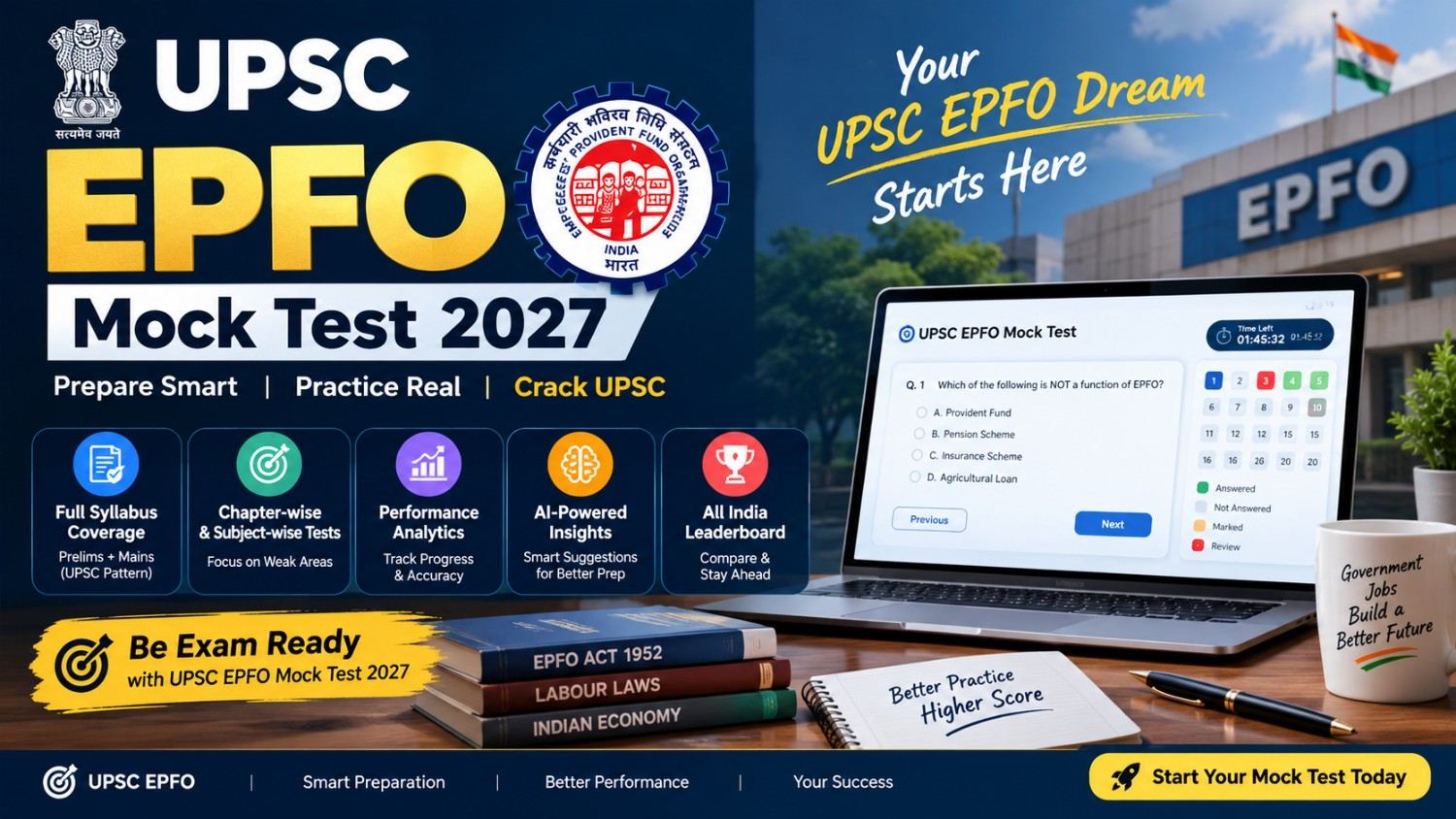 full
full
UPSC EPFO Mock Test 2027: Free EO/AO & APFC Test Series
UPSC EPFO Mock Test 2027: Free Full-Length EO/AO & APFC Online Test Series & 75:25 Selection Simulator In view of the most recent UPSC EPFO EO/AO and APFC exam pattern and the related references for the 2027 cycle, this test series has been brought up to date; although the pattern rules are still correct, the exam dates, the number of vacancies and the syllabus emphasis have all been adjusted in accordance with the official announcements. If one wishes to obtain one of the prominent positions of Enforcement Officer / Accounts Officer (EO/AO) or Assistant Public Provident Commissioner (APFC), it is essential to blend the standard material covered in General Studies with a knowledge of the particular statutory subjects. The facility provided by SarkariMockTest.com for taking UPSC EPFO Mock Tests gives free, full-length practice papers in accordance with the official structure of the 120-question, 300-mark Recruitment Test (RT). The test simulator includes a realistic 120-minute countdown timer and implements a precise negative marking penalty of -0.833, so as to allow you to prepare for passing the written screening examination and to secure a safe position in the final 75:25 merit list. There is a lot of discussion concerning how best to manage one's time when studying either the conventional civil services subjects or the more specialised commercial ones. In this recruitment process, having only a knowledge of the General Studies subject is not sufficient to guarantee selection. Candidates who do not study General Accounting Principles, the four New Labour Codes, and Social Security in India are missing out on nearly one-third of the total marks. The practice platform provides balanced diagnostics enabling both civil services aspirants and commerce graduates to spot their weak points and achieve a high degree of consistency in their scores across all sections. Quick Overview: UPSC EPFO Recruitment Examination (EO/AO & APFC) Examination Feature Official UPSC Recruitment Standard SarkariMockTest Practice Hub Exam Name UPSC EPFO EO/AO & APFC Recruitment Test (RT) UPSC EPFO Mock Test Series 2027 Conducting Authority Union Public Service Commission (UPSC) SarkariMockTest Civil Services Research Cell Cadres Included Enforcement Officer / Accounts Officer & APFC Integrated EO/AO & APFC Practice Tracks Total Question Count 120 Objective Multiple Choice Questions Exactly 120 Questions per Full Mock Test The total is 300 marks (2.50 marks for each correct answer) 300 Marks Total 300 marks when automated sectional scoring is applied. Testing Duration 120 Minutes (2 Continuous Hours) 120-Minute Real-Time Timer with Pause Mode A negative marking feature has been included which imposes a penalty of -0.833 marks for each incorrect answer -0.833 Marks per wrong answer and an Automated Penalty Deduction Engine is provided. Selection Weightage 75% Written Test (RT) : 25% Interview Stage 75:25 Merit Projection & Safety Benchmark Syllabus Standard Graduate Level (Core GS + Specialized Non-GS) Balanced Diagnostic Split (GS vs Commercial) Language Medium Bilingual (Hindi & English, except English section) Instant Question-Level Language Toggle Selection Stages Single-Stage Written RT > Document Check > Interview Complete Written Simulation for Stage 1 UPSC EPFO Online Test Series 2027 – Exam Pattern & Marks Distribution The written test consists of a single objective paper containing 120 multiple-choice questions and the candidates have two continuous hours to complete it. Section Category Observed Question Share Marks Allocated Marking Per Correct Item Negative Penalty Recommended Pacing General English 20 questions 50.0 marks Plus 2.50 marks for each correct answer Minus 0.833 marks for each wrong answer 15 minutes Specialized Non-GS Core 38 Specialized Non-GS Core questions 95.0 marks +2.50 marks -0.833 marks 40 minutes General Studies and Administration About 42 Questions About 105.0 Marks +2.50 Marks for each correct answer -0.833 Marks for each wrong answer 35 Minutes Quantitative Aptitude and Logic about 20 questions 50.0 marks +2.50 marks –0.833 marks 30 minutes Total Composite Paper 120 questions 300 marks an increase of 2.50 marks a decrease of 0.833 marks and 120 minutes (2.0 hours) It should be pointed out that the UPSC does not expressly specify a strict sectional distribution in its recruitment notification; the distribution mentioned above is one that has been derived from the patterns seen in recent examinations. UPSC EPFO 120-QUESTION BALANCED EXAMINATION ARCHITECTURE Blueprint | Part 1: General English -> ~20 Qs (~50 Marks) | Vocabulary, Idioms, Error Spotting | | Part 2: Specialized Non-GS Core -> ~38 Qs (~95 Marks) | 4 Labour Codes, Accounting, Security | | Part 3: General Studies & Admin -> ~42 Qs (~105 Marks) | Freedom Struggle, Polity, Economy, IT | | Part 4: Quant & Mental Ability -> ~20 Qs (~50 Marks) | Arithmetic, Ratios, Deductive Logic | | TOTAL: 120 QUESTIONS | 300 MARKS | 120 MINUTES | SELECTION WEIGHTAGE: 75% WRITTEN : 25% INTERVIEW | The Non-GS Differentiator: Why Labour Laws & Accounting Decide Your Rank A person who is intending to secure a post in the civil services and goes to EPFO finds that their solid knowledge of Polity and History does not help them, since they have ten marks deducted for questions on Bank Reconciliation Statements which they had not expected to see. A graduate in commerce goes there confident about his knowledge of Accounting only to face a question on the spread of the 1857 revolt among peasant communities. EPFO does not ask about the subject in which you are skilled; instead, it tests whether you have prepared for the exam that you are actually taking, not for the one that your background has prepared you for. The examination brings together two distinct groups of candidates: The group which had a background in the Civil Services and General Studies did well in subjects like the Indian Freedom Struggle, Indian Polity, and General Science, but had no knowledge of double-entry bookkeeping, trial balance adjustments, standing orders, and the new labour codes. Among the group of individuals who are involved in Commerce / Banking / Corporate fields, competence has been shown in respect to balance sheets, depreciation, and mathematics, while there is a lack of knowledge concerning modern Indian history, working-class resistance movements, and the different constitutional articles. The online test series known as SarkariMockTest for the UPSC EPFO exam eliminates this gap. Your score is evaluated by means of two separate dashboards, one covering Core General Studies and the other dealing with the Specialized Non-GS Domains. This setup ensures that no group is disadvantaged because of background-related blind spots. The 4 New Labour Codes (2019-2020) vs Legacy Acts: What UPSC Actually Tests The candidates are very confused about whether the new labour codes will come into effect or whether the old acts will be kept; it is usual for them to consider whether they should look at the 29 historical labour acts or the four consolidated codes passed by Parliament. THE 4 NEW LABOUR CODES AMALGAMATION BLUEPRINT Amalgamation The 2019 Code on Wages has taken the place of the four Acts (such as the Payment of Wages, the Minimum Wages, the Bonus, etc.). | 2. The Industrial Relations Code of 2020—this code supersedes the three Acts (Trade Unions, Standing Orders, Disputes)| | 3. The Social Security Code, 2020—this code replaces the nine Acts (among these are the EPF Act of 1952, the ESI Act of 1948, the Gratuity Act, etc.)| The 2020 OSH and Working Conditions Act replaces the 13 Acts (these including the Factories Act 1948, the Contract Labour Act, etc). | UPSC TESTING STRATEGY: Comparative Questions evaluating structural changes and continuity | The UPSC looks at the two frameworks and, when evaluating your answer, checks whether you understand how the new statutory codes modify the rules which were originally established in the older acts. Code on Wages, 2019 It incorporates the following previous statutes: the Payment of Wages Act (1936), the Minimum Wages Act (1948), the Payment of Bonus Act (1965), and the Equal Remuneration Act (1976). The principle is universal in that it extends the advantages of the minimum wage to all workers in both the organized and the unorganized sectors, abolishing the earlier limitation which had only concerned scheduled employment. The Floor Wage Mechanism allows the Central Government to fix a mandatory national statutory "Floor Wage", the amount being set in accordance with the minimum living standards in various geographical areas, and it is not permitted for the state governments to fix their minimum wage rates below this national floor. The policy prohibiting discrimination on the ground of gender includes a ban on such discrimination when it comes to recruitment and with regard to the wages paid for the same work or work which is of a similar nature. 2020 Industrial Relations Code The Trade Unions Act of 1926, the Industrial Employment (Standing Orders) Act of 1946, and the Industrial Disputes Act of 1947 have all been consolidated. The legal threshold for the number of workers in an industrial enterprise needed in order to prepare formal Standing Orders has risen from 100 workers, as specified in the 1946 Act, to 300 workers, as set out in the 2020 Code. Advance notice of strikes and lockouts: A 14-day advance notice is now required in all industrial establishments, eliminating the earlier distinction between public utility services and other utilities. The Sole Negotiating Union rule states that an employer must recognise a registered trade union as the sole negotiating union where that union has 51 per cent or more of the workers listed on the muster roll; and if no one union has 51 per cent, a negotiating council must be set up to represent unions which have at least 20per cent membership each. 3. The Social Security Code from 2020 It includes the nine Social Security Acts, such as the Employees' Provident Funds and Miscellaneous Provisions Act (1952), the Employees' State Insurance Act (1948), the Maternity Benefit Act (1961), and the Payment of Gratuity Act (1972). For the first time, the terms 'Gig Workers' and 'Platform Workers' are defined in Indian statutory law, together with the establishment of special social security funds financed by the aggregators (who are required to pay a contribution ranging from 1% to 2% of their annual turnover, the rate to be capped at 5% of the amounts paid to gig workers). Employees on fixed-term contracts are entitled to a pro-rata gratuity if they have completed one year of service, which eliminates the strict requirement of five years' continuous service that applies to regular permanent workers. The Occupational Safety, Health and Working Conditions (OSH) Code of 2020 It includes the thirteen safety acts, for example the Factories Act (1948), the Mines Act (1952), and the Contract Labour (Regulation and Abolition) Act (1970). The number of workers needed for the application has gone up from 20 to 50 in the case of businesses that use contract labour. The policy which allows women to work night shifts (between 7:00 PM and 6:00 AM) in all kinds of establishments must be based on their clear consent and on the employer making sure that appropriate standards are established concerning safety, transportation and working conditions. Regarding implementation: Although Parliament has approved these four codes and the central rules have already been established, the different state governments are now at various stages with respect to issuing their regional rules. You should therefore examine both the operational provisions of the older acts and the statutory amendments introduced by the new codes. General Accounting Principles for Non-Commerce Aspirants: High-Yield Topics People who do not have a background in commerce are usually worried as to how they can deal with the 'EPFO accounting section' without having studied commerce. The UPSC does not ask you to carry out complex corporate consolidations or involve sophisticated partnership liquidations. Rather, the exam focuses on the fundamental accounting concepts, the classification of transactions, and the logic of the balance sheet, all of which are taught in the Class 11 and 12 NCERT textbooks. Focus your preparation on these seven high-yield areas: The fundamental principles and conventions of accounting The business is considered to be a separate legal entity from its owners and the private affairs of the owners are never mixed up with those of the business. The going concern assumption is based on the idea that the business will continue to operate for the foreseeable future and has no intention of carrying out a liquidation. The principle of accrual provides that revenues and expenses should be recorded in the period during which they take place, not in the period in which cash is received or paid. When it comes to prudence or conservatism, no profits should be expected but provision should be made for all possible future losses; assets and income must never be stated too high while liabilities and expenses must never be stated too low. The Matching Principle states that the expenses suffered in order to produce revenue in a given period should be matched and then be deducted from the revenue which is recognised in that same period. Capital vs Revenue Expenditure Capital expenditure refers to money spent on buying or improving fixed assets like buildings, machinery, or equipment. These expenses help the business over several years. For example, when a company buys a new delivery truck, it records this as a capital expenditure. Revenue expenditure covers money spent on daily operations. This includes repairs, rent, salaries, or utility bills. These costs only help the business for a short time, usually within the same year. For example, fixing a delivery truck or paying for fuel counts as revenue expenditure. Capital expenditure refers to the money that a business spends on purchasing, improving or extending assets which will last for longer than one year, such as new equipment, buildings or vehicles. These assets assist the business in earning money over a long period and the company records the expenses as assets on the balance sheet, then allocates the cost over the asset's useful life by means of depreciation. Revenue expenditure refers to the money that a business spends on carrying out its daily operations, such as on repairs, regular maintenance, rent, utilities, and wages. These expenses are essential for keeping the business going, but they do not increase the value of its assets in the long term. The business records them as expenses on the income statement in the period during which they occur. Capital Expenditure involves expenses that lead to the formation of lasting assets, increase a business's earning capacity, or extend the useful life of an asset (for instance, the purchase of factory machinery or the cost of a major engine overhaul); these expenses are included in the Balance Sheet. Revenue expenditure means the normal operational costs required to keep the existing assets able to carry out their daily functions (for instance, the annual maintenance of machinery, the rent for the factory, and worker wages), and these are directly charged to the Trading and Profit & Loss Account. The methods of depreciation (a comparison between the straight-line method and the written-down value method) With the Straight Line Method (SLM) depreciation is calculated using the original cost of the asset and the annual amount of depreciation remains constant each year. The WDV method calculates depreciation by using the reduced book value of the asset at the start of each year, which causes the annual depreciation charge to decrease from year to year. The classification of accounting errors in the trial balance Omission error: A transaction may be entirely or partly left out of the books; full omission has no impact on the Trial Balance. Error of Commission: This type of error occurs due to incorrect postings, wrong calculations, or because inaccurate totals have been carried forward (for example, recording Rs. 500 as Rs. 5,000). These errors usually cause the Trial Balance not to agree. A mistake based on principle arises when a transaction is recorded in a manner that breaches the fundamental rules of accounting (for example, by treating the purchase of office furniture as a normal revenue office expense). Yet it has no impact on the totals in the Trial Balance. Errors can be cancelled out in the following manner: if one error is exactly offset by another error which is of the same amount but on the opposite side of the ledger, the Trial Balance will still agree as a result of the two errors. Bank Reconciliation Statement (BRS) Reconciles discrepancies between the cash book balance (maintained by the firm) and the pass book balance (maintained by the bank): The cheques which have been issued but have not yet been presented for payment cause the cash book balance to go down while the pass book balance remains at a higher level until it has been cleared. The balance in the cash book increases straight away when cheques are deposited but have not yet been collected; the balance in the pass book remains at a lower amount until the clearing process is complete. When the bank carries out direct debits (for example, when charging fees or interest), the balance in the pass book goes down before the accountant enters the transaction into the firm's cash book. Why Most UPSC EPFO Mock Tests Fail Candidates Many online test series provide inadequate practice for the unique requirements of the EPFO examination: Commercial websites often hire accounting tutors to give students lengthy and complicated ledger problems that take twelve minutes to solve, while the UPSC instead sets multiple-choice questions based on concepts such as definitions, errors, and classifications that can be answered in sixty seconds. Because they do not update their banks of industrial relations questions, generic test providers keep on using the rules that were in place before 2019 rather than comparing them with those introduced under the 4 New Labour Codes. The majority of general test banks only provide a shallow account of the different statutory schemes, concentrating on general knowledge questions instead of giving detailed information regarding the EPF Act 1952, employee contribution ceilings, pension formulas, and gratuity calculations. Usually, a single sample test is provided free of charge, but all the other tests are then placed behind subscription paywalls without informing the candidates whether or not they have met the required accuracy standards. Attempt Free UPSC EPFO Full-Length Mock Tests Begin your preparations by making use of our interactive computer-based testing modules, the test being based on the 120-question, 300-mark blueprint. Full-Length Mock 1 (120 Questions • 300 Marks • Exact UPSC-Style OMR Simulator Interface) It features a true mix of General English, Specialized Non-GS Core, General Studies, and elementary Mathematics, as well as an automated -0.833 penalty calculator and All India Rank benchmarking. Full-Length Mock 2 (Specialized Domain Shift: Heavy Labour Laws & Social Security) The text concentrates on the comparative features of the four New Labour Codes, the statutory social security schemes (PM-SYM, Atal Pension Yojana, e-Shram), and the conceptual accounting adjustments. Full-Length Mock 3 (General Studies & Quantitative Aptitude Intensive Paper) The text highlights present-day Indian resistance movements carried out by the working class, mentions the constitutional provisions concerning labour rights, and employs arithmetic problem sets to train students to work quickly under time pressure. UPSC EPFO Previous Year Question Papers as Timed Mocks Work through questions from previous examination papers that have been verified (for example, those from the 2021 and 2023 EO/AO and APFC cycles) and provide step-by-step explanations. Test Series Structure & Coverage Matrix The programme consisting of 40 modules leads you step by step through your preparation, beginning with drills on each individual topic and finishing with full-length exam simulations. Level & Segment Sections Covered Number of Tests Question Format Focus & Exam Alignment Tier 1: Sectional Drills English, Labour Codes, Accounting, Security, GS, Math 20 Tests (20 Qs / 20 Mins each) Timed topic drills Builds speed and subject-specific accuracy Tier 2: Full Simulations All Sections Put Together 14 Tests (120 Questions per Test / 120 Minutes per Test) The same as the actual exam but with a bonus of +2.5 and a penalty of -0.833 Assists in building pacing and stamina over a 120-minute period Tier 3: Specialized Labs 4 Labour Codes & General Accounting Principles 4 Labs (30 Qs / 30 Mins each) Comparative code questions Targets the high-yield non-GS domain Tier 4: Shift-Style Mocks Complete Composite Syllabus 2 Tests (120 Qs each) Past-shift style questions Real exam trend and format familiarity Subject-Wise Mock Test Breakdown & 120-Question Allocation The 120 questions divide into four major subject areas based on observed exam trends: General English (approximately 20 Questions / approximately 50 Marks) General English tests practical vocabulary, grammatical precision, and sentence clarity: The words used and the situations referred to make heavy use of synonyms and antonyms that are common in administrative contexts. There is a section dealing with idioms and phrasal verbs (four questions): this covers common expressions and the meanings that they have in a given context. Prepositions and conjunctions (three questions): the correct prepositions and linking conjunctions. The way to identify errors is by posing four questions: checking for mistakes in subject-verb agreement, looking at the correct placement of modifiers, and ensuring consistency in tense. How to improve sentences (by asking four questions): choosing the most concise and grammatically correct method of expressing the clauses that are underlined. Specialised Non-GS Core (about 38 questions, about 95 marks) The specialized statutory and commercial portion of the paper accounts for nearly a third of total marks: The historical development of trade unions, together with the Trade Unions Act of 1926, the Industrial Disputes Act of 1947, and the complete structural consolidation achieved through the Industrial Relations Code of 2020 and the Code on Wages of 2019. The topics dealt with include the accounting concepts (such as the going concern, the accrual, and prudence), the way in which items are classified in the trial balance, journal entries, the various methods of depreciation, and Bank Reconciliation Statements. There are about ten questions regarding Social Security in India: these include the Employees' Provident Funds and Miscellaneous Provisions Act of 1952, the statutory contribution rates, EDLI, the Employees' State Insurance Act of 1948, the Payment of Gratuity Act of 1972, the various initiatives aimed at the unorganised sector (such as e-Shram, PM-SYM, and the Atal Pension Yojana), and the new provisions related to gig workers. General Studies and Administration (approximately 42 questions / approximately 105 marks) A discussion of the Indian struggle for independence (involving approximately fifteen questions): this covers the period beginning with the 1857 revolt and ending with independence in 1947, with an emphasis on the growth of the working-class movement, the early strikes, the founding of the All India Trade Union Congress (AITUC) in 1920, the peasant movements (the Kisan Sabhas), and the major nationalist campaigns. The topics covered are constitutional provisions relating to labour rights (namely Articles 23, 24, 39, 41, 42, 43, and 43A), the Directive Principles of State Policy, the emergency provisions, fiscal policy, macroeconomic indicators, and the recent economic initiatives. This part looks at the everyday uses of physics, chemistry, and biology as well as the basic principles of information technology such as computer networking, cybersecurity, databases, and operating systems. Quantitative Aptitude and Mental Ability (approximately 20 questions / approximately 50 marks) Questions involving elementary mathematics: number systems, ratios and proportions, percentages, profit and loss, simple and compound interest, time and work, and speed-time-distance. The section on logical reasoning includes nine questions, some of which deal with number and alphabet sequences, coding and decoding, syllogisms, blood relationships, and problems concerning direction sense. EO/AO vs APFC: Where the Syllabus Differs People often ask, "What is the difference in the syllabus between eo ao and apfc?" Even though both posts include the same core subjects such as General Studies, Labour Laws, and Accounting, the exam for Assistant Public Provident Commissioner (APFC) has a number of additional topics: Syllabus Component Enforcement Officer / Accounts Officer (EO/AO) Assistant Public Provident Commissioner (APFC) Cadre Classification Group 'B' Non-Ministerial Post Group 'A' Junior Scale Administrative Post General English Included (~20 Questions) Included (~20 Questions) Industrial Relations & Labour Laws Included (Core Statutory Focus) Included (Advanced Policy & Legal Focus) General Accounting Principles Included (Class 11-12 NCERT Scope) Included (Class 11-12 NCERT Scope) Social Security in India Included (Schemes, EPF/ESI Acts) Included (Schemes, EPF/ESI Acts, Global Models) Principles of Auditing Not Included in Standard Syllabus Explicitly Tested (Audit standards, verification) Basic Principles of Insurance Not Included in Standard Syllabus Explicitly Tested (Life/General, principles, IRDAI) Indian Culture & Heritage Minimal (General History Focus) Explicitly Tested (Art, architecture, literature) Population, Development & Globalization General Economic Reference Explicitly Tested (Demography, urbanization, trade) Statistics & Mathematics Basic Arithmetic (~10-12 Questions) Basic Statistics & Higher Mathematics Concepts Before beginning your specialized revision of the APFC-specific modules, you should check the exact syllabus for the relevant post in the official UPSC notification for the recruitment cycle to which you are applying. Worked Sample Questions with Complete Explanations Here are some sample questions, which illustrate the conceptual depth and the four-option explanations employed in our practice sets. Sample 1: Industrial Relations & Labour Laws (Comparative Codes) SAMPLE QUESTION: INDUSTRIAL RELATIONS CODE 2020 VS LEGACY ACT Labour Laws | Question: Under the Industrial Relations Code, 2020, what is the minimum threshold of workers | | employed in an industrial establishment above which the employer is mandatorily required to | What is the process for preparing and certifying Standing Orders? | (A) 100 or more workers | | (B) 200 or more workers | | (C) 300 or more workers | | (D) 500 or more workers | | CORRECT ANSWER: (C) 300 or more workers | | Step-by-Step Concept Explanation: | | Why Option (C) is Correct: | | Under the legacy Industrial Employment (Standing Orders) Act, 1946, the threshold for mandatory | The number of workers corresponding to the certification level for Standing Orders was fixed at 100 (with the possibility of adjustments made by the state). | Section 28 of the Industrial Relations Code, 2020 raised this threshold to 300 workers, giving | | establishments employing fewer than 300 workers greater flexibility in defining working hours, | You must not carry out assignments for shifts and operational procedures unless you have first obtained administrative certification. | Why Other Options Are Incorrect: | — Option (A): The old 1946 Act specified a figure of one hundred workers, although that figure is now obsolete. The amendment draft had at one time suggested a figure of 200 workers, but this had not been incorporated into the code. In some of the chapters of the OSH Code, option (D) states a figure of 500 workers for safety committees. Sample 2: General Accounting Principles (Trial Balance Errors) SAMPLE QUESTION: GENERAL ACCOUNTING PRINCIPLES (CLASSIFICATION OF ERRORS) Accounting Question: As a result, an enterprise pays cash for some new manufacturing machinery worth Rs. 50,000. The 'Machinery Repairs Account' is credited and the 'Cash Account' is debited. What accounting error has occurred and will the Trial Balance still balance? | (A) This is an omission error since the trial balance will not balance. | | (B) It is a mistake intended to occur; the trial balance will still balance. | | (C) The mistake is based on a fundamental principle, since the Trial Balance will still balance. | (D) It is a compensating error; in that case the trial balance will show a discrepancy. The right choice is (C) because it represents an error of principle, as the Trial Balance will still balance. | Step-by-Step Concept Explanation: | | Why Option (C) is Correct: | | An Error of Principle occurs when an accounting transaction is recorded in violation of basic | Mistaking capital expenditure for revenue expenditure, together with other accounting concepts. The buying of machinery is a capital expenditure and must be recorded on an asset account. To treat it as an expense against an expense account is in violation of accounting principles. A trial balance was prepared since a debit entry (Rs. 50,000) and a credit entry (Rs. 50,000) had been made. The totals will remain exactly equal even though there is a fundamental conceptual error. | Why Other Options Are Incorrect: | — Option (A): An error caused by omission occurs when a transaction is completely omitted from the ledger. | - Option (B): An Error of Commission involves incorrect arithmetic, wrong ledger accounts within | | the same class or wrong totals. | – Option (D): A compensating error consists of two separate errors cancelling each other out. Sample 3: Indian Freedom Struggle (Working-Class Movements) SAMPLE QUESTION: INDIAN FREEDOM STRUGGLE (TRADE UNION HISTORY) Freedom Struggle | Question: Who presided over the inaugural session of the All India Trade Union Congress (AITUC) | Could it have taken place in Bombay in October 1920? | (A) Narayan Malhar Joshi | | (B) Lala Lajpat Rai | | (C) Dewan Chaman Lall | | (D) B.P. Wadia | | CORRECT ANSWER: (B) Lala Lajpat Rai | | Step-by-Step Concept Explanation: | | Why Option (B) is Correct: | | The All India Trade Union Congress (AITUC) was founded in October 1920 in Bombay in response to | The founding of the International Labour Organization (ILO). A seasoned nationalist leader | Lala Lajpat Rai was elected its first President, famously emphasizing in his address that Indian | Organised labour ought to connect its struggle for economic gains directly with the national freedom movement. | Why Other Options Are Incorrect: | – Option (A): N.M. Joshi was one of the main founders and served as the first General Secretary. — Option (C): Dewan Chaman Lall was one of the active founders and served as General Secretary in 1927. D. B. P. Wadia founded the Madras Labour Union in 1918, it being the first modern trade union. Full UPSC EPFO Syllabus — Micro Breakdown Use this complete topic-by-topic micro-syllabus to organize your daily study schedule: Plaintext UPSC EPFO COMPLETE 4-PART MICRO-SYLLABUS BLUEPRINT Micro-Syllabus | General English: Detecting errors, using prepositions, conjunctions, vocabulary and synonyms || Antonyms, Idioms & Phrases, Sentence Improvement, Cloze Tests | | 2. SPECIALIZED NON-GS : Code on Wages 2019, IR Code 2020 (Standing Orders, Trade Unions, || Disputes), Social Security Code 2020 (Gig Workers), OSH Code 2020; || Accounting Principles (Accrual, Going Concern, Prudence, Matching); || Depreciation (SLM, WDV), Trial Balance Errors, Capital vs Revenue, BRS;|| Social Security Acts (EPF 1952, ESI 1948, Gratuity, PM-SYM, e-Shram) | | 3. GENERAL STUDIES: the Indian struggle for freedom (1857–1947), trade unions, peasant sabhas; || Constitution (Rights, DPSP, Labour Articles 23, 24, 39, 43A); Economy || (Fiscal Policy, Inflation, NITI Aayog); Science & Computer Applications| | 4. QUANTITATIVE AND REASONING: Number systems, percentages, profit and loss, simple and compound interest, || Ratios, Time & Work, Speed-Distance, Syllogisms, Series, Blood Relations|| APFC EXTENSIONS : Auditing Standards, Insurance Principles, Culture, Population Trends | The 75:25 Selection Strategy: Target 210+ Marks in Written Test People frequently ask, "How many marks are considered safe in the EPFO written examination?" The merit list that is eventually released takes into account the scores from the two stages in the ratio of 75:25 as prescribed by statute: The recruitment test accounts for 75 per cent of the total final weight. The interview portion accounts for 25 per cent of the total final weight. The written examination carries three times the weight of the interview, so achieving a good mark in the objective paper gives you a big advantage. When you score 210 or higher out of 300, you have a substantial margin of marks which protects your position in the face of unexpected changes in the interview marks. The impact of the -0.833 negative mark (the safe attempt window) If a candidate gives an incorrect answer, the UPSC imposes a penalty of one-third of a mark (that is, –0.833 marks). Consequently, three wrong answers completely cancel out the marks gained from one correct answer. A loss resulting from three incorrect answers is equal to three times (−0.8333), which is −2.50 marks (and this nullifies one question that was answered correctly). To secure a competitive score, aim for a balanced, high-accuracy attempt rather than guessing across the entire paper: Safe Attempt Roadmap Table Attempt Strategy Profile Total Attempted Assumed Correct Assumed Incorrect Gross Marks Negative Penalty Net Score Final Selection Prospect High Accuracy Baseline 90 questions, then 78 questions, then 12 questions, a gain of 195.00 marks, a loss of 10.00 marks, 185.00 marks, and the baseline interview call range Competitive Target 96 Questions, 85 Questions, 11 Questions. +212.50 Marks, -9.17 Marks, 203.33 Marks. strong final appointment cushion High-Volume Guessing 114 Questions 75 Questions 39 Questions +187.50 Marks -32.50 Marks 155.00 Marks Disqualified by negative penalty The table below serves as an example of a practice benchmark rather than a guaranteed cutoff formula; the optimal number of attempts to make will vary according to your individual accuracy rate for each subject. Previous Year Trend Analysis & Question Complexity Distribution Analysis of past examination shifts (such as the 2021 and 2023 recruitment tests) shows a consistent difficulty distribution across topics: QUESTION DIFFICULTY ARCHITECTURE (OUR MOCK DESIGN) Complexity | Easy Questions (30%) -> Direct English vocabulary, standard Indian Polity articles, simple math| | Moderate Questions (45%) -> Comparative labour code provisions, trial balance errors, BRS, history| | Hard Questions (25%) -> Multi-statement social security schemes, complex accounting adjustments | The most recent updates indicate that it is the 38 questions in the Specialized Non-GS Core (which include topics on Labour Laws, Accounting, and Social Security) that determine the final rank positions, and candidates who perform well in these technical areas always receive higher written marks. Product Features: How Our Analytics Work The accurate progress you make in your preparations can be monitored thanks to the detailed analytical feedback provided by our online testing platform. Core-GS vs Specialized Non-GS Performance Split The UPSC EPFO dashboard provides an automated diagnostic split: Your results when taking a mock test are split into two separate categories: Core General Studies (this comprising History, Polity, Science, and Math) and Specialized Non-GS Domains (this comprising Accounting, Labour Laws, and Social Security). If a candidate who is aiming to obtain a civil services position scores 85 per cent in General Studies but less than 40 per cent in Accounting Principles, the diagnostic dashboard will show which specific accounting concepts need to be revised. It helps candidates who come from all different academic backgrounds to manage their study time effectively. Real-Time All India Rank (AIR), Leaderboard & Peer Comparison When you complete a test, our scoring system compares your performance against thousands of active aspirants nationwide: Live Leaderboard: You can see the highest scores, the median scores, and the average times required to finish each mock paper. You should check your percentile score to see how you compare with the rest of the group of competitors. For the peer question insights, you can discover the percentage of the other candidates who got each question correct or chose each of the distractor options. 📊 View All India Rank & Leaderboard 🤖 AI-Based Weak Area Recommendation Engine Personalized Diagnostics Our integrated AI diagnostic tool examines your performance across all four subject areas after every test: It records how long was spent on each question together with the number of questions answered correctly and the number answered incorrectly for each topic. If your scores in the General English and Modern History sections are high, then the respective sections will appear as red on the dashboard provided that you score below 40% in the Industrial Relations Code or the Depreciation adjustments. The system then provides an automatic recommendation about studying:"Since your accuracy has dropped to 35% in Industrial Relations (Standing Orders and Trade Union Recognition), it is suggested that you review Labour Codes Sprint Lab 1 before carrying out your next full mock test." Diagnostic Summary: Real-time split tracking across Core General Studies and Specialized Non-GS Domains (Industrial Relations Code, Social Security Code, General Accounting Principles). Generates targeted corrective sprint drills based on your attempt logbook. ⚡ Launch AI Weak-Area Diagnostic Tool Explanations Covering All Four Options In the accounting sections of each of the mock tests in our series the explanation box demonstrates the appropriate conceptual entries and classification rules rather than relying on confusing mathematical formulas, and in all the mock tests there is an explanation box which explains why the correct answer is right and also shows why the other three answers are wrong. ⚡ Daily Current Affairs & Economy Booster 15-Min Daily Quiz Free Daily Current Affairs & Industrial Economy Quiz To keep yourself updated on state labour notifications, economic indicators, and national developments, spend 15 minutes every morning doing our free daily current affairs quiz: 👉 Take the Free Daily Current Affairs Quiz Gamified Study Streaks and Badges Build steady daily study habits by setting question targets, maintaining your practice streaks, and earning badges when your accuracy reaches the 75% and 85% milestones. How to Attempt the UPSC EPFO Mock Test on Sarkari Mock Test People often ask themselves, 'How can I take the UPSC EPFO mock test?' It takes less than two minutes to get started on our platform. Go to the Portal: At SarkariMockTest.com, select UPSC & Central Regulatory Bodies and then UPSC EPFO from the navigation menu. Choose your test track. Pick a full-length simulation with 120 questions. Try a section drill with 20 questions. You can also choose a Labour Codes Sprint Lab. To begin the Simulator, you should click on Start Free Mock Test. This action causes the testing console to appear, showing a 120-minute countdown timer, the question numbers clearly displayed, and the facility to switch between the two languages. Solve and Submit: Make your way through the sections covering General English, Specialized Non-GS, General Studies, and Mathematics. After you have done this, select Submit Examination in order to view your immediate scorecard, All India Rank, and the performance analytics that compare Core-GS with Non-GS. Section-Wise Weightage & Preparation Strategy + Important Books Follow this structured preparation strategy and use standard academic reference books: Section & Marks Core Units to Master Authoritative Reference Books The General English section (approximately 50 marks) – covering idioms, prepositions, error spotting, vocabulary, and sentence improvement – is from the book Objective General English by S.P. Bakshi (Arihant Publications). Regarding Labour Laws and the IR (approximately 38 marks): the four New Labour Codes (2019–2020), the Standing Orders, and the Trade Union Act 1926. The official notifications published in the Ministry of Labour Gazette; the unaltered texts of the four Codes. General Accounting Principles (~32 Marks) The topics include depreciation (using the straight-line method and the written-down value method), the difference between capital and revenue expenses, errors in the trial balance, and the Balance Sheet, as well as Financial Accounting (Parts I and II) from the NCERT Class 11 textbooks. On the subject of Social Security in India (~25 Marks): the EPF Act 1952, the ESI Act 1948, Gratuity, Maternity Benefit, PM-SYM, and e-Shram; the official annual reports of the EPFO and the Ministry of Labour and Welfare scheme documents. Indian Freedom Struggle (~38 Marks) A brief history of modern India by Rajiv Ahir (published by Spectrum Publications) – covering working-class movements, the 1857 revolt, the history of the AITUC, and the nationalist timeline. Polity, Economy and Science (approximately 67 marks) – the Constitutional Labour Articles (23, 24, 43A), Macroeconomics, Computer Basics – M. Laxmikanth's book on Indian Polity; the Science textbooks for Classes 9 to 10 The quantitative aptitude section (approximately 50 marks) includes topics such as number systems, percentages, profit and loss, ratios, and deductive logic. The recommended books are 'Quantitative Aptitude' by R.S. Aggarwal and 'Elementary NCERT Mathematics'. Common Mistakes Aspirants Make in UPSC EPFO Prep Suppose that ordinary preparation for the civil services is enough and at the same time disregard the 38 questions concerning Accounting, the Labour Codes, and Social Security. If one only looks at the previous Labour Acts from before 2019—such as the Factories Act or the Trade Unions Act—without also examining the structural changes brought about by the four New Labour Codes. People suffer from a misplacement of math anxiety and therefore regard accounting as an advanced subject requiring calculation, rather than simply studying the Class 11 NCERT rules concerning trial balance errors, depreciation, and the classification of transactions. If one makes random guesses when answering the uncertain questions, he or she will lose between 25 and 30 marks as a result of the -0.833 negative marking penalty. Giving more attention to the interview than to the written score: assuming that the average written score can be compensated for in the interview, while failing to take into account the fact that the written test makes up 75% of the total final merit weightage. Why Attempt This Free UPSC EPFO Test Series Regular mock testing under realistic computer-based conditions improves both your pace and conceptual clarity: Regulatory & Testing Parameter Outdated Preparation Practice Modern 2027 SarkariMockTest Requirement Labour Law Coverage Testing repealed legacy acts exclusively Comparative coverage of the 4 New Labour Codes and legacy acts Accounting Approach Lengthy, multi-page ledger problems Conceptual Class 11-12 NCERT rules and classification checks Performance Reporting Single overall score with no subject insights Split performance tracking: Core-GS vs Specialized Non-GS Selection Strategy Ignoring the 75:25 weightage ratio Safe-attempt roadmap targeting a 210+ mark written cushion Official UPSC Recruitment Portal & Syllabus Links Use these verified official portals to track examination notifications, download syllabus documents, and review recruitment schedules: Department / Commission Official Website Link Primary Purpose for Candidates Union Public Service Commission (UPSC) upsc.gov.in Official examination notifications, admit cards, exam schedules, and declared results. Employees' Provident Fund Organisation (EPFO) epfindia.gov.in Statutory circulars, departmental functions, annual reports, and social security guidelines. Ministry of Labour and Employment labour.gov.in Official gazette copies of the 4 New Labour Codes, rules, and national welfare schemes. SarkariMockTest UPSC EPFO Assessment Hub sarkarimocktest.com Free full-length mock tests, specialized labour law drills, and performance scorecards. Practical Preparation Advice: The Math of Guessing and Exam Endurance Succeeding in the UPSC EPFO Recruitment Test requires managing risk under strict negative marking. Because the examination deducts one-third of the question's value (-0.833 marks) for every incorrect answer, making completely blind random guesses has an expected mathematical value of zero: $$\text{Expected Value of Blind Guess} = (0.25 \times 2.50) - (0.75 \times 0.8333) = +0.625 - 0.625 = 0.00\text{ Marks}$$ Random guessing across four options offers zero statistical advantage and exposes your scorecard to heavy downside risk. However, the moment you eliminate even one incorrect choice through logical deduction, the probability of selecting the correct answer among the remaining three options rises to 33.3%, turning the statistical return positive: $$\text{Expected Value (1 Option Eliminated)} = \left(\frac{1}{3} \times 2.50\right) - \left(\frac{2}{3} \times 0.8333\right) \approx +0.8333 - 0.5555 = +0.2778\text{ Marks}$$ Commit to a balanced study routine: allocate 30 minutes every morning to reviewing the 4 New Labour Codes using summary comparison charts, practice 15 accounting concept questions and arithmetic problems daily, and take one full-length UPSC EPFO Mock Test every weekend under timed 120-minute conditions. Maintain an error logbook to track missed concepts across both General Studies and technical domains, verify that your score reaches a safe 200+ mark written cushion on your diagnostic dashboard, and build the speed and confidence you need to secure your appointment as an Enforcement Officer or APFC. About the Author Ali Hassan is a Senior Content Editor at SarkariMockTest.com, specializing in civil services preliminary and recruitment test curricula, labour law statutory frameworks, and commerce assessment methodologies. Having analyzed competitive examination trends for over three years, he reviews question sets to ensure they reflect current UPSC testing patterns and verified conceptual standards. .epfo-mock-wrapper, .epfo-mock-wrapper * { box-sizing: border-box !important; -webkit-tap-highlight-color: transparent; } .epfo-mock-wrapper { width: 100% !important; max-width: 100% !important; margin: 0 !important; padding: 16px 12px !important; font-family: -apple-system, BlinkMacSystemFont, "Segoe UI", Roboto, Helvetica, Arial, sans-serif; line-height: 1.65; color: #212121; background-color: #ffffff; overflow-wrap: break-word; word-wrap: break-word; text-align: left !important; display: block !important; clear: both !important; float: none !important; } .epfo-mock-wrapper p, .epfo-mock-wrapper h1, .epfo-mock-wrapper h2, .epfo-mock-wrapper h3, .epfo-mock-wrapper ul, .epfo-mock-wrapper ol, .epfo-mock-wrapper li, .epfo-card-architecture, .epfo-author-box, .epfo-module-card, .epfo-box-alert, .epfo-ai-diagnostic-wrapper, .epfo-quiz-container { text-align: left !important; } .epfo-top-h2 { display: block !important; width: 100% !important; background: linear-gradient(135deg, #1b5e20, #2e7d32) !important; color: #ffffff !important; font-size: 22px !important; font-weight: 800 !important; padding: 16px 18px !important; border-radius: 8px !important; margin: 10px 0 18px 0 !important; line-height: 1.35 !important; border-left: 6px solid #fbc02d !important; box-shadow: 0 4px 12px rgba(27, 94, 32, 0.22) !important; } .epfo-disclaimer-box { background-color: #fffde7; border-left: 5px solid #fbc02d; padding: 14px 16px; margin-bottom: 16px; border-radius: 0 6px 6px 0; font-size: 14px; color: #424242; } .epfo-h2 { font-size: 21px; font-weight: 700; color: #1b5e20; margin: 28px 0 14px 0; border-bottom: 2px solid #e0e0e0; padding-bottom: 8px; line-height: 1.35; } .epfo-h3 { font-size: 17px; font-weight: 600; margin: 20px 0 10px 0; line-height: 1.4; } .epfo-p { font-size: 15px; color: #333333; margin: 0 0 16px 0; } .epfo-formula-box { background-color: #f1f8e9; border: 1px solid #c5e1a5; border-left: 5px solid #2e7d32; padding: 12px 16px; font-family: monospace; font-size: 14px; border-radius: 6px; color: #1b5e20; margin: 12px 0; line-height: 1.6; } .terminal-text { font-family: monospace; font-size: 13px; margin-bottom: 6px; color: #666; } .link-styled { color: #1b5e20; font-weight: 700; text-decoration: underline; } .link-styled:hover { color: #0d47a1; } .epfo-action-btn-bar { display: flex; flex-wrap: wrap; gap: 12px; margin: 14px 0 18px 0; } .btn-rank { display: inline-block !important; background-color: #1565c0 !important; color: #ffffff !important; font-size: 14px !important; font-weight: 700 !important; text-decoration: none !important; padding: 10px 20px !important; border-radius: 6px !important; box-shadow: 0 3px 8px rgba(21, 101, 192, 0.25) !important; transition: background-color 0.2s ease !important; } .btn-rank:hover { background-color: #0d47a1 !important; } .btn-ai { display: inline-block !important; background-color: #f57f17 !important; color: #ffffff !important; font-size: 14px !important; font-weight: 700 !important; text-decoration: none !important; padding: 10px 20px !important; border-radius: 6px !important; box-shadow: 0 3px 8px rgba(245, 127, 23, 0.25) !important; transition: background-color 0.2s ease !important; } .btn-ai:hover { background-color: #bc6502 !important; } .epfo-table-wrap { width: 100% !important; max-width: 100% !important; overflow-x: auto !important; -webkit-overflow-scrolling: touch; margin: 18px 0 24px 0; border: 1px solid #e0e0e0; border-radius: 6px; background-color: #ffffff; } .epfo-table { width: 100% !important; border-collapse: collapse; text-align: left !important; font-size: 14px; min-width: 620px; } .epfo-table th { background-color: #1b5e20; color: #ffffff; padding: 11px 12px; font-weight: 700; border: 1px solid #1b5e20; white-space: normal; text-align: left !important; } .epfo-table td { padding: 11px 12px; border: 1px solid #e0e0e0; color: #212121; vertical-align: top; text-align: left !important; } .epfo-table tr:nth-child(even) { background-color: #f9fbe7; } .epfo-table tr:hover { background-color: #fff9c4; } .epfo-box-alert { width: 100% !important; background-color: #ffebee; border-left: 5px solid #c62828; padding: 16px; margin: 20px 0; border-radius: 0 6px 6px 0; } .epfo-card-architecture { width: 100% !important; background: #ffffff; border: 1px solid #e0e0e0; border-radius: 8px; margin: 20px 0; overflow: hidden; box-shadow: 0 1px 4px rgba(0,0,0,0.04); } .epfo-card-header { background-color: #1b5e20; color: #ffffff; padding: 12px 16px; font-weight: 700; font-size: 15px; display: flex; align-items: center; justify-content: space-between; flex-wrap: wrap; gap: 8px; text-align: left !important; } .epfo-card-badge { background-color: #fbc02d; color: #212121; font-size: 12px; font-weight: 700; padding: 3px 8px; border-radius: 4px; } .epfo-card-body { padding: 14px; text-align: left !important; } .section-green { background-color: #f1f8e9; border: 1px solid #c5e1a5; border-left: 5px solid #2e7d32; border-radius: 6px; padding: 12px 14px; text-align: left !important; } .section-yellow { background-color: #fffde7; border: 1px solid #fff59d; border-left: 5px solid #fbc02d; border-radius: 6px; padding: 12px 14px; text-align: left !important; } .section-blue { background-color: #e1f5fe; border: 1px solid #b3e5fc; border-left: 5px solid #0288d1; border-radius: 6px; padding: 12px 14px; text-align: left !important; } .section-red { background-color: #ffebee; border: 1px solid #ffcdd2; border-left: 5px solid #c62828; border-radius: 6px; padding: 12px 14px; text-align: left !important; } .epfo-author-box { width: 100% !important; background-color: #ffffff; border: 1px solid #e0e0e0; border-left: 5px solid #1b5e20; border-radius: 8px; padding: 20px 18px; margin: 28px 0; box-shadow: 0 2px 6px rgba(0,0,0,0.04); text-align: left !important; } .epfo-author-header { color: #1b5e20; font-size: 20px; font-weight: 800; margin: 0 0 12px 0; padding-bottom: 8px; border-bottom: 1px solid #eef2f6; text-align: left !important; } .epfo-module-card { background: #ffffff; border: 1px solid #e0e0e0; border-radius: 8px; padding: 18px 16px; margin: 20px 0; box-shadow: 0 1px 4px rgba(0,0,0,0.04); text-align: left !important; } .border-green { border-left: 5px solid #2e7d32; } .border-yellow { border-left: 5px solid #fbc02d; } .border-blue { border-left: 5px solid #0288d1; } .border-red { border-left: 5px solid #c62828; } .color-green { color: #1b5e20; } .color-yellow { color: #f57f17; } .color-blue { color: #0288d1; } .color-red { color: #c62828; } .font-15 { font-size: 15px; } .font-bold { font-weight: 700; } .mb-0 { margin-bottom: 0 !important; } .mb-6 { margin-bottom: 6px !important; } .mb-8 { margin-bottom: 8px !important; } .mt-14 { margin-top: 14px !important; } .block { display: block; } .epfo-list { list-style-type: disc !important; margin: 0 0 16px 0 !important; padding-left: 24px !important; text-align: left !important; } .epfo-list li { margin-bottom: 8px !important; color: #333333; display: list-item !important; text-align: left !important; } /* AI Diagnostic Wrapper */ .epfo-ai-diagnostic-wrapper { width: 100% !important; background: #ffffff; border: 1px solid #e0e0e0; border-left: 6px solid #fbc02d; border-radius: 12px; padding: 22px 18px; margin: 26px 0; box-shadow: 0 4px 14px rgba(0,0,0,0.05); text-align: left !important; } .epfo-ai-header { display: flex; align-items: center; justify-content: space-between; flex-wrap: wrap; gap: 10px; border-bottom: 1px solid #eef2f6; padding-bottom: 12px; margin-bottom: 14px; text-align: left !important; } .epfo-ai-title { color: #1b5e20; font-size: 21px; font-weight: 800; margin: 0; display: flex; align-items: center; gap: 8px; text-align: left !important; } .epfo-ai-badge { background-color: #fffde7; color: #f57f17; font-size: 11px; font-weight: 800; padding: 4px 10px; border-radius: 20px; border: 1px solid #fff59d; text-transform: uppercase; letter-spacing: 0.4px; } .epfo-placeholder-box { border: 2px dashed #1b5e20; background-color: #f1f8e9; padding: 20px 16px; text-align: center; margin: 20px 0 16px 0; border-radius: 8px; } .icon-stat { font-size: 26px; margin-bottom: 6px; } .placeholder-desc { font-size: 13px; color: #555; text-align: left; background: #ffffff; padding: 10px 12px; border-radius: 6px; border: 1px solid #e0e0e0; line-height: 1.5; } /* Quiz Container */ .epfo-quiz-container { width: 100% !important; background: #ffffff; border: 1px solid #c5e1a5; border-left: 6px solid #2e7d32; border-radius: 10px; padding: 22px 18px; margin: 28px 0; box-shadow: 0 3px 10px rgba(46, 125, 50, 0.07); text-align: left !important; } .epfo-quiz-header { display: flex; align-items: center; justify-content: space-between; flex-wrap: wrap; gap: 8px; font-size: 13px; font-weight: 800; color: #2e7d32; text-transform: uppercase; letter-spacing: 0.5px; margin-bottom: 10px; } .epfo-quiz-badge { background-color: #f1f8e9; color: #2e7d32; font-size: 11px; font-weight: 800; padding: 3px 10px; border-radius: 20px; border: 1px solid #c5e1a5; text-transform: uppercase; letter-spacing: 0.4px; } .epfo-quiz-title { color: #1b5e20; font-size: 20px; font-weight: 800; margin: 0 0 12px 0; padding-bottom: 8px; border-bottom: 1px solid #eef2f6; text-align: left !important; line-height: 1.35; } .btn-wrap-center { text-align: center !important; margin: 20px 0 24px 0; clear: both !important; } .btn-green-cta { display: inline-block !important; background-color: #2e7d32 !important; color: #ffffff !important; font-size: 15px !important; font-weight: 700 !important; text-decoration: none !important; padding: 13px 28px !important; border-radius: 6px !important; box-shadow: 0 4px 10px rgba(46, 125, 50, 0.28) !important; border: 1px solid #1b5e20 !important; transition: background-color 0.2s ease, transform 0.15s ease !important; cursor: pointer !important; text-align: center !important; } .btn-green-cta:hover { background-color: #1b5e20 !important; color: #ffffff !important; text-decoration: none !important; } @media (min-width: 768px) { .epfo-mock-wrapper { padding: 24px 16px !important; } .epfo-top-h2 { font-size: 25px !important; } .epfo-h2 { font-size: 23px; } .epfo-h3 { font-size: 19px; } .epfo-p { font-size: 16px; } .epfo-table { font-size: 15px; } } @media (max-width: 600px) { .epfo-mock-wrapper { padding: 12px 6px !important; } .epfo-top-h2 { font-size: 20px !important; } .epfo-h2 { font-size: 18px; } .epfo-h3 { font-size: 16px; } .btn-green-cta, .btn-rank, .btn-ai { width: 100% !important; display: block !important; text-align: center !important; } .epfo-action-btn-bar { flex-direction: column; } }
 full
full
UPSC CSAT Mock Test 2027: Free Prelims Paper 2 Test Series
UPSC CSAT Mock Test 2027: Free Full-Length Prelims Paper 2 Practice Series & 66.67 Marks Qualifying Simulator The test series has been brought up to date to match the most recent UPSC CSAT (GS Paper-II) pattern and the references applicable for the 2027 cycle, the pattern rules remaining accurate while the exam dates and the cycle-specific figures having been updated in accordance with the official announcements. In order to succeed in the first stage of the Civil Services Examination, one needs to treat General Studies Paper-II with serious strategic discipline. The free UPSC CSAT Mock Test website on SarkariMockTest.com provides full-length practice papers containing 80 questions and meeting the standards of the official 200-mark Computer-Based and offline exams. The test engine is based on a strict 120-minute countdown timer and has an integrated negative marking calculator set at -0.833, thereby ensuring that your preparation takes place under the same conditions you will encounter on the day of the exam. Many people ask themselves: "Why do they fail in the CSAT even though they have performed well in General Studies Paper I?" In recent cycles, Paper II has resulted in the elimination of thousands of candidates who had easily met the cutoff in General Studies Paper I. The UPSC has abandoned simple formulae-based arithmetic and has instead adopted logic-based number theory, multi-statement data sufficiency, and analytical reading comprehension. The full-length tests and topic-specific drills available enable you to achieve the required 33% qualifying mark without having to make unnecessary guesses. Quick Overview: UPSC Civil Services Examination (GS Paper-II / CSAT) Examination Parameter Official UPSC Standard SarkariMockTest Practice Hub Exam Name Civil Services (Preliminary) Examination — Paper II (CSAT) UPSC CSAT Mock Test Series 2027 Conducting Authority Union Public Service Commission (UPSC) SarkariMockTest Civil Services Research Cell Total Question Count 80 Multiple Choice Questions (Objective) Exactly 80 Questions per Full-Length Simulation 200 marks (with an additional 2.5 marks for each correct answer) 200 Marks Total 200 marks using automated sectional scoring Testing Duration 120 Minutes (2 Continuous Hours) 120-Minute Real-Time Timer with Pause Mode A penalty of negative marking – which involves deducting one-third (that is, 0.833 marks for each incorrect answer) -0.833 Marks per wrong answer Automated Penalty Deduction Engine The qualifying cutoff includes a required score of 33 per cent (that is, 66.67 marks out of a total of 200) 33% (66.67 Marks out of 200) and a live indication of whether the 'Qualifying Status' is Cleared or Failed. Merit Impact Strictly Qualifying (Does not count toward final rank) Practice Focused on Reaching Safe Accuracy Buffer Observed Sectional Split Quant (~35 Qs), RC (~27 Qs), Reasoning & DS (~18 Qs) Balanced Distribution Based on Recent Exam Trends Language Medium Bilingual (Hindi & English, except English RC) Instant Question-Level Language Toggle UPSC CSAT Online Test Series 2027 – Exam Pattern & Marks Distribution The exam consists of 80 multiple-choice questions, each carrying 2.5 marks, and a penalty of one-third of the mark value of each question (that is, −0.833 marks) is applied when an answer is incorrect. Section Category Observed Question Share Marks Allocated Correct Mark Value Negative Mark Value Recommended Time Quantitative Aptitude: approximately 35 questions, approximately 87.5 marks, a reward of +2.50 marks, a penalty of –0.833 marks, and a time limit of 45 to 50 minutes. Reading Comprehension: approximately 27 questions, approximately 67.5 marks, plus 2.50 marks, minus 0.833 marks, and taking between 40 and 45 minutes Reasoning and Data Sufficiency: approximately 18 questions, approximately 45 marks, with a reward of +2.50 marks and a penalty of -0.833 marks, taking between 25 and 30 minutes Total Complete Paper 80 questions, 200 marks, a bonus of +2.50 marks, a penalty of –0.833 marks, and 120 minutes (2.0 hours) It should be pointed out that the UPSC does not officially state a fixed allocation of questions across the sections in its notification; the distribution mentioned above is based on observations of recent exam papers. UPSC CSAT 80-QUESTION BALANCED EXAMINATION BLUEPRINT Blueprint Part 1: Quantitative Aptitude — around 35 questions (roughly 87.5 marks) — covers Number System, Permutations and Combinations, Probability, and Work Part 2: Reading Comprehension — consisting of about 27 questions (approximately 67.5 marks) — Passages relating to the Environment, the Economy and Governance Part 3: Reasoning and Data Sufficiency — approximately 18 questions (about 45.0 marks) — includes Multi-statement Data Sufficiency, Syllogisms, and Puzzles | TOTAL: 80 QUESTIONS | 200 MARKS | 120 MINUTES | QUALIFYING CUTOFF: 33% (66.67 MARKS) | The 66.67 Marks Elimination Trap: The Reason Why the Top Scoring Candidates in GS 1 Fail in CSAT Until they check their own score sheet, most of the candidates think that the CSAT is a paper which they will pass even if they put in no effort. A candidate who scored 118 in GS Paper 1 might still fail the whole exam because they guessed on ten questions related to the Number System even though it was not necessary for them to solve them. The CSAT does not reward how much mathematics you know; rather, it rewards knowing exactly which twenty-seven questions to answer and which fifty to leave unanswered. A major point of confusion for beginners is how the qualifying status operates: The scores you get in the CSAT are not taken into account when determining the cutoff for the Prelims based on General Studies Paper-I, and they also have no influence on your final rank in the Mains or the Personality Test. Should your score in GS Paper-I be 130 while your CSAT score is 65.80, your Paper-I score will be discarded and you will be disqualified from the Civil Services (Mains) Examination. The impact of a negative mark of -0.833: the way wrong guesses reduce your score Those who ask 'how negative marking works in csat' tend to ignore the penalty. In a test in which each correct answer awards +2.5 marks, an incorrect answer results in one-third of that mark being deducted. Negative Penalty= 3 2.5 ≈0.8333 marks Let us analyze two test-takers who attempt 46 questions, demonstrating why aggressive guessing leads to failure: Metric Candidate A (High Accuracy) Candidate B (Careless Guessing) Total Questions Attempted 46 Questions 46 Questions Correct Responses 36 Questions 30 Questions Incorrect Responses 10 Questions 16 Questions Gross Positive Marks 36 x 2.50 = +90.00 Marks 30 x 2.50 = +75.00 Marks Total Penalty Deductions 10 x 0.8333 = -8.33 Marks 16 x 0.8333 = -13.33 Marks Net Final CSAT Score 90.00 minus 8.33 equals 81.67 Marks 75.00 minus 13.33 equals 61.67 Marks Official qualifying decision CLEARED (well above 66.67) FAILED (disqualified by 5 Marks) Even though candidate B answered 30 questions correctly, that is still more than the 27 net questions which were theoretically needed to achieve 33 per cent, the 16 incorrect guesses caused a deduction of 13.33 marks and so brought the net score down to 61.67, which in effect ended the candidate's chances for the year. The Net-Correct-Questions Target: Why Accuracy Beats Volume You need 66.67 marks to reach the 33% threshold, which in mathematical terms is: Net Correct Questions Required= 2.5 66.6667 ≈26.67 Questions The figure of 27 net correct questions is the practice benchmark most often quoted. It is unproductive to attempt between 70 and 80 questions by making quick guesses; instead, a controlled attempt made up of 45 to 52 questions carefully selected and achieved with an accuracy rate of 80 to 85 per cent offers a reliable safety margin without causing severe negative deductions to your scorecard. Why Most UPSC CSAT Mock Tests Fail Candidates Many commercial test series mislead civil services aspirants by presenting materials that do not reflect recent trends: Since commercial coaching institutes include the CSAT in their expensive test packages, students are forced to pay high fees just in order to do some basic aptitude papers. The SSC and Banking exams still contain a large number of questions on speed math, trigonometry, complex coordinate geometry, and lengthy data interpretation related to banks. By contrast, the present UPSC CSAT papers concentrate on basic logic, the properties of numbers, and conceptual reasoning rather than on algebra based on formulas. Answer keys typically provide lengthy and impractical algebraic solutions that would take six minutes to answer a question; within the 90-second time limit of the real exam such methods cannot be used. Practice tests should therefore illustrate quick logical deductions and elimination techniques. There is no automatic indicator showing whether or not the candidate has exceeded the 66.67-mark threshold when negative marking is taken into account: the generic test platforms simply display the raw score and the percentile rank. A main feature of shallow reading comprehension is that the various platforms do not explain the difference between an assumption, an inference, and a corollary, and as a result students do not understand why their answers in the reading comprehension section have been judged wrong. Attempt Free UPSC CSAT Full-Length Mock Tests Start your preparation by making use of our free interactive test modules, as each of the tests provides you with real-time scoring and at once confirms your qualification. Full Mock 1 (80 Questions • 120 Minutes • Exact UPSC-Style OMR Simulator Interface) It features a true mix of sections on quantitative aptitude, logical reasoning, and reading comprehension, along with an automated system which imposes a -0.833 penalty and gives out a live All India Ranking. Full Mock 2 (Hard Quant Shift: Number System & P&C Heavy Paper) It aims to simulate an advanced quantitative change that concentrates on remainder theorems, unit digit cyclicity, factorials, and multi-statement data sufficiency in order to assess your ability to control your pacing when under pressure. UPSC CSAT Previous-Shift-Style Papers Formatted as Timed Mocks Make use of questions similar to those that have appeared in the recent civil services preliminary examinations, and for these include step-by-step shortcut solutions together with an explanation of the reasoning used in the reading comprehension questions. Test Series Structure & Coverage Matrix The programme consisting of 40 modules leads you step by step through your preparation, beginning with topic drills and finishing with full-length exam simulations. Level & Segment Sections Covered Number of Tests Question Format Focus & Exam Alignment Tier 1: Sectional Drills Number System, P&C, Arithmetic, RC, Reasoning 18 Tests (20 Qs / 25 Mins each) Topic-wise timed drills Builds 90-second solving accuracy Tier 2: Full Simulations this involves taking the 80-question Composite Paper which consists of 14 Tests (with 80 questions over a period of 120 minutes each) it is a real exam simulation with a score adjustment of +2.5/-0.833 it aids in the development of pacing and stamina over a 120-minute period. Tier 3: Quant Sprint Labs Number System, P&C, Data Sufficiency 5 Labs (20 Qs / 25 Mins each) Short logic-based quantitative sets Focuses on high-yield mathematical areas Tier 4: RC Elimination Labs Reading Comprehension Passages 3 Labs (20 Qs / 30 Mins each) Passage-based critical reasoning Master assumption, inference, and crux Mastering Quantitative Aptitude: The New CAT-Style Shift In the most recent examination cycles the UPSC has reduced the number of questions on traditional commercial arithmetic (for example that concerning simple interest and profit and loss calculations) while at the same time having increased the number of questions drawn from discrete mathematics, number properties and combinatorics. QUANTITATIVE REORIENTATION: OBSERVED SHIFT IN RECENT CSAT PAPERS Quant Trends | Traditional Arithmetic (Declining Share) -> Time & Distance, Boat & Stream, Compound Interest | | Logic-Driven Number Theory (Rising Share) -> Cyclicity, Remainders, Prime Factors, Divisibility | | Combinatorics & Probability (Rising Share)-> Permutations, Selections, Grouping, Distributions | | Data Sufficiency (Rising Share) -> Evaluating Statements I, II, & III without full math | Number System Dominance: Unit Digits, Remainders & Factorial Traps The section on number systems is the most important mathematical part of the latest CSAT exams, and if you know the basic properties of numbers you will be able to solve these questions within 60 to 90 seconds without having to do a great deal of writing. The cyclicity of powers: If we want to find the unit digit of large exponents (for example, 7 85 Use a cyclicity period of 4; when 85 is divided by 4 the remainder is 1, so the unit digit of 7 85 is identical to 7 1 =7. When it comes to the Remainder Theorems, if you are working out the remainder in the case of an expression like (97 × 98 × 99) ÷ 6, you should calculate the remainders individually: 97 is equivalent to 1 (mod 6), 98 is equivalent to 2 (mod 6), and 99 is equivalent to 3 (mod 6). Multiplying these remainders together gives 1 × 2 × 3 = 6, and this product has a remainder of 0 when divided by 6. The number of trailing zeroes is determined by the combination of prime factors 2 and 5; since the number of factors of 2 is greater than the number of factors of 5 in a factorial, the number of trailing zeroes in n! is obtained by finding the highest power of 5 that is contained in n!. Number of zeroes in n! equals the floor of n divided by 5 plus the floor of n divided by 25 plus the floor of n divided by 125, and so on, until the result is zero. 5 n ⌋+⌊ 25 n ⌋+⌊ 125 n ⌋+… WORKED NUMBER SYSTEM SAMPLE: CYCLICITY SHORTCUT Number System What remainder do you obtain when 3 to the power of 2027 is divided by 5? | (A) 1 (B) 2 (C) 3 (D) 4 | | Step-by-Step Logic Shortcut: | | 1. Examine the pattern given by the powers of 3 modulo 5:| | 3^1 = 3 (leaves remainder 3) | | 3^2 = 9 (leaves remainder 4) | | 3^3 = 27 (leaves remainder 2) | | 3^4 = 81 (leaves remainder 1) | | 2. The powers repeat themselves every four steps, having a cycle of 4. | | 3. Divide the exponent 2027 by the cycle length 4.| 2027 is four times 506 plus 3. It leaves a remainder of 3. | 4. The remainder obtained from dividing 3^2027 by 5 is the same as the remainder obtained from dividing 3^3 by 5: | | 3^3 = 27. 27 = (5 * 5) + 2. | | Correct Answer: (B) 2 | Permutations, Combinations & Probability: Solving Logic-Based Questions Fast Questions on arrangements and selections test systematic thinking rather than memorized formulas: Selection vs Arrangement: Use Combinations ( n C r = r!(n−r)! n! You should use permutations in the case where the order is not important (for instance, when choosing a committee of 3 people from among 8 candidates). n P r = (n−r)! n! When the sequence of the items leads to different results (for example, when forming 4-digit numbers from different digits). If the items have to be together, treat them as a single block; if the items must not be together, then arrange all the other items first and afterwards put the items which cannot be together into the gaps between the others. WORKED COMBINATORICS SAMPLE: RESTRICTED SELECTION Combinatorics | Question: How many 3-digit numbers can be formed using the digits 1, 2, 3, 4, 5 without repeating | Is there a digit for which the resulting number becomes even? | (A) 12 (B) 24 (C) 36 (D) 48 | | Step-by-Step Logic Shortcut: | An number is even when its final digit is even; the even digits available are 2 and 4; there are 2 options. Start by filling in the unit digit since there are two options. | 3. After the unit digit has been selected, there are still 4 digits left for the hundreds place → 4 choices. | After the hundreds and units digits have been selected, there are still 3 digits left for the tens digit → 3 possibilities. 5. The total number of valid numbers is 4 multiplied by 3 and by 2, making 24 even numbers. | Correct Answer: (B) 24 | Data Sufficiency (Statements I, II, III): The Elimination Strategy The purpose of Data Sufficiency questions is to assess whether the information given in the statements is enough to solve the problem, even though it is not necessary to perform lengthy calculations. Follow this systematic elimination method: Look at Statement I by itself and decide whether it provides a single and clear answer. If it does, then eliminate the options that state Statement I on its own is not sufficient. Consider Statement II on its own: look at Statement II without referring to Statement I. If the two statements are not sufficient on their own, combine the conditions and check whether you get a unique solution. You needn't work out the values; it's not necessary to spend time calculating the exact numerical answer. Once it has been determined that a single definite value is obtainable, you should cease your calculations and select your answer. How to tackle Reading Comprehension: an elimination method for over 25 questions Reading Comprehension usually consists of about 25 to 28 questions and accounts for approximately one-third of the whole exam paper. The passages provided by the UPSC are dense and have an academic style, the topics dealt with including climate policy, macroeconomics, technology ethics, and constitutional governance. Many candidates do not answer the questions correctly because they consider terms such as 'Assumption', 'Inference', 'Corollary', and 'Crux' to be identical. It is important to grasp the specific logical criterion required by each kind of question. CRITICAL REASONING TAXONOMY IN UPSC READING COMPREHENSION Taxonomy | 1. Assumption: the unstated foundation; the basic premise which is essential for the reasoning to be valid. | | 2. Inference: the conclusion which is not expressly stated but is instead logically derived from the premises provided. | | 3. Corollary: the practical consequence; the action or result that directly follows from the text. | | 4. Crux → The key point; the central thesis that summarizes the entire passage. | Understanding the Trap: The Difference Between Assumption, Inference, Corollary and Crux Assumption (पूर्वधारणा): An assumption is a premise which is not stated but has to be regarded as true by the author if their argument is to be valid. In order to find out whether a particular statement is a valid assumption, apply the Negation Test: deny the statement. If this results in the author's argument being weakened, then the statement is a necessary assumption. Inference (निष्कर्ष): An inference is a conclusion which is factual and is derived strictly from the text; it must be in accordance with the information provided in the passage and should not involve any external facts. Corollary (उपसिद्धांत / उपप्रमेय): A corollary is a direct consequence or a further deduction; for instance, if the passage says that the depletion of groundwater puts crop yields at risk, a valid corollary would be that agricultural planning should make use of water-efficient irrigation methods. Essence (मूल संदेश / सार): The essence of the passage is its main argument or primary purpose. Any choice that centers on minor supporting examples or on isolated sentences is a distraction; the essence must capture the main theme. Red Flag Words in the Options (A Useful Heuristic, Not an Absolute Rule) When you consider the answer options in a Reading Comprehension question you should be careful of very extreme qualifying language; in the case of civil services reading comprehension, such strongly worded expressions are often a warning signal: Words like Always, Never, Solely, Invariably, All, None, Entirely, and Impossible are examples of extreme indicators. They often fail because in academic and policy discussions people never make absolute or strict claims; instead they use phrases such as tends to, often, largely, substantially, may, could to qualify their views. Warning: It is important to regard strong words as warning signals rather than as rules which must be followed in an absolutely strict way. In the case where the passage itself makes an absolute statement, an answer choice that is also absolute might still be correct. Time Allocation Blueprint: How to Approach 80 Questions in 120 Minutes The paper contains 80 questions and lasts for 120 minutes, so on average candidates have 90 seconds per question. Yet they usually fail when attempting the questions in simple numerical order from 1 to 80, because they get stuck on the long mathematical problems towards the beginning of the paper. Therefore, during your mock practice follow this three-stage structured method: 3-ROUND STRATEGIC ATTEMPT PROTOCOL (OUR RECOMMENDED ROADMAP) Pacing Protocol | Round 1 (Minutes 00 to 50) -> High-Confidence Hits: Short Math, Logic, Direct Syllogisms | | Round 2 (Minutes 50 to 95) -> High-Certainty Reading Comprehension Passages | | Round 3 (Minutes 95 to 120)-> Selected Analytical Quant, Verification, Safe Attempt Buffer | Round 1: Direct Math and Logic Questions (Minutes 00 to 50) Go through the paper to identify and answer the easy, high-confidence questions first: Work through the questions on the Number System (for instance, those that concern unit digits, remainders, and divisibility tests). Solve the logical reasoning puzzles, syllogisms, blood relation questions, and direction sense questions. In the first 50-minute session try to do 22 to 25 questions so as to obtain steady positive marks before growing tired. Round 2: High-Certainty Short Passages (Minutes 50 to 95) Shift your focus to the Reading Comprehension section during the middle part of the exam: Consider the one-paragraph passages that have a clear argument structure. To answer questions involving assumptions, apply the Negation Test in order to eliminate the answer choices that are extreme. Ensure that you answer 15 to 18 of the reading comprehension questions with high accuracy within these 45 minutes. Round 3: Selected Long Quant Questions and Final Review (Minutes 95 to 120) Use your final 25 minutes to go back and review the questions you have flagged and to complete your target number of attempts: Do six to eight Data Sufficiency or Combinatorics problems that involve multiple statements and for which you have already done the initial reasoning. Make sure that you have achieved a safe and controlled level by checking the total number of attempts that you have made. Make certain that you have completed your answers on the answer sheet and that you haven't made any accidental selection errors. Safe Attempt Roadmap Table The table below shows three different attempt strategies, illustrating how accuracy helps to protect your score: Attempt Strategy Model Questions Attempted Assumed Correct Assumed Incorrect Gross Positive Negative Penalty Net Score Qualifying Verdict Conservative High-Accuracy 44 Questions 37 Questions 7 Questions +92.50 Marks -5.83 Marks 86.67 Marks Safely Cleared (+20 Buffer) 50 questions in the Balanced Competitive Target section 50 Questions 39 questions 11 questions and a mark change of +97.50 –9.17 and +88.33 respectively safely cleared with a buffer of +21.6. Reckless high-volume guessing 72 questions 42 questions 30 questions plus 105.00 marks minus 25.00 marks 80.00 marks high stress / unforced risk. Note that the models listed above are merely illustrative examples intended to assist you in your practice and are not an official formula; the optimal number of attempts for each candidate will differ depending on their individual accuracy in each subject. RECOMMENDED 120-MINUTE TIME ALLOCATION PROFILE Time Profile [=======] Round 1: Direct Math and Logic (50 minutes) -> 41.6% of the time | Around 25 questions were secured [======] Round 2: Reading Comprehension (45 minutes) -> 37.5% of the time | 16 questions were solved [====] Round 3: Selected Quantitative and Review (25 Minutes) — 20.8% of the time | 48 to 52 Safe Attempts are reached TOTAL: 120 MINUTES | ATTEMPT VOLUME TARGET: 46 TO 52 QUESTIONS | MINIMUM ACCURACY: 80% Previous Year Trend Analysis & Topic Share Evolution An analysis of recent Civil Services Preliminary shifts reveals a clear shift in question patterns: OBSERVED TOPIC WEIGHTAGE EVOLUTION ACROSS RECENT CSAT CYCLES (OUR MOCK DESIGN) Weightage Shift | Number System & Properties -> Expanded from ~10% to ~22% of Total Paper Share | | Reading Comprehension -> Maintained Stable Share at ~33% to ~35% of Total Paper Share | | Permutations & Combinations-> Expanded from ~4% to ~10% of Total Paper Share | | Traditional Arithmetic -> Reduced from ~25% to ~10% of Total Paper Share | | Logical & Analytical Logic -> Maintained Stable Share at ~22% to ~25% of Total Paper Share | Current trends show that Number System, Combinatorics, and Data Sufficiency account for more than half of the maths questions. The mock exams that we provide are in line with these trends, enabling you to practice problems of the type included in the present version of the exam. Product Features: How Our Analytics Work The detailed analytical feedback provided by our online testing platform will enable you to accurately track your progress. Automated Qualifying Status Indicator The CSAT dashboard features an automated Qualifying Status Indicator: After you have submitted a mock test, our system applies the +2.5 / -0.833 formula to calculate your net score. The scorecard provides a clear assessment, indicating either "Qualifying Status: Cleared" or "Qualifying Status: Not Cleared" based on the 66.67-mark threshold. This feature allows you to regularly achieve the required standard rather than looking at the raw scores without any context. Real-Time All India Rank (AIR), Leaderboard & Peer Benchmarking When you complete a test, our scoring system compares your performance against thousands of civil services aspirants nationwide: Live Leaderboard: You can see the highest scores, the median scores, and the average times required to complete each mock test. You can see your percentile score to discover your position among the rest of the competitors. The percentages of the other aspirants who got each question correct or chose each of the wrong answer options are as follows. 📊 View All India Rank & Leaderboard 🤖 AI-Based Weak Area Recommendation Engine Personalized Diagnostics Our integrated AI diagnostic tool examines your performance across all three subject areas after every test: It records how long was spent on each question together with the number of questions answered correctly and the number answered incorrectly for each topic. If your score in Reading Comprehension is high but your scores in Number System or Data Sufficiency are below 40%, the dashboard will show those topics in red. The system then provides an automated recommendation about studying:"Since your accuracy has dropped to 33% in the topic Number System (Remainders and Divisibility), we suggest that you go through Quant Sprint Lab 1 and practice the cyclicity shortcuts before taking your next full mock test." Diagnostic Summary: Tracks accuracy percentages across Number System cyclicity, Permutations & Combinations, Assumption-based Reading Comprehension, and Data Sufficiency. Generates targeted corrective sprint drills based on your attempt log. ⚡ Launch AI Weak-Area Diagnostic Tool Shortcut-Based Explanations Covering All Four Options In the mock tests we offer there is a box containing an explanation which tells why the correct answer is right and also indicates why the other three answers are incorrect. In the quantitative sections, the explanations provide examples of logical shortcuts which take between 60 and 90 seconds rather than requiring lengthy school algebra. ⚡ Daily General Studies Booster 15-Min Daily Quiz Free Daily Current Affairs Quiz Build broader awareness for General Studies Paper-I by spending 15 minutes each morning taking our free daily current affairs quiz: 👉 Take the Free Daily Current Affairs Quiz Gamified Study Streaks and Badges Make it a habit to study every day by setting yourself questions, maintaining your practice streak, and earning badges when your accuracy reaches the 75% and 85% marks. How to Attempt the UPSC CSAT Mock Test on Sarkari Mock Test People frequently ask, "What is the way to take the UPSC CSAT mock test?" You will be able to begin on our platform in under two minutes. Go to the Portal: You should choose UPSC & Civil Services Exams from the navigation menu and then select UPSC CSAT at SarkariMockTest.com. Choose your test track. Pick a full simulation with 80 questions. Try a section drill with 20 questions. Or go for a Quant Sprint Lab. To begin the Simulator, you should click on Start Free Mock Test. The testing console will then load featuring an active 120-minute timer, clear navigation between the questions, and the possibility of switching between the two languages. Solve and Submit: Attempt the Quantitative section, the Reading Comprehension section, and the Logic section. If you want to view your immediate scorecard, your All India Rank, and your Qualifying Status Indicator, click on Submit Examination. Section-Wise Weightage & Preparation Strategy + Important Books Follow this structured preparation strategy and use standard civil services reference books: Section & Focus High-Yield Topics to Master Authoritative Reference Books Quantitative Aptitude The topics covered in the section on Quantitative Aptitude are the Number System, Factorials, Remainders, Permutations and Combinations, Probability, Ratio and Averages. As reference material for Quantitative Aptitude in competitive examinations there is the book by R.S. Aggarwal and the Mathematics textbook for Classes 9 to 10. Reading Comprehension An analysis of the assumption, inference, corollary, crux, tone, and the main argument; the official archive of previous UPSC CSAT papers (from 2015 to 2024); standard critical reasoning guides Reasoning and Data Sufficiency The parts dealing with Reasoning and Data Sufficiency cover Statement Sufficiency (with two or three statements), Syllogisms, Blood Relations, and Seating Arrangements. The book called A Modern Approach to Verbal & Non-Verbal Reasoning by R.S. Aggarwal. Common Mistakes Aspirants Make in UPSC CSAT Prep To assume that since the CSAT is a qualifying paper no preparation is needed is a mistake; the primary reason why capable candidates in the General Studies section are eliminated at the preliminary stage is that they fail to prepare for Paper-II. Attempting to answer all 80 questions by considering the CSAT to be similar to a general knowledge exam and thus going through all of them leads to rushed calculations, a large number of errors, and heavy negative marking penalties. The error of considering assumptions and inferences to be the same must be kept in mind: an assumption is a premise that is not stated, while an inference is a conclusion that is supported. The way to fully solve Data Sufficiency questions is not to spend three minutes searching for exact numerical answers, but rather to examine whether the given statements are sufficient. Taking practice tests in a situation where there is no negative marking involves using answer keys that ignore the -0.833 penalty, and this results in bad guessing habits, which in turn damages your exam scores on the day of the test. Why Attempt This Free UPSC CSAT Test Series Regular mock testing under realistic computer-based conditions improves both your pace and conceptual clarity: Regulatory & Testing Parameter Outdated Preparation Practice Modern 2027 SarkariMockTest Requirement Quantitative Focus Heavy speed math and bank trigonometry Logic-driven Number System and Combinatorics Reading Comprehension Method Intuitive guessing based on reading speed Systematic elimination using critical reasoning rules Feedback regarding the scoring tracking the marks without using a cutoff — a comparison of the current situation during the qualification phase with 66.67 marks Testing Interface Static printed question sheets Interactive digital CBT simulation with real-time analytics Why This Mock Test Series Was Put Together I am Shubham Kumar Sah and I have founded SarkariMockTest.com. The different UPSC CSAT materials that I have examined are either charged with extremely high fees for a paper which ought to be just a simple formality, or contain maths questions at the level of the SSC and Banking exams, which UPSC has largely stopped asking. The two points that are most frequently ignored are this: first, candidates are rarely made aware of their qualifying status in an explicit way—they are only given a score and not told whether that score actually goes above the 66.67 mark; and second, the latest shift towards including questions on the Number System, Permutations and Combinations, and those which involve multiple statements in Data Sufficiency is not apparent in most of the free test series, because these still concentrate on traditional arithmetic. The series takes into account both of these points; in each full mock exam there is a clear Qualifying Status Indicator as well as the raw score. The quantitative labs focus on the topics which are currently appearing, and rather than suppose that the candidates already know them, the Reading Comprehension labs teach the difference between Assumption, Inference, Corollary and Crux directly. A large part of the series is still available because there is no need for a heavy paywall in order to carry out a proper diagnosis of a qualifying paper. While I am working on this series I always ensure that each of the tests answers the question of whether or not it clearly shows the point at which a candidate's accuracy or judgement fails under a strict negative-marking system; if it doesn't then the test is not included. Official UPSC Civil Services Notification & Syllabus Portal Links Use these verified official portals to track examination notifications, download syllabus documents, and review preliminary schedules: Department / Commission Official Website Link Primary Purpose for Candidates Union Public Service Commission (UPSC) upsc.gov.in Official Civil Services Examination notifications, admit cards, and declared results. UPSC Examination Calendar Portal upsc.gov.in/examinations/calendar Annual preliminary exam dates, application windows, and official schedules. SarkariMockTest UPSC Assessment Hub sarkarimocktest.com Free full-length CSAT mock tests, topic drills, and qualifying status tools. Practical Preparation Advice: The Math of Guessing and Exam Endurance Succeeding in the UPSC Civil Services Aptitude Test requires managing risk under strict negative marking. Because the examination deducts one-third of the question's value (-0.833 marks) for every incorrect answer, making completely blind random guesses has an expected mathematical value of zero: Random guessing across four options offers zero statistical advantage and exposes your scorecard to heavy downside risk. However, the moment you eliminate even one incorrect choice through logical deduction, the probability of selecting the correct answer among the remaining three options rises to 33.3%, turning the statistical return positive: Commit to a balanced study routine: spend two hours every weekend taking a timed, full-length UPSC CSAT Mock Test, review the shortcut explanations for every question, and maintain an error logbook to track missed concepts. Train yourself to identify and eliminate distractors in Reading Comprehension, solve Number System questions using cyclicity and remainder properties, and verify that your net score clears the 66.67-mark threshold on your diagnostic dashboard. Disciplined accuracy across 46 to 52 well-chosen questions is the surest way to clear Paper-II and secure your place in the Civil Services (Mains) ExaminationAbout the Author Ali Hassan is a Senior Content Editor at SarkariMockTest.com, specializing in civil services preliminary examination curricula, aptitude assessment methodologies, and quantitative problem-solving frameworks. Having analyzed competitive examination trends for over three years, he reviews question sets to ensure they reflect current UPSC CBT and offline testing patterns and verified conceptual standards. .csat-mock-wrapper, .csat-mock-wrapper * { box-sizing: border-box !important; -webkit-tap-highlight-color: transparent; } .csat-mock-wrapper { width: 100% !important; max-width: 100% !important; margin: 0 !important; padding: 16px 12px !important; font-family: -apple-system, BlinkMacSystemFont, "Segoe UI", Roboto, Helvetica, Arial, sans-serif; line-height: 1.65; color: #212121; background-color: #ffffff; overflow-wrap: break-word; word-wrap: break-word; text-align: left !important; display: block !important; clear: both !important; float: none !important; } .csat-mock-wrapper p, .csat-mock-wrapper h1, .csat-mock-wrapper h2, .csat-mock-wrapper h3, .csat-mock-wrapper ul, .csat-mock-wrapper ol, .csat-mock-wrapper li, .csat-card-architecture, .csat-author-box, .csat-module-card, .csat-box-alert, .csat-ai-diagnostic-wrapper, .csat-quiz-container { text-align: left !important; } .csat-main-h1 { display: block !important; width: 100% !important; background: linear-gradient(135deg, #1b5e20, #0d47a1) !important; color: #ffffff !important; font-size: 22px !important; font-weight: 800 !important; padding: 16px 18px !important; border-radius: 8px !important; margin: 10px 0 18px 0 !important; line-height: 1.35 !important; border-left: 6px solid #fbc02d !important; box-shadow: 0 4px 12px rgba(27, 94, 32, 0.22) !important; } .csat-disclaimer-box { background-color: #fffde7; border-left: 5px solid #fbc02d; padding: 14px 16px; margin-bottom: 16px; border-radius: 0 6px 6px 0; font-size: 14px; color: #424242; } .csat-h2 { font-size: 21px; font-weight: 700; color: #1b5e20; margin: 28px 0 14px 0; border-bottom: 2px solid #e0e0e0; padding-bottom: 8px; line-height: 1.35; } .csat-h3 { font-size: 17px; font-weight: 600; margin: 20px 0 10px 0; line-height: 1.4; } .csat-p { font-size: 15px; color: #333333; margin: 0 0 16px 0; } .csat-formula-box { background-color: #f1f8e9; border: 1px solid #c5e1a5; border-left: 5px solid #2e7d32; padding: 12px 16px; font-family: monospace; font-size: 14px; border-radius: 6px; color: #1b5e20; margin: 12px 0; line-height: 1.6; } .terminal-text { font-family: monospace; font-size: 13px; margin-bottom: 6px; color: #666; } .link-styled { color: #1b5e20; font-weight: 700; text-decoration: underline; } .link-styled:hover { color: #0d47a1; } .csat-action-btn-bar { display: flex; flex-wrap: wrap; gap: 12px; margin: 14px 0 18px 0; } .btn-rank { display: inline-block !important; background-color: #1565c0 !important; color: #ffffff !important; font-size: 14px !important; font-weight: 700 !important; text-decoration: none !important; padding: 10px 20px !important; border-radius: 6px !important; box-shadow: 0 3px 8px rgba(21, 101, 192, 0.25) !important; transition: background-color 0.2s ease !important; } .btn-rank:hover { background-color: #0d47a1 !important; } .btn-ai { display: inline-block !important; background-color: #f57f17 !important; color: #ffffff !important; font-size: 14px !important; font-weight: 700 !important; text-decoration: none !important; padding: 10px 20px !important; border-radius: 6px !important; box-shadow: 0 3px 8px rgba(245, 127, 23, 0.25) !important; transition: background-color 0.2s ease !important; } .btn-ai:hover { background-color: #bc6502 !important; } .csat-table-wrap { width: 100% !important; max-width: 100% !important; overflow-x: auto !important; -webkit-overflow-scrolling: touch; margin: 18px 0 24px 0; border: 1px solid #e0e0e0; border-radius: 6px; background-color: #ffffff; } .csat-table { width: 100% !important; border-collapse: collapse; text-align: left !important; font-size: 14px; min-width: 620px; } .csat-table th { background-color: #1b5e20; color: #ffffff; padding: 11px 12px; font-weight: 700; border: 1px solid #1b5e20; white-space: normal; text-align: left !important; } .csat-table td { padding: 11px 12px; border: 1px solid #e0e0e0; color: #212121; vertical-align: top; text-align: left !important; } .csat-table tr:nth-child(even) { background-color: #f9fbe7; } .csat-table tr:hover { background-color: #fff9c4; } .csat-box-alert { width: 100% !important; background-color: #ffebee; border-left: 5px solid #c62828; padding: 16px; margin: 20px 0; border-radius: 0 6px 6px 0; } .csat-card-architecture { width: 100% !important; background: #ffffff; border: 1px solid #e0e0e0; border-radius: 8px; margin: 20px 0; overflow: hidden; box-shadow: 0 1px 4px rgba(0,0,0,0.04); } .csat-card-header { background-color: #1b5e20; color: #ffffff; padding: 12px 16px; font-weight: 700; font-size: 15px; display: flex; align-items: center; justify-content: space-between; flex-wrap: wrap; gap: 8px; text-align: left !important; } .csat-card-badge { background-color: #fbc02d; color: #212121; font-size: 12px; font-weight: 700; padding: 3px 8px; border-radius: 4px; } .csat-card-body { padding: 14px; text-align: left !important; } .section-green { background-color: #f1f8e9; border: 1px solid #c5e1a5; border-left: 5px solid #2e7d32; border-radius: 6px; padding: 12px 14px; text-align: left !important; } .section-yellow { background-color: #fffde7; border: 1px solid #fff59d; border-left: 5px solid #fbc02d; border-radius: 6px; padding: 12px 14px; text-align: left !important; } .section-blue { background-color: #e1f5fe; border: 1px solid #b3e5fc; border-left: 5px solid #0288d1; border-radius: 6px; padding: 12px 14px; text-align: left !important; } .section-red { background-color: #ffebee; border: 1px solid #ffcdd2; border-left: 5px solid #c62828; border-radius: 6px; padding: 12px 14px; text-align: left !important; } .csat-author-box { width: 100% !important; background-color: #ffffff; border: 1px solid #e0e0e0; border-left: 5px solid #1b5e20; border-radius: 8px; padding: 20px 18px; margin: 28px 0; box-shadow: 0 2px 6px rgba(0,0,0,0.04); text-align: left !important; } .csat-author-header { color: #1b5e20; font-size: 20px; font-weight: 800; margin: 0 0 12px 0; padding-bottom: 8px; border-bottom: 1px solid #eef2f6; text-align: left !important; } .csat-module-card { background: #ffffff; border: 1px solid #e0e0e0; border-radius: 8px; padding: 18px 16px; margin: 20px 0; box-shadow: 0 1px 4px rgba(0,0,0,0.04); text-align: left !important; } .border-green { border-left: 5px solid #2e7d32; } .border-yellow { border-left: 5px solid #fbc02d; } .border-blue { border-left: 5px solid #0288d1; } .border-red { border-left: 5px solid #c62828; } .color-green { color: #1b5e20; } .color-yellow { color: #f57f17; } .color-blue { color: #0288d1; } .color-red { color: #c62828; } .font-15 { font-size: 15px; } .font-bold { font-weight: 700; } .mb-0 { margin-bottom: 0 !important; } .mb-6 { margin-bottom: 6px !important; } .mb-8 { margin-bottom: 8px !important; } .mt-14 { margin-top: 14px !important; } .block { display: block; } .csat-list { list-style-type: disc !important; margin: 0 0 16px 0 !important; padding-left: 24px !important; text-align: left !important; } .csat-list li { margin-bottom: 8px !important; color: #333333; display: list-item !important; text-align: left !important; } /* AI Diagnostic Wrapper */ .csat-ai-diagnostic-wrapper { width: 100% !important; background: #ffffff; border: 1px solid #e0e0e0; border-left: 6px solid #fbc02d; border-radius: 12px; padding: 22px 18px; margin: 26px 0; box-shadow: 0 4px 14px rgba(0,0,0,0.05); text-align: left !important; } .csat-ai-header { display: flex; align-items: center; justify-content: space-between; flex-wrap: wrap; gap: 10px; border-bottom: 1px solid #eef2f6; padding-bottom: 12px; margin-bottom: 14px; text-align: left !important; } .csat-ai-title { color: #1b5e20; font-size: 21px; font-weight: 800; margin: 0; display: flex; align-items: center; gap: 8px; text-align: left !important; } .csat-ai-badge { background-color: #fffde7; color: #f57f17; font-size: 11px; font-weight: 800; padding: 4px 10px; border-radius: 20px; border: 1px solid #fff59d; text-transform: uppercase; letter-spacing: 0.4px; } .csat-placeholder-box { border: 2px dashed #1b5e20; background-color: #f1f8e9; padding: 20px 16px; text-align: center; margin: 20px 0 16px 0; border-radius: 8px; } .icon-stat { font-size: 26px; margin-bottom: 6px; } .placeholder-desc { font-size: 13px; color: #555; text-align: left; background: #ffffff; padding: 10px 12px; border-radius: 6px; border: 1px solid #e0e0e0; line-height: 1.5; } /* Quiz Container */ .csat-quiz-container { width: 100% !important; background: #ffffff; border: 1px solid #c5e1a5; border-left: 6px solid #2e7d32; border-radius: 10px; padding: 22px 18px; margin: 28px 0; box-shadow: 0 3px 10px rgba(46, 125, 50, 0.07); text-align: left !important; } .csat-quiz-header { display: flex; align-items: center; justify-content: space-between; flex-wrap: wrap; gap: 8px; font-size: 13px; font-weight: 800; color: #2e7d32; text-transform: uppercase; letter-spacing: 0.5px; margin-bottom: 10px; } .csat-quiz-badge { background-color: #f1f8e9; color: #2e7d32; font-size: 11px; font-weight: 800; padding: 3px 10px; border-radius: 20px; border: 1px solid #c5e1a5; text-transform: uppercase; letter-spacing: 0.4px; } .csat-quiz-title { color: #1b5e20; font-size: 20px; font-weight: 800; margin: 0 0 12px 0; padding-bottom: 8px; border-bottom: 1px solid #eef2f6; text-align: left !important; line-height: 1.35; } .btn-wrap-center { text-align: center !important; margin: 20px 0 24px 0; clear: both !important; } .btn-green-cta { display: inline-block !important; background-color: #2e7d32 !important; color: #ffffff !important; font-size: 15px !important; font-weight: 700 !important; text-decoration: none !important; padding: 13px 28px !important; border-radius: 6px !important; box-shadow: 0 4px 10px rgba(46, 125, 50, 0.28) !important; border: 1px solid #1b5e20 !important; transition: background-color 0.2s ease, transform 0.15s ease !important; cursor: pointer !important; text-align: center !important; } .btn-green-cta:hover { background-color: #1b5e20 !important; color: #ffffff !important; text-decoration: none !important; } @media (min-width: 768px) { .csat-mock-wrapper { padding: 24px 16px !important; } .csat-main-h1 { font-size: 26px !important; } .csat-h2 { font-size: 23px; } .csat-h3 { font-size: 19px; } .csat-p { font-size: 16px; } .csat-table { font-size: 15px; } } @media (max-width: 600px) { .csat-mock-wrapper { padding: 12px 6px !important; } .csat-main-h1 { font-size: 20px !important; } .csat-h2 { font-size: 18px; } .csat-h3 { font-size: 16px; } .btn-green-cta, .btn-rank, .btn-ai { width: 100% !important; display: block !important; text-align: center !important; } .csat-action-btn-bar { flex-direction: column; } } .csat-mock-wrapper, .csat-mock-wrapper * { box-sizing: border-box !important; -webkit-tap-highlight-color: transparent; } .csat-mock-wrapper { width: 100% !important; max-width: 100% !important; margin: 0 !important; padding: 16px 12px !important; font-family: -apple-system, BlinkMacSystemFont, "Segoe UI", Roboto, Helvetica, Arial, sans-serif; line-height: 1.65; color: #212121; background-color: #ffffff; overflow-wrap: break-word; word-wrap: break-word; text-align: left !important; display: block !important; clear: both !important; float: none !important; } .csat-mock-wrapper p, .csat-mock-wrapper h1, .csat-mock-wrapper h2, .csat-mock-wrapper h3, .csat-mock-wrapper ul, .csat-mock-wrapper ol, .csat-mock-wrapper li, .csat-card-architecture, .csat-author-box, .csat-module-card, .csat-box-alert, .csat-ai-diagnostic-wrapper, .csat-quiz-container { text-align: left !important; } .csat-main-h1 { display: block !important; width: 100% !important; background: linear-gradient(135deg, #1b5e20, #0d47a1) !important; color: #ffffff !important; font-size: 22px !important; font-weight: 800 !important; padding: 16px 18px !important; border-radius: 8px !important; margin: 10px 0 18px 0 !important; line-height: 1.35 !important; border-left: 6px solid #fbc02d !important; box-shadow: 0 4px 12px rgba(27, 94, 32, 0.22) !important; } .csat-disclaimer-box { background-color: #fffde7; border-left: 5px solid #fbc02d; padding: 14px 16px; margin-bottom: 16px; border-radius: 0 6px 6px 0; font-size: 14px; color: #424242; } .csat-h2 { font-size: 21px; font-weight: 700; color: #1b5e20; margin: 28px 0 14px 0; border-bottom: 2px solid #e0e0e0; padding-bottom: 8px; line-height: 1.35; } .csat-h3 { font-size: 17px; font-weight: 600; margin: 20px 0 10px 0; line-height: 1.4; } .csat-p { font-size: 15px; color: #333333; margin: 0 0 16px 0; } .csat-formula-box { background-color: #f1f8e9; border: 1px solid #c5e1a5; border-left: 5px solid #2e7d32; padding: 12px 16px; font-family: monospace; font-size: 14px; border-radius: 6px; color: #1b5e20; margin: 12px 0; line-height: 1.6; } .terminal-text { font-family: monospace; font-size: 13px; margin-bottom: 6px; color: #666; } .link-styled { color: #1b5e20; font-weight: 700; text-decoration: underline; } .link-styled:hover { color: #0d47a1; } .csat-action-btn-bar { display: flex; flex-wrap: wrap; gap: 12px; margin: 14px 0 18px 0; } .btn-rank { display: inline-block !important; background-color: #1565c0 !important; color: #ffffff !important; font-size: 14px !important; font-weight: 700 !important; text-decoration: none !important; padding: 10px 20px !important; border-radius: 6px !important; box-shadow: 0 3px 8px rgba(21, 101, 192, 0.25) !important; transition: background-color 0.2s ease !important; } .btn-rank:hover { background-color: #0d47a1 !important; } .btn-ai { display: inline-block !important; background-color: #f57f17 !important; color: #ffffff !important; font-size: 14px !important; font-weight: 700 !important; text-decoration: none !important; padding: 10px 20px !important; border-radius: 6px !important; box-shadow: 0 3px 8px rgba(245, 127, 23, 0.25) !important; transition: background-color 0.2s ease !important; } .btn-ai:hover { background-color: #bc6502 !important; } .csat-table-wrap { width: 100% !important; max-width: 100% !important; overflow-x: auto !important; -webkit-overflow-scrolling: touch; margin: 18px 0 24px 0; border: 1px solid #e0e0e0; border-radius: 6px; background-color: #ffffff; } .csat-table { width: 100% !important; border-collapse: collapse; text-align: left !important; font-size: 14px; min-width: 620px; } .csat-table th { background-color: #1b5e20; color: #ffffff; padding: 11px 12px; font-weight: 700; border: 1px solid #1b5e20; white-space: normal; text-align: left !important; } .csat-table td { padding: 11px 12px; border: 1px solid #e0e0e0; color: #212121; vertical-align: top; text-align: left !important; } .csat-table tr:nth-child(even) { background-color: #f9fbe7; } .csat-table tr:hover { background-color: #fff9c4; } .csat-box-alert { width: 100% !important; background-color: #ffebee; border-left: 5px solid #c62828; padding: 16px; margin: 20px 0; border-radius: 0 6px 6px 0; } .csat-card-architecture { width: 100% !important; background: #ffffff; border: 1px solid #e0e0e0; border-radius: 8px; margin: 20px 0; overflow: hidden; box-shadow: 0 1px 4px rgba(0,0,0,0.04); } .csat-card-header { background-color: #1b5e20; color: #ffffff; padding: 12px 16px; font-weight: 700; font-size: 15px; display: flex; align-items: center; justify-content: space-between; flex-wrap: wrap; gap: 8px; text-align: left !important; } .csat-card-badge { background-color: #fbc02d; color: #212121; font-size: 12px; font-weight: 700; padding: 3px 8px; border-radius: 4px; } .csat-card-body { padding: 14px; text-align: left !important; } .section-green { background-color: #f1f8e9; border: 1px solid #c5e1a5; border-left: 5px solid #2e7d32; border-radius: 6px; padding: 12px 14px; text-align: left !important; } .section-yellow { background-color: #fffde7; border: 1px solid #fff59d; border-left: 5px solid #fbc02d; border-radius: 6px; padding: 12px 14px; text-align: left !important; } .section-blue { background-color: #e1f5fe; border: 1px solid #b3e5fc; border-left: 5px solid #0288d1; border-radius: 6px; padding: 12px 14px; text-align: left !important; } .section-red { background-color: #ffebee; border: 1px solid #ffcdd2; border-left: 5px solid #c62828; border-radius: 6px; padding: 12px 14px; text-align: left !important; } .csat-author-box { width: 100% !important; background-color: #ffffff; border: 1px solid #e0e0e0; border-left: 5px solid #1b5e20; border-radius: 8px; padding: 20px 18px; margin: 28px 0; box-shadow: 0 2px 6px rgba(0,0,0,0.04); text-align: left !important; } .csat-author-header { color: #1b5e20; font-size: 20px; font-weight: 800; margin: 0 0 12px 0; padding-bottom: 8px; border-bottom: 1px solid #eef2f6; text-align: left !important; } .csat-module-card { background: #ffffff; border: 1px solid #e0e0e0; border-radius: 8px; padding: 18px 16px; margin: 20px 0; box-shadow: 0 1px 4px rgba(0,0,0,0.04); text-align: left !important; } .border-green { border-left: 5px solid #2e7d32; } .border-yellow { border-left: 5px solid #fbc02d; } .border-blue { border-left: 5px solid #0288d1; } .border-red { border-left: 5px solid #c62828; } .color-green { color: #1b5e20; } .color-yellow { color: #f57f17; } .color-blue { color: #0288d1; } .color-red { color: #c62828; } .font-15 { font-size: 15px; } .font-bold { font-weight: 700; } .mb-0 { margin-bottom: 0 !important; } .mb-6 { margin-bottom: 6px !important; } .mb-8 { margin-bottom: 8px !important; } .mt-14 { margin-top: 14px !important; } .block { display: block; } .csat-list { list-style-type: disc !important; margin: 0 0 16px 0 !important; padding-left: 24px !important; text-align: left !important; } .csat-list li { margin-bottom: 8px !important; color: #333333; display: list-item !important; text-align: left !important; } /* AI Diagnostic Wrapper */ .csat-ai-diagnostic-wrapper { width: 100% !important; background: #ffffff; border: 1px solid #e0e0e0; border-left: 6px solid #fbc02d; border-radius: 12px; padding: 22px 18px; margin: 26px 0; box-shadow: 0 4px 14px rgba(0,0,0,0.05); text-align: left !important; } .csat-ai-header { display: flex; align-items: center; justify-content: space-between; flex-wrap: wrap; gap: 10px; border-bottom: 1px solid #eef2f6; padding-bottom: 12px; margin-bottom: 14px; text-align: left !important; } .csat-ai-title { color: #1b5e20; font-size: 21px; font-weight: 800; margin: 0; display: flex; align-items: center; gap: 8px; text-align: left !important; } .csat-ai-badge { background-color: #fffde7; color: #f57f17; font-size: 11px; font-weight: 800; padding: 4px 10px; border-radius: 20px; border: 1px solid #fff59d; text-transform: uppercase; letter-spacing: 0.4px; } .csat-placeholder-box { border: 2px dashed #1b5e20; background-color: #f1f8e9; padding: 20px 16px; text-align: center; margin: 20px 0 16px 0; border-radius: 8px; } .icon-stat { font-size: 26px; margin-bottom: 6px; } .placeholder-desc { font-size: 13px; color: #555; text-align: left; background: #ffffff; padding: 10px 12px; border-radius: 6px; border: 1px solid #e0e0e0; line-height: 1.5; } /* Quiz Container */ .csat-quiz-container { width: 100% !important; background: #ffffff; border: 1px solid #c5e1a5; border-left: 6px solid #2e7d32; border-radius: 10px; padding: 22px 18px; margin: 28px 0; box-shadow: 0 3px 10px rgba(46, 125, 50, 0.07); text-align: left !important; } .csat-quiz-header { display: flex; align-items: center; justify-content: space-between; flex-wrap: wrap; gap: 8px; font-size: 13px; font-weight: 800; color: #2e7d32; text-transform: uppercase; letter-spacing: 0.5px; margin-bottom: 10px; } .csat-quiz-badge { background-color: #f1f8e9; color: #2e7d32; font-size: 11px; font-weight: 800; padding: 3px 10px; border-radius: 20px; border: 1px solid #c5e1a5; text-transform: uppercase; letter-spacing: 0.4px; } .csat-quiz-title { color: #1b5e20; font-size: 20px; font-weight: 800; margin: 0 0 12px 0; padding-bottom: 8px; border-bottom: 1px solid #eef2f6; text-align: left !important; line-height: 1.35; } .btn-wrap-center { text-align: center !important; margin: 20px 0 24px 0; clear: both !important; } .btn-green-cta { display: inline-block !important; background-color: #2e7d32 !important; color: #ffffff !important; font-size: 15px !important; font-weight: 700 !important; text-decoration: none !important; padding: 13px 28px !important; border-radius: 6px !important; box-shadow: 0 4px 10px rgba(46, 125, 50, 0.28) !important; border: 1px solid #1b5e20 !important; transition: background-color 0.2s ease, transform 0.15s ease !important; cursor: pointer !important; text-align: center !important; } .btn-green-cta:hover { background-color: #1b5e20 !important; color: #ffffff !important; text-decoration: none !important; } @media (min-width: 768px) { .csat-mock-wrapper { padding: 24px 16px !important; } .csat-main-h1 { font-size: 26px !important; } .csat-h2 { font-size: 23px; } .csat-h3 { font-size: 19px; } .csat-p { font-size: 16px; } .csat-table { font-size: 15px; } } @media (max-width: 600px) { .csat-mock-wrapper { padding: 12px 6px !important; } .csat-main-h1 { font-size: 20px !important; } .csat-h2 { font-size: 18px; } .csat-h3 { font-size: 16px; } .btn-green-cta, .btn-rank, .btn-ai { width: 100% !important; display: block !important; text-align: center !important; } .csat-action-btn-bar { flex-direction: column; } }
 full
full
UP Home Guard Mock Test 2027: Free Full Length Test Series
Last Updated: 26 September 2026 The following test series has been updated to correspond with the most recent UP Home Guard written examination pattern and relates to the 2027 recruitment cycle. The pattern rules are still accurate while information about the exam dates, the number of vacancies available, and the physical requirements is kept up to date in accordance with the official announcements. UP Home Guard Mock Test 2027: Free full-length online test series with 100 questions in Hindi In order to apply for a position with the auxiliary police force, one should carry out targeted practice using the official syllabus at the high school level. The UP Home Guard mock test 2027 platform on SarkariMockTest.com provides free, full-length practice papers that follow the confirmed format of 100 questions and 100 marks. Each practice test has a realistic 120-minute countdown clock and does not include negative marking, which allows candidates from all parts of Uttar Pradesh to become familiar with the actual exam conditions. Many applicants ask themselves whether the pattern of the UP Home Guard written exam is known or if a certain amount of preparation is sufficient for the UP Home Guard. Unlike the sub-inspector or civil constable exams, the recruitment process for the UP Home Guard involves testing knowledge at the basic Class 10th level in General Hindi, Uttar Pradesh Special General Knowledge, Elementary Mathematics, and General Reasoning. Quick Overview: UP Home Guard Swamsevak Recruitment 2027 Examination Feature Official Departmental Standard SarkariMockTest Practice Hub Recruitment Title UP Home Guard Volunteer (Swamsevak) Examination UP Home Guard Online Test Series 2027 Conducting Authority UP Home Guards Department / UPPBPB SarkariMockTest Educational Research Team Target Exam Cycle 2027 Recruitment Cycle Full-Length Simulation Tests 2027 Total Question Count 100 Multiple Choice Questions (MCQs) Exactly 100 Questions per Full Mock Total Marks 100 Marks (1 mark for each correct answer) 100 Marks with Automated Scorecards Allotted Duration 120 Minutes (2 Continuous Hours) 120-Minute Real-Time Timer with Pause Mode Negative Marking Zero Negative Marking (No Penalty) Zero Deduction Evaluation Engine Minimum Qualifying Score Baseline screening threshold (approximately 25% to 30%) Automated Benchmark Eligibility Validator Academic Syllabus Level High School (Class 10th / Matriculation) Calibrated strictly to UP Board / NCERT Class 10 Testing Language Hindi Medium (with bilingual terms for Math/GK) Primary Clean Hindi with Dual-Language Prompts Selection Flow Written Exam > PMT & PET > Document Check > Medical Realistic Written Stage 1 Preparation UP Home Guard versus Bihar Home Guard: A Brief Clarification When candidates are searching online for information they often mix up the recruitment rules in different states and it is useful to immediately realise the main differences in the way the auxiliary recruitment procedures operate in Uttar Pradesh and Bihar as follows: The recruitment of Home Guards in Uttar Pradesh takes place pursuant to the Uttar Pradesh Home Guards Act and in accordance with the guidelines of the state police auxiliary, being carried out by the Home Guards Directorate in Lucknow or by the UPPBPB. By contrast, in Bihar the recruitment of Home Guards is handled by the Central Selection Board of Constable (CSBC) in Patna. For the Bihar Home Guard the written test is used only as an initial qualifying stage and the final selection is entirely on the marks achieved in the Physical Efficiency Test (PET), which includes running, the shot put and the high jump; in Uttar Pradesh candidates must pass an objective written examination consisting of state-specific general knowledge, basic mathematics, reasoning and Hindi if they are to qualify for the physical screening stage. This page focuses completely on the UP Home Guard Mock Test course for anyone who wishes to join the Uttar Pradesh Home Guard. UP Home Guard Online Test Series 2027 – Exam Pattern and Marks Distribution The written exam includes a single composite objective paper containing 100 multiple-choice questions and awards one mark for each correct answer. Section Number Subject Title Question Count Marks Allotted Suggested Pacing Target Section 1 Samanya Hindi (General Hindi) 25 Questions 25 Marks 25 Minutes Section 2 Samanya Gyan & UP Special GK 30 Questions 30 Marks 25 Minutes Section 3 Samanya Ganit (Elementary Mathematics) 25 Questions 25 Marks 35 Minutes Section 4 Tarkshakti (General Reasoning) 20 Questions 20 Marks 35 Minutes Total Complete Composite Written Paper 100 Questions 100 Marks 120 Minutes (2.0 Hours) UP HOME GUARD 100-QUESTION BALANCED EXAMINATION BLUEPRINT Blueprint | Section 1: Samanya Hindi -> 25 Questions (25 Marks) | Grammar, Vocabulary, Syntax | | Section 2: Samanya Gyan & UP GK -> 30 Questions (30 Marks) | UP Districts, Rivers, Dial 112 | | Section 3: Samanya Ganit (Math) -> 25 Questions (25 Marks) | Class 10 Arithmetic, Mensuration | | Section 4: Tarkshakti (Reasoning) -> 20 Questions (20 Marks) | Analogies, Coding, Series, Logic | | TOTAL: 100 QUESTIONS | 100 MARKS | 120 MINUTES | ZERO NEGATIVE MARKING | CLASS 10TH STANDARD | The Breakthrough in the Written Exam: Why Preparing at the 10th-Grade Level is the Key A common error made by candidates is to make their study plan too complicated. Many ask themselves "how much preparation is enough for the Home Guard" and then go on to buy advanced study materials intended for Sub-Inspector or Civil Constable positions. Shift to a Mandatory 100-Mark Objective Written Examination In earlier times, enrolment in the auxiliary forces mainly depended on physical rallies and simple interview checks. The current selection process makes use of a standard 100-mark objective written examination. This screening test ensures that the people who are enrolled have the necessary level of functional literacy, mathematical ability, civic awareness, and reasoning skills to assist local police stations, manage traffic flow, help out during festival bandobast, and operate communication terminals. Refuting the Myth: Why You Don’t Need to Study Advanced UP SI/Constable Material Many Home Guard aspirants take up a book at the Constable level because that is the type of material easily available in local markets, and as a result end up studying topics that will not appear in this exam. The written test is deliberately kept at the 10th-standard level. The candidates who perform well are not those who have studied the most difficult questions; they are the ones who have studied the correct ones, particularly the UP-specific general knowledge which most guides completely ignore. You do not need to study the entire Indian Penal Code, the Bharatiya Nyaya Sanhita, or the advanced criminal procedures required for Sub-Inspector posts. You do not need to study senior secondary trigonometry, coordinate geometry, or calculus. The math syllabus concentrates on standard commercial arithmetic: calculating percentages, simple profit and loss, ratio divisions, and simple interest. The Hindi section focuses on functional spelling, everyday vocabulary, and the standard grammar rules taught in UP Board schools from Classes 8 to 10. Why Most UP Home Guard Mock Tests Fail Many online test websites offer practice papers that do not reflect the real conditions of the recruitment exam: Putting Forward Unrealistic Constable or SI-Level Difficulty: Commercial websites often take question banks prepared for the UP Police Constable or Sub-Inspector exams and re-label them as Home Guard tests. This leads to candidates being frustrated by complex multi-variable reasoning puzzles that do not match the standard of a 10th-grade matriculation exam. Negligible Coverage of UP-Specific General Knowledge: Most general platforms include standard national history and central geography questions while omitting details about Uttar Pradesh's administrative structure, district boundaries, local rivers, and the setup of the police department. Hiding Tests Behind Subscription Paywalls: Many sites advertise free preparation, allow candidates to attempt ten sample questions, and then ask for a paid subscription before showing the full answer keys or performance rankings. Failing to Provide Guidance on Zero Negative Marking: Portals that do not set up the zero-negative-marking scoring system lead candidates to unnecessarily skip questions, which harms their overall score. Try Our Free UP Home Guard Full-Length Mock Tests Start your preparation with our free interactive test modules. Each test mimics the actual 100-question exam environment with automatic scoring. Full-Length Mock 1 (100 Questions • 120 Minutes • OMR-Style Web Simulator) Includes a balanced test with 25 Hindi questions, 30 General Knowledge and UP GK questions, 25 Mathematics questions, and 20 Reasoning questions, together with instant All India Rank benchmarking. Full-Length Mock 2 (With a Focus on High-Yield UP GK and Basic Arithmetic) Focuses on Uttar Pradesh district geography, state welfare schemes, police Dial 112 operations, and simple percentage and ratio calculations. Full-Length Mock 3 (A More Challenging Model: Hindi Grammar and Reasoning Puzzles) Presents slightly more difficult sentence-correction problems, compound word breakdowns, number series, and directional logic problems in order to build speed under pressure. Structure and Coverage of the Test Series Our 30-module test programme guides your preparation step by step, from individual topic exercises to complete full-length simulations. Level and Section Sections Covered Number of Tests Question Format Focus and Alignment with the Exam Tier 1: Sectional Drills Hindi, GK/UP GK, Maths, Reasoning 16 Tests (20 Questions / 20 Minutes each) Topic-wise timed drills Builds speed and mechanical accuracy Tier 2: Full-Length Mocks All 4 Sections Combined 10 Tests (100 Questions / 120 Minutes each) Real OMR-style simulation, zero penalty Builds complete 120-minute test stamina Tier 3: UP Special GK Labs UP-Specific Geography, History, Schemes 3 Labs (30 Questions / 30 Minutes each) Focused regional questions Targets the state GK questions that competitors often skip Tier 4: Physical Checklist Height, Chest, Running Standards 1 Printable Checklist Guide Physical awareness reference Guides readiness for PMT and PET on the ground Breakdown of the Subject-Wise Mock Tests and Allocation of 100 Questions The 100 questions are divided into four clear subjects that correspond to the high school curriculum. 1. Samanya Hindi (25 Questions / 25 Marks) The Hindi section assesses functional language skills at the high school matriculation level: Vartani evam Vakya Shuddhi (7 Questions): Identifying common spelling mistakes in standard Hindi words and correcting sentence syntax errors. Sandhi evam Samas (4 Questions): Basic vowel junctions and identifying simple compound words (Tatpurusha, Dvigu, Dvandva). Tatsam evam Tadbhav (3 Questions): Distinguishing classical Sanskrit root words from common spoken vernacular terms. Vilom evam Paryayvachi (4 Questions): High-frequency antonyms and synonyms used in daily communication. Muhavare evam Lokoktiyan (4 Questions): Understanding the meaning and usage of popular proverbs and idioms. Anek Shabdon ke Liye Ek Shabd (3 Questions): Common one-word substitutions. 2. Samanya Gyan & UP Special GK (30 Questions / 30 Marks) This section has the greatest individual weight on the paper, combining state-specific knowledge with general awareness. Uttar Pradesh Special General Knowledge Focus Our mock design dedicates approximately 12 to 15 questions specifically to Uttar Pradesh state affairs: The administrative divisions, the boundaries with the neighbouring states and Nepal, the main rivers (Ganga, Yamuna, Gomti, Ghaghara, Betwa, Ken), and the various soil areas. The organisation of the UP Police and the Home Guard: this includes the ranks within the auxiliary force (such as Honorary Company Commander, Platoon Commander, Section Leader, and Volunteer), the relationship that exists between the auxiliary force and the local civil police stations (the Thanas), and their duties regarding emergency deployments. The 112 Emergency Service is a single emergency response service operated in Uttar Pradesh and includes police assistance, fire response, and medical ambulances all under one dispatch system. The main welfare programmes are the One District One Product (ODOP) scheme, the Mukhyamantri Kanya Sumangala Yojana, and the farmer welfare schemes. The culture and heritage consist of the major pilgrimage sites (for example Varanasi, Ayodhya, Prayagraj and Mathura), the state symbols (State Animal: Swamp Deer; State Bird: Sarus Crane; State Tree: Ashoka; State Flower: Palash), and the traditional folk dances (Charkula, Nautanki, Raslila). General Science & National Awareness The remaining 15 to 18 questions cover basic general studies: The topic area consists of six questions in the field of general science—these cover everyday physics (such as motion, work, and light), basic chemistry (including acids, bases, and metals), and human biology (including vitamins, organ systems, and common infectious diseases). A discussion of the National Freedom Movement and History (in response to six questions): the major events in the struggle for freedom, the 1857 Uprising, Mahatma Gandhi's principal satyagrahas, and some basic facts about the constitution (for example, the Fundamental Rights and the Preamble). Here are five questions regarding current affairs: national sports events, national awards, and state appointments. 3. Elementary Mathematics: Samanya Ganit (25 Questions, 25 Marks) Mathematics evaluates basic calculation speed and everyday arithmetic without requiring complex algebraic manipulations: There are four questions involving number systems and simplification—these concern the BODMAS rules, fractions, decimals, square roots, and the basic divisibility tests. The questions involving percentages and averages cover simple percentage calculations, the determination of class averages, and the calculation of a percentage increase or decrease. Profit, Loss & Simple Interest (6 Questions): Calculating cost price, selling price, profit percentage, and direct simple interest formulas ($SI = \frac{P \times R \times T}{100}$). There are three questions on ratio, proportion and partnership: those concerning the division of quantities into shares that are proportional. The subjects are time, work, and distance (three questions), including direct unit rate problems (for example, five workers taking ten days to complete a task) and simple conversions of speed from kilometres per hour to metres per second. Here is a beginner's introduction to the subject of mensuration, consisting of three questions: how to calculate the perimeter and area of simple geometric shapes like rectangles, squares, and circles. 4. Tarkshakti: General Reasoning (20 Questions, 20 Marks) Reasoning tests logical relationships, pattern recognition, and basic spatial thinking: Sequences that involve numbers and letters (4 questions): identifying simple arithmetic rules or letter patterns in a sequence. The part on coding and decoding (which includes four questions) consists of questions based on shifting letters, replacing letters according to their position, and the use of simple substitution codes. There are six questions on Analogies and Classification: these consist of identifying pairs of related words (for instance, Capital : Country) and then choosing the one item which does not belong in a list. The part dealing with direction sense and blood relations includes six questions: these ask you to draw out the direct paths of walking (in the directions North, South, East, and West) and to work out family relationships (for example, those of uncle, nephew, and grandfather). Worked Sample Questions with Complete Explanations Consider the sample questions that show what the High School standard entails and complete the four-option explanations which are included in our practice papers. Sample 1: UP Special General Knowledge SAMPLE QUESTION: UTTAR PRADESH SPECIAL GENERAL KNOWLEDGE UP GK | Question: In Uttar Pradesh, what is the single integrated emergency toll-free helpline number | What action do citizens take when they need at once assistance from the police, the fire services, and medical ambulances? | (A) 100 | | (B) 108 | | (C) 112 | | (D) 1090 | | CORRECT ANSWER: (C) 112 | | Step-by-Step Concept Explanation: | | Why Option (C) is Correct: | | In Uttar Pradesh, the state government unified emergency response services under the 'Dial 112' | The project (it had been called UP 100 before) ensures that if you dial 112 you will be connected to a central dispatch system. | Lucknow that routes the nearest police response vehicle (PRV), fire brigade, or ambulance to | The place is regularly kept occupied and supported by members of the Home Guard. | Why Other Options Are Incorrect: | | A) 100 was the police helpline number prior to its being incorporated into Dial 112. | – Option (B): 108 has always been the special helpline number for medical emergencies. Option (D): 1090 is the dedicated Women Power Line (WPL) service in Uttar Pradesh. Sample 2: Samanya Ganit (Elementary Mathematics) SAMPLE QUESTION: ELEMENTARY MATHEMATICS (PERCENTAGE & PROFIT) Arithmetic A shopkeeper buys a bicycle for Rs. 2,400 and also pays Rs. 100 for some minor repairs. He then The bicycle is sold for Rs. 3,000; what then is the exact profit percentage on the total investment? | (A) 15% | | (B) 20% | | (C) 25% | | (D) 30% | | CORRECT ANSWER: (B) 20% | | Step-by-Step Concept Explanation: | | Why Option (B) is Correct: | | 1. Work out the total effective cost price (CP):| The total cost price is the sum of the purchase price and the repair cost, that is, Rs. 2,400 and Rs. 100 making a total of Rs. 2,500. | 2. Establish the selling price (SP):| The price at which it is sold is Rs. 3,000. | 3. Figure out total profit: | Profit equals selling price minus cost price. Here, Rs. 3,000 minus Rs. 2,500 equals Rs. 500. | 4. Calculate the profit percentage: | | Profit % = (Profit / Total CP) * 100 | Profit % = (500 / 2,500) * 100 = (1 / 5) * 100 = 20%. | Why Other Options Are Incorrect: | A provides 15% as a result of an incorrect division. – Option (C) gives 25% because the Rs. 2,000 is wrongly taken as the base cost price. The (D) option is just a distractor that has been included by chance. Full UP Home Guard Syllabus — Micro Breakdown Review this complete topic-by-topic micro-syllabus to organize your daily study routine: UP HOME GUARD COMPLETE 4-SECTION MICRO-SYLLABUS (HIGH SCHOOL LEVEL) Syllabus | 1. SAMANYA HINDI: Vartani Shuddhi, Sandhi, Samas, Tatsam-Tadbhav, Vilom Shabd, || Paryayvachi, Muhavare-Lokoktiyan, Anek Shabdon ke Ek Shabd, Vakya || Shuddhi, Karak, Ling, Vachan, Kaal (Present, Past, Future) | 2. General knowledge and general awareness: the districts and borders of Uttar Pradesh, the major rivers (Ganga, Yamuna, Gomti), dial 112.| UP Police & Home Guard Ranks, State Symbols, Welfare Schemes (ODOP), || General Science (Physics, Chemistry, Biology), Freedom Movement, Polity | | 3. SAMANYA GANIT: the number system, simplification, percentages, profit and loss, simple || Interest, Ratio-Proportion, Averages, Time and Work, Speed-Distance, || Mensuration (Area & Perimeter of Rectangles, Squares, Triangles) | 4. Tarkshakti (Reason): number series, alphabet series, coding-decoding, analogies, odd one out.| Direction Sense Test, Blood Relations, Venn Diagrams, Basic Logic | Zero Negative Marking Strategy: Solving All 100 Questions in 120 Minutes It is often questioned whether "negative marking is applied in the home guard." The policy associated with the official recruitment examination is one of no negative marking; candidates receive +1 mark for each question they answer correctly and incorrect answers are given 0 marks with no deduction being made. The 100% Attempt Imperative (Never Leave Any Question Blank) As there is no deduction of marks for wrong answers, there is no point in handing in the paper with certain questions not attempted. If you have 15 questions without answers in the maths or reasoning section when you reach the last 10 minutes of the exam, don't leave them blank. Eliminate all the options that obviously cannot be correct and then select the one that is most appropriate for all the other questions before the time expires. A candidate who attempts all 100 questions has a greater statistical advantage than one who leaves out 15 questions since they are unsure. Time Allocation Blueprint If you make good use of your 120 minutes, you will be able to complete all the sections without feeling the need to rush. Phase & Subject Focus Question Count Recommended Time Allotted Operational Pacing Strategy Phase 1: Samanya Hindi 25 Questions 25 Minutes Read and answer direct grammar and vocabulary questions first. In phase 2 there are 30 questions on general knowledge and that of Uttar Pradesh – you have 25 minutes to answer them and should quickly respond to the factual questions about state general knowledge and science. In phase 3, which is called Tarkshakti (Reasoning), there are 20 questions to be done in 35 minutes — you should go through the coding, analogy and sequence problems carefully. In the fourth phase the subject is Samanya Ganit (Math) and candidates have to solve 25 questions in 35 minutes by using clean scratch paper. Total Allocation: 100 Questions. 120 Minutes (2.0 Hours). Answer all 100 questions. Do not leave any blanks. Physical Eligibility Checklist Alongside Written Exam (PMT & PET Parameters) People frequently ask themselves what they should do in order to pass the home guard physical test; even though this website mainly focuses on the written examination, it is important to keep track of the physical measurement standards so that you meet the physical requirements for enrollment. Use this awareness checklist to review standard physical parameters: Height & Chest Requirements (Physical Measurement Test - PMT) Category & Gender Minimum Height Standard Chest Measurement (Male Only) For male candidates in the General, OBC, and SC categories, the required height is approximately 168 cm and the chest measurement is 78.8 cm when unexpanded, with at least 5 cm of expansion to reach 83.8 cm. For men in the ST category: their height should be about 162 cm and their chest measurement, unexpanded, is 76.5 cm; they must expand it by at least 5 cm in order to reach 81.5 cm. For women belonging to the General, OBC, or SC categories, the required height is 152.0 cm and the weight standard does not apply (the minimum weight is 40 kg). For women in the ST category: 147.0 cm, not applicable (the weight standard is a minimum of 40 kg) It should be remembered that the criteria relating to height, chest, and physical relaxation vary as indicated in the official departmental gazettes and the concessions available in the hilly regional areas. Before beginning any training, it is necessary to verify the exact physical measurements in the latest official notification. Running (Race) Distance and Qualifying Standards (Physical Efficiency Test - PET) Candidates who clear the written examination and physical measurement screening advance to the running test: For men the standard distance is 1,500 metres (1.5 km) or, depending on the rules in force during the specific recruitment cycle, up to 2.4 km or 4.8 km, with graded marks or qualifying time limits. For women the standard distance is 400 metres to 1.0 km, and their performance is evaluated based on the set time limits. About physical readiness: do not wait until you have your written exam scorecards before beginning your training. Every morning, spend from 30 to 45 minutes on some light jogging, doing push-ups, and stretching as you are preparing for the written examination. Previous Year Trend Analysis & Question Complexity Distribution Analysis of past auxiliary police and home guard examination papers shows a clear difficulty distribution: QUESTION DIFFICULTY ARCHITECTURE (OUR MOCK DESIGN) Complexity | Easy Questions (50%) -> Direct High School definitions, basic Hindi grammar, simple arithmetic| | Moderate Questions (40%) -> Two-step percentage math, UP district geography, series reasoning | | Hard Questions (10%) -> Basic mensuration geometry, multi-level logic analogies, state schemes| Easy Questions (50%): These are questions involving the direct identification of Hindi spellings, single-step problems based on addition or multiplication, the identification of the capital cities of the states, and the recognition of common national symbols. Questions of a moderate difficulty (40%) involve calculating simple interest on savings, identifying the points at which rivers converge in Uttar Pradesh, solving problems that require shifting letters in a code, and working out averages from various data sets. Hard Questions (10%): These are multi-step arithmetic word problems, inquiries about the eligibility rules for certain welfare schemes, and complex puzzles that involve directional blood relationships. Product Features: How Our Analytics Work The detailed analytical feedback available through our online testing platform can help you monitor your progress in your studies. All India Rank (AIR), Live Leaderboard & Peer Comparison When you complete a test, our scoring system compares your performance against thousands of active aspirants across Uttar Pradesh: Live Leaderboard: You can see the highest scores and the average times needed to finish each practice test. See your percentile score to discover your position relative to the rest of the group of competitors. For the peer questions, find out what percentage of the other candidates answered each question correctly or chose each of the distractor options. 📊 Check All India Rank & Leaderboard 🤖 AI-Based Weak Area Recommendation Engine Personalized Diagnostics Our integrated AI diagnostic tool examines your performance across all four subjects after every test: It records how long is spent on each question together with the correct and incorrect answers for each topic. The dashboard used for diagnosis will display the relevant sections in red when your scores in Hindi and General Knowledge are high but your scores in Mathematics or Reasoning are lower than 40%. The system then provides an automated recommendation about studying by saying: "As your accuracy has dropped to 36% in Elementary Mathematics (Percentages and Averages), we suggest that you go over our Arithmetic Practice Drill and then attempt Sectional Drill 3 once more before taking your next full mock test." Diagnostic Summary: Tracks accuracy across Samanya Hindi, Samanya Gyan & UP Special, Samanya Ganit, and Tarkshakti. Generates targeted high-school level corrective drills based on your test logbook. ⚡ Launch AI Weak-Area Diagnostic Tool Explanations Covering All Four Options In the mock tests we offer there is a box containing an explanation which not only shows why the correct answer is right but also explains why the other three answers are wrong; this way you are able to learn the basic elements of a variety of different concepts from a single question. ⚡ Daily Current Affairs Booster 15-Min Daily Quiz Free Daily Current Affairs & UP GK Quiz Stay informed on state welfare schemes, agricultural programs, and national events by spending fifteen minutes each morning doing our free daily current affairs quiz. 👉 Take the Free Daily Current Affairs Quiz Gamified Study Streaks and Badges Build steady daily study habits by setting questions as targets, maintaining your sequence of consecutive practice, and earning badges when your accuracy reaches the 75% and 85% marks. How to Attempt the UP Home Guard Mock Test on Sarkari Mock Test People often wonder how they should go about taking the 'home guard mock test'. It takes less than two minutes to get started on our platform. Go to the portal: From the navigation menu, choose State Police & Auxiliary Forces and then UP Home Guard on SarkariMockTest.com. Choose the test track that you wish by selecting either a 100-question full-length simulation, a 20-question sectional drill, or the UP Special GK sprint lab. To begin the Simulator, you should click on Start Free Mock Test. A testing console then appears, displaying a 120-minute countdown clock, the question numbers clearly shown, together with all the section-navigation tabs. Solve and Submit: Go through the sections covering Hindi, General Knowledge, Mathematics, and Reasoning. After you have clicked Submit Examination, you will be able to view your immediate scorecard, your All India Rank, and the question-by-question analytics. Section-Wise Weightage & Preparation Strategy + Important Books Follow this structured preparation strategy and use standard academic reference books: Subject & Marks Core Units to Master Authoritative Reference Books Samanya Hindi (25 Marks). Vartani, Sandhi, Samas, Tatsam-Tadbhav, Vilom, Paryayvachi, Muhavare. Samanya Hindi by Vasudev Nandan Prasad. Class 9-10 UP Board Hindi Vyakaran. The UP Districts, Rivers, Dial 112, the Police Structure, General Science, and the Freedom Movement are all included in the Samanya Gyan and UP General Knowledge section (which carries 30 marks). The book on Uttar Pradesh Samanya Gyan is published by Standard Publications, and Lucent's Samanya Gyan also includes this topic. The subject matter covered in Samanya Ganit (25 marks) consists of Number Systems, Percentages, Profit and Loss, Simple Interest, Ratios, and Mensuration; this corresponds to the Mathematics textbooks for Classes 9 and 10 published by both the NCERT and the UP Board. Tarkshakti/Reasoning (20 marks) – Number Series, Coding-Decoding, Direction Sense, Blood Relations, Analogies. – General Intelligence & Reasoning by R.S. Aggarwal (Elementary Edition) The common errors made by candidates when preparing for the UP Home Guard exam include: studying textbooks that are too advanced. Specifically, they buy preparation guides at the graduate level which concentrate on complicated sections of criminal law and trigonometry, spending time on topics that are not included in the 10th-standard examination. Another mistake is to ignore Uttar Pradesh state knowledge; instead of preparing on local matters, they only study central Indian history and leave out local UP geography, the boundaries of the districts, the state's symbols, and the Dial 112 police auxiliary structures. Candidates also leave questions unanswered, failing to make use of the rule that there is no negative marking. Since there is no penalty for wrong answers, every question not attempted is a missed opportunity to score marks. There is also a neglect of physical training while preparing for the written exam; people concentrate only on books and delay starting running practice until after the results of the written exam have been announced, which ultimately causes them to fail the physical test. Additionally, they take practice tests without keeping an error logbook; they complete the tests merely to see their raw scores without recording the exact grammar rules or math formulas that were behind their incorrect answers. Why should you attempt this free UP Home Guard test series? Taking regular mock tests under realistic computer-based conditions helps improve both your speed and your understanding of the concepts: Regulatory and Testing Factors Previous Traditional Preparation Requirement Current 2027 Preparation Requirement Syllabus Standard Confusing graduate-level materials Calibrated strictly to the Class 10th High School standard UP Special GK Coverage Generic central general knowledge Dedicated focus on UP districts, Dial 112, and state welfare programs Negative Marking Practice Fear of guessing penalties Confident 100% attempt strategy under zero negative marking Testing Interface Static printed question sheets Interactive digital CBT simulation with real-time analytics Why was this mock test series developed? My name is Shubham Kumar Sah and I am the founder of SarkariMockTest.com. When I have reviewed many UP Home Guard resources, I have found that either they reuse Constable or SI-level questions that are much harder than what this exam actually requires, or they completely omit Uttar Pradesh-specific general knowledge. The two things that are most often missed are this: first, candidates end up preparing too much using 12th-standard level material even though the syllabus remains at the 10th-standard level; and second, UP Special GK—covering districts, rivers, the Home Guard and Police structure, and welfare schemes—is almost entirely left out on most free platforms, even though it makes up a significant portion of the General Knowledge section. This test series is designed around both of these points. Each full-length mock test is adjusted to the actual difficulty level of the 10th-standard curriculum. A special module on UP Special GK is included in every full-length test. All explanations provide the reasoning, not just the answer key. The entire test series remains free and includes a live All India Rank, because a well-designed diagnostic tool should not be behind a paywall for an exam of this level. As I continue to develop this series, I check each test to make sure it answers one key question: does it match the real difficulty and content of this exam, not a more difficult exam that someone has assumed it to be? If the answer is no, then the test is not included. Official UP Home Guard Department Portal & Notification Links Use these verified official portals to track recruitment advertisements, download syllabus circulars, and verify declared results: Department / Commission Official Website Link Primary Purpose for Candidates Directorate General of Home Guards, UP homeguard.up.gov.in Official departmental circulars, volunteer service rules, and notifications. UP Police Recruitment & Promotion Board uppbpb.gov.in Application gateways, examination timetables, and declared written results. SarkariMockTest Auxiliary Police Hub sarkarimocktest.com Free full-length mock tests, sectional drills, and downloadable OMR sheets. Practical Preparation Advice: Balanced Daily Routine for Written and Ground Readiness Succeeding in the UP Home Guard recruitment requires balanced preparation between academic revision and physical fitness. Because the written test is calibrated to a Class 10th High School standard, you do not need to study complex graduate-level textbooks. Focus your study hours on mastering standard Hindi grammar rules, reviewing elementary arithmetic formulas, and learning Uttar Pradesh state geography and emergency services. Set aside two hours every morning to study High School NCERT or UP Board textbooks, spend 30 minutes practicing elementary arithmetic and reasoning problems daily, and take one full-length up home guard mock test 2027 every weekend under timed 120-minute conditions. Because there is zero negative marking, train yourself to attempt all 100 questions steadily. Pair your study hours with an hour of daily running and body conditioning on the track to ensure you clear both the written examination and the physical test to earn your enrollment. About the Author Ali Hassan is a Senior Content Editor at SarkariMockTest.com, specializing in state police service examinations, uniform auxiliary cadre testing, and matriculation-level recruitment curricula across Uttar Pradesh and northern India. Having analyzed competitive examination trends for over three years, he reviews question sets to ensure they reflect current departmental patterns and verified factual standards. .uphg-mock-wrapper, .uphg-mock-wrapper * { box-sizing: border-box !important; -webkit-tap-highlight-color: transparent; } .uphg-mock-wrapper { width: 100% !important; max-width: 100% !important; margin: 0 !important; padding: 16px 12px !important; font-family: -apple-system, BlinkMacSystemFont, "Segoe UI", Roboto, Helvetica, Arial, sans-serif; line-height: 1.65; color: #212121; background-color: #ffffff; overflow-wrap: break-word; word-wrap: break-word; text-align: left !important; display: block !important; clear: both !important; float: none !important; } .uphg-mock-wrapper p, .uphg-mock-wrapper h1, .uphg-mock-wrapper h2, .uphg-mock-wrapper h3, .uphg-mock-wrapper ul, .uphg-mock-wrapper ol, .uphg-mock-wrapper li, .uphg-card-architecture, .uphg-author-box, .uphg-module-card, .uphg-box-alert, .uphg-ai-diagnostic-wrapper, .uphg-quiz-container { text-align: left !important; } .uphg-stamp { display: block !important; width: 100% !important; background-color: #e8f5e9; color: #1b5e20; font-size: 13px; padding: 10px 14px; border-radius: 4px; border-left: 5px solid #2e7d32; margin-bottom: 14px; line-height: 1.55; } .uphg-disclaimer-box { background-color: #fffde7; border-left: 5px solid #fbc02d; padding: 14px 16px; margin-bottom: 16px; border-radius: 0 6px 6px 0; font-size: 14px; color: #424242; } .uphg-main-h1 { font-size: 24px; font-weight: 800; color: #1b5e20; line-height: 1.35; margin: 14px 0 16px 0; letter-spacing: -0.01em; border-bottom: 2px solid #e0e0e0; padding-bottom: 8px; } .uphg-h2 { font-size: 21px; font-weight: 700; color: #1b5e20; margin: 28px 0 14px 0; border-bottom: 2px solid #e0e0e0; padding-bottom: 8px; line-height: 1.35; } .uphg-h3 { font-size: 17px; font-weight: 600; margin: 20px 0 10px 0; line-height: 1.4; } .uphg-p { font-size: 15px; color: #333333; margin: 0 0 16px 0; } .terminal-text { font-family: monospace; font-size: 13px; margin-bottom: 6px; color: #666; } .link-styled { color: #1b5e20; font-weight: 700; text-decoration: underline; } .link-styled:hover { color: #b71c1c; } .uphg-action-btn-bar { display: flex; flex-wrap: wrap; gap: 12px; margin: 14px 0 18px 0; } .btn-rank { display: inline-block !important; background-color: #1b5e20 !important; color: #ffffff !important; font-size: 14px !important; font-weight: 700 !important; text-decoration: none !important; padding: 10px 20px !important; border-radius: 6px !important; box-shadow: 0 3px 8px rgba(27, 94, 32, 0.25) !important; transition: background-color 0.2s ease !important; } .btn-rank:hover { background-color: #0e3d13 !important; } .btn-ai { display: inline-block !important; background-color: #f57f17 !important; color: #ffffff !important; font-size: 14px !important; font-weight: 700 !important; text-decoration: none !important; padding: 10px 20px !important; border-radius: 6px !important; box-shadow: 0 3px 8px rgba(245, 127, 23, 0.25) !important; transition: background-color 0.2s ease !important; } .btn-ai:hover { background-color: #bc6502 !important; } .uphg-table-wrap { width: 100% !important; max-width: 100% !important; overflow-x: auto !important; -webkit-overflow-scrolling: touch; margin: 18px 0 24px 0; border: 1px solid #e0e0e0; border-radius: 6px; background-color: #ffffff; } .uphg-table { width: 100% !important; border-collapse: collapse; text-align: left !important; font-size: 14px; min-width: 620px; } .uphg-table th { background-color: #1b5e20; color: #ffffff; padding: 11px 12px; font-weight: 700; border: 1px solid #1b5e20; white-space: normal; text-align: left !important; } .uphg-table td { padding: 11px 12px; border: 1px solid #e0e0e0; color: #212121; vertical-align: top; text-align: left !important; } .uphg-table tr:nth-child(even) { background-color: #f9fbe7; } .uphg-table tr:hover { background-color: #fff9c4; } .uphg-box-alert { width: 100% !important; background-color: #ffebee; border-left: 5px solid #c62828; padding: 16px; margin: 20px 0; border-radius: 0 6px 6px 0; } .uphg-card-architecture { width: 100% !important; background: #ffffff; border: 1px solid #e0e0e0; border-radius: 8px; margin: 20px 0; overflow: hidden; box-shadow: 0 1px 4px rgba(0,0,0,0.04); } .uphg-card-header { background-color: #1b5e20; color: #ffffff; padding: 12px 16px; font-weight: 700; font-size: 15px; display: flex; align-items: center; justify-content: space-between; flex-wrap: wrap; gap: 8px; text-align: left !important; } .uphg-card-badge { background-color: #fbc02d; color: #212121; font-size: 12px; font-weight: 700; padding: 3px 8px; border-radius: 4px; } .uphg-card-body { padding: 14px; text-align: left !important; } .section-green { background-color: #f1f8e9; border: 1px solid #c5e1a5; border-left: 5px solid #2e7d32; border-radius: 6px; padding: 12px 14px; text-align: left !important; } .section-yellow { background-color: #fffde7; border: 1px solid #fff59d; border-left: 5px solid #fbc02d; border-radius: 6px; padding: 12px 14px; text-align: left !important; } .section-red { background-color: #ffebee; border: 1px solid #ffcdd2; border-left: 5px solid #c62828; border-radius: 6px; padding: 12px 14px; text-align: left !important; } .uphg-author-box { width: 100% !important; background-color: #ffffff; border: 1px solid #e0e0e0; border-left: 5px solid #1b5e20; border-radius: 8px; padding: 20px 18px; margin: 28px 0; box-shadow: 0 2px 6px rgba(0,0,0,0.04); text-align: left !important; } .uphg-author-header { color: #1b5e20; font-size: 20px; font-weight: 800; margin: 0 0 12px 0; padding-bottom: 8px; border-bottom: 1px solid #eef2f6; text-align: left !important; } .uphg-module-card { background: #ffffff; border: 1px solid #e0e0e0; border-radius: 8px; padding: 18px 16px; margin: 20px 0; box-shadow: 0 1px 4px rgba(0,0,0,0.04); text-align: left !important; } .border-green { border-left: 5px solid #2e7d32; } .border-yellow { border-left: 5px solid #fbc02d; } .border-red { border-left: 5px solid #c62828; } .color-green { color: #1b5e20; } .color-yellow { color: #f57f17; } .color-red { color: #c62828; } .font-15 { font-size: 15px; } .font-bold { font-weight: 700; } .mb-0 { margin-bottom: 0 !important; } .mb-6 { margin-bottom: 6px !important; } .mb-8 { margin-bottom: 8px !important; } .mt-14 { margin-top: 14px !important; } .block { display: block; } .uphg-list { list-style-type: disc !important; margin: 0 0 16px 0 !important; padding-left: 24px !important; text-align: left !important; } .uphg-list li { margin-bottom: 8px !important; color: #333333; display: list-item !important; text-align: left !important; } /* AI Diagnostic Wrapper */ .uphg-ai-diagnostic-wrapper { width: 100% !important; background: #ffffff; border: 1px solid #e0e0e0; border-left: 6px solid #fbc02d; border-radius: 12px; padding: 22px 18px; margin: 26px 0; box-shadow: 0 4px 14px rgba(0,0,0,0.05); text-align: left !important; } .uphg-ai-header { display: flex; align-items: center; justify-content: space-between; flex-wrap: wrap; gap: 10px; border-bottom: 1px solid #eef2f6; padding-bottom: 12px; margin-bottom: 14px; text-align: left !important; } .uphg-ai-title { color: #1b5e20; font-size: 21px; font-weight: 800; margin: 0; display: flex; align-items: center; gap: 8px; text-align: left !important; } .uphg-ai-badge { background-color: #fffde7; color: #f57f17; font-size: 11px; font-weight: 800; padding: 4px 10px; border-radius: 20px; border: 1px solid #fff59d; text-transform: uppercase; letter-spacing: 0.4px; } .uphg-placeholder-box { border: 2px dashed #1b5e20; background-color: #f1f8e9; padding: 20px 16px; text-align: center; margin: 20px 0 16px 0; border-radius: 8px; } .icon-stat { font-size: 26px; margin-bottom: 6px; } .placeholder-desc { font-size: 13px; color: #555; text-align: left; background: #ffffff; padding: 10px 12px; border-radius: 6px; border: 1px solid #e0e0e0; line-height: 1.5; } /* Quiz Container */ .uphg-quiz-container { width: 100% !important; background: #ffffff; border: 1px solid #c5e1a5; border-left: 6px solid #2e7d32; border-radius: 10px; padding: 22px 18px; margin: 28px 0; box-shadow: 0 3px 10px rgba(46, 125, 50, 0.07); text-align: left !important; } .uphg-quiz-header { display: flex; align-items: center; justify-content: space-between; flex-wrap: wrap; gap: 8px; font-size: 13px; font-weight: 800; color: #2e7d32; text-transform: uppercase; letter-spacing: 0.5px; margin-bottom: 10px; } .uphg-quiz-badge { background-color: #f1f8e9; color: #2e7d32; font-size: 11px; font-weight: 800; padding: 3px 10px; border-radius: 20px; border: 1px solid #c5e1a5; text-transform: uppercase; letter-spacing: 0.4px; } .uphg-quiz-title { color: #1b5e20; font-size: 20px; font-weight: 800; margin: 0 0 12px 0; padding-bottom: 8px; border-bottom: 1px solid #eef2f6; text-align: left !important; line-height: 1.35; } .btn-wrap-center { text-align: center !important; margin: 20px 0 24px 0; clear: both !important; } .btn-green-cta { display: inline-block !important; background-color: #2e7d32 !important; color: #ffffff !important; font-size: 15px !important; font-weight: 700 !important; text-decoration: none !important; padding: 13px 28px !important; border-radius: 6px !important; box-shadow: 0 4px 10px rgba(46, 125, 50, 0.28) !important; border: 1px solid #1b5e20 !important; transition: background-color 0.2s ease, transform 0.15s ease !important; cursor: pointer !important; text-align: center !important; } .btn-green-cta:hover { background-color: #1b5e20 !important; color: #ffffff !important; text-decoration: none !important; } @media (min-width: 768px) { .uphg-mock-wrapper { padding: 24px 16px !important; } .uphg-main-h1 { font-size: 26px; } .uphg-h2 { font-size: 23px; } .uphg-h3 { font-size: 19px; } .uphg-p { font-size: 16px; } .uphg-table { font-size: 15px; } } @media (max-width: 600px) { .uphg-mock-wrapper { padding: 12px 6px !important; } .uphg-main-h1 { font-size: 21px; } .uphg-h2 { font-size: 18px; } .uphg-h3 { font-size: 16px; } .btn-green-cta, .btn-rank, .btn-ai { width: 100% !important; display: block !important; text-align: center !important; } .uphg-action-btn-bar { flex-direction: column; } }
 full
full
UP SI History Mock Test 2027: Subject Practice Sets
UP SI History Mock Test 2027: Free Bhartiya Itihas Practice Sets & Topic-Wise Quizzes Last Updated: 26 September 2026 This practice set has been revised so that it matches the latest UP SI (UPPRPB) exam pattern and relates to the 27 cycle; the historical facts remain accurate and unchanged, the exact number of history questions in each shift being determined on the basis of previous exam trends and as a result may vary. In order to perform well in the General Knowledge section of Section 2, you should focus on topics that are both reliable and offer a high return on investment. In the official UP Police Sub-Inspector examination, Indian History typically accounts for about 5 to 8 questions (12.5 to 20 marks) in Section 2 (Mool Vidhi, Samvidhan evam Samanya Gyan). Taking a focused UP SI History Mock Test will allow you to make the most of these valuable opportunities without spending your study time on topics that are doubtful. The general central examinations, like the Uttar Pradesh Police Recruitment and Promotion Board (UPPRPB), set history questions according to the state's historical heritage. On our free practice platform you can find tests at the subject level covering the ancient Mahajanapadas, Buddhist pilgrimage sites, medieval monuments, the 1857 uprising in various districts of UP, and the Indian National Movement. If you want the complete set of 160 questions, the marking scheme, and the full-length exam papers for all four sections, please go to our main UP SI Mock Test page. Quick Overview: Indian History in UP Police SI Section 2 Examination Parameter Historical & Sectional Context SarkariMockTest Cluster Hub Parent Examination UP Police Sub Inspector (Civil Police) / Daroga UP SI Subject-Wise Practice Track Section Placement Section 2: Mool Vidhi, Samvidhan & Samanya Gyan Dedicated History & Heritage Module Estimated Questions 5 to 8 Questions (Based on Past Shift Trends) 20 Dedicated Topic & Mini Mock Sets Marks Value 12.5 to 20 Marks (2.5 Marks for each question) Real-Time Scorecard with Step-by-Step Explanations Syllabus Balance Ancient India, Medieval India, Modern & 1857, Freedom Struggle Balanced Focus on UP-Centric Historical Centers Language Medium Hindi Medium with Bilingual Terminology Instant Language Toggle on Every Question Access Model Free Online CBT Simulator & Printable Practice Sets Open Access with No Subscription Walls UP SI History Questions Breakdown & Marks Weightage If you look at the recruitment trends from earlier examination cycles, the history section distributes its questions among four historical periods. Historical Era Estimated Question Share Key Regional Focus Areas High-Yield Topics for UP SI Ancient India Expect 1 to 2 questions. Sarnath, Shravasti, Kaushambi, and Kushinagar are among the 16 Mahajanapadas in UP. Harappan sites include Alamgirpur. Look for mentions of Mauryan pillars and Gupta inscriptions. Medieval India There were one or two questions about Jaunpur, Agra, Fatehpur Sikri and Awadh in medieval India, the subjects being the administration of the Delhi Sultanate, Sharqi architecture, the Mughal revenue reforms and the Bhakti saints. Modern India & 1857 There were at that time—regarding modern India and the year 1857—two or three questions connected with Meerut, Lucknow, Kanpur, Jhansi and Bareilly, namely the revolt of 1857, the local rebel leaders, the participation of the civilians, and the British suppression officers. National Movement In Uttar Pradesh the Indian National Congress held meetings, together with the Kakori Train Action and the Chauri Chaura incident, and the parallel government which was set up as part of the Quit India movement. Total History Scope For the entire history section 5 to 8 questions are included, and for state-wide heritage centres 12.5 to 20 marks are assigned in total for Section 2. Why History is a High-Yield Part of Your Section 2 Strategy Many of the candidates find it difficult to deal with Section 2 because they spend their entire time memorizing rapidly changing current affairs or detailed legal updates. It is necessary to be up to date with legal changes, but Indian History provides a good basis for achieving a good score. A Reliable, Revisable Subject Within General Knowledge History is a subject whose details do not alter; the historical dates, treaties, dynasties, and battlefield alliances stay the same in every exam. Once you have memorised the sequence of the 1857 revolt in Kanpur or the positions of the ancient Mahajanapadas, that knowledge will always be useful. If you get between 5 and 8 of the questions right, this will give you a good edge in reaching the 35% sectional cutoff required in Section 2 and will help boost your confidence at the start of the test, thereby saving some of your mental energy for the more calculation-heavy sections such as Mathematics and Reasoning. UP-Specific History vs General Indian History The majority of books written for a national audience present a completely central view of Indian history, paying no attention to the individual towns, administrative centres, and leaders in Uttar Pradesh and instead concentrating on the national timeline of the freedom movement. Whenever it looks at general historical topics it relates them to the local situation. Rather than treating the 1857 rebellion in a general manner, for example, the examiners ask which rebel leader carried out operations in Faizabad and where Chittu Pandey established a parallel government during the 1942 movement. History can become simple questions that are easy to answer when it is studied with a specific focus on Uttar Pradesh. Why Most UP SI History Mocks Fail Candidates Standard test series available online frequently fail to prepare aspirants for the real examination due to three common flaws: The habit of recycling generic questions from the central SSC examinations involves simply copying questions from the central staff selection test banks. These questions give a strong focus to the southern dynasties or to the measures adopted by the central administration, while failing to include coverage of the regional historical aspects of Uttar Pradesh. Many test series ignore the ancient and medieval periods since they focus almost entirely on the modern freedom struggle and therefore offer no opportunity to study the Sharqi dynasty of Jaunpur, the capitals of the ancient Mahajanapada, or the early Buddhist councils that took place in northern India. Answer keys prepared in the conventional way usually give only the letter of the correct answer and fail to explain why the other options are wrong, and therefore do not make use of the opportunity to reinforce related dates and locations. Try our free UP SI History Mock Tests Try our free UP SI History Mock Tests. Start your preparation with our well-structured, step-by-step practice sets; the tests are completed in a timed computer-based simulation and are then followed by detailed bilingual explanations. Mini Mock 1: Modern History and the Freedom Movement (25 Questions • 20 Mins) The mock exam looks at the meetings of the Indian National Congress that occurred in Uttar Pradesh, the Non-Cooperation Movement, the revolutionary groups (HRA and HSRA), and the Quit India uprising. Mini Mock 2: Ancient History, the Mahajanapadas and Buddhism in Uttar Pradesh (25 Questions • 20 Mins) The text puts to the test your memory of the ancient urban centres, the 16 Mahajanapadas located in the Gangetic plains, the Ashokan rock edicts, and the major events in the life of Gautama Buddha which took place in Uttar Pradesh. Mini Mock 3: Medieval History, the Delhi Sultanate and Mughal Architecture in Uttar Pradesh (25 Questions • 20 Mins) The examination will test your knowledge of the Sharqi rulers of Jaunpur, the construction of the monuments in Agra and Fatehpur Sikri, medieval administrative terminology, and the poets connected with the Bhakti movement. Full Subject Mock: 50 High-Yield History Questions (40 Mins) It is a test at subject level which includes questions on all the various historical periods, in the same pattern as the most recent UP police recruitment examinations. Test Series Structure and Coverage Matrix The course consisting of 20 modules takes you through your preparation in a step-by-step manner, beginning with exercises which concentrate on each individual topic and then moving on to full simulations at the subject level. Segment Topics Covered Number of Tests Question Format Focus and Exam Alignment Tier 1: Mini Mocks Ancient, Medieval, Modern/1857, Freedom Movement 4 Tests (25 Questions / 20 Minutes each) Topic-focused timed quizzes Builds speed and recall specific to each topic Tier 2: Micro-Topic Drills 8 Sub-Topics (Mahajanapadas, Buddhism, Jaunpur, Architecture, 1857, INC, HRA, Bhakti) 8 Drills (10–15 Questions / 10 Minutes each) In-depth conceptual review Outlines the regional historical facts that competitors often overlook Tier 3: PYQ-Style Quizzes Mixed Historical Eras 6 Tests (50 Questions / 40 Minutes each) Questions in the style of previous years' exams Familiarity with current exam trends Tier 4: Full Subject Mocks Complete Indian History Syllabus 2 Tests (50 Questions / 40 Minutes each) Comprehensive subject review Includes full examination-level pacing and review Topic-by-Topic Master Syllabus Blueprint for UP Police SI Consider the complete guide that covers the historical events, the monuments, and the personalities associated with Uttar Pradesh. Ancient India: Sites in UP and the Mahajanapadas A second phase of urbanization in India took place in the fertile area of the Gangetic basin in the 6th century BCE. As is typically the case when examining this period, eight of the classical 16 Mahajanapadas were situated in what is now Uttar Pradesh: The capital of Kashi was Varanasi and it was well known as an ancient centre of Vedic learning, textile weaving, and philosophical discussion. Kosala placed its capital at Shravasti (Ayodhya serving as a major administrative city) and was ruled by King Prasenjit, who was contemporaneous with Gautama Buddha. The capital of Vatsa was Kaushambi, a town situated near the point at which the Ganga and Yamuna rivers converge; the kingdom was ruled by King Udayana. Malla was a republican clan called Ganasangha. It had two capitals. These were Kushinagar and Pawa. The Chedi is located in the eastern section of the Bundelkhand region, the capital of which is Suktimati (Sothivati). Shurasena lies in the Braj area and its capital city is Mathura; it was ruled by King Avantiputra. Kuru reaches into western Uttar Pradesh and also extends into Delhi, its capital cities being Hastinapur and Indraprastha. The region of Panchala was separated by the Ganga, the northern section of which had its capital at Ahichchhatra (in the current Bareilly district) and the southern section having its capital at Kampilya (in the present-day Farrukhabad district). Other notable ancient sites include: Alamgirpur, which is situated in the Meerut district, is located on the Hindon River and therefore marks the easternmost extension of the Harappan Civilization. The Allahabad Pillar Inscription, known as the Prayag Prashasti, was written in classical Sanskrit by the court poet Harisena and gives an account of the military campaigns and imperial policies of the Gupta emperor Samudragupta. The temple known as the Dashavatara Temple, which is in Deogarh in the district of Lalitpur, is a stone temple dating from the 6th century and belonging to the Gupta period; it is dedicated to Vishnu and represents an early example of the Panchayatana style of architecture. Buddhism and Jainism: Sarnath, Kushinagar and Shravasti Uttar Pradesh played a key role in the development of early heterodox religious traditions: Sarnath (which is also called Isipatana or Mrigadava) is located near Varanasi and it was there that Gautama Buddha delivered his first sermon to his five former ascetic companions; in Buddhist tradition this occasion is known as the Dhammachakra Pravartana (the Turning of the Wheel of Law). The site includes the ancient Dhamekh Stupa and the Ashoka Pillar, the Lion Capital of which is the National Emblem of India. Shravasti (also called Sahet-Mahet): This was the capital city of the Kosala kingdom; there Buddha spent the greatest number of his rainy-season retreats (Vassavasa) and performed a number of miracles in order to deal with the ascetics from the other sects. The merchant Anathapindika bought the Jetavana monastery and then gave it to the Buddhist Sangha. Kushinagar (Kasia): It was the capital of the Mallas and it was there that Buddha attained his Mahaparinirvana (final passing) at the age of eighty under a grove of Sal trees; the Parinirvana Stupa and the large reclining Buddha statue are situated at the place where this event took place. Kaushambi was an important site for the historic monastery known as Ghositarama and was often visited by the Buddha when King Udayana was king. The Jain heritage in Uttar Pradesh consists of various Tirthankaras who were born in the ancient cities within the state, for example Rishabhanatha (also known as Adinatha), Ajitanatha, Abhinandanatha and Sumatinatha in Ayodhya, and Parshvanatha (the 23rd Tirthankara) in Varanasi. Medieval India: Sultanate Architecture, Jaunpur and Mughal Administration Shams-ud-din Iltutmish, before he was appointed Sultan of Delhi in 1211 CE, was the provincial governor (Iqtedar) of Badaun, a post which saw the town remain an important intellectual and administrative centre throughout the Sultanate period. Firoz Shah Tughlaq established Jaunpur on the Gomti River as a gesture of homage to his cousin Muhammad bin Tughlaq (Jauna Khan), and it was Malik Sarwar (Khwaja Jahan) who granted it independence in the year 1394 CE. During the reign of Sultan Ibrahim Shah Sharqi, Jaunpur became a well-known centre of Islamic scholarship, architecture and classical music and obtained the historic title "Shiraz-e-Hind" (the Shiraz of India); examples of the particular Sharqi architectural style, which is characterised by its large sloping pylons, are the Atala Masjid (completed in 1408 CE) and the Jhanjhari Masjid. Sultan Sikandar Lodi established the city of Agra in 1504 CE in order to gain tighter military control over the rebellious chieftains of the Doab and the trade routes in central India, his main base of operations having been Delhi before that. Mughal Architecture in UP: The city of Fatehpur Sikri was established by the emperor Akbar next to Agra in 1571 CE in honour of the Sufi saint Sheikh Salim Chisti; notable buildings in it include the Buland Darwaza (which was built to commemorate Akbar's conquest of Gujarat), the Panch Mahal, the Diwan-i-Khas, and the Ibadat Khana (the Hall of Religious Debates, which was founded in 1575 CE). The Dahsala Revenue System: The system of Dahsala revenue was established in 1580 CE by Akbar's finance minister, Raja Todar Mal, who came from Laharpur (which is now in the Sitapur district of Uttar Pradesh), using ten-year averages of crop yields and prices. Bhakti Movement Saints in UP: The 15th-century Sant Kabir had a connection with Varanasi; his verses, in which he criticised ritualism and caste divisions, are contained in the Bijak, and he spent his final days at Maghar (in the district of Sant Kabir Nagar) in order to refute the belief that dying there would prevent one from entering heaven. Goswami Tulsidas (16th century) had a connection with Rajapur (in the Chitrakoot district) and with Varanasi; he composed the epic Awadhi poem Ramcharitmanas when Akbar was ruler. Amir Khusrau, who was alive in the 13th and 14th centuries, was born in Patiyali (in the Kasganj district, Uttar Pradesh); he was a famous poet and musician and is credited with having invented the Qawwali musical style, referring to himself as the Tuti-e-Hind (the Parrot of India). 1857 Revolt in Uttar Pradesh: Leaders, Districts & British Suppression The Great Uprising of 1857 broke out, with the fiercest fighting occurring in Uttar Pradesh; it is generally difficult for the UPPRPB to establish which leader was active in each administrative district. 1857 REVOLT: CRITICAL LEADERSHIP MAP ACROSS UTTAR PRADESH DISTRICTS 1857 Map | Meerut -> Sepoy Mutiny begins (10 May 1857) | Rebel Leader: Kadam Singh | | Lucknow -> Siege of the Residency | Rebel Leader: Begum Hazrat Mahal, Birjis Qadr | | Kanpur -> Seizure of the Wheeler's Entrenchment| Rebel Leader: Nana Saheb, Tatya Tope, Azimullah| | Jhansi -> Armed Resistance in Bundelkhand | Rebel Leader: Rani Lakshmibai | | Bareilly -> Rohilkhand Provincial Command | Rebel Leader: Khan Bahadur Khan | | Faizabad -> Guerilla Campaigns across Awadh | Rebel Leader: Maulvi Ahmadullah Shah | | Prayagraj -> Control of the Fort and Doab | Rebel Leader: Maulvi Liaquat Ali | District-by-District Breakdown Table District / Center Key Rebel Leadership Historical Significance British Suppressing Officer Meerut Hewitt states that at Meerut the sepoys of the 3rd Native Cavalry, including Kadam Singh, began the outbreak on 10 May 1857 and that they marched all night in order to declare Bahadur Shah Zafar emperor in Delhi. General Hewitt Lucknow (Awadh) In Lucknow (in the region of Awadh) the Begum Hazrat Mahal and Birjis Qadr, the younger Nawab, carried out a long-lasting siege of the British Residency, together with heavy fighting in the city with the support of the taluqdars of Awadh; Sir Colin Campbell managed to retake it in March 1858. Kanpur (Cawnpore) Kanpur (Cawnpore). Nana Saheb (Dhondu Pant), Tatya Tope, and Azimullah Khan set up their own government. Major fighting took place at Sati Chaura and Bibighar. Sir Colin Campbell. Jhansi Jhansi Rani Lakshmibai (Manikarnika) refused to accept the Doctrine of Lapse; she defended the Jhansi Fort before subsequently fighting at Kalpi and Gwalior, according to Sir Hugh Rose. Bareilly (Rohilkhand) In Rohilkhand, at Bareilly, Khan Bahadur Khan (being the grandson of Hafiz Rahmat Khan) declared himself governor and assembled an army of 40,000 men, who opposed the authorities throughout Rohilkhand. – Sir Colin Campbell Faizabad (Ayodhya) In Faizabad (Ayodhya) Maulvi Ahmadullah Shah, known as 'Danka Shah', called for a holy resistance throughout Awadh and won against the British at the Battle of Chinhat (in June 1857). Colin Campbell was the one who was responsible for the assassination at Powayan. Prayagraj (Allahabad) Maulvi Liaquat Ali carried out his activities from Samdabad (Khusro Bagh) and led bands of peasants and soldiers through the Doab. Colonel James Neill Ballia (Eastern UP) The place where Mangal Pandey was born (Nagwa village, Ballia, Eastern UP) – Historical note: Even though Mangal Pandey revolted at Barrackpore (in Bengal) on 29 March 1857, he was born in Ballia, UP. – General Hearsey (at Barrackpore) Mathura In Mathura Devi led the peasants in organizing a revolt and the villagers in the area declared the end of British revenue authority. The local colonial detachments Indian National Movement & Revolutionary Nationalism (Kakori to 1942 Ballia) In the present-day struggle for freedom Uttar Pradesh served as a centre for the activities of both the two major political parties and the revolutionary groups. The Indian National Congress in Uttar Pradesh A total of 9 annual sessions of the Indian National Congress took place within Uttar Pradesh prior to independence: Year of Session Host City in UP Congress President Historical Milestone & Decisions 1888 At Allahabad (now Prayagraj) George Yule was the first European man (not an Indian) to act as president at a Congress meeting. 1892 Allahabad (Prayagraj) W.C. Bonnerjee was in office for the second time in 1892, stressing constitutional reforms. 1899 In 1899 Romesh Chunder Dutt from Lucknow Romesh Chunder Dutt gave an economic critique of the colonial land revenue system and the drain of wealth. 1905 In 1905 at Banaras (Varanasi) Gopal Krishna Gokhale presented a formal objection to the partition of Bengal and supported the Swadeshi movement. 1910 Allahabad (Prayagraj) Sir William Wedderburn was the representative for Allahabad (Prayagraj) in 1910 as a result of the Morley-Minto Reforms. 1916 Lucknow Ambica Charan Mazumdar took part in the Lucknow Pact, which was the agreement between the INC and the Muslim League, and this was seen as a reunification of the Moderate and Extremist groups. 1925 Kanpur Sarojini Naidu from Kanpur was the first Indian woman to serve as President of the Indian National Congress in 1925. 1936 In 1936 Nehru from Lucknow Jawaharlal Nehru backed the principles of socialism and agrarian land reform. 1946 In Meerut in 1946 Acharya J.B. Kripalani held an important session marking the transition on the night prior to Indian independence. Revolutionary Nationalism: HRA and the Kakori Train Action In October 1924 a number of young revolutionaries gathered in Kanpur with the object of establishing the Hindustan Republican Association (HRA); the principal founders were Ram Prasad Bismil, Sachindra Nath Sanyal (author of Bandi Jeevan), and Jogesh Chandra Chatterjee. On 9 August 1925 the members of the Hindustan Republican Association carried out the Kakori train robbery by halting the 8-Down passenger train outside the village of Kakori (near Lucknow) and taking the official British railway money. The Trials and Sacrifices: The colonial government made a large number of arrests and, as a result of the trials, hung four of the revolutionaries in December 1927: Ram Prasad Bismil was hanged at the Gorakhpur District Jail. Ashfaqulla Khan was hanged in the Faizabad (Ayodhya) District Jail. Thakur Roshan Singh was hanged in Naini Central Jail, Prayagraj. Rajendra Lahiri was hanged in the jail in the Gonda District on 17 December 1927, which was two days before the scheduled date. Chandrashekhar Azad succeeded in evading the police chase and, in 1928 at Feroz Shah Kotla in Delhi, joined forces with Bhagat Singh in re-establishing the group as the Hindustan Socialist Republican Association (HSRA). On 27 February 1931 Azad had an armed encounter with the police at Alfred Park in Allahabad (the place is now called Chandrashekhar Azad Park) and then put an end to his life by shooting himself with his final bullet in order to fulfil his promise of dying a free man. Mass Movements in Uttar Pradesh The Chauri Chaura Incident (4 February 1922): When taking part in the Non-Cooperation Movement a protest procession came into clash with the local police in Chauri Chaura village in the Gorakhpur district; after the police had opened fire on the crowd the protesters set the police station on fire and as a result 22 police officers were killed. Because he was concerned about the outbreak of violence Mahatma Gandhi suspended the Non-Cooperation Movement, which was going on throughout India, on 12 February 1922 at Bardoli. In August 1942 local nationalists, with Chittu Pandey at their head and known as "Sher-e-Ballia", broke open the district jail, seized control of the civil administration and established an independent parallel government (Jatiya Sarkar) which stayed in power for several days before being suppressed by the military. Worked Sample Questions with Complete Explanations Consider the following sample questions; they illustrate the level of detail focused on the state and the four-option explanations that we employ in our practice sets. Sample 1: Ancient History & Mahajanapadas SAMPLE QUESTION: ANCIENT INDIAN MAHAJANAPADAS IN UTTAR PRADESH Ancient History | Question: Which of the following ancient Mahajanapadas had its capital located at Kaushambi, | Where does the Ganga river meet the Yamuna river in present-day Uttar Pradesh? | (A) Chedi | | (B) Vatsa | | (C) Shurasena | | (D) Panchala | | CORRECT ANSWER: (B) Vatsa | | Step-by-Step Concept Explanation: | | Why Option (B) is Correct: | | - The Vatsa Mahajanapada was situated in the central Doab region with its capital at Kaushambi | — it is located about 50 km to the southwest of the current Prayagraj. | - Kaushambi was a prosperous urban trading center and the seat of the famous Puru king Udayana, | The principal character in Bhasa's play 'Svapnavasavadattam'. | Why Other Options Are Incorrect: | | - Option (A): Chedi was situated in the eastern Bundelkhand region, with its capital at Suktimati | The epic literature shows that Sothivati was ruled by King Shishupala. | - Option (C): Shurasena had its capital at Mathura on the banks of the Yamuna, ruled by King | Avantiputra was one of those people who was responsible for spreading out early Buddhism. | - Option (D): Panchala was divided into Northern Panchala (capital Ahichchhatra in Bareilly) and | Southern Panchala had its capital at Kampilya in Farrukhabad. Sample 2: 1857 Revolt in Uttar Pradesh SAMPLE QUESTION: 1857 REVOLT REGIONAL LEADERSHIP IN UP 1857 Revolt | Question: During the 1857 Uprising, who among the following leaders established control over | Would it have been possible for Bareilly and the Rohilkhand area to have established an effective local rebel government? | (A) Maulvi Liaquat Ali | | (B) Khan Bahadur Khan | | (C) Maulvi Ahmadullah Shah | | (D) Kadam Singh | | CORRECT ANSWER: (B) Khan Bahadur Khan | | Step-by-Step Concept Explanation: | | Why Option (B) is Correct: | | - Khan Bahadur Khan, the grandson of the former Rohilla chieftain Hafiz Rahmat Khan, led the | A rebellion took place in Bareilly; after this he organised the civil and revenue administration over the whole of Rohilkhand. In May 1858 the British army under Sir Colin Campbell recovered the town. | Why Other Options Are Incorrect: | | - Option (A): Maulvi Liaquat Ali was a schoolmaster who mobilized rebel forces in Allahabad | It was headquartered in Khusro Bagh before it was defeated by Colonel Neill. | - Option (C): Maulvi Ahmadullah Shah (known as the 'Danka Shah') was a prominent leader of the | A revolt took place in Faizabad (Ayodhya) and in Awadh and the British were defeated at Chinhat. | - Option (D): Kadam Singh was a local Gurjar leader who mobilized rural communities around the | The region situated around Meerut and Parikshitgarh after the 10th of May. The common errors made by candidates when preparing for the UP SI history section include: Failing to know which of the 1857 leaders carried out operations in Bareilly, Allahabad, or Faizabad while concentrating instead on general facts regarding the south Indian or Maratha campaigns. Taking the village where Mangal Pandey was born for the place where he carried out his mutiny is incorrect since although he did commit the mutiny at Barrackpore (in Bengal) he was in fact born in Nagwa village in the Ballia district (in Uttar Pradesh). Ignoring the particular architectural features of the Sharqi monuments in Jaunpur (for example, the Atala Masjid) or of Akbar's administrative buildings in Fatehpur Sikri. One does not remember the correct dates of important modern revolutionary events, for example the Kakori Train Action (9 August 1925) and the Chauri Chaura incident (4 February 1922), since such dates are frequently asked about by examiners. Taking tests without systematically recording your errors—such as not keeping a record of the mistakes made on history quizzes regarding incorrect dates, dynasties, or treaty names—leads to the same errors being repeated again and again. What's the point of attempting this free UP SI history practice question set? By carrying out systematic, state-specific revision under timed conditions, you can improve both your confidence and your ability to recall information: Preparation Metric Generic History Preparation Sarkari Mock Test UP SI History Series Regional Context 90% national questions Focused attention on the historical centres and leaders of Uttar Pradesh Era Balance Overemphasizes the national movement Provides a balanced coverage of the Ancient, Medieval, and 1857 periods Explanatory Quality One-line answer keys with no context Four-option explanations that give the full historical background Testing Engine Static PDF files Interactive CBT simulator with a timer and analytics How to attempt the free history mock tests on Sarkari Mock Test Setting up on our platform takes less than two minutes: To access the portal: visit SarkariMockTest.com and then select Police Exams > UP Police SI > History Practice Sets from the navigation menu. Choose your quiz mode. Pick a 25-question mini mock, a 10-question micro-topic drill, or a full 50-question subject simulation. To start the simulator: click on Start Free Quiz. After that, the testing interface will appear, showing a running countdown timer, allowing for easy navigation between the questions, and providing the option to switch between the two languages. Solve them and submit: After going through the questions, click Submit Examination to view your immediate scorecard, the time analysis, and the explanations for the questions. What was the reason for compiling this mock test series? I am Shubham Kumar Sah and I run SarkariMockTest.com; the majority of the UP SI history materials that I have come across just reuse the same kind of questions found in the SSC format and then relabel them for the UP SI exam, without connecting the events to Uttar Pradesh. The fact that there is a gap is significant since UPPRPB often poses questions concerning the UP connection—such as which of the Mahajanapadas were in the state, which INC sessions took place in that state, and which of the 1857 leaders came from which UP district. The dataset in question has indeed been designed with that type of connection in mind. All the mini mocks and each micro-topic drill concentrate on specific details relevant to Uttar Pradesh, rather than merely covering general historical facts. Each explanation specifies the year, the event, and how it relates to Uttar Pradesh, thus making revision more effective. When I am updating this series, I examine each question against a single criterion: whether it tests the same UP-focused detail which appears in the actual exam, instead of just a general history fact? If the answer to that is no, the question is not included. Product Features: How Our Analytics Work Our practice platform includes analytical tools to help you identify gaps at the topic level: Here is a breakdown of your accuracy rates at the topic level, as shown in the analytics dashboard for Ancient India, Medieval India, the 1857 movement, and the National Movement. All India Subject Rank & Live Leaderboard The overall subject leaderboard for India allows you to compare your score, the time it took you to complete the test, and your accuracy percentage with those of thousands of other candidates across the state who are preparing to become UP SI. The questions are given in simple Hindi, with the relevant English terms for the historical dynasties, monuments, and texts corresponding to them. 📊 View All India Subject Rank & Leaderboard 🤖 AI-Based Weak Area Diagnostic Tool Personalized Analytics The system monitors your record of answers over several attempts and, if your accuracy decreases in areas like Medieval Monuments or Revolutionary Movements, will point out those topics and offer you specific 10-question drills to fix your errors. Diagnostic Summary: Real-time accuracy tracking across Ancient Mahajanapadas in UP, Buddhist Heritage Sites, Sultanate & Mughal Architecture, 1857 Uprising Leaders, and Revolutionary Nationalism. Generates targeted corrective sprint drills based on your attempt log. ⚡ Launch AI Weak-Area Diagnostic Tool ⚡ Daily Current Affairs Drill 15-Min Daily Quiz Daily Current Affairs Practice Quiz Get access to the Daily Current Affairs: Improve your general knowledge for Section 2 by doing our free daily current affairs quiz – take the Free Daily Current Affairs Quiz. 👉 Take the Free Daily Current Affairs Quiz Official UPPRPB Recruitment & Syllabus Links Use the following official websites to keep track of examination notifications, check on recruitment updates, and examine the syllabus guidelines: Department / Commission Official Website Link Primary Purpose for Candidates UP Police Recruitment & Promotion Board uppbpb.gov.in Official recruitment notices, exam schedules, admit cards, and results. Uttar Pradesh Police Official Portal uppolice.gov.in Departmental circulars, regulations, and public notifications. NCERT History Resources Archive ncert.nic.in The standard Class 11 and 12 history textbooks for authentic factual reference. Advice on practical preparation: focusing on chronological timelines and regional mapping To score well in the history section of Part 2, it is necessary to understand chronological sequences and the regional connections. Instead of trying to memorise individual historical dates, make a two-column timeline notebook in which you list the historical event on the left and note the specific district or town in Uttar Pradesh on the right. Each morning review your table showing the districts involved in the 1857 revolt, memorise the nine Congress sessions that took place in Uttar Pradesh, and take two 25-question UP SI History mock tests every week to develop quick recall under time pressure. Regular practice with these fixed facts will ensure that you earn easy marks and improve your overall preparation for Part 2. About the Author Ali Hassan is a Senior Content Editor at SarkariMockTest.com, specializing in state police service examinations, Indian history curricula, and uniform cadre testing standards across Uttar Pradesh and northern India. Having analyzed competitive examination trends for over three years, he reviews question sets to ensure they reflect current UPPRPB patterns and verified factual standards. .upsi-history-wrapper, .upsi-history-wrapper * { box-sizing: border-box !important; -webkit-tap-highlight-color: transparent; } .upsi-history-wrapper { width: 100% !important; max-width: 100% !important; margin: 0 !important; padding: 16px 12px !important; font-family: -apple-system, BlinkMacSystemFont, "Segoe UI", Roboto, Helvetica, Arial, sans-serif; line-height: 1.65; color: #212121; background-color: #ffffff; overflow-wrap: break-word; word-wrap: break-word; text-align: left !important; display: block !important; clear: both !important; float: none !important; } .upsi-history-wrapper p, .upsi-history-wrapper h1, .upsi-history-wrapper h2, .upsi-history-wrapper h3, .upsi-history-wrapper ul, .upsi-history-wrapper ol, .upsi-history-wrapper li, .upsi-card-architecture, .upsi-author-box, .upsi-module-card, .upsi-box-alert, .upsi-ai-diagnostic-wrapper, .upsi-quiz-container { text-align: left !important; } .upsi-top-h2 { display: block !important; width: 100% !important; background: linear-gradient(135deg, #1b5e20, #2e7d32) !important; color: #ffffff !important; font-size: 22px !important; font-weight: 800 !important; padding: 14px 18px !important; border-radius: 8px !important; margin: 10px 0 16px 0 !important; line-height: 1.35 !important; border-left: 6px solid #fbc02d !important; box-shadow: 0 3px 10px rgba(27, 94, 32, 0.2) !important; } .upsi-stamp { display: block !important; width: 100% !important; background-color: #e8f5e9; color: #1b5e20; font-size: 13px; padding: 10px 14px; border-radius: 4px; border-left: 5px solid #2e7d32; margin-bottom: 14px; line-height: 1.55; } .upsi-disclaimer-box { background-color: #fffde7; border-left: 5px solid #fbc02d; padding: 14px 16px; margin-bottom: 16px; border-radius: 0 6px 6px 0; font-size: 14px; color: #424242; } .upsi-h2 { font-size: 21px; font-weight: 700; color: #1b5e20; margin: 28px 0 14px 0; border-bottom: 2px solid #e0e0e0; padding-bottom: 8px; line-height: 1.35; } .upsi-h3 { font-size: 17px; font-weight: 600; margin: 20px 0 10px 0; line-height: 1.4; } .upsi-p { font-size: 15px; color: #333333; margin: 0 0 16px 0; } .terminal-text { font-family: monospace; font-size: 13px; margin-bottom: 6px; color: #666; } .link-styled { color: #1b5e20; font-weight: 700; text-decoration: underline; } .link-styled:hover { color: #b71c1c; } .upsi-action-btn-bar { display: flex; flex-wrap: wrap; gap: 12px; margin: 14px 0 18px 0; } .btn-rank { display: inline-block !important; background-color: #1b5e20 !important; color: #ffffff !important; font-size: 14px !important; font-weight: 700 !important; text-decoration: none !important; padding: 10px 20px !important; border-radius: 6px !important; box-shadow: 0 3px 8px rgba(27, 94, 32, 0.25) !important; transition: background-color 0.2s ease !important; } .btn-rank:hover { background-color: #0e3d13 !important; } .btn-ai { display: inline-block !important; background-color: #f57f17 !important; color: #ffffff !important; font-size: 14px !important; font-weight: 700 !important; text-decoration: none !important; padding: 10px 20px !important; border-radius: 6px !important; box-shadow: 0 3px 8px rgba(245, 127, 23, 0.25) !important; transition: background-color 0.2s ease !important; } .btn-ai:hover { background-color: #bc6502 !important; } .upsi-table-wrap { width: 100% !important; max-width: 100% !important; overflow-x: auto !important; -webkit-overflow-scrolling: touch; margin: 18px 0 24px 0; border: 1px solid #e0e0e0; border-radius: 6px; background-color: #ffffff; } .upsi-table { width: 100% !important; border-collapse: collapse; text-align: left !important; font-size: 14px; min-width: 620px; } .upsi-table th { background-color: #1b5e20; color: #ffffff; padding: 11px 12px; font-weight: 700; border: 1px solid #1b5e20; white-space: normal; text-align: left !important; } .upsi-table td { padding: 11px 12px; border: 1px solid #e0e0e0; color: #212121; vertical-align: top; text-align: left !important; } .upsi-table tr:nth-child(even) { background-color: #f9fbe7; } .upsi-table tr:hover { background-color: #fff9c4; } .upsi-box-alert { width: 100% !important; background-color: #ffebee; border-left: 5px solid #c62828; padding: 16px; margin: 20px 0; border-radius: 0 6px 6px 0; } .upsi-card-architecture { width: 100% !important; background: #ffffff; border: 1px solid #e0e0e0; border-radius: 8px; margin: 20px 0; overflow: hidden; box-shadow: 0 1px 4px rgba(0,0,0,0.04); } .upsi-card-header { background-color: #1b5e20; color: #ffffff; padding: 12px 16px; font-weight: 700; font-size: 15px; display: flex; align-items: center; justify-content: space-between; flex-wrap: wrap; gap: 8px; text-align: left !important; } .upsi-card-badge { background-color: #fbc02d; color: #212121; font-size: 12px; font-weight: 700; padding: 3px 8px; border-radius: 4px; } .upsi-card-body { padding: 14px; text-align: left !important; } .section-green { background-color: #f1f8e9; border: 1px solid #c5e1a5; border-left: 5px solid #2e7d32; border-radius: 6px; padding: 12px 14px; text-align: left !important; } .section-yellow { background-color: #fffde7; border: 1px solid #fff59d; border-left: 5px solid #fbc02d; border-radius: 6px; padding: 12px 14px; text-align: left !important; } .section-red { background-color: #ffebee; border: 1px solid #ffcdd2; border-left: 5px solid #c62828; border-radius: 6px; padding: 12px 14px; text-align: left !important; } .upsi-author-box { width: 100% !important; background-color: #ffffff; border: 1px solid #e0e0e0; border-left: 5px solid #1b5e20; border-radius: 8px; padding: 20px 18px; margin: 28px 0; box-shadow: 0 2px 6px rgba(0,0,0,0.04); text-align: left !important; } .upsi-author-header { color: #1b5e20; font-size: 20px; font-weight: 800; margin: 0 0 12px 0; padding-bottom: 8px; border-bottom: 1px solid #eef2f6; text-align: left !important; } .upsi-module-card { background: #ffffff; border: 1px solid #e0e0e0; border-radius: 8px; padding: 18px 16px; margin: 20px 0; box-shadow: 0 1px 4px rgba(0,0,0,0.04); text-align: left !important; } .border-green { border-left: 5px solid #2e7d32; } .border-yellow { border-left: 5px solid #fbc02d; } .border-red { border-left: 5px solid #c62828; } .color-green { color: #1b5e20; } .color-yellow { color: #f57f17; } .color-red { color: #c62828; } .font-15 { font-size: 15px; } .font-bold { font-weight: 700; } .mb-0 { margin-bottom: 0 !important; } .mb-6 { margin-bottom: 6px !important; } .mb-8 { margin-bottom: 8px !important; } .mt-14 { margin-top: 14px !important; } .block { display: block; } .upsi-list { list-style-type: disc !important; margin: 0 0 16px 0 !important; padding-left: 24px !important; text-align: left !important; } .upsi-list li { margin-bottom: 8px !important; color: #333333; display: list-item !important; text-align: left !important; } /* AI Diagnostic Wrapper */ .upsi-ai-diagnostic-wrapper { width: 100% !important; background: #ffffff; border: 1px solid #e0e0e0; border-left: 6px solid #fbc02d; border-radius: 12px; padding: 22px 18px; margin: 26px 0; box-shadow: 0 4px 14px rgba(0,0,0,0.05); text-align: left !important; } .upsi-ai-header { display: flex; align-items: center; justify-content: space-between; flex-wrap: wrap; gap: 10px; border-bottom: 1px solid #eef2f6; padding-bottom: 12px; margin-bottom: 14px; text-align: left !important; } .upsi-ai-title { color: #1b5e20; font-size: 21px; font-weight: 800; margin: 0; display: flex; align-items: center; gap: 8px; text-align: left !important; } .upsi-ai-badge { background-color: #fffde7; color: #f57f17; font-size: 11px; font-weight: 800; padding: 4px 10px; border-radius: 20px; border: 1px solid #fff59d; text-transform: uppercase; letter-spacing: 0.4px; } .upsi-placeholder-box { border: 2px dashed #1b5e20; background-color: #f1f8e9; padding: 20px 16px; text-align: center; margin: 20px 0 16px 0; border-radius: 8px; } .icon-stat { font-size: 26px; margin-bottom: 6px; } .placeholder-desc { font-size: 13px; color: #555; text-align: left; background: #ffffff; padding: 10px 12px; border-radius: 6px; border: 1px solid #e0e0e0; line-height: 1.5; } /* Quiz Container */ .upsi-quiz-container { width: 100% !important; background: #ffffff; border: 1px solid #c5e1a5; border-left: 6px solid #2e7d32; border-radius: 10px; padding: 22px 18px; margin: 28px 0; box-shadow: 0 3px 10px rgba(46, 125, 50, 0.07); text-align: left !important; } .upsi-quiz-header { display: flex; align-items: center; justify-content: space-between; flex-wrap: wrap; gap: 8px; font-size: 13px; font-weight: 800; color: #2e7d32; text-transform: uppercase; letter-spacing: 0.5px; margin-bottom: 10px; } .upsi-quiz-badge { background-color: #f1f8e9; color: #2e7d32; font-size: 11px; font-weight: 800; padding: 3px 10px; border-radius: 20px; border: 1px solid #c5e1a5; text-transform: uppercase; letter-spacing: 0.4px; } .upsi-quiz-title { color: #1b5e20; font-size: 20px; font-weight: 800; margin: 0 0 12px 0; padding-bottom: 8px; border-bottom: 1px solid #eef2f6; text-align: left !important; line-height: 1.35; } .btn-wrap-center { text-align: center !important; margin: 20px 0 24px 0; clear: both !important; } .btn-green-cta { display: inline-block !important; background-color: #2e7d32 !important; color: #ffffff !important; font-size: 15px !important; font-weight: 700 !important; text-decoration: none !important; padding: 13px 28px !important; border-radius: 6px !important; box-shadow: 0 4px 10px rgba(46, 125, 50, 0.28) !important; border: 1px solid #1b5e20 !important; transition: background-color 0.2s ease, transform 0.15s ease !important; cursor: pointer !important; text-align: center !important; } .btn-green-cta:hover { background-color: #1b5e20 !important; color: #ffffff !important; text-decoration: none !important; } @media (min-width: 768px) { .upsi-history-wrapper { padding: 24px 16px !important; } .upsi-top-h2 { font-size: 25px !important; } .upsi-h2 { font-size: 23px; } .upsi-h3 { font-size: 19px; } .upsi-p { font-size: 16px; } .upsi-table { font-size: 15px; } } @media (max-width: 600px) { .upsi-history-wrapper { padding: 12px 6px !important; } .upsi-top-h2 { font-size: 19px !important; } .upsi-h2 { font-size: 18px; } .upsi-h3 { font-size: 16px; } .btn-green-cta, .btn-rank, .btn-ai { width: 100% !important; display: block !important; text-align: center !important; } .upsi-action-btn-bar { flex-direction: column; } }
 LATEST ALERT
RRB Paramedical Recruitment 2026: 560 Posts, Apply Now!
Last Update: 09 September 2026 Introduction The indicative notice for RRB Paramedical Recruitment 2026 (CEN 05/2026) was issued on 8 September 2026, relating to 560 provisional positions in various paramedical roles such as Nursing Superintendent, Pharmacist, Radiographer, Lab Assistant, and others within the Indian Railways. The online applications will be available from 15 September and must be submitted by 14 October 2026 at rrbapply.gov.in. The Nursing Superintendent position has a pay scale of Pay Level-7 (with a basic pay of ₹44,900). However, the full CEN together with the breakdown of vacancies by post, the exact eligibility criteria, and the confirmed examination pattern are still to be received. .rrb-table-wrap{overflow-x:auto;-webkit-overflow-scrolling:touch;margin:16px 0;max-width:100%;} .rrb-table{width:100%;min-width:520px;border-collapse:collapse;font-size:14px;border-radius:8px;overflow:hidden;} .rrb-table th{background:#00695c;color:#ffffff;padding:10px 12px;text-align:left;} .rrb-table td{padding:9px 12px;text-align:left;vertical-align:top;word-break:break-word;border-bottom:1px solid #e0e0e0;} .rrb-table tr:nth-child(even) td{background:#e6f4f2;} .rrb-table tr:nth-child(odd) td{background:#ffffff;} @media (max-width:480px){.rrb-table{font-size:13px;}.rrb-table th,.rrb-table td{padding:7px 8px;}} .rrb-note{background:#fff8e1;border-left:4px solid #f0ad00;border-radius:0;padding:10px 14px;margin:16px 0;} .rrb-warn{background:#ffebee;border-left:4px solid #d32f2f;border-radius:0;padding:10px 14px;margin:16px 0;} .rrb-confirmed{color:#1b5e20;font-weight:600;} .rrb-tentative{color:#e65100;font-weight:600;} .rrb-awaited{color:#b71c1c;font-weight:600;} What Is the RRB Paramedical Recruitment 2026 (CEN 05/2026)? The 2026 RRB Paramedical Recruitment is a central employment advertisement put out by the Railway Recruitment Boards in order to fill positions such as Nursing Superintendent, Pharmacist, Radiographer, Lab Assistant, ECG Technician, Dialysis Technician, Health and Malaria Inspector, Optometrist, and Audiologist and Speech Therapist, in the various zones of Indian Railways. The following points should be known at the beginning since the current amount of coverage is going ahead of what has actually been confirmed: until now RRB has issued only an indicative notice, not the full CEN. The figure of 560, the application dates, and the pay scales have been officially confirmed. However, the vacancy splits by post, the exact CBT pattern, and the precise age and eligibility criteria for this particular cycle have not been confirmed — they are still 'as per the detailed CEN', which RRB has not yet published at the time of writing. We will clearly indicate, section by section, what is locked in and what is carried over from the previous paramedical cycle (CEN 03/2025) as a reasonable basis for planning. At-a-Glance Snapshot Particular Details Status Recruiting Body Railway Recruitment Boards (RRBs), Ministry of Railways Confirmed CEN Number 05/2026 Confirmed Indicative Notice Released 08 September 2026 Confirmed Total Tentative Vacancies 560 Confirmed (Tentative) Application Start 15 September 2026 Tentative Application Close 14 October 2026, 23:59 hrs Tentative Pay Level Range Level 3 to Level 7 (7th CPC) Confirmed Application Portal rrbapply.gov.in Confirmed Detailed CEN Not yet released Awaited RRB Paramedical 560 Vacancies: Post-Wise Breakdown The RRB has not yet released a post-wise breakdown of the vacancies for CEN 05/2026. The figures currently being circulated—available even on some of the websites of competing organisations—are those from the previous paramedical cycle (CEN 03/2025) and are being used merely as a reference for planning purposes, not as the confirmed figures for this cycle. Here's that reference structure, clearly labeled: Post Name Pay Level Initial Basic Pay (₹) CEN 05/2026 Vacancy Count Nursing Superintendent Level 7 44,900 Not yet released Health & Malaria Inspector Grade II Level 6 35,400 Not yet released Dialysis Technician Level 6 35,400 Not yet released Audiologist & Speech Therapist Level 6 35,400 Not yet released Pharmacist (Entry Grade) Level 5 29,200 Not yet released Radiographer / X-Ray Technician Level 5 29,200 Not yet released ECG Technician Level 4 25,500 Not yet released Optometrist Level 4 25,500 Not yet released Lab Assistant Grade II Level 3 21,700 Not yet released Total (CEN 05/2026 Tentative) — — 560 Here's a useful piece of advice: do not finalise your choice of post or begin preparing for a specific post on the basis of this table alone. You should wait for the detailed CEN, as the RRB has in previous cycles changed the number of posts between the indicative and detailed notices too—the total has decreased from an initial unofficial figure of 600 to the current tentative figure of 560 even at the stage of the indicative notice. RRB Paramedical Salary 2026: Pay Level & In-Hand Breakdown The confirmed pay scales for RRB Paramedical CEN 05/2026 vary from Level 3 (with a basic pay of ₹21,700) to Level 7 (with a basic pay of ₹44,900) according to the matrix established by the 7th Central Pay Commission—this salary range is mentioned in the indicative notice itself. Focusing on Nursing Superintendent, the highest-paying post in this notification, since it's your primary keyword target: Component Amount Pay Level Level 7 Basic Pay ₹44,900/month Dearness Allowance (DA) Applicable, revised periodically House Rent Allowance (HRA) As per posting city classification Transport Allowance Applicable The gross starting salary is approximately ₹65,000 to ₹75,000 per month (including basic pay and allowances, according to previous cycle patterns). Beyond monthly pay, Railway employment carries benefits most paramedical roles in the private or state sector don't offer: Free/concessional railway travel passes for self and dependents National Pension System (NPS) coverage Medical facility access for self and family across Railway hospitals Leave Travel Concession (LTC) Central government DA revisions (typically twice yearly) Application Fee & Refund Policy: The Detail Most Candidates Get Wrong The fee for General/OBC-NCL/EWS candidates for RRB Paramedical 2026 is ₹500 while that for SC/ST, Ex-Servicemen, PwBD, Female, Transgender, Minority, and EBC candidates is ₹250 – a partial refund being given only in the case of candidates who actually take the CBT. Category Application Fee Refund (Only If You Appear for CBT) General / OBC-NCL / EWS ₹500 ₹400 (after bank charges) SC / ST / Ex-Servicemen / PwBD / Female / Transgender / Minorities / EBC ₹250 ₹250 (full amount, after bank charges) The Part Competitors Skim Past: Refund Conditions The refund isn't issued automatically when you pay; it only takes place if you turn up for the CBT. If you pay the fee, obtain your admit card and then fail to take the exam for any reason, you lose the whole fee. There is no arrangement allowing for partial attendance. The method of payment is limited to online options, such as net banking, debit card, credit card, or UPI; there is no possibility of making an offline/challan payment for this notice. The bank charges are taken off before the refund is issued; the amounts of ₹400 and ₹250 already include the usual transaction fees, so do not expect the neat round figure to end up in your account since it will be a bit less. It is essential that your bank account information (including the account number, IFSC, and account holder's name) is entered accurately when you apply; a discrepancy in this regard is one of the most frequently cited reasons by candidates for refunds being delayed or not being issued after taking the CBT. Eligibility Criteria: Age Limit & Qualification The RRB has said that the age and medical requirements for CEN 05/2026 will be the same as those set out in the detailed CEN — although this has not yet been published — with the age being calculated as of 01 January 2027, in keeping with the precedent from the previous paramedical cycle. Educational Qualification (Post-Wise, Based on Standard RRB Paramedical Norms) Post Typical Qualification Required Nursing Superintendent Diploma in Nursing (3-year course) or B.Sc. in Nursing, with active registration with the State or Indian Nursing Council Pharmacist Diploma or degree in pharmacy (D.Pharm/B.Pharm) together with registration with the State Pharmacy Council Radiographer Diploma/Degree in Radiography or Medical Radiation Technology Lab Assistant DMLT or equivalent Diploma in Medical Laboratory Technology Dialysis Technician Diploma in haemodialysis together with a B.Sc or equivalent relevant experience Health and Malaria Inspector B.Sc. (Chemistry/Biology) with a relevant diploma Age Relaxation Norms (Standard Central Government / Railway Practice) While the exact relaxation table for CEN 05/2026 awaits confirmation, RRB recruitment has historically followed: OBC-NCL candidates: 3 years relaxation over the upper age limit SC/ST candidates: 5 years relaxation PwBD candidates: 10 years relaxation (15 for SC/ST-PwBD, 13 for OBC-PwBD) Ex-Servicemen: Relaxation equal to military service rendered, plus 3 years Check them off against the detailed CEN once it has been released—do not assume your specific relaxation bracket until the RRB publishes the final eligibility annexure. RRB Paramedical CBT Exam Pattern: What to Expect The exam pattern, as seen in the previous RRB Nursing Superintendent CBT, consists of 100 objective questions amounting to 100 marks to be completed in 90 minutes, including 70 questions from the professional or paramedical area and 30 from general subjects, with one-third negative marking for each incorrect answer. Although this pattern has not yet been officially confirmed for CEN 05/2026, it remains the most dependable basis for planning at this time. Section Approx. Questions Approx. Marks Professional/Paramedical Knowledge (Subject-Specific) 70 70 General Awareness, Arithmetic, Reasoning, General Science 30 30 Total 100 100 The reason the professional section scoring 70 marks requires a complete change to your preparation strategy is that most competitive RRB and SSC-type exams divide their content about equally between subject-specific knowledge and general aptitude. In this case, 70% of your marks will depend on the depth of your real clinical or technical knowledge—this could be the coursework you did as a GNM/B.Sc Nursing student, your understanding of pharmacology, or the specific details of laboratory techniques, depending on your job role. If you allocate the same amount of time to preparing for reasoning and for professional knowledge as you would for a typical government exam, you will in fact lower your score in this type of exam. For each incorrect answer, one-third of a mark is deducted (in accordance with the standard RRB paramedical convention) — thus, guessing without any basis does have real disadvantages here. The exam will be computer-based (CBT) and will take place at the various examination centres over a number of shifts. The stages involved are CBT, followed by document verification and then a medical examination (in contrast to some of the other RRB technical categories, there is no separate skill test for most paramedical posts). How to Apply for RRB Paramedical Recruitment 2026 Online Go to rrbapply.gov.in — the one unified portal for all the RRB zones; during the initial "One-Time Registration" you need not identify or choose your particular zonal RRB. If you haven't already, make sure to complete your one-time registration (OTR) since RRB makes use of a central registration system that is used across all notifications and as a result returning applicants may already have a profile. When the application window opens, find CEN 05/2026 in the 'Current Notifications' section. When entering the personal, educational, and category information please do so carefully since alterations are generally not allowed after submission for RRB notifications. Upload the photograph and signature in accordance with the specified format and file size. After you have had the detailed CEN clarify which zones are recruiting for which posts, please select the post(s) you prefer and the RRB zone(s) you would like to choose. You can pay the application fee online using net banking, a debit/credit card, or UPI. Get your application printout and download it for reference. Keep an eye out for the release of the admit card near the date of the CBT, where you can download it from the same portal using your registration details. People Also Ask Is the RRB Paramedical Recruitment 2026 notification official? Yes, but only partially — RRB has released an official indicative notice for CEN 05/2026 on 08 September 2026, confirming 560 tentative vacancies and application dates. The detailed CEN, which will carry post-wise vacancies, exact eligibility, and the confirmed exam pattern, is still awaited. What is the last date to apply for RRB Paramedical Recruitment 2026? The tentative closing date is 14 October 2026, 23:59 hrs, at rrbapply.gov.in. This date is marked "tentative" in the indicative notice, so confirm it against the detailed CEN once released before treating it as final. What is the salary for RRB Nursing Superintendent under CEN 05/2026? Nursing Superintendent carries Pay Level-7 with a starting basic pay of ₹44,900/month, plus DA, HRA, and Transport Allowance — bringing the approximate gross starting salary to ₹65,000–₹75,000/month based on comparable previous-cycle allowances. Will the RRB Paramedical application fee be refunded if I don't appear in the exam? No. The fee refund — ₹400 for General/OBC/EWS and ₹250 for SC/ST/PwBD/Female/Ex-Servicemen/Transgender/Minority/EBC — is issued only to candidates who physically appear for the CBT. Paying the fee and skipping the exam means forfeiting the entire amount. Resource / Purpose Direct Link & Anchor Text Apply Online Portal Click Here to Apply Online (RRB Apply Portal) Download Notification PDF Download Official RRB Paramedical CEN 05/2026 Notice PDF Official Railways Website Ministry of Railways Official Recruitment Portal Practice Railway Tests Attempt Free Railway & Paramedical Mock Tests Daily Science Quizzes Practice Daily General Science & Medical Awareness Quizzes Railway Jobs Tracker Latest Indian Railways Recruitment & Vacancy Alerts External Test Series Attempt Full-Length Railway Paramedical Test Series on MockTestCenter
 LATEST ALERT
DSSSB MTS Result 2026 Out: Download 812/24 Merit List Now
Last Update: 09 September 2026 DSSSB MTS Result 2026: Quick Summary The DSSSB announced the results for Post Code 812/24 on 04 September 2026. Of the 69,607 candidates who took the exam, 1,732 have now been provisionally shortlisted for 579 positions. The UR cut-off mark is 183.36 out of 200 and the e-Dossier submissions will take place from 07 to 21 September 2026 on the OARS portal. If you attended this CBT between 24 February and 14 May 2026, then this is your result. Be sure to check your marks before the e-Dossier window closes since missing that deadline will result in your being dropped out even if your score is good. .dsssb-table-wrap{overflow-x:auto;-webkit-overflow-scrolling:touch;margin:16px 0;max-width:100%;} .dsssb-table{width:100%;min-width:520px;border-collapse:collapse;font-size:14px;border-radius:8px;overflow:hidden;} .dsssb-table th{background:#1565c0;color:#ffffff;padding:10px 12px;text-align:left;} .dsssb-table td{padding:9px 12px;text-align:left;vertical-align:top;word-break:break-word;border-bottom:1px solid #e0e0e0;} .dsssb-table tr:nth-child(even) td{background:#eaf2fb;} .dsssb-table tr:nth-child(odd) td{background:#ffffff;} @media (max-width:480px){.dsssb-table{font-size:13px;}.dsssb-table th,.dsssb-table td{padding:7px 8px;}} .dsssb-links-table th{background:#c2185b;color:#ffffff;padding:10px 12px;text-align:left;} .dsssb-links-table td{padding:9px 12px;vertical-align:top;word-break:break-word;border-bottom:1px solid #f5d9e4;} .dsssb-links-table tr:nth-child(even) td{background:#fdf0f5;} .dsssb-links-table tr:nth-child(odd) td{background:#ffffff;} .dsssb-links-table{width:100%;min-width:520px;border-collapse:collapse;font-size:14px;border-radius:8px;overflow:hidden;} .dsssb-note{background:#fff8e1;border-left:4px solid #f0ad00;border-radius:0;padding:10px 14px;margin:16px 0;} .dsssb-warn{background:#ffebee;border-left:4px solid #d32f2f;border-radius:0;padding:10px 14px;margin:16px 0;} At-a-Glance Snapshot Particular Details Recruiting Body Delhi Subordinate Services Selection Board (DSSSB) Post Name Multi-Tasking Staff (MTS) Post Code 812/24 Advertisement No. 03/2024 Departments Covered 15 GNCTD Departments Total Vacancies 579 Candidates Appeared 69,607 Candidates Shortlisted 1,732 Exam Mode Computer-Based Test (CBT) Maximum Marks 200 Result Declared 04 September 2026 Next Stage e-Dossier Document Upload e-Dossier Window 07 – 21 September 2026 Marks Portal dsssbonline.nic.in (OARS) Official Website dsssb.delhi.gov.in A few words about the vacancy figures: the exam was first advertised as being for 567 posts; however, the DSSSB's final result notice for Post Code 812/24 shows that there are 579 vacancies among the 15 departments taking part. Any instances where '567' has been mentioned before refer to the number that was advertised before the exam, not the figure at the result stage. How to Check Your DSSSB MTS Result: By Means of OARS or the Official Website Two portals are relevant here, and candidates often confuse them: The OARS (Online Application Registration System) login page, known as dsssbonline.nic.in, is the one you use to check your personal marks with your registration details. The result notices, the category-wise cut-off marks, and the PDF of the shortlisted roll numbers for Post Code 812/24 are published on dsssb.delhi.gov.in. You need both—the official website will let you know if you've met the cut-off and OARS will display your actual score. How to Check Your Marks on OARS Go to dsssbonline.nic.in. Enter your Registration Number, your Date of Birth, and your password. On your candidate dashboard, open the 'View Marks' section. Select Multi-Tasking Staff — Post Code 812/24. The score from your written exam appears on the screen. Check the score you have against the cut-off table listed below by category. Take a screenshot or PDF copy for your records since you'll need this figure once more when you carry out e-Dossier verification. DSSSB MTS Cut-Off Marks 2026 (Out of 200) The figure that most competing websites either leave out or hide behind general "expected cut-off" ranges is the real declared cut-off for Post Code 812/24: Category Cut-Off Marks UR (Unreserved) 183.36 EWS 175.61 OBC (Delhi) 167.43 SC 176.20 ST 161.25 PwBD Category (a) 169.78 PwBD Category (b) 106.97 PwBD Category (c) 94.43 PwBD Category (d and e) 155.10 Ex-Servicemen 95.25 Sports Person 128.69 Minimum Qualifying Marks (Separate From Cut-Off) Don't confuse the cut-off above with the minimum qualifying percentage — they're two different thresholds: Category Minimum Qualifying % General / EWS 40% (80 marks) OBC (Delhi) 35% (70 marks) SC / ST / PwD 30% (60 marks) Ex-Servicemen 5% relaxation on category minimum, floor of 30% Meeting the minimum qualifying percentage entitles you to merit consideration, but this does not mean that you have been shortlisted—whether or not you are shortlisted depends on how your score compares with the cut-off score in your category, since only the number of candidates required to fill the vacancies (together with a buffer) are called for e-Dossier. Why SC Cut-Off Sits Higher Than OBC and ST Here This often causes a great deal of difficulty for candidates: the SC cut-off (176.20) is higher than both the OBC-Delhi cut-off (167.43) and the ST cut-off (161.25). It is not a mistake in the data since cut-offs are determined entirely by the number of candidates in each category who achieve high scores, not by any predetermined order among the categories. A category with fewer vacancies but a large number of high-scoring applicants will have a higher internal cut-off than a category which has more relative room. You should not assume that SC candidates need to 'beat' OBC candidates or vice versa — each category's cut-off is worked out separately in relation to its own number of vacancies. The Delhi OBC Certificate Rule Almost Nobody Explains Properly This is the main reason why OBC candidates are quietly reclassified as UR at the e-Dossier stage – and it is the gap that most competing articles fail to mention. The DSSSB will only accept OBC certificates which are issued by the Government of the NCT of Delhi. If your OBC certificate was obtained from any other state government—even if your caste is included in the central OBC list—then the DSSSB will not recognize it for this recruitment. What actually happens if you submit a non-Delhi OBC certificate: You are not immediately turned down. You are automatically placed in the Unreserved (UR) category when it comes to merit. Your application is assessed in relation to the UR cut-off (183.36), not the OBC cut-off (167.43)—that is a difference of almost 16 marks. Important point to note: whenever you are an OBC candidate who moved to Delhi from a different state or possess a certificate that was awarded before you acquired residence in Delhi, you should at once check whether your certificate clearly indicates that it was issued by a competent authority of the Government of the NCT of Delhi. If it does not state this, then you will need to obtain a new certificate issued by Delhi before the e-Dossier deadline, not afterwards. The same reasoning applies to SC/ST certificates in the majority of the DSSSB recruitment rounds, although it is the OBC rule that most frequently catches candidates by surprise, since the OBC lists and the creamy layer criteria differ significantly from state to state. e-Dossier Submission: Dates, Process & What Happens If You Miss It e-Dossier window is from 07 September 2026 to 21 September 2026. The e-Dossier is compulsory paperwork; it actually serves as the verification checkpoint between being "shortlisted" and being "selected". If you miss this opportunity by just one day you will usually lose your candidature even if your score is good. How to Submit Your e-Dossier Log in to dsssbonline.nic.in with the credentials that you have registered. The e-Dossier/Document Upload link should be found, although it is only active for candidates who have been shortlisted. Upload scans of all the necessary certificates in the format and file size specified. Before you finally submit it, check all the documents you have uploaded against the original—one usually can't make corrections after having submitted them. Save the submission acknowledgment/'receipt' for your records. Standard Documents Required for e-Dossier Class 10 marksheet and certificate (proof of qualification and DOB) Category certificate — OBC certificates must be Delhi-issued, per the rule above EWS certificate (current financial year, where applicable) Domicile/residence proof for Delhi, where relevant to the post Ex-Servicemen discharge certificate, Sports Person certificate, or PwBD certificate, as applicable to your claimed category A valid government photo ID Passport-size photograph matching your application record If the e-Dossier you have submitted is not submitted within the time frame or if the document you submit does not correspond to the category you have claimed, the DSSSB will proceed to the next candidate on the shortlist — which is why the distinction between the OBC certificates mentioned above is so important at this particular stage. Department-Wise MTS Postings: What "579 Vacancies" Actually Means The 579 positions are not all assigned to one department; instead, they are distributed among 15 departments under the Government of the NCT of Delhi. The department you are ultimately assigned to will be determined by your rank in the merit list for your category and by the department-wise breakdown of vacancies that was published together with the original Advertisement No. 03/2024. If you care about department preferences, you should refer to the annexure in the original notice rather than suppose that the posting process is the same everywhere—in the case of MTS appointments in departments recruited by DSSSB, the allocations are made according to merit rank, not solely on the basis of the candidate's choice. People Also Ask How do I get the DSSSB MTS results? The results for the DSSSB MTS position with Post Code 812/24 are available on dsssb.delhi.gov.in in the 'Result' section, and once you have logged into the OARS portal at dsssbonline.nic.in using your registration number and date of birth, your individual marks can be seen. What is the cutoff score for the DSSSB MTS? For the DSSSB MTS post with code 812/24, the UR cut-off is 183.36 out of 200, the EWS cut-off is 175.61, the SC cut-off is 176.20, the OBC (Delhi) cut-off is 167.43, and the ST cut-off is 161.25. What is the lowest mark required to pass the DSSSB MTS exam? The lowest qualifying percentages are 40% for the General/EWS category, 35% for OBC (Delhi), and 30% for SC/ST/PwD candidates—this being separate from the higher merit cutoff required for actual shortlisting. When is the DSSSB MTS exam expected to take place? The computer-based test (CBT) organised by the DSSSB for Post Code 812/24 had already taken place from 24 February to 14 May 2026 in three daily shifts, and the results of this exam are the ones discussed in this article; there is no expected date for the exam in this particular cycle. Important Links Table Resource Link OARS Login (Check Marks) dsssbonline.nic.in Free Mock Tests Attempt Free DSSSB & Central MTS Mock Tests Daily Free Quizzes Practice Daily General Awareness & Reasoning Quizzes Latest Jobs Latest Delhi State & DSSSB Recruitment Alerts Disclaimer: All details above are based on DSSSB's official result notice for Post Code 812/24, dated 04 September 2026, as available at the time of writing. Candidates must verify their exact score, cut-off status, and e-Dossier deadline directly from their individual OARS login at dsssbonline.nic.in and dsssb.delhi.gov.in before taking any action.
 LATEST ALERT
UKSSSC Group C Recruitment 2026: 553 Posts, Apply Now!
Last Update: 09 September 2026 UKSSSC Group C Recruitment 2026: Quick Summary The UKSSSC issued Advertisement No. 80/UKSSSC/2026 on 31 August 2026, offering 553 Group C positions — including Junior Assistant, Computer Assistant, Registration Clerk, Survey Lekhpal, and others — in various departments of the Uttarakhand government. Applications can be made online at sssc.uk.gov.in from 08 September to 07 October 2026. The written examination will take place on 15 November 2026, which means you have about 65 days to prepare for a 100-mark paper of which 40 marks are devoted solely to Uttarakhand-specific general knowledge. The point I just mentioned is the one that most list articles tend to overlook. About half of your marks will depend on how familiar you are with your own state—not with national current affairs, not with reasoning techniques. We will go into more detail about what this 40-point section includes later on. .uksssc-table-wrap{overflow-x:auto;-webkit-overflow-scrolling:touch;margin:16px 0;max-width:100%;} .uksssc-table{width:100%;min-width:520px;border-collapse:collapse;font-size:14px;border-radius:8px;overflow:hidden;} .uksssc-table th{background:#2e7d32;color:#ffffff;padding:10px 12px;text-align:left;} .uksssc-table td{padding:9px 12px;text-align:left;vertical-align:top;word-break:break-word;border-bottom:1px solid #e0e0e0;} .uksssc-table tr:nth-child(even) td{background:#eef7ee;} .uksssc-table tr:nth-child(odd) td{background:#ffffff;} @media (max-width:480px){.uksssc-table{font-size:13px;}.uksssc-table th,.uksssc-table td{padding:7px 8px;}} .uksssc-links-table th{background:#8e24aa;color:#ffffff;padding:10px 12px;text-align:left;} .uksssc-links-table td{padding:9px 12px;vertical-align:top;word-break:break-word;border-bottom:1px solid #ecd9f0;} .uksssc-links-table tr:nth-child(even) td{background:#f9f1fb;} .uksssc-links-table tr:nth-child(odd) td{background:#ffffff;} .uksssc-links-table{width:100%;min-width:520px;border-collapse:collapse;font-size:14px;border-radius:8px;overflow:hidden;} .uksssc-note{background:#fff8e1;border-left:4px solid #f0ad00;border-radius:0;padding:10px 14px;margin:16px 0;} At-a-Glance Snapshot Particular Details Recruiting Body Uttarakhand Subordinate Services Selection Commission (UKSSSC) Advertisement No. 80/UKSSSC/2026, dated 31.08.2026 Total Vacancies 553 Post Category Group C (Inter-Level / Intermediate) Application Window 08 September – 07 October 2026 Correction Window 12 – 14 October 2026 Written Exam Date 15 November 2026 Exam Mode Offline, Objective (MCQ) Official Website sssc.uk.gov.in 553 Vacancies: Where the Posts Actually Are While most of the competing pages give the figure of '553 vacancies' and stop there, here is the actual breakdown by post, since your preparation priorities should be based on where the seats are rather than on the post with the most attractive name. Post Name Vacancies Pay Level Pay Scale (₹) Junior Assistant (various departments) 420 Level-3 21,700 – 69,100 Registration Clerk 55 Level-3 21,700 – 69,100 Assistant Mineral Supervisor 22 Level-3 21,700 – 69,100 Survey Lekhpal 16 Level-2 19,900 – 63,200 Computer Assistant 9 Level-4 25,500 – 81,100 Land Acquisition Amin/Inspector 8 Level-3 21,700 – 69,100 Junior Assistant / Co-Data Entry Operator 3 Level-4 25,500 – 81,100 Grihamata (House Mother) 3 Level-3 21,700 – 69,100 Ahalmad & Cashier 2 Level-3 21,700 – 69,100 Senior Assistant 1 Level-4 25,500 – 81,100 Telephone Operator 1 Level-5 29,200 – 92,300 Store Keeper 1 Level-3 21,700 – 69,100 76 per cent of all the positions (420 out of 553) are Junior Assistant roles. You will find the odds — as well as the pattern of the exam — are in your favour if you are preparing without a clear preference for a particular post. The following departments — the State Tax department, the Rural Construction department, and the Employees' State Insurance Scheme — have posts which are still awaiting confirmation and will be included in the notice at a later stage. If you are aiming to apply for those departments, keep an eye on sssc.uk.gov.in for the addendum. UKSSSC Junior Assistant Salary & Pay Matrix, Explained The pay scale isn't uniform across posts — it scales with Pay Level under the Uttarakhand 7th Pay Commission matrix: Level-2 (₹19,900 – ₹63,200): Survey Lekhpal Level-3 (₹21,700 – ₹69,100): Most Junior Assistant roles, Registration Clerk, Assistant Mineral Supervisor, Store Keeper, Grihamata, Ahalmad & Cashier Level-4 (₹25,500 – ₹81,100): Computer Assistant, Junior Assistant-cum-DEO, Senior Assistant Level-5 (₹29,200 – ₹92,300): Telephone Operator In addition to your basic salary, you should expect to receive the usual state government allowances—such as the DA, HRA, and any other components that apply to your posting location. The amount you will actually receive in your first year is generally higher than the basic pay figure on its own indicates when these allowances are taken into account. Eligibility: Age Limit & Qualification The educational qualification needed is a pass in Intermediate (Class 12) from the Uttarakhand Board, the UP Board, or a board that is recognised as equivalent; this satisfies the basic requirement for the majority of positions. For certain posts—such as Computer Assistant and Senior Assistant—there are extra requirements like typing speed, proficiency in MS Office, or a certificate in a computer course. Before deciding which post to apply for, refer to the annexure given separately for each post in the notification. Age Limit (Calculated as on 01 July 2026) Category Age Range Most posts 18 – 42 years Junior Assistant (Tourism Development Board, Department of Internal and Provincial Affairs, Advocate General's Office, Judicial and Legal Academy), Store Keeper 21 – 42 years Age Relaxation Category Relaxation Uttarakhand SC/ST/OBC 5 years Uttarakhand PwBD (Divyang) 10 years Uttarakhand Dependents of Freedom Fighters 5 years Ex-Servicemen Military service years deducted from actual age; up to 3 years beyond ceiling condoned The matter of domicile is important here; the relaxations regarding category and age under the Uttarakhand rules apply only to candidates who are domiciled in Uttarakhand—applicants from outside the state may apply but do not benefit from these relaxations. UKSSSC Group C 100-Mark Exam Pattern A single paper, with the aim of assessing candidates, lasting two hours and involving no qualifying preliminary exams or a multi-stage written test—instead, it is this one 100-mark exam that determines who proceeds to the typing test and the DV stage. Section Questions Marks General Hindi 20 20 General Knowledge & General Studies 40 40 Uttarakhand General Knowledge 40 40 Total 100 100 For each incorrect answer, 0.25 marks are deducted. The minimum qualifying percentages are 45% for the UR, EWS, and OBC categories and 35% for the SC and ST categories (in accordance with the standard UKSSSC norms — this should be verified against the final notification for this particular advertisement). Merit is entirely determined by the marks obtained in written exams. The typing test that takes place for posts which require typing serves only as a qualifying exercise and does not count towards your score. Why the 40-Mark Uttarakhand GK Section Decides This Exam What most guidebooks fail to emphasize is that this one section is as important as General Hindi and General Studies put together; if you overlook it, your own score will be capped at 60% regardless of how good your reasoning or knowledge of current affairs is. The Uttarakhand GK syllabus specifically covers: History: Formation of the state, freedom movement contributions from the region, historical dynasties (Katyuri, Chand, Parmar/Panwar) Geography: Garhwal and Kumaon physical divisions, major Himalayan peaks, glaciers, rivers (Ganga, Yamuna, Alaknanda, Bhagirathi origins), lakes, forest cover Flora & Fauna: State animal, bird, tree; national parks and wildlife sanctuaries (Jim Corbett, Rajaji, Valley of Flowers); biodiversity hotspots Culture & Heritage: Festivals (Nanda Devi Raj Jat, Harela), folk dances, traditional attire, local dialects (Garhwali, Kumaoni), pilgrimage circuits (Char Dham) Economy: State budget highlights, major crops, horticulture, hydroelectric projects, tourism industry data Local Governance & Current Affairs: Panchayati Raj structure in the state, recent state government schemes, administrative divisions and district reorganization For maths preparation, since the exam is on 15 November 2026 and the applications start on 8 September, that gives you about 65 days from the time the applications open until the exam day. You should allocate about 25 days to Uttarakhand GK, 25 days to General Studies and reasoning, 10 days to Hindi, and then use the remaining time for mock tests and revision. How to Apply Online for UKSSSC Group C 2026 Go to sssc.uk.gov.in — that is the sole official portal. Do not use any third-party "apply here" links. To generate your login details, you must register using a valid mobile number and email address. Complete the application form by giving your personal information, educational qualification, category, and preferred position. Upload documents—scan in the photograph, signature, and category/domicile certificates in the required format and size. Pay the application fee: ₹300 for General/OBC/EWS, ₹150 for SC/ST/PwD, Nil for Orphan candidates. Check and submit — make sure the posts have been selected correctly and that your personal details are accurate before finally submitting; alterations can only be made during the correction period. If you notice an error, you should use the correction window (12–14 October 2026) — that will be your only opportunity before the admit card is generated. Save your application printout by downloading it for future reference. Important Dates: UKSSSC Group C Recruitment 2026 Event Date Notification Released 31 August 2026 Online Application Start 08 September 2026 Last Date to Apply & Pay Fee 07 October 2026 Application Correction Window 12 – 14 October 2026 Admit Card Release Before the exam date, on sssc.uk.gov.in Written Examination 15 November 2026 Typing Test (Qualifying) Date announced after written result Final Result To be announced post-DV Important Links Table Resource Link Apply Online — UKSSSC Group C 2026 Application Portal Link State Subordinate & Clerical Practice Attempt State Subordinate & Clerical Practice Sets Sibling Central Clerical Post SSC Combined Higher Secondary 10+2 Recruitment State Subordinate job Tracker Latest State Government & Subordinate Job Alerts Disclaimer: All details above are based on UKSSSC's official notification, Advertisement No. 80/UKSSSC/2026, dated 31 August 2026, as available at the time of writing. Candidates must download and verify the complete official notification PDF from sssc.uk.gov.in before applying, particularly regarding post-wise annexure qualifications and category-wise vacancy breakup.
 LATEST ALERT
UGC NET Re-Exam Admit Card 2026 Out: Download Hall Ticket for Sept 9-1
Last Update: 09 September 2026 The UGC NET re-exam admission ticket 2026 has been issued: download your hall ticket for the June session exam on 09 and 10 September from ugcnet.nta.ac.in and check the shift timings and the guidelines. The UGC NET Re-Exam Admit Card 2026 was made available on 04 September 2026 for those candidates who are taking the re-exam in English, Commerce, and Sociology. The re-examination will take place on 09 and 10 September 2026 at ugcnet.nta.ac.in. You can download the admit card using your Application Number and Date of Birth — although this procedure applies only to the three subjects mentioned, not to all of the 84 UGC NET papers. You need not be concerned by this if you did not take English, Commerce, or Sociology in June; your result remains as originally declared. .net-table-wrap{overflow-x:auto;-webkit-overflow-scrolling:touch;margin:16px 0;max-width:100%;} .net-table{width:100%;min-width:520px;border-collapse:collapse;font-size:14px;border-radius:8px;overflow:hidden;} .net-table th{background:#1f4e8c;color:#ffffff;padding:10px 12px;text-align:left;} .net-table td{padding:9px 12px;text-align:left;vertical-align:top;word-break:break-word;border-bottom:1px solid #e0e0e0;} .net-table tr:nth-child(even) td{background:#eef4fb;} .net-table tr:nth-child(odd) td{background:#ffffff;} @media (max-width:480px){.net-table{font-size:13px;}.net-table th,.net-table td{padding:7px 8px;}} .net-links-table th{background:#a6321f;color:#ffffff;padding:10px 12px;text-align:left;} .net-links-table td{padding:9px 12px;vertical-align:top;word-break:break-word;border-bottom:1px solid #f0d8cc;} .net-links-table tr:nth-child(even) td{background:#fdf1ee;} .net-links-table tr:nth-child(odd) td{background:#ffffff;} .net-links-table{width:100%;min-width:520px;border-collapse:collapse;font-size:14px;border-radius:8px;overflow:hidden;} .net-note{background:#e8f6ec;border-left:4px solid #2e9e4c;border-radius:0;padding:10px 14px;margin:16px 0;} .net-warn{background:#fff3e0;border-left:4px solid #ef8c00;border-radius:0;padding:10px 14px;margin:16px 0;} At-a-Glance Snapshot Particular Details Exam UGC NET June 2026 (Re-Examination) Subjects Affected English, Commerce, Sociology Admit Card Released 04 September 2026 Re-Exam Dates 09 & 10 September 2026 Mode Computer-Based Test (CBT) Conducting Body National Testing Agency (NTA) Official Portal ugcnet.nta.ac.in Additional Fee None Negative Marking None What Is the Reason for the UGC NET Re-Exam in September 2026? The UGC NET June 2026 examination took place from 22nd to 30th June and covered 84 subjects. Following the exam, a review committee identified errors of a factual, typographical, translation, and repeated-question nature, particularly in the English, Commerce, and Sociology papers. The NTA concluded that the only just course of action was to conduct a full reconduct for these three subjects, rather than awarding partial grace marks or making subjective corrections. The results for the remaining 84 subjects who were not affected were announced as planned. For you, if your case is not among these three, this re-examination has no effect on your result. There is no additional charge; candidates who have already signed up for the June session and have been confirmed by the NTA need not pay once more in order to take the reconduct. UGC NET Re-Exam 2026 Subject-Wise Schedule Subject Date Shift Timing English 09 September 2026 Shift 1 9:00 AM – 12:00 Noon Commerce 09 September 2026 Shift 2 3:00 PM – 6:00 PM Sociology 10 September 2026 Shift 1 9:00 AM – 12:00 Noon Make sure to look at your own admit card to see which slot you have been given, since you shouldn't assume it based just on this table, as in some cases a city/centre reallocation may change a candidate's exact reporting details. How to Download UGC NET Re-Exam Admit Card 2026 Go to the official NTA website at ugcnet.nta.ac.in; some of the regional mirrors also pass through ugcnet.nta.nic.in, since both sites are operated by the NTA. On the homepage you can find the link to the re-exam admit card; this link is given separately from the one for the original June admit card. You can log in with your Application Number and Date of Birth (or with your password, as specified during your registration). Check your details. Look at your name, photo, signature, subject, exam date, shift, and centre address. Get the admit card and print it out; a digital version on your phone will not be accepted at the gate — you must have a physical printed copy. Check that the city and centre you have been assigned match those that were allocated to you during the original June attempt — they might have been altered for the reconduct. If you carried out a search using the terms "ugcnet.nta.ac.in 2026 mains result" or "NTA UGC NET Hall Ticket 2026 download" in order to arrive at this page, then the following is the right and up-to-date link for the September reconduct. Exam Pattern: What's Different (and What Isn't) for the Re-Exam The total time allowed is 3 hours for both Paper-1 and Paper-2, with no break between the two papers. You will need to decide on your own how to allocate this time; the exam system will not compel you to switch from one paper to the other. Total questions: 150. Paper-1 has 50 questions. Paper-2 has 100 questions. This follows the usual UGC NET format. There is no negative marking; each question has only a positive consequence since there is no penalty for getting an answer wrong. You should attempt all 150 questions because leaving one blank is equivalent to answering it incorrectly, meaning that guessing costs you nothing. The criteria for qualification are that, in order to be eligible for the position of Assistant Professor, the number of candidates who qualify will be determined by 6 per cent of all those who took the exam — this being calculated from the higher of the two figures, namely the total number who sat the exam in June or the number who took the re-test in September. UGC NET Exam Day Guidelines: Reporting Time & Gate Closing Shift Exam Timing Reporting Time Gate Closing Shift 1 9:00 AM – 12:00 Noon Report 2 hours early 8:30 AM Shift 2 3:00 PM – 6:00 PM Report 2 hours early 2:30 PM Make a report at least two hours before your shift begins so that there will be enough time for the search, biometric verification, and assigning of seats. The registration desk will close thirty minutes before the exam starts, and if you arrive after the gate-closing time you will not be admitted — neither because of traffic, weather, nor transport delays. Stay only in the seat that has been assigned to you. When you arrive at the door the centre staff will check your allocated seat against your admit card. Mandatory Documents to Carry Printed copy of the UGC NET Re-Exam Admit Card 2026 (physical printout, not a phone screenshot) One original government-issued photo ID — Aadhaar, PAN, Passport, Voter ID, or Driving Licence One recent passport-size photograph, matching the one uploaded during application PwD/PwBD certificate, if applicable, along with any scribe-request documentation already approved by NTA Items Not Allowed Inside the Exam Hall Mobile phones, smartwatches, Bluetooth devices, calculators Textbooks, notes, or any printed/written study material Food and beverages (check your specific admit card — some centres permit a transparent water bottle) Any bag, pouch, or wallet beyond what's explicitly permitted What If There's a Mistake on Your Admit Card? Should your name, photograph, signature, subject, or assigned centre be wrong on the re-exam admit card, you should raise the issue immediately through your NTA candidate login — do not delay until the day of the exam. It is not guaranteed that corrections can be made at the centre, and NTA's opportunity to resolve any discrepancies on the admit card before the re-exam deadline closes quickly due to the tight re-exam schedule. Important Links Table Resource Link UGC NET Re-Exam Admit Card Download Download Admit Card Free UGC NET & Teaching mock tests Attempt Free UGC NET & Teaching Exam Mock Tests Daily Quizzes Practice Daily Teaching & Research Aptitude Quizzes Latest Jobs Update Latest UGC NET & Higher Education Updates Disclaimer: All details above are based on NTA's official notices for the UGC NET June 2026 Re-Examination, as available at the time of writing. Candidates must verify their exact shift, reporting time, and exam centre directly from their individually issued re-exam admit card on ugcnet.nta.ac.in before traveling on 09 or 10 September 2026.
 LATEST ALERT
UPSSSC Nakshanavish Result 2026 Out: Download 997 Merit List PDF
Last Update: 08 September 2026 UPSSSC Nakshanavish & Manchitrak Mains Result 2026 Declared: Download 997 Shortlisted Merit List PDF & Check Official Cut-Off UPSSSC declared the Nakshanavish (Cartographer) and Manchitrak Mains Result on 07 September 2026 under Advertisement No. 11-Exam/2023. Against 283 total posts, 997 candidates have been shortlisted for Eligibility/Document Verification. General cut-off stands at 51.50, OBC 50.00, EWS 47.50, SC 41.25, and ST 38.75. This is not the final selection. It's the qualifying list for the next stage — records scrutiny. Being on the list of 997 gets you a DV call letter. It doesn't get you the job yet. .upsssc-table-wrap{overflow-x:auto;-webkit-overflow-scrolling:touch;margin:16px 0;max-width:100%;} .upsssc-table{width:100%;min-width:520px;border-collapse:collapse;font-size:14px;border-radius:8px;overflow:hidden;} .upsssc-table th{background:#0d6e6e;color:#ffffff;padding:10px 12px;text-align:left;} .upsssc-table td{padding:9px 12px;text-align:left;vertical-align:top;word-break:break-word;border-bottom:1px solid #e0e0e0;} .upsssc-table tr:nth-child(even) td{background:#f2fbfa;} .upsssc-table tr:nth-child(odd) td{background:#ffffff;} @media (max-width:480px){.upsssc-table{font-size:13px;}.upsssc-table th,.upsssc-table td{padding:7px 8px;}} .upsssc-links-table th{background:#c1440e;color:#ffffff;padding:10px 12px;text-align:left;} .upsssc-links-table td{padding:9px 12px;vertical-align:top;word-break:break-word;border-bottom:1px solid #f0d8cc;} .upsssc-links-table tr:nth-child(even) td{background:#fff4ee;} .upsssc-links-table tr:nth-child(odd) td{background:#ffffff;} .upsssc-links-table{width:100%;min-width:520px;border-collapse:collapse;font-size:14px;border-radius:8px;overflow:hidden;} .upsssc-note{background:#fff8e1;border-left:4px solid #f0ad00;border-radius:0;padding:10px 14px;margin:16px 0;} At-a-Glance Snapshot Particular Details Advertisement No. 11-Exam/2023 Post Names Nakshanavish (Cartographer), Manchitrak Conducting Body UP Subordinate Services Selection Commission (UPSSSC) Total Vacancies 283 Written Exam Date 16 November 2025 Mains Result Declared 07 September 2026 Candidates Shortlisted 997 Pay Level Level-5, ₹29,200 – ₹92,300 (UP 7th Pay Commission) Next Stage Eligibility / Document Verification (DV) Official Website upsssc.gov.in Key Highlights: Advt 11-Exam/2023 Selection Stats & Vacancy Ratio Here's the math behind the shortlist, because most portals just print "997" without explaining what it means. 283 posts → 997 shortlisted → roughly 3.52x screening ratio. That ratio isn't arbitrary. UPSSSC typically shortlists 3 to 4 times the number of vacancies for DV, because a chunk of candidates get rejected at the document stage — wrong caste certificate format, expired EWS income certificate, diploma from an unrecognized institute, and so on. A 3.52x buffer gives the commission enough surplus to still fill all 283 seats after rejections. Post-wise Vacancy Split (As Per the Original 2023 Notification) Post Name General EWS OBC SC ST Total Nakshanveesh (Cartographer) 86 17 29 112 4 250 Manchitrak 16 3 6 6 2 33 Total 102 20 35 118 6 283 Pay structure: Both posts sit at Level-5 of the UP State 7th Pay Commission matrix — ₹29,200 to ₹92,300 basic pay, plus applicable DA, HRA, and other standard state government allowances. This is a step below Level-6 (₹35,400–₹1,12,400) that some technical posts carry — if you've seen that figure floating around for this exam, it's incorrect. Level-5 is what's attached to Nakshanavish/Manchitrak specifically. Official UPSSSC Nakshanavish & Manchitrak Cut-Off Marks 2026 (Advt 11-Exam/2023) Vertical (Category-Wise) Cut-Off Category Cut-Off Marks UR / General 51.50 OBC 50.00 EWS 47.50 SC 41.25 ST 38.75 Horizontal Reservation Cut-Off Category Cut-Off Marks Women 34.00 Dependents of Freedom Fighters (DFF) 28.00 Ex-Servicemen (ESM) 7.00 PwBD – Hearing Handicap (H.H.) 1.25 PwBD – One Arm (O.A.) 26.25 PwBD – One Leg (O.L.) 31.25 PwBD – Both Leg (B.L.) 22.75 PwBD – Locomotor (L.C.) 13.50 The notice also states that candidates were not available in a few PwBD sub-categories (including Dwarfism and Acid Attack Victims), and some horizontal categories weren't advertised for these two posts at all — so don't be alarmed if your specific sub-category doesn't appear. Why the Ex-Servicemen and DFF Cut-Offs Look "Low" If you're comparing this to other UPSSSC exams, the Ex-Servicemen cut-off of 7.00 and DFF cut-off of 28.00 might look surprisingly low next to the general cut-off of 51.50. This isn't a typo — horizontal cut-offs are calculated within the pool of candidates who qualify under that specific reservation category and clear the minimum eligibility threshold, not against the full applicant pool. A small number of ESM/DFF applicants for a niche technical post like Nakshanavish naturally produces a lower internal cut-off. It doesn't mean the exam was "easier" for that category — it means fewer people competed within it. Cut-Off Dynamics: What Actually Moved the Needle Two things typically decide where a technical-post cut-off lands: PET 2022 score weightage in the applicant pool — since eligibility to sit the mains exam was gated by UPSSSC PET, the pool skewed toward candidates who'd already cleared a competitive screening, which tends to push cut-offs up slightly compared to open-entry exams. Paper difficulty on 16 November 2025 — technical/drafting-heavy papers (civil engineering diploma-level content) usually produce a wider score spread than generic GK papers, which is part of why SC/ST cut-offs sit noticeably lower than UR/OBC/EWS here — a steeper drop-off in the mid-score range is typical for technical papers. How to Download UPSSSC Nakshanavish / Manchitrak Mains Result 2026 PDF Go to the official portal — open upsssc.gov.in in your browser. Don't use third-party mirror links; UPSSSC results are only authoritative from the official domain. Open the "Result" section on the homepage menu. Locate Advertisement No. 11-Exam/2023 — search "Nakshanavish and Manchitrak Mains Result" in the results list. Click the result/merit-list link, which redirects you to the candidate login dashboard. Log in using: Registration Number, Date of Birth, Gender, and the Verification Code (captcha). Submit to view your status — shortlisted or not shortlisted for DV. Download and save the PDF. Take a screenshot too; portal links occasionally go down under heavy traffic right after a result is declared. If "Sarkari Result UPSSSC Nakshanavish" or "upsssc.gov.in 2026 mains result" is what brought you here — this is the exact path. Skip any site asking for payment or additional personal details to "unlock" your result; UPSSSC never charges for result access. UPSSSC Nakshanavish / Manchitrak Document Verification (DV): What's Confirmed and What Isn't Status as of this writing: UPSSSC has not yet released a formal DV schedule (dates, reporting slots, or venue notice) for Advt 11-Exam/2023. The commission's result notice states only that eligibility/document verification is the next stage — candidates need to keep checking upsssc.gov.in for the call letter and schedule. Any site giving you a specific DV date right now is guessing; treat it as unconfirmed until UPSSSC publishes an actual notice. What we do know: UPSSSC's headquarters — where DV for most of its central recruitment drives is conducted — is located at 3rd Floor, Pickup Bhawan, Vibhuti Khand, Gomti Nagar, Lucknow – 226010. This is the commission's standard verification venue for Lucknow-based DV rounds, though UPSSSC can also assign satellite venues for large candidate pools. The DV call letter, when released, will be downloadable the same way as the mains result — via registration number and DOB login on the official portal. Technical Eligibility Scrutiny: Civil Engineering Diploma vs. ITI Draftsman Certificate This is the part most portals gloss over, and it's where a real chunk of the 997 candidates could get rejected. The original notification lists two separate qualification routes to the same post: Route 1 — Diploma in Civil Engineering (3-year, AICTE/state board recognized) OR Certificate in Cartography from specified institutions (Roorkee University, AMU, BHU, Govt. Art College Lucknow) Route 2 — ITI Certificate in Nakshanveesh (Draftsman trade) At DV, scrutiny officers verify these very differently: Check Point Civil Engineering Diploma Route ITI Draftsman Certificate Route Recognizing Body AICTE / State Board of Technical Education NCVT / SCVT Duration Requirement Full 3-year diploma (part-time/lateral entry diplomas face extra scrutiny) 2-year ITI trade certificate, typically accepted as-is if from a recognized ITI Marksheet Cross-Check All semester marksheets + provisional/final diploma certificate Trade certificate + NCVT/SCVT verification Common Rejection Reason Diploma from an unrecognized private polytechnic, or a "diploma equivalent" certificate not on the state's approved list Certificate from an unrecognized private ITI, or an expired/unrenewed registration Typically Favored For General technical drafting proficiency + broader civil engineering fundamentals Post-specific drafting and tracing skill validation The practical takeaway: candidates coming through the diploma route need their institution to appear on the UP Directorate of Technical Education's recognized list, and candidates coming through the ITI route need NCVT/SCVT affiliation proof, not just the certificate itself. Scrutiny officers commonly ask for the original registration/enrollment number alongside the certificate — carry that even if it's not explicitly listed on the checklist. Mandatory DV Document Checklist (Standard for UPSSSC Technical Posts) Based on UPSSSC's standard document-verification format for technical drafting/cartography posts, keep these ready: High School (Class 10) marksheet and certificate — for DOB and name verification Intermediate (Class 12) marksheet, if applicable to your route Diploma in Civil Engineering / Cartography Certificate / ITI Draftsman Certificate (original + attested photocopy) UPSSSC PET 2022 scorecard Category certificate (SC/ST/OBC), issued within the validity window UPSSSC specifies in the DV notice EWS certificate for the current financial year (EWS certificates typically expire annually — an old one will get you rejected on the spot) Domicile / residency certificate for Uttar Pradesh Aadhaar card or another government photo ID Character certificate, where required Passport-size photographs matching the ones uploaded during application Original mains admit card and result printout Important Dates & Timeline (Advt 11-Exam/2023) Event Date Application Window 18 December 2023 – 08 January 2024 Correction Window Closed 15 January 2024 Eligibility (PET-based) Result 17 May 2025 Written (Mains) Exam 16 November 2025 Mains Result Declared 07 September 2026 DV Call Letter / Schedule Awaited — check upsssc.gov.in Final Selection Result To be announced after DV completion Important Links Table Resource Link UPSSSC Official Website upsssc.gov.in Related UP State Result UPSSSC Female Health Worker Selection Result Free mock tests Attempt Free UPSSSC & Civil Engineering Mock Tests Latest Govt jbs Latest Uttar Pradesh Government Recruitment Alerts Admit Cards Latest Admit Cards 2026 UPSSSC changes its direct PDF links periodically — always navigate via the official homepage rather than bookmarking a deep link, to avoid outdated URLs.
 LATEST ALERT
SSC Stenographer Tier 1 Admit Card 2026: Download at ssc.gov.in
Last Update: 08 September 2026 SSC Stenographer Tier 1 Admit Card 2026 Released: Download Grade C & D Hall Ticket, Check Exam City Status & Shift Timings The admit card for the SSC Stenographer Tier-1 Grade 'C' and Grade 'D' Computer-Based Examination has been issued by the Staff Selection Commission. Candidates were able to view their hall tickets by region from 6 September 2026 onwards, prior to the exam period beginning on 9 September 2026. The one thing you need to make sure of before doing anything else if you're taking this exam is that the paper contains no section on Mathematics or Numerical Aptitude. If your preparation has simply become focused on quantitative practice because of the way previous SSC exams were structured, then it would be better to spend that time somewhere else. All the details have been confirmed—see the download instructions, the precise 200-mark breakdown by subject, the shift and gate rules, and the ID document requirement, which catches more candidates by surprise than any other rule on this admit card. .steno-table-wrap{overflow-x:auto;-webkit-overflow-scrolling:touch;margin:16px 0;max-width:100%;} .steno-table{width:100%;min-width:520px;border-collapse:collapse;font-size:14px;} .steno-table th,.steno-table td{border:1px solid #ddd;padding:8px 10px;text-align:left;vertical-align:top;word-break:break-word;} .steno-table th{background:#f5f5f5;font-weight:600;} @media (max-width:480px){.steno-table{font-size:13px;}.steno-table th,.steno-table td{padding:6px 8px;}} SSC Stenographer Tier-1 Admit Card 2026 — Quick Overview Particulars Details Conducting Body Staff Selection Commission (SSC), New Delhi Exam Name Stenographer Grade 'C' & Grade 'D' Examination, 2026 Governing Notice SSC Notice No. HQ-C1102/2026 Exam Stage Tier-I / Computer-Based Examination (CBE) Total Vacancies About 1,275 (Revised and Tentative) City Intimation Slip Released 31 August 2026 Admit Card Release Date 6 September 2026 onward (region-wise) Tier-I Exam Window 9 – 12 September 2026 Selection Stages Tier-I (CBE), Skill Test (Stenography Dictation & Transcription) Official Website ssc.gov.in A Note on the Exam Date Window You might have come across slightly different dates for the exam window being given out — certain sources refer to a temporary extension until 15 September before the SSC cancelled the change to the schedule. According to the latest official update, the Tier-I Computer-Based Examination will take place from 9 to 12 September 2026. As this timetable has already been altered once this cycle, the exam date printed on your personal admit card should be regarded as the final one, even if it differs from that in any third-party article. The Differentiator Every Candidate Must Get Right: No Maths, But a Strict ID Rule More than any other item on the syllabus side, two facts are what define this exam. First of all, there is no section on Quantitative Aptitude or Mathematics in this paper at all; the 200 marks are completely divided among English Language & Comprehension (100 marks), General Intelligence & Reasoning (50 marks), and General Awareness (50 marks). If you've been preparing for the SSC CGL or CHSL exams where the Maths section makes up a quarter of the paper, you should adjust your approach now since all 200 of your marks here come from language, logic, and general awareness, not from calculation. The second point—this is the rule which causes otherwise well-prepared candidates problems on the day of the exam—is that your original photo identification must show your full date of birth exactly as it appears on your admit card. If the ID you are using—for example, a PAN Card or a Voter ID that only displays your age and not your full date of birth—does not include your complete date of birth, then you must also carry an original 10th class (Matriculation) marksheet or certificate as proof of your date of birth. Otherwise, the exam centre staff are entitled to refuse your entry completely, no matter how correctly you have filled in and downloaded all the other information. How to Download Your SSC Stenographer Tier-I Admit Card 2026 Go to the official website at ssc.gov.in. The fact that SSC provides Stenographer admission cards on a regional basis means that you should go to the website of the particular Regional SSC Office if the hall ticket does not show up on the main portal. Check under the Admit Card or Notice Board section for the notice titled 'Admit Card for Stenographer Grade 'C' & 'D' Examination, 2026'. Click on the link and log in with your Registration Number or Roll Number and your Date of Birth or Password. Make sure that your Tier-I hall ticket appears on the screen and carefully check your name, photograph, roll number, exam date, shift, reporting time, gate closure time, and the address of the centre. Get the PDF and print out at least two clear copies before the date of your exam. If your admit card still isn't appearing: the SSC will activate the download links on a regional basis in stages rather than releasing all the regions at the same time. Instead of thinking that there is a technical error, keep checking near your particular exam date during the 9 to 12 September period. SSC Stenographer Tier-I: 200-Mark Subject Distribution Section Subject Number of Questions Maximum Marks Part I General Intelligence & Reasoning 50 50 Part II General Awareness 50 50 Part III English Language & Comprehension 100 100 Total — 200 200 Key Exam Rules The total time allowed is two hours, with the time for each section strictly enforced—usually 30 minutes for Part I and Part II and 60 minutes for Part III—making a total of the full two hours. Candidates who are eligible for scribe assistance are given extra time, the total amount being about two hours and forty minutes (the time being increased in proportion for each section). For each wrong answer, 0.25 marks are deducted. The exam does not have a Quantitative Aptitude/Mathematics section at any stage of the CBT. The questions are given in both Hindi and English with the exception of the English Language & Comprehension section, which consists solely of English. Shift Timings & Gate Closing Protocol At each centre, the Tier-I exam takes place in a number of shifts each day throughout the period from 9 to 12 September. Detail Guidance Number of Shifts Typically 2–3 shifts per day per centre Reporting Time As specifically printed on your individual admit card — arrive well ahead of this Gate Closure Time Strictly enforced; typically closes 30 minutes before the shift's scheduled start Candidates Without Aadhaar Authentication Advised to report at least 2 hours before the scheduled shift time for additional verification Exam Duration Per Shift 2 hours (extended for eligible scribe candidates) This must absolutely be adhered to: if the gate closing time has passed, you will in no way be allowed in, even if your shift has not yet technically begun. The exact times for reporting and for the gate closing are specific to each shift and are given only on your personal hall ticket—do not use a general timing table from any source, including this one, when planning your personal schedule on the day of the exam. Mandatory ID Document Checklist for Exam Day Carry every item below without exception — SSC exam centres apply these rules strictly and uniformly: Printed copy of the SSC Stenographer Tier-I Admit Card 2026 (clear printout, both pages if applicable) One valid original photo ID proof — Aadhaar Card, Voter ID, Driving Licence, Passport, or PAN Card If your photo ID does not display your complete Date of Birth, you must additionally carry an original 10th (Matriculation) pass certificate, or another accepted DOB proof such as a birth certificate, as specified in the official notice Two recent passport-size colour photographs, especially if you have not completed Aadhaar-based authentication during application Category certificate (if applicable), for reserved-category candidates PwBD/Scribe-related documentation, if applicable to your case The following items are not permitted in the examination room: mobile phones, smartwatches, calculators, all kinds of electronic devices, bags, and any form of written material. Since most examination centres do not offer secure storage, it is advisable to leave them with someone who is outside the venue or in your car. Important Dates for SSC Stenographer 2026 Event Date Notification Release Date 24 April 2026 Online Application Start Date 24 April 2026 Last Date to Apply Online 15 May 2026 Last Date for Fee Payment 16 May 2026 Application Correction Window 20–21 May 2026 Exam City Intimation Slip Released 31 August 2026 Tier-I Admit Card Release 6 September 2026 onward (region-wise) Tier-I Computer-Based Examination 9–12 September 2026 Answer Key Release Approximately 10 to 15 days after the exam Skill Test (Stenography) To be announced, post Tier-I result Important Links Table Resource Link SSC Stenographer Tier-I Admit Card Login Direct Admit Card Login Link Free Mock tests Attempt Free SSC Steno & Clerical Mock Tests Latest Jobs Latest SSC Examination Schedules & Call Letter Updates Disclaimer: All details above are based on SSC Notice No. HQ-C1102/2026 and related official announcements for the Stenographer Grade 'C' & 'D' Examination 2026, as available at the time of writing. Since the exam schedule has already seen one revision this cycle, candidates must verify their exact exam date, shift, reporting time, and gate closure time directly from their individually issued admit card on ssc.gov.in before traveling.
 LATEST ALERT
SSC CHSL Recruitment 2026: Apply for 2536 LDC/DEO Posts
For the SSC CHSL recruitment in 2026, apply online for 2,536 LDC, JSA and DEO positions at ssc.gov.in, check your eligibility with a 10+2 qualification, and find out the salary levels 2 to 4 and the exam pattern. The SSC Staff Selection Commission has issued the notification for the Combined Higher Secondary (10+2) Level Examination in 2026, providing for 2,536 tentative positions for the posts of Lower Divisional Clerk (LDC), Junior Secretariat Assistant (JSA), Data Entry Operator (DEO), and DEO Grade 'A' across the Central Government's Ministries, Departments and Offices. The online applications became available on 7 September 2026 and must be submitted by 7 October 2026 at 11:00 PM. For a 12th-pass candidate who is looking to secure your first post with the Central Government, this notice includes more alterations than is the case with the usual annual repetition—there is now a new sectional timing, a rule requiring exam centres to be locked according to region, and a compulsory need to carry out a fresh registration on the SSC's new portal. Below is all that has been confirmed, set out in such a way that you will know precisely what is different this year and what has not changed. .chsl-table-wrap{overflow-x:auto;-webkit-overflow-scrolling:touch;margin:16px 0;max-width:100%;} .chsl-table{width:100%;min-width:520px;border-collapse:collapse;font-size:14px;} .chsl-table th,.chsl-table td{border:1px solid #ddd;padding:8px 10px;text-align:left;vertical-align:top;word-break:break-word;} .chsl-table th{background:#f5f5f5;font-weight:600;} @media (max-width:480px){.chsl-table{font-size:13px;}.chsl-table th,.chsl-table td{padding:6px 8px;}} SSC CHSL Recruitment 2026 — Quick Overview Particulars Details Recruiting Body Staff Selection Commission (SSC), New Delhi Exam Name Combined Higher Secondary (10+2) Level Examination, 2026 Advertisement Number HQ-C1102/5/2026-C-1 Posts LDC/JSA, DEO, DEO Grade 'A' Total Vacancies About 2,536 (Tentative) Notification Release Date 7 September 2026 Application Start Date 7 September 2026 Last Date to Apply Online 7 October 2026, 11:00 PM Last Date for Fee Payment 8 October 2026, 11:00 PM Application Correction Window 14–16 October 2026 Age Limit 18 to 27 years (as on 1 August 2026) Selection Stages Tier-I (CBE), Tier-II (CBE + Skill/Typing Test), Document Verification Official Website ssc.gov.in Why This Year's Notification Is Different: Changes Every Candidate Must Know Do not regard this as a simple repetition of last year's CHSL cycle since SSC has introduced several structural changes this time which have a direct impact on your preparation and application. Vacancies Down Nearly 19% From 2025 The SSC CHSL 2025 recruitment included 3,131 vacancies; the 2,536 tentative positions for this year amount to about a 19% decrease. This does not indicate that your chances have diminished – instead, it suggests that the competition for each post will be more intense, so you should approach both Tier-I and Tier-II with equal seriousness rather than treating Tier-I as if it were a formality. New Sectional Timing Introduced in Tier-I and Tier-II SSC is making sectional timing available for both parts of the CHSL test for the first time. This represents a significant change from the previous composite-timing system, under which candidates were free to move between sections within the total time allowed. Nowadays, once the time allowed for a section has expired, you can no longer go back to it—so you should plan your pacing section by section during your preparation, not on the day of the exam. Exam Centre Choice Now Locked to a Single SSC Region Before now, candidates have at times been able to choose exam centre preferences that included centres in different regions. However, according to the 2026 notification, all three of your centre preferences must be within the same SSC region. Make sure to carefully check the list of centres for your region before you submit your application, as you can no longer do it to make it more convenient or because of availability. Correction Window Extended to 3 Days The period allowed for making corrections to the application has now been extended from the previous two-day timeframe to 14–16 October 2026 — that is, by three full days. Make good use of this time to rectify any errors in your application, since this is your last opportunity to make changes after having submitted it. Post-wise Breakdown: LDC, JSA, DEO & DEO Grade 'A' Post Pay Level Nature of Work Typing/Skill Requirement Lower Divisional Clerk (LDC) / Junior Secretariat Assistant (JSA) Level-2 General clerical and secretarial assistance duties in Central Government Ministries/Departments Typing Test: 35 wpm (English) or 30 wpm (Hindi) on computer Data Entry Operator (DEO) Level-4 Data entry and computer-based operational work in specified departments Data Entry Speed Test: 8,000 key depressions per hour on computer Data Entry Operator Grade 'A' Level-4 Similar to DEO, typically posted in specific offices such as C&AG under stricter speed norms Data Entry Speed Test: 8,000 key depressions per hour on computer As for deciding your preference, it should be noted that LDC/JSA positions are available in a wider range of ministries, whereas DEO and DEO Grade 'A' posts, although offering a higher salary, are limited to certain departments and include a strict requirement regarding typing speed and data entry. If your typing speed isn't already good, begin practicing at this time — this is a qualifying requirement which you cannot omit no matter how well you do in the written examinations. SSC CHSL 2026 Eligibility Criteria Educational Qualification It is necessary to have passed the Class 12 (10+2) or a similar qualification from a recognised board or university. People who are waiting for their 12th result or whose results have already been announced by 7 October 2026 are also entitled to apply, on the condition that they can provide evidence of having passed by the date given in the notice. Age Limit Minimum Age: 18 years Maximum Age: 27 years The age is that as of 1 August 2026. For the SC/ST category, a relaxation of 5 years; for OBC, 3 years; for PwBD, 10 years (and in the case of combinations of PwBD with OBC or SC/ST, an additional relaxation is provided); and for the ex-servicemen category, the relaxations are in accordance with the norms of the Government of India. SSC CHSL Salary 2026: Level-2 vs Level-4 Pay Level Applicable Posts Pay Scale Range Approx. Starting Gross Salary Level-2 LDC / JSA ₹19,900 to ₹63,200 About ₹25,000 to ₹29,000 per month Level-4 DEO / DEO Grade 'A' ₹25,500 to ₹81,100 Approx. ₹31,000 to ₹36,000 per month The actual amount you take home will depend on the classification of the city where you are posted (X/Y/Z) since the rates for the Dearness Allowance and the House Rent Allowance differ according to this classification. Posts held by DEO and DEO Grade 'A' have a considerably higher pay level than those of LDC/JSA right from the start, so this point should be taken into account if you are deciding which post to prefer and are confident of passing the data-entry speed test. SSC CHSL Application Fee 2026 Category Application Fee General / OBC / EWS (Male) ₹100 All Female Candidates (Any Category) Exempted SC / ST Exempted PwBD (Persons with Benchmark Disabilities) Exempted Ex-Servicemen Exempted You have the option of paying the fees online using BHIM UPI, net banking, or eligible debit or credit cards. If you belong to any of the categories that are exempt, you can leave out the payment stage when you submit your application. Step-by-Step: How to Apply for SSC CHSL 2026 on the New SSC Portal Step 1: Complete One-Time Registration (OTR) The SSC is now carrying out all its operations on its new website. In the event that your OTR was produced using the earlier portal, it will not be transferred to you and therefore you will have to complete a new OTR based on your Aadhaar on the present ssc.gov.in system before you can go ahead with an application. Do not suppose that a previous registration from an earlier CHSL or another SSC exam cycle will still be valid; you must first check your OTR status. Step 2: Capture Your Live Photograph A rule which causes many applicants who are applying for the first time to make a mistake is that the new application module demands a live photograph to be taken directly through the portal, either by means of your webcam or an Android device—photos that have been stored earlier or already saved are not accepted. When taking the photograph keep the following points in mind: Select a spot that has good and even lighting and a simple background. Set your webcam or camera so that it is at eye level. Look directly ahead and meet the camera. While the photograph is being taken, don't wear a cap, a mask, sunglasses, or spectacles. Step 3: Fill Personal, Educational & Exam Centre Details Log in with your Registration Number and Password, then click 'Apply' for the CHSL 2026 notification. Carefully enter your personal information, details of your educational qualification, and your category information. When you are choosing exam centres, make sure that all three of your preferences are within the same SSC Region. Step 4: Upload Signature and Pay the Fee Scan your signature and upload it in JPEG format (the file size is usually between 10 and 20 KB, as stated in the notification). If you are not in an exempted group, pay the application fee online. Step 5: Preview, Submit, and Print Check all the details that have been entered on the Preview page. When you are certain that all the information is correct, click to submit the form and print or save the confirmation page together with your registration number. Errors which cause applications to be flagged or rejected include using an old photograph rather than carrying out live capture, choosing examination centres in different SSC Regions, having a mismatched signature file size, and providing incomplete details of the category certificate for applicants in reserved categories. Before making the final submission, check all of these points. SSC CHSL 2026 Exam Pattern: Tier-I and Tier-II Tier-I Pattern (Computer-Based Examination) Section Subject Number of Questions Maximum Marks 1 General Intelligence 25 50 2 General Awareness 25 50 3 Quantitative Aptitude 25 50 4 English Language 25 50 Total — 100 200 Tier-I lasts for a total of 60 minutes (this is extended to 80 minutes in the case of candidates who are eligible for scribe assistance). There is a negative marking of 0.50 marks for each incorrect answer, and Tier-I functions as a qualifying stage by which candidates are shortlisted for Tier-II according to the cut-offs set by category. Tier-II Pattern: Two Sessions, One Day Tier-II takes place over two sessions on the same day, the first session being for the written portions and the second session for the Skill Test/Typing Test. Section Components Questions Marks Duration Section-I Mathematical Abilities + Reasoning & General Intelligence 60 180 1 hour Section-II English Language & Comprehension + General Awareness 60 180 1 hour Section-III Computer Knowledge Test 15 45 15 minutes Session-I Total — 135 405 2 hours 15 minutes Session-II Skill Test / Typing Test Qualifying — Post-specific duration Candidates must qualify all sections of Tier-II individually, not just the overall total — a strong score in one section cannot compensate for failing to meet the minimum in another. How the New Sectional Timing Changes Your Strategy Since both Tier-I and Tier-II now enforce section-wise time limits rather than one composite timer, you can no longer "borrow" extra time from a section you finish early to spend on a harder one. If General Awareness typically takes you longer than Quantitative Aptitude, for instance, you need to build that pacing into your practice now, since the exam interface will lock you out of a section the moment its allotted time expires. Skill Test / Typing Test (Session-II / Tier-III Equivalent) LDC/JSA: Typing Test at 35 words per minute (English) or 30 words per minute (Hindi) on computer. DEO/DEO Grade 'A': Data Entry Speed Test at 8,000 key depressions per hour on computer. This stage is purely qualifying — candidates must clear the prescribed speed but don't earn additional merit marks for exceeding it. Documents Required for SSC CHSL 2026 Application Valid OTR generated on the new ssc.gov.in portal Aadhaar Card (mandatory for OTR) Class 10 Marksheet, for date of birth verification Class 12 Marksheet/Certificate, or proof of appearing status with expected result date Caste/Category Certificate, if applicable (SC/ST/OBC/EWS) PwBD Certificate, if applicable Ex-Servicemen discharge certificate, if applicable Live-captured photograph (via webcam/mobile during application) Scanned signature in the specified JPEG format and size Important Links Table Resource Link Apply Online — SSC CHSL 2026 (OTR/Login) Direct Application Portal Attempt Free SSC CHSL Mock Tests Attempt Free SSC CHSL Tier-1 & Tier-2 Mock Tests Latest Jobs Latest 10+2 & Central Government Job Alerts Daily Quizzes Practice Daily SSC Math, Reasoning & English Quizzes Disclaimer: All details above are based on the Staff Selection Commission's official notification (Advt. No. HQ-C1102/5/2026-C-1) dated 7 September 2026, as available at the time of writing. Tier-I and Tier-II exam dates were not announced at the time of writing. Candidates must download and verify the complete notification PDF from ssc.gov.in before applying, and regularly check the official website for exam date updates.
 LATEST ALERT
UIIC AO Scale-I Recruitment 2026: Apply for 225 Posts
Last Update: 07 September 2026 To apply online for 225 Administrative Officer positions through the UIIC AO Scale-I Recruitment 2026, visit uiic.co.in, and find out the salary, eligibility criteria and the scheme for the pre-mains exam. The notification for Administrative Officer (Scale-I) posts by United India Insurance Company Limited (UIIC) was issued on 7 September 2026, with 225 positions available — 200 for generalists and 25 for Hindi officers. Online applications started on 8 September 2026 and had to be submitted by 28 September 2026, the preliminary examination being held on 22 October 2026 and the main examination on 30 November 2026. For a graduate or postgraduate considering this option in comparison with other opportunities in the PSU sector such as those with LIC AAO, NIACL AO, or GIC Re, the following information has been taken directly from the notification — regarding the split of the vacancies, eligibility, the two-stage examination pattern, and the actual pay scale. .uiic-table-wrap{overflow-x:auto;-webkit-overflow-scrolling:touch;margin:16px 0;max-width:100%;} .uiic-table{width:100%;min-width:520px;border-collapse:collapse;font-size:14px;} .uiic-table th,.uiic-table td{border:1px solid #ddd;padding:8px 10px;text-align:left;vertical-align:top;word-break:break-word;} .uiic-table th{background:#f5f5f5;font-weight:600;} @media (max-width:480px){.uiic-table{font-size:13px;}.uiic-table th,.uiic-table td{padding:6px 8px;}} UIIC AO Scale-I Recruitment 2026 — Quick Overview Particulars Details Recruiting Organisation United India Insurance Company Limited (UIIC), Head Office, Chennai Post Name Administrative Officer (Scale-I) Disciplines Generalists and Hindi Officers Total Vacancies 225 (Provisional) Notification Date 7 September 2026 Online Application Start Date 8 September 2026 Last Date to Apply Online 28 September 2026 Phase-I (Preliminary) Exam Date 22 October 2026 (Tentative) Phase-II (Main) Exam Date 30 November 2026 (Tentative) Age Limit 21 to 30 years (as on 30 June 2026) Official Website uiic.co.in The Key Differentiator: This Isn't Just a Generalist-Only Drive The reason why this recruitment deserves to be read carefully rather than just glanced at is that out of the 225 posts, 200 are open to any graduate—whether they have a B.A., B.Sc., B.Com., B.Tech., or indeed any other degree—as long as they achieve the required minimum of 60% (55% for candidates from SC/ST/PwBD communities). It is not necessary to have a specific background in finance, insurance, or commerce if you are applying for the Generalist stream. The 25 posts left are set aside for Hindi Officers and are intended for candidates who have the appropriate academic background in Hindi and English translation, generally meaning that they hold a postgraduate degree in Hindi with English studied at the degree level or the other way around — however, it is essential to check the exact qualification requirement for this particular stream in the official notification PDF before applying. The two streams adhere to the same examination and selection schedule: the Phase-I Preliminary on 22 October 2026, the Phase-II Main on 30 November 2026, and then an interview stage. Stream-wise Vacancy Breakdown Post Discipline Vacancies Minimum Educational Qualification Administrative Officer (Scale-I) Generalists 200 Graduation in any discipline from a recognized university, minimum 60% marks (55% for SC/ST/PwBD) Administrative Officer (Scale-I) Hindi Officers 25 Postgraduate degree in Hindi with English as a subject at graduation level (or equivalent combination as specified in the official notification) Total — 225 — It should be noted that the number of vacancies is provisional and may be altered according to UIIC's organizational needs when the final selection is made. The breakdown of vacancies by category (UR/OBC/SC/ST/EWS/PwBD) within each stream is given in the official notification PDF and should be checked directly according to your own category. Eligibility Criteria Educational Qualification (Generalists) Graduation from any discipline at a university that is recognized by the UGC. General, EWS, and OBC candidates need at least 60% total marks. SC/ST/PwBD candidates must obtain a minimum of 55% in the aggregate. Age Limit Minimum Age: 21 years Maximum Age: 30 years The age will be calculated as of 30 June 2026, obliging candidates to have been born no earlier than 30 June 1996 and no later than 30 June 2005 (both dates being inclusive). In accordance with the norms of the Government of India, age relaxation is available to reserved categories and the total age relaxation that can be granted to candidates who are eligible under more than one category should not exceed 45 years. Nationality Indian citizens are eligible, together with all the other categories of nationality, as expressly allowed under the official notification (for example, subjects of Nepal, Bhutan, certain categories of Tibetan refugees, and persons of Indian origin who have migrated from specified countries, in accordance with the standard eligibility rules of the Government of India for such recruitments). Phase-I & Phase-II Examination Pattern Phase-I: Preliminary Examination (22 October 2026) Section Number of Questions Maximum Marks Duration English Language 30 30 Composite time Reasoning Ability 35 35 Composite time Numerical Ability 35 35 Composite time Total 100 100 60 Minutes The Preliminary Examination serves only as a qualifying stage; although candidates have to meet both the sectional and the overall cut-offs in order to be shortlisted for Phase-II, their Prelims marks are not included in the final merit list. Phase-II: Main Examination (30 November 2026) Section Number of Questions Maximum Marks Duration Reasoning Ability & Computer Aptitude 40 40 Composite time (Objective) English Language 40 40 Composite time (Objective) General Awareness 40 40 Composite time (Objective) Quantitative Aptitude 40 40 Composite time (Objective) Insurance & Financial Market Awareness 30 30 Composite time (Objective) Descriptive Test (Essay/Letter/Précis) 2 25 Separate timed section Total (Objective + Descriptive) — 215 — In the objective sections of both the Prelims and the Mains, a deduction of 0.25 marks is made for each incorrect answer, which is why it is important to make calculated attempts rather than guess randomly at this stage. Interview Those who pass the Main Examination (with the combined cut-off of the objective and descriptive portions) are invited to take a Personal Interview, this interview being given additional weight in the preparation of the final merit list together with the marks obtained in the Main Examination. Salary & Allowances Breakdown Component Details Starting Basic Pay ₹82,485 per month Pay Scale ₹82,485 – 4,050 (14) – ₹1,39,185 – 4,390 (4) – ₹1,56,745 Estimated Gross Monthly Income (Metro Centres) About ₹1,10,000 Estimated Gross Monthly Income (Other Centres) Could be a bit less than the metro figure, depending on the relevant City Compensatory Allowance and HRA rate bracket — some sources have quoted ₹88,000 for non-metro appointments as well Additional Perks Dearness Allowance, House Rent Allowance, City Compensatory Allowance, Leave Travel Subsidy, Medical Benefits, Group Personal Accident Insurance, Performance Linked Incentive, National Pension System, Leased Accommodation (as applicable) Probation Period 1 year, extendable as per organizational discretion Minimum Service Bond 5 years, including probation period As for the total gross amount, UIIC's own figures relating to salaries most frequently give an approximate monthly gross pay of ₹1,10,000 at Metropolitan Centres. Figures around ₹88,000 probably apply to non-metropolitan areas or to postings in lower-classified cities, where the HRA and City Compensatory Allowance bands are smaller. The amount you actually receive home after deductions will vary according to your posting location — see the detailed allowances table in the official notification for the exact figures by city. Step-by-Step UIIC Application Guide Go to the official website at uiic.co.in and look for the 'Careers' or 'Recruitment' section. Before you proceed, make sure you find and download the notification called "Recruitment of Administrative Officers (Scale-I) – Generalists and Hindi Officers 2026". Click on the "Apply Online" link and sign up using a valid email address and mobile number. Log in and fill in the application form with information about your personal details, educational background, and category. Choose the discipline you would like — either Generalist or Hindi Officer — and also select your city preference for the exam. You must upload the following documents: a recent passport-sized photograph, a scanned signature, and any category or education certificates. Pay the required application fee using the available online payment methods. It is advisable to check your entire application on the Preview page before you finally submit it — corrections are usually not allowed after submission. Fill in the form and then download or print the confirmation page together with your registration number for future reference. Important Links Table Resource Link Apply Online — UIIC AO Recruitment 2026 Application Portal Link Free Mock tests Attempt Free Insurance AO & Banking Mock Tests Practice Daily Quizzes Practice Daily Reasoning, Quant & English Quizzes Latest Jobs Latest General Insurance & Administrative Officer Alerts External practice Series Attempt Full-Length Insurance Officer Practice Series on MockTestCenter Disclaimer: All details above are based on United India Insurance Company Limited's official notification dated 7 September 2026, as available at the time of writing. Prelims and Mains exam dates are tentative as per the notification. Candidates must download and verify the complete notification PDF from uiic.co.in before applying, particularly regarding the exact Hindi Officer qualification clause and city-wise salary/allowance figures.
 LATEST ALERT
Bihar DElEd 2nd Merit List 2026: Download at deledbihar.in
Last Update: 07 September 2026 The second merit list for Bihar's DElEd in 2026 has been announced: you can download your college seat allotment intimation letter and check the admission schedule at results.deledbihar.in. The Bihar School Examination Board published its Bihar DElEd 2nd Merit List 2026 on 5 September 2026, and should your name be on the list you will have a strict four-day period in which to take action. Applications based on this list will only be accepted from 5 to 8 September 2026 — if you fail to do so, the BSEB may permanently cancel your candidacy for this counselling cycle, no matter what your merit rank is. The guide shows you the steps for downloading your seat allotment letter, explains precisely how the slide-up option functions this year, and, most important of all, makes clear a rule which confuses more candidates than any other aspect of the process: you cannot use slide-up as a substitute for securing admission. .deled-table-wrap{overflow-x:auto;-webkit-overflow-scrolling:touch;margin:16px 0;max-width:100%;} .deled-table{width:100%;min-width:520px;border-collapse:collapse;font-size:14px;} .deled-table th,.deled-table td{border:1px solid #ddd;padding:8px 10px;text-align:left;vertical-align:top;word-break:break-word;} .deled-table th{background:#f5f5f5;font-weight:600;} @media (max-width:480px){.deled-table{font-size:13px;}.deled-table th,.deled-table td{padding:6px 8px;}} Bihar DElEd 2nd Merit List 2026 — Quick Overview Particulars Details Conducting Body Bihar School Examination Board (BSEB), Patna Exam Name D.El.Ed Joint Entrance Test 2026 Course 2-Year Diploma in Elementary Education (2026–28 Session) Total Seats 30,750 (Government: 9,100 across 60 colleges; Private: 21,650 across 246 colleges) 2nd Merit List Release Date 5 September 2026 Admission Period (2nd List) 5 September – 8 September 2026 Slide-Up Window (2nd Round) 5 September – 8 September 2026 Security Deposit Required ₹3,000 (one-time, at first admission) Official Websites results.deledbihar.in, bsebdeled.com, and secondary.biharboardonline.com Why This Diploma Matters Beyond the Merit List If you're applying for this place, you will already be aware of the endgame, namely that the D.El.Ed qualification is the diploma which makes it possible for you to take the BPSC Teacher Recruitment Examination (TRE) for elementary-level teaching positions in Bihar. This second merit list is not merely about securing a college place—it is the first step onto that longer career pathway for teachers. Which is precisely the reason why it is so important to get the admission ranking right this week. The Rule That Will Cost You Your Seat If You Get It Wrong Before you carry out anything else, read this section twice. You are required to pay the ₹3,000 security deposit and to officially apply for admission to the college that has been allocated to you in this second Merit List by 8 September 2026 if you are to consider attempting the Slide-Up option. Slide-Up is not an alternative to admission; it is a request which can only be made after you have already obtained the place you currently have. The reason this causes problems for candidates is that a large number of them think that, since their aim is to get into a better college by means of slide-up, they can skip the formal admission process at the college to which they have currently been allotted and just wait around. This is quite the reverse of the correct approach and represents a serious error. Should you not finish your admission and make the payment within the 5 to 8 September period, BSEB will regard this as abandoning the opportunity. Your position in this round will then be permanently cancelled and you will also be excluded from consideration for the next round's allotment — your merit rank will not shield you from this result. The Correct Sequence Get your letter allocating your second Merit List quota. Go to the college that has been assigned to you and leave the security deposit of ₹3,000. Enroll fully and formally at that institute by 8 September 2026. At that point you should log back into the student portal and if you want one, make a Slide-Up request for a higher-preference university. If a seat with a higher priority becomes available to you in a subsequent list, then the seat you currently have becomes vacant and is redistributed, but your admission status remains secure during this time. The one-time payment of ₹3,000 will be transferred to your new college instead of being charged again if you are moved to a different one by slide-up. Has the Second Merit List for the Bihar DElEd Course in 2026 Been Released? Yes, the BSEB announced on 5 September 2026 the release of the second Merit List, the category-wise cut-off ranks, and the individual allotment letters, all of which could be viewed directly via the candidate's login on results.deledbihar.in and bsebdeled.com. Step-by-Step: How to Download Your Seat Allotment Intimation Letter Go to the official website — results.deledbihar.in or bsebdeled.com. Find the link on the homepage marked 'D.El.Ed Admission 2nd Merit List 2026' or 'Download Allotment Letter'. By clicking on the link, you will be taken to the page where you can log in or view the results. Input your Application Number / Application ID and Date of Birth exactly as they were recorded when you completed your Common Application Form (CAF). Load your result and allotment status by clicking on View or Submit. If you are given a seat, the letter informing you of your college seat allocation will show on screen — be sure to check the name of the college, its code, the category, and the reporting deadline. Download the PDF and get yourself at least two printed copies, keeping one for the college and one as a personal record. If your name isn't shown among the allotments, look to see if it appears under 'waiting' or 'not selected', as these statuses have different subsequent actions. You can get your results by going to secondary.biharboardonline.com, which uses the same login system as that used for the other BSEB counselling processes. Mandatory Documents Checklist for Admission Carry these originals plus one self-attested photocopy of each when reporting to your allotted institute — colleges will not process admission with incomplete documentation: 2nd Merit List Seat Allotment Intimation Letter (printed copy) Admit Card and Scorecard for the D.El.Ed Joint Entrance Test 2026 Intermediate (12th) or Graduation marksheet and certificate, as applicable to your qualifying criteria Matriculation certificate, for date of birth proof Caste/Category certificate (if applicable — SC/ST/BC/EBC/EWS) Domicile certificate (Bihar residence proof) Income certificate, if claiming EWS or fee concession Valid original photo ID (Aadhaar Card, Voter ID, or equivalent) Recent passport-size photographs (as specified by the institute) Proof of ₹3,000 security deposit payment (receipt/transaction record) Any category-specific relaxation certificate used during CAF filling Bihar DElEd Counselling 2026: Full Round-by-Round Schedule Event Date Online CAF Application Period 10 August – 16/24 August 2026 (Extended) First Selection List Release 20 August 2026 Admission on First Selection List 20 – 24 August 2026 Slide-Up After First Admission 20 – 24 August 2026 Institute Seat Update (Round 1) 25 August 2026 New Choice Filling for Unselected Candidates Till 3 September 2026 Second Selection List Release 5 September 2026 Admission on Second Selection List 5 – 8 September 2026 Slide-Up After Second Admission 5 – 8 September 2026 Institute Final Seat Update (Round 2) After 8 September 2026 Regarding the numbering: different sources refer to the counselling rounds using slightly different numbers (such as the 2nd versus the 3rd list) because the timing of when the schedule was published varies, as the BSEB has extended the dates more than once during this cycle. This article adopts the numbering used by BSEB itself — treating the list issued on 5 September 2026, with admissions due by 8 September, as the 2nd Merit List — this is in line with the information available on the official websites deledbihar.in and bsebdeled.com. The dates that you see on your personal login should always be taken as final, even if they conflict with any third-party schedule, including this one. What Will Occur If You Are Not Included in This List? That doesn't mean you're finished just because your name isn't on the 2nd Merit List. Generally, the BSEB permits candidates who have not yet been selected to submit new or altered preferences for institutes for consideration in the following round, especially in view of seats that have become vacant due to slide-up movements and non-joiners. During this period, you should regularly check your login status on results.deledbihar.in rather than simply assuming that your chances have disappeared. Important Links Table Resource Link Download 2nd Merit List / Allotment Letter Download Bihar DElEd 2nd Seat Allotment Letter Free Bihar Mock tests Attempt Free Bihar State Exam Mock Tests Daily Teacher Fre Quizzes Practice Daily Teacher Aptitude & Hindi Quizzes Browse Latest Govt Jobs Latest Bihar Education & Teacher Recruitment News Admit cards 2026 Latest Admit Cards 2026 Disclaimer: All details above are based on BSEB's official notices for Bihar D.El.Ed Counselling 2026, as available at the time of writing. Since counselling dates have been revised more than once this cycle, candidates must verify their exact admission deadline, allotted institute, and slide-up eligibility directly from their individual login on results.deledbihar.in or bsebdeled.com before taking any action.
 LATEST ALERT
Rajasthan SET Admit Card 2026: Download at uok.ac.in
Last Update: 07 September 2026 Rajasthan SET Admit Card 2026 Released: Download UOK State Eligibility Test Hall Ticket, Check 13 September Exam Timings & Guidelines The University of Kota has released the Rajasthan SET Admit Card 2026 for candidates appearing in the State Eligibility Test on 13 September 2026 (Sunday). If you registered for this exam to secure your Assistant Professor eligibility certificate, this hall ticket is the one document you cannot afford to get wrong — it carries your exam center address, your reporting time, and the login details you'll need before gate closure. Here's what makes this exam different from a typical postgraduate eligibility test: it runs as a single, unbroken 3-hour session with zero break between Paper 1 and Paper 2, and there's no negative marking anywhere in the paper. Both of these facts should directly shape how you plan your exam day and how you approach the OMR sheet itself. Below is the complete breakdown — download steps, timing rules, exam centers, and the document checklist you need before 13 September. .rset-table-wrap{overflow-x:auto;-webkit-overflow-scrolling:touch;margin:16px 0;max-width:100%;} .rset-table{width:100%;min-width:520px;border-collapse:collapse;font-size:14px;} .rset-table th,.rset-table td{border:1px solid #ddd;padding:8px 10px;text-align:left;vertical-align:top;word-break:break-word;} .rset-table th{background:#f5f5f5;font-weight:600;} @media (max-width:480px){.rset-table{font-size:13px;}.rset-table th,.rset-table td{padding:6px 8px;}} Rajasthan SET Admit Card 2026 — Quick Overview Particulars Details Conducting Body University of Kota (UOK), Rajasthan Exam Name Rajasthan State Eligibility Test (SET) 2026 Purpose Eligibility for Assistant Professor / Lecturer posts in Rajasthan colleges and universities Number of Subjects 35+ subjects Exam Date 13 September 2026 (Sunday) Exam Timing 11:00 AM to 2:00 PM (Single Shift) Exam Duration 3 Hours (180 minutes), continuous, no break Admit Card Release On or around 5 September 2026 Application Closed On 10 August 2026 Exam Mode Offline (OMR-based, Pen & Paper) Official Website uok.ac.in Is the Rajasthan SET Admit Card 2026 Released? Yes — the University of Kota has made the hall ticket available on uok.ac.in in the days leading up to the 13 September exam, consistent with its usual practice of releasing admit cards roughly a week before the test date. If you don't see your card yet, don't panic; keep refreshing the official portal directly rather than relying on third-party mirror links, since only uok.ac.in and the linked SSO Rajasthan portal issue the authentic hall ticket. The Differentiator That Actually Changes Your Exam Strategy Most exam-alert articles treat "no negative marking" and "single continuous session" as throwaway facts. They shouldn't be. Here's why both matter more than they first appear: No break between Paper 1 and Paper 2 means you walk into the hall at 11:00 AM and don't get up again until 2:00 PM. Paper 1 (50 questions, teaching and research aptitude) and Paper 2 (100 questions, subject-specific) are administered as one continuous OMR exercise. Plan your hydration and washroom visit before 10:30 AM — once you're seated and the exam begins, there's no scheduled pause to step out. No negative marking changes how you should handle uncertain questions entirely. Each correct answer earns 2 marks, and a wrong answer costs you nothing. This means guessing is mathematically safer than leaving a question blank — with 150 questions worth 300 total marks and zero penalty for errors, every single question deserves an attempt, even a pure guess in your final few minutes. Strict 10:30 AM gate closure is the other detail candidates underestimate. Since the exam starts at 11:00 AM, University of Kota's gate closure rule typically locks entry 30 minutes before the shift begins. Arriving even five minutes past the cutoff, due to traffic or a wrong center address, can mean losing your seat entirely — plan to reach your center by 10:00 AM at the latest. Rajasthan SET 2026: 150-Question Examination Structure Paper Subject Focus Number of Questions Marks per Question Total Marks Duration Paper 1 Teaching & Research Aptitude, Reasoning, Comprehension (Common for All) 50 2 100 Part of the 3-hour combined session Paper 2 Candidate's Chosen Subject (Subject-Specific) 100 2 200 Part of the 3-hour combined session Total — 150 — 300 3 Hours (11:00 AM – 2:00 PM), No Break Key Exam Rules All questions are objective-type Multiple Choice Questions (MCQs). Question papers are bilingual — available in both Hindi and English. There is no negative marking for incorrect answers. Unanswered questions receive zero marks, with no penalty either way. Both Paper 1 and Paper 2 are compulsory for every candidate, regardless of subject. How to Download the Rajasthan SET Admit Card 2026 Visit the official website — uok.ac.in. On the homepage, locate the notice under "Important Links" titled "State Eligibility Test (SET) Admit Card 2026." Click the link — you'll be redirected to the admit card download page. Enter your Application Number and Date of Birth / Password, as generated during your original registration. Submit the details and your e-admit card will load on screen. Verify every detail carefully — your name, photograph, application number, subject, exam center address, and reporting time. Download the PDF and print at least two clear copies before exam day. Candidates can alternatively access their admit card through the Rajasthan SSO (Single Sign-On) portal, using the same login credentials linked to their SET application. Rajasthan SET 2026: Exam Centers Across Rajasthan's Divisions The University of Kota conducts the SET examination across notified centers spread throughout Rajasthan's administrative divisions, allowing candidates from across the state to appear without excessive travel. Division Representative District Centers (Illustrative) Jaipur Division Jaipur, Dausa, Alwar, Sikar Jodhpur Division Jodhpur, Barmer, Jaisalmer, Pali Kota Division Kota, Bundi, Baran, Jhalawar Bikaner Division Bikaner, Ganganagar, Hanumangarh, Churu Ajmer Division Ajmer, Bhilwara, Nagaur, Tonk Udaipur Division Udaipur, Chittorgarh, Rajsamand, Dungarpur Bharatpur Division Bharatpur, Dholpur, Karauli, Sawai Madhopur Pali Division Pali, Sirohi and surrounding areas Your exact center is finalized only on your individual admit card. The University allocates centers based on your application preferences and seat availability at the time of registration — this table is meant to show the general spread across divisions, not to indicate which center you specifically have been assigned. Always confirm your allotted center name, address, and city from your own downloaded hall ticket. Mandatory Document Checklist for Exam Day Carry these without exception — University of Kota exam centers strictly deny entry for missing documentation, even minutes before the gate closes: Printed copy of the Rajasthan SET Admit Card 2026 (clear, color printout preferred) One valid original photo ID — Aadhaar Card, PAN Card, Voter ID, Driving Licence, or Passport The same photo ID type/number used during online application, to avoid last-minute mismatch issues Two passport-size photographs, matching the one uploaded during registration A simple transparent/see-through pouch for carrying admit card and ID, since exam centers typically don't allow bags inside the hall Blue or black ballpoint pen for OMR sheet marking (centers may or may not provide one — don't rely on this) Not allowed inside the exam hall: mobile phones, smartwatches, calculators, bags, books, or any electronic device. Leave these with someone outside or in your vehicle, since most centers don't offer a secure storage facility. Important Dates for Rajasthan SET 2026 Event Date Notification Release Date 12–13 June 2026 Online Application Start Date 14 June 2026 Last Date to Apply Online (Extended) 10 August 2026 Original Exam Date 6 September 2026 Revised Exam Date 13 September 2026 Admit Card Release On or around 5 September 2026 Exam Timing 11:00 AM – 2:00 PM (Single Shift) Result Declaration To be announced Important Links Table Resource Link Rajasthan SSO Portal Download Admit Card Now Teaching Mock Tests Attempt Free UGC NET & Teaching Exam Mock Tests Practice Daily Teaching Quizzes Practice Daily Teaching & Research Aptitude Quizzes Latest Govt Jobs Latest Rajasthan Government & Teaching Alerts External Teaching series Attempt Full-Length Teaching Practice Series on MockTestCenter Disclaimer: All details above are based on University of Kota's official notices for Rajasthan SET 2026, as available at the time of writing. Candidates must verify their exact exam center, reporting time, and gate closure details directly from their individually issued admit card before traveling on 13 September 2026.
 LATEST ALERT
MP High Court Assistant Grade 3 2026: Apply for 1174 Posts
Last Update: 07 September 2026 Recruitment for the Grade 3 position with the MP High Court in 2026: Apply online for 1,174 posts at mphc.gov.in, see the CPCT requirements, the salary and the exam pattern. The High Court of Madhya Pradesh in Jabalpur is now accepting online applications for 1,174 Assistant Grade-III positions in the District and Sessions Court offices throughout the state. This recruitment initiative, which is advertised as No. 614/Exam/2026 and was issued on 14 August 2026, is one of the largest judicial clerical recruitment campaigns in Madhya Pradesh this year, the application period ending on 15 September 2026. This guide contains precisely the information that you need if you are a graduate with a CPCT scorecard or a computer diploma: it covers the eligibility rules, the CPCT/DCA exemption which most candidates get wrong, the two-stage structure of the exam, and the full MPOnline application procedure. Before proceeding any further, it should be stated that the notification in question applies exclusively to the Assistant Grade-III positions. It is incorrect to refer to this recruitment as involving stenographer vacancies; for the purpose of this particular advertisement, the MP High Court's stenographer recruitment is a separate notification with its own eligibility criteria and typing-speed requirements and is not included in these 1,174 posts. .mphc-table-wrap{overflow-x:auto;-webkit-overflow-scrolling:touch;margin:16px 0;max-width:100%;} .mphc-table{width:100%;min-width:520px;border-collapse:collapse;font-size:14px;} .mphc-table th,.mphc-table td{border:1px solid #ddd;padding:8px 10px;text-align:left;vertical-align:top;word-break:break-word;} .mphc-table th{background:#f5f5f5;font-weight:600;} @media (max-width:480px){.mphc-table{font-size:13px;}.mphc-table th,.mphc-table td{padding:6px 8px;}} MP High Court Assistant Grade 3 Recruitment 2026 — Quick Overview Particulars Details Recruiting Body High Court of Madhya Pradesh, Jabalpur Recruiting For District & Sessions Court establishments across Madhya Pradesh Advertisement Number 614/Exam/2026 Notification Date 14 August 2026 Post Name Assistant Grade-III (सहायक ग्रेड-III) Total Vacancies 1,174 Governing Rules MP District Court Establishment (Recruitment & Conditions of Service) Rules, 2016 Mode of Application Online only, through mponline.gov.in Application Start Date 17 August 2026, 12:00 PM Last Date to Apply 15 September 2026, 5:00 PM Pay Level Level-4 (7th CPC) Pay Matrix Range ₹19,500 – ₹62,000 Official Websites mphc.gov.in and mponline.gov.in The Real Differentiator: CPCT and DCA Aren't Both Always Required It is the one eligibility rule in this recruitment that is most commonly misinterpreted, and if you misjudge it you might end up applying for a post for which you are not actually qualified — or even worse, conclude that you are not eligible when in fact you are. The basic requirement is a degree in any subject from a recognized university, together with a valid CPCT (Computer Proficiency Certification Test) scorecard obtained from MAP-IT or another agency recognized by the MP government, or alternatively a one-year Diploma in Computer Applications (DCA) from an institution that is recognized by the UGC/DOEACC/NIELIT/Government Polytechnic/Government ITI (COPA). The point that most candidates overlook is that if you have a BE, MCA, BCA, B.Sc-IT, M.Sc-IT, or M.Tech degree, you are exempt from the one-year separate computer diploma requirement since your degree meets the computer qualification criterion. This exemption has been provided specifically for people who already possess a formal degree related to computer science, so they are not obliged to obtain an extra DCA certificate merely to fulfill a procedural requirement. However, a CPCT scorecard is still generally necessary, even with this exemption — make sure to read the exact clause in the official notification before concluding that you are fully exempt from all computer-related requirements. Post-wise Vacancy & Category Breakdown Post Total Vacancies Pay Level Minimum Qualification Assistant Grade-III 1,174 Level-4 (₹19,500 – ₹62,000) Graduation + CPCT Scorecard or 1-Year DCA Regarding the breakdown of reservations by category: the official notification provides, for each district cadre, the detailed reservation figures by category (UR/OBC/SC/ST/EWS) and by group (Women/PwBD/Ex-Servicemen). As the figures are specific to each cadre and are given in detail for a number of districts, candidates should download the full official notification PDF from mphc.gov.in in order to see the exact number of vacancies that applies to their category and the district they have preferred. Eligibility Criteria Educational & Technical Qualification Graduation from any discipline by means of a degree awarded by a recognized university. A valid CPCT scorecard from MAP-IT (the Madhya Pradesh Agency for Promotion of Information Technology) or any other agency recognised by the Madhya Pradesh government. Or a one-year Diploma in Computer Applications (DCA) from an institution recognised by the Government of Madhya Pradesh. Candidates who possess a BE, MCA, BCA, B.Sc-IT, M.Sc-IT, or M.Tech degree are exempted from the requirement of the separate DCA diploma. Age Limit Minimum Age: 18 years Maximum Age: 40 years, applicable to both Madhya Pradesh domicile and other-state candidates Reserved category and women candidates from Madhya Pradesh get age relaxation as per state government norms Reservation and age-relaxation benefits apply only to original residents of Madhya Pradesh; candidates from other states must apply strictly under the Unreserved category Other Eligibility Conditions One must be an Indian citizen. People who have more than one spouse still alive are not eligible. According to the MP Civil Service (General Conditions of Service) Rules of 1961, people who have more than two children — in the case where one of the children was born on or after 26 January 2001 — are not eligible. CPCT & DCA Exemption Guidelines at a Glance Candidate's Background Is CPCT Scorecard Required? Is a Separate DCA Diploma Required? Graduate with no computer-specific degree Yes Yes, unless CPCT scorecard already held Graduate with BCA, B.Sc-IT, or M.Sc-IT Generally yes Exempted BE or B.Tech in Computer Science or IT Generally yes Exempted MCA / M.Tech graduate Generally yes Exempted The fact that the exemption only relates to the requirement regarding the computer diploma and does not automatically extend to the CPCT scorecard condition in all cases means that candidates coming from exempted backgrounds should still check the exact wording in the official notification PDF, as eligibility clauses of this kind are strictly interpreted when documents are verified. Two-Stage Examination Scheme The process for selecting candidates for the Assistant Grade-III position consists of two stages, and it is more important than most people realize to understand which of these stages actually determines your rank. Stage 1: Online Preliminary Examination (100 Marks) Section Number of Questions Maximum Marks Medium General Knowledge & Science (including MP GK) 20 20 Bilingual (Hindi & English) Mathematics & Logical Reasoning 20 20 Bilingual (Hindi & English) General Hindi 20 20 Hindi Medium Only English Knowledge 20 20 English Medium Only Computer Knowledge 20 20 English Medium Only Total 100 100 120 Minutes The Preliminary Examination serves solely as a qualifying or screening stage and the marks you obtain in it are not carried forward to the final merit list; the minimum qualifying marks are usually given as 45% for UR/OBC candidates and 40% for SC/ST candidates, and candidates are shortlisted for Stage 2 according to their merit and in accordance with the prescribed shortlisting ratio. Stage 2: Hindi Typing Skill Test (50 Marks) — This Is What Actually Decides Your Rank This stage is one that most candidates fail to appreciate. The Preliminary Exam being purely a qualifying exercise, your final merit ranking is almost entirely based on your performance in this Hindi Typing Skill Test. Parameter Details Test Type Practical Hindi typing test Software/Layout Remington Gail keyboard layout Passage Length Approximately 350 words Time Allotted 10 minutes Total Marks 50 Minimum Qualifying Marks Approximately 50% Nature Qualifying and merit-deciding — this score forms your final rank Now, if you've mostly devoted your preparation time to General Knowledge and Reasoning for the Preliminary stage, it's time to make adjustments. The Preliminary Exam not being taken into account in your final selection means that your real advantage lies in speed and accuracy when doing the Remington Gail Hindi typing — here, consistent and disciplined daily practice brings far greater benefits than further revision of General Knowledge. Stage 3: Document Verification The candidates who have been shortlisted have their original certificates checked, including those for graduation, the CPCT scorecard or DCA diploma, category certificates, and identity documents. Application Fee Category Exam Fee Portal & Service Charges Total Payable Candidates from outside Madhya Pradesh / MP General/EWS ₹200 ₹743.40 ₹943.40 MP OBC / SC / ST / EWS Candidates (MP Domicile) ₹0 ₹743.40 ₹743.40 All PwBD (Divyang) Candidates ₹0 ₹743.40 ₹743.40 The fees have to be paid online using a Credit Card, a Debit Card, Net Banking, or one of the other methods available on the MPOnline portal. Step-by-Step MPOnline Application Guide Go to mponline.gov.in or use the recruitment link on mphc.gov.in. Look for the notice entitled 'Recruitment for the post of Assistant Grade-III, Advt. No. 614/Exam/2026'. You must register by providing your personal information, mobile number, and email address in order to obtain a User ID and a Password. Log in and carefully complete the entire application form, filling in the personal, educational, and category information. You must upload the following documents: your graduation marksheet or degree, CPCT scorecard or DCA diploma certificate, a recent photograph, and your signature. Choose the district/cadre options you prefer in accordance with the instructions given in the application form. You can pay the relevant application fee online using the available payment methods. Carefully go through your entire application — check the accuracy of all the fields before you finally submit it. Fill in the form and then download or print the confirmation page for your own records. If you need to make any corrections to your application you have already submitted, you should use the correction window which is available from 19 to 21 September 2026 — this window is not intended for late submissions, only for correcting previously submitted forms. Documents Required Graduation degree/marksheet CPCT Score Card One-year Computer Diploma certificate (if applicable, based on your qualification) Hindi Typing certificate, if separately held Aadhaar Card or other valid photo ID Date of birth proof Domicile certificate, if applicable Caste certificate, if applicable EWS certificate, if applicable PwBD certificate, if applicable Recent passport-size photograph Signature (scanned, as per specified format) Important Links Table Resource Link Apply Online — Assistant Grade-III Application Portal Link Court & Judicial Mock Tests Attempt Free High Court & Judicial Mock Tests Madhya Pradesh job Alerts Latest Madhya Pradesh & Court Job Alerts External Practice series Attempt Full-Length Court Assistant Test Series on MockTestCenter Disclaimer: All details above are based on the High Court of Madhya Pradesh's official notification, Advertisement No. 614/Exam/2026, dated 14 August 2026, as available at the time of writing. Category-wise vacancy breakup varies by district cadre — candidates must download and verify the complete official notification PDF from mphc.gov.in for the exact figures applicable to their category and preferred posting district before applying.
 LATEST ALERT
Bank of Baroda SO Recruitment 2026: Apply 1,100 Posts
Last Updated: 07 September 2026 Bank of Baroda SO Recruitment 2026: Apply Online for 1,100 Wealth Executive & Credit Analyst Posts at bankofbaroda.in, Check Salary, Eligibility & Interview Pattern The Bank of Baroda has launched one of its biggest Specialist Officer recruitment drives this year, accepting applications for 1,100 regular positions — specifically, 1,000 Wealth Executives and 100 Credit Analysts (in the areas of Corporate & Institutional Credit). The notice was published on 4 September 2026 under advertisement number BOB/HRM/REC/ADVT/2026/17 and the closing date for applications is 24 September 2026. For an experienced professional in wealth management or a Chartered Accountant who has worked in the banking sector, this represents a real opportunity to secure a permanent officer position with one of India's largest public sector banks. The following is a full explanation—covering the vacancies, the pay scale, the eligibility criteria, and precisely how the selection process works. .bob-table-wrap{overflow-x:auto;-webkit-overflow-scrolling:touch;margin:16px 0;max-width:100%;} .bob-table{width:100%;min-width:520px;border-collapse:collapse;font-size:14px;} .bob-table th,.bob-table td{border:1px solid #ddd;padding:8px 10px;text-align:left;vertical-align:top;word-break:break-word;} .bob-table th{background:#f5f5f5;font-weight:600;} @media (max-width:480px){.bob-table{font-size:13px;}.bob-table th,.bob-table td{padding:6px 8px;}} Bank of Baroda SO Recruitment 2026 — Quick Overview Particulars Details Recruiting Organisation Bank of Baroda (BOB), Corporate Centre, Mumbai Advertisement Number BOB/HRM/REC/ADVT/2026/17 Posts Wealth Executive, Credit Analyst – C&IC Total Vacancies 1,100 Notification Release Date 4 September 2026 Application Start Date 4 September 2026 Last Date to Apply 24 September 2026, 11:59 PM Nature of Appointment Regular (Permanent) Age Reckoning Date 1 September 2026 Official Website bankofbaroda.in The Key Differentiator: Two Posts, Two Very Different Candidate Profiles This recruitment is not a standard exercise in appointing officers—it has been designed with two particular professional backgrounds in mind. There are 1,000 positions for Wealth Executives, aimed at people who are already engaged in the sale of wealth products, regardless of whether they work in banks, broking firms, or asset management companies. Separate-wise, there are 100 posts for Credit Analysts, which are set aside exclusively for Chartered Accountants who have at least one year's experience in corporate credit within the banking sector. It isn't intended for absolute beginners. Wealth Executive does require a minimum of two years' relevant sales experience together with a mandatory IC 38 or NISM certification, whereas Credit Analyst demands the CA qualification plus one year's banking experience. If you have come across this recruitment being described online as being open 'to freshers', be careful about it — the required experience and certification eliminate anyone who does not have previous experience in the industry. Regarding fees, women candidates, together with SC/ST and PwBD applicants, have to pay an application fee of ₹175 which is subsidised, as against ₹850 for General/EWS/OBC candidates. The process of selection places great emphasis on the shortlisting and the interview stage—only an online test is administered if the Bank receives an unmanageably large number of applications, and even in such a case the interview is still the factor that determines final merit. Post-wise Vacancy Breakdown Post Grade/Scale Total Vacancies UR OBC SC ST EWS PwBD Wealth Executive JMG/S-I 1,000 405 270 150 75 100 40 Credit Analyst – C&IC MMG/S-II 100 40 27 15 8 10 4 Total — 1,100 445 297 165 83 110 44 Eligibility Criteria Wealth Executive (JMG/S-I) Parameter Requirement Educational Qualification Graduation in any discipline from a recognized university Mandatory Certification Any one of: IC 38 (Insurance Institute of India), NISM Series V-A (Mutual Fund Distributors), NISM Series XXI-A (PMS Distributors), or NISM Series V-D (Mutual Fund Specialised Investment Fund Distributors) Preferred Qualification 2-year full-time PG Degree/Diploma in Management or MBA (Finance/Marketing/Banking) Experience Minimum 2 years in sales of wealth products, with public/private/foreign banks, broking firms, securities firms, or asset/wealth management companies Age Limit 22 to 32 years (as on 1 September 2026) Credit Analyst – C&IC (MMG/S-II) Parameter Requirement Educational Qualification Graduation in any discipline Mandatory Professional Qualification Chartered Accountant (CA) Experience Minimum 1 year of banking experience in a Scheduled Commercial Bank; experience in Corporate Credit preferred Age Limit 21 to 33 years (as on 1 September 2026) Age Relaxation (Upper Age Limit) Category Relaxation SC / ST 5 years OBC (Non-Creamy Layer) 3 years PwBD – General/EWS 10 years PwBD – OBC 13 years PwBD – SC/ST 15 years Ex-Servicemen – General/EWS 5 years Ex-Servicemen – OBC 8 years Ex-Servicemen – SC/ST 10 years CTC, Pay Scale & Allowances Post Grade Pay Scale Structure Starting Basic Pay Approximate Gross Monthly Salary Wealth Executive JMG/S-I 48,480–2,000/7–62,480–2,340/2–67,160–2,680/7–85,920 48,480 About ₹65,000 to ₹72,000 (at joining) Credit Analyst – C&IC MMG/S-II ₹64,820–2,340 per 1 year/₹67,160–2,680 per 10 years/₹93,960 ₹64,820 approximately ₹85,000 to ₹93,000 (at joining) Here's a clear explanation regarding the ₹85,000 figure: For a Wealth Executive, ₹85,920 is the highest point on the pay scale that is achieved only after a number of salary increments over a number of years, not the initial take-home pay. The gross salary you will receive when you join will be based on the starting basic pay of ₹48,480, together with the Dearness Allowance, the House Rent Allowance, and other benefits specific to the bank. In cases where you have come across the figure of '₹85,000 salary' in relation to this recruitment, it more precisely refers to the upper end of what a Credit Analyst earns from the very beginning, or what a Wealth Executive attains only after a number of years of gradual salary increases — not the starting salary package of a Wealth Executive. Therefore, it is advisable to refer to the detailed pay structure in the official notification before setting your salary expectations. The selected candidates also go through a probationary period of 12 months and are subject to a three-year service agreement (or they must pay an amount equal to three months' gross salary, with a cap, if they leave early). Step-by-Step BOB Portal Application Guide Go to the official Bank of Baroda website, at bankofbaroda.in, and click on the 'Careers' section. Find the notice called "Recruitment of Wealth Executive and Credit Analyst-C&IC on Regular Basis" in advertisement number BOB/HRM/REC/ADVT/2026/17. Before carrying on, please download and read the complete official notification in PDF format. Click on the "Apply Online" link and sign up using a valid email address and mobile number. Log in and complete the application form by entering your personal details, educational background, certification information, and experience. You need to upload the necessary documents, which should include a recent passport-sized photograph, a scanned signature, and evidence of your required certification (IC 38/NISM) or CA qualification, as applicable to the position you have chosen. It is important to enter your experience details carefully, since both postings have mandatory minimum experience requirements which will be verified later. You can pay the relevant application fee online using a Debit Card, Credit Card, Net Banking, or UPI. It is advisable to look over the entire form on the Preview page before you carry out the final submission since corrections are usually not allowed after submission has taken place. Fill in the application and save or print the confirmation page together with your registration number for future reference. Selection Process The applications are checked to ensure that they meet the eligibility, qualification, and experience requirements. Online Test (in the case it is held) – It is only carried out when the Bank receives a very large number of applications for a particular post. The proposed format includes English Language, Reasoning & Quantitative Aptitude, General/Economic & Banking Awareness (20 marks for each of these, and these sections are qualifying in character), together with a Professional Knowledge section (60 marks) which by itself determines merit if this stage is initiated, there being a negative mark of 0.25 for each incorrect answer. Psychometric Test (if applicable). Group Discussion and/or Personal Interview — This is usually the most important stage and in many cases the only one that decides anything for most of the candidates in this recruitment cycle, and it may be carried out over several rounds. The verification of documents and the medical examination—these are carried out with regard to candidates who have been provisionally selected before they are finally appointed. In order to pass the interview round, candidates must obtain at least 60 per cent marks if they are in the General or EWS category and 55 per cent if they are in any of the other reserved categories. Those who fail to meet this threshold are not taken into account for final selection even if they have performed well in the previous stages. Important Links Table Resource Link Apply Online — Bank of Baroda Careers Portal Application Portal Link Banking Related Mock Tests Attempt Free Bank PO & SO Mock Tests Free Quzzies Practice Daily Banking & Financial Awareness Quizzes Latest Banking Jobs Latest Bank Jobs & Specialist Officer Alerts Disclaimer: All details above are based on Bank of Baroda's official notification, Advertisement No. BOB/HRM/REC/ADVT/2026/17, dated 4 September 2026, as available at the time of writing. Candidates must download and verify the full notification PDF from bankofbaroda.in before applying, particularly regarding certification requirements, experience proofs, and the exact CTC/allowance structure.
 LATEST ALERT
HPSC PGT Computer Science Final Result 2026 Out
Last updated: September 2026 The final result for the HPSC PGT Computer Science exam 2026 has been announced: you can download the merit list of the selected candidates in PDF form and check the cut-off at hpsc.gov.in. The preparation took several months, involved a Subject Knowledge Test which lasted three hours, and also included an interview process that took place over a number of sessions in July — all of this has now led to the release of one PDF. The Haryana Public Service Commission has announced the HPSC PGT Computer Science Final Result 2026, indicating the candidates who have been recommended for permanent appointment as Post Graduate Teachers in the Rest of Haryana (ROH) and Mewat areas. If you applied for this post through Advertisement No. 23/2026, the result that is relevant to you is the one I am now giving you—not the previous list from the Subject Knowledge Test, which had only informed you that you would go to interview. This is your final selection status. The following points have so far been confirmed: how to find out your roll number, the way in which the 87.5:12.5 scoring was calculated, what document verification entails, and what takes place between this point and the time when you receive your joining letter. HPSC PGT Computer Science Final Result 2026 — Quick Overview Particulars Details Conducting Body Haryana Public Service Commission (HPSC), Panchkula Post Name Post Graduate Teacher (PGT) – Computer Science Advertisement Number 23/2026 Department Secondary Education Department, Haryana Total Advertised Vacancies 1,672 (ROH Cadre: 1,594 + Mewat Cadre: 78) Subject Knowledge Test Date 17 May 2026 SKT Result Declared 4 July 2026 Interview / Viva-Voce Conducted 24 July – 1 August 2026 Interview Marks Released 1 August 2026 Final Result (Result-I) Declared 12 August 2026 Final Result-II (Additional List) Declared 21 August 2026 Official Website hpsc.gov.in The Real Story Behind This Result: Merit, Not Just Marks The differences between this latest result and the earlier SKT list that you might have looked at back in July are as follows: the previous result had only stated that you had passed the written Subject Knowledge Test and had therefore progressed to the interview stage; it gave no information regarding your actual rank or your chances of being selected. This result is the one that matters since it combines both stages into a single weighted score and clearly tells you whether or not you have been recommended for appointment. The final merit is made up of 87.5% from the Subject Knowledge Test and 12.5% from the interview or viva voce. The Subject Knowledge Test was worth 150 marks and candidates had to score at least 35% to be eligible for an interview. Approximately twice as many candidates were shortlisted for interview as there were advertised posts—this meant that a large number of those who had passed the SKT were still having to compete fiercely for the small number of final positions. The way the marks are weighted has an effect on the way you should assess your own performance. It is impossible for a strong interview to make up for a weak score in the Subject Knowledge Test, as the written exam accounts for the majority of your total marks. If you are dissatisfied with your final rank even though you had a good interview, then this marking system is very likely the reason. The official notice also states that the HPSC has decided to leave 4 posts (3 general and 1 BC-A) vacant due to ongoing court cases, and has withheld the results of 456 candidates until it receives clarifications from the Government/Department. If your roll number is not found in either the Result-I or Result-II list, you should consider checking the withheld category before concluding that you have not been selected — HPSC usually issues a separate notice to clarify the cases that have been withheld. Selection Statistics — Cadre-wise Breakdown Cadre General SC BC-A BC-B EWS Total Advertised Rest of Haryana (ROH) 859 327 163 82 163 1,594 Mewat 43 15 08 04 08 78 Grand Total 1,672 Regarding the final selection figures: Although several online reports mention 622 candidates as having been finally recommended for appointment out of the 1,672 posts that were advertised, the HPSC's official result notices state that 456 candidates were excluded and 4 posts remain vacant because of ongoing litigation; however, the consolidated "total recommended" figure is not given in any of the PDFs published by the Commission that were available at the time of writing. Therefore, candidates should regard any specific number of selected candidates, such as 622, as provisional until it has been verified directly against the roll-number list in the official Result-I and Result-II PDFs on hpsc.gov.in. 87.5:12.5 Scoring Breakdown Component Total Marks Weightage in Final Merit Minimum Qualifying Requirement Subject Knowledge Test (SKT) 150 87.5% 35% required to be eligible for interview Interview / Viva-Voce In accordance with the notification 12.5% No separate published minimum; combined with SKT for final merit Final Selection — 100% Based on combined weighted score The Subject Knowledge Test lasted for 180 minutes, took place in English and examined the essential aspects of Computer Science at the post-graduate teaching level. Since it accounts for almost nine-tenths of your total score, those preparing for future HPSC PGT cycles in other subjects should take note of this feature – it is a feature that is found throughout HPSC's PGT recruitment system, not something specific to Computer Science. How to Check the HPSC PGT Computer Science Final Result 2026 Go to the official website at hpsc.gov.in. Go to the "What's New" or "Results" section from the homepage. Find the notice labelled "Final Result for the post of Post Graduate Teacher (Computer Science), Rest of Haryana Cadre & Mewat Cadre, Advt. No. 23/2026", which is dated 12 August 2026, and also the subsequent Result-II notice from 21 August 2026. Click on the PDF to open it — you don't need to log in or register since this is a public list of roll numbers. The recommended roll numbers are given in ascending order, separately for the ROH Cadre and the Mewat Cadre. To search for your roll number directly within the document use Ctrl+F (or Cmd+F on a Mac). When your roll number is displayed, save the page and print it as proof for your own records. Document Verification Checklist The recommendation given in this result is for now and will have to be verified by the Secondary Education Department, Haryana with regard to your qualifications and category status. In accordance with the verification requirements stated in the official notice, make sure that you have the following items ready: ☐ Your original Post-Graduate degree certificate and photocopies of it (an M.Sc. in Computer Science, an MCA, or a B.E./B.Tech in CS/IT as applicable) ☐ HTET or STET qualifying certificate ☐ Proof of Hindi or Sanskrit as a subject studied at Matriculation or higher level ☐ Caste/category certificate, where applicable (SC/BC-A/BC-B/EWS) ☐ Valid original photo identity proof ☐ HPSC admit card and SKT/Interview call letters ☐ Recent passport-size photographs ☐ Any other document specifically listed in your individual call letter for document verification Regarding the verification site: Although some sources link this stage to Shiksha Sadan in Panchkula—since that is the known administrative office of the Haryana Education Department and has in the past been used as a venue for document verification in various previous HPSC teacher recruitment rounds—the exact venue, date, and reporting time for your individual document verification will be informed to you separately by the Secondary Education Department of Haryana; you should always verify this directly in your official call letter or in an official notice from the department itself, not by referring to any third-party article, including this one. What Happens After This Result The dossiers of the candidates who have been recommended are sent on to the Secondary Education Department in Haryana for further processing. To verify documents, the department checks the candidates' educational qualifications, category certificates, and eligibility conditions. When verification has been completed, the candidates then attend counselling and are allocated a station, the school postings in Haryana being assigned according to your merit rank and cadre. A medical examination is generally necessary before final joining, in accordance with the standard procedure for teaching appointments by the Haryana government. After all the verification and medical formalities have been completed, the appointment letters are sent. Keep a watch on both hpsc.gov.in and the official communication channels of the Secondary Education Department during this time since the allocation of posts and the joining instructions are issued by the department, not by the HPSC itself. Important Dates Event Date Online Application Period 16 February 2026 – 9 March 2026 Admit Card Released 11 May 2026 Subject Knowledge Test (SKT) 17 May 2026 SKT Result Declared 4 July 2026 Interview / Viva-Voce Conducted 24 July – 1 August 2026 Interview Marks (Roll Number-wise) Released 1 August 2026 Final Result (Result-I) Declared 12 August 2026 Final Result-II Declared 21 August 2026 Document Verification To be notified by Secondary Education Department, Haryana Important Links Table Resource Link Official HPSC Website hpsc.gov.in Related National Teaching Result UGC NET Assistant Professor & JRF Result Teaching Mock Tests Attempt UGC NET & Teaching Exam Mock Tests Practice Daily Quizzes Practice Daily Computer Science & IT Quizzes Latest Jobs Alerts Latest State PSC & Teaching Job Alerts Disclaimer: All details above are based on HPSC's official result notices dated 12 August 2026 and 21 August 2026, along with related notices, as available at the time of writing. Specific figures such as the total number of finally recommended candidates and the exact document verification venue could not be independently confirmed from official sources at the time of writing — candidates must verify their selection status, and all subsequent verification details, directly from hpsc.gov.in and their official call letter.
 LATEST ALERT
IOCL Recruitment 2026: Apply for Grade A Engineer Posts
Last updated: September 2026 For the IOCL Recruitment 2026: Apply online for the positions of Executive Engineer and for experienced professionals at iocl.com; check the Grade A salary, the eligibility requirements and the experience criteria. In September 2026 the Indian Oil Corporation Limited will be conducting two distinct recruitment exercises, and the simplest way to apply for the wrong position is to confuse the two – or to completely miss a deadline. One of these is an Executive recruitment drive aimed at freshers and includes more than 400 posts. The other is a small recruitment exercise at a senior level for experienced plant professionals who are to join IOCL's new Poly Butadiene Rubber facility. The guide clearly distinguishes between the two and gives the exact salary, eligibility, and experience requirements as stated in IOCL's own advertisements. If you are an engineering graduate who hopes to begin your executive career at a Maharatna PSU, or if you are an experienced production professional aiming for a senior plant leadership position, you will find the path suitable for your particular situation below. IOCL Recruitment 2026 — Quick Overview Particulars Executive Recruitment (RECTT/2026/01) Experienced Professionals (RECTT/2026/02) Organisation Indian Oil Corporation Limited (IOCL) Indian Oil Corporation Limited (IOCL) Advertisement Date 14 August 2026 3 September 2026 Posts Graduate Engineer, Officer (Marketing), Law Officer, Assistant Quality Control Officer, Diploma Engineer Production Manager, Senior Production Manager, Senior Manager (PBR-Marketing) Total Vacancies 470 3 Grades Grade A, Grade A0, Grade E0 Grade C, Grade D Experience Needed Not required for Engineer/Diploma posts; 2 years for Law Officer and AQCO 10 to 14 years, post-qualification Application Window 14 August – 3 September 2026 3 September – 16/17 September 2026 Official Website iocl.com The Key Differentiator: Two Very Different Hiring Tracks Do not think that these two are the same recruitment process using different names. RECTT/2026/01 refers to IOCL's normal annual Executive intake—an permanent and pensionable career entry route for new engineering graduates and young professionals—and this is mostly filled via IOCL's own Computer-Based Test with no requirement for a GATE score. RECTT/2026/02, on the other hand, is a specific lateral hiring initiative for exactly three senior positions linked to IOCL's new PBR plant in Panipat—there is no CBT in this case; selection is based entirely on documented industry experience and an interview. For a new graduate or one who has less than two years' experience, RECTT/01 is the only option available. However, if you are a seasoned professional in chemical engineering or the polymer industry with ten years or more of experience in running plant operations, then RECTT/02 is worth considering — although it should be noted that it has only three places available nationwide, so you should view it as a long shot among your other applications, not as your main choice. Discipline-wise Qualification Breakdown — Executive Recruitment (RECTT/2026/01) Post Grade Vacancies Eligible Disciplines Minimum Marks Experience Required Graduate Engineer A 411 Chemical, Civil, Computer Science/IT, Electrical, Electronics & Communication, Instrumentation, Mechanical 65% (Gen/EWS/OBC-NCL), 55% (SC/ST/PwBD) Not required Officer (Marketing) A Included in 411 Full-time MBA/PGDBA with Marketing specialization 60% Not required Law Officer A Included in 411 Graduation + LLB, or 5-year Integrated LLB, recognized by Bar Council of India 60% (Gen/EWS/OBC-NCL), 55% (SC/ST/PwBD) Minimum 2 years post-qualification legal practice Assistant Quality Control Officer A0 9 M.Sc. in Chemistry As stated in the notification Minimum 2 years' experience in lab testing (petroleum, petrochemicals, polymers, fertilisers, or NABL-accredited lab) Diploma Engineer E0 50 3-year Engineering Diploma in relevant discipline As per notification Not required Regarding the date of the experience cut-off: in the case of posts which have a requirement for prior experience—such as Law Officer and Assistant Quality Control Officer—the required amount of experience is based on 30 June 2026. Experience gained through internships, teaching duties, and short-term training does not count towards this requirement. When assessing your own eligibility for any post that is based on experience, apply the same rule: only confirmed work experience carried out after qualification should be taken into account, not that obtained through apprenticeships or training periods. Executive Pay Scale & CTC Breakdown (RECTT/2026/01) Grade Initial Basic Pay (Monthly) Pay Scale Approximate Annual CTC Graduate Engineer / Officer-Marketing / Law Officer – Grade A ₹50,000 ₹50,000 to ₹1,60,000 ₹18.4 Lakh Assistant Quality Control Officer (Grade A0) ₹40,000 ₹40,000 – ₹1,40,000 ₹14.8 Lakh Diploma Engineer (Grade E0) ₹30,000 ₹30,000 to ₹1,20,000 ₹11.1 Lakh The amount represented by the CTC consists of the basic salary together with the Dearness Allowance, the House Rent Allowance, and other benefits typical of Maharatna-level executives such as medical benefits, the leave travel concession, the provident fund, and the performance-linked pay which apply to IOCL executives. This is a permanent appointment within the executive cadre and not a contractual, fixed-term, or apprentice one – the candidates who are selected join the regular IOCL workforce and are entitled to all the benefits of employment from the very first day. Experienced Professionals Recruitment Details (RECTT/2026/02) Post Grade Vacancies Pay Scale Approx. Annual CTC Minimum Experience Production Manager C 1 ₹80,000 – ₹2,20,000 ~₹30 Lakh 10 years post-qualification, including 5 years in PBR/synthetic rubber production Senior Production Manager D 1 ₹90,000 – ₹2,40,000 ~₹35 Lakh 14 years post-qualification, including 7 years in senior plant production roles Senior Manager (PBR-Marketing) D 1 ₹90,000 – ₹2,40,000 ~₹35 Lakh 14 years post-qualification in polymer/synthetic rubber marketing or business development The posts are for IOCL's forthcoming Poly Butadiene Rubber (PBR) plant and for the PBR Business Marketing Group based in Panipat; eligibility is restricted to Indian nationals and all three positions are Unreserved. For the roles of Production Manager and Senior Production Manager, a full-time B.E./B.Tech in Chemical Engineering is required together with a minimum of 60% marks, while the Senior Manager (PBR-Marketing) position requires either an engineering degree or a Science graduate degree along with a full-time MBA or PGDM, in each case obtaining at least 60% marks. Step-by-Step IOCL Portal Application Guide Go to the official website at iocl.com and look in the "Latest Job Openings" or "Careers" section. To select the right notification for your track, get the one numbered IOCL/CO-HR/RECTT/2026/01 if you are applying for Executive/Graduate Engineer positions, or obtain the one numbered IOCL/CO-HR/RECTT/2026/02 for Experienced Professional positions. Carefully download and read the full advertisement PDF since detailed lists of the eligible degree names and equivalent subjects are provided and a close match is important for being shortlisted. To create your login details, you must register on the portal using a valid email address and mobile number. Log in and fill in the online application form with details about your personal circumstances, education, category, and experience. Upload the required documents. These include a recent passport-size photograph, a scanned signature, and for experienced-track applicants, detailed employment or experience certificates. When applying under RECTT/2026/01, please choose your preferred exam cities (a maximum of three cities from those listed). You can pay the relevant application fee online using a Debit Card, Credit Card, Net Banking, or UPI, if this applies to your category. It is generally not permitted to make corrections after final submission, so you should carefully go through each entry on the Preview tab before clicking Complete Registration. Save the confirmation page and the application summary for your records by downloading them. Application Fee (RECTT/2026/01 — Executive Recruitment) Category Application Fee General / EWS / OBC-NCL ₹1,000 + applicable GST SC / ST / PwBD / Ex-Servicemen Exempted (Nil) Once the fees have been submitted, they are not refundable regardless of the category or any subsequent disqualification. Important Dates Event RECTT/2026/01 (Executive) RECTT/2026/02 (Experienced Professionals) Notification Release 14 August 2026 3 September 2026 Application Start 14 August 2026 3 September 2026 Last Date to Apply 3 September 2026, 5:00 PM 16–17 September 2026, 5:00 PM Admit Card Release 15 September 2026 Not applicable (interview-based) Computer-Based Test 24 September 2026 (Tentative) Not applicable Group Discussion / Group Task After CBT shortlisting Not applicable Personal Interview October 2026 (Tentative) To be scheduled after application screening Important Links Table Resource Link Official IOCL Website iocl.com Apply Online — Executive Recruitment Direct Application Portal Link Related Central Engineering Jobs SSC Junior Engineer Technical Recruitment BEL Deputy Engineer Job BEL Deputy Engineer Recruitment 2026 Practive Engineering Mock tests Attempt Free PSU & Mechanical/Chemical Engineering Mock Tests PSU Job Tracker Hub Latest Maharatna & Central PSU Engineering Alerts Disclaimer: All figures, dates, and eligibility criteria above are based on IOCL's official notifications IOCL/CO-HR/RECTT/2026/01 and IOCL/CO-HR/RECTT/2026/02, as available at the time of writing. Since both notifications are advertised separately with their own PDFs, candidates must download and verify the exact document relevant to their intended post from iocl.com before applying.
 LATEST ALERT
IOCL Recruitment 2026: Apply for Grade A Engineer Posts
Last updated: September 2026 For the IOCL Recruitment 2026: Apply online for the positions of Executive Engineer and for experienced professionals at iocl.com; check the Grade A salary, the eligibility requirements and the experience criteria. In September 2026 the Indian Oil Corporation Limited will be conducting two distinct recruitment exercises, and the simplest way to apply for the wrong position is to confuse the two – or to completely miss a deadline. One of these is an Executive recruitment drive aimed at freshers and includes more than 400 posts. The other is a small recruitment exercise at a senior level for experienced plant professionals who are to join IOCL's new Poly Butadiene Rubber facility. The guide clearly distinguishes between the two and gives the exact salary, eligibility, and experience requirements as stated in IOCL's own advertisements. If you are an engineering graduate who hopes to begin your executive career at a Maharatna PSU, or if you are an experienced production professional aiming for a senior plant leadership position, you will find the path suitable for your particular situation below. IOCL Recruitment 2026 — Quick Overview Particulars Executive Recruitment (RECTT/2026/01) Experienced Professionals (RECTT/2026/02) Organisation Indian Oil Corporation Limited (IOCL) Indian Oil Corporation Limited (IOCL) Advertisement Date 14 August 2026 3 September 2026 Posts Graduate Engineer, Officer (Marketing), Law Officer, Assistant Quality Control Officer, Diploma Engineer Production Manager, Senior Production Manager, Senior Manager (PBR-Marketing) Total Vacancies 470 3 Grades Grade A, Grade A0, Grade E0 Grade C, Grade D Experience Needed Not required for Engineer/Diploma posts; 2 years for Law Officer and AQCO 10 to 14 years, post-qualification Application Window 14 August – 3 September 2026 3 September – 16/17 September 2026 Official Website iocl.com The Key Differentiator: Two Very Different Hiring Tracks Do not think that these two are the same recruitment process using different names. RECTT/2026/01 refers to IOCL's normal annual Executive intake—an permanent and pensionable career entry route for new engineering graduates and young professionals—and this is mostly filled via IOCL's own Computer-Based Test with no requirement for a GATE score. RECTT/2026/02, on the other hand, is a specific lateral hiring initiative for exactly three senior positions linked to IOCL's new PBR plant in Panipat—there is no CBT in this case; selection is based entirely on documented industry experience and an interview. For a new graduate or one who has less than two years' experience, RECTT/01 is the only option available. However, if you are a seasoned professional in chemical engineering or the polymer industry with ten years or more of experience in running plant operations, then RECTT/02 is worth considering — although it should be noted that it has only three places available nationwide, so you should view it as a long shot among your other applications, not as your main choice. Discipline-wise Qualification Breakdown — Executive Recruitment (RECTT/2026/01) Post Grade Vacancies Eligible Disciplines Minimum Marks Experience Required Graduate Engineer A 411 Chemical, Civil, Computer Science/IT, Electrical, Electronics & Communication, Instrumentation, Mechanical 65% (Gen/EWS/OBC-NCL), 55% (SC/ST/PwBD) Not required Officer (Marketing) A Included in 411 Full-time MBA/PGDBA with Marketing specialization 60% Not required Law Officer A Included in 411 Graduation + LLB, or 5-year Integrated LLB, recognized by Bar Council of India 60% (Gen/EWS/OBC-NCL), 55% (SC/ST/PwBD) Minimum 2 years post-qualification legal practice Assistant Quality Control Officer A0 9 M.Sc. in Chemistry As stated in the notification Minimum 2 years' experience in lab testing (petroleum, petrochemicals, polymers, fertilisers, or NABL-accredited lab) Diploma Engineer E0 50 3-year Engineering Diploma in relevant discipline As per notification Not required Regarding the date of the experience cut-off: in the case of posts which have a requirement for prior experience—such as Law Officer and Assistant Quality Control Officer—the required amount of experience is based on 30 June 2026. Experience gained through internships, teaching duties, and short-term training does not count towards this requirement. When assessing your own eligibility for any post that is based on experience, apply the same rule: only confirmed work experience carried out after qualification should be taken into account, not that obtained through apprenticeships or training periods. Executive Pay Scale & CTC Breakdown (RECTT/2026/01) Grade Initial Basic Pay (Monthly) Pay Scale Approximate Annual CTC Graduate Engineer / Officer-Marketing / Law Officer – Grade A ₹50,000 ₹50,000 to ₹1,60,000 ₹18.4 Lakh Assistant Quality Control Officer (Grade A0) ₹40,000 ₹40,000 – ₹1,40,000 ₹14.8 Lakh Diploma Engineer (Grade E0) ₹30,000 ₹30,000 to ₹1,20,000 ₹11.1 Lakh The amount represented by the CTC consists of the basic salary together with the Dearness Allowance, the House Rent Allowance, and other benefits typical of Maharatna-level executives such as medical benefits, the leave travel concession, the provident fund, and the performance-linked pay which apply to IOCL executives. This is a permanent appointment within the executive cadre and not a contractual, fixed-term, or apprentice one – the candidates who are selected join the regular IOCL workforce and are entitled to all the benefits of employment from the very first day. Experienced Professionals Recruitment Details (RECTT/2026/02) Post Grade Vacancies Pay Scale Approx. Annual CTC Minimum Experience Production Manager C 1 ₹80,000 – ₹2,20,000 ~₹30 Lakh 10 years post-qualification, including 5 years in PBR/synthetic rubber production Senior Production Manager D 1 ₹90,000 – ₹2,40,000 ~₹35 Lakh 14 years post-qualification, including 7 years in senior plant production roles Senior Manager (PBR-Marketing) D 1 ₹90,000 – ₹2,40,000 ~₹35 Lakh 14 years post-qualification in polymer/synthetic rubber marketing or business development The posts are for IOCL's forthcoming Poly Butadiene Rubber (PBR) plant and for the PBR Business Marketing Group based in Panipat; eligibility is restricted to Indian nationals and all three positions are Unreserved. For the roles of Production Manager and Senior Production Manager, a full-time B.E./B.Tech in Chemical Engineering is required together with a minimum of 60% marks, while the Senior Manager (PBR-Marketing) position requires either an engineering degree or a Science graduate degree along with a full-time MBA or PGDM, in each case obtaining at least 60% marks. Step-by-Step IOCL Portal Application Guide Go to the official website at iocl.com and look in the "Latest Job Openings" or "Careers" section. To select the right notification for your track, get the one numbered IOCL/CO-HR/RECTT/2026/01 if you are applying for Executive/Graduate Engineer positions, or obtain the one numbered IOCL/CO-HR/RECTT/2026/02 for Experienced Professional positions. Carefully download and read the full advertisement PDF since detailed lists of the eligible degree names and equivalent subjects are provided and a close match is important for being shortlisted. To create your login details, you must register on the portal using a valid email address and mobile number. Log in and fill in the online application form with details about your personal circumstances, education, category, and experience. Upload the required documents. These include a recent passport-size photograph, a scanned signature, and for experienced-track applicants, detailed employment or experience certificates. When applying under RECTT/2026/01, please choose your preferred exam cities (a maximum of three cities from those listed). You can pay the relevant application fee online using a Debit Card, Credit Card, Net Banking, or UPI, if this applies to your category. It is generally not permitted to make corrections after final submission, so you should carefully go through each entry on the Preview tab before clicking Complete Registration. Save the confirmation page and the application summary for your records by downloading them. Application Fee (RECTT/2026/01 — Executive Recruitment) Category Application Fee General / EWS / OBC-NCL ₹1,000 + applicable GST SC / ST / PwBD / Ex-Servicemen Exempted (Nil) Once the fees have been submitted, they are not refundable regardless of the category or any subsequent disqualification. Important Dates Event RECTT/2026/01 (Executive) RECTT/2026/02 (Experienced Professionals) Notification Release 14 August 2026 3 September 2026 Application Start 14 August 2026 3 September 2026 Last Date to Apply 3 September 2026, 5:00 PM 16–17 September 2026, 5:00 PM Admit Card Release 15 September 2026 Not applicable (interview-based) Computer-Based Test 24 September 2026 (Tentative) Not applicable Group Discussion / Group Task After CBT shortlisting Not applicable Personal Interview October 2026 (Tentative) To be scheduled after application screening Important Links Table Resource Link Official IOCL Website iocl.com Apply Online — Executive Recruitment Direct Application Portal Link Related Central Engineering Jobs SSC Junior Engineer Technical Recruitment BEL Deputy Engineer Job BEL Deputy Engineer Recruitment 2026 Practive Engineering Mock tests Attempt Free PSU & Mechanical/Chemical Engineering Mock Tests PSU Job Tracker Hub Latest Maharatna & Central PSU Engineering Alerts Disclaimer: All figures, dates, and eligibility criteria above are based on IOCL's official notifications IOCL/CO-HR/RECTT/2026/01 and IOCL/CO-HR/RECTT/2026/02, as available at the time of writing. Since both notifications are advertised separately with their own PDFs, candidates must download and verify the exact document relevant to their intended post from iocl.com before applying.
 LATEST ALERT
AIIMS NORCET 11 Admit Card 2026 Out: Download Hall Ticket
Last updated: 9 September 2026 The AIIMS NORCET 11 admit card for 2026 has been issued: download your Stage 1 Nursing Officer hall ticket and check the CBT exam times on 12 September at aiimsexams.ac.in For those who have signed up for NORCET 11, the following four days are more important than the four months of preparation that came before. The AIIMS NORCET 11 Admit Card 2026 was made available on 9 September 2026 and the Stage 1 CBT will take place on 12 September 2026 at various exam centres in India. The one hall ticket you receive includes information about your exam centre, your reporting shift, and most important of all the login details that you'll need before AIIMS closes the portal on the day of the exam. This year the exam is being conducted using a strict sectional timer, and that single decision affects the way in which you should tackle the paper as compared to the nursing exams you took previously. The following points have so far been confirmed — the steps for downloading the exam, the rules to observe on the day of the exam, the structure of the sectional timing, and the actual cost to you of getting a question wrong. AIIMS NORCET 11 Admit Card 2026 — Quick Overview Particulars Details Conducting Body All India Institute of Medical Sciences (AIIMS), New Delhi Exam Name Nursing Officer Recruitment Common Eligibility Test (NORCET) – 11 Advertisement Number 103/2026 Post Name Nursing Officer Total Vacancies 2,218 Exam City Intimation Slip 3 September 2026 Admit Card Release Date 9 September 2026 Stage 1 (Preliminary) Exam Date 12 September 2026 Stage 2 (Mains) Exam Date 30 September 2026 Exam Mode Online, Computer-Based Test (CBT) Official Website aiimsexams.ac.in The Rule Every Candidate Needs to Read Before 12 September The differences between this year's NORCET and a normal MCQ exam are as follows, and they might be overlooked if you quickly go through the admit card instructions. The Stage 1 paper, which lasts 90 minutes, is divided into five sections with 20 questions in each section and each section is given exactly 18 minutes. When the 18-minute time limit for a section ends, that section automatically submits itself and you cannot go back; it is not possible to finish a question that has not been answered in Section 2 while you are in Section 3. The questions that have been answered when the timer reaches zero are the ones that count, all the others are recorded as unattempted. Your approach to the exam has to be entirely different. In a standard 90-minute paper you would normally deal with your slower topics towards the end. In this case, however, if General Knowledge and Aptitude questions appear in an early section and you spend too long second-guessing a single question, you will lose all the other questions in that section forever, with no possibility of coming back to them later in the exam. If a one-third negative marking penalty is applied for each incorrect answer, guessing quickly becomes a costly option. In fact, three wrong guesses result in the loss of a full mark—a amount big enough to cause a noticeable change in your rank in an examination in which thousands of candidates are competing for a limited number of qualifying positions. How to Download AIIMS NORCET 11 Admit Card 2026 Visit the official AIIMS examinations website at aiimsexams.ac.in. On the homepage, check the section headed 'Important Announcements' for the notice stating: 'Admit Card for Nursing Officer Recruitment Common Eligibility Test (NORCET-11)'. By clicking on the link, you will be directed to the NORCET-11 Admit Card Download page. Input your Candidate ID (or registration number) and password together with the captcha code which is shown. Click Login/Submit. The admit card will appear on the screen. Before downloading it, check all the details — your name, photograph, roll number, the exam date, the reporting time, and the centre address. Get the PDF and make sure you have at least two clear printed copies. Admit cards will not be posted; AIIMS will send only an SMS and email notification when the card is live – you will have to download the actual document from the portal yourself. If You Can't Log In On the same login page, select the 'Forgot Candidate ID/Password' option. Recovery of access will require the mobile number or email address associated with your registration. It's not a good idea to wait until the evening before the exam to deal with this — the helpline and the portal become very busy in the 24 hours leading up to a CBT of this scale. What's Printed on Your Admit Card ✔ Candidate's name and photograph ✔ Candidate ID / registration number and roll number ✔ Date of birth and category (UR/OBC/SC/ST/EWS/PwBD) ✔ Exam date, shift, and reporting time ⚠ Entry closing time — after this, you will not be let in, regardless of your scheduled exam time ✔ Exam center name, address, and code ✔ Exam-day conduct instructions Documents to Carry to the Exam Center ☐ A printed copy of the AIIMS NORCET 11 admit card (color printout preferred) ☐ One valid original photo ID — Aadhaar Card, PAN Card, Voter ID, or Passport ☐ A recent passport-size photograph, matching the one uploaded during registration ☐ Any category or PwBD certificate mentioned as mandatory on your specific admit card You should arrive well in advance of the reporting time on your card since the entry closing time is strict, gate checks at CBT centres involving biometric and frisking procedures regularly turn away candidates who arrive as little as 10 to 15 minutes after the cutoff. AIIMS NORCET 11 Stage 1 Exam Pattern 2026 Component Details Exam Nature Qualifying only — not counted toward final merit Duration 90 minutes Total Questions 100 MCQs Subject Split 20 questions – General Knowledge & Aptitude, 80 questions – Nursing subjects Total Marks 100 Negative Marking 1/3 mark deducted per wrong answer Sectional Structure 5 sections of 20 questions each Sectional Timing 18 minutes per section, auto-submitted when time expires AIIMS NORCET 11 Stage 2 Exam Pattern 2026 (For Reference) The only candidates who pass Stage 1 will advance to Stage 2 on 30 September 2026, and it is this stage which determines your final merit and All India Rank. Component Details Exam Nature Merit-deciding — final ranking based solely on Stage 2 marks Duration 180 minutes Total Questions 160 MCQs Subject Coverage Full nursing syllabus, including case-scenario-based questions Total Marks 160 Negative Marking 1/3 mark deducted per wrong answer Sectional Structure 4 sections of 40 questions each Sectional Timing 45 minutes per section, auto-submitted when time expires Although your score in Stage 1 does not show up on your final scorecard since it is just a qualifying stage, you still have to meet the category-wise qualifying percentile if you want to take Stage 2. You shouldn't regard the sectional timer as a problem that only affects Stage 2; the same rule applies from your very first CBT attempt on 12 September. Important Dates for AIIMS NORCET 11 Event Date Notification Release 24 July 2026 Application Start Date 24 July 2026 Last Date to Apply 13 August 2026, 5:00 PM Application Status Available 24 August 2026 Exam City Intimation Slip 3 September 2026 Admit Card Release 9 September 2026 Stage 1 (Preliminary) Exam 12 September 2026 Stage 2 (Mains) Exam 30 September 2026 Important Links Resource Link AIIMS NORCET 11 Admit Card Login Admit Card Login Link UPSSSC Femal Health Worker Related UPSSSC Female Health Worker Selection Result Related Paramedical Admit Card CISF ASI Paramedical Staff PST Hall Ticket Attempt Free Mock tests Attempt Free AIIMS Nursing & Medical Mock Tests Latest Jobs Track Latest Medical & Nursing Officer Recruitments Disclaimer: All details above are based on AIIMS's official notices and admit card announcements available at the time of writing. Candidates must verify their exact exam center, reporting time, and entry closing time from their individually issued admit card before traveling on 12 September 2026.
 LATEST ALERT
Delhi HC SPA PA Recruitment 2026: Apply for 150 Posts
Last updated: 6 September 2026 For the 2026 Senior Personal Assistant and Personal Assistant recruitment by the Delhi High Court: apply online at delhihighcourt.nic.in for 150 posts and find out about the Level-8 salary, the eligibility requirements and the shorthand requirements. The official announcement of the Delhi High Court's SPA PA Recruitment 2026 has just been made, and it is one of the most distinguished opportunities available this year for the clerical cadre within India's judicial system. The Delhi High Court has called for online applications for 150 Group 'B' positions — consisting of 117 Senior Personal Assistants (SPA) and 33 Personal Assistants (PA) — with the starting pay being among the highest offered to stenographers throughout the country. The post is well worth applying for if you are a graduate possessing good English shorthand and typing abilities. However, before you start filling in the application form, it is important that you clearly understand what kind of position suits your skill level, how the four-stage selection process actually functions, and where most candidates fail to get marks even though they aren't aware of it. This guide provides a full explanation of all the official details given in the notification issued by the Delhi High Court on 2 September 2026. Delhi High Court SPA PA Recruitment 2026 — Quick Overview Recruiting Body High Court of Delhi, New Delhi Exam Name Senior Personal Assistant and Personal Assistant Examination 2026 Post Category Group 'B' Total Vacancies 150 Notification Release Date 2 September 2026 Application Mode Online Only Application Start Date 15 September 2026, 11:00 AM Last Date to Apply 5 October 2026, 11:00 PM Correction Window 12 October 2026 (11:00 AM) to 14 October 2026 (11:00 PM) Age Limit 18 to 32 years (on 01.01.2026) Job Location New Delhi Official Website delhihighcourt.nic.in The Real Differentiator: Two Posts, Two Separate Applications This is the section that most candidates fail to notice until it's too late. SPA and PA are considered to be two separate recruitment processes even though they are issued under the same notification. In the case where you are eligible for both positions and wish to increase your chances of success, you have to file two individual online applications and pay two separate application fees—one cannot take the place of the other and there is no combined application form. This has a strategic implication. Although SPA requires a more demanding shorthand speed (110 wpm) it provides a higher Pay Level (8), whereas PA has a slightly less strict requirement in terms of shorthand (100 wpm) but offers only Pay Level 7. A candidate who is only confident at 100 wpm should not simply decide to skip applying just because SPA appears more prestigious—instead, if eligible they should apply for both, since doing so actually doubles your chance of being selected. Post-wise Vacancy Breakdown Post Vacancies Pay Level (7th CPC) Minimum Shorthand Speed Minimum Typing Speed Senior Personal Assistant (SPA) 117 Level 8 110 words per minute 40 words per minute Personal Assistant (PA) 33 Level 7 100 words per minute 40 words per minute Total 150 — — — Eligibility Criteria Educational Qualification A bachelor's degree from any field of study at a university that is recognized. The ability to write in English shorthand at the speed required for the relevant position (110 wpm for SPA and 100 wpm for PA). Typing in English at a speed of at least 40 words per minute on a computer. A good knowledge of computer applications. Age Limit Minimum age: 18 years Maximum age: 32 years The age is that as of 1 January 2026. The age relaxation is in accordance with the norms of the Government of India — for the exact number of years available by category, refer to the official notification. Delhi High Court SPA & PA Salary 2026 — Pay Level 8 vs Level 7 This is one of the main reasons why this recruitment attracts stenographers from all over the country. Post Pay Level Pay Scale Range (Approximate) Senior Personal Assistant (SPA) Level 8 ₹47,600 – ₹1,51,100 per month Personal Assistant (PA) Level 7 ₹44,900 – ₹1,42,400 per month In addition to their basic salary, certain candidates are given a Dearness Allowance (DA), a House Rent Allowance (HRA), and other allowances which are applicable to appointments in Delhi, as a result of which their actual in-hand salary is much higher than the basic amount alone. Four-Stage Selection Workflow The process used for selecting candidates for both SPA and PA is the same in that it has four stages, but different criteria are applied at each stage. Stage I — English Typing Test (Qualifying Only) It is a computer-administered typing test of 10 minutes' duration and a minimum speed of 40 words per minute, the rate being calculated using the 'characters with space' method. The maximum number of errors allowed is 3% of the total number of words typed. This section is entirely for qualifying purposes and the marks obtained in it are not included in your final merit, so you should regard it simply as a clearance hurdle and not as a chance to score points. Stage II — English Shorthand Test Candidates are only admitted to this stage if they have passed Stage I, and it is at this point that merit actually begins to count. SPA: The dictation was carried out at a speed of 110 words per minute for a 550-word passage lasting over five minutes, and then there was an additional 45 minutes for transcription. The total score was 120. PA: The dictation was carried out at a speed of 100 words per minute for a 500-word passage, taking five minutes, and then there was 45 minutes allocated to transcription. The total score was 110. A candidate has two tries at the shorthand dictation-transcription test and the higher of the two scores is taken as the result. Stage III — Main (Descriptive) Examination The paper should be written over a period of 120 minutes and be worth 100 marks; the minimum qualifying marks are 50 out of 100 for candidates in the General category and 45 out of 100 for those in the Reserved category, this including eligible candidates with permanent disabilities. Stage IV — Interview The last stage consists of 15 marks and looks at the candidate's overall suitability, their communication skills, and their general awareness with regard to the role of a judicial secretarial appointee. Shorthand Accuracy & Transcription Parameters It is actually accuracy — not speed — that leads to the majority of eliminations; the precise method of marking according to the official pattern is as follows: Parameter Senior Personal Assistant (SPA) Personal Assistant (PA) Shorthand Dictation Speed 110 words per minute 100 words per minute Passage Length 550 words 500 words Dictation Duration 5 minutes 5 minutes Transcription Time 45 minutes (no extra reading time) 45 minutes (no extra reading time) Total Marks 120 110 Maximum Permissible Mistakes 27.5 mistakes (5% of total words) 25 mistakes (5% of total words) Marking Deduction 4 marks per full mistake, 2 marks per half mistake 4 marks per full mistake, 2 marks per half mistake Disqualification Threshold Over 27.5 errors Over 25 errors Attempts Given 2 (better of the two considered) 2 (better of the two considered) This should be made clear: the 3% allowance for mistakes refers only to the Stage I Typing Test; the Shorthand Test at Stage II has its own, more strict 5% mistake tolerance, which is calculated based on the total number of words dictated. It is a typical error that candidates make when preparing themselves — you should practice each stage according to its individual benchmark. Application Fee Category Application Fee General / OBC-NCL / EWS ₹1,500 SC / ST / PwBD / Ex-Servicemen ₹1,300 The fees can only be paid online using a Debit Card, a Credit Card, Net Banking, or UPI. Remember that when you are applying for both SPA and PA, the fee is charged separately for each application. Step-by-Step Online Application Guide Go to the official website at delhihighcourt.nic.in. Go to the 'Recruitment' or 'Notices' section and find the link for the SPA & PA Examination 2026. To generate your login details, you must register using a valid email address and mobile number. Sign in and complete the application form by entering your personal, educational, and category information. Upload scans of your photograph, signature, and the necessary certificates in the format and size specified. Decide whether you are submitting an application for SPA, PA, or for both of them—just remember that applying for both means you have to make two separate submissions. Make the application fee payable using the online payment methods that are available. Before finally submitting the entries, please go through them carefully—corrections can only be made during the specified correction period. Fill in the form and then download or print the confirmation page for your own records. Delhi High Court SPA & PA Recruitment 2026: Important Dates Event Date Notification Release Date 2 September 2026 Online Application Start Date 15 September 2026, 11:00 AM Last Date to Apply Online 5 October 2026, 11:00 PM Last Date for Fee Payment 5 October 2026 Correction Window Opens 12 October 2026, 11:00 AM Correction Window Closes 14 October 2026, 11:00 PM Typing Test / Exam Date To be announced Admit Card Release Before the respective exam stage Important Links Table Resource Link Apply Online (Active from 15 Sept 2026) Application Portal Link Latest Jobs Latest Judicial & High Court Job Notifications SSC Stenographer Fina Selection SSC Stenographer Final Selection Result Punjab & Haryana High Court Recruitment Punjab and Haryana High Court Recruitment Free Mock Tests Free High Court & Judicial Mock Tests Daily Free Quizzes Daily English Comprehension & Grammar Quizzes Disclaimer: All figures above — vacancy numbers, dates, fee structure, and shorthand parameters — are based on the Delhi High Court's official notification dated 2 September 2026, as available at the time of writing. Candidates must verify the final exam date, admit card details, and any addenda directly from delhihighcourt.nic.in before applying or appearing for any stage.
 LATEST ALERT
PFRDA Grade A Recruitment 2026 - 30 Posts, Apply Now
Last updated: 5 September 2026 PFRDA Grade A Recruitment 2026 — Overview The notification for the PFRDA Grade A Recruitment 2026 has now been issued, and for those in finance, law, IT, and among postgraduate professionals who are considering a career in regulation, this is one that is well worth keeping an eye on. The Pension Fund Regulatory and Development Authority put out Advertisement No. 03/2026 on 3 September 2026, offering 30 Officer Grade A (Assistant Manager) positions, and the applications period is open at pfrda.org.in until 24 September 2026. In short, there are 30 positions in four different streams, with a revised pay scale beginning at a basic pay of ₹62,500, and the selection will take place through three stages—Phase I, Phase II, and the Interview. Organization Pension Fund Regulatory and Development Authority (PFRDA), New Delhi Advertisement No. 03/2026, dated 3 September 2026 Post Name Officer Grade 'A' (Assistant Manager) Total Vacancies 30 Application Window 3 September – 24 September 2026 Age Limit Not exceeding 30 years as on 31 July 2026 (born on or after 1 August 1996) Selection Stages Phase I → Phase II → Interview Official Website pfrda.org.in PFRDA Grade A Vacancy Details (Stream-Wise) Stream Posts General 25 Research 2 Actuary 2 Official Language (Rajbhasha) 1 Total 30 The General stream includes the majority of the available places this cycle, making it the most competitive one but also the most accessible route for applicants seeking an MBA (Finance), or for those with a graduate or postgraduate qualification without a specific stream qualification. Streams such as Actuary and Rajbhasha have only a small number of spots — it's important to be aware of this before deciding to spend time preparing for a specialist stream that offers just one or two places. PFRDA Grade A Eligibility Criteria 2026 Educational qualification depends entirely on the stream applied for: In the General Stream, graduation is offered, although those who hold a professional qualification—such as CA, MBA Finance, or a similar postgraduate degree—usually have a advantage since the PFRDA arranges the Phase II specialisation papers in this way. For the various specialized fields such as Finance & Accounts, IT, and Legal, a relevant professional degree or certification (specifically, CA or CFA in the case of Finance, B.Tech or MCA for IT, and LLB for Legal) as stated in the criteria for each stream in the official notification is required. For the Research and Actuary streams: a relevant postgraduate qualification or actuarial certification as specified. It is also necessary for candidates to be computer literate and familiar with MS-Office (Word and Excel) – this is a definite requirement, not just a matter of formality, since it is verified at the document verification stage. Age limit: 30 years at the latest as of 31 July 2026. The usual government relaxations apply in the cases of the SC/ST/OBC/PwBD/Ex-Servicemen categories. One point to note is that candidates who fall within the OBC 'Creamy Layer' are not eligible for OBC reservation and have to apply in the UR/General category. PFRDA Grade A Salary Structure 2026 — What Changed This Year The headline change is that this cycle the PFRDA has increased the basic pay for Grade A officers from ₹44,500 to ₹62,500 a month. This represents a significant rise and is the principal reason why this recruitment is attracting more attention than in earlier PFRDA cycles. The lowest monthly income figures on the scale range from ₹1.4 to ₹2.05 lakh, depending on the source and the various allowances (HRA, DA, and other perquisites differing according to the posting location). The exact amount you will receive in hand will depend on your city category and the deductions made; therefore, you should check the detailed breakdown in the official notification PDF rather than depend on a single figure that is circulating online. The fact that working at the PFRDA places you in the same prestigious category as officers at SEBI, the RBI, and the IFSCA — India's other main regulators in the financial and pension sectors — is one of the reasons why competition for these 30 positions is so intense throughout each cycle. PFRDA Grade A Phase 1-2 Exam Pattern 2026 Selection runs through three stages, and each one filters out a large chunk of applicants: Phase I (Preliminary): There are two papers, each containing 100 marks. This year there has been one notable change – the number of Reasoning questions in Prelims Paper 1 has gone up to 30, as compared to earlier years. When using old PFRDA previous year questions for practice, you should take into account this change before concluding that the paper format is the same. In Phase II (Mains) there are two papers each carrying 100 marks, the papers covering knowledge of the subject relevant to the stream as well as including English and general awareness components according to the stream applied for. In Phase III (the interview), candidates who meet both the Phase I and Phase II cut-offs are interviewed. For each incorrect answer in the relevant papers, negative marking is applied by deducting one-fourth of the marks that would have been awarded to that answer — a rule established by the PFRDA which targets candidates who make careless guesses in Phase I. The final assessment is based on a ratio of 85:15 between the Phase II CBT and the interview — so your written results have much more influence than the interview, although a bad interview can still have a significant negative effect on an otherwise good Phase II score. PFRDA Grade A Application Fee 2026 Candidates belonging to the General/OBC/EWS categories have to pay the standard application fee as announced for each stream (a separate fee applies for each stream if one is applying to more than one stream). The point worth noting is that all female candidates, together with those from the SC/ST/PwBD communities, are completely exempt from having to pay the application fee—a wider exemption than is generally available in most PSU or regulatory recruitment exercises, which usually limit exemption to SC/ST/PwBD candidates only. Once a fee has been paid, it cannot be refunded under any circumstances, and if you are applying to more than one stream you must make separate applications together with separate fee payments. How to Apply for PFRDA Grade A Recruitment 2026 Go to pfrda.org.in to find the advertisement for the Officer Grade A (Assistant Manager) recruitment in 2026. Sign up using a valid email address and mobile number. Please carefully enter the information regarding your personal details, education, and preferences for streams. Upload a photograph, your signature, and the certificates relating to your education and category. You need to pay the fee that applies to the stream that you have selected (those that are exempted may omit this step). Before you finally submit the form, please check it in preview mode since no alterations can then be made. Make the submission by 24 September 2026 and then obtain the confirmation document for future reference. PFRDA Grade A Important Dates Event Date Notification Released 3 September 2026 Online Application Start 3 September 2026 Last Date to Apply Online 24 September 2026 Phase I Exam (Expected) October 2026 Phase II Exam (Expected) November 2026 Important Links Resource Link Apply Online PFRDA Careers Portal Free Mock tests Solve Free Regulatory Body & Commerce Mock Tests Quizzes Practice Financial Sector Awareness Quizzes Latest Jobs 2026 Explore Ongoing RBI, SEBI & Banking Notifications Closing PFRDA Grade A Recruitment 2026 opens a genuinely lucrative door into India's pension-sector regulatory space, with the revised ₹62,500 basic pay making this cycle more attractive than previous years. Applications close 24 September 2026 — confirm your stream-specific eligibility and fee details from the official notification before submitting, and start Phase I prep now given the increased Reasoning question count this time around.
 LATEST ALERT
BEL Deputy Engineer Recruitment 2026 - 14 Posts
Last updated: September 2026 BEL Deputy Engineer Recruitment 2026: Apply Online for 14 Permanent E-II Grade Posts Quick Answer: Bharat Electronics Limited has opened the BEL Deputy Engineer Recruitment 2026 for 14 Deputy Engineer (E-II) posts under Advt No. 383/HR/DE-FTE/NS-S&CS/2026-27, dated 2 September 2026. Apply online at bel-india.in between 2 and 23 September 2026. Posting is at Kochi under the Naval Systems (S&CS) SBU, with a starting pay scale of ₹40,000–3%–₹1,40,000 and an approximate annual CTC around ₹12.5 lakh (verify exact figure against the official notification). BEL Deputy Engineer Recruitment 2026 — Overview Field Details Organization Bharat Electronics Limited (BEL), Navratna PSU, Ministry of Defence Advertisement No. 383/HR/DE-FTE/NS-S&CS/2026-27, dated 2 September 2026 Post Name Deputy Engineer, Grade E-II Total Vacancies 14 Engagement Type Fixed Tenure Engagement (FTE) — initial 5 years, extendable up to 2 more years Business Unit Naval Systems (S&CS) SBU, Bengaluru Complex Unit Posting Location Kochi, Kerala Application Window 2 September – 23 September 2026 Age Limit 28 years, as on 1 September 2026 Pay Scale ₹40,000 – 3% – ₹1,40,000 (plus DA, HRA, perquisites, PF, medical benefits) Official Website bel-india.in Important clarification: This is a permanent executive cadre position at Grade E-II, engaged on a Fixed Tenure basis — not a temporary contract or outsourced role. Candidates confusing FTE with a short-term contract often skip applying unnecessarily. Also note: this 14-post Kochi notification is separate from an earlier 35-post BEL Bengaluru notification (Civil/Architecture/Horticulture) whose application window already closed — don't mix the two up while researching. BEL Deputy Engineer Vacancy Details (Discipline-Wise) Discipline Vacancies Electronics 06 Mechanical 03 Computer Science 05 Total 14 Category-Wise Reservation Category Posts UR 07 EWS 01 OBC (NCL) 03 SC 02 ST 01 Total 14 BEL Deputy Engineer Eligibility Criteria 2026 Educational Qualification A full-time, regular 4-year B.E. / B.Tech degree in Electronics & Communication, Electronics & Instrumentation, Mechanical, or Computer Science / IT (or an allied recognized branch matching the discipline applied for) from a recognized university or institute. Post-Qualification Experience Candidates need relevant post-qualification industrial or engineering experience in the discipline applied for. As per the recruitment brief circulating for this cycle, a minimum of 2 years post-qualification experience is expected — confirm the exact figure and any relaxation for reserved categories against the official notification PDF before applying, since experience norms can be revised discipline-wise in the detailed advertisement. Age Limit Maximum 28 years as on 1 September 2026. Age relaxation applies for OBC-NCL, SC, ST, PwBD, and Ex-Servicemen candidates as per standard Government of India norms. BEL Deputy Engineer Salary & CTC Breakdown Component Details Pay Scale ₹40,000 – 3% annual increment – ₹1,40,000 Grade E-II (Executive Cadre) Approximate Annual CTC ~₹12.5 lakh (indicative; verify exact figure from the official notification PDF) Allowances Dearness Allowance, House Rent Allowance, Perquisites (up to 35% of Basic Pay), Performance Related Pay (PRP) Other Benefits Provident Fund, Gratuity, Medical Benefits, Group Insurance BEL Deputy Engineer Application Fee 2026 Category Fee General / OBC / EWS ₹400 + 18% GST = ₹472 SC / ST / PwBD / Ex-Servicemen 100% Exempted Fee is payable through SBI Collect or the online payment gateway integrated with the BEL application portal. BEL Deputy Engineer Selection Process 2026 Stage 1: Shortlisting Applications are screened against eligibility criteria (qualification, experience, age); only eligible candidates move forward. Stage 2: Written Test (85 Marks) Shortlisted candidates appear for a Written Test carrying 85 marks. The test typically evaluates core technical knowledge in the candidate's engineering discipline, along with general aptitude components — exact BEL Written Test Pattern 2026 section-wise breakup should be confirmed from the detailed notification once released. Stage 3: Interview Based on Written Test performance, candidates are shortlisted for interview in a 1:5 ratio, category-wise. Final selection depends on combined Written Test and Interview performance. How to Apply Online for BEL Deputy Engineer Recruitment 2026 Visit bel-india.in and go to the Careers / Job Notifications section. Open the notification titled "Recruitment of Deputy Engineer E-II for Kochi Unit." Click the online application link to access candidate registration. Register using a valid personal email address and mobile number. Fill in personal, educational (B.Tech marks/semester scores), and experience details carefully. Upload photograph, signature, 10th marksheet, B.E./B.Tech degree and consolidated marksheet, category certificate (if applicable), and experience certificates. Pay the application fee via SBI Collect or the online gateway (SC/ST/PwBD candidates are exempt). Preview all entries carefully — no corrections are allowed after final submission. Submit before 23 September 2026 and download/print the confirmation for future reference. BEL Deputy Engineer Important Dates Event Date Notification Released 2 September 2026 Online Application Start 2 September 2026 Last Date to Apply Online 23 September 2026 Written Test (Expected) To be notified on bel-india.in Important Links Resource Link Apply Online BEL Careers Portal Official Website bel-india.in Free Engineering Mock Tests Free Engineering & PSU Mock Tests BEL Probationary Engineer Recruitment Updates Latest Central Government & Engineering Job Alerts Daily Quizzes Daily General Intelligence & Aptitude Quizzes Online Mock Test Portal Sarkari Mock Test Online Practice Portal Closing BEL Deputy Engineer Recruitment 2026 offers 14 permanent E-II grade posts at Kochi under a Navratna Defence PSU, with applications open until 23 September 2026. Engineering professionals in Electronics, Mechanical, and Computer Science with relevant post-qualification experience should confirm exact experience and pay details from the official notification before applying — and double-check you're not confusing this with the earlier, separate BEL Bengaluru notification.
 LATEST ALERT
SSC Stenographer Final Result 2026 Declared - 1715 Posts
Last updated: 5 September 2026 SSC Stenographer Final Result 2026 Declared: Grade C & D Merit List, Cut Off & Department Allocation The final result for the SSC Stenographer exam in 2026 is now available, and for those who took the Grade C or Grade D Skill Test, this is the document which determines what happens next. The Staff Selection Commission announced the result on 18 June 2026, suspended it the following day, and then released an amended version. The fact that it was announced, paused and then revised is important—so if you're only reading one article on this result, you should read the section about the revision before any other part. In short, 1,715 candidates have been shortlisted in the first round of tentative allocation, with them being distributed between the Grade C and Grade D positions, and the next stage of the process is department-level sliding and document verification. Overview Table Field Details Conducting Body Staff Selection Commission (SSC), New Delhi Exam Name Stenographer Grade 'C' & 'D' Examination 2025 CBT Held On 6–8 August 2025 Result Type Final Result — First Round of Tentative Allocation (FRTA) Result Declared On 18 June 2026 (revised after Skill Test re-evaluation) Total Candidates Shortlisted 1,715 Grade C Shortlisted About 232 Grade D Shortlisted About 1,483 Official Website ssc.gov.in Why This Result Has Two Versions — Not a Typo The section that most articles omit refers to the fact that on 18 June the SSC announced the SSC Stenographer Final Result 2026, including the FRTA department allocations. On the following day, 19 June, the Commission suspended the process since candidates had objected to the way their Skill Test dictation and transcription had been assessed. This led to a re-examination, after which a revised result was issued based on the updated Sliding Mechanism. It's to be expected if you save a screenshot or PDF of the site on 18 June and it doesn't match the current version, since the amended one is the one that matters for department allocation and all the subsequent steps. Grade C & D Selection Breakdown Stage Grade C Grade D Qualified in CBT for Skill Test 8,624 22,456 Actually Appeared for Skill Test 4,907 12,564 Shortlisted in Final Result (FRTA) ~232 ~1,483 Grade D has about six times as many vacancies as Grade C this cycle—something to bear in mind if you are deciding which preference to rank higher when sliding. Understanding the Sliding Process Sliding is not a separate examination; rather, it is the method by which the SSC decides which department each eligible candidate will enter when more than one candidate is eligible for a particular post. From 19 to 22 June 2026, candidates who were eligible had the opportunity to log in and select their preferred venue, date, and time slot for the sliding exercise — this being a compulsory step if you wanted to have any influence over the outcome of your department allocation. If you miss that window, you'll be assigned by SSC according to its merit-and-vacancy criteria rather than your preferred order. Department Code Guide The SSC Stenographer posts are assigned to the various central ministries and departments, not to any one office. Previous cycles—along with this one—have included the following allocations: Ministry of External Affairs (MEA) Central Board of Direct Taxes (CBDT) Central Board of Indirect Taxes and Customs (CBIC) Ministry of Defence Ministry of Home Affairs Various attached and subordinate offices under different central ministries The department code is listed next to your roll number in the result PDF; you should match it carefully since two candidates who have similar roll numbers may be assigned to completely different ministries and errors in reading the code are a common mistake which can be avoided. How to Download the SSC Stenographer Final Result 2026 PDF Visit ssc.gov.in. On the homepage, click on the 'Results' section. Open the "Stenographer" category. Choose the 'Stenographer Grade 'C' and 'D' Examination — Declaration of Final Result (Revised). Download the PDF. Press the Ctrl and F keys and search for your roll number. If you see your roll number, write your department code beside it. Keep the PDF file since you'll have to verify it again during the document verification process. SSC Steno Cut Off Marks 2026 The cut-off score for Stenographer Grade C and D is determined by combining the results from the CBT with qualification in the Skill Test, and this cut-off differs according to category and post preference. The SSC has not set a single fixed figure that applies to all candidates—the only sure way to find out where you stand is to check the cut-off figure for your specific category in the official result PDF. As a general trend observed in recent cycles, the cut-off for Grade C is considerably higher than that for Grade D, since there are fewer vacancies for Grade C. Pre-Appointment Verification Formalities Before your appointment is confirmed, keep these ready — department verification teams are strict about originals, not photocopies: ☐ Original 12th (Intermediate) passing certificate ☐ Shorthand/typing skill certificate issued at the time of the Skill Test ☐ Caste/category certificate, if claiming reservation ☐ Valid photo ID (Aadhaar, Voter ID, or equivalent) ☐ Recent passport-size photographs ☐ SSC Stenographer admit card (CBT and Skill Test both) ☐ Any experience or additional qualification certificates mentioned in your application The ministry that has been allocated to you—whether it be MEA, CBDT, CBIC, or the one to which you have been assigned—will get in touch with you directly about the next steps. Since the dossiers have already been sent to these departments, there's no need to wait for a general announcement from the SSC; instead, you should keep an eye out for messages from your particular ministry. Important Dates Event Date CBT Held 6–8 August 2025 Skill Test Conducted Late 2025 / Early 2026 (as per SSC regional schedule) First Result Declared 18 June 2026 Result Withheld Pending Review 19 June 2026 Sliding Process Window 19–22 June 2026 Revised Final Result Released Following review completion Important Links Resource Link Official Result PDF ssc.gov.in — Results section Free Mock tests Attempt Free SSC Steno & Central Exam Mock Tests Daily English & GK Questions Practice Daily English Grammar & Reasoning Quizzes Latest Results Browse Latest Govt Exam Results 2026 Closing The SSC Stenographer Final Result 2026 marks the near-final stage for 1,715 candidates heading into central government stenographer roles across Grade C and Grade D posts. The revision after 18 June caught many candidates off guard, so treat the current PDF — not the first one — as authoritative. Keep your documents ready, watch for direct contact from your allotted ministry, and confirm every date against ssc.gov.in before making travel or joining arrangements.