

AFCAT Mock Test 2027: Free Practice Set, Online Series & Full Syllabus
Executive Exam Summary:
| Exam Name | Air Force Common Admission Test (AFCAT 2027) | Conducting Body | Indian Air Force (IAF) via CDAC |
| Exam Cycle | AFCAT 1 2027 & AFCAT 2 2027 | Test Mode | Online Computer Based Test (CBT) |
| Total Questions | 100 Questions | Total Marks | 300 Marks (+3 per correct answer) |
| Duration | 2 Hours (120 Minutes) | Marking Scheme | +3 for correct, -1 for wrong |
| Language Medium | English Only (No Hindi Option) | Next Selection Stage | AFSB Interview (Stage 1 & Stage 2) |
The Air Force Common Admission Test (AFCAT) provides access to commissioned officer positions in the Flying Branch and in the Ground Duty branches of the Indian Air Force, which include both Technical and Non-Technical streams. To meet the written cutoff, one must demonstrate good time management, have a strong understanding of English, show accurate mental reasoning, and possess quick arithmetic skills, since there is strict negative marking.
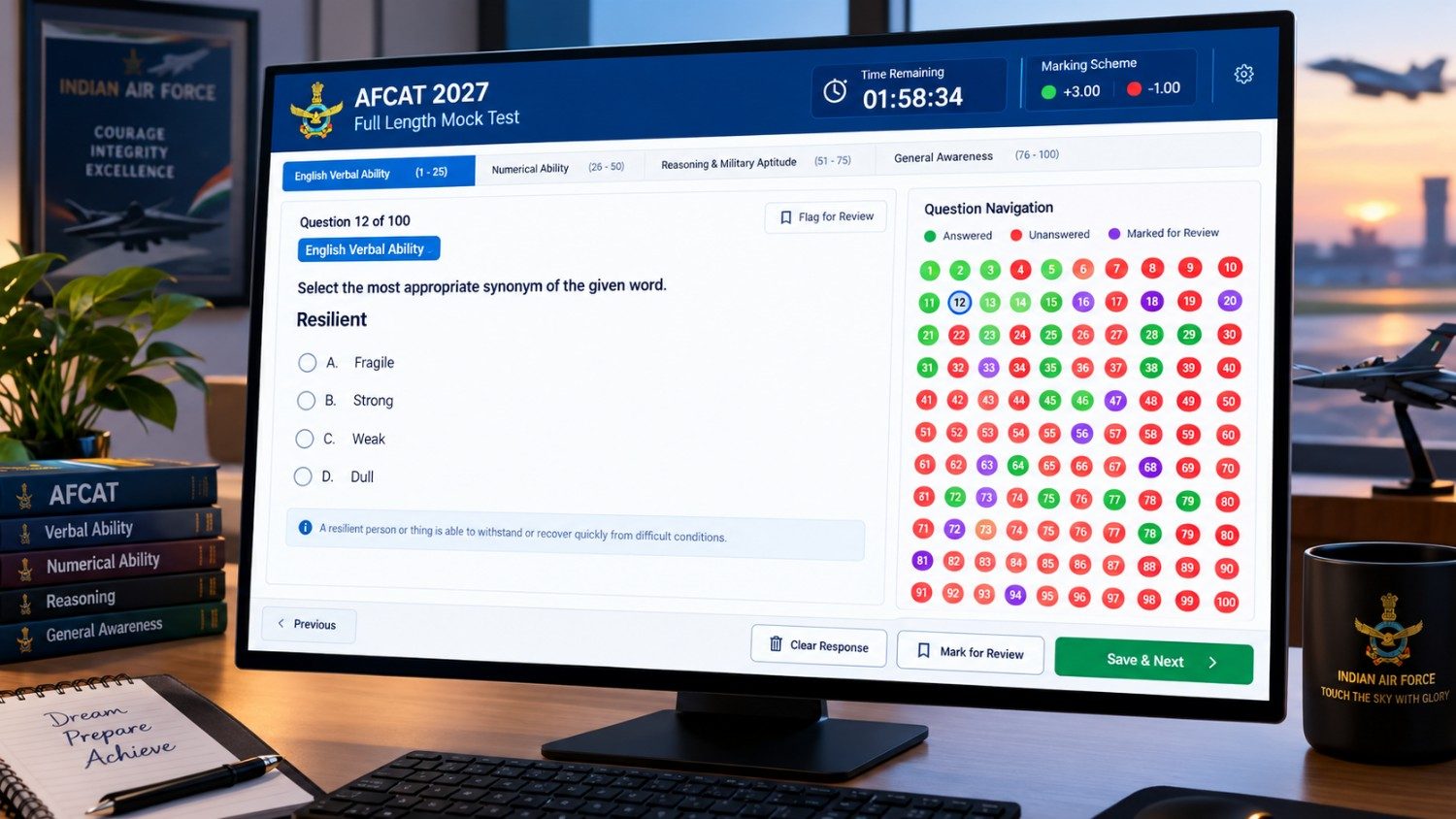
The Afcat mock test 2027 series is designed to mimic the real exam screen, the distribution of questions, and the scoring rules. With each test you can monitor your speed, avoid random guessing, and get a clear understanding of your score trends. The official detailed advertisement for the 2027 cycle has not yet been published on the IAF recruitment website as of September 10, 2026. All the practice papers, the subject distributions, and the scoring rules given here are in accordance with the most recent examination standards established by the Indian Air Force.
Start AFCAT Mock Test 2027 Online
Attempt an authentic 100-question, 300-mark mock test with real-time countdown, live All India Rank, and instant step-by-step solutions for every question.
Attempt Free AFCAT 2027 Practice Test2 Full-Length Tests Free • Sectional Topic Drills • AI Weak Area Analysis
Official Updates and Examination Status
The Indian Air Force conducts AFCAT twice every year. Keep track of official milestones below:
| Recruitment Event | Expected Schedule | Current Status | Official Source |
|---|---|---|---|
| AFCAT 1 2027 Notification | Late November / Early December 2026 | Awaited | afcat.cdac.in |
| AFCAT 1 2027 Written Exam | February 2027 | Projected Cycle | IAF Official Notices |
| AFCAT 2 2027 Notification | Late May / Early June 2027 | Upcoming | afcat.cdac.in |
| AFCAT 2 2027 Written Exam | August 2027 | Projected Cycle | IAF Official Notices |
Why Take AFCAT 2027 Mock Test?
Reading reference books does help you to understand the concepts, but it doesn't get you ready for the psychological pressure caused by a digital 120-minute countdown timer. The following explains why it is essential to solve ordinary mock tests:
- Control the -1 Negative Marking: Every wrong answer costs you 1 mark. Worse, you lose the 3 marks you could have earned. That creates a 4-mark swing against you. A realistic afcat mock test negative marking practice 2027 trains your brain to skip uncertain questions.
- Pure English Test Environment: Unlike many Indian competitive examinations, AFCAT does not offer a Hindi translation. Reading complex comprehension passages, sentence rearrangements, and error detection questions fast in English requires steady practice.
- Reasoning Speed: Spatial reasoning and dot situation figures require visual practice. Doing these on a digital screen makes your eyes and mind fast on exam day.
- Sectional Balance: Scoring 180+ marks requires points from all four sections. Taking a balanced afcat 2027 full length mock test 100 questions prevents you from over-investing time into one single favorite section.
AFCAT 2027 Exam Pattern
The written examination is conducted as an online Computer-Based Test (CBT). All questions are objective multiple-choice items:
| Test Parameter | Official Pattern Specification | Tactical Implication |
|---|---|---|
| Total Questions | 100 Multiple Choice Questions (MCQs) | Broad syllabus coverage across all four core domains |
| Total Marks | 300 Marks | Cutoff generally fluctuates between 135 and 165 marks |
| Exam Duration | 2 Hours (120 Minutes) | Average time per question: 72 seconds |
| Marking for Correct | +3 Marks | High reward for genuine accuracy |
| Marking for Incorrect | -1 Mark | High penalty; 3 wrong answers completely cancel 1 correct answer |
| Unattempted Questions | 0 Marks | Leaving difficult questions is safer than guessing blindly |
| Medium of Exam | English Only | Vocabulary and reading speed are critical across all sections |
Subject-Wise Question & Marks Weightage
The table below shows the distribution of questions and marks across subjects in recent AFCAT cycles:
| Subject Domain | Questions | Total Marks | Weightage Share | Scoring Difficulty |
|---|---|---|---|---|
| Verbal Ability in English | 30 Questions | 90 Marks | 30% | High Scoring with Strong Vocabulary |
| Reasoning & Military Aptitude | 25 Questions | 75 Marks | 25% | Very High Scoring & Visual |
| General Awareness | 25 Questions | 75 Marks | 25% | Moderate; Vast Syllabus |
| Numerical Ability (Maths) | 20 Questions | 60 Marks | 20% | Time Consuming; Requires Calculation |
Full Syllabus: AFCAT 2027
The syllabus includes assessments of general education, language comprehension, logical problem solving, and basic mathematical ability. To organize your notes, use the structured summary listed below:
| Section | Key Topics Covered | Candidate Target |
|---|---|---|
| English Language | Comprehension, Error Detection, Sentence Completion, Synonyms, Antonyms, Idioms, One Word Substitution, Spellings | Aim for 24+ correct answers out of 30 |
| General Awareness | Defence, History, Geography, Indian Polity, Current Affairs, Science, Sports awards & terminology, Environment | Aim for 16+ correct answers out of 25 |
| Reasoning & Aptitude | Analogy, Odd One Out, Venn Diagrams, Syllogisms, Dot Situation, Embedded Figures, Pattern Completion | Aim for 22+ correct answers out of 25 |
| Numerical Ability | Decimal Fractions, Time and Work, Profit and Loss, Average, Percentage, Ratio and Proportion, Simple Interest, Speed & Distance | Aim for 15+ correct answers out of 20 |
Detailed Micro-Syllabus & Topic Study Checklist
A micro-syllabus breaks high-level subject headings into specific factual units. Use this table as your daily revision checklist:
| Subject | Topic | Micro Sub-Topics to Master | Standard Question Type |
|---|---|---|---|
| Verbal Ability | Vocabulary | Contextual Synonyms, Antonyms, Commonly Confused Words | Identify word closest or opposite in meaning |
| Verbal Ability | Grammar & Usage | Subject-Verb Agreement, Preposition placement, Tenses | Spot the grammatical error in a four-part sentence |
| Verbal Ability | Idioms & Phrases | Traditional English idioms, military and leadership expressions | Choose the exact practical meaning of a highlighted idiom |
| Verbal Ability | Comprehension | Short 150-200 word factual and inferential passages | Direct fact check, author's main tone, and vocabulary in context |
| Reasoning | Non-Verbal Figures | Dot Situation, Embedded Figures, Figure Series completion | Place a dot in given figures satisfying exact overlapping regions |
| Reasoning | Verbal Logic | Word Analogy, Semantic Odd One Out, Venn Diagrams | Map sets of categories (e.g., Doctors, Pilots, Females) into circles |
| General Awareness | Defence Knowledge | IAF Commands & bases, aircraft inventory (Rafale, Su-30, Tejas), joint military exercises, ranks | Name the location of maintenance commands or missile types |
| General Awareness | Sports | Trophies, cups, player positions, Olympic facts, Grand Slam records | Identify the game associated with a cup or sports term |
| General Awareness | Static GK & Science | Constitutional articles, Indian freedom movement, basic physics laws, human disease causes | Direct matching of battles, treaties, discoverers, or scientific units |
| Numerical Ability | Commercial Math | Profit & Loss markups, Simple Interest, Percentage changes | Calculate net profit percentage or original principal sum |
| Numerical Ability | Motion & Work | Relative speed of trains, upstream/downstream boats, pipes and cisterns | Determine crossing times or hours required to fill a tank |
| Numerical Ability | Number Systems | Averages of sequences, ratio sharing, decimal fraction simplifications | Find missing terms or compute new average after item replacement |
Actual PYQ Trend Analysis
A look at previous AFCAT papers shows that there are consistent patterns in the way questions are set. Although the specific questions vary, the ratio of memory questions to those based on logical reasoning stays the same.
Indicative Data Notice: The visual breakdown below shows the question proportion across sections from verified recent papers:
Question Difficulty Spread
| Difficulty Bracket | Share of Exam | Question Characteristics | Candidate Strategy |
|---|---|---|---|
| Direct / Easy | 40 Questions | Straight vocabulary, simple analogies, direct sports terms, formula math. | Solve these first within 35 minutes to secure a safe baseline score. |
| Moderate / Analytical | 45 Questions | Multi-step arithmetic, reading passages, embedded figures, layered static GK. | Read carefully, calculate cleanly on scratch sheets, and avoid rushing. |
| Challenging / Tricky | 15 Questions | Obscure current defence treaties, tricky dot situation figures, long word problems. | Skip if you cannot eliminate at least two choices to protect your score from -1 penalties. |
What You Get in the AFCAT Mock Test Series 2027
Our practice platform offers complete exam preparation with tools built for real progress:
| Feature Component | Specification Details | Preparation Advantage |
|---|---|---|
| Full Length Mock Tests | 100 questions, 300 marks, strict 120-minute countdown. | Builds the stamina needed to stay sharp across the entire exam. |
| Sectional Topic Drills | Targeted 25-question sets for English, Math, Reasoning, and GA. | Fix specific weak areas without sitting for a full two-hour test. |
| PDF Practice Sets | Clean, printable question papers with detailed answer keys. | Practice offline when traveling or studying away from your computer. |
| Technical EKT Practice Sets | Specialized sets for Mechanical, Computer Science, and Electrical branches. | Helps technical candidates review core engineering concepts. |
| Topper Solution Comparison | Side-by-side view showing question selection by high scorers. | Shows you which difficult questions top candidates skip to save time. |
| Explanations for Every Question | Step-by-step reasoning solutions and grammar rule breakdowns. | Understand why an option is right without searching external textbooks. |
AI-Based Weak Area Recommendation
Taking practice tests and not looking over the mistakes you've made means that you'll make the same errors over and over again. The system on our platform has an AI-powered weak area recommendation engine which examines your test attempts in the way that an experienced private tutor would:
- Tracks Question Timing: Logs the exact seconds spent on each question screen.
- Detects Guessing Patterns: Identifies questions answered in under 10 seconds that resulted in -1 penalties.
- Maps Performance to Micro-Topics: Connects missed questions to specific topics, such as Numerical Ability → Speed & Distance → Train Problems.
- Builds Your Personal Heatmap: Uses green for mastered topics, yellow for inconsistent areas, and red for high-risk topics causing mark deductions.
- Delivers Focused Revision Sets: Generates targeted 15-question revision drills based directly on your red zones.
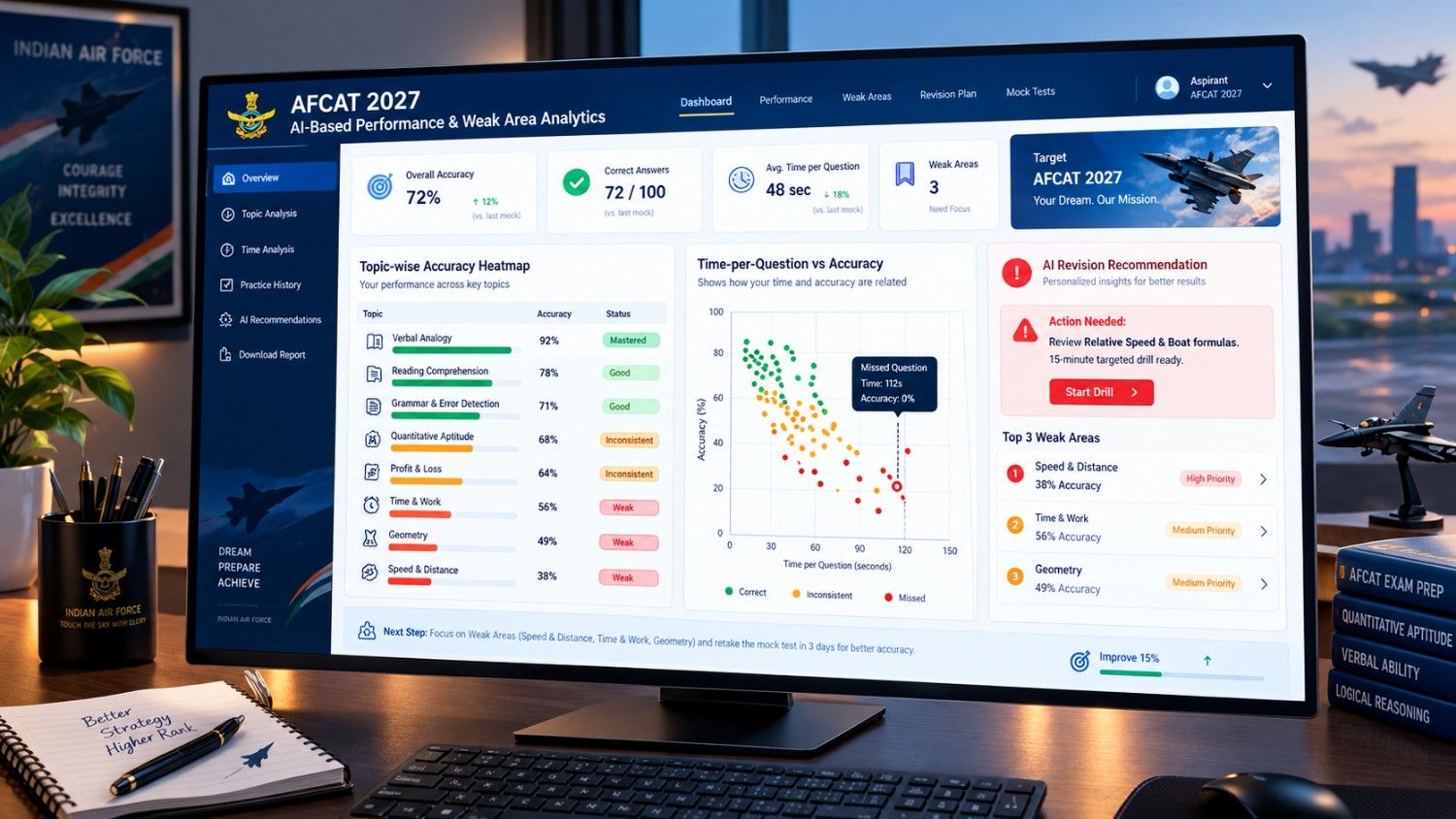
Caption: AI-based weak area dashboard displaying topic accuracy heatmaps, time-per-question analysis, and personalized revision suggestions.
All India Rank, Percentile, and Live Leaderboard
Scoring 160 marks feels different depending on whether the test was easy or difficult. Our live comparison tools provide clear context:
- All India Rank (AIR): Your exact numerical position among all candidates who attempted that specific mock test.
- Percentile Score: The percentage of test-takers who scored below you. An 88 percentile means you outperformed 88% of participants.
- Live Leaderboard: Tracks top scores, completion times, and overall cohort averages in real time.
Free Daily Current Affairs Quiz
General Awareness in the AFCAT often includes topics such as defence developments, national awards, sports events, and international summits. It does not help to go through the news in the week before the exam. Instead, it is useful to carry out daily practice in order to remember the facts easily.
Take today's 10-minute quiz on our testing portal:
Branch-Wise Cutoff Trends (Last 5-10 Years)
The written cutoff for AFCAT is the same in all branches for the written exam phase. The table which follows gives the official written cutoffs from recent testing cycles:
| Exam Cycle | Official Written Cutoff (Out of 300) | Recommended Safe Mock Target | Overall Competition Index |
|---|---|---|---|
| AFCAT 1 2024 | 137 Marks | 175+ Marks | High |
| AFCAT 2 2023 | 151 Marks | 180+ Marks | Very High |
| AFCAT 1 2023 | 155 Marks | 185+ Marks | Very High |
| AFCAT 2 2022 | 157 Marks | 185+ Marks | High |
| AFCAT 1 2022 | 157 Marks | 185+ Marks | High |
| AFCAT 2 2021 | 157 Marks | 180+ Marks | Moderate to High |
| AFCAT 1 2021 | 165 Marks | 190+ Marks | Peak Difficulty |
| AFCAT 2 2020 | 155 Marks | 180+ Marks | Moderate |
| AFCAT 1 2020 | 153 Marks | 180+ Marks | Moderate |
Free vs. Paid Mock Test: What You Get
Foundational test practice should be accessible to all candidates. Here is how our free tier compares with the full test package:
| Feature Offering | Free Tier Access | Full Pro Test Series |
|---|---|---|
| Full Length Mock Tests | 2 Full Length Tests Free | 20 Full Length Simulation Tests |
| Sectional Topic Drills | 4 Practice Quizzes (1 per subject) | 40+ In-Depth Topic Tests |
| Instant Detailed Solutions | Included for All Tests | Included for All Tests |
| PDF Downloads with Answers | Sample Paper PDF Included | All 20 Mocks Downloadable as PDFs |
| AI Weak Area Heatmap | Basic Summary Overview | Full Topic Heatmap & Custom Drills |
| All India Ranking & Percentile | Basic Rank Among Participants | Comprehensive Leaderboard & Category Breakdown |
| Topper Attempt Comparison | Not Included | Detailed Question-by-Question Comparison |
Eligibility Criteria: Age Limit & Education
Confirm your eligibility details before filling out your application form:
| Branch Category | Age Limits (As of Cycle Date) | Educational Qualifications |
|---|---|---|
| Flying Branch | 20 to 24 Years (Up to 26 for Commercial Pilot License holders) | Minimum 50% marks each in Maths & Physics at 10+2 level AND Graduation with minimum 60% marks (or BE/B.Tech with min 60%). |
| Ground Duty (Technical) - Aeronautical Eng | 20 to 26 Years | Minimum 50% marks each in Physics & Maths at 10+2 level AND 4-year degree in Engineering/Technology with minimum 60% marks. |
| Ground Duty (Non-Technical) - Admin & Logistics | 20 to 26 Years | 10+2 AND Graduate Degree (minimum three years) in any discipline with minimum 60% marks or equivalent. |
| Ground Duty (Non-Technical) - Accounts | 20 to 26 Years | 10+2 AND B.Com / BBA (Finance) / Qualified CA or CMA with minimum 60% marks or equivalent. |
| Ground Duty (Non-Technical) - Weapon Systems | 20 to 26 Years | Minimum 50% marks each in Maths & Physics at 10+2 AND Graduation in any discipline with minimum 60% marks. |
AFCAT 2027 Important Dates
The schedule below outlines expected dates based on standard annual recruitment cycles:
| Cycle Stage | AFCAT 1 2027 (Expected) | AFCAT 2 2027 (Expected) | Official Action |
|---|---|---|---|
| Notification Release | December 2026 | June 2027 | Download detailed PDF from afcat.cdac.in |
| Online Registration Closes | Late December 2026 | Late June 2027 | Complete online form and pay fee |
| Admit Card Release | Late January / Early February 2027 | Early August 2027 | Verify allocated exam center city |
| Online CBT Exam Date | Mid to Late February 2027 | Late August 2027 | Report to center with original ID & admit card |
| Result & AFSB Slot Booking | March 2027 | September 2027 | Log in promptly to select your preferred AFSB center |
Preparation Strategy: Written Exam, AFSB Interview & Medical Fitness
Leaving yourself to preparation for just the written exam leaves you at risk when you take the Air Force Selection Board (AFSB) interview. Start from day one by combining preparation for the written exam with getting ready for the interview and maintaining physical fitness.
| Time of Day | Focus Domain | Actionable Preparation Goals |
|---|---|---|
| Morning (06:00 AM - 07:30 AM) | Physical Fitness & Stamina | Run 2.4 km in under 12 minutes, practice push-ups, sit-ups, and chin-ups. AFSB outdoor obstacles require solid upper body and core strength. |
| Morning (09:00 AM - 12:00 PM) | Academic Written Exam Study | Study English vocabulary, grammar rules, and complete 25 quantitative arithmetic questions. |
| Afternoon (02:00 PM - 04:00 PM) | Reasoning & General Awareness | Solve 30 non-verbal pattern questions and take the daily current affairs quiz. |
| Evening (05:30 PM - 07:00 PM) | AFSB Soft Skills & OIR Practice | Read national editorials aloud to build fluent English expression. Practice Picture Perception & Discussion Test (PPDT) story writing. |
| Night (08:30 PM - 10:30 PM) | Mock Test & Error Analysis | Attempt a timed sectional test or full-length paper. Review every incorrect answer in your error logbook. |
15 Common Mistakes Aspirants Make in AFCAT
- Excessive Guesswork: Guessing on 15 uncertain questions often results in -15 marks, pulling your score below the cut-off line.
- Ignoring English Vocabulary: Neglecting synonyms, antonyms, and idioms costs you easy marks in the largest section (30 questions).
- Over-Investing in Tricky Math: Spending 4 minutes on a single arithmetic problem leaves too little time for straightforward reasoning questions.
- Starting Physical Training Too Late: Beginning running workouts only after clearing the written exam makes passing AFSB physical tasks much harder.
- Skipping Test Analysis: Taking practice tests without reviewing missed questions repeats the same mistakes on exam day.
- Neglecting Defence Static Facts: Skipping basic questions on aircraft names, missile systems, and IAF command locations.
- Rushing Through Questions: Missing negative keywords like "NOT", "EXCEPT", or "OPPOSITE" in question stems.
- Ignoring Dot Situation Concepts: Losing marks on simple non-verbal reasoning problems by not learning basic overlapping rule principles.
- Lacking Time Allocation Discipline: Failing to plan how many minutes to spend on each section during the 120-minute exam.
- Delaying Current Affairs Revision: Attempting to read 12 months of news summaries in the final 48 hours before the exam.
- Not Practicing in Pure English: Using bilingual practice materials when the official AFCAT interface is entirely in English.
- Disregarding Eye and Medical Standards: Not checking eyesight, height, and spinal criteria for specific branches early in your preparation.
- Focusing Only on Favorite Topics: Spending all your study time on history while completely avoiding arithmetic.
- Taking Tests Passively: Solving practice sets while looking at the answer keys instead of working under timed test conditions.
- Allowing Early Plateau Frustration: Giving up when scores stall between 130 and 140 marks instead of using topic heatmaps to fix clear weaknesses.
Recommended Preparation Books
| Subject Domain | Recommended Book Title | Primary Study Focus |
|---|---|---|
| Verbal Ability in English | Word Power Made Easy (Norman Lewis) & Objective General English (SP Bakshi) | Root words, contextual vocabulary, prepositions, idioms, and sentence correction rules. |
| Reasoning & Military Aptitude | A Modern Approach to Verbal & Non-Verbal Reasoning (R.S. Aggarwal) | Dot situations, figure series, embedded figures, analogies, and Venn diagrams. |
| Numerical Ability | Quantitative Aptitude for Competitive Examinations (R.S. Aggarwal) | Percentage formulas, profit and loss, averages, time and distance, and ratio proportions. |
| General Awareness | Lucent's General Knowledge & Manorama Yearbook (for Defence & Sports) | Indian history, geography, basic physical sciences, sports cups, and national awards. |
How to Analyze a Mock Test: Error Classification Framework
Reviewing your completed test is where real improvement happens. Classify every wrong answer using this framework:
| Error Category | Underlying Reason | Action to Fix It |
|---|---|---|
| Concept Gap | You did not understand the underlying grammar rule or math formula. | Return to your reference textbook, write down the formula, and solve 10 practice problems on it. |
| Calculation Slip | You used the right method but made a basic arithmetic mistake under time pressure. | Do your calculations clearly on scratch paper instead of trying to compute large numbers in your head. |
| Misread Question | You missed key words like "NOT" or chose a synonym instead of an antonym. | Slow down your reading of the question stem. Never select an option until you finish reading the question. |
| Unforced Guess | You had no clear idea but marked an option anyway. | Practice discipline. If you cannot eliminate at least two options, leave the question unattempted. |
30-Day AFCAT Mock Test Schedule
Use this 30-day schedule to balance syllabus review, practice sets, and full test simulations:
| Day Bracket | Core Study Focus | Practice Component | Review Objective |
|---|---|---|---|
| Days 1 to 6 | English Grammar rules, Synonyms root words, Number systems math | Solve 30 topic questions daily | Log initial errors in a dedicated notebook |
| Days 7 to 12 | Non-verbal dot situations, Analogy, Speed & Distance arithmetic | Take 2 Sectional Tests | Fix formulas for train and boat problems |
| Days 13 to 18 | Static GK (Defence, Sports, Geography) + Time & Work | Attempt Full Mock Test 1 | Complete 2-hour full review and generate your heatmap |
| Days 19 to 24 | Reading Comprehension, Venn diagrams, Profit & Loss | Attempt Full Mock Test 2 | Compare question selection against the topper attempt sheet |
| Days 25 to 28 | Current affairs, military exercises, and grammar flashcards | Take 2 Sectional Drills on your red zones | Re-test topics where your accuracy was under 60% |
| Days 29 to 30 | Formulas, idioms, and error log review | Light 15-minute quick quizzes | Rest your mind and organize exam day documents |
How to Apply: AFCAT 2027 Application Process
When the application window opens on the IAF web portal, follow these steps to register:
- Visit the official CDAC AFCAT website at
afcat.cdac.in. - Click on the registration link for the current cycle (AFCAT 01/2027 or AFCAT 02/2027).
- Register using a valid personal email address and active mobile number.
- Fill in personal details, educational qualifications, and 10+2 physics and mathematics marks accurately.
- Select your branch preferences in order of choice (Flying, Ground Duty Technical, Ground Duty Non-Technical).
- Upload your passport photograph, signature, and left thumb impression according to the specified pixel dimensions.
- Select five preferred examination cities.
- Pay the non-refundable examination fee through the online payment gateway.
- Download and save two printed copies of the completed application form for your records.
Your Next Step
A strong exam score is built through small daily actions. Here is your plan for today:
- Review the micro-syllabus table and choose two topics you find challenging.
- Take your first free full-length test in our practice engine.
- Review your scorecard, check which questions were flagged in red, and read their step-by-step explanations.
- Spend 20 minutes reviewing the root words for the vocabulary questions you missed.
- Take today's free current affairs quiz to keep your defence knowledge up to date.