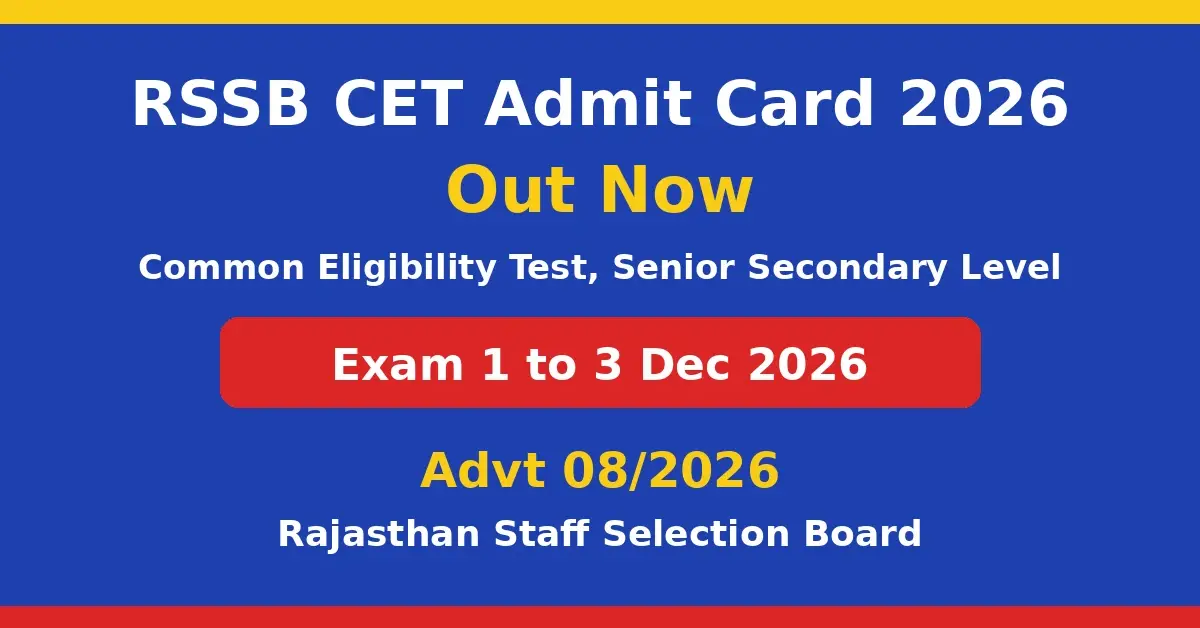
RSSB CET Admit Card 2026 Out, Exam on 1 to 3 December 2026
RSSB CET Admit Card 2026 is out now, and candidates of the Common Eligibility Test at Senior Secondary Level can download the provisional e-admit card from 26 November 2026 through their own SSO ID on the official Rajasthan recruitment portal. The Rajasthan Staff Selection Board will hold the exam on 1, 2 and 3 December 2026, with two shifts on each date.
Download the admit card today itself. The Board will not send admit cards separately to any candidate, so every candidate must take the provisional e-admit card through the official portal route and keep a print copy ready for the exam day. This page gives the download steps, the reporting rule, the gate closing rule and the OMR bubble rule in simple words.
Listen to this article in 1 minute:
What is the RSSB CET Admit Card 2026 for?
The admit card belongs to the Common Eligibility Test at Senior Secondary Level for the year 2026, and the Rajasthan Staff Selection Board, also called RSSB in short, conducts this test as a common first stage for many Rajasthan government posts. A candidate who qualifies in this test can move ahead for the posts linked with this test, as per the rules of each department.
The advertisement number of this test is 08/2026. The Board listed the advertisement on 23 June 2026, and online applications ran from 24 June 2026 to 23 July 2026 with the last time fixed at 23:59 on 23 July 2026. That application window closed long back, so candidates who applied in that window should now give full attention to the admit card and the exam day rules.
One question paper will come in the exam. The paper will carry questions with five bubbles for each question on the OMR sheet, and the bubbles are A, B, C, D and E, where the E bubble marks a question that the candidate chooses to skip. This E bubble rule is the most important new point of this exam, because many candidates lose marks only because they leave a full row blank.
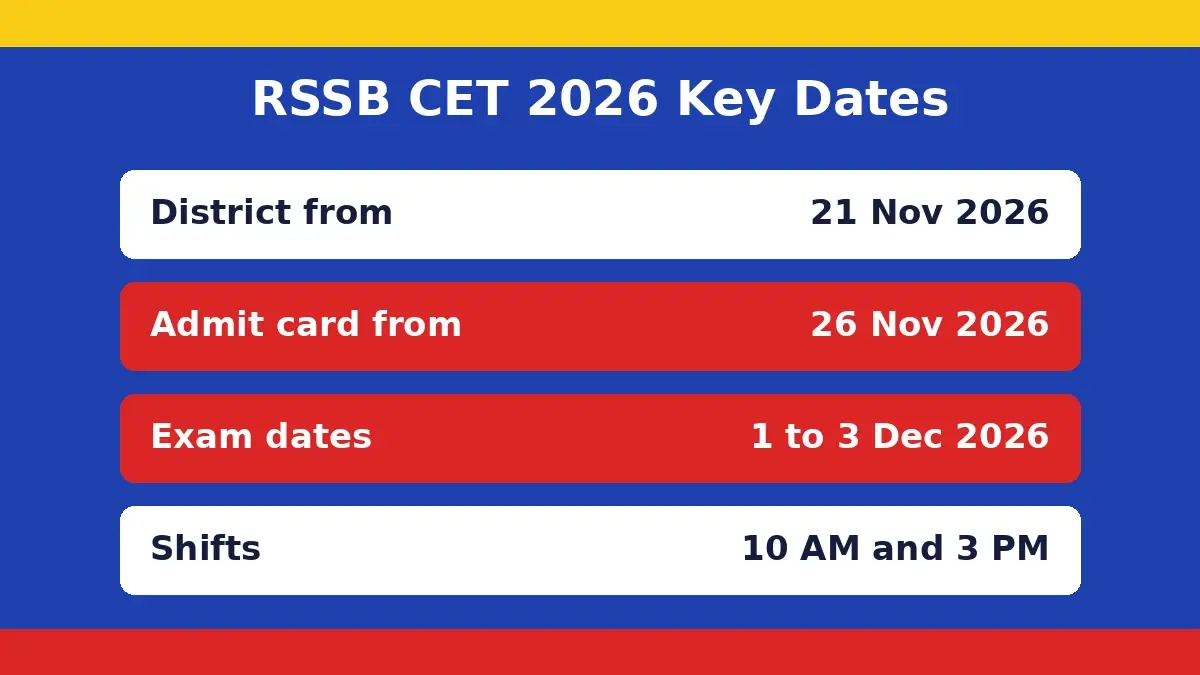
The exam district detail came first, and candidates could see the exam district from 21 November 2026 through their own SSO ID. The provisional e-admit card opened after that, from 26 November 2026. So the order is simple. First check the district, then download the admit card, and then plan your travel and reach the centre on time.
| Point | Details |
|---|---|
| Exam name | Common Eligibility Test (Senior Secondary Level) 2026 |
| Conducting body | Rajasthan Staff Selection Board (RSSB) |
| Advertisement number | 08/2026 |
| Admit card status | Provisional e-admit card available from 26 November 2026 |
| Exam dates | 1, 2 and 3 December 2026 |
| Shifts each day | Morning 10:00 AM to 12:30 PM and afternoon 3:00 PM to 5:30 PM |
| Question paper | One question paper with OMR answering |
What are the key dates for the Rajasthan CET admit card?
Keep these dates in mind. The advertisement came on 23 June 2026, applications ran from 24 June 2026 to 23 July 2026, the exam district link opened on 21 November 2026 and the provisional e-admit card opened on 26 November 2026. Today is 26 November 2026, so only a few days remain before the first exam date.
The June advertisement first gave an exam period of 23 to 25 October 2026. The November notices give the exam dates as 1 to 3 December 2026, and the November notices also point to an exam programme press release with RajKaj reference 24735427 dated 28 September 2026. Candidates should follow the December dates now, because the October period is old information and travel plans must rest on the new dates only.
Two official notices cover the admit card stage. The Board signed one notice on 16 November 2026 with RajKaj reference 25429714, and the Board signed the second notice on 19 November 2026 with RajKaj reference 25500121. Both notices belong to this same Senior Secondary Level test, and candidates can read both notices on the Board website through the official links given in the Sources section at the end of this page.
| Event | Date |
|---|---|
| Advertisement listed | 23 June 2026 |
| Online applications | 24 June 2026 to 23 July 2026, up to 23:59 |
| Exam district visible through SSO ID | From 21 November 2026 |
| Provisional e-admit card through SSO ID | From 26 November 2026 |
| Exam dates | 1, 2 and 3 December 2026 |
| Notice | Sign date and reference |
|---|---|
| First November notice | Signed 16 November 2026, RajKaj Ref No. 25429714 |
| Second November notice | Signed 19 November 2026, RajKaj Ref No. 25500121 |
| Exam programme press release | RajKaj 24735427 dated 28 September 2026 |
How can you download the RSSB CET Admit Card 2026?
The download route is fully online. Open the official admit card route of the Rajasthan recruitment portal, press the Get Admit Card button there, and then choose the Get Admit Card option for this recruitment. The portal shows the row with the text COMMON ELIGIBILITY TEST (SENIOR SECONDARY LEVEL) 2026 (RSSB), and that row carries its own Get Admit Card button, which you should press to move ahead.
The next screen asks for your Application Number and your Date of Birth. Type both details with full care, because one wrong digit can stop the download at the first step itself. The admit card form shows four fields, namely Admit Card For, Application No., Date Of Birth and CAPTCHA, and you should fill the CAPTCHA as shown on the screen and then submit the form. Your provisional e-admit card will open on the screen after that.
Print the admit card on clean paper. Keep one extra copy with you as well, because a phone copy alone will not help at the gate. The Board will not send admit cards separately by post or by any other route, so the print copy works as your entry pass together with your photo ID. Check your name and your exam detail on the print copy once before you leave home.
Candidates reach the admit card through their own SSO ID as per the Board notice. Keep your SSO ID detail ready before you start, keep your application number ready too, and keep your date of birth in the same form as your application. Small care at this stage saves big trouble on the exam day. If the page loads slowly, wait for some time and try again on the same official route.
| Step | What to do |
|---|---|
| Step 1 | Open the official admit card route on the Rajasthan recruitment portal |
| Step 2 | Press Get Admit Card on the portal page |
| Step 3 | Choose Get Admit Card for this recruitment |
| Step 4 | Find the row COMMON ELIGIBILITY TEST (SENIOR SECONDARY LEVEL) 2026 (RSSB) and press its Get Admit Card button |
| Step 5 | Enter Application Number and Date of Birth |
| Step 6 | Fill the CAPTCHA and submit the form |
| Step 7 | Download the provisional e-admit card and take a print copy |
| Form field | What to enter |
|---|---|
| Admit Card For | The recruitment name for this test |
| Application No. | Your application number from the application stage |
| Date Of Birth | Your date of birth as per your application |
| CAPTCHA | The code shown on the screen |
How can you check your exam district?
The exam district detail opened before the admit card. Candidates can see the exam district from 21 November 2026 through their own SSO ID, and the portal entry for this detail carries the text Click here to know your Exam District location COMMON ELIGIBILITY TEST (SENIOR SECONDARY LEVEL) 2026. The district form opens on the official recruitment portal, so check your district today if you have not checked it yet.
The district detail helps you plan travel early. You can book your bus or train in time, and you can also plan where you will stay one night before the exam. Read our Rajasthan CET exam city post for the district detail in full. That post covers the district link stage of this same test, and the admit card stage has now started after the district stage.
Keep the two stages apart in your mind. The district detail tells you the district of your exam, and the admit card tells you your personal exam detail, so you need both pieces of information before you travel. First confirm the district, then download the admit card, and then match both details with your travel plan. This simple order keeps the last days calm and clear.
| Detail | District stage | Admit card stage |
|---|---|---|
| Start date | 21 November 2026 | 26 November 2026 |
| Route | Own SSO ID on the recruitment portal | Own SSO ID on the recruitment portal |
| What you get | Exam district location | Provisional e-admit card |
| Portal text | Click here to know your Exam District location | COMMON ELIGIBILITY TEST (SENIOR SECONDARY LEVEL) 2026 (RSSB) |
What are the exam dates and shift timings?
The exam will run for three days. The dates are 1 December 2026, 2 December 2026 and 3 December 2026, and each date carries two shifts, with the morning shift from 10:00 AM to 12:30 PM and the afternoon shift from 3:00 PM to 5:30 PM. So the exam has six shift slots in total across the three days. Your own date and your own shift will come with your exam detail, and you should follow your own slot only.
One question paper will come for the exam, and the paper uses OMR answering, where candidates mark answers on the OMR sheet with bubbles. The Board will upload the question papers of all shifts on the Board website within 24 hours after the last exam. That upload will help candidates check the paper after the exam ends. Note your question paper series on the exam day, because the series detail will help you match your paper later.
Plan your day around your shift time. Morning shift candidates should wake up early and leave home with a big time margin, and afternoon shift candidates should also leave early, because traffic and crowds can delay any travel plan. A calm reach at the centre helps you read the paper with a clear mind. A late reach can end your exam before it starts.
| Exam date | Morning shift | Afternoon shift |
|---|---|---|
| 1 December 2026 | 10:00 AM to 12:30 PM | 3:00 PM to 5:30 PM |
| 2 December 2026 | 10:00 AM to 12:30 PM | 3:00 PM to 5:30 PM |
| 3 December 2026 | 10:00 AM to 12:30 PM | 3:00 PM to 5:30 PM |
When should you report at the exam centre?
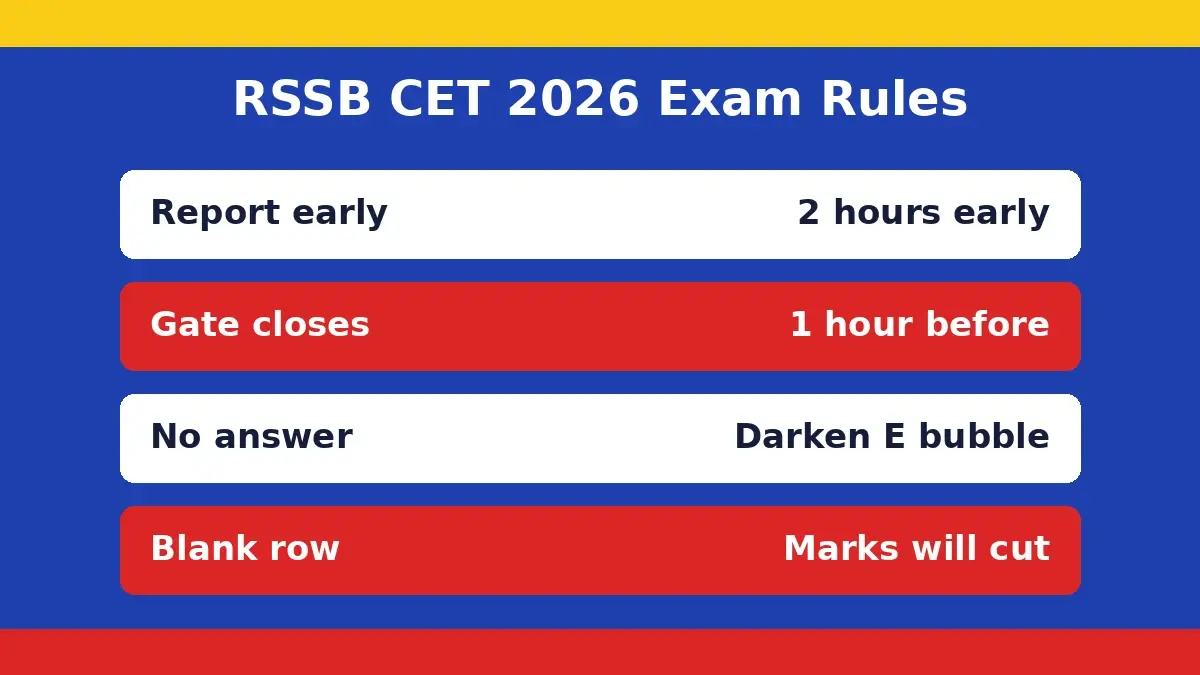
This rule is strict. Report at the centre 2 hours before your exam time, because entry will run only up to 1 hour before the exam start and the gate will close exactly 1 hour before the exam start. No entry will open after that time in any circumstance. Read that line again, and reach the centre well before the gate closing time.
Morning shift candidates have a 10:00 AM exam start. They should report by 8:00 AM, and the gate for the morning shift will close at 9:00 AM. Afternoon shift candidates have a 3:00 PM exam start, so they should report by 1:00 PM, and the gate for the afternoon shift will close at 2:00 PM. These times come from the 2 hour reporting rule and the 1 hour gate rule of the Board notice.
Keep a big safety margin in your travel plan. Reach the centre area early, and keep your admit card and photo ID in your hand before you reach the gate, because staff will check your documents at entry. A ready candidate passes the gate check fast. A late candidate gets no entry at all, and the rule leaves no space for excuses.
| Shift | Exam start | Report by | Gate closes |
|---|---|---|---|
| Morning | 10:00 AM | 8:00 AM | 9:00 AM |
| Afternoon | 3:00 PM | 1:00 PM | 2:00 PM |
| Rule | What it means |
|---|---|
| Report 2 hours before exam time | Reach the centre 2 hours before your shift start |
| Entry only up to 1 hour before start | Entry stops 1 hour before the exam start |
| Gate closes exactly 1 hour before | The gate shuts at that fixed time |
| No entry after gate closing | No entry in any circumstance after that time |
What should you carry to the exam centre?
Carry four things with full care. First, carry your provisional e-admit card print copy, and second, carry one original photo ID. Third, carry one recent colour photo of size 2.5 cm by 2.5 cm, and fourth, carry a blue transparent ball pen, because you will darken the OMR bubbles with a blue ballpoint pen. Keep one spare blue pen with you as well.
The photo ID rule is clear. Carry your Aadhaar card with your date of birth on it, and in special circumstances the notice allows a PAN card, a passport, a driving licence or a voter ID. Carry the original ID only, because a photo copy will not serve as your ID proof at the gate. Keep the ID and the admit card together in one folder, since this small habit saves time at the entry check.
The photo size rule is also fixed. The photo must be a recent colour photo, and the size is 2.5 cm by 2.5 cm. Get the photo ready today itself. Shops stay crowded in the last days, and a ready photo keeps your exam morning free of stress, so do not leave the photo work for the exam morning.
| Item | Rule |
|---|---|
| Provisional e-admit card | Print copy of the downloaded admit card |
| Original photo ID | Aadhaar with date of birth |
| Other ID in special circumstances | PAN card, passport, driving licence or voter ID |
| Recent colour photo | Size 2.5 cm by 2.5 cm |
| Pen | Blue transparent ball pen |
| Photo ID | When it works |
|---|---|
| Aadhaar card | Main ID choice, with date of birth on the card |
| PAN card | Only in special circumstances |
| Passport | Only in special circumstances |
| Driving licence | Only in special circumstances |
| Voter ID | Only in special circumstances |
How does the OMR bubble rule work?
Read this section with full attention. This rule can save your result, because each question on the OMR sheet carries five bubbles, namely A, B, C, D and E, and the E bubble means an unattempted question. So E is not a fifth answer choice. E is the mark for a question you choose to skip, and this point confuses many candidates, so clear this point in your mind before the exam day.
Darken only one bubble from A to D when you answer a question. Use a blue ballpoint pen for the darkening, and darken the E bubble when you do not want to answer that question. So every question row needs one dark bubble, either one answer bubble from A to D or the E bubble for a skip. No row should stay fully blank, because a fully blank row brings a marks cut.
Here is the penalty rule. If you darken none of the five bubbles for a question, one third of the marks of that question will get cut, and the cut applies to that question. So a blank row costs you marks, while a skipped question with a dark E bubble follows the skip route. This is why the E bubble exists. Use it for every question you skip.
The second penalty is even more serious. If you leave the bubble row blank in more than 10 percent of the questions, the Board will declare you ineligible. Read that line once more, because more than 10 percent blank rows can end your candidature. So the safe habit is simple. Touch every row, mark A, B, C or D for an answer, and mark E for a skip.
Keep your hand steady on the OMR sheet. Darken the bubble fully and cleanly, because a half dark bubble can create doubt in reading. Take a few seconds for each row. Speed matters, but a clean bubble matters more, and in the last minutes of the paper you should scan your sheet once and darken E on any fully blank row at once. This last scan can save your result.
| Bubble | Meaning |
|---|---|
| A | Answer choice one |
| B | Answer choice two |
| C | Answer choice three |
| D | Answer choice four |
| E | Unattempted question, mark this bubble when you skip the question |
| Situation | Result |
|---|---|
| One bubble from A to D darkened | Your answer counts for that question |
| E bubble darkened | The question counts as unattempted by your choice |
| No bubble darkened in a row | One third of the marks of that question will get cut |
| No bubble darkened in more than 10 percent of questions | Candidate will be declared ineligible |
What happens to the question paper and OMR sheet after the exam?
The question paper booklet will stay at the centre. You cannot take the booklet away with you, so read your paper with full care inside the hall and note your question paper series during the exam. The Board will upload the question papers of all shifts on the Board website within 24 hours after the last exam. You can match your series paper after that upload.
The OMR sheet carries a carbon copy. You may take the carbon copy with you, and you should keep that carbon copy safe till the final result. Do not throw it away after the exam, because the copy holds your marked answers and it can help you check your answers when the Board uploads the papers. Keep the copy in a safe file at home, and treat it like an important document.
Write your series detail at a safe place after the exam. You can note it on your admit card copy after you leave the hall, and this small note will help you find your exact paper later. Candidates who skip this note often struggle to match the right paper. A two second note saves that trouble, so do it without fail.
| Item | Rule after the exam |
|---|---|
| Question paper booklet | Cannot be taken away from the centre |
| OMR carbon copy | May be taken, keep safe till the final result |
| Question paper series | Note the series during the exam |
| All shift papers on Board website | Within 24 hours after the last exam |
Which posts does this CET cover?
This test covers 14 post rows in the advertisement. The posts span many Rajasthan services, with Forest Guard under the Rajasthan Forest Subordinate Service and Hostel Superintendent under the Rajasthan Minority Affairs Subordinate Service. Jamadar Grade-II comes under the Rajasthan Excise Subordinate Service, Preventive Branch, and Constable comes under the Rajasthan Police Subordinate Service. These four rows open the list.
Clerk and Junior Assistant rows form the big part of the list. Clerk Grade-II rows cover the Rajasthan Public Service Commission Office Clerical Service and the Rajasthan Secretariat Clerical Service, while Junior Assistant rows cover the Rajasthan Subordinate Offices Clerical Service and the Rajasthan Staff Selection Board Clerical Service. Junior Assistant also covers Rajasthan Panchayati Raj. More Junior Assistant rows cover the Rajasthan State Agricultural Marketing Board Service and the Rajasthan Agricultural Produce Market Mandi Committee Employees Service.
The last rows complete the list. Clerk Grade-II covers the Board of Secondary Education Rajasthan Employees Amended Service Regulations, and Junior Assistant covers the Rajasthan State Pollution Control Board Employees Service Rules and Regulations. Junior Assistant also covers the Jaipur Development Authority Subordinate Service. So the list holds 14 rows in total, and each row follows the service rules of its own department for the later stages.
This test is the Senior Secondary Level test. A separate Graduate Level test also exists for degree posts, and candidates of the Graduate Level test should read the RSSB CET Graduate Level Syllabus page for that separate test. Keep the two tests apart in your mind. This page covers the Senior Secondary Level test only, so check your level once before you download the admit card.
| Post | Service |
|---|---|
| Forest Guard | Rajasthan Forest Subordinate Service |
| Hostel Superintendent | Rajasthan Minority Affairs Subordinate Service |
| Jamadar Grade-II | Rajasthan Excise Subordinate Service, Preventive Branch |
| Constable | Rajasthan Police Subordinate Service |
| Clerk Grade-II | Rajasthan Public Service Commission Office Clerical Service |
| Clerk Grade-II | Rajasthan Secretariat Clerical Service |
| Junior Assistant | Rajasthan Subordinate Offices Clerical Service |
| Junior Assistant | Rajasthan Staff Selection Board Clerical Service |
| Junior Assistant | Rajasthan Panchayati Raj |
| Junior Assistant | Rajasthan State Agricultural Marketing Board Service |
| Junior Assistant | Rajasthan Agricultural Produce Market Mandi Committee Employees Service |
| Clerk Grade-II | Board of Secondary Education Rajasthan Employees Amended Service Regulations |
| Junior Assistant | Rajasthan State Pollution Control Board Employees Service Rules and Regulations |
| Junior Assistant | Jaipur Development Authority Subordinate Service |
Who could apply for this test?
The basic education rule is simple. A candidate needs Senior Secondary or an equal qualification, and final year Senior Secondary candidates could also apply, with the condition that such candidates must gain the qualification as per the rules of the concerned department. So a final year candidate should watch the department rule with care. The qualification must come in time as per that rule.
Post wise rules vary by service. Qualification, age and experience for each post follow the concerned service rules, so one common test opens the door, but each service keeps its own rule book. Candidates should read the rule of their target post with care. The advertisement gives this direction in clear words, and no candidate should assume one rule for all posts.
The age rule uses a fixed date. Age counts as on 1 January 2027, with the minimum age at 18 years and the upper line at not having attained 40 years on that date, and relaxations apply as per rules. So the age window runs from 18 years up to below 40 years on 1 January 2027, with rule based relaxations. This age detail belongs to the application stage, and the admit card stage now needs your exam focus.
| Eligibility point | Rule |
|---|---|
| Education | Senior Secondary or equivalent |
| Final year candidates | Could apply, must acquire the qualification as required by concerned departmental rules |
| Post wise rules | Qualification, age and experience follow concerned service rules |
| Age date | Age as on 1 January 2027 |
| Minimum age | 18 years |
| Maximum age | Not having attained 40 years, relaxations as per rules |
What marks do you need to qualify in the CET?
The qualifying rule is fixed. A candidate needs a minimum of 40 percent marks to qualify in the CET, and SC and ST candidates get a 5 percent relaxation in the minimum marks, so the minimum line drops by 5 percent for SC and ST candidates. Every candidate should keep this line in mind while solving the paper. A safe attempt plan keeps the qualifying line in view.
The CET score stays valid for 3 years from the result date. So a qualifying score can serve the candidate for 3 years, and this long validity gives the test big value, because one good attempt can support post stages across the validity period, as per the rules. So treat this exam with full seriousness. A careless attempt wastes a long validity window.
The blank row penalty connects with this qualifying line. A blank row cuts one third of the marks of that question, and many blank rows can pull your score below the qualifying line. Worse, blank rows in more than 10 percent of questions bring ineligibility. So the E bubble habit protects both your marks and your candidature, and you should mark E for every skip. This one habit guards your qualifying chance.
| Qualifying point | Rule |
|---|---|
| Minimum qualifying marks | 40 percent marks |
| SC and ST relaxation | 5 percent relaxation in minimum marks |
| Score validity | 3 years from the result date |
What should you do in the last days before the exam?
Use the last days in a simple order. Download the admit card today, and check your district on the Rajasthan CET exam city page route if you still need the district detail. Print two copies of the admit card, keep your original photo ID ready, and get your recent colour photo of size 2.5 cm by 2.5 cm ready. Keep blue transparent ball pens ready, and finish all document work today itself.
Plan your travel next. Fix your bus or train plan now, and decide your stay plan for the night before the exam, with a big time margin in the plan. Your report time is 2 hours before the exam start, and your gate closing time is 1 hour before the exam start. Plan your reach well before the gate closing time. A calm plan beats a rushed plan every time.
Revise the OMR rule once each day. Say the rule in your mind, with one bubble from A to D for an answer and the E bubble for a skip, and no fully blank row at any cost. This daily recall builds a strong habit. On the exam day, the habit will run on its own, and habits save marks when the mind feels pressure.
Keep checking the official Board website in the last days. The Board puts official information on its own website, so read only official notices for any change. Loose talk about date changes or rule changes can mislead you. The December dates and the rules on this page come from the official notices, so follow official words only till the exam ends.
| Task | When to finish it |
|---|---|
| Download and print the admit card | Today, 26 November 2026 |
| Check exam district | Today, if still pending |
| Photo ID and photo ready | Today |
| Travel and stay plan | Before the exam date |
| Reach the centre | 2 hours before exam start |
What mistakes should you avoid on the exam day?
The first mistake is a late reach. The gate closes exactly 1 hour before the exam start, and no entry opens after that time in any circumstance, so a candidate who reaches late loses the full exam. Leave home early. Keep extra time for traffic, and reach the centre area before your report time. This one habit protects your full attempt.
The second mistake is a blank OMR row. A blank row cuts one third of the marks of that question, and blank rows in more than 10 percent of questions bring ineligibility. So never leave a row fully blank. Mark E when you skip a question, scan your sheet in the last minutes, and fix any blank row with an E mark at once.
The third mistake is a missing document. A candidate without the admit card print copy faces trouble at the gate, and a candidate without an original photo ID faces the same trouble. Keep the admit card, the original ID and the photo in one folder. Check the folder before you leave home, and check it once more before you leave your stay place.
The fourth mistake is a wrong pen habit. Darken bubbles with a blue ballpoint pen only, and carry a blue transparent ball pen as the notice directs. Keep one spare pen with you. A pen failure in the hall can waste your time, and a spare pen removes that risk at once. Small care like this keeps the exam smooth.
The fifth mistake is forgetting the paper series. Note your question paper series during the exam, because the Board will upload all shift papers within 24 hours after the last exam and your series note will help you find your exact paper. Keep your OMR carbon copy safe till the final result. These two small steps help you after the exam ends.
| Mistake | Safe habit |
|---|---|
| Late reach at the centre | Report 2 hours before exam start |
| Fully blank OMR row | Darken E for every skipped question |
| Missing admit card or ID | Keep admit card print, original ID and photo in one folder |
| Wrong pen | Carry a blue transparent ball pen and one spare pen |
| Forgetting paper series | Note the series and keep the OMR carbon copy safe |
Where can you read the official notices?
Read the official documents on the Board website. The advertisement PDF gives the full test detail, and the two November notices give the admit card stage detail, while the recruitment portal gives the district form and the admit card route. Use only these official routes. The Rajasthan CET exam city post on this site also covers the district stage of this test for quick reading.
Keep the official links saved on your phone. Open the Board website once each day till your exam date, because a fresh official notice can come at any stage. Official words will guide you in the right way. Loose talk on social media can mislead you, so trust the Board website and the recruitment portal only.
Sources
All facts on this page come from the official Rajasthan government websites listed below. Read the official documents for full detail.
Rajasthan Staff Selection Board advertisement 08/2026 PDF
Rajasthan Staff Selection Board notice signed 16 November 2026 PDF
Rajasthan Staff Selection Board notice signed 19 November 2026 PDF
Rajasthan recruitment portal admit card route