RPSC School Lecturer Special Education Exam Date 2026: Exam on 8 December
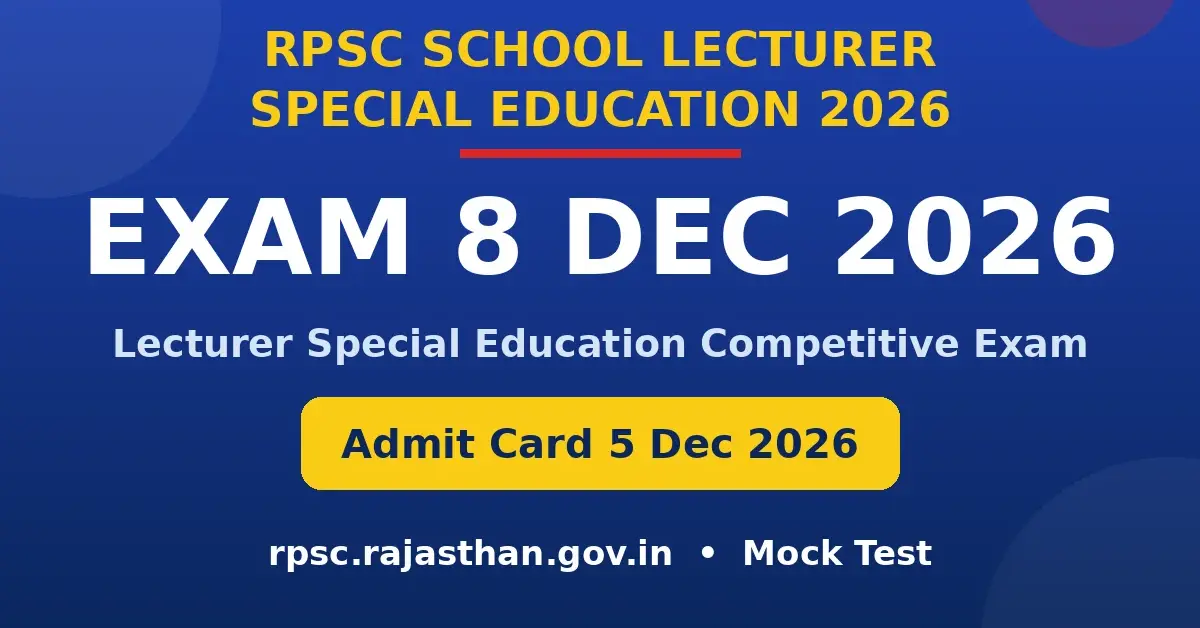
The Rajasthan Public Service Commission will hold the RPSC School Lecturer Special Education Exam Date 2026 test on 8 December 2026.
The exam will run in two sessions on the same day, a morning session and an afternoon session.
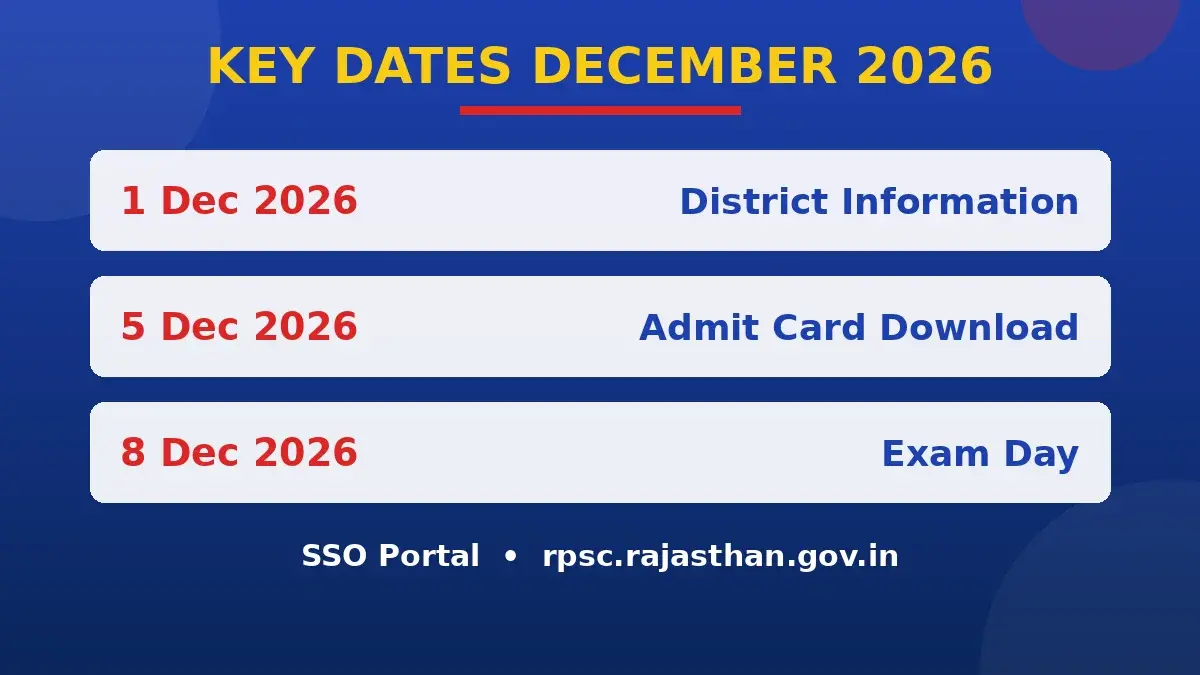
Candidates can check exam district information from 1 December 2026 and download admit cards from 5 December 2026.
Listen to this article in 1 minute:
The Commission gave this update through a press note dated 26 November 2026. The press note covers the Lecturer Special Education Competitive Examination 2026 for the Secondary Education Department. Candidates now hold three clear dates for district information, admit card download and the exam day. Time matters here. A candidate who treats these three dates as one connected chain, and who completes each step on the first day itself instead of waiting for the last moment, will reach the exam centre with a calm mind and a ready plan.
Key Facts
The table below gives the main facts from the official RPSC press note in one place. Candidates can read the full detail in the sections after the table.
| Point | Detail |
|---|---|
| Commission | Rajasthan Public Service Commission (RPSC), Ajmer |
| Exam name | Lecturer Special Education Competitive Examination 2026 |
| Department | Secondary Education Department |
| Press note date | 26 November 2026 |
| Exam date | 8 December 2026 |
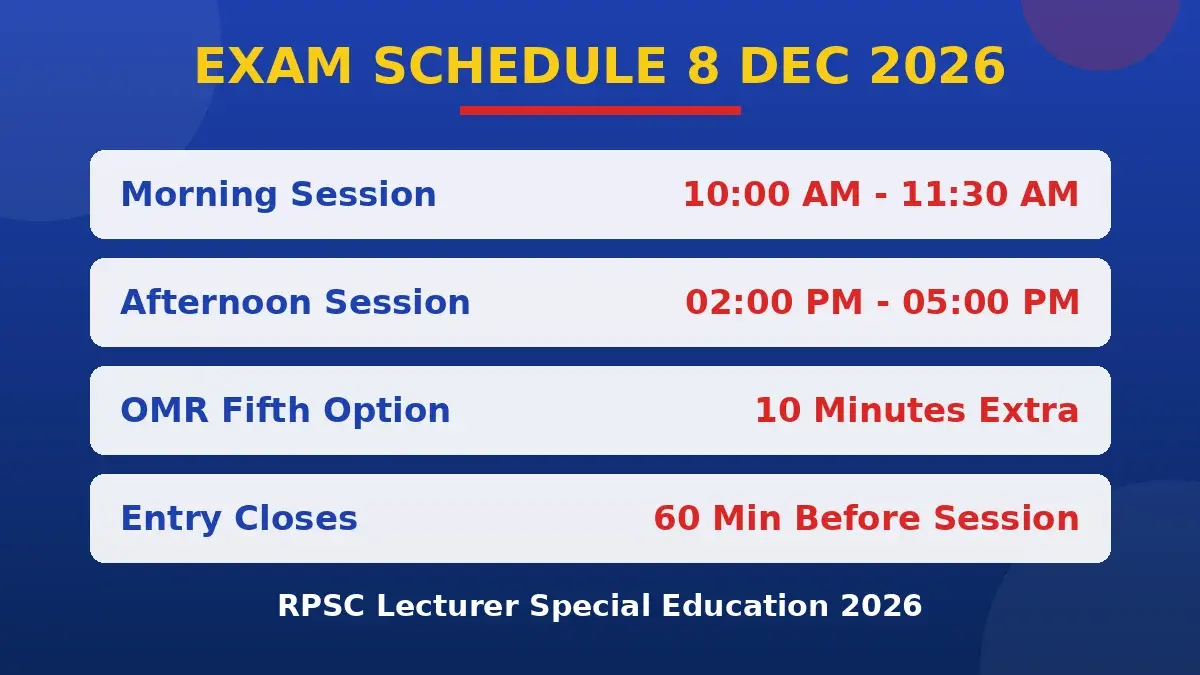
| Morning session | 10:00 AM to 11:30 AM |
| Afternoon session | 02:00 PM to 05:00 PM |
| Extra OMR time | 10 minutes extra for the fifth option in each paper |
| Exam district information | From 1 December 2026 on the SSO Portal |
| Admit card upload | 5 December 2026 on the Commission website and SSO Portal |
| Entry rule | Entry only up to 60 minutes before each session starts |
| Official website | rpsc.rajasthan.gov.in |
| SSO Portal | sso.rajasthan.gov.in |
The table covers the full update in short form. Each section below explains one part of the table in simple words. Read it twice. Candidates who read the full table first, and who then read each section with the table open beside the study notes, will catch every date and every rule without confusion.
What is the RPSC School Lecturer Special Education Exam Date 2026?
The exam will take place on 8 December 2026. The Rajasthan Public Service Commission gave this date in a press note dated 26 November 2026.
The press note names the exam as the Lecturer Special Education Competitive Examination 2026. Candidates should note the full exam name with care, because a clear name helps candidates match the portal screens, the admit card detail and every fresh notice with the correct examination during the full process. The exam sits under the Secondary Education Department. The Commission office sits at Ajmer and the press note carries the name of Ashutosh Gupta, Secretary.
Candidates should note one clear point from the start. The press note gives the exam date and the admit card schedule. The press note does not give the number of posts or the advertisement number. Candidates should read the press note as a schedule update and not as a fresh vacancy notice.
The exam will run on one single day. One day decides a lot. Candidates who keep the full day free from other work, who rest well on the night before the exam, and who reach the centre with a wide time margin will give the paper with full focus. Two sessions will run on that day. A morning session will run first. An afternoon session will run later in the day. Candidates must read their own admit card with care when it comes out. The admit card will carry the personal exam detail for each candidate.
Many candidates search for the exam date again and again on social media. Social media posts often mix old dates with new dates. The official press note should guide every candidate. The Commission website and the SSO Portal will carry the next steps in this process.
Candidates who follow other RPSC updates on this site can also read the RPSC School Lecturer Maths Result 2026 update. That update covers a separate RPSC school lecturer process. Special Education candidates should follow the 26 November 2026 press note for their own exam.
A fixed exam date helps candidates plan the last days with care. Candidates can now fix the revision plan around 8 December 2026. Candidates can also fix travel and stay plans after the district information comes out on 1 December 2026. A clear date removes guess work from the last phase of preparation. That helps a lot. Candidates can now divide the remaining days between revision, travel planning and document checks in a balanced manner, and no candidate needs to depend on rumours or old social media posts for the exam schedule.
What are the session timings on 8 December 2026?
The morning session will run from 10:00 AM to 11:30 AM. The afternoon session will run from 02:00 PM to 05:00 PM.
| Session | Date | Time |
|---|---|---|
| Morning session | 8 December 2026 | 10:00 AM to 11:30 AM |
| Afternoon session | 8 December 2026 | 02:00 PM to 05:00 PM |
The morning session covers one and a half hours on the clock. Candidates in the morning session should fix the wake up time, the leaving time and the centre arrival time on the night before the exam, so that the morning runs in a calm and planned manner. The afternoon session covers three hours on the clock. Candidates should note both session timings with care. A candidate must reach the centre well before the session on the admit card.
The press note also gives one more time detail for every candidate. For each question paper, candidates will get 10 minutes extra time to fill the fifth option in the OMR answer sheet. Candidates should treat this extra time as OMR time. The extra time sits apart from the main paper time in the press note wording.
Candidates should plan the full day around both sessions. A morning candidate will start the day early. An afternoon candidate will keep the full day free for the exam. No candidate should plan other work close to the session time on 8 December 2026.
The gap between the two sessions also needs care. Candidates in the afternoon session should use the gap in a wise manner, should eat a light meal before leaving home, and should reach the centre well before the entry closing time for checking. The morning session ends at 11:30 AM. The afternoon session starts at 02:00 PM. Candidates in the afternoon session should use the gap to reach the centre early. Early arrival gives time for security checking and identification.
Candidates should not pick a session by choice. The card decides. A candidate who reads the session detail on the admit card, marks the entry closing time on a calendar, and plans the leaving time from home with a wide margin will avoid the most common exam day mistake. The admit card will show the session detail for each candidate. Candidates should read the admit card line by line after the download on 5 December 2026. A wrong reading of the session time can spoil the full exam day.
What are the key dates candidates must note?
Candidates must note three dates from the press note. District information starts on 1 December 2026, admit cards come on 5 December 2026 and the exam runs on 8 December 2026.
| Event | Date | Where |
|---|---|---|
| Exam district information | 1 December 2026 | SSO Portal login |
| Admit card upload | 5 December 2026 | Commission website and SSO Portal |
| Exam day | 8 December 2026 | Allotted exam centre |
The three dates form a short and clear chain. Candidates first learn the exam district. Candidates then download the admit card. Candidates then sit in the exam on 8 December 2026. Each step depends on the step before it.
The district information step comes first for a clear reason. A candidate who knows the district early can check travel options, can plan the stay near the centre area, and can keep the revision plan steady without any last moment travel tension. A candidate who knows the district can plan travel early. Travel planning becomes hard when the district comes out at the last moment. The 1 December 2026 date gives candidates a full week before the exam day.
The admit card step comes on 5 December 2026. Candidates will get three days between the admit card date and the exam day. Candidates should download the admit card on the first day itself. A quick download leaves time to read every instruction with care.
Candidates should mark all three dates on a calendar today. Do it now. A candidate who sets a phone reminder for the district check, another reminder for the admit card download, and a third reminder for the centre visit will complete every step without a last day rush. A phone calendar with a reminder will help. A paper note near the study table will also help. Small habits prevent a missed date in a busy exam week.
Candidates should also keep the login details ready before 1 December 2026. The district information step needs an SSO Portal login. The admit card step needs the Application No. and date of birth on the Commission website. Ready details save time on both dates.
How can candidates check exam district information from 1 December 2026?
Candidates can check exam district information from 1 December 2026 by logging in to the SSO Portal. The press note gives this step in clear words.
Candidates should follow the steps below on 1 December 2026:
- Open the SSO Portal at sso.rajasthan.gov.in.
- Log in with the SSO ID and password.
- Open the Recruitment portal link in Citizen Apps (G2C).
- Look for the Lecturer Special Education Competitive Examination 2026 detail.
- Note the exam district shown for the candidate.
- Save a screenshot or note the district name in a safe place.
The district information tells the candidate the exam district. The district name helps the candidate plan travel and stay. Candidates should start travel planning on the same day. Early travel planning keeps the exam week calm.
Candidates should read the district name with full care. A careful reading takes only a few seconds, but a careless reading can send a candidate towards a wrong city, and such a mistake can waste the full exam week in confusion. A similar district name can confuse a candidate in a hurry. Candidates should match the district name letter by letter with the portal screen. A small spelling mistake can send a candidate towards the wrong city.
The district information step also helps families plan support. Family members can arrange travel, can keep the exam day free for support work, and can help the candidate reach the centre on time after the district detail comes out. Family members can help with travel and stay after the district comes out. Candidates should share the district detail with family on 1 December 2026 itself. Shared planning reduces last day stress.
Candidates who face a login problem should stay calm. Candidates should first check the SSO ID and password with care. Candidates should then try the login again after a short gap. Candidates should keep the Application No. ready for every step in this process.
District information updates now form a common step in big exams. Candidates can read the UPPSC PCS District Information Slip 2026 update on this site for a similar district slip process in another exam. Each commission runs a separate portal and a separate process. RPSC candidates should use the SSO Portal for this exam.
Candidates should not wait for the admit card to learn the district. Early knowledge wins. A candidate who learns the district on the first day can compare travel options, can ask family members for support in a calm manner, and can keep the study plan steady through the full week. The press note gives district information four days before the admit card date. Candidates who use the district step well will reach the admit card step with a ready travel plan.
How can candidates download the admit card from 5 December 2026?
Admit cards will come on 5 December 2026 on the Commission website and the SSO Portal. Candidates should download the admit card promptly after the upload.
Candidates can use the Commission website route with these steps:
- Open the Commission website at rpsc.rajasthan.gov.in.
- Click the Admit Card link on the website.
- Enter the Application No. and date of birth.
- Download the admit card file.
- Print the admit card on clean paper.
- Read every line and instruction on the admit card.
Candidates can also use the SSO Portal route with these steps:
- Open the SSO Portal at sso.rajasthan.gov.in.
- Log in with the SSO ID and password.
- Open the Recruitment portal link in Citizen Apps (G2C).
- Download the admit card from the recruitment section.
- Print the admit card and read all instructions with care.
Both routes lead to the same admit card. Candidates can choose the route that opens in a smooth manner on the download day, and a candidate who keeps both routes in mind will face less tension if one page loads slowly. Candidates can use either route. A candidate who faces a slow page on one route can try the other route. Candidates should avoid unknown websites for the admit card download.
The press note asks candidates to download the admit card promptly. A prompt download gives candidates enough time to check the name, the photo, the session detail and the centre address, and to read every instruction before the exam day. A prompt download gives candidates time to check every detail. Candidates should check the name, photo and session detail on the printed admit card. Candidates should read the instructions issued with the admit card in full.
Candidates should keep two print copies of the admit card. One copy travels. The other copy stays safe at home, and a family member who holds the backup copy can help the candidate in case the main copy gets lost or damaged during travel. One copy will go to the exam centre. One copy will stay at home as a backup. A backup copy helps if the first copy gets lost or damaged.
Candidates should also save the admit card file on the phone. A saved file helps during travel, a printed copy helps at the gate, and a backup copy at home protects the candidate from a lost card problem. A saved file helps during travel. The printed copy still matters at the centre gate. Candidates should carry the printed admit card with the identity documents.
The admit card download needs correct details. A wrong Application No. will block the download. A wrong date of birth will also block the download. Candidates should keep the application details ready before 5 December 2026.
What identity documents must candidates carry to the exam centre?
Candidates must carry an updated original colour Aadhaar card to the exam centre. The press note also allows another original photo identity card when the Aadhaar photo looks old or unclear.
Candidates should keep these identity points ready before the exam day:
- Updated original colour Aadhaar card
- One more original photo identity card if the Aadhaar photo looks old or unclear, such as a driving licence, passport or voter ID
- Latest clear colour photo pasted on the admit card
- Printed admit card with clear details
The press note gives a clear rule on identity. No entry without a clear card. Candidates who check the identity card photo today, and who arrange a second card in time, will complete identification at the gate in a smooth manner. No candidate will get entry without a clear original photo identity card. Candidates should treat this rule as final. A photocopy will not serve the purpose of an original card at the gate.
Candidates should check the Aadhaar photo today itself. An old photo can slow the identification work at the gate, and a slow gate process can create panic for a candidate who reaches the centre close to the entry closing time. An old photo can create a problem during identification. An unclear photo can also create a problem at the gate. Candidates with an old or unclear Aadhaar photo should keep a second original photo identity card ready.
The second identity card must carry the latest clear colour photo of the candidate. The press note names three options for this second card. Candidates can carry a driving licence, a passport or a voter ID. Each option must show a latest clear colour photo.
Candidates must also paste a latest clear colour photo on the admit card. The photo on the admit card should match the face of the candidate. A clear photo helps the centre staff complete identification in less time. Candidates should paste the photo with care and keep the admit card clean.
Candidates should keep all identity documents in one file. One file, full safety. A candidate who keeps the admit card, the Aadhaar card and the second identity card in one clean file will find every document in seconds. A single file prevents a last minute search at home. Candidates should check the file on the night before the exam. A night check gives time to fix a missing document.
Candidates should also read the instructions issued with the admit card. Read every line. A candidate who reads the full instruction set on the download day itself, and who notes each centre rule in a small diary, will face no surprise at the gate on the exam day. The instructions will carry centre rules in full detail. Candidates should follow those instructions along with the press note points. Careful reading prevents a gate problem on the exam day.
What is the entry rule at the exam centre?
Entry to the exam centre will stay open only up to 60 minutes before each session starts. No candidate will get entry after that point.
The entry rule works in a simple way for both sessions. Morning session candidates must enter by 09:00 AM. Afternoon session candidates must enter by 01:00 PM. Candidates should reach the centre well before these times.
The Commission will run security checking and identification at the centre. Checking takes time for every candidate, so a candidate who arrives early will complete the full process in a calm manner and will sit in the hall without stress. Checking takes time for every candidate. A late arrival leaves no time for checking. Candidates should arrive early and complete checking in a calm manner.
Candidates should plan the morning around the entry rule. A morning candidate should leave home early, should keep a wide margin for road delays, and should aim to reach the centre well before the entry closing time. A morning candidate should leave home with a wide time margin. Traffic and distance can add extra time on any road. A wide margin protects the candidate from a late entry problem.
Afternoon candidates should also plan with care. The afternoon session starts at 02:00 PM. Entry closes at 01:00 PM for this session. Candidates should reach the centre before 01:00 PM and complete checking without hurry.
Candidates should not test the entry rule at the gate. The gate rule stays firm. A candidate who reaches after the entry point will miss the session, and no request at the gate can change that outcome. The press note gives no scope for late entry. A candidate who reaches after the entry point will miss the session. Early arrival stays the only safe plan for every candidate.
Candidates should keep the admit card and identity card in hand near the gate. Ready hands move fast. A candidate who holds both documents in hand, who keeps the centre address clear in mind, and who follows the centre staff directions step by step will complete checking in a short time. Ready documents speed up identification. Candidates should also keep the centre address clear in mind. A clear address prevents a wrong turn near the centre.
How should candidates use the extra 10 minutes for the fifth option in the OMR sheet?
Candidates will get 10 minutes extra time for each question paper to fill the fifth option in the OMR answer sheet. Candidates should use this time only for the fifth option work.
The OMR answer sheet needs clean and careful filling. A wrong bubble can harm the result, a missed row can waste a correct answer, and a rushed sheet can carry many small mistakes in the last minutes. A wrong bubble can harm the result of a candidate. Candidates should fill each bubble with full attention. The extra 10 minutes give candidates a fixed window for the fifth option.
Candidates should plan the paper time with the OMR work in mind. A candidate who transfers answers in small sets during the paper will keep the OMR work under control and will use the extra time in a calm manner. A candidate should mark answers in the question paper during the paper. The candidate should then transfer answers to the OMR sheet in a steady manner. A steady transfer reduces the load at the end of the paper.
The fifth option needs the same care as every other option. Candidates should check the question number before filling the bubble. Candidates should fill one bubble for one question. Candidates should avoid double filling on any question.
Candidates should use the extra time in a calm manner. Calm hands fill better. A candidate who counts the filled rows near the end can catch a missed row in time and can fix the sheet before submission. A calm hand fills bubbles with more accuracy. Candidates should count the filled rows near the end. A quick count helps candidates catch a missed row in time.
Candidates should avoid a last minute rush on the OMR sheet. A rush creates wrong bubbles and missed rows. Candidates who transfer answers in small sets during the paper will face less pressure. Small sets keep the OMR work under control through the full paper.
The press note gives this extra time for each question paper. Candidates in both sessions should note this point. The morning paper and the afternoon paper both carry this OMR provision. Candidates should listen to the invigilator instructions in the exam hall as well.
Candidates should practise OMR filling before the exam day. Practice builds speed. A candidate who practises bubble filling at home with a sample sheet will fill the real sheet with more accuracy and less fear. Practice with a sample OMR sheet builds speed and accuracy. Candidates can practise bubble filling at home with a pen and a printed sheet. Regular practice makes the exam day work smooth.
What should candidates do on the exam day?
Candidates should reach the centre early, complete security checking and identification, and sit in the session shown on the admit card. A calm and planned exam day helps every candidate.
Candidates should follow this exam day checklist:
- Printed admit card with the latest clear colour photo pasted on it
- Updated original colour Aadhaar card
- Second original photo identity card if the Aadhaar photo looks old or unclear
- Centre address checked in person before the exam day
- Arrival well before the entry closing time
- Full reading of the instructions issued with the admit card
The exam day should start with a document check at home. A home check takes two minutes, and the same check at the centre gate can take much longer, so candidates should complete the check before leaving home. Candidates should open the document file and check each item. A home check takes two minutes. The same check at the centre gate can take much longer and can create panic.
Candidates should eat a light meal before leaving home. A light meal keeps the mind fresh, a calm mind reads each question with more care, and a steady start helps the candidate through the full paper. A light meal keeps the mind fresh during the paper. Candidates should also carry water for the travel time. Small comfort steps help candidates stay calm through the day.
Candidates should leave home with a wide time margin. Road traffic can change without warning. A wide margin absorbs small delays. Candidates who reach early can complete checking without stress.
Candidates should keep the phone and other items as per centre instructions. The instructions issued with the admit card will guide candidates on centre rules. Candidates should follow the centre staff directions at every step.
Candidates in the morning session should plan the full day with care. The morning session ends at 11:30 AM. The afternoon session runs later on the same day. Candidates should follow the session detail on their own admit card and should not mix the two sessions.
Candidates should stay calm inside the exam hall. A calm mind reads each question with care, marks answers in a steady order, and keeps the OMR work in step with the paper work through the full session. A calm mind reads each question with more care. Candidates should attempt the paper in a steady order. Candidates should keep the OMR work in step with the paper work.
Why should candidates confirm the centre address in person?
The press note asks candidates to not rely on Google Map for the centre location. Candidates should physically confirm the address on the e-admit card before the exam day.
A map pin can sit at a wrong place. A wrong pin can send a candidate to a wrong road, a wrong building or a wrong gate, and such confusion can waste the full entry window on the exam day. A wrong pin can send a candidate to a wrong road or a wrong building. The address on the e-admit card carries the official centre detail. Candidates should trust the admit card address over any map result.
Candidates should visit the centre area before 8 December 2026 if possible. A short visit shows the exact gate, the nearby roads and the travel time, and this knowledge removes confusion on the exam morning. A short visit shows the exact gate and the nearby roads. Candidates can note the travel time during the visit. A noted travel time helps candidates fix the leaving time for the exam day.
Candidates who travel from another district should plan with extra care. Such candidates can reach the exam district a day early. An early arrival gives time to see the centre area in daylight. A daylight visit removes confusion on the exam morning.
Candidates should also note a nearby landmark during the visit. A landmark helps the candidate explain the place to a driver. Clear directions save time on the exam day. Candidates should keep the centre address saved in the phone as text.
The press note gives this advice for a clear reason. Centre confusion on the exam day wastes the entry window. The entry window closes 60 minutes before the session. A candidate lost near the centre can miss the full session.
Candidates should treat the centre visit as part of exam preparation. The visit takes a short time, but the visit protects the full exam day from centre confusion, wrong turns and late arrival problems. The visit takes a short time. The visit protects the full exam day. Candidates should complete this step between 5 December 2026 and 7 December 2026.
What warning has the Commission given about brokers and unfair means?
The Commission has warned candidates to not get misled by brokers and mediators. The press note also gives strong punishment detail under the Rajasthan Public Examination (Prevention of Unfair Means) Act, 2022.
Candidates should stay away from any person who promises help in the exam for money. Such promises carry no truth, such persons take money from innocent candidates, and such contact can create a serious legal problem for the candidate. Such promises carry no truth. A broker can take money and leave the candidate with a legal problem. Candidates should trust only the official process of the Commission.
The press note gives a clear path for complaints. Candidates can report a bribe or inducement demand with proof to the investigation agency. Candidates can also report the matter to the Commission control room. The control room numbers are 0145-2635200, 2635212 and 2635255.
| Control room number | Use |
|---|---|
| 0145-2635200 | Bribe or inducement complaint with proof |
| 2635212 | Bribe or inducement complaint with proof |
| 2635255 | Bribe or inducement complaint with proof |
Candidates should save these numbers in the phone today. A saved number helps in a tense moment, and a candidate who holds proof of a bribe demand can report the matter to the control room without delay. A saved number helps in a tense moment. Candidates should also share the warning with fellow candidates. Shared awareness protects the full candidate group.
The press note also names the punishment for unfair means. The Rajasthan Public Examination (Prevention of Unfair Means) Act, 2022 provides life imprisonment for such acts. The Act also provides a fine up to Rs. 10 crore. Movable and immovable property of the guilty person may face attachment and confiscation under the Act.
Candidates should read this warning with full seriousness. One wrong step can end a career, can end a life of freedom, and can bring heavy punishment under the Act, so honest preparation stays the only safe path. One wrong step can end a career and a life of freedom. Honest preparation stays the only path in this exam. Candidates should keep away from any unfair means offer in any form.
Candidates should also avoid rumour groups that spread false exam claims. False claims waste time and create fear. The Commission website and the SSO Portal will carry every real update. Candidates should check only these official channels for exam news.
What does the press note not state?
The press note does not state several points that candidates often ask about. Candidates should note this silence and should not fill the gaps with guess work.
The press note does not state these points:
- Number of posts
- Advertisement number and advertisement year
- Exam centre list, city list or district list
- Subject wise schedule
- Eligibility detail
- Fee detail
- Syllabus detail
- Exam pattern, marks and negative marking
- Result date
Candidates should read this list with care. A press note on exam date and admit card schedule often leaves other points to earlier notices, and candidates should look at the original recruitment documents for those points. A press note on exam date and admit card schedule often leaves other points to earlier notices. Candidates should look at the original recruitment documents for points outside this press note. This article states only the facts from the 26 November 2026 press note.
The silence on the centre list needs special care. Candidates will learn the district from the portal, the admit card will carry the centre detail, and candidates should wait for these two official steps with patience. Candidates will learn the exam district from the SSO Portal from 1 December 2026. The admit card will carry the centre detail for each candidate. Candidates should wait for these two official steps.
The silence on exam pattern also needs care. Candidates should not copy a pattern from a random website. A wrong pattern can mislead the last days of preparation. Candidates should revise from their own study material and should follow official documents for pattern detail.
The silence on the result date needs patience. Candidates should not treat any guessed result date as an official date, and the Commission will give the result update through official channels in due course. The press note gives no result date. Candidates should not treat any guessed result date as an official date. The Commission will give the result update through official channels in due course.
Clear silence in an official note protects candidates from false claims. Candidates who respect the silence will avoid wrong information. Candidates should keep checking the Commission website for any fresh notice on these points.
What common mistakes should candidates avoid?
Candidates should avoid late arrival, wrong identity documents and map based centre search. These three mistakes can block entry or waste the exam day.
The first common mistake is late arrival at the centre. Entry closes sixty minutes before each session, and a candidate who plans arrival at the session start time will miss entry and will lose the full session. Entry closes 60 minutes before each session. A candidate who plans arrival at the session start time will miss entry. Candidates should plan arrival well before the entry closing time.
The second common mistake is a weak identity document. An old Aadhaar photo or an unclear photo can slow identification. A missing second identity card can block entry. Candidates should check identity documents before 5 December 2026.
The third common mistake is full trust in a map search for the centre. The press note asks candidates to confirm the centre address in person. Candidates should follow this advice and should visit the centre area before the exam day.
The fourth common mistake is a late admit card download. Candidates who download the card on the exam morning face print pressure, reading pressure and travel pressure in the same short window of time. Candidates who download the admit card on the exam morning face print and reading pressure. Candidates should download the admit card on 5 December 2026 itself. An early download leaves calm time for every check.
The fifth common mistake is careless OMR filling. A rushed OMR sheet can carry wrong bubbles. Candidates should transfer answers in small sets and should use the extra 10 minutes for the fifth option with care.
The sixth common mistake is trust in broker talk. A broker promise can destroy a candidate career. Candidates should report bribe demands with proof to the investigation agency or the Commission control room. Candidates should keep full distance from such persons.
Candidates should make a small mistake checklist at home. A written checklist helps candidates catch weak points early, and a candidate who ticks each point before the exam day will start the day with full confidence. A written checklist helps candidates catch weak points early. Candidates should tick each point before 7 December 2026. A complete checklist gives a calm start to the exam day.
How should candidates use the last days for revision and mock test practice?
Candidates should use the last days for calm revision, OMR practice and timed mock test practice. The press note gives no syllabus or pattern detail, so candidates should revise from their own study material.
A short revision plan works better than a heavy plan in the last days. Candidates should revise notes in small sets, should avoid a heavy new topic load, and should keep the mind fresh for the exam day. Candidates should revise notes and key points in small sets. Candidates should avoid a full new topic load close to the exam day. Calm revision keeps memory fresh and steady.
Candidates should give timed practice papers in the session hours. Morning candidates can practise in the morning hours. Afternoon candidates can practise in the afternoon hours. Practice in the session hours builds the body clock for the exam day.
Mock test practice helps candidates find weak areas in time. A candidate who reads the mistake list after each practice paper can fix weak areas in the next revision set before the exam day. Candidates can attempt a mock test and then read the mistakes with care. A mistake list guides the next revision set. Candidates should repeat this cycle in the days before 8 December 2026.
Candidates should also practise OMR filling with each practice paper. OMR practice builds bubble speed and accuracy. Candidates should practise the fifth option filling in the same manner. Regular OMR practice removes exam hall fear.
Candidates should keep the last day light. A light last day keeps the mind fresh, a fresh mind reads questions with more care, and a calm candidate performs better in the exam hall. A light last day keeps the mind fresh for the exam. Candidates should check documents and centre plans on 7 December 2026. Candidates should sleep early on the night before the exam.
Candidates should avoid comparison with other candidates in the last days. Comparison creates stress without gain. Candidates should follow their own plan and should trust their preparation. A steady mind performs better in the exam hall.
What should candidates do between 1 December and 5 December 2026?
Candidates should check the exam district on 1 December 2026, plan travel, and keep admit card details ready for 5 December 2026. These four days form the bridge between district information and the admit card.
Candidates should complete the district check on the first day. A first day check gives the maximum travel planning time, and a candidate who plans travel early will keep the exam week calm and steady. A first day check gives the maximum travel planning time. Candidates should note the district and should share the detail with family. Family support helps with travel and stay arrangements.
Candidates should book travel and stay after the district check. Early booking gives more options, a simple travel plan reduces stress, and a safe stay near the centre area helps the candidate on the exam day. Early booking gives more options and better prices. Candidates should keep the travel plan simple and safe. A simple plan reduces exam week stress.
Candidates should keep the Application No. and date of birth ready. The admit card download on the Commission website needs these two details. Candidates should also keep the SSO login ready. Ready details make the 5 December 2026 download smooth.
Candidates should check identity documents in this period. A weak Aadhaar photo needs a second identity card. Candidates should arrange the second card before the admit card date. Early arrangement prevents a last day search.
Candidates should also keep revision steady in this period. District and travel work should not stop study. Candidates should fix study hours around the travel planning work. A balanced day keeps both preparation and planning on track.
Candidates should watch the Commission website in this period. A fresh notice can come at any time. Candidates should read every fresh notice under this exam with care. Official updates should guide every change in the plan.
How should candidates read the admit card after the download?
Candidates should read the admit card line by line after the download on 5 December 2026. The admit card will carry the personal exam detail and the centre instructions for each candidate.
Candidates should check the name and photo on the admit card first. A clear photo helps identification at the gate, and a correct name detail helps the centre staff complete the checking work in less time. A clear photo helps identification at the gate. Candidates must paste a latest clear colour photo on the admit card as the press note directs. A pasted photo should sit clean and flat on the card.
Candidates should check the session detail next. The morning session and the afternoon session run at different hours, and a candidate who marks the correct session time will plan the day in a right manner. The morning session runs from 10:00 AM to 11:30 AM. The afternoon session runs from 02:00 PM to 05:00 PM. Candidates should mark the session time on the calendar after this check.
Candidates should check the centre address with full care. The centre address on the admit card will guide the centre visit. Candidates should note the address in the phone as text. Candidates should then confirm the address in person before the exam day.
Candidates should read the instructions issued with the admit card in full. The instructions will carry centre rules and candidate duties. Candidates should follow those instructions along with the press note. A full reading prevents a surprise at the gate.
Candidates should keep the card safe after printing. A folded or damaged card can create a reading problem at the gate, so candidates should keep the card in a clean file with identity documents. A folded or damaged card can create a reading problem. Candidates should keep the card in a clean file with identity documents. A clean file keeps every document ready for the exam morning.
Candidates should print one extra copy as a backup. The backup copy can stay at home or with a family member. A backup copy protects the candidate from a lost card problem. Candidates should carry the main printed copy to the centre.
What should candidates do if the admit card download faces a problem?
Candidates should first check the Application No. and date of birth with care. A small typing mistake can block the download on the Commission website.
Candidates should try the second route after a failed attempt. The portal route works through login, the website route works through the admit card link, and both routes carry the same admit card for candidates. The SSO Portal route works through login and the Recruitment portal link in Citizen Apps (G2C). A candidate who faces a slow page on one route can use the other route. Both routes carry the same admit card.
Candidates should avoid unknown websites during a download problem. Unknown sites can carry wrong files and false claims. The Commission website and the SSO Portal remain the only safe routes. Candidates should stay on official channels at every step.
Candidates should keep the login details safe during every attempt. Candidates should not share the SSO password with any person. A shared password can create account risk. Candidates should complete the download on a personal device where possible.
Candidates should download the admit card early on 5 December 2026. An early attempt leaves time for a second attempt, and a calm second attempt often succeeds without any tension for the candidate. An early attempt leaves time for a second attempt. A calm second attempt often succeeds. Candidates should avoid a last hour download plan on 7 December 2026.
Candidates should save the downloaded file in two places. A phone copy and a computer copy give double safety. Candidates should print the card after the save step. A printed card completes the download work.
Sources
The facts in this article come from the official RPSC press note dated 26 November 2026. Candidates should read the official press note for the full wording.
- Rajasthan Public Service Commission press note dated 26 November 2026: RPSC Press Note PDF
- Rajasthan Public Service Commission News and Events listing dated 26 November 2026: rpsc.rajasthan.gov.in
- SSO Portal for district information and admit card download: sso.rajasthan.gov.in