NPC Technical Assistant Recruitment 2026: Apply Online for 15 Posts
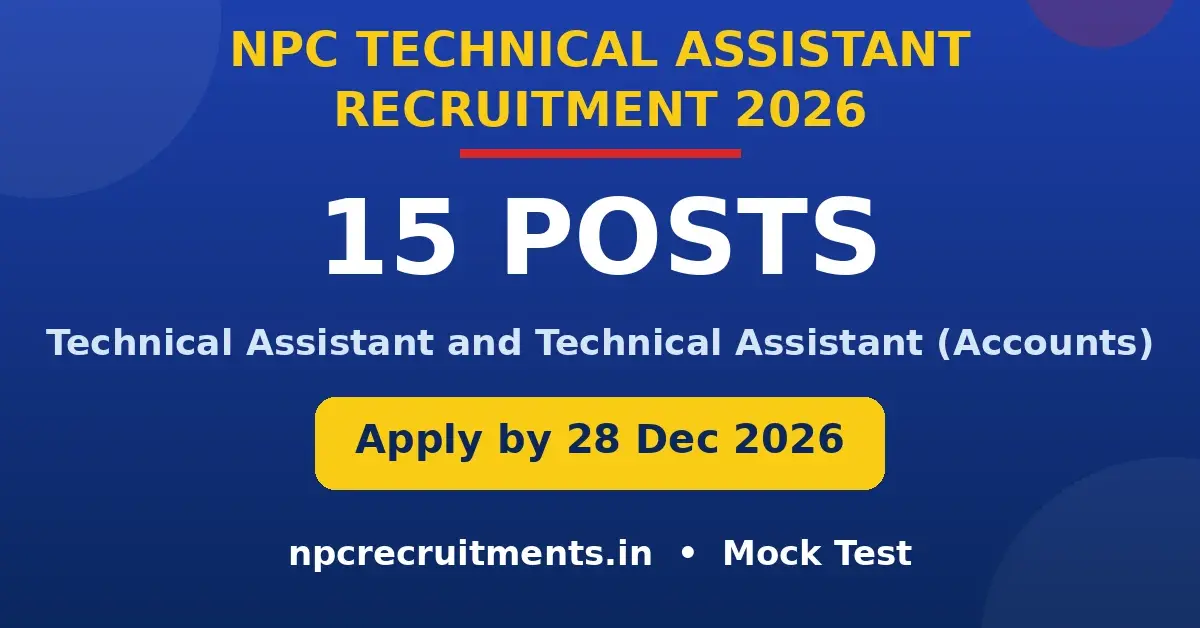
National Productivity Council has opened online applications for 15 Group B posts of Technical Assistant and Technical Assistant (Accounts). Candidates can apply online from 28 November 2026 to 28 December 2026 up to 5:00 PM on the official recruitment portal. The Phase-I computer based test is tentatively fixed for 24 January 2027.
Listen to this article in 1 minute:
This is a small recruitment with only 15 posts open, and that single fact shapes everything about this form, from how carefully a candidate should read the eligibility rules to how much weight each written test mark will carry when the final merit list is prepared. Read the rules first. Then fill the form.
The advertisement number is NPC/TA/1/2026. It is dated 28 November 2026. The National Productivity Council works under the Department for Promotion of Industry and Internal Trade. The department sits in the Ministry of Commerce and Industry, Government of India. The headquarters address given in the notification is Utpadakta Bhavan, 5-6 Institutional Area, Lodhi Road, New Delhi-110003.
What are the key facts of NPC Technical Assistant Recruitment 2026?
The table below gives the full job picture in one place. It carries the job title, the hiring organisation, the posting date, the last date, the job location, the employment type, the salary level and the advertisement number.
| Point | Detail |
|---|---|
| Job title | Technical Assistant and Technical Assistant (Accounts) |
| Hiring organisation | National Productivity Council |
| Department | Department for Promotion of Industry and Internal Trade, Ministry of Commerce and Industry |
| Advertisement number | NPC/TA/1/2026 |
| Date posted | 28 November 2026 |
| Apply online starts | 28 November 2026 at 10:00 AM |
| Last date to apply | 28 December 2026 at 5:00 PM |
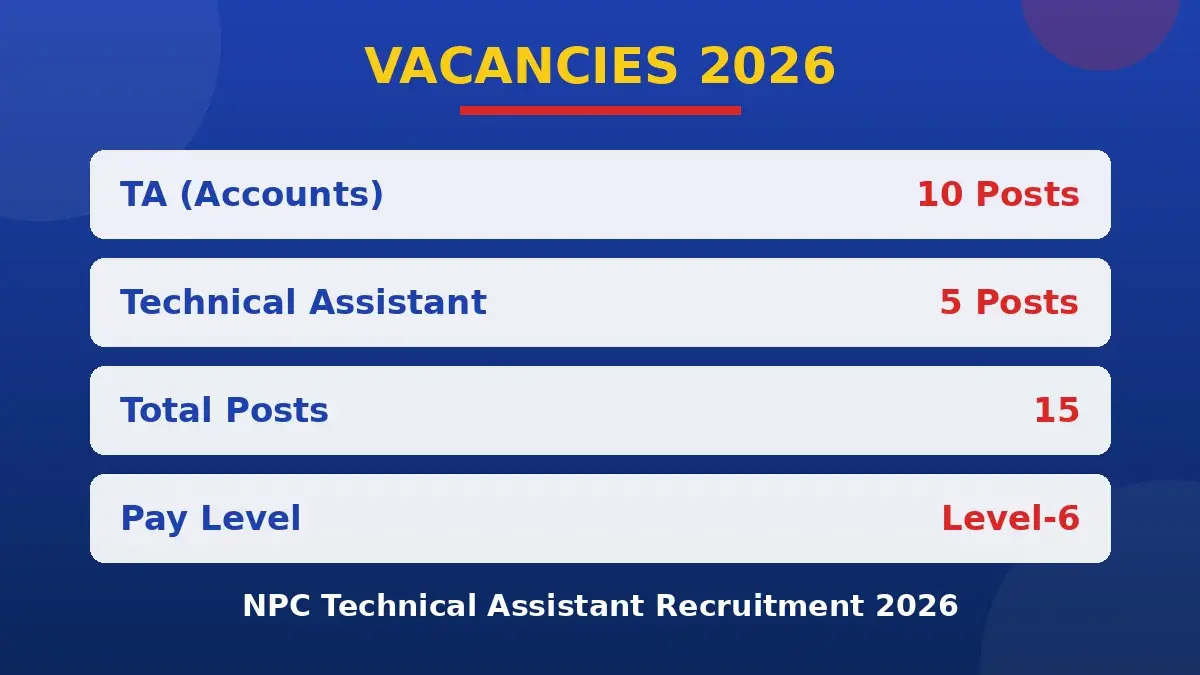
| Total posts | 15 |
| Employment type | Group B |
| Job location | NPC Headquarters, New Delhi, with transfer liability |
| Salary | Level-6, Rs 35,400 to Rs 1,12,400 |
| Application mode | Online only |
| Phase-I exam date | 24 January 2027, tentative |
Both posts carry the same pay level. Both posts are Group B posts. The difference lies in the work area and in the degree and experience that each post asks for. A commerce graduate with accounts experience fits one post. A graduate with office administration experience fits the other post. Some candidates may fit both posts. The fee rule allows one post or both posts, and the fee amount changes with that choice.
How many vacancies are open for each post and category?
There are 10 posts of Technical Assistant (Accounts) and 5 posts of Technical Assistant. The category breakup is given in the table below. The number of vacancies is provisional and may vary, as the notification states.
| Post | UR | OBC (NCL) | SC | EWS | Total |
|---|---|---|---|---|---|
| Technical Assistant (Accounts) | 6 | 2 | 1 | 1 | 10 |
| Technical Assistant | 4 | 1 | 0 | 0 | 5 |
| Total | 10 | 3 | 1 | 1 | 15 |
One post in each post category is earmarked for PwBD candidates with locomotor disability. The earmarked disability types are One Arm or One Leg. A PwBD candidate of any category may apply against the earmarked post. The candidate is then adjusted against the candidate's own category.
Candidates of a category with no reserved vacancy may apply against UR posts. This covers ST candidates for both posts. It also covers SC and EWS candidates for the Technical Assistant post. Such candidates get no age relaxation for this route. The notification gives no reservation for Ex-Servicemen.
The vacancy count is small, so the category of a candidate matters in a practical way. A candidate should check the post wise breakup before choosing a post. The shortlisting for the second phase also works post wise and category wise. A candidate who picks a post without checking the breakup may lose a fair chance.
What are the important dates for this recruitment?
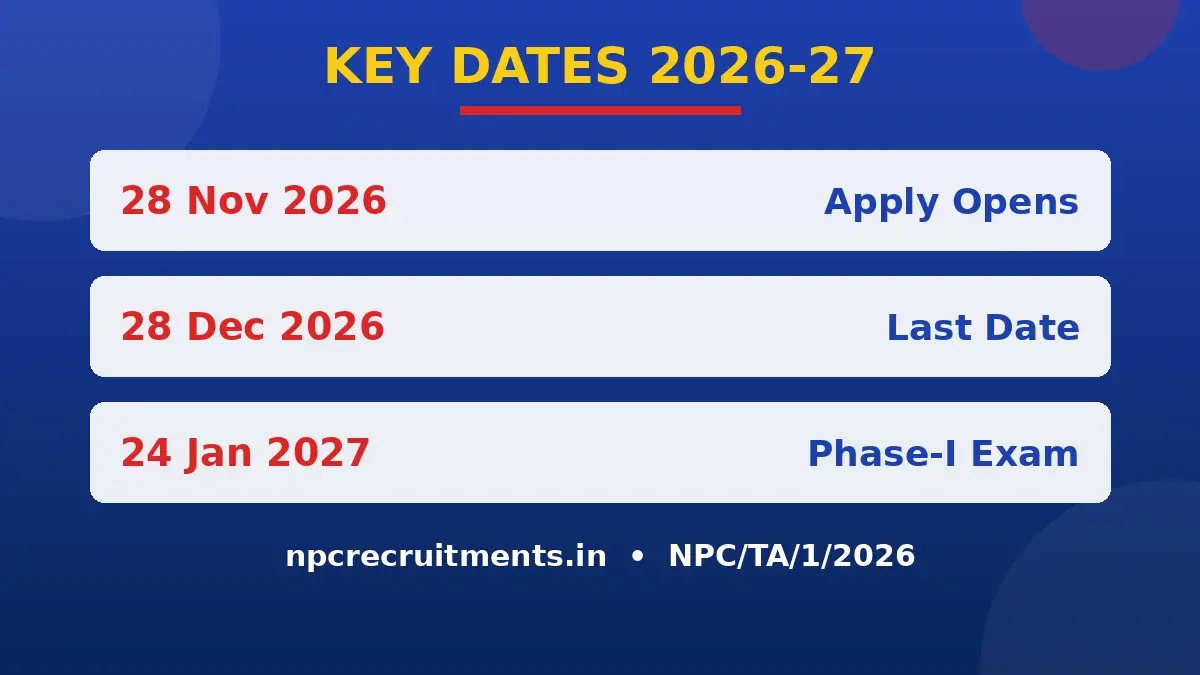
Online registration opened on 28 November 2026 at 10:00 AM. It closes on 28 December 2026 at 5:00 PM. The Phase-I exam is tentatively set for 24 January 2027.
| Event | Date |
|---|---|
| Advertisement date | 28 November 2026 |
| Online registration opens | 28 November 2026 at 10:00 AM |
| Last date for online registration | 28 December 2026 at 5:00 PM |
| Last date for fee payment | 28 December 2026 |
| Phase-I examination | 24 January 2027, tentative |
| Phase-II descriptive examination | March 2027, tentative |
| Digital Competency Test | March 2027, tentative |
A separate closing time for fee payment is not stated in the notification. The closing date for fee payment is 28 December 2026. Candidates should finish the fee step well before the last hour. Payment systems can slow down on the final day.
The notification gives March 2027 as the tentative time for the Phase-II descriptive examination. A specific March date is not stated in the notification. The recruitment portal shows 13 March 2027 as the tentative Phase-II date. Treat that portal date as tentative and keep checking the portal for updates. The Digital Competency Test is also placed in March 2027 on a tentative basis.
The gap between the last date and the Phase-I exam is short. From 28 December 2026 to 24 January 2027, candidates get less than a month. A candidate who waits for the last week to start study will feel pressed. Start preparation now and fill the form early. Both tasks can run side by side.
Who can apply for Technical Assistant (Accounts)?
A candidate needs a degree in Commerce for this post. The candidate also needs 5 years of experience in accounts, finance, audit, taxation or budget work. The experience must come from Central Government, State Government, a Public Sector Undertaking or an autonomous body.
| Point | Rule for Technical Assistant (Accounts) |
|---|---|
| Essential qualification | Degree in Commerce |
| Essential experience | 5 years in accounts, finance, audit, taxation or budget work |
| Eligible employer types | Central Government, State Government, Public Sector Undertaking, autonomous body |
| Desirable qualification | Post Graduate in Commerce, or pass in the Intermediate Examination of the Institute of Chartered Accountants or the Institute of Cost Accountants |
The experience area must match the post. General office work does not fit this post. The work should link to accounts, finance, audit, taxation or budget tasks. Experience certificates should show the work area in clear words. A vague certificate can raise questions at document verification.
Private organisation experience is not listed as an eligible employer type in the notification table. A candidate with only private company experience should read this rule with care. The employer type matters as much as the years of work.
Who can apply for Technical Assistant?
A candidate needs a degree in Arts, Science, Commerce or Management for this post. The candidate also needs 5 years of experience in administrative or office work. The work areas named in the notification include noting and drafting, establishment work, procurement, and records and file management. The experience must come from Central Government, State Government, a Public Sector Undertaking or an autonomous body.
| Point | Rule for Technical Assistant |
|---|---|
| Essential qualification | Degree in Arts, Science, Commerce or Management |
| Essential experience | 5 years in administrative or office work |
| Work areas named | Noting and drafting, establishment, procurement, records and file management |
| Eligible employer types | Central Government, State Government, Public Sector Undertaking, autonomous body |
| Desirable qualification | Post Graduate degree in any discipline |
The two posts look close on paper. They are not the same in practice. One post tests accounts depth. The other post tests office administration depth. The domain part of the exam follows the same split. A candidate should pick the post that matches real work experience.
A candidate who fits both posts can apply for both posts. The form and the fee both allow that choice. Even then, the candidate should prepare the domain part for each post with care. The Phase-II paper is separate for each post.
What is the age limit and who gets age relaxation?
The upper age limit is 30 years. Age is counted as on 28 December 2026, and this same date works as the eligibility reckoning date for the full form, which means age, qualification and experience must all hold true on this one date and not on the date a candidate happens to submit the form.
| Category | Age relaxation |
|---|---|
| OBC (NCL) | 3 years |
| SC | 5 years |
| PwBD with One Arm or One Leg disability | 10 years |
| OBC (NCL) PwBD | 13 years |
| SC PwBD | 15 years |
| NPC regular departmental employees with at least 3 years of continuous service | Up to 5 years |
| NPC contractual employees | Equal to years of contract service, up to 5 years, subject to conditions in the notification |
ST age relaxation is not stated in the notification. EWS age relaxation is also not stated. Candidates from these categories should not assume any relaxation. The table above lists only the relaxation that the notification states.
There is no general relaxation in essential qualification or experience. One small relief exists for experience. A candidate who falls short of the required experience by up to 3 months on the eligibility date is not rejected at initial scrutiny. The candidate must still complete the requirement as prescribed in the notification. This relief does not remove the experience rule. It only softens the first scrutiny step.
Age proof and category proof must match the form entries. A wrong date of birth entry can create trouble later. Check the date of birth against the Class X or identity record before final submit. Small typing errors cause big problems in government forms.
What is the application fee and who is exempt?
Male candidates in UR, OBC (NCL) and EWS categories pay Rs 1,000 for one post. The fee is Rs 2,000 for both posts. Women of all categories pay no fee. SC, ST and PwBD candidates also pay no fee.
| Candidate group | Fee for one post | Fee for both posts |
|---|---|---|
| Male candidates, UR, OBC (NCL) and EWS | Rs 1,000 | Rs 2,000 |
| Women of all categories | No fee | No fee |
| SC candidates | No fee | No fee |
| ST candidates | No fee | No fee |
| PwBD candidates | No fee | No fee |
Payment is online through the payment gateway, where candidates can pay by Debit Card or Credit Card on VISA, Master or RuPay networks, or through Internet Banking if they prefer that route. The fee is non-refundable.
A candidate who applies for both posts should pay the both posts fee. A short payment can leave the application incomplete. Keep the payment receipt or transaction record safe until the process ends. If money leaves the account and the form does not show success, do not pay again in panic. Check the application status first and use the helpline if needed.
The notification gives a helpline number, +91-6393905801. The portal also shows the email recruitment@npcindia.gov.in. The portal contact time is 9 AM to 6 PM. Use these official channels for form trouble. Do not trust random phone numbers from social media posts.
How will NPC select candidates for these posts?
Selection has three clear stages. First comes the Phase-I computer based test. Next come the Phase-II descriptive examination and the Digital Competency Test. Document verification and medical fitness follow before appointment.
| Stage | What happens |
|---|---|
| Phase-I | Computer based test. This stage works as a screening test. |
| Shortlisting | Candidates move to Phase-II in a 1:12 ratio by post and category. Tied candidates are included as prescribed. |
| Phase-II | Descriptive examination with a separate paper for each post. |
| Digital Competency Test | Computer based practical test. This test is qualifying in nature. |
| Final merit | Merit rests on Phase-II descriptive marks among candidates who qualify in the Digital Competency Test. |
| Last checks | Document verification and medical fitness before appointment. |
Phase-I marks do not decide the final merit. They decide who reaches Phase-II, and that one point should shape the whole study plan, because a candidate must first clear the screening stage with a strong rank in a small field, and only after that crossing does the descriptive paper begin to carry the final weight in the merit list.
The 1:12 ratio works by post and by category. PwBD candidates are included as stated in the notification. With only 15 posts, the Phase-II group will stay small. Every mark in Phase-I can change a rank near the cutoff line.
Admission to any phase is provisional. Original documents are checked at document verification. False or hidden information can lead to cancellation. If a candidate gets appointed and the problem comes out later, termination can follow after due process. Honest entries protect a candidate at every stage.
What is the Phase-I exam pattern?
Phase-I is a computer based test with 120 multiple choice questions. The paper carries 120 marks. The time limit is 120 minutes. The medium is English only.
| Subject | Questions | Marks |
|---|---|---|
| General Awareness | 20 | 20 |
| Mental Ability and Reasoning | 20 | 20 |
| Numerical Ability, Data Interpretation and Basic Computer Knowledge | 20 | 20 |
| English Language | 20 | 20 |
| Domain Knowledge | 40 | 40 |
| Total | 120 | 120 |
Each correct answer gives 1 mark. Each wrong answer cuts 0.25 mark. Unattempted questions carry no deduction. A fixed qualifying percentage for Phase-I is not stated in the notification. Shortlisting follows the 1:12 ratio.
The domain part holds 40 questions. It is the largest single block in the paper. A candidate with strong subject depth gains a clear edge here. The other four blocks hold 20 questions each. Together they still make 80 marks, so no block can be ignored.
Negative marking changes the attempt plan. A blind guess has a cost, so a candidate should attempt a question only when some logic supports the choice, because leaving a question blank costs nothing at all, and in a close contest for a handful of seats those saved fractions of marks can decide who crosses the shortlisting line and who stops one step short of it.
English only medium also matters. Candidates who study in Hindi medium should practise English questions from the start. The questions will not come in Hindi. Reading speed in English will affect the full paper, not only the English block.
What happens in Phase-II and the Digital Competency Test?
Phase-II is a descriptive examination. Each post has a separate paper. The paper carries 100 marks and runs for 120 minutes. The mode is pen and paper. The paper rests on Annexure-I Part B of the notification. The number of descriptive questions is not stated.
| Test | Marks | Time | Mode | Key rule |
|---|---|---|---|---|
| Phase-II descriptive paper | 100 | 120 minutes | Pen and paper | Separate paper for each post |
| Digital Competency Test | 100 | 60 minutes | Computer based | Qualifying in nature, common to both posts |
The Digital Competency Test uses MS Office 2019 or a later version. The keyboard setting is English (India). The test has three packages. MS Word carries 40 marks with 20 as the qualifying mark. MS Excel carries 40 marks with 20 as the qualifying mark. MS PowerPoint carries 20 marks with 10 as the qualifying mark.
| Package | Marks | Qualifying marks |
|---|---|---|
| MS Word | 40 | 20 |
| MS Excel | 40 | 20 |
| MS PowerPoint | 20 | 10 |
| Total | 100 | Qualify in each package |
A candidate must secure the qualifying marks in each package. A high score in one package does not cover a low score in another package. Final merit uses Phase-II descriptive marks, and only candidates who qualify in the Digital Competency Test stay in that merit pool.
Descriptive writing needs a different skill set from objective tests. Clear structure matters, and so do neat presentation and direct answers that come to the point without wandering, which is why candidates should practise writing short and clear answers by hand well before March. Typing skill alone will not help here.
What syllabus should candidates study?
Annexure-I of the notification carries the syllabus in two parts. Part A covers the common Phase-I subjects. Part B covers post specific domain topics. The summary below stays close to the areas named in the notification.
| Part | Areas named in the notification |
|---|---|
| Part A, common | General Awareness |
| Part A, common | Mental Ability and Reasoning |
| Part A, common | Numerical Ability, Data Interpretation and Basic Computer Knowledge |
| Part A, common | English Language |
| Part B, Technical Assistant (Accounts) | Accounting and financial statements |
| Part B, Technical Assistant (Accounts) | Audit |
| Part B, Technical Assistant (Accounts) | Taxation, including GST, TDS and income tax related topics |
| Part B, Technical Assistant (Accounts) | Budgeting and government financial procedures |
| Part B, Technical Assistant | Human resource and establishment matters |
| Part B, Technical Assistant | Office administration |
| Part B, Technical Assistant | Noting and drafting |
| Part B, Technical Assistant | Procurement |
| Part B, Technical Assistant | Records and file management |
| Part B, Technical Assistant | Related government office procedures |
The domain areas match the experience areas of each post. That link helps experienced candidates. Daily work knowledge can support exam preparation. Still, exam answers need book clarity as well. Work habit and exam concept do not always match word for word.
Candidates should read Annexure-I in the official notification before making a study plan. The table above is a summary. The official annexure stays the final word on syllabus areas.
Where will the Phase-I exam take place?
The notification lists 13 Phase-I exam centres. Candidates select an exam centre in the application form. NPC can change or cancel a centre and can allot a centre. The allotment decision is final.
| Exam centres for Phase-I |
|---|
| Delhi-NCR |
| Mumbai |
| Kolkata |
| Chennai |
| Bengaluru |
| Hyderabad |
| Ahmedabad |
| Pune |
| Jaipur |
| Lucknow |
| Guwahati |
| Patna |
| Thiruvananthapuram |
Pick a centre that you can reach without stress. A far centre adds travel cost and risk. The admit card will come from the portal. No TA or DA is payable for appearing in the examination or document verification.
Centre choice looks minor during form filling. It stops looking minor on exam morning, when a long journey, traffic trouble or a missed connection can disturb the mind before the first question even appears on the screen, while a nearby centre keeps the day calm and lets a candidate settle into the paper from the first minute.
How can candidates apply online step by step?
Applications are online only. The portal is npcrecruitments.in. Follow the steps below in order.
- Open the official recruitment portal at npcrecruitments.in.
- Register with the details asked for, including name, date of birth, mobile number and email.
- Complete OTP verification and obtain the registration credentials.
- Log in with the registration credentials.
- Fill the application form with care.
- Select the post or posts you want to apply for.
- Select the examination centre and fill the other required fields.
- Preview the full form and correct any error.
- Upload the photograph, signature and documents in the stated format and size.
- Pay the fee online if the fee applies to you.
- Submit the form finally.
- Keep a PDF copy of the submitted application for your records. The copy need not be sent to NPC.
If a candidate submits more than one application for the same post, only the last complete application is considered. This rule gives a small safety net for errors. It does not reward careless repeat forms. Fill the form once with full care.
Use a mobile number and email that stay active. OTP and later updates depend on them. A dead email account can block admit card news. Keep the registration credentials in a safe place.
What photo, signature and document upload rules apply?
The photograph must be a passport size colour photograph. It should not be older than 3 months before the application date. The background should be light, preferably white. The size is 139 x 179 pixels at 200 dpi. The file should not cross 500 KB.
The signature goes on white paper with a dark blue or black ink pen. The size is 140 x 60 pixels at 200 dpi. The file should not cross 500 KB.
| Upload item | Format or size rule |
|---|---|
| Photograph | 139 x 179 pixels, 200 dpi, up to 500 KB |
| Signature | 140 x 60 pixels, 200 dpi, up to 500 KB |
| Class XII certificate or mark sheet | jpg or pdf, up to 500 KB |
| Graduation degree or mark sheets | jpg or pdf, up to 2.5 MB |
| Post graduate or CA or CMA Intermediate certificate, if any | jpg or pdf, up to 500 KB |
| All experience certificates | jpg or pdf, up to 1 MB |
| Category certificate, if applicable | jpg or pdf, up to 500 KB |
| PwBD certificate or UDID and scribe certificate, if applicable | jpg or pdf, up to 500 KB |
| Identity proof | jpg or pdf, up to 500 KB |
| NOC or proof of informing employer, where applicable | jpg or pdf, up to 500 KB |
| NPC contract service certificate, where applicable | jpg or pdf, up to 500 KB |
Prepare the files before you open the form. Resize each file, check that it opens cleanly, and read every line once on screen, because a blurry scan creates doubt at verification, while a clear scan takes one extra minute at home and saves a candidate from hard questions in front of a verification officer months later.
Candidates in government, PSU or autonomous body employment must produce an NOC as prescribed. A candidate can also show proof of having informed the employer by the closing date. In that case, the NOC must come at document verification.
Which documents should candidates keep ready?
Keep the full document set ready before the last date. Original documents are verified at document verification. The list below follows the upload table and the instructions in the notification.
- Class XII certificate or mark sheet
- Graduation degree and mark sheets
- Post graduate certificate, if any
- CA or CMA Intermediate certificate, if any, for the accounts post claim
- Experience certificates for the full required period
- Category certificate in the prescribed format, if applicable
- PwBD certificate or UDID, if applicable
- Scribe certificate, if applicable
- Identity proof
- NOC, or proof of informing the employer, where applicable
- NPC contract service certificate, where applicable
- A PDF copy of the submitted application form
- Fee payment record, where fee was paid
Reservation and category certificates must follow the prescribed format from the competent authority. This covers OBC (NCL), EWS, SC, ST and PwBD or UDID documents as applicable. An old or wrong format certificate can fail at verification. Check the format early and renew the certificate if needed.
Experience certificates deserve extra care. They should show the employer name, the post held, the work area and the period of work. A certificate that hides the work area weakens the claim. Ask the employer office for a clear certificate while time remains.
What are the posting and pay details?
Selected candidates are posted at NPC Headquarters in New Delhi. They remain liable for transfer to NPC Regional Directorates and offices. Probation and other service conditions follow the rules prescribed in the notification.
| Point | Detail |
|---|---|
| Pay level | Level-6 of the 7th CPC Pay Matrix |
| Pay scale | Rs 35,400 to Rs 1,12,400 |
| Allowances | As admissible under NPC rules |
| Pension | National Pension System coverage as stated in the notification |
| First posting | NPC Headquarters, New Delhi |
| Transfer | Liable for transfer to NPC Regional Directorates and offices |
The pay scale gives the matrix range. Actual monthly pay depends on allowances under NPC rules and on the posting. Candidates should not treat the top of the scale as starting pay. The scale range and the starting point are different things.
Transfer liability is a normal service condition in such posts. A candidate who needs a fixed city for personal reasons should weigh this point now. The headquarters posting comes first, but transfer can follow under service rules.
Which common mistakes should candidates avoid?
Most form rejections in small recruitments come from basic errors. The list below covers the errors that hurt most in this recruitment.
- Applying for the accounts post without a commerce degree
- Counting private organisation experience as eligible experience
- Missing the 5 year experience rule on the eligibility date
- Assuming ST or EWS age relaxation that the notification does not state
- Paying the one post fee while applying for both posts
- Uploading a photograph older than 3 months
- Uploading files above the stated size limit
- Using a category certificate in a wrong format
- Forgetting the NOC or the proof of informing the employer
- Submitting repeat forms and trusting an early incomplete form
- Waiting for the last day and facing payment trouble
- Ignoring the domain part, which carries 40 marks in Phase-I
One more mistake deserves a line of its own. Candidates often read only the vacancy table and skip the instructions. The instructions carry the eligibility date rule, the multiple application rule and the certificate rules. Ten minutes with the full notification can save a full application.
Check the preview screen line by line. Names, dates and category entries must match the documents. The preview step exists for this check. Use it slowly.
How should candidates prepare for this exam?
Time is short, so the plan must stay simple. The Phase-I exam is tentatively set for 24 January 2027. Build the plan around the five Phase-I blocks and the domain part of your post.
Start with the domain part. It carries 40 marks, the largest share in Phase-I. Accounts candidates should revise accounting basics, financial statements, audit ideas, GST, TDS, income tax topics and budget procedures. Technical Assistant candidates should revise establishment matters, noting and drafting, procurement, records work and office procedures.
Give the common blocks steady daily time. General Awareness needs regular reading. Mental Ability and Reasoning improves with timed practice. Numerical Ability and Data Interpretation need speed with accuracy. Basic Computer Knowledge supports both Phase-I and the Digital Competency Test. English Language practice should cover reading and grammar in the exam style.
Practise descriptive writing from the second week itself. Phase-II decides the final merit. Write short answers by hand on domain topics. Keep answers direct, structured and clean. A clear answer with correct points beats a long answer with loose points.
Practise MS Word, MS Excel and MS PowerPoint tasks on a computer. The Digital Competency Test is qualifying, but a fail in any one package ends the run. Simple tasks done fast and clean matter most here. Formatting, tables, formulas and slides should feel routine before March 2027.
Take timed mock tests in the final stretch. A full paper in 120 minutes teaches pacing like nothing else. Review each test the same day. Note the error type, not only the score. Silly errors and concept gaps need different fixes.
Candidates who track other government openings can also read our recent updates. The BPSC AEDO Recruitment 2026 post covers a Bihar education department opening. The AP Police Recruitment 2026 post covers Andhra Pradesh police posts. The BHEL Trainee Recruitment 2026 post covers trainee posts in a public sector unit. Each post follows official notifications, so dates and rules stay tied to source documents.
Keep the study material small and trusted. Too many sources create confusion in a short window. The official syllabus annexure should guide topic choice. Notes made by your own hand will serve revision better than heavy printouts.
Rest also counts. A tired mind makes silly errors in reasoning and numerical questions, so sleep well in the last week, keep the admit card and identity proof ready the night before, and reach the centre early on exam day with time in hand instead of running in at the last moment.
What should candidates do next?
Eligible candidates should apply online now and start preparation in parallel. The form closes on 28 December 2026 at 5:00 PM. The Phase-I exam follows soon after on a tentative date of 24 January 2027. Early action keeps both tasks calm.
Read the official notification once in full. Match your degree, experience, age and category against the rules. Prepare the upload files in the stated sizes. Then submit the form and save the PDF copy.
This recruitment rewards exact fit and steady preparation. Only 15 posts are open, so precision matters at each step. A correct form, a strong domain base and clean descriptive writing give a candidate the best fair chance.
Sources
- National Productivity Council careers page: https://npcindia.gov.in/career
- Official notification PDF, Advertisement No. NPC/TA/1/2026: https://npcindia.gov.in/api/v1/careers/files/career_20261127172235_95722401f80343f69249971ab3ee7e85.pdf
- Official recruitment portal: https://npcrecruitments.in
- National Productivity Council official website: https://npcindia.gov.in/