


Bihar Police Special Branch Paper 1 Mock Test 2027
Executive Exam Summary:
| Exam Name | Bihar Police Special Branch Recruitment | Target Paper | Paper 1 (Screening Test) |
| Target Year | 2027 Recruitment Cycle | Test Format | Objective Multiple Choice Questions (MCQ) |
| Total Questions | 100 Questions (Standard Pattern) | Total Marks | 100 Marks (1 Mark Each) |
| Duration | 2 Hours (120 Minutes) | Language Medium | Bilingual (Hindi and English) |
| Negative Marking | Subject to official 2027 notice (Historically 0 or qualifying rules apply) | Current Status | Notification Awaited for 2027 |
The Central Selection Board for Constables (CSBC) arranges recruitment examinations for the various specialized departments of the state police. The Special Branch (विशेष शाखा) functions as an intelligence and security unit within the Bihar Police. The process of selecting candidates for this branch begins with a competitive screening exam, the first paper of which acts as an entry requirement for all applicants. In order to perform well in Paper 1, one needs disciplined practice in General Hindi, General English, Bihar General Knowledge, General Science, and basic numerical reasoning.
You can access the Bihar Police Special Branch Paper 1 mock test 2027 directly from this page, and you'll also get a precise breakdown of the syllabus, an analysis of past years' question trends, information on the expected cutoff marks, and practical study schedules. However, as of 10 September 2026, CSBC has not yet issued the official recruitment advertisement for 2027. The pattern, the subjectwise distribution, and the practice tests provided here are based on the most recent verified CSBC Special Branch recruitment requirements (for example, Advertisement Number 01/2019) and on the current police screening guidelines.
Start Bihar Police Special Branch Paper 1 Mock Test 2027
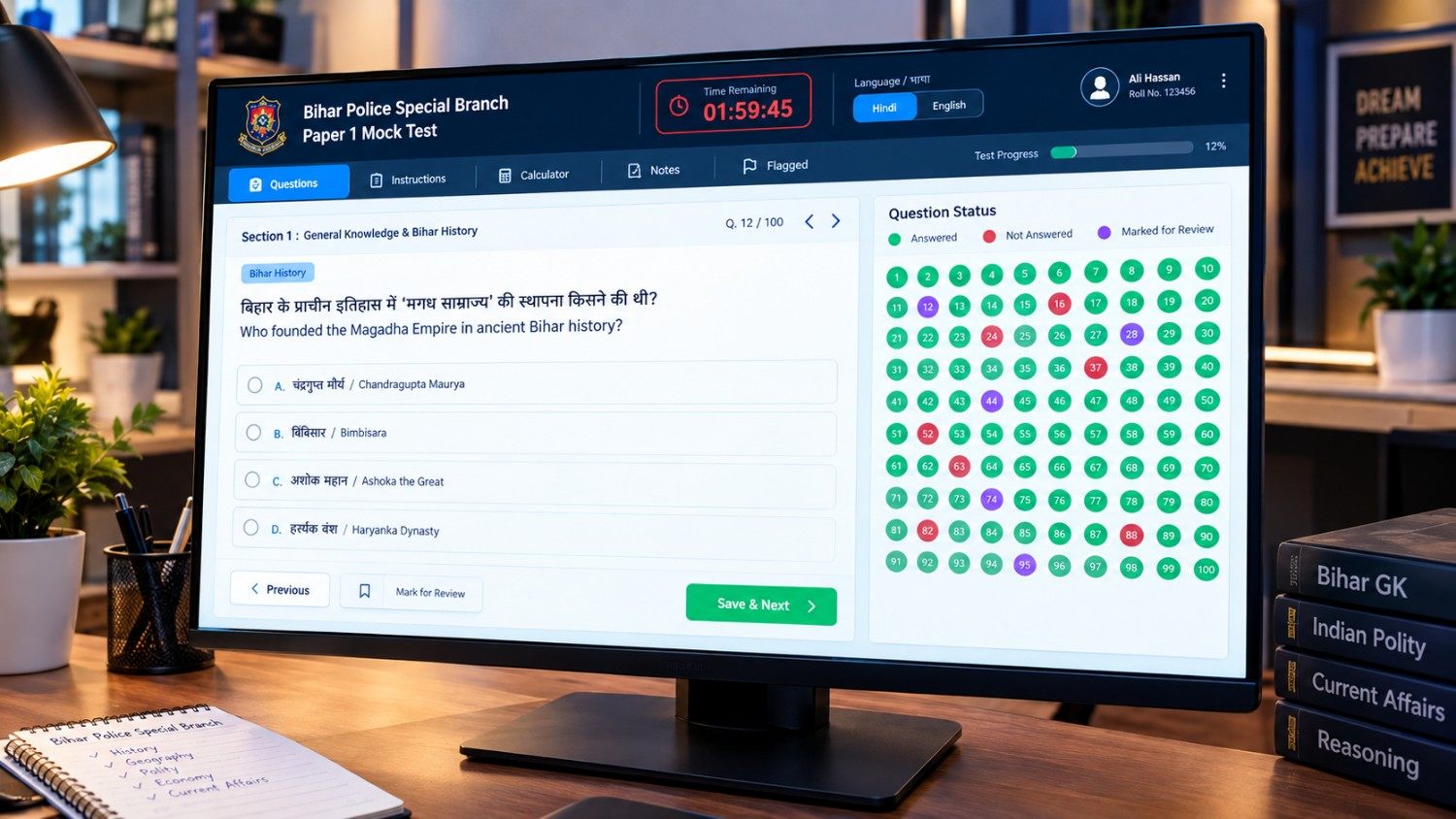
Attempt our 100-mark full-length model test designed on the official CSBC syllabus. Test your speed, check your All India Rank, and get instant answers with clear explanations in Hindi and English.
Attempt Free Paper 1 Mock Test NowIncludes 2 Free Full-Length Tests • Instant Score Card • AI Weak Area Analysis
Official Updates and Recruitment Status
Candidates must always separate official board announcements from unofficial rumors. Here is the verified status of the Bihar Police Special Branch recruitment as tracked from official government channels:
| Recruitment Item | Official Status | Verification Source | Action for Candidates |
|---|---|---|---|
| 2027 Official Notification | Not Yet Released | csbc.bih.nic.in | Begin foundational preparation based on earlier notified pattern |
| Application Dates | To Be Announced | CSBC Official Gazettes | Keep identity documents and 10+2 mark sheets ready |
| Exam Stage 1 | Written Screening (Paper 1) | Standard Police Wing Rules | Practice with timed online practice sets weekly |
| Exam Stage 2 | Physical Evaluation / Language Test | Recruitment Cadre Bylaws | Maintain daily morning running and physical conditioning |
Why Take Bihar Police Special Branch Paper 1 Mock Test 2027?
Reading textbooks helps to build knowledge, but only by taking a mock test from the Bihar Police Special Branch covering 100 marks in 2027 can one develop real exam-taking stamina. Although thousands of candidates study the same syllabus, a great many still fail on the day of the exam because of predictable errors. The following explains why taking regular mock tests makes a real difference:
- Mastering the 120-Minute Window: 100 questions sounds easy until you face 15 complex math problems and long reading passages. A mock test trains you to allocate your seconds evenly.
- Developing Negative Marking Caution: When negative marking applies or when cutoffs are high, wild guessing destroys your score. Practicing on realistic sets teaches you when to take an educated guess and when to leave a question.
- Tackling the OMR Bubble Pressure: Offline exams require darkening OMR bubbles with a ballpoint pen. Solving full practice tests helps you build the rhythm of marking your responses without double-marking errors.
- Active Memory Retrieval: Testing yourself on Bihar geography, river lengths, and historical dates forces your brain to recall information under pressure, which cements facts far better than passive reading.
Exam Pattern: Bihar Police Special Branch Paper 1
The written screening test for the Special Branch Constable cadre is arranged according to a balanced objective format, as set out in the table below based on the official recruitment guidelines:
| Feature | Verified Pattern Details | Candidate Impact |
|---|---|---|
| Exam Name | Bihar Police Special Branch Written Test (Paper 1) | Primary qualifying screening stage |
| Question Type | Objective Type Multiple Choice Questions (MCQs) | Each question has 4 options with 1 correct option |
| Total Questions | 100 Questions | Divided across 5 major subject sections |
| Total Marks | 100 Marks | 1 mark awarded for each correct answer |
| Exam Duration | 2 Hours (120 Minutes) | 72 seconds available per question on average |
| Language Medium | Bilingual (Hindi and English) | Language sections appear in their respective tongues |
| Minimum Qualifying Mark | 30% (Standard Benchmark) | Scoring 30% does not guarantee selection; merit is higher |
| Difficulty Level | Intermediate (10+2) Standard | Requires solid grasp of Class 9, 10, and 12 basics |
Subject-Wise Weightage Analysis
The table below shows the distribution of questions across subjects based on available official question sets and historical CSBC exam patterns:
| Subject Domain | Approximate Questions | Weightage Share | Preparation Priority |
|---|---|---|---|
| General Science (Physics, Chemistry, Biology) | 25 - 30 Questions | 28% | High Priority (Core Scoring) |
| Bihar GK & State Awareness | 18 - 22 Questions | 20% | High Priority (Make or Break) |
| General Hindi (सामान्य हिंदी) | 15 - 20 Questions | 18% | Moderate Priority (High Accuracy) |
| Indian History, Polity & Geography | 15 - 18 Questions | 16% | Moderate Priority (Conceptual) |
| Basic Mathematics & Logical Reasoning | 10 - 15 Questions | 12% | Moderate Priority (Practice Driven) |
| General English | 8 - 10 Questions | 6% | Foundational (Grammar Rules) |
Bihar Police Special Branch Paper 1 Syllabus 2027
In order to prepare properly, it is necessary to have a good understanding of both the overall syllabus and the more specific topics. The full subject breakdown for Paper 1 is given below:
| Subject | Main Core Areas | Primary Learning Objective |
|---|---|---|
| General Hindi | Grammar, Vocabulary, Sentence Structure, Famous Literature | Test language accuracy and formal Hindi comprehension |
| General English | Basic Grammar, Error Spotting, Vocabulary, Comprehension | Evaluate basic functional English ability |
| Bihar General Knowledge | History, Geography, Polity, Economy, State Culture | Assess deep knowledge of the state of Bihar |
| General Science | Everyday Physics, Basic Chemistry, Human Biology | Test scientific literacy relevant to everyday observations |
| Social Studies | Indian Freedom Struggle, Constitution, Indian Rivers & Climate | Examine knowledge of Indian national identity and institutions |
| Maths & Reasoning | Basic Arithmetic, Series, Directions, Relations, Coding | Test practical numerical accuracy and logical problem-solving |
Detailed Micro-Syllabus Study Checklist
Take this micro-syllabus and use it as a daily study checklist; for each topic, tick it off once you have finished reading the relevant section in the textbook and completed the practice problems:
| Subject | Topic | Micro Topics to Cover | Common Question Formats |
|---|---|---|---|
| General Hindi | वर्ण एवं वर्तनी | स्वर, व्यंजन, अनुस्वार, वर्तनी की शुद्धता | Find the correctly spelled word among four options |
| General Hindi | संधि और समास | स्वर संधि, व्यंजन संधि, तत्पुरुष, कर्मधारय, बहुव्रीहि समास | Split a compound word or identify the समास type |
| General Hindi | शब्दावली | पर्यायवाची शब्द, विलोम शब्द, अनेक शब्दों के लिए एक शब्द | Direct antonyms and synonyms of common Hindi words |
| General Hindi | मुहावरे एवं लोकोक्तियाँ | दैनिक बोलचाल के मुहावरे, लोकोक्तियों के सटीक अर्थ | Complete the idiom or identify its correct practical meaning |
| General English | Grammar Basics | Subject-Verb Agreement, Tenses, Prepositions, Articles | Fill in the blank with the appropriate preposition or verb form |
| General English | Vocabulary | Synonyms, Antonyms, One-Word Substitutes, Common Idioms | Select the word closest in meaning to the highlighted term |
| General English | Error Detection | Sentence correction, finding incorrect parts of a sentence | Identify which part of a 4-part sentence contains a grammatical error |
| Bihar GK | Ancient & Medieval Bihar | Magadha Empire, Maurya Dynasty, Nalanda University, Sher Shah Suri | Historical capitals, rulers, battles, and architectural monuments |
| Bihar GK | Modern Bihar & Freedom | 1857 Revolt (Kunwar Singh), Champaran Satyagraha (1917), Quit India | Names of freedom fighters, dates, and locations of uprisings |
| Bihar GK | Geography of Bihar | Ganga river basin, Gandak, Kosi, soil types, climate, forests | Districts bordering Nepal, river origins, and wildlife sanctuaries |
| Bihar GK | Census & Demographics | 2011 Census: Literacy rates, sex ratio, population density | Highest and lowest literacy districts, population ranks |
| General Science | Physics | Units & Measurements, Motion, Work & Energy, Light, Electricity | SI units, mirror formulas, lenses, Newton laws, power calculations |
| General Science | Chemistry | Acids, Bases & Salts, Metals & Non-metals, Carbon compounds | Chemical formulas of common substances (Baking soda, Bleaching powder) |
| General Science | Biology | Human digestive system, vitamins, infectious diseases, plant cells | Deficiency diseases, hormone functions, cell organelle roles |
| General Studies | Indian Polity | Fundamental Rights, DPSP, President powers, Panchayati Raj | Matching constitutional articles with rights and institutional roles |
| General Studies | Indian Geography | Himalayan ranges, monsoon patterns, soil zones, major dams | States through which rivers flow, crop seasons (Rabi vs Kharif) |
| Mathematics | Arithmetic | Percentages, Profit and Loss, Simple Interest, Ratios, Time & Work | Word problems requiring 2 to 3 step numerical calculations |
| Reasoning | Mental Ability | Number series, Coding-decoding, Blood relations, Direction tests | Identify the missing number or determine directional displacement |
Actual PYQ Trend Analysis (Available Papers)
When examination papers from before are analysed, it becomes evident that there are clear patterns in the way questions are constructed. Although CSBC replaces the specific questions each cycle, the main themes stay the same.
Disclaimer: The following analysis should be understood as indicating a general trend, since official historical data for each individual recruitment year is very limited.
Difficulty Trends Across Recent Screening Cycles
Based on our editorial analysis of available past questions, the balance of difficulty generally follows this spread:
| Difficulty Bracket | Approximate Share | Question Nature | How Aspirants Perform |
|---|---|---|---|
| Direct / Easy | 45% of Paper | Direct facts: State capital, SI units, direct antonyms, simple percentages. | Most well-prepared students answer these correctly. Speed matters here. |
| Moderate / Analytical | 40% of Paper | Requires multi-step thinking: Matching columns, multi-clause grammar, 2-step math. | This bracket decides who clears the qualifying cutoff mark. |
| Challenging / Deep | 15% of Paper | Niche Bihar welfare dates, complex chemical equations, tricky reasoning puzzles. | Differentiates top rankers from the rest. Best skipped if guessing is penalized. |
What You Get in the Bihar Police Special Branch Paper 1 Mock Test 2027
Our practice platform on sarkarimocktest.com provides a realistic exam simulation. Every test is built to replicate the actual difficulty and structure of the CSBC examination:
| Test Component | Format Description | Direct Benefit to You |
|---|---|---|
| Full-Length Mock Tests | 100 questions, 120-minute timer, bilingual interface. | Builds physical and mental endurance for the real exam day. |
| Sectional Subject Tests | 25 to 30 questions focusing solely on one subject (e.g., Bihar GK). | Allows targeted practice on your weakest study areas. |
| Daily Practice Sets | 15-minute quick quizzes with 15 questions. | Keeps your revision steady even on busy workdays. |
| Online Hindi Test Interface | Pure Hindi typography with standard devanagari phrasing. | Eliminates confusion with awkward machine-translated terms. |
| Model Papers | Curated sets reflecting projected 2027 question trends. | Exposes you to fresh question styles before entering the test hall. |
| PYQ-Style Question Sets | Newly authored questions mapped to historical examination themes. | Tests your conceptual depth without repeating old questions you already memorized. |
AI-Based Weak Area Recommendation
The main feature of the test series is the AI-powered system which recommends areas needing improvement. Rather than just giving you a score out of 100, the system looks at the way you take your tests. You could think of it as having a personal study tutor sit next to you while you work through the papers.
Here is how the analysis works after you hit the submit button:
- Question Evaluation: The system logs which questions you answered correctly, which you got wrong, and which you skipped.
- Time Tracking: It records the exact number of seconds you spent on each question. If you spent 180 seconds on a math problem and still got it wrong, that topic is flagged.
- Topic Mapping: Mistakes are tied to micro-topics. For example, if you miss 3 questions on chemical salts, it tags General Science → Chemistry → Acids, Bases & Salts.
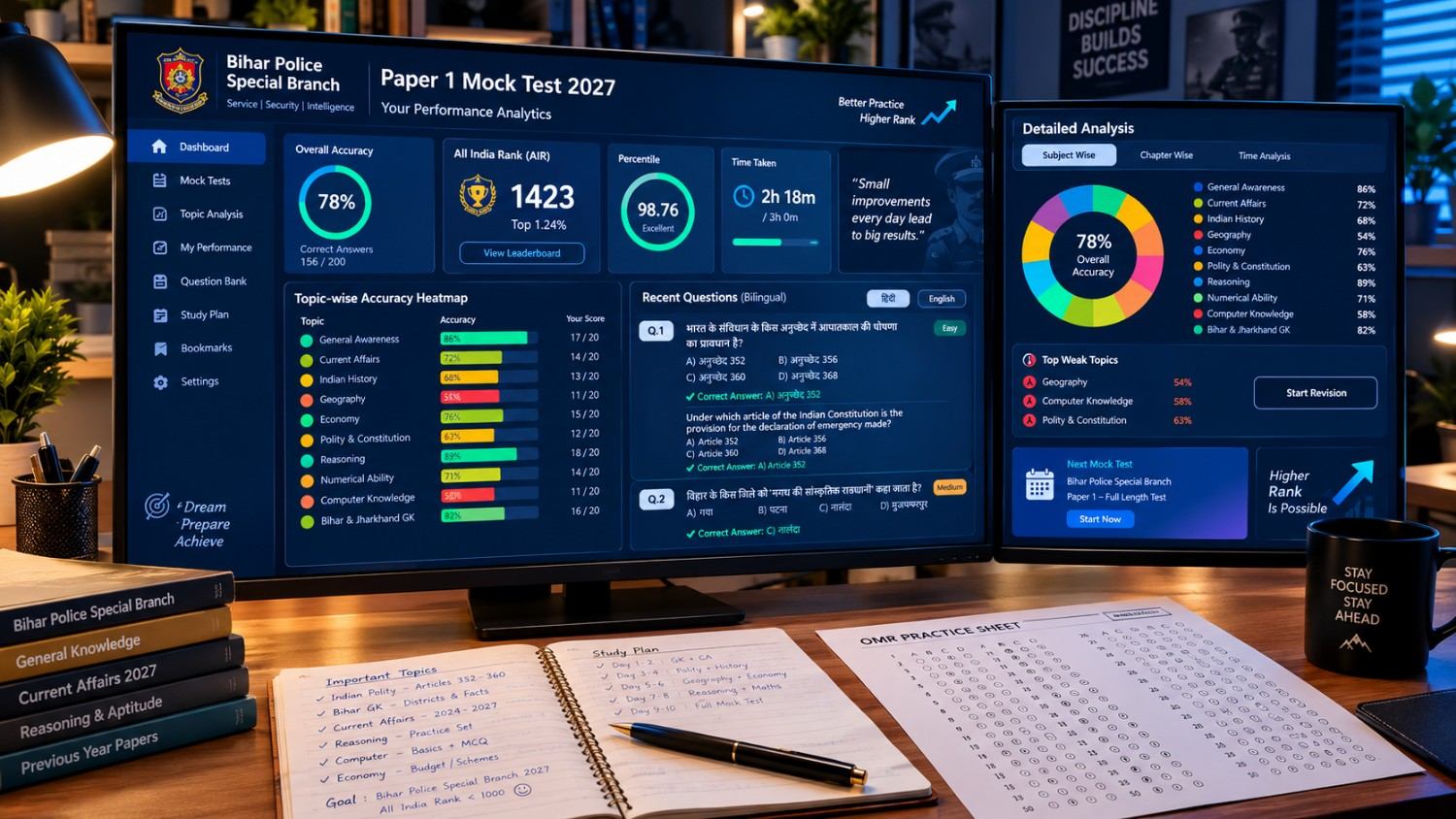
- Heatmap Generation: The platform builds a visual color-coded heatmap of your syllabus mastery. Green shows mastered areas, yellow shows inconsistent areas, and red highlights critical weaknesses.
- Targeted Study Recommendations: The dashboard suggests specific textbook chapters to re-read and provides a mini-quiz focused strictly on your red zones.
All India Rank, Percentile, and Live Leaderboard
Feeling pleased with a score of 70 out of 100 is one thing, but the score's true worth will vary according to how the other candidates did on the same test. The live leaderboard enables real-time comparison with others:
- All India Rank (AIR): Shows your exact numerical position among all candidates who attempted that specific mock test on sarkarimocktest.com.
- Percentile Score: Indicates the percentage of test-takers who scored below you. A 92 percentile means your score was higher than 92% of participants.
- Topper Comparison: View the question attempt order of the highest-scoring candidate. Learn which questions the topper solved first and which difficult questions they chose to skip.
Free Daily Current Affairs Quiz
The current affairs questions in exams held in Bihar cover both national developments and initiatives which are specific to the state. It is unlikely that studying current affairs in a hurry during the last week before an exam will be effective; instead, you should do short, regular revisions every day.
Test your daily news awareness with our dedicated daily quiz engine:
Free vs. Paid Mock Test: What You Get
We believe that all students should have access to good preparation resources no matter what their budget is. The following is an honest comparison between our free version and our full pro series:
| Feature | Free Tier Access | Full Pro Test Series |
|---|---|---|
| Full-Length Paper 1 Mocks | 2 Full-Length Tests Free | 20 Full-Length Simulation Tests |
| Sectional Tests | 5 Practice Quizzes (1 per subject) | 50+ Detailed Chapter-Wise Tests |
| Bilingual Support | Hindi and English Available | Hindi and English Available |
| Score Card & Answer Key | Instant Detailed Solutions | Instant Detailed Solutions |
| AI Weak Area Analysis | Basic Summary Report | Full Topic Heatmap & Custom Revision Drills |
| Peer Comparison & AIR | Basic Rank among Participants | Deep Percentile & Category Leaderboard |
| Topper Answer Sheet Comparison | Not Included | Full Question-by-Question Comparison |
Eligibility Criteria: Age Limit & Education
Before putting in months of preparation, make sure that you meet the recruitment requirements. The criteria listed below are the established standards defined by CSBC for selecting members of the police cadre:
| Eligibility Factor | Official Standard Requirement | Key Clarifications |
|---|---|---|
| Nationality | Citizen of India | Candidates from any Indian state may apply; non-Bihar residents fall under General category |
| Educational Qualification | Intermediate (10+2) Passed | Must have passed 10+2 from a recognized State Board, CBSE, ICSE, or recognized Sanskrit/Madarsa board |
| General Male Age Limit | 18 to 25 Years | Calculated as of the cutoff date stated in the official advertisement |
| General Female Age Limit | 18 to 25 Years | Same standard age bracket as unreserved male applicants |
| OBC / EBC Male Age Limit | 18 to 27 Years | 2-year age relaxation for recognized backward class residents of Bihar |
| OBC / EBC Female Age Limit | 18 to 28 Years | 3-year age relaxation for female backward class residents of Bihar |
| SC / ST (Male & Female) | 18 to 30 Years | 5-year age relaxation for scheduled caste and scheduled tribe residents |
| Trained Bihar Home Guards | Up to 5 Years Relaxation | Applicable to candidates who have completed formal Home Guard service |
Bihar Police Special Branch 2027 Important Dates
The table below outlines the expected recruitment schedule. Official dates will be confirmed once the formal notification is released:
| Recruitment Milestone | Expected Date / Status | Official Source |
|---|---|---|
| Official Notification PDF | Awaited (Expected Late 2026 / Early 2027) | csbc.bih.nic.in |
| Online Registration Opens | To Be Announced | CSBC Official Portal |
| Application Submission Deadline | To Be Announced | CSBC Official Portal |
| Admit Card Release Date | Approximately 15 days before written exam | Online Download Only |
| Paper 1 Written Examination | To Be Announced | Designated Centers across Bihar |
| Answer Key Publication | Within 7-10 days after written exam | CSBC Portal |
| Written Screening Results | 6 to 8 weeks after examination | Merit List PDF |
Passing Marks vs. Cutoff Marks
Aspirants often confuse passing marks with cutoff marks. Understanding the difference will save you from false assumptions during your preparation:
- Minimum Qualifying Marks (30%): CSBC rules mandate that candidates scoring below 30% are disqualified immediately. However, scoring 31% does not mean you pass.
- Cutoff Marks: This is the score of the last candidate selected for the next stage based on available category vacancies. For General category male applicants, this cutoff is usually much higher than 70 marks.
- Safe Target Score: Aiming for 78 to 82 marks in your practice mock tests ensures that negative marking shifts or difficult papers do not push you out of the selection zone.
Indicative Category-Wise Cutoff Trends
Notice: Official historical cutoff scores for specialized police branches are published along with final selection lists. The numbers below reflect indicative ranges compiled from past screening cycles:
| Category | Estimated Historical Range (Out of 100) | Safe Mock Target Score | Competition Level |
|---|---|---|---|
| General (Unreserved) Male | 74 - 78 Marks | 80+ Marks | Very High |
| General (Unreserved) Female | 62 - 66 Marks | 70+ Marks | High |
| Economically Weaker Section (EWS) | 66 - 70 Marks | 74+ Marks | Moderate to High |
| Backward Class (BC / OBC) Male | 70 - 74 Marks | 78+ Marks | High |
| Extremely Backward Class (EBC) Male | 66 - 70 Marks | 72+ Marks | Moderate |
| Scheduled Caste (SC) | 58 - 62 Marks | 65+ Marks | Moderate |
| Scheduled Tribe (ST) | 60 - 64 Marks | 68+ Marks | Moderate |
Recommended Preparation Books
Do not buy dozens of reference books. Stick to a few standard titles and read them repeatedly:
| Subject | Recommended Book | How to Use It |
|---|---|---|
| General Studies & Science | Lucent's General Knowledge (Hindi or English) | Read General Science, Modern History, and Indian Constitution thoroughly. |
| Bihar GK | Imtiaz Ahmad (Bihar Ek Parichay) or Crown Bihar GK | Focus on historical movements, rivers, soil types, and 2011 Census figures. |
| General Hindi | Lucent's Samanya Hindi or Dr. Vasudev Nandan Prasad | Study Sandhi, Samas, Muhavare, and practice 100 objective questions per topic. |
| Mathematics | R.S. Aggarwal (Quantitative Aptitude - Arithmetic Section) | Practice standard 10th-grade arithmetic: Profit & Loss, Percentages, and Ratios. |
15 Common Mistakes Aspirants Make
Knowing what to avoid is just as valuable as knowing what to study. Here are 15 common mistakes that cost candidates marks:
- Skipping Bihar GK: Treating Bihar GK as an afterthought loses you 18 to 22 straightforward marks.
- Rushing Through Questions: Misreading questions that include the words "NOT" or "INCORRECT".
- Blind Guessing: Marking answers at random when unsure, which ruins your accuracy rate.
- Ignoring General Hindi Grammar: Assuming Hindi is easy without understanding the formal rules of Sandhi and Samas.
- Delaying Physical Training: Waiting for written exam results before starting running practice.
- Neglecting NCERT Science Basics: Reading advanced university-level guides while forgetting Class 9 and 10 science fundamentals.
- Accumulating Too Many Books: Buying five different General Knowledge books instead of reading one good book five times.
- Failing to Analyze Mocks: Attempting tests one after another without studying your wrong answers.
- Poor Time Allocation: Spending 5 minutes on a single math puzzle during a timed 120-minute test.
- Neglecting Current Affairs: Cramming 12 months of news into the last two days before the exam.
- Ignoring OMR Practice: Practicing only on screens and struggling with bubble sheets on exam day.
- Focusing Only on Favorite Subjects: Spending all your study time on History while completely avoiding Science or Math.
- Overlooking Demographic Stats: Forgetting exact figures from the 2011 Bihar Census.
- Taking Low-Quality Quizzes: Practicing random online quizzes that have incorrect answer keys or outdated questions.
- Losing Consistency: Studying 12 hours one day and then skipping books entirely for the next three days.
How to Analyze a Mock Test: Error Classification Framework
Taking a mock test takes 2 hours. Analyzing your results should take at least 1 hour. Classify every wrong answer into one of these categories:
| Error Type | Why It Happened | Action to Fix It |
|---|---|---|
| Concept Gap | You did not know the underlying rule or formula. | Open your reference book and write out the rule in your summary notes. |
| Memory Lapse | You studied the topic previously but mixed up dates, names, or formulas. | Add the fact to your flashcards and review it within 24 hours. |
| Misread Question | You missed words like "except", "not", or "incorrect". | Read every question stem with your finger or pen before viewing the options. |
| Calculation Error | You used the right formula but made a basic arithmetic mistake. | Write down clean calculations on scrap paper instead of calculating in your head. |
| Wild Guess | You picked an option without any solid reasoning. | Practice discipline. If you cannot eliminate two choices, leave the question alone. |
30-Day Preparation and Mock Test Timetable
Follow this structured 30-day schedule to balance syllabus coverage, revision, and regular testing:
| Day Bracket | Academic Study Focus | Practice Component | Physical Workout Plan |
|---|---|---|---|
| Days 1 to 5 | Bihar History (Ancient & Modern) + Hindi Varna & Sandhi | Solve 30 topic MCQs daily | Morning 2 km light jog + stretching |
| Days 6 to 10 | General Science (Physics Motion & Optics) + Indian Polity | Take 1 Sectional Science Test | 1.6 km timed run + core exercises |
| Days 11 to 15 | Bihar Geography & River Systems + Hindi Samas & Vocabulary | Attempt Full-Length Mock Test 1 | Interval running + pushups & squats |
| Days 16 to 20 | Chemistry (Acids & Metals) + Arithmetic Basics | Analyze Mock 1 + Topic Quizzes | 1.6 km time-trial check |
| Days 21 to 25 | Biology (Human Body Systems) + Indian Freedom Movement | Attempt Full-Length Mock Test 2 | Stamina building + high-jump basics |
| Days 26 to 28 | 2011 Census figures, State Schemes & Current Affairs | Analyze Mock 2 + Red Zone drills | Light jogging + mobility drills |
| Days 29 to 30 | Formula sheets, Hindi idiom lists, and error logbook review | Short 15-question daily quizzes | Rest and recovery |
How to Apply: Registration Process Overview
When the official advertisement is published on the CSBC website, follow these steps to register:
Go to the official CSBC portal: csbc.bih.nic.in.
Select the "Bihar Police" or "Advt Notifications" section.
Click on the registration link for Special Branch Constable Recruitment.
Complete the initial registration using an active personal mobile number and email ID.
Pay the required application fee through the online payment gateway.
Fill in your educational records, personal details, and address accurately.
Upload your passport photo (clear background) and signatures in both Hindi and English.
Review the preview page carefully before clicking final submit.
Download and save two printed copies of the final application form for document verification.
Your Next Step
Consistent preparation is built one day at a time. Follow this immediate action sequence:
- Review the micro-syllabus table above and list your three weakest topics.
- Take your first free full-length Paper 1 mock test on sarkarimocktest.com.
- Review your score card, read the explanations, and check your topic heatmap.
- Re-read your textbook chapters for the topics highlighted in red.
- Take today's daily current affairs quiz to keep your general awareness sharp.