

Welcome, students! Are you studying for the UPSC EPFO exam? Do you find the official notification hard to read? Do not worry. You are in the right place. Many students feel confused when they look at big words in the exam syllabus. In this article, we will teach you the complete UPSC EPFO Syllabus & Exam Pattern in very simple English. It is written just like a book for a class 6 student. We want you to understand everything easily so you can start studying with a happy mind.
1. What is the UPSC EPFO Exam? (A Simple Introduction)
UPSC stands for Union Public Service Commission. It is a big government office in India that takes exams to give jobs to smart people. EPFO stands for Employees' Provident Fund Organisation. This is another government office. They keep the money safe for people who work in companies. When people retire (stop working because they are old), EPFO gives them their money back.
Sometimes, the UPSC takes a test to find good workers for the EPFO office. They mainly look for people to fill two big job posts:
- EO/AO: This stands for Enforcement Officer or Accounts Officer.
- APFC: This stands for Assistant Public Provident Commissioner. This is a bigger job than EO/AO.
If you pass this exam, you will get a very good government job. You will get a good salary, and people will respect you. But to pass the test, you must know the UPSC EPFO Syllabus & Exam Pattern very well. Let us learn about it step by step.
2. Understanding the UPSC EPFO Exam Pattern
What is an exam pattern? An exam pattern tells us how the test will happen. It tells us how many parts the test has, how many marks it carries, and how much time you will get sitting in the exam hall. The UPSC EPFO exam pattern is very simple. It only has two parts or stages. Let us look at them:
Stage 1: The Written Test (Recruitment Test)
The first step is a written test. But you do not have to write long answers. It is an objective test. This means they will give you a question and four options (A, B, C, D). You have to choose the one correct answer. You will get a paper sheet with circles (called an OMR sheet). You have to fill the correct circle with a black pen.
Stage 2: The Interview
If you get good marks in the written test, you will pass Stage 1. Then, the UPSC will call you for an Interview. In the interview, some smart teachers and officers will sit in front of you. They will ask you simple questions about yourself, your studies, and the world. If they like your answers, you get the job!
Now, let us look closely at the rules of the Written Test. Here is a simple table to show you how the written test works.
| Rule Name | What it means |
|---|---|
| Type of Test | Objective (Multiple Choice Questions - MCQs). Choose 1 out of 4 options. |
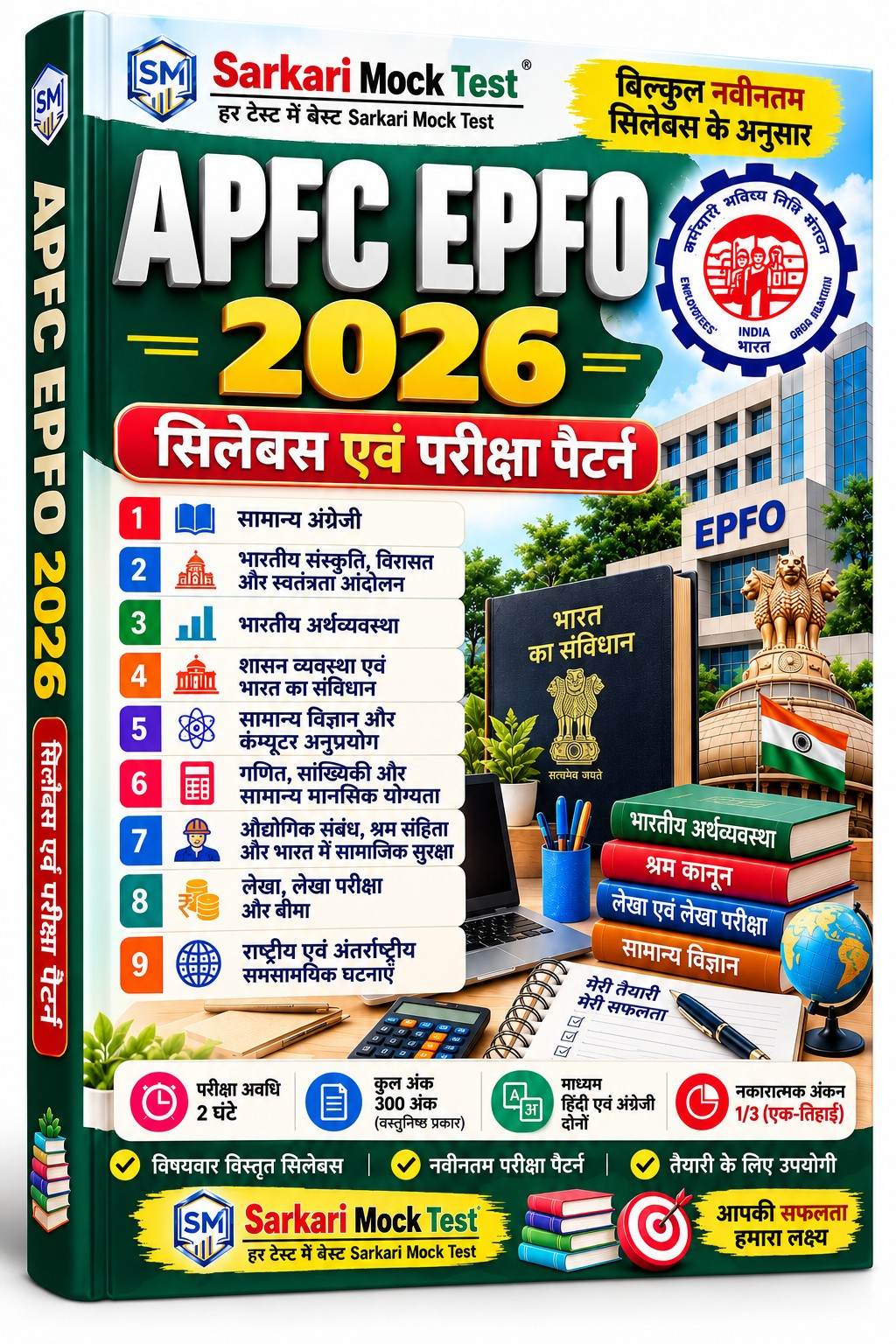
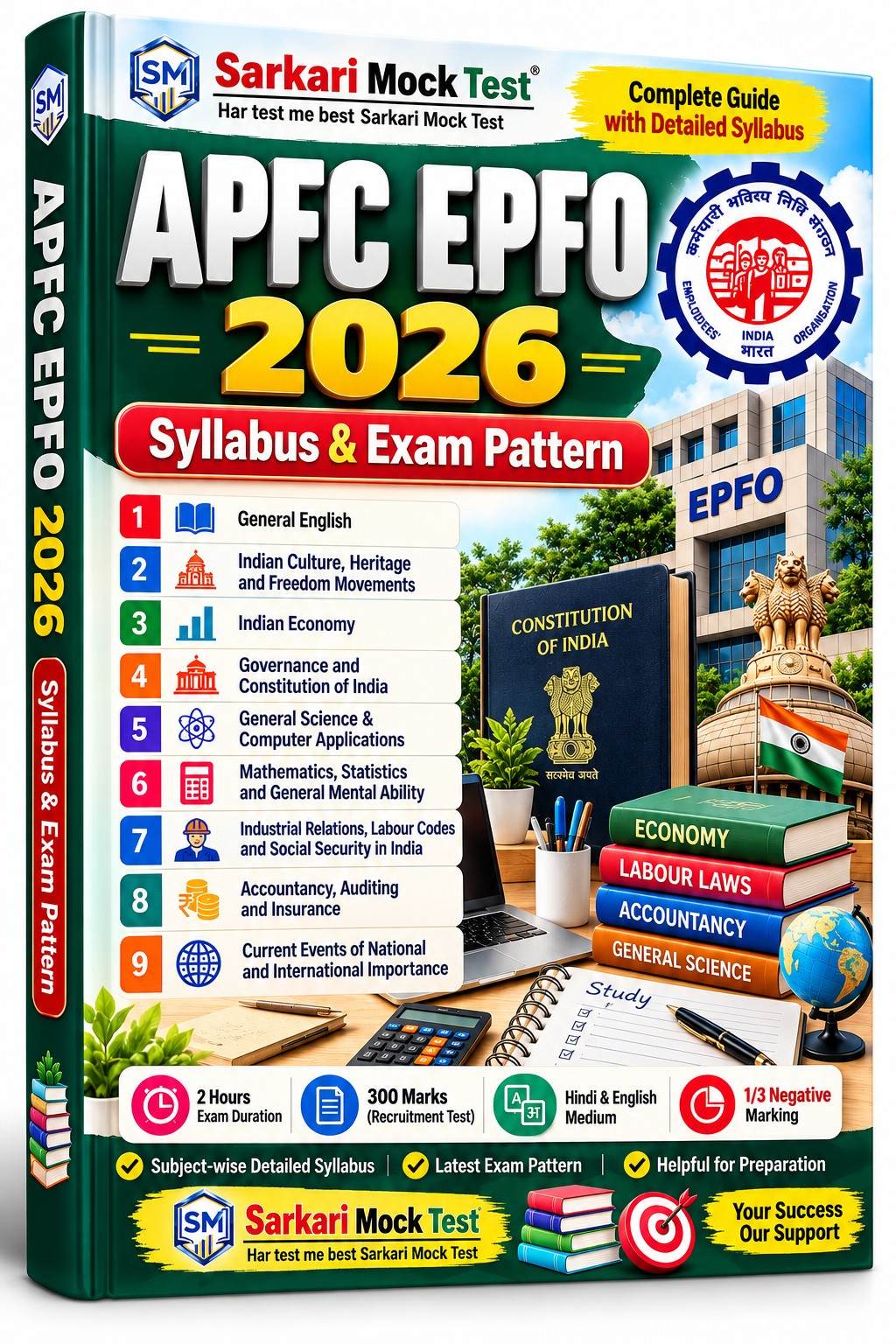
| Total Time Given | 2 Hours. This is exactly 120 minutes. You must be fast. |
| Total Marks | The total paper is worth 300 Marks. |
| Language of the Test | The paper is printed in both Hindi and English. (Except the English grammar part). |
How are the Final Marks Calculated? (Weightage)
When the final result comes, how do they decide who gets the job? They use a rule called the 75:25 ratio. This means they take 75 percent (a very big part) of the marks from your written test. And they take 25 percent (a small part) of the marks from your Interview. This tells us one big secret: The written test is very, very important. If you score very high in the written test, your chances of getting the job are very high!
3. The Complete UPSC EPFO Syllabus (What Do You Need to Study?)
Syllabus means the list of subjects and topics you must read from your books before going to the exam. If you study outside the syllabus, you waste your time. If you study only what is in the syllabus, you will do great. Because there are two jobs (EO/AO and APFC), we will look at the syllabus for both separately.
Part A: Syllabus for EO/AO (Enforcement Officer / Accounts Officer)
For the EO/AO job, you have to study 9 main subjects. Do not be scared by the names. They are very basic and easy if you read them daily. Here is the simple explanation of each subject:
- 1. General English: You must know basic English. They will ask you to find mistakes in sentences. They will ask for synonyms (words that mean the same) and antonyms (words that mean the opposite). If you can read a class 10 English book easily, you can pass this part.
- 2. Indian Freedom Struggle: This is a history subject. You have to read about how India became free from British rule. You will study about Mahatma Gandhi, Bhagat Singh, Subhas Chandra Bose, and big events like the Revolt of 1857. You do not have to read ancient history (like kings and old empires). Just read modern history.
- 3. Current Events and Developmental Issues: This means you should know what is happening in India and the world today. Are there new trains? Did India win a big sports cup? Did the Prime Minister start a new scheme for poor people? If you read a newspaper daily, this is easy.
- 4. Indian Polity & Economy: Polity means the rules of our country. You will learn about our Constitution, the President, the Prime Minister, and the Supreme Court. Economy means money. You will learn about the Reserve Bank of India (RBI), taxes, and how the country makes money.
- 5. General Accounting Principles: This is about keeping records of money. If you have a shop, you write down what you buy and sell. Companies do this too. You will learn basic rules like what is debit, what is credit, and what is a balance sheet. You do not need to be a math expert for this. It is just basic rules.
- 6. Industrial Relations & Labour Laws: This is a special subject for this exam. Since EPFO works for factory and company workers, you must know the rules for workers. How many hours should a worker work? What happens if they get hurt? What are Trade Unions (groups of workers)? You will study the simple laws made by the government to protect workers.
- 7. General Science & Knowledge of Computer Applications: General Science is what you read in class 8, 9, and 10. Simple physics (like light and sound), simple chemistry (like water and air), and simple biology (like vitamins and diseases). Computer knowledge means you must know what a mouse, keyboard, MS Word, and Internet are.
- 8. General Mental Ability & Quantitative Aptitude: This is Mathematics and Reasoning. You will solve simple math problems like adding, percentage, profit and loss (buying and selling), and time and distance (like how fast a train is going). Reasoning means puzzle-solving, like finding the next number in a line.
- 9. Social Security in India: Social security means how the government helps people when they are old, sick, or have no job. You will learn about pension plans, health insurance, and provident fund schemes.
Part B: Syllabus for APFC (Assistant Public Provident Commissioner)
The APFC is a bigger officer. Because the post is bigger, the exam has a few extra subjects. But the good news is: the APFC syllabus contains EVERYTHING that is in the EO/AO syllabus. So, if you study for APFC, you are also ready for EO/AO! Let us see what extra things you need to study for APFC:
Extra Subjects for APFC:
- 1. Population, Development, and Globalization: You will read about the number of people living in India (Population). You will read about how the country is building new roads and cities (Development). Globalization means how India buys and sells things with other countries like America or Japan.
- 2. Governance and Constitution of India: This is like Polity, but a little deeper. You will read about how the government runs daily and the important rights given to the people by the Constitution book.
- 3. Present Trends in Indian Economy: You will study what is happening to money in India right now. Are prices going up? Is agriculture doing well?
- 4. Auditing & Insurance: Auditing means checking the accounts to see if anyone is stealing money. Insurance means protecting things (like life insurance or car insurance). You will learn the basic rules of these two things.
4. How to Prepare? (A Simple Step-by-Step Study Plan)
Now that you know the UPSC EPFO Syllabus & Exam Pattern, you might ask, "How do I start studying? I am confused!" Do not worry. We have made a very easy plan for you. Follow these simple steps, just like climbing stairs:
Step 1: Print the Syllabus
Take a piece of paper. Write down all the subjects we talked about above. Stick this paper on the wall near your study table. Every time you finish reading a topic, put a big tick mark (✓) next to it. This will make you feel very happy and proud.
Step 2: Read NCERT School Books
Do not buy big, thick, scary books first. First, find NCERT books of class 8, 9, 10, 11, and 12. These are school books. The language is very simple. Read the History, Science, and Polity NCERT books. They will make your base very strong. It is like building a strong foundation for a house.
Step 3: Read a Newspaper Daily
For Current Events, you must know what is happening in the world. Ask your newspaper man to give you an English newspaper like 'The Hindu' or 'The Indian Express'. Read it every morning for 45 minutes. Read the main news, not the movie gossip. Write down new things in a notebook.
Step 4: Watch Free Online Videos for Hard Topics
Subjects like 'Accounting' and 'Labour Laws' are new for many students. Do not cry if you do not understand them from a book. Go to the internet (like YouTube) and search for "Basic Accounting for beginners". Teachers explain with pictures, and it becomes very easy to learn.
Step 5: Solve Old Question Papers
UPSC has taken this exam before. Find the old question papers. Look at them. Try to see what kind of questions they ask. Are they asking direct questions or tricky questions? This will make you smart.
Step 6: Practice with Mock Tests on Sarkari Mock Test
A mock test is a fake exam. It is practice. When you have read half of your books, you must give a practice test. Set an alarm clock for 2 hours. Sit quietly in a room and solve a paper. You can visit sarkarimocktest.com to get the best practice papers. Practicing will help you manage your time so you do not leave any questions on the real exam day.
5. Which Books Should You Buy? (A Simple Book List)
Buying too many books is a bad idea. You will get scared looking at a mountain of books. Buy only one good book for one subject. Read that one book five times. That is better than reading five books one time. Here is a simple list of famous books that students use:
| Name of the Subject | Name of the Best Book to Buy | Why is it good? |
|---|---|---|
| Indian Freedom Struggle (History) | A Brief History of Modern India by Spectrum | It is a small, thick book. The story is told like a nice movie. Very easy to understand. |
| Indian Polity | Indian Polity by M. Laxmikanth | Everyone says this is the best book for rules and constitution. Everything is in points. |
| Maths & Reasoning | Quantitative Aptitude by R.S. Aggarwal | It has thousands of simple questions for practice. Very famous book. |
| General English | Objective General English by S.P. Bakshi | It teaches grammar rules simply and gives exercises to practice. |
| Labour Laws & Accounting | Any EPFO Guide by Disha Publications or Arihant | Because these are small topics, one guide book will give you all the basic notes you need. |
6. Tips for the Final Exam Day (What to do in the Exam Hall)
You have studied for many months. Now the big exam day has come. Your heart is beating fast. What should you do? Read these simple tips:
- Sleep Well: Before the exam day, sleep for 8 hours. If your brain is tired, you will forget what you studied. Do not stay awake all night reading.
- Take Your Admit Card: Put your admit card, black pen, and ID card in your bag at night. Do not search for them in the morning.
- Read Questions Slowly: Sometimes, the question says "Which of these is NOT correct?" In a hurry, students miss the word "NOT" and mark the wrong answer. Read each word like you are reading a storybook.
- Do Easy Questions First: The exam paper has 120 questions. Some are very easy, some are very hard. If you see a hard question, do not waste 5 minutes on it. Skip it. Move to the next one. Find all the easy questions and do them first. Come back to the hard ones later.
- Do not guess blindly: Remember the negative marking! If you play a guessing game, your correct marks will be eaten up by the wrong marks. Only answer if you are at least 50% sure.
7. Life After Passing the Exam (Your New Job)
Let us talk about happy things! What happens when you pass this hard test? You become an Officer in the Government of India. You will get a nice office, a computer, and a very good salary every month. Your duty will be to make sure that factories and big companies are treating their workers nicely. You will check if the companies are putting money in the worker's provident fund (PF) account.
As an APFC officer, you will have even more power. You will make big decisions. Your parents will be very proud of you. People in your town will respect you. This happy dream should give you the energy to study every single day!
8. Frequently Asked Questions (FAQs)
Students always have many questions in their minds. Here, we answer the most common questions in simple English:
Q1. Is there an interview in the UPSC EPFO exam?
Answer: Yes. The exam has two parts. First, you take the written paper with multiple-choice questions. If you pass that, you will be called for an interview.
Q2. Do I need to be a commerce student to pass Accounting?
Answer: No, absolutely not! You can be from an Arts, Science, or Engineering background. The accounting asked in this exam is very basic. Anyone can learn it by reading simple books or watching videos for a few weeks.
Q3. What is the age limit for this exam?
Answer: Generally, for the EO/AO post, the maximum age limit is 30 years. For the APFC post, the maximum age limit is 35 years. (Note: People from reserved categories like OBC, SC, ST get extra years to apply. Always check the official notification for exact details).
Q4. Can final-year college students apply?
Answer: Usually, you need to have your final degree in your hand on the last day of filling the online application form. So, check if your college results are out before you apply.
Q5. Is the exam paper available in Hindi?
Answer: Yes. The question paper is printed in both English and Hindi. But the "General English" section will only be in English, of course!
Q6. How much time is needed to prepare?
Answer: If you study honestly for 5 to 6 hours every day, you can finish the full syllabus and practice mock tests in about 5 to 6 months.
Q7. Where can I give practice mock tests?
Answer: You can visit our website, sarkarimocktest.com. We have created very good practice papers based on the latest syllabus. Solving them will make you perfect.
9. Conclusion (Final Words of Motivation)
We have reached the end of this big guide. We hope you now understand the UPSC EPFO Syllabus & Exam Pattern clearly. Do not let big words scare you. Every big journey begins with a small step. Your first step is to learn the syllabus. Your second step is to buy the books. Your third step is to sit at your table and start reading.
Sometimes you will feel tired. Sometimes you will feel like giving up. When that happens, remember why you started. Think about the respect and the great life waiting for you. Drink some water, take a deep breath, and start studying again.
Keep visiting Sarkarimocktest.com for more simple guides, notes, and the best practice tests. We are always here to help you win. Best of luck with your studies! Go and make your dreams come true!